

ISO 4619:2018
(Main)Driers for paints and varnishes
General Information
- Abstract
This document specifies the requirements and the corresponding test methods for driers for paints, varnishes and related products. It applies to driers in the solid or liquid form. It does not apply to emulsifiable driers.
- Status
- Published
- Publication Date
- 06-Nov-2018
- Technical Committee
- ISO/TC 35 - Paints and varnishes
- Drafting Committee
- ISO/TC 35/WG 4 - Binders for paints and varnishes
- Current Stage
- 9093 - International Standard confirmed
- Start Date
- 05-Jul-2024
- Completion Date
- 29-Aug-2026
Buy Documents
ISO 4619:2018 - Driers for paints and varnishes
ISO 4619:2018 - Driers for paints and varnishes/7/2018
ISO 4619:2018 - Siccatifs pour peintures et vernis
ISO 4619:2018 - Siccatifs pour peintures et vernis/7/2018
Overview
ISO 4619:2018 - Driers for paints and varnishes specifies requirements and corresponding test methods for driers (also called siccatifs) used in paints, varnishes and related products. It applies to driers supplied in solid or liquid form and explicitly excludes emulsifiable driers. The 2018 third edition updates test details and removes the previous lead determination; it is intended for use by manufacturers, laboratories and specifiers involved in coating formulation and quality control.
Key topics and technical requirements
ISO 4619 covers both descriptive and analytical requirements, including:
- Types: Definitions and descriptions of solid driers (hard, soft, powder) and liquid driers (solutions in organic solvents, e.g., white spirit).
- Composition: Typical metals used (cobalt, manganese, zinc, calcium, cerium/rare earths, iron, zirconium, vanadium, barium, aluminium, strontium, etc.) and common acids (fatty acids, tall-oil, resinic, naphthenic, 2‑ethylhexanoic and related acids).
- Safety note: Emphasis on handling risks - particularly heavy‑metal hazards - and that tests are to be performed by qualified personnel.
- Physical and chemical tests for solid and liquid driers, such as:
- Appearance and consistency
- Colour
- Solubility/miscibility in solvents or drying media
- Stability of solution
- Suspended solid matter
- Volatile matter
- Acidity (including ion‑exchange based titration procedures)
- Viscosity (for liquid driers)
- Metal content determination:
- Methods for single-metal driers (EDTA titrations for cobalt, manganese, zinc, calcium, zirconium; iodometric for iron; gravimetric/acidimetric for barium)
- Methods for mixed-metal driers
- Sampling and test report requirements to ensure traceability and consistency.
Practical applications and users
Who uses ISO 4619:
- Coatings manufacturers and raw‑material suppliers - for product specification and release testing.
- QC/analytical laboratories - to verify physical properties, metal content and conformity.
- Formulation chemists - to select appropriate driers based on metal type and compatibility.
- Procurement and regulatory teams - to specify acceptance criteria and document compliance.
Practical uses:
- Routine quality control of paint driers
- Verification of metal content and purity in siccatives
- Acceptance testing for incoming materials and supplier audits
- Supporting safety assessments for heavy‑metal content in coatings
Related standards
ISO 4619 references and aligns with other ISO documents, including:
- ISO 150 (linseed oil)
- ISO 1523, ISO 2592 (flash/fire point)
- ISO 2811-1 (density)
- ISO 3251 (non-volatile matter)
- ISO 3696 (laboratory water)
- ISO 4618 (terms and definitions)
- ISO 15528 (sampling)
Keywords: ISO 4619, driers for paints and varnishes, paint driers, test methods, metal content, solid driers, liquid driers, quality control.
Relations
- Effective Date
- 12-Feb-2026
- Consolidates
ISO 17989-1:2015 - Tractors and machinery for agriculture and forestry — Sustainability — Part 1: Principles - Effective Date
- 06-Jun-2022
- Consolidated By
ISO 3657:2020 - Animal and vegetable fats and oils — Determination of saponification value - Effective Date
- 06-Jun-2022
- Effective Date
- 04-Nov-2015
Buy Documents
ISO 4619:2018 - Driers for paints and varnishes
ISO 4619:2018 - Driers for paints and varnishes/7/2018
ISO 4619:2018 - Siccatifs pour peintures et vernis
ISO 4619:2018 - Siccatifs pour peintures et vernis/7/2018
Frequently Asked Questions
ISO 4619:2018 is a standard published by the International Organization for Standardization (ISO). Its full title is "Driers for paints and varnishes". This standard covers: This document specifies the requirements and the corresponding test methods for driers for paints, varnishes and related products. It applies to driers in the solid or liquid form. It does not apply to emulsifiable driers.
This document specifies the requirements and the corresponding test methods for driers for paints, varnishes and related products. It applies to driers in the solid or liquid form. It does not apply to emulsifiable driers.
ISO 4619:2018 is classified under the following ICS (International Classification for Standards) categories: 87.060.99 - Other paint ingredients. The ICS classification helps identify the subject area and facilitates finding related standards.
ISO 4619:2018 has the following relationships with other standards: It is inter standard links to EN ISO 4619:2018, ISO 17989-1:2015, ISO 3657:2020, ISO 4619:1998. Understanding these relationships helps ensure you are using the most current and applicable version of the standard.
ISO 4619:2018 is available in PDF format for immediate download after purchase. The document can be added to your cart and obtained through the secure checkout process. Digital delivery ensures instant access to the complete standard document.
Standards Content (Sample)
INTERNATIONAL ISO
STANDARD 4619
Third edition
2018-11
Driers for paints and varnishes
Siccatifs pour peintures et vernis
Reference number
©
ISO 2018
© ISO 2018
All rights reserved. Unless otherwise specified, or required in the context of its implementation, no part of this publication may
be reproduced or utilized otherwise in any form or by any means, electronic or mechanical, including photocopying, or posting
on the internet or an intranet, without prior written permission. Permission can be requested from either ISO at the address
below or ISO’s member body in the country of the requester.
ISO copyright office
CP 401 • Ch. de Blandonnet 8
CH-1214 Vernier, Geneva
Phone: +41 22 749 01 11
Fax: +41 22 749 09 47
Email: copyright@iso.org
Website: www.iso.org
Published in Switzerland
ii © ISO 2018 – All rights reserved
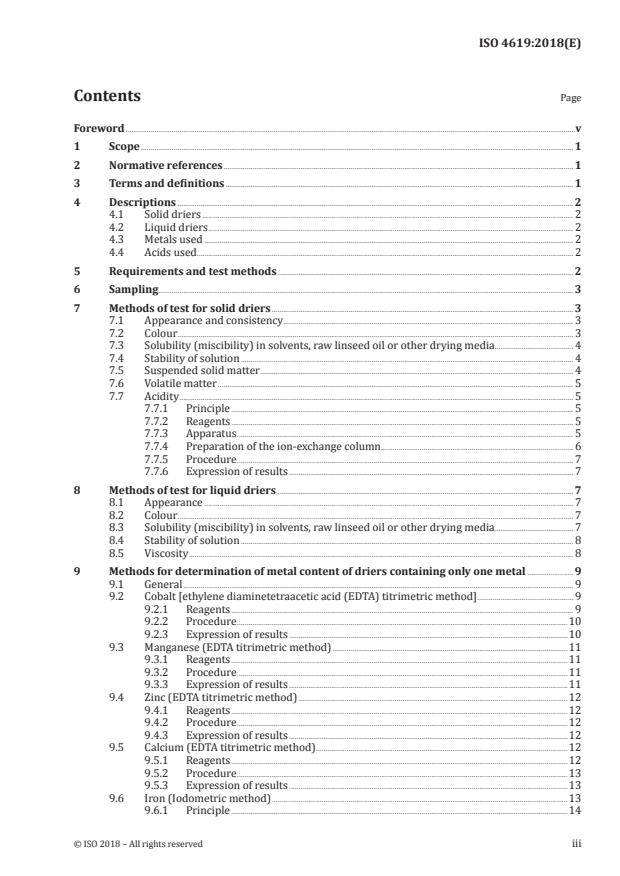
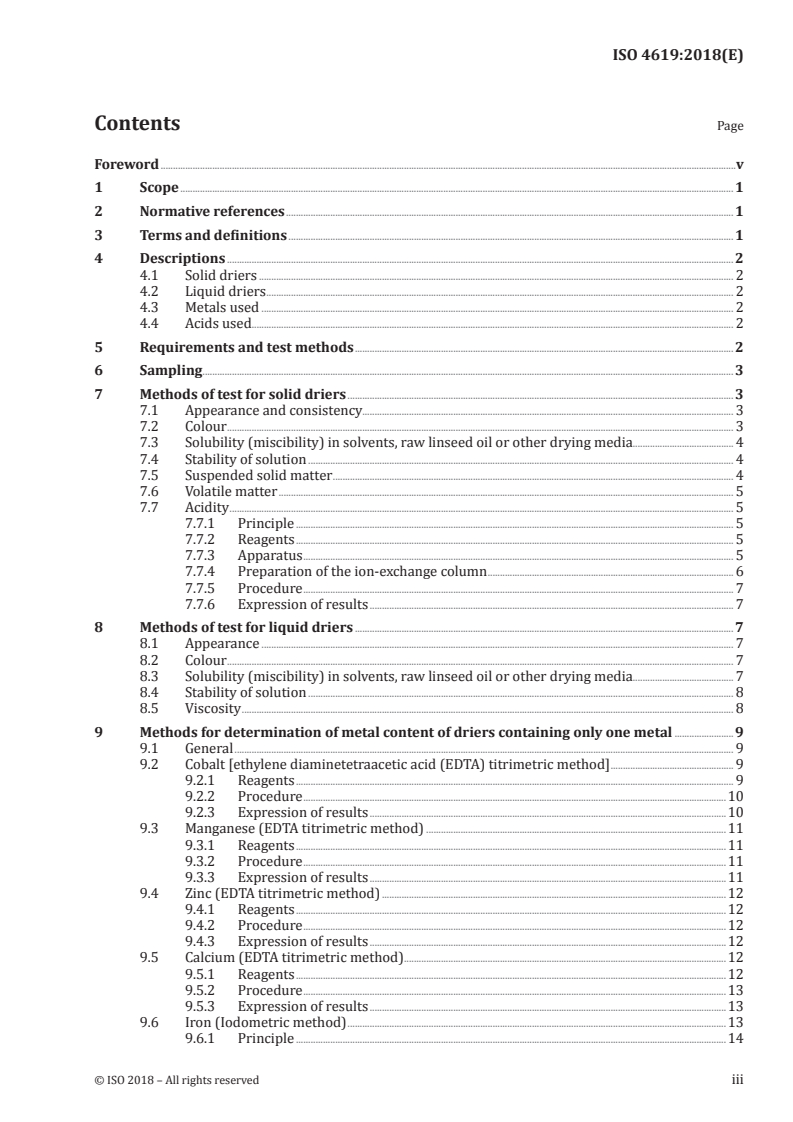
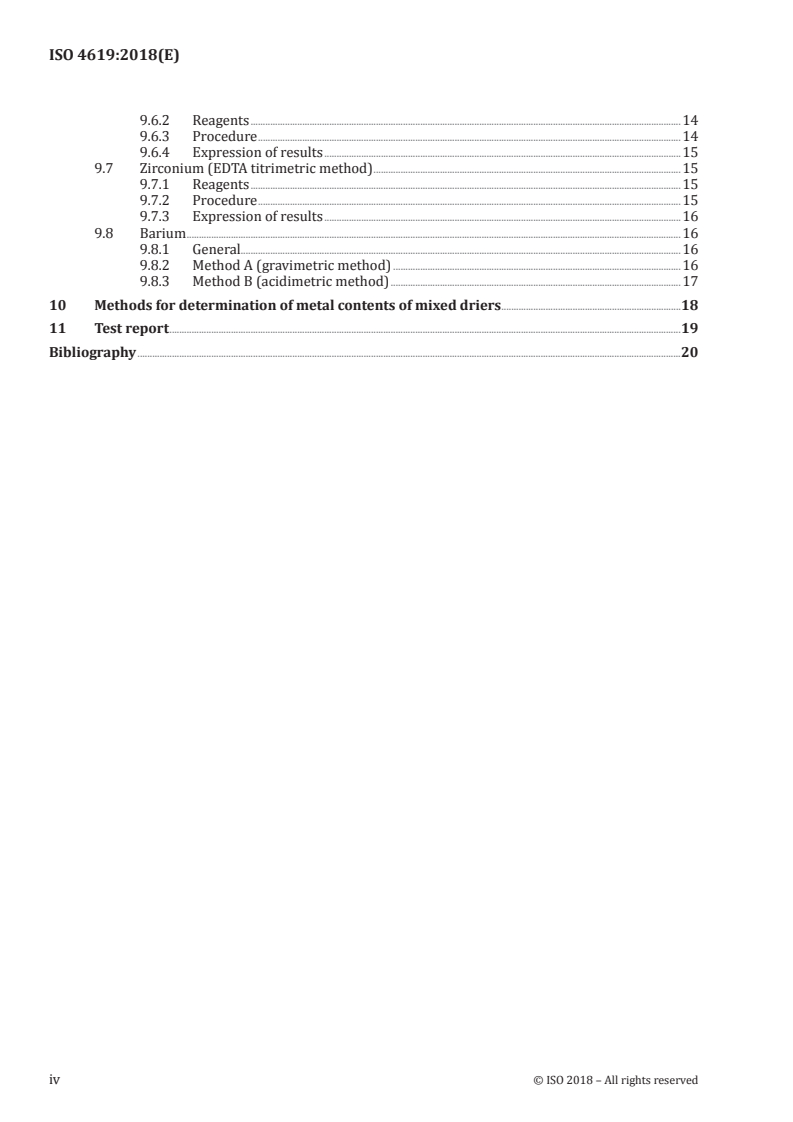
Contents Page
Foreword .v
1 Scope . 1
2 Normative references . 1
3 Terms and definitions . 1
4 Descriptions . 2
4.1 Solid driers . 2
4.2 Liquid driers . 2
4.3 Metals used . 2
4.4 Acids used. 2
5 Requirements and test methods . 2
6 Sampling . 3
7 Methods of test for solid driers . 3
7.1 Appearance and consistency. 3
7.2 Colour . 3
7.3 Solubility (miscibility) in solvents, raw linseed oil or other drying media. 4
7.4 Stability of solution . 4
7.5 Suspended solid matter . 4
7.6 Volatile matter . 5
7.7 Acidity . 5
7.7.1 Principle . 5
7.7.2 Reagents . 5
7.7.3 Apparatus . 5
7.7.4 Preparation of the ion-exchange column . 6
7.7.5 Procedure . 7
7.7.6 Expression of results . 7
8 Methods of test for liquid driers . 7
8.1 Appearance . 7
8.2 Colour . 7
8.3 Solubility (miscibility) in solvents, raw linseed oil or other drying media. 7
8.4 Stability of solution . 8
8.5 Viscosity . 8
9 Methods for determination of metal content of driers containing only one metal .9
9.1 General . 9
9.2 Cobalt [ethylene diaminetetraacetic acid (EDTA) titrimetric method] . 9
9.2.1 Reagents . 9
9.2.2 Procedure .10
9.2.3 Expression of results .10
9.3 Manganese (EDTA titrimetric method) .11
9.3.1 Reagents .11
9.3.2 Procedure .11
9.3.3 Expression of results .11
9.4 Zinc (EDTA titrimetric method) .12
9.4.1 Reagents .12
9.4.2 Procedure .12
9.4.3 Expression of results .12
9.5 Calcium (EDTA titrimetric method) .12
9.5.1 Reagents .12
9.5.2 Procedure .13
9.5.3 Expression of results .13
9.6 Iron (Iodometric method) .13
9.6.1 Principle .14
9.6.2 Reagents .14
9.6.3 Procedure .14
9.6.4 Expression of results .15
9.7 Zirconium (EDTA titrimetric method) .15
9.7.1 Reagents .15
9.7.2 Procedure .15
9.7.3 Expression of results .16
9.8 Barium .16
9.8.1 General.16
9.8.2 Method A (gravimetric method) .16
9.8.3 Method B (acidimetric method) .17
10 Methods for determination of metal contents of mixed driers .18
11 Test report .19
Bibliography .20
iv © ISO 2018 – All rights reserved
Foreword
ISO (the International Organization for Standardization) is a worldwide federation of national standards
bodies (ISO member bodies). The work of preparing International Standards is normally carried out
through ISO technical committees. Each member body interested in a subject for which a technical
committee has been established has the right to be represented on that committee. International
organizations, governmental and non-governmental, in liaison with ISO, also take part in the work.
ISO collaborates closely with the International Electrotechnical Commission (IEC) on all matters of
electrotechnical standardization.
The procedures used to develop this document and those intended for its further maintenance are
described in the ISO/IEC Directives, Part 1. In particular, the different approval criteria needed for the
different types of ISO documents should be noted. This document was drafted in accordance with the
editorial rules of the ISO/IEC Directives, Part 2 (see www .iso .org/directives).
Attention is drawn to the possibility that some of the elements of this document may be the subject of
patent rights. ISO shall not be held responsible for identifying any or all such patent rights. Details of
any patent rights identified during the development of the document will be in the Introduction and/or
on the ISO list of patent declarations received (see www .iso .org/patents).
Any trade name used in this document is information given for the convenience of users and does not
constitute an endorsement.
For an explanation of the voluntary nature of standards, the meaning of ISO specific terms and
expressions related to conformity assessment, as well as information about ISO's adherence to the
World Trade Organization (WTO) principles in the Technical Barriers to Trade (TBT) see www .iso
.org/iso/foreword .html.
This document was prepared by Technical Committee ISO/TC 35, Paints and varnishes.
This third edition cancels and replaces the second edition (ISO 4619:1998), which has been technically
revised. The main changes compared to the previous edition are as follows:
— the concentration of phenolphthalein indicator solution in 7.7.2.6 has been reduced to 0,5 % following
actual requirements;
— the determination of lead has been deleted;
— the normative references have been updated;
— the text has been editorially revised.
Any feedback or questions on this document should be directed to the user’s national standards body. A
complete listing of these bodies can be found at www .iso .org/members .html.
INTERNATIONAL STANDARD ISO 4619:2018(E)
Driers for paints and varnishes
CAUTION — The procedures described in this document are intended to be carried out by
qualified chemist or by other suitably trained and/or supervised personnel. The substances and
procedures used in this document can be injurious to health if adequate precautions are not
taken. It is the responsibility of the user of this document to establish appropriate health and
safety practices prior to its use.
Attention is particularly drawn to the health hazards of heavy metals which might be a
constituent of driers (e.g. cobalt, cerium, zirconium, vanadium).
1 Scope
This document specifies the requirements and the corresponding test methods for driers for paints,
varnishes and related products. It applies to driers in the solid or liquid form. It does not apply to
emulsifiable driers.
2 Normative references
The following documents are referred to in the text in such a way that some or all of their content
constitutes requirements of this document. For dated references, only the edition cited applies. For
undated references, the latest edition of the referenced document (including any amendments) applies.
ISO 150, Raw, refined and boiled linseed oil for paints and varnishes — Specifications and methods of test
ISO 1523, Determination of flash point — Closed cup equilibrium method
ISO 2592, Petroleum and related products — Determination of flash and fire points — Cleveland open
cup method
ISO 2811-1, Paints and varnishes — Determination of density — Part 1: Pycnometer method
ISO 3251, Paints, varnishes and plastics — Determination of non-volatile-matter content
ISO 3696, Water for analytical laboratory use — Specification and test methods
ISO 4618, Paints and varnishes — Terms and definitions
ISO 15528, Paints, varnishes and raw materials for paints and varnishes — Sampling
3 Terms and definitions
For the purposes of this document, the terms and definitions given in ISO 4618 and the following apply.
ISO and IEC maintain terminological databases for use in standardization at the following addresses:
— ISO Online browsing platform: available at https: //www .iso .org/obp
— IEC Electropedia: available at http: //www .electropedia .org/
3.1
drier
compound, usually a metallic soap, that is added to products drying by oxidation in order to accelerate
this process
4 Descriptions
4.1 Solid driers
Solid driers are materials which can be manufactured in a hard, soft (highly viscous) or powder form.
4.2 Liquid driers
Liquid driers are materials which are supplied as solutions in organic solvents, usually white spirit.
All these types of driers, when dissolved in solvents (normally hydrocarbons), impart specific drying
properties depending on the metal used.
4.3 Metals used
The following metals are normally used: cobalt, manganese, zinc, calcium, cerium (or other rare earths),
iron, zirconium, vanadium, barium, aluminium, strontium, etc.
NOTE In this document, methods for determination of metal content are given only for those metals which
are in common use.
4.4 Acids used
The following acids are used: fatty acids of linseed oils, tall-oil fatty acids, resinic acids, naphthenic
acids, 2-ethylhexanoic acid, fatty iso-acids with 9 carbon atoms, other fatty acids with 9 to 11 carbon
atoms, etc.
5 Requirements and test methods
5.1 Driers for paints shall conform to the requirements given in Table 1.
Table 1 — Requirements and test methods
Test method
Characteristic Requirement
Solid driers Liquid driers
Clear and uniform;
Appearance no suspended matter 7.1 8.1
or sediment
As agreed between To be agreed
Consistency, if required the interested parties between the —
interested parties
As agreed between
Colour 7.2 8.2
the interested parties
Solubility (miscibility) in solvent, raw lin- No separation or
7.3 8.3
seed oil and other drying media deposit
Clear solution; no
Stability of solution clouding, gelation or 7.4 8.4
sedimentation
of liquid driers
max. 0,1 — 7.5
Suspended solid % (mass fraction)
matter
As agreed between
of solid driers 7.5 —
the interested parties
a
Tolerance (absolute value) on the metal content declared or agreed.
2 © ISO 2018 – All rights reserved
Table 1 (continued)
Test method
Characteristic Requirement
Solid driers Liquid driers
As agreed between
Viscosity, only for liquid driers — 8.5
the interested parties
As agreed between
Volatile matter at 105 °C 7.6 7.6
the interested parties
As agreed between
Flashpoint ISO 2592 ISO 1523
the interested parties
As agreed between To be agreed
Density the interested parties between the ISO 2811-1
interested parties
As agreed between
Acidity or basicity 7.7 7.7
the interested parties
As agreed between To be agreed To be agreed
Drying characteristics the interested parties between the between the
interested parties interested parties
±0,2 % (mass
up to 10 % (mass fraction)
a
fraction)
above 10 % (mass fraction) ±0,3 % (mass
a
to 20 % (mass fraction) fraction)
Metal content
Clause 9 or Clause 10
(range)
above 20 % (mass fraction) ±0,4 % (mass
a
to 30 % (mass fraction) fraction)
±0,5 % (mass
above 30 % (mass fraction)
a
fraction)
a
Tolerance (absolute value) on the metal content declared or agreed.
5.2 Driers named according to the commercial name of the main acid used shall contain at least 90 %
of this acid, except for driers based on naphthenic acids, which shall contain at least 70 % of these acids,
expressed as a percentage of the total mass of acid present.
NOTE The type and content of the acids can be determined by gas-chromatographic (GC) analysis, except in
the case of naphthenic acids.
6 Sampling
Take a representative sample of the drier to be tested, as specified in ISO 15528.
7 Methods of test for solid driers
During the analysis, use only reagents of recognized analytical grade and only water of at least grade 3
purity in accordance with ISO 3696.
7.1 Appearance and consistency
Examine the sample visually for uniformity. If the consistency is specified, a method for its
determination shall be agreed between the interested parties.
7.2 Colour
Dissolve 1 part by mass of the drier in 1 part by mass of white spirit or other agreed solvent and
compare the colour against an agreed sample or colour standard.
7.3 Solubility (miscibility) in solvents, raw linseed oil or other drying media
Slowly heat, raising the temperature at a rate of 1 °C/min, 5 g of the drier and 20 g of an agreed solvent
(or drying medium) under reflux on a sand bath, with stirring, until a homogeneous solution is obtained.
Allow to cool to room temperature and examine the solution for clarity, clouding and any separation or
deposit.
7.4 Stability of solution
Allow 3 portions of the solution obtained by the method specified in 7.3 to stand for 7 days in stoppered
bottles, one at each of the following temperatures:
a) 0 °C;
b) ambient temperature;
c) 50 °C.
After 1 day and again after 7 days, examine the solutions for clarity, clouding sedimentation or gelation.
The bottle used for the test at 50 °C shall be able to withstand the pressure generated.
7.5 Suspended solid matter
Weigh, to the nearest 0,1 g, 5 g of solid drier (or 10 g of liquid drier) into a glass flask and dissolve in
(or dilute with) 100 g of white spirit or an agreed solvent. Stopper the flask, allow to stand at ambient
temperature for 3 days, then filter off the sediment or suspended matter using a glass filter crucible of
porosity P 16 (see ISO 4793). Wash the residue on the filter with the solvent and dry it at 105 °C for 3 h.
Cool to ambient temperature and weigh to the nearest 1 mg.
Calculate the suspended solid matter SSM, as a percentage mass fraction, using Formula (1):
m
SSM=×100 (1)
m
4 © ISO 2018 – All rights reserved
where
m is the mass, in grams, of the test portion;
m is the mass, in grams, of the residue.
7.6 Volatile matter
Proceed in accordance with ISO 3251, taking a flat-bottomed glass of aluminium dish and a test portion
of (1,00 ± 0,02) g. Place the dish with the test portion in the air oven, maintained at (105 ± 2) °C. Leave it
in the oven at this temperature for 3 h.
7.7 Acidity
7.7.1 Principle
A solution of the drier in toluene/propan-2-ol is passed through a strong acid cation exchanger and the
total acid in the eluate is determined. From the total acid determined, the acid combined with the metal
is subtracted.
If a negative value for the acidity is obtained, the drier tested is a basic drier.
The method is suitable for driers containing barium, calcium, cobalt or zinc as metals, but is not
applicable to driers containing cerium, iron, manganese or zirconium as metals.
In such cases, the method shall be agreed between the interested parties.
7.7.2 Reagents
7.7.2.1 Cation exchanger: a strong-acid, ring-sulfonated polystyrene resin (for example, Merck 1,
1)
Dowex 50, Amberlite IR 120) .
7.7.2.2 Propan-2-ol.
7.7.2.3 Toluene.
7.7.2.4 Hydrochloric acid, approximately 5 % (mass fraction) solution.
7.7.2.5 Potassium hydroxide, approximately 0,2 mol/l standard volumetric solution in 96 % (volume
fraction) ethanol.
7.7.2.6 Phenolphthalein, 0,5 % (mass fraction) solution in 96 % (volume fraction) ethanol.
7.7.3 Apparatus
Ordinary laboratory apparatus and glassware, and the following.
7.7.3.1 Suitable ion-exchange column, as shown in Figure 1, for instance.
1) These are examples of suitable products available commercially. This information is given for the convenience
of users of this document and does not constitute an endorsement by ISO of these products.
Dimension in millimetres
Key
1 layer of glass wool
2 ion-exchange resin
3 sintered-glass disc
4 capillary tubing ⌀ 2 mm
Figure 1 — Example of a suitable ion-exchange column
7.7.4 Preparation of the ion-exchange column
Fill the ion-exchange column (7.7.3.1) with a quantity of the swollen ion-exchange resin (7.7.2.1) so that
the height of resin in the column is about 170
...
INTERNATIONAL ISO
STANDARD 4619
Third edition
2018-11
Driers for paints and varnishes
Siccatifs pour peintures et vernis
Reference number
©
ISO 2018
© ISO 2018
All rights reserved. Unless otherwise specified, or required in the context of its implementation, no part of this publication may
be reproduced or utilized otherwise in any form or by any means, electronic or mechanical, including photocopying, or posting
on the internet or an intranet, without prior written permission. Permission can be requested from either ISO at the address
below or ISO’s member body in the country of the requester.
ISO copyright office
CP 401 • Ch. de Blandonnet 8
CH-1214 Vernier, Geneva
Phone: +41 22 749 01 11
Fax: +41 22 749 09 47
Email: copyright@iso.org
Website: www.iso.org
Published in Switzerland
ii © ISO 2018 – All rights reserved
Contents Page
Foreword .v
1 Scope . 1
2 Normative references . 1
3 Terms and definitions . 1
4 Descriptions . 2
4.1 Solid driers . 2
4.2 Liquid driers . 2
4.3 Metals used . 2
4.4 Acids used. 2
5 Requirements and test methods . 2
6 Sampling . 3
7 Methods of test for solid driers . 3
7.1 Appearance and consistency. 3
7.2 Colour . 3
7.3 Solubility (miscibility) in solvents, raw linseed oil or other drying media. 4
7.4 Stability of solution . 4
7.5 Suspended solid matter . 4
7.6 Volatile matter . 5
7.7 Acidity . 5
7.7.1 Principle . 5
7.7.2 Reagents . 5
7.7.3 Apparatus . 5
7.7.4 Preparation of the ion-exchange column . 6
7.7.5 Procedure . 7
7.7.6 Expression of results . 7
8 Methods of test for liquid driers . 7
8.1 Appearance . 7
8.2 Colour . 7
8.3 Solubility (miscibility) in solvents, raw linseed oil or other drying media. 7
8.4 Stability of solution . 8
8.5 Viscosity . 8
9 Methods for determination of metal content of driers containing only one metal .9
9.1 General . 9
9.2 Cobalt [ethylene diaminetetraacetic acid (EDTA) titrimetric method] . 9
9.2.1 Reagents . 9
9.2.2 Procedure .10
9.2.3 Expression of results .10
9.3 Manganese (EDTA titrimetric method) .11
9.3.1 Reagents .11
9.3.2 Procedure .11
9.3.3 Expression of results .11
9.4 Zinc (EDTA titrimetric method) .12
9.4.1 Reagents .12
9.4.2 Procedure .12
9.4.3 Expression of results .12
9.5 Calcium (EDTA titrimetric method) .12
9.5.1 Reagents .12
9.5.2 Procedure .13
9.5.3 Expression of results .13
9.6 Iron (Iodometric method) .13
9.6.1 Principle .14
9.6.2 Reagents .14
9.6.3 Procedure .14
9.6.4 Expression of results .15
9.7 Zirconium (EDTA titrimetric method) .15
9.7.1 Reagents .15
9.7.2 Procedure .15
9.7.3 Expression of results .16
9.8 Barium .16
9.8.1 General.16
9.8.2 Method A (gravimetric method) .16
9.8.3 Method B (acidimetric method) .17
10 Methods for determination of metal contents of mixed driers .18
11 Test report .19
Bibliography .20
iv © ISO 2018 – All rights reserved
Foreword
ISO (the International Organization for Standardization) is a worldwide federation of national standards
bodies (ISO member bodies). The work of preparing International Standards is normally carried out
through ISO technical committees. Each member body interested in a subject for which a technical
committee has been established has the right to be represented on that committee. International
organizations, governmental and non-governmental, in liaison with ISO, also take part in the work.
ISO collaborates closely with the International Electrotechnical Commission (IEC) on all matters of
electrotechnical standardization.
The procedures used to develop this document and those intended for its further maintenance are
described in the ISO/IEC Directives, Part 1. In particular, the different approval criteria needed for the
different types of ISO documents should be noted. This document was drafted in accordance with the
editorial rules of the ISO/IEC Directives, Part 2 (see www .iso .org/directives).
Attention is drawn to the possibility that some of the elements of this document may be the subject of
patent rights. ISO shall not be held responsible for identifying any or all such patent rights. Details of
any patent rights identified during the development of the document will be in the Introduction and/or
on the ISO list of patent declarations received (see www .iso .org/patents).
Any trade name used in this document is information given for the convenience of users and does not
constitute an endorsement.
For an explanation of the voluntary nature of standards, the meaning of ISO specific terms and
expressions related to conformity assessment, as well as information about ISO's adherence to the
World Trade Organization (WTO) principles in the Technical Barriers to Trade (TBT) see www .iso
.org/iso/foreword .html.
This document was prepared by Technical Committee ISO/TC 35, Paints and varnishes.
This third edition cancels and replaces the second edition (ISO 4619:1998), which has been technically
revised. The main changes compared to the previous edition are as follows:
— the concentration of phenolphthalein indicator solution in 7.7.2.6 has been reduced to 0,5 % following
actual requirements;
— the determination of lead has been deleted;
— the normative references have been updated;
— the text has been editorially revised.
Any feedback or questions on this document should be directed to the user’s national standards body. A
complete listing of these bodies can be found at www .iso .org/members .html.
INTERNATIONAL STANDARD ISO 4619:2018(E)
Driers for paints and varnishes
CAUTION — The procedures described in this document are intended to be carried out by
qualified chemist or by other suitably trained and/or supervised personnel. The substances and
procedures used in this document can be injurious to health if adequate precautions are not
taken. It is the responsibility of the user of this document to establish appropriate health and
safety practices prior to its use.
Attention is particularly drawn to the health hazards of heavy metals which might be a
constituent of driers (e.g. cobalt, cerium, zirconium, vanadium).
1 Scope
This document specifies the requirements and the corresponding test methods for driers for paints,
varnishes and related products. It applies to driers in the solid or liquid form. It does not apply to
emulsifiable driers.
2 Normative references
The following documents are referred to in the text in such a way that some or all of their content
constitutes requirements of this document. For dated references, only the edition cited applies. For
undated references, the latest edition of the referenced document (including any amendments) applies.
ISO 150, Raw, refined and boiled linseed oil for paints and varnishes — Specifications and methods of test
ISO 1523, Determination of flash point — Closed cup equilibrium method
ISO 2592, Petroleum and related products — Determination of flash and fire points — Cleveland open
cup method
ISO 2811-1, Paints and varnishes — Determination of density — Part 1: Pycnometer method
ISO 3251, Paints, varnishes and plastics — Determination of non-volatile-matter content
ISO 3696, Water for analytical laboratory use — Specification and test methods
ISO 4618, Paints and varnishes — Terms and definitions
ISO 15528, Paints, varnishes and raw materials for paints and varnishes — Sampling
3 Terms and definitions
For the purposes of this document, the terms and definitions given in ISO 4618 and the following apply.
ISO and IEC maintain terminological databases for use in standardization at the following addresses:
— ISO Online browsing platform: available at https: //www .iso .org/obp
— IEC Electropedia: available at http: //www .electropedia .org/
3.1
drier
compound, usually a metallic soap, that is added to products drying by oxidation in order to accelerate
this process
4 Descriptions
4.1 Solid driers
Solid driers are materials which can be manufactured in a hard, soft (highly viscous) or powder form.
4.2 Liquid driers
Liquid driers are materials which are supplied as solutions in organic solvents, usually white spirit.
All these types of driers, when dissolved in solvents (normally hydrocarbons), impart specific drying
properties depending on the metal used.
4.3 Metals used
The following metals are normally used: cobalt, manganese, zinc, calcium, cerium (or other rare earths),
iron, zirconium, vanadium, barium, aluminium, strontium, etc.
NOTE In this document, methods for determination of metal content are given only for those metals which
are in common use.
4.4 Acids used
The following acids are used: fatty acids of linseed oils, tall-oil fatty acids, resinic acids, naphthenic
acids, 2-ethylhexanoic acid, fatty iso-acids with 9 carbon atoms, other fatty acids with 9 to 11 carbon
atoms, etc.
5 Requirements and test methods
5.1 Driers for paints shall conform to the requirements given in Table 1.
Table 1 — Requirements and test methods
Test method
Characteristic Requirement
Solid driers Liquid driers
Clear and uniform;
Appearance no suspended matter 7.1 8.1
or sediment
As agreed between To be agreed
Consistency, if required the interested parties between the —
interested parties
As agreed between
Colour 7.2 8.2
the interested parties
Solubility (miscibility) in solvent, raw lin- No separation or
7.3 8.3
seed oil and other drying media deposit
Clear solution; no
Stability of solution clouding, gelation or 7.4 8.4
sedimentation
of liquid driers
max. 0,1 — 7.5
Suspended solid % (mass fraction)
matter
As agreed between
of solid driers 7.5 —
the interested parties
a
Tolerance (absolute value) on the metal content declared or agreed.
2 © ISO 2018 – All rights reserved
Table 1 (continued)
Test method
Characteristic Requirement
Solid driers Liquid driers
As agreed between
Viscosity, only for liquid driers — 8.5
the interested parties
As agreed between
Volatile matter at 105 °C 7.6 7.6
the interested parties
As agreed between
Flashpoint ISO 2592 ISO 1523
the interested parties
As agreed between To be agreed
Density the interested parties between the ISO 2811-1
interested parties
As agreed between
Acidity or basicity 7.7 7.7
the interested parties
As agreed between To be agreed To be agreed
Drying characteristics the interested parties between the between the
interested parties interested parties
±0,2 % (mass
up to 10 % (mass fraction)
a
fraction)
above 10 % (mass fraction) ±0,3 % (mass
a
to 20 % (mass fraction) fraction)
Metal content
Clause 9 or Clause 10
(range)
above 20 % (mass fraction) ±0,4 % (mass
a
to 30 % (mass fraction) fraction)
±0,5 % (mass
above 30 % (mass fraction)
a
fraction)
a
Tolerance (absolute value) on the metal content declared or agreed.
5.2 Driers named according to the commercial name of the main acid used shall contain at least 90 %
of this acid, except for driers based on naphthenic acids, which shall contain at least 70 % of these acids,
expressed as a percentage of the total mass of acid present.
NOTE The type and content of the acids can be determined by gas-chromatographic (GC) analysis, except in
the case of naphthenic acids.
6 Sampling
Take a representative sample of the drier to be tested, as specified in ISO 15528.
7 Methods of test for solid driers
During the analysis, use only reagents of recognized analytical grade and only water of at least grade 3
purity in accordance with ISO 3696.
7.1 Appearance and consistency
Examine the sample visually for uniformity. If the consistency is specified, a method for its
determination shall be agreed between the interested parties.
7.2 Colour
Dissolve 1 part by mass of the drier in 1 part by mass of white spirit or other agreed solvent and
compare the colour against an agreed sample or colour standard.
7.3 Solubility (miscibility) in solvents, raw linseed oil or other drying media
Slowly heat, raising the temperature at a rate of 1 °C/min, 5 g of the drier and 20 g of an agreed solvent
(or drying medium) under reflux on a sand bath, with stirring, until a homogeneous solution is obtained.
Allow to cool to room temperature and examine the solution for clarity, clouding and any separation or
deposit.
7.4 Stability of solution
Allow 3 portions of the solution obtained by the method specified in 7.3 to stand for 7 days in stoppered
bottles, one at each of the following temperatures:
a) 0 °C;
b) ambient temperature;
c) 50 °C.
After 1 day and again after 7 days, examine the solutions for clarity, clouding sedimentation or gelation.
The bottle used for the test at 50 °C shall be able to withstand the pressure generated.
7.5 Suspended solid matter
Weigh, to the nearest 0,1 g, 5 g of solid drier (or 10 g of liquid drier) into a glass flask and dissolve in
(or dilute with) 100 g of white spirit or an agreed solvent. Stopper the flask, allow to stand at ambient
temperature for 3 days, then filter off the sediment or suspended matter using a glass filter crucible of
porosity P 16 (see ISO 4793). Wash the residue on the filter with the solvent and dry it at 105 °C for 3 h.
Cool to ambient temperature and weigh to the nearest 1 mg.
Calculate the suspended solid matter SSM, as a percentage mass fraction, using Formula (1):
m
SSM=×100 (1)
m
4 © ISO 2018 – All rights reserved
where
m is the mass, in grams, of the test portion;
m is the mass, in grams, of the residue.
7.6 Volatile matter
Proceed in accordance with ISO 3251, taking a flat-bottomed glass of aluminium dish and a test portion
of (1,00 ± 0,02) g. Place the dish with the test portion in the air oven, maintained at (105 ± 2) °C. Leave it
in the oven at this temperature for 3 h.
7.7 Acidity
7.7.1 Principle
A solution of the drier in toluene/propan-2-ol is passed through a strong acid cation exchanger and the
total acid in the eluate is determined. From the total acid determined, the acid combined with the metal
is subtracted.
If a negative value for the acidity is obtained, the drier tested is a basic drier.
The method is suitable for driers containing barium, calcium, cobalt or zinc as metals, but is not
applicable to driers containing cerium, iron, manganese or zirconium as metals.
In such cases, the method shall be agreed between the interested parties.
7.7.2 Reagents
7.7.2.1 Cation exchanger: a strong-acid, ring-sulfonated polystyrene resin (for example, Merck 1,
1)
Dowex 50, Amberlite IR 120) .
7.7.2.2 Propan-2-ol.
7.7.2.3 Toluene.
7.7.2.4 Hydrochloric acid, approximately 5 % (mass fraction) solution.
7.7.2.5 Potassium hydroxide, approximately 0,2 mol/l standard volumetric solution in 96 % (volume
fraction) ethanol.
7.7.2.6 Phenolphthalein, 0,5 % (mass fraction) solution in 96 % (volume fraction) ethanol.
7.7.3 Apparatus
Ordinary laboratory apparatus and glassware, and the following.
7.7.3.1 Suitable ion-exchange column, as shown in Figure 1, for instance.
1) These are examples of suitable products available commercially. This information is given for the convenience
of users of this document and does not constitute an endorsement by ISO of these products.
Dimension in millimetres
Key
1 layer of glass wool
2 ion-exchange resin
3 sintered-glass disc
4 capillary tubing ⌀ 2 mm
Figure 1 — Example of a suitable ion-exchange column
7.7.4 Preparation of the ion-exchange column
Fill the ion-exchange column (7.7.3.1) with a quantity of the swollen ion-exchange resin (7.7.2.1) so that
the height of resin in the column is about 170
...
NORME ISO
INTERNATIONALE 4619
Troisième édition
2018-11
Siccatifs pour peintures et vernis
Driers for paints and varnishes
Numéro de référence
©
ISO 2018
DOCUMENT PROTÉGÉ PAR COPYRIGHT
© ISO 2018
Tous droits réservés. Sauf prescription différente ou nécessité dans le contexte de sa mise en œuvre, aucune partie de cette
publication ne peut être reproduite ni utilisée sous quelque forme que ce soit et par aucun procédé, électronique ou mécanique,
y compris la photocopie, ou la diffusion sur l’internet ou sur un intranet, sans autorisation écrite préalable. Une autorisation peut
être demandée à l’ISO à l’adresse ci-après ou au comité membre de l’ISO dans le pays du demandeur.
ISO copyright office
Case postale 401 • Ch. de Blandonnet 8
CH-1214 Vernier, Genève
Tél.: +41 22 749 01 11
Fax: +41 22 749 09 47
E-mail: copyright@iso.org
Web: www.iso.org
Publié en Suisse
ii © ISO 2018 – Tous droits réservés
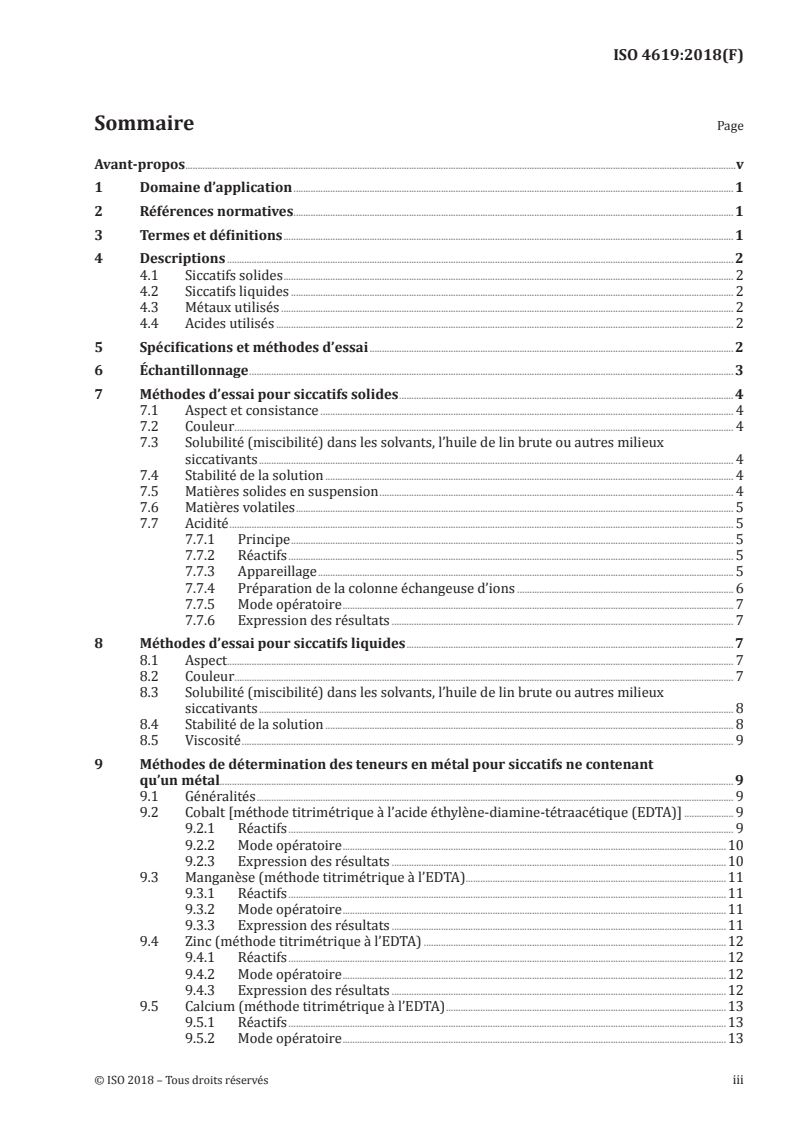
Sommaire Page
Avant-propos .v
1 Domaine d’application . 1
2 Références normatives . 1
3 Termes et définitions . 1
4 Descriptions . 2
4.1 Siccatifs solides . 2
4.2 Siccatifs liquides . 2
4.3 Métaux utilisés . 2
4.4 Acides utilisés . 2
5 Spécifications et méthodes d’essai . 2
6 Échantillonnage . 3
7 Méthodes d’essai pour siccatifs solides . 4
7.1 Aspect et consistance . 4
7.2 Couleur . 4
7.3 Solubilité (miscibilité) dans les solvants, l’huile de lin brute ou autres milieux
siccativants . 4
7.4 Stabilité de la solution . 4
7.5 Matières solides en suspension . 4
7.6 Matières volatiles . 5
7.7 Acidité . 5
7.7.1 Principe . 5
7.7.2 Réactifs . 5
7.7.3 Appareillage . 5
7.7.4 Préparation de la colonne échangeuse d’ions . 6
7.7.5 Mode opératoire . 7
7.7.6 Expression des résultats . 7
8 Méthodes d’essai pour siccatifs liquides . 7
8.1 Aspect . . 7
8.2 Couleur . 7
8.3 Solubilité (miscibilité) dans les solvants, l’huile de lin brute ou autres milieux
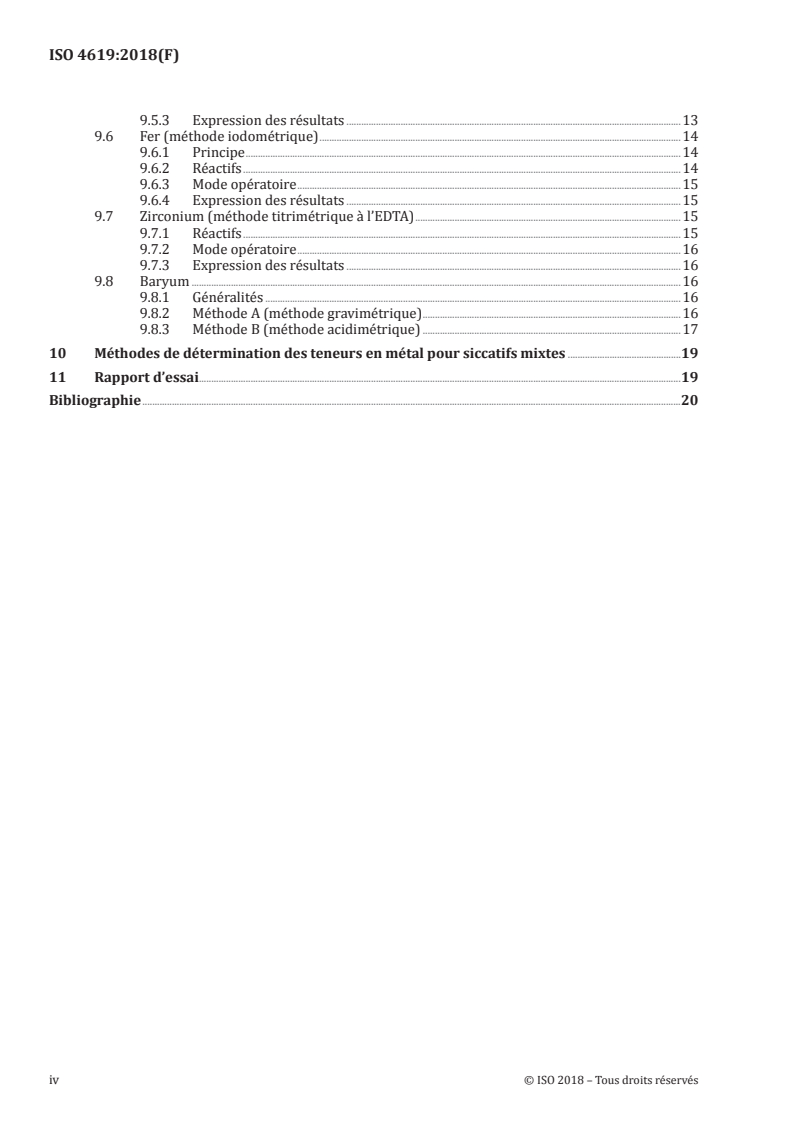
siccativants . 8
8.4 Stabilité de la solution . 8
8.5 Viscosité . 9
9 Méthodes de détermination des teneurs en métal pour siccatifs ne contenant
qu’un métal. 9
9.1 Généralités . 9
9.2 Cobalt [méthode titrimétrique à l’acide éthylène-diamine-tétraacétique (EDTA)] . 9
9.2.1 Réactifs . 9
9.2.2 Mode opératoire .10
9.2.3 Expression des résultats .10
9.3 Manganèse (méthode titrimétrique à l’EDTA) .11
9.3.1 Réactifs .11
9.3.2 Mode opératoire .11
9.3.3 Expression des résultats .11
9.4 Zinc (méthode titrimétrique à l’EDTA) .12
9.4.1 Réactifs .12
9.4.2 Mode opératoire .12
9.4.3 Expression des résultats .12
9.5 Calcium (méthode titrimétrique à l’EDTA) .13
9.5.1 Réactifs .13
9.5.2 Mode opératoire .13
9.5.3 Expression des résultats .13
9.6 Fer (méthode iodométrique) .14
9.6.1 Principe .14
9.6.2 Réactifs .14
9.6.3 Mode opératoire .15
9.6.4 Expression des résultats .15
9.7 Zirconium (méthode titrimétrique à l’EDTA) .15
9.7.1 Réactifs .15
9.7.2 Mode opératoire .16
9.7.3 Expression des résultats .16
9.8 Baryum .16
9.8.1 Généralités .16
9.8.2 Méthode A (méthode gravimétrique) .16
9.8.3 Méthode B (méthode acidimétrique) .17
10 Méthodes de détermination des teneurs en métal pour siccatifs mixtes .19
11 Rapport d’essai .19
Bibliographie .20
iv © ISO 2018 – Tous droits réservés
Avant-propos
L'ISO (Organisation internationale de normalisation) est une fédération mondiale d'organismes
nationaux de normalisation (comités membres de l'ISO). L'élaboration des Normes internationales est
en général confiée aux comités techniques de l'ISO. Chaque comité membre intéressé par une étude
a le droit de faire partie du comité technique créé à cet effet. Les organisations internationales,
gouvernementales et non gouvernementales, en liaison avec l'ISO participent également aux travaux.
L'ISO collabore étroitement avec la Commission électrotechnique internationale (IEC) en ce qui
concerne la normalisation électrotechnique.
Les procédures utilisées pour élaborer le présent document et celles destinées à sa mise à jour sont
décrites dans les Directives ISO/IEC, Partie 1. Il convient, en particulier, de prendre note des différents
critères d'approbation requis pour les différents types de documents ISO. Le présent document a été
rédigé conformément aux règles de rédaction données dans les Directives ISO/IEC, Partie 2 (voir www
.iso .org/directives).
L'attention est attirée sur le fait que certains des éléments du présent document peuvent faire l'objet de
droits de propriété intellectuelle ou de droits analogues. L'ISO ne saurait être tenue pour responsable
de ne pas avoir identifié de tels droits de propriété et averti de leur existence. Les détails concernant
les références aux droits de propriété intellectuelle ou autres droits analogues identifiés lors de
l'élaboration du document sont indiqués dans l'Introduction et/ou dans la liste des déclarations de
brevets reçues par l'ISO (voir www .iso .org/brevets).
Les appellations commerciales éventuellement mentionnées dans le présent document sont données
pour information, par souci de commodité, à l’intention des utilisateurs et ne sauraient constituer un
engagement.
Pour une explication de la nature volontaire des normes, la signification des termes et expressions
spécifiques de l'ISO liés à l'évaluation de la conformité, ou pour toute information au sujet de l'adhésion
de l'ISO aux principes de l’Organisation mondiale du commerce (OMC) concernant les obstacles
techniques au commerce (OTC), voir www .iso .org/avant -propos.
Le présent document a été élaboré par le comité technique ISO/TC 35, Peintures et vernis.
Cette troisième édition annule et remplace la deuxième édition (ISO 4619:1998), qui a fait l’objet d’une
révision technique. Les principales modifications par rapport à l’édition précédente sont les suivantes:
— réduction de la concentration de la solution de phénolphtaléine (servant d’indicateur) spécifiée en
7.7.2.6 à 0,5 % conformément aux spécifications actuelles;
— suppression de la détermination de la teneur en plomb;
— mise à jour des références normatives;
— révision éditoriale du texte.
Il convient que l’utilisateur adresse tout retour d’information ou toute question concernant le présent
document à l’organisme national de normalisation de son pays. Une liste exhaustive desdits organismes
se trouve à l’adresse www .iso .org/fr/members .html.
NORME INTERNATIONALE ISO 4619:2018(F)
Siccatifs pour peintures et vernis
ATTENTION — Les modes opératoires décrits dans le présent document sont destinés à être
effectués par des chimistes qualifiés ou par du personnel convenablement entraîné et/ou
supervisé. Les substances et modes opératoires utilisés dans le présent document peuvent être
nocifs pour la santé si des précautions adéquates ne sont pas prises. Il est de la responsabilité
de l’utilisateur de ce document d’établir les pratiques appropriées en matière de santé et de
sécurité avant son utilisation.
L’attention est attirée en particulier sur les dangers pour la santé que présentent les métaux
lourds susceptibles d’être un constituant des siccatifs (par exemple cobalt, cérium, zirconium,
vanadium).
1 Domaine d’application
Le présent document fixe des spécifications et les méthodes d’essai correspondantes des siccatifs pour
peintures, vernis et produits assimilés. Il s’applique aux siccatifs sous forme solide ou liquide. Il ne
s’applique pas aux siccatifs émulsionnables.
2 Références normatives
Les documents suivants cités dans le texte constituent, pour tout ou partie de leur contenu, des
exigences du présent document. Pour les références datées, seule l’édition citée s’applique. Pour les
références non datées, la dernière édition du document de référence s’applique (y compris les éventuels
amendements).
ISO 150, Huiles de lin brutes, raffinées et cuites, pour peintures et vernis — Spécifications et méthodes d’essai
ISO 1523, Détermination du point d'éclair — Méthode à l'équilibre en vase clos
ISO 2592, Pétrole et produits connexes — Détermination des points d'éclair et de feu — Méthode Cleveland
à vase ouvert
ISO 2811-1, Peintures et vernis — Détermination de la masse volumique — Partie 1: Méthode pycnométrique
ISO 3251, Peintures, vernis et plastiques — Détermination de l’extrait sec
ISO 3696, Eau pour laboratoire à usage analytique — Spécification et méthodes d'essai
ISO 4618, Peintures et vernis — Termes et définitions
ISO 15528, Peintures, vernis et matières premières pour peintures et vernis — Échantillonnage
3 Termes et définitions
Pour les besoins du présent document, les termes et définitions de l’ISO 4618 ainsi que les suivants,
s’appliquent.
L’ISO et l’IEC tiennent à jour des bases de données terminologiques destinées à être utilisées en
normalisation, consultables aux adresses suivantes:
— ISO Online browsing platform: disponible à l’adresse https: //www .iso .org/obp
— IEC Electropedia: disponible à l’adresse http: //www .electropedia .org/
3.1
siccatif
composé, généralement un sel métallique d’un acide organique, qui est additionné aux produits séchant
par oxydation pour accélérer le processus
4 Descriptions
4.1 Siccatifs solides
Les siccatifs solides sont des produits qui peuvent être fabriqués sous forme dure, molle (haute
viscosité) ou pulvérulente.
4.2 Siccatifs liquides
Les siccatifs liquides sont des produits qui sont fournis en solution dans des solvants organiques, en
général le white spirit.
Tous ces types de siccatifs, lorsqu’ils sont dissous dans les solvants (normalement hydrocarbures),
donnent des propriétés de séchage spécifiques dépendant du métal utilisé.
4.3 Métaux utilisés
Les métaux suivants sont habituellement utilisés: cobalt, manganèse, zinc, calcium, cérium (ou autres
terres rares), fer, zirconium, vanadium, baryum, aluminium, strontium, etc.
NOTE Dans le présent document ne sont données des méthodes de détermination de la teneur en métal que
pour ces métaux, lesquels sont généralement utilisés.
4.4 Acides utilisés
Les acides suivants sont utilisés: acides gras d’huile de lin, acides gras d’huile de tall, acides résiniques,
acides naphténiques, acide 2-éthylhexanoïque, acides gras «iso» avec 9 atomes de carbone, autres acides
gras avec 9 à 11 atomes de carbone, etc.
5 Spécifications et méthodes d’essai
5.1 Les siccatifs pour peintures doivent être conformes aux spécifications indiquées dans le Tableau 1.
Tableau 1 — Spécifications et méthodes d’essai
Méthode d’essai
Caractéristique Spécification
Siccatifs solides Siccatifs liquides
Limpide et uniforme;
Aspect pas de matière en suspension 7.1 8.1
ou de sédiment
Doit faire l’objet
Doit faire l’objet d’un accord
Consistance, si requise d’un accord entre —
entre les parties intéressées
les parties intéressées
Doit faire l’objet d’un accord
Couleur 7.2 8.2
entre les parties intéressées
Solubilité (miscibilité) dans
les solvants, l’huile de lin brute Pas de séparation ni de dépôt 7.3 8.3
et autres milieux siccativants
a
Tolérance (en valeur absolue) sur la teneur en métal déclarée ou convenue.
2 © ISO 2018 – Tous droits réservés
Tableau 1 (suite)
Méthode d’essai
Caractéristique Spécification
Siccatifs solides Siccatifs liquides
Solution limpide;
Stabilité de la solution pas de trouble, de gélification 7.4 8.4
ni de sédimentation
des siccatifs liquides
max. 0,1 — 7.5
Matières % (fraction
solides en massique)
suspension
Doit faire l’objet d’un accord
des siccatifs solides 7.5 —
entre les parties intéressées
Viscosité, pour les siccatifs Doit faire l’objet d’un accord
— 8.5
liquides uniquement entre les parties intéressées
Doit faire l’objet d’un accord
Matières volatiles à 105 °C 7.6 7.6
entre les parties intéressées
Doit faire l’objet d’un accord
Point d’éclair ISO 2592 ISO 1523
entre les parties intéressées
Doit faire l’objet
Doit faire l’objet d’un accord
Masse volumique d’un accord entre ISO 2811-1
entre les parties intéressées
les parties intéressées
Doit faire l’objet d’un accord
Acidité ou basicité 7.7 7.7
entre les parties intéressées
Doit faire l’objet
Doit faire l’objet
Doit faire l’objet d’un accord d’un accord entre
Caractéristiques de séchage d’un accord entre
entre les parties intéressées les parties
les parties intéressées
intéressées
jusqu’à 10 %
a
±0,2 % (fraction massique)
(fraction massique)
au-dessus de 10 %
(fraction massique)
a
±0,3 % (fraction massique)
à 20 % (fraction
Teneur
massique)
en métal Article 9 ou Article 10
au-dessus de 20 %
(plage)
(fraction massique)
a
±0,4 % (fraction massique)
à 30 % (fraction
massique)
au-dessus de 30 %
a
±0,5 % (fraction massique)
(fraction massique)
a
Tolérance (en valeur absolue) sur la teneur en métal déclarée ou convenue.
5.2 Les siccatifs dénommés suivant le nom commercial du principal acide utilisé doivent contenir au
moins 90 % de cet acide, à l’exception des siccatifs basés sur les acides naphténiques qui doivent contenir
au moins 70 % de ces acides, exprimés en pourcentage de la masse totale d’acide présent.
NOTE Le type et la teneur en acide peuvent être déterminés par analyse chromatographique en phase
gazeuse (GC), sauf dans le cas des acides naphténiques.
6 Échantillonnage
Prélever un échantillon représentatif du siccatif à soumettre à essai, comme spécifié dans l’ISO 15528.
7 Méthodes d’essai pour siccatifs solides
Au cours des analyses, utiliser uniquement des réactifs de qualité analytique reconnue et de l’eau d’au
moins qualité 3 conformément à l’ISO 3696.
7.1 Aspect et consistance
Examiner visuellement l’uniformité de l’échantillon. Si la consistance est spécifiée, une méthode de
détermination doit faire l’objet d’un accord entre les parties intéressées.
7.2 Couleur
Dissoudre 1 partie en masse du siccatif dans 1 partie en masse de white spirit ou dans tout autre solvant
ayant fait l’objet d’un accord, et comparer la couleur avec celle d’un échantillon ayant fait l’objet d’un
accord ou avec un étalon de couleur de référence.
7.3 Solubilité (miscibilité) dans les solvants, l’huile de lin brute ou autres milieux
siccativants
Chauffer lentement à reflux, en élevant la température à une vitesse de 1 °C/min, 5 g du siccatif et 20 g
d’un solvant (ou d’un milieu siccativant) ayant fait l’objet d’un accord sur un bain de sable, en agitant
jusqu’à ce qu’une solution homogène soit obtenue.
Laisser refroidir la solution à la température ambiante, puis l’examiner vis-à-vis de la clarté, de la
turbidité et de toute séparation ou tout dépôt.
7.4 Stabilité de la solution
Laisser reposer 3 prises d’essai de la solution obtenue selon la méthode spécifiée en 7.3, durant 7 jours,
dans des flacons bouchés, aux températures suivantes:
a) un à 0 °C;
b) un à la température ambiante;
c) un à 50 °C.
Après 1 jour et de nouveau après 7 jours, examiner la clarté, le trouble, la sédimentation ou la gélification
des solutions. Le flacon utilisé pour l’essai à 50 °C doit être capable de résister à la pression produite.
7.5 Matières solides en suspension
Peser, à 0,1 g près, 5 g de siccatif solide (ou 10 g de siccatif liquide) dans une fiole en verre et les dissoudre
dans (ou les diluer avec) 100 g de white spirit ou du solvant ayant fait l’objet d’un accord. Boucher la fiole
et laisser reposer à la température ambiante durant 3 jours, puis filtrer les matières sédimentées ou en
suspension, en utilisant un creuset filtrant à plaque en verre fritté de porosité P 16 (voir ISO 4793).
Laver le résidu sur le filtre avec le solvant et le sécher à 105 °C durant 3 h. Refroidir à la température
ambiante et peser à 1 mg près.
Calculer les matières solides en suspension, MSS, en pourcentage en fraction massique, au moyen de la
Formule (1):
m
SSM=×100 (1)
m
où
4 © ISO 2018 – Tous droits réservés
m est la masse, en grammes, de la prise d’essai;
m est la masse, en grammes, du résidu.
7.6 Matières volatiles
Procéder comme décrit dans l’ISO 3251, en utilisant une capsule à fond plat, en verre ou en aluminium,
et une prise d’essai de (1,00 ± 0,02) g. Placer la capsule avec la prise d’essai dans l’étuve à l’air maintenue
à (105 ± 2) °C. Les laisser dans l’étuve à cette température durant 3 h.
7.7 Acidité
7.7.1 Principe
Une solution du siccatif dans le toluène/propan-2-ol est versée à travers un échangeur de cations
fortement acide, et l’acidité totale dans l’éluat est déterminée. L’acide combiné au métal est retranché de
l’acidité totale déterminée.
Si le résultat obtenu pour l’acidité est une valeur négative, le siccatif soumis à essai est un siccatif
basique.
La méthode convient pour les siccatifs contenant du baryum, du calcium, du cobalt ou du zinc comme
métal. Elle n’est pas applicable aux siccatifs contenant du cérium, du fer, du manganèse ou du zirconium
comme métal.
Dans de tels cas, la méthode doit faire l’objet d’un accord entre les parties intéressées.
7.7.2 Réactifs
7.7.2.1 Échangeur de cations: résine de polystyrène à noyau sulfoné, fortement acide (par exemple,
1)
Merck 1, Dowex 50, Amberlite IR 120) .
7.7.2.2 Propan-2-ol.
7.7.2.3 Toluène.
7.7.2.4 Acide chlorhydrique, solution à 5 % (fraction massique) environ.
7.7.2.5 Hydroxyde de potassium, solution titrée à 0,2 mol/l environ dans de l’éthanol à 96 % (fraction
volumique).
7.7.2.6 Phénolphtaléine, solution à 0,5 % (fraction massique) dans de l’éthanol à 96 % (fraction
volumique).
7.7.3 Appareillage
Verrerie et appareillage courants de laboratoire, et ce qui suit.
7.7.3.1 Colonne échangeuse d’ions convenable, telle que représentée sur la Figure 1, à titre
d’exemple.
1) Il s’agit d’exemples de produits appropriés disponibles sur le marché. Cette information est donnée à l’intention
des utilisateurs du présent document et ne signifie nullement que l’ISO approuve ou recommande l’emploi exclusif
des produits ainsi désignés.
Dimensions en millimètres
Légende
1 couche de laine de verre
2 résine échangeuse d’ions
3 disque en verre fritté
4 tube capillaire ⌀ 2 mm
Figure 1 — Exemple de colonne échangeuse d’ions convenable
7.7.4 Préparation de la colonne échangeuse d’ions
Remplir la colonne échangeuse d’ions (7.7.3.1) avec une quantité de la résine échangeuse d’ions (7.7.2.1)
saturée, telle que la hauteur de résine dans la colonne soit de 170 mm environ. Verser, par petites
fractions, 250 ml de la solution d’acide chl
...
NORME ISO
INTERNATIONALE 4619
Troisième édition
2018-11
Siccatifs pour peintures et vernis
Driers for paints and varnishes
Numéro de référence
©
ISO 2018
DOCUMENT PROTÉGÉ PAR COPYRIGHT
© ISO 2018
Tous droits réservés. Sauf prescription différente ou nécessité dans le contexte de sa mise en œuvre, aucune partie de cette
publication ne peut être reproduite ni utilisée sous quelque forme que ce soit et par aucun procédé, électronique ou mécanique,
y compris la photocopie, ou la diffusion sur l’internet ou sur un intranet, sans autorisation écrite préalable. Une autorisation peut
être demandée à l’ISO à l’adresse ci-après ou au comité membre de l’ISO dans le pays du demandeur.
ISO copyright office
Case postale 401 • Ch. de Blandonnet 8
CH-1214 Vernier, Genève
Tél.: +41 22 749 01 11
Fax: +41 22 749 09 47
E-mail: copyright@iso.org
Web: www.iso.org
Publié en Suisse
ii © ISO 2018 – Tous droits réservés
Sommaire Page
Avant-propos .v
1 Domaine d’application . 1
2 Références normatives . 1
3 Termes et définitions . 1
4 Descriptions . 2
4.1 Siccatifs solides . 2
4.2 Siccatifs liquides . 2
4.3 Métaux utilisés . 2
4.4 Acides utilisés . 2
5 Spécifications et méthodes d’essai . 2
6 Échantillonnage . 3
7 Méthodes d’essai pour siccatifs solides . 4
7.1 Aspect et consistance . 4
7.2 Couleur . 4
7.3 Solubilité (miscibilité) dans les solvants, l’huile de lin brute ou autres milieux
siccativants . 4
7.4 Stabilité de la solution . 4
7.5 Matières solides en suspension . 4
7.6 Matières volatiles . 5
7.7 Acidité . 5
7.7.1 Principe . 5
7.7.2 Réactifs . 5
7.7.3 Appareillage . 5
7.7.4 Préparation de la colonne échangeuse d’ions . 6
7.7.5 Mode opératoire . 7
7.7.6 Expression des résultats . 7
8 Méthodes d’essai pour siccatifs liquides . 7
8.1 Aspect . . 7
8.2 Couleur . 7
8.3 Solubilité (miscibilité) dans les solvants, l’huile de lin brute ou autres milieux
siccativants . 8
8.4 Stabilité de la solution . 8
8.5 Viscosité . 9
9 Méthodes de détermination des teneurs en métal pour siccatifs ne contenant
qu’un métal. 9
9.1 Généralités . 9
9.2 Cobalt [méthode titrimétrique à l’acide éthylène-diamine-tétraacétique (EDTA)] . 9
9.2.1 Réactifs . 9
9.2.2 Mode opératoire .10
9.2.3 Expression des résultats .10
9.3 Manganèse (méthode titrimétrique à l’EDTA) .11
9.3.1 Réactifs .11
9.3.2 Mode opératoire .11
9.3.3 Expression des résultats .11
9.4 Zinc (méthode titrimétrique à l’EDTA) .12
9.4.1 Réactifs .12
9.4.2 Mode opératoire .12
9.4.3 Expression des résultats .12
9.5 Calcium (méthode titrimétrique à l’EDTA) .13
9.5.1 Réactifs .13
9.5.2 Mode opératoire .13
9.5.3 Expression des résultats .13
9.6 Fer (méthode iodométrique) .14
9.6.1 Principe .14
9.6.2 Réactifs .14
9.6.3 Mode opératoire .15
9.6.4 Expression des résultats .15
9.7 Zirconium (méthode titrimétrique à l’EDTA) .15
9.7.1 Réactifs .15
9.7.2 Mode opératoire .16
9.7.3 Expression des résultats .16
9.8 Baryum .16
9.8.1 Généralités .16
9.8.2 Méthode A (méthode gravimétrique) .16
9.8.3 Méthode B (méthode acidimétrique) .17
10 Méthodes de détermination des teneurs en métal pour siccatifs mixtes .19
11 Rapport d’essai .19
Bibliographie .20
iv © ISO 2018 – Tous droits réservés
Avant-propos
L'ISO (Organisation internationale de normalisation) est une fédération mondiale d'organismes
nationaux de normalisation (comités membres de l'ISO). L'élaboration des Normes internationales est
en général confiée aux comités techniques de l'ISO. Chaque comité membre intéressé par une étude
a le droit de faire partie du comité technique créé à cet effet. Les organisations internationales,
gouvernementales et non gouvernementales, en liaison avec l'ISO participent également aux travaux.
L'ISO collabore étroitement avec la Commission électrotechnique internationale (IEC) en ce qui
concerne la normalisation électrotechnique.
Les procédures utilisées pour élaborer le présent document et celles destinées à sa mise à jour sont
décrites dans les Directives ISO/IEC, Partie 1. Il convient, en particulier, de prendre note des différents
critères d'approbation requis pour les différents types de documents ISO. Le présent document a été
rédigé conformément aux règles de rédaction données dans les Directives ISO/IEC, Partie 2 (voir www
.iso .org/directives).
L'attention est attirée sur le fait que certains des éléments du présent document peuvent faire l'objet de
droits de propriété intellectuelle ou de droits analogues. L'ISO ne saurait être tenue pour responsable
de ne pas avoir identifié de tels droits de propriété et averti de leur existence. Les détails concernant
les références aux droits de propriété intellectuelle ou autres droits analogues identifiés lors de
l'élaboration du document sont indiqués dans l'Introduction et/ou dans la liste des déclarations de
brevets reçues par l'ISO (voir www .iso .org/brevets).
Les appellations commerciales éventuellement mentionnées dans le présent document sont données
pour information, par souci de commodité, à l’intention des utilisateurs et ne sauraient constituer un
engagement.
Pour une explication de la nature volontaire des normes, la signification des termes et expressions
spécifiques de l'ISO liés à l'évaluation de la conformité, ou pour toute information au sujet de l'adhésion
de l'ISO aux principes de l’Organisation mondiale du commerce (OMC) concernant les obstacles
techniques au commerce (OTC), voir www .iso .org/avant -propos.
Le présent document a été élaboré par le comité technique ISO/TC 35, Peintures et vernis.
Cette troisième édition annule et remplace la deuxième édition (ISO 4619:1998), qui a fait l’objet d’une
révision technique. Les principales modifications par rapport à l’édition précédente sont les suivantes:
— réduction de la concentration de la solution de phénolphtaléine (servant d’indicateur) spécifiée en
7.7.2.6 à 0,5 % conformément aux spécifications actuelles;
— suppression de la détermination de la teneur en plomb;
— mise à jour des références normatives;
— révision éditoriale du texte.
Il convient que l’utilisateur adresse tout retour d’information ou toute question concernant le présent
document à l’organisme national de normalisation de son pays. Une liste exhaustive desdits organismes
se trouve à l’adresse www .iso .org/fr/members .html.
NORME INTERNATIONALE ISO 4619:2018(F)
Siccatifs pour peintures et vernis
ATTENTION — Les modes opératoires décrits dans le présent document sont destinés à être
effectués par des chimistes qualifiés ou par du personnel convenablement entraîné et/ou
supervisé. Les substances et modes opératoires utilisés dans le présent document peuvent être
nocifs pour la santé si des précautions adéquates ne sont pas prises. Il est de la responsabilité
de l’utilisateur de ce document d’établir les pratiques appropriées en matière de santé et de
sécurité avant son utilisation.
L’attention est attirée en particulier sur les dangers pour la santé que présentent les métaux
lourds susceptibles d’être un constituant des siccatifs (par exemple cobalt, cérium, zirconium,
vanadium).
1 Domaine d’application
Le présent document fixe des spécifications et les méthodes d’essai correspondantes des siccatifs pour
peintures, vernis et produits assimilés. Il s’applique aux siccatifs sous forme solide ou liquide. Il ne
s’applique pas aux siccatifs émulsionnables.
2 Références normatives
Les documents suivants cités dans le texte constituent, pour tout ou partie de leur contenu, des
exigences du présent document. Pour les références datées, seule l’édition citée s’applique. Pour les
références non datées, la dernière édition du document de référence s’applique (y compris les éventuels
amendements).
ISO 150, Huiles de lin brutes, raffinées et cuites, pour peintures et vernis — Spécifications et méthodes d’essai
ISO 1523, Détermination du point d'éclair — Méthode à l'équilibre en vase clos
ISO 2592, Pétrole et produits connexes — Détermination des points d'éclair et de feu — Méthode Cleveland
à vase ouvert
ISO 2811-1, Peintures et vernis — Détermination de la masse volumique — Partie 1: Méthode pycnométrique
ISO 3251, Peintures, vernis et plastiques — Détermination de l’extrait sec
ISO 3696, Eau pour laboratoire à usage analytique — Spécification et méthodes d'essai
ISO 4618, Peintures et vernis — Termes et définitions
ISO 15528, Peintures, vernis et matières premières pour peintures et vernis — Échantillonnage
3 Termes et définitions
Pour les besoins du présent document, les termes et définitions de l’ISO 4618 ainsi que les suivants,
s’appliquent.
L’ISO et l’IEC tiennent à jour des bases de données terminologiques destinées à être utilisées en
normalisation, consultables aux adresses suivantes:
— ISO Online browsing platform: disponible à l’adresse https: //www .iso .org/obp
— IEC Electropedia: disponible à l’adresse http: //www .electropedia .org/
3.1
siccatif
composé, généralement un sel métallique d’un acide organique, qui est additionné aux produits séchant
par oxydation pour accélérer le processus
4 Descriptions
4.1 Siccatifs solides
Les siccatifs solides sont des produits qui peuvent être fabriqués sous forme dure, molle (haute
viscosité) ou pulvérulente.
4.2 Siccatifs liquides
Les siccatifs liquides sont des produits qui sont fournis en solution dans des solvants organiques, en
général le white spirit.
Tous ces types de siccatifs, lorsqu’ils sont dissous dans les solvants (normalement hydrocarbures),
donnent des propriétés de séchage spécifiques dépendant du métal utilisé.
4.3 Métaux utilisés
Les métaux suivants sont habituellement utilisés: cobalt, manganèse, zinc, calcium, cérium (ou autres
terres rares), fer, zirconium, vanadium, baryum, aluminium, strontium, etc.
NOTE Dans le présent document ne sont données des méthodes de détermination de la teneur en métal que
pour ces métaux, lesquels sont généralement utilisés.
4.4 Acides utilisés
Les acides suivants sont utilisés: acides gras d’huile de lin, acides gras d’huile de tall, acides résiniques,
acides naphténiques, acide 2-éthylhexanoïque, acides gras «iso» avec 9 atomes de carbone, autres acides
gras avec 9 à 11 atomes de carbone, etc.
5 Spécifications et méthodes d’essai
5.1 Les siccatifs pour peintures doivent être conformes aux spécifications indiquées dans le Tableau 1.
Tableau 1 — Spécifications et méthodes d’essai
Méthode d’essai
Caractéristique Spécification
Siccatifs solides Siccatifs liquides
Limpide et uniforme;
Aspect pas de matière en suspension 7.1 8.1
ou de sédiment
Doit faire l’objet
Doit faire l’objet d’un accord
Consistance, si requise d’un accord entre —
entre les parties intéressées
les parties intéressées
Doit faire l’objet d’un accord
Couleur 7.2 8.2
entre les parties intéressées
Solubilité (miscibilité) dans
les solvants, l’huile de lin brute Pas de séparation ni de dépôt 7.3 8.3
et autres milieux siccativants
a
Tolérance (en valeur absolue) sur la teneur en métal déclarée ou convenue.
2 © ISO 2018 – Tous droits réservés
Tableau 1 (suite)
Méthode d’essai
Caractéristique Spécification
Siccatifs solides Siccatifs liquides
Solution limpide;
Stabilité de la solution pas de trouble, de gélification 7.4 8.4
ni de sédimentation
des siccatifs liquides
max. 0,1 — 7.5
Matières % (fraction
solides en massique)
suspension
Doit faire l’objet d’un accord
des siccatifs solides 7.5 —
entre les parties intéressées
Viscosité, pour les siccatifs Doit faire l’objet d’un accord
— 8.5
liquides uniquement entre les parties intéressées
Doit faire l’objet d’un accord
Matières volatiles à 105 °C 7.6 7.6
entre les parties intéressées
Doit faire l’objet d’un accord
Point d’éclair ISO 2592 ISO 1523
entre les parties intéressées
Doit faire l’objet
Doit faire l’objet d’un accord
Masse volumique d’un accord entre ISO 2811-1
entre les parties intéressées
les parties intéressées
Doit faire l’objet d’un accord
Acidité ou basicité 7.7 7.7
entre les parties intéressées
Doit faire l’objet
Doit faire l’objet
Doit faire l’objet d’un accord d’un accord entre
Caractéristiques de séchage d’un accord entre
entre les parties intéressées les parties
les parties intéressées
intéressées
jusqu’à 10 %
a
±0,2 % (fraction massique)
(fraction massique)
au-dessus de 10 %
(fraction massique)
a
±0,3 % (fraction massique)
à 20 % (fraction
Teneur
massique)
en métal Article 9 ou Article 10
au-dessus de 20 %
(plage)
(fraction massique)
a
±0,4 % (fraction massique)
à 30 % (fraction
massique)
au-dessus de 30 %
a
±0,5 % (fraction massique)
(fraction massique)
a
Tolérance (en valeur absolue) sur la teneur en métal déclarée ou convenue.
5.2 Les siccatifs dénommés suivant le nom commercial du principal acide utilisé doivent contenir au
moins 90 % de cet acide, à l’exception des siccatifs basés sur les acides naphténiques qui doivent contenir
au moins 70 % de ces acides, exprimés en pourcentage de la masse totale d’acide présent.
NOTE Le type et la teneur en acide peuvent être déterminés par analyse chromatographique en phase
gazeuse (GC), sauf dans le cas des acides naphténiques.
6 Échantillonnage
Prélever un échantillon représentatif du siccatif à soumettre à essai, comme spécifié dans l’ISO 15528.
7 Méthodes d’essai pour siccatifs solides
Au cours des analyses, utiliser uniquement des réactifs de qualité analytique reconnue et de l’eau d’au
moins qualité 3 conformément à l’ISO 3696.
7.1 Aspect et consistance
Examiner visuellement l’uniformité de l’échantillon. Si la consistance est spécifiée, une méthode de
détermination doit faire l’objet d’un accord entre les parties intéressées.
7.2 Couleur
Dissoudre 1 partie en masse du siccatif dans 1 partie en masse de white spirit ou dans tout autre solvant
ayant fait l’objet d’un accord, et comparer la couleur avec celle d’un échantillon ayant fait l’objet d’un
accord ou avec un étalon de couleur de référence.
7.3 Solubilité (miscibilité) dans les solvants, l’huile de lin brute ou autres milieux
siccativants
Chauffer lentement à reflux, en élevant la température à une vitesse de 1 °C/min, 5 g du siccatif et 20 g
d’un solvant (ou d’un milieu siccativant) ayant fait l’objet d’un accord sur un bain de sable, en agitant
jusqu’à ce qu’une solution homogène soit obtenue.
Laisser refroidir la solution à la température ambiante, puis l’examiner vis-à-vis de la clarté, de la
turbidité et de toute séparation ou tout dépôt.
7.4 Stabilité de la solution
Laisser reposer 3 prises d’essai de la solution obtenue selon la méthode spécifiée en 7.3, durant 7 jours,
dans des flacons bouchés, aux températures suivantes:
a) un à 0 °C;
b) un à la température ambiante;
c) un à 50 °C.
Après 1 jour et de nouveau après 7 jours, examiner la clarté, le trouble, la sédimentation ou la gélification
des solutions. Le flacon utilisé pour l’essai à 50 °C doit être capable de résister à la pression produite.
7.5 Matières solides en suspension
Peser, à 0,1 g près, 5 g de siccatif solide (ou 10 g de siccatif liquide) dans une fiole en verre et les dissoudre
dans (ou les diluer avec) 100 g de white spirit ou du solvant ayant fait l’objet d’un accord. Boucher la fiole
et laisser reposer à la température ambiante durant 3 jours, puis filtrer les matières sédimentées ou en
suspension, en utilisant un creuset filtrant à plaque en verre fritté de porosité P 16 (voir ISO 4793).
Laver le résidu sur le filtre avec le solvant et le sécher à 105 °C durant 3 h. Refroidir à la température
ambiante et peser à 1 mg près.
Calculer les matières solides en suspension, MSS, en pourcentage en fraction massique, au moyen de la
Formule (1):
m
SSM=×100 (1)
m
où
4 © ISO 2018 – Tous droits réservés
m est la masse, en grammes, de la prise d’essai;
m est la masse, en grammes, du résidu.
7.6 Matières volatiles
Procéder comme décrit dans l’ISO 3251, en utilisant une capsule à fond plat, en verre ou en aluminium,
et une prise d’essai de (1,00 ± 0,02) g. Placer la capsule avec la prise d’essai dans l’étuve à l’air maintenue
à (105 ± 2) °C. Les laisser dans l’étuve à cette température durant 3 h.
7.7 Acidité
7.7.1 Principe
Une solution du siccatif dans le toluène/propan-2-ol est versée à travers un échangeur de cations
fortement acide, et l’acidité totale dans l’éluat est déterminée. L’acide combiné au métal est retranché de
l’acidité totale déterminée.
Si le résultat obtenu pour l’acidité est une valeur négative, le siccatif soumis à essai est un siccatif
basique.
La méthode convient pour les siccatifs contenant du baryum, du calcium, du cobalt ou du zinc comme
métal. Elle n’est pas applicable aux siccatifs contenant du cérium, du fer, du manganèse ou du zirconium
comme métal.
Dans de tels cas, la méthode doit faire l’objet d’un accord entre les parties intéressées.
7.7.2 Réactifs
7.7.2.1 Échangeur de cations: résine de polystyrène à noyau sulfoné, fortement acide (par exemple,
1)
Merck 1, Dowex 50, Amberlite IR 120) .
7.7.2.2 Propan-2-ol.
7.7.2.3 Toluène.
7.7.2.4 Acide chlorhydrique, solution à 5 % (fraction massique) environ.
7.7.2.5 Hydroxyde de potassium, solution titrée à 0,2 mol/l environ dans de l’éthanol à 96 % (fraction
volumique).
7.7.2.6 Phénolphtaléine, solution à 0,5 % (fraction massique) dans de l’éthanol à 96 % (fraction
volumique).
7.7.3 Appareillage
Verrerie et appareillage courants de laboratoire, et ce qui suit.
7.7.3.1 Colonne échangeuse d’ions convenable, telle que représentée sur la Figure 1, à titre
d’exemple.
1) Il s’agit d’exemples de produits appropriés disponibles sur le marché. Cette information est donnée à l’intention
des utilisateurs du présent document et ne signifie nullement que l’ISO approuve ou recommande l’emploi exclusif
des produits ainsi désignés.
Dimensions en millimètres
Légende
1 couche de laine de verre
2 résine échangeuse d’ions
3 disque en verre fritté
4 tube capillaire ⌀ 2 mm
Figure 1 — Exemple de colonne échangeuse d’ions convenable
7.7.4 Préparation de la colonne échangeuse d’ions
Remplir la colonne échangeuse d’ions (7.7.3.1) avec une quantité de la résine échangeuse d’ions (7.7.2.1)
saturée, telle que la hauteur de résine dans la colonne soit de 170 mm environ. Verser, par petites
fractions, 250 ml de la solution d’acide chl
...