

ISO 8623:2015
(Main)Tall-oil fatty acids for paints and varnishes — Test methods and characteristic values
General Information
- Abstract
ISO 8623:2015 specifies test methods and gives information on characteristic values for distilled tall-oil fatty acids for paints and varnishes.
- Status
- Published
- Publication Date
- 12-Aug-2015
- Technical Committee
- ISO/TC 35 - Paints and varnishes
- Drafting Committee
- ISO/TC 35 - Paints and varnishes
- Current Stage
- 9093 - International Standard confirmed
- Start Date
- 17-Feb-2024
- Completion Date
- 29-Aug-2026
Buy Documents
ISO 8623:2015 - Tall-oil fatty acids for paints and varnishes -- Test methods and characteristic values
ISO 8623:2015 - Tall-oil fatty acids for paints and varnishes — Test methods and characteristic values/13/2015
ISO 8623:2015 - Acides gras de tall-oil pour peintures et vernis -- Méthodes d'essai et valeurs caractéristiques
ISO 8623:2015 - Acides gras de tall-oil pour peintures et vernis — Méthodes d'essai et valeurs caractéristiques/13/2015
Overview
ISO 8623:2015 - Tall-oil fatty acids for paints and varnishes: Test methods and characteristic values specifies laboratory test methods and provides typical characteristic values for distilled tall-oil fatty acids used in paints and varnishes. Rather than mandating requirements, this second edition supplies analytical procedures and reference characteristic values to support quality control, procurement, and formulation decisions in coatings and allied industries.
Key topics and technical requirements
The standard focuses on analytical testing and reporting of properties relevant to paint and varnish applications. Key technical topics include:
Characteristic values (typical/reference values) for distilled tall-oil fatty acids:
- Density: 0.900–0.910 g/cm3 at 20 °C; 0.898–0.908 g/cm3 at 23 °C (ISO 2811)
- Colour: max. 5 (Gardner scale, ISO 4630)
- Acid value: ≥ 192 mg KOH/g (ISO 2114)
- Saponification value: ≥ 193 mg KOH/g (ISO 3681)
- Iodine value: ≥ 125 g I2/100 g (ISO 3961)
- Unsaponifiable matter: max. 5% (mass fraction) - determined by the diethyl ether method (Annex A, normative)
- Rosin acid content: max. 2.5% (mass fraction) - determined by the butanol–sulphuric esterification/titration method (Annex B, normative)
Test methods included:
- Annex A: detailed procedure for determination of unsaponifiable matter (diethyl ether extraction, drying, titration).
- Annex B: determination of rosin acids (esterification with butanol/sulphuric reagent and titration; results expressed as abietic acid).
Normative references cited for instrumentation and ancillary methods, e.g., ISO 2114, ISO 2811, ISO 3681, ISO 3961, ISO 4630 and ISO 3696 for water quality.
Applications and users
ISO 8623:2015 is practical for:
- Paint, varnish and coating formulators assessing raw tall-oil fatty acid quality.
- Quality control and analytical laboratories performing acceptance testing on incoming tall-oil fatty acids.
- Procurement/specification engineers and suppliers who need consistent test methods and characteristic values for contract specifications.
- R&D teams evaluating feedstock suitability for binder modification, drying characteristics, or additive compatibility.
Using ISO 8623:2015 helps ensure reproducible test results, consistent supplier comparison, and informed decisions about tall-oil fatty acid suitability in coatings formulations.
Related standards
Relevant standards referenced in ISO 8623:2015 include:
- ISO 2114 (acid value), ISO 2811 (density), ISO 3681 (saponification value), ISO 3696 (laboratory water), ISO 3961 (iodine value), ISO 4630 (Gardner colour), ISO 383 (glassware joints).
Keywords: ISO 8623:2015, tall-oil fatty acids, paints and varnishes, test methods, characteristic values, unsaponifiable matter, rosin acid, acid value, saponification value.
Relations
- Effective Date
- 12-Feb-2026
- Effective Date
- 06-Jun-2022
- Revises
ISO 8623:1997 - Tall-oil fatty acids for paints and varnishes — Specifications and test methods - Effective Date
- 18-May-2013
Buy Documents
ISO 8623:2015 - Tall-oil fatty acids for paints and varnishes -- Test methods and characteristic values
ISO 8623:2015 - Tall-oil fatty acids for paints and varnishes — Test methods and characteristic values/13/2015
ISO 8623:2015 - Acides gras de tall-oil pour peintures et vernis -- Méthodes d'essai et valeurs caractéristiques
ISO 8623:2015 - Acides gras de tall-oil pour peintures et vernis — Méthodes d'essai et valeurs caractéristiques/13/2015
Frequently Asked Questions
ISO 8623:2015 is a standard published by the International Organization for Standardization (ISO). Its full title is "Tall-oil fatty acids for paints and varnishes — Test methods and characteristic values". This standard covers: ISO 8623:2015 specifies test methods and gives information on characteristic values for distilled tall-oil fatty acids for paints and varnishes.
ISO 8623:2015 specifies test methods and gives information on characteristic values for distilled tall-oil fatty acids for paints and varnishes.
ISO 8623:2015 is classified under the following ICS (International Classification for Standards) categories: 87.060.99 - Other paint ingredients. The ICS classification helps identify the subject area and facilitates finding related standards.
ISO 8623:2015 has the following relationships with other standards: It is inter standard links to EN ISO 8623:2015, ISO 17510-1:2002/Cor 1:2004, ISO 8623:1997. Understanding these relationships helps ensure you are using the most current and applicable version of the standard.
ISO 8623:2015 is available in PDF format for immediate download after purchase. The document can be added to your cart and obtained through the secure checkout process. Digital delivery ensures instant access to the complete standard document.
Standards Content (Sample)
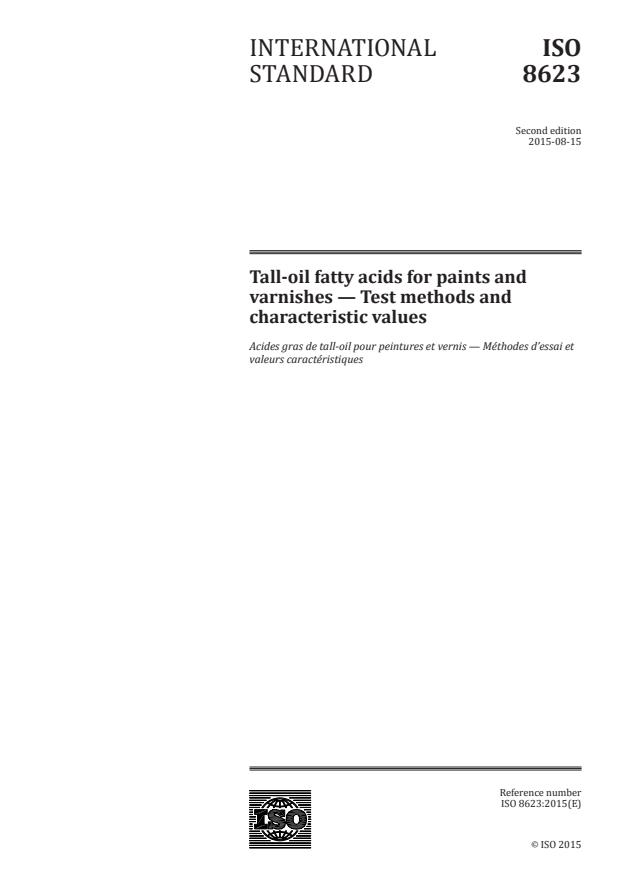
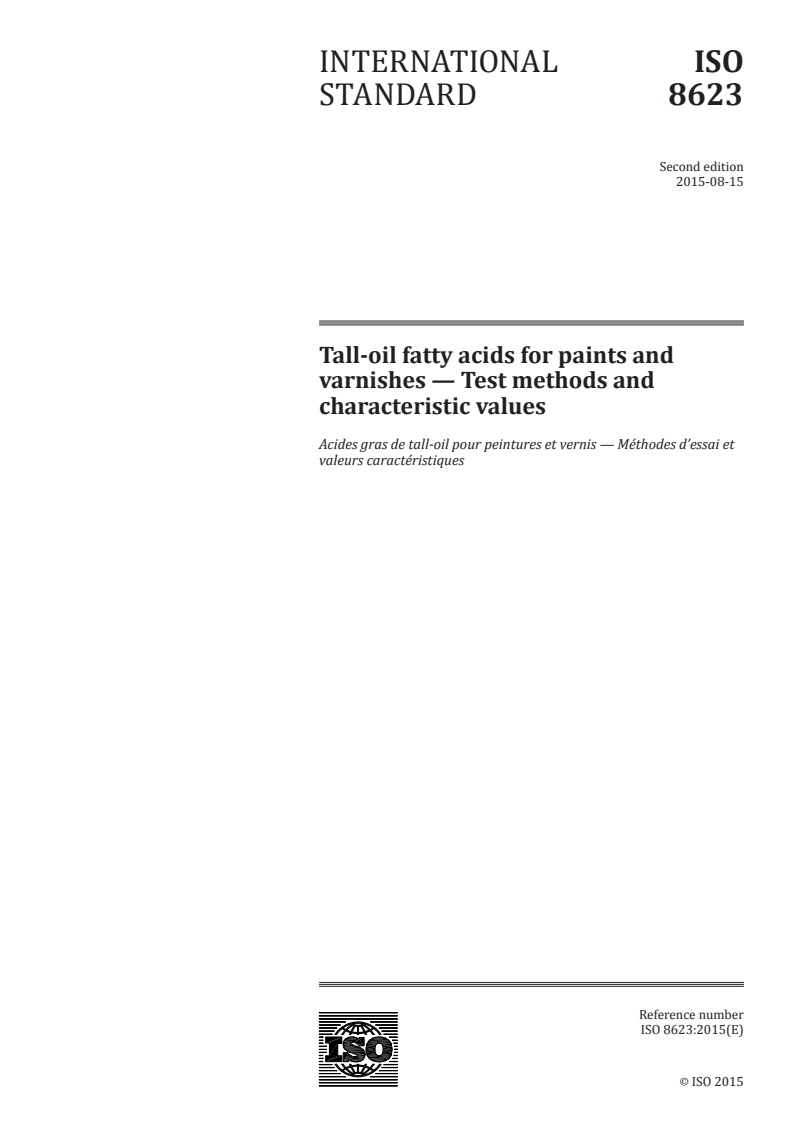
INTERNATIONAL ISO
STANDARD 8623
Second edition
2015-08-15
Tall-oil fatty acids for paints and
varnishes — Test methods and
characteristic values
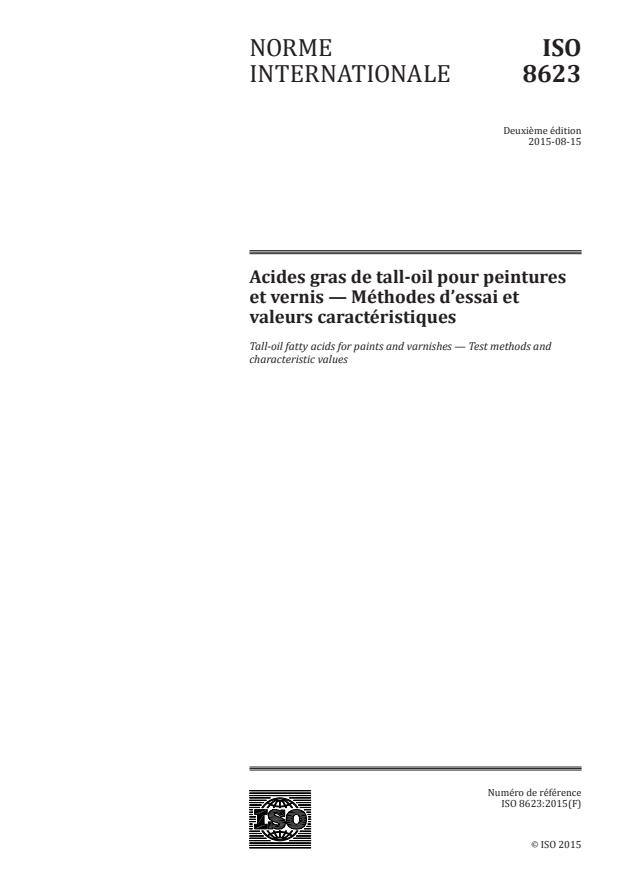
Acides gras de tall-oil pour peintures et vernis — Méthodes d’essai et
valeurs caractéristiques
Reference number
©
ISO 2015
© ISO 2015, Published in Switzerland
All rights reserved. Unless otherwise specified, no part of this publication may be reproduced or utilized otherwise in any form
or by any means, electronic or mechanical, including photocopying, or posting on the internet or an intranet, without prior
written permission. Permission can be requested from either ISO at the address below or ISO’s member body in the country of
the requester.
ISO copyright office
Ch. de Blandonnet 8 • CP 401
CH-1214 Vernier, Geneva, Switzerland
Tel. +41 22 749 01 11
Fax +41 22 749 09 47
copyright@iso.org
www.iso.org
ii © ISO 2015 – All rights reserved
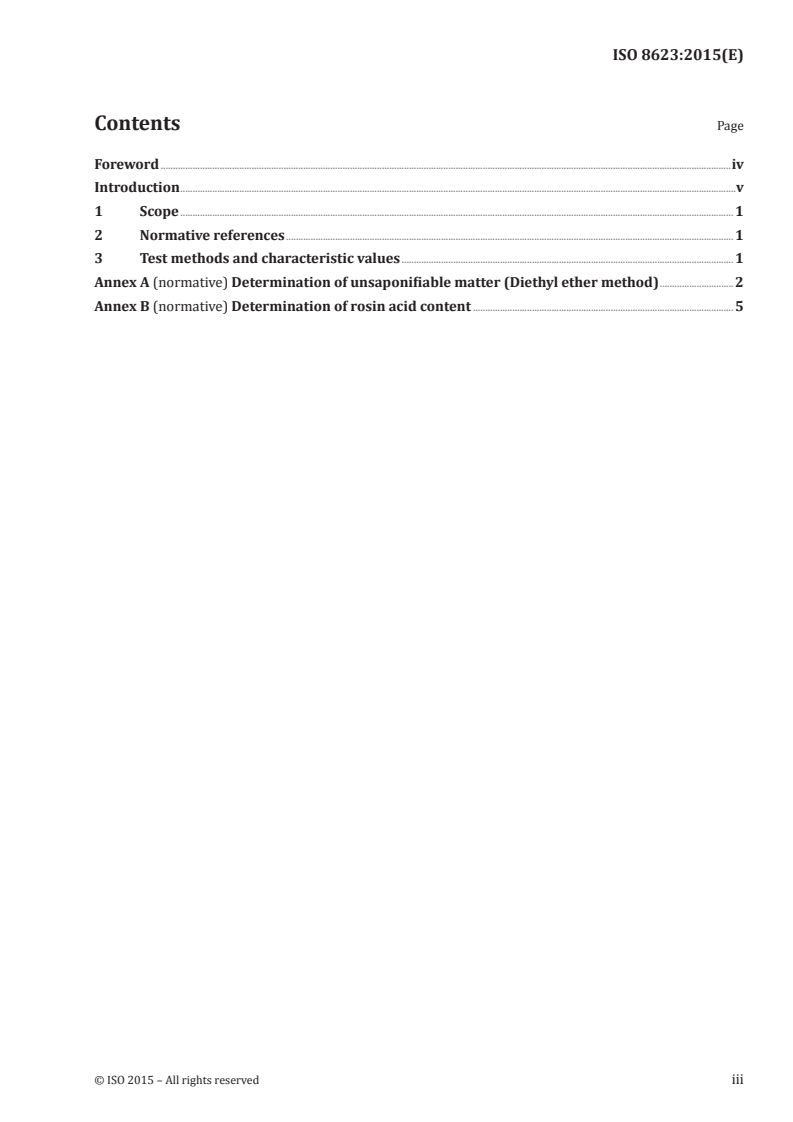
Contents Page
Foreword .iv
Introduction .v
1 Scope . 1
2 Normative references . 1
3 Test methods and characteristic values . 1
Annex A (normative) Determination of unsaponifiable matter (Diethyl ether method) .2
Annex B (normative) Determination of rosin acid content . 5
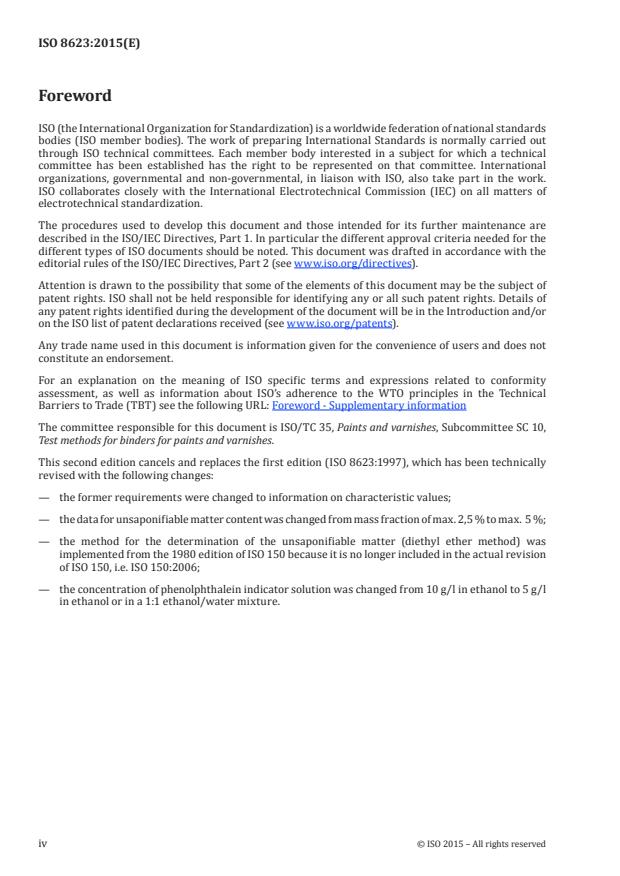
Foreword
ISO (the International Organization for Standardization) is a worldwide federation of national standards
bodies (ISO member bodies). The work of preparing International Standards is normally carried out
through ISO technical committees. Each member body interested in a subject for which a technical
committee has been established has the right to be represented on that committee. International
organizations, governmental and non-governmental, in liaison with ISO, also take part in the work.
ISO collaborates closely with the International Electrotechnical Commission (IEC) on all matters of
electrotechnical standardization.
The procedures used to develop this document and those intended for its further maintenance are
described in the ISO/IEC Directives, Part 1. In particular the different approval criteria needed for the
different types of ISO documents should be noted. This document was drafted in accordance with the
editorial rules of the ISO/IEC Directives, Part 2 (see www.iso.org/directives).
Attention is drawn to the possibility that some of the elements of this document may be the subject of
patent rights. ISO shall not be held responsible for identifying any or all such patent rights. Details of
any patent rights identified during the development of the document will be in the Introduction and/or
on the ISO list of patent declarations received (see www.iso.org/patents).
Any trade name used in this document is information given for the convenience of users and does not
constitute an endorsement.
For an explanation on the meaning of ISO specific terms and expressions related to conformity
assessment, as well as information about ISO’s adherence to the WTO principles in the Technical
Barriers to Trade (TBT) see the following URL: Foreword - Supplementary information
The committee responsible for this document is ISO/TC 35, Paints and varnishes, Subcommittee SC 10,
Test methods for binders for paints and varnishes.
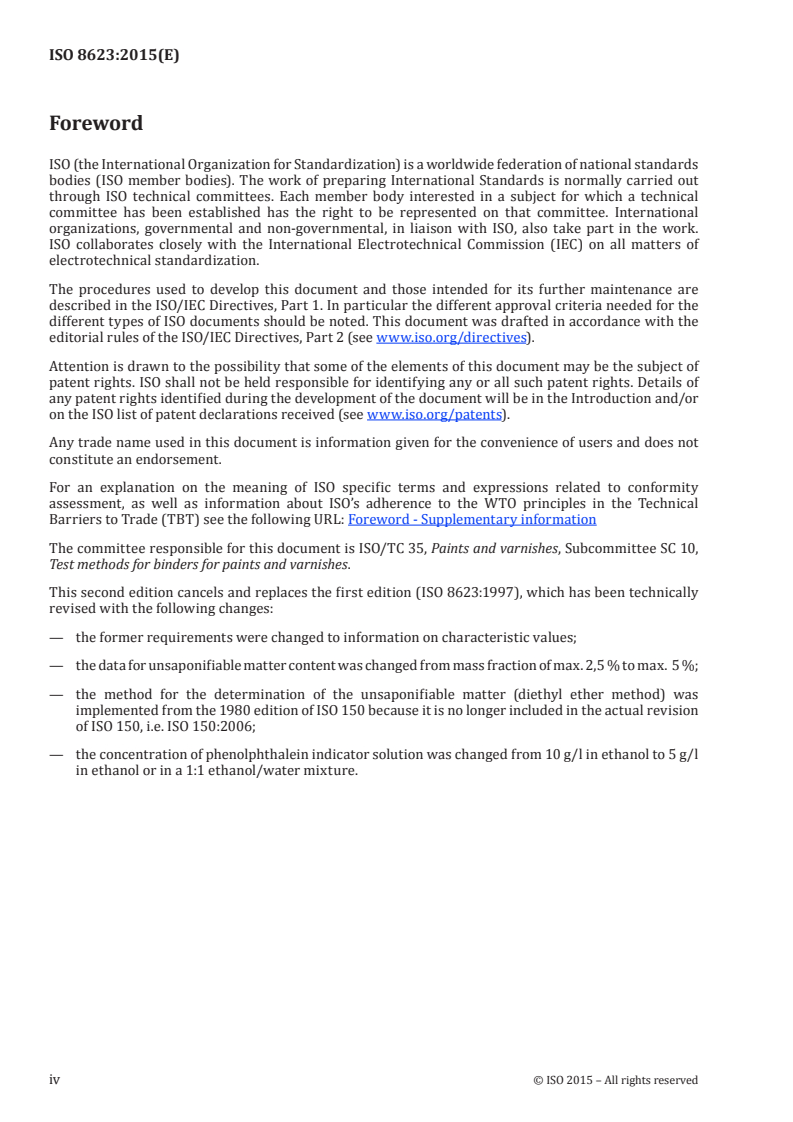
This second edition cancels and replaces the first edition (ISO 8623:1997), which has been technically
revised with the following changes:
— the former requirements were changed to information on characteristic values;
— the data for unsaponifiable matter content was changed from mass fraction of max. 2,5 % to max. 5 %;
— the method for the determination of the unsaponifiable matter (diethyl ether method) was
implemented from the 1980 edition of ISO 150 because it is no longer included in the actual revision
of ISO 150, i.e. ISO 150:2006;
— the concentration of phenolphthalein indicator solution was changed from 10 g/l in ethanol to 5 g/l
in ethanol or in a 1:1 ethanol/water mixture.
iv © ISO 2015 – All rights reserved
Introduction
Normally, requirements are agreed between the interested parties. So with this new edition, this
International Standard no longer specifies requirements but only test methods and gives information
on characteristic values for tall-oil fatty acids.
INTERNATIONAL STANDARD ISO 8623:2015(E)
Tall-oil fatty acids for paints and varnishes — Test methods
and characteristic values
1 Scope
This International Standard specifies test methods and gives information on characteristic values for
distilled tall-oil fatty acids for paints and varnishes.
2 Normative references
The following documents, in whole or in part, are normally referenced in this document and are
indispensable for its application. For dated references, only the edition cited applies. For undated
references, the latest edition of the referenced document (including any amendments) applies.
ISO 383, Laboratory glassware — Interchangeable conical ground joints
ISO 2114, Plastics (polyester resins) and paints and varnishes (binders) — Determination of partial acid
value and total acid value
ISO 2811 (all parts), Paints and varnishes — Determination of density
ISO 3681, Binders for paints and varnishes — Determination of saponification value — Titrimetric method
ISO 3696, Water for analytical laboratory use — Specification and test methods
ISO 3961, Animal and vegetable fats and oils — Determination of iodine value
ISO 4630, Clear liquids — Estimation of colour by the Gardner colour scale
3 Test methods and characteristic values
Test methods and typical characteristic values for tall-oil fatty acids for paints and varnishes are
given in Table 1.
Table 1 — Test methods and characteristic values for tall-oil fatty acids
Property Characteristic value Test method
at 20 °C g/cm 0,900 to 0,910
Density ISO 2811
at 23 °C g/cm 0,898 to 0,908
Colour max. 5 ISO 4630
Acid value mg KOH/g min. 192 ISO 2114
Saponification value mg KOH/g min. 193 ISO 3681
Iodine value g Iodine /100 g min. 125 ISO 3961
Unsaponifiable matter % (mass fraction) max. 5 Annex A
Rosin acid content % (mass fraction) max. 2,5 Annex B
Annex A
(normative)
Determination of unsaponifiable matter (Diethyl ether method)
A.1 General
This test method is applicable to all fats. It is, however, only approximate for certain fats having high
content of unsaponifiable matter.
A.2 Terms and definitions
A.2.1
unsaponifiable matter
substances soluble in the fat, which after saponification are insoluble in water but soluble in the solvent
used for the determination
Note 1 to entry It includes lipids of natural origin such as sterols, alcohols and hydrocarbons as well as any
foreign organic matter non-volatile at 100 °C (mineral oils) which may be present.
A.3 Apparatus
Use ordinary laboratory apparatus and glassware, together with the following:
A.3.1 150 ml flask fitted with a reflux condenser.
A.3.2 500 ml separating funnels.
A.3.3 Oven, regulated at (103 ± 2) °C.
A.4 Reagents
During the analysis, use only reagents of recognized analytical grade and only water of at least
grade 3 as defined in ISO 36
...
INTERNATIONAL ISO
STANDARD 8623
Second edition
2015-08-15
Tall-oil fatty acids for paints and
varnishes — Test methods and
characteristic values
Acides gras de tall-oil pour peintures et vernis — Méthodes d’essai et
valeurs caractéristiques
Reference number
©
ISO 2015
© ISO 2015, Published in Switzerland
All rights reserved. Unless otherwise specified, no part of this publication may be reproduced or utilized otherwise in any form
or by any means, electronic or mechanical, including photocopying, or posting on the internet or an intranet, without prior
written permission. Permission can be requested from either ISO at the address below or ISO’s member body in the country of
the requester.
ISO copyright office
Ch. de Blandonnet 8 • CP 401
CH-1214 Vernier, Geneva, Switzerland
Tel. +41 22 749 01 11
Fax +41 22 749 09 47
copyright@iso.org
www.iso.org
ii © ISO 2015 – All rights reserved
Contents Page
Foreword .iv
Introduction .v
1 Scope . 1
2 Normative references . 1
3 Test methods and characteristic values . 1
Annex A (normative) Determination of unsaponifiable matter (Diethyl ether method) .2
Annex B (normative) Determination of rosin acid content . 5
Foreword
ISO (the International Organization for Standardization) is a worldwide federation of national standards
bodies (ISO member bodies). The work of preparing International Standards is normally carried out
through ISO technical committees. Each member body interested in a subject for which a technical
committee has been established has the right to be represented on that committee. International
organizations, governmental and non-governmental, in liaison with ISO, also take part in the work.
ISO collaborates closely with the International Electrotechnical Commission (IEC) on all matters of
electrotechnical standardization.
The procedures used to develop this document and those intended for its further maintenance are
described in the ISO/IEC Directives, Part 1. In particular the different approval criteria needed for the
different types of ISO documents should be noted. This document was drafted in accordance with the
editorial rules of the ISO/IEC Directives, Part 2 (see www.iso.org/directives).
Attention is drawn to the possibility that some of the elements of this document may be the subject of
patent rights. ISO shall not be held responsible for identifying any or all such patent rights. Details of
any patent rights identified during the development of the document will be in the Introduction and/or
on the ISO list of patent declarations received (see www.iso.org/patents).
Any trade name used in this document is information given for the convenience of users and does not
constitute an endorsement.
For an explanation on the meaning of ISO specific terms and expressions related to conformity
assessment, as well as information about ISO’s adherence to the WTO principles in the Technical
Barriers to Trade (TBT) see the following URL: Foreword - Supplementary information
The committee responsible for this document is ISO/TC 35, Paints and varnishes, Subcommittee SC 10,
Test methods for binders for paints and varnishes.
This second edition cancels and replaces the first edition (ISO 8623:1997), which has been technically
revised with the following changes:
— the former requirements were changed to information on characteristic values;
— the data for unsaponifiable matter content was changed from mass fraction of max. 2,5 % to max. 5 %;
— the method for the determination of the unsaponifiable matter (diethyl ether method) was
implemented from the 1980 edition of ISO 150 because it is no longer included in the actual revision
of ISO 150, i.e. ISO 150:2006;
— the concentration of phenolphthalein indicator solution was changed from 10 g/l in ethanol to 5 g/l
in ethanol or in a 1:1 ethanol/water mixture.
iv © ISO 2015 – All rights reserved
Introduction
Normally, requirements are agreed between the interested parties. So with this new edition, this
International Standard no longer specifies requirements but only test methods and gives information
on characteristic values for tall-oil fatty acids.
INTERNATIONAL STANDARD ISO 8623:2015(E)
Tall-oil fatty acids for paints and varnishes — Test methods
and characteristic values
1 Scope
This International Standard specifies test methods and gives information on characteristic values for
distilled tall-oil fatty acids for paints and varnishes.
2 Normative references
The following documents, in whole or in part, are normally referenced in this document and are
indispensable for its application. For dated references, only the edition cited applies. For undated
references, the latest edition of the referenced document (including any amendments) applies.
ISO 383, Laboratory glassware — Interchangeable conical ground joints
ISO 2114, Plastics (polyester resins) and paints and varnishes (binders) — Determination of partial acid
value and total acid value
ISO 2811 (all parts), Paints and varnishes — Determination of density
ISO 3681, Binders for paints and varnishes — Determination of saponification value — Titrimetric method
ISO 3696, Water for analytical laboratory use — Specification and test methods
ISO 3961, Animal and vegetable fats and oils — Determination of iodine value
ISO 4630, Clear liquids — Estimation of colour by the Gardner colour scale
3 Test methods and characteristic values
Test methods and typical characteristic values for tall-oil fatty acids for paints and varnishes are
given in Table 1.
Table 1 — Test methods and characteristic values for tall-oil fatty acids
Property Characteristic value Test method
at 20 °C g/cm 0,900 to 0,910
Density ISO 2811
at 23 °C g/cm 0,898 to 0,908
Colour max. 5 ISO 4630
Acid value mg KOH/g min. 192 ISO 2114
Saponification value mg KOH/g min. 193 ISO 3681
Iodine value g Iodine /100 g min. 125 ISO 3961
Unsaponifiable matter % (mass fraction) max. 5 Annex A
Rosin acid content % (mass fraction) max. 2,5 Annex B
Annex A
(normative)
Determination of unsaponifiable matter (Diethyl ether method)
A.1 General
This test method is applicable to all fats. It is, however, only approximate for certain fats having high
content of unsaponifiable matter.
A.2 Terms and definitions
A.2.1
unsaponifiable matter
substances soluble in the fat, which after saponification are insoluble in water but soluble in the solvent
used for the determination
Note 1 to entry It includes lipids of natural origin such as sterols, alcohols and hydrocarbons as well as any
foreign organic matter non-volatile at 100 °C (mineral oils) which may be present.
A.3 Apparatus
Use ordinary laboratory apparatus and glassware, together with the following:
A.3.1 150 ml flask fitted with a reflux condenser.
A.3.2 500 ml separating funnels.
A.3.3 Oven, regulated at (103 ± 2) °C.
A.4 Reagents
During the analysis, use only reagents of recognized analytical grade and only water of at least
grade 3 as defined in ISO 36
...
NORME ISO
INTERNATIONALE 8623
Deuxième édition
2015-08-15
Acides gras de tall-oil pour peintures
et vernis — Méthodes d’essai et
valeurs caractéristiques
Tall-oil fatty acids for paints and varnishes — Test methods and
characteristic values
Numéro de référence
©
ISO 2015
DOCUMENT PROTÉGÉ PAR COPYRIGHT
© ISO 2015, Publié en Suisse
Droits de reproduction réservés. Sauf indication contraire, aucune partie de cette publication ne peut être reproduite ni utilisée
sous quelque forme que ce soit et par aucun procédé, électronique ou mécanique, y compris la photocopie, l’affichage sur
l’internet ou sur un Intranet, sans autorisation écrite préalable. Les demandes d’autorisation peuvent être adressées à l’ISO à
l’adresse ci-après ou au comité membre de l’ISO dans le pays du demandeur.
ISO copyright office
Ch. de Blandonnet 8 • CP 401
CH-1214 Vernier, Geneva, Switzerland
Tel. +41 22 749 01 11
Fax +41 22 749 09 47
copyright@iso.org
www.iso.org
ii © ISO 2015 – Tous droits réservés
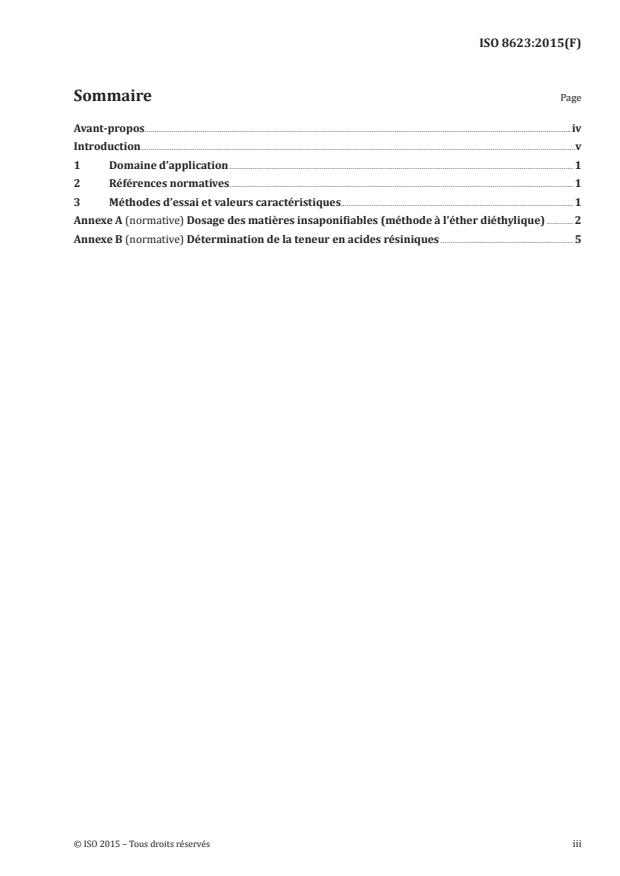
Sommaire Page
Avant-propos .iv
Introduction .v
1 Domaine d’application . 1
2 Références normatives . 1
3 Méthodes d’essai et valeurs caractéristiques . 1
Annexe A (normative) Dosage des matières insaponifiables (méthode à l’éther diéthylique) .2
Annexe B (normative) Détermination de la teneur en acides résiniques . 5
Avant-propos
L’ISO (Organisation internationale de normalisation) est une fédération mondiale d’organismes
nationaux de normalisation (comités membres de l’ISO). L’élaboration des Normes internationales est
en général confiée aux comités techniques de l’ISO. Chaque comité membre intéressé par une étude
a le droit de faire partie du comité technique créé à cet effet. Les organisations internationales,
gouvernementales et non gouvernementales, en liaison avec l’ISO participent également aux travaux.
L’ISO collabore étroitement avec la Commission électrotechnique internationale (IEC) en ce qui
concerne la normalisation électrotechnique.
Les procédures utilisées pour élaborer le présent document et celles destinées à sa mise à jour sont
décrites dans les Directives ISO/IEC, Partie 1. Il convient, en particulier de prendre note des différents
critères d’approbation requis pour les différents types de documents ISO. Le présent document a été
rédigé conformément aux règles de rédaction données dans les Directives ISO/IEC, Partie 2 (voir www.
iso.org/directives).
L’attention est appelée sur le fait que certains des éléments du présent document peuvent faire l’objet de
droits de propriété intellectuelle ou de droits analogues. L’ISO ne saurait être tenue pour responsable
de ne pas avoir identifié de tels droits de propriété et averti de leur existence. Les détails concernant
les références aux droits de propriété intellectuelle ou autres droits analogues identifiés lors de
l’élaboration du document sont indiqués dans l’Introduction et/ou dans la liste des déclarations de
brevets reçues par l’ISO (voir www.iso.org/brevets).
Les appellations commerciales éventuellement mentionnées dans le présent document sont données
pour information, par souci de commodité, à l’intention des utilisateurs et ne sauraient constituer
un engagement.
Pour une explication de la signification des termes et expressions spécifiques de l’ISO liés à
l’évaluation de la conformité, ou pour toute information au sujet de l’adhésion de l’ISO aux principes
de l’OMC concernant les obstacles techniques au commerce (OTC), voir le lien suivant: Avant-propos —
Informations supplémentaires.
Le comité chargé de l’élaboration du présent document est l’ISO/TC 35, Peintures et vernis, Sous-comité
SC 10, Méthodes d’essai des liants pour peintures et vernis.
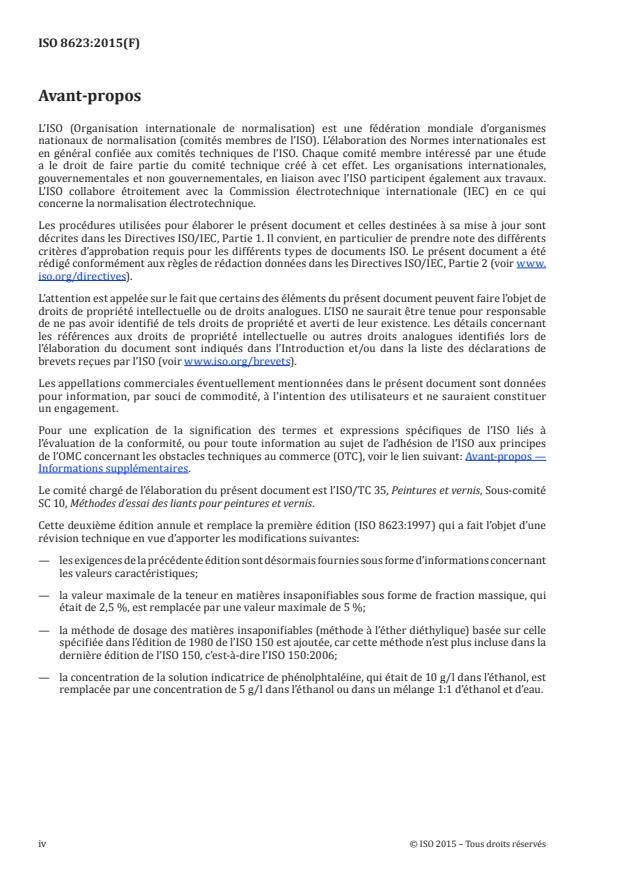
Cette deuxième édition annule et remplace la première édition (ISO 8623:1997) qui a fait l’objet d’une
révision technique en vue d’apporter les modifications suivantes:
— les exigences de la précédente édition sont désormais fournies sous forme d’informations concernant
les valeurs caractéristiques;
— la valeur maximale de la teneur en matières insaponifiables sous forme de fraction massique, qui
était de 2,5 %, est remplacée par une valeur maximale de 5 %;
— la méthode de dosage des matières insaponifiables (méthode à l’éther diéthylique) basée sur celle
spécifiée dans l’édition de 1980 de l’ISO 150 est ajoutée, car cette méthode n’est plus incluse dans la
dernière édition de l’ISO 150, c’est-à-dire l’ISO 150:2006;
— la concentration de la solution indicatrice de phénolphtaléine, qui était de 10 g/l dans l’éthanol, est
remplacée par une concentration de 5 g/l dans l’éthanol ou dans un mélange 1:1 d’éthanol et d’eau.
iv © ISO 2015 – Tous droits réservés
Introduction
En règle générale, les exigences font l’objet d’un accord entre les parties intéressées. Par conséquent,
dans la présente nouvelle édition de cette Norme internationale, plus aucune exigence n’est spécifiée,
seules des méthodes d’essai ainsi que des informations concernant les valeurs caractéristiques des
acides gras de tall oil (tallol) sont fournies.
NORME INTERNATIONALE ISO 8623:2015(F)
Acides gras de tall-oil pour peintures et vernis — Méthodes
d’essai et valeurs caractéristiques
1 Domaine d’application
La présente Norme internationale spécifie des méthodes d’essai pour les acides gras de tall oil (tallol)
distillés utilisés dans des peintures et des vernis, et fournit des informations concernant les valeurs
caractéristiques de ces acides gras.
2 Références normatives
Les documents ci-après, dans leur intégralité ou non, sont des références normatives indispensables à
l’application du présent document. Pour les références datées, seule l’édition citée s’applique. Pour les
références non datées, la dernière édition du document de référence s’applique (y compris les éventuels
amendements).
ISO 383, Verrerie de laboratoire — Assemblages coniques rodés interchangeables
ISO 2114, Plastiques (résines de polyesters) et peintures et vernis (liants) — Détermination de l’indice
d’acide partiel et de l’indice d’acide total
ISO 2811 (toutes les parties), Peintures et vernis — Détermination de la masse volumique
ISO 3681, Liants pour peintures et vernis — Détermination de l’indice de saponification — Méthode
titrimétrique
ISO 3696, Eau pour laboratoire à usage analytique — Spécification et méthodes d’essai
ISO 3961, Corps gras d’origines animale et végétale — Détermination de l’indice d’iode
ISO 4630, Liants pour peintures et vernis — Estimation de la couleur des liquides non opaques au moyen de
l’échelle de couleur Gardner
3 Méthodes d’essai et valeurs caractéristiques
Les méthodes d’essai applicables aux acides gras de tall oil utilisés dans des peintures et des vernis
ainsi que les valeurs caractéristiques de ces acides gras sont données dans le Tableau 1.
Tableau 1 — Méthodes d’essai et valeurs caractéristiques pour les acides gras de tall oil
Propriété Valeur caractéristique Méthode d’essai
Masse volumique à 20 °C g/cm de 0,900 à 0,910
ISO 2811
à 23 °C g/cm de 0,898 à 0,908
Couleur maximum 5 ISO 4630
Indice d’acide mg KOH/g minimum 192 ISO 2114
Indice de saponification mg KOH/g minimum 193 ISO 3681
Indice d’iode en g d’iode / 100 g minimum 125 ISO 3961
Matières insaponifiables % (fraction massique) maximum 5 Annexe A
Teneur en acides rési- % (fraction massique) maximum 2,5
Annexe B
niques
Annexe A
(normative)
Dosage des matières insaponifiables (méthode à l’éther
diéthylique)
A.1 Généralités
La présente méthode d’essai est applicable à toutes les matières grasses. Toutefois, elle permet
uniquement d’obtenir des résultats approximatifs pour certaines matières grasses ayant une teneur
élevée en matières insaponifiables.
A.2 Termes et définitions
A.2.1
matières insaponifiables
substances solubles dans la matière grasse qui, après saponification, sont insolubles dans l’eau mais
solubles dans le solvant utilisé pour la détermination
Note 1 à l’article Ces substances incluent les lipides d’origine naturelle tels que les stérols, les alcools et les
hydrocarbures, ainsi que toute matière organique étrangère non volatile à 100 °C (huiles minérales) qui peut
être présente.
A.3 Appareillage
Utiliser du matériel et de la verrerie courants de laboratoire ainsi que ce qui suit.
A.3.1 Fiole de 150 ml munie d’un réfrigérant à reflux.
A.3.2 Ampoules à décanter de 500 ml.
A.3.3 Étuve, réglée à (103 ± 2) °C.
A.4 Réactifs
Pendant l’analyse, utiliser uniquement des réactifs de qualité analytique reconnue et de l’eau de qualité
3 au moins, selon l’ISO 3696.
A.4.1 Solution aqueuse d’hydroxyde de potassium, c (KOH) = 28 g/l.
A.4.2 Solution éthanoli
...
NORME ISO
INTERNATIONALE 8623
Deuxième édition
2015-08-15
Acides gras de tall-oil pour peintures
et vernis — Méthodes d’essai et
valeurs caractéristiques
Tall-oil fatty acids for paints and varnishes — Test methods and
characteristic values
Numéro de référence
©
ISO 2015
DOCUMENT PROTÉGÉ PAR COPYRIGHT
© ISO 2015, Publié en Suisse
Droits de reproduction réservés. Sauf indication contraire, aucune partie de cette publication ne peut être reproduite ni utilisée
sous quelque forme que ce soit et par aucun procédé, électronique ou mécanique, y compris la photocopie, l’affichage sur
l’internet ou sur un Intranet, sans autorisation écrite préalable. Les demandes d’autorisation peuvent être adressées à l’ISO à
l’adresse ci-après ou au comité membre de l’ISO dans le pays du demandeur.
ISO copyright office
Ch. de Blandonnet 8 • CP 401
CH-1214 Vernier, Geneva, Switzerland
Tel. +41 22 749 01 11
Fax +41 22 749 09 47
copyright@iso.org
www.iso.org
ii © ISO 2015 – Tous droits réservés
Sommaire Page
Avant-propos .iv
Introduction .v
1 Domaine d’application . 1
2 Références normatives . 1
3 Méthodes d’essai et valeurs caractéristiques . 1
Annexe A (normative) Dosage des matières insaponifiables (méthode à l’éther diéthylique) .2
Annexe B (normative) Détermination de la teneur en acides résiniques . 5
Avant-propos
L’ISO (Organisation internationale de normalisation) est une fédération mondiale d’organismes
nationaux de normalisation (comités membres de l’ISO). L’élaboration des Normes internationales est
en général confiée aux comités techniques de l’ISO. Chaque comité membre intéressé par une étude
a le droit de faire partie du comité technique créé à cet effet. Les organisations internationales,
gouvernementales et non gouvernementales, en liaison avec l’ISO participent également aux travaux.
L’ISO collabore étroitement avec la Commission électrotechnique internationale (IEC) en ce qui
concerne la normalisation électrotechnique.
Les procédures utilisées pour élaborer le présent document et celles destinées à sa mise à jour sont
décrites dans les Directives ISO/IEC, Partie 1. Il convient, en particulier de prendre note des différents
critères d’approbation requis pour les différents types de documents ISO. Le présent document a été
rédigé conformément aux règles de rédaction données dans les Directives ISO/IEC, Partie 2 (voir www.
iso.org/directives).
L’attention est appelée sur le fait que certains des éléments du présent document peuvent faire l’objet de
droits de propriété intellectuelle ou de droits analogues. L’ISO ne saurait être tenue pour responsable
de ne pas avoir identifié de tels droits de propriété et averti de leur existence. Les détails concernant
les références aux droits de propriété intellectuelle ou autres droits analogues identifiés lors de
l’élaboration du document sont indiqués dans l’Introduction et/ou dans la liste des déclarations de
brevets reçues par l’ISO (voir www.iso.org/brevets).
Les appellations commerciales éventuellement mentionnées dans le présent document sont données
pour information, par souci de commodité, à l’intention des utilisateurs et ne sauraient constituer
un engagement.
Pour une explication de la signification des termes et expressions spécifiques de l’ISO liés à
l’évaluation de la conformité, ou pour toute information au sujet de l’adhésion de l’ISO aux principes
de l’OMC concernant les obstacles techniques au commerce (OTC), voir le lien suivant: Avant-propos —
Informations supplémentaires.
Le comité chargé de l’élaboration du présent document est l’ISO/TC 35, Peintures et vernis, Sous-comité
SC 10, Méthodes d’essai des liants pour peintures et vernis.
Cette deuxième édition annule et remplace la première édition (ISO 8623:1997) qui a fait l’objet d’une
révision technique en vue d’apporter les modifications suivantes:
— les exigences de la précédente édition sont désormais fournies sous forme d’informations concernant
les valeurs caractéristiques;
— la valeur maximale de la teneur en matières insaponifiables sous forme de fraction massique, qui
était de 2,5 %, est remplacée par une valeur maximale de 5 %;
— la méthode de dosage des matières insaponifiables (méthode à l’éther diéthylique) basée sur celle
spécifiée dans l’édition de 1980 de l’ISO 150 est ajoutée, car cette méthode n’est plus incluse dans la
dernière édition de l’ISO 150, c’est-à-dire l’ISO 150:2006;
— la concentration de la solution indicatrice de phénolphtaléine, qui était de 10 g/l dans l’éthanol, est
remplacée par une concentration de 5 g/l dans l’éthanol ou dans un mélange 1:1 d’éthanol et d’eau.
iv © ISO 2015 – Tous droits réservés
Introduction
En règle générale, les exigences font l’objet d’un accord entre les parties intéressées. Par conséquent,
dans la présente nouvelle édition de cette Norme internationale, plus aucune exigence n’est spécifiée,
seules des méthodes d’essai ainsi que des informations concernant les valeurs caractéristiques des
acides gras de tall oil (tallol) sont fournies.
NORME INTERNATIONALE ISO 8623:2015(F)
Acides gras de tall-oil pour peintures et vernis — Méthodes
d’essai et valeurs caractéristiques
1 Domaine d’application
La présente Norme internationale spécifie des méthodes d’essai pour les acides gras de tall oil (tallol)
distillés utilisés dans des peintures et des vernis, et fournit des informations concernant les valeurs
caractéristiques de ces acides gras.
2 Références normatives
Les documents ci-après, dans leur intégralité ou non, sont des références normatives indispensables à
l’application du présent document. Pour les références datées, seule l’édition citée s’applique. Pour les
références non datées, la dernière édition du document de référence s’applique (y compris les éventuels
amendements).
ISO 383, Verrerie de laboratoire — Assemblages coniques rodés interchangeables
ISO 2114, Plastiques (résines de polyesters) et peintures et vernis (liants) — Détermination de l’indice
d’acide partiel et de l’indice d’acide total
ISO 2811 (toutes les parties), Peintures et vernis — Détermination de la masse volumique
ISO 3681, Liants pour peintures et vernis — Détermination de l’indice de saponification — Méthode
titrimétrique
ISO 3696, Eau pour laboratoire à usage analytique — Spécification et méthodes d’essai
ISO 3961, Corps gras d’origines animale et végétale — Détermination de l’indice d’iode
ISO 4630, Liants pour peintures et vernis — Estimation de la couleur des liquides non opaques au moyen de
l’échelle de couleur Gardner
3 Méthodes d’essai et valeurs caractéristiques
Les méthodes d’essai applicables aux acides gras de tall oil utilisés dans des peintures et des vernis
ainsi que les valeurs caractéristiques de ces acides gras sont données dans le Tableau 1.
Tableau 1 — Méthodes d’essai et valeurs caractéristiques pour les acides gras de tall oil
Propriété Valeur caractéristique Méthode d’essai
Masse volumique à 20 °C g/cm de 0,900 à 0,910
ISO 2811
à 23 °C g/cm de 0,898 à 0,908
Couleur maximum 5 ISO 4630
Indice d’acide mg KOH/g minimum 192 ISO 2114
Indice de saponification mg KOH/g minimum 193 ISO 3681
Indice d’iode en g d’iode / 100 g minimum 125 ISO 3961
Matières insaponifiables % (fraction massique) maximum 5 Annexe A
Teneur en acides rési- % (fraction massique) maximum 2,5
Annexe B
niques
Annexe A
(normative)
Dosage des matières insaponifiables (méthode à l’éther
diéthylique)
A.1 Généralités
La présente méthode d’essai est applicable à toutes les matières grasses. Toutefois, elle permet
uniquement d’obtenir des résultats approximatifs pour certaines matières grasses ayant une teneur
élevée en matières insaponifiables.
A.2 Termes et définitions
A.2.1
matières insaponifiables
substances solubles dans la matière grasse qui, après saponification, sont insolubles dans l’eau mais
solubles dans le solvant utilisé pour la détermination
Note 1 à l’article Ces substances incluent les lipides d’origine naturelle tels que les stérols, les alcools et les
hydrocarbures, ainsi que toute matière organique étrangère non volatile à 100 °C (huiles minérales) qui peut
être présente.
A.3 Appareillage
Utiliser du matériel et de la verrerie courants de laboratoire ainsi que ce qui suit.
A.3.1 Fiole de 150 ml munie d’un réfrigérant à reflux.
A.3.2 Ampoules à décanter de 500 ml.
A.3.3 Étuve, réglée à (103 ± 2) °C.
A.4 Réactifs
Pendant l’analyse, utiliser uniquement des réactifs de qualité analytique reconnue et de l’eau de qualité
3 au moins, selon l’ISO 3696.
A.4.1 Solution aqueuse d’hydroxyde de potassium, c (KOH) = 28 g/l.
A.4.2 Solution éthanoli
...