

ISO/FDIS 7120
(Main)Petroleum products and lubricants — Petroleum oils and other fluids — Determination of rust-preventing characteristics in the presence of water
- Abstract
Defines a method for evaluating these products to indicate the effectiveness in preventing the rusting of ferrous parts should water becomes mixed the oil/fluid. The methodis for application to inhibited oils including steam turbine oils, circulating oils and hydraulic oils and non-hydrocarbon fluids including fluids denser than water.
- Status
- Not Published
- Technical Committee
- ISO/TC 28 - Petroleum and related products, fuels and lubricants from natural or synthetic sources
- Drafting Committee
- ISO/TC 28/WG 26 - Physio-chemical and inspection tests
- Current Stage
- 5000 - Final text received or FDIS registered for formal approval - 50 Approval
- Start Date
- 02-Oct-2026
- Due Date
- 05-Sep-2026
- Completion Date
- 05-Sep-2026
Buy Documents
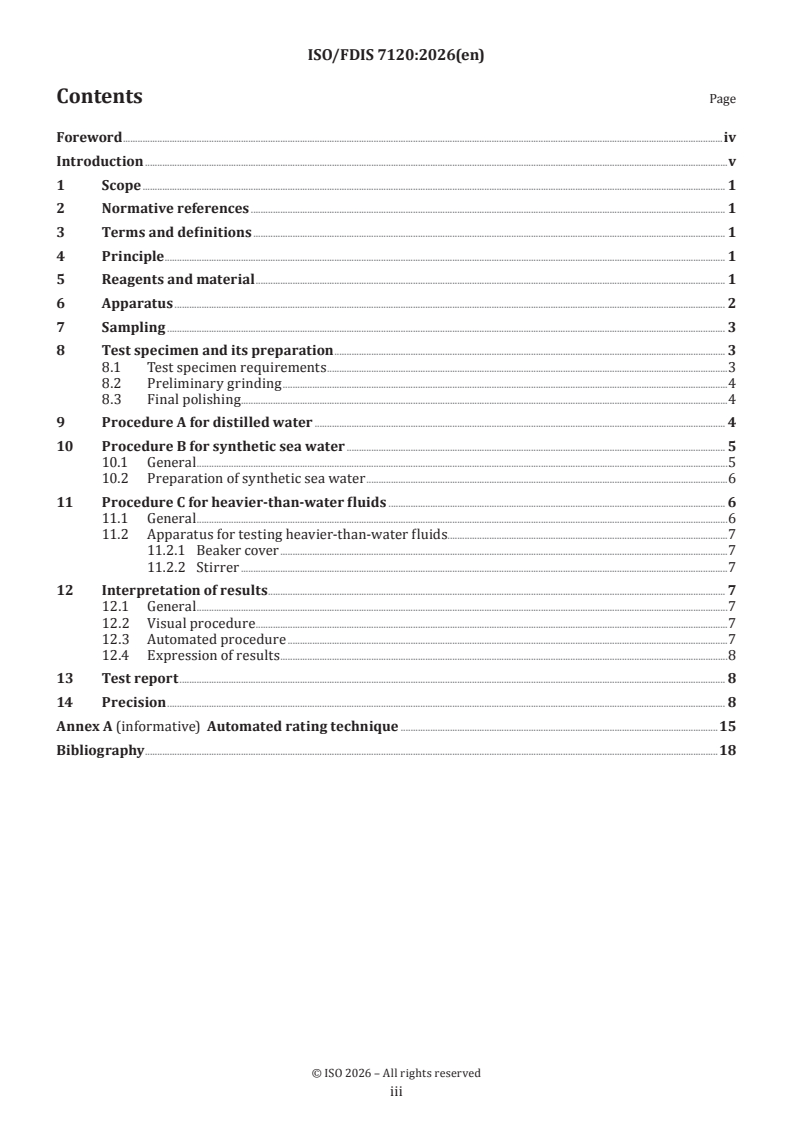
ISO/FDIS 7120 - Petroleum products and lubricants — Petroleum oils and other fluids — Determination of rust-preventing characteristics in the presence of water
REDLINE ISO/FDIS 7120 - Petroleum products and lubricants — Petroleum oils and other fluids — Determination of rust-preventing characteristics in the presence of water
ISO/FDIS 7120 is an ISO document that specifies a laboratory method for evaluating petroleum oils and other fluids for rust-preventing characteristics in the presence of water. It is written for inhibited mineral oils such as steam turbine oils, circulating oils and hydraulic oils, as well as non-hydrocarbon fluids including fluids denser than water, so laboratories and users can judge how well a product protects ferrous parts when water contamination occurs.
What does ISO/FDIS 7120 specify?
ISO/FDIS 7120 specifies a rust-prevention test in which an oil or fluid is contacted with water at controlled temperature while a steel specimen is immersed. The result shows whether the product helps prevent rusting of ferrous parts when water is mixed with the fluid.
The document is organized as follows:
- Clauses 1 to 3 cover scope, normative references, and terms and definitions.
- Clause 4 gives the test principle.
- Clauses 5 to 8 cover reagents, apparatus, sampling, and test specimen preparation.
- Clauses 9 to 11 describe Procedure A for distilled water, Procedure B for synthetic sea water, and Procedure C for heavier-than-water fluids.
- Clauses 12 to 14 cover interpretation of results, the test report, and precision.
- Annex A gives an informative description of an automated rating technique.
What are the key requirements of ISO/FDIS 7120?
Test principle and exposure conditions
ISO/FDIS 7120 uses a mixed oil-water exposure with a cylindrical steel specimen fully immersed. Clause 4 states that 300 ml of test fluid is stirred with 30 ml of water at 60 °C, and the specimen is examined for rust after the exposure period.
In practice, this means the method is not a simple storage test. It recreates the conditions where water enters a service fluid, so the user can compare products under a controlled and repeatable severity.
Sample and specimen preparation
ISO/FDIS 7120 requires a representative sample taken in accordance with ISO 3170 or ISO 3171, depending on whether manual or automatic sampling is used. Clause 8 also requires careful preparation of the steel specimen by grinding and final polishing before the test.
This matters because surface condition strongly affects rust formation. The specimen must be handled so that skin oils, dirt, or leftover abrasives do not influence the result, and reused specimens are discarded when wear becomes excessive.
Required apparatus and materials
ISO/FDIS 7120 calls for a thermostatically controlled bath or equivalent heating arrangement that keeps the test mixture at 60 °C ± 1 °C, a stirrer running at 1 000 r/min ± 50 r/min, suitable beakers and covers, and a thermometer or equivalent temperature-measuring device. Clause 5 also specifies cleaning and polishing fluid, detergent cleaning solution, distilled water, synthetic sea water for Procedure B, and a steel test specimen.
For heavier-than-water fluids, Clause 11 changes the setup by adding an auxiliary stirrer blade and recommending more chemically resistant cover and holder materials. In practice, this is important because some fluids do not mix in the same way as lighter oils and can attack standard plastics.
Procedure A, Procedure B and Procedure C
ISO/FDIS 7120 provides three procedures. Procedure A in Clause 9 uses distilled water and is run in duplicate. Procedure B in Clause 10 is the same test logic but replaces distilled water with synthetic sea water. Procedure C in Clause 11 is used for heavier-than-water fluids and modifies the stirring arrangement.
The test sequence is consistent across the procedures: the oil is heated, the steel specimen is wetted in the hot oil, water is added after initial stirring, and the system is then held under test conditions for the chosen duration. In practice, Procedure B is used when salt-water resistance matters, while Procedure C is used when the fluid under test behaves differently from ordinary mineral oils.
Interpretation of rusting
ISO/FDIS 7120 allows visual rating or an automated rating system. Clause 12 says the visual procedure is the referee method in case of disagreement. The specimen is examined without magnification under normal light, and rust is identified by visible reddish-brown corrosion.
The pass/fail rule is direct: if both specimens are rust-free, the oil passes; if both are rusted, it fails. If one specimen is rusted and the other is not, two additional specimens are tested. Clause 12 also gives rust severity classes - light, moderate, and severe - based on spot count and affected surface area, which helps users compare borderline results.
Test report and precision
Clause 13 requires the report to identify the product, state the document reference, identify which procedure was used, state the duration, give the result, and list any deviations or unusual observations. If the automated procedure is used, the report may also include rust percentage and digital images.
Clause 14 treats the method as essentially pass/fail and states that no recognized precision method is available. That is important for buyers and laboratories because the method is best used for specification checks, product comparison, and in-service monitoring rather than for tight statistical tolerance claims.
What changed in ISO/FDIS 7120 from the previous edition?
ISO/FDIS 7120 is the second edition and cancels and replaces ISO 7120:1987. The foreword states these main changes:
- chromic acid cleaning of glassware was replaced by a detergent solution;
- the quality of distilled water and reagent purity were defined;
- the outdated Annex B of ISO 7120:1987 was deleted;
- the steel grade definition was updated;
- the old steel grade definition, formerly Annex A of ISO 7120:1987, was deleted;
- the abrasive cloth definitions were updated to match current industry use;
- the water-addition procedure was amended to align with ASTM/IP test methods;
- notes were added to clarify the definition of rust;
- an alternative rust rating by automated technique was added;
- the automated rating technique was added as Annex A.
Which standards are used with ISO/FDIS 7120?
ISO/FDIS 7120 cites several standards that support the test:
- ISO 3170 - manual sampling of hydrocarbon liquids, used when taking a representative sample.
- ISO 3171 - automatic pipeline sampling of petroleum liquids, used as the alternative sampling route.
- ISO 3448:1992/Cor 1 - ISO viscosity classification, used in the apparatus clause to identify a suitable bath oil grade.
- ISO 3696 - water for analytical laboratory use, used for the distilled water quality requirement.
- ISO 683-1 - provides the steel specification referenced for the test specimen material.
- DIN EN 10083-2 - also cited for equivalent unalloyed carbon steel for the specimen.
What does the ISO/FDIS 7120 document contain?
ISO/FDIS 7120 contains detailed test instructions, apparatus descriptions, specimen preparation steps, and result interpretation rules. It includes figures for the test arrangement, beaker cover, specimen holders, polishing chuck, and auxiliary stirrer blade, which help laboratories build and assemble the setup correctly.
It also includes tables for synthetic sea water composition and for the comparison data behind the automated rating discussion. Those tables support the preparation of Procedure B and the justification for the optional automated approach.
Annex A describes the automated rating technique in practical terms. It covers the lighting chamber, rotating specimen handling, digital imaging, software-based rust detection, periodic verification, and the saved output images used for traceability.
Relations
- Effective Date
- 03-May-2025
Buy Documents
ISO/FDIS 7120 - Petroleum products and lubricants — Petroleum oils and other fluids — Determination of rust-preventing characteristics in the presence of water
REDLINE ISO/FDIS 7120 - Petroleum products and lubricants — Petroleum oils and other fluids — Determination of rust-preventing characteristics in the presence of water
Get Certified
Connect with accredited certification bodies for this standard

Element Materials Technology
Materials testing and product certification.

ABS Group Brazil
ABS Group certification services in Brazil.

ABS Quality Evaluations Inc.
American Bureau of Shipping quality certification.
Sponsored listings
Frequently Asked Questions
ISO/FDIS 7120 is a draft published by the International Organization for Standardization (ISO). Its full title is "Petroleum products and lubricants — Petroleum oils and other fluids — Determination of rust-preventing characteristics in the presence of water". This standard covers: Defines a method for evaluating these products to indicate the effectiveness in preventing the rusting of ferrous parts should water becomes mixed the oil/fluid. The methodis for application to inhibited oils including steam turbine oils, circulating oils and hydraulic oils and non-hydrocarbon fluids including fluids denser than water.
Defines a method for evaluating these products to indicate the effectiveness in preventing the rusting of ferrous parts should water becomes mixed the oil/fluid. The methodis for application to inhibited oils including steam turbine oils, circulating oils and hydraulic oils and non-hydrocarbon fluids including fluids denser than water.
ISO/FDIS 7120 is classified under the following ICS (International Classification for Standards) categories: 75.080 - Petroleum products in general; 75.100 - Lubricants, industrial oils and related products. The ICS classification helps identify the subject area and facilitates finding related standards.
ISO/FDIS 7120 has the following relationships with other standards: It is inter standard links to ISO 7120:1987. Understanding these relationships helps ensure you are using the most current and applicable version of the standard.
ISO/FDIS 7120 is available in PDF format for immediate download after purchase. The document can be added to your cart and obtained through the secure checkout process. Digital delivery ensures instant access to the complete standard document.
Standards Content (Sample)
Contents
- Introduction
- 1 Scope
- 2 Normative references
- 3 Terms and definitions
- 4 Principle
- 5 Reagents and material
- 6 Apparatus
- 7 Sampling
- 8 Test specimen and its preparation
- 8.1 Test specimen requirements
- 8.2 Preliminary grinding
- 8.3 Final polishing
- 9 Procedure A for distilled water
- 10 Procedure B for synthetic sea water
- 10.1 General
- 10.2 Preparation of synthetic sea water
- 11 Procedure C for heavier-than-water fluids
- 11.1 General
- 11.2 Apparatus for testing heavier-than-water fluids
- 12 Interpretation of results
- 12.1 General
- 12.2 Visual procedure
- 12.3 Automated procedure
- 12.4 Expression of results
- 13 Test report
- 14 Precision
- Annex A
- Bibliography
Introduction
Rust is a continuing problem in turbines when carbon steel is present because water contamination of steam turbine oils and fluids is very difficult to avoid. Although the engine in gas turbines is usually constructed of stainless steel or exotic alloys, carbon steel can still be present in the auxiliary equipment, such as in the gears of a steam turbine, and the oil tank.
To prevent rusting and corrosion, chemicals inhibitors have been developed to protect the metal surfaces. Such inhibitors are usually highly polar materials that form an adsorbed film on the surface of the metal that physically hinders the transfer of water to the metal surface. As many turbines operate in saline environments, rust protection is frequently required against salt water. This is a more severe requirement than distilled water protection.
The test method specified in this document is widely used to evaluate how effectively inhibited mineral oils prevent rusting of ferrous parts in the presence of water. This test method is also used for testing hydraulic and circulating oils, including heavier-than-water fluids. It is used for the specification of new oils and the monitoring of in-service oils .
FINAL DRAFT International Standard ISO/FDIS 7120:2026(en) Petroleum products and lubricants — Petroleum oils and other fluids — Determination of rust-preventing characteristics in the presence of water
1 Scope
This document specifies a method for evaluating petroleum oils and other fluids to indicate their effectiveness in preventing the rusting of ferrous parts when water becomes mixed with the oil or fluid. This method is applicable to inhibited mineral oils including steam turbine oils, circulating oils and hydraulic oils, and non-hydrocarbon fluids including fluids denser than water.
2 Normative references
The following documents are referred to in the text in such a way that some or all of their content constitutes requirements of this document. For dated references, only the edition cited applies. For undated references, the latest edition of the referenced document (including any amendments) applies. ISO 3170, Hydrocarbon Liquids — Manual sampling ISO 3171, Petroleum liquids — Automatic pipeline sampling ISO 3696, Water for analytical laboratory use — Specification and test methods
3 Terms and definitions
No terms and definitions are listed in this document.
ISO and IEC maintain terminology databases for use in standardization at the following addresses:
- ISO Online browsing platform: available at https:// www .iso .org/ obp
- IEC Electropedia: available at https:// www .electropedia .org/
4 Principle
A mixture of 300 ml of the oil or fluid under test is stirred with 30 ml of distilled water or synthetic sea water, as required, at a temperature of 60 °C with a cylindrical steel specimen completely immersed therein. It is customary to run the test for 24 h; however, the test period may, at the discretion of the interested parties, be for a shorter or longer period. The specimen is then observed for signs of rusting and degree of rusting.
5 Reagents and material
Unless otherwise stated, use only reagents of recognized analytical grade and only distilled water (see 5.3). 5.1 Cleaning and polishing fluid, iso-octane (2,2,4-trimethylpentane), minimum purity 99,75 %. NOTE For non-reference testing, petroleum spirit of satisfactory volatility can be used. WARNING — Iso-octane is flammable. Do not use in an area near sparks or an open flame. Provide adequate ventilation.
ISO/FDIS 7120:2026(en) 5.2 Detergent cleaning solution for glassware cleaning in accordance with good laboratory practice. 5.3 Distilled water conforming to grade 3 of ISO 3696.
It is recommended, especially if water was stored prolonged period, to check before use that its pH is within 5,0 to 7,0. If it is not in the specified range, use the other batch of distilled water. 5.4 Synthetic sea water, for testing in accordance with procedure B, and conforming to the requirements given in 10.2.
5.5 Steel test specimen, as described in 8.1.
6 Apparatus
6.1 Liquid bath, thermostatically controlled and capable of maintaining the test sample at a temperature
of 60 ± 1 °C. A mineral oil with viscosity of 32 mm /s at 40°C is suitable for the bath. The bath shall have a cover with holes to accommodate the test beakers. If using water, monitor its level to limit evaporation. NOTE An electric heated solid metal block can be used in place of a liquid bath if the sample heating rate and sample temperature demonstrated the same performance to that of the liquid bath. 6.2 Thermometer, for checking the temperature of the test fluid with scale divisions of 0,5 °C with a specified immersion specification to allow measurement of the temperature in the test vessel at 60 °C with a [1] precision at least equal to that of thermometer STL/0,5/ -35/+115 (see ISO 653 ). NOTE It is possible to use thermometers ASTM 9C/IP 15C or ASTM 34C/IP21C, or alternative temperature measuring device of suitable dimensions, capable of reading to 60 °C ± 1 °C. 6.3 Beaker, 400 ml, tail-form heat-resistant borosilicate glass without pour out, as shown in Figure 1, approximately 127 mm in height measured from the inside bottom centre and approximately 70 mm in inside diameter measured at the middle.
6.4 Beaker cover, flat, as shown in Figure 2, of glass, polymethyl methacrylate (PMMA) or other chemically resistant material , kept in position by suitable means such as a rim or groove. An inverted Petri dish makes a suitable cover, as the sides of the dish aid in keeping it in position. Figure 2 shows a PMMA cover for the beaker which has been found to be suitable. If the test is used for other fluids such as synthetics, the beaker cover shall be made from chemically resistant materials such as poly(chlorotrifluoroethylene) (PCTFE), polytetrafluoroethylene (PTFE) or chlorotrifluoroethylene (ECTFE).
Two holes shall be provided on any diameter of the cover; one for a stirrer approximately 12,0 mm in diameter with its centre approximately 6,4 mm from the centre of the cover; and the other, on the opposite side of the centre of the cover, for the test specimen assembly (see Clause 8), approximately 18 mm in diameter with its centre approximately 16 mm from the centre of the cover. In addition, a third hole 12 mm in diameter shall be provided for a thermometer with its centre approximately 22 mm from the centre of the cover and on a diameter of the cover at right angles to the diameter through the other two holes (see Figure 2 for the tolerances of these dimensions.) An optional feature is shown on Figure 2, consisting of a slot, 1,6 mm by 27,0 mm, which is centred on a diameter of the stirrer hole at right angles to the cover diameter through the specimen hole and stirrer hole. This feature allows withdrawal of the stirrer while the beaker cover is in place.
ISO/FDIS 7120:2026(en) 6.5 Stirrer, constructed entirely from 18/8 chromium nickel stainless steel in the form of an inverted T. A flat blade 25 mm ± 1,0 mm × 6 mm ± 0,5 mm × 0,6 mm ± 0,1 mm shall be attached to a 6 mm rod in such a way that the blade is symmetrical with the rod and has its flat surface in the vertical plane. If stainless steel is not obtainable, stirrers made of heat-resistant borosilicate glass and having the same dimensions as the stainless steel stirrers specified can be used. 6.6 Stirring apparatus, any convenient form, capable of maintaining a speed of 1 000 r/min ± 50 r/min. 6.7 Grinding and polishing equipment:
6.7.1 Abrasive cloth, metalworking aluminium oxide, 97 µm and 53 µm (see NOTE) closed coat on a jeans backing.
NOTE The corresponding grit sizes differ in Europe (FEPA - Federation of European Producers of Abrasives) and the USA (CAMI - Coated Abrasives Manufacturers Institute). The following corresponding values are suitable for preliminary grinding: for 53 µm cloth - CAMI 240 grit or FEPA P280J, and for 97 µm cloth - CAMI 150 grit or FEPA P150J.
6.7.2 Chuck, suitable for holding the specimen (see Figure 4). 6.7.3 Rotation device, capable of rotating the specimen at a speed of 1 700 r/min to 1 800 r/min. 6.8 Specimen assembly, as described in 8.1.
6.9 Oven, capable of maintaining a temperature of 64 °C ± 1 °C. 6.10 Pipette or other suitable mean to dispense 30 ml ± 1 ml of water.
7 Sampling
Take a representative sample of the product to be tested in accordance with ISO 3170 or ISO 3171.
8 Test specimen and its preparation
8.1 Test specimen requirements
The specimen assembly (6.8) shall consist of a round steel specimen fitted to a plastic holder. The plastic holder shall be made of PMMA resin in accordance with the dimensions shown in Figure 3 (two types of holders are illustrated).
When testing non-hydrocarbon fluids, the plastic holder should be made from chemically resistant material such as polytetrafluoroethylene (PTFE).
The round steel specimen, when new, shall be 12,5 mm ± 0,5 mm in diameter and approximately 68 mm in length exclusive of the threaded portion which screws into the plastic holder. The round steel specimen shall be tapered at one end as shown in Figure 3. It shall be made of steel conforming to the grade C22E number [2] [3] 1.1151 (see DIN EN 10083-2 ) or C25E number 1.1158 (see ISO 683-1 ), or the equivalent unalloyed carbon steel.
If these steels are not available, other equivalent steels may be used, if they are found to be satisfactory by comparative testing using this method. When making such comparative testing, the steel specimen that showed rust shall not be re-used. Specimens that repeatedly show rust in tests of various oils can be imperfect. Such specimens should be checked with oils known to pass the test,. If rusting occurs in repeat tests, this steel specimens shall be discarded. In cases of dispute, steel corresponding to the specification C22E number 1.1151 shall be used for reference testing.
ISO/FDIS 7120:2026(en) The steel specimen, either new or from a previous test, shall be prepared as described in 8.2 and 8.3.
8.2 Preliminary grinding
If the specimen has been used previously and is free from rust or other irregularities, the preliminary grinding may be omitted, and the specimen may be subjected only to final polishing as prescribed in 8.3. If the specimen is new or if any part of its surface shows rust or other irregularities, clean it with cleaning solvent (5.1). Grind with 97 µm aluminium oxide cloth (6.7.1) to remove all irregularities, pits, and scratches, as determined by visual inspection.
...
Contents
- Introduction
- 1 Scope
- 2 Normative references
- 3 Terms and definitions
- 4 Principle
- 5 Reagents and material
- 6 Apparatus
- 7 Sampling
- 8 Test specimen and its preparation
- 8.1 Test specimen requirements
- 8.2 Preliminary grinding
- 8.3 Final polishing
- 9 Procedure A for distilled water
- 10 Procedure B for synthetic sea water
- 10.1 General
- 10.2 Preparation of synthetic sea water
- 11 Procedure C for heavier-than-water fluids
- 11.1 General
- 11.2 Apparatus for testing heavier-than-water fluids
- 12 Interpretation of results
- 12.1 General
- 12.2 Visual procedure
- 12.3 Automated procedure
- 12.4 Expression of results
- 13 Test report
- 14 Precision
- 1 Optionaloptional slot 1,6 mm by 27,0 mm
- Annex A
- Bibliography
Introduction
Rust is a continuing problem in turbines when carbon steel is present because water contamination of steam turbine oils and fluids is very difficult to avoid. Although the engine in gas turbines is usually constructed of stainless steel or exotic alloys, carbon steel can still be present in the auxiliary equipment, such as in the gears of a steam turbine, and the oil tank.
To prevent rusting and corrosion, chemicals inhibitors have been developed to protect the metal surfaces. Such inhibitors are usually highly polar materials that form an adsorbed film on the surface of the metal that physically hinders the transfer of water to the metal surface. As many turbines operate in saline environments, rust protection is frequently required against salt water. This is a more severe requirement than distilled water protection.
This testThe test method specified in this document is widely used to evaluate how effectively inhibited mineral oils prevent rusting of ferrous parts in the presence of water. This test method is also used for testing hydraulic and circulating oils, including heavier-than-water fluids. It is used for the specification of new oils and the monitoring of in-service oils .
ISO/DISFDIS 7120:2026(en) Petroleum products and lubricants — Petroleum oils and other fluids - Determination of rust-preventing characteristics in the presence of water
1 Scope
This International Standarddocument specifies a method for evaluating petroleum oils and other fluids to indicate their effectiveness in preventing the rusting of ferrous parts when water becomebecomes mixed with the oil/ or fluid. TheThis method is applicable to inhibited mineral oils including steam turbine oils, circulating oils and hydraulic oils, and non-hydrocarbon fluids including fluids denser than water.
2 Normative references
The following documents are referred to in the text in such a way that some or all of their content constitutes requirements of this document. For dated references, only the edition cited applies. For undated references, the latest edition of the referenced document (including any amendments) applies. ISO 3170, Hydrocarbon Liquids — Manual sampling ISO 3171, Petroleum liquids — Automatic pipeline sampling ISO 3448:1992/Cor 1, Industrial liquid lubricants — ISO viscosity classification — Technical Corrigendum 1 ISO 3696, Water for analytical laboratory use — Specification and test methods
3 Terms and definitions
No terms and definitions are listed in this document.
ISO and IEC maintain terminology databases for use in standardization at the following addresses:
- ISO Online browsing platform: available at https://www.iso.org/obp
- IEC Electropedia: available at https://www.electropedia.org/
4 Principle
A mixture of 300 ml of the oil or fluid under test is stirred with 30 ml of distilled water or synthetic sea water, as required, at a temperature of 60 °C with a cylindrical steel specimen completely immersed therein. It is customary to run the test for 24 h; however, the test period may, at the discretion of the interested parties, be for a shorter or longer period. The specimen is then observed for signs of rusting and degree of rusting.
5 Reagents and material
Unless otherwise stated, use only reagents of recognized analytical grade and only distilled water (see 5.3). 5.1 Cleaning and polishing fluid, iso-octane (2,2,4-trimethylpentane), minimum purity 99,75 %. NOTE For non-reference testing, petroleum spirit of satisfactory volatility can be used. Caution — CAUTIONWARNING — Iso-octane is flammable. Do not use in an area near sparks or an open flame. Provide adequate ventilation.
ISO/DISFDIS 7120:2026(en) 5.2 Detergent cleaning solution for glassware cleaning in accordance with good laboratory practice. 5.3 Distilled water conforming to grade 3 of ISO 3696.
It is recommended, especially if water was stored prolonged period, to check before use that its pH is within 5,0 to 7,0. If it is not in the specified range, use the other batch of distilled water. 5.4 Synthetic sea water, for testing in accordance with procedure B, and conforming to the requirements given in 10.2.
5.5 Steel test specimen, as described in 8.1.
6 Apparatus
6.1 Liquid bath, thermostatically controlled and capable of maintaining the test sample at a temperature
of 60 ± 1 °C. AnA mineral oil ofwith viscosity grade ISO VGof 32 (see ISO 3448:1992/Cor 1 )mm /s at 40°C is suitable for the bath. The bath shall have a cover with holes to accommodate the test beakers. If using water, monitor its level to limit evaporation.
NOTE An electric heated solid metal block can be used in place of a liquid bath if the sample heating rate and sample temperature demonstrated the same performance to that of the liquid bath. 6.2 Thermometer, for checking the temperature of the test fluid with scale divisions of 0,5 °C with a specified immersion specification to allow measurement of the temperature in the test vessel at 60 °C with a [1] precision at least equal to that of thermometer STL/0,5/ -35/+115 (see ISO 653 ).). NOTE It is possible to use thermometers ASTM 9C/IP 15C or ASTM 34C/IP21C, or alternative temperature measuring device of suitable dimensions, capable of reading to 60 °C ± 1 °C. 6.3 Beaker, 400 ml, tail-form heat-resistant borosilicate glass without pour out, as shown in Figure 1, approximately 127 mm in height measured from the inside bottom centre and approximately 70 mm in inside diameter measured at the middle.
6.4 Beaker cover, flat, as shown in Figure 2, of glass, polymethyl methacrylate (PMMA) or other chemically resistant material , kept in position by suitable means such as a rim or groove. An inverted Petri dish makes a suitable cover, as the sides of the dish aid in keeping it in position. Figure 2 shows a PMMA cover for the beaker which has been found to be suitable. If the test is used for other fluids such as synthetics, the beaker cover shall be made from chemically resistant materials such as poly(chlorotrifluoroethylene) (PCTFE), polytetrafluoroethylene (PTFE) or chlorotrifluoroethylene (ECTFE).
Two holes shall be provided on any diameter of the cover; one for a stirrer approximately 12,0 mm in diameter with its centre approximately 6,4 mm from the centre of the cover; and the other, on the opposite side of the centre of the cover, for the test specimen assembly (see Clause 8), approximately 18 mm in diameter with its centre approximately 16 mm from the centre of the cover. In addition, a third hole 12 mm in diameter shall be provided for a thermometer with its centre approximately 22 mm from the centre of the cover and on a diameter of the cover at right angles to the diameter through the other two holes (see Figure 2. (Tolerances with respect to for the tolerances of these dimensions are given in .).) An optional feature is shown on Figure 2.,, consisting of a slot, 1,6 mm by 27,0 mm, which is centred on a diameter of the stirrer hole at right angles to the cover diameter through the specimen hole and stirrer hole. This feature allows withdrawal of the stirrer while the beaker cover is in place.
ISO/DISFDIS 7120:2026(en) 6.5 Stirrer, constructed entirely from 18/8 chromium nickel stainless steel in the form of an inverted T. A flat blade 25 mm ± 1,0 mm x× 6 mm ± 0,5 mm x× 0,6 mm ± 0,1 mm shall be attached to a 6 mm rod in such a way that the blade is symmetrical with the rod and has its flat surface in the vertical plane. If stainless steel is not obtainable, stirrers made of heat-resistant borosilicate glass and having the same dimensions as the stainless steel stirrers specified can be used. 6.6 Stirring apparatus, any convenient form, capable of maintaining a speed of 1 000 r/min ± 50 r/min. 6.7 Grinding and polishing equipment:
6.7.1 Abrasive cloth, metalworking aluminium oxide, 97 µm and 53 µm (see NOTE) closed coat on a jeans backing.
NOTE The corresponding grit sizes differ in Europe (FEPA - Federation of European Producers of Abrasives) and the USA (CAMI - Coated Abrasives Manufacturers Institute). The following corresponding values are suitable for preliminary grinding: for 53 µm cloth - CAMI 240 grit or FEPA P280J, and for 97 µm cloth - CAMI 150 grit or FEPA P150J. 6.7.2 Chuck, suitable for holding the specimen (see Figure 4). 6.7.3 Rotation device, capable of rotating the specimen at a speed of 1 700 r/min to 1 800 r/min. 6.8 Specimen assembly, as described in 8.1.
6.9 Oven, capable of maintaining a temperature of 64 °C ± 1 °C. 6.10 Pipette or other suitable mean to dispense 30 ml ± 1 ml of water.
7 Sampling
Take a representative sample of the product to be tested in accordance with ISO 3170 or ISO 3171.
8 Test specimen and its preparation
8.1 Test specimen requirements
The specimen assembly (6.8 )) shall consist of a round steel specimen fitted to a plastic holder. The plastic holder shall be made of PMMA resin in accordance with the dimensions shown in Figure 3 (two types of holders are illustrated).
When testing non-hydrocarbon fluids, the plastic holder should be made from chemically resistant material such as polytetrafluoroethylene (PTFE).
The round steel specimen, when new, shall be 12,5 mm ± 0,5 mm in diameter and approximately 68 mm in length exclusive of the threaded portion which screws into the plastic holder and. The round steel specimen shall be tapered at one end as shown in Figure 3. It shall be made of steel conforming to the grade C22E number [2] [3] ) or C25E number 1.1158 (see ISO 683-1 ),), or the equivalent unalloyed 1.1151 (see DIN EN 10083-2 carbon steel.
If these steels are not available, other equivalent steels may be used, if they are found to be satisfactory by comparative testing using this method. When making such comparative testing, the steel specimen that showed rust shall not be re-used. Specimens that repeatedly show rust in tests of various oils maycan be imperfect. Such specimens should be checked with oils known to pass the test, and if,. If rusting occurs in repeat tests, this steel specimens shall be discarded. In cases of dispute, steel corresponding to the specification C22E number 1.1151 shall be used for reference testing.
ISO/DISFDIS 7120:2026(en) The steel specimen, either new or from a previous test, shall be prepared as described in 8.2 and 8.3.
8.2 Preliminary grinding
If the specimen has been used previously and is free from rust or other irregularities, the preliminary grinding may be omitted, and the specimen may be subjected only to final polishing as prescribed in 8.3. If the specimen is new or if any part of its surface shows rust or other irregularities, clean it with cleaning solvent (5.1). Grind with 97 µm aluminium oxide cloth (6.7.1) to remove all irregularities, pits, and scratches, as determined by visual inspection.
...