

ISO/FDIS 18758
(Main)Mining and earth-moving machinery — Rock drill rigs and rock reinforcement rigs — Safety requirements
General Information
- Abstract
This document specifies the safety requirements for rock drill rigs and rock reinforcement rigs designed for the following underground or surface operations: a) blast hole drilling; b) rock reinforcement; c) drilling for secondary breaking; d) dimensional stone drilling; e) mineral prospecting, e.g. utilizing core drilling or reverse circulation; f) water and methane drainage drilling; g) raise boring. NOTE Rigs can be designed for more than one of the operations above. See ISO 18758-1 for vocabulary. This document is also applicable to earth-moving machinery as defined in ISO 6165, modified to become a rock drill rig or rock reinforcement rig. This document is not applicable to the following machines: drill rigs for soil and rock mixture; (geothermal drill rigs, water well drill rigs, water jet drill rigs, micro pile drill rigs; surface horizontal directional drill rigs (HDD) as defined in ISO 21467), kelly drill rigs (and casing drivers); cable tool drill rigs; pre-armouring machines; sonic drill rigs; shaft sinking drill rigs; crane attached drill rigs; drill rigs on derricks; scaling machines. This document deals with the significant hazards, hazardous situations or hazardous events, as listed in Annex E, relevant to rock drill rigs and rock reinforcement rigs (see ISO 18758‑1), when they are used as intended and under the conditions of misuse which are reasonably foreseeable by the manufacturer. This document is not applicable to rigs manufactured before the date of its publication.
- Status
- Not Published
- Technical Committee
- ISO/TC 82 - Mining
- Drafting Committee
- ISO/TC 82 - Mining
- Current Stage
- 5020 - FDIS ballot initiated: 2 months. Proof sent to secretariat
- Start Date
- 20-Aug-2026
- Completion Date
- 20-Aug-2026
Buy Documents
ISO/FDIS 18758 - Mining and earth-moving machinery — Rock drill rigs and rock reinforcement rigs — Safety requirements/27/2024
ISO/FDIS 18758 - Mining and earth-moving machinery — Rock drill rigs and rock reinforcement rigs — Safety requirements
REDLINE ISO/FDIS 18758 - Mining and earth-moving machinery — Rock drill rigs and rock reinforcement rigs — Safety requirements
ISO/FDIS 18758 - Engins d'exploitation minière et de terrassement — Machines de forage pour roches et de renfort de roches — Exigences de sécurité/22/2025
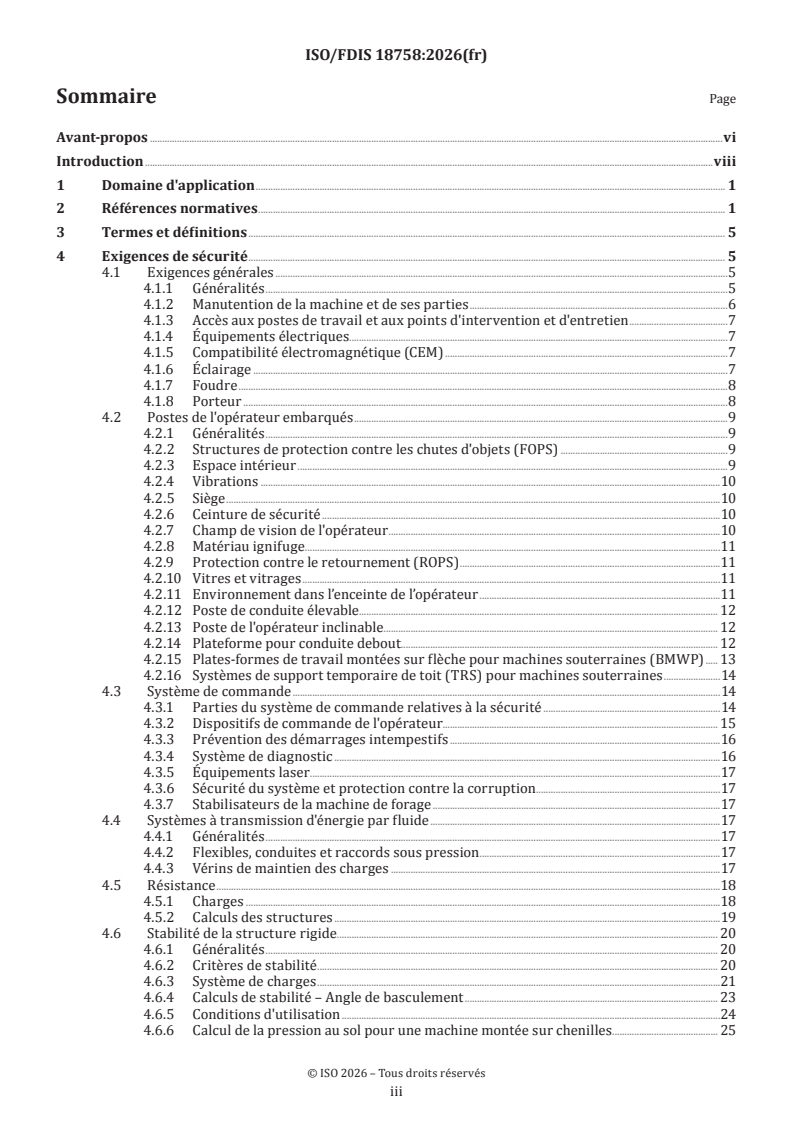
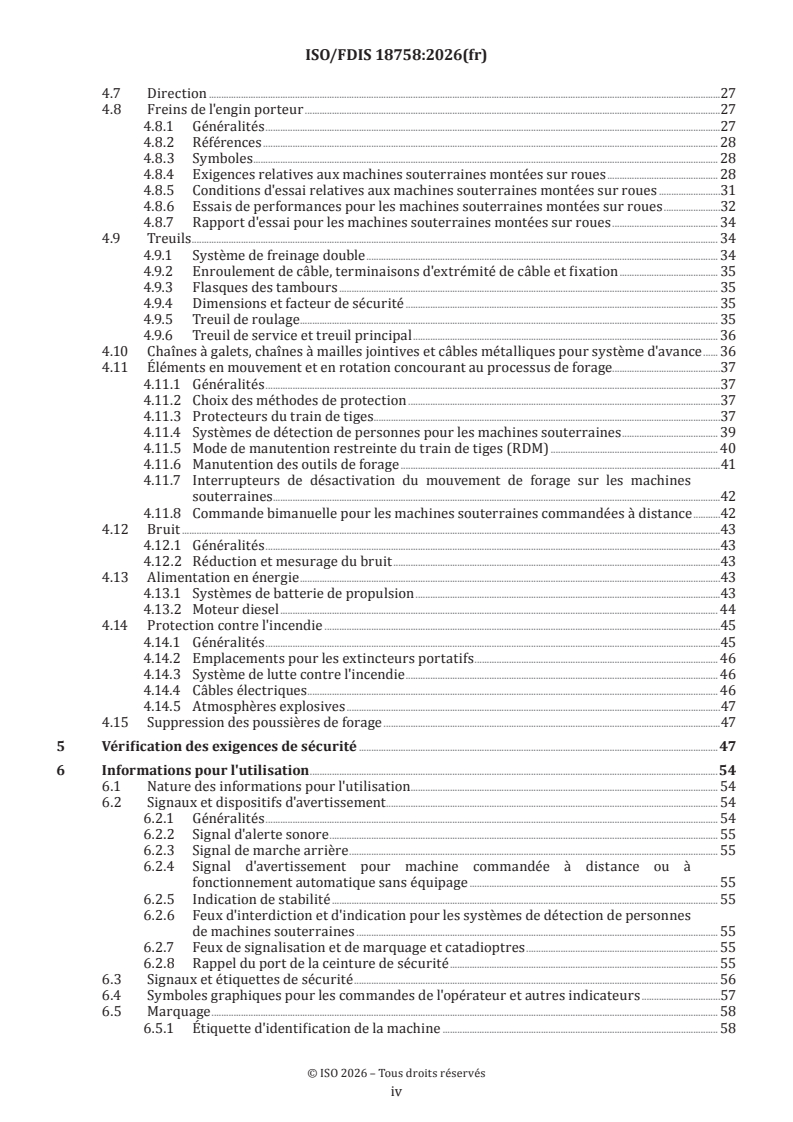
ISO/FDIS 18758 - Engins d'exploitation minière et de terrassement — Machines de forage pour roches et de renfort de roches — Exigences de sécurité
Overview
ISO/FDIS 18758: Mining and earth-moving machinery - Rock drill rigs and rock reinforcement rigs - Safety requirements is an international standard developed by ISO’s Technical Committee for Mining (ISO/TC 82) in cooperation with Earth-moving machinery (ISO/TC 127). This standard sets out comprehensive safety requirements specifically for rock drill rigs and rock reinforcement rigs used in a range of underground and surface operations within the mining and construction sectors. Its purpose is to help manufacturers, suppliers, and end users manage and mitigate hazards associated with these powerful machines, fostering a safer work environment and standardizing best safety practices globally.
Key Topics
Scope of Application:
The standard applies to machines used for:- Blast hole drilling
- Rock reinforcement and consolidation (e.g., bolting, netting, injection holes)
- Secondary breaking
- Dimensional stone drilling
- Mineral prospecting (including core drilling or reverse circulation)
- Water and methane drainage drilling
- Raise boring It specifically covers rigs that may combine two or more functions and those modified from earth-moving machinery as defined in ISO 6165.
Exclusions:
Excluded equipment includes:- Drill rigs for soil and rock mixtures
- Kelly drill rigs, cable tool drill rigs, casing drivers
- Sonic drill rigs, shaft sinking drill rigs, scaling machines
- Specialized rigs such as those for geothermal, water well, micro piling, surface HDD
- Pre-armouring machines, crane or derrick-mounted drill rigs
Safety Requirements:
- Handling, access, and operator stations
- Electrical and fire protection systems
- Control systems, including safety-related parts and diagnostic systems
- Fluid power (hydraulics and pneumatics) and load-holding equipment
- Stability, structural integrity, and braking systems
- Winches, tramming equipment, and rope/wire guidance
- Protection from noise, vibration, dust, and moving or rotating parts
- Signalling, labelling, and operator interface clarity
Information for Use:
- Clear operator and maintenance instructions
- Safety signs, warning devices, and signals
- Procedures for foreseeable misuse or emergencies
- Marking for identification and traceability
Applications
ISO/FDIS 18758 is of practical value in the following contexts:
- Engineering and Manufacturing:
Guides design, production, and modification of rock drill rigs and rock reinforcement rigs to align with internationally recognized safety standards. - Mining and Quarrying Operations:
Ensures operational safety in underground and surface drilling, prospecting, rock stabilization, and resource extraction. - Occupational Health and Safety:
Provides a basis for risk assessments, operator training, and compliance with governmental or regional regulations. - Product Documentation and Instruction:
Informs the development of user manuals, maintenance guides, warning labels, and safety training materials.
By using this standard, organizations can reduce incidents, comply with international best practices, enhance equipment reliability, and improve worker safety.
Related Standards
Key standards referenced or related to ISO/FDIS 18758 include:
- ISO 6165: Earth-moving machinery - Basic types - Identification and terms
- ISO 3411, ISO 5006, ISO 6683: Operator space and field of view for earth-moving machinery
- ISO 3450, ISO 2867, ISO 3449, ISO 3471: Braking performance, access systems, FOPS, and ROPS
- ISO 22932-5: Vocabulary relevant to drilling and tunnelling machinery safety
- ISO 12100: General principles for machinery safety/risk assessment
- ISO 4413, ISO 4414: Safety rules for hydraulic and pneumatic systems
These related standards collectively help standardize safety across heavy machinery used in mining and construction. ISO/FDIS 18758 also aligns with European regulations, referencing CEN harmonization and aligning with essential safety requirements in EU directives.
By adopting ISO/FDIS 18758, stakeholders demonstrate commitment to internationally recognized mining safety practices, risk mitigation, and continuous improvement in machine safety.
Relations
- Effective Date
- 12-Feb-2026
- Effective Date
- 03-Jun-2023
- Effective Date
- 03-Dec-2022
Buy Documents
ISO/FDIS 18758 - Mining and earth-moving machinery — Rock drill rigs and rock reinforcement rigs — Safety requirements/27/2024
ISO/FDIS 18758 - Mining and earth-moving machinery — Rock drill rigs and rock reinforcement rigs — Safety requirements
REDLINE ISO/FDIS 18758 - Mining and earth-moving machinery — Rock drill rigs and rock reinforcement rigs — Safety requirements
ISO/FDIS 18758 - Engins d'exploitation minière et de terrassement — Machines de forage pour roches et de renfort de roches — Exigences de sécurité/22/2025
ISO/FDIS 18758 - Engins d'exploitation minière et de terrassement — Machines de forage pour roches et de renfort de roches — Exigences de sécurité
Get Certified
Connect with accredited certification bodies for this standard

Bureau Veritas Chile
Bureau Veritas certification services in Chile.
Bureau Veritas Peru
Bureau Veritas certification services in Peru.
BVQI Peru
Bureau Veritas certification in Peru.
Sponsored listings
Frequently Asked Questions
ISO/FDIS 18758 is a draft published by the International Organization for Standardization (ISO). Its full title is "Mining and earth-moving machinery — Rock drill rigs and rock reinforcement rigs — Safety requirements". This standard covers: This document specifies the safety requirements for rock drill rigs and rock reinforcement rigs designed for the following underground or surface operations: a) blast hole drilling; b) rock reinforcement; c) drilling for secondary breaking; d) dimensional stone drilling; e) mineral prospecting, e.g. utilizing core drilling or reverse circulation; f) water and methane drainage drilling; g) raise boring. NOTE Rigs can be designed for more than one of the operations above. See ISO 18758-1 for vocabulary. This document is also applicable to earth-moving machinery as defined in ISO 6165, modified to become a rock drill rig or rock reinforcement rig. This document is not applicable to the following machines: drill rigs for soil and rock mixture; (geothermal drill rigs, water well drill rigs, water jet drill rigs, micro pile drill rigs; surface horizontal directional drill rigs (HDD) as defined in ISO 21467), kelly drill rigs (and casing drivers); cable tool drill rigs; pre-armouring machines; sonic drill rigs; shaft sinking drill rigs; crane attached drill rigs; drill rigs on derricks; scaling machines. This document deals with the significant hazards, hazardous situations or hazardous events, as listed in Annex E, relevant to rock drill rigs and rock reinforcement rigs (see ISO 18758‑1), when they are used as intended and under the conditions of misuse which are reasonably foreseeable by the manufacturer. This document is not applicable to rigs manufactured before the date of its publication.
This document specifies the safety requirements for rock drill rigs and rock reinforcement rigs designed for the following underground or surface operations: a) blast hole drilling; b) rock reinforcement; c) drilling for secondary breaking; d) dimensional stone drilling; e) mineral prospecting, e.g. utilizing core drilling or reverse circulation; f) water and methane drainage drilling; g) raise boring. NOTE Rigs can be designed for more than one of the operations above. See ISO 18758-1 for vocabulary. This document is also applicable to earth-moving machinery as defined in ISO 6165, modified to become a rock drill rig or rock reinforcement rig. This document is not applicable to the following machines: drill rigs for soil and rock mixture; (geothermal drill rigs, water well drill rigs, water jet drill rigs, micro pile drill rigs; surface horizontal directional drill rigs (HDD) as defined in ISO 21467), kelly drill rigs (and casing drivers); cable tool drill rigs; pre-armouring machines; sonic drill rigs; shaft sinking drill rigs; crane attached drill rigs; drill rigs on derricks; scaling machines. This document deals with the significant hazards, hazardous situations or hazardous events, as listed in Annex E, relevant to rock drill rigs and rock reinforcement rigs (see ISO 18758‑1), when they are used as intended and under the conditions of misuse which are reasonably foreseeable by the manufacturer. This document is not applicable to rigs manufactured before the date of its publication.
ISO/FDIS 18758 is classified under the following ICS (International Classification for Standards) categories: 53.100 - Earth-moving machinery; 73.100.30 - Equipment for drilling and mine excavation. The ICS classification helps identify the subject area and facilitates finding related standards.
ISO/FDIS 18758 has the following relationships with other standards: It is inter standard links to FprEN ISO 18758, ISO 18758-1:2018, ISO 18758-2:2018. Understanding these relationships helps ensure you are using the most current and applicable version of the standard.
ISO/FDIS 18758 is available in PDF format for immediate download after purchase. The document can be added to your cart and obtained through the secure checkout process. Digital delivery ensures instant access to the complete standard document.
Standards Content (Sample)
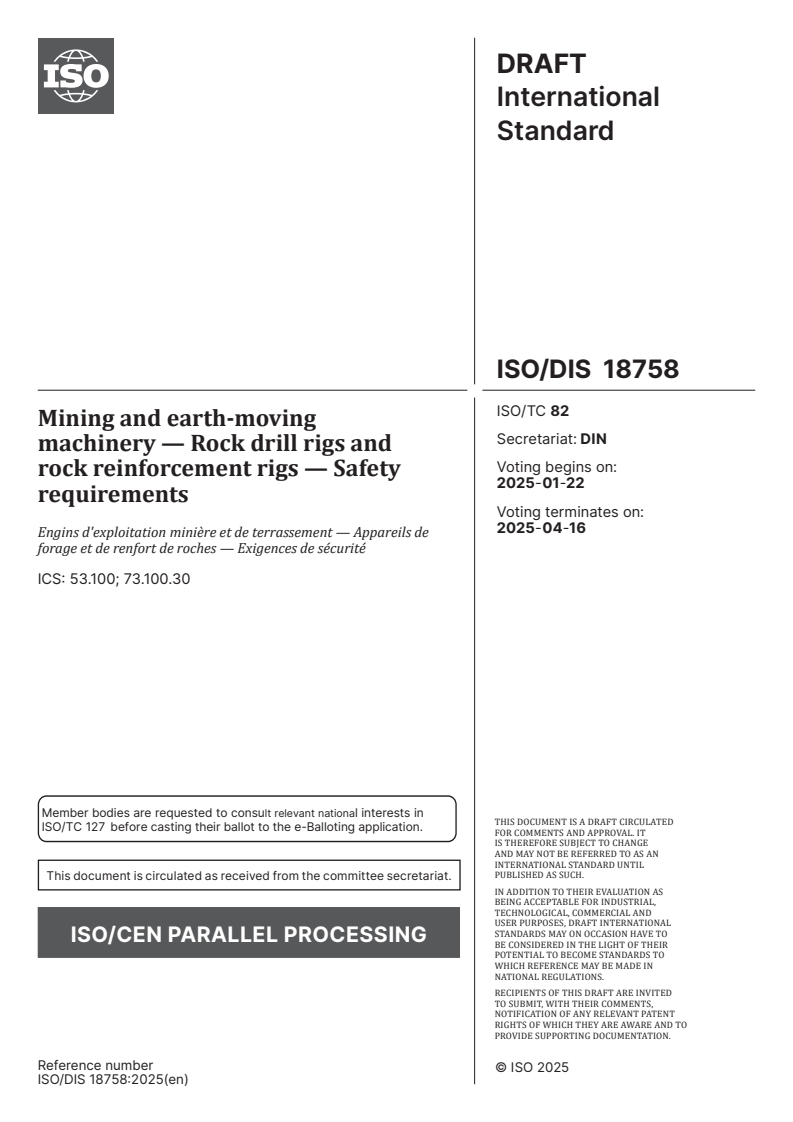
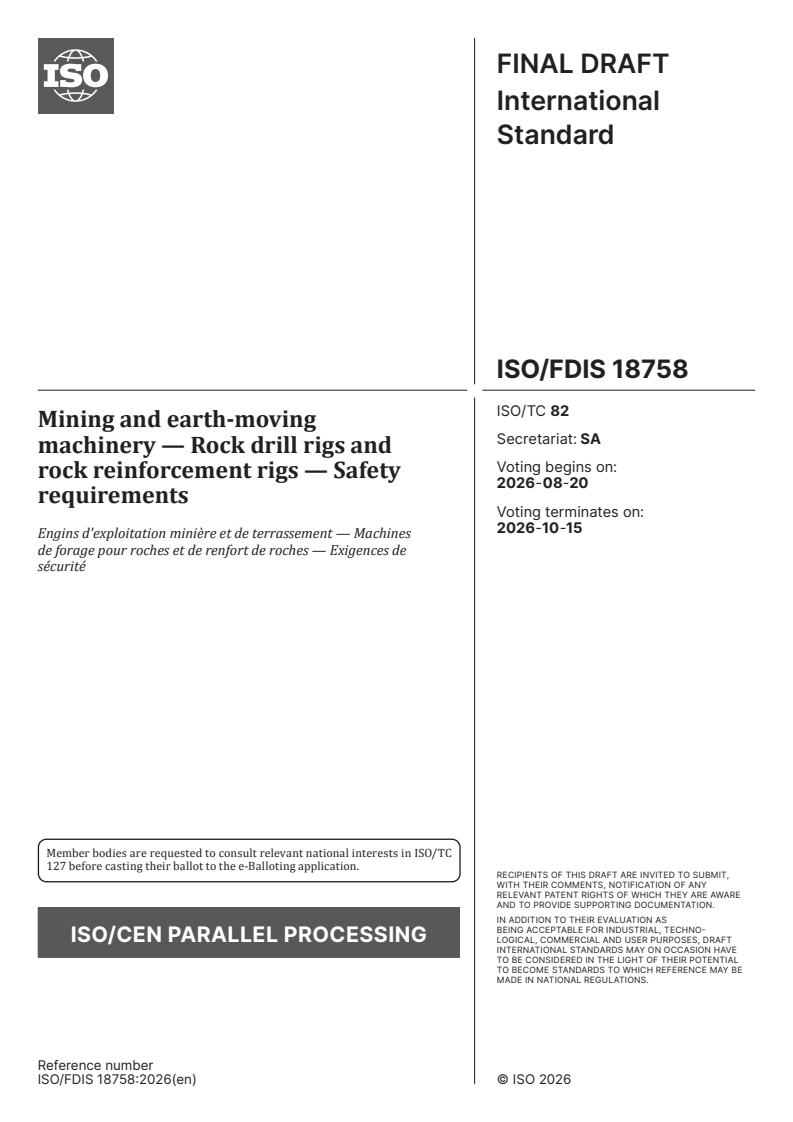
DRAFT
International
Standard
ISO/DIS 18758
ISO/TC 82
Mining and earth-moving
Secretariat: DIN
machinery — Rock drill rigs and
Voting begins on:
rock reinforcement rigs — Safety
2025-01-22
requirements
Voting terminates on:
2025-04-16
Engins d'exploitation minière et de terrassement — Appareils de
forage et de renfort de roches — Exigences de sécurité
ICS: 53.100; 73.100.30
Member bodies are requested to consult relevant national interests in
THIS DOCUMENT IS A DRAFT CIRCULATED
ISO/TC 127 before casting their ballot to the e-Balloting application.
FOR COMMENTS AND APPROVAL. IT
IS THEREFORE SUBJECT TO CHANGE
AND MAY NOT BE REFERRED TO AS AN
INTERNATIONAL STANDARD UNTIL
PUBLISHED AS SUCH.
This document is circulated as received from the committee secretariat.
IN ADDITION TO THEIR EVALUATION AS
BEING ACCEPTABLE FOR INDUSTRIAL,
TECHNOLOGICAL, COMMERCIAL AND
USER PURPOSES, DRAFT INTERNATIONAL
STANDARDS MAY ON OCCASION HAVE TO
ISO/CEN PARALLEL PROCESSING
BE CONSIDERED IN THE LIGHT OF THEIR
POTENTIAL TO BECOME STANDARDS TO
WHICH REFERENCE MAY BE MADE IN
NATIONAL REGULATIONS.
RECIPIENTS OF THIS DRAFT ARE INVITED
TO SUBMIT, WITH THEIR COMMENTS,
NOTIFICATION OF ANY RELEVANT PATENT
RIGHTS OF WHICH THEY ARE AWARE AND TO
PROVIDE SUPPORTING DOCUMENTATION.
Reference number
ISO/DIS 18758:2025(en)
DRAFT
ISO/DIS 18758:2025(en)
International
Standard
ISO/DIS 18758
ISO/TC 82
Mining and earth-moving
Secretariat: DIN
machinery — Rock drill rigs and
Voting begins on:
rock reinforcement rigs — Safety
requirements
Voting terminates on:
Engins d'exploitation minière et de terrassement — Appareils de
forage et de renfort de roches — Exigences de sécurité
ICS: 53.100; 73.100.30
THIS DOCUMENT IS A DRAFT CIRCULATED
FOR COMMENTS AND APPROVAL. IT
IS THEREFORE SUBJECT TO CHANGE
AND MAY NOT BE REFERRED TO AS AN
INTERNATIONAL STANDARD UNTIL
PUBLISHED AS SUCH.
This document is circulated as received from the committee secretariat.
IN ADDITION TO THEIR EVALUATION AS
BEING ACCEPTABLE FOR INDUSTRIAL,
© ISO 2025
TECHNOLOGICAL, COMMERCIAL AND
USER PURPOSES, DRAFT INTERNATIONAL
All rights reserved. Unless otherwise specified, or required in the context of its implementation, no part of this publication may
STANDARDS MAY ON OCCASION HAVE TO
ISO/CEN PARALLEL PROCESSING
be reproduced or utilized otherwise in any form or by any means, electronic or mechanical, including photocopying, or posting on
BE CONSIDERED IN THE LIGHT OF THEIR
the internet or an intranet, without prior written permission. Permission can be requested from either ISO at the address below
POTENTIAL TO BECOME STANDARDS TO
WHICH REFERENCE MAY BE MADE IN
or ISO’s member body in the country of the requester.
NATIONAL REGULATIONS.
ISO copyright office
RECIPIENTS OF THIS DRAFT ARE INVITED
CP 401 • Ch. de Blandonnet 8
TO SUBMIT, WITH THEIR COMMENTS,
CH-1214 Vernier, Geneva
NOTIFICATION OF ANY RELEVANT PATENT
Phone: +41 22 749 01 11
RIGHTS OF WHICH THEY ARE AWARE AND TO
PROVIDE SUPPORTING DOCUMENTATION.
Email: copyright@iso.org
Website: www.iso.org
Published in Switzerland Reference number
ISO/DIS 18758:2025(en)
ii
ISO/DIS 18758:2025(en)
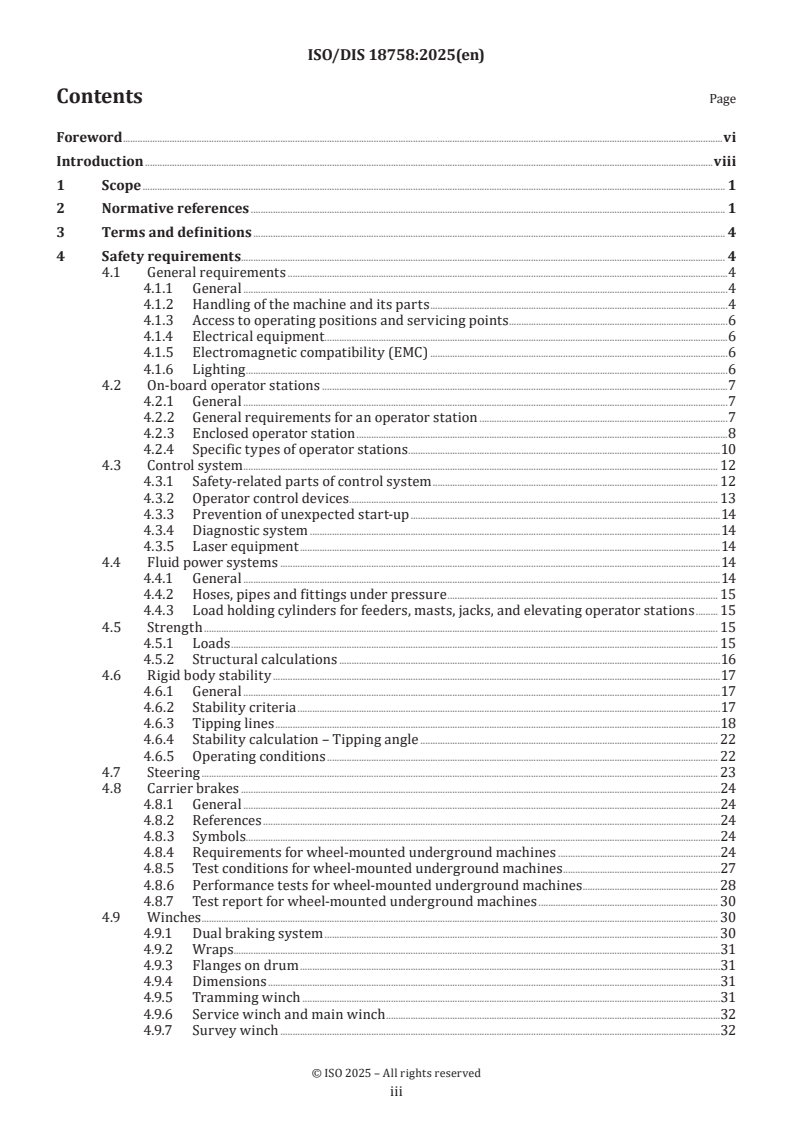
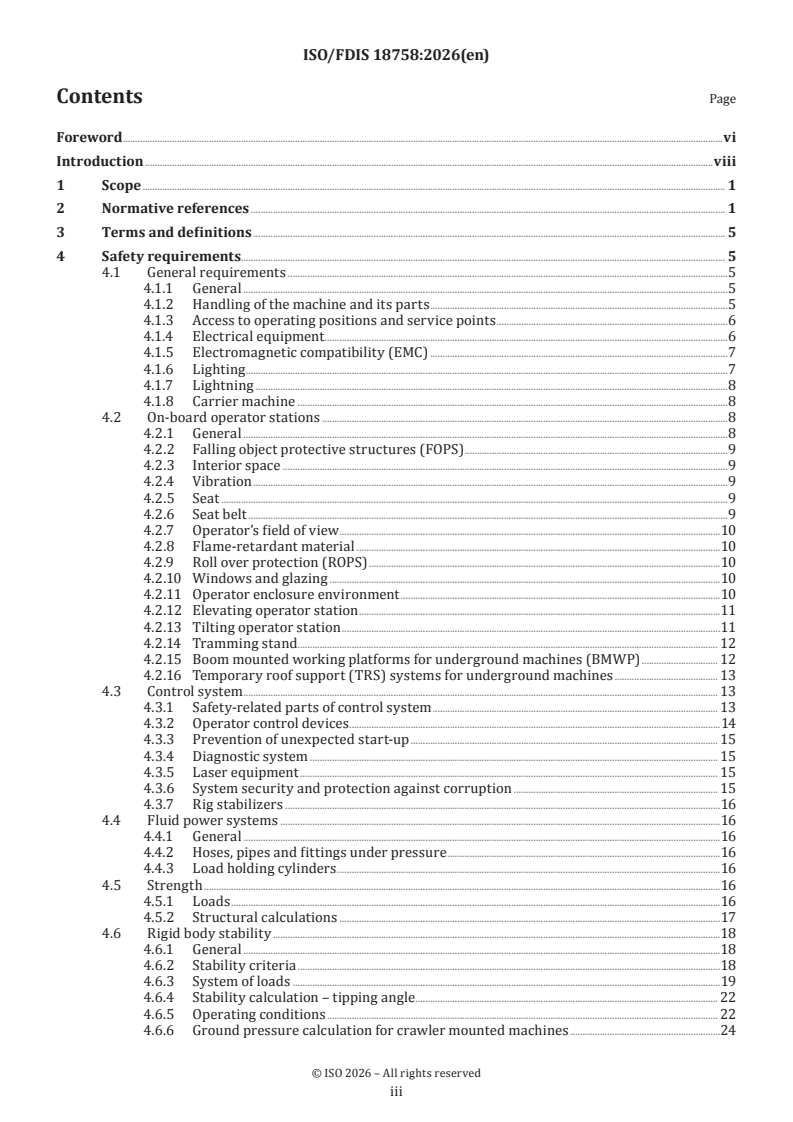
Contents Page
Foreword .vi
Introduction .viii
1 Scope . 1
2 Normative references . 1
3 Terms and definitions . 4
4 Safety requirements. 4
4.1 General requirements .4
4.1.1 General .4
4.1.2 Handling of the machine and its parts .4
4.1.3 Access to operating positions and servicing points .6
4.1.4 Electrical equipment .6
4.1.5 Electromagnetic compatibility (EMC) .6
4.1.6 Lighting .6
4.2 On-board operator stations .7
4.2.1 General .7
4.2.2 General requirements for an operator station .7
4.2.3 Enclosed operator station .8
4.2.4 Specific types of operator stations.10
4.3 Control system . 12
4.3.1 Safety-related parts of control system . 12
4.3.2 Operator control devices . 13
4.3.3 Prevention of unexpected start-up .14
4.3.4 Diagnostic system .14
4.3.5 Laser equipment .14
4.4 Fluid power systems .14
4.4.1 General .14
4.4.2 Hoses, pipes and fittings under pressure . 15
4.4.3 Load holding cylinders for feeders, masts, jacks, and elevating operator stations . 15
4.5 Strength . 15
4.5.1 Loads . 15
4.5.2 Structural calculations .16
4.6 Rigid body stability .17
4.6.1 General .17
4.6.2 Stability criteria .17
4.6.3 Tipping lines .18
4.6.4 Stability calculation – Tipping angle . 22
4.6.5 Operating conditions . 22
4.7 Steering . 23
4.8 Carrier brakes .24
4.8.1 General .24
4.8.2 References .24
4.8.3 Symbols.24
4.8.4 Requirements for wheel-mounted underground machines .24
4.8.5 Test conditions for wheel-mounted underground machines .27
4.8.6 Performance tests for wheel-mounted underground machines . 28
4.8.7 Test report for wheel-mounted underground machines . 30
4.9 Winches . 30
4.9.1 Dual braking system . 30
4.9.2 Wraps.31
4.9.3 Flanges on drum .31
4.9.4 Dimensions .31
4.9.5 Tramming winch .31
4.9.6 Service winch and main winch .32
4.9.7 Survey winch .32
iii
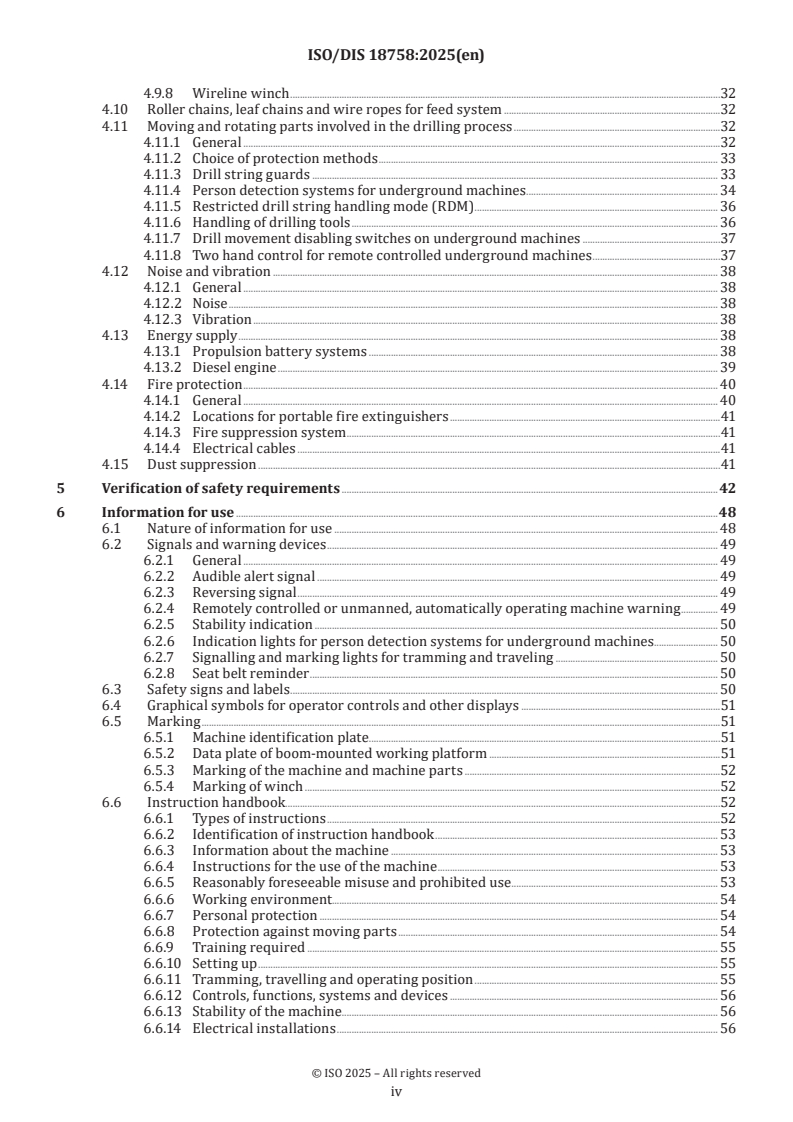
ISO/DIS 18758:2025(en)
4.9.8 Wireline winch .32
4.10 Roller chains, leaf chains and wire ropes for feed system .32
4.11 Moving and rotating parts involved in the drilling process .32
4.11.1 General .32
4.11.2 Choice of protection methods . 33
4.11.3 Drill string guards . 33
4.11.4 Person detection systems for underground machines . . 34
4.11.5 Restricted drill string handling mode (RDM) . 36
4.11.6 Handling of drilling tools . 36
4.11.7 Drill movement disabling switches on underground machines .37
4.11.8 Two hand control for remote controlled underground machines .37
4.12 Noise and vibration . 38
4.12.1 General . 38
4.12.2 Noise . 38
4.12.3 Vibration . 38
4.13 Energy supply . 38
4.13.1 Propulsion battery systems . 38
4.13.2 Diesel engine . 39
4.14 Fire protection . 40
4.14.1 General . 40
4.14.2 Locations for portable fire extinguishers .41
4.14.3 Fire suppression system .41
4.14.4 Electrical cables .41
4.15 Dust suppression .41
5 Verification of safety requirements .42
6 Information for use .48
6.1 Nature of information for use . 48
6.2 Signals and warning devices . 49
6.2.1 General . 49
6.2.2 Audible alert signal . 49
6.2.3 Reversing signal . 49
6.2.4 Remotely controlled or unmanned, automatically operating machine warning . 49
6.2.5 Stability indication . 50
6.2.6 Indication lights for person detection systems for underground machines. 50
6.2.7 Signalling and marking lights for tramming and traveling . 50
6.2.8 Seat belt reminder . 50
6.3 Safety signs and labels . . 50
6.4 Graphical symbols for operator controls and other displays .51
6.5 Marking .51
6.5.1 Machine identification plate.51
6.5.2 Data plate of boom-mounted working platform .51
6.5.3 Marking of the machine and machine parts .52
6.5.4 Marking of winch .52
6.6 Instruction handbook.52
6.6.1 Types of instructions .52
6.6.2 Identification of instruction handbook . 53
6.6.3 Information about the machine . 53
6.6.4 Instructions for the use of the machine . 53
6.6.5 Reasonably foreseeable misuse and prohibited use . 53
6.6.6 Working environment. 54
6.6.7 Personal protection . 54
6.6.8 Protection against moving parts . 54
6.6.9 Training required . 55
6.6.10 Setting up . 55
6.6.11 Tramming, travelling and operating position . 55
6.6.12 Controls, functions, systems and devices . 56
6.6.13 Stability of the machine. 56
6.6.14 Electrical installations . 56
iv
ISO/DIS 18758:2025(en)
6.6.15 Machines powered by diesel engine . 56
6.6.16 Noise and vibration . 56
6.6.17 Winches and ropes.57
6.6.18 Machines for underground operation .57
6.6.19 Instructions for two-person operation .57
6.6.20 Information for emergency situations . 58
6.6.21 Transport instructions . 58
6.6.22 Assembly instructions . . 58
6.6.23 Maintenance instructions . 58
6.6.24 Instructions for maintenance by two service technicians .59
6.6.25 Spare parts list . 60
6.6.26 Disassembling, disabling and scrapping . 60
6.6.27 Vocabulary for the instruction handbook . 60
Annex A (normative) Noise test code . 61
Annex B (normative) Whole-body and hand-arm vibration test .68
Annex C (informative) List of significant hazards .70
Annex ZA (informative) Relationship between this European Standard and the essential
requirements of Directive 2006/42/EC aimed to be covered .72
Annex ZB (informative) Relationship between this European Standard and the essential
requirements of Regulation (EU) 2023/1230 aimed to be covered .89
Bibliography .101
v
ISO/DIS 18758:2025(en)
Foreword
ISO (the International Organization for Standardization) is a worldwide federation of national standards
bodies (ISO member bodies). The work of preparing International Standards is normally carried out through
ISO technical committees. Each member body interested in a subject for which a technical committee
has been established has the right to be represented on that committee. International organizations,
governmental and non-governmental, in liaison with ISO, also take part in the work. ISO collaborates closely
with the International Electrotechnical Commission (IEC) on all matters of electrotechnical standardization.
The procedures used to develop this document and those intended for its further maintenance are described
in the ISO/IEC Directives, Part 1. In particular, the different approval criteria needed for the different types
of ISO documents should be noted. This document was drafted in accordance with the editorial rules of the
ISO/IEC Directives, Part 2 (see www.iso.org/directives).
ISO draws attention to the possibility that the implementation of this document may involve the use of (a)
patent(s). ISO takes no position concerning the evidence, validity or applicability of any claimed patent
rights in respect thereof. As of the date of publication of this document, ISO had not received notice of (a)
patent(s) which may be required to implement this document. However, implementers are cautioned that
this may not represent the latest information, which may be obtained from the patent database available at
www.iso.org/patents. ISO shall not be held responsible for identifying any or all such patent rights.
Any trade name used in this document is information given for the convenience of users and does not
constitute an endorsement.
For an explanation of the voluntary nature of standards, the meaning of ISO specific terms and expressions
related to conformity assessment, as well as information about ISO's adherence to the World Trade
Organization (WTO) principles in the Technical Barriers to Trade (TBT), see www.iso.org/iso/foreword.html.
This document was prepared by Technical Committee ISO/TC 82, Mining, in cooperation with Technical
Committee ISO/TC 127, Earth-moving machinery.
This edition of ISO 18758 cancels and replaces ISO 18758-1:2018 and ISO 18758-2:2018.
In addition to several editorial changes, the main revisions with respect to the previous edition
(ISO 18758-2:2018) are as follows:
a) This document has been revised under the Vienna agreement in cooperation with CEN/TC 196;
b) The short-form term rig in this document has been replaced with the term machine to provide
consistency with other machinery safety standards;
c) The scope exclusions have been simplified and clarified. Most of the machines excluded are within the
scope of the ISO 20770 series;
d) The vocabulary of ISO 18758-1:2018 has been moved to ISO 22932-5, which has been revised to include
new vocabulary;
e) Internal references within this document have been updated, including Annex C on significant hazards;
f) Repeated requirements have been deleted;
g) Requirements for laser equipment have been added;
h) Requirements for propulsion batteries have been added;
i) Requirements for strength and stability have been revised;
j) The carrier brake requirements have been revised to align more closely with ISO 3450;
k) Winch and rope requirements have been revised;
l) Revised requirements on the protection of moving parts.
vi
ISO/DIS 18758:2025(en)
m) The requirements for the location for mounting fire extinguishers have been clarified;
n) A verification table has been added to Clause 5;
o) The content of clause 6 has been adapted from ISO 12100:2010, 6.4 and expanded to apply to rock drill rigs.
p) The requirements on signals and warning devices have been adapted from ISO 12100:2010, 6.4.3.
q) Annex ZA has been added to the CEN version, complying with CEN guide 414:2017, Option C;
r) Annex ZB has been added to the CEN version to harmonise with the European Machinery regulation.
s) The bibliography has been restructured under headings corresponding to the topics covered, often
relating to the names of the TCs that drafted them;
Any feedback or questions on this document should be directed to the user’s national standards body. A
complete listing of these bodies can be found at www.iso.org/members.html.
European foreword
This document has been prepared under a standardisation request addressed to CEN by the European
Commission. The Standing Committee of the EFTA States subsequently approves these requests for its
Member States.
For the relationship with EU Legislation, see informative Annex ZA and ZB, which is an integral part of this
document.
vii
ISO/DIS 18758:2025(en)
Introduction
This document is a type C standard as stated in ISO 12100:2010.
This document is of relevance, in particular, for the following stakeholder groups representing the market
players with regard to machinery safety:
— machine manufacturers;
— mining companies;
— health and safety bodies (regulators, accident prevention organisations, market surveillance, etc.).
Others that can be affected by the level of machinery safety achieved with the means of the document by the
above-mentioned stakeholder groups are:
— machine operators;
— service providers, e.g. for maintenance;
— third party system and technology providers.
The above-mentioned stakeholder groups have been given the possibility to participate at the drafting
process of this document.
The machinery concerned and the extent to which hazards, hazardous situations or hazardous events are
covered are indicated in the scope of this document.
The vocabulary of ISO 22932-5 is essential for the understanding of the safety requirements of this document.
When requirements of this type C standard are different from those which are stated in type A or B
standards, the requirements of this type C standard take precedence over the requirements of the other
standards, for rock drill rigs and rock reinforcement drills that have been designed and built according to
the requirements of this type C standard.
The following assumptions were made in writing this document:
a) the operators of the machines are well trained professionals and aware of potential risks of using the
machine in the working environment, including the hazards of reasonably foreseeable misuse (See ISO/
IEC GUIDE 51:2014, 6.1 a), b));
b) the machines are operated and maintained according to the instructions given by the manufacturer,
such as operator's instructions (See ISO/IEC GUIDE 51:2014, 7.4.2.2);
c) that administrative controls are in place for preventing unauthorized entry of persons to the area where
machines are working (See ISO/IEC GUIDE 51:2014, 6.2.2 and note).
For increased readability of this document, rock drill rigs and rock reinforcement rigs are called machines
from clause 4 onwards unless the specific term is needed for emphasis or clarity.
viii
DRAFT International Standard ISO/DIS 18758:2025(en)
Mining and earth-moving machinery — Rock drill rigs and
rock reinforcement rigs — Safety requirements
1 Scope
This document specifies the safety requirements for rock drill rigs and rock reinforcement rigs designed for
the following underground or surface operations:
a) blast hole drilling;
b) rock reinforcement and consolidation (injection holes, pipe roofing, netting, bolting);
c) drilling for secondary breaking;
d) dimensional stone drilling;
e) mineral prospecting, e.g. utilizing core drilling or reverse circulation drilling;
f) water and methane drainage drilling;
g) raise boring;
when used by a well-trained operator in accordance with the information for use and where sufficient
measures have been taken to prevent unauthorized entry of persons to the area where machines are
working.
NOTE Machines can be designed for more than one of the operations above. See ISO 22932-4 and ISO 22932-5 for
vocabulary.
This document is also applicable to rock drill rigs and rock reinforcement rigs based on earth-moving
machinery (EMM) as defined in ISO 6165.
NOTE When requirements of this type-C standard are different from those which are stated in EMM standards,
the requirements of this type-C standard take precedence over the requirements of the EMM standards for machines
that have been designed and built according to the requirements of this type-C standard.
This document is not applicable to the following machines: drill rigs for soil and rock mixture, Kelly drill
rigs and casing drivers, cable tool drill rigs, pre-armouring machines, sonic drill rigs; shaft sinking drill rigs,
crane attached drill rigs, drill rigs on derricks, scaling machines.
This document does not cover machines on railway tracks, artificial intelligence, autonomous systems, self-
evolving systems, cyber security, lightning, protection against corruption, malicious attempts from third
parties, or potentially explosive atmospheres.
This document deals with the relevant and significant hazards, hazardous situations, or hazardous events,
as listed in Annex C, when the machine is used as intended and under the conditions of misuse which are
reasonably foreseeable by the manufacturer.
This document is not applicable to machines manufactured before the date of its publication.
2 Normative references
The following documents are referred to in the text in such a way that some or all of their content constitutes
requirements of this document. For dated references, only the edition cited applies. For undated references,
the latest edition of the referenced document (including any amendments) applies.
ISO/DIS 18758:2025(en)
ISO 2631-1, Mechanical vibration and shock — Evaluation of human exposure to whole-body vibration — Part 1:
General requirements
ISO 2860, Earth-moving machinery — Minimum access dimensions
ISO 2867, Earth-moving machinery — Access systems
ISO 3411:2007, Earth-moving machinery — Physical dimensions of operators and minimum operator space
envelope
ISO 3449, Earth-moving machinery — Falling-object protective structures — Laboratory tests and performance
requirements
ISO 3450:2011, Earth-moving machinery — Wheeled or high-speed rubber-tracked machines — Performance
requirements and test procedures for brake systems
ISO 3457, Earth-moving machinery — Guards — Definitions and requirements
ISO 3471, Earth-moving machinery — Roll-over protective structures — Laboratory tests and performance
requirements
ISO 3795, Road vehicles, and tractors and machinery for agriculture and forestry — Determination of burning
behaviour of interior materials
ISO 3864 (all parts), Graphical symbols — Safety colours and safety signs
ISO 4302, Cranes — Wind load assessment
ISO 4413, Hydraulic fluid power — General rules and safety requirements for systems and their components
ISO 4414, Pneumatic fluid power — General rules and safety requirements for systems and their components
ISO 4871, Acoustics — Declaration and verification of noise emission values of machinery and equipment
ISO 5006, Earth-moving machinery — Operator's field of view — Test method and performance criteria
ISO 5010, Earth-moving machinery — Wheeled machines — Steering requirements
ISO 6405 (all parts), Earth-moving machinery — Symbols for operator controls and other displays
ISO 6683, Earth-moving machinery — Seat belts and seat belt anchorages — Performance requirements and tests
ISO 7000, Graphical symbols for use on equipment — Registered symbols
ISO 7010, Graphical symbols — Safety colours and safety signs — Registered safety signs
ISO 7731, Ergonomics — Danger signals for public and work areas — Auditory danger signals
ISO 9244, Earth-moving machinery — Machine safety labels — General principles
ISO 9533, Earth-moving machinery — Machine-mounted audible travel alarms and forward horns — Test
methods and performance criteria
ISO 10265, Earth-moving machinery — Crawler machines — Performance requirements and test procedures for
braking systems
ISO 10532, Earth-moving machinery — Machine-mounted retrieval device — Performance requirements
ISO 10570, Earth-moving machinery — Articulated frame lock — Performance requirements
ISO 10968, Earth-moving machinery — Operator's controls
ISO 11201:2010, Acoustics — Noise emitted by machinery and equipment — Determination of emission sound
pressure levels at a work station and at other specified positions in an essentially free field over a reflecting
plane with negligible environmental corrections
ISO/DIS 18758:2025(en)
ISO 12100, Safety of machinery — General principles for design — Risk assessment and risk reduction
ISO 12509, Earth-moving machinery and rough-terrain trucks — Lighting, signalling and marking lights, and
reflex reflectors
ISO 13766-1, Earth-moving and building construction machinery — Electromagnetic compatibility (EMC)
of machines with internal electrical power supply — Part 1: General EMC requirements under typical
electromagnetic environmental conditions
ISO 13766-2, Earth-moving and building construction machinery — Electromagnetic compatibility (EMC) of
machines with internal electrical power supply — Part 2: Additional EMC requirements for functional safety
ISO 13849-1, Safety of machinery — Safety-related parts of control systems — Part 1: General principles for design
ISO 13849-2, Safety of machinery — Safety-related parts of control systems — Part 2: Validation
ISO 13850, Safety of machinery — Emergency stop function — Principles for design
ISO 13851, Safety of machinery — Two-hand control devices — Principles for design and selection
ISO 13856-2, Safety of machinery — Pressure-sensitive protective devices — Part 2: General principles for
design and testing of pressure-sensitive edges and pressure-sensitive bars
ISO 13856-3, Safety of machinery — Pressure-sensitive protective devices — Part 3: General principles for
design and testing of pressure-sensitive bumpers, plates, wires and similar devices
ISO 14118, Safety of machinery — Prevention of unexpected start-up
ISO 14119, Safety of machinery — Interlocking devices associated with guards — Principles for design and
selection
ISO 14120, Safety of machinery — Guards — General requirements for the design and construction of fixed and
movable guards
ISO 15817, Earth-moving machinery — Safety requirements for remote operator control systems
ISO 15818, Earth-moving machinery — Lifting and tying-down attachment points — Performance requirements
ISO 16368, Mobile elevating work platforms — Design, calculations, safety requirements and test methods
ISO 22932-5, Mining — Vocabulary — Part 5: Drilling and blasting
ISO 23875, Mining — Air quality control systems for operator enclosures — Performance requirements and
test methods
IEC 60204-1, Safety of machinery — Electrical equipment of machines — Part 1: General requirements
IEC 60204-11, Safety of machinery — Electrical equipment of machines — Part 11: Requirements for equipment
for voltages above 1 000 V AC or 1 500 V DC and not exceeding 36 kV
IEC 61000-6-2, Electromagnetic compatibility (EMC) — Part 6–2: Generic standards — Immunity for industrial
environments
IEC 61000-6-4, Electromagnetic compatibility (EMC) — Part 6–4: Generic standards — Emission standard for
industrial environments
IEC 60825-1, Safety of laser products — Part 1: Equipment classification and requirements
IEC 61310-1, Safety of machinery — Indication, marking and actuation — Part 1: Requirements for visual,
acoustic and tactile signals
IEC 61310-2, Safety of machinery — Indication, marking and actuation — Part 2: Requirements for marking
IEC 61851-1, Electric vehicle conductive charging system — Part 1: General requirements
ISO/DIS 18758:2025(en)
IEC 62196 (all parts), Plugs, socket-outlets, vehicle connectors and vehicle inlets — Conductive charging of
electric vehicles
IEC 62485-6, Safety requirements for secondary batteries and battery installations — Part 6: Safe operation of
lithium-ion batteries in traction applications
IEC 62619, Secondary cells and batteries containing alkaline or other non-acid electrolytes — Safety
requirements for secondary lithium cells and batte
...
FINAL DRAFT
International
Standard
ISO/TC 82
Mining and earth-moving
Secretariat: SA
machinery — Rock drill rigs and
Voting begins on:
rock reinforcement rigs — Safety
2026-08-20
requirements
Voting terminates on:
2026-10-15
Engins d'exploitation minière et de terrassement — Machines
de forage pour roches et de renfort de roches — Exigences de
sécurité
Member bodies are requested to consult relevant national interests in ISO/TC
127 before casting their ballot to the e-Balloting application.
RECIPIENTS OF THIS DRAFT ARE INVITED TO SUBMIT,
WITH THEIR COMMENTS, NOTIFICATION OF ANY
RELEVANT PATENT RIGHTS OF WHICH THEY ARE AWARE
AND TO PROVIDE SUPPOR TING DOCUMENTATION.
IN ADDITION TO THEIR EVALUATION AS
BEING ACCEPTABLE FOR INDUSTRIAL, TECHNO
ISO/CEN PARALLEL PROCESSING LOGICAL, COMMERCIAL AND USER PURPOSES, DRAFT
INTERNATIONAL STANDARDS MAY ON OCCASION HAVE
TO BE CONSIDERED IN THE LIGHT OF THEIR POTENTIAL
TO BECOME STAN DARDS TO WHICH REFERENCE MAY BE
MADE IN NATIONAL REGULATIONS.
Reference number
FINAL DRAFT
International
Standard
ISO/TC 82
Mining and earth-moving
Secretariat: SA
machinery — Rock drill rigs and
Voting begins on:
rock reinforcement rigs — Safety
requirements
Voting terminates on:
Engins d'exploitation minière et de terrassement — Machines
de forage pour roches et de renfort de roches — Exigences de
sécurité
Member bodies are requested to consult relevant national interests in ISO/TC
127 before casting their ballot to the e-Balloting application.
RECIPIENTS OF THIS DRAFT ARE INVITED TO SUBMIT,
WITH THEIR COMMENTS, NOTIFICATION OF ANY
RELEVANT PATENT RIGHTS OF WHICH THEY ARE AWARE
AND TO PROVIDE SUPPOR TING DOCUMENTATION.
© ISO 2026
IN ADDITION TO THEIR EVALUATION AS
All rights reserved. Unless otherwise specified, or required in the context of its implementation, no part of this publication may
BEING ACCEPTABLE FOR INDUSTRIAL, TECHNO
ISO/CEN PARALLEL PROCESSING
LOGICAL, COMMERCIAL AND USER PURPOSES, DRAFT
be reproduced or utilized otherwise in any form or by any means, electronic or mechanical, including photocopying, or posting on
INTERNATIONAL STANDARDS MAY ON OCCASION HAVE
the internet or an intranet, without prior written permission. Permission can be requested from either ISO at the address below
TO BE CONSIDERED IN THE LIGHT OF THEIR POTENTIAL
or ISO’s member body in the country of the requester.
TO BECOME STAN DARDS TO WHICH REFERENCE MAY BE
MADE IN NATIONAL REGULATIONS.
ISO copyright office
CP 401 • Ch. de Blandonnet 8
CH-1214 Vernier, Geneva
Phone: +41 22 749 01 11
Email: copyright@iso.org
Website: www.iso.org
Published in Switzerland Reference number
ii
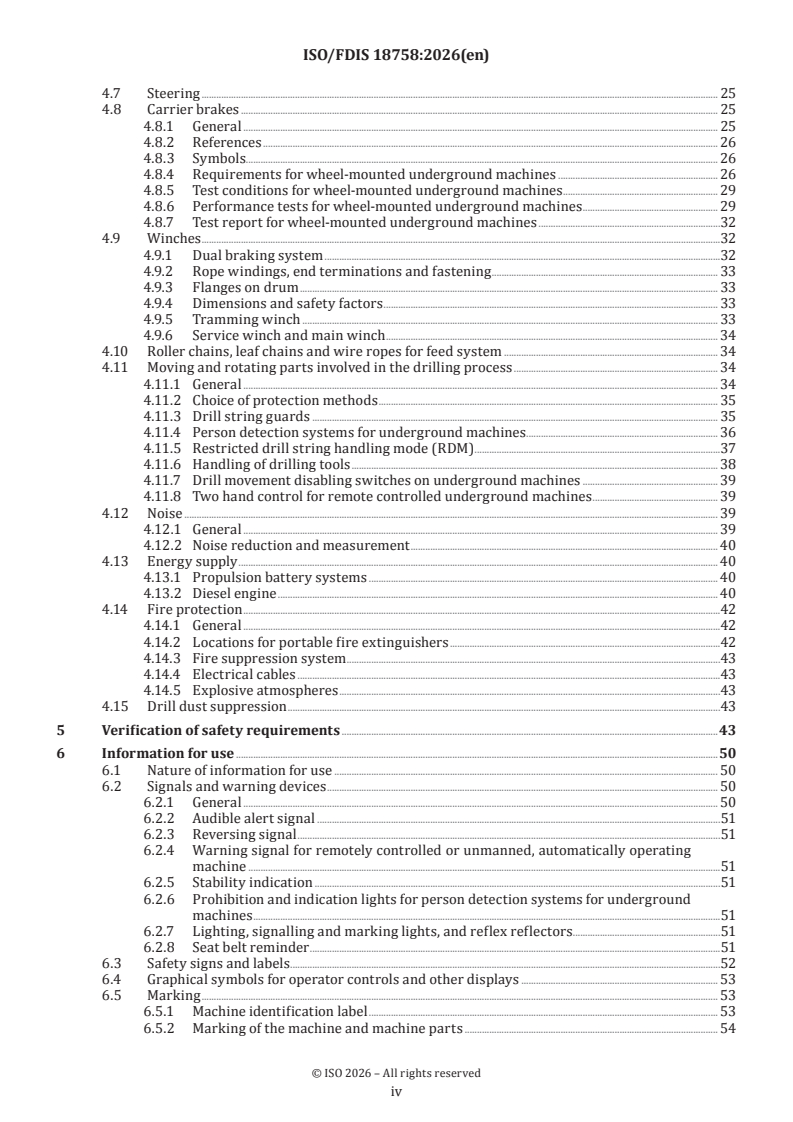
Contents Page
Foreword .vi
Introduction .viii
1 Scope . 1
2 Normative references . 1
3 Terms and definitions . 5
4 Safety requirements. 5
4.1 General requirements .5
4.1.1 General .5
4.1.2 Handling of the machine and its parts .5
4.1.3 Access to operating positions and service points .6
4.1.4 Electrical equipment .6
4.1.5 Electromagnetic compatibility (EMC) .7
4.1.6 Lighting .7
4.1.7 Lightning .8
4.1.8 Carrier machine .8
4.2 On-board operator stations .8
4.2.1 General .8
4.2.2 Falling object protective structures (FOPS) .9
4.2.3 Interior space .9
4.2.4 Vibration .9
4.2.5 Seat .9
4.2.6 Seat belt .9
4.2.7 Operator’s field of view . .10
4.2.8 Flame-retardant material .10
4.2.9 Roll over protection (ROPS) .10
4.2.10 Windows and glazing .10
4.2.11 Operator enclosure environment .10
4.2.12 Elevating operator station .11
4.2.13 Tilting operator station .11
4.2.14 Tramming stand . . 12
4.2.15 Boom mounted working platforms for underground machines (BMWP) . 12
4.2.16 Temporary roof support (TRS) systems for underground machines . 13
4.3 Control system . 13
4.3.1 Safety-related parts of control system . 13
4.3.2 Operator control devices .14
4.3.3 Prevention of unexpected start-up . 15
4.3.4 Diagnostic system . 15
4.3.5 Laser equipment . 15
4.3.6 System security and protection against corruption . 15
4.3.7 Rig stabilizers .16
4.4 Fluid power systems .16
4.4.1 General .16
4.4.2 Hoses, pipes and fittings under pressure .16
4.4.3 Load holding cylinders .16
4.5 Strength .16
4.5.1 Loads .16
4.5.2 Structural calculations .17
4.6 Rigid body stability .18
4.6.1 General .18
4.6.2 Stability criteria .18
4.6.3 System of loads .19
4.6.4 Stability calculation – tipping angle . 22
4.6.5 Operating conditions . 22
4.6.6 Ground pressure calculation for crawler mounted machines .24
iii
4.7 Steering . 25
4.8 Carrier brakes . 25
4.8.1 General . 25
4.8.2 References . 26
4.8.3 Symbols. 26
4.8.4 Requirements for wheel-mounted underground machines . 26
4.8.5 Test conditions for wheel-mounted underground machines . 29
4.8.6 Performance tests for wheel-mounted underground machines . 29
4.8.7 Test report for wheel-mounted underground machines .32
4.9 Winches .32
4.9.1 Dual braking system .32
4.9.2 Rope windings, end terminations and fastening . 33
4.9.3 Flanges on drum . 33
4.9.4 Dimensions and safety factors . 33
4.9.5 Tramming winch . 33
4.9.6 Service winch and main winch . 34
4.10 Roller chains, leaf chains and wire ropes for feed system . 34
4.11 Moving and rotating parts involved in the drilling process . 34
4.11.1 General . 34
4.11.2 Choice of protection methods . 35
4.11.3 Drill string guards . 35
4.11.4 Person detection systems for underground machines . . 36
4.11.5 Restricted drill string handling mode (RDM) .37
4.11.6 Handling of drilling tools . 38
4.11.7 Drill movement disabling switches on underground machines . 39
4.11.8 Two hand control for remote controlled underground machines . 39
4.12 Noise . 39
4.12.1 General . 39
4.12.2 Noise reduction and measurement . 40
4.13 Energy supply . 40
4.13.1 Propulsion battery systems . 40
4.13.2 Diesel engine . 40
4.14 Fire protection .42
4.14.1 General .42
4.14.2 Locations for portable fire extinguishers .42
4.14.3 Fire suppression system .43
4.14.4 Electrical cables .43
4.14.5 Explosive atmospheres .43
4.15 Drill dust suppression .43
5 Verification of safety requirements .43
6 Information for use .50
6.1 Nature of information for use . 50
6.2 Signals and warning devices . 50
6.2.1 General . 50
6.2.2 Audible alert signal .51
6.2.3 Reversing signal .51
6.2.4 Warning signal for remotely controlled or unmanned, automatically operating
machine .51
6.2.5 Stability indication .51
6.2.6 Prohibition and indication lights for person detection systems for underground
machines .51
6.2.7 Lighting, signalling and marking lights, and reflex reflectors .51
6.2.8 Seat belt reminder .51
6.3 Safety signs and labels . .52
6.4 Graphical symbols for operator controls and other displays . 53
6.5 Marking . 53
6.5.1 Machine identification label . 53
6.5.2 Marking of the machine and machine parts . 54
iv
6.5.3 Marking of machine part mass . 54
6.6 Instruction handbook. 54
6.6.1 Types of instructions . 54
6.6.2 Identification of instruction handbook . 55
6.6.3 Information about the machine . 55
6.6.4 Working environment. 55
6.6.5 Instructions for the use of the machine . 55
6.6.6 Reasonably foreseeable misuse and prohibited use . 56
6.6.7 Personal protection . 56
6.6.8 Training required .57
6.6.9 Setting up .57
6.6.10 Tramming, travelling and operating position .57
6.6.11 Controls, functions, systems and devices . 58
6.6.12 Stability of the machine. 58
6.6.13 Electrical installations . 58
6.6.14 Machines powered by diesel engine . 58
6.6.15 Noise and vibration .59
6.6.16 Winches and ropes.59
6.6.17 Protection against moving parts .59
6.6.18 Machines for underground operation . 60
6.6.19 Instructions for drill movement disabling switches on underground machines . 60
6.6.20 Instructions for two-person operation .61
6.6.21 Information for emergency situations .61
6.6.22 Transport instructions .61
6.6.23 Assembly instructions . .61
6.6.24 Maintenance instructions .62
6.6.25 Instructions for maintenance by two service technicians . 63
6.6.26 Spare parts list . 63
6.6.27 Disassembling, disabling and scrapping . 63
6.6.28 Vocabulary for the instruction handbook . 64
Annex A (normative) Noise test code .65
Annex B (normative) Whole-body and hand-arm vibration test .72
Annex C (informative) List of significant hazards . 74
Annex ZA (informative) Relationship between this International Standard and the essential
requirements of Directive 2006/42/EC aimed to be covered . 76
Annex ZB (informative) Relationship between this International Standard and the essential
requirements of Regulation (EU) 2023/1230 aimed to be covered .88
Bibliography .92
v
Foreword
ISO (the International Organization for Standardization) is a worldwide federation of national standards
bodies (ISO member bodies). The work of preparing International Standards is normally carried out through
ISO technical committees. Each member body interested in a subject for which a technical committee
has been established has the right to be represented on that committee. International organizations,
governmental and non-governmental, in liaison with ISO, also take part in the work. ISO collaborates closely
with the International Electrotechnical Commission (IEC) on all matters of electrotechnical standardization.
The procedures used to develop this document and those intended for its further maintenance are described
in the ISO/IEC Directives, Part 1. In particular, the different approval criteria needed for the different types
of ISO documents should be noted. This document was drafted in accordance with the editorial rules of the
ISO/IEC Directives, Part 2 (see www.iso.org/directives).
ISO draws attention to the possibility that the implementation of this document may involve the use of (a)
patent(s). ISO takes no position concerning the evidence, validity or applicability of any claimed patent
rights in respect thereof. As of the date of publication of this document, ISO had not received notice of (a)
patent(s) which may be required to implement this document. However, implementers are cautioned that
this may not represent the latest information, which may be obtained from the patent database available at
www.iso.org/patents. ISO shall not be held responsible for identifying any or all such patent rights.
Any trade name used in this document is information given for the convenience of users and does not
constitute an endorsement.
For an explanation of the voluntary nature of standards, the meaning of ISO specific terms and expressions
related to conformity assessment, as well as information about ISO’s adherence to the World Trade
Organization (WTO) principles in the Technical Barriers to Trade (TBT), see www.iso.org/iso/foreword.html.
This document was prepared by Technical Committee ISO/TC 82, Mining, in cooperation with Technical
Committee ISO/TC 127, Earth-moving machinery, in collaboration with the European Committee for
Standardization (CEN) Technical Committee CEN/TC 196, Mining machinery and equipment – Safety, in
accordance with the Agreement on technical cooperation between ISO and CEN (Vienna Agreement).
This first edition of ISO 18758 cancels and replaces the first edition of ISO 18758-2:2018 which has been
technically revised.
The main changes are as follows:
a) the short-form term rig in this document has been replaced with the term machine to provide
consistency with other machinery safety standards;
b) the scope exclusions have been simplified and clarified. Most of the machines excluded are within the
scope of the ISO 20770 series;
c) the vocabulary of ISO 18758-1:2018 has been moved to ISO 22932-5, which has been revised to include
new vocabulary;
d) internal references within this document have been updated, including Annex C on significant hazards;
e) repeated requirements have been deleted;
f) requirements for laser equipment have been added;
g) requirements for propulsion batteries have been added;
h) requirements for strength and stability have been revised;
i) the carrier brake requirements have been revised to align more closely with ISO 3450;
j) winch and rope requirements have been revised;
k) revised requirements on the protection of moving parts;
vi
l) the requirements for the location for mounting fire extinguishers have been clarified;
m) a verification table has been added to Clause 5;
n) the content of Clause 6 has been adapted from ISO 12100:2010, 6.4 and expanded to apply to rock drill
rigs;
o) the requirements on signals and warning devices have been adapted from ISO 12100:2010, 6.4.3;
p) the bibliography has been restructured under headings corresponding to the topics covered, often
relating to the names of the TCs that drafted them.
Any feedback or questions on this document should be directed to the user’s national standards body. A
complete listing of these bodies can be found at www.iso.org/members.html.
vii
Introduction
This document is a type C standard as stated in ISO 12100:2010.
This document is of relevance, in particular, for the following stakeholder groups representing the market
players with regard to machinery safety:
— machine manufacturers;
— mining companies;
— health and safety bodies (regulators, accident prevention organisations, market surveillance, etc.).
Others that can be affected by the level of machinery safety achieved with the means of the document by the
above-mentioned stakeholder groups are:
— machine operators;
— service providers, e.g. for maintenance;
— third party system and technology providers.
The above-mentioned stakeholder groups have been given the possibility to participate at the drafting
process of this document.
The machinery concerned and the extent to which hazards, hazardous situations or hazardous events are
covered are indicated in the scope of this document.
The vocabulary of ISO 22932-5 is essential for the understanding of the safety requirements of this document.
When requirements of this type C standard are different from those which are stated in type A or B
standards, the requirements of this type C standard take precedence over the requirements of the other
standards, for rock drill rigs and rock reinforcement rigs that have been designed and built in accordance
with the requirements of this type C standard.
The following assumptions were made in writing this document:
a) the operators of the machines are well trained professionals and aware of potential risks of using the
machine in the working environment, including the hazards of reasonably foreseeable misuse (See
ISO/IEC Guide 51:2014, 6.1 a), b));
b) the machines are operated and maintained in accordance with the instructions given by the
manufacturer, such as operator’s instructions (See ISO/IEC Guide 51:2014, 7.4.2.2);
c) that administrative controls are in place for preventing unauthorized entry of persons to the area where
machines are working (See ISO/IEC Guide 51:2014, 6.2.2 and note).
For increased readability of this document, rock drill rigs and rock reinforcement rigs are called machines
from Clause 4 onwards unless the specific term is needed for emphasis or clarity.
Where for clarity an example of a safety measure is given in the text, this does not need to be considered as
the only possible solution. Alternative solutions may be used provided they achieve an equivalent level of
risk reduction.
viii
FINAL DRAFT International Standard ISO/FDIS 18758:2026(en)
Mining and earth-moving machinery — Rock drill rigs and
rock reinforcement rigs — Safety requirements
1 Scope
This document specifies the safety requirements for rock drill rigs and rock reinforcement rigs designed for
the following underground or surface operations:
a) blast hole drilling;
b) rock reinforcement and consolidation (injection holes, pipe roofing, netting, bolting);
c) drilling for secondary breaking;
d) dimensional stone drilling;
e) mineral prospecting, e.g. utilizing core drilling or reverse circulation drilling;
f) water and methane drainage drilling;
g) raise boring;
when used by a well-trained operator in accordance with the information for use and where sufficient
measures have been taken to prevent unauthorized entry of persons to the area where machines are
working.
NOTE Machines can be designed for more than one of the operations above. See ISO 22932-4 and ISO 22932-5 for
vocabulary.
This document is not applicable to the following machines: drill rigs for soil and rock mixture, Kelly drill
rigs and casing drivers, cable tool drill rigs, pre-armouring machines, sonic drill rigs, shaft sinking drill rigs,
crane attached drill rigs, drill rigs on derricks, scaling machines.
This document deals with the relevant and significant hazards, hazardous situations, or hazardous events,
as listed in Annex C, when the machine is used as intended and under the conditions of misuse which are
reasonably foreseeable by the manufacturer.
This document is not applicable to machines manufactured before the date of its publication.
2 Normative references
The following documents are referred to in the text in such a way that some or all of their content constitutes
requirements of this document. For dated references, only the edition cited applies. For undated references,
the latest edition of the referenced document (including any amendments) applies.
ISO 2041, Mechanical vibration, shock and condition monitoring — Vocabulary
ISO 2631-1, Mechanical vibration and shock — Evaluation of human exposure to whole-body vibration — Part 1:
General requirements
ISO 2860, Earth-moving machinery — Minimum access dimensions
ISO 2867, Earth-moving machinery — Access systems
ISO 3411, Earth-moving machinery — Physical dimensions of operators and minimum operator space envelope
ISO 3449, Earth-moving machinery — Falling-object protective structures — Laboratory tests and performance
requirements
ISO 3450:2011, Earth-moving machinery — Wheeled or high-speed rubber-tracked machines — Performance
requirements and test procedures for brake systems
ISO 3457, Earth-moving machinery — Guards — Definitions and requirements
ISO 3471, Earth-moving machinery — Roll-over protective structures — Laboratory tests and performance
requirements
ISO 3740, Acoustics — Determination of sound power levels of noise sources — Guidelines for the use of basic
standards
ISO 3744, Acoustics — Determination of sound power levels of noise sources using sound pressure — Engineering
methods for an essentially free field over a reflecting plane
ISO 3747, Acoustics — Determination of sound power levels and sound energy levels of noise sources using sound
pressure — Engineering/survey methods for use in situ in a reverberant environment
ISO 3795, Road vehicles, and tractors and machinery for agriculture and forestry — Determination of burning
behaviour of interior materials
ISO 3864 (all parts), Graphical symbols — Safety colours and safety signs
ISO 4302, Cranes — Wind load assessment
ISO 4309, Cranes — Wire ropes — Care and maintenance, inspection and discard
ISO 4413, Hydraulic fluid power — General rules and safety requirements for systems and their components
ISO 4414, Pneumatic fluid power — General rules and safety requirements for systems and their components
ISO 4871, Acoustics — Declaration and verification of noise emission values of machinery and equipment
ISO 5006, Earth-moving machinery — Operator's field of view — Test method and performance criteria
ISO 5010, Earth-moving machinery — Wheeled machines — Steering requirements
ISO 5149-2, Refrigerating systems and heat pumps — Safety and environmental requirements — Part 2: Design,
construction, testing, marking and documentation
ISO 6405 (all parts), Earth-moving machinery — Symbols for operator controls and other displays
ISO 6682, Earth-moving machinery — Zones of comfort and reach for controls
ISO 6683, Earth-moving machinery — Seat-belt assemblies and seat-belt anchorages — Performance
requirements and tests
ISO 7000, Graphical symbols for use on equipment — Registered symbols
ISO 7010, Graphical symbols — Safety colours and safety signs — Registered safety signs
ISO 7096, Earth-moving machinery — Laboratory evaluation of operator seat vibration
ISO 7731, Ergonomics — Danger signals for public and work areas — Auditory danger signals
ISO 9244, Earth-moving machinery — Machine safety labels — General principles
ISO 9533, Earth-moving machinery — Machine-mounted audible travel alarms and forward horns — Test
methods and performance criteria
ISO 9614-2, Acoustics — Determination of sound power levels of noise sources using sound intensity — Part 2:
Measurement by scanning
ISO 10263 (all parts), Earth-moving machinery — Operator enclosure environment
ISO 10265, Earth-moving machinery — Crawler machines — Performance requirements and test procedures for
braking systems
ISO 10532, Earth-moving machinery — Machine-mounted retrieval device — Performance requirements
ISO 10570, Earth-moving machinery — Articulated frame lock — Performance requirements
ISO 10968, Earth-moving machinery — Operator's controls
ISO 11112, Earth-moving machinery — Operator's seat — Dimensions and requirements
ISO 11200, Acoustics — Noise emitted by machinery and equipment — Guidelines for the use of basic standards
for the determination of emission sound pressure levels at a work station and at other specified positions
ISO 11201:2010, Acoustics — Noise emitted by machinery and equipment — Determination of emission sound
pressure levels at a work station and at other specified positions in an essentially free field over a reflecting
plane with negligible environmental corrections
ISO 11203, Acoustics — Noise emitted by machinery and equipment — Determination of emission sound pressure
levels at a work station and at other specified positions from the sound power level
ISO 11428, Ergonomics — Visual danger signals — General requirements, design and testing
ISO 12001, Acoustics — Noise emitted by machinery and equipment — Rules for the drafting and presentation
of a noise test code
ISO 12100, Safety of machinery — General principles for design — Risk assessment and risk reduction
ISO 12509, Earth-moving machinery and rough-terrain trucks — Lighting, signalling and markin
...
ISO/TC 82
Secretariat: DIN
Date: 2026-xx
Mining and earth-moving machinery — Rock drill rigs and rock reinforcement rigs —
Safety requirements
Engins d’exploitation minière et de terrassement — AppareilsMachines de forage et de renfort de
roches —Exigences de sécurité
All rights reserved. Unless otherwise specified, or required in the context of its implementation, no
part of this publication may be reproduced or utilized otherwise in any form or by any means,
electronic or mechanical, including photocopying, or posting on the internet or an intranet, without
prior written permission. Permission can be requested from either ISO at the address below or
ISO’s member body in the country of the requester.
ISO copyright office
CP 401 • Ch. de Blandonnet 8
CH-1214 Vernier, Geneva
Phone: +41 22 749 01 11
Email: copyright@iso.org
Website: www.iso.org
Published in Switzerland
ii
Contents
Foreword . vii
Introduction . ix
1 Scope . 1
2 Normative references . 1
3 Terms and definitions . 6
4 Safety requirements . 6
4.1 General requirements . 6
4.1.1 General . 6
4.1.2 Handling of the machine and its parts . 6
4.1.3 Access to operating positions and service points . 7
4.1.4 Electrical equipment . 8
4.1.5 Electromagnetic compatibility (EMC) . 8
4.1.6 Lighting . 8
4.1.7 Lightning . 9
4.2 On-board operator stations . 9
4.2.1 General . 9
4.2.2 Falling object protective structures (FOPS) . 10
4.2.3 Interior space. 10
4.2.4 Vibration . 10
4.2.5 Seat . 10
4.2.6 Seat belt . 11
4.2.7 Operator’s field of view . 11
4.2.8 Flame-retardant material . 11
4.2.9 Roll over protection (ROPS) . 11
4.2.10 Windows and glazing . 11
4.2.11 Operator enclosure environment . 12
4.2.12 Elevating operator station . 12
4.2.13 Tilting operator station . 13
4.2.14 Tramming stand . 13
4.2.15 Boom mounted working platforms for underground machines (BMWP) . 13
4.2.16 Temporary roof support (TRS) systems for underground machines . 14
4.3 Control system . 15
4.3.1 Safety-related parts of control system . 15
4.3.2 Operator control devices . 15
4.3.3 Prevention of unexpected start-up . 17
4.3.4 Diagnostic system . 17
4.3.5 Laser equipment . 17
4.3.6 System security and protection against corruption . 17
4.3.7 Rig stabilizers . 17
4.4 Fluid power systems . 17
4.4.1 General . 17
4.4.2 Hoses, pipes and fittings under pressure . 17
4.4.3 Load holding cylinders . 18
4.5 Strength . 18
4.5.1 Loads. 18
4.5.2 Structural calculations . 19
4.6 Rigid body stability . 20
4.6.1 General . 20
4.6.2 Stability criteria . 20
iii
4.6.3 System of loads . 21
4.6.4 Stability calculation – tipping angle . 23
4.6.5 Operating conditions . 24
4.7 Steering . 27
4.8 Carrier brakes . 27
4.8.1 General . 27
4.8.2 References. 28
4.8.3 Symbols . 28
4.8.4 Requirements for wheel-mounted underground machines . 28
4.8.5 Test conditions for wheel-mounted underground machines . 31
4.8.6 Performance tests for wheel-mounted underground machines . 32
4.8.7 Test report for wheel-mounted underground machines . 34
4.9 Winches. 35
4.9.1 Dual braking system . 35
4.9.2 Rope windings, end terminations and fastening . 35
4.9.3 Flanges on drum . 35
4.9.4 Dimensions and safety factors . 35
4.9.5 Tramming winch . 36
4.9.6 Service winch and main winch . 36
4.10 Roller chains, leaf chains and wire ropes for feed system. 36
4.11 Moving and rotating parts involved in the drilling process . 37
4.11.1 General . 37
4.11.2 Choice of protection methods . 37
4.11.3 Drill string guards . 37
4.11.4 Person detection systems for underground machines . 38
4.11.5 Restricted drill string handling mode (RDM) . 40
4.11.6 Handling of drilling tools . 41
4.11.7 Drill movement disabling switches on underground machines . 42
4.11.8 Two hand control for remote controlled underground machines . 42
4.12 Noise . 42
4.12.1 General . 42
4.12.2 Noise reduction and measurement . 43
4.13 Energy supply . 43
4.13.1 Propulsion battery systems. 43
4.13.2 Diesel engine . 43
4.14 Fire protection . 45
4.14.1 General . 45
4.14.2 Locations for portable fire extinguishers . 45
4.14.3 Fire suppression system . 46
4.14.4 Electrical cables. 46
4.14.5 Explosive atmospheres . 46
4.15 Drill dust suppression . 46
5 Verification of safety requirements . 47
6 Information for use . 55
6.1 Nature of information for use . 55
6.2 Signals and warning devices . 56
6.2.1 General . 56
6.2.2 Audible alert signal . 56
6.2.3 Reversing signal . 56
6.2.4 Warning signal for remotely controlled or unmanned, automatically operating
machine . 56
6.2.5 Stability indication . 57
iv
6.2.6 Prohibition and indication lights for person detection systems for underground
machines . 57
6.2.7 Lighting, signalling and marking lights, and reflex reflectors . 57
6.2.8 Seat belt reminder . 57
6.3 Safety signs and labels . 57
6.4 Graphical symbols for operator controls and other displays . 59
6.5 Marking . 59
6.5.1 Machine identification label . 59
6.5.2 Marking of the machine and machine parts . 59
6.5.3 Marking of machine part mass . 60
6.6 Instruction handbook . 60
6.6.1 Types of instructions . 60
6.6.2 Identification of instruction handbook . 61
6.6.3 Information about the machine . 61
6.6.4 Working environment . 61
6.6.5 Instructions for the use of the machine . 61
6.6.6 Reasonably foreseeable misuse and prohibited use . 62
6.6.7 Personal protection . 62
6.6.8 Training required . 63
6.6.9 Setting up . 63
6.6.10 Tramming, travelling and operating position . 63
6.6.11 Controls, functions, systems and devices . 64
6.6.12 Stability of the machine . 64
6.6.13 Electrical installations . 65
6.6.14 Machines powered by diesel engine . 65
6.6.15 Noise and vibration . 65
6.6.16 Winches and ropes . 65
6.6.17 Protection against moving parts . 66
6.6.18 Machines for underground operation . 66
6.6.19 Instructions for drill movement disabling switches on underground machines . 67
6.6.20 Instructions for two-person operation . 67
6.6.21 Information for emergency situations. 68
6.6.22 Transport instructions . 68
6.6.23 Assembly instructions . 68
6.6.24 Maintenance instructions . 68
6.6.25 Instructions for maintenance by two service technicians . 69
6.6.26 Spare parts list . 70
6.6.27 Disassembling, disabling and scrapping . 70
6.6.28 Vocabulary for the instruction handbook . 70
Annex A (normative) Noise test code . 71
Annex B (normative) Whole-body and hand-arm vibration test . 78
Annex C (informative) List of significant hazards . 80
Annex ZA (informative) Relationship between this International Standard and the essential
requirements of Directive 2006/42/EC aimed to be covered . 83
Table ZA.1 — Correspondence between this International Standard and Annex I of Directive
2006/42/EC . 83
Table ZA.2 — Applicable Standards to confer presumption of conformity as described in
this Annex ZA . 96
Annex ZB (informative) Relationship between this International Standard and the essential
requirements of Regulation (EU) 2023/1230 aimed to be covered. 106
v
Table ZB.1 — Correspondence between this International Standard and Annex III of
Regulation (EU) 2023/1230 . 106
Bibliography . 121
vi
Foreword
ISO (the International Organization for Standardization) is a worldwide federation of national standards
bodies (ISO member bodies). The work of preparing International Standards is normally carried out
through ISO technical committees. Each member body interested in a subject for which a technical
committee has been established has the right to be represented on that committee. International
organizations, governmental and non-governmental, in liaison with ISO, also take part in the work. ISO
collaborates closely with the International Electrotechnical Commission (IEC) on all matters of
electrotechnical standardization.
The procedures used to develop this document and those intended for its further maintenance are
described in the ISO/IEC Directives, Part 1. In particular, the different approval criteria needed for the
different types of ISO documents should be noted. This document was drafted in accordance with the
editorial rules of the ISO/IEC Directives, Part 2 (see www.iso.org/directives).
ISO draws attention to the possibility that the implementation of this document may involve the use of
(a) patent(s). ISO takes no position concerning the evidence, validity or applicability of any claimed
patent rights in respect thereof. As of the date of publication of this document, ISO had not received notice
of (a) patent(s) which may be required to implement this document. However, implementers are
cautioned that this may not represent the latest information, which may be obtained from the patent
database available at www.iso.org/patents. ISO shall not be held responsible for identifying any or all
such patent rights.
Any trade name used in this document is information given for the convenience of users and does not
constitute an endorsement.
For an explanation of the voluntary nature of standards, the meaning of ISO specific terms and
expressions related to conformity assessment, as well as information about ISO’s adherence to the World
Trade Organization (WTO) principles in the Technical Barriers to Trade (TBT), see
www.iso.org/iso/foreword.html.
This document was prepared by Technical Committee ISO/TC 82, Mining, in cooperation with Technical
Committee ISO/TC 127, Earth-moving machinery, in collaboration with the European Committee for
Standardization (CEN) Technical Committee CEN/TC 196, Mining machinery and equipment – Safety, in
accordance with the Agreement on technical cooperation between ISO and CEN (Vienna Agreement).
This first edition of ISO 18758 cancels and replaces the first edition of ISO 18758-1:2018 and ISO 18758-
2:2018 which havehas been technically revised.
The main changes are as follows:
a) this document has been revised under the Vienna agreement in cooperation with CEN/TC 196;
ba) the short-form term rig in this document has been replaced with the term machine to provide
consistency with other machinery safety standards;
cb) the scope exclusions have been simplified and clarified. Most of the machines excluded are within the
scope of the ISO 20770 series;
dc) the vocabulary of ISO 18758-1:2018 has been moved to ISO 22932-5, which has been revised to
include new vocabulary;
ed) internal references within this document have been updated, including Annex C on significant
hazards;
vii
fe) repeated requirements have been deleted;
gf) requirements for laser equipment have been added;
hg) requirements for propulsion batteries have been added;
ih) requirements for strength and stability have been revised;
ji) the carrier brake requirements have been revised to align more closely with ISO 3450;
kj) winch and rope requirements have been revised;
lk) revised requirements on the protection of moving parts;
ml) the requirements for the location for mounting fire extinguishers have been clarified;
nm) a verification table has been added to Clause 5;
on) the content of Clause 6 has been adapted from ISO 12100:2010, 6.4 and expanded to apply to rock
drill rigs;
po) the requirements on signals and warning devices have been adapted from ISO 12100:2010, 6.4.3;
q) Annex ZA has been added to the CEN version, conforming to CEN guide 414:2017, Option C;
r) Annex ZB has been added to the CEN version to harmonise with the European Machinery Regulation;
sp) the bibliography has been restructured under headings corresponding to the topics covered, often
relating to the names of the TCs that drafted them.
Any feedback or questions on this document should be directed to the user’s national standards body. A
complete listing of these bodies can be found at www.iso.org/members.html.
viii
Introduction
This document is a type C standard as stated in ISO 12100:2010.
This document is of relevance, in particular, for the following stakeholder groups representing the market
players with regard to machinery safety:
— machine manufacturers;
— mining companies;
— health and safety bodies (regulators, accident prevention organisations, market surveillance, etc.).
Others that can be affected by the level of machinery safety achieved with the means of the document by
the above-mentioned stakeholder groups are:
— machine operators;
— service providers, e.g. for maintenance;
— third party system and technology providers.
The above-mentioned stakeholder groups have been given the possibility to participate at the drafting
process of this document.
The machinery concerned and the extent to which hazards, hazardous situations or hazardous events are
covered are indicated in the scope of this document.
The vocabulary of ISO 22932-5 is essential for the understanding of the safety requirements of this
document.
When requirements of this type C standard are different from those which are stated in type A or B
standards, the requirements of this type C standard take precedence over the requirements of the other
standards, for rock drill rigs and rock reinforcement rigs that have been designed and built in accordance
with the requirements of this type C standard.
The following assumptions were made in writing this document:
a) the operators of the machines are well trained professionals and aware of potential risks of using the
machine in the working environment, including the hazards of reasonably foreseeable misuse (See
ISO/IEC Guide 51:2014, 6.1 a), b));
b) the machines are operated and maintained in accordance with the instructions given by the
manufacturer, such as operator’s instructions (See ISO/IEC Guide 51:2014, 7.4.2.2);
c) that administrative controls are in place for preventing unauthorized entry of persons to the area
where machines are working (See ISO/IEC Guide 51:2014, 6.2.2 and note).
For increased readability of this document, rock drill rigs and rock reinforcement rigs are called machines
from Clause 4 onwards unless the specific term is needed for emphasis or clarity.
Where for clarity an example of a safety measure is given in the text, this does not need to be considered
as the only possible solution. Alternative solutions may be used provided they achieve an equivalent level
of risk reduction.
ix
FINAL DRAFT International Standard ISO/FDIS 18758:2025(en)
Mining and earth-moving machinery — Rock drill rigs and rock
reinforcement rigs — Safety requirements
1 Scope
This document specifies the safety requirements for rock drill rigs and rock reinforcement rigs designed
for the following underground or surface operations:
a) blast hole drilling;
b) rock reinforcement and consolidation (injection holes, pipe roofing, netting, bolting);
c) drilling for secondary breaking;
d) dimensional stone drilling;
e) mineral prospecting, e.g. utilizing core drilling or reverse circulation drilling;
f) water and methane drainage drilling;
g) raise boring;
when used by a well-trained operator in accordance with the information for use and where sufficient
measures have been taken to prevent unauthorized entry of persons to the area where machines are
working.
NOTE Machines can be designed for more than one of the operations above. See ISO 22932-4 and ISO 22932-5
for vocabulary.
This document is not applicable to the following machines: drill rigs for soil and rock mixture, Kelly drill
rigs and casing drivers, cable tool drill rigs, pre-armouring machines, sonic drill rigs, shaft sinking drill
rigs, crane attached drill rigs, drill rigs on derricks, scaling machines.
This document deals with the relevant and significant hazards, hazardous situations, or hazardous
events, as listed in Annex C, when the machine is used as intended and under the conditions of misuse
which are reasonably foreseeable by the manufacturer.
This document is not applicable to machines manufactured before the date of its publication.
2 Normative references
The following documents are referred to in the text in such a way that some or all of their content
constitutes requirements of this document. For dated references, only the edition cited applies. For
undated references, the latest edition of the referenced document (including any amendments) applies.
ISO 2041, Mechanical vibration, shock and condition monitoring — Vocabulary
ISO 2631-1, Mechanical vibration and shock — Evaluation of human exposure to whole-body
vibration — Part 1: General requirements
ISO 2860, Earth-moving machinery — Minimum access dimensions
ISO 2867, Earth-moving machinery — Access systems
ISO 3411, Earth-moving machinery — Physical dimensions of operators and minimum operator space
envelope
ISO 3449, Earth-moving machinery — Falling-object protective structures — Laboratory tests and
performance requirements
ISO 3450:2011, Earth-moving machinery — Wheeled or high-speed rubber-tracked machines —
Performance requirements and test procedures for brake systems
ISO 3457, Earth-moving machinery — Guards — Definitions and requirements
ISO 3471, Earth-moving machinery — Roll-over protective structures — Laboratory tests and
performance requirements
ISO 3740, Acoustics — Determination of sound power levels of noise sources — Guidelines for the use
of basic standards
ISO 3744, Acoustics — Determination of sound power levels of noise sources using sound pressure —
Engineering methods for an essentially free field over a reflecting plane
ISO 3747, Acoustics — Determination of sound power levels and sound energy levels of noise sources
using sound pressure — Engineering/survey methods for use in situ in a reverberant environment
ISO 3795, Road vehicles, and tractors and machinery for agriculture and forestry — Determination of
burning behaviour of interior materials
ISO 3864 (all parts), Graphical symbols — Safety colours and safety signs
ISO 4302, Cranes — Wind load assessment
ISO 4309, Cranes — Wire ropes — Care and maintenance, inspection and discard
ISO 4413, Hydraulic fluid power — General rules and safety requirements for systems and their
components
ISO 4414, Pneumatic fluid power — General rules and safety requirements for systems and their
components
ISO 4871, Acoustics — Declaration and verification of noise emission values of machinery and
equipment
ISO 5006, Earth-moving machinery — Operator's field of view — Test method and performance
criteria
ISO 5010, Earth-moving machinery — Wheeled machines — Steering requirements
ISO 5149-2, Refrigerating systems and heat pumps — Safety and environmental requirements — Part
2: Design, construction, testing, marking and documentation
ISO 6405 (all parts), Earth-moving machinery — Symbols for operator controls and other
displays
ISO 6682, Earth-moving machinery — Zones of comfort and reach for controls
ISO 6683, Earth-moving machinery — Seat-belt assemblies and seat-belt anchorages — Performance
requirements and tests
ISO 7000, Graphical symbols for use on equipment — Registered symbols
ISO 7010, Graphical symbols — Safety colours and safety signs — Registered safety signs
ISO 7096, Earth-moving machinery — Laboratory evaluation of operator seat vibration
ISO 7731, Ergonomics — Danger signals for public and work areas — Auditory danger signals
ISO 9244, Earth-moving machinery — Machine safety labels — General principles
ISO 9533, Earth-moving machinery — Machine-mounted audible travel alarms and forward horns —
Test methods and performance criteria
ISO 9614-2, Acoustics — Determination of sound power levels of noise sources using sound intensity
— Part 2: Measurement by scanning
ISO 10263 (all parts), Earth-moving machinery — Operator enclosure environment
ISO 10265, Earth-moving machinery — Crawler machines — Performance requirements and test
procedures for braking systems
ISO 10532, Earth-moving machinery — Machine-mounted retrieval device — Performance
requirements
ISO 10570, Earth-moving machinery — Articulated frame lock — Performance requirements
ISO 10968, Earth-moving machinery — Operator's controls
ISO 11112, Earth-moving machinery — Operator's seat — Dimensions and requirements
ISO 11200, Acoustics — Noise emitted by machinery and equipment — Guidelines for the use of basic
standards for the determination of emission sound pressure levels at a work station and at other specified
positions
ISO 11201:2010, Acoustics — Noise emitted by machinery and equipment — Determination of
emission sound pressure levels at a work station and at other specified positions in an essentially free field
over a reflecting plane with negligible environmental corrections
ISO 11203, Acoustics — Noise emitted by machinery and equipment — Determination of emission
sound pressure levels at a work station and at other specified positions from the sound power level
ISO 11428, Ergonomics — Visual danger signals — General requirements, design and testing
ISO 12001, Acoustics — Noise emitted by machinery and equipment — Rules for the drafting and
presentation of a noise test code
ISO 12100, Safety of machinery — General principles for design — Risk assessment and risk
reduction
ISO 12509, Earth-moving machinery and rough-terrain trucks — Lighting, signalling and marking
lights, and reflex reflectors
ISO 13333, Earth-moving machinery — Dumper body support and operator's cab tilt support
devices
ISO 13459, Earth-moving machinery — Trainer seat — Deflection limiting volume, space envelope
and performance requirements
ISO 13766-1, Earth-moving and building construction machinery — Electromagnetic compatibility
(EMC) of machines with internal electrical power supply — Part 1: General EMC requirements under typical
electromagnetic environmental conditions
ISO 13766-2, Earth-moving and building construction machinery — Electromagnetic compatibility
(EMC) of machines with internal electrical power supply — Part 2: Additional EMC requirements for
functional safety
ISO 13849-1, Safety of machinery — Safety-related parts of control systems — Part 1: General
principles for design
ISO 13849-2, Safety of machinery — Safety-related parts of control systems — Part 2:
Validation
ISO 13850, Safety of machinery — Emergency stop function — Principles for design
ISO 13851, Safety of machinery — Two-hand control devices — Principles for design and
selection
ISO 13856-2, Safety of machinery — Pressure-sensitive protective devices — Part 2: General
principles for design and testing of pressure-sensitive edges and pressure-sensitive bars
ISO 13856-3, Safety of machinery — Pressure-sensitive protective devices — Part 3: General
principles for design and testing of pressure-sensitive bumpers, plates, wires and similar devices
ISO 14118, Safety of machinery — Prevention of unexpected start-up
ISO 14119, Safety of machinery — Interlocking devices associated with guards — Principles for design
and selection
ISO 14120, Safety of machinery — Guards — General requirements for the design and construction of
fixed and movable guards
ISO 15442, Cranes — Safety requirements for loader cranes
ISO 15817, Earth-moving machinery — Safety requirements for remote operator control
systems
ISO 15818, Earth-moving machinery — Lifting and tying-down attachment points — Performance
requirements
ISO 16368, Mobile elevating work platforms — Design, calculations, safety requirements and test
methods
ISO 16754, Earth-moving machinery — Determination of average ground contact pressure for crawler
machines
ISO 20474-5, Earth-moving machinery — Safety — Part 5: Requirements for hydraulic
excavators
ISO 22448, Earth-moving machinery — Anti-theft systems — Classification and performance
ISO 22932-5, Mining — Vocabulary — Part 5: Drilling and blasting
ISO 23875, Mining — Air quality control systems for operator enclosures — Performance
requirements and test methods
IEC 60204-1, Safety of machinery — Electrical equipment of machines — Part 1: General
requirements
IEC 60204-11, Safety of machinery — Electrical equipment of machines — Part 11: Requirements for
equipment for voltages above 1 000 V AC or 1 500 V DC and not exceeding 36 kV
IEC 61000-6-2, Electromagnetic compatibility (EMC) — Part 6–2: Generic standards — Immunity for
industrial environments
IEC 61000-6-4, Electromagnetic compatibility (EMC) — Part 6–4: Generic standards — Emission
standard for industrial environments
IEC 60825-1, Safety of laser products — Part 1: Equipment classification and requirements
IEC 61310-1, Safety of machinery — Indication, marking and actuation — Part 1: Requirements for
visual, acoustic and tactile signals
IEC 61310-2, Safety of machinery — Indication, marking and actuation — Part 2: Requirements for
marking
IEC 61851-1, Electric vehicle conductive charging system — Part 1: General requirements
IEC 62196 (all parts), Plugs, socket-outlets, vehicle connectors and vehicle inlets — Conductive
charging of electric vehicles
IEC 62443-3-3, Security for industrial automation and control systems Part 3-3: System security
requirements and security levels
IEC 62485-6, Safety requirements for secondary batteries and battery installations — Part 6: Safe
operation of lithium-ion batteries in traction applications
IEC 62619, Secondary cells and batteries containing alkaline or other non-acid electrolytes — Safety
requirements for secondary lithium cells and batteries, for use in industrial applications
IEC 62620, Secondary cells and batteries containing alkaline or other non-acid electrolytes —
Secondary lithium cells and batteries for use in industrial applications
IEC 62745, Safety of machinery — Requirements for cableless control systems of machinery
ISO/IEC 80079-38, Explosive atmospheres — Part 38: Equipment and components in explosive
atmospheres in underground mines
EN 280-1, Mobile elevating work platforms — Design calculations — Stability criteria — Construction
— Safety — Examinations and tests
EN 378-2, Refrigerating systems and heat pumps — Safety and environmental requirements — Part
2: Design, construction, testing, marking and documentation
EN 474-5, Earth-moving machinery — Safety — Part 5: Requirements for hydraulic excavators
EN 842, Safety of machinery - Visual danger signals - General requirements, design and testing
EN 12999, Cranes — Loader cranes
EN 14492-1, Cranes — Power driven winches and hoists — Part 1: Power driven winches
EN 14492-2, Cranes — Power driven winches and hoists — Part 2: Power driven hoists
3 Terms and definitions
For the purposes of this document, the terms and definitions given in ISO 2041, ISO 3450, ISO 3740,
ISO 3864, ISO 4871, ISO 7010, ISO 9244, ISO 11200, ISO 11201, ISO 12100, ISO 14120, ISO 22932-5 and
IEC 60204-1 apply.
ISO and IEC maintain terminological databases for use in standardization at the following addresses:
— ISO Online browsing platform: availa
...
PROJET
Norme
internationale
ISO/DIS 18758
ISO/TC 82
Engins d'exploitation minière et de
Secrétariat: DIN
terrassement — Machines de forage
Début de vote:
pour roches et de renfort de roches
2025-01-22
— Exigences de sécurité
Vote clos le:
2025-04-16
Mining and earth-moving machinery — Rock drill rigs and rock
reinforcement rigs — Safety requirements
ICS: 53.100; 73.100.30
Il est demandé aux comités membres de consulter les intérêts
CE DOCUMENT EST UN PROJET DIFFUSÉ
nationaux concernant l’ISO/TC 127 avant de donner leur position sur la
POUR OBSERVATIONS ET APPROBATION. IL
EST DONC SUSCEPTIBLE DE MODIFICATION
plateforme de e-Balloting.
ET NE PEUT ÊTRE CITÉ COMME NORME
INTERNATIONALE AVANT SA PUBLICATION EN
TANT QUE TELLE.
Le présent document est distribué tel qu’il est parvenu du secrétariat
du comité. OUTRE LE FAIT D’ÊTRE EXAMINÉS POUR
ÉTABLIR S’ILS SONT ACCEPTABLES À DES
FINS INDUSTRIELLES, TECHNOLOGIQUES ET
COMMERCIALES, AINSI QUE DU POINT DE VUE
DES UTILISATEURS, LES PROJETS DE NORMES
INTERNATIONALES DOIVENT PARFOIS ÊTRE
TRAITEMENT PARALLÈLE ISO/CEN
CONSIDÉRÉS DU POINT DE VUE DE LEUR
POSSIBILITÉ DE DEVENIR DES NORMES
POUVANT SERVIR DE RÉFÉRENCE DANS LA
RÉGLEMENTATION NATIONALE.
LES DESTINATAIRES DU PRÉSENT PROJET
SONT INVITÉS À PRÉSENTER, AVEC LEURS
OBSERVATIONS, NOTIFICATION DES DROITS
DE PROPRIÉTÉ DONT ILS AURAIENT
ÉVENTUELLEMENT CONNAISSANCE
ET À FOURNIR UNE DOCUMENTATION
EXPLICATIVE.
Numéro de référence
ISO/DIS 18758:2025(fr)
ISO/DIS 18758:2025(fr)
ISO/DIS 18758:2025(fr)
ISO/TC 82
Secrétariat : DIN
Date : 2024-11-26
Engins d'exploitation minière et de terrassement — Machines de forage pour roches et
de renfort de roches — Exigences de sécurité
Mining and earth-moving machinery — Rock drill rigs and rock reinforcement rigs — Safety
requirements
DOCUMENT PROTÉGÉ PAR COPYRIGHT
© ISO 2025
Tous droits réservés. Sauf prescription différente ou nécessité dans le contexte de sa mise en œuvre, aucune partie de cette
publication ne peut être reproduite ni utilisée sous quelque forme que ce soit et par aucun procédé, électronique ou mécanique,
y compris la photocopie, ou la diffusion sur l’internet ou sur un intranet, sans autorisation écrite préalable. Une autorisation peut
être demandée à l’ISO à l’adresse ci-après ou au comité membre de l’ISO dans le pays du demandeur.
ISO copyright office
Case postale 401 • Ch. de Blandonnet 8
CH-1214 Vernier, Genève
Tél.: +41 22 749 01 11
E-mail: copyright@iso.org
Web: www.iso.org
Publié en Suisse
ii
ISO/DIS 18758:2025(fr)
Sommaire
Avant-propos . vi
Introduction . viii
1 Domaine d'application . 1
2 Références normatives . 2
3 Termes et définitions . 5
4 Exigences de sécurité . 5
4.1 Exigences générales . 5
4.1.1 Généralités . 5
4.1.2 Manutention de la machine et de ses parties . 5
4.1.3 Accès aux postes de travail et aux points d'intervention et d'entretien . 7
4.1.4 Équipements électriques . 7
4.1.5 Compatibilité électromagnétique (CEM) . 7
4.1.6 Éclairage. 8
4.2 Postes de l'opérateur embarqués . 8
4.2.1 Généralités . 8
4.2.2 Exigences générales pour un poste de l'opérateur . 9
4.2.3 Poste de l'opérateur fermé. 10
4.2.4 Types spécifiques de postes de l'opérateur . 11
4.3 Système de commande . 14
4.3.1 Parties du système de commande relatives à la sécurité . 14
4.3.2 Dispositifs de commande de l'opérateur . 15
4.3.3 Prévention des démarrages intempestifs . 16
4.3.4 Système de diagnostic . 16
4.3.5 Équipements laser . 16
4.4 Systèmes à transmission d'énergie par fluide . 17
4.4.1 Généralités . 17
4.4.2 Flexibles, conduites et raccords sous pression . 17
4.4.3 Vérins de maintien des charges pour systèmes d'avance, mâts, vérins, et postes de
conduite élevables . 17
4.5 Résistance . 17
4.5.1 Charges . 17
4.5.2 Calculs des structures . 18
4.6 Stabilité de la structure rigide . 19
4.6.1 Généralités . 19
4.6.2 Critères de stabilité . 20
4.6.3 Axes de basculement . 20
4.6.4 Calculs de stabilité – Angle de basculement. 25
4.6.5 Conditions d'utilisation . 25
4.7 Direction . 27
4.8 Freins de porteur . 27
4.8.1 Généralités . 27
4.8.2 Références . 27
4.8.3 Symboles . 27
4.8.4 Exigences relatives aux machines souterraines montées sur roues . 28
4.8.5 Conditions d'essai relatives aux machines souterraines montées sur roues . 31
iii
ISO/DIS 18758:2025(fr)
4.8.6 Essais de performances pour les machines souterraines montées sur roues . 31
4.8.7 Rapport d'essai pour les machines souterraines montées sur roues . 33
4.9 Treuils . 34
4.9.1 Système de freinage double. 34
4.9.2 Couches . Erreur ! Signet non défini.
4.9.3 Flasques des tambours . 34
4.9.4 Dimensions . 34
4.9.5 Treuil de roulage . 35
4.9.6 Treuil de service et treuil principal . 35
4.9.7 Treuil de sondage . 35
4.9.8 Treuil de câble . 36
4.10 Chaînes à galets, chaînes à mailles jointives et câbles métalliques pour système
d'avance . 36
4.11 Éléments en mouvement et en rotation concourant au processus de forage . 36
4.11.1 Généralités. 36
4.11.2 Choix des méthodes de protection . 36
4.11.3 Protecteurs du train de tiges . 37
4.11.4 Systèmes de détection de personnes pour les machines souterraines . 38
4.11.5 Mode de manutention restreinte du train de tiges (RDM) . 40
4.11.6 Manutention des outils de forage . 41
4.11.7 Interrupteurs de désactivation du mouvement de forage sur les machines
souterraines . 42
4.11.8 Commande bimanuelle pour les machines souterraines commandées à distance . 42
4.12 Bruit et vibrations . 43
4.12.1 Généralités. 43
4.12.2 Bruit . 43
4.12.3 Vibrations . 43
4.13 Alimentation en énergie . 43
4.13.1 Systèmes de batterie de propulsion . 43
4.13.2 Moteur diesel . 44
4.14 Protection contre l'incendie . 46
4.14.1 Généralités. 46
4.14.2 Emplacements pour les extincteurs portatifs . 46
4.14.3 Système de lutte contre l'incendie . 47
4.14.4 Câbles électriques . 47
4.15 Suppression des poussières . 47
5 Vérification des exigences de sécurité . 48
6 Informations pour l'utilisation . 57
6.1 Nature des informations pour l'utilisation . 57
6.2 Signaux et dispositifs d'avertissement . 57
6.2.1 Généralités. 57
6.2.2 Signal d'alerte sonore . 58
6.2.3 Signal de marche arrière . 58
6.2.4 Avertissement de machine commandée à distance ou à fonctionnement automatique
sans équipage . 58
6.2.5 Indication de stabilité . 58
6.2.6 Feux d'indication pour les systèmes de détection de personnes de machines
souterraines . 59
6.2.7 Feux de signalisation et de marquage pour le roulage et le déplacement . 59
6.2.8 Rappel de ceinture de sécurité . 59
6.3 Signaux et étiquettes de sécurité . 59
6.4 Symboles graphiques pour les commandes de l'opérateur et autres indicateurs . 60
6.5 Marquage . 60
iv
ISO/DIS 18758:2025(fr)
6.5.1 Plaque d'identification de la machine . 60
6.5.2 Plaque signalétique de la plate-forme de travail montée sur flèche . 61
6.5.3 Marquage de la machine et des parties de la machine . 61
6.5.4 Marquage du treuil . 61
6.6 Notice d'instructions . 61
6.6.1 Types d'instructions . 61
6.6.2 Identification de la notice d'instructions . 62
6.6.3 Informations concernant la machine . 62
6.6.4 Instructions pour l'utilisation de la machine . 63
6.6.5 Mauvais usages raisonnablement prévisibles et applications proscrites . 63
6.6.6 Environnement de travail . 63
6.6.7 Protection individuelle . 63
6.6.8 Protection contre les éléments mobiles . 64
6.6.9 Formation requise . 65
6.6.10 Mise en œuvre . 65
6.6.11 Position de roulage, de déplacement et de travail . 65
6.6.12 Systèmes et dispositifs de commande . 66
6.6.13 Stabilité de la machine . 66
6.6.14 Installations électriques . 66
6.6.15 Machines alimentées par un moteur diesel . 66
6.6.16 Bruit et vibrations . 67
6.6.17 Treuils et câbles . 67
6.6.18 Machines destinées à une utilisation souterraine . 67
6.6.19 Instructions pour une utilisation par deux personnes . 67
6.6.20 Informations pour les situations d'urgence. 68
6.6.21 Instructions de transport . 68
6.6.22 Instructions pour le montage . 68
6.6.23 Instructions pour la maintenance . 69
6.6.24 Instructions pour la maintenance par deux techniciens d'entretien . 70
6.6.25 Liste des pièces de rechange . 71
6.6.26 Démontage, mise hors service et mise au rebut . 71
6.6.27 Vocabulaire pour la notice d'instructions . 71
Annex A (normative) Code d'essai acoustique . 72
Annex B (normative) Essai de vibrations globales du corps et du système main-bras . 80
Annex C (informative) Liste des phénomènes dangereux significatifs . 82
Annexe ZA (informative) Relation entre la présente Norme européenne et les exigences
essentielles concernées de la Directive 2006/42/CE . 85
Annexe ZB (informative) Relation entre la présente Norme européenne et les exigences
essentielles du Règlement (UE) 2023/1230 destinées à être couvertes . 107
Bibliographie . 123
v
ISO/DIS 18758:2025(fr)
Avant-propos
L'ISO (Organisation internationale de normalisation) est une fédération mondiale d'organismes
nationaux de normalisation (comités membres de l'ISO). L'élaboration des Normes internationales est
en général confiée aux comités techniques de l'ISO. Chaque comité membre intéressé par une étude a le
droit de faire partie du comité technique créé à cet effet. Les organisations internationales,
gouvernementales et non gouvernementales, en liaison avec l'ISO participent également aux travaux.
L'ISO collabore étroitement avec la Commission électrotechnique internationale (IEC) en ce qui
concerne la normalisation électrotechnique.
Les procédures utilisées pour élaborer le présent document et celles destinées à sa mise à jour sont
décrites dans les Directives ISO/IEC, Partie 1. Il convient, en particulier, de prendre note des différents
critères d'approbation requis pour les différents types de documents ISO. Le présent document a été
rédigé conformément aux règles de rédaction données dans les Directives ISO/IEC, Partie 2 (voir
www.iso.org/directives).
L'ISO attire l'attention sur le fait que la mise en application du présent document peut entraîner
l'utilisation d'un ou de plusieurs brevets. L'ISO ne prend pas position quant à la preuve, à la validité et à
l'applicabilité de tout droit de propriété revendiqué à cet égard. À la date de publication du présent
document, l'ISO n'avait pas reçu notification qu'un ou plusieurs brevets pouvaient être nécessaires à sa
mise en application. Toutefois, il y a lieu d'avertir les responsables de la mise en application du présent
document que des informations plus récentes sont susceptibles de figurer dans la base de données de
brevets, disponible à l'adresse www.iso.org/brevets. L'ISO ne saurait être tenue pour responsable de ne
pas avoir identifié tout ou partie de tels droits de brevet.
Les appellations commerciales éventuellement mentionnées dans le présent document sont données
pour information, par souci de commodité, à l'intention des utilisateurs et ne sauraient constituer un
engagement.
Pour une explication de la nature volontaire des normes, la signification des termes et expressions
spécifiques de l'ISO liés à l'évaluation de la conformité, ou pour toute information au sujet de l'adhésion
de l'ISO aux principes de l'Organisation mondiale du commerce (OMC) concernant les obstacles
techniques au commerce (OTC), voir www.iso.org/avant-propos.
Le présent document a été élaboré par le comité technique ISO/TC 82, Exploitation minière, en
coopération avec le comité technique ISO/TC 127, Engins de terrassement.
La présente édition de l'ISO 18758 annule et remplace l'ISO 18758-1:2018 et l'ISO 18758-2:2018.
En complément de plusieurs modifications rédactionnelles, les principales modifications par rapport à
la précédente édition (ISO 18758-2:2018) sont les suivantes :
a) Le présent document a été révisé au titre de l'Accord de Vienne en coopération avec
le CEN/TC 196 ;
b) Le terme abrégé « appareil » du présent document a été remplacé par le terme « machine » afin
d'assurer une cohérence avec d'autres normes relatives à la sécurité des machines ;
c) Les exclusions du domaine d'application ont été simplifiées et clarifiées. La plupart des machines
exclues relèvent du domaine d'application de la série ISO 20770 ;
d) Le vocabulaire de l'ISO 18758-1:2018 a été déplacé dans l'ISO 22932-5, qui a été révisée pour
inclure un nouveau vocabulaire ;
vi
ISO/DIS 18758:2025(fr)
e) Les références internes du présent document ont été mises à jour, y compris l'Annexe C sur les
phénomènes dangereux significatifs ;
f) Les exigences répétées ont été supprimées ;
g) Des exigences relatives aux équipements laser ont été ajoutées ;
h) Des exigences relatives aux batteries de propulsion ont été ajoutées ;
i) Les exigences relatives à la résistance et à la stabilité ont été révisées ;
j) Les exigences relatives aux freins de porteur ont été révisées pour s'aligner plus étroitement sur
l'ISO 3450 ;
k) Les exigences relatives aux treuils et aux câbles ont été révisées ;
l) Les exigences relatives à la protection des éléments en mouvement ont été révisées ;
m) Les exigences relatives à l'emplacement de montage des extincteurs ont été clarifiées ;
n) Un tableau de vérification a été ajouté à l'Article 5 ;
o) Le contenu de l'Article 6 a été adapté de l'ISO 12100:2010, 6.4 et étendu pour s'appliquer aux
machines de forage de roches ;
p) Les exigences relatives aux signaux et aux dispositifs d'avertissement ont été adaptées de
l'ISO 12100:2010, 6.4.3 ;
q) L'Annexe ZA a été ajoutée à la version CEN, conformément au Guide CEN 414:2017, Option C ;
r) L'Annexe ZB a été ajoutée à la version CEN aux fins d'harmonisation avec le règlement européen
Machines ;
s) La bibliographie a été restructurée en adoptant des intitulés correspondant aux sujets couverts,
souvent relatifs aux noms des TC qui les ont préparés.
Il convient que l'utilisateur adresse tout retour d'information ou toute question concernant le présent
document à l'organisme national de normalisation de son pays. Une liste exhaustive desdits organismes
se trouve à l'adresse www.iso.org/members.html.
Avant-propos européen
Le présent document a été élaboré dans le cadre d'une demande de normalisation adressée au CEN par
la Commission européenne. Le Comité permanent des États de l'AELE approuve ensuite ces demandes
pour ses États membres.
Pour la relation avec la Législation UE, voir les Annexes ZA et ZB, informatives, qui font partie
intégrante du présent document.
vii
ISO/DIS 18758:2025(fr)
Introduction
Le présent document est une norme de type C comme stipulé dans l'ISO 12100:2010.
Le présent document concerne, en particulier, les groupes de parties prenantes suivants, représentant
les acteurs du marché dans le domaine de la sécurité des machines :
— les fabricants de machines ;
— les entreprises minières ;
— les organismes de santé et de sécurité (régulateurs, organisations de prévention des accidents,
surveillance du marché, etc.).
Les autres qui peuvent être affectés par le niveau de sécurité des machines obtenu au moyen du
document par les groupes de parties prenantes mentionnés ci-dessus sont :
— les opérateurs de machine ;
— les prestataires de services, par exemple, sociétés de maintenance ;
— les fournisseurs de systèmes et de technologies tiers.
Les groupes de parties prenantes mentionnés ci-dessus ont eu la possibilité de participer au processus
d'élaboration du présent document.
Les machines concernées et la mesure dans laquelle les phénomènes dangereux, les situations
dangereuses ou les événements dangereux sont couverts sont indiquées dans le domaine d'application
du présent document.
Le vocabulaire de l'ISO 22932-5 est essentiel pour la compréhension des exigences de sécurité du
présent document.
Lorsque des exigences de la présente norme de type C sont différentes de celles énoncées dans les
normes de type A ou de type B, les exigences de la présente norme de type C ont priorité sur celles des
autres normes pour les machines de forage pour roches et de renfort de roches ayant été conçues et
fabriquées suivant les exigences de la présente norme de type C.
Les hypothèses suivantes ont été faites au moment de la rédaction du présent document :
a) les opérateurs des machines sont des professionnels bien formés et sont conscients des risques
potentiels liés à l'utilisation de la machine dans l'environnement de travail, y compris les
phénomènes dangereux d'un mauvais usage raisonnablement prévisible (voir
l'ISO/IEC Guide 51:2014, 6.1 a), b)) ;
b) les machines sont utilisées et maintenues selon les instructions données par le fabricant, telles que
les instructions de l'opérateur (voir l'ISO/IEC Guide 51:2014, 7.4.2.2) ;
c) des contrôles administratifs sont en place pour empêcher toute entrée non autorisée de personnes
dans la zone où les machines sont en fonctionnement (voir l'ISO/IEC Guide 51:2014, 6.2.2 et note).
Pour une lisibilité accrue du présent document, les machines de forage pour roches et de renfort de
roches sont appelées machines à partir de l'Article 4 à moins que le terme spécifique ne soit nécessaire
pour plus d'accent ou de clarté.
viii
PROJET de norme internationale ISO/DIS 18758:2025(fr)
Engins d'exploitation minière et de terrassement — Machines de
forage pour roches et de renfort de roches — Exigences de
sécurité
1 Domaine d'application
Le présent document spécifie les exigences de sécurité pour les machines de forage pour roches et de
renfort de roches conçues pour les opérations souterraines ou de surface suivantes :
a) forage de trous de mine ;
b) renfort et consolidation de roches (trous d'injection, voûte-parapluie, pose de filets, boulonnage) ;
c) forage pour fragmentation secondaire ;
d) forage de pierres dimensionnelles ;
e) prospection minérale, par exemple utilisation d'un carottage ou d'un forage en circulation inverse ;
f) forage pour le drainage de l'eau et du méthane ;
g) forage remontant ;
lorsqu'elles sont utilisées par un opérateur bien formé conformément aux informations pour
l'utilisation et lorsque des mesures suffisantes ont été prises pour empêcher toute entrée non autorisée
de personnes dans la zone où les machines sont en fonctionnement.
NOTE Les machines peuvent être conçues pour plus d'une des opérations ci-dessus. Voir l'ISO 22932-4 et
l'ISO 22932-5 pour le vocabulaire.
Le présent document s'applique également aux machines de forage pour roches et de renfort de roches
basées sur des engins de terrassement (EMM) tels que définis dans l'ISO 6165.
NOTE : Lorsque des exigences de la présente norme de type C sont différentes de celles énoncées dans les
normes EMM, les exigences de la présente norme de type C ont priorité sur celles des normes EMM pour les
machines ayant été conçues et fabriquées suivant les exigences de la présente norme de type C.
Le présent document ne s'applique pas aux machines suivantes : machines de forage pour mélange de
sol et de roche, machines de forage à kelly et systèmes d'enfonçage de tubage, machines de forage à
câble, machines de pré-soutènement, machines de forage sonique ; machines de forage par fonçage de
puits, machines de forage fixées à une grue, machines de forage sur derricks, machines de décapage.
Le présent document ne couvre pas les machines sur voies ferrées, l'intelligence artificielle, les
systèmes autonomes, les systèmes auto-évolutifs, la cybersécurité, la foudre, la protection contre la
corruption, les tentatives malveillantes de tiers, ou les atmosphères potentiellement explosives.
Le présent document traite des phénomènes dangereux, situations dangereuses, ou événements
dangereux, pertinents et significatifs, tels qu'énumérés à l'Annexe C, lorsque la machine est utilisée
comme prévu et dans les conditions de mauvais usage qui sont raisonnablement prévisibles par le
fabricant.
ISO/DIS 18758:2025(fr)
Le présent document ne s'applique pas aux machines fabriquées avant la date de sa publication.
2 Références normatives
Les documents suivants sont cités dans le texte de sorte qu'ils constituent, pour tout ou partie de leur
contenu, des exigences du présent document. Pour les références datées, seule l'édition citée s'applique.
Pour les références non datées, la dernière édition du document de référence s'applique (y compris les
éventuels amendements).
ISO 2631-1, Vibrations et chocs mécaniques — Évaluation de l'exposition des individus à des vibrations
globales du corps — Partie 1 : Spécifications générales
ISO 2860, Engins de terrassement — Dimensions minimales des passages
ISO 2867, Engins de terrassement — Moyens d'accès
ISO 3411:2007, Engins de terrassement — Dimensions des opérateurs et espace enveloppe minimal pour
les opérateurs
ISO 3449, Engins de terrassement — Structures de protection contre les chutes d'objets — Essais de
laboratoire et critères de performance
ISO 3450:2011, Engins de terrassement — Engins sur pneumatiques ou sur chenilles en caoutchouc à
grande vitesse — Exigences de performance et modes opératoires d'essai des systèmes de freinage
ISO 3457, Engins de terrassement — Protecteurs — Définitions et exigences
ISO 3471, Engins de terrassement — Structures de protection au retournement — Essais de laboratoire et
exigences de performance
ISO 3795, Véhicules routiers et tracteurs et matériels agricoles et forestiers — Détermination des
caractéristiques de combustion des matériaux intérieurs
ISO 3864 (toutes les parties), Symboles graphiques — Couleurs de sécurité et signaux de sécurité
ISO 4302, Appareils de levage à charge suspendue — Évaluation des charges dues au vent
ISO 4413, Transmissions hydrauliques — Règles générales et exigences de sécurité relatives aux systèmes
et leurs composants
ISO 4414, Transmissions pneumatiques — Règles générales et exigences de sécurité pour les systèmes et
leurs composants
ISO 4871, Acoustique — Déclaration et vérification des valeurs d'émission sonore des machines et
équipements
ISO 5006, Engins de terrassement — Visibilité de l'opérateur — Méthode d'essai et critères de
performance
ISO 5010, Engins de terrassement — Engins équipés de pneumatiques — Systèmes de direction
ISO 6405 (toutes les parties), Engins de terrassement — Symboles pour les commandes de l'opérateur et
autres indicateurs
ISO/DIS 18758:2025(fr)
ISO 6683, Engins de terrassement — Ceintures de sécurité et ancrages pour ceintures de sécurité —
Exigences de performance et essais
ISO 7000, Symboles graphiques utilisables sur le matériel — Symboles enregistrés
ISO 7010, Symboles graphiques — Couleurs de sécurité et signaux de sécurité — Signaux de sécurité
enregistrés
ISO 7731, Ergonomie — Signaux de danger pour lieux publics et lieux de travail — Signaux de danger
auditifs
ISO 9244, Engins de terrassement — Étiquetage de sécurité de la machine — Principes généraux
ISO 9533, Engins de terrassement — Avertisseurs sonores de déplacement et de recul montés sur engins —
Méthodes d'essai et critères de performance
ISO 10265, Engins de terrassement — Engins à chenilles — Exigences de performance et modes
opératoires d'essai des dispositifs de freinage
ISO 10532, Engins de terrassement — Dispositif de remorquage monté sur l'engin — Exigences de
performance
ISO 10570, Engins de terrassement — Dispositif de verrouillage de la direction par châssis articulé —
Exigences de performance
ISO 10968, Engins de terrassement — Commandes de l'opérateur
ISO 11201:2010, Acoustique — Bruit émis par les machines et équipements — Détermination des niveaux
de pression acoustique d'émission au poste de travail et en d'autres positions spécifiées dans des conditions
approchant celles du champ libre sur plan réfléchissant avec des corrections d'environnement négligeables
ISO 12100, Sécurité des machines — Principes généraux de conception — Appréciation du risque et
réduction du risque
ISO 12509, Engins de terrassement et chariots tout-terrain — Feux d'éclairage, de signalisation, de
position et d'encombrement, et catadioptres
ISO 13766-1, Engins de terrassement et machines pour la construction des bâtiments — Compatibilité
électromagnétique (CEM) des machines équipées de réseaux électriques de distribution interne —
Partie 1 : Exigences CEM générales dans des conditions électromagnétiques environnementales typiques
ISO 13766-2, Engins de terrassement et machines pour la construction des bâtiments — Compatibilité
électromagnétique (CEM) des machines équipées de réseaux électriques de distribution interne —
Partie 2 : Exigences CEM supplémentaires pour les fonctions de sécurité
ISO 13849-1, Sécurité des machines — Parties des systèmes de commande relatives à la sécurité —
Partie 1 : Principes généraux de conception
ISO 13849-2, Sécurité des machines — Parties des systèmes de commande relatives à la sécurité —
Partie 2 : Validation
ISO 13850, Sécurité des machines — Arrêt d'urgence — Principes de conception
ISO 13851, Sécurité des machines — Dispositifs de commande bimanuelle — Principes de conception et de
choix
ISO/DIS 18758:2025(fr)
ISO 13856-2, Sécurité des machines — Dispositifs de protection sensibles à la pression — Partie 2 :
Principes généraux de conception et d'essai des bords et barres sensibles à la pression
ISO 13856-3, Sécurité des machines — Dispositifs de protection sensibles à la pression — Partie 3 :
Principes généraux de conception et d'essai des pare-chocs, plaques, câbles et dispositifs analogues
sensibles à la pression
ISO 14118, Sécurité des machines — Prévention de la mise en marche intempestive
ISO 14119, Sécurité des machines — Dispositifs de verrouillage associés à des protecteurs — Principes de
conception et de choix
ISO 14120, Sécurité des machines — Protecteurs — Prescriptions générales pour la conception et la
construction des protecteurs fixes et mobiles
ISO 15817, Engins de terrassement — Exigences de sécurité relatives aux systèmes de commande à
distance utilisés par l'opérateur
ISO 15818, Engins de terrassement — Points d'ancrage pour le levage et l'arrimage — Exigences de
performance
ISO 16368, Plates-formes élévatrices mobiles de personnel — Conception, calculs, exigences de sécurité et
méthodes d'essai
ISO 22932-5, Exploitation minière — Vocabulaire — Partie 5 : Forage et abattage à l'explosif
ISO 23875, Exploitation minière — Systèmes de contrôle de la qualité de l'air destinés aux enceintes de
l'opérateur — Exigences de performance et méthodes d'essai
IEC 60204-1, Sécurité des machines — Équipement électrique des machines — Partie 1 : Exigences
générales
IEC 60204-11, Sécurité des machines — Équipement électrique des machines — Partie 11 : Exigences pour
les équipements fonctionnant à des tensions supérieures à 1 000 V en courant alternatif ou 1 500 V en
courant continu et ne dépassant pas 36 kV
IEC 61000-6-2, Compatibilité électromagnétique (CEM) — Partie 6-2 : Normes génériques — Immunité
pour les environnements industriels
IEC 61000-6-4, Compatibilité électromagnétique (CEM) — Partie 6-4 : Normes génériques — Norme sur
l'émission pour les environnements industriels
IEC 60825-1, Sécurité des appareils à laser — Partie 1 : Classification des matériels et exigences
IEC 61310-1, Sécurité des machines — Indication, marquage et manœuvre — Partie 1 : Exigences pour les
signaux visuels, acoustiques et tactiles
IEC 61310-2, Sécurité des machines — Indication, marquage et manœuvre — Partie 2 : Exigences pour le
marquage
IEC 61851-1, Système de charge conductive pour véhicules électriques — Partie 1 : Exigences générales
IEC 62196 (toutes les parties), Fiches, socles de prise de courant, prises mobiles de véhicule et socles de
connecteurs de véhicule — Charge conductive des véhicules électriques
ISO/DIS 18758:2025(fr)
IEC 62485-6, Exigences de sécurité pour les batteries d'accumulateurs et les installations de batteries —
Partie 6 : Fonctionnement en toute sécurité des batteries ions-lithium dans les applications de traction
IEC 62619, Accumulateurs alcalins et autres accumulateurs à électrolyte non acide — Exigences de
sécurité pour les accumulateurs au lithium pour utilisation dans des applications industrielles
IEC 62620, Accumulateurs alcalins et autres accumulateurs à électrolyte non acide — Éléments et
batteries d'accumulateurs au lithium pour utilisation dans les applications industrielles
IEC 62745, Sécurité des machines — Exigences générales pour les systèmes de commande sans fil des
machines
EN 14492-2:2019, Appareils de levage à charge suspendue — Treuils et palans motorisés — Partie 2 :
Palans et treuils de levage motorisés
3 Termes et définitions
Pour les besoins du présent document, les termes et définitions donnés dans les IEC 60204-1, ISO 2631-
1, ISO 3450, ISO 4871, ISO 11201, ISO 12100, ISO 14120, et ISO 22932-5 s'appliquent.
L'ISO et l'IEC tiennent à jour des bases de données terminologiques destinées à être utilisées en
normalisation, consultables aux adresses suivantes :
— ISO Online browsing platform: disponible à l'adresse https://www.iso.org/obp
— IEC Electropedia: disponible à l'adresse https://www.electropedia.org/
4 Exigences de sécurité
4.1 Exigences générales
4.1.1 Généralités
Les machines doivent satisfaire aux exigences de sécurité du présent document. De plus, la machine doit
être conçue selon les principes de l'ISO 12100 pour les phénomènes dangereux qui ne sont pas traités
dans le présent document.
4.1.2 Manutention de la machine et de ses parties
4.1.2.1 Manutention manuelle
Pour les composants nécessitant une manutention manuelle pendant le fonction
...
PROJET FINAL
Norme
internationale
ISO/TC 82
Engins d'exploitation minière et de
Secrétariat: SA
terrassement — Machines de forage
Début de vote:
pour roches et de renfort de roches
2026-08-20
— Exigences de sécurité
Vote clos le:
2026-10-15
Mining and earth-moving machinery — Rock drill rigs and rock
reinforcement rigs — Safety requirements
LES DESTINATAIRES DU PRÉSENT PROJET SONT
INVITÉS À PRÉSENTER, AVEC LEURS OBSERVATIONS,
Il est demandé aux comités membres de consulter les intérêts nationaux NOTIFICATION DES DROITS DE PROPRIÉTÉ DONT ILS
AURAIENT ÉVENTUELLEMENT CONNAISSANCE ET À
respectifs concernant l’ISO/TC 127 avant de donner leur position sur la
FOURNIR UNE DOCUMENTATION EXPLICATIVE.
plateforme de e-Balloting.
OUTRE LE FAIT D’ÊTRE EXAMINÉS POUR
ÉTABLIR S’ILS SONT ACCEPTABLES À DES FINS
INDUSTRIELLES, TECHNOLOGIQUES ET COM-MERCIALES,
AINSI QUE DU POINT DE VUE DES UTILISATEURS, LES
PROJETS DE NORMES
TRAITEMENT PARALLÈLE ISO/CEN
INTERNATIONALES DOIVENT PARFOIS ÊTRE CONSIDÉRÉS
DU POINT DE VUE DE LEUR POSSI BILITÉ DE DEVENIR DES
NORMES POUVANT
SERVIR DE RÉFÉRENCE DANS LA RÉGLEMENTATION
NATIONALE.
Numéro de référence
PROJET FINAL
Norme
internationale
ISO/TC 82
Engins d'exploitation minière et de
Secrétariat: SA
terrassement — Machines de forage
Début de vote:
pour roches et de renfort de roches
2026-08-20
— Exigences de sécurité
Vote clos le:
2026-10-15
Mining and earth-moving machinery — Rock drill rigs and rock
reinforcement rigs — Safety requirements
LES DESTINATAIRES DU PRÉSENT PROJET SONT
INVITÉS À PRÉSENTER, AVEC LEURS OBSERVATIONS,
Il est demandé aux comités membres de consulter les intérêts nationaux
NOTIFICATION DES DROITS DE PROPRIÉTÉ DONT ILS
AURAIENT ÉVENTUELLEMENT CONNAISSANCE ET À
respectifs concernant l’ISO/TC 127 avant de donner leur position sur la
FOURNIR UNE DOCUMENTATION EXPLICATIVE.
plateforme de e-Balloting.
DOCUMENT PROTÉGÉ PAR COPYRIGHT
OUTRE LE FAIT D’ÊTRE EXAMINÉS POUR
ÉTABLIR S’ILS SONT ACCEPTABLES À DES FINS
© ISO 2026 INDUSTRIELLES, TECHNOLOGIQUES ET COM-MERCIALES,
AINSI QUE DU POINT DE VUE DES UTILISATEURS, LES
Tous droits réservés. Sauf prescription différente ou nécessité dans le contexte de sa mise en œuvre, aucune partie de cette
PROJETS DE NORMES
TRAITEMENT PARALLÈLE ISO/CEN
INTERNATIONALES DOIVENT PARFOIS ÊTRE CONSIDÉRÉS
publication ne peut être reproduite ni utilisée sous quelque forme que ce soit et par aucun procédé, électronique ou mécanique,
DU POINT DE VUE DE LEUR POSSI BILITÉ DE DEVENIR DES
y compris la photocopie, ou la diffusion sur l’internet ou sur un intranet, sans autorisation écrite préalable. Une autorisation peut
NORMES POUVANT
être demandée à l’ISO à l’adresse ci-après ou au comité membre de l’ISO dans le pays du demandeur.
SERVIR DE RÉFÉRENCE DANS LA RÉGLEMENTATION
NATIONALE.
ISO copyright office
Case postale 401 • Ch. de Blandonnet 8
CH-1214 Vernier, Genève
Tél.: +41 22 749 01 11
E-mail: copyright@iso.org
Web: www.iso.org
Publié en Suisse Numéro de référence
ii
Sommaire Page
Avant-propos .vi
Introduction .viii
1 Domaine d'application . 1
2 Références normatives . 1
3 Termes et définitions . 5
4 Exigences de sécurité . 5
4.1 Exigences générales .5
4.1.1 Généralités .5
4.1.2 Manutention de la machine et de ses parties .6
4.1.3 Accès aux postes de travail et aux points d'intervention et d'entretien .7
4.1.4 Équipements électriques.7
4.1.5 Compatibilité électromagnétique (CEM) .7
4.1.6 Éclairage .7
4.1.7 Foudre .8
4.1.8 Porteur .8
4.2 Postes de l'opérateur embarqués .9
4.2.1 Généralités .9
4.2.2 Structures de protection contre les chutes d'objets (FOPS) .9
4.2.3 Espace intérieur .9
4.2.4 Vibrations .10
4.2.5 Siège .10
4.2.6 Ceinture de sécurité .10
4.2.7 Champ de vision de l'opérateur .10
4.2.8 Matériau ignifuge . .11
4.2.9 Protection contre le retournement (ROPS) .11
4.2.10 Vitres et vitrages .11
4.2.11 Environnement dans l’enceinte de l’opérateur .11
4.2.12 Poste de conduite élevable. 12
4.2.13 Poste de l'opérateur inclinable . 12
4.2.14 Plateforme pour conduite debout. 12
4.2.15 Plates-formes de travail montées sur flèche pour machines souterraines (BMWP) . 13
4.2.16 Systèmes de support temporaire de toit (TRS) pour machines souterraines .14
4.3 Système de commande .14
4.3.1 Parties du système de commande relatives à la sécurité .14
4.3.2 Dispositifs de commande de l'opérateur. 15
4.3.3 Prévention des démarrages intempestifs .16
4.3.4 Système de diagnostic .16
4.3.5 Équipements laser . .17
4.3.6 Sécurité du système et protection contre la corruption .17
4.3.7 Stabilisateurs de la machine de forage .17
4.4 Systèmes à transmission d'énergie par fluide .17
4.4.1 Généralités .17
4.4.2 Flexibles, conduites et raccords sous pression .17
4.4.3 Vérins de maintien des charges .17
4.5 Résistance .18
4.5.1 Charges .18
4.5.2 Calculs des structures .19
4.6 Stabilité de la structure rigide. 20
4.6.1 Généralités . 20
4.6.2 Critères de stabilité . 20
4.6.3 Système de charges .21
4.6.4 Calculs de stabilité – Angle de basculement . 23
4.6.5 Conditions d'utilisation .24
4.6.6 Calcul de la pression au sol pour une machine montée sur chenilles . 25
iii
4.7 Direction .27
4.8 Freins de l'engin porteur .27
4.8.1 Généralités .27
4.8.2 Références . 28
4.8.3 Symboles . 28
4.8.4 Exigences relatives aux machines souterraines montées sur roues . 28
4.8.5 Conditions d'essai relatives aux machines souterraines montées sur roues .31
4.8.6 Essais de performances pour les machines souterraines montées sur roues .32
4.8.7 Rapport d'essai pour les machines souterraines montées sur roues . 34
4.9 Treuils . 34
4.9.1 Système de freinage double . 34
4.9.2 Enroulement de câble, terminaisons d'extrémité de câble et fixation . 35
4.9.3 Flasques des tambours . 35
4.9.4 Dimensions et facteur de sécurité . 35
4.9.5 Treuil de roulage . . 35
4.9.6 Treuil de service et treuil principal . 36
4.10 Chaînes à galets, chaînes à mailles jointives et câbles métalliques pour système d'avance . 36
4.11 Éléments en mouvement et en rotation concourant au processus de forage.37
4.11.1 Généralités .37
4.11.2 Choix des méthodes de protection .37
4.11.3 Protecteurs du train de tiges.37
4.11.4 Systèmes de détection de personnes pour les machines souterraines . 39
4.11.5 Mode de manutention restreinte du train de tiges (RDM) . 40
4.11.6 Manutention des outils de forage .41
4.11.7 Interrupteurs de désactivation du mouvement de forage sur les machines
souterraines . .42
4.11.8 Commande bimanuelle pour les machines souterraines commandées à distance .42
4.12 Bruit .43
4.12.1 Généralités .43
4.12.2 Réduction et mesurage du bruit .43
4.13 Alimentation en énergie .43
4.13.1 Systèmes de batterie de propulsion .43
4.13.2 Moteur diesel . 44
4.14 Protection contre l'incendie .45
4.14.1 Généralités .45
4.14.2 Emplacements pour les extincteurs portatifs . 46
4.14.3 Système de lutte contre l'incendie . 46
4.14.4 Câbles électriques . 46
4.14.5 Atmosphères explosives .47
4.15 Suppression des poussières de forage .47
5 Vérification des exigences de sécurité . 47
6 Informations pour l'utilisation .54
6.1 Nature des informations pour l'utilisation . 54
6.2 Signaux et dispositifs d'avertissement . 54
6.2.1 Généralités . 54
6.2.2 Signal d'alerte sonore . 55
6.2.3 Signal de marche arrière . 55
6.2.4 Signal d'avertissement pour machine commandée à distance ou à
fonctionnement automatique sans équipage . 55
6.2.5 Indication de stabilité . 55
6.2.6 Feux d'interdiction et d'indication pour les systèmes de détection de personnes
de machines souterraines . 55
6.2.7 Feux de signalisation et de marquage et catadioptres . 55
6.2.8 Rappel du port de la ceinture de sécurité . 55
6.3 Signaux et étiquettes de sécurité . 56
6.4 Symboles graphiques pour les commandes de l'opérateur et autres indicateurs .57
6.5 Marquage . 58
6.5.1 Étiquette d'identification de la machine . 58
iv
6.5.2 Marquage de la machine et des parties de la machine . 58
6.5.3 Marquage de la masse des parties de la machine . 58
6.6 Notice d'instructions . .59
6.6.1 Types d'instructions . .59
6.6.2 Identification de la notice d'instructions .59
6.6.3 Informations concernant la machine .59
6.6.4 Environnement de travail . 60
6.6.5 Instructions pour l'utilisation de la machine . 60
6.6.6 Mauvais usages raisonnablement prévisibles et applications proscrites . 60
6.6.7 Protection individuelle .61
6.6.8 Formation requise .61
6.6.9 Mise en œuvre .61
6.6.10 Position de roulage, de déplacement et de travail .62
6.6.11 Systèmes et dispositifs de commande.62
6.6.12 Stabilité de la machine .62
6.6.13 Installations électriques . 63
6.6.14 Machines alimentées par un moteur diesel . 63
6.6.15 Bruit et vibrations . 63
6.6.16 Treuils et câbles . 63
6.6.17 Protection contre les éléments mobiles . . 64
6.6.18 Machines destinées à une utilisation souterraine . 64
6.6.19 Instructions relatives aux interrupteurs de désactivation du mouvement de
forage sur les machines souterraines . 65
6.6.20 Instructions pour une utilisation par deux personnes . 65
6.6.21 Informations pour les situations d'urgence . 66
6.6.22 Instructions de transport . 66
6.6.23 Instructions pour le montage . 66
6.6.24 Instructions pour la maintenance .67
6.6.25 Instructions pour la maintenance par deux techniciens d'entretien . 68
6.6.26 Liste des pièces de rechange . . 68
6.6.27 Démontage, mise hors service et mise au rebut . 68
6.6.28 Vocabulaire pour la notice d'instructions. 69
Annexe A (normative) Code d'essai acoustique .70
Annexe B (normative) Essai de vibrations globales du corps et du système main-bras .77
Annexe C (informative) Liste des phénomènes dangereux significatifs .79
Annexe ZA (informative) Relation entre la présente Norme européenne et les exigences
essentielles concernées de la Directive 2006/42/CE .82
Annexe ZB (informative) Relation entre la présente Norme européenne et les exigences
essentielles du Règlement (UE) 2023/1230 destinées à être couvertes .92
Bibliographie .97
v
Avant-propos
L'ISO (Organisation internationale de normalisation) est une fédération mondiale d'organismes nationaux
de normalisation (comités membres de l'ISO). L'élaboration des Normes internationales est en général
confiée aux comités techniques de l'ISO. Chaque comité membre intéressé par une étude a le droit de faire
partie du comité technique créé à cet effet. Les organisations internationales, gouvernementales et non
gouvernementales, en liaison avec l'ISO participent également aux travaux. L'ISO collabore étroitement avec
la Commission électrotechnique internationale (IEC) en ce qui concerne la normalisation électrotechnique.
Les procédures utilisées pour élaborer le présent document et celles destinées à sa mise à jour sont
décrites dans les Directives ISO/IEC, Partie 1. Il convient, en particulier, de prendre note des différents
critères d'approbation requis pour les différents types de documents ISO. Le présent document a
été rédigé conformément aux règles de rédaction données dans les Directives ISO/IEC, Partie 2 (voir
www.iso.org/directives).
L'ISO attire l'attention sur le fait que la mise en application du présent document peut entraîner l'utilisation
d'un ou de plusieurs brevets. L'ISO ne prend pas position quant à la preuve, à la validité et à l'applicabilité de
tout droit de propriété revendiqué à cet égard. À la date de publication du présent document, l'ISO n'avait pas
reçu notification qu'un ou plusieurs brevets pouvaient être nécessaires à sa mise en application. Toutefois,
il y a lieu d'avertir les responsables de la mise en application du présent document que des informations
plus récentes sont susceptibles de figurer dans la base de données de brevets, disponible à l'adresse
www.iso.org/brevets. L'ISO ne saurait être tenue pour responsable de ne pas avoir identifié tout ou partie de
tels droits de brevet.
Les appellations commerciales éventuellement mentionnées dans le présent document sont données pour
information, par souci de commodité, à l'intention des utilisateurs et ne sauraient constituer un engagement.
Pour une explication de la nature volontaire des normes, la signification des termes et expressions
spécifiques de l'ISO liés à l'évaluation de la conformité, ou pour toute information au sujet de l'adhésion de
l'ISO aux principes de l'Organisation mondiale du commerce (OMC) concernant les obstacles techniques au
commerce (OTC), voir www.iso.org/avant-propos.
Le présent document a été élaboré par le comité technique ISO/TC 82, Exploitation minière, en coopération
avec le comité technique ISO/TC 127, Engins de terrassement, en collaboration avec le Comité technique
CEN/TC 196, Machines pour mines souterraines - Sécurité du Comité européen de normalisation (CEN),
conformément à l'accord de coopération technique entre l'ISO et le CEN (accord de Vienne).
La présente première édition de l'ISO 18758 annule et remplace la première édition de
l'ISO 18758-2:2018 qui a fait l’objet d’une révision technique.
Les principales modifications sont les suivantes:
a) Le terme abrégé «appareil» du présent document a été remplacé par le terme «machine» afin d'assurer
une cohérence avec d'autres normes relatives à la sécurité des machines;
b) Les exclusions du domaine d'application ont été simplifiées et clarifiées. La plupart des machines exclues
relèvent du domaine d'application de la série ISO 20770;
c) Le vocabulaire de l'ISO 18758-1:2018 a été déplacé dans l'ISO 22932-5, qui a été révisée pour inclure un
nouveau vocabulaire;
d) Les références internes du présent document ont été mises à jour, y compris l'Annexe C sur les
phénomènes dangereux significatifs;
e) Les exigences répétées ont été supprimées;
f) Des exigences relatives aux équipements laser ont été ajoutées;
g) Des exigences relatives aux batteries de propulsion ont été ajoutées;
h) Les exigences relatives à la résistance et à la stabilité ont été révisées;
vi
i) Les exigences relatives aux freins de porteur ont été révisées pour s'aligner plus étroitement sur
l'ISO 3450;
j) Les exigences relatives aux treuils et aux câbles ont été révisées;
k) Les exigences relatives à la protection des éléments en mouvement ont été révisées;
l) Les exigences relatives à l'emplacement de montage des extincteurs ont été clarifiées;
m) Un tableau de vérification a été ajouté à l'Article 5;
n) Le contenu de l'Article 6 a été adapté de l'ISO 12100:2010, 6.4 et étendu pour s'appliquer aux machines
de forage de roches;
o) Les exigences relatives aux signaux et aux dispositifs d'avertissement ont été adaptées de
l'ISO 12100:2010, 6.4.3;
p) La bibliographie a été restructurée en adoptant des intitulés correspondant aux sujets couverts, souvent
relatifs aux noms des TC qui les ont préparés.
Il convient que l'utilisateur adresse tout retour d'information ou toute question concernant le présent
document à l'organisme national de normalisation de son pays. Une liste exhaustive desdits organismes se
trouve à l'adresse www.iso.org/members.html.
vii
Introduction
Le présent document est une norme de type C comme stipulé dans l'ISO 12100:2010.
Le présent document concerne, en particulier, les groupes de parties prenantes suivants, représentant les
acteurs du marché dans le domaine de la sécurité des machines:
— les fabricants de machines;
— les entreprises minières;
— les organismes de santé et de sécurité (régulateurs, organisations de prévention des accidents,
surveillance du marché, etc.).
Les autres qui peuvent être affectés par le niveau de sécurité des machines obtenu au moyen du document
par les groupes de parties prenantes mentionnés ci-dessus sont:
— les opérateurs de machine;
— les prestataires de services, par exemple, sociétés de maintenance;
— les fournisseurs de systèmes et de technologies tiers.
Les groupes de parties prenantes mentionnés ci-dessus ont eu la possibilité de participer au processus
d'élaboration du présent document.
Les machines concernées et la mesure dans laquelle les phénomènes dangereux, les situations dangereuses
ou les événements dangereux sont couverts sont indiquées dans le domaine d'application du présent
document.
Le vocabulaire de l'ISO 22932-5 est essentiel pour la compréhension des exigences de sécurité du présent
document.
Lorsque des exigences de la présente norme de type C sont différentes de celles énoncées dans les normes de
type A ou de type B, les exigences de la présente norme de type C ont priorité sur celles des autres normes
pour les machines de forage pour roches et de renfort de roches ayant été conçues et fabriquées suivant les
exigences de la présente norme de type C.
Les hypothèses suivantes ont été faites au moment de la rédaction du présent document:
a) les opérateurs des machines sont des professionnels bien formés et sont conscients des risques potentiels
liés à l'utilisation de la machine dans l'environnement de travail, y compris les phénomènes dangereux
d'un mauvais usage raisonnablement prévisible (voir le Guide ISO/IEC 51:2014, 6.1 a), b));
b) les machines sont utilisées et maintenues conformément aux instructions données par le fabricant,
telles que les instructions de l'opérateur (voir le Guide ISO/IEC 51:2014, 7.4.2.2);
c) des contrôles administratifs sont en place pour empêcher toute entrée non autorisée de personnes dans
la zone où les machines sont en fonctionnement (voir le Guide ISO/IEC 51:2014, 6.2.2 et note).
Pour une lisibilité accrue du présent document, les machines de forage pour roches et de renfort de roches
sont appelées machines à partir de l'Article 4 à moins que le terme spécifique ne soit nécessaire pour plus
d'accent ou de clarté.
Lorsqu'un exemple de mesure de sécurité est donné dans le texte à des fins de clarté, il ne doit pas être
considéré comme la seule solution possible. D'autres solutions peuvent être utilisées à condition qu'elles
permettent d'atteindre un niveau au moins équivalent de réduction du risque.
viii
PROJET FINAL Norme internationale ISO/FDIS 18758:2026(fr)
Engins d'exploitation minière et de terrassement — Machines
de forage pour roches et de renfort de roches — Exigences de
sécurité
1 Domaine d'application
Le présent document spécifie les exigences de sécurité pour les machines de forage pour roches et de renfort
de roches conçues pour les opérations souterraines ou de surface suivantes:
a) forage de trous de mine;
b) renfort et consolidation de roches (trous d'injection, voûte-parapluie, pose de filets, boulonnage);
c) forage pour fragmentation secondaire;
d) forage de pierres dimensionnelles;
e) prospection minérale, par exemple utilisation d'un carottage ou d'un forage en circulation inverse;
f) forage pour le drainage de l'eau et du méthane;
g) forage remontant;
lorsqu'elles sont utilisées par un opérateur bien formé conformément aux informations pour l'utilisation et
lorsque des mesures suffisantes ont été prises pour empêcher toute entrée non autorisée de personnes dans
la zone où les machines sont en fonctionnement.
NOTE Les machines peuvent être conçues pour plus d'une des opérations ci-dessus. Voir l'ISO 22932-4 et
l'ISO 22932-5 pour le vocabulaire.
Le présent document ne s'applique pas aux machines suivantes: machines de forage pour mélange de sol et
de roche, machines de forage à kelly et systèmes d'enfonçage de tubage, machines de forage à câble, machines
de pré-soutènement, machines de forage sonique; machines de forage par fonçage de puits, machines de
forage fixées à une grue, machines de forage sur derricks, machines de décapage.
Le présent document traite des phénomènes dangereux, situations dangereuses, ou événements dangereux,
pertinents et significatifs, tels qu'énumérés à l'Annexe C, lorsque la machine est utilisée comme prévu et
dans les conditions de mauvais usage qui sont raisonnablement prévisibles par le fabricant.
Le présent document ne s'applique pas aux machines fabriquées avant la date de sa publication.
2 Références normatives
Les documents suivants sont cités dans le texte de sorte qu'ils constituent, pour tout ou partie de leur
contenu, des exigences du présent document. Pour les références datées, seule l'édition citée s'applique. Pour
les références non datées, la dernière édition du document de référence s'applique (y compris les éventuels
amendements).
ISO 2041, Vibrations et chocs mécaniques, et leur surveillance — Vocabulaire
ISO 2631-1, Vibrations et chocs mécaniques — Évaluation de l’exposition des individus à des vibrations globales
du corps — Partie 1: Spécifications générales
ISO 2860, Engins de terrassement — Dimensions minimales des passages
ISO 2867, Engins de terrassement — Moyens d'accès
ISO 3411, Engins de terrassement — Dimensions des opérateurs et espace enveloppe minimal pour les opérateurs
ISO 3449, Engins de terrassement — Structures de protection contre les chutes d'objets — Essais de laboratoire
et critères de performance
ISO 3450:2011, Engins de terrassement — Engins sur pneumatiques ou sur chenilles en caoutchouc à grande
vitesse — Exigences de performance et modes opératoires d'essai des systèmes de freinage
ISO 3457, Engins de terrassement — Protecteurs — Définitions et exigences
ISO 3471, Engins de terrassement — Structures de protection au retournement — Essais de laboratoire et
exigences de performance
ISO 3740, Acoustique — Détermination des niveaux de puissance acoustique émis par les sources de bruit —
Lignes directrices pour l'utilisation des normes de base
ISO 3744, Acoustique — Détermination des niveaux de puissance acoustique et des niveaux d’énergie acoustique
émis par les sources de bruit à partir de la pression acoustique — Méthodes d’expertise pour des conditions
approchant celles du champ libre sur plan réfléchissant
ISO 3747, Acoustique — Détermination des niveaux de puissance acoustique et des niveaux d'énergie acoustique
émis par les sources de bruit à partir de la pression acoustique — Méthode d'expertise et de contrôle pour une
utilisation in situ en environnement réverbérant
ISO 3795, Véhicules routiers et tracteurs et matériels agricoles et forestiers — Détermination des caractéristiques
de combustion des matériaux intérieurs
ISO 3864 (toutes les parties), Symboles graphiques — Couleurs de sécurité et signaux de sécurité
ISO 4302, Appareils de levage à charge suspendue — Évaluation des charges dues au vent
ISO 4309, Appareils de levage à charge suspendue — Câbles en acier — Entretien et maintenance, inspection et
dépose
ISO 4413, Transmissions hydrauliques — Règles générales et exigences de sécurité relatives aux systèmes et
leurs composants
ISO 4414, Transmissions pneumatiques — Règles générales et exigences de sécurité pour les systèmes et leurs
composants
ISO 4871, Acoustique — Déclaration et vérification des valeurs d'émission sonore des machines et équipements
ISO 5006, Engins de terrassement — Visibilité de l'opérateur — Méthode d'essai et critères de performance
ISO 5010, Engins de terrassement — Engins équipés de pneumatiques — Systèmes de direction
ISO 5149-2, Systèmes frigorifiques et pompes à chaleur — Exigences de sécurité et d’environnement — Partie 2:
Conception, construction, essais, marquage et documentation
ISO 6405 (toutes les parties), Engins de terrassement — Symboles pour les commandes de l’opérateur et autres
indicateurs
ISO 6682, Engins de terrassement — Zones de confort et d'accessibilité des commandes
ISO 6683, Engins de terrassement — Assemblages de ceintures de sécurité et ancrages pour ceintures de sécurité
— Exigences de performance et essais
ISO 7000, Symboles graphiques utilisables sur le matériel — Symboles enregistrés
ISO 7010, Symboles graphiques — Couleurs de sécurité et signaux de sécurité — Signaux de sécurité enregistrés
ISO 7096, Engins de terrassement — Évaluation en laboratoire des vibrations transmises à l'opérateur par le
siège
ISO 7731, Ergonomie - Signaux de danger pour lieux publics et lieux de travail — Signaux de danger auditifs
ISO 9244, Engins de terrassement — Étiquetage de sécurité de la machine — Principes généraux
ISO 9533, Engins de terrassement — Avertisseurs sonores de déplacement et de recul montés sur engins —
Méthodes d'essai et critères de performance
ISO 9614-2, Acoustique — Détermination par intensimétrie des niveaux de puissance acoustique émis par les
sources de bruit — Partie 2: Mesurage par balayage
ISO 10263 (toutes les parties), Engins de terrassement — Environnement de l’enceinte de l’opérateur
ISO 10265, Engins de terrassemen
...