

ISO 8062-1:2007
(Main)Geometrical product specifications (GPS) — Dimensional and geometrical tolerances for moulded parts — Part 1: Vocabulary
General Information
- Abstract
ISO 8062-1:2007 establishes a vocabulary of terms and definitions used to describe the features, form and tolerance types when assigning dimensional and geometrical tolerances to moulded parts in geometrical product specifications (GPS).
- Status
- Published
- Publication Date
- 30-May-2007
- Drafting Committee
- ISO/TC 213/WG 9 - Dimensional and geometrical tolerancing for castings
- Current Stage
- 9093 - International Standard confirmed
- Start Date
- 10-Dec-2021
- Completion Date
- 29-Aug-2026

Overview
ISO 8062-1:2007 is the first part of the ISO 8062 series for geometrical product specifications (GPS) of moulded parts. Its primary purpose is to establish a consistent vocabulary - terms and definitions - used when assigning dimensional and geometrical tolerances to parts produced by moulding processes. The standard covers moulded products such as castings, die forgings, injection-moulded parts, powder metallurgy parts, glass mouldings and rubber mouldings and defines language for features, form, tolerance types and related manufacturing elements (mould, die, cavity, core, etc.).
Key Topics
- Vocabulary for moulded parts: Definitions of “moulded part,” “raw moulded part,” “final moulded part,” and process-specific part types (casting, injection moulded part, die forging, powder metallurgy part, glass and rubber mouldings).
- Manufacturing equipment terms: Clear names for mould components and tooling (mould, die, cavity, core, pattern).
- Process and defect terminology: Terms related to the moulding process, mismatch, surface imperfections and finishing operations.
- Structure and scope: Six clauses covering moulded parts, equipment, manufacturing process, mismatch, surface imperfections and finishing plus an informative Annex A linking this vocabulary to the GPS matrix model.
- GPS alignment: Positioned as a complementary process-specific GPS standard and linked to GPS framework guidance (see ISO/TR 14638).
Applications
Who uses ISO 8062-1 and why:
- Design engineers - to specify clear, unambiguous tolerance callouts and to select appropriate tolerance types for moulded parts.
- Toolmakers and mould designers - to communicate component and cavity terminology consistently with downstream users.
- Quality and inspection teams - to interpret tolerance specifications and to maintain consistent inspection criteria.
- Procurement and suppliers - to ensure contractual clarity on geometric requirements for moulded components.
- Standards writers and technical trainers - as the authoritative vocabulary when teaching or creating documentation on moulding tolerances.
Practical value:
- Improves cross-disciplinary communication across design, manufacturing and quality functions.
- Reduces ambiguity in drawings and specifications to speed up production and reduce rework.
- Serves as the basis for assigning and interpreting dimensional and geometrical tolerances for moulded parts in GPS frameworks.
Related Standards
- ISO 8062-3: General dimensional and geometrical tolerances and machining allowances for castings (companion part).
- ISO/TS 8062-2: (Technical Specification planned) - rules for application.
- ISO/TR 14638: Guidance on GPS and process-specific tolerance standards.
- Developed by ISO/TC 213 (Dimensional and geometrical product specifications and verification).
Keywords: ISO 8062-1, GPS, geometrical product specifications, moulded parts, dimensional tolerances, geometrical tolerances, mould vocabulary, casting, injection moulding, die forging.
Relations
- Effective Date
- 25-Aug-2026
- Effective Date
- 25-Aug-2026
- Effective Date
- 25-Aug-2026
- Effective Date
- 03-Jun-2026
- Effective Date
- 12-Feb-2026
- Effective Date
- 06-Jun-2022
- Effective Date
- 15-Apr-2008
Get Certified
Connect with accredited certification bodies for this standard

BSMI (Bureau of Standards, Metrology and Inspection)
Taiwan's standards and inspection authority.
Sponsored listings
Frequently Asked Questions
ISO 8062-1:2007 is a standard published by the International Organization for Standardization (ISO). Its full title is "Geometrical product specifications (GPS) — Dimensional and geometrical tolerances for moulded parts — Part 1: Vocabulary". This standard covers: ISO 8062-1:2007 establishes a vocabulary of terms and definitions used to describe the features, form and tolerance types when assigning dimensional and geometrical tolerances to moulded parts in geometrical product specifications (GPS).
ISO 8062-1:2007 establishes a vocabulary of terms and definitions used to describe the features, form and tolerance types when assigning dimensional and geometrical tolerances to moulded parts in geometrical product specifications (GPS).
ISO 8062-1:2007 is classified under the following ICS (International Classification for Standards) categories: 01.040.17 - Metrology and measurement. Physical phenomena (Vocabularies); 17.040.10 - Limits and fits. The ICS classification helps identify the subject area and facilitates finding related standards.
ISO 8062-1:2007 has the following relationships with other standards: It is inter standard links to EN ISO 10135:2009, EN ISO 8062-3:2023, CEN ISO/TS 8062-2:2013, EN ISO 8062-3:2007, EN ISO 8062-1:2007, ISO 3375:1975, ISO 8062:1994. Understanding these relationships helps ensure you are using the most current and applicable version of the standard.
ISO 8062-1:2007 is available in PDF format for immediate download after purchase. The document can be added to your cart and obtained through the secure checkout process. Digital delivery ensures instant access to the complete standard document.
Standards Content (Sample)
INTERNATIONAL ISO
STANDARD 8062-1
NORME
First edition
Première édition
INTERNATIONALE
2007-06-01
Geometrical product specifications
(GPS) — Dimensional and geometrical
tolerances for moulded parts —
Part 1:
Vocabulary
Spécification géométrique des produits
(GPS) — Tolérances dimensionnelles et
géométriques des pièces moulées —
Partie 1:
Vocabulaire
Reference number
Numéro de référence
©
ISO 2007
PDF disclaimer
This PDF file may contain embedded typefaces. In accordance with Adobe's licensing policy, this file may be printed or viewed but
shall not be edited unless the typefaces which are embedded are licensed to and installed on the computer performing the editing. In
downloading this file, parties accept therein the responsibility of not infringing Adobe's licensing policy. The ISO Central Secretariat
accepts no liability in this area.
Adobe is a trademark of Adobe Systems Incorporated.
Details of the software products used to create this PDF file can be found in the General Info relative to the file; the PDF-creation
parameters were optimized for printing. Every care has been taken to ensure that the file is suitable for use by ISO member bodies. In
the unlikely event that a problem relating to it is found, please inform the Central Secretariat at the address given below.
PDF – Exonération de responsabilité
Le présent fichier PDF peut contenir des polices de caractères intégrées. Conformément aux conditions de licence d'Adobe, ce fichier
peut être imprimé ou visualisé, mais ne doit pas être modifié à moins que l'ordinateur employé à cet effet ne bénéficie d'une licence
autorisant l'utilisation de ces polices et que celles-ci y soient installées. Lors du téléchargement de ce fichier, les parties concernées
acceptent de fait la responsabilité de ne pas enfreindre les conditions de licence d'Adobe. Le Secrétariat central de l'ISO décline toute
responsabilité en la matière.
Adobe est une marque déposée d'Adobe Systems Incorporated.
Les détails relatifs aux produits logiciels utilisés pour la création du présent fichier PDF sont disponibles dans la rubrique General Info
du fichier; les paramètres de création PDF ont été optimisés pour l'impression. Toutes les mesures ont été prises pour garantir
l'exploitation de ce fichier par les comités membres de l'ISO. Dans le cas peu probable où surviendrait un problème d'utilisation,
veuillez en informer le Secrétariat central à l'adresse donnée ci-dessous.
DOCUMENT PROTÉGÉ PAR COPYRIGHT
© ISO 2007
The reproduction of the terms and definitions contained in this International Standard is permitted in teaching manuals, instruction
booklets, technical publications and journals for strictly educational or implementation purposes. The conditions for such reproduction are:
that no modifications are made to the terms and definitions; that such reproduction is not permitted for dictionaries or similar publications
offered for sale; and that this International Standard is referenced as the source document.
With the sole exceptions noted above, no other part of this publication may be reproduced or utilized in any form or by any means,
electronic or mechanical, including photocopying and microfilm, without permission in writing from either ISO at the address below or
ISO's member body in the country of the requester.
La reproduction des termes et des définitions contenus dans la présente Norme internationale est autorisée dans les manuels
d'enseignement, les modes d'emploi, les publications et revues techniques destinés exclusivement à l'enseignement ou à la mise en
application. Les conditions d'une telle reproduction sont les suivantes: aucune modification n'est apportée aux termes et définitions; la
reproduction n'est pas autorisée dans des dictionnaires ou publications similaires destinés à la vente; la présente Norme internationale
est citée comme document source.
À la seule exception mentionnée ci-dessus, aucune partie de cette publication ne peut être reproduite ni utilisée sous quelque forme que
ce soit et par aucun procédé, électronique ou mécanique, y compris la photocopie et les microfilms, sans l'accord écrit de l'ISO à
l'adresse ci-après ou du comité membre de l'ISO dans le pays du demandeur.
ISO copyright office
Case postale 56 • CH-1211 Geneva 20
Tel. + 41 22 749 01 11
Fax + 41 22 749 09 47
E-mail copyright@iso.org
Web www.iso.org
Published in Switzerland/Publié en Suisse
ii © ISO 2007 – All rights reserved/Tous droits réservés
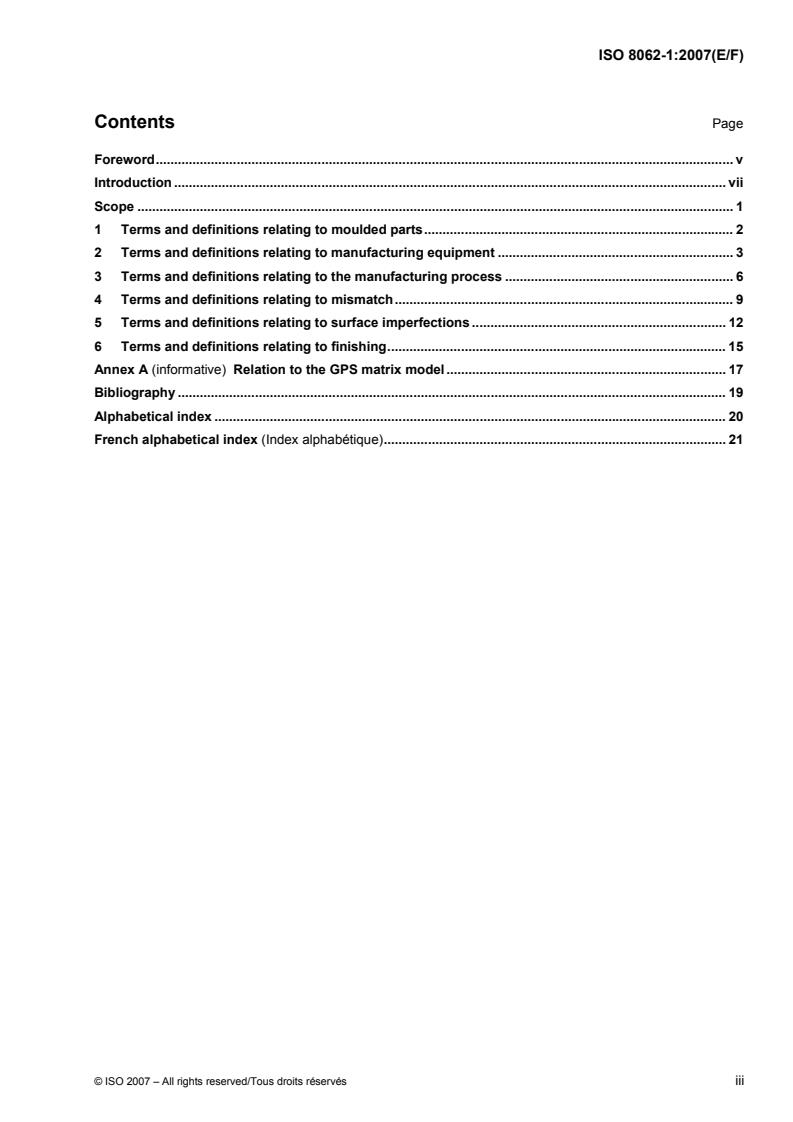
Contents Page
Foreword. v
Introduction . vii
Scope . 1
1 Terms and definitions relating to moulded parts. 2
2 Terms and definitions relating to manufacturing equipment . 3
3 Terms and definitions relating to the manufacturing process . 6
4 Terms and definitions relating to mismatch. 9
5 Terms and definitions relating to surface imperfections . 12
6 Terms and definitions relating to finishing. 15
Annex A (informative) Relation to the GPS matrix model. 17
Bibliography . 19
Alphabetical index . 20
French alphabetical index (Index alphabétique). 21
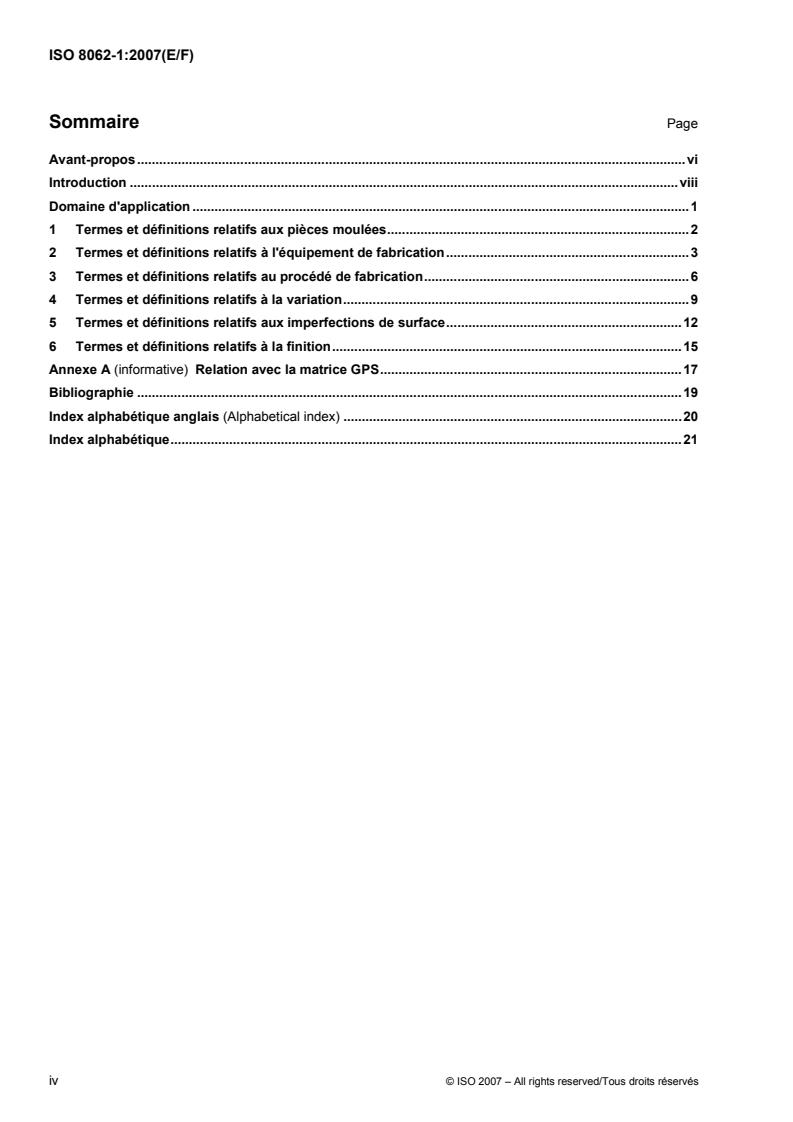
Sommaire Page
Avant-propos.vi
Introduction .viii
Domaine d'application .1
1 Termes et définitions relatifs aux pièces moulées.2
2 Termes et définitions relatifs à l'équipement de fabrication.3
3 Termes et définitions relatifs au procédé de fabrication.6
4 Termes et définitions relatifs à la variation.9
5 Termes et définitions relatifs aux imperfections de surface.12
6 Termes et définitions relatifs à la finition.15
Annexe A (informative) Relation avec la matrice GPS.17
Bibliographie .19
Index alphabétique anglais (Alphabetical index) .20
Index alphabétique.21
iv © ISO 2007 – All rights reserved/Tous droits réservés
Foreword
ISO (the International Organization for Standardization) is a worldwide federation of national standards bodies
(ISO member bodies). The work of preparing International Standards is normally carried out through ISO
technical committees. Each member body interested in a subject for which a technical committee has been
established has the right to be represented on that committee. International organizations, governmental and
non-governmental, in liaison with ISO, also take part in the work. ISO collaborates closely with the
International Electrotechnical Commission (IEC) on all matters of electrotechnical standardization.
International Standards are drafted in accordance with the rules given in the ISO/IEC Directives, Part 2.
The main task of technical committees is to prepare International Standards. Draft International Standards
adopted by the technical committees are circulated to the member bodies for voting. Publication as an
International Standard requires approval by at least 75 % of the member bodies casting a vote.
ISO 8062-1 was prepared by Technical Committee ISO/TC 213, Dimensional and geometrical product
specifications and verification.
This first edition of ISO 8062-1, together with ISO/TS 8062-2 and ISO 8062-3, cancels and replaces
ISO 8062:1994, of which it constitutes a technical revision.
ISO 8062 consists of the following parts under the general title Geometrical product specifications (GPS) —
Dimensional and geometrical tolerances for moulded parts:
⎯ Part 1: Vocabulary
⎯ Part 3: General dimensional and geometrical tolerances and machining allowances for castings
Rules is to form the subject of a future Part 2 [Technical Specification].
Avant-propos
L'ISO (Organisation internationale de normalisation) est une fédération mondiale d'organismes nationaux de
normalisation (comités membres de l'ISO). L'élaboration des Normes internationales est en général confiée
aux comités techniques de l'ISO. Chaque comité membre intéressé par une étude a le droit de faire partie du
comité technique créé à cet effet. Les organisations internationales, gouvernementales et non
gouvernementales, en liaison avec l'ISO participent également aux travaux. L'ISO collabore étroitement avec
la Commission électrotechnique internationale (CEI) en ce qui concerne la normalisation électrotechnique.
Les Normes internationales sont rédigées conformément aux règles données dans les Directives ISO/CEI,
Partie 2.
La tâche principale des comités techniques est d'élaborer les Normes internationales. Les projets de Normes
internationales adoptés par les comités techniques sont soumis aux comités membres pour vote. Leur
publication comme Normes internationales requiert l'approbation de 75 % au moins des comités membres
votants.
L'ISO 8062 a été élaborée par le comité technique ISO/TC 213, Spécifications et vérification dimensionnelles
et géométriques des produits.
Cette première édition de l’ISO 8062-1, conjointement avec l’ISO/TS 8062-2 et l’ISO 8062-3, annule et
remplace l'ISO 8062:1994, dont elle constitue une révision technique.
L'ISO 8062 comprend les parties suivantes, présentées sous le titre général Spécification géométrique des
produits (GPS) — Tolérances dimensionnelles et géométriques des pièces moulées:
⎯ Partie 1: Vocabulaire
⎯ Partie 3: Tolérances dimensionnelles et géométriques générales et surépaisseurs d'usinage pour les
pièces moulées
Les règles d'utilisation feront l'objet d'une future Partie 2 [Spécification technique].
vi © ISO 2007 – All rights reserved/Tous droits réservés
Introduction
This part of ISO 8062 is a geometrical product specification (GPS) standard and is to be regarded as a
complementary process specific tolerance GPS standard (see ISO/TR 14638). It influences link 1 and 2 of the
chain of standards on mouldings.
For more detailed information about the relation of this part of ISO 8062 to other standards and the GPS
matrix model, see Annex A.
Introduction
La présente partie de l'ISO 8062 est une norme traitant de la spécification géométrique des produits (GPS) et
doit être considérée comme une norme GPS complémentaire de tolérances en fonction du procédé (voir
l’ISO/TR 14638). Elle influence les maillons 1 et 2 de la chaîne de normes relatives au moulage.
Pour de plus amples informations sur la relation de la présente partie de l'ISO 8062 avec les autres normes et
la matrice GPS, voir l'Annexe A.
viii © ISO 2007 – All rights reserved/Tous droits réservés
INTERNATIONAL STANDARD
NORME INTERNATIONALE
Geometrical product Spécification géométrique
specifications (GPS) — des produits (GPS) —
Dimensional and geometrical Tolérances dimensionnelles
tolerances for moulded et géométriques des pièces
parts — moulées —
Part 1: Partie 1:
Vocabulary Vocabulaire
Scope Domaine d'application
This part of ISO 8062 establishes a vocabulary of La présente partie de l'ISO 8062 établit un
terms and definitions used to describe the features, vocabulaire des termes et définitions utilisés pour
form and tolerance types when assigning décrire les éléments, ainsi que les types de forme et
dimensional and geometrical tolerances to moulded de tolérance pour l'attribution de tolérances aux
parts in geometrical product specifications (GPS). pièces moulées dans la spécification géométrique
des produits (GPS).
1 Terms and definitions relating to 1 Termes et définitions relatifs aux
moulded parts pièces moulées
1.1 1.1
moulded part pièce moulée
any part produced by the use of a mould (2.2) tout produit obtenu avec un moule (2.2)
NOTE The parts produced by moulding operations NOTE Les produits obtenus en utilisant un moule
include but are not limited to the following: incluent, sans toutefois s'y limiter, les produits suivants:
⎯ castings (1.2); ⎯ pièces moulées (1.2);
⎯ die forgings (1.4); ⎯ pièces forgées (1.4);
⎯ injection moulded parts (1.3); ⎯ pièces moulées par injection (1.3);
⎯ powder metallurgy parts (1.5); ⎯ pièces de la métallurgie des poudres (1.5);
⎯ glass moulded parts (1.6); ⎯ pièces moulées en verre (1.6);
⎯ rubber moulded parts (1.7). ⎯ pièces moulées en caoutchouc (1.7).
1.1.1 1.1.1
raw moulded part pièce brute de démoulage
moulded part as it comes out of the mould (2.2) pièce moulée telle qu'elle sort du moule (2.2), sans
without any further processing autre travail
1.1.2 1.1.2
final moulded part pièce brute de fonderie
moulded part after fettling (if any) pièce moulée après ébarbage
1.1.3 1.1.3
final machined moulded part pièce moulée finie d'usinage
moulded part which has been machined and is ready pièce moulée qui a été usinée et qui est prête pour
for use son utilisation
1.2 1.2
casting pièce moulée
general term for products at or near finished shape, terme général pour des produits ayant leur forme
formed by solidification of a metal or alloy in a mould définitive ou proche de celle-ci, formés par la
(2.2) solidification d'un métal ou d'un alliage dans un
moule (2.2)
[ISO 3134-4:1985, definition 2.1]
[ISO 3134-4:1985, définition 2.1]
1.3 1.3
injection moulded part pièce moulée par injection
part produced by introducing heated and/or melted produit obtenu par l'introduction, sous pression, dans
thermoplastic material, under pressure, into a die une coquille (2.3), d'une matière thermoplastique
(2.3) chauffée
1.4 1.4
die forging pièce forgée
part produced by the plastic deformation of metals in produit obtenu par la déformation plastique de
a die (2.3) métaux dans une coquille (2.3)
2 © ISO 2007 – All rights reserved/Tous droits réservés
1.5 1.5
powder metallurgy part pièce de la métallurgie des poudres
part produced from powder or particulate materials, produit obtenu par consolidation sous pression, et/ou
both metals, alloys and ceramics, made by sous une certaine température, de poudres ou de
consolidating the powder or particulate under matières particulaires, pouvant être des métaux, des
pressure and/or temperature using a die (2.3) and/or alliages ou des céramiques, en utilisant une coquille
tooling (2.3) et/ou un outillage spécifique
1.6 1.6
moulded glass part pièce moulée en verre
part produced by the introduction of heated glasses produit obtenu par introduction de verres chauffés
into a mould (2.2) dans un moule (2.2)
1.7 1.7
moulded rubber part pièce moulée en caoutchouc
part produced by the introduction of rubber-based produit obtenu par introduction de matière à base de
material into a mould (2.2) caoutchouc dans un moule (2.2)
2 Terms and definitions relating to 2 Termes et définitions relatifs à
manufacturing equipment l'équipement de fabrication
2.1 2.1
cavity empreinte
space to be filled to form a moulded part (1.1) espace ou cavité à remplir pour former une pièce
moulée (1.1)
2.2 2.2
mould moule
elements or material encompassing a cavity (2.1) élément ou matière entourant l’empreinte (2.1) dans
laquelle la matière est introduite afin de donner forme
NOTE Moulds may or may not be capable of being used
à un produit
repetitively.
NOTE Les moules peuvent ou non résister à une
utilisation répétitive.
2.3 2.3
die coquille
permanent mould (2.2) that can be used repetitively moule (2.2) permanent pouvant être utilisé de
manière répétitive
2.4 2.4
pattern modèle
tool which is a replica of the shape to be produced outil qui est une réplique de la forme à produire, dont
having the purpose of forming the cavity (2.1) in the l'objectif est de donner sa forme à l’empreinte (2.1)
mould (2.2) du moule (2.2)
NOTE Patterns may be reusable or destroyed in the NOTE Les modèles peuvent être réutilisables ou détruits
moulded part (1.1) manufacturing operation. lors de la fabrication de la pièce moulée (1.1).
2.5 2.5
core noyau
piece inserted in the mould (2.2) to shape part of the pièce insérée dans le moule (2.2) pour former une
moulded part (1.1) partie de la pièce moulée (1.1)
See Figure 1. Voir Figure 1.
Key Légende
1 insert pins (or chaplet) 1 inserts (ou support de noyau)
2 upper part of the mould 2 partie supérieure du moule
3 cavity 3 cavité
4 core 4 noyau
5 lower part of the mould 5 partie inférieure du moule
Figure 1 — Elements of mould assemblies
Figure 1 — Éléments de remoulage
2.6 2.6
slide coulisseau
part in a die (2.3) which moves during the moulding partie d'une coquille (2.3) ou d'un moule (2.2) qui se
cycle déplace au cours du cycle de moulage
2.7 2.7
core print portée de noyau
register in the mould (2.2) for the location of the empreinte dans le moule (2.2) pour l'emplacement
core (2.5) du noyau (2.5)
See Figure 2. Voir Figure 2.
Key Légende
1 core 1 noyau
2 upper part of the mould 2 partie supérieure du moule
3 lower part of the mould 3 partie inférieure du moule
a a
Core print. Portée de noyau.
Figure 2 — Core print
Figure 2 — Portée de noyau
4 © ISO 2007 – All rights reserved/Tous droits réservés
2.8 2.8
ejector éjecteur
device used to remove a moulding from a mould dispositif d'un moule (2.2) pour démouler le moulage
(2.2)
2.9 2.9
part insert insert d'élément
component consisting of metal or other material composant en métal ou autre matériau pouvant être
which may be moulded into position in the moulded moulé en position ou placé dans le produit issu du
part (1.1) or put into the moulded part after the moulage
completion of the moulding operation
EXEMPLE Inserts de filetage, paliers.
EXAMPLE Screw thread insert, bearing.
2.10 2.10
insert pin broche d'insert
core locator positionneur de noyau
core setting insert insert de remoulage
chaplet support de noyau
component used in the mould cavity assembly to composant utilisé dans la cavité du moule (2.2) afin
assist in maintaining dimensions de conserver les dimensions requises
NOTE Depending on purchaser and service NOTE En fonction des exigences de l'acheteur et de
requirements, it may be necessary to remove insert pins service, il peut être nécessaire de retirer les broches
from a moulded part (1.1). d'insert d'une pièce moulée (1.1).
2.11 2.11
shaping mould component composant de l'empreinte
part of the moulding tool which forms the intended élément du moule (2.2) qui forme la géométrie
geometrical shape of the product to be moulded voulue du produit à mouler
EXAMPLE Core, side. EXEMPLE Noyaux et coulisseaux.
2.12 2.12
auxiliary mould component composant auxiliaire de moule
part of the moulding tool which is necessary in order élément du moule (2.2) qui est nécessaire pour
to produce the moulded part (1.1) in the mould obtenir une pièce moulée (1.1) et qui ne concourt
(2.2) and which does not form any desired pas à obtenir la forme géométrique voulue, mais qui
geometrical shape of the product but can lead to peut laisser des marques d'outillage indésirables
undesired tool markings
EXEMPLE Éjecteurs et parties rapportées pour les
attaques, les évents et les masselottes.
EXAMPLE Ejectors and tools for gates, vents and risers.
2.13 2.13
parting surface surface de joint
mating surface of an individual component of the surface en regard des composants d'un moule (2.2)
mould (2.2) or die (2.3) ou d'une coquille (2.3)
NOTE The term parting line (2.14) can also be used to
NOTE Le terme ligne de joint (2.14) est parfois utilisé
describe the parting surface.
pour désigner la surface de joint.
2.14 2.14
parting line ligne de joint
représentation de la surface de joint (2.13) sur le
representation of the parting surface (2.13) on a
dessin de la pièce moulée (1.1)
drawing of the moulded part (1.1)
2.15 2.15
draft angle angle de dépouille
angle added to a geometrical feature of a pattern angle ajouté à un élément géométrique d'un modèle
(2.4) or mould (2.2) to ensure the easy removal of (2.4) ou d'un moule (2.2) permettant le démoulage
the pattern or moulded part (1.1) from the mould or aisé du modèle ou de la pièce moulée (1.1) du
to improve the quality of the product moule ou contribuant à l'amélioration de la qualité du
produit
See Figure 3.
Voir Figure 3.
a a
Core print. Portée de noyau.
b b
Draft angle. Angle de dépouille.
Figure 3 — Draft angles
Figure 3 — Angles de dépouille
3 Terms and definitions relating to the 3 Termes et définitions relatifs au
manufacturing process procédé de fabrication
3.1 3.1
sprue descente
primary feeding channel, running from the outer face canal primaire d'alimentation allant de la face
of the mould (2.2) to the runner (3.3) or the mould extérieure du moule (2.2) au canal secondaire (3.3)
gate (3.5) ou à l'attaque de coulée (3.5) du moule
See Figure 4. Voir Figure 4.
6 © ISO 2007 – All rights reserved/Tous droits réservés
Key Légende
1 sprue 1 descente
2 runner 2 canal secondaire
3 gate 3 attaque de coulée
4 casting (part) 4 pièce moulée (pièce)
5 riser 5 masselotte
6 chill 6 refroidisseur
7 vent 7 event
Figure 4 — Example for sand casting
Figure 4 — Exemple pour moulage au sable
3.2 3.2
sprue descente
moulding material in the primary feeding channel matériau de moulage dans le canal primaire
[sprue (3.1)] running from the outer face of the d’alimentation [descente (3.1)] allant de la face
mould (2.2) to the runner (3.3) or the mould gate extérieure du moule (2.2) au canal secondaire (3.3)
(3.5) ou à l'attaque de coulée (3.5) du moule
3.3 3.3
runner canal secondaire
secondary feeding channel in a mould (2.2), running canal secondaire d'alimentation dans un moule
from the end of the sprue (3.1) to the gate (3.5) (2.2), allant de l'extrémité intérieure de la descente
(3.1) à l'attaque de coulée (3.5)
See Figure 4.
Voir Figure 4.
3.4 3.4
runner canal secondaire
moulding material in the secondary feeding channel matériau de moulage dans le canal secondaire
[runner (3.3)] running in a mould (2.2) from the end d'alimentation [canal secondaire (3.3)] allant dans
of the sprue (3.1) to the gate (3.5) un moule (2.2) de l'extrémité intérieure de la
descente (3.1) à l'attaque de coulée (3.5)
3.5 3.5
gate attaque de coulée
channel or orifice through which material flows from canal ou orifice par lequel la matière s'écoule du
the runner (3.3) (if any) or the sprue (3.1) into the canal secondaire (3.3) (le cas échéant) ou de la
cavity (2.1) descente (3.1) à l’empreinte (2.1)
See Figure 4. Voir Figure 4.
3.6 3.6
riser masselotte
reservoir of material which compensates for the réservoir de matière qui compense la contraction
volumetric contraction of the material in the mould volumique de la matière dans le moule (2.2) lors du
(2.2) during solidification refroidissement
NOTE 1 Risers are usually located over the last section NOTE 1 Les masselottes sont généralement situées au-
to solidify, i.e. the thickest section, see Figure 4. dessus de la dernière zone à se solidifier, c'est-à-dire la
zone la plus épaisse, voir Figure 4.
...