

ISO 6009:2016
(Main)Hypodermic needles for single use — Colour coding for identification
General Information
- Abstract
ISO 6009:2016 establishes a colour code for the identification of single-use hypodermic needles of designated metric sizein the range of 0,18 mm (34 Gauge) to 3,4 mm (10 Gauge) . It applies to regular-walled, thin-walled, extra-thin-walled and ultra-thin walled needles, and to opaque and translucent colours. It is not applicable to pen-needles.
- Status
- Published
- Publication Date
- 01-Aug-2016
- Technical Committee
- ISO/TC 84 - Devices for administration of medicinal products and catheters
- Current Stage
- 9093 - International Standard confirmed
- Start Date
- 04-Dec-2021
- Completion Date
- 29-Aug-2026
Buy Documents
ISO 6009:2016 - Hypodermic needles for single use -- Colour coding for identification
ISO 6009:2016 - Hypodermic needles for single use — Colour coding for identification/2/2016
ISO 6009:2016 - Aiguilles hypodermiques non réutilisables -- Code de couleurs pour l'identification
ISO 6009:2016 - Aiguilles hypodermiques non réutilisables — Code de couleurs pour l'identification/2/2016
Overview
ISO 6009:2016 - "Hypodermic needles for single use - Colour coding for identification" defines a standardized colour code to enable rapid visual identification of single‑use hypodermic needles by nominal outside diameter (metric sizes from 0.18 mm / 34G to 3.4 mm / 10G). The standard covers regular‑walled, thin‑walled, extra‑thin and ultra‑thin needles and accepts both opaque and translucent hub colours. It does not apply to pen‑needles and does not mandate that needles must be colour‑coded or where the colour should be applied.
Key topics and requirements
- Scope: Colour code applies to single‑use hypodermic needles with nominal outside diameters 0.18 mm (34G) to 3.4 mm (10G).
- Colour mapping: A colour is assigned to each designated needle size (gauge) to facilitate quick visual identification. Annex A provides RAL and Pantone references for the specified colours.
- Material and wall types: Colour coding is applicable to regular‑walled, thin‑walled, extra‑thin and ultra‑thin needles and to both opaque and translucent hub materials.
- Measurement guidance: The standard recognizes practical difficulties in instrumentally measuring hub colours (chromaticity/luminance) and therefore references colour systems (RAL, Pantone) rather than strict instrumental colour zones.
- User responsibility: Colour coding is an identification aid only; the presence of colour does not replace verification of the needle’s marked size.
- Exclusions: Pen‑needles are excluded from ISO 6009’s scope.
- Transition guidance: Implementers are referred to ISO/TR 19244 for guidance on transition periods for adopting the standard.
Applications and who uses this standard
ISO 6009 is directly relevant to:
- Medical device manufacturers - to standardize hub colours across product ranges and simplify labelling/production specifications.
- Procurement and distributors - for consistent identification and inventory control of needle sizes.
- Regulatory and quality teams - to reference a harmonized colour code in product documentation, conformity assessments and supplier audits.
- Clinical staff and hospital supply chain - to speed size selection and reduce selection errors during procedures.
- Test laboratories and standards bodies - for conformity checks and color reference use (RAL/Pantone).
Practical benefits include improved safety through faster size recognition, reduced risk of selecting incorrect needle sizes, and simplified communication between manufacturers and healthcare providers.
Related standards
- ISO 7864 - Sterile hypodermic needles for single use (product standard; specifies packaging/sterility).
- ISO 9626 - Stainless steel needle tubing (specifies needle tubing nominal diameters referenced by ISO 6009).
- ISO/TR 19244 - Guidance on transition periods for standards developed by ISO/TC 84.
Keywords: ISO 6009, hypodermic needles, colour coding, needle identification, single‑use needles, RAL, Pantone, needle gauge, medical device standards.
Relations
- Consolidates
EN ISO 6009:2016 - Hypodermic needles for single use - Colour coding for identification (ISO 6009:2016) - Effective Date
- 12-Feb-2026
- Effective Date
- 06-Jun-2022
- Effective Date
- 06-Jun-2022
- Effective Date
- 15-Dec-2012
Buy Documents
ISO 6009:2016 - Hypodermic needles for single use -- Colour coding for identification
ISO 6009:2016 - Hypodermic needles for single use — Colour coding for identification/2/2016
ISO 6009:2016 - Aiguilles hypodermiques non réutilisables -- Code de couleurs pour l'identification
ISO 6009:2016 - Aiguilles hypodermiques non réutilisables — Code de couleurs pour l'identification/2/2016
Get Certified
Connect with accredited certification bodies for this standard

BSI Group
BSI (British Standards Institution) is the business standards company that helps organizations make excellence a habit.

TÜV Rheinland
TÜV Rheinland is a leading international provider of technical services.

TÜV SÜD
TÜV SÜD is a trusted partner of choice for safety, security and sustainability solutions.
Sponsored listings
Frequently Asked Questions
ISO 6009:2016 is a standard published by the International Organization for Standardization (ISO). Its full title is "Hypodermic needles for single use — Colour coding for identification". This standard covers: ISO 6009:2016 establishes a colour code for the identification of single-use hypodermic needles of designated metric sizein the range of 0,18 mm (34 Gauge) to 3,4 mm (10 Gauge) . It applies to regular-walled, thin-walled, extra-thin-walled and ultra-thin walled needles, and to opaque and translucent colours. It is not applicable to pen-needles.
ISO 6009:2016 establishes a colour code for the identification of single-use hypodermic needles of designated metric sizein the range of 0,18 mm (34 Gauge) to 3,4 mm (10 Gauge) . It applies to regular-walled, thin-walled, extra-thin-walled and ultra-thin walled needles, and to opaque and translucent colours. It is not applicable to pen-needles.
ISO 6009:2016 is classified under the following ICS (International Classification for Standards) categories: 01.070 - Colour coding; 11.040.25 - Syringes, needles an catheters. The ICS classification helps identify the subject area and facilitates finding related standards.
ISO 6009:2016 has the following relationships with other standards: It is inter standard links to EN ISO 6009:2016, ISO 3070-3:2007, ISO 6581:2018, ISO 6009:1992. Understanding these relationships helps ensure you are using the most current and applicable version of the standard.
ISO 6009:2016 is available in PDF format for immediate download after purchase. The document can be added to your cart and obtained through the secure checkout process. Digital delivery ensures instant access to the complete standard document.
Standards Content (Sample)
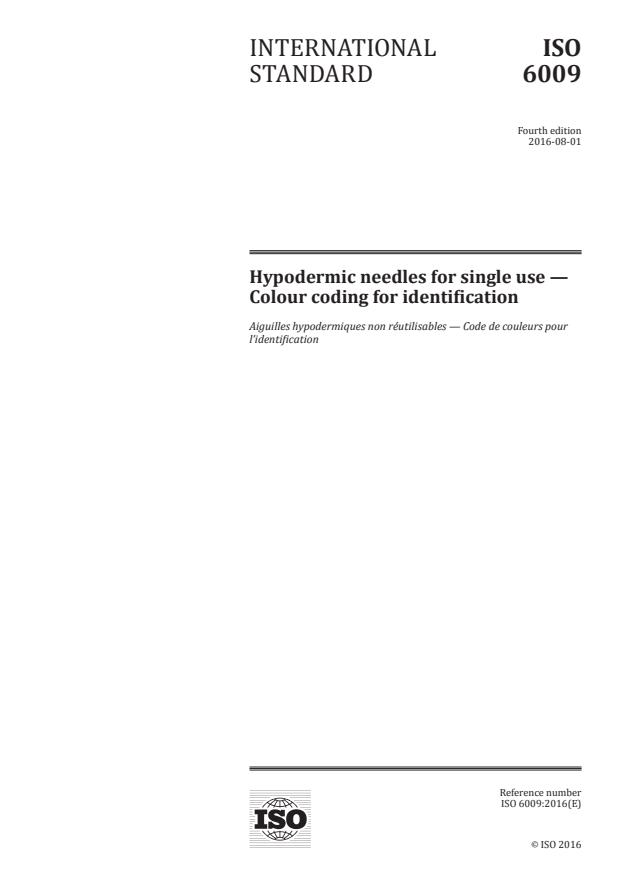
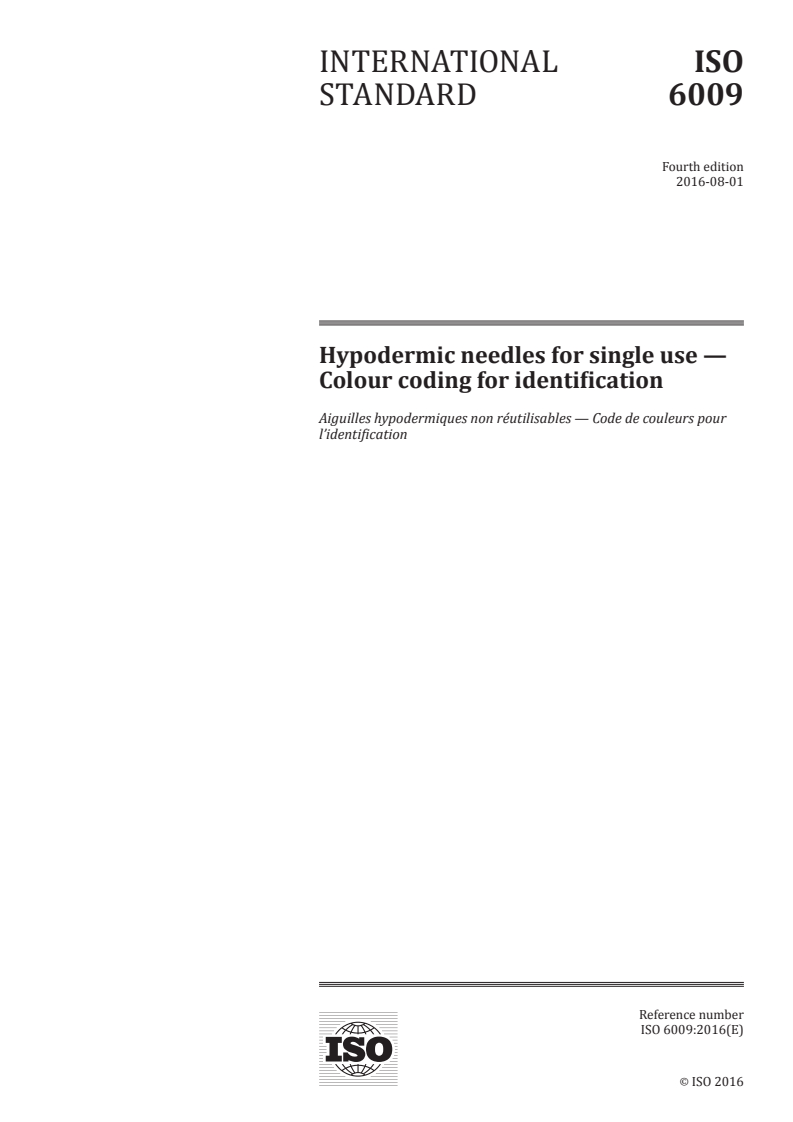
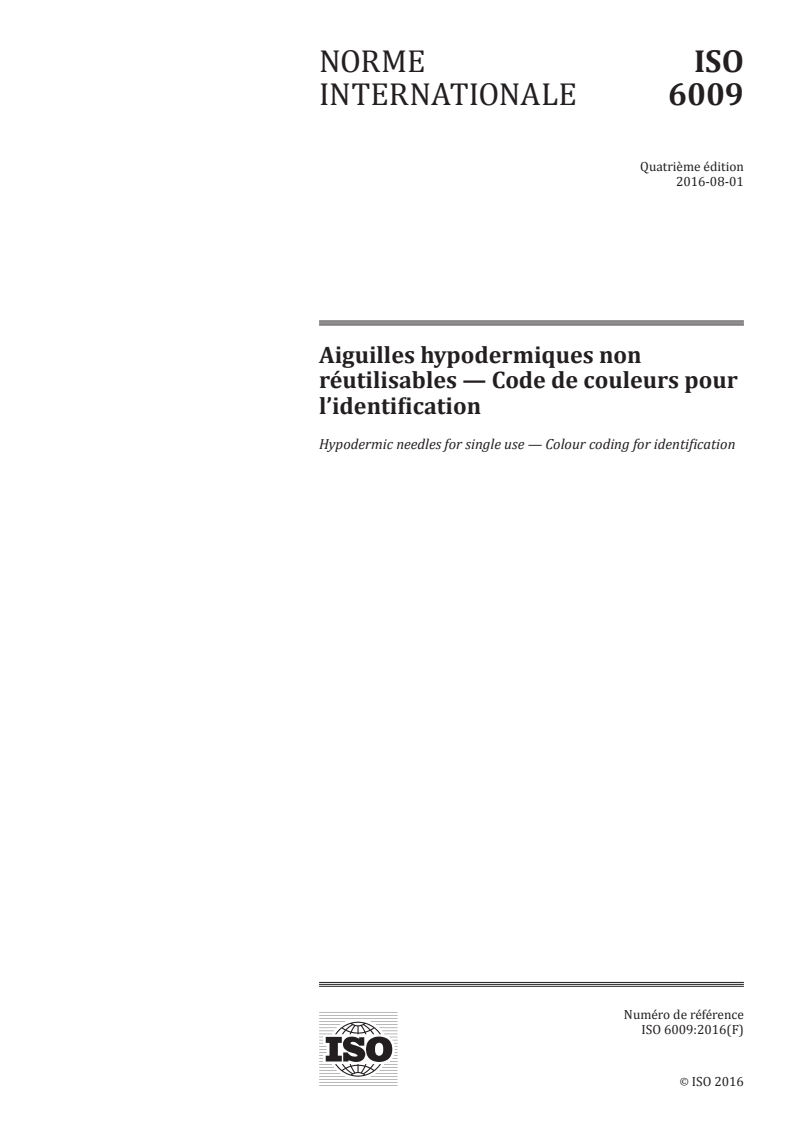
INTERNATIONAL ISO
STANDARD 6009
Fourth edition
2016-08-01
Hypodermic needles for single use —
Colour coding for identification
Aiguilles hypodermiques non réutilisables — Code de couleurs pour
l’identification
Reference number
©
ISO 2016
© ISO 2016, Published in Switzerland
All rights reserved. Unless otherwise specified, no part of this publication may be reproduced or utilized otherwise in any form
or by any means, electronic or mechanical, including photocopying, or posting on the internet or an intranet, without prior
written permission. Permission can be requested from either ISO at the address below or ISO’s member body in the country of
the requester.
ISO copyright office
Ch. de Blandonnet 8 • CP 401
CH-1214 Vernier, Geneva, Switzerland
Tel. +41 22 749 01 11
Fax +41 22 749 09 47
copyright@iso.org
www.iso.org
ii © ISO 2016 – All rights reserved
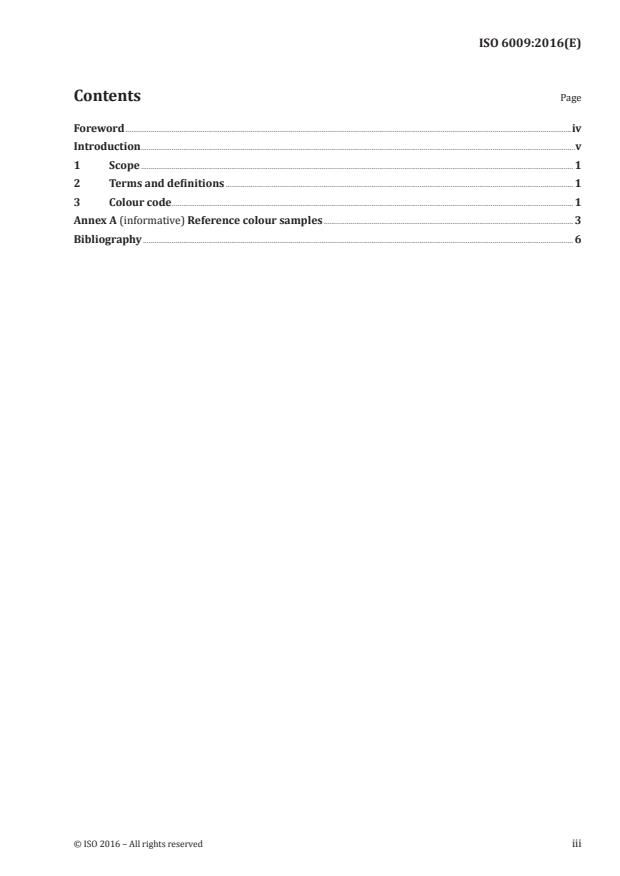
Contents Page
Foreword .iv
Introduction .v
1 Scope . 1
2 Terms and definitions . 1
3 Colour code . 1
Annex A (informative) Reference colour samples . 3
Bibliography . 6
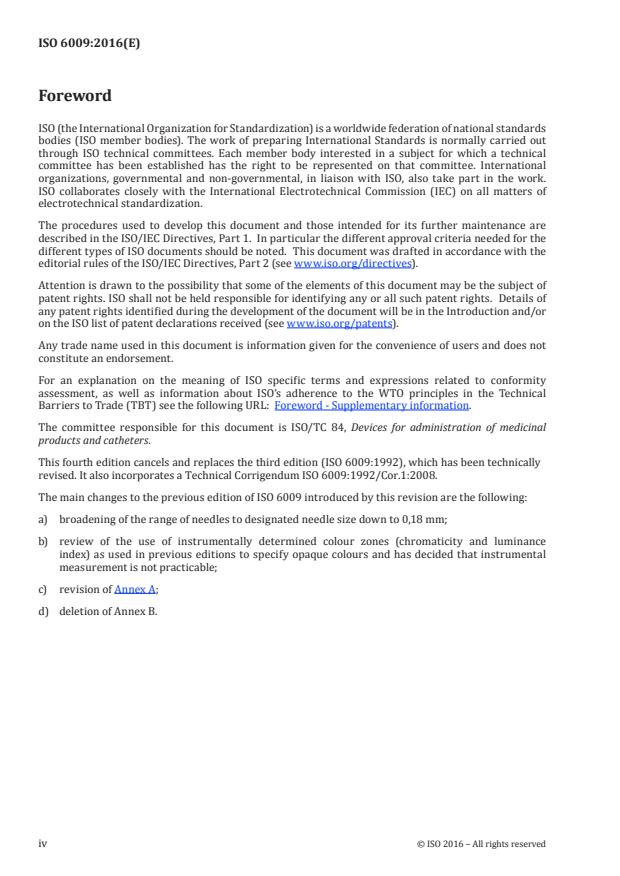
Foreword
ISO (the International Organization for Standardization) is a worldwide federation of national standards
bodies (ISO member bodies). The work of preparing International Standards is normally carried out
through ISO technical committees. Each member body interested in a subject for which a technical
committee has been established has the right to be represented on that committee. International
organizations, governmental and non-governmental, in liaison with ISO, also take part in the work.
ISO collaborates closely with the International Electrotechnical Commission (IEC) on all matters of
electrotechnical standardization.
The procedures used to develop this document and those intended for its further maintenance are
described in the ISO/IEC Directives, Part 1. In particular the different approval criteria needed for the
different types of ISO documents should be noted. This document was drafted in accordance with the
editorial rules of the ISO/IEC Directives, Part 2 (see www.iso.org/directives).
Attention is drawn to the possibility that some of the elements of this document may be the subject of
patent rights. ISO shall not be held responsible for identifying any or all such patent rights. Details of
any patent rights identified during the development of the document will be in the Introduction and/or
on the ISO list of patent declarations received (see www.iso.org/patents).
Any trade name used in this document is information given for the convenience of users and does not
constitute an endorsement.
For an explanation on the meaning of ISO specific terms and expressions related to conformity
assessment, as well as information about ISO’s adherence to the WTO principles in the Technical
Barriers to Trade (TBT) see the following URL: Foreword - Supplementary information.
The committee responsible for this document is ISO/TC 84, Devices for administration of medicinal
products and catheters.
This fourth edition cancels and replaces the third edition (ISO 6009:1992), which has been technically
revised. It also incorporates a Technical Corrigendum ISO 6009:1992/Cor.1:2008.
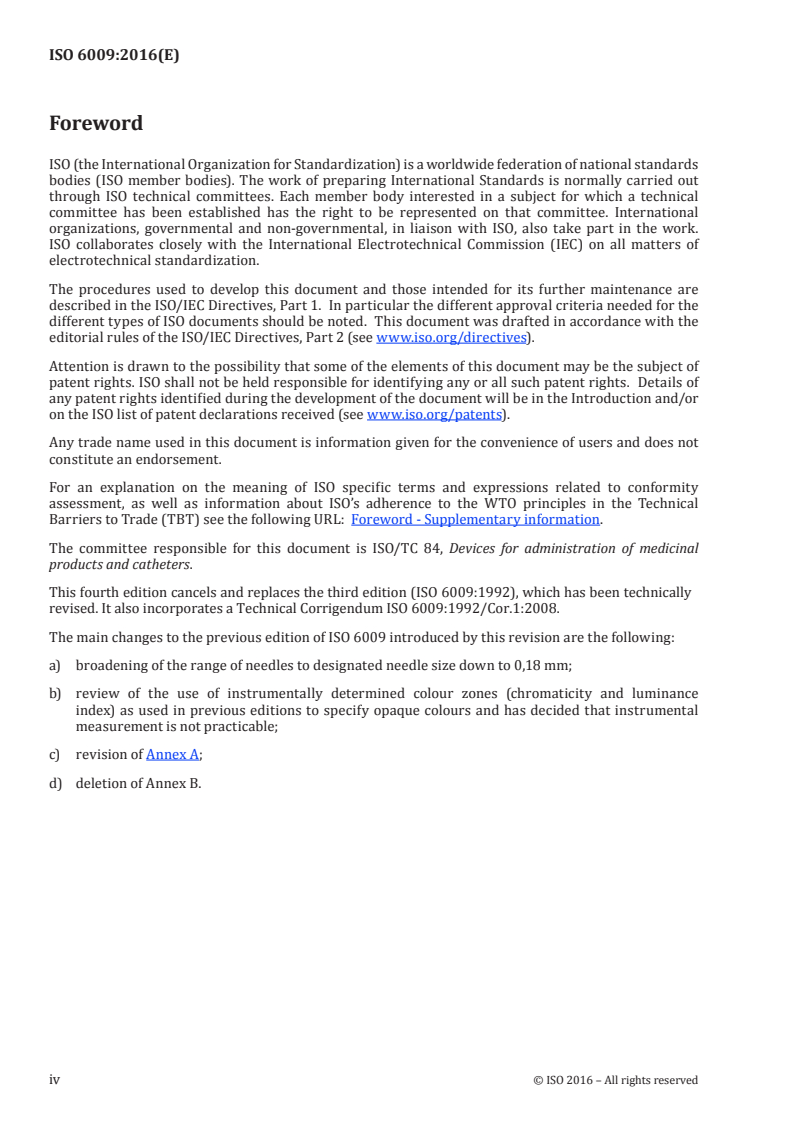
The main changes to the previous edition of ISO 6009 introduced by this revision are the following:
a) broadening of the range of needles to designated needle size down to 0,18 mm;
b) review of the use of instrumentally determined colour zones (chromaticity and luminance
index) as used in previous editions to specify opaque colours and has decided that instrumental
measurement is not practicable;
c) revision of Annex A;
d) deletion of Annex B.
iv © ISO 2016 – All rights reserved
Introduction
The intention of this International Standard is to specify colours to enable rapid visual identification
of the outer diameter of single-use hypodermic needles. The presence of colour coding on a needle or
package does not absolve the user of the responsibility to check the marked size of the needle. This
revision defines, in addition, colours for more fine needles to follow the trend in the market.
The colours used to code needles may be applied in either opaque or transparent form, and the colour
code is equally applicable to regular walled, thin-walled, extra-thin and ultra-thin walled needles. The
nominal outer diameters of needles listed in this International Standard for which colours are given are
those specified in ISO 9626.
This International Standard establishes a colour code but does not specify that needles are to be colour-
coded or to what portion of the needle and/or packaging the colour
...
INTERNATIONAL ISO
STANDARD 6009
Fourth edition
2016-08-01
Hypodermic needles for single use —
Colour coding for identification
Aiguilles hypodermiques non réutilisables — Code de couleurs pour
l’identification
Reference number
©
ISO 2016
© ISO 2016, Published in Switzerland
All rights reserved. Unless otherwise specified, no part of this publication may be reproduced or utilized otherwise in any form
or by any means, electronic or mechanical, including photocopying, or posting on the internet or an intranet, without prior
written permission. Permission can be requested from either ISO at the address below or ISO’s member body in the country of
the requester.
ISO copyright office
Ch. de Blandonnet 8 • CP 401
CH-1214 Vernier, Geneva, Switzerland
Tel. +41 22 749 01 11
Fax +41 22 749 09 47
copyright@iso.org
www.iso.org
ii © ISO 2016 – All rights reserved
Contents Page
Foreword .iv
Introduction .v
1 Scope . 1
2 Terms and definitions . 1
3 Colour code . 1
Annex A (informative) Reference colour samples . 3
Bibliography . 6
Foreword
ISO (the International Organization for Standardization) is a worldwide federation of national standards
bodies (ISO member bodies). The work of preparing International Standards is normally carried out
through ISO technical committees. Each member body interested in a subject for which a technical
committee has been established has the right to be represented on that committee. International
organizations, governmental and non-governmental, in liaison with ISO, also take part in the work.
ISO collaborates closely with the International Electrotechnical Commission (IEC) on all matters of
electrotechnical standardization.
The procedures used to develop this document and those intended for its further maintenance are
described in the ISO/IEC Directives, Part 1. In particular the different approval criteria needed for the
different types of ISO documents should be noted. This document was drafted in accordance with the
editorial rules of the ISO/IEC Directives, Part 2 (see www.iso.org/directives).
Attention is drawn to the possibility that some of the elements of this document may be the subject of
patent rights. ISO shall not be held responsible for identifying any or all such patent rights. Details of
any patent rights identified during the development of the document will be in the Introduction and/or
on the ISO list of patent declarations received (see www.iso.org/patents).
Any trade name used in this document is information given for the convenience of users and does not
constitute an endorsement.
For an explanation on the meaning of ISO specific terms and expressions related to conformity
assessment, as well as information about ISO’s adherence to the WTO principles in the Technical
Barriers to Trade (TBT) see the following URL: Foreword - Supplementary information.
The committee responsible for this document is ISO/TC 84, Devices for administration of medicinal
products and catheters.
This fourth edition cancels and replaces the third edition (ISO 6009:1992), which has been technically
revised. It also incorporates a Technical Corrigendum ISO 6009:1992/Cor.1:2008.
The main changes to the previous edition of ISO 6009 introduced by this revision are the following:
a) broadening of the range of needles to designated needle size down to 0,18 mm;
b) review of the use of instrumentally determined colour zones (chromaticity and luminance
index) as used in previous editions to specify opaque colours and has decided that instrumental
measurement is not practicable;
c) revision of Annex A;
d) deletion of Annex B.
iv © ISO 2016 – All rights reserved
Introduction
The intention of this International Standard is to specify colours to enable rapid visual identification
of the outer diameter of single-use hypodermic needles. The presence of colour coding on a needle or
package does not absolve the user of the responsibility to check the marked size of the needle. This
revision defines, in addition, colours for more fine needles to follow the trend in the market.
The colours used to code needles may be applied in either opaque or transparent form, and the colour
code is equally applicable to regular walled, thin-walled, extra-thin and ultra-thin walled needles. The
nominal outer diameters of needles listed in this International Standard for which colours are given are
those specified in ISO 9626.
This International Standard establishes a colour code but does not specify that needles are to be colour-
coded or to what portion of the needle and/or packaging the colour
...
NORME ISO
INTERNATIONALE 6009
Quatrième édition
2016-08-01
Aiguilles hypodermiques non
réutilisables — Code de couleurs pour
l’identification
Hypodermic needles for single use — Colour coding for identification
Numéro de référence
©
ISO 2016
DOCUMENT PROTÉGÉ PAR COPYRIGHT
© ISO 2016, Publié en Suisse
Droits de reproduction réservés. Sauf indication contraire, aucune partie de cette publication ne peut être reproduite ni utilisée
sous quelque forme que ce soit et par aucun procédé, électronique ou mécanique, y compris la photocopie, l’affichage sur
l’internet ou sur un Intranet, sans autorisation écrite préalable. Les demandes d’autorisation peuvent être adressées à l’ISO à
l’adresse ci-après ou au comité membre de l’ISO dans le pays du demandeur.
ISO copyright office
Ch. de Blandonnet 8 • CP 401
CH-1214 Vernier, Geneva, Switzerland
Tel. +41 22 749 01 11
Fax +41 22 749 09 47
copyright@iso.org
www.iso.org
ii © ISO 2016 – Tous droits réservés
Sommaire Page
Avant-propos .iv
Introduction .v
1 Domaine d’application . 1
2 Termes et définitions . 1
3 Code de couleurs. 1
Annexe A (informative) Échantillons de couleur de référence . 3
Bibliographie . 6
Avant-propos
L’ISO (Organisation internationale de normalisation) est une fédération mondiale d’organismes
nationaux de normalisation (comités membres de l’ISO). L’élaboration des Normes internationales est
en général confiée aux comités techniques de l’ISO. Chaque comité membre intéressé par une étude
a le droit de faire partie du comité technique créé à cet effet. Les organisations internationales,
gouvernementales et non gouvernementales, en liaison avec l’ISO participent également aux travaux.
L’ISO collabore étroitement avec la Commission électrotechnique internationale (IEC) en ce qui
concerne la normalisation électrotechnique.
Les procédures utilisées pour élaborer le présent document et celles destinées à sa mise à jour sont
décrites dans les Directives ISO/IEC, Partie 1. Il convient, en particulier, de prendre note des différents
critères d’approbation requis pour les différents types de documents ISO. Le présent document a été
rédigé conformément aux règles de rédaction données dans les Directives ISO/IEC, Partie 2 (voir www.
iso.org/directives).
L’attention est appelée sur le fait que certains des éléments du présent document peuvent faire l’objet de
droits de propriété intellectuelle ou de droits analogues. L’ISO ne saurait être tenue pour responsable
de ne pas avoir identifié de tels droits de propriété et averti de leur existence. Les détails concernant
les références aux droits de propriété intellectuelle ou autres droits analogues identifiés lors de
l’élaboration du document sont indiqués dans l’Introduction et/ou dans la liste des déclarations de
brevets reçues par l’ISO (voir www.iso.org/brevets).
Les appellations commerciales éventuellement mentionnées dans le présent document sont données
pour information, par souci de commodité, à l’intention des utilisateurs et ne sauraient constituer un
engagement.
Pour une explication de la signification des termes et expressions spécifiques de l’ISO liés à l’évaluation
de la conformité, ou pour toute information au sujet de l’adhésion de l’ISO aux principes de l’Organisation
mondiale du commerce (OMC) concernant les obstacles techniques au commerce (OTC), voir le lien
suivant: Foreword - Supplementary information.
Le comité chargé de l’élaboration de ce document est l’ISO/TC 84, Dispositifs pour administration des
produits médicaux et cathéters intravasculaires.
Cette quatrième édition annule et remplace la troisième édition (ISO 6009:1992), qui a fait l’objet d’une
révision technique. Elle comprend également le Rectificatif technique ISO 6009:1992/Cor. 1:2008.
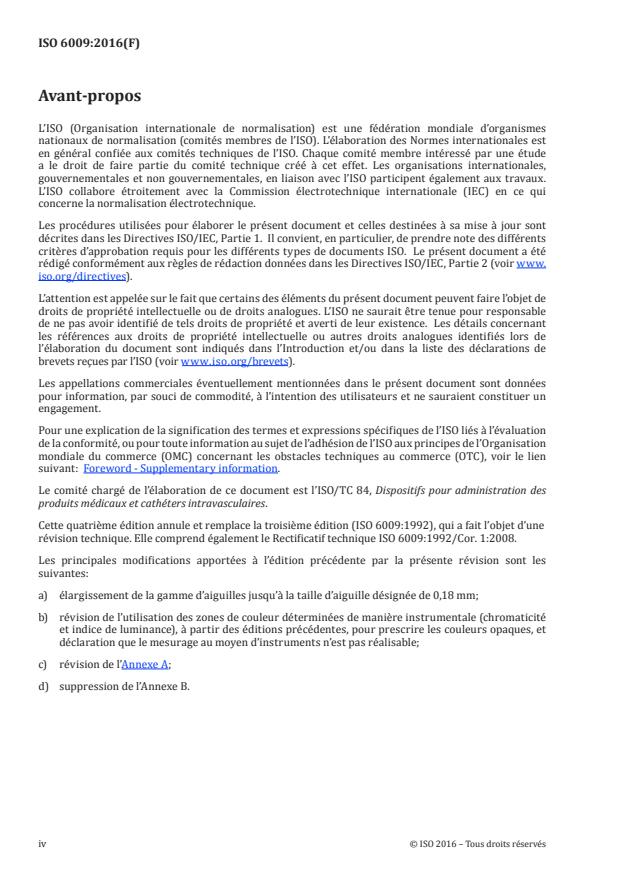
Les principales modifications apportées à l’édition précédente par la présente révision sont les
suivantes:
a) élargissement de la gamme d’aiguilles jusqu’à la taille d’aiguille désignée de 0,18 mm;
b) révision de l’utilisation des zones de couleur déterminées de manière instrumentale (chromaticité
et indice de luminance), à partir des éditions précédentes, pour prescrire les couleurs opaques, et
déclaration que le mesurage au moyen d’instruments n’est pas réalisable;
c) révision de l’Annexe A;
d) suppression de l’Annexe B.
iv © ISO 2016 – Tous droits réservés
Introduction
La présente Norme internationale a pour objet de prescrire les couleurs permettant une identification
visuelle rapide du diamètre extérieur des aiguilles hypodermiques à usage unique. La présence du
code de couleurs sur l’aiguille ou sur l’emballage ne décharge pas l’utilisateur de la responsabilité de
vérifier la dimension indiquée sur l’aiguille. La présente révision définit, en outre, des couleurs pour des
aiguilles plus fines afin de suivre l’évolution du marché.
Les couleurs utilisées pour coder les aiguilles peuvent être appliquées sous forme opaque ou sous forme
transparente; le code de couleurs est également applicable aux aiguilles à parois normales, à parois
minces, à parois extra-minces et à parois ultra-minces. Les diamètres extérieurs nominaux des aiguilles
énumérés dans la présente Norme internationale et pour lesquels les couleurs sont données sont ceux
prescrits dans l’ISO 9626.
La présente Norme internationale établit un code de couleurs mais elle ne pre
...
NORME ISO
INTERNATIONALE 6009
Quatrième édition
2016-08-01
Aiguilles hypodermiques non
réutilisables — Code de couleurs pour
l’identification
Hypodermic needles for single use — Colour coding for identification
Numéro de référence
©
ISO 2016
DOCUMENT PROTÉGÉ PAR COPYRIGHT
© ISO 2016, Publié en Suisse
Droits de reproduction réservés. Sauf indication contraire, aucune partie de cette publication ne peut être reproduite ni utilisée
sous quelque forme que ce soit et par aucun procédé, électronique ou mécanique, y compris la photocopie, l’affichage sur
l’internet ou sur un Intranet, sans autorisation écrite préalable. Les demandes d’autorisation peuvent être adressées à l’ISO à
l’adresse ci-après ou au comité membre de l’ISO dans le pays du demandeur.
ISO copyright office
Ch. de Blandonnet 8 • CP 401
CH-1214 Vernier, Geneva, Switzerland
Tel. +41 22 749 01 11
Fax +41 22 749 09 47
copyright@iso.org
www.iso.org
ii © ISO 2016 – Tous droits réservés
Sommaire Page
Avant-propos .iv
Introduction .v
1 Domaine d’application . 1
2 Termes et définitions . 1
3 Code de couleurs. 1
Annexe A (informative) Échantillons de couleur de référence . 3
Bibliographie . 6
Avant-propos
L’ISO (Organisation internationale de normalisation) est une fédération mondiale d’organismes
nationaux de normalisation (comités membres de l’ISO). L’élaboration des Normes internationales est
en général confiée aux comités techniques de l’ISO. Chaque comité membre intéressé par une étude
a le droit de faire partie du comité technique créé à cet effet. Les organisations internationales,
gouvernementales et non gouvernementales, en liaison avec l’ISO participent également aux travaux.
L’ISO collabore étroitement avec la Commission électrotechnique internationale (IEC) en ce qui
concerne la normalisation électrotechnique.
Les procédures utilisées pour élaborer le présent document et celles destinées à sa mise à jour sont
décrites dans les Directives ISO/IEC, Partie 1. Il convient, en particulier, de prendre note des différents
critères d’approbation requis pour les différents types de documents ISO. Le présent document a été
rédigé conformément aux règles de rédaction données dans les Directives ISO/IEC, Partie 2 (voir www.
iso.org/directives).
L’attention est appelée sur le fait que certains des éléments du présent document peuvent faire l’objet de
droits de propriété intellectuelle ou de droits analogues. L’ISO ne saurait être tenue pour responsable
de ne pas avoir identifié de tels droits de propriété et averti de leur existence. Les détails concernant
les références aux droits de propriété intellectuelle ou autres droits analogues identifiés lors de
l’élaboration du document sont indiqués dans l’Introduction et/ou dans la liste des déclarations de
brevets reçues par l’ISO (voir www.iso.org/brevets).
Les appellations commerciales éventuellement mentionnées dans le présent document sont données
pour information, par souci de commodité, à l’intention des utilisateurs et ne sauraient constituer un
engagement.
Pour une explication de la signification des termes et expressions spécifiques de l’ISO liés à l’évaluation
de la conformité, ou pour toute information au sujet de l’adhésion de l’ISO aux principes de l’Organisation
mondiale du commerce (OMC) concernant les obstacles techniques au commerce (OTC), voir le lien
suivant: Foreword - Supplementary information.
Le comité chargé de l’élaboration de ce document est l’ISO/TC 84, Dispositifs pour administration des
produits médicaux et cathéters intravasculaires.
Cette quatrième édition annule et remplace la troisième édition (ISO 6009:1992), qui a fait l’objet d’une
révision technique. Elle comprend également le Rectificatif technique ISO 6009:1992/Cor. 1:2008.
Les principales modifications apportées à l’édition précédente par la présente révision sont les
suivantes:
a) élargissement de la gamme d’aiguilles jusqu’à la taille d’aiguille désignée de 0,18 mm;
b) révision de l’utilisation des zones de couleur déterminées de manière instrumentale (chromaticité
et indice de luminance), à partir des éditions précédentes, pour prescrire les couleurs opaques, et
déclaration que le mesurage au moyen d’instruments n’est pas réalisable;
c) révision de l’Annexe A;
d) suppression de l’Annexe B.
iv © ISO 2016 – Tous droits réservés
Introduction
La présente Norme internationale a pour objet de prescrire les couleurs permettant une identification
visuelle rapide du diamètre extérieur des aiguilles hypodermiques à usage unique. La présence du
code de couleurs sur l’aiguille ou sur l’emballage ne décharge pas l’utilisateur de la responsabilité de
vérifier la dimension indiquée sur l’aiguille. La présente révision définit, en outre, des couleurs pour des
aiguilles plus fines afin de suivre l’évolution du marché.
Les couleurs utilisées pour coder les aiguilles peuvent être appliquées sous forme opaque ou sous forme
transparente; le code de couleurs est également applicable aux aiguilles à parois normales, à parois
minces, à parois extra-minces et à parois ultra-minces. Les diamètres extérieurs nominaux des aiguilles
énumérés dans la présente Norme internationale et pour lesquels les couleurs sont données sont ceux
prescrits dans l’ISO 9626.
La présente Norme internationale établit un code de couleurs mais elle ne pre
...