

IEC 60076-22-2:2019
(Main)Power transformers - Part 22-2: Power transformer and reactor fittings - Removable radiators
General Information
- Abstract
IEC 60076-22-2:2019 applies to radiators mounted on liquid immersed power transformers according to IEC 60076-1 and reactors according to IEC 60076-6 with and without conservator for indoor or outdoor installation. It outlines the service conditions and the mechanical and electrical requirements that are common to this equipment. It also outlines the operation requirements specific to this equipment as well as the preferred dimensions relevant for interchangeability and the type and routine tests to be performed.
Keywords: radiators mounted on liquid immersed power transformers
- Status
- Published
- Publication Date
- 15-Jan-2019
- Technical Committee
- TC 14 - Power transformers
- Drafting Committee
- WG 32 - TC 14/WG 32
- Current Stage
- PPUB - Publication issued
- Start Date
- 16-Jan-2019
- Completion Date
- 24-Jan-2019
Overview
IEC 60076-22-2:2019 is an international standard published by the International Electrotechnical Commission (IEC) that specifically addresses removable radiators used as fittings on power transformers and reactors. These radiators are mounted on liquid-immersed power transformers and reactors for both indoor and outdoor installations. The standard is part of the broader IEC 60076 series that focuses on power transformers and associated equipment.
This standard outlines the essential mechanical, electrical, and operational requirements for removable radiators, ensuring reliable cooling performance and interchangeability. It also covers the dimensions, materials, corrosion protection, and testing protocols to guarantee quality and compatibility with transformers designed under IEC 60076-1 and IEC 60076-6.
Key Topics
Scope and Application
Applicable to removable radiators mounted on oil-filled power transformers and reactors, IEC 60076-22-2 specifies requirements for both with and without conservator tanks. The radiators serve as cooling components circulating transformer insulating liquid to dissipate heat naturally or assisted by fans and pumps.Service and Environmental Conditions
The standard adopts normal service conditions as referenced in IEC 60076-1 but recognizes the need for special design considerations for unusual environments. It emphasizes corrosion resistance tailored to environmental factors by following ISO 12944 guidelines for protective coatings.Construction and Materials
Radiator components must resist corrosion from insulating liquids and environmental exposure. The standard advises on material selection, surface treatments, and mechanical design features to ensure durability and effective heat dissipation.Dimensions and Interchangeability
IEC 60076-22-2 provides preferred dimensions and tolerances to enable radiator interchangeability across different transformers, facilitating maintenance and replacement without extensive customization.Testing Requirements
The standard mandates routine and type tests, including tightness, surface quality, cooling performance, and vacuum resistance. These tests validate radiator integrity, cooling efficiency, and mechanical robustness.
Applications
Removable radiators conforming to IEC 60076-22-2 are crucial components in:
Power Transformers and Reactors Cooling Systems
These radiators maintain optimal transformer operating temperatures by facilitating efficient heat transfer from the insulating oil to the external environment.Indoor and Outdoor Transformer Installations
Designed for diverse environments, the radiators provide reliable operation whether mounted in controlled indoor settings or exposed outdoor sites.Maintenance and Replacement Scenarios
Removability is key for shipment and maintenance, allowing transformers to be serviced or relocated without dismantling entire cooling assemblies.Customization for Specific Environmental Conditions
By specifying corrosion protection levels and materials, the radiators can be adapted to environments ranging from industrial zones to harsh climatic conditions.
Related Standards
To understand and apply IEC 60076-22-2 effectively, familiarity with the following related standards is recommended:
IEC 60076-1: Power Transformers – Part 1: General
Provides foundational requirements and conditions for power transformers to which radiator fittings are attached.IEC 60076-6: Power Transformers – Part 6: Reactors
Covers reactors’ construction and performance, including those equipped with removable radiators.IEC 60076-7: Power Transformers – Part 7: Loading Guide for Oil-Immersed Power Transformers
Offers guidance on transformer loading and thermal considerations enabling effective cooling design.IEC 60296: Fluids for Electrotechnical Applications – Mineral Insulating Oils
Defines characteristics of insulating oils in which radiator cooling systems operate.ISO 12944 (all parts): Paints and Varnishes – Corrosion Protection of Steel Structures
Sets standards for corrosion protection relevant to radiator surface treatment.ISO 4406: Hydraulic Fluid Power – Method for Coding Contamination Level by Solid Particles
Assists in specifying insulation liquid cleanliness impacting radiator operation.
Conclusion
IEC 60076-22-2:2019 establishes critical standards for removable radiators on liquid immersed power transformers and reactors. By defining mechanical, electrical, and operational requirements alongside precise testing and corrosion protection guidelines, the standard ensures that radiators efficiently support transformer cooling, durability, and maintainability. Compliance with IEC 60076-22-2 guarantees interoperability, safety, and longevity of power transformer cooling equipment across various operational environments worldwide.
Keywords: removable radiators, liquid immersed power transformers, power transformer fittings, radiator corrosion protection, transformer cooling systems, IEC 60076 series, radiator testing standards.
Get Certified
Connect with accredited certification bodies for this standard

IMQ S.p.A. (Certification)
Italian electrical product certification.

SLG Prüf- und Zertifizierungs GmbH
German testing and certification body.

UL Solutions
Global safety science company with testing, inspection and certification.
Sponsored listings
Frequently Asked Questions
IEC 60076-22-2:2019 is a standard published by the International Electrotechnical Commission (IEC). Its full title is "Power transformers - Part 22-2: Power transformer and reactor fittings - Removable radiators". This standard covers: IEC 60076-22-2:2019 applies to radiators mounted on liquid immersed power transformers according to IEC 60076-1 and reactors according to IEC 60076-6 with and without conservator for indoor or outdoor installation. It outlines the service conditions and the mechanical and electrical requirements that are common to this equipment. It also outlines the operation requirements specific to this equipment as well as the preferred dimensions relevant for interchangeability and the type and routine tests to be performed. Keywords: radiators mounted on liquid immersed power transformers
IEC 60076-22-2:2019 applies to radiators mounted on liquid immersed power transformers according to IEC 60076-1 and reactors according to IEC 60076-6 with and without conservator for indoor or outdoor installation. It outlines the service conditions and the mechanical and electrical requirements that are common to this equipment. It also outlines the operation requirements specific to this equipment as well as the preferred dimensions relevant for interchangeability and the type and routine tests to be performed. Keywords: radiators mounted on liquid immersed power transformers
IEC 60076-22-2:2019 is classified under the following ICS (International Classification for Standards) categories: 29.120.50 - Fuses and other overcurrent protection devices; 29.120.99 - Other electrical accessories; 29.180 - Transformers. Reactors; 31.060.70 - Power capacitors. The ICS classification helps identify the subject area and facilitates finding related standards.
IEC 60076-22-2:2019 is available in PDF format for immediate download after purchase. The document can be added to your cart and obtained through the secure checkout process. Digital delivery ensures instant access to the complete standard document.
Standards Content (Sample)
IEC 60076-22-2 ®
Edition 1.0 2019-01
INTERNATIONAL
STANDARD
NORME
INTERNATIONALE
colour
inside
Power transformers –
Part 22-2: Power transformer and reactor fittings – Removable radiators
Transformateurs de puissance –
Partie 22-2: Accessoires pour transformateurs de puissance et bobines
d'inductance – Radiateurs détachables
All rights reserved. Unless otherwise specified, no part of this publication may be reproduced or utilized in any form
or by any means, electronic or mechanical, including photocopying and microfilm, without permission in writing from
either IEC or IEC's member National Committee in the country of the requester. If you have any questions about IEC
copyright or have an enquiry about obtaining additional rights to this publication, please contact the address below or
your local IEC member National Committee for further information.
Droits de reproduction réservés. Sauf indication contraire, aucune partie de cette publication ne peut être reproduite
ni utilisée sous quelque forme que ce soit et par aucun procédé, électronique ou mécanique, y compris la photocopie
et les microfilms, sans l'accord écrit de l'IEC ou du Comité national de l'IEC du pays du demandeur. Si vous avez des
questions sur le copyright de l'IEC ou si vous désirez obtenir des droits supplémentaires sur cette publication, utilisez
les coordonnées ci-après ou contactez le Comité national de l'IEC de votre pays de résidence.
IEC Central Office Tel.: +41 22 919 02 11
3, rue de Varembé info@iec.ch
CH-1211 Geneva 20 www.iec.ch
Switzerland
About the IEC
The International Electrotechnical Commission (IEC) is the leading global organization that prepares and publishes
International Standards for all electrical, electronic and related technologies.
About IEC publications
The technical content of IEC publications is kept under constant review by the IEC. Please make sure that you have the
latest edition, a corrigendum or an amendment might have been published.
IEC publications search - webstore.iec.ch/advsearchform Electropedia - www.electropedia.org
The advanced search enables to find IEC publications by a The world's leading online dictionary on electrotechnology,
variety of criteria (reference number, text, technical containing more than 22 000 terminological entries in English
committee,…). It also gives information on projects, replaced and French, with equivalent terms in 16 additional languages.
and withdrawn publications. Also known as the International Electrotechnical Vocabulary
(IEV) online.
IEC Just Published - webstore.iec.ch/justpublished
Stay up to date on all new IEC publications. Just Published IEC Glossary - std.iec.ch/glossary
details all new publications released. Available online and 67 000 electrotechnical terminology entries in English and
once a month by email. French extracted from the Terms and Definitions clause of
IEC publications issued since 2002. Some entries have been
IEC Customer Service Centre - webstore.iec.ch/csc collected from earlier publications of IEC TC 37, 77, 86 and
If you wish to give us your feedback on this publication or CISPR.
need further assistance, please contact the Customer Service
Centre: sales@iec.ch.
A propos de l'IEC
La Commission Electrotechnique Internationale (IEC) est la première organisation mondiale qui élabore et publie des
Normes internationales pour tout ce qui a trait à l'électricité, à l'électronique et aux technologies apparentées.
A propos des publications IEC
Le contenu technique des publications IEC est constamment revu. Veuillez vous assurer que vous possédez l’édition la
plus récente, un corrigendum ou amendement peut avoir été publié.
Recherche de publications IEC - Electropedia - www.electropedia.org
webstore.iec.ch/advsearchform Le premier dictionnaire d'électrotechnologie en ligne au
La recherche avancée permet de trouver des publications IEC monde, avec plus de 22 000 articles terminologiques en
en utilisant différents critères (numéro de référence, texte, anglais et en français, ainsi que les termes équivalents dans
comité d’études,…). Elle donne aussi des informations sur les 16 langues additionnelles. Egalement appelé Vocabulaire
projets et les publications remplacées ou retirées. Electrotechnique International (IEV) en ligne.
IEC Just Published - webstore.iec.ch/justpublished Glossaire IEC - std.iec.ch/glossary
Restez informé sur les nouvelles publications IEC. Just 67 000 entrées terminologiques électrotechniques, en anglais
Published détaille les nouvelles publications parues. et en français, extraites des articles Termes et Définitions des
Disponible en ligne et une fois par mois par email. publications IEC parues depuis 2002. Plus certaines entrées
antérieures extraites des publications des CE 37, 77, 86 et
Service Clients - webstore.iec.ch/csc CISPR de l'IEC.
Si vous désirez nous donner des commentaires sur cette
publication ou si vous avez des questions contactez-nous:
sales@iec.ch.
IEC 60076-22-2 ®
Edition 1.0 2019-01
INTERNATIONAL
STANDARD
NORME
INTERNATIONALE
colour
inside
Power transformers –
Part 22-2: Power transformer and reactor fittings – Removable radiators
Transformateurs de puissance –
Partie 22-2: Accessoires pour transformateurs de puissance et bobines
d'inductance – Radiateurs détachables
INTERNATIONAL
ELECTROTECHNICAL
COMMISSION
COMMISSION
ELECTROTECHNIQUE
INTERNATIONALE
ICS 29.180 ISBN 978-2-8322-5669-5
– 2 – IEC 60076-22-2:2019 © IEC 2019
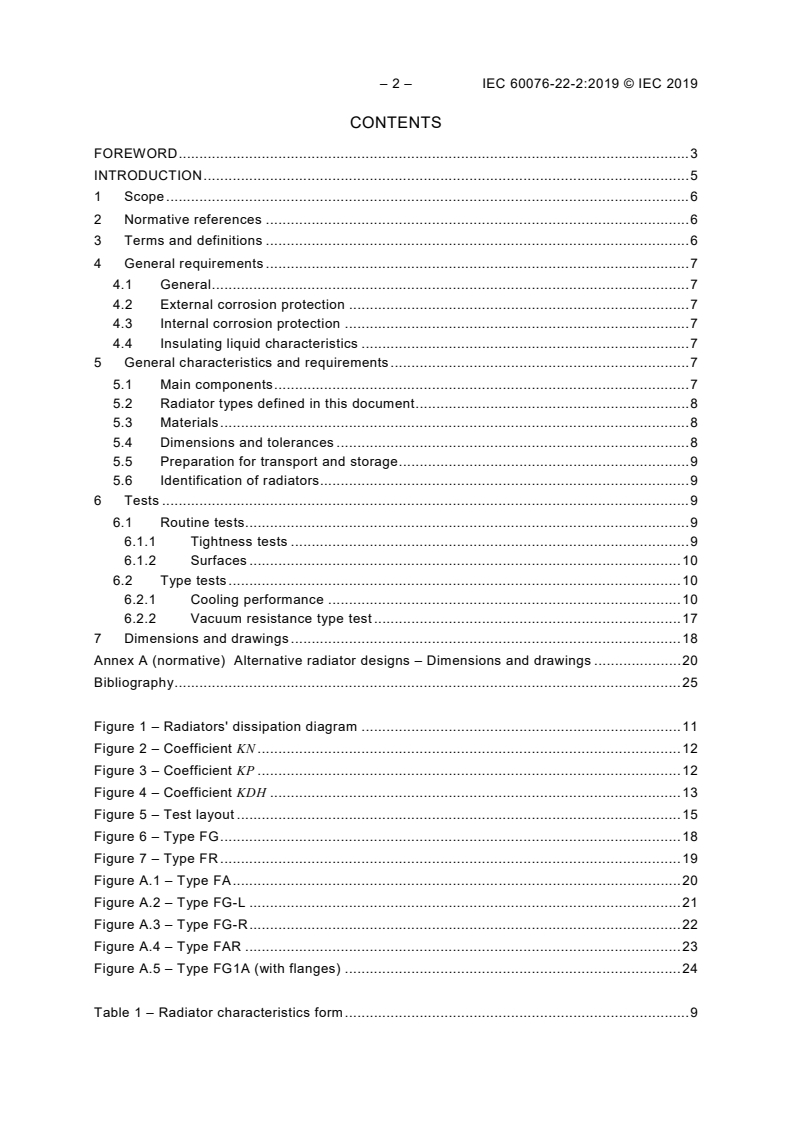
CONTENTS
FOREWORD . 3
INTRODUCTION . 5
1 Scope . 6
2 Normative references . 6
3 Terms and definitions . 6
4 General requirements . 7
4.1 General . 7
4.2 External corrosion protection . 7
4.3 Internal corrosion protection . 7
4.4 Insulating liquid characteristics . 7
5 General characteristics and requirements . 7
5.1 Main components . 7
5.2 Radiator types defined in this document . 8
5.3 Materials . 8
5.4 Dimensions and tolerances . 8
5.5 Preparation for transport and storage . 9
5.6 Identification of radiators. 9
6 Tests . 9
6.1 Routine tests. 9
6.1.1 Tightness tests . 9
6.1.2 Surfaces . 10
6.2 Type tests . 10
6.2.1 Cooling performance . 10
6.2.2 Vacuum resistance type test . 17
7 Dimensions and drawings . 18
Annex A (normative) Alternative radiator designs – Dimensions and drawings . 20
Bibliography . 25
Figure 1 – Radiators' dissipation diagram . 11
Figure 2 – Coefficient KN . 12
Figure 3 – Coefficient KP . 12
Figure 4 – Coefficient KDH . 13
Figure 5 – Test layout . 15
Figure 6 – Type FG . 18
Figure 7 – Type FR . 19
Figure A.1 – Type FA . 20
Figure A.2 – Type FG-L . 21
Figure A.3 – Type FG-R . 22
Figure A.4 – Type FAR . 23
Figure A.5 – Type FG1A (with flanges) . 24
Table 1 – Radiator characteristics form . 9
INTERNATIONAL ELECTROTECHNICAL COMMISSION
____________
POWER TRANSFORMERS –
Part 22-2: Power transformer and reactor fittings –
Removable radiators
FOREWORD
1) The International Electrotechnical Commission (IEC) is a worldwide organization for standardization comprising
all national electrotechnical committees (IEC National Committees). The object of IEC is to promote
international co-operation on all questions concerning standardization in the electrical and electronic fields. To
this end and in addition to other activities, IEC publishes International Standards, Technical Specifications,
Technical Reports, Publicly Available Specifications (PAS) and Guides (hereafter referred to as “IEC
Publication(s)”). Their preparation is entrusted to technical committees; any IEC National Committee interested
in the subject dealt with may participate in this preparatory work. International, governmental and non-
governmental organizations liaising with the IEC also participate in this preparation. IEC collaborates closely
with the International Organization for Standardization (ISO) in accordance with conditions determined by
agreement between the two organizations.
2) The formal decisions or agreements of IEC on technical matters express, as nearly as possible, an international
consensus of opinion on the relevant subjects since each technical committee has representation from all
interested IEC National Committees.
3) IEC Publications have the form of recommendations for international use and are accepted by IEC National
Committees in that sense. While all reasonable efforts are made to ensure that the technical content of IEC
Publications is accurate, IEC cannot be held responsible for the way in which they are used or for any
misinterpretation by any end user.
4) In order to promote international uniformity, IEC National Committees undertake to apply IEC Publications
transparently to the maximum extent possible in their national and regional publications. Any divergence
between any IEC Publication and the corresponding national or regional publication shall be clearly indicated in
the latter.
5) IEC itself does not provide any attestation of conformity. Independent certification bodies provide conformity
assessment services and, in some areas, access to IEC marks of conformity. IEC is not responsible for any
services carried out by independent certification bodies.
6) All users should ensure that they have the latest edition of this publication.
7) No liability shall attach to IEC or its directors, employees, servants or agents including individual experts and
members of its technical committees and IEC National Committees for any personal injury, property damage or
other damage of any nature whatsoever, whether direct or indirect, or for costs (including legal fees) and
expenses arising out of the publication, use of, or reliance upon, this IEC Publication or any other IEC
Publications.
8) Attention is drawn to the Normative references cited in this publication. Use of the referenced publications is
indispensable for the correct application of this publication.
9) Attention is drawn to the possibility that some of the elements of this IEC Publication may be the subject of
patent rights. IEC shall not be held responsible for identifying any or all such patent rights.
International Standard IEC 60076-22-2 has been prepared by IEC technical committee 14:
Power transformers.
The text of this International Standard is based on the following documents:
CDV Report on voting
14/895/CDV 14/917A/RVC
Full information on the voting for the approval of this International Standard can be found in
the report on voting indicated in the above table.
This document has been drafted in accordance with the ISO/IEC Directives, Part 2.
A list of all parts in the IEC 60076 series, published under the general title Power
transformers, can be found on the IEC website.
– 4 – IEC 60076-22-2:2019 © IEC 2019
The committee has decided that the contents of this document will remain unchanged until the
stability date indicated on the IEC website under "http://webstore.iec.ch" in the data related to
the specific document. At this date, the document will be
• reconfirmed,
• withdrawn,
• replaced by a revised edition, or
• amended.
IMPORTANT – The 'colour inside' logo on the cover page of this publication indicates
that it contains colours which are considered to be useful for the correct
understanding of its contents. Users should therefore print this document using a
colour printer.
INTRODUCTION
Under the part title “Power transformer and reactor fittings" this part of IEC 60076-22 covers
the removable radiators used in the cooling circuits of power transformers and reactors.
– 6 – IEC 60076-22-2:2019 © IEC 2019
POWER TRANSFORMERS –
Part 22-2: Power transformer and reactor fittings –
Removable radiators
1 Scope
This part of IEC 60076 applies to radiators mounted on liquid immersed power transformers
according to IEC 60076-1 and reactors according to IEC 60076-6 with and without
conservator for indoor or outdoor installation. It outlines the service conditions and the
mechanical and electrical requirements that are common to this equipment.
It also outlines the operation requirements specific to this equipment as well as the preferred
dimensions relevant for interchangeability and the type and routine tests to be performed.
2 Normative references
The following documents are referred to in the text in such a way that some or all of their
content constitutes requirements of this document. For dated references, only the edition
cited applies. For undated references, the latest edition of the referenced document (including
any amendments) applies.
IEC 60076-1, Power transformers – Part 1: General
IEC 60076-7, Power transformers – Part 7: Loading guide for oil-immersed power
transformers
IEC 60296, Fluids for electrotechnical applications – Unused mineral insulating oils for
transformers and switchgear
ISO 4406, Hydraulic fluid power – Fluids – Method for coding the level of contamination by
solid particles
ISO 12944 (all parts), Paints and varnishes – Corrosion protection of steel structures by
protective paint systems
3 Terms and definitions
For the purposes of this document, the following terms and definitions apply.
ISO and IEC maintain terminological databases for use in standardization at the following
addresses:
• IEC Electropedia: available at http://www.electropedia.org/
• ISO Online browsing platform: available at http://www.iso.org/obp
3.1
removable radiator
component through which the transformer insulating liquid circulates and is cooled
Note 1 to entry: The component is removable from the transformer for shipment and maintenance purposes.
Note 2 to entry: This component has natural cooling capacity.
Note 3 to entry: Radiator cooling systems can be equipped with fans and/or circulating pumps.
4 General requirements
4.1 General
The normal service conditions set out in IEC 60076-1 represent the normal scope of operation
of the equipment specified in this document.
For any unusual service conditions which require special consideration in the design of the
equipment, see IEC 60076-1; operation under such unusual service conditions shall be
subject to agreement between the purchaser and supplier, as they require special
consideration in the design of the equipment.
4.2 External corrosion protection
The materials used for the construction of the equipment and the surface treatment shall be
resistant to accidental contact with the insulating liquid and suitable to withstand the
environmental conditions given in 4.1. The corrosion protection shall be agreed between
purchaser and manufacturer according to ISO 12944 (all parts). The responsibility to specify
the correct level of corrosion protection lies with the purchaser and is dependent on the
environment where the transformer will be located and on the durability required. Unless
otherwise specified, minimum withstand level shall be C4 medium durability according to
ISO 12944-6.
Due to the specific painting process of radiators a common final colour would be a great
contribution to reducing the environmental pollution. Unless differently specified by the
purchaser, RAL 7031, 7032 or 7033 are the recommended final colours.
4.3 Internal corrosion protection
In consideration of the storage conditions and expected time between shipment and
commissioning, the corrosion protection on the inner side of the radiator shall be agreed
between purchaser and manufacturer. As a minimum requirement, precautions shall be taken
to prevent the ingress of moisture and the development of internal corrosion. The internal
flushing with insulation liquid fully miscible and compatible with the liquid to be used in
service conditions and the use of blanking plates with gaskets are considered as a minimum.
Internal painting, nitrogen filling, dehydrating material, etc., can be used as other or additional
solutions.
4.4 Insulating liquid characteristics
If not otherwise specified, the insulating liquid shall be mineral oil according to IEC 60296 and
the operating temperature shall be in accordance with IEC 60076-7.
When the insulating liquid is not mineral oil then the viscosity variation, the operating
temperature and all the other operating characteristics shall be indicated by the purchaser.
5 General characteristics and requirements
5.1 Main components
The main radiator components are:
• header; collectors on the top and bottom of the radiator;
• connection flanges; flanges which connect the radiators to the transformer tank;
– 8 – IEC 60076-22-2:2019 © IEC 2019
• cooling elements; elements of the radiator which dissipate the heat;
• lifting lugs; devices used to lift the radiator;
• securing plates; facilities to connect the radiators to one another for stiffening purposes;
• fan attachments; optional facilities for fan installation on the side and on the bottom.
The headers shall be made in such a way as to guarantee a complete filling and a complete
draining. Oblique elements or reduced elements are acceptable.
The layout is given in Figure 6 and Figure 7, and in Figure A.1 to Figure A.5.
The radiators shall be provided with an air vent device on the top header and a draining
device on the bottom header.
5.2 Radiator types defined in this document
The designations to identify the types of radiator are:
Common radiator types
FG radiators with square flanges and elements of equal length (see Figure 6)
FR radiators with square flanges with lowered upper header (see Figure 7)
Alternative design types
FA radiators with square flanges and elements of unequal length (see Figure A.1)
FG-L radiators with square flanges and elements of equal length with a number of bevelled
elements on the left side (see Figure A.2)
FG-R radiators with square flanges and elements of equal length with a number of bevelled
elements on the right side (see Figure A.3)
FAR radiators with square flanges with sloped down external elements, without or with
lowered upper header (see Figure A.4)
FG1A radiators with or without square flanges without header, without or with out of centre
connection (see Figure A.5)
5.3 Materials
The radiator elements shall be made of stamped steel sheets or steel pipes (round, oval or
finned pipes) with a minimum thickness of 1,0 mm. For enhanced mechanical performance a
thickness of 1,2 mm can be specified by the purchaser for the stamped steel sheets. Other
materials and thicknesses may be used upon agreement between manufacturer and
purchaser.
5.4 Dimensions and tolerances
To ensure interchangeability between radiators of different manufacturers, the tolerances
given in Figure 6 to Figure A.5 are mandatory.
There shall be at least two lifting lugs, one at the top and one at the bottom of the radiator,
which shall have a 30 mm minimum hole diameter.
The radiators shall not deflect from horizontal by more than 2 mm/m without oil. For this
reason, the stiffening number and distances illustrated on Figure 6 to Figure A.5 are the
minimum required. Additional stiffening may be agreed between purchaser and manufacturer
depending on:
• transformer specific requirements (for instance reactors, noise requirements);
• seismic and environmental specific severe conditions.
The manufacturer shall provide a table indicating exactly the surface in m , the weight in kg
and the capacity of oil per element in function of the height of the element itself. The table
does not include the data associated with the radiator nozzles. Table 1 is an example of such
a table.
Table 1 – Radiator characteristics form
ELEMENT HEIGHT ELEMENT SURFACE ELEMENT WEIGHT ELEMENT CAPACITY
2 3
(mm) (m ) (kg) (dm )
800 XXXX XXXX XXXX
……. ……. ……. …….
3 500 XXXX XXXX XXXX
5.5 Preparation for transport and storage
It is the responsibility of the manufacturer to prepare the radiator flanges for shipment in order
to prevent particles or contaminants from entering the radiator during transport or storage,
and precautions shall be taken to ensure that there is no deterioration caused by moisture.
Unless otherwise specified the storage configuration shall be designed to ensure a minimum
storage period of six months in the environmental conditions defined in IEC 60076-1.
All measures shall be taken to avoid mechanical damage to the elements such as:
• rubber, or wooden material between the radiators to avoid scratches of the external
treatment on the cooling elements;
• plastic belts to keep the radiators tight to the pallet and to each other;
• robust pallets to ensure protection under the radiators from the forklift handling.
For international shipment, a wooden cage is recommended, unless otherwise agreed with the
buyer.
5.6 Identification of radiators
The radiators shall bear the name or the logo of the manufacturer, a lot identification number
and the production site, in order to identify the radiators in the field.
6 Tests
6.1 Routine tests
6.1.1 Tightness tests
The radiator shall be submitted to one of the following tightness tests; the choice of the test
shall be at the discretion of the radiator manufacturer:
• hydraulic test with transformer oil filled at 60 °C ± 5 °C and pressure of 200 kPa for 3 h;
– 10 – IEC 60076-22-2:2019 © IEC 2019
• pneumatic test with compressed air under water at 200 kPa for a period of not less than
30 min;
• pneumatic test with compressed air under water at 500 kPa for a period of not less than
5 min.
For the above listed tests the acceptance criterion is that in the mentioned period no leakage
shall be detected by visual inspection.
Different testing procedures may be agreed between purchaser and manufacturer.
6.1.2 Surfaces
6.1.2.1 Visual inspection
The radiators shall be visually inspected and there shall be no visible deformations, damages
or bumps.
6.1.2.2 Inspection of the external paint
The total and partial thickness of the different coats shall be measured in accordance with the
procedure described in ISO 12944-7.
Upon request from the customer, a control sheet shall be available to demonstrate the quality
of the external paint application. Therefore, a control sheet should be prepared, where the
manufacturer records all the relevant parameters of each lot of production. In particular,
ambient temperature and humidity during application, type of pre-treatment of the surface
(sandblasting, degreasing), lot and type of painting used, temperature and time of drying and
final thicknesses measured after each coat shall be recorded; if required, result of the
adhesion test should also be recorded.
6.1.2.3 Internal surfaces
All internal surfaces shall be cleaned so thoroughly that no subsequent cleaning by the
purchaser will be required.
For the measurement of the cleanliness of the internal surfaces, the purchaser shall specify
the acceptance criteria by means of particles count according to ISO 4406.
For radiators with unpainted internal surfaces, if no criteria are specified, then flushing using
a maximum 20 µm filter to detect the presence of any particles or contaminations shall be
carried out as a minimum requirement.
For radiators with painted internal surfaces, if no criteria are specified, visual inspection is the
minimum requirement to ensure that no detached particles are present within the radiator and
that the internal surface is dry and the paint has a good adhesion. The coating used shall be
agreed between purchaser and manufacturer; it shall be compatible with transformer
insulating and cooling fluid and shall not break down over time and compromise the integrity
of the electrical equipment.
6.2 Type tests
6.2.1 Cooling performance
6.2.1.1 Overview
This procedure describes the method that shall be used to determine the cooling
performances of the radiators in ONAN conditions; the purpose of the type test is to obtain the
following results:
a) The diagram showing the specific heat dissipation of the radiator (W/m ) as a function of
the radiator height (mm) and of the temperature rise of the average oil over the ambient
air (K). Figure 1 shows a typical diagram.
∆T 60°
∆T 55°
∆T 50°
∆T 45°
∆T 40°
1 000 1 500 2 000 2 500 3 000 3 500
Radiators height, I (mm)
IEC
NOTE ∆T is intended as average oil temperature rise [ΔT ] = (0,5x([T ]+[T ])) - [T ].
avg,oil i,oil o,oil amb
Figure 1 – Radiators' dissipation diagram
b) The value of the corrective coefficient KN as a function of the number of elements of the
radiator; this coefficient is used to correct the specific heat dissipation of a radiator
depending on the number of elements of the radiators itself. Figure 2 shows a typical
diagram.
Dissipation (W/m )
– 12 – IEC 60076-22-2:2019 © IEC 2019
1,1
0,9
0,8
5 10 15 20 25 30 35
Number of elements
KN coefficient where N is the number of elements for each radiator
IEC
Figure 2 – Coefficient KN
c) The value of the corrective coefficient KP as a function of the distance between the
radiators (pitch). This coefficient is used to correct the specific heat dissipation of a
radiator depending on the difference between centres of adjoining radiators. Figure 3
shows a typical diagram.
1,1
0,9
0,8
P (mm)
550 650 750
KP coefficient where P is the difference between
centre of adjoining radiators (pitch)
IEC
Figure 3 – Coefficient KP
d) The value of the corrective coefficient KDH as a function of the difference DH in height
between the horizontal centreline of the active part of the transformer and the horizontal
centreline of the radiators. This coefficient is used to correct the specific heat dissipation
of a radiator depending on the difference between the two horizontal centre lines. Figure 4
shows a typical diagram.
Coefficient (KP)
Coefficient (KN)
1,1
0,9
0,8
DH (mm)
100 500 1 000
KDH coefficient where DH is the difference in height
between the nucleus centre line and radiator
IEC
Figure 4 – Coefficient KDH
The cooling capacity of a radiator depends on the average oil temperature rise and the height
of the elements. This value shall be corrected by the coefficients KN, KP and KDH.
These diagrams are applicable for ONAN applications only. For ONAF, OFAN or OFAF
applications, they have to be adjusted by multiplicative factors, peculiar to every configuration.
6.2.1.2 Type test conditions
The heat dissipation tests shall be performed in a closed and stable environment, within a
suitable area, which maintains the ambient temperature stable without variation due to the
thermic test itself or to the external climate conditions. This ambient temperature shall be
maintained at around 25°C ± 5°C.
The ratio between the volume of the hot oil used in the cooling test and the volume of the
room where the tests are performed shall be higher than 1:100.
The specific dissipation curves shall be obtained by testing several times the cooling
performances of a specific radiator filled with transformer mineral oil and attached in its
normal vertical position to a tank with a well-known oil capacity, dimensions and heat
dissipation. The tank shall be designed in such a way that its heat dissipation capacity does
not influence the dissipation characteristics of the radiator (see 6.2.1.5).
The radiator painting thickness shall be 120 µm ± 10 %.
The radiators tested shall be of the FG type. The dissipation characteristics of the FR type
radiators shall be calculated by interpolation.
No other tests conditions are admissible.
6.2.1.3 Values and parameters to be measured
During the test, the following parameters shall be measured:
• ambient temperature [T ]: defined as the average of three air temperatures measured
amb
by thermocouples immersed in oil and placed in the position described in Figure 5 at 2 m
from the ground, with at least 2 m of free space around them;
Coefficient (KDH)
– 14 – IEC 60076-22-2:2019 © IEC 2019
• radiator oil temperature at inlet [T ]: oil inlet temperature measured on the radiator at a
i,oil
distance of 50 mm from the inlet flange, using a thermocouple placed on the external
surface and well isolated from the ambient environment, or in a thermometer pocket;
• radiator oil temperature at outlet [T ]: oil outlet temperature measured on the radiator at
o,oil
a distance of 50 mm from the outlet flange, using a thermocouple placed on the external
surface and well isolated from the ambient environment, or in a thermometer pocket;
• maximum tank oil temperature [T ]: temperature measured on the hottest point of the
top,oil
tank on the top of the tank itself;
• maximum oil temperature rise [ΔT ] = [T ] - [T ];
max,oil top,oil amb
• average oil temperature rise [ΔT ] = (0,5 x ([T ] + [T ])) - [T ];
avg,oil i,oil o,oil amb
• total cooling capacity [q ]: equivalent to the total power generated by the electrical
TOT
resistors immersed in oil inside the tank;
• cooling capacity of the tank [q ]: the heat dissipated by the tank only, without any radiator
t
attached;
• radiator cooling capacity [q ] = [q ] - [q ] expressed in kW.
rad TOT t
All the values listed above shall be measured in the test conditions described in 6.2.1.2.
6.2.1.4 Instrument characteristics and requirements
The data collection system shall be based on the following elements:
• automatic temperature data collection system;
• thermocouple with functioning range -10 °C to +300 °C;
• monitoring system of the electric power of the oil immersed resistance.
The temperature data collection system shall have a minimum resolution of 0,1 °C, and
accuracy of ±1,5 %.
The only admitted heat source are batches of electric resistance immersed in oil with a
regulation system of the input power which allows a continuous regulation.
All instruments shall be calibrated and certified.
6.2.1.5 Characteristics of the tank used for dissipation tests
The tank shall be equipped with a conservator to compensate the oil expansion. The shape of
the tank shall be such as to guarantee a uniform temperature distribution in any area. A
cylindrical shape is the preferred solution.
The tank shall be large enough to ensure a minimum ratio of 1:10 between the oil volume of
the tank and the biggest radiator and high enough to allow the mounting of the biggest
radiator on test.
To ensure a good temperature distribution inside the tank, a study of the temperature shall be
performed during the heat test of the tank alone.
The resistor inside the tank shall have an adjustable position making it possible to change the
DH parameter.
-2 -1
The tank shall be insulated to provide an emission of maximum 1 Wm K . The conservator
does not require to be insulated. Figure 5 shows a typical test layout.
Temperature
sensor
Heating Radiator
box on test
IEC
Figure 5 – Test layout
6.2.1.6 Dissipation test method
6.2.1.6.1 Tank dissipation test
The tank should start the heating process by increasing the input power to the resistors in
order to reach at least three different temperature rises (60 K, 50 K and 40 K).
The values of the top oil temperature rise and average oil temperature rise shall be recorded
at least every 30 min. When the top oil temperature rise rate of change has fallen below
0,5 K/h and has remained there for a period of 4 h, then the tank is considered to have
reached stability. The three values of power (kW) corresponding to the three different
temperatures shall be recorded.
The manufacturer shall provide in his report the following parameters:
• tank dimension, oil capacity and surface;
• tank insulation characteristics;
• oil type and its characteristics;
• top and average oil temperature rise for each specific electric power dissipated.
Other values of tank heat dissipation (KW) corresponding to a different oil temperature rise
can be calculated by interpolation.
6.2.1.6.2 Radiators dissipation tests
Each dissipation test shall be carried out by changing only one parameter at a time from the
following:
• number of elements: N;
• difference between the radiator centre line and the active part centre line: DH;
• distance from one radiator to the other, which is the pitch between radiators: P.
The distance between the first element and the test tank shall be 300 mm.
– 16 – IEC 60076-22-2:2019 © IEC 2019
For each dissipation test, a report shall be done with the following parameters:
– radiator characteristics (oil capacity, surface, weight, height, number of elements);
– oil type and its characteristics;
– top and average oil temperature rise for each specific electric power dissipated;
– DH (centre lines difference).
The test shall be performed as follows:
Start the dissipation test by energizing the resistor inside the test tank. The input power in kW
shall be comparable to the expected radiator and tank losses at the required temperature rise.
Wait for the thermal stability, then adjust the input power in order to reach the required
temperature rise.
When the top oil temperature rise rate of change has fallen below 0,5 K/h and has remained
there for a period of 4 h, then the tank is considered to have reached stability; at this point the
test is considered completed.
The radiator specific dissipation at a certain temperature rise will be calculated by deducting
the tank dissipation at the same temperature rise from the total losses measured during the
test.
The manufacturer shall conduct these tests for at least four radiator heights (for instance
800 mm, 1 600 mm, 2 400 mm, 3 200 mm), with a DH = 0 condition, no other radiators nearby
and with a certain number of elements decided by the manufacturer (for example
20 elements).
The tests as described above on the four radiators shall be conducted at three average oil
temperature rises (60 K, 50 K and 40 K).
6.2.1.6.3 KDH diagram generation
The same radiators used for the tests above (four radiators) shall be used by adjusting the
height of the resistor inside the test tank in order to change the value of DH: at least three
different positions of the resistor shall be tested at the three different temperature rises (60 K,
50 K and 40 K) for each radiator. For example: 350 mm, 700 mm, 1 000 mm. The different
positions shall change by at least 300 mm.
6.2.1.6.4 KN diagram generation
Three tests with different number of elements shall be carried out for each radiator height,
and for the three temperature rises above (60 K, 50 K and 40 K). The number of elements
shall change in steps of 10 (for example 5, 15, 25 elements).
6.2.1.6.5 KP diagram generation
Three dissipation tests for each radiator height (four radiators) and for the three temperature
rises (60 K, 50 K and 40 K) shall be performed using thermal insulating panels at the two
sides of the radiator, to simulate the proximity of other radiators. The panels shall be as high
-2 -1
as the tested radiator and with thermal conductivity of less than 1 Wm K . Each test should
be carried out by changing the distance of the panels by at least 100 mm, for example at
50 mm, 150 mm, 250 mm from the tested radiator.
6.2.1.6.6 Results
Coefficients and dissipation values for different temperature rises, radiator heights, number of
elements and centre lines are determined by interpolation of the measured values.
6.2.2 Vacuum resistance type test
The radiator shall be submitted to an internal absolute pressure of 200 Pa and then closed off
hermetically. After 6 h, the internal absolute pressure shall not exceed 500 Pa. At the end of
the test, with the radiator open to ambient pressure, no permanent deformation shall be
registered.
– 18 – IEC 60076-22-2:2019 © IEC 2019
7 Dimensions and drawings
Key
1 Vent plug
2 Lifting lug
3 Fixing plate
4 Stiffening
5 Stiffening
6 Fixing plate
7 Drain plug
8 Lifting lug
9 Flange
10 Flange
Figure 6 – Type FG
Key
1 Vent plug
2 Lifting lug
3 Fixing plate
4 Stiffening
5 Stiffening
6 Fixing plate
7 Drain plug
8 Lifting lug
9 Flange
10 Flange
Figure 7 – Type FR
– 20 – IEC 60076-22-2:2019 © IEC 2019
Annex A
(normative)
Alternative radiator designs – Dimensions and drawings
Key
1 Vent plug
2 Lifting lug
3 Fixing plate
4 Stiffening
5 Stiffening
6 Fixing plate
7 Drain plug
8 Lifting lug
9 Flange
10 Flange
Figure A.1 – Type FA
Key
1 Vent plug
2 Lifting lug
3 Fixing plate
4 Stiffening
5 Stiffening
6 Fixing plate
7 Drain plug
8 Lifting lug
9 Flange
10 Flange
Figure A.2 – Type FG-L
– 22 – IEC 60076-22-2:2019 © IEC 2019
Key
1 Vent plug
2 Lifting lug
3 Fixing plate
4 Stiffening
5 Stiffening
6 Fixing plate
7 Drain plug
8 Lifting lug
9 Flange
10 Flange
Figure A.3 – Type FG-R
Key
1 Vent plug
2 Lifting lug
3 Fixing plate
4 Stiffening
5 Stiffening
6 Fixing plate
7 Drain plug
8 Lifting lug
9 Flange
10 Flange
Figure A.4 – Type FAR
– 24 – IEC 60076-22-2:2019 © IEC 2019
Key
1 Flange
2 Flange
3 Stiffening
4 Stiffening
Figure A.5 – Type FG1A (with flanges)
Bibliography
IEC 60076-6, Power transformers – Part 6: Reactors
___________
– 26 – IEC 60076-22-2:2019 © IEC 2019
SOMMAIRE
AVANT-PROPOS . 27
INTRODUCTION . 29
1 Domaine d’application . 30
2 Références normatives . 30
3 Termes et définitions . 30
4 Exigences générales . 31
4.1 Généralités . 31
4.2 Protection contre la corrosion externe . 31
4.3 Protection contre la corrosion interne . 31
4.4 Caractéristiques du liquide isolant. 31
5 Caractéristiques et exigences
...