

IEC TS 63428:2024
(Main)Guidance on material circulation considerations in environmentally conscious design
General Information
- Abstract
IEC TS 63428:2024 describes principles and provides guidance on how to embed material circularity aspects into the design and development of products.
This includes making efficient use of materials and closing material flows in design and production, extending the lifetime of products through increased durability and enabling parts and materials to be reused or recycled at end-of-life.
• Closing the material flows includes the use of recycled content and reused parts.
• Durability extensions include such measures as to improve reliability and maintenance, enable and facilitate repair, provide updates and upgrades, refurbish and reuse.
• Improvements in material recyclability, parts reuse, and remanufacturing are possible through measures such as design for disassembly, separability of materials, choice of materials, traceability of materials, and durability of parts.
This document builds on the jointly published (ISO and IEC) document, IEC 62430:2019 for requirements for environmentally conscious design (ECD) processes, and it supplements ECD by adding more specific guidance on the aspects of material circularity and material efficiency.
This document only deals with material circularity of products. Economic, social and energy aspects are excluded from the scope of this document.
This document is applicable to all electrotechnical products including goods and services.
- Status
- Published
- Publication Date
- 22-Aug-2024
- Technical Committee
- TC 111 - Environmental standardization for electrical and electronic products and systems
- Drafting Committee
- WG 20 - TC 111/WG 20
- Current Stage
- PPUB - Publication issued
- Start Date
- 23-Aug-2024
- Completion Date
- 13-Sep-2024
Overview
IEC TS 63428:2024 - Guidance on material circulation considerations in environmentally conscious design - is a Technical Specification from the IEC that explains how to embed material circularity into product design and development. Applicable to all electrotechnical products (goods and services), the document focuses on making efficient use of materials and closing material flows by extending product lifetime, enabling reuse and recycling, and designing for material efficiency. Economic, social and energy aspects are explicitly excluded from its scope.
Key topics and requirements
- Material circularity principles and their relationship with environmentally conscious design (ECD) and life‑cycle thinking.
- Guidance across design and development phases: value proposition, material selection, manufacture, distribution/installation, product use, and end‑of‑life.
- Measures to close material flows:
- Use of recycled content and reused parts.
- Design approaches to increase recyclability, remanufacturability, and parts reuse.
- Measures to extend product life: durability, reliability, maintenance, repairability, updates/upgrades, refurbishment and reuse.
- Design techniques to enable circularity: design for disassembly, separability of materials, material choice, traceability of materials, and durability of parts.
- Consideration of trade‑offs between different ecodesign measures and guidance on handling them.
- Focused technical guidance for the end‑of‑life phase including remanufacturing, repurposing, and recycling considerations.
Practical applications and users
Who should use IEC TS 63428:2024:
- Product designers and mechanical/electrical engineers integrating design for circularity.
- Sustainability, innovation and product‑management teams defining ecodesign strategies.
- Manufacturing and supply‑chain managers selecting materials and designing processes for recycled content and material traceability.
- After‑sales, repair and remanufacturing operations implementing repairable, upgradeable, and refurbishable product concepts.
- Regulatory and compliance teams aligning product design with emerging circular economy requirements.
Practical uses:
- Integrate material circularity checks into design reviews and design‑for‑manufacture decisions.
- Specify materials and joining methods that support disassembly and recycling.
- Design modular, upgradeable products to extend service life and reduce waste.
- Prepare documentation and traceability schemes to support reuse and recycled‑content claims.
Related standards
- Builds on IEC 62430:2019 (joint ISO/IEC guidance on requirements for environmentally conscious design).
- Complements life‑cycle and material‑efficiency work by ISO/CEN/CENELEC and other ecodesign standards.
Keywords: IEC TS 63428:2024, material circularity, environmentally conscious design, ecodesign, design for disassembly, recyclability, repairability, remanufacturing, material efficiency, circular economy.
Get Certified
Connect with accredited certification bodies for this standard

BSI Group
BSI (British Standards Institution) is the business standards company that helps organizations make excellence a habit.

Bureau Veritas
Bureau Veritas is a world leader in laboratory testing, inspection and certification services.

DNV
DNV is an independent assurance and risk management provider.
Sponsored listings
Frequently Asked Questions
IEC TS 63428:2024 is a technical specification published by the International Electrotechnical Commission (IEC). Its full title is "Guidance on material circulation considerations in environmentally conscious design". This standard covers: IEC TS 63428:2024 describes principles and provides guidance on how to embed material circularity aspects into the design and development of products. This includes making efficient use of materials and closing material flows in design and production, extending the lifetime of products through increased durability and enabling parts and materials to be reused or recycled at end-of-life. • Closing the material flows includes the use of recycled content and reused parts. • Durability extensions include such measures as to improve reliability and maintenance, enable and facilitate repair, provide updates and upgrades, refurbish and reuse. • Improvements in material recyclability, parts reuse, and remanufacturing are possible through measures such as design for disassembly, separability of materials, choice of materials, traceability of materials, and durability of parts. This document builds on the jointly published (ISO and IEC) document, IEC 62430:2019 for requirements for environmentally conscious design (ECD) processes, and it supplements ECD by adding more specific guidance on the aspects of material circularity and material efficiency. This document only deals with material circularity of products. Economic, social and energy aspects are excluded from the scope of this document. This document is applicable to all electrotechnical products including goods and services.
IEC TS 63428:2024 describes principles and provides guidance on how to embed material circularity aspects into the design and development of products. This includes making efficient use of materials and closing material flows in design and production, extending the lifetime of products through increased durability and enabling parts and materials to be reused or recycled at end-of-life. • Closing the material flows includes the use of recycled content and reused parts. • Durability extensions include such measures as to improve reliability and maintenance, enable and facilitate repair, provide updates and upgrades, refurbish and reuse. • Improvements in material recyclability, parts reuse, and remanufacturing are possible through measures such as design for disassembly, separability of materials, choice of materials, traceability of materials, and durability of parts. This document builds on the jointly published (ISO and IEC) document, IEC 62430:2019 for requirements for environmentally conscious design (ECD) processes, and it supplements ECD by adding more specific guidance on the aspects of material circularity and material efficiency. This document only deals with material circularity of products. Economic, social and energy aspects are excluded from the scope of this document. This document is applicable to all electrotechnical products including goods and services.
IEC TS 63428:2024 is classified under the following ICS (International Classification for Standards) categories: 13.020.01 - Environment and environmental protection in general; 13.020.20 - Environmental economics. Sustainability. The ICS classification helps identify the subject area and facilitates finding related standards.
IEC TS 63428:2024 is available in PDF format for immediate download after purchase. The document can be added to your cart and obtained through the secure checkout process. Digital delivery ensures instant access to the complete standard document.
Standards Content (Sample)
IEC TS 63428 ®
Edition 1.0 2024-08
TECHNICAL
SPECIFICATION
colour
inside
Guidance on material circulation considerations in environmentally conscious
design
All rights reserved. Unless otherwise specified, no part of this publication may be reproduced or utilized in any form
or by any means, electronic or mechanical, including photocopying and microfilm, without permission in writing from
either IEC or IEC's member National Committee in the country of the requester. If you have any questions about IEC
copyright or have an enquiry about obtaining additional rights to this publication, please contact the address below or
your local IEC member National Committee for further information.
IEC Secretariat Tel.: +41 22 919 02 11
3, rue de Varembé info@iec.ch
CH-1211 Geneva 20 www.iec.ch
Switzerland
About the IEC
The International Electrotechnical Commission (IEC) is the leading global organization that prepares and publishes
International Standards for all electrical, electronic and related technologies.
About IEC publications
The technical content of IEC publications is kept under constant review by the IEC. Please make sure that you have the
latest edition, a corrigendum or an amendment might have been published.
IEC publications search - webstore.iec.ch/advsearchform IEC Products & Services Portal - products.iec.ch
The advanced search enables to find IEC publications by a Discover our powerful search engine and read freely all the
variety of criteria (reference number, text, technical publications previews, graphical symbols and the glossary.
committee, …). It also gives information on projects, replaced With a subscription you will always have access to up to date
and withdrawn publications. content tailored to your needs.
IEC Just Published - webstore.iec.ch/justpublished
Electropedia - www.electropedia.org
Stay up to date on all new IEC publications. Just Published
The world's leading online dictionary on electrotechnology,
details all new publications released. Available online and once
containing more than 22 500 terminological entries in English
a month by email.
and French, with equivalent terms in 25 additional languages.
Also known as the International Electrotechnical Vocabulary
IEC Customer Service Centre - webstore.iec.ch/csc
(IEV) online.
If you wish to give us your feedback on this publication or need
further assistance, please contact the Customer Service
Centre: sales@iec.ch.
IEC TS 63428 ®
Edition 1.0 2024-08
TECHNICAL
SPECIFICATION
colour
inside
Guidance on material circulation considerations in environmentally conscious
design
INTERNATIONAL
ELECTROTECHNICAL
COMMISSION
ICS 13.020.01; 13.020.20 ISBN 978-2-8322-9553-3
– 2 – IEC TS 63428:2024 © IEC 2024
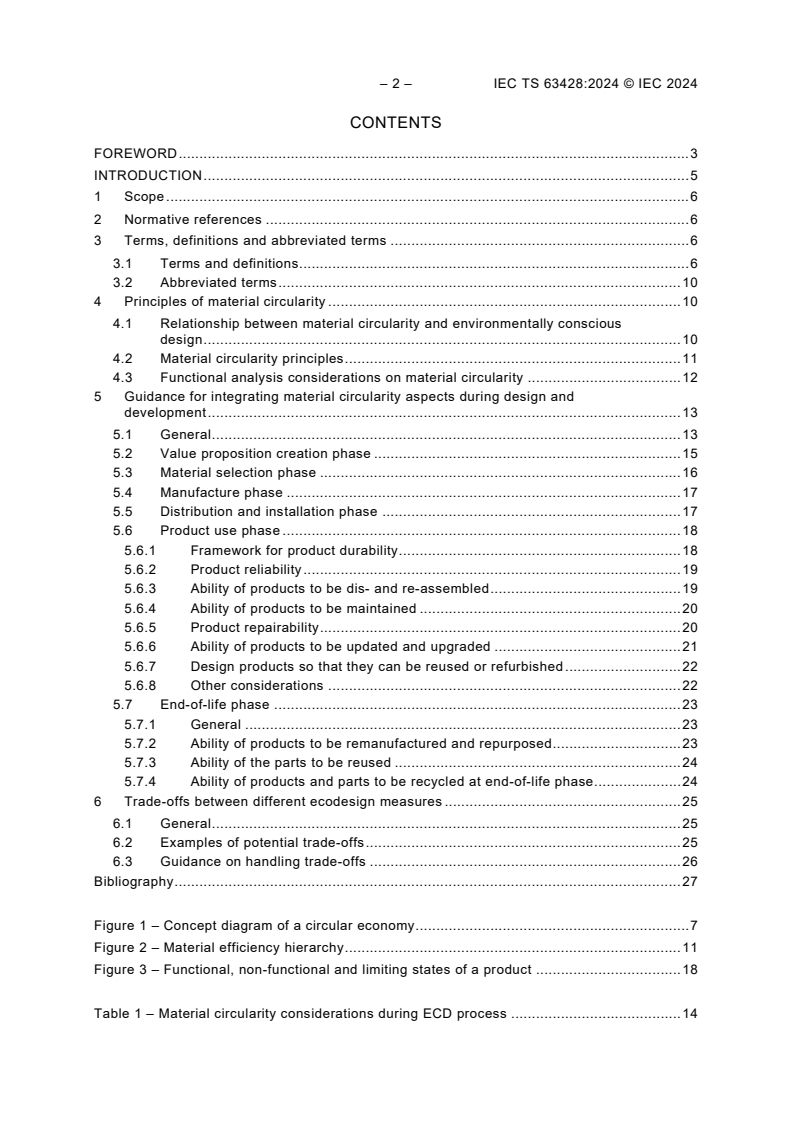
CONTENTS
FOREWORD . 3
INTRODUCTION . 5
1 Scope . 6
2 Normative references . 6
3 Terms, definitions and abbreviated terms . 6
3.1 Terms and definitions . 6
3.2 Abbreviated terms . 10
4 Principles of material circularity . 10
4.1 Relationship between material circularity and environmentally conscious
design . 10
4.2 Material circularity principles . 11
4.3 Functional analysis considerations on material circularity . 12
5 Guidance for integrating material circularity aspects during design and
development . 13
5.1 General . 13
5.2 Value proposition creation phase . 15
5.3 Material selection phase . 16
5.4 Manufacture phase . 17
5.5 Distribution and installation phase . 17
5.6 Product use phase . 18
5.6.1 Framework for product durability . 18
5.6.2 Product reliability . 19
5.6.3 Ability of products to be dis- and re-assembled . 19
5.6.4 Ability of products to be maintained . 20
5.6.5 Product repairability . 20
5.6.6 Ability of products to be updated and upgraded . 21
5.6.7 Design products so that they can be reused or refurbished . 22
5.6.8 Other considerations . 22
5.7 End-of-life phase . 23
5.7.1 General . 23
5.7.2 Ability of products to be remanufactured and repurposed . 23
5.7.3 Ability of the parts to be reused . 24
5.7.4 Ability of products and parts to be recycled at end-of-life phase . 24
6 Trade-offs between different ecodesign measures . 25
6.1 General . 25
6.2 Examples of potential trade-offs . 25
6.3 Guidance on handling trade-offs . 26
Bibliography . 27
Figure 1 – Concept diagram of a circular economy . 7
Figure 2 – Material efficiency hierarchy . 11
Figure 3 – Functional, non-functional and limiting states of a product . 18
Table 1 – Material circularity considerations during ECD process . 14
INTERNATIONAL ELECTROTECHNICAL COMMISSION
____________
GUIDANCE ON MATERIAL CIRCULATION CONSIDERATIONS
IN ENVIRONMENTALLY CONSCIOUS DESIGN
FOREWORD
1) The International Electrotechnical Commission (IEC) is a worldwide organization for standardization comprising
all national electrotechnical committees (IEC National Committees). The object of IEC is to promote international
co-operation on all questions concerning standardization in the electrical and electronic fields. To this end and
in addition to other activities, IEC publishes International Standards, Technical Specifications, Technical Reports,
Publicly Available Specifications (PAS) and Guides (hereafter referred to as "IEC Publication(s)"). Their
preparation is entrusted to technical committees; any IEC National Committee interested in the subject dealt with
may participate in this preparatory work. International, governmental and non-governmental organizations liaising
with the IEC also participate in this preparation. IEC collaborates closely with the International Organization for
Standardization (ISO) in accordance with conditions determined by agreement between the two organizations.
2) The formal decisions or agreements of IEC on technical matters express, as nearly as possible, an international
consensus of opinion on the relevant subjects since each technical committee has representation from all
interested IEC National Committees.
3) IEC Publications have the form of recommendations for international use and are accepted by IEC National
Committees in that sense. While all reasonable efforts are made to ensure that the technical content of IEC
Publications is accurate, IEC cannot be held responsible for the way in which they are used or for any
misinterpretation by any end user.
4) In order to promote international uniformity, IEC National Committees undertake to apply IEC Publications
transparently to the maximum extent possible in their national and regional publications. Any divergence between
any IEC Publication and the corresponding national or regional publication shall be clearly indicated in the latter.
5) IEC itself does not provide any attestation of conformity. Independent certification bodies provide conformity
assessment services and, in some areas, access to IEC marks of conformity. IEC is not responsible for any
services carried out by independent certification bodies.
6) All users should ensure that they have the latest edition of this publication.
7) No liability shall attach to IEC or its directors, employees, servants or agents including individual experts and
members of its technical committees and IEC National Committees for any personal injury, property damage or
other damage of any nature whatsoever, whether direct or indirect, or for costs (including legal fees) and
expenses arising out of the publication, use of, or reliance upon, this IEC Publication or any other IEC
Publications.
8) Attention is drawn to the Normative references cited in this publication. Use of the referenced publications is
indispensable for the correct application of this publication.
9) IEC draws attention to the possibility that the implementation of this document may involve the use of (a)
patent(s). IEC takes no position concerning the evidence, validity or applicability of any claimed patent rights in
respect thereof. As of the date of publication of this document, IEC had not received notice of (a) patent(s), which
may be required to implement this document. However, implementers are cautioned that this may not represent
the latest information, which may be obtained from the patent database available at https://patents.iec.ch. IEC
shall not be held responsible for identifying any or all such patent rights.
IEC TS 63428 has been prepared by IEC technical committee 111: Environmental
standardization for electrical and electronic products and systems. It is a Technical
Specification.
The text of this Technical Specification is based on the following documents:
Draft Report on voting
111/759/DTS 111/772/RVDTS
Full information on the voting for its approval can be found in the report on voting indicated in
the above table.
The language used for the development of this Technical Specification is English.
– 4 – IEC TS 63428:2024 © IEC 2024
This document was drafted in accordance with ISO/IEC Directives, Part 2, and developed in
accordance with ISO/IEC Directives, Part 1 and ISO/IEC Directives, IEC Supplement, available
at www.iec.ch/members_experts/refdocs. The main document types developed by IEC are
described in greater detail at www.iec.ch/publications.
The committee has decided that the contents of this document will remain unchanged until the
stability date indicated on the IEC website under webstore.iec.ch in the data related to the
specific document. At this date, the document will be
• reconfirmed,
• withdrawn, or
• revised.
IMPORTANT – The "colour inside" logo on the cover page of this document indicates
that it contains colours which are considered to be useful for the correct understanding
of its contents. Users should therefore print this document using a colour printer.
INTRODUCTION
The circular economy can be described as a systemic approach to the design of processes,
products (including services) and business models, that tackles global challenges like climate
change, resource depletion, biodiversity loss, waste, and pollution. It is based on the principles
driven by design: eliminate waste and pollution, decreasing the use of resources, circulate
products and materials (at their highest value), and regenerate nature. As such it focuses on
managing resources more effectively and increasingly closing material flows. Changing from
the traditional linear economy to a circular economy represents a paradigm shift in the way that
society and natural capital are interrelated.
Different geographies have already introduced or are expected to introduce soon, the concept
of circular economy into their legal systems. Standards can assist the effective adoption of
legislation. It is important that the international community speed up addressing this topic, for
example, CEN and CENELEC are already doing this in Europe on the assessment of the
different aspects of material efficiency such as durability, ability to repair, reuse and upgrade,
recyclability and recoverability, proportion of reused components, proportion of recycled content,
and the ability of a product to be remanufactured.
Current IEC standards deal with functional approaches and dependability topics. Both can
support material circularity optimization during the design phase across the different life cycle
stages. Material circularity for a product can be supported by a systematic design approach
taking all life stages of the product into consideration.
The design for material circularity means a design contributing to circular economy. This covers
several interrelated efficiencies such as material efficiency, energy efficiency, and
environmental footprint efficiency. Safety and health as functional priorities are covered by
other standards.
Whereas ISO 14009 provides guidance and requirements for management systems to support
incorporating material circulation in design and development, this document focuses on
integrating the material circularity aspects in the design and development processes.
The design for material circularity supports innovation and technology managers, product
designers and engineers by analysing the consequences of their ideas and decisions to the
different life cycle stages of a product. Facilitating circulation of materials by closing the flow
will assist organizations in fulfilling the objectives of circular economy, which is increasingly
becoming an important objective in many parts of the world.
Environmentally conscious design (ECD) is the overarching concept applying life cycle thinking
(LCT), which includes material circularity. This document, focusing on material circularity, aims
at minimizing material losses and closing the material flow of the product's entire life.
This document is intended to become a horizontal document in a future edition, for example, if
it becomes an International Standard.
– 6 – IEC TS 63428:2024 © IEC 2024
GUIDANCE ON MATERIAL CIRCULATION CONSIDERATIONS
IN ENVIRONMENTALLY CONSCIOUS DESIGN
1 Scope
This document describes principles and provides guidance on how to embed material circularity
aspects into the design and development of products.
This includes making efficient use of materials and closing material flows in design and
production, extending the lifetime of products through increased durability and enabling parts
and materials to be reused or recycled at end-of-life.
• Closing the material flows includes the use of recycled content and reused parts.
• Durability extensions include such measures as to improve reliability and maintenance,
enable and facilitate repair, provide updates and upgrades, refurbish and reuse.
• Improvements in material recyclability, parts reuse, and remanufacturing are possible
through measures such as design for disassembly, separability of materials, choice of
materials, traceability of materials, and durability of parts.
This document builds on the jointly published (ISO and IEC) document, IEC 62430:2019 for
requirements for environmentally conscious design (ECD) processes, and it supplements ECD
by adding more specific guidance on the aspects of material circularity and material efficiency.
This document only deals with material circularity of products. Economic, social and energy
aspects are excluded from the scope of this document.
This document is applicable to all electrotechnical products including goods and services.
2 Normative references
There are no normative references in this document.
3 Terms, definitions and abbreviated terms
3.1 Terms and definitions
For the purposes of this document, the following terms and definitions apply.
ISO and IEC maintain terminology databases for use in standardization at the following
addresses:
• IEC Electropedia: available at https://www.electropedia.org/
• ISO Online browsing platform: available at https://www.iso.org/obp
3.1.1
circular economy
economic system that uses a systemic approach to the sustainable development by optimizing
the use of natural resources, aiming to eliminate losses and emissions, circulate products and
materials at their highest value for as long as possible
Note 1 to entry: Circular economy is driven by design aiming at enhancing value by increasing the satisfaction of
the needs and expectations of users, in relation to the resources used.
Note 2 to entry: Circular economy supports natural systems regeneration.
Note 3 to entry: A concept diagram of a circular economy is given in Figure 1.
Figure 1 – Concept diagram of a circular economy
Note 4 to entry: This terminological entry is based on IEC 60050-193:—.
3.1.2
corrective maintenance
maintenance carried out after fault detection to effect restoration
Note 1 to entry: Corrective maintenance of software invariably involves some modification.
[SOURCE: IEC 60050-192:2015, 192-06-06]
3.1.3
critical raw material
CRM
materials which, according to a defined classification methodology, are economically important,
and have a high risk associated with their supply
[SOURCE: EN 45558:2019, 3.1.1, modified – The note has been deleted.]
3.1.4
durability
ability to function as required, under specified conditions of use,
maintenance and repair, until the end-of-life is reached
Note 1 to entry: The criteria for transition from non-functional state to end-of-life should be specified. The criteria
is based on predictable aspects (e.g. technical aspects) so that the durability can be estimated.
Note 2 to entry: Durability can be expressed in units appropriate to the part or product concerned, e.g. calendar
time, operating cycles, distance run, etc.
Note 3 to entry: This terminological entry is based on IEC 60050-193:—.
– 8 – IEC TS 63428:2024 © IEC 2024
3.1.5
environmentally conscious design
ECD
systematic approach which considers environmental aspects in the design and development
with the aim to reduce adverse environmental impacts throughout the life cycle of a product
Note 1 to entry: Other terminology used worldwide with the same meaning includes ecodesign, design for
environment (DFE), green design and environmentally sustainable design.
[SOURCE: IEC 62430:2019, 3.1.1]
3.1.6
functional analysis
systematic investigation of the functions of a real or planned system
[SOURCE: ISO/IEC/IEEE 24765:2017, 3.1685, modified – The second definition was deleted.]
3.1.7
maintenance
process to retain a product, or restore it to, a state in which it can perform as intended
[SOURCE: IEC 60050-192:2015, 192-06-01, modified –"combination of all technical and
management actions intended" has been replaced with "process", "item" has been replaced
with "product", "required" has been replaced with "intended", and the Note to entry has been
deleted.]
3.1.8
material
(physical) matter composed by one or more substances
[SOURCE: IEC/ISO 82474-1:—, 3.1.7]
3.1.9
material circularity
capability for product, parts, and the materials they are composed of to be kept in value
retention loops
Note 1 to entry: Value retention loops refer to the capability of products and parts to have their life maintained or
extended through multiple uses and materials to be recovered at end-of-life.
Note 2 to entry: This terminological entry is based on IEC 60050-193:—.
3.1.10
material efficiency
degree to which a system or product performs its designated functions with effective use of
materials
Note 1 to entry: An effective use of materials can be achieved through balancing material use, product durability,
and recovery.
3.1.11
product
good, service or combination hereof
Note 1 to entry: This terminological entry is based on IEC 60050-193:—.
3.1.12
refurbishing
reconditioning
industrial process to return a used product or part to its original or predetermined design
Note 1 to entry: Original design include form, functionality, performance and safety aspects.
Note 2 to entry: Upgrade could take place simultaneously with refurbishment. The refurbished product remains
within the limits of the original specifications.
Note 3 to entry: The identity of the product or part shall be maintained (e.g. serial or type number).
Note 4 to entry: This terminological entry is based on IEC 60050-193:—.
3.1.13
reliability
ability to perform as required, without failure, for a given time interval, under
given conditions
Note 1 to entry: The time interval duration can be expressed in units appropriate to the item concerned, e.g.
calendar time, operating cycles, distance run, etc., and the units should always be clearly stated.
Note 2 to entry: Given conditions include aspects that affect reliability, such as: mode of operation, stress levels,
environmental conditions, and maintenance.
[SOURCE: IEC 60050-192:2015, 192-01-24, modified – The domain, "" has been
replaced with "" and Note 3 to entry has been deleted.]
3.1.14
remanufacturing
industrial process to create a product by combining different parts from used products and
including, where necessary, new parts
Note 1 to entry: Remanufacturing also occurs when at least one change is made which influences the safety or
original performance of an existing product.
Note 2 to entry: The product shall be given a new identity (for example serial or type number) .
Note 3 to entry: This terminological entry is based on IEC 60050-193:—.
3.1.15
repair
direct action taken to effect restoration
Note 1 to entry: Repair includes fault localization (IEV 192-06-19), fault diagnosis (IEV 192-06-20), fault correction
(IEV 192-06-21), and function checkout (IEV 192-06-22).
[SOURCE: IEC 60050-192:2015, 192-06-14]
3.1.16
reuse
operation by which a product or part having reached the end-of-use is used again
Note 1 to entry: Reused for another purpose is called repurpose.
Note 2 to entry: This terminological entry is based on IEC 60050-193:—.
– 10 – IEC TS 63428:2024 © IEC 2024
3.1.17
update
maintenance of software
Note 1 to entry: Update of software includes fixes and security patches.
Note 2 to entry: Software includes applications, operation systems or firmware.
Note 3 to entry: This terminological entry is based on IEC 60050-193:—.
3.1.18
upgrade
process to enhance the functionality, aesthetics, or performance of a product
Note 1 to entry: An upgrade to a product can involve changes to its software, firmware or hardware(e.g. adding
memory).
Note 2 to entry: This terminological entry is based on IEC 60050-193:—.
3.2 Abbreviated terms
CRM critical raw materials
ECD environmental conscious design
LCA life cycle assessment
EoL end-of-life
4 Principles of material circularity
4.1 Relationship between material circularity and environmentally conscious design
Circular economy approaches focus on the efficiency of the material flow with the aim of
maintaining a circular flow of materials, by retaining value and reducing use of raw materials
and eliminating waste. This concept promotes resource efficiency through closed-loop material
flows throughout the product life cycle.
Environmentally conscious design (ECD), on the other hand, is a systematic approach aimed
at minimizing the adverse environmental impacts of a product across its whole life cycle. ECD
considers all the environmental impacts of a product from the earliest stage of design. This
avoids uncoordinated product planning, for example decreasing use of materials in a product
can lead to a decrease of durability, which on balance can have a negative impact on the
environment. ECD systematically addresses the aspects of material efficiency and material
circularity, with the focus on life cycle impacts.
Both concepts contribute to a sustainable development and promotes innovation and cross
sector collaboration. Also, both concepts require a systematic approach to the design and
development process to meet the targets of reduced environmental impact and increased
material circularity. However, integration of material efficiency with ECD is necessary to
guarantee that environmental impacts and trade-offs are carefully considered beyond just the
promotion of the material efficiency only.
4.2 Material circularity principles
The linear "take-make-use-dispose" economic model is reaching its limits, and initiatives to
develop alternative economic models are emerging. Circular economy promises an industrial
system that is restorative and regenerative by design. As part of the circular economy, the
material efficiency can be described through the three principles of narrowing, slowing down,
and closing resource flows in order to increase the efficiency on the use of materials and other
resources:
a) Narrowing resource flows: aimed at using fewer materials or other resources per product. It
is an approach aiming to optimize use of materials associated with the product and
production processes by using less materials to deliver the same function to the user or by
applying strategies such as intensifying the use of products (e.g. by sharing products) or
replacing products with services.
b) Slowing resource flows: through the design of long-life goods and product-life extension
(e.g. services to extend a product's life, for instance through maintenance, repair, and
refurbishing), the useful life of products is extended, resulting in a slowdown of the flow of
materials by reducing the need to replace products.
c) Closing resource flows: through the use of recycled, reused, and renewable content, the
flow between post-use and production is closed, resulting in a circular flow of materials.
Remanufacturing and repurposing are common strategies to close the material flows by
creating new products from already used ones. The durability (longevity) of the parts is key.
Recycling is a common strategy involving actual "closure" of the material flows. It asks for
strategies that contribute to making products and parts more easily recyclable. The selection
of material that can be easily separated and the recycling technology are keys to guarantee
the quality of recycled content, so that the material can be used for the same or similar
purpose without being downgraded.
Although material circularity encompasses mostly slowing or closing the material flows,
narrowing the flow of materials is also an important subset of material efficiency; therefore, this
document focuses on strategies that contribute to the overall optimization (i.e. reduction) of use
of additional materials to the circular flows.
Another guiding principle is the material efficiency hierarchy as shown in Figure 2, which can
be used for prioritization when considering different strategies for material efficiency, in
particular during product design. Here choices can be made on strategies when designing,
using and discarding both consumer and professional products. Highest in this hierarchy are
strategies associated with longer product life while using less resources: design products that
use less material and are able to inherently last longer before they fail. The objective of design
products should be to use less materials based on virgin materials, but incorporate recycled
materials, to contribute to the circular economy and lower carbon footprint.
Figure 2 – Material efficiency hierarchy
– 12 – IEC TS 63428:2024 © IEC 2024
Next in the hierarchy are design strategies that enable the reuse of products and extend the
product life with repair, update, upgrade, and refurbishment. Reuse and repair are preferred
over refurbishing. This is because the lower you go in this hierarchy, the more value can be lost
or, in other words, the more resources are necessary to accomplish the intended functionality.
For example, refurbishing is typically a more complex process than repair as it can require extra
resources for its execution.
Lowest in the material efficiency hierarchy that still supports circularity is recycling. Although
for many people, circular economy – closing the materials flows – equals recycling, it most often
results in significant losses in value compared to the other material efficiency strategies.
Recycling most often involves loss of material, lower quality material (downcycling) and can be
energy intensive. Recycling is, therefore, to be applied only when all the other strategies are
no longer possible. As most products eventually will reach their end-of-life, recyclability of
products towards the pure materials is to always be considered during product design. The
focus is on materials and design choices that allow for recycling at the highest possible quality
and value.
If after their use, products are incinerated or discarded into landfill, there is a significant loss of
value associated with that product. As such, we can attribute very low efficiency in the use of
such product and its materials are literally "lost" for the economy. Such strategies belong to a
linear economy and, where possible, should be avoided. Therefore, the last preferred strategy
is energy recovery from the materials that cannot be otherwise recovered. Landfill should be
avoided where possible.
It has to be noted that the hierarchy shown in Figure 2 should be considered in the context of
the product type and the product sector, and should be put in perspective with other aspects
that are also important for the organization. For example, the reuse of products containing
certain (hazardous) substances can have low priority for an organization due to safety or
compliance issues. Likewise, consuming less material to design a product can impact its
durability. Therefore, it is necessary for organizations to consider the different strategies of this
figure and analyse the trade-offs with other aspects that are relevant when defining their own
material circularity strategy.
The material efficiency hierarchy of Figure 2 can be considered during all the life cycle stages
of the product. This can be done by different approaches to improving durability (extended
lifetimes) such as increasing reliability, and designing for maintenance, reuse, repair, upgrade,
refurbishment, and ultimately recycling.
4.3 Functional analysis considerations on material circularity
When applying material circularity considerations as part of ECD, circularity strategies will be
an integral part of the design process, business management and into the value chain
management of an organization. Circularity is to be considered like any other design aspects,
such as physical and economic requirements, aesthetics, usefulness, identity and meaning. In
this case, the functional analysis of the product will include materials efficiency and material
circularity considerations, meaning that material circularity is a functional aspect of the product
to consider together with other functional aspects. Integrating material circularity in the
functional analysis can successfully contribute to enhancing the value of products and as such
support mitigating design challenges. Three indicative examples are given as the following:
• Aiming for increased recyclability can increase the value of the product at end-of-life and it
can involve simplification of the product architecture and a reduction in use of materials,
which in turn will contribute to lowering costs.
• Designing products prepared for predictive maintenance by adding smart controls and
reducing downtime of the product and the total cost of ownership.
• Designing products for easy repair of the parts most likely to fail can increase the lifetime
of the product and thereby also make the product more attractive as a long-time investment.
In practice, there will often be complexities when balancing the different functional requirements
against each other, which can require to be explored further in the analysis.
With the focus on increasing the material circularity of the product at end-of-life and introducing
material circularity considerations as part of ECD, the designers will have to ask questions that
help them improve the environmental performance of such a design. Typical questions that can
be asked as part of the functional analysis are:
• How to increase the recyclability rate of the product?
• How to introduce and validate the use of materials (including recycled content) that are
easily separated from each other at the end-of-life to improve reuse of parts and
recyclability?
• How to use durable and robust parts and materials to increase overall durability of the
product and to support reuse, remanufacturing and repurposing?
• How to avoid or reduce the combination of material properties reducing the need and the
number of additives in a material, for example reducing the use of substances such as
brominated flame retardants, anti-dripping agents, or plasticizers that can reduce the
recyclability of the materials at end-of-life (EoL)?
NOTE 1 Examples of main classifications of material properties are: mechanical, thermal, electrical,
environmental, porosity, workability, fire reaction.
NOTE 2 Sometimes it is not possible to reduce such additives, in particular if there is a negative influence on
the safety or performance of the product that cannot be, otherwise, prevented.
• How to design the product in a way that supports easy cleaning and maintenance with easy
access to exposed as well as inner parts and choosing materials that minimize the need for
environmental harmful cleaning agents?
• How to design products to support easy repair including easy disassembly and easy access
to those parts most likely to be changed and how to apply the use of standard parts and
modular design to facilitate availability of spare parts?
• How to carry out simple life cycle thinking at the concept phase of the product design –
avoiding the situation whereby improvements in one area are undone by bigger losses in
another area?
• How to obtain the material declaration (extent of hazardous materials, percentage of flame
retardant, percentage of CRM, etc.)?
• How to provide information and documentation to the users that can support maintenance,
repair, upgrade, reuse, remanufacture, and recycling actions?
An important outcome of the functional analysis is, therefore, a product design specification
which will encompass the circularity design strategies, their respective contributions and
impacts along the life cycle phases, and the respective trade-offs, if any, for the minimization
of the environmental footprint.
5 Guidance for integrating material circularity aspects during design and
development
5.1 General
When applying material circularity considerations during the ECD process, optimization of the
product design in relation to the various life cycle phases should be considered. Each of those
offers opportunities or pose risks for material circularity, which can be anticipated and planned
for in the design and development process.
Table 1 presents different life-cycle phases for consideration at design and development and
the corresponding recommendations applied to materials, parts, and products, aiming at
realizing material circularity when conducting ECD. The actions should be in accordance with
the design strategies and the material efficiency hierarchy in Clause 4.
– 14 – IEC TS 63428:2024 © IEC 2024
Designers should be aware that some life-cycle phases can affect material circularity more than
others. Therefore, life cycle assessment (LCA), in addition to other qualitative criteria (i.e.
possibility to extend the product life cycle), should be applied as part of the ECD process to
support that chosen solutions have the lowest possible environmental impact.
Table 1 – Material circularity considerations during ECD process
Life-cycle phases for
Material circularity considerations Recommendations
consideration at design
• Identify stakeholders' requirements,
expectations, and other aspects that
can take material circularity into
account, e.g. resource availability,
• Value creation propositions that
Value proposition creation
including use of recycled, reused, and
include material circularity
renewable content
• Consider value propositions to meet
identified requirements
• Seek opportunities to reduce the
amount of materials used, e.g. apply
• Use less materials to achieve
dematerialization
same functionality
• Select materials that contribute to the
• Support extended durability
extension of the lifetime of the
product
• Use renewable materials coming
from sustainably managed
• Replace virgin materials by reused
renewable sources
parts or recycled material content
• Reduce the use of critical raw
• Decrease the number of different
materials
types of materials, and so improve
Material selection
recyclability of the product
• Use recycled materials (recycled
material content)
• Choose materials with the lowest
environmental impact
• Use recyclable materials, where
recycling infrastructure is
• Be aware of use of hazardous
commonly available in the region
substances and CRMs; check for
where the product will be sold
possible reductions or alternatives
• Design for material recovery at
• Avoid hazardous substances
EoL
• Avoid, when possible, laminated and
• Reuse already used parts
composite materials as it is more
difficult for them to be recycled
• Rethink product design and
manufacturing processes towards
• Avoid scraps or rejects through
zero waste
effective product designs and
• Segregation or separation of streams
manufacturing processes
Manufacture
of discarded materials for either
• Reuse or recycle, internally or
internal or external use
externally, industrial scrap
• Create business models for use of
byproducts
• Design to allow multiple use of
packaging
• Design packaging with less use of
materials, e.g. reduce packaging
• Optimize use of packaging
volume, increase recycled or
material
renewable content in packaging, or
Distribution and • Use recycled packaging material both, use mono packaging material,
installation use recyclable packaging, consider
• Avoid product durability from
possibility for reusable packaging and
being affected due to distribution
reverse logistics
and storage conditions
• Identify the environmental conditions
in which the product will be
transported and stored and design for
robust transportation and storage
Life-cycle phases for
Material circularity considerations Recommendations
consideration at design
• Improve product durability and
• Optimize product reliability
apply lifetime extension
strategies:
• Improve the ability of a part or
product to be maintained, repaired or
– Improve reliability
refurbished by including designs for
– Improve ability to be dis-
easy dis- and re-assembly
and re-assembled
• Match lifetime of parts with lifetime of
– Improve ability to be
Use of product
product to the extent possible
maintained or repaired, or
(Maintenance, repair,
both • Build maintenance or repair services
upgrade, reuse and
– Improve ability to be
• Anticipate potential updates or
refurbishing)
updated or upgraded
upgrades
– Design for reusability and
• Optimize use of consumables by e.g.
ability to be refurbished
developing technologies that
consume less materials
– Design for lower cost of
reuse
• Consider need for de-installation at a
later stage (e.g. due to repair)
• Optimize use of consumables
• Design product for easy replacement
of the most vulnerable parts
• Support remanufacturing through
modular designs and use of
standardized and compatible parts
• Identify parts best suited for reuse
and improve lifetime and reusability of
parts
• Improve ability for materials to be
recovered at the end-of-life by e.g.
promoting separability of materials,
• Improve ability to be
End-of-life avoiding coatings and composite
remanufactured
materials that reduce recyclability
(Remanufacture,
• Improve ability to recover parts
repurpose, recycling,
• Favour use of materials with existing
for reuse
recovery and disposal)
recycling stream or that can be
• Improve recyclability
recycled without loss of value
(downcycling)
• Avoid materials that have an adverse
impact on recycling, in particular
hazardous substances
• Avoid glue and favour latches, snaps,
clips, bolts and screws as they can be
used multiple times
• Identify and consider use of non-
recyclable contents or difficult
supplies (e.g. CRMs)
5.2 Value proposition creation phase
At the value proposition of the product, stakeholders' requirements and expectations as well as
market opportunities should be identified. This can include regulatory requirements (e.g. on
recycled content), criteria from ecolabels or environmental schemes, customer requirements,
market opportunities, and organization's internal sustainability and circularity objectives.
Consider which value proposition(s) will meet the identified requirements, for example durable
products having a long lifetime or a highly recyclable product that will secure resource
availability. The value proposition on material circularity will guide further considerations in the
design and development process.
...