

IEC 61800-9-2:2017
(Main)Adjustable speed electrical power drive systems - Part 9-2: Ecodesign for power drive systems, motor starters, power electronics and their driven applications - Energy efficiency indicators for power drive systems and motor starters
General Information
- Abstract
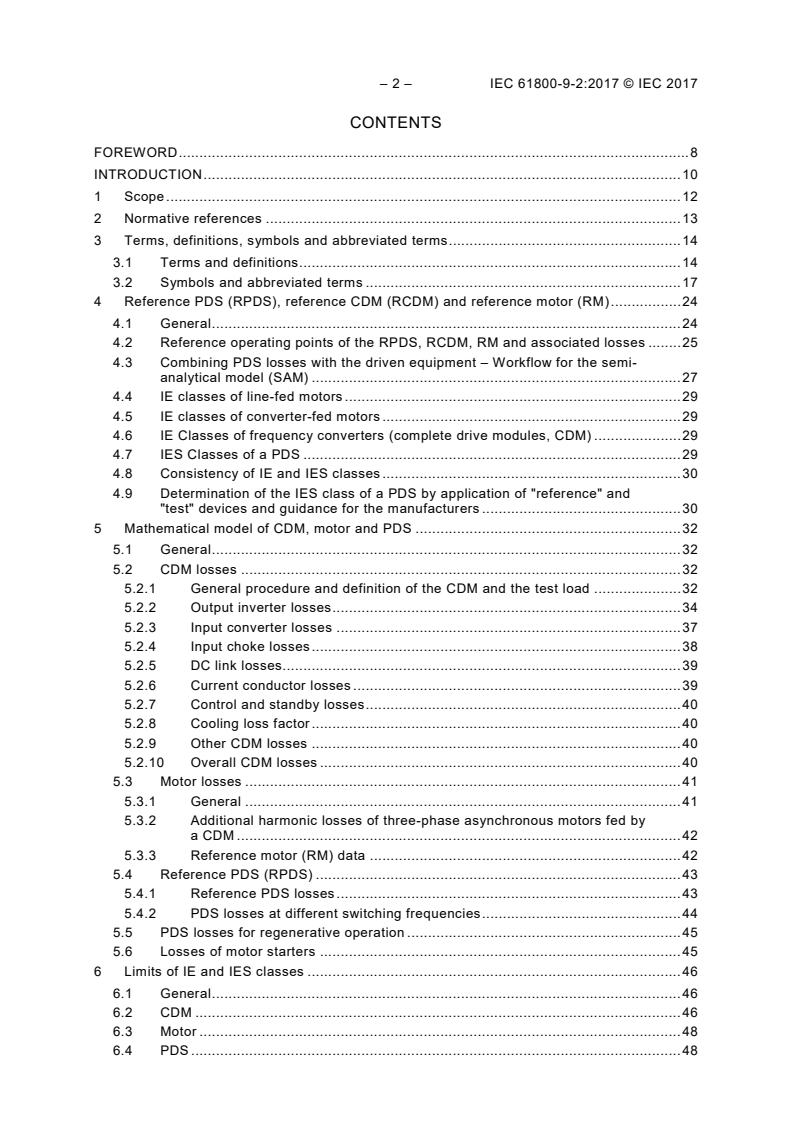
IEC 61800-9-2:2017 specifies energy efficiency indicators of power electronics (complete drive modules, CDM), power drive systems (PDS) and motor starters, all used for motor driven equipment. It specifies the methodology for the determination of losses of the complete drive module (CDM), the power drive system (PDS) and the motor system.
It defines IE and IES-classes, their limit values and provides test procedures for the classification of the overall losses of the motor system.
Furthermore, this document proposes a methodology for the implementation of the best energy efficiency solution of drive systems.
This depends on the architecture of the motor driven system, on the speed/load profile and on the operating points over time of the driven equipment.
- Status
- Published
- Publication Date
- 02-Mar-2017
- Technical Committee
- SC 22G - Adjustable speed electric power drive systems (PDS)
- Drafting Committee
- WG 18 - TC 22/SC 22G/WG 18
- Current Stage
- DELPUB - Deleted Publication
- Start Date
- 20-Oct-2023
- Completion Date
- 31-Aug-2018
Buy Documents
IEC 61800-9-2:2017 - Adjustable speed electrical power drive systems - Part 9-2: Ecodesign for power drive systems, motor starters, power electronics and their driven applications - Energy efficiency indicators for power drive systems and motor starters Released:3/3/2017
Overview
IEC 61800-9-2:2017 is an international standard developed by the International Electrotechnical Commission (IEC) that addresses energy efficiency indicators for adjustable speed electrical power drive systems (PDS), motor starters, and power electronics used in motor-driven applications. It forms Part 9-2 of the IEC 61800 series, focusing on ecodesign principles to support improved energy performance in power drive systems.
This standard provides a comprehensive methodology for determining losses in complete drive modules (CDM), power drive systems, and motor systems. It defines energy efficiency (IE) and energy efficiency system (IES) classes, their limit values, and standardized test procedures for measuring overall system losses. The aim is to help manufacturers, system integrators, and energy managers optimize motor-driven equipment for maximum energy efficiency while considering operational profiles and system architecture.
Key Topics
- Energy Efficiency Indicators: Defines IE classes for motors, motor starters, and complete drive modules, and IES classes for entire power drive systems.
- Loss Determination Methodology: Specifies testing and calculation procedures to measure losses across different components, including input converters, output inverters, DC link, motor losses, control and standby losses, and cooling factors.
- Reference Models: Utilizes reference power drive systems (RPDS), reference complete drive modules (RCDM), and reference motors (RM) to benchmark and classify efficiency.
- Test Procedures: Provides detailed type testing methods such as input-output measurements and calorimetric techniques to accurately assess efficiency under varying operating conditions.
- Ecodesign Approach: Offers guidelines for selecting and implementing the best energy-efficient solutions considering speed/load profiles, operating points over time, and system architecture.
- Classification Limits: Establishes clear limit values for IE and IES classes, enabling consistent energy performance comparison across different products and systems.
- User Documentation Requirements: Specifies mandatory information for manufacturers to include for product selection and efficiency classification.
Applications
IEC 61800-9-2:2017 applies broadly to industries and sectors utilizing motor-driven systems that can benefit from energy efficiency improvements, including:
- Industrial Automation: Enhancing energy performance of variable speed drives used in manufacturing processes.
- HVAC Systems: Improving motor and drive efficiency in heating, ventilation, and air conditioning equipment.
- Renewable Energy and Utilities: Optimizing power electronics in renewable generation and energy distribution systems.
- Process Engineering: Reducing energy losses in pumps, fans, compressors, and conveyors through better drive system design.
- Building Management: Integrating efficient motor starters and power electronics in building infrastructure to reduce operational costs.
- Energy Management Systems: Assisting facility managers to evaluate and select energy-efficient motor drive components and systems.
By following the standard’s methodology, stakeholders can achieve reduced energy consumption, lowered carbon footprint, and compliance with ecodesign regulations while maintaining system reliability and operational flexibility.
Related Standards
IEC 61800-9-2:2017 complements and builds upon various related standards within the IEC 61800 series and beyond:
- IEC 61800-1: General requirements for adjustable speed electrical power drive systems.
- IEC 61800-2: Electrical and electronic equipment for power drive systems-Safety requirements.
- IEC 60034 series: Standards covering rotating electrical machines, including energy efficiency classes for motors.
- IEV (International Electrotechnical Vocabulary): Provides standardized technical terminology used throughout the IEC standards.
- EN 50598 series: Energy performance standards for power drive systems focusing on overall efficiency assessment.
Together, these standards facilitate a harmonized framework supporting the systematic improvement of energy efficiency in adjustable speed motor drives globally.
Keywords: IEC 61800-9-2, energy efficiency indicators, power drive systems, motor starters, complete drive modules, adjustable speed drives, ecodesign, motor system efficiency, power electronics, loss determination, energy efficiency classes, IE class, IES class, industrial automation, energy management.
Relations
- Effective Date
- 05-Sep-2023
Buy Documents
IEC 61800-9-2:2017 - Adjustable speed electrical power drive systems - Part 9-2: Ecodesign for power drive systems, motor starters, power electronics and their driven applications - Energy efficiency indicators for power drive systems and motor starters Released:3/3/2017
Get Certified
Connect with accredited certification bodies for this standard

IMQ S.p.A. (Certification)
Italian electrical product certification.

SLG Prüf- und Zertifizierungs GmbH
German testing and certification body.

UL Solutions
Global safety science company with testing, inspection and certification.
Sponsored listings
Frequently Asked Questions
IEC 61800-9-2:2017 is a standard published by the International Electrotechnical Commission (IEC). Its full title is "Adjustable speed electrical power drive systems - Part 9-2: Ecodesign for power drive systems, motor starters, power electronics and their driven applications - Energy efficiency indicators for power drive systems and motor starters". This standard covers: IEC 61800-9-2:2017 specifies energy efficiency indicators of power electronics (complete drive modules, CDM), power drive systems (PDS) and motor starters, all used for motor driven equipment. It specifies the methodology for the determination of losses of the complete drive module (CDM), the power drive system (PDS) and the motor system. It defines IE and IES-classes, their limit values and provides test procedures for the classification of the overall losses of the motor system. Furthermore, this document proposes a methodology for the implementation of the best energy efficiency solution of drive systems. This depends on the architecture of the motor driven system, on the speed/load profile and on the operating points over time of the driven equipment.
IEC 61800-9-2:2017 specifies energy efficiency indicators of power electronics (complete drive modules, CDM), power drive systems (PDS) and motor starters, all used for motor driven equipment. It specifies the methodology for the determination of losses of the complete drive module (CDM), the power drive system (PDS) and the motor system. It defines IE and IES-classes, their limit values and provides test procedures for the classification of the overall losses of the motor system. Furthermore, this document proposes a methodology for the implementation of the best energy efficiency solution of drive systems. This depends on the architecture of the motor driven system, on the speed/load profile and on the operating points over time of the driven equipment.
IEC 61800-9-2:2017 is classified under the following ICS (International Classification for Standards) categories: 29.060.10 - Wires; 29.130.01 - Switchgear and controlgear in general; 29.160.30 - Motors; 29.200 - Rectifiers. Convertors. Stabilized power supply. The ICS classification helps identify the subject area and facilitates finding related standards.
IEC 61800-9-2:2017 has the following relationships with other standards: It is inter standard links to IEC 61800-9-2:2023. Understanding these relationships helps ensure you are using the most current and applicable version of the standard.
IEC 61800-9-2:2017 is available in PDF format for immediate download after purchase. The document can be added to your cart and obtained through the secure checkout process. Digital delivery ensures instant access to the complete standard document.
Standards Content (Sample)
IEC 61800-9-2 ®
Edition 1.0 2017-03
INTERNATIONAL
STANDARD
NORME
INTERNATIONALE
colour
inside
Adjustable speed electrical power drive systems –
Part 9-2: Ecodesign for power drive systems, motor starters, power electronics
and their driven applications – Energy efficiency indicators for power drive
systems and motor starters
Entraînements électriques de puissance à vitesse variable –
Partie 9-2: Écoconception des entraînements électriques de puissance, des
démarreurs de moteurs, de l'électronique de puissance et de leurs applications
entraînées – Indicateurs d'efficacité énergétique pour les entraînements
électriques de puissance et les démarreurs de moteurs
IEC 61800-9-2:2017-03(en-fr)
All rights reserved. Unless otherwise specified, no part of this publication may be reproduced or utilized in any form
or by any means, electronic or mechanical, including photocopying and microfilm, without permission in writing from
either IEC or IEC's member National Committee in the country of the requester. If you have any questions about IEC
copyright or have an enquiry about obtaining additional rights to this publication, please contact the address below or
your local IEC member National Committee for further information.
Droits de reproduction réservés. Sauf indication contraire, aucune partie de cette publication ne peut être reproduite
ni utilisée sous quelque forme que ce soit et par aucun procédé, électronique ou mécanique, y compris la photocopie
et les microfilms, sans l'accord écrit de l'IEC ou du Comité national de l'IEC du pays du demandeur. Si vous avez des
questions sur le copyright de l'IEC ou si vous désirez obtenir des droits supplémentaires sur cette publication, utilisez
les coordonnées ci-après ou contactez le Comité national de l'IEC de votre pays de résidence.
IEC Central Office Tel.: +41 22 919 02 11
3, rue de Varembé Fax: +41 22 919 03 00
CH-1211 Geneva 20 info@iec.ch
Switzerland www.iec.ch
About the IEC
The International Electrotechnical Commission (IEC) is the leading global organization that prepares and publishes
International Standards for all electrical, electronic and related technologies.
About IEC publications
The technical content of IEC publications is kept under constant review by the IEC. Please make sure that you have the
latest edition, a corrigenda or an amendment might have been published.
IEC Catalogue - webstore.iec.ch/catalogue Electropedia - www.electropedia.org
The stand-alone application for consulting the entire The world's leading online dictionary of electronic and
bibliographical information on IEC International Standards, electrical terms containing 20 000 terms and definitions in
Technical Specifications, Technical Reports and other English and French, with equivalent terms in 16 additional
documents. Available for PC, Mac OS, Android Tablets and languages. Also known as the International Electrotechnical
iPad. Vocabulary (IEV) online.
IEC publications search - www.iec.ch/searchpub IEC Glossary - std.iec.ch/glossary
The advanced search enables to find IEC publications by a 65 000 electrotechnical terminology entries in English and
variety of criteria (reference number, text, technical French extracted from the Terms and Definitions clause of
committee,…). It also gives information on projects, replaced IEC publications issued since 2002. Some entries have been
and withdrawn publications. collected from earlier publications of IEC TC 37, 77, 86 and
CISPR.
IEC Just Published - webstore.iec.ch/justpublished
Stay up to date on all new IEC publications. Just Published IEC Customer Service Centre - webstore.iec.ch/csc
details all new publications released. Available online and If you wish to give us your feedback on this publication or
also once a month by email. need further assistance, please contact the Customer Service
Centre: csc@iec.ch.
A propos de l'IEC
La Commission Electrotechnique Internationale (IEC) est la première organisation mondiale qui élabore et publie des
Normes internationales pour tout ce qui a trait à l'électricité, à l'électronique et aux technologies apparentées.
A propos des publications IEC
Le contenu technique des publications IEC est constamment revu. Veuillez vous assurer que vous possédez l’édition la
plus récente, un corrigendum ou amendement peut avoir été publié.
Catalogue IEC - webstore.iec.ch/catalogue Electropedia - www.electropedia.org
Application autonome pour consulter tous les renseignements
Le premier dictionnaire en ligne de termes électroniques et
bibliographiques sur les Normes internationales,
électriques. Il contient 20 000 termes et définitions en anglais
Spécifications techniques, Rapports techniques et autres
et en français, ainsi que les termes équivalents dans 16
documents de l'IEC. Disponible pour PC, Mac OS, tablettes
langues additionnelles. Egalement appelé Vocabulaire
Android et iPad.
Electrotechnique International (IEV) en ligne.
Recherche de publications IEC - www.iec.ch/searchpub
Glossaire IEC - std.iec.ch/glossary
65 000 entrées terminologiques électrotechniques, en anglais
La recherche avancée permet de trouver des publications IEC
en utilisant différents critères (numéro de référence, texte, et en français, extraites des articles Termes et Définitions des
comité d’études,…). Elle donne aussi des informations sur les publications IEC parues depuis 2002. Plus certaines entrées
projets et les publications remplacées ou retirées. antérieures extraites des publications des CE 37, 77, 86 et
CISPR de l'IEC.
IEC Just Published - webstore.iec.ch/justpublished
Service Clients - webstore.iec.ch/csc
Restez informé sur les nouvelles publications IEC. Just
Published détaille les nouvelles publications parues. Si vous désirez nous donner des commentaires sur cette
Disponible en ligne et aussi une fois par mois par email. publication ou si vous avez des questions contactez-nous:
csc@iec.ch.
IEC 61800-9-2 ®
Edition 1.0 2017-03
INTERNATIONAL
STANDARD
NORME
INTERNATIONALE
colour
inside
Adjustable speed electrical power drive systems –
Part 9-2: Ecodesign for power drive systems, motor starters, power electronics
and their driven applications – Energy efficiency indicators for power drive
systems and motor starters
Entraînements électriques de puissance à vitesse variable –
Partie 9-2: Écoconception des entraînements électriques de puissance, des
démarreurs de moteurs, de l'électronique de puissance et de leurs applications
entraînées – Indicateurs d'efficacité énergétique pour les entraînements
électriques de puissance et les démarreurs de moteurs
INTERNATIONAL
ELECTROTECHNICAL
COMMISSION
COMMISSION
ELECTROTECHNIQUE
INTERNATIONALE
ICS 29.130.01; 29.160.30; 29.200 ISBN 978-2-8322-3996-4
– 2 – IEC 61800-9-2:2017 © IEC 2017
CONTENTS
FOREWORD . 8
INTRODUCTION . 10
1 Scope . 12
2 Normative references . 13
3 Terms, definitions, symbols and abbreviated terms . 14
3.1 Terms and definitions . 14
3.2 Symbols and abbreviated terms . 17
4 Reference PDS (RPDS), reference CDM (RCDM) and reference motor (RM) . 24
4.1 General . 24
4.2 Reference operating points of the RPDS, RCDM, RM and associated losses . 25
4.3 Combining PDS losses with the driven equipment – Workflow for the semi-
analytical model (SAM) . 27
4.4 IE classes of line-fed motors . 29
4.5 IE classes of converter-fed motors . 29
4.6 IE Classes of frequency converters (complete drive modules, CDM) . 29
4.7 IES Classes of a PDS . 29
4.8 Consistency of IE and IES classes . 30
4.9 Determination of the IES class of a PDS by application of "reference" and
"test" devices and guidance for the manufacturers . 30
5 Mathematical model of CDM, motor and PDS . 32
5.1 General . 32
5.2 CDM losses . 32
5.2.1 General procedure and definition of the CDM and the test load . 32
5.2.2 Output inverter losses . 34
5.2.3 Input converter losses . 37
5.2.4 Input choke losses . 38
5.2.5 DC link losses. 39
5.2.6 Current conductor losses . 39
5.2.7 Control and standby losses . 40
5.2.8 Cooling loss factor . 40
5.2.9 Other CDM losses . 40
5.2.10 Overall CDM losses . 40
5.3 Motor losses . 41
5.3.1 General . 41
5.3.2 Additional harmonic losses of three-phase asynchronous motors fed by
a CDM . 42
5.3.3 Reference motor (RM) data . 42
5.4 Reference PDS (RPDS) . 43
5.4.1 Reference PDS losses . 43
5.4.2 PDS losses at different switching frequencies . 44
5.5 PDS losses for regenerative operation . 45
5.6 Losses of motor starters . 45
6 Limits of IE and IES classes . 46
6.1 General . 46
6.2 CDM . 46
6.3 Motor . 48
6.4 PDS . 48
7 Loss determination . 51
7.1 General . 51
7.2 Type testing of CDM for IE classification . 51
7.3 Type testing of PDS for IES classification . 52
7.4 Determination procedures for CDM and PDS losses in part load operation. 52
7.5 CDM loss calculation . 53
7.6 PDS loss calculation . 53
7.7 Input-output measurement method . 53
7.7.1 Input-output measurement of CDM losses . 53
7.7.2 Input-output measurement of PDS losses . 54
7.7.3 Requirements of input-output measurement methods . 54
7.8 Calorimetric measurement of CDM losses . 57
7.9 Testing conditions for CDM testing . 58
7.10 Testing conditions for PDS testing . 59
7.11 Flowcharts for test procedures . 59
8 Requirements for the user’s documentation . 62
8.1 General . 62
8.2 Information for selection . 62
8.3 Information for determination of energy efficiency classification . 63
8.4 Information on the determination of additional energy losses and part load
conditions . 63
8.4.1 General . 63
8.4.2 Losses in part load conditions . 63
8.4.3 Losses of auxiliaries and options . 63
8.4.4 Losses in stand-by mode . 64
8.4.5 Losses in regenerative mode . 64
Annex A (normative) Losses of RCDM, RM and RPDS . 65
A.1 Relative loss tables . 65
Annex B (informative) Description of the elements of an extended product using PDS
with regard to their impact on losses. 69
B.1 General . 69
B.2 Losses in the mains cabling and feeding section . 69
B.3 Input filter . 70
B.3.1 High frequency EMI filter . 70
B.3.2 Low frequency line harmonics filter . 71
B.4 Input converter . 71
B.4.1 General . 71
B.4.2 Diode rectifier . 72
B.4.3 Active infeed converter . 72
B.4.4 Power factor of the input converter . 74
B.5 DC link . 75
B.6 Output inverter . 76
B.7 Output filter and motor cables . 77
B.7.1 General . 77
B.7.2 Sine wave filters . 78
B.7.3 dV/dt filters and motor chokes . 79
B.7.4 High frequency EMI motor filters . 79
B.7.5 Motor cables . 79
– 4 – IEC 61800-9-2:2017 © IEC 2017
B.8 Motor . 79
B.9 Mechanical load . 79
B.10 Control and standby losses . 79
B.11 Cooling losses . 80
B.11.1 Primary cooling losses . 80
B.11.2 Secondary cooling losses . 80
Annex C (informative) Converter topology . 81
C.1 General . 81
C.2 Voltage source output inverter topologies different from those
mathematically described in 5.2.2 . 81
C.3 Voltage source input converter topologies different from those
mathematically described in 5.2.3 . 81
C.4 CDM topologies different from voltage source type . 82
Annex D (informative) Motor model and loss interpolation . 83
D.1 Overview. 83
D.2 Losses of AC motors . 83
D.2.1 General . 83
D.2.2 Stator and rotor winding I R losses (P + P (for induction or wound
LS LR
rotor motors)) . 83
D.2.3 Additional losses (P ) . 83
LL
D.2.4 Iron losses (P ) . 84
Lfe
D.2.5 Friction and windage losses (P ) . 84
Lfw
D.2.6 Additional harmonic losses (P ) . 85
LHL
D.3 Interpolation formula . 85
D.4 Analytical determination of the interpolation coefficients . 86
D.4.1 General . 86
D.4.2 Additional losses due to frequency converter voltage drop . 87
D.4.3 Alternate operating points to determine interpolation coefficients . 88
D.4.4 Motors for square-torque applications . 89
D.5 Determination of interpolation error . 89
D.6 Numerical determination of the interpolation coefficients . 89
D.7 Typical IE2 induction motor efficiency . 90
Annex E (informative) Application example for loss calculations of a CDM and a PDS . 93
E.1 General . 93
E.2 CDM loss determination . 93
E.2.1 General . 93
E.2.2 Loss determination by maximum losses of neighbouring loss points . 94
E.2.3 Loss determination by two-dimensional interpolation of losses of
neighbouring loss points . 94
E.2.4 Loss determination by the mathematical model described in 5.2 . 97
E.3 Loss determination of the motor . 99
E.4 Loss determination of the PDS . 100
Annex F (informative) Uncertainty of loss determination method . 101
F.1 General . 101
F.2 Calculation of uncertainty at randomly occurring errors . 101
F.3 Comparison of uncertainties for different loss determination methods . 101
Annex G (informative) Calorimetric measurement for CDM losses . 102
G.1 General . 102
G.2 Calorimeter with two chambers with air as a cooling medium . 102
G.3 Calorimeter with one chamber with air as a cooling medium . 103
G.4 Calorimeter with liquid as a cooling medium . 104
Bibliography . 105
Figure 1 − Illustration of core requirements of energy efficiency standardization . 10
Figure 2 – Illustration of the extended product with included motor system . 15
Figure 3 – Torque-speed-characteristic of servo PDS . 16
Figure 4 – Illustration of the operating points (shaft speed, torque) for the
determination of relative losses of the power drive system (RPDS) . 25
Figure 5 – Illustration of the operating points (shaft speed, torque) for the
determination of relative losses of the reference motor (RM). 26
Figure 6 – Illustration of the operating points (relative motor stator frequency, relative
torque-producing current) for the determination of losses of the reference complete
drive module (RCDM) . 26
Figure 7 – Illustration of the workflow to determine the energy efficiency index (EEI) of
an extended product . 28
Figure 8 – Illustration how to combine different data sources to determine the energy
efficiency index (EEI) of an extended product . 28
Figure 9 – Metrical relation of IE, IES classes . 30
Figure 10 – Guidance for CDM and Motor manufacturers for the usage of "test" and
"reference" devices to determine the IE/IES classes . 31
Figure 11 – Illustration of the CDM and the test load . 32
Figure 12 – Relative losses p of the 9,95 kVA RCDM . 41
L,CDM
Figure 13 – Example of the relative power losses of PDS as function of speed and
torque . 44
Figure 14 – Example of the relative power losses versus switching frequency. 45
Figure 15 – Example of a CDM with resistor for dissipating generated power . 45
Figure 16 – Illustration of IE classes for a CDM . 48
Figure 17 – Illustration of IES classes of a PDS . 49
Figure 18 – Losses of CDM are provided as the sum of the determined losses plus the
uncertainty of the determination method . 52
Figure 19 – Input-output measurement setup for determination of CDM losses . 54
Figure 20 – Input-output measurement setup for PDS losses . 54
Figure 21 – Order of CDM measurements from [1] to [8] . 56
Figure 22 – Order of PDS measurements from [1] to [8] . 57
Figure 23 – Calorimetric measurement setup for determining CDM losses . 58
Figure 24 – Determination of IE classification for CDM and loss determination for part
load operating points . 60
Figure 25 – Determination of IES classification for PDS and loss determination for part
load operating points . 61
Figure B.1 – Overview of the extended product and energy flow . 69
Figure B.2 – Equivalent circuit of the mains and mains cabling . 70
Figure B.3 – Illustration of a single phase line harmonics filter . 71
Figure B.4 – PDS with a diode rectifier input converter . 72
Figure B.5 – PDS with a standard AIC input converter . 73
Figure B.6 – PDS with a F3E-AIC input converter without line choke . 74
– 6 – IEC 61800-9-2:2017 © IEC 2017
Figure B.7 – Typical waveform of a diode rectifier line current . 74
Figure B.8 – DC link circuit . 75
Figure B.9 – DC link circuit with additional DC chokes . 76
Figure B.10 – Output inverter of the PDS . 77
Figure B.11 – Motor cable and optional output filter of the PDS . 77
Figure B.12 – Typical waveform of inverter output voltage and motor voltage when
using a sine wave output filter . 78
Figure D.1 – Normative operating points . 87
Figure E.1 – Segments of operating points. 93
Figure E.2 – Two-dimensional interpolation . 95
Figure G.1 – One-step calorimetric measurement setup for comparative loss
measurement (CDM and heating resistor are loaded simultaneously). 103
Figure G.2 – Two-step calorimetric measurement setup for comparative loss
measurement (CDM and heating resistor are not loaded simultaneously) . 104
Figure G.3 – Liquid cooled calorimetric measurement setup for CDM loss
measurement . 104
Table 1 – Minimum test load currents at different points of operation . 33
Table 2 – Test load displacement factor between fundamental output current and
fundamental output voltage at different points of operation . 33
Table 3 – Reference parameters for Formula (5) . 35
Table 4 – Variables for Formula (5) . 35
Table 5 – Reference parameters for Formula (6) . 35
Table 6 – Reference parameters for Formula (7) . 36
Table 7 – Reference parameters for Formula (8) . 37
Table 8 – Reference parameters for Formula (10) . 38
Table 9 – Variables for Formula (10) . 38
Table 10 – Reference parameters for Formula (11): . 38
Table 11 – Reference parameters for Formula (12) . 39
Table 12 – Reference parameters for Formula (13) . 39
Table 13 – Reference parameter for Formula (15) . 40
Table 14 – Reference parameter for Formula (14) . 40
Table 15 – Relative losses of the 400 V/9,95 kVA reference CDM at the operating
points described in Figure 6 . 41
Table 16 – Reference parameter for Formula (19) . 43
Table 17 – Relative losses of the 400 V/7,5 kW RPDS . 44
Table 18 – Reference CDM losses for class IE1 definition . 47
Table 19 – Reference PDS losses of IES class 1 definition . 50
Table 20 – Information requirements . 62
Table A.1 – Relative losses (%) of reference CDMs at different power ratings at the
operating points described in Figure 6 . 65
Table A.2 – Relative losses (%) of reference motors at different power ratings at the
operating points described in Figure 5 . 66
Table A.3 – Relative losses (%) for a reference PDS at different power ratings at the
operating points described in Figure 4 . 67
Table B.1 – Typical values of λ for different input converter topologies . 75
Table D.1 – Recommended split of windage and friction losses for IC 411 self-
ventilated motors . 85
Table D.2 – Normative operating points with graphical representation . 86
Table D.3 – Non-normative alternate operating points . 88
Table D.4 – Interpolation coefficients of typical 4-pole reference IE2 induction
machines . 91
Table D.5 – Interpolation coefficients of typical 2-pole reference IE2 induction
machines . 92
Table E.1 – Relative losses of a 400 V/9,95 kVA example CDM at the predefined
operating points . 94
Table E.2 – Parameters of the example CDM . 98
Table E.3 – Results of the CDM calculation according to the mathematical model . 99
Table E.4 – Comparison of different loss evaluation methods . 99
Table E.5 – Loss data of the 7,5kW reference motor . 99
– 8 – IEC 61800-9-2:2017 © IEC 2017
INTERNATIONAL ELECTROTECHNICAL COMMISSION
____________
ADJUSTABLE SPEED ELECTRICAL POWER DRIVE SYSTEMS –
Part 9-2: Ecodesign for power drive systems,
motor starters, power electronics and their driven applications –
Energy efficiency indicators for power drive systems and motor starters
FOREWORD
1) The International Electrotechnical Commission (IEC) is a worldwide organization for standardization comprising
all national electrotechnical committees (IEC National Committees). The object of IEC is to promote
international co-operation on all questions concerning standardization in the electrical and electronic fields. To
this end and in addition to other activities, IEC publishes International Standards, Technical Specifications,
Technical Reports, Publicly Available Specifications (PAS) and Guides (hereafter referred to as “IEC
Publication(s)”). Their preparation is entrusted to technical committees; any IEC National Committee interested
in the subject dealt with may participate in this preparatory work. International, governmental and non-
governmental organizations liaising with the IEC also participate in this preparation. IEC collaborates closely
with the International Organization for Standardization (ISO) in accordance with conditions determined by
agreement between the two organizations.
2) The formal decisions or agreements of IEC on technical matters express, as nearly as possible, an international
consensus of opinion on the relevant subjects since each technical committee has representation from all
interested IEC National Committees.
3) IEC Publications have the form of recommendations for international use and are accepted by IEC National
Committees in that sense. While all reasonable efforts are made to ensure that the technical content of IEC
Publications is accurate, IEC cannot be held responsible for the way in which they are used or for any
misinterpretation by any end user.
4) In order to promote international uniformity, IEC National Committees undertake to apply IEC Publications
transparently to the maximum extent possible in their national and regional publications. Any divergence
between any IEC Publication and the corresponding national or regional publication shall be clearly indicated in
the latter.
5) IEC itself does not provide any attestation of conformity. Independent certification bodies provide conformity
assessment services and, in some areas, access to IEC marks of conformity. IEC is not responsible for any
services carried out by independent certification bodies.
6) All users should ensure that they have the latest edition of this publication.
7) No liability shall attach to IEC or its directors, employees, servants or agents including individual experts and
members of its technical committees and IEC National Committees for any personal injury, property damage or
other damage of any nature whatsoever, whether direct or indirect, or for costs (including legal fees) and
expenses arising out of the publication, use of, or reliance upon, this IEC Publication or any other IEC
Publications.
8) Attention is drawn to the Normative references cited in this publication. Use of the referenced publications is
indispensable for the correct application of this publication.
9) Attention is drawn to the possibility that some of the elements of this IEC Publication may be the subject of
patent rights. IEC shall not be held responsible for identifying any or all such patent rights.
International Standard IEC 61800-9-2 has been prepared by subcommittee 22G: Adjustable
speed electric drive systems incorporating semiconductor power converters, of IEC technical
committee 22: Power electronic systems and equipment.
The text of this document is based on the following documents:
FDIS Report on voting
22G/349/FDIS 22G/352/RVD
Full information on the voting for the approval of this document can be found in the report on
voting indicated in the above table.
This publication has been drafted in accordance with the ISO/IEC Directives, Part 2.
A list of all parts in the IEC 61800 series, published under the general title Adjustable speed
electrical power drive systems, can be found on the IEC website.
The committee has decided that the contents of this publication will remain unchanged until
the stability date indicated on the IEC website under "http://webstore.iec.ch" in the data
related to the specific publication. At this date, the publication will be
• reconfirmed,
• withdrawn,
• replaced by a revised edition, or
• amended.
IMPORTANT – The 'colour inside' logo on the cover page of this publication indicates
that it contains colours which are considered to be useful for the correct
understanding of its contents. Users should therefore print this document using a
colour printer.
– 10 – IEC 61800-9-2:2017 © IEC 2017
INTRODUCTION
This part of IEC 61800 has been developed to allow evaluation of power losses of CDMs
(complete drive modules) and PDSs (power drive systems).
The requirements for measuring energy efficiency of motors with non-sinusoidal supply are
under the responsibility of IEC/TC 2 and will be published under the IEC 60034 series.
IEC SC 22G includes the standardization task force for dealing with this topic. It has close
collaboration with several other technical committees (for example, IEC TC 2, IEC SC 121A).
IEC SC 22G maintains responsibility for all relevant aspects in the field of energy efficiency
and ecodesign requirements for power electronics, switchgear, control gear and power drive
systems and their industrial applications.
The core requirements of energy efficiency standardization are illustrated in Figure 1. The
work has been agreed to provide the reasonable target as a best compromise.
Market surveillable
(independent
certifiable)
Technically
comprehensive
Reasonable target
Manufacturer neutral
(no marketing messages)
IEC
Figure 1 − Illustration of core requirements
of energy efficiency standardization
IEC 61800 (all parts) does not deal with mechanical engineering components.
NOTE Geared motors (motors with directly adapted gearboxes) are treated like power drive systems (converter
plus motor). See IEC 60034-30-1 for classification of the losses of a geared motor. The efficiency classes of
gearboxes as individual components are under consideration.
IEC 61800-9-2 is a subpart of the IEC 61800 series, which has the following structure:
– Part 1: General requirements – Rating specifications for low voltage adjustable speed DC
power drive systems
– Part 2: General requirements – Rating specifications for low voltage adjustable speed AC
power drive systems
– Part 3: EMC requirements and specific test methods
– Part 4: General requirements – Rating specifications for AC power drive systems above
1 000 V AC and not exceeding 35 kV
– Part 5: Safety requirements
– Part 6: Guide for determination of types of load duty and corresponding current ratings
– Part 7: Generic interface and use of profiles for power drive systems
– Part 8: Specification of voltage on the power interface
– Part 9: Ecodesign for power drive systems, motor starters, power electronics and their
driven applications
Each part is further subdivided into several subparts, published either as International
Standards or as Technical Specifications or Technical Reports, some of which have already
been published. Other will be published with the part number followed by a dash and a
second number identifying the subdivision (example: IEC 61800-9-2).
It considers basic requirements from the EN 50598-2 CENELEC standard published on
2014-12-19 and considers also the following key points in cooperation with relevant technical
committees.
It has been developed in close collaboration with other technical committees (IEC TC 2, IEC
SC 121A) and with a customer’s stakeholder committee CEN/TC 197 in order to provide a
comprehensive standard for energy efficiency and ecodesign requirements.
Key points:
• Requirements for energy-efficient design of electric drive systems in accordance with the
driven load
• Requirements and IE-classification of complete drive modules (CDM)
• Requirements and IES-classification of power drive systems (PDS)
• Determination of PDS losses and requirements for the link to the driven equipment for the
determination of energy efficiency classification/evaluation of the extended product
• Requirements for an environmentally conscious system design and environmental
declaration of a motor system
...