


IEC 60191-1:2007
(Main)Mechanical standardization of semiconductor devices - Part 1: General rules for the preparation of outline drawings of discrete devices
General Information
- Abstract
IEC 60191-1:2007 gives guidelines on the preparation of outline drawings of discrete devices. For preparation of outline drawings of surface mounted discrete devices, IEC 60191-6 should be referred to as well. The main changes from the previous edition are as follows:
- requirement added for SI-dimensions for new drawings to be published;
- former rules concerning inch-dimensions are given in an informative annex;
- former rules for coding are given in an informative annex; incorporation of the supplements;
- updating of references and
- restructuring and renumbering.
- Status
- Published
- Publication Date
- 23-Apr-2007
- Technical Committee
- SC 47D - Semiconductor devices packaging
- Drafting Committee
- WG 2 - TC 47/SC 47D/WG 2
- Current Stage
- DELPUB - Deleted Publication
- Start Date
- 23-Jan-2018
- Completion Date
- 28-Aug-2026
Buy Documents
IEC 60191-1:2007 - Mechanical standardization of semiconductor devices - Part 1: General rules for the preparation of outline drawings of discrete devices Released:4/24/2007
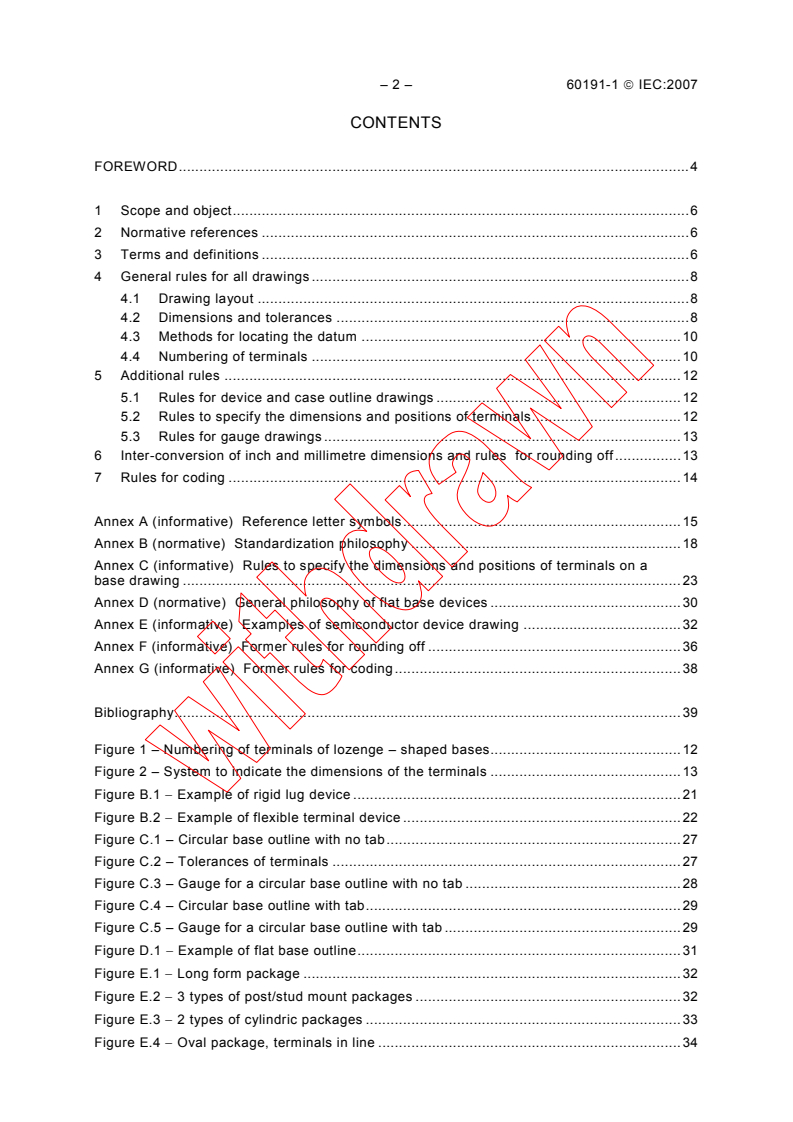
IEC 60191-1:2007 - Mechanical standardization of semiconductor devices - Part 1: General rules for the preparation of outline drawings of discrete devices Released:4/24/2007
Overview - IEC 60191-1:2007
IEC 60191-1:2007 defines general rules for preparing outline drawings of discrete semiconductor devices. Its primary aim is to ensure mechanical interchangeability by specifying how case outlines, terminal positions, mounting features and datum references should be presented on drawings. The 2007 edition introduced a requirement that new drawings use SI dimensions, moved former inch-dimension and coding rules into informative annexes, updated references and reorganized the document.
Key topics and technical requirements
- Drawing scope and layout
- Show all dimensions needed for mechanical interchangeability (case, terminals, locating tab, seating plane).
- Use third-angle projection with appropriate side and end views and detail views where needed.
- Dimensions and tolerances
- Preferential use of SI (metric) dimensions for new drawings.
- Rules for tolerancing and rounding, and procedures for inch–millimetre inter-conversion are included.
- Datums and locating features
- Definition and use of datum references, seating plane/base, mechanical index (locating tab, key) and visual index for orientation.
- Terminal and base drawings
- Separate concepts for case outline drawings, base drawings (terminal dimensions and positions) and device outline drawings (complete device).
- Numbering and positional rules for terminals; controlled zones for lead diameters and lengths.
- Additional elements
- Guidance on gauge drawings, numbering conventions, coding rules (informative annex), and examples of package drawings (informative annexes).
Practical applications and who uses it
IEC 60191-1:2007 is used by:
- Semiconductor manufacturers to produce standardized outline drawings ensuring parts fit existing equipment.
- Mechanical and PCB designers to allocate space, mounting holes and keep-out areas in enclosures and boards.
- Test-fixture and assembly engineers for designing jigs, gauges and handling fixtures.
- Procurement and quality teams to verify mechanical interchangeability between suppliers.
- Regulatory and standards teams to harmonize mechanical documentation internationally.
Benefits include improved cross-supplier compatibility, reduced redesign risk, and clearer mechanical specifications for product development and manufacturing.
Related standards
- IEC 60191 series (Part 2: Dimensions; Part 3: IC outline rules; Part 4: Coding; Part 6: Surface‑mounted device outlines)
- Normative reference in the document: ISO 370 (noted in the standard; withdrawn status should be checked)
For surface-mounted discrete devices, refer also to IEC 60191-6. Always verify you have the latest edition and applicable corrigenda before use.
Relations
- Effective Date
- 05-Sep-2023
Buy Documents
IEC 60191-1:2007 - Mechanical standardization of semiconductor devices - Part 1: General rules for the preparation of outline drawings of discrete devices Released:4/24/2007
IEC 60191-1:2007 - Mechanical standardization of semiconductor devices - Part 1: General rules for the preparation of outline drawings of discrete devices Released:4/24/2007
Frequently Asked Questions
IEC 60191-1:2007 is a standard published by the International Electrotechnical Commission (IEC). Its full title is "Mechanical standardization of semiconductor devices - Part 1: General rules for the preparation of outline drawings of discrete devices". This standard covers: IEC 60191-1:2007 gives guidelines on the preparation of outline drawings of discrete devices. For preparation of outline drawings of surface mounted discrete devices, IEC 60191-6 should be referred to as well. The main changes from the previous edition are as follows: - requirement added for SI-dimensions for new drawings to be published; - former rules concerning inch-dimensions are given in an informative annex; - former rules for coding are given in an informative annex; incorporation of the supplements; - updating of references and - restructuring and renumbering.
IEC 60191-1:2007 gives guidelines on the preparation of outline drawings of discrete devices. For preparation of outline drawings of surface mounted discrete devices, IEC 60191-6 should be referred to as well. The main changes from the previous edition are as follows: - requirement added for SI-dimensions for new drawings to be published; - former rules concerning inch-dimensions are given in an informative annex; - former rules for coding are given in an informative annex; incorporation of the supplements; - updating of references and - restructuring and renumbering.
IEC 60191-1:2007 is classified under the following ICS (International Classification for Standards) categories: 31.080.01 - Semiconductor devices in general. The ICS classification helps identify the subject area and facilitates finding related standards.
IEC 60191-1:2007 has the following relationships with other standards: It is inter standard links to IEC 60191-1:2018. Understanding these relationships helps ensure you are using the most current and applicable version of the standard.
IEC 60191-1:2007 is available in PDF format for immediate download after purchase. The document can be added to your cart and obtained through the secure checkout process. Digital delivery ensures instant access to the complete standard document.
Standards Content (Sample)
INTERNATIONAL IEC
STANDARD 60191-1
Second edition
2007-04
Mechanical standardization of semiconductor
devices –
Part 1:
General rules for the preparation of outline
drawings of discrete devices
Reference number
All rights reserved. Unless otherwise specified, no part of this publication may be reproduced or utilized in any form
or by any means, electronic or mechanical, including photocopying and microfilm, without permission in writing from
either IEC or IEC's member National Committee in the country of the requester.
If you have any questions about IEC copyright or have an enquiry about obtaining additional rights to this publication,
please contact the address below or your local IEC member National Committee for further information.
IEC Central Office
3, rue de Varembé
CH-1211 Geneva 20
Switzerland
Email: inmail@iec.ch
Web: www.iec.ch
About the IEC
The International Electrotechnical Commission (IEC) is the leading global organization that prepares and publishes
International Standards for all electrical, electronic and related technologies.
About IEC publications
The technical content of IEC publications is kept under constant review by the IEC. Please make sure that you have the
latest edition, a corrigenda or an amendment might have been published.
ƒ Catalogue of IEC publications: www.iec.ch/searchpub
The IEC on-line Catalogue enables you to search by a variety of criteria (reference number, text, technical committee,…).
It also gives information on projects, withdrawn and replaced publications.
ƒ IEC Just Published: www.iec.ch/online_news/justpub
Stay up to date on all new IEC publications. Just Published details twice a month all new publications released. Available
on-line and also by email.
ƒ Customer Service Centre: www.iec.ch/webstore/custserv
If you wish to give us your feedback on this publication or need further assistance, please visit the Customer Service
Centre FAQ or contact us:
Email: csc@iec.ch
Tel.: +41 22 919 02 11
Fax: +41 22 919 03 00
INTERNATIONAL IEC
STANDARD 60191-1
Second edition
2007-04
Mechanical standardization of semiconductor
devices –
Part 1:
General rules for the preparation of outline
drawings of discrete devices
PRICE CODE
Commission Electrotechnique Internationale W
International Electrotechnical Commission
МеждународнаяЭлектротехническаяКомиссия
For price, see current catalogue
– 2 – 60191-1 © IEC:2007(E)
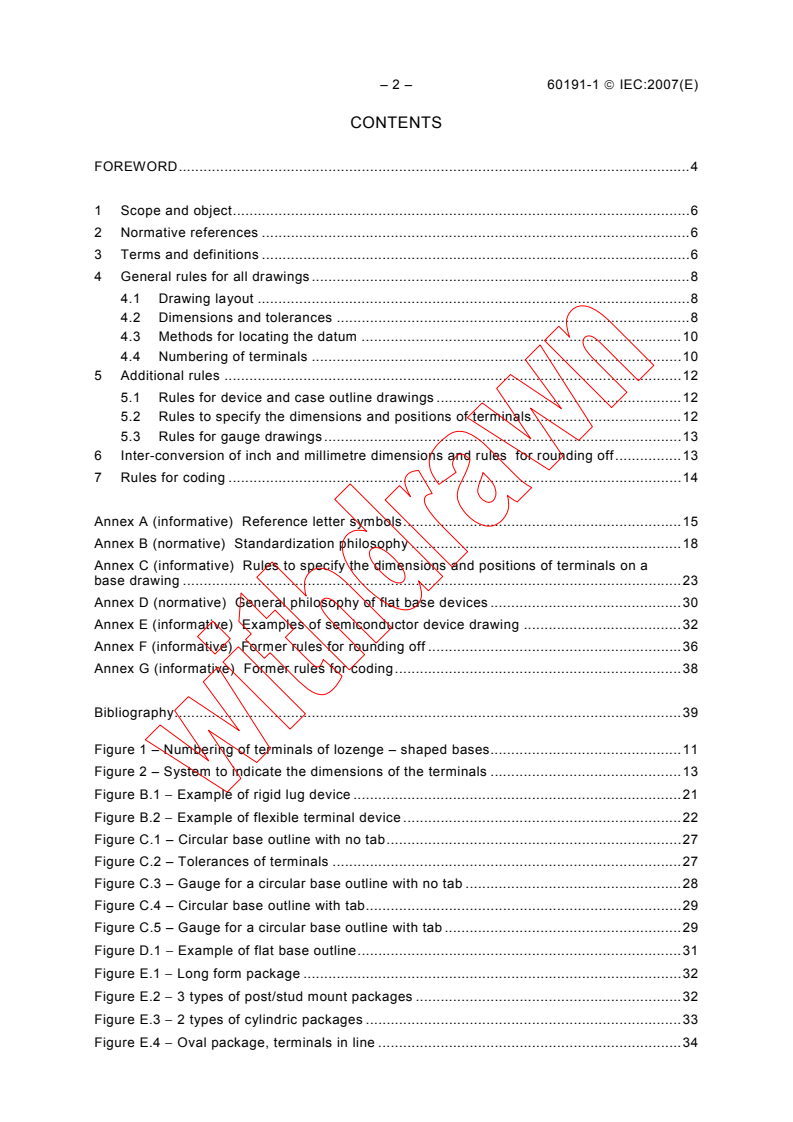
CONTENTS
FOREWORD.4
1 Scope and object.6
2 Normative references .6
3 Terms and definitions .6
4 General rules for all drawings .8
4.1 Drawing layout .8
4.2 Dimensions and tolerances .8
4.3 Methods for locating the datum .10
4.4 Numbering of terminals .10
5 Additional rules .12
5.1 Rules for device and case outline drawings .12
5.2 Rules to specify the dimensions and positions of terminals.12
5.3 Rules for gauge drawings.13
6 Inter-conversion of inch and millimetre dimensions and rules for rounding off.13
7 Rules for coding .14
Annex A (informative) Reference letter symbols.15
Annex B (normative) Standardization philosophy .18
Annex C (informative) Rules to specify the dimensions and positions of terminals on a
base drawing .23
Annex D (normative) General philosophy of flat base devices .30
Annex E (informative) Examples of semiconductor device drawing .32
Annex F (informative) Former rules for rounding off .36
Annex G (informative) Former rules for coding.38
Bibliography.39
Figure 1 – Numbering of terminals of lozenge – shaped bases.11
Figure 2 – System to indicate the dimensions of the terminals .13
Figure B.1 − Example of rigid lug device .21
Figure B.2 − Example of flexible terminal device .22
Figure C.1 – Circular base outline with no tab.27
Figure C.2 – Tolerances of terminals .27
Figure C.3 – Gauge for a circular base outline with no tab .28
Figure C.4 – Circular base outline with tab.29
Figure C.5 – Gauge for a circular base outline with tab .29
Figure D.1 − Example of flat base outline.31
Figure E.1 − Long form package .32
Figure E.2 − 3 types of post/stud mount packages .32
Figure E.3 − 2 types of cylindric packages .33
Figure E.4 − Oval package, terminals in line .34
60191-1 © IEC:2007(E) – 3 –
Figure E.5 − Cylindric package with different terminations .34
Figure E.6 − Flange mount package.34
Figure E.7 − Disk button package with 3 terminations .35
Figure E.8 − Special shape for bolt-fixture .35
Table A.1 – Dimensions of reference letter symbols.15
– 4 – 60191-1 © IEC:2007(E)
INTERNATIONAL ELECTROTECHNICAL COMMISSION
____________
MECHANICAL STANDARDIZATION OF SEMICONDUCTOR DEVICES –
Part 1: General rules for the preparation of outline drawings
of discrete devices
FOREWORD
1) The International Electrotechnical Commission (IEC) is a worldwide organization for standardization comprising
all national electrotechnical committees (IEC National Committees). The object of IEC is to promote
international co-operation on all questions concerning standardization in the electrical and electronic fields. To
this end and in addition to other activities, IEC publishes International Standards, Technical Specifications,
Technical Reports, Publicly Available Specifications (PAS) and Guides (hereafter referred to as “IEC
Publication(s)”). Their preparation is entrusted to technical committees; any IEC National Committee interested
in the subject dealt with may participate in this preparatory work. International, governmental and non-
governmental organizations liaising with the IEC also participate in this preparation. IEC collaborates closely
with the International Organization for Standardization (ISO) in accordance with conditions determined by
agreement between the two organizations.
2) The formal decisions or agreements of IEC on technical matters express, as nearly as possible, an international
consensus of opinion on the relevant subjects since each technical committee has representation from all
interested IEC National Committees.
3) IEC Publications have the form of recommendations for international use and are accepted by IEC National
Committees in that sense. While all reasonable efforts are made to ensure that the technical content of IEC
Publications is accurate, IEC cannot be held responsible for the way in which they are used or for any
misinterpretation by any end user.
4) In order to promote international uniformity, IEC National Committees undertake to apply IEC Publications
transparently to the maximum extent possible in their national and regional publications. Any divergence
between any IEC Publication and the corresponding national or regional publication shall be clearly indicated in
the latter.
5) IEC provides no marking procedure to indicate its approval and cannot be rendered responsible for any
equipment declared to be in conformity with an IEC Publication.
6) All users should ensure that they have the latest edition of this publication.
7) No liability shall attach to IEC or its directors, employees, servants or agents including individual experts and
members of its technical committees and IEC National Committees for any personal injury, property damage or
other damage of any nature whatsoever, whether direct or indirect, or for costs (including legal fees) and
expenses arising out of the publication, use of, or reliance upon, this IEC Publication or any other IEC
Publications.
8) Attention is drawn to the Normative references cited in this publication. Use of the referenced publications is
indispensable for the correct application of this publication.
9) Attention is drawn to the possibility that some of the elements of this IEC Publication may be the subject of
patent rights. IEC shall not be held responsible for identifying any or all such patent rights.
International Standard IEC 60191-1 has been prepared by subcommittee 47D: Mechanical
standardization for semiconductor devices, of IEC technical committee 47: Semiconductor
devices.
This second edition cancels and replaces the first edition published in 1966 together with
supplements 60191-1A:1969, 60191-1B:1970 and 60191-1C:1974 and constitutes a technical
revision. The main changes from the previous edition are as follows:
– requirement added for SI-dimensions for new drawings to be published;
– former rules concerning inch-dimensions are given in an informative annex;
– former rules for coding are given in an informative annex;
– incorporation of the supplements;
– updating of references;
– restructuring and renumbering.
60191-1 © IEC:2007(E) – 5 –
The text of this standard is based on the following documents:
FDIS Report on voting
47D/678/FDIS 47D/682/RVD
Full information on the voting for the approval of this standard can be found in the report on
voting indicated in the above table.
This publication has been drafted in accordance with the ISO/IEC Directives, Part 2.
The IEC 60191 series, published under the general title Mechanical standardization of
semiconductor devices, comprises the following parts:
Part 1: General rules for the preparation of outline drawings of discrete devices
Part 2: Dimensions
Part 3: General rules for the preparation of outline drawings of integrated circuits
Part 4: Coding system and classification into forms of package outlines for semiconductor
device packages
Part 5: Recommendations applying to integrated circuit packages using tape automated
bonding (TAB)
Part 6: General rules for the preparation of outline drawings of surface mounted
semiconductor device packages
The committee has decided that the contents of this publication will remain unchanged until
the maintenance result date indicated on the IEC web site under "http://webstore.iec.ch" in
the data related to the specific publication. At this date, the publication will be
• reconfirmed;
• withdrawn;
• replaced by a revised edition, or
• amended.
A bilingual version of this publication may be issued at a later date.
– 6 – 60191-1 © IEC:2007(E)
MECHANICAL STANDARDIZATION OF SEMICONDUCTOR DEVICES –
Part 1: General rules for the preparation of outline drawings
of discrete devices
1 Scope and object
This part of IEC 60191 gives guidelines on the preparation of outline drawings of discrete
devices.
NOTE For preparation of outline drawings of surface mounted discrete devices, IEC 60191-6 should be referred to
as well.
The primary object of these drawings is to indicate the space which should be allowed for
devices in an equipment, together with other dimensional characteristics required to ensure
mechanical interchangeability.
It should be noted that complete interchangeability involves other considerations such as the
electrical and thermal characteristics of the semiconductor devices concerned.
The international standardization represented by these drawings therefore encourages the
manufacturers of devices to comply with the tolerances shown on the drawings in order to
extend their range of customers internationally. It also gives equipment designers an
assurance of mechanical interchangeability between the devices obtained from suppliers in
different countries, provided they allow the space in their equipment that is indicated by the
drawings and take note of the more precise information on bases, studs, etc.
NOTE Additional details on the standardization philosophy used in this standard are given in Annex B.
2 Normative references
The following referenced documents are indispensable for the application of this document.
For dated references, only the edition cited applies. For undated references, the latest edition
of the referenced document (including any amendments) applies.
IEC 60191-2:1966, Mechanical standardization of semiconductor devices – Part 2:
Dimensions (including all supplements and amendments)
IEC 60191-4, Mechanical standardization of semiconductor devices – Part 4: Coding system
and classification into forms of package outlines for semiconductor device packages
ISO 370, Toleranced dimensions – Conversion from inches to millimetres and vice versa
(withdrawn 2000-05)
3 Terms and definitions
For the purposes of this document, the following definitions apply.
3.1
device outline drawing
drawing which includes all dimensional characteristics required for the mechanical
interchangeability of the complete device. It includes the case or body, all terminals and the
locating tab if present
60191-1 © IEC:2007(E) – 7 –
3.2
terminal
that part of the semiconductor device primarily used in making an electrical, mechanical or
thermal connection. Examples of terminals are flexible leads, rigid leads, pins, studs, etc.
3.3
case outline drawing
drawing which includes all dimensional characteristics required for the mechanical
interchangeability of the case or body. It does not include the dimensions of the terminals or
the locating tab if present, but their positions are shown by dotted lines
3.4
base drawing
drawing which includes all dimensional characteristics required for the mechanical
interchangeability of the terminals and mechanical index
NOTE 1 Examples of these characteristics are: lead length, lead diameters with controlled zones, lead spacing,
pitch circle diameter, thickness, width and length of a tab, etc
NOTE 2 The diameter or major axis of the case outline should not be given on the base drawing.
NOTE 3 Many semiconductor devices have identical cases, but differ in the number or the length of terminals. It is
also possible to have the same type of base associated with cases which are not identical.
Consequently, there are advantages in having:
a) a single drawing including only the dimensional characteristics of the case outline and separate drawings for
the various bases which can be associated with this case outline,
or
b) a single drawing including only the dimensional characteristics of the base and separate drawings for the
various case outlines which can be associated with this base.
3.5
mechanical index
locating feature, or that portion of the device specifically designed to provide orientation.
NOTE Examples of a mechanical index are: key, keyway, locating tab, etc.
3.6
visual index
any single terminal (or omission of) readily distinguished by the eye from others or any
distinctive boss, stippled pattern or colour mark adjacent to a terminal
3.7
datum
a theoretically exact geometric reference (such as axes, planes, straight lines etc.) to which
toleranced features are related. Datums may be based on one or more datum features of a
part
[ISO 5459:1981, definition 3.1]
3.8
seating plane or seating base
reference plane from which, in general, outline and base dimensions are given
3.9
seated height or mounted height
distance from the seating plane to the top of any exposed tip or rigid terminal present,
otherwise to the top of the outline. Flexible terminals should not be included as part of the
seated height, but the mounted height should include a minimum allowance necessary for an
axially mounted flexible lead to be bent at right angles
– 8 – 60191-1 © IEC:2007(E)
3.10
controlled cylindrical zone
zone which defines a portion of the body of minimum length over which the diameter is
controlled to closer tolerances than is allowed over the full length of the body
4 General rules for all drawings
NOTE General rules for the preparation of outline drawings of surface mounted semiconductor device packages
are given in IEC 60191-6.
4.1 Drawing layout
General rules for the drawing layout are as follows.
a) A drawing should show all dimensions required to ensure mechanical interchangeability.
b) The drawing using third angle projection, should include:
– a suitable side-view;
– suitable end-views, where appropriate;
– such additional views and details as are required to show any special configuration or
features.
c) The following information should be put in the cartouche, at the bottom of the page:
– the projection method where there is more than one view, indicated as follows:
– date of publication of the drawing;
– IEC code number;
– country of origin and code of that country indicated by sign Δ;
NOTE This is no longer in practice.
– other interested countries and codes of those countries.
d) When a drawing is re-issued because of modifications, the changes made should be
indicated by arrows in the margin. The date of publication of the revised issue and of the
superseded issue should be stated.
e) While drawings need not to be drawn to scale, they should be roughly in proportion and,
where necessary for clarity, enlarged detail drawing(s) should be used.
4.2 Dimensions and tolerances
Application of dimensions and tolerances are as follows.
a) Dimensions of bases, outlines, etc. quoted shall apply to the finished product. They
should, therefore, not quote manufacturing tolerances, but give customers acceptance
limits.
60191-1 © IEC:2007(E) – 9 –
b) The following types of dimension may be used on the drawings as appropriate:
i) Toleranced dimensions
A toleranced dimension can be expressed:
– preferably by both minimum and maximum limits
(example: L = 5,77 mm, L = 5,82 mm); or
min max
– by a nominal value and maximum and minimum limits. Such a nominal value
need not necessarily be the average of two limits
+0,4
(example: L =6mm ).
−0,2
ii) Untoleranced dimensions
– Untoleranced limiting dimensions
i.e.: minimum only or maximum only
(example: L = 5,85 mm) .
max
– Untoleranced nominal dimensions
These dimensions may be used:
– either for general information as an actual nominal figure;
– or to specify true geometrical position (by means of linear or angular
dimensions). Such dimensions shall be indicated by an asterisk (*) after
the numerical value, the asterisk in this sense meaning "true geometrical
position"
(example: L = 5,85 mm).
nom
c) Single minimum, single maximum or single nominal (where not given for general
information) dimensions should be stated in decimals to such a number of places as is
considered adequate to express the degree of accuracy appropriate for that dimension;
e.g. if measurement to the nearest 0,001 mm is considered appropriate, the dimension
should be expressed to the third decimal place (for example 0,500 mm), but if the
measurement to the nearest 0,01 mm is sufficient, the dimension should be expressed to
the second decimal place (for example 0,50 mm) and so on. Similar consideration should
be given to the number of decimal places necessary when an original dimension is
expressed in millimetres.
d) Limiting values or nominal value and limits of a toleranced dimension should be stated
with the same number of decimal places (e.g. 0,016 mm min. – 0,017 mm nom. –
0,019 mm max.).
e) The use of fractional mm dimensions is permitted to describe nominal hexagon sizes.
f) Numerical dimensions should not be shown directly on the figure(s). They should be
shown in tabular form under the figure(s) and correspond to the reference letter symbols
on the figure(s). The letter symbols on the figure(s) should be upright. Upper case letters
should be used for device outline and case outline dimensions and lower case letters for
base dimensions. If confusion could arise, upper case letters should preferably be used
throughout.
g) In the case of a diameter, the symbol “Ø” should appear in front of the reference letter
concerned both on the figure(s) and in the table. In cases where the cross-section is
uncontrolled (not necessarily round), the “Ø” symbol should not be used.
h) The table shall give dimensions in millimetres. The basic dimensions and system
(millimetres or inches) will be indicated immediately above the table.
NOTE Outline drawings published in IEC 60191-2 before this document came into effect may give
dimensions in inches.
i) The dimensions and limits which should normally be given and their corresponding
reference letter symbols are contained in Annex A. Some examples of drawings prepared
in accordance with these rules are given in Annex E.
Where a particular reference letter is to be used for more than one dimension on the same
drawing, use should be made of a suffix to identify the dimensions.
– 10 – 60191-1 © IEC:2007(E)
Annex A cannot be expected to include all dimensions likely to be necessary for
mechanical standardization, more particularly in the future. A distinction has been made
between primary and secondary reference letter symbols, primary reference letter symbols
being those which are used most frequently, secondary reference letter symbols being
those which are used less frequently and which can, if necessary, be associated with
dimensions other than those given in the table.
j) Where it is self-evident that several angles are equal, it is not necessary to show more
than one angle on the figure(s).
k) Notes will be numbered and placed under the table of dimensions, which will have a
“notes”' column on the right-hand side. The note reference will be placed opposite the
dimension to which the note refers in the table or, when this dimension does not appear in
the table, on the figure(s). The numerical sequence of the notes should follow the
alphabetical sequence of the dimensional reference letters to which the notes refer. Notes
referring to the figure(s) should follow notes referring to dimensions given in the table.
4.3 Methods for locating the datum
These methods are listed below in order of preference. When more than one of these
methods is possible for a given device, the method appearing earliest in the list should be
used. When none of the following methods is possible, the method best suited to the device
should be used.
The datum is
a) the radial line through the centre of the mechanical or visual index;
b) the radial line midway between the two terminals which obviously comprise a gap in an
otherwise equally spaced circular terminal array;
c) the radial line 180° from the locating radius of the most isolated terminal;
d) the radial line 180° from the mid-point of, in order of preference:
– the two most widely spaced terminals;
– the two most closely spaced terminals;
e) the radial line through the centre of the index terminal. In order of preference, the index
terminal is defined as that having:
– the smallest cross-sectional area at the point of emergence from the case;
– the greatest axial length, when one terminal is noticeably longer than the others;
– the smallest axial length, when one terminal is noticeably shorter than the others.
4.4 Numbering of terminals
4.4.1 General
Where possible, device terminals should be identified by numbers according to the system
outlined in 4.4.2 to 4.4.7. In all instances terminals are considered as being viewed from their
free ends.
4.4.2 Single-ended devices with terminals in a linear array
4.4.2.1 Symmetrical linear array
The terminal nearest the reference mark should be numbered as No.1, the other terminals
should be numbered progressively from terminal No.1.
4.4.2.2 Asymmetrical linear array
The terminals should be numbered progressively from the end having the most terminals.
60191-1 IEC:2007(E) – 11 –
4.4.3 Single-ended devices with terminals in a circular array
• The terminal, the centre of which is past the datum, should be numbered as No.1, the
other terminals should be numbered progressively and in a clockwise sequence from No.1.
• Where a terminal is situated in the centre of the base, this should be known as the centre
terminal and shall not be given a number.
• Where omission of one terminal in an otherwise equally spaced array identifies the datum,
the position of the omitted terminal should not be numbered; but, in a fixed modular
circular array, any location of omitted terminal which does not define a datum should be
numbered.
4.4.4 Double-ended devices
Terminals on both end views should be numbered without duplication of numbers.
4.4.5 Devices with terminals disposed in a square or rectangular periphery
Visual identification of the top of the device should be provided. The means of identification of
terminal position number one should also be provided. These identifications may be
combined.
The terminal positions should be numbered progressively in an anti-clockwise direction
around the periphery of the device as viewed from the top. The number one terminal position
shall be the first position anti-clockwise from the means of identification.
Each terminal shall be identified by the number of its position. Terminals may not necessarily be
present in all the numbered positions but those present shall have the number of the position.
4.4.6 Particular case of lozenge – shaped bases
Given two orthogonal axes, X'X and Y'Y, the device is oriented so that:
a) the greatest diagonal of the base coincides with the Y'Y axis, whereas the smallest
diagonal coincides with the X'X axis;
b) the greatest number of terminals is in the upper half (Figure1A, 1B, 1C) or in the right-
hand half (Figure 1D).
The numeration is clockwise, starting from the quadrant in the upper left-hand side.
If the terminals are disposed in a cross on the axis (Figure 1E), it is necessary to mark on the
body with a visual index the terminal which shall be considered as the first in the clockwise
numeration.
IEC 575/07
Figure 1 – Numbering of terminals of lozenge – shaped bases
– 12 – 60191-1 © IEC:2007(E)
4.4.7 Other devices
For devices having terminals, mounting studs or holes, in more than one plane, the following
rules should apply.
The numbering should start at the end:
– opposite to the end containing a threaded stud or hole;
– opposite to the end with the smallest number of terminals;
– opposite to the end identified by a hand, dot or other applied visual identification;
– opposite to the end with the larger ferrule, flange, insert, etc.
5 Additional rules
5.1 Rules for device and case outline drawings
Rules for device and case outline drawings are as follows.
a) The device outline drawings which appear in chapter I of IEC 60191-2 should include all
dimensional characteristics required for interchangeability in accordance with general
rules.
b) Where the requirements for mechanical interchangeability will permit, the minimum and
maximum dimensions should be chosen so that the creation of unnecessary drawings of
variants is avoided.
c) The case outline drawings which appear in Chapter III of IEC 60191-2 should include all
dimensional characteristics required for interchangeability in accordance with general
rules, omitting the terminal dimensioning which will be given on the associated base
drawings appearing in Chapter II of IEC 60191-2.
On the case outline drawings, the terminals should be shown only by dotted lines.
5.2 Rules to specify the dimensions and positions of terminals
5.2.1 General rules
General rules for specifying the dimensions and positions of terminals are as follows.
a) The terminals should be numbered in accordance with 4.4.
b) The following system should be used to locate the terminals on the bases.
The true geometrical position of the terminals (or of the holes in gauge
...
IEC 60191-1 ®
Edition 2.0 2007-04
INTERNATIONAL
STANDARD
NORME
INTERNATIONALE
Mechanical standardization of semiconductor devices –
Part 1: General rules for the preparation of outline drawings of discrete devices
Normalisation mécanique des dispositifs à semiconducteurs –
Partie 1: Régles générales pour la préparation des dessins d’encombrement des
dispositifs discrets
All rights reserved. Unless otherwise specified, no part of this publication may be reproduced or utilized in any form
or by any means, electronic or mechanical, including photocopying and microfilm, without permission in writing from
either IEC or IEC's member National Committee in the country of the requester.
If you have any questions about IEC copyright or have an enquiry about obtaining additional rights to this publication,
please contact the address below or your local IEC member National Committee for further information.
Droits de reproduction réservés. Sauf indication contraire, aucune partie de cette publication ne peut être reproduite ni
utilisée sous quelque forme que ce soit et par aucun procédé, électronique ou mécanique, y compris la photocopie et les
microfilms, sans l'accord écrit de la CEI ou du Comité national de la CEI du pays du demandeur.
Si vous avez des questions sur le copyright de la CEI ou si vous désirez obtenir des droits supplémentaires sur cette
publication, utilisez les coordonnées ci-après ou contactez le Comité national de la CEI de votre pays de résidence.
IEC Central Office Tel.: +41 22 919 02 11
3, rue de Varembé Fax: +41 22 919 03 00
CH-1211 Geneva 20 info@iec.ch
Switzerland www.iec.ch
About the IEC
The International Electrotechnical Commission (IEC) is the leading global organization that prepares and publishes
International Standards for all electrical, electronic and related technologies.
About IEC publications
The technical content of IEC publications is kept under constant review by the IEC. Please make sure that you have the
latest edition, a corrigenda or an amendment might have been published.
Useful links:
IEC publications search - www.iec.ch/searchpub Electropedia - www.electropedia.org
The advanced search enables you to find IEC publications The world's leading online dictionary of electronic and
by a variety of criteria (reference number, text, technical electrical terms containing more than 30 000 terms and
committee,…). definitions in English and French, with equivalent terms in
It also gives information on projects, replaced and additional languages. Also known as the International
withdrawn publications. Electrotechnical Vocabulary (IEV) on-line.
IEC Just Published - webstore.iec.ch/justpublished Customer Service Centre - webstore.iec.ch/csc
Stay up to date on all new IEC publications. Just Published If you wish to give us your feedback on this publication
details all new publications released. Available on-line and or need further assistance, please contact the
also once a month by email. Customer Service Centre: csc@iec.ch.
A propos de la CEI
La Commission Electrotechnique Internationale (CEI) est la première organisation mondiale qui élabore et publie des
Normes internationales pour tout ce qui a trait à l'électricité, à l'électronique et aux technologies apparentées.
A propos des publications CEI
Le contenu technique des publications de la CEI est constamment revu. Veuillez vous assurer que vous possédez
l’édition la plus récente, un corrigendum ou amendement peut avoir été publié.
Liens utiles:
Recherche de publications CEI - www.iec.ch/searchpub Electropedia - www.electropedia.org
La recherche avancée vous permet de trouver des Le premier dictionnaire en ligne au monde de termes
publications CEI en utilisant différents critères (numéro de électroniques et électriques. Il contient plus de 30 000
référence, texte, comité d’études,…). termes et définitions en anglais et en français, ainsi que
Elle donne aussi des informations sur les projets et les les termes équivalents dans les langues additionnelles.
publications remplacées ou retirées. Egalement appelé Vocabulaire Electrotechnique
International (VEI) en ligne.
Just Published CEI - webstore.iec.ch/justpublished
Service Clients - webstore.iec.ch/csc
Restez informé sur les nouvelles publications de la CEI.
Just Published détaille les nouvelles publications parues. Si vous désirez nous donner des commentaires sur
Disponible en ligne et aussi une fois par mois par email. cette publication ou si vous avez des questions
contactez-nous: csc@iec.ch.
IEC 60191-1 ®
Edition 2.0 2007-04
INTERNATIONAL
STANDARD
NORME
INTERNATIONALE
Mechanical standardization of semiconductor devices –
Part 1: General rules for the preparation of outline drawings of discrete devices
Normalisation mécanique des dispositifs à semiconducteurs –
Partie 1: Régles générales pour la préparation des dessins d’encombrement des
dispositifs discrets
INTERNATIONAL
ELECTROTECHNICAL
COMMISSION
COMMISSION
ELECTROTECHNIQUE
PRICE CODE
INTERNATIONALE
CODE PRIX W
ICS 31.080.01 ISBN 978-2-83220-231-9
– 2 – 60191-1 IEC:2007
CONTENTS
FOREWORD . 4
Scope and object . 6
2 Normative references . 6
3 Terms and definitions . 6
4 General rules for all drawings . 8
4.1 Drawing layout . 8
4.2 Dimensions and tolerances . 8
4.3 Methods for locating the datum . 10
4.4 Numbering of terminals . 10
5 Additional rules . 12
5.1 Rules for device and case outline drawings . 12
5.2 Rules to specify the dimensions and positions of terminals . 12
5.3 Rules for gauge drawings . 13
6 Inter-conversion of inch and millimetre dimensions and rules for rounding off . 13
7 Rules for coding . 14
Annex A (informative) Reference letter symbols . 15
Annex B (normative) Standardization philosophy . 18
Annex C (informative) Rules to specify the dimensions and positions of terminals on a
base drawing . 23
Annex D (normative) General philosophy of flat base devices . 30
Annex E (informative) Examples of semiconductor device drawing . 32
Annex F (informative) Former rules for rounding off . 36
Annex G (informative) Former rules for coding . 38
Bibliography . 39
Figure 1 – Numbering of terminals of lozenge – shaped bases . 12
Figure 2 – System to indicate the dimensions of the terminals . 13
Figure B.1 − Example of rigid lug device . 21
Figure B.2 − Example of flexible terminal device . 22
Figure C.1 – Circular base outline with no tab . 27
Figure C.2 – Tolerances of terminals . 27
Figure C.3 – Gauge for a circular base outline with no tab . 28
Figure C.4 – Circular base outline with tab . 29
Figure C.5 – Gauge for a circular base outline with tab . 29
Figure D.1 − Example of flat base outline . 31
Figure E.1 − Long form package . 32
Figure E.2 − 3 types of post/stud mount packages . 32
Figure E.3 − 2 types of cylindric packages . 33
Figure E.4 − Oval package, terminals in line . 34
60191-1 IEC:2007 – 3 –
Figure E.5 − Cylindric package with different terminations . 34
Figure E.6 − Flange mount package . 34
Figure E.7 − Disk button package with 3 terminations . 35
Figure E.8 − Special shape for bolt-fixture . 35
Table A.1 – Dimensions of reference letter symbols . 15
– 4 – 60191-1 IEC:2007
INTERNATIONAL ELECTROTECHNICAL COMMISSION
____________
MECHANICAL STANDARDIZATION OF SEMICONDUCTOR DEVICES –
Part 1: General rules for the preparation of outline drawings
of discrete devices
FOREWORD
1) The International Electrotechnical Commission (IEC) is a worldwide organization for standardization comprising
all national electrotechnical committees (IEC National Committees). The object of IEC is to promote
international co-operation on all questions concerning standardization in the electrical and electronic fields. To
this end and in addition to other activities, IEC publishes International Standards, Technical Specifications,
Technical Reports, Publicly Available Specifications (PAS) and Guides (hereafter referred to as “IEC
Publication(s)”). Their preparation is entrusted to technical committees; any IEC National Committee interested
in the subject dealt with may participate in this preparatory work. International, governmental and non-
governmental organizations liaising with the IEC also participate in this preparation. IEC collaborates closely
with the International Organization for Standardization (ISO) in accordance with conditions determined by
agreement between the two organizations.
2) The formal decisions or agreements of IEC on technical matters express, as nearly as possible, an international
consensus of opinion on the relevant subjects since each technical committee has representation from all
interested IEC National Committees.
3) IEC Publications have the form of recommendations for international use and are accepted by IEC National
Committees in that sense. While all reasonable efforts are made to ensure that the technical content of IEC
Publications is accurate, IEC cannot be held responsible for the way in which they are used or for any
misinterpretation by any end user.
4) In order to promote international uniformity, IEC National Committees undertake to apply IEC Publications
transparently to the maximum extent possible in their national and regional publications. Any divergence
between any IEC Publication and the corresponding national or regional publication shall be clearly indicated in
the latter.
5) IEC provides no marking procedure to indicate its approval and cannot be rendered responsible for any
equipment declared to be in conformity with an IEC Publication.
6) All users should ensure that they have the latest edition of this publication.
7) No liability shall attach to IEC or its directors, employees, servants or agents including individual experts and
members of its technical committees and IEC National Committees for any personal injury, property damage or
other damage of any nature whatsoever, whether direct or indirect, or for costs (including legal fees) and
expenses arising out of the publication, use of, or reliance upon, this IEC Publication or any other IEC
Publications.
8) Attention is drawn to the Normative references cited in this publication. Use of the referenced publications is
indispensable for the correct application of this publication.
9) Attention is drawn to the possibility that some of the elements of this IEC Publication may be the subject of
patent rights. IEC shall not be held responsible for identifying any or all such patent rights.
International Standard IEC 60191-1 has been prepared by subcommittee 47D: Mechanical
standardization for semiconductor devices, of IEC technical committee 47: Semiconductor
devices.
This second edition cancels and replaces the first edition published in 1966 together with
supplements 60191-1A:1969, 60191-1B:1970 and 60191-1C:1974 and constitutes a technical
revision. The main changes from the previous edition are as follows:
– requirement added for SI-dimensions for new drawings to be published;
– former rules concerning inch-dimensions are given in an informative annex;
– former rules for coding are given in an informative annex;
– incorporation of the supplements;
– updating of references;
– restructuring and renumbering.
60191-1 IEC:2007 – 5 –
This bilingual version (2012-07) corresponds to the monolingual English version, published in
2007-04.
The text of this standard is based on the following documents:
FDIS Report on voting
47D/678/FDIS 47D/682/RVD
Full information on the voting for the approval of this standard can be found in the report on
voting indicated in the above table.
The French version of this standard has not been voted upon.
This publication has been drafted in accordance with the ISO/IEC Directives, Part 2.
The IEC 60191 series, published under the general title Mechanical standardization of
semiconductor devices, comprises the following parts:
Part 1: General rules for the preparation of outline drawings of discrete devices
Part 2: Dimensions
Part 3: General rules for the preparation of outline drawings of integrated circuits
Part 4: Coding system and classification into forms of package outlines for semiconductor
device packages
Part 5: Recommendations applying to integrated circuit packages using tape automated
bonding (TAB)
Part 6: General rules for the preparation of outline drawings of surface mounted
semiconductor device packages
The committee has decided that the contents of this publication will remain unchanged until
the maintenance result date indicated on the IEC web site under "http://webstore.iec.ch" in
the data related to the specific publication. At this date, the publication will be
• reconfirmed;
• withdrawn;
• replaced by a revised edition, or
• amended.
– 6 – 60191-1 IEC:2007
MECHANICAL STANDARDIZATION OF SEMICONDUCTOR DEVICES –
Part 1: General rules for the preparation of outline drawings
of discrete devices
1 Scope and object
This part of IEC 60191 gives guidelines on the preparation of outline drawings of discrete
devices.
NOTE For preparation of outline drawings of surface mounted discrete devices, IEC 60191-6 should be referred to
as well.
The primary object of these drawings is to indicate the space which should be allowed for
devices in an equipment, together with other dimensional characteristics required to ensure
mechanical interchangeability.
It should be noted that complete interchangeability involves other considerations such as the
electrical and thermal characteristics of the semiconductor devices concerned.
The international standardization represented by these drawings therefore encourages the
manufacturers of devices to comply with the tolerances shown on the drawings in order to
extend their range of customers internationally. It also gives equipment designers an
assurance of mechanical interchangeability between the devices obtained from suppliers in
different countries, provided they allow the space in their equipment that is indicated by the
drawings and take note of the more precise information on bases, studs, etc.
NOTE Additional details on the standardization philosophy used in this standard are given in Annex B.
2 Normative references
The following referenced documents are indispensable for the application of this document.
For dated references, only the edition cited applies. For undated references, the latest edition
of the referenced document (including any amendments) applies.
IEC 60191-2:1966, Mechanical standardization of semiconductor devices – Part 2:
Dimensions (including all supplements and amendments)
IEC 60191-4, Mechanical standardization of semiconductor devices – Part 4: Coding system
and classification into forms of package outlines for semiconductor device packages
ISO 370, Toleranced dimensions – Conversion from inches to millimetres and vice versa
(withdrawn 2000-05)
3 Terms and definitions
For the purposes of this document, the following definitions apply.
3.1
device outline drawing
drawing which includes all dimensional characteristics required for the mechanical
interchangeability of the complete device. It includes the case or body, all terminals and the
locating tab if present
60191-1 IEC:2007 – 7 –
3.2
terminal
that part of the semiconductor device primarily used in making an electrical, mechanical or
thermal connection. Examples of terminals are flexible leads, rigid leads, pins, studs, etc.
3.3
case outline drawing
drawing which includes all dimensional characteristics required for the mechanical
interchangeability of the case or body. It does not include the dimensions of the terminals or
the locating tab if present, but their positions are shown by dotted lines
3.4
base drawing
drawing which includes all dimensional characteristics required for the mechanical
interchangeability of the terminals and mechanical index
NOTE 1 Examples of these characteristics are: lead length, lead diameters with controlled zones, lead spacing,
pitch circle diameter, thickness, width and length of a tab, etc
NOTE 2 The diameter or major axis of the case outline should not be given on the base drawing.
NOTE 3 Many semiconductor devices have identical cases, but differ in the number or the length of terminals. It is
also possible to have the same type of base associated with cases which are not identical.
Consequently, there are advantages in having:
a) a single drawing including only the dimensional characteristics of the case outline and separate drawings for
the various bases which can be associated with this case outline,
or
b) a single drawing including only the dimensional characteristics of the base and separate drawings for the
various case outlines which can be associated with this base.
3.5
mechanical index
locating feature, or that portion of the device specifically designed to provide orientation.
NOTE Examples of a mechanical index are: key, keyway, locating tab, etc.
3.6
visual index
any single terminal (or omission of) readily distinguished by the eye from others or any
distinctive boss, stippled pattern or colour mark adjacent to a terminal
3.7
datum
a theoretically exact geometric reference (such as axes, planes, straight lines etc.) to which
toleranced features are related. Datums may be based on one or more datum features of a
part
[ISO 5459:1981, definition 3.1]
3.8
seating plane or seating base
reference plane from which, in general, outline and base dimensions are given
3.9
seated height or mounted height
distance from the seating plane to the top of any exposed tip or rigid terminal present,
otherwise to the top of the outline. Flexible terminals should not be included as part of the
seated height, but the mounted height should include a minimum allowance necessary for an
axially mounted flexible lead to be bent at right angles
– 8 – 60191-1 IEC:2007
3.10
controlled cylindrical zone
zone which defines a portion of the body of minimum length over which the diameter is
controlled to closer tolerances than is allowed over the full length of the body
4 General rules for all drawings
NOTE General rules for the preparation of outline drawings of surface mounted semiconductor device packages
are given in IEC 60191-6.
4.1 Drawing layout
General rules for the drawing layout are as follows.
a) A drawing should show all dimensions required to ensure mechanical interchangeability.
b) The drawing using third angle projection, should include:
– a suitable side-view;
– suitable end-views, where appropriate;
– such additional views and details as are required to show any special configuration or
features.
c) The following information should be put in the cartouche, at the bottom of the page:
– the projection method where there is more than one view, indicated as follows:
– date of publication of the drawing;
– IEC code number;
– country of origin and code of that country indicated by sign ∆;
NOTE This is no longer in practice.
– other interested countries and codes of those countries.
d) When a drawing is re-issued because of modifications, the changes made should be
indicated by arrows in the margin. The date of publication of the revised issue and of the
superseded issue should be stated.
e) While drawings need not to be drawn to scale, they should be roughly in proportion and,
where necessary for clarity, enlarged detail drawing(s) should be used.
4.2 Dimensions and tolerances
Application of dimensions and tolerances are as follows.
a) Dimensions of bases, outlines, etc. quoted shall apply to the finished product. They
should, therefore, not quote manufacturing tolerances, but give customers acceptance
limits.
60191-1 IEC:2007 – 9 –
b) The following types of dimension may be used on the drawings as appropriate:
i) Toleranced dimensions
A toleranced dimension can be expressed:
– preferably by both minimum and maximum limits
(example: L = 5,77 mm, L = 5,82 mm); or
min max
– by a nominal value and maximum and minimum limits. Such a nominal value
need not necessarily be the average of two limits
+0,4
(example: L = 6 mm ).
−0,2
ii) Untoleranced dimensions
– Untoleranced limiting dimensions
i.e.: minimum only or maximum only
(example: L = 5,85 mm) .
max
– Untoleranced nominal dimensions
These dimensions may be used:
– either for general information as an actual nominal figure;
– or to specify true geometrical position (by means of linear or angular
dimensions). Such dimensions shall be indicated by an asterisk (*) after the
numerical value, the asterisk in this sense meaning "true geometrical
position"
(example: L = 5,85 mm).
nom
c) Single minimum, single maximum or single nominal (where not given for general
information) dimensions should be stated in decimals to such a number of places as is
considered adequate to express the degree of accuracy appropriate for that dimension;
e.g. if measurement to the nearest 0,001 mm is considered appropriate, the dimension
should be expressed to the third decimal place (for example 0,500 mm), but if the
measurement to the nearest 0,01 mm is sufficient, the dimension should be expressed to
the second decimal place (for example 0,50 mm) and so on. Similar consideration should
be given to the number of decimal places necessary when an original dimension is
expressed in millimetres.
d) Limiting values or nominal value and limits of a toleranced dimension should be stated
with the same number of decimal places (e.g. 0,016 mm min. – 0,017 mm nom. –
0,019 mm max.).
e) The use of fractional mm dimensions is permitted to describe nominal hexagon sizes.
f) Numerical dimensions should not be shown directly on the figure(s). They should be
shown in tabular form under the figure(s) and correspond to the reference letter symbols
on the figure(s). The letter symbols on the figure(s) should be upright. Upper case letters
should be used for device outline and case outline dimensions and lower case letters for
base dimensions. If confusion could arise, upper case letters should preferably be used
throughout.
g) In the case of a diameter, the symbol “Ø” should appear in front of the reference letter
concerned both on the figure(s) and in the table. In cases where the cross-section is
uncontrolled (not necessarily round), the “Ø” symbol should not be used.
h) The table shall give dimensions in millimetres. The basic dimensions and system
(millimetres or inches) will be indicated immediately above the table.
NOTE Outline drawings published in IEC 60191-2 before this document came into effect may give
dimensions in inches.
i) The dimensions and limits which should normally be given and their corresponding
reference letter symbols are contained in Annex A. Some examples of drawings prepared
in accordance with these rules are given in Annex E.
Where a particular reference letter is to be used for more than one dimension on the same
drawing, use should be made of a suffix to identify the dimensions.
– 10 – 60191-1 IEC:2007
Annex A cannot be expected to include all dimensions likely to be necessary for
mechanical standardization, more particularly in the future. A distinction has been made
between primary and secondary reference letter symbols, primary reference letter symbols
being those which are used most frequently, secondary reference letter symbols being
those which are used less frequently and which can, if necessary, be associated with
dimensions other than those given in the table.
j) Where it is self-evident that several angles are equal, it is not necessary to show more
than one angle on the figure(s).
k) Notes will be numbered and placed under the table of dimensions, which will have a
“notes”' column on the right-hand side. The note reference will be placed opposite the
dimension to which the note refers in the table or, when this dimension does not appear in
the table, on the figure(s). The numerical sequence of the notes should follow the
alphabetical sequence of the dimensional reference letters to which the notes refer. Notes
referring to the figure(s) should follow notes referring to dimensions given in the table.
4.3 Methods for locating the datum
These methods are listed below in order of preference. When more than one of these
methods is possible for a given device, the method appearing earliest in the list should be
used. When none of the following methods is possible, the method best suited to the device
should be used.
The datum is
a) the radial line through the centre of the mechanical or visual index;
b) the radial line midway between the two terminals which obviously comprise a gap in an
otherwise equally spaced circular terminal array;
c) the radial line 180° from the locating radius of the most isolated terminal;
d) the radial line 180° from the mid-point of, in order of preference:
– the two most widely spaced terminals;
– the two most closely spaced terminals;
e) the radial line through the centre of the index terminal. In order of preference, the index
terminal is defined as that having:
– the smallest cross-sectional area at the point of emergence from the case;
– the greatest axial length, when one terminal is noticeably longer than the others;
– the smallest axial length, when one terminal is noticeably shorter than the others.
4.4 Numbering of terminals
4.4.1 General
Where possible, device terminals should be identified by numbers according to the system
outlined in 4.4.2 to 4.4.7. In all instances terminals are considered as being viewed from their
free ends.
4.4.2 Single-ended devices with terminals in a linear array
4.4.2.1 Symmetrical linear array
The terminal nearest the reference mark should be numbered as No.1, the other terminals
should be numbered progressively from terminal No.1.
4.4.2.2 Asymmetrical linear array
The terminals should be numbered progressively from the end having the most terminals.
60191-1 IEC:2007 – 11 –
4.4.3 Single-ended devices with terminals in a circular array
• The terminal, the centre of which is past the datum, should be numbered as No.1, the
other terminals should be numbered progressively and in a clockwise sequence from No.1.
• Where a terminal is situated in the centre of the base, this should be known as the centre
terminal and shall not be given a number.
• Where omission of one terminal in an otherwise equally spaced array identifies the datum,
the position of the omitted terminal should not be numbered; but, in a fixed modular
circular array, any location of omitted terminal which does not define a datum should be
numbered.
4.4.4 Double-ended devices
Terminals on both end views should be numbered without duplication of numbers.
4.4.5 Devices with terminals disposed in a square or rectangular periphery
Visual identification of the top of the device should be provided. The means of identification of
terminal position number one should also be provided. These identifications may be
combined.
The terminal positions should be numbered progressively in an anti-clockwise direction
around the periphery of the device as viewed from the top. The number one terminal position
shall be the first position anti-clockwise from the means of identification.
Each terminal shall be identified by the number of its position. Terminals may not necessarily
be present in all the numbered positions but those present shall have the number of the
position.
4.4.6 Particular case of lozenge – shaped bases
Given two orthogonal axes, X'X and Y'Y, the device is oriented so that:
a) the greatest diagonal of the base coincides with the Y'Y axis, whereas the smallest
diagonal coincides with the X'X axis;
b) the greatest number of terminals is in the upper half (Figure1A, 1B, 1C) or in the right-
hand half (Figure 1D).
The numeration is clockwise, starting from the quadrant in the upper left-hand side.
If the terminals are disposed in a cross on the axis (Figure 1E), it is necessary to mark on the
body with a visual index the terminal which shall be considered as the first in the clockwise
numeration.
– 12 – 60191-1 IEC:2007
IEC 575/07
Figure 1 – Numbering of terminals of lozenge – shaped bases
4.4.7 Other devices
For devices having terminals, mounting studs or holes, in more than one plane, the following
rules should apply.
The numbering should start at the end:
– opposite to the end containing a threaded stud or hole;
– opposite to the end with the smallest number of terminals;
– opposite to the end identified by a hand, dot or other applied visual identification;
– opposite to the end with the larger ferrule, flange, insert, etc.
5 Additional rules
5.1 Rules for device and case outline drawings
Rules for device and case outline drawings are as follows.
a) The device outline drawings which appear in chapter I of IEC 60191-2 should include all
dimensional characteristics required for interchangeability in accordance with general
rules.
b) Where the requirements for mechanical interchangeability will permit, the minimum and
maximum dimensions should be chosen so that the creation of unnecessary drawings of
variants is avoided.
c) The case outline drawings which appear in Chapter III of IEC 60191-2 should include all
dimensional characteristics required for interchangeability in accordance with general
rules, omitting the terminal dimensioning which will be given on the associated base
drawings appearing in Chapter II of IEC 60191-2.
On the case outline drawings, the terminals should be shown only by dotted lines.
5.2 Rules to specify the dimensions and positions of terminals
5.2.1 General rules
General rules for specifying the dimensions and positions of terminals are as follows.
60191-1 IEC:2007 – 13 –
a) The terminals should be numbered in accordance with 4.4.
b) The following system should be used to locate the terminals on the bases.
The true geometrical position of the terminals (or of the holes in gauges) is defined by
angular spacing on a pitch circle (polar co-ordinates) or by rectangular co-ordinates in
relation to certain fixed references. Such dimensions are not toleranced.
c) The positional tolerance is indicated by stating that the cross-section of each terminal at
its point of origin or at a specified distance from the seating plane lies in a circle (of stated
diameter) centred at the true geometrical point defining the terminal axis.
d) The following system should be used either in total or in part to indicate the dimensions of
the terminals.
IEC 576/07
Ø b applies over the length l
1 1
Ø b applies over the length l – l
2 2 1
Ø b applies over the length l – l or where appropriate l – l
3 3 2 2
Figure 2 – System to indicate the dimensions of the terminals
e) The base drawings which appear in Chapter II of IEC 60191-2 should include the
dimensional characteristics required for interchangeability of the base and in certain
instances for compatibility between the base and a socket.
5.2.2 Rules to specify the dimensions and the positions of the terminals on a base
drawing
See Annex C.
5.3 Rules for gauge drawings
Where possible, the same reference letter symbols should be used as on the associated case
outline or base drawing.
6 Inter-conversion of inch and millimetre dimensions and rules
for rounding off
Conversion of toleranced dimensions from inches into millimetres or vice-versa should be
made according to ISO 370.
Tables I and II of ISO 370 may be extended as necessary.
– 14 – 60191-1 IEC:2007
Warning When converting inch dimensions to millimetre dimensions and vice-versa,
attention is drawn to the fact that the first column of Tables I and II are headed
"equal to at least".
ISO 370 has been withdrawn in May 2000. The rules which were applied before the year 2000
are given now in the informative Annex F at the end of this document.
7 Rules for coding
The classification of forms of package outline for semiconductor devices is specified in
IEC 60191-4.
NOTE Drawings in IEC 60191-2, published before IEC 60191-4 came into effect, are classified according to the
coding system in the informative Annex G.
60191-1 IEC:2007 – 15 –
Annex A
(informative)
Reference letter symbols
NOTE These symbols were used in the past. Nowadays use of dimensions A, D and E is preferred.
Where appropriate to the particular drawing being prepared, the dimensions listed in the
following table should be given with the associated reference letter symbols.
Table A.1 – Dimensions of reference letter symbols
Reference Description of the dimension Type of limits Notes
letter symbol
A Length from seating plane to top of case. min. - max. P
a
a Pitch circle diameter of terminals. - nom. - P
B, b Diameter of a terminal, or of the larger terminal min. - max. 1, 2, 3, P
if the cross-section is circular. If the cross-
section is not circular, width or major axis of
the cross-section of a terminal.
B , b Other diameter of terminal as shown in the - - max. P
1 1
diagram in Subclause 5.2.1, d)
B , b Other diameter of terminal as shown in the min. - max. P
2 2
diagram in Subclause 5.2.1, d)
B , b Other diameter of terminal as shown in the min. - max. P
3 3
diagram in Subclause 5.2.1, d)
C, c Diameter of smaller terminal, if the cross- min. - max. 1, 2, 3, 4, S
section is circular. If the cross-section is not
circular, thickness or minor axis of the cross-
section of a terminal.
D Diameter or major axis of case. min. - max. 1, P
D Smallest diameter of case. min. - max. 1, P
D , D , etc. Other diameters of case. min. - max. 1, P
2 3
a
d Distance from an axial reference line to a - nom. - S
terminal centre.
E Minor axis of case. min. - max. 1, S
E Or across flats dimension of a hexagon. min. nom. max. 1, 2, S
a
e Distance between two terminal centres - nom. - S
(distance between the centres of the nearest
terminal when there are more than two
terminals).
e Or clearance between two terminals. min. - - S
a
e , e , etc. Other distances between terminal centres. - nom. - S
1 2
e , e , etc. Or clearances between terminals. min. - - S
1 2
F Thickness or length of flange zone of the case min. - max. 2, S
including any fillet if present.
G Overall length excluding terminals and slugs. min. - max. 1, S
G Overall length excluding terminals but including - - max. S
slugs.
H Overall length including terminals. min. - - S
h Height of a mechanical index. - - max. S
– 16 – 60191-1 IEC:2007
Table A.1 (continued)
Reference Description of the dimension Type of limits Notes
letter symbol
J Seated height or mounted height. - - max. P
j Width or diameter of a mechanical index. min. - max. S
K Length of top zone of the case. - - max. S
k Length of a mechanical index. min. - max. S
L, l Length of a terminal. min. - max. 2,5, 6, P
L , l Other length of terminal as shown in the - - max. 5, P
1 1
diagram in Subclause 5.2.1, d)
L , l Other length of terminal as shown in the min. - - 5, P
2 2
diagram in Subclause 5.2.1, d)
L , l Other length of the terminal as shown in the min. - max. 2, 5, P
3 3
diagram in Subclause 5.2.1, d)
M, m Diameter or width of a terminal stud or slug. min. - max. 1, P
N, n Overall length of a stud threaded entirely or min. - max. P
partially or not at all.
N , n Distance to end of full thread (unthreaded min. - max. 1, P
1 1
portion) of a stud.
O Distance between seated plane and centre of min - max. 2, S
hole in the lug of a terminal.
P Length of controlled zone of the case. min. - - S
p Diameter of a mounting hole. min. - max. S
Q Other dimensions S
q Distance between the centres of two mounting min. - max. S
holes.
R, r Curve radii min. - max. 1, 2, P
R , r Curve radii of the ends of the base seat - - max. P
1 2
S Distance from a reference line to the centre min. - max. 1, S
line of a terminal
a
s Distance from the reference line through the - nom. - S
centres of two terminals to the centre of the
mounting hole which is the farthest from this
reference line.
T, t Diameter of the hole ( or smallest dimension of min. - max. 2, P
a non-circular hole) in a terminal lug or slug .
V, v Depth of a tapped hole. min. - max. S
W, w Diameter of the threaded portion of a stud with Thread reference 7, P
full thread form, or diameter of a tapped hole
(x x)
(y – y)
P
Section reference continuous
x – y Section reference, not continuous P
Z, z Other dimensions S
Small angle - nom. - P
α
β, γ Larger angles - nom. - P
60191-1 IEC:2007 – 17 –
Table A.1 (continued)
P primary reference letter symbol (see Subclause 4.2, i)
S secondary reference letter symbol (see Subclause 4.2, i)
NOTE 1 Minimum dimension may be omitted where appropriate.
NOTE 2 Maximum dimension may be omitted where appropriate.
NOTE 3 To distinguish in the same drawing between major or minor axes of cross-section of different terminals
having different dimensions, the signs (‘) prime, (“) second, etc. may be used with reference letters B, b and C,
c.
NOTE 4 Reference letter symbols C c ; C c ; C c may also be used in the same manner as reference
1, 1 2, 2 3, 3
letter symbols B or b.
NOTE 5 Measured from the seating plane.
NOTE 6 For terminals of different overall lengths, the letter symbols L l L l , L l L , l etc. may be
z, z, y, y x, x, w w,
used.
NOTE 7 Metric and/or inch thread reference. See ISO 261and ISO 263.
a
True geometrical position.
– 18 – 60191-1 IEC:2007
Annex B
(normative)
Standardization philosophy
B.1 General considerations
An attempt has been made here to standardize the dimensions and tolerances in the IEC
drawings to conform as closely as possible with those of the country of origin.
The IEC drawings are based on proposals from National Committees and it was assumed that
the country of origin has given full consideration to the principles of good engineering practice
and mechanical interchangeability when preparing its national proposals.
Any alterations subsequently introduced and receiving the general agreement of IEC still have
to conform to the principles of mechanical interchangeability and good engineering practice.
It is permissible, of course, for any country when preparing its national standards, to introduce
other dimensions or additional details if it is felt these are needed.
If an equipment designer allows for the dimensions and tolerances indicated by the IEC
drawing, he will be able to take advantage of the availability of supplies from more than one
country.
Where an equipment designer is unable to do this, for instance because of stringent space
considerations, it follows that he may be limiting his possible suppliers.
When a device is likely to be used in an equipment where there are stringent packing density
requirements (generally the case for low-power devices), the space required for the body of
such a device is closely defined.
For a high-power device (where generally the heat sink to which it is attached is larger than
the device), packing density is not the chief factor when considering mechanical
standardization.
Parts used for fixing the devices, such as bases, studs, etc. are closely defined.
The attempt has therefore been made to standardize those dimensions considered to be
important for mechanical interchangeability in all its aspects and to dimension these closely,
leaving the
...