


IEC 60191-4:2013
(Main)Mechanical standardization of semiconductor devices - Part 4: Coding system and classification into forms of package outlines for semiconductor device packages
General Information
- Abstract
IEC 60191-4:2013 specifies a method for the designation of package outlines and for the classification of forms of package outlines for semiconductor devices and a systematic method for generating universal descriptive designators for semiconductor device packages. The descriptive designator provides a useful communication tool but has no implied control for assuring package interchangeability. This edition includes the following significant technical changes with respect to the previous edition:
a) Material code "S" is added to indicate a silicon based package.
b) Description of "WL" is added to be used for general use.
- Status
- Published
- Publication Date
- 26-Mar-2018
- Technical Committee
- SC 47D - Semiconductor devices packaging
- Drafting Committee
- WG 2 - TC 47/SC 47D/WG 2
- Current Stage
- PPUB - Publication issued
- Start Date
- 10-Oct-2013
- Completion Date
- 15-Nov-2013
Buy Documents
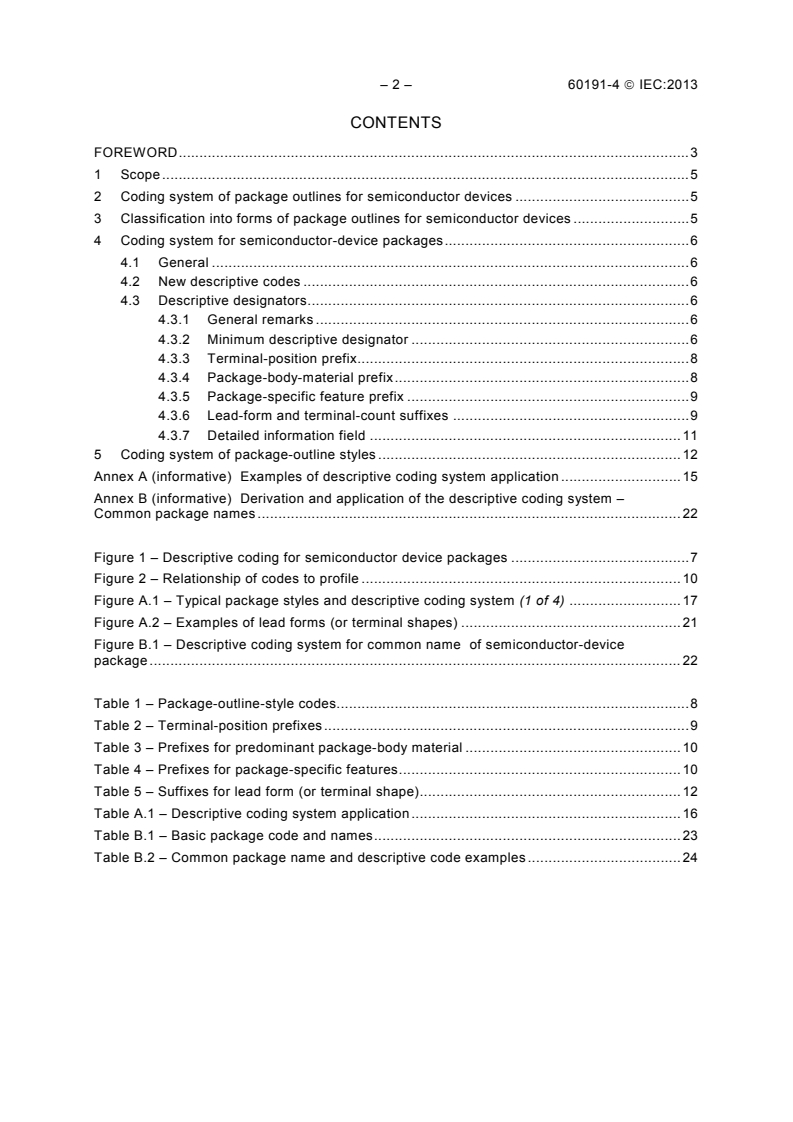
IEC 60191-4:2013 - Mechanical standardization of semiconductor devices - Part 4: Coding system and classification into forms of package outlines for semiconductor device packages Released:10/10/2013

IEC 60191-4:2013+AMD1:2018 CSV - Mechanical standardization of semiconductor devices - Part 4: Coding system and classification into forms of package outlines for semiconductor device packages Released:3/27/2018
Overview
The IEC 60191-4:2013 standard, titled Mechanical standardization of semiconductor devices - Part 4: Coding system and classification into forms of package outlines for semiconductor device packages, is an internationally recognized guideline developed by the International Electrotechnical Commission (IEC). This standard specifies a systematic method for designating and classifying package outlines of semiconductor devices. It provides a coding system that generates universal descriptive designators for semiconductor device packages, facilitating consistent communication within the electronics industry.
Importantly, IEC 60191-4:2013 standardizes mechanical features such as package outline styles, material types, and terminal configurations. While the descriptive designator aids clear identification and communication of package characteristics, it does not guarantee package interchangeability between manufacturers.
The 2018 amendment introduced key technical updates, such as adding the material code "S" for silicon-based packages and introducing the general-use description "WL". These updates enhance the standard's applicability to emerging packaging technologies.
Key Topics
Coding System for Package Outlines:
The standard uses a three-part code to classify semiconductor package outlines:- A three-digit serial number (000 to 999),
- A single-letter form code representing the package style (A to H),
- A two-digit serial number to indicate variants within the outline style.
Example:101A00or050G13.
Classification of Package Forms:
Packages are categorized into forms based on mechanical construction and mounting style:- Form A: Single-ended
- Form B: Heat-sink-mounted
- Form C: Stud-mounted
- Form D: Axial-leaded
- Form E: Surface-mounted
- Form F: Single-ended heat-sink-mounted
- Form G: Dual and quad in-line
- Form H: Axial lead-less
Descriptive Designators:
The coding system extends beyond style to include:- Terminal positions and counts
- Terminal form and shape
- Package body material (including newly added silicon material code "S")
- Package-specific features (e.g., general use "WL")
These designators allow detailed yet standardized description of package features while remaining adaptable for new developments.
Systematic and Universal Approach:
This standard provides a universal language for semiconductor packaging, enabling electronic component manufacturers, designers, and test engineers to communicate clear mechanical specifications.
Applications
The IEC 60191-4 coding and classification standard is vital for various semiconductor and electronics applications:
Component Design and Specification:
Assists designers in selecting and specifying package types during component development, ensuring physical compatibility and manufacturing feasibility.Manufacturing and Assembly:
Standardized coding facilitates automated processes and quality control in semiconductor packaging and printed circuit board (PCB) assembly.Procurement and Inventory:
Enables purchasers to unambiguously identify package types and variants across different manufacturers, streamlining supply chain management.Testing and Reliability Analysis:
Providing clear mechanical package descriptions supports reliability testing and failure analysis of semiconductor devices.Documentation and Communication:
Ensures consistent mechanical documentation across international teams, reducing misunderstandings and errors in product specifications.
Related Standards
IEC 60191-4 is part of the broader IEC 60191 series focusing on mechanical standardization of semiconductor devices. Related standards within this series and other relevant IEC/ISO documents include:
IEC 60191 Series: Covers multiple parts detailing mechanical outlines, terminal dimensions, and testing environments for semiconductor packages.
IEC 60747: Semiconductor devices standards addressing electronic characteristics and reliability.
ISO/IEC Directives: Framework for drafting and maintaining IEC standards, ensuring consistency and international consensus.
Complementary standards on surface mounting technology and device interchangeability help integrate mechanical coding with electrical and functional requirements.
By adopting IEC 60191-4:2013, semiconductor manufacturers, equipment suppliers, and end users benefit from a clear, standardized system for identifying and classifying semiconductor package outlines-promoting interoperability, reducing design cycles, and supporting technological innovation in the global electronics marketplace.
Relations
- Effective Date
- 05-Sep-2023
- Effective Date
- 05-Sep-2023
- Effective Date
- 05-Sep-2023
- Effective Date
- 05-Sep-2023
- Effective Date
- 05-Sep-2023
Buy Documents
IEC 60191-4:2013 - Mechanical standardization of semiconductor devices - Part 4: Coding system and classification into forms of package outlines for semiconductor device packages Released:10/10/2013
IEC 60191-4:2013+AMD1:2018 CSV - Mechanical standardization of semiconductor devices - Part 4: Coding system and classification into forms of package outlines for semiconductor device packages Released:3/27/2018
Frequently Asked Questions
IEC 60191-4:2013 is a standard published by the International Electrotechnical Commission (IEC). Its full title is "Mechanical standardization of semiconductor devices - Part 4: Coding system and classification into forms of package outlines for semiconductor device packages". This standard covers: IEC 60191-4:2013 specifies a method for the designation of package outlines and for the classification of forms of package outlines for semiconductor devices and a systematic method for generating universal descriptive designators for semiconductor device packages. The descriptive designator provides a useful communication tool but has no implied control for assuring package interchangeability. This edition includes the following significant technical changes with respect to the previous edition: a) Material code "S" is added to indicate a silicon based package. b) Description of "WL" is added to be used for general use.
IEC 60191-4:2013 specifies a method for the designation of package outlines and for the classification of forms of package outlines for semiconductor devices and a systematic method for generating universal descriptive designators for semiconductor device packages. The descriptive designator provides a useful communication tool but has no implied control for assuring package interchangeability. This edition includes the following significant technical changes with respect to the previous edition: a) Material code "S" is added to indicate a silicon based package. b) Description of "WL" is added to be used for general use.
IEC 60191-4:2013 is classified under the following ICS (International Classification for Standards) categories: 31.080.01 - Semiconductor devices in general. The ICS classification helps identify the subject area and facilitates finding related standards.
IEC 60191-4:2013 has the following relationships with other standards: It is inter standard links to IEC 60191-4:2013/AMD1:2018, IEC 60191-4:1999, IEC 60191-4:1999/AMD1:2001, IEC 60191-4:1999/AMD2:2002, IEC 60191-4/FRAG3. Understanding these relationships helps ensure you are using the most current and applicable version of the standard.
IEC 60191-4:2013 is available in PDF format for immediate download after purchase. The document can be added to your cart and obtained through the secure checkout process. Digital delivery ensures instant access to the complete standard document.
Standards Content (Sample)
IEC 60191-4 ®
Edition 3.0 2013-10
INTERNATIONAL
STANDARD
NORME
INTERNATIONALE
colourcolour
insinsiidede
Mechanical standardization of semiconductor devices –
Part 4: Coding system and classification into forms of package outlines for
semiconductor device packages
Normalisation mécanique des dispositifs à semiconducteurs –
Partie 4: Système de codification et classification en formes des structures des
boîtiers pour dispositifs à semiconducteurs
All rights reserved. Unless otherwise specified, no part of this publication may be reproduced or utilized in any form
or by any means, electronic or mechanical, including photocopying and microfilm, without permission in writing from
either IEC or IEC's member National Committee in the country of the requester.
If you have any questions about IEC copyright or have an enquiry about obtaining additional rights to this publication,
please contact the address below or your local IEC member National Committee for further information.
Droits de reproduction réservés. Sauf indication contraire, aucune partie de cette publication ne peut être reproduite ni
utilisée sous quelque forme que ce soit et par aucun procédé, électronique ou mécanique, y compris la photocopie et les
microfilms, sans l'accord écrit de la CEI ou du Comité national de la CEI du pays du demandeur.
Si vous avez des questions sur le copyright de la CEI ou si vous désirez obtenir des droits supplémentaires sur cette
publication, utilisez les coordonnées ci-après ou contactez le Comité national de la CEI de votre pays de résidence.
IEC Central Office Tel.: +41 22 919 02 11
3, rue de Varembé Fax: +41 22 919 03 00
CH-1211 Geneva 20 info@iec.ch
Switzerland www.iec.ch
About the IEC
The International Electrotechnical Commission (IEC) is the leading global organization that prepares and publishes
International Standards for all electrical, electronic and related technologies.
About IEC publications
The technical content of IEC publications is kept under constant review by the IEC. Please make sure that you have the
latest edition, a corrigenda or an amendment might have been published.
Useful links:
IEC publications search - www.iec.ch/searchpub Electropedia - www.electropedia.org
The advanced search enables you to find IEC publications The world's leading online dictionary of electronic and
by a variety of criteria (reference number, text, technical electrical terms containing more than 30 000 terms and
committee,…). definitions in English and French, with equivalent terms in
It also gives information on projects, replaced and additional languages. Also known as the International
withdrawn publications. Electrotechnical Vocabulary (IEV) on-line.
IEC Just Published - webstore.iec.ch/justpublished Customer Service Centre - webstore.iec.ch/csc
Stay up to date on all new IEC publications. Just Published If you wish to give us your feedback on this publication
details all new publications released. Available on-line and or need further assistance, please contact the
also once a month by email. Customer Service Centre: csc@iec.ch.
A propos de la CEI
La Commission Electrotechnique Internationale (CEI) est la première organisation mondiale qui élabore et publie des
Normes internationales pour tout ce qui a trait à l'électricité, à l'électronique et aux technologies apparentées.
A propos des publications CEI
Le contenu technique des publications de la CEI est constamment revu. Veuillez vous assurer que vous possédez
l’édition la plus récente, un corrigendum ou amendement peut avoir été publié.
Liens utiles:
Recherche de publications CEI - www.iec.ch/searchpub Electropedia - www.electropedia.org
La recherche avancée vous permet de trouver des Le premier dictionnaire en ligne au monde de termes
publications CEI en utilisant différents critères (numéro de électroniques et électriques. Il contient plus de 30 000
référence, texte, comité d’études,…). termes et définitions en anglais et en français, ainsi que
Elle donne aussi des informations sur les projets et les les termes équivalents dans les langues additionnelles.
publications remplacées ou retirées. Egalement appelé Vocabulaire Electrotechnique
International (VEI) en ligne.
Just Published CEI - webstore.iec.ch/justpublished
Service Clients - webstore.iec.ch/csc
Restez informé sur les nouvelles publications de la CEI.
Just Published détaille les nouvelles publications parues. Si vous désirez nous donner des commentaires sur
Disponible en ligne et aussi une fois par mois par email. cette publication ou si vous avez des questions
contactez-nous: csc@iec.ch.
IEC 60191-4 ®
Edition 3.0 2013-10
INTERNATIONAL
STANDARD
NORME
INTERNATIONALE
colour
inside
Mechanical standardization of semiconductor devices –
Part 4: Coding system and classification into forms of package outlines for
semiconductor device packages
Normalisation mécanique des dispositifs à semiconducteurs –
Partie 4: Système de codification et classification en formes des structures des
boîtiers pour dispositifs à semiconducteurs
INTERNATIONAL
ELECTROTECHNICAL
COMMISSION
COMMISSION
ELECTROTECHNIQUE
PRICE CODE
INTERNATIONALE
CODE PRIX T
ICS 31.080 ISBN 978-2-8322-1155-7
– 2 – 60191-4 IEC:2013
CONTENTS
FOREWORD . 3
1 Scope . 5
2 Coding system of package outlines for semiconductor devices . 5
3 Classification into forms of package outlines for semiconductor devices . 5
4 Coding system for semiconductor-device packages . 6
4.1 General . 6
4.2 New descriptive codes . 6
4.3 Descriptive designators . 6
4.3.1 General remarks . 6
4.3.2 Minimum descriptive designator . 6
4.3.3 Terminal-position prefix. 8
4.3.4 Package-body-material prefix . 8
4.3.5 Package-specific feature prefix . 9
4.3.6 Lead-form and terminal-count suffixes . 9
4.3.7 Detailed information field . 11
5 Coding system of package-outline styles . 12
Annex A (informative) Examples of descriptive coding system application . 15
Annex B (informative) Derivation and application of the descriptive coding system –
Common package names . 22
Figure 1 – Descriptive coding for semiconductor device packages . 7
Figure 2 – Relationship of codes to profile . 10
Figure A.1 – Typical package styles and descriptive coding system (1 of 4) . 17
Figure A.2 – Examples of lead forms (or terminal shapes) . 21
Figure B.1 – Descriptive coding system for common name of semiconductor-device
package . 22
Table 1 – Package-outline-style codes. 8
Table 2 – Terminal-position prefixes . 9
Table 3 – Prefixes for predominant package-body material . 10
Table 4 – Prefixes for package-specific features . 10
Table 5 – Suffixes for lead form (or terminal shape) . 12
Table A.1 – Descriptive coding system application . 16
Table B.1 – Basic package code and names . 23
Table B.2 – Common package name and descriptive code examples . 24
60191-4 IEC:2013 – 3 –
INTERNATIONAL ELECTROTECHNICAL COMMISSION
____________
MECHANICAL STANDARDIZATION OF SEMICONDUCTOR DEVICES –
Part 4: Coding system and classification into forms of package
outlines for semiconductor device packages
FOREWORD
1) The International Electrotechnical Commission (IEC) is a worldwide organization for standardization comprising
all national electrotechnical committees (IEC National Committees). The object of IEC is to promote
international co-operation on all questions concerning standardization in the electrical and electronic fields. To
this end and in addition to other activities, IEC publishes International Standards, Technical Specifications,
Technical Reports, Publicly Available Specifications (PAS) and Guides (hereafter referred to as “IEC
Publication(s)”). Their preparation is entrusted to technical committees; any IEC National Committee interested
in the subject dealt with may participate in this preparatory work. International, governmental and non-
governmental organizations liaising with the IEC also participate in this preparation. IEC collaborates closely
with the International Organization for Standardization (ISO) in accordance with conditions determined by
agreement between the two organizations.
2) The formal decisions or agreements of IEC on technical matters express, as nearly as possible, an international
consensus of opinion on the relevant subjects since each technical committee has representation from all
interested IEC National Committees.
3) IEC Publications have the form of recommendations for international use and are accepted by IEC National
Committees in that sense. While all reasonable efforts are made to ensure that the technical content of IEC
Publications is accurate, IEC cannot be held responsible for the way in which they are used or for any
misinterpretation by any end user.
4) In order to promote international uniformity, IEC National Committees undertake to apply IEC Publications
transparently to the maximum extent possible in their national and regional publications. Any divergence
between any IEC Publication and the corresponding national or regional publication shall be clearly indicated in
the latter.
5) IEC itself does not provide any attestation of conformity. Independent certification bodies provide conformity
assessment services and, in some areas, access to IEC marks of conformity. IEC is not responsible for any
services carried out by independent certification bodies.
6) All users should ensure that they have the latest edition of this publication.
7) No liability shall attach to IEC or its directors, employees, servants or agents including individual experts and
members of its technical committees and IEC National Committees for any personal injury, property damage or
other damage of any nature whatsoever, whether direct or indirect, or for costs (including legal fees) and
expenses arising out of the publication, use of, or reliance upon, this IEC Publication or any other IEC
Publications.
8) Attention is drawn to the Normative references cited in this publication. Use of the referenced publications is
indispensable for the correct application of this publication.
9) Attention is drawn to the possibility that some of the elements of this IEC Publication may be the subject of
patent rights. IEC shall not be held responsible for identifying any or all such patent rights.
International Standard IEC 60191-4 has been prepared by subcommittee 47D: Semiconductor
devices packaging, of IEC technical committee 47: Semiconductor devices.
This third edition cancels and replaces the second edition published in 1999,
Amendment 1:2001 and Amendment 2:2002.This edition constitutes a technical revision.
This edition includes the following significant technical changes with respect to the previous
edition:
a) Material code "S" is added to indicate a silicon based package.
b) Description of "WL" is added to be used for general use.
– 4 – 60191-4 IEC:2013
The text of this standard is based on the following documents:
FDIS Report on voting
47D/837/FDIS 47D/848/RVD
Full information on the voting for the approval of this standard can be found in the report on
voting indicated in the above table.
This publication has been drafted in accordance with the ISO/IEC Directives, Part 2.
A list of all the parts in the IEC 60191 series, published under the general title Mechanical
standardization of semiconductor devices, can be found on the IEC website.
The committee has decided that the contents of this publication will remain unchanged until the
stability date indicated on the IEC web site under "http://webstore.iec.ch" in the data related to
the specific publication. At this date, the publication will be
• reconfirmed,
• withdrawn,
• replaced by a revised edition, or
• amended.
IMPORTANT – The 'colour inside' logo on the cover page of this publication indicates
that it contains colours which are considered to be useful for the correct understanding
of its contents. Users should therefore print this document using a colour printer.
60191-4 IEC:2013 – 5 –
MECHANICAL STANDARDIZATION OF SEMICONDUCTOR DEVICES –
Part 4: Coding system and classification into forms of package
outlines for semiconductor device packages
1 Scope
This part of IEC 60191 specifies a method for the designation of package outlines and for the
classification of forms of package outlines for semiconductor devices and a systematic method
for generating universal descriptive designators for semiconductor device packages.
The descriptive designator provides a useful communication tool but has no implied control for
assuring package interchangeability.
2 Coding system of package outlines for semiconductor devices
The following coding system will be used in the publications concerning mechanical
standardization:
– first: a three-digit serial number (000 to 999);
– second: a single reference letter indicating the form as shown in Table 1;
– third: a two-digit serial number (00 to 99) to indicate a variant of an outline drawing.
The use of prefix P to indicate a provisional drawing remains unchanged.
Examples
– 101A00
– 050G13
– P 101F01
3 Classification into forms of package outlines for semiconductor devices
The package outline drawings for semiconductor devices are classified into forms according to
the following scheme:
– form A: single-ended
– form B: heat-sink-mounted
– form C: stud-mounted
– form D: axial-leaded
– form E: surface-mounted
– form F: single-ended, heat-sink-mounted
– form G: dual and quad in-line
– form H: axial lead-less.
– 6 – 60191-4 IEC:2013
4 Coding system for semiconductor-device packages
4.1 General
The standard coding system is a method for identifying the physical features of an electronic
device package family. The system is predicated upon a minimum two-character designator,
which indicates the package outline style. This designator can be extended, through the use of
optional, user-selected fields, to provide additional package information such as terminal
position and count, terminal form, package shape, and predominant body material.
4.2 New descriptive codes
If a new package that does not conform to one of the designated field character codes is being
proposed, a new code may be recommended for standardization.
4.3 Descriptive designators
4.3.1 General remarks
The package outline style code is the only compulsory field within this descriptive designation
system. Additional information may be provided using optional prefixes and suffixes described
by the system. In general, these fields are independent of one another. Unless otherwise
indicated herein, the users of this system may pick and choose which of these fields they wish
to implement for their specific application (see Figure 1). The descriptive designator may be
extended with additional information, provided this information is separated from the
descriptive designator by a slash (/) (see 4.3.7).
NOTE Basic package codes and names are presented in Table B.1.
4.3.2 Minimum descriptive designator
The minimum descriptive designator is a two-letter code that classifies device packages into
standard package outline styles. These styles identify general external physical features.
Common two-letter descriptive codes or abbreviations are included, such as CC, FP, SO, GA.
Figure A.1 shows two-letter codes for various device package outline styles and depicts
examples of each. Table 1 lists the two-letter package-outline-style codes described in
Clause 5.
60191-4 IEC:2013 – 7 –
Optional unless Minimum
Optional – Optional material prefix descriptive – Optional Optional
designator designator
P – S Q C C – J 3 2
Material Features Position Package Form Count
Terminal count
(4.3.6.1, 4.3.6.2)
A one-, two-, or
three-digit suffix
Lead form
(4.3.6.1, 4.3.6.2,
Table 5, Figure A.2)
A single-letter suffix
Package outline style
(4.3.2, Table 1, Figure A.1)
A double-letter designator
Terminal position
(4.3.3, Table 2)
A single-letter prefix
Package-specific features
(4.3.5, Table 4)
A single-letter or multi-
letter prefix
Package-body material
(4.3.4, Table 3)
A single-letter prefix
IEC 2560/13
Figure 1 – Descriptive coding for semiconductor device packages
– 8 – 60191-4 IEC:2013
Table 1 – Package-outline-style codes
Form Code Outline style
E CC Chip-carrier package
B CP Clamped package (press-pack)
A CY Cylinder or can package
D/E DB Disk-button package
F FM Flange-mount package
A FO Fibre optic device package
E FP Flatpack package
G GA Grid-array package
G IL In-line package. The preferred designator is IP.
G IP
In-line package or inserted package. Restrict to DIP/SIP/ZIP.
D/H LF Long-form horizontal package
MA Microelectronic assembly
B MP Power module package
MW Microwave package
B PF Press-fit package
C PM Post-(stud-) mount package
E SO* Small-outline package
A SS Special-shape package
UC Uncased chip
VP Vertical surface-mount package
XA-XZ Non-defined family; vendor or user option
* Industry practice sometimes uses "P" for "package" in the location normally occupied by this field (except that
there is no preceding hyphen), for example SOP.
4.3.3 Terminal-position prefix
The two-letter, package-outline-style code may be supplemented with a single-letter prefix that
identifies the physical terminal positions or, if applicable, the interconnect land pattern.
Examples of three-letter designators include common acronyms or abbreviations, such as DIP,
LCC (QCC preferred), PGA, QFP, SIP, ZIP.
NOTE 1 A terminal is defined as an externally available point of connection.
NOTE 2 The proper terminal-position prefix is determined by the interconnect land structure. For example, the
code for a single row of terminals formed into a staggered configuration would be "Z".
Table 2 gives a list of one-letter, terminal-position prefix codes.
4.3.4 Package-body-material prefix
The three-letter descriptive designator (see 4.3.2) may be further supplemented by a single-
letter prefix that identifies the predominant package-body material. This prefix shall not be
used unless the terminal-position prefix described in 4.3.2 is also used. Examples of such four-
letter descriptive designators include common acronyms or abbreviations, such as CDIP, PDIP,
PLCC (PQCC preferred), MELF, PQFP.
Table 3 gives a list of one-letter package-body-material prefix codes.
60191-4 IEC:2013 – 9 –
If the package-body material is other than one of those defined in Table 3, the letter "X" shall
be used within the descriptive designator to signify a special or new material and shall later be
replaced with an IEC-approved code.
4.3.5 Package-specific feature prefix
Package-specific features may be described through the use of a multiletter prefix. The
package-specific feature prefix shall be set off from the following portion of the descriptive
designator by a dash (–).
Table 4 gives a list of package-specific feature prefix codes. Figure 2 shows the relationship of
codes to profile and pitch.
4.3.6 Lead-form and terminal-count suffixes
4.3.6.1 General lead-form and number of terminals
The general lead form (or terminal shape) and/or the number of terminals on a package may
be described through the use of two fields, the lead-form suffix and the terminal-count suffix.
These two fields shall be set off from the preceding portion of the descriptive designator by a
dash (–).
Users of this system may choose to use the lead-form suffix, or the terminal-count suffix, or
both. If the lead-form suffix is used in conjunction with the terminal-count suffix, it shall
precede the terminal-count suffix.
Table 2 – Terminal-position prefixes
a) b)
Code Name Position
A Axial Terminals extend from both ends in the direction of the major axis of a cylindrical or
elliptical package
B Bottom Terminals extend from the bottom of the package
D Double Terminals are on opposite sides of a square or rectangular package or located in two
parallel rows
E End Terminals are package endcaps having a circular or elliptical cross-section
L Lateral Terminals are on the four sides of a square or rectangular package
The preferred name is "quad", code Q
P Perpendicular Terminals are perpendicular to the seating plane on a square or rectangular
package. Restrict to PGA family
Q Quad Terminals are on four sides of a square or rectangular package or located in four
parallel rows
R Radial Terminals extended radially from the periphery of a cylindrical or spherical package
S Single Terminals are on one surface of a square or rectangular package in a single row
T Triple Terminals are on three sides of a square or rectangular package
U Upper Terminals are perpendicular to and opposite the seating plane, and are on one
surface of a package
X Other Terminal positions are other than those described
Z Zig-zag Terminals are on one surface of a square or rectangular package arranged in a
staggered configuration
a)
These descriptions assume the seating plane in the bottom of the package.
b)
Reference to package shape does not take into account flanges, notches or other irregularities.
– 10 – 60191-4 IEC:2013
Table 3 – Prefixes for predominant package-body material
Code Material
C Ceramic, metal-sealed co-fired
G Ceramic, glass-sealed
L Glass
M Metal
P Plastic (including epoxy)
S Silicon
T Tape
X Other
Table 4 – Prefixes for package-specific features
Order Functional classification Code Package-specific feature
H Integral heat slug
1 Outline addition D Transparent window
P Piggyback or Terminal for stack
None Standard profile (1,70 mm < none)
L Low profile (1,20 mm < L ≤ 1,70 mm)
T
Thin profile (1,00 mm < T ≤ 1,20 mm)
2 Seating height V Very thin profile (0,80 mm < V ≤ 1,00 mm)
W Very, very thin profile (0,65 mm < W ≤ 0,80 mm)
U
Ultra thin profile (0,50 mm < U ≤ 0,65 mm)
X Extremely thin profile (X ≤ 0,50 mm)
Shrink pitch (< basic pitch) (restricted to DIP, SIP, SOP
families)
SDIP (1,778 mm pitch)
S
SZIP (1,778 mm and 1,27 mm pitch)
3 Terminal pitch and position
SSOP (1,0 mm, 0,8 mm, 0,65 mm, 0,5 mm and 0,4 mm
pitch)
Fine pitch (QFP at ≤ 0,50 mm pitch and ≤ 0,80 mm pitch
F
for BGA and LGA)
I Interstitial pitch (staggered leads)
X ≤ 0,50 mm < U ≤ 0,65 mm < W ≤ 0,80 mm < V ≤ 1,00 mm
< T ≤ 1,20 mm < L ≤ 1,70 mm < No code
IEC 2561/13
Figure 2 – Relationship of codes to profile
4.3.6.2 Lead-form suffix
The lead-form suffix is a one-letter suffix that identifies the standard form or shape of the lead.
Table 5 gives a list of one-letter, lead-form suffix codes.
If more than one type of terminal is present, the terminals carrying the principal current
determine the lead-form code. If one of these terminals is a mounting stud or flange, its shape
60191-4 IEC:2013 – 11 –
shall not govern the choice of lead-form (or terminal-shape) suffix because that has already
been described by the package-outline-style code. If the lead form is other than one of those
defined in Table 5, the letter "X" shall be used within the descriptive designator to signify a
special or new lead form and shall later be replaced with an IEC-approved code. Examples are
illustrated in Figure A.2.
4.3.6.3 Terminal-count suffix
The terminal-count suffix is a numeric field used to identify the number of terminals on the
device package. If there is more than one type of terminal, the terminal count shall include only
those terminals that were used to determine the lead-form suffix in accordance with 4.3.6.1. If
the terminal count (including terminals not used) is less than the number of available terminal
positions, the latter may be added in parentheses, for example 20(26) and 168(289).
4.3.7 Detailed information field
A slash (/), followed by a supplemental one- to twenty-character detailed information field, may
be added to the descriptive designator. The field may contain the IEC designation or some
other user-specified coding scheme.
The slash (/) shall signify the beginning of the supplementary detailed information field. There
shall be no space character between the slash (/) and adjacent fields.
– 12 – 60191-4 IEC:2013
Table 5 – Suffixes for lead form (or terminal shape)
Code Form/shape Description (see Figure A.2)
A Screw A threaded hole for a screw on the top of the package
B Butt or ball A short lead or solder ball intended for attachment perpendicular to the land
structure
C C-bend A "C"-shaped compliant or non-compliant lead bent down and under the body
of the package
D Solder lug A lug terminal on the package
E Fast-on plug A fast-on plug extending from the body of the package
F Flat A compliant or non-compliant, non-formed flat lead that extends away from
the body of the package
G Gull wing A compliant lead bent down from the body of the package with a foot at the
end pointing away from the package
H High-current cable A lug terminal at the end of a flexible lead
I Insulated A flat lead formed by depositing a thin conductor on a supporting insulating
film
J "J" bend A "J"-shaped compliant lead bent down and back under the body of the
package
L "L" bend An "L"-shaped compliant lead intended for surface mounting
N No lead Metallized terminal pads located on the body of the package
P* Pin or peg A tempered lead extending from the body of the package and intended for
attachment to a plated through-hole in the land structure
Q Quick-connect A tab-like terminal extending from the body of the package
R Wrap-around A metallized non-compliant terminal wrapped around the package body
S "S" bend An "S"-shaped compliant lead bent under the body of the package
T Through-hole A terminal with flat or V-shaped cross-section intended for attachment to a
plated through-hole in the land structure
U "J" inverted A "J"-shaped compliant or non-compliant lead bent down from the body of the
package with the curved end pointing away from the package
W Wire An untempered wire lead extending from the body of the package
X Other A lead form or terminal shape other than those defined
Y Screw A threaded hole
* Industry practice sometimes uses "P" for "package" in the location normally occupied by this field (except that
there is no preceding hyphen), for example SOP.
5 Coding system of package-outline styles
– CC, chip carrier: A low-profile package whose chip cavity or mounting area occupies a
major portion of the package area and whose terminals consist of metal pad surfaces (on
the leadless versions) or leads formed around the sides and under the package or out from
the package (on leaded versions).
NOTE 1 The body of the chip carrier, usually square or of low aspect ratio, is similar to that of a flatpack.
NOTE 2 When leads extend out from the package, the preferred term is "flatpack" (see FP).
– CP, clamped package (press-pack): Package, for high-current devices, in the form of a
cylinder with a plane, circular, high-current terminal at each end, intended to be clamped
against or between two busbars acting as heat sinks.
– CY, cylinder or can: Generally cylindrical package. It usually has terminals that exit from
one end, parallel to the central axis of the package and is mounted perpendicular to the
seating plane.
60191-4 IEC:2013 – 13 –
– DB, disk-button: Low-profile package that looks like a disk or button. It usually has
terminals that exit radially from the periphery of the package like the spokes of a wheel or
from the disk centre. Terminals may be formed into a variety of shapes.
– FO, fibre optic: Microcircuit package that has one or more fibre-optic connectors. Its
terminals may exit from, or attach to, any surface of the package and may be formed in a
variety of lead shapes.
NOTE 3 The fibre-optic connectors are considered to be terminals.
– FM, flange mount: Package that has a flange-mounted heat sink that is an integral part of
the package and provides mechanical mounting to a packaging interconnect structure or
cold plate. It usually has terminals that exit from, or attach to, any surface of the package in
a variety of forms.
– FP, flatpack: Low-profile package whose leads project parallel to, and are designed
primarily to be attached parallel to, the seating plane.
NOTE 4 The leads originate typically at either two or four sides of a package.
NOTE 5 The body of the flatpack is similar to that of a chip carrier.
NOTE 6 Leads can be formed generally away from the package body. If the leads are formed back towards
the package body, the correct term is "chip carrier" (see CC).
– GA, grid array: Low-profile package whose terminals are located on one surface in a
matrix of at least three rows and three columns; terminals may be missing from some row-
column intersections.
– IP (or IL), in-line package: Rectangular package having one row or two or more parallel
rows of leads designed primarily for insertion mounting perpendicular to the seating plane.
NOTE 7 The leads can all emerge from a single side or from two parallel sides with the leads formed to
produce parallel rows.
NOTE 8 The preferred code is "IP".
– LF, (long-form) package: Cylindrical or elliptical tubular package having terminal end-caps
or axial leads. Its long-form body is usually mounted parallel to the mounting plane.
– MA, microelectronic assembly: Assembly of unpackaged (uncased) microcircuits and/or
packaged microcircuits, which may also include discrete devices, so constructed on a
packaging interconnect structure that for the purpose of specification, testing, commerce,
and maintenance, the package is considered to be an indivisible component. The passive
and/or active discrete and microelectronic devices may be mounted on either one or two
sides of the packaging interconnect structure, and the external terminals usually exit from
one side of the assembly. A variety of package sizes, shapes, and external terminal forms
are possible.
– MP, (power) module package: Package designed for housing two or more power
semiconductor chips having a mounting base which is not a terminal, and several screw
and/or fast-on or pin terminals on the surface opposite the mounting base.
– MW, microwave package: Package specially designed to provide device operation at
microwave frequencies.
NOTE 9 "Specially designed" includes, but is not limited to, microwave cavities or terminals with controlled
common-element impedance.
– PF, press fit: Round or elliptical package whose mechanical mounting area is pressed into
the packaging interconnect structure or cold plate for purposes of thermal and electrical
connection. Its external terminals may take on a variety of forms.
– PM, post or stud mount: Package whose mechanical mounting device is a threaded stud,
threaded hole, or post for mounting to the packaging and interconnect structure or cold
plate. A variety of package shapes and external terminal forms are possible.
– SO, small outline: Low-profile rectangular surface-mount component package. Its chip (die)
is bonded to an inner land contact area, primarily a lead frame. External terminals exit
parallel to the seating plane on two opposite sides of the moulded, flat package.
– 14 – 60191-4 IEC:2013
NOTE 10 The lead form is usually gull wing but other lead forms are possible.
NOTE 11 This term is deprecated in favour of "chip carrier" (see CC) or "flatpack" (see FP), depending on the
lead form.
– SS, special-shape package: Miniature component package whose devices require a
special shape. Its terminals may project from one or more surfaces.
NOTE 12 Mechanical mounting and terminal attachment may require special techniques.
– UC, uncased chip: Uncased, microminiature chip (die). Usually the chip has bonding pads,
bumps, etc., that are bonded to pads or lands on a lead-frame, tape, or substrate.
– VP, vertical surface-mount package: Surface-mount package intended to be mounted
perpendicular to the seating plane. Terminals are located in one or more parallel rows. The
package may include supporting posts (for insertion through the seating surface) or
pedestals (for attachment to the seating surface).
– XA-XZ, non-defined family: Electronic device package that does not fall under any of the
other IEC-approved package-style families.
These vendor- or user-specified package-outline-style codes are temporary and should later
be replaced with an IEC-approved code. They may be reused and so have no unique, fixed
meanings.
– WL, Wafer-level array: A chip-scale package whose size is generally equal to the size of
the semiconductor device it contains and that is formed by processing on a complete wafer
rather than on an individual device.
60191-4 IEC:2013 – 15 –
Annex A
(informative)
Examples of descriptive coding system application
Table A.1 lists some examples of applications of the descriptive coding system. It does not
demonstrate all possible combinations of package-outline-style codes, prefixes and suffixes.
Figure A.1 shows the two-letter codes for device package outline styles and depicts examples
of typical four-letter designators.
Figure A.2 illustrates the one-letter lead-form (or terminal-shape) codes shown in Table 5.
– 16 – 60191-4 IEC:2013
Table A.1 – Descriptive coding system application
Common package Package Typical descriptive Complete descriptive
designation outline style coding system designator example
CCC CC CC, QCC or GQCC GQCC-J68
a)
LCC CC CC, LCC , R-LCC, or R-LCC-N R-CLCC-N32
a)
LCC CC CC, LCC , or CLCC-N CLCC-N32
b)
PLCC CC PLCC or PQCC-68 PQCC-J68
TO-5 CY CY-3, BCY, or MBCY MBCY-W3
TO-92 CY CY-3, BCY, or PBCY PBCY-W3
TO-224 DB DB-3, RDB, or PRDB PRDB-F3
TO-234 DB DB-3, RDB, or CRDB CRDB-F3
MO-025 FM FM-11 or MBFM MBFM-P11
TO-3 FM FM-2 or MBFM MBFM-P2
TO-220 FM FM-3, SFM, or PSFM PSFM-T3
FP FP FP, R-FP or DFP GDFP-F24
FP FP FP, S-FP, or QFP PQFP-G28
BGA GA BGA, BGA-340 E-BGA-B340(484)
PGA GA PGA or PGA-108 CPGA-P108(144)
CerDIP IP DIP, GDIP, or GDIP-18 GDIP-T18
DIP IP DIP, PDIP, or DIP-14 PDIP-T14
QDI IP DIP or PDIP PDIP-T44
SIP IP SIP, PSIP, or SIP-11 PSIP-T11
ZIP IP ZIP, PZIP, or ZIP-15 PZIP-T15
MO-02 IP DIP or PDIP PDIP-T16
MELF LF MELF MELF-R2
Axial lead LF ALF LALF-W2
DO-209 PF PF or MUPF MUPF-D1
DO-4 PM PM or UPM MUPM-D1
TO-209 PM PM, UPM, or MUPM MUPM-H2
SO SO SO, DSO, or PDSO PDSO-G8
SOIC SO SO, DSO, or PDSO PDSO-G14
SOJ SO SO-J or SO-J24 PDSO-J24(28)
SOL SO DSO or PDSO PDSO-G20
SOT-23 SO DSO or PDSO PDSO-G3
SOT-89 SO SSO or PSSO PSSO-F3
TO-244 FM UFM or PUFM R-PUFM-Y2
TAB UC UC-I, QUC-I PQUC-I
a)
The "L" in "LCC" means "lateral", not "with or without lead". Whether an LCC is with or without a lead can be
determined from a more complete descriptive designator. For example, an "N" suffix would indicate that the
package is without lead, a "J" suffix would indicate that the package has a lead.
b)
The use of "L" ("lateral") in LCC is discouraged in favour of "Q" (quad). Thus, the preferred descriptive
designator for PLCC is PQCC.
60191-4 IEC:2013 – 17 –
Package outline
Examples Form
style and code
CC
E
Chip carrier
PQCC-J CQCC-N CQCC-J
(PLCC-J) (CLCC-N) (CLCC-J)
CY
A
Cylinder
MBCY-W MBCY-W PBCY-W
DB
D and E
Disk button
PADB-W LRDB-F GRDB-F PRDB-F
CP
B
Clamped
package
CECP-N
IEC 2562/13
Figure A.1 – Typical package styles and descriptive coding system (1 of 4)
– 18 – 60191-4 IEC:2013
Package outline
Examples Form
style and code
FM
F
PSFM-T
MBFM-P PDFM-T
Flange mount
GDFM-F
GRFM-F
FO
A
Fibre optic
MXFO-W MAFO-W PXFO-P
FP
E
Flatpack
CQFP-F PDFP-G CDFP-F CQFP-G
IEC 2563/13
Figure A.1 (2 of 4)
60191-4 IEC:2013 – 19 –
Package outline
Examples Form
style and code
GA
G
Grid array
CPGA-P PBGA-B
IP
GDIP-T CDIP-T PSIP-W
G
In-line
PDIP-P PDIP-T PZIP-T
LF
H and D
Long form
MELF-N
PALF-W MALF-W
LELF-N
IEC 2564/13
Figure A.1 (3 of 4)
– 20 – 60191-4 IEC:2013
Package outline
Examples Form
style and code
MP
B
Power module
PUMP-A3 MUMP-E4
PF
Press fit
B
MUPF-D
PM
C
Post/stud mount
MUPM-D MUPM-D CRPM-F
SO
E
Small outline
PDSO-G PDSO-J PSSO-F
SS
A
Special shape
PDSS-W
IEC 2565/13
Figure A.1 (4 of 4)
60191-4 IEC:2013 – 21 –
B C
"C" bend
Butt or ball
D F
Solder slug
Flat
or
G H
Gull wing
High-current cable
J L
"J" bend
"L" bend
N P
Pin or peg
No lead
R S
Wraparound
"S" bend
T U
"J" inverted
Through-hole
W Y
Screw
Wire
Body of package Land structure
IEC 2566/13
Figure A.2 – Examples of lead forms (or terminal shapes)
– 22 – 60191-4 IEC:2013
Annex B
(informative)
Derivation and application of the descriptive coding system –
Common package names
Common package names or abbreviations are often used to directly indicate the form of
package in marketing or advertising fields. The descriptive coding for them is to be simplified
and modified from the formal coding system for easier usage.
The structure of a common package code consists of a package-body-material code and
derived package code being set off by a dash (-) between them.
The package-body-material code is referred to in 4.3.4.
The derived package code is created from the package outline style code (4.3.2) by the add-
ition of a terminal-position code (4.3.3) or lead-form code (4.3.6.2) and optionally the package-
specific feature code (4.3.5).
The basic package code consisting of three characters which shows package outline style code
by addition of a terminal-position code or lead-form code is generally used in marketing or
advertising fields.
To prevent confusion due to minor differences between the common package code and the
formal code, it is required to list them in IEC 60191-4.
Figure B.1 shows the descriptive coding structure for common package names.
Table B.1 gives a list of basic package codes and names.
Table B.2 gives a list of some examples of common package names and descriptive codes.
Package-body-material prefix Derived package code
Descriptive code Optional Basic package code
P F(XX) BGA
Material Features Package, position, form
A triple letter code
A single-letter or
multi-letter prefix
A single-letter prefix
IEC 2567/13
Figure B.1 – Descriptive coding system for common name
of semiconductor-device package
60191-4 IEC:2013 – 23 –
Table B.1 – Basic package code and names
Basic package code Basic package name Description
BGA Ball Grid Array Package Package having balls or bumps on top or bottom face
in a matrix of at least three rows and three columns.
DIP Dual Inline Package Package having leads in parallel rows on two opposite
sides of the body for though-hole insertion.
DTP Dual Tape Carrier Package Tape carrier package having flat leads on two opposite
sides of the body.
LGA Land Grid Array Package Package having lands on top or bottom face in a
matrix layout of at least three rows and three columns.
PGA Pin Grid Array Package Package having pins on top or bottom face in a matrix
layout of at least three rows and three columns.
QFF Quad Flat F-Leaded Package Package having unformed leads on four sides of the
body.
QFI Quad Flat I-Leaded Package Package having I-shaped leads on four sides of the
body.
QFJ Quad Flat J-Leaded Package Package having J-shaped leads on four sides of the
body.
QFN Quad Flat No Lead Package Package having single-inline terminal pads along four
edges of the bottom face. The terminal pads may or
may not be exposed on package sides.
QFP Quad Flat Package Package having gull-wing-shaped leads on four sides
of the body.
QTP Quad Tape Carrier Package Tape carrier package having flat leads on four side of
the body.
SIP Single Inline Package Package having leads on single side of the body.
SOF Small Outline F-Leaded Package Package having unformed leads on two opposite sides
of the body.
SOI Small Outline I-Leaded Package Package having I-shaped leads on two opposite sides
of the body.
SOJ Small Outline J-Leaded Package Package having J-shaped leads on two opposite sides
of the body.
SON Small Outline No Lead Package Package having single-inline terminal pads along two
opposite edges of the bottom face. The terminal pads
may or may not be exposed on package sides.
SOP Small Outline Package Package having gull-wing-shaped leads on two
opposite sides of the body.
SVP Surface Vertical Package Package having L-shaped leads on a single side of the
body.
ZIP Zigzag Inline Pa
...
IEC 60191-4 ®
Edition 3.1 2018-03
CONSOLIDATED VERSION
INTERNATIONAL
STANDARD
NORME
INTERNATIONALE
colour
inside
Mechanical standardization of semiconductor devices –
Part 4: Coding system and classification into forms of package outlines for
semiconductor device packages
Normalisation mécanique des dispositifs à semiconducteurs –
Partie 4: Système de codification et classification en formes des structures des
boîtiers pour dispositifs à semiconducteurs
All rights reserved. Unless otherwise specified, no part of this publication may be reproduced or utilized in any form
or by any means, electronic or mechanical, including photocopying and microfilm, without permission in writing from
either IEC or IEC's member National Committee in the country of the requester. If you have any questions about IEC
copyright or have an enquiry about obtaining additional rights to this publication, please contact the address below or
your local IEC member National Committee for further information.
Droits de reproduction réservés. Sauf indication contraire, aucune partie de cette publication ne peut être reproduite
ni utilisée sous quelque forme que ce soit et par aucun procédé, électronique ou mécanique, y compris la photocopie
et les microfilms, sans l'accord écrit de l'IEC ou du Comité national de l'IEC du pays du demandeur. Si vous avez des
questions sur le copyright de l'IEC ou si vous désirez obtenir des droits supplémentaires sur cette publication, utilisez
les coordonnées ci-après ou contactez le Comité national de l'IEC de votre pays de résidence.
IEC Central Office Tel.: +41 22 919 02 11
3, rue de Varembé info@iec.ch
CH-1211 Geneva 20 www.iec.ch
Switzerland
About the IEC
The International Electrotechnical Commission (IEC) is the leading global organization that prepares and publishes
International Standards for all electrical, electronic and related technologies.
About IEC publications
The technical content of IEC publications is kept under constant review by the IEC. Please make sure that you have the
latest edition, a corrigenda or an amendment might have been published.
IEC Catalogue - webstore.iec.ch/catalogue Electropedia - www.electropedia.org
The stand-alone application for consulting the entire The world's leading online dictionary of electronic and
bibliographical information on IEC International Standards, electrical terms containing 21 000 terms and definitions in
Technical Specifications, Technical Reports and other English and French, with equivalent terms in 16 additional
documents. Available for PC, Mac OS, Android Tablets and languages. Also known as the International Electrotechnical
iPad. Vocabulary (IEV) online.
IEC publications search - webstore.iec.ch/advsearchform IEC Glossary - std.iec.ch/glossary
The advanced search enables to find IEC publications by a 67 000 electrotechnical terminology entries in English and
variety of criteria (reference number, text, technical French extracted from the Terms and Definitions clause of
committee,…). It also gives information on projects, replaced IEC publications issued since 2002. Some entries have been
and withdrawn publications. collected from earlier publications of IEC TC 37, 77, 86 and
CISPR.
IEC Just Published - webstore.iec.ch/justpublished
Stay up to date on all new IEC publications. Just Published IEC Customer Service Centre - webstore.iec.ch/csc
details all new publications released. Available online and If you wish to give us your feedback on this publication or
also once a month by email. need further assistance, please contact the Customer Service
Centre: sales@iec.ch.
A propos de l'IEC
La Commission Electrotechnique Internationale (IEC) est la première organisation mondiale qui élabore et publie des
Normes internationales pour tout ce qui a trait à l'électricité, à l'électronique et aux technologies apparentées.
A propos des publications IEC
Le contenu technique des publications IEC est constamment revu. Veuillez vous assurer que vous possédez l’édition la
plus récente, un corrigendum ou amendement peut avoir été publié.
Catalogue IEC - webstore.iec.ch/catalogue Electropedia - www.electropedia.org
Application autonome pour consulter tous les renseignements
Le premier dictionnaire en ligne de termes électroniques et
bibliographiques sur les Normes internationales,
électriques. Il contient 21 000 termes et définitions en anglais
Spécifications techniques, Rapports techniques et autres
et en français, ainsi que les termes équivalents dans 16
documents de l'IEC. Disponible pour PC, Mac OS, tablettes
langues additionnelles. Egalement appelé Vocabulaire
Android et iPad.
Electrotechnique International (IEV) en ligne.
Recherche de publications IEC -
Glossaire IEC - std.iec.ch/glossary
webstore.iec.ch/advsearchform
67 000 entrées terminologiques électrotechniques, en anglais
La recherche avancée permet de trouver des publications IEC et en français, extraites des articles Termes et Définitions des
en utilisant différents critères (numéro de référence, texte, publications IEC parues depuis 2002. Plus certaines entrées
comité d’études,…). Elle donne aussi des informations sur les antérieures extraites des publications des CE 37, 77, 86 et
projets et les publications remplacées ou retirées. CISPR de l'IEC.
IEC Just Published - webstore.iec.ch/justpublished Service Clients - webstore.iec.ch/csc
Restez informé sur les nouvelles publications IEC. Just Si vous désirez nous donner des commentaires sur cette
Published détaille les nouvelles publications parues. publication ou si vous avez des questions contactez-nous:
Disponible en ligne et aussi une fois par mois par email. sales@iec.ch.
IEC 60191-4 ®
Edition 3.1 2018-03
CONSOLIDATED VERSION
INTERNATIONAL
STANDARD
NORME
INTERNATIONALE
colour
inside
Mechanical standardization of semiconductor devices –
Part 4: Coding system and classification into forms of package outlines for
semiconductor device packages
Normalisation mécanique des dispositifs à semiconducteurs –
Partie 4: Système de codification et classification en formes des structures des
boîtiers pour dispositifs à semiconducteurs
INTERNATIONAL
ELECTROTECHNICAL
COMMISSION
COMMISSION
ELECTROTECHNIQUE
INTERNATIONALE
ICS 31.080.01 ISBN 978-2-8322-5532-2
IEC 60191-4 ®
Edition 3.1 2018-03
CONSOLIDATED VERSION
REDLINE VERSION
VERSION REDLINE
colour
inside
Mechanical standardization of semiconductor devices –
Part 4: Coding system and classification into forms of package outlines for
semiconductor device packages
Normalisation mécanique des dispositifs à semiconducteurs –
Partie 4: Système de codification et classification en formes des structures des
boîtiers pour dispositifs à semiconducteurs
– 2 – IEC 60191-4:2013+AMD1:2018 CSV
IEC 2018
CONTENTS
FOREWORD . 3
1 Scope . 5
2 Coding system of package outlines for semiconductor devices . 5
3 Classification into forms of package outlines for semiconductor devices . 5
4 Coding system for semiconductor-device packages . 6
4.1 General . 6
4.2 New descriptive codes . 6
4.3 Descriptive designators . 6
4.3.1 General remarks . 6
4.3.2 Minimum descriptive designator . 6
4.3.3 Terminal-position prefix. 8
4.3.4 Package-body-material prefix . 8
4.3.5 Package-specific feature prefix . 9
4.3.6 Lead-form and terminal-count suffixes . 9
4.3.7 Detailed information field . 11
5 Coding system of package-outline styles . 12
Annex A (informative) Examples of descriptive coding system application . 15
Annex B (informative) Derivation and application of the descriptive coding system –
Common package names . 22
Annex C (informative) Terminology of semiconductor package outlines . 25
Figure 1 – Descriptive coding for semiconductor device packages . 7
Figure 2 – Relationship of codes to profile . 10
Figure A.1 – Typical package styles and descriptive coding system (1 of 4) . 17
Figure A.2 – Examples of lead forms (or terminal shapes) . 21
Figure B.1 – Descriptive coding system for common name of semiconductor-device
package . 22
Table 1 – Package-outline-style codes. 8
Table 2 – Terminal-position prefixes . 9
Table 3 – Prefixes for predominant package-body material . 10
Table 4 – Prefixes for package-specific features . 10
Table 5 – Suffixes for lead form (or terminal shape) . 12
Table A.1 – Descriptive coding system application . 16
Table B.1 – Basic package code and names . 23
Table B.2 – Common package name and descriptive code examples . 24
Table C.1 – Package name and parts name . 26
IEC 2018
INTERNATIONAL ELECTROTECHNICAL COMMISSION
____________
MECHANICAL STANDARDIZATION OF SEMICONDUCTOR DEVICES –
Part 4: Coding system and classification into forms of package
outlines for semiconductor device packages
FOREWORD
1) The International Electrotechnical Commission (IEC) is a worldwide organization for standardization comprising
all national electrotechnical committees (IEC National Committees). The object of IEC is to promote
international co-operation on all questions concerning standardization in the electrical and electronic fields. To
this end and in addition to other activities, IEC publishes International Standards, Technical Specifications,
Technical Reports, Publicly Available Specifications (PAS) and Guides (hereafter referred to as “IEC
Publication(s)”). Their preparation is entrusted to technical committees; any IEC National Committee interested
in the subject dealt with may participate in this preparatory work. International, governmental and non-
governmental organizations liaising with the IEC also participate in this preparation. IEC collaborates closely
with the International Organization for Standardization (ISO) in accordance with conditions determined by
agreement between the two organizations.
2) The formal decisions or agreements of IEC on technical matters express, as nearly as possible, an international
consensus of opinion on the relevant subjects since each technical committee has representation from all
interested IEC National Committees.
3) IEC Publications have the form of recommendations for international use and are accepted by IEC National
Committees in that sense. While all reasonable efforts are made to ensure that the technical content of IEC
Publications is accurate, IEC cannot be held responsible for the way in which they are used or for any
misinterpretation by any end user.
4) In order to promote international uniformity, IEC National Committees undertake to apply IEC Publications
transparently to the maximum extent possible in their national and regional publications. Any divergence
between any IEC Publication and the corresponding national or regional publication shall be clearly indicated in
the latter.
5) IEC itself does not provide any attestation of conformity. Independent certification bodies provide conformity
assessment services and, in some areas, access to IEC marks of conformity. IEC is not responsible for any
services carried out by independent certification bodies.
6) All users should ensure that they have the latest edition of this publication.
7) No liability shall attach to IEC or its directors, employees, servants or agents including individual experts and
members of its technical committees and IEC National Committees for any personal injury, property damage or
other damage of any nature whatsoever, whether direct or indirect, or for costs (including legal fees) and
expenses arising out of the publication, use of, or reliance upon, this IEC Publication or any other IEC
Publications.
8) Attention is drawn to the Normative references cited in this publication. Use of the referenced publications is
indispensable for the correct application of this publication.
9) Attention is drawn to the possibility that some of the elements of this IEC Publication may be the subject of
patent rights. IEC shall not be held responsible for identifying any or all such patent rights.
This consolidated version of the official IEC Standard and its amendment has been prepared
for user convenience.
IEC 60191-4 edition 3.1 contains the third edition (2013-10) [documents 47D/837/FDIS and
47D/848/RVD] and its amendment 1 (2018-03) [documents 47D/897/CDV and 47D/904/RVC].
In this Redline version, a vertical line in the margin shows where the technical content is
modified by amendment 1. Additions are in green text, deletions are in strikethrough red text.
A separate Final version with all changes accepted is available in this publication.
– 4 – IEC 60191-4:2013+AMD1:2018 CSV
IEC 2018
International Standard IEC 60191-4 has been prepared by subcommittee 47D: Semiconductor
devices packaging, of IEC technical committee 47: Semiconductor devices.
This third edition constitutes a technical revision.
This edition includes the following significant technical changes with respect to the previous
edition:
a) Material code "S" is added to indicate a silicon based package.
b) Description of "WL" is added to be used for general use.
This publication has been drafted in accordance with the ISO/IEC Directives, Part 2.
A list of all the parts in the IEC 60191 series, published under the general title Mechanical
standardization of semiconductor devices, can be found on the IEC website.
The committee has decided that the contents of the base publication and its amendment will
remain unchanged until the stability date indicated on the IEC web site under
"http://webstore.iec.ch" in the data related to the specific publication. At this date, the
publication will be
• reconfirmed,
• withdrawn,
• replaced by a revised edition, or
• amended.
IMPORTANT – The 'colour inside' logo on the cover page of this publication indicates
that it contains colours which are considered to be useful for the correct understanding
of its contents. Users should therefore print this document using a colour printer.
IEC 2018
MECHANICAL STANDARDIZATION OF SEMICONDUCTOR DEVICES –
Part 4: Coding system and classification into forms of package
outlines for semiconductor device packages
1 Scope
This part of IEC 60191 specifies a method for the designation of package outlines and for the
classification of forms of package outlines for semiconductor devices and a systematic method
for generating universal descriptive designators for semiconductor device packages.
The descriptive designator provides a useful communication tool but has no implied control for
assuring package interchangeability.
2 Coding system of package outlines for semiconductor devices
The following coding system will be used in the publications concerning mechanical
standardization:
– first: a three-digit serial number (000 to 999);
– second: a single reference letter indicating the form as shown in Table 1;
– third: a two-digit serial number (00 to 99) to indicate a variant of an outline drawing.
The use of prefix P to indicate a provisional drawing remains unchanged.
Examples
– 101A00
– 050G13
– P 101F01
3 Classification into forms of package outlines for semiconductor devices
The package outline drawings for semiconductor devices are classified into forms according to
the following scheme:
– form A: single-ended
– form B: heat-sink-mounted
– form C: stud-mounted
– form D: axial-leaded
– form E: surface-mounted
– form F: single-ended, heat-sink-mounted
– form G: dual and quad in-line
– form H: axial lead-less.
– 6 – IEC 60191-4:2013+AMD1:2018 CSV
IEC 2018
4 Coding system for semiconductor-device packages
4.1 General
The standard coding system is a method for identifying the physical features of an electronic
device package family. The system is predicated upon a minimum two-character designator,
which indicates the package outline style. This designator can be extended, through the use of
optional, user-selected fields, to provide additional package information such as terminal
position and count, terminal form, package shape, and predominant body material.
4.2 New descriptive codes
If a new package that does not conform to one of the designated field character codes is being
proposed, a new code may be recommended for standardization.
4.3 Descriptive designators
4.3.1 General remarks
The package outline style code is the only compulsory field within this descriptive designation
system. Additional information may be provided using optional prefixes and suffixes described
by the system. In general, these fields are independent of one another. Unless otherwise
indicated herein, the users of this system may pick and choose which of these fields they wish
to implement for their specific application (see Figure 1). The descriptive designator may be
extended with additional information, provided this information is separated from the
descriptive designator by a slash (/) (see 4.3.7).
NOTE Basic package codes and names are presented in Table B.1.
4.3.2 Minimum descriptive designator
The minimum descriptive designator is a two-letter code that classifies device packages into
standard package outline styles. These styles identify general external physical features.
Common two-letter descriptive codes or abbreviations are included, such as CC, FP, SO, GA.
Figure A.1 shows two-letter codes for various device package outline styles and depicts
examples of each. Table 1 lists the two-letter package-outline-style codes described in
Clause 5.
IEC 2018
Optional unless Minimum
Optional – Optional material prefix descriptive – Optional Optional
designator designator
P – S Q C C – J 3 2
Material Features Position Package Form Count
Terminal count
(4.3.6.1, 4.3.6.2)
A one-, two-, or
three-digit suffix
Lead form
(4.3.6.1, 4.3.6.2,
Table 5, Figure A.2)
A single-letter suffix
Package outline style
(4.3.2, Table 1, Figure A.1)
A double-letter designator
Terminal position
(4.3.3, Table 2)
A single-letter prefix
Package-specific features
(4.3.5, Table 4)
A single-letter or multi-
letter prefix
Package-body material
(4.3.4, Table 3)
A single-letter prefix
IEC 2560/13
Figure 1 – Descriptive coding for semiconductor device packages
– 8 – IEC 60191-4:2013+AMD1:2018 CSV
IEC 2018
Table 1 – Package-outline-style codes
Form Code Outline style
E CC Chip-carrier package
B CP Clamped package (press-pack)
A CY Cylinder or can package
D/E DB Disk-button package
F FM Flange-mount package
A FO Fibre optic device package
E FP Flatpack package
G GA Grid-array package
G IL In-line package. The preferred designator is IP.
G IP
In-line package or inserted package. Restrict to DIP/SIP/ZIP.
D/H LF Long-form horizontal package
MA Microelectronic assembly
B MP Power module package
MW Microwave package
B PF Press-fit package
C PM Post-(stud-) mount package
E SO* Small-outline package
A SS Special-shape package
UC Uncased chip
VP Vertical surface-mount package
XA-XZ Non-defined family; vendor or user option
* Industry practice sometimes uses "P" for "package" in the location normally occupied by this field (except that
there is no preceding hyphen), for example SOP.
4.3.3 Terminal-position prefix
The two-letter, package-outline-style code may be supplemented with a single-letter prefix that
identifies the physical terminal positions or, if applicable, the interconnect land pattern.
Examples of three-letter designators include common acronyms or abbreviations, such as DIP,
LCC (QCC preferred), PGA, QFP, SIP, ZIP.
NOTE 1 A terminal is defined as an externally available point of connection.
NOTE 2 The proper terminal-position prefix is determined by the interconnect land structure. For example, the
code for a single row of terminals formed into a staggered configuration would be "Z".
Table 2 gives a list of one-letter, terminal-position prefix codes.
4.3.4 Package-body-material prefix
The three-letter descriptive designator (see 4.3.2) may be further supplemented by a single-
letter prefix that identifies the predominant package-body material. This prefix shall not be
used unless the terminal-position prefix described in 4.3.2 is also used. Examples of such four-
letter descriptive designators include common acronyms or abbreviations, such as CDIP, PDIP,
PLCC (PQCC preferred), MELF, PQFP.
Table 3 gives a list of one-letter package-body-material prefix codes.
IEC 2018
If the package-body material is other than one of those defined in Table 3, the letter "X" shall
be used within the descriptive designator to signify a special or new material and shall later be
replaced with an IEC-approved code.
4.3.5 Package-specific feature prefix
Package-specific features may be described through the use of a multiletter prefix. The
package-specific feature prefix shall be set off from the following portion of the descriptive
designator by a dash (–).
Table 4 gives a list of package-specific feature prefix codes. Figure 2 shows the relationship of
codes to profile and pitch.
4.3.6 Lead-form and terminal-count suffixes
4.3.6.1 General lead-form and number of terminals
The general lead form (or terminal shape) and/or the number of terminals on a package may
be described through the use of two fields, the lead-form suffix and the terminal-count suffix.
These two fields shall be set off from the preceding portion of the descriptive designator by a
dash (–).
Users of this system may choose to use the lead-form suffix, or the terminal-count suffix, or
both. If the lead-form suffix is used in conjunction with the terminal-count suffix, it shall
precede the terminal-count suffix.
Table 2 – Terminal-position prefixes
a) b)
Code Name Position
A Axial Terminals extend from both ends in the direction of the major axis of a cylindrical or
elliptical package
B Bottom Terminals extend from the bottom of the package
D Double Terminals are on opposite sides of a square or rectangular package or located in two
parallel rows
E End Terminals are package endcaps having a circular or elliptical cross-section
L Lateral Terminals are on the four sides of a square or rectangular package
The preferred name is "quad", code Q
P Perpendicular Terminals are perpendicular to the seating plane on a square or rectangular
package. Restrict to PGA family
Q Quad Terminals are on four sides of a square or rectangular package or located in four
parallel rows
R Radial Terminals extended radially from the periphery of a cylindrical or spherical package
S Single Terminals are on one surface of a square or rectangular package in a single row
T Triple Terminals are on three sides of a square or rectangular package
U Upper Terminals are perpendicular to and opposite the seating plane, and are on one
surface of a package
X Other Terminal positions are other than those described
Z Zig-zag Terminals are on one surface of a square or rectangular package arranged in a
staggered configuration
a)
These descriptions assume the seating plane in the bottom of the package.
b)
Reference to package shape does not take into account flanges, notches or other irregularities.
– 10 – IEC 60191-4:2013+AMD1:2018 CSV
IEC 2018
Table 3 – Prefixes for predominant package-body material
Code Material
C Ceramic, metal-sealed co-fired
G Ceramic, glass-sealed
L Glass
M Metal
P Plastic (including epoxy)
S Silicon
T Tape
X Other
Table 4 – Prefixes for package-specific features
Order Functional classification Code Package-specific feature
H Integral heat slug
1 Outline addition D Transparent window
P Piggyback or Terminal for stack
None Standard profile (1,70 mm < none)
L Low profile (1,20 mm < L ≤ 1,70 mm)
T
Thin profile (1,00 mm < T ≤ 1,20 mm)
2 Seating height V Very thin profile (0,80 mm < V ≤ 1,00 mm)
W Very, very thin profile (0,65 mm < W ≤ 0,80 mm)
U
Ultra thin profile (0,50 mm < U ≤ 0,65 mm)
X Extremely thin profile (X ≤ 0,50 mm)
Shrink pitch (< basic pitch) (restricted to DIP, SIP, SOP
families)
SDIP (1,778 mm pitch)
S
SZIP (1,778 mm and 1,27 mm pitch)
3 Terminal pitch and position
SSOP (1,0 mm, 0,8 mm, 0,65 mm, 0,5 mm and 0,4 mm
pitch)
Fine pitch (QFP at ≤ 0,50 mm pitch and ≤ 0,80 mm pitch
F
for BGA and LGA)
I Interstitial pitch (staggered leads)
X ≤ 0,50 mm < U ≤ 0,65 mm < W ≤ 0,80 mm < V ≤ 1,00 mm
< T ≤ 1,20 mm < L ≤ 1,70 mm < No code
IEC 2561/13
Figure 2 – Relationship of codes to profile
4.3.6.2 Lead-form suffix
The lead-form suffix is a one-letter suffix that identifies the standard form or shape of the lead.
Table 5 gives a list of one-letter, lead-form suffix codes.
If more than one type of terminal is present, the terminals carrying the principal current
determine the lead-form code. If one of these terminals is a mounting stud or flange, its shape
IEC 2018
shall not govern the choice of lead-form (or terminal-shape) suffix because that has already
been described by the package-outline-style code. If the lead form is other than one of those
defined in Table 5, the letter "X" shall be used within the descriptive designator to signify a
special or new lead form and shall later be replaced with an IEC-approved code. Examples are
illustrated in Figure A.2.
4.3.6.3 Terminal-count suffix
The terminal-count suffix is a numeric field used to identify the number of terminals on the
device package. If there is more than one type of terminal, the terminal count shall include only
those terminals that were used to determine the lead-form suffix in accordance with 4.3.6.1. If
the terminal count (including terminals not used) is less than the number of available terminal
positions, the latter may be added in parentheses, for example 20(26) and 168(289).
4.3.7 Detailed information field
A slash (/), followed by a supplemental one- to twenty-character detailed information field, may
be added to the descriptive designator. The field may contain the IEC designation or some
other user-specified coding scheme.
The slash (/) shall signify the beginning of the supplementary detailed information field. There
shall be no space character between the slash (/) and adjacent fields.
– 12 – IEC 60191-4:2013+AMD1:2018 CSV
IEC 2018
Table 5 – Suffixes for lead form (or terminal shape)
Code Form/shape Description (see Figure A.2)
A Screw A threaded hole for a screw on the top of the package
B Butt or ball A short lead or solder ball intended for attachment perpendicular to the land
structure
C C-bend A "C"-shaped compliant or non-compliant lead bent down and under the body
of the package
D Solder lug A lug terminal on the package
E Fast-on plug A fast-on plug extending from the body of the package
F Flat A compliant or non-compliant, non-formed flat lead that extends away from
the body of the package
G Gull wing A compliant lead bent down from the body of the package with a foot at the
end pointing away from the package
H High-current cable A lug terminal at the end of a flexible lead
I Insulated A flat lead formed by depositing a thin conductor on a supporting insulating
film
J "J" bend A "J"-shaped compliant lead bent down and back under the body of the
package
L "L" bend An "L"-shaped compliant lead intended for surface mounting
N No lead Metallized terminal pads located on the body of the package
P* Pin or peg A tempered lead extending from the body of the package and intended for
attachment to a plated through-hole in the land structure
Q Quick-connect A tab-like terminal extending from the body of the package
R Wrap-around A metallized non-compliant terminal wrapped around the package body
S "S" bend An "S"-shaped compliant lead bent under the body of the package
T Through-hole A terminal with flat or V-shaped cross-section intended for attachment to a
plated through-hole in the land structure
U "J" inverted A "J"-shaped compliant or non-compliant lead bent down from the body of the
package with the curved end pointing away from the package
W Wire An untempered wire lead extending from the body of the package
X Other A lead form or terminal shape other than those defined
Y Screw A threaded hole
* Industry practice sometimes uses "P" for "package" in the location normally occupied by this field (except that
there is no preceding hyphen), for example SOP.
5 Coding system of package-outline styles
– CC, chip carrier: A low-profile package whose chip cavity or mounting area occupies a
major portion of the package area and whose terminals consist of metal pad surfaces (on
the leadless versions) or leads formed around the sides and under the package or out from
the package (on leaded versions).
NOTE 1 The body of the chip carrier, usually square or of low aspect ratio, is similar to that of a flatpack.
NOTE 2 When leads extend out from the package, the preferred term is "flatpack" (see FP).
– CP, clamped package (press-pack): Package, for high-current devices, in the form of a
cylinder with a plane, circular, high-current terminal at each end, intended to be clamped
against or between two busbars acting as heat sinks.
– CY, cylinder or can: Generally cylindrical package. It usually has terminals that exit from
one end, parallel to the central axis of the package and is mounted perpendicular to the
seating plane.
IEC 2018
– DB, disk-button: Low-profile package that looks like a disk or button. It usually has
terminals that exit radially from the periphery of the package like the spokes of a wheel or
from the disk centre. Terminals may be formed into a variety of shapes.
– FO, fibre optic: Microcircuit package that has one or more fibre-optic connectors. Its
terminals may exit from, or attach to, any surface of the package and may be formed in a
variety of lead shapes.
NOTE 3 The fibre-optic connectors are considered to be terminals.
– FM, flange mount: Package that has a flange-mounted heat sink that is an integral part of
the package and provides mechanical mounting to a packaging interconnect structure or
cold plate. It usually has terminals that exit from, or attach to, any surface of the package in
a variety of forms.
– FP, flatpack: Low-profile package whose leads project parallel to, and are designed
primarily to be attached parallel to, the seating plane.
NOTE 4 The leads originate typically at either two or four sides of a package.
NOTE 5 The body of the flatpack is similar to that of a chip carrier.
NOTE 6 Leads can be formed generally away from the package body. If the leads are formed back towards
the package body, the correct term is "chip carrier" (see CC).
– GA, grid array: Low-profile package whose terminals are located on one surface in a
matrix of at least three rows and three columns; terminals may be missing from some row-
column intersections.
– IP (or IL), in-line package: Rectangular package having one row or two or more parallel
rows of leads designed primarily for insertion mounting perpendicular to the seating plane.
NOTE 7 The leads can all emerge from a single side or from two parallel sides with the leads formed to
produce parallel rows.
NOTE 8 The preferred code is "IP".
– LF, (long-form) package: Cylindrical or elliptical tubular package having terminal end-caps
or axial leads. Its long-form body is usually mounted parallel to the mounting plane.
– MA, microelectronic assembly: Assembly of unpackaged (uncased) microcircuits and/or
packaged microcircuits, which may also include discrete devices, so constructed on a
packaging interconnect structure that for the purpose of specification, testing, commerce,
and maintenance, the package is considered to be an indivisible component. The passive
and/or active discrete and microelectronic devices may be mounted on either one or two
sides of the packaging interconnect structure, and the external terminals usually exit from
one side of the assembly. A variety of package sizes, shapes, and external terminal forms
are possible.
– MP, (power) module package: Package designed for housing two or more power
semiconductor chips having a mounting base which is not a terminal, and several screw
and/or fast-on or pin terminals on the surface opposite the mounting base.
– MW, microwave package: Package specially designed to provide device operation at
microwave frequencies.
NOTE 9 "Specially designed" includes, but is not limited to, microwave cavities or terminals with controlled
common-element impedance.
– PF, press fit: Round or elliptical package whose mechanical mounting area is pressed into
the packaging interconnect structure or cold plate for purposes of thermal and electrical
connection. Its external terminals may take on a variety of forms.
– PM, post or stud mount: Package whose mechanical mounting device is a threaded stud,
threaded hole, or post for mounting to the packaging and interconnect structure or cold
plate. A variety of package shapes and external terminal forms are possible.
– SO, small outline: Low-profile rectangular surface-mount component package. Its chip (die)
is bonded to an inner land contact area, primarily a lead frame. External terminals exit
parallel to the seating plane on two opposite sides of the moulded, flat package.
– 14 – IEC 60191-4:2013+AMD1:2018 CSV
IEC 2018
NOTE 10 The lead form is usually gull wing but other lead forms are possible.
NOTE 11 This term is deprecated in favour of "chip carrier" (see CC) or "flatpack" (see FP), depending on the
lead form.
– SS, special-shape package: Miniature component package whose devices require a
special shape. Its terminals may project from one or more surfaces.
NOTE 12 Mechanical mounting and terminal attachment may require special techniques.
– UC, uncased chip: Uncased, microminiature chip (die). Usually the chip has bonding pads,
bumps, etc., that are bonded to pads or lands on a lead-frame, tape, or substrate.
– VP, vertical surface-mount package: Surface-mount package intended to be mounted
perpendicular to the seating plane. Terminals are located in one or more parallel rows. The
package may include supporting posts (for insertion through the seating surface) or
pedestals (for attachment to the seating surface).
– XA-XZ, non-defined family: Electronic device package that does not fall under any of the
other IEC-approved package-style families.
These vendor- or user-specified package-outline-style codes are temporary and should later
be replaced with an IEC-approved code. They may be reused and so have no unique, fixed
meanings.
– WL, Wafer-level array: A chip-scale package whose size is generally equal to the size of
the semiconductor device it contains and that is formed by processing on a complete wafer
rather than on an individual device.
IEC 2018
Annex A
(informative)
Examples of descriptive coding system application
Table A.1 lists some examples of applications of the descriptive coding system. It does not
demonstrate all possible combinations of package-outline-style codes, prefixes and suffixes.
Figure A.1 shows the two-letter codes for device package outline styles and depicts examples
of typical four-letter designators.
Figure A.2 illustrates the one-letter lead-form (or terminal-shape) codes shown in Table 5.
– 16 – IEC 60191-4:2013+AMD1:2018 CSV
IEC 2018
Table A.1 – Descriptive coding system application
Common package Package Typical descriptive Complete descriptive
designation outline style coding system designator example
CCC CC CC, QCC or GQCC GQCC-J68
a)
LCC CC CC, LCC , R-LCC, or R-LCC-N R-CLCC-N32
a)
LCC CC CC, LCC , or CLCC-N CLCC-N32
b)
PLCC CC PLCC or PQCC-68 PQCC-J68
TO-5 CY CY-3, BCY, or MBCY MBCY-W3
TO-92 CY CY-3, BCY, or PBCY PBCY-W3
TO-224 DB DB-3, RDB, or PRDB PRDB-F3
TO-234 DB DB-3, RDB, or CRDB CRDB-F3
MO-025 FM FM-11 or MBFM MBFM-P11
TO-3 FM FM-2 or MBFM MBFM-P2
TO-220 FM FM-3, SFM, or PSFM PSFM-T3
FP FP FP, R-FP or DFP GDFP-F24
FP FP FP, S-FP, or QFP PQFP-G28
BGA GA BGA, BGA-340 E-BGA-B340(484)
PGA GA PGA or PGA-108 CPGA-P108(144)
CerDIP IP DIP, GDIP, or GDIP-18 GDIP-T18
DIP IP DIP, PDIP, or DIP-14 PDIP-T14
QDI IP DIP or PDIP PDIP-T44
SIP IP SIP, PSIP, or SIP-11 PSIP-T11
ZIP IP ZIP, PZIP, or ZIP-15 PZIP-T15
MO-02 IP DIP or PDIP PDIP-T16
MELF LF MELF MELF-R2
Axial lead LF ALF LALF-W2
DO-209 PF PF or MUPF MUPF-D1
DO-4 PM PM or UPM MUPM-D1
TO-209 PM PM, UPM, or MUPM MUPM-H2
SO SO SO, DSO, or PDSO PDSO-G8
SOIC SO SO, DSO, or PDSO PDSO-G14
SOJ SO SO-J or SO-J24 PDSO-J24(28)
SOL SO DSO or PDSO PDSO-G20
SOT-23 SO DSO or PDSO PDSO-G3
SOT-89 SO SSO or PSSO PSSO-F3
TO-244 FM UFM or PUFM R-PUFM-Y2
TAB UC UC-I, QUC-I PQUC-I
a)
The "L" in "LCC" means "lateral", not "with or without lead". Whether an LCC is with or without a lead can be
determined from a more complete descriptive designator. For example, an "N" suffix would indicate that the
package is without lead, a "J" suffix would indicate that the package has a lead.
b)
The use of "L" ("lateral") in LCC is discouraged in favour of "Q" (quad). Thus, the preferred descriptive
designator for PLCC is PQCC.
IEC 2018
Package outline
Examples Form
style and code
CC
E
Chip carrier
PQCC-J CQCC-N CQCC-J
(PLCC-J) (CLCC-N) (CLCC-J)
CY
A
Cylinder
MBCY-W MBCY-W PBCY-W
DB
D and E
Disk button
PADB-W LRDB-F GRDB-F PRDB-F
CP
B
Clamped
package
CECP-N
IEC 2562/13
Figure A.1 – Typical package styles and descriptive coding system (1 of 4)
– 18 – IEC 60191-4:2013+AMD1:2018 CSV
IEC 2018
Package outline
Examples Form
style and code
FM
F
PSFM-T
MBFM-P PDFM-T
Flange mount
GDFM-F
GRFM-F
FO
A
Fibre optic
MXFO-W MAFO-W PXFO-P
FP
E
Flatpack
CQFP-F PDFP-G CDFP-F CQFP-G
IEC 2563/13
Figure A.1 (2 of 4)
IEC 2018
Package outline
Examples Form
style and code
GA
G
Grid array
CPGA-P PBGA-B
IP
GDIP-T CDIP-T PSIP-W
G
In-line
PDIP-P PDIP-T PZIP-T
LF
H and D
Long form
MELF-N
PALF-W MALF-W
LELF-N
IEC 2564/13
Figure A.1 (3 of 4)
– 20 – IEC 60191-4:2013+AMD1:2018 CSV
IEC 2018
Package outline
Examples Form
style and code
MP
B
Power module
PUMP-A3 MUMP-E4
PF
Press fit
B
MUPF-D
PM
C
Post/stud mount
MUPM-D MUPM-D CRPM-F
SO
E
Small outline
PDSO-G PDSO-J PSSO-F
SS
A
Special shape
PDSS-W
IEC 2565/13
Figure A.1 (4 of 4)
IEC 2018
B C
"C" bend
Butt or ball
D F
Solder slug
Flat
or
G H
Gull wing
High-current cable
J L
"J" bend
"L" bend
N P
Pin or peg
No lead
R S
Wraparound
"S" bend
T U
"J" inverted
Through-hole
W Y
Screw
Wire
Body of package Land structure
IEC 2566/13
Figure A.2 – Examples of lead forms (or terminal shapes)
– 22 – IEC 60191-4:2013+AMD1:2018 CSV
IEC 2018
Annex B
(informative)
Derivation and application of the descriptive coding system –
Common package names
Common package names or abbreviations are often used to directly indicate the form of
package in marketing or advertising fields. The descriptive coding for them is to be simplified
and modified from the formal coding system for easier usage.
The structure of a common package code consists of a package-body-material code and
derived package code being set off by a dash (-) between them.
The package-body-material code is referred to in 4.3.4.
The derived package code is created from the package outline style code (4.3.2) by the add-
ition of a terminal-position code (4.3.3) or lead-form code (4.3.6.2) and optionally the package-
specific feature code (4.3.5).
The basic package code consisting of three characters which shows package outline style code
by addition of a terminal-position code or lead-form code is generally used in marketing or
advertising fields.
To prevent confusion due to minor differences between the common package code and the
formal code, it is required to list them in IEC 60191-4.
Figure B.1 shows the descriptive coding structure for common package names.
Table B.1 gives a list of basic package codes and names.
Table B.2 gives a list
...