

IEC 60676:2011
(Main)Industrial electroheating equipment - Test methods for direct arc furnaces
General Information
- Abstract
IEC 60676:2011 specifies test procedures, conditions and methods according to which the main parameters and the main operational characteristics of electric arc furnaces (EAF) operated either with alternating current (EAFac) or with direct current (EAFdc) with a capacity above 500 kg/heat are established. This third edition cancels and replaces the previous edition published in 2002 and constitutes a technical revision. Significant technical changes with respect to the previous edition are as follows:
- Clause 1 (Scope and object) - types of furnaces are more clearly defined.
- Clause 2 (Normative references) and Clause 3 (Terms and definitions) have been updated and completed.
- New Clause 4 (Features of the EAFsystem) has been added; it mainly concentrates on the tests necessary for high-voltage / high-current electrical equipment in the installation.
- Clause 5 (Type of tests and general conditions of their performance) and Clause 6 (Technical tests) have been modified according to today's requirements for safe operation of an EAF.
- Status
- Published
- Publication Date
- 07-Nov-2011
- Technical Committee
- TC 27 - Industrial electroheating and electromagnetic processing
- Drafting Committee
- MT 21 - TC 27/MT 21
- Current Stage
- DELPUB - Deleted Publication
- Start Date
- 28-Feb-2024
- Completion Date
- 16-Sep-2022
Overview
IEC 60676:2011 is an international standard developed by the International Electrotechnical Commission (IEC) that specifies test methods for industrial electroheating equipment, particularly for electric arc furnaces (EAFs). This third edition of IEC 60676 focuses on test procedures, conditions, and methods to establish the main parameters and operational characteristics of direct arc furnaces with capacities above 500 kg per heat. The standard applies to both alternating current electric arc furnaces (EAFac) and direct current electric arc furnaces (EAFdc).
This standard serves as a critical guideline for manufacturers, testing laboratories, and industrial operators involved in the production, installation, and maintenance of electric arc furnaces. It ensures safe, reliable, and standardized operation of high-voltage and high-current electroheating equipment used in metal melting and refining processes.
Key Topics
Scope and Object
Defines the types of furnaces covered (EAFac and EAFdc) and the thermal capacities involved. It also distinguishes between EAF and related technologies such as ladle furnaces and submerged arc furnaces.Normative References
Includes essential IEC publications related to safety and test methods for industrial electroheating installations to ensure comprehensive application.Terms and Definitions
Provides clear technical terminology including parameters such as active power, apparent power, asymmetry factor, electrode types, and thermal states (hot and cold).Features of the EAF System
Covers aspects like electrical assembly of the furnace, furnace construction, and water cooling systems vital for safe operation.Type of Tests and Testing Conditions
Specifies tests for both cold and hot conditions, emphasizing operational safety and performance verification.Technical Tests
Details critical test methods such as:- Electrical insulation and resistance measurement of high-current systems
- Cooling water system performance
- Electrode motion speed and consumption measurements
- Short-circuit test procedures to verify furnace resilience
- Evaluation of main production characteristics under operational conditions
- Phase rotation and rated capacity verification
Safety Considerations
Adheres to updated norms emphasizing safe operation under modern industrial requirements, including aspects of switchgear performance.
Applications
Electric Arc Furnace Manufacturing
IEC 60676:2011 guides manufacturers on the standardized testing needed to certify EAF systems prior to market release, ensuring compliance with international safety and performance criteria.Industrial Electroheating Operations
Operators use this standard to perform regular testing and maintenance of EAF equipment, optimizing furnace reliability and minimizing operational hazards.Quality Assurance and Certification
Testing bodies and certification agencies apply the standard to verify furnace electrical characteristics, insulation, and operational performance as part of quality control programs.Metals and Steel Industry
Electric arc furnaces designed for melting and refining steel and other metals rely on IEC 60676 testing guidelines to maintain consistent production efficiency and safety.Research and Development
Enables R&D teams to benchmark new EAF designs and modifications against internationally accepted test procedures, fostering innovation with compliance.
Related Standards
IEC 60398:1999 – Industrial electroheating installations – General test methods
Complements IEC 60676 by defining broader testing methods for electroheating installations.IEC 60519-1 & IEC 60519-4 – Safety in electroheating installations
Specifies general and arc furnace-specific safety requirements essential for EAF installations and operations.IEC 60146-1-1 – Semiconductor converters – Test methods for controlled rectifiers used in EAFdc
Applicable for testing specific converter equipment integrated within direct current arc furnaces.IEC 60683 – Test methods for submerged arc furnaces (SAF)
Addresses test procedures for similar industrial electroheating equipment with different arc furnace types.
Summary
IEC 60676:2011 plays a pivotal role in standardizing the testing of industrial direct arc furnaces, ensuring controlled and safe operation in high-demand metallurgical environments. By addressing both alternating and direct current EAFs, it provides comprehensive coverage of test procedures essential for performance assessment, safety verification, and operational efficiency. Compliance with IEC 60676 equips manufacturers and users with benchmarks for quality and reliability, supporting advancements in industrial electroheating technology worldwide.
Relations
- Effective Date
- 05-Sep-2023
- Effective Date
- 05-Sep-2023
- Effective Date
- 05-Sep-2023
Get Certified
Connect with accredited certification bodies for this standard

DVS-ZERT GmbH
German welding certification society.

IMQ S.p.A. (Certification)
Italian electrical product certification.

SLG Prüf- und Zertifizierungs GmbH
German testing and certification body.
Sponsored listings
Frequently Asked Questions
IEC 60676:2011 is a standard published by the International Electrotechnical Commission (IEC). Its full title is "Industrial electroheating equipment - Test methods for direct arc furnaces". This standard covers: IEC 60676:2011 specifies test procedures, conditions and methods according to which the main parameters and the main operational characteristics of electric arc furnaces (EAF) operated either with alternating current (EAFac) or with direct current (EAFdc) with a capacity above 500 kg/heat are established. This third edition cancels and replaces the previous edition published in 2002 and constitutes a technical revision. Significant technical changes with respect to the previous edition are as follows: - Clause 1 (Scope and object) - types of furnaces are more clearly defined. - Clause 2 (Normative references) and Clause 3 (Terms and definitions) have been updated and completed. - New Clause 4 (Features of the EAFsystem) has been added; it mainly concentrates on the tests necessary for high-voltage / high-current electrical equipment in the installation. - Clause 5 (Type of tests and general conditions of their performance) and Clause 6 (Technical tests) have been modified according to today's requirements for safe operation of an EAF.
IEC 60676:2011 specifies test procedures, conditions and methods according to which the main parameters and the main operational characteristics of electric arc furnaces (EAF) operated either with alternating current (EAFac) or with direct current (EAFdc) with a capacity above 500 kg/heat are established. This third edition cancels and replaces the previous edition published in 2002 and constitutes a technical revision. Significant technical changes with respect to the previous edition are as follows: - Clause 1 (Scope and object) - types of furnaces are more clearly defined. - Clause 2 (Normative references) and Clause 3 (Terms and definitions) have been updated and completed. - New Clause 4 (Features of the EAFsystem) has been added; it mainly concentrates on the tests necessary for high-voltage / high-current electrical equipment in the installation. - Clause 5 (Type of tests and general conditions of their performance) and Clause 6 (Technical tests) have been modified according to today's requirements for safe operation of an EAF.
IEC 60676:2011 is classified under the following ICS (International Classification for Standards) categories: 25.180.10 - Electric furnaces; 29.120.50 - Fuses and other overcurrent protection devices. The ICS classification helps identify the subject area and facilitates finding related standards.
IEC 60676:2011 has the following relationships with other standards: It is inter standard links to IEC 60676:2002/COR1:2002, IEC 60676:2002, IEC 60676:2024. Understanding these relationships helps ensure you are using the most current and applicable version of the standard.
IEC 60676:2011 is available in PDF format for immediate download after purchase. The document can be added to your cart and obtained through the secure checkout process. Digital delivery ensures instant access to the complete standard document.
Standards Content (Sample)
IEC 60676 ®
Edition 3.0 2011-11
INTERNATIONAL
STANDARD
NORME
INTERNATIONALE
Industrial electroheating equipment – Test methods for direct arc furnaces
Chauffage électrique industriel – Méthodes d’essai des fours à arc direct
All rights reserved. Unless otherwise specified, no part of this publication may be reproduced or utilized in any form or by
any means, electronic or mechanical, including photocopying and microfilm, without permission in writing from either IEC or
IEC's member National Committee in the country of the requester.
If you have any questions about IEC copyright or have an enquiry about obtaining additional rights to this publication,
please contact the address below or your local IEC member National Committee for further information.
Droits de reproduction réservés. Sauf indication contraire, aucune partie de cette publication ne peut être reproduite
ni utilisée sous quelque forme que ce soit et par aucun procédé, électronique ou mécanique, y compris la photocopie
et les microfilms, sans l'accord écrit de la CEI ou du Comité national de la CEI du pays du demandeur.
Si vous avez des questions sur le copyright de la CEI ou si vous désirez obtenir des droits supplémentaires sur cette
publication, utilisez les coordonnées ci-après ou contactez le Comité national de la CEI de votre pays de résidence.
IEC Central Office
3, rue de Varembé
CH-1211 Geneva 20
Switzerland
Email: inmail@iec.ch
Web: www.iec.ch
About the IEC
The International Electrotechnical Commission (IEC) is the leading global organization that prepares and publishes
International Standards for all electrical, electronic and related technologies.
About IEC publications
The technical content of IEC publications is kept under constant review by the IEC. Please make sure that you have the
latest edition, a corrigenda or an amendment might have been published.
Catalogue of IEC publications: www.iec.ch/searchpub
The IEC on-line Catalogue enables you to search by a variety of criteria (reference number, text, technical committee,…).
It also gives information on projects, withdrawn and replaced publications.
IEC Just Published: www.iec.ch/online_news/justpub
Stay up to date on all new IEC publications. Just Published details twice a month all new publications released. Available
on-line and also by email.
Electropedia: www.electropedia.org
The world's leading online dictionary of electronic and electrical terms containing more than 20 000 terms and definitions
in English and French, with equivalent terms in additional languages. Also known as the International Electrotechnical
Vocabulary online.
Customer Service Centre: www.iec.ch/webstore/custserv
If you wish to give us your feedback on this publication or need further assistance, please visit the Customer Service
Centre FAQ or contact us:
Email: csc@iec.ch
Tel.: +41 22 919 02 11
Fax: +41 22 919 03 00
A propos de la CEI
La Commission Electrotechnique Internationale (CEI) est la première organisation mondiale qui élabore et publie des
normes internationales pour tout ce qui a trait à l'électricité, à l'électronique et aux technologies apparentées.
A propos des publications CEI
Le contenu technique des publications de la CEI est constamment revu. Veuillez vous assurer que vous possédez
l’édition la plus récente, un corrigendum ou amendement peut avoir été publié.
Catalogue des publications de la CEI: www.iec.ch/searchpub/cur_fut-f.htm
Le Catalogue en-ligne de la CEI vous permet d’effectuer des recherches en utilisant différents critères (numéro de référence,
texte, comité d’études,…). Il donne aussi des informations sur les projets et les publications retirées ou remplacées.
Just Published CEI: www.iec.ch/online_news/justpub
Restez informé sur les nouvelles publications de la CEI. Just Published détaille deux fois par mois les nouvelles
publications parues. Disponible en-ligne et aussi par email.
Electropedia: www.electropedia.org
Le premier dictionnaire en ligne au monde de termes électroniques et électriques. Il contient plus de 20 000 termes et
définitions en anglais et en français, ainsi que les termes équivalents dans les langues additionnelles. Egalement appelé
Vocabulaire Electrotechnique International en ligne.
Service Clients: www.iec.ch/webstore/custserv/custserv_entry-f.htm
Si vous désirez nous donner des commentaires sur cette publication ou si vous avez des questions, visitez le FAQ du
Service clients ou contactez-nous:
Email: csc@iec.ch
Tél.: +41 22 919 02 11
Fax: +41 22 919 03 00
IEC 60676 ®
Edition 3.0 2011-11
INTERNATIONAL
STANDARD
NORME
INTERNATIONALE
Industrial electroheating equipment – Test methods for direct arc furnaces
Chauffage électrique industriel – Méthodes d’essai des fours à arc direct
INTERNATIONAL
ELECTROTECHNICAL
COMMISSION
COMMISSION
ELECTROTECHNIQUE
PRICE CODE
INTERNATIONALE
CODE PRIX R
ICS 25.180.10 ISBN 978-2-88912-725-2
– 2 – 60676 © IEC:2011
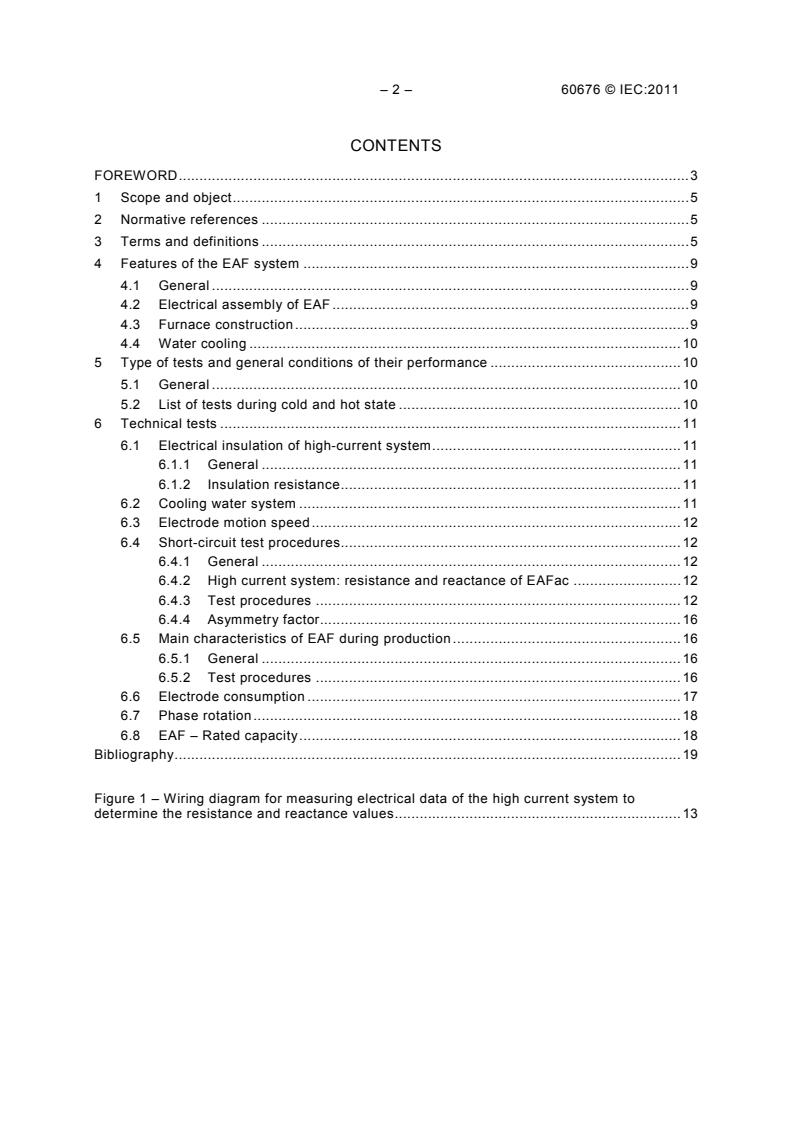
CONTENTS
FOREWORD . 3
1 Scope and object . 5
2 Normative references . 5
3 Terms and definitions . 5
4 Features of the EAF system . 9
4.1 General . 9
4.2 Electrical assembly of EAF . 9
4.3 Furnace construction . 9
4.4 Water cooling . 10
5 Type of tests and general conditions of their performance . 10
5.1 General . 10
5.2 List of tests during cold and hot state . 10
6 Technical tests . 11
6.1 Electrical insulation of high-current system . 11
6.1.1 General . 11
6.1.2 Insulation resistance . 11
6.2 Cooling water system . 11
6.3 Electrode motion speed . 12
6.4 Short-circuit test procedures. 12
6.4.1 General . 12
6.4.2 High current system: resistance and reactance of EAFac . 12
6.4.3 Test procedures . 12
6.4.4 Asymmetry factor. 16
6.5 Main characteristics of EAF during production . 16
6.5.1 General . 16
6.5.2 Test procedures . 16
6.6 Electrode consumption . 17
6.7 Phase rotation . 18
6.8 EAF – Rated capacity . 18
Bibliography . 19
Figure 1 – Wiring diagram for measuring electrical data of the high current system to
determine the resistance and reactance values . 13
60676 © IEC:2011 – 3 –
INTERNATIONAL ELECTROTECHNICAL COMMISSION
____________
INDUSTRIAL ELECTROHEATING EQUIPMENT –
TEST METHODS FOR DIRECT ARC FURNACES
FOREWORD
1) The International Electrotechnical Commission (IEC) is a worldwide organization for standardization comprising
all national electrotechnical committees (IEC National Committees). The object of IEC is to promote
international co-operation on all questions concerning standardization in the electrical and electronic fields. To
this end and in addition to other activities, IEC publishes International Standards, Technical Specifications,
Technical Reports, Publicly Available Specifications (PAS) and Guides (hereafter referred to as “IEC
Publication(s)”). Their preparation is entrusted to technical committees; any IEC National Committee interested
in the subject dealt with may participate in this preparatory work. International, governmental and non-
governmental organizations liaising with the IEC also participate in this preparation. IEC collaborates closely
with the International Organization for Standardization (ISO) in accordance with conditions determined by
agreement between the two organizations.
2) The formal decisions or agreements of IEC on technical matters express, as nearly as possible, an international
consensus of opinion on the relevant subjects since each technical committee has representation from all
interested IEC National Committees.
3) IEC Publications have the form of recommendations for international use and are accepted by IEC National
Committees in that sense. While all reasonable efforts are made to ensure that the technical content of IEC
Publications is accurate, IEC cannot be held responsible for the way in which they are used or for any
misinterpretation by any end user.
4) In order to promote international uniformity, IEC National Committees undertake to apply IEC Publications
transparently to the maximum extent possible in their national and regional publications. Any divergence
between any IEC Publication and the corresponding national or regional publication shall be clearly indicated in
the latter.
5) IEC itself does not provide any attestation of conformity. Independent certification bodies provide conformity
assessment services and, in some areas, access to IEC marks of conformity. IEC is not responsible for any
services carried out by independent certification bodies.
6) All users should ensure that they have the latest edition of this publication.
7) No liability shall attach to IEC or its directors, employees, servants or agents including individual experts and
members of its technical committees and IEC National Committees for any personal injury, property damage or
other damage of any nature whatsoever, whether direct or indirect, or for costs (including legal fees) and
expenses arising out of the publication, use of, or reliance upon, this IEC Publication or any other IEC
Publications.
8) Attention is drawn to the Normative references cited in this publication. Use of the referenced publications is
indispensable for the correct application of this publication.
9) Attention is drawn to the possibility that some of the elements of this IEC Publication may be the subject of
patent rights. IEC shall not be held responsible for identifying any or all such patent rights.
International Standard IEC 60676 has been prepared by IEC technical committee 27:
Industrial electroheating.
This third edition cancels and replaces the previous edition published in 2002 and constitutes
a technical revision.
Significant technical changes with respect to the previous edition are as follows:
– Clause 1 (Scope and object) – types of furnaces are more clearly defined.
– Clause 2 (Normative references) and Clause 3 (Terms and definitions) have been updated
and completed.
– New Clause 4 (Features of the EAFsystem) has been added; it mainly concentrates on the
tests necessary for high-voltage / high-current electrical equipment in the installation.
– Clause 5 (Type of tests and general conditions of their performance) and Clause 6
(Technical tests) have been modified according to today’s requirements for safe operation
of an EAF.
– 4 – 60676 © IEC:2011
The text of this standard is based on the following documents:
FDIS Report on voting
27/816/FDIS 27/837/RVD
Full information on the voting for the approval of this standard can be found in the report on
voting indicated in the above table.
This publication has been drafted in accordance with the ISO/IEC Directives, Part 2.
The committee has decided that the contents of this publication will remain unchanged until
the stability date indicated on the IEC web site under "http://webstore.iec.ch" in the data
related to the specific publication. At this date, the publication will be
• reconfirmed,
• withdrawn,
• replaced by a revised edition, or
• amended.
60676 © IEC:2011 – 5 –
INDUSTRIAL ELECTROHEATING EQUIPMENT –
TEST METHODS FOR DIRECT ARC FURNACES
1 Scope and object
This International Standard specifies test procedures, conditions and methods according to
which the main parameters and the main operational characteristics of electric arc furnaces
(EAF) operated either with alternating current (EAFac) or with direct current (EAFdc) with a
capacity above 500 kg/heat are established.
The EAF technology is also applicable to furnaces, in which liquid metal is kept at high
temperature or superheated to casting temperature (e.g. in a ladle furnace (LF), operated with
alternating current).
Test methods for some special equipment, e.g. controlled rectifiers for EAFdc, are covered by
IEC 60146-1-1.
Test methods for submerged arc furnaces (SAF) are covered by IEC 60683.
2 Normative references
The following referenced documents are indispensable for the application of this document.
For dated references, only the edition cited applies. For undated references, the latest edition
of the referenced document (including any amendments) applies.
IEC 60398:1999, Industrial electroheating installations – General test methods
IEC 60519-1, Safety in electroheating installations – Part 1: General requirements
IEC 60519-4, Safety in electroheat installations – Part 4: Particular requirements for arc
furnace installations
3 Terms and definitions
For the purposes of this document the terms and definitions given in IEC 60519-1:2010 and
the following apply.
NOTE Refer to International Electrotechnical Vocabulary, IEC 600500, for general definitions. Terms relating to
industrial electroheat are defined in IEC 60050-841.
3.1
active power
P
mean value of the instantaneous power p (in kW) taken under periodic conditions over one
period of time T (in h):
T
P= p dt
∫
T
NOTE Active power instantaneous value (r.m.s.) measured at any time, including all phases.
[IEC 60050-131:2002, 131-11-42, modified]
– 6 – 60676 © IEC:2011
3.2
apparent power
S
power rating of the transformer, energizing the EAF (in MVA)
S= 3 UI (for three-phase EAF)
where
U is the voltage, r.m.s., sinusoidal value [in kV]
I is the current, r.m.s. sinusoidal value [in KA]
[IEC 60050-131:2002, 131-11-41, modified]
3.3
arc furnace
furnace with a vessel, in which a metallic charge is heated mainly by electric arc using
alternating current (EAFac) or direct current (EAFdc)
[IEC 60050-841:2004, 841-26-05, modified]
3.4
arc furnace transformer
transformer changing medium/high voltage electrical supply to low voltage and high current
for an EAF
[IEC 60050-841:2004, 841-26-55, modified]
3.5
asymmetry factor
K
difference between maximum and minimum impedance of any phase, divided by the mean
impedance of all three phases (in %)
NOTE Not applicable for EAFdc.
3.6
capacity (of EAF)
volume of liquid material, which can be produced in the EAF (in t)
NOTE Whether metric or short tonnes according to pre-requisites.
[IEC 60050-841:2004, 841-21-40, modified]
3.7
cold state (of EAF installation)
thermal state of EAF installation when the temperature of all parts equals the ambient
temperature
3.8
electric arc furnace using alternating current
EAFac
furnace, in which electric arcs between the electrodes and the process material are formed,
using three-phase alternating current
NOTE Ladle furnace (LF) is operated under the same conditions.
[IEC 60050-841:2004, 841-26-07, modified]
60676 © IEC:2011 – 7 –
3.9
electric arc furnace using direct current
EAFdc
furnace, in which the direct current is induced via a bottom electrode (anode) to the material
to be processed, forming arcs between the material and the electrode from top (cathode)
[IEC 60050-841:2004, 841-26-06, modified]
3.10
EAF electrode
part produced from high density graphite to transfer the electrical energy forming arcs
between tip and charge material
NOTE In EAFdc, a bottom electrode (anode) is metallic or conductive material in the bottom of an EAF and arcs
are formed between the charge material and the graphite electrode from top (cathode).
[IEC 60050-841:2004, 841-26-38, modified]
3.11
electrode clamp
metallic, water cooled equipment to hold the electrode and supply current for arcing to the
electrode
[IEC 60050-841:2004, 841-26-39, modified]
3.12
heat
mass of liquid material which is tapped after one process from an EAF into a ladle (in t)
3.13
high-current line
assembly to conduct the high current between transformer secondary bushings and
electrode(s) of an EAF
NOTE It consists of the bus bar system, cables and either a current tube system or current conducting electrode
arm to the electrodes.
[IEC 60050-841:2004, 841-26-54, modified]
3.14
hot state (of EAF)
thermal state of an EAF in which the components and charge material are at a temperature
above 600 °C and a steady-state temperature of the components is reached
3.15
medium/high-voltage switchgear
medium/high-voltage switchgear connecting the EAF transformer to the electrical supply by
switching on/off under load
NOTE EAF circuit switchgear capable for up to 150 operations under load per day.
3.16
operational short circuit
short circuit due to direct contact of at least two electrodes in an EAFac with charge/liquid
material
NOTE In EAFdc, short circuit is reached if the electrode from top is in contact with the charge/liquid material.
[IEC 60050-841:2004, 841-26-70, modified]
– 8 – 60676 © IEC:2011
3.17
phase rotation
phase sequence of the electromagnetic field (counter clock wise seen from top of the furnace)
3.18
power factor
cos φ
ratio of the active power to the apparent power measured on the primary side of the
transformer
P
cos ϕ=
S
where
P is the active power [in MW]
S is the apparent power [in MVA]
NOTE In case of harmonics, power factor is determined according to IEC 60146-1-1.
3.19
power-on time (time p-on)
time (in min) between first arcing and tapping, in which the electrodes are under current
3.20
production rate
total quantity of metal (in t) tapped, divided by the tap-to-tap time (in h)
3.21
reactive power
Q
total reactive electrical power (in MVAr) used in the system, measured on the primary side of
the transformer
[IEC 60050-131:2002, 131-11-44, modified]
3.22
rectifier for direct current
device by means of which alternating current is transferred into direct current for EAFdc
3.23
reactor
reactor connected in series to the EAFac transformer to minimise impacts on the electrical
supply created by the arcs and ensure arc stability during the process
3.24
shell
body of EAF made from steel and covered by a roof
[IEC 60050-841:2004, 841-26-20, modified]
3.25
smoothing choke (shunt reactor)
inductor smoothing electrical high frequency fluctuations in d.c. technology, due to changes in
arc conditions
NOTE In case multiple rectifiers are coupled in the system, inductors can decrease the fluctuations as well.
60676 © IEC:2011 – 9 –
3.26
specific electrical energy consumption
quotient of electrical energy consumed (in kWh) during melting and superheating of the metal
(in t) tapped at a specified temperature
[IEC 60050-841:2004, 841-22-72, modified]
3.27
tap-to-tap time
t
ttt
time (in min) between end of tapping of previous heat and end of tapping of actual heat
4 Features of the EAF system
4.1 General
In the EAF ferrous metal (e.g. steel or liquid iron) or non-ferrous metal (e.g. copper, nickel or
corundum etc.) can be produced. The EAF can be charged with solid or liquid material.
4.2 Electrical assembly of EAF
In the electrical assembly of an EAF the following equipment is included:
a) main circuit, i.e.:
– medium/high voltage supply line including switchgear,
– reactive power compensation (if applicable),
– alternating current series reactor (if applicable),
– EAF transformer,
– high current bus bar system,
– high current cables,
– electrode arm system,
– EAFdc: controlled rectifier and shunt reactor for direct current,
– EAFac: three graphite electrodes from top,
– EAFdc: specific electrode(s) in the bottom and graphite electrode(s) from top;
b) equipment to control all electrical parameters of the installation (i.e. boards, panels, desks,
controls measuring and signalling devices etc.).
4.3 Furnace construction
The EAF consists of a vessel, covered by a roof, which can be opened for charging or
maintenance.
The EAF is constructed from steel according to its nominal capacity. The bottom is lined with
refractory to hold the liquid metal and slag. The side walls above the bottom are either lined
with refractory or issued with water cooled side wall panels. The roof is either totally
refractory clad or water cooled with a refractory centre piece around the electrodes.
The EAF capacity: according to the free volume of the furnace bottom and the specific density
of the respective material to be molten in the EAF. The vessel: in horizontal position, metal
surface below defined sill line, which allows the minimum amount of slag on top of the liquid
material. Vessel lined according to design definitions.
NOTE Specific density of the respective material to be agreed upon between the supplier and user.
– 10 – 60676 © IEC:2011
4.4 Water cooling
In specific cases electrical parts of the EAF shall be cooled by water.
NOTE In addition, cooling water is necessary to cool the vessel, roof and hydraulic system.
It shall be differentiated between the following cooling water circuits for the electrical
equipment:
a) transformer, cooled by oil, which is indirectly cooled by water;
b) high current bus bar system including cables;
c) electrode arms;
d) semiconductor devices, cooled by special treated water, which is indirectly cooled by
water.
5 Type of tests and general conditions of their performance
5.1 General
Tests shall be in accordance with the specifications given in IEC 60398.
During test procedures IEC 60519-1 and IEC 60519-4 shall be taken into account.
Tests shall be performed independently of the status of the SVC (Static Var Compensation)
equipment.
Fluctuations in power supply should be minimal and symmetry of the three phases shall be
maximized.
All measurement points are to be agreed upon between the supplier and user.
The type of measurement equipment as well as the layout and arrangement of the
measurement points shall be shown in the test report.
5.2 List of tests during cold and hot state
The following tests with respect to the electrical equipment shall be conducted before the EAF
is ready for operation and at regular intervals or following repair and modifications:
a) verification of electrical insulation of the high/medium voltage equipment and the high
current lines (see 6.1.2),
b) cooling water system for transformer and high current system (see 6.2),
c) speed and motion of electrode system (see 6.3),
d) phase rotation test (see 6.7),
e) check of all safety devices and interlocks.
The following tests shall be made in hot state of the EAF:
f) short circuit during operation (see 6.4),
g) phase reactance symmetry (see 6.4.4),
h) specific electrical energy consumption (see 6.5),
i) specific production rate (see 6.5),
j) net power-on time (see 6.5.2),
k) power factor (see 6.5.2),
60676 © IEC:2011 – 11 –
l) specific electrode consumption (see 6.6).
NOTE Additional tests are covered by commissioning and operation manuals issued by the supplier.
6 Technical tests
6.1 Electrical insulation of high-current system
6.1.1 General
Electrical insulation test shall be carried out on the EAF, empty in cold state without any
cooling water in the system (water supply hoses disconnected) and electrodes in position.
EAFdc: transformer (controlled rectifier) and measurement systems on the secondary side
shall be disconnected from the high current system.
6.1.2 Insulation resistance
Insulation shall be tested by means of a mega ohmmeter according to IEC 60398:1999,
subclauses 7.1.2 and 7.1.3.
The tests shall be performed as follows:
– disconnect furnace transformer (EAFac) or rectifier (EAFdc) from the high current system,
– measure insulation between each phase and the EAF structure (earthed). The minimum
value shall be 1 kΩ/V rated voltage.
The insulation test of the bottom electrode(s) shall be performed according to the
commissioning or operation manual, issued by the supplier.
6.2 Cooling water system
Tests shall be carried out during normal production and EAF in hot state.
The following specific information of the cooling water is necessary in this respect:
– flow rate (in m /h),
– inlet and outlet pressure (in bar),
– maximum inlet and outlet temperature (in °C),
– quality (i.e. hardness, conductivity, etc.).
Cooling water composition, properties, pressure and inlet temperature shall be according to
supplier’s recommendations.
Cooling water flow rate q (in m /h) shall be calculated according to the following formula:
Q
m
q=
(1)
t
where
Q
is the measured quantity of water [in m ];
m
t
is the time required for the test [in h].
– 12 – 60676 © IEC:2011
6.3 Electrode motion speed
Electrode motion is measured using a stop watch for a defined distance in both directions (up
and down). Each electrode arm issued with operational length of graphite electrode
separately and in case of EAFac all three electrodes together.
NOTE Measurement is possible as well using an electric signal control.
6.4 Short-circuit test procedures
6.4.1 General
a) EAFac
Resistance [R] and reactance [X] of the high current system are determined by measuring the
system current and voltage on the primary side of the transformer during short circuit. Values
are converted to the high current system on the transformer secondary side according to
transformer ratio and vector group.
For transformers with vector groups other than Dd0 (delta/delta without phase shift) the
installation shall allow the measurement of the secondary currents with relevant instruments
(i.e. Rogowski coils or current transformers).
b) EAFdc
Short circuit test shall be carried out to determine the rated and maximum current of the
transformer and rectifier and to evaluate the losses of the high current system.
6.4.2 High current system: resistance and reactance of EAFac
Resistance (R) and reactance (X) values of the high current system are determined by means
of a three phase short circuit condition (i.e. measurement of voltage and current in case three
electrodes are dipped into the liquid metal at the same time) during normal operation with flat
bath conditions (temperature above liquidus point).
Suitable alternative methods shall be agreed between the supplier and user in case the
above-mentioned option is not possible due to certain preconditions.
6.4.3 Test procedures
Prior to tests, the EAF transformer shall be switched to suitable low tapping (reactor inserted,
when installed) to ensure that the furnace current under the three-phase operational short
circuit condition is as close as possible to the rated secondary current of the EAF transformer.
Tests shall be carried out under conditions close to rated current however avoiding damage at
involved equipment (i.e. electrodes, transformer etc.).
Prior to the test, the three electrodes shall be adapted to the same length below the arm, to
guarantee that the three arms are in the same position during the test. During the test the
electrodes shall be dipped into the bath to reach a safe short circuit condition (stabilised
fluctuation conditions and power factor reaches the short circuit value < 0,25 inductive).
All tests shall be verified by a minimum of two tests. Impedance and asymmetry values are
calculated for all tests and the arithmetic average value indicates the short circuit impedance.
Measurement on primary side
I , I , I U , U , U P , P , P
1A 1B 1C 1A 1B 1C 1A 1B 1C
U , U , U P , P P
1AB 1AC 1BC 1AB 1AC 1BC
60676 © IEC:2011 – 13 –
Calculations of primary values
P= P + P + P P= P + P
1A 1B 1C 1AB 1BC (2)
∑ ∑
or according to Figure 1
3 = three phases
EAF circuit breaker
V, A, cosϕ,
Voltage transformer
MW, MVAr,
MWh, MVArh
Current transformer
Disconnector switch
and
earthing switch
Series reactor
(optional)
EAF transformer
EAFac
IEC 2329/11
Figure 1 – Wiring diagram for measuring electrical data of the high current system to
determine the resistance and reactance values
Short-circuit test electrode A and B dipped
4 P
2 U
∑
1AB
2 2
Z = (3)
R =
1AB X = Z − R
1AB
1AB
2 1AB 1AB
I + I
1A 1B
(I + I )
1A 1B
Short-circuit test electrode B and C dipped
4 P
2 U
∑
1BC
2 2
Z =
R = X = Z − R (4)
1BC
1BC 1BC
2 1BC 1BC
I + I
1B 1C
(I + I )
1B 1C
– 14 – 60676 © IEC:2011
Short-circuit test electrode A and C dipped
4 P 2 U
∑ 1AC
2 2
Z =
R =
X = Z − R (5)
1AC
1AC 1AC
1AC 1AC
I + I
( ) 1A 1C
I + I
1A 1C
NOTE 1 In case U , U and U are measured instead of U , U and U , the phase-phase voltages can
1A 1B 1C 1AB 1AC 1BC
be calculated via the vector diagrams of the three single-phase short-circuit tests.
Common analyses for the three single-phase short-circuit tests:
R + R − R R + R − R
R + R − R
1AB 1AC 1BC 1BC 1AC 1AB
1AB 1BC 1AC
R = R = (6)
1A R = 1C
1B
2 2
X + X − X X + X − X X + X − X
1AB 1AC 1BC 1AB 1BC 1AC 1BC 1AC 1AB
(7)
X = X = X =
1A 1B 1C
2 2 2
2 2
2 2 2 2
Z = R + X (8)
Z = R + X Z = R + X
1C
1A 1B 1C 1C
1A 1A 1B 1B
EAF transformer voltage ratio, resistance and reactance
U
(9)
k =
T
U
P
CuT
R ≈ R ≈ R ≈ R =
T2A T2B T2C 2Tm (10)
3 I
2T
U u
kT
2T 2 (11)
X ≈ X ≈ X ≈ X = − R
2TA 2TB 2TC 2Tm
2Tm
100S
T
High-current line (secondary voltage) for EAF transformers with vector group Dd0 or Yy0
R
R
R
1B
1A
1C
R ≈ − R
R ≈ − R
R ≈ − R
A 2Tm B 2Tm
C 2Tm (12)
2 2
k
k k
T T
T
X X
X
1A 1C
1B
X ≈ − X X ≈ − X
A 2Tm X ≈ − X C 2Tm
(13)
B 2Tm
2 2
k k
k
T T
T
2 2
2 2 2 2
(14)
Z = R + X Z = R + X Z = R + X
C
A B
A A B B C C
Analysis of three single-phase short-circuit tests for calculating mean values of impedance
and reactance according to Figure 1.
1 P P P
1A 1B 1C
(15)
R = + +
1, mean
2 2 2
I I I
A B
C
60676 © IEC:2011 – 15 –
2 2
2 2 2
1 U P U P U P
1A 1A 1B 1B 1C 1C
(16)
X = − + − + −
1, mean
2 2 2
3 I I I
1A I 1B I 1C I
1A 1B 1C
2 2
(17)
Z = R + X
1, mean
1, mean 1, mean
Analysis of three-phase short-circuit tests for calculating mean values of impedance and
reactance
U + U + U
1AB 1AC 1BC
U = (18)
1 phase-ground, mean
3 3
I + I + I
1A 1B 1C
(19)
I =
1, mean
U P + P
1phase-ground, mean 2 2
1AB 1BC
R = X = Z − R
Z =
1, mean (20)
1, mean 1, mean
1, mean 1, mean
I
1, mean 3⋅ I
1, mean
In these formulae: test conditions: (1) primary side; (2) secondary side; (A, B, C) phases:
is the current per phase;
I , I , I
1A 1B 1C
is the voltage per phase;
U , U , U
1A 1B 1C
is the power per phase;
P , P , P
1A 1B 1C
is the resistance per phase;
R , R , R
1A 1B 1C
is the reactance per phase;
X , X , X
1A 1B 1C
is the impedance per phase;
Z , Z , Z
1A 1B 1C
is the voltage ratio of the transformer for the tap of the test;
k
T
is the transformer load losses at rated capacity;
P
CuT
is the rated secondary transformer current;
I
2T
is the rated secondary transformer voltage;
U
2T
is the rated apparent power of the transformer;
S
T
is the rated percentage impedance voltage of the transformer;
u
kT
is the secondary phase resistances of the transformer;
R , R , R
2TA 2TB 2TC
is the mean secondary phase resistance of the transformer;
R
2Tm
is the secondary phase reactance of the transformer;
X , X , X
2TA 2TB 2TC
is the mean secondary phase reactance of the transformer;
X
2Tm
is the resistance per phase;
R , R , R
A B C
is the reactance per phase;
X , X , X
A B C
Is the impedance per phase.
Z , Z , Z
A B C
NOTE 2 Data concerning the EAF transformer may include the reactor. Special care is necessary in case the
reactor is saturated during the test.
NOTE 3 In calculations of characteristics for taps other than those used in the short-circuit test, be aware of
different values of the transformer reactance on each tap.
The adopted phase resistance/reactance of the high-current line is the arithmetic mean value of resistance /
reactance determined during two or more tests.
– 16 – 60676 © IEC:2011
6.4.4 Asymmetry factor
The asymmetry factor (K) (in %) is calculated on basis of the value per phase impedances
Z , Z , Z by the following formula:
1A 1B 1C
Z − Z
max min
K = 100 (21)
as−z
Z
m
where
Z is the maximum impedance per phase;
max
Z is the minimum impedance per phase;
min
Z is the arithmetic mean value of impedance of all three phases.
m
The impedances shall be measured during the short circuit test as close as possible to the
rated secondary current, corresponding to the power rating of the transformer on the primary
side. Resistance (R) values not to be considered due to large influences by the electrode
dimensions and material.
NOTE Asymmetry (in %) can be derived by measuring the phase reactance (X) according to the following formula:
X − X
max min
K = 100
as−x (22)
X
m
where
X
max
is the maximum reactance per phase;
X
min is the minimum reactance per phase;
X
m is the arithmetic mean value of reactance of all three phases.
The arithmetic mean value of minimum two measurements represents the test result.
6.5 Main characteristics of EAF during production
6.5.1 General
The following characteristics shall be measured and/or calculated:
– specific electrical energy consumption [in kWh/t],
– production rate [in t/h],
– power factor (in cos φ),
– power-on time [in min],
– tap-to-tap time [in min].
6.5.2 Test procedures
The tests shall be carried out during five consecutive heats under normal operation (fume
extraction and cleaning systems, if any, in operation). The arithmetic mean value of each test
value represents the test result.
Bulk density and main characteristics of the charge material shall be defined between the
supplier and user.
The following values are measured and/or calculated:
60676 © IEC:2011 – 17 –
a) Specific electrical energy consumption (in kWh/t): electrical energy consumed for the heat
divided by the mass of liquid metal (in t) tapped at a specific temperature:
E − E
pt 0
(23)
e =
p
G
where
E is the energy reading following tapping [in kWh];
pt
E is the energy reading prior to test [in kWh];
G is the mass of liquid metal tapped [in t].
NOTE Since e is affected by the tapping temperature, power-off time, oxygen consumption etc., the correction for
p
e should be according to a formula defined and agreed between the supplier and the user.
p
b) Specific production rate p (in t/h) during time t :
ttt
G
p=
(24)
t
ttt
where
G is the mass of liquid metal tapped [in t];
t is the tap-to-tap time [in h].
ttt
c) Power factor cos φ during agreed time of process steps:
E − E
pt 0
cosϕ=
(25)
2 2
(E − E ) + (E − E )
pt 0 Qt Q0
where
E is the energy reactive after test period [in kVArh];
Qt
E is the energy reactive prior to test [in kVArh].
Q0
NOTE Energy measurements are made by means of a suitable and verified three phase meter connected to the
primary side of the transformer.
d) Power-on time: the time measured under which the electrodes are under current.
e) Tap-to-Tap time: operation time measured under specified conditions.
6.6 Electrode consumption
Electrode consumption per mass of liquid metal (in kg/t) is measured during five consecutive
test heats. Electrode quality shall be defined and agreed between the supplier and user.
Any electrode breakage or unspecific losses during the test period shall be deducted.
G
el
g = (26)
el
G
where
g is the electrode consumption per mass of metal tapped [in kg/t];
el
G is the electrode consumption during test heats [in kg];
el
G is the mass of total tapped material during the test heats [t].
– 18 – 60676 © IEC:2011
6.7 Phase rotation
Phase rotation shall be measured by a phase sequence meter on the secondary side of the
transformer as close as possible to the electrodes. Phase rotation shall be anti clock wise.
Improper phase rotation loosens the electrode nippling and thus could initiate electrode
breakage.
6.8 EAF – Rated capacity
Shell, refractory lined and in hot state. Charge material (metallic and additives) and
proceedings (melt down, submerged arc heating, deslagging, tapping etc.) shall be according
to supplier’s recommendations. Reaching final temperature and composition the heat is
tapped. The final mass of metal in the ladle shall reach at least the EAF rated capacity.
In case of an EAF using a bottom tapping system, a liquid heel inside the EAF shall be
considered.
60676 © IEC:2011 – 19 –
Bibliography
[1] IEC 60050 (all parts), International Electrotechnical Vocabulary (available at
)
[2] IEC 60146-1-1:2009, Semiconductor convertors – General requirements and line
commutated convertors – Part 1-1: Specifications of basic requirements
[3] IEC 60683:2011, Industrial electroheating equipment – Test methods for submerged-arc
furnaces
___________
– 20 – 60676 © CEI:2011
SOMMAIRE
AVANT-PROPOS . 21
1 Domaine d’application et objet . 23
2 Références normatives . 23
3 Termes et définitions . 23
4 Caractéristiques du système de four à arc électrique (FAE) . 27
4.1 Généralités. 27
4.2 Ensemble électrique d’un four à arc électrique (FAE) . 27
4.3 Construction du four . 28
4.4 Refroidissement à l’eau . 28
5 Type des essais et conditions générales d'exécution . 28
5.1 Généralités. 28
5.2 Liste des essais à l’état froid et à l’état chaud . 29
6 Essais techniques . 29
6.1 Isolement électrique du système à haute intensité . 29
6.1.1 Généralités . 29
6.1.2 Résistance d’isolement . 29
6.2 Système d’eau de refroidissement . 30
6.3 Vitesse de déplacement des électrodes . 30
6.4 Procédures d’essai de court-circuit . 30
6.4.1 Généralités . 30
6.4.2 Système à haute intensité: résistance et réactance d’un four à arc
électrique à courant alternatif (FAE c.a.) . 31
6.4.3 Procédures d’essai . 31
6.4.4 Facteur de dissymétrie . 35
6.5 Caractéristiques principales du four à arc pendant la production . 35
6.5.1 Généralités . 35
6.5.2 Procédures d’essai . 35
6.6 Consommation d’électrodes . 36
6.7 Rotation des phases . 37
6.8 Four à arc électrique (FAE) – Capacité assignée . 37
Bibliographie . 38
Figure 1 – Circuit de mesure des données électriques du système à haute intensité
permettant de déterminer les valeurs de résistance et de réactance . 32
60676 © CEI:2011 – 21 –
COMMISSION ÉLECTROTECHNIQUE INTERNATIONALE
____________
CHAUFFAGE ÉLECTRIQUE INDUSTRIEL –
MÉTHODES D’ESSAI DES FOURS À ARC DIRECT
AVANT-PROPOS
1) La Commission Electrotechnique Internationale (CEI) est une organisation mondiale de normalisation
composée de l
...