

IEC 60092-350:2001
(Main)Electrical installations in ships - Part 350: Shipboard power cables - General construction and test requirements
General Information
- Abstract
This part of IEC 60092 specifies the general constructional requirements and general test recommendations for shipboard cables with copper conductors intended for power systems at voltages up to and including 8,7/15 kV.
- Status
- Published
- Publication Date
- 10-Jun-2001
- Technical Committee
- SC 18A - Electric cables for ships and mobile and fixed offshore units
- Current Stage
- DELPUB - Deleted Publication
- Start Date
- 07-Feb-2008
- Completion Date
- 28-Aug-2026
Overview
IEC 60092-350:2001 is an essential standard developed by the International Electrotechnical Commission (IEC) covering electrical installations in ships. Specifically, this part sets out the general construction and testing requirements for shipboard power cables with copper conductors operating at voltages up to and including 8.7/15 kV. Its objective is to promote international consistency and quality in shipboard cable systems, ensuring reliability, safety, and compatibility across marine vessels and offshore units.
The standard defines material specifications, construction practices, and comprehensive test requirements to confirm product quality and meet operational standards in harsh marine environments.
Key Topics
- Scope of Application: Applies to shipboard power cables with copper conductors, suitable for fixed installations in power systems up to 8.7/15 kV.
- Construction Requirements:
- Detailed rules for the use of copper conductors, including material, class, form, and cross-sectional limitations.
- Guidance on appropriate insulation materials and their application, referencing IEC 60092-351 for insulation compounds.
- Cabling arrangements for cores, fillers, inner covering, and protective coverings such as metallic armours and sheaths.
- Specifications for the use of non-metallic sheathing materials, referencing IEC 60092-359.
- Testing Procedures:
- Routine tests: Electrical resistance, high-voltage testing, and insulation resistance for all finished cable lengths.
- Special tests: Verification of conductor quality, insulation and sheath thickness, armour dimensions, hot-set testing, and watertightness (for watertight cables).
- Type tests: Performed prior to market release to demonstrate cable performance for electrical and mechanical properties, flame retardance, fire resistance, and environmental compatibility.
- Definitions and Terminology: Provides extensive definitions for terms related to cables, constructional features, test types, and dimensional values, supporting clarity and consistency in technical communication.
Applications
IEC 60092-350:2001 provides practical value for a range of stakeholders in the maritime and offshore industries, including:
- Shipbuilders and Shipowners: Ensures the use of compliant shipboard power cables, enhancing vessel safety and reducing operational risks.
- Cable Manufacturers: Offers a clear set of construction and testing standards, facilitating quality control, product certification, and market acceptance.
- Marine Surveyors and Regulatory Bodies: Supplies a reliable basis for assessing cable installations against recognized international standards.
- Design and Engineering Consultants: Informs specification writing and system design for new builds, retrofits, and upgrades of shipboard electrical systems.
- Installers and Technicians: Aids in selecting and installing cables suited to the rigors of maritime environments, including mechanical stresses, temperature variations, and fire hazards.
By complying with IEC 60092-350, shipboard cable installations can achieve optimal performance, increased longevity, and adherence to international safety and reliability benchmarks.
Related Standards
To support comprehensive electrical installations in ships, several related IEC standards should be considered alongside IEC 60092-350:
- IEC 60092-351: Insulating materials for shipboard and offshore power, telecommunication, and control cables
- IEC 60092-359: Sheathing materials for shipboard power and telecommunication cables
- IEC 60228: Conductors of insulated cables
- IEC 60331 (all parts): Tests for electric cables under fire conditions - Circuit integrity
- IEC 60332-3: Tests on electric cables under fire conditions - Tests on bunched wires or cables
- IEC 60811 series: Common test methods for insulating and sheathing materials for electric cables
- IEC 60754 series: Tests on gases evolved during combustion of cable materials
Familiarity with these standards ensures robust, integrated, and compliant shipboard electrical systems that meet the demands of modern maritime operations.
Keywords: IEC 60092-350, shipboard power cables, marine electrical installations, cable construction, cable test requirements, copper conductors, marine standards, ship electrical safety, IEC standards, cable armouring, insulation testing, offshore cable requirements
Relations
- Effective Date
- 20-Feb-2026
- Effective Date
- 05-Sep-2023
- Effective Date
- 05-Sep-2023
Get Certified
Connect with accredited certification bodies for this standard

DNV
DNV is an independent assurance and risk management provider.

Lloyd's Register
Lloyd's Register is a global professional services organisation specialising in engineering and technology.

FSC International
Forest Stewardship Council certification.
Sponsored listings
Frequently Asked Questions
IEC 60092-350:2001 is a standard published by the International Electrotechnical Commission (IEC). Its full title is "Electrical installations in ships - Part 350: Shipboard power cables - General construction and test requirements". This standard covers: This part of IEC 60092 specifies the general constructional requirements and general test recommendations for shipboard cables with copper conductors intended for power systems at voltages up to and including 8,7/15 kV.
This part of IEC 60092 specifies the general constructional requirements and general test recommendations for shipboard cables with copper conductors intended for power systems at voltages up to and including 8,7/15 kV.
IEC 60092-350:2001 is classified under the following ICS (International Classification for Standards) categories: 29.035.01 - Insulating materials in general; 29.060.20 - Cables; 47.020.60 - Electrical equipment of ships and of marine structures. The ICS classification helps identify the subject area and facilitates finding related standards.
IEC 60092-350:2001 has the following relationships with other standards: It is inter standard links to EN 60092-507:2015, IEC 60092-350:1988/AMD2:1999, IEC 60092-350:2008. Understanding these relationships helps ensure you are using the most current and applicable version of the standard.
IEC 60092-350:2001 is available in PDF format for immediate download after purchase. The document can be added to your cart and obtained through the secure checkout process. Digital delivery ensures instant access to the complete standard document.
Standards Content (Sample)
INTERNATIONAL IEC
STANDARD
60092-350
Second edition
2001-06
Electrical installations in ships –
Part 350:
Shipboard power cables –
General construction and test requirements
Installations électriques à bord des navires –
Partie 350:
Câbles d'énergie pour utilisation à bord des navires –
Construction générale et prescriptions d'essai
Reference number
Publication numbering
As from 1 January 1997 all IEC publications are issued with a designation in the
60000 series. For example, IEC 34-1 is now referred to as IEC 60034-1.
Consolidated editions
The IEC is now publishing consolidated versions of its publications. For example,
edition numbers 1.0, 1.1 and 1.2 refer, respectively, to the base publication, the
base publication incorporating amendment 1 and the base publication incorporating
amendments 1 and 2.
Further information on IEC publications
The technical content of IEC publications is kept under constant review by the IEC,
thus ensuring that the content reflects current technology. Information relating to
this publication, including its validity, is available in the IEC Catalogue of
publications (see below) in addition to new editions, amendments and corrigenda.
Information on the subjects under consideration and work in progress undertaken
by the technical committee which has prepared this publication, as well as the list
of publications issued, is also available from the following:
• IEC Web Site (www.iec.ch)
• Catalogue of IEC publications
The on-line catalogue on the IEC web site (www.iec.ch/catlg-e.htm) enables
you to search by a variety of criteria including text searches, technical
committees and date of publication. On-line information is also available on
recently issued publications, withdrawn and replaced publications, as well as
corrigenda.
• IEC Just Published
This summary of recently issued publications (www.iec.ch/JP.htm) is also
available by email. Please contact the Customer Service Centre (see below) for
further information.
• Customer Service Centre
If you have any questions regarding this publication or need further assistance,
please contact the Customer Service Centre:
Email: custserv@iec.ch
Tel: +41 22 919 02 11
Fax: +41 22 919 03 00
INTERNATIONAL IEC
STANDARD
60092-350
Second edition
2001-06
Electrical installations in ships –
Part 350:
Shipboard power cables –
General construction and test requirements
Installations électriques à bord des navires –
Partie 350:
Câbles d'énergie pour utilisation à bord des navires –
Construction générale et prescriptions d'essai
IEC 2001 Copyright - all rights reserved
No part of this publication may be reproduced or utilized in any form or by any means, electronic or
mechanical, including photocopying and microfilm, without permission in writing from the publisher.
International Electrotechnical Commission 3, rue de Varembé Geneva, Switzerland
Telefax: +41 22 919 0300 e-mail: inmail@iec.ch IEC web site http://www.iec.ch
Commission Electrotechnique Internationale
PRICE CODE
X
International Electrotechnical Commission
For price, see current catalogue
– 2 – 60092-350 IEC:2001(E)
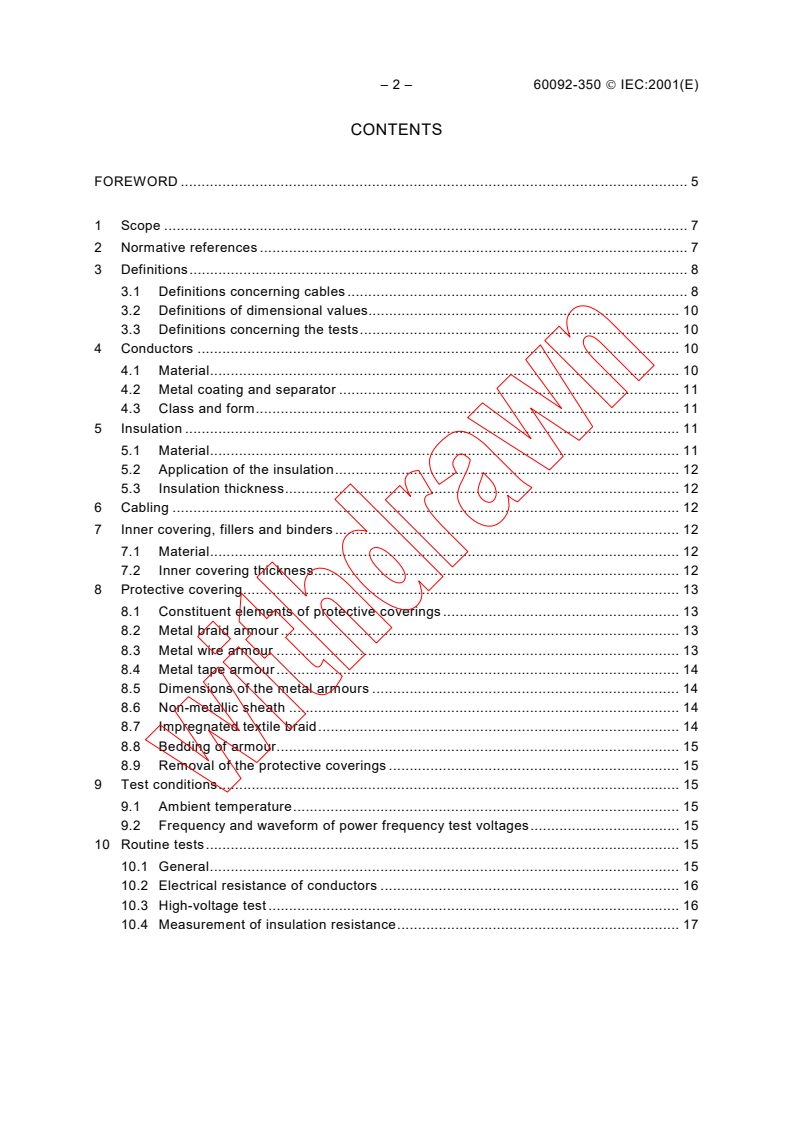
CONTENTS
FOREWORD . 5
1 Scope . 7
2 Normative references . 7
3 Definitions. 8
3.1 Definitions concerning cables . 8
3.2 Definitions of dimensional values. 10
3.3 Definitions concerning the tests. 10
4 Conductors . 10
4.1 Material. 10
4.2 Metal coating and separator . 11
4.3 Class and form. 11
5 Insulation . 11
5.1 Material. 11
5.2 Application of the insulation. 12
5.3 Insulation thickness. 12
6 Cabling . 12
7 Inner covering, fillers and binders . 12
7.1 Material. 12
7.2 Inner covering thickness. 12
8 Protective covering. 13
8.1 Constituent elements of protective coverings . 13
8.2 Metal braid armour . 13
8.3 Metal wire armour . 13
8.4 Metal tape armour . 14
8.5 Dimensions of the metal armours . 14
8.6 Non-metallic sheath . 14
8.7 Impregnated textile braid. 14
8.8 Bedding of armour. 15
8.9 Removal of the protective coverings . 15
9 Test conditions. 15
9.1 Ambient temperature. 15
9.2 Frequency and waveform of power frequency test voltages. 15
10 Routine tests. 15
10.1 General. 15
10.2 Electrical resistance of conductors . 16
10.3 High-voltage test . 16
10.4 Measurement of insulation resistance. 17
60092-350 © IEC:2001(E) – 3 –
11 Special tests . 18
11.1 General. 18
11.2 Frequency of special tests. 18
11.3 Conductor examination. 18
11.4 Measurement of thickness of insulation . 19
11.5 Measurements of thickness of non-metallic sheaths (excluding inner
coverings) . 19
11.6 Dimensions of armourings. 20
11.7 Measurement of external diameter . 20
11.8 Hot-set test for insulation and for sheaths . 20
11.9 Test for the behaviour at low temperature of PVC insulation and PVC, SHF 1
and SHF 2 sheaths. 20
11.10 Watertightness test . 20
11.11 Test of the metal coating of copper wires. 21
11.12 Galvanizing test. 21
12 Type tests, electrical . 21
12.1 General. 21
12.2 Insulation resistance measurement . 21
12.3 Increase in a.c. capacitance after immersion in water . 22
12.4 High-voltage test for 4 h . 23
13 Type tests, non-electrical . 23
13.1 Measurement of thickness of insulation . 23
13.2 Measurement of thickness of non-metallic sheaths (excluding inner coverings). 24
13.3 Tests for determining the mechanical properties of insulation before and after
ageing. 24
13.4 Tests for determining the mechanical properties of sheaths before and after
ageing. 24
13.5 Additional ageing test on pieces of completed cables (compatibility test). 25
13.6 Loss of mass test on PVC insulation and sheaths . 25
13.7 Test for the behaviour at high temperature of PVC insulation and PVC and
SHF 1 sheaths (pressure test). 26
13.8 Test for the behaviour at low temperature of PVC insulation and PVC, SHF 1
and SHF 2 sheaths. 26
13.9 Test for resistance to cracking of PVC insulation and PVC and SHF 1 sheaths
(heat shock test) . 26
13.10 Ozone resistance test for insulation and for sheaths . 26
13.11 Hot-set test for insulations and for sheaths . 26
13.12 Oil immersion test for elastomeric sheaths. 27
13.13 Flame retardance test. 27
13.14 Test for fire-proof or fire-resisting cables . 27
13.15 Determination of hardness for HEPR and HF HEPR insulations. 27
13.16 Determination of elastic modulus for HEPR and HF HEPR insulation. 27
13.17 Determination of degree of acidity of gases evolved during the combustion
of insulating materials by measuring pH and conductivity . 27
13.18 Determination of the amount of halogen acid gas for sheathing materials. 27
– 4 – 60092-350 IEC:2001(E)
Annex A (normative) The fictitious calculation method for determination of dimensions
of protective coverings. 30
Annex B (normative) Rounding of numbers . 35
Annex C (Informative) Calculation of the lower and upper limits for the average outer
dimensions of cables with circular copper conductors . 36
Annex D (normative) Procedure for checking the efficacy of the spark testing method . 40
Annex E (normative) Test of the metal coating of copper wires. 42
Annex F (normative) Galvanizing test for steel wires . 43
Bibliography . 44
60092-350 © IEC:2001(E) – 5 –
INTERNATIONAL ELECTROTECHNICAL COMMISSION
____________
ELECTRICAL INSTALLATIONS IN SHIPS –
Part 350: Shipboard power cables –
General construction and test requirements
FOREWORD
1) The IEC (International Electrotechnical Commission) is a worldwide organization for standardization comprising
all national electrotechnical committees (IEC National Committees). The object of the IEC is to promote
international co-operation on all questions concerning standardization in the electrical and electronic fields. To
this end and in addition to other activities, the IEC publishes International Standards. Their preparation is
entrusted to technical committees; any IEC National Committee interested in the subject dealt with may
participate in this preparatory work. International, governmental and non-governmental organizations liaising
with the IEC also participate in this preparation. The IEC collaborates closely with the International Organization
for Standardization (ISO) in accordance with conditions determined by agreement between the two
organizations.
2) The formal decisions or agreements of the IEC on technical matters express, as nearly as possible, an
international consensus of opinion on the relevant subjects since each technical committee has representation
from all interested National Committees.
3) The documents produced have the form of recommendations for international use and are published in the form
of standards, technical specifications, technical reports or guides and they are accepted by the National
Committees in that sense.
4) In order to promote international unification, IEC National Committees undertake to apply IEC International
Standards transparently to the maximum extent possible in their national and regional standards. Any
divergence between the IEC Standard and the corresponding national or regional standard shall be clearly
indicated in the latter.
5) The IEC provides no marking procedure to indicate its approval and cannot be rendered responsible for any
equipment declared to be in conformity with one of its standards.
6) Attention is drawn to the possibility that some of the elements of this International Standard may be the subject
of patent rights. The IEC shall not be held responsible for identifying any or all such patent rights.
International Standard IEC 60092-350 has been prepared by subcommittee 18A: Cables and
cable installations, of IEC technical committee 18: Electrical installations of ships and of mobile
and fixed offshore units.
This second edition cancels and replaces the first edition published in 1988, Amendment 1
(1994) and Amendment 2 (1999), and constitutes a technical revision.
The text of this standard is based on the following documents:
FDIS Report on voting
18A/206/FDIS 18A/213/RVD
Full information on the voting for the approval of this standard can be found in the report on
voting indicated in the above table.
This publication has been drafted in accordance with the ISO/IEC Directives, Part 3.
Annexes A, B, D, E and F form an integral part of this standard.
Annex C is for information only.
– 6 – 60092-350 IEC:2001(E)
This standard forms a part of IEC 60092 Electrical installations in ships.
The committee has decided that the contents of this publication will remain unchanged until
2004. At this date, the publication will be:
• reconfirmed;
• withdrawn;
• replaced by a revised edition, or
• amended.
60092-350 © IEC:2001(E) – 7 –
ELECTRICAL INSTALLATIONS IN SHIPS –
Part 350: Shipboard power cables –
General construction and test requirements
1 Scope
This part of IEC 60092 specifies the general constructional requirements and general test
recommendations for shipboard cables with copper conductors intended for power systems at
voltages up to and including 8,7/15 kV.
2 Normative references
The following normative documents contain provisions which, through reference in this text,
constitute provisions of this part of IEC 60092. For dated references, subsequent amendments
to, or revisions of, any of these publications do not apply. However, parties to agreements
based on this part of IEC 60092 are encouraged to investigate the possibility of applying the
most recent editions of the normative documents indicated below. For undated references, the
latest edition of the normative document referred to applies. Members of IEC and ISO maintain
registers of currently valid International Standards.
IEC 60092-351, Electrical installations in ships – Part 351: Insulating materials for shipboard
and mobile and fixed offshore units power, telecommunication and control data cables
IEC 60092-359, Electrical installations in ships – Part 359: Sheathing materials for shipboard
power and telecommunication cables
IEC 60228, Conductors of insulated cables
IEC 60331 (all parts), Tests for electric cables under fire conditions – Circuit integrity
IEC 60332-3, Tests on electric cables under fire conditions – Part 3: Tests on bunched wires or
cables
IEC 60811-1-1, Common test methods for insulating and sheathing materials of electric cables –
Part 1: Methods for general application – Section 1: Measurement of thickness and overall
dimensions – Tests for determining the mechanical properties
IEC 60811-1-2, Common test methods for insulating and sheathing materials of electric cables –
Part 1: Methods for general application – Section Two: Thermal ageing methods
IEC 60811-1-4, Common test methods for insulating and sheathing materials of electric cables –
Part 1: Methods for general application – Section Four: Tests at low temperature
IEC 60811-2-1, Insulating and sheathing materials of electric and optical cables – Common test
methods – Part 2-1: Methods specific to elastomeric compounds – Ozone resistance, hot set and
mineral oil immersion tests
IEC 60811-3-1, Common test methods for insulating and sheathing materials of electric cables –
Part 3: Methods specific to PVC compounds – Section One: Pressure test at high temperature –
Tests for resistance to cracking
– 8 – 60092-350 IEC:2001(E)
IEC 60811-3-2, Common test methods for insulating and sheathing materials of electric cables –
Part 3: Methods specific to PVC compounds – Section Two: Loss of mass test – Thermal
stability test
IEC 60754-1, Test on gases evolved during combustion of materials from cables – Part 1:
Determination of the amount of halogen acid gas
IEC 60754-2, Test on gases evolved during combustion of electric cables – Part 2: Determination
of degree of acidity of gases evolved during the combustion of materials taken from electric
cables by measuring pH and conductivity
3 Definitions
For the purpose of this standard, the following definitions apply.
3.1 Definitions concerning cables
3.1.1
insulated cable
assembly consisting of
– one or more cores;
– individual covering(s) (if any);
– assembly protection (if any);
– protective covering(s) (if any).
Additional uninsulated conductor(s) may be included in the cable
3.1.2
radial field cable
cable in which each core is covered with an individual screen
3.1.3
screen
conducting layer(s) having the function of control of the electric field within the insulation. It
may also provide smooth surfaces at the boundaries of the insulation and assist in the
elimination of spaces at these boundaries
3.1.4
conductor
part of the cable which has the specific function of carrying current
3.1.5
stranded conductor
conductor consisting of a number of individual wires, all or the major part of which should have
a helical form
NOTE The stranded conductor may be circular or shaped.
3.1.6
core
assembly comprising a conductor and its own insulation
3.1.7
core screen
electric screen of non-metallic and/or metallic materials covering the insulation
60092-350 © IEC:2001(E) – 9 –
3.1.8
shield
surrounding earthed metallic layer to confine the electric field within the cable and/or to protect
the cable from external electric influence
3.1.9
flexible cable
cable which is required to be capable of being flexed while in service, and of which the
structure and materials are such as to fulfil this requirement
3.1.10
cord
flexible cable with a limited number of conductors of small cross-sectional area
3.1.11
length of lay
axial length of one complete turn of the helix formed by one of the cable components
3.1.12
separator
thin layer, used as a barrier to prevent mutually detrimental effects between different
components of a cable, for example between conductor and insulation or between insulation
and sheath
3.1.13
filler
material used to fill the interstices between the cores of a multiconductor cable
3.1.14
inner covering
non-metallic covering which surrounds the assembly of the cores (and fillers, if any) of a
multicore cable and over which the protective covering is applied
3.1.15
sheath
uniform and continuous tubular covering consisting of non-metallic material, generally extruded
3.1.16
oversheath
non-metallic sheath applied over a metallic covering, constituting the outermost sheath of the
cable
3.1.17
armour
covering consisting of metal tape(s) or wires, generally used to protect the cable from external
mechanical effects
3.1.18
braid
covering made of plaited metallic or non-metallic material
– 10 – 60092-350 IEC:2001(E)
3.2 Definitions of dimensional values
3.2.1
nominal value
value by which a quantity is designated and which is often used in tables. Usually, nominal
values give rise to values to be checked by measurements, taking into account specified
tolerances
3.2.2
approximate value
value which is neither guaranteed nor checked; it is used, for example, for the calculation of
other dimensional values
3.2.3
median value
when several results have been obtained and ordered in increasing (or decreasing)
succession, the median value is the middle value if the number of available values is odd, and
the mean of the two middle values if the number is even
3.2.4
fictitious value
value calculated according to the "fictitious method" described in annex A
3.3 Definitions concerning the tests
3.3.1
routine tests
routine tests are tests made on all finished cable lengths to demonstrate the integrity of the
cable
NOTE By agreement between purchaser, manufacturer and, when involved, approval organization (making
reference, for example, to results of quality control procedures), the number of lengths of finished cable on which
these tests should be carried out may be reduced.
3.3.2
special tests
tests made by the manufacturer on samples of completed cable or components taken from a
completed cable, at a specified frequency, so as to verify that the finished product meets the
design specifications
3.3.3
type tests
tests required to be made by a manufacturer before supplying on a general commercial basis a
type of cable covered by this standard, in order to demonstrate satisfactory performance
characteristics to meet the intended application. These tests are of such a nature that, after
they have been made, they need not be repeated unless changes are made in the cable
materials or design which might change the performance characteristics
4 Conductors
4.1 Material
The conductors shall consist of plain or metal-coated annealed copper.
60092-350 © IEC:2001(E) – 11 –
4.2 Metal coating and separator
The component copper wires shall be metal-coated when used for conductors having a
thermosetting insulation, unless a separator between the conductor and the insulation is
provided. For conductors having thermoplastic insulation, the metal coating may be omitted.
The same applies to thermosetting insulation provided suitable type tests demonstrate that no
harmful effects occur.
The metal coating shall be considered as satisfactory if, on visual inspection, the wire surface
appears smooth, uniform and bright, and the insulation does not adhere to the conductor.
If a chemical test is required it shall be carried out with the methods and requirements
specified in annex E.
4.3 Class and form
The conductors considered in this standard are intended only for fixed installations and shall
comply with class 2 or class 5 of IEC 60228.
NOTE 1 In these applications the class 5 conductors are used only to facilitate easier installation and termination
under certain circumstances. Cables with such class 5 conductors should not be regarded as flexible cables.
NOTE 2 When using cables with class 5 conductors, users should carefully check the applicable current rating,
which may be lower than for cables with the same cross-sectional area of class 2 conductors.
Stranded circular non-compacted or compacted and sector-shaped conductors are permitted
for class 2.
The nominal cross-sectional area of the conductors shall have one of the values specified in
table II or table III of IEC 60228, with the following limitations:
– for all types of conductors, the nominal cross-sectional area shall not exceed, in general,
630 mm .
NOTE 3 For any cable requiring larger conductors, these should comply with the requirement for class 2 or class 5
of IEC 60228.
Circular non-compacted class 2 and flexible class 5 conductors should be not less than 1 mm
nominal cross-sectional area.
Circular compacted class 2 conductors should be not less than 10 mm nominal cross-
sectional area. (Cross-sectional areas less than 10 mm are under consideration.)
NOTE 4 Sector-shaped conductors should be not less than 25 mm nominal cross-sectional area.
NOTE 5 Conductors for cables suitable for portable use in ships are under consideration.
– All conductors shall have a regular shape, and shall be free from sharp projections and
other defects liable to damage the insulation.
Compliance with these requirements is checked by the appropriate test requirements specified
in clauses 8 to 12 of this standard.
5 Insulation
5.1 Material
The insulation shall consist of one of the insulating compounds considered in IEC 60092-351.
– 12 – 60092-350 IEC:2001(E)
5.2 Application of the insulation
The insulation shall be extruded closely to the conductor or to the separator, if any.
It shall be possible to remove the insulation without damaging the conductor or the metal
coating, if any.
5.3 Insulation thickness
The insulation thicknesses are specified for each type of cable in the relevant standard.
The average thickness of the insulation shall be not less than the value specified for each type
of insulation and conductor cross-section.
The thickness at any point may be less than the specified value provided that the difference
does not exceed 0,1 mm + 10 % of the specified value.
6 Cabling
The cores of a multicore cable shall be laid up. The use of fillers is permitted in the assembly
of multicore cables.
7 Inner covering, fillers and binders
7.1 Material
The inner covering, if any, may be extruded or lapped, as specified in the relevant standard of
the cable.
The inner covering, fillers and binders, if any, shall be of non-hygroscopic suitable material,
capable of withstanding the temperature arising when the conductors are operating at their
maximum rated temperature, and compatible with the insulating material.
An open helix of suitable tape is permitted as a binder before application of an extruded inner
covering. The thickness of the binder tape shall be optional.
When rubberlike or plastic inner coverings or fillers are specified, they should consist of rubber
(including regenerated and/or non-vulcanized rubber) or plastic compounds, and shall be
resistant to moisture. When a non-metallic sheath is applied directly over the inner covering or
the fillers, it may (at manufacturer's option) substitute partially or totally for the inner covering
or fillers.
When a "watertight cable" is specified, the spaces among cores and sheath and the interstices
in the conductor strands shall be filled so as to obtain a continuous sealing all along the cable,
which shall comply with the watertightness test specified in 11.10.
7.2 Inner covering thickness
The approximate thickness of the extruded or lapped inner coverings, if any, is specified in the
relevant standard for the cable.
60092-350 © IEC:2001(E) – 13 –
8 Protective covering
8.1 Constituent elements of protective coverings
The protective covering of any cable consists of one or more "constituent elements" which shall
be specified by the relevant standard for the cable. The following types of "constituent
elements" are considered in this standard:
a) Metallic elements:
1) metal braid armour;
2) metal wire armour;
3) metal tape armour.
b) Non-metallic elements:
1) thermosetting or thermoplastic sheath;
2) impregnated fibrous braid;
3) bedding for metal armour;
4) paint for metal armour.
8.2 Metal braid armour
The standard type of braid armour shall be made of zinc-coated (galvanized) steel wires
complying with the galvanizing test specified in 11.12 and annex F, or copper, tinned copper or
copper-alloy wires. On special request, the braid may be formed of aluminium-alloy wires with
protection against corrosion.
The "coverage density" of the braid shall be such that the weight of the braid is at least 90 % of
the weight of a tube of the same metal, having an internal diameter equal to the calculated
internal diameter under the braid and a thickness equal to the nominal diameter of the wires
forming the braid.
The diameter under the braid is calculated with the fictitious method given in annexes A and B.
(For test method, see item b) of 11.6.)
NOTE An alternative method for evaluating the "coverage density" is given by the following formula giving the
"filling factor", F, per unit:
NPd
F =
sin α
where
α is the slope angle between the cable axis and the braid wires;
d is the diameter of braid wire
N is the number of wires per carrier
P is the number of picks per millimetre.
The corresponding "coverage density", expressed as a percentage, is given by the formula:
π
G = ⋅ F ⋅ 100
G F
To obtain the minimum value of (90 %) the minimum value of should be: 0,573.
8.3 Metal wire armour
The standard type of metal wire armour shall consist of zinc-coated mild steel wires having an
elongation at break of at least 12 % and complying with the galvanized test specified in 11.12
and annex F.
– 14 – 60092-350 IEC:2001(E)
On special request, wires may be of a non-magnetic material instead of steel.
Also on special request, and where the diameter under armour is greater than 15 mm, a flat
wire armour may be used.
The wires should be applied over the bedding so as to form a uniform and substantially
uninterrupted cylindrical layer and so as to ensure sufficient flexibility for the finished cable.
8.4 Metal tape armour
The standard type of metal tape armour shall be made of annealed steel tapes which, on
special request, may be galvanized. Tapes of non-magnetic metals (for instance copper- or
aluminium-alloys) may be used, on special request, in place of steel tapes.
NOTE The risk of corrosion shall be considered when using aluminium alloys.
The armour shall, in general, be formed of two tapes wound over the bedding in the same
direction so that the gap in the first layer is not more than one-half of the tape width, and the
second layer covers this gap with an overlap.
Particular types of metal tape armour (for instance consisting of one tape) may be permitted,
provided their mechanical characteristics are specified.
For cables whose diameter under the bedding is less than 10 mm, the use of a metal type
armour is not recommended.
8.5 Dimensions of the metal armours
For the purposes of this standard, when wire diameters, tape thicknesses and other similar
armouring dimensions are specified, they shall be understood as nominal values, complying
with 11.6.
8.6 Non-metallic sheath
8.6.1 Material
The sheath shall consist of one of the sheathing compounds considered in IEC 60092-359. The
quality of the sheathing material shall be suitable for the operating temperature of the cable.
8.6.2 Thickness of sheath
The thicknesses of the sheaths are specified in the relevant standard for each type of cable.
The average value of the sheath thickness shall be not less than the specified value.
The thickness at any point may be less than the specified value but shall not fall below 85 % of
the specified nominal thickness by more than 0,1 mm for sheaths applied on a smooth
cylindrical surface, or below 80 % of the specified nominal thickness by more than 0,2 mm for
sheaths applied on an irregular cylindrical surface.
8.7 Impregnated textile braid
The textile braid, if permitted, shall be of cotton, hemp, glass, or synthetic or other equivalent
textile fibre.
It shall be effectively impregnated with a compound which is resistant to moisture and free from
deleterious action upon the various materials constituting the cable.
60092-350 © IEC:2001(E) – 15 –
8.8 Bedding of armour
When tapes are used as a bedding, they shall be wound in such a manner that each tape
covers the gap (if any) between the adjacent edges. Woven tapes (for instance cotton or glass
tapes) should be saturated or coated with a moisture-resistant compound.
Synthetic tapes (for instance PVC tapes) do not need coating.
When fibrous rovings are used (for instance jute or glass rovings), they shall be wound in close
spirals and be saturated and filled with a moisture-resistant compound.
When a fibrous braid is used as a bedding, it shall comply with 8.7.
When a non-metallic sheath is used as a bedding, it shall comply with 8.6.
The relevant thickness shall be considered as an approximate value.
8.9 Removal of the protective coverings
It shall be possible to remove easily:
– the outer sheath from the metallic covering
and
– the metallic covering from the inner covering or the inner sheath.
9 Test conditions
9.1 Ambient temperature
Unless otherwise specified in the details for a particular test, voltage tests shall be made at an
ambient temperature of (20 ± 15) °C and other tests at an ambient temperature of (20 ± 5) °C.
9.2 Frequency and waveform of power frequency test voltages
The frequency of the alternating test voltages shall be in the range 49 Hz to 61 Hz. The wave-
form shall be substantially sinusoidal. The values quoted are r.m.s. values.
10 Routine tests
10.1 General
The routine tests required by this standard are:
a) measurement of the electrical resistance of conductors (see 10.2);
b) high-voltage test (see 10.3);
c) insulation resistance test (see 10.4).
The routine tests shall normally be carried out in all finished cable lengths, but the number of
lengths may be reduced by agreement between the purchaser, the manufacturer and, when
involved, the approval organization (making reference, for instance, to the results of quality
control procedures).
– 16 – 60092-350 IEC:2001(E)
The routine test may be carried out, at the manufacturer's option, either on delivery lengths or
on manufacturing lengths before they are cut into delivery lengths.
10.2 Electrical resistance of conductors
a) For multicore cables, measurements shall be made on all conductors of each cable length
selected for the routine test.
b) The completed cable length, or a sample therefrom, shall be in the test room, which shall
be maintained at a reasonably constant temperature for at least 12 h before the test. If it is
doubtful whether the conductor temperature is the same as the room temperature, the
resistance shall be measured after the cable has been in the test room for 24 h.
Alternatively, the resistance shall be measured on a sample of conductor conditioned for at
least 1 h in a temperature-controlled bath.
The measured value of resistance shall be corrected to a temperature of 20 °C and 1 km
length in accordance with the formulae and factors given in clause 6 of IEC 60228.
c) The d.c. resistance of each conductor at 20 °C shall not exceed the appropriate maximum
value specified in table II for class 2 and table III for class 5 of IEC 60228.
10.3 High-voltage test
a) The high-voltage test shall be made at ambient temperature using, at the manufacturer's
option, alternating voltage at power frequency, direct voltage or, for spark testing, high-
frequency or other forms of voltage.
b) Single-core cables without metallic covering shall be immersed in water at room
temperature for 1 h and the test voltage then applied for 5 min between the conductor and
the water.
Alternatively for single-core cycles without sheath, at manufacturer's option, a spark test
shall be carried out on the cable. The spark test equipment shall detect a puncture in the
insulation having a diameter equal to or greater than half of the specified insulation
thickness. The recovery time of the spark shall be not greater than 1 s. The magnitude and
the presence of the voltage shall be such that with the electrode system employed and at
the speed employed for the passage of the cable through the spark tester, the test
requirements are effectively met. The reference method to be used to establish the efficacy
of the spark testing equipment is given in annex D.
c) For multicore cables and single-core cycles with metallic covering, the test voltage shall be
applied for 5 min in succession between each insulated conductor and all the other ones
connected to earth and to the metallic covering, if any. The conductors may be suitably
connected for successive applications of the test voltage to limit the total testing time,
provided that the sequence of connections ensures that the voltage is applied for at least
5 min without interruption between each conductor and the other conductors and between
each conductor and the metallic covering, if any.
d) Unless otherwise stated in the relevant standard for the cable, the values of the test voltage
for the standard rated voltages are given in the following table 1:
60092-350 © IEC:2001(E) – 17 –
Table 1 – Test voltage
Rated voltage of cable Test voltage for 5 min
U /U Alternating current (a.c.) Direct current (d.c.)
o
kV kV kV
Up to and including 0,15 / 0,25 1,5 3,6
Up to and including 0,6 / 1,0 3,5 8,4
Up to and including 1,8 / 3 6,5 15,6
Up to and including 3,6 / 6 11 26,4
Up to and including 6 / 10 15 36
Up to and including 8,7 / 15 22 52,8
e) The test voltage shall be increased gradually to the specified value and no breakdown of
the insulation shall occur.
10.4 Measurement of insulation resistance
a) The insulation resistance shall be measured at ambient temperature using a d.c. voltage of
80 V to 500 V, after the high-voltage test has been carried out.
b) The measurement shall in general be effected 1 min after application of the voltage. In
certain cases, however, in order to reach a substantial steady-state condition, the time of
application may be prolonged up to a maximum of 5 min.
c) The connection procedure in carrying out the test on different types of cables shall be as
follows:
– for single-core cables with metallic covering, the insulation resistance measurement
shall be performed between the conductor and the metallic covering;
– for single-core cables without metallic covering, the insulation resistance measurement
shall be performed between the conductor and the water in which the cable shall be
immersed at least 1 h before the test;
– for cables having two to five conductors, with or without metallic covering, the insulation
resistance measurement shall be performed in turn between each conductor and all
other conductors connected together and to the metallic covering, if any;
– for cables having more than five conductors, the insulation resistance measurement test
shall be performed: first, between all conductors of uneven number in all layers and all
conductors of even number in all layers; second, between all conductors of even layers
and all conductors of uneven layers; third, if necessary, between the first and the last
conductor of each layer having an uneven number of conductors.
d) The measurement values of the insulation resistance shall be corrected to the reference
temperature of 20 °C by using an appropriate temperature correction factor based on
experimental results obtained on the insulation material concerned.
e) The insulation resistance constant K shall be calculated using the formula:
i
−9
"R × 10
K = MΩ⋅km
i
D
log
d
where
R is the measured insulation resistance, in ohms, corrected to 20 °C;
" is the length of the cable, in metres;
D is the outer diameter of the insulation, in millimetres;
d is the inner diameter of the insulation, in millimetres.
– 18 – 60092-350 IEC:2001(E)
The calculated value of K shall be not less than the value specified for the relevant insulating
i
material in table 2 of IEC 60092-351.
NOTE For the core of shaped conductors, the ratio D/d is the ratio of the perimeter over the insulation to the
perimeter over the conductors.
11 Special tests
11.1 General
The special tests required by this standard are:
a) conductor examination (see 11.3);
b) check of dimensions (see 11.4 and 11.7);
c) Hot-set test for insulation and for sheaths: see tables 2 and 3 for applicability of
compounds in the test method (see 11.8);
d) test at low temperature for PVC (see 11.9);
e) watertightness test (see 11.10);
f) test of the metal coating of copper wires (see 11.11);
g) galvanizing test (see 11.12).
11.2 Frequency of special tests
a) Conductor examination and check of dimensions
Conductor examination, measurement of the thickness of insulation and sheath and
measurement of the overall diameter, if required by the purchaser, shall be made on one
length from each manufacturing series of the same type and size of cable, but shall be
limited to not more than 10 % of the number of lengths in any one contract.
b) Electrical and physical tests
By agreement between the purchaser and manufacturer, the test specified shall be made
on samples taken from ca
...