

IEC TR 62936:2016
(Main)Test method development - Guidelines for substance selection
General Information
- Abstract
IEC TR 62936:2016(E) provides guidelines for the selection of substances for the development of test method standards. The substances and substance groups listed in the IEC 62474 database are the primary source of candidate substances. Other substances that are under regulatory roadmap and market requirements can also be considered for this filtering and selection process.
- Status
- Published
- Publication Date
- 07-Nov-2016
- Technical Committee
- TC 111 - Environmental standardization for electrical and electronic products and systems
- Drafting Committee
- WG 3 - TC 111/WG 3
- Current Stage
- PPUB - Publication issued
- Start Date
- 08-Nov-2016
- Completion Date
- 15-Jan-2017
Overview
IEC TR 62936:2016 - Test method development: Guidelines for substance selection - is an IEC Technical Report providing a structured process to filter, prioritize and select chemical substances for the development of test method standards. Targeted at electrotechnical products, the report uses the IEC 62474 database as the primary source of candidate substances while also allowing inclusion of substances on regulatory roadmaps or driven by market requirements (e.g., EPEAT, Energy Star, Low Halogen). The document helps standards developers focus limited resources on the “critical few” substances that most urgently need validated test methods.
Key Topics
- Scope and purpose: Guidance for selecting substances to be addressed by standardized test methods for electrical and electronic equipment (EEE).
- Source lists: Primary use of the IEC 62474 material-declaration database; allowance for other regulatory or market-driven candidate substances.
- Process flow: A logical screening and selection workflow (initial candidate list → filtering → prioritization → final selection).
- Substance filtering criteria (illustrative and used in scoring):
- Presence in final EEE product
- Regulatory or market requirements
- Regional and regulatory impact (e.g., RoHS, REACH, SVHC, CMR listings)
- Whether the substance is intentionally added
- Strategic considerations (market access, industry initiatives)
- Need and feasibility for test method development
- Consideration of existing standards: Assessment of whether related standards or validated methods already exist (e.g., IEC 62321 series) before initiating new method development.
- Final selection and pilot studies: Use of judgment and supplemental criteria to finalize substances for development; the report includes pilot study examples (e.g., RoHS II priority substances).
Applications
Who uses IEC TR 62936:2016 and why:
- Standards development organizations (SDOs) - to prioritize which substances need standardized test methods.
- Test laboratories and method developers - to identify candidate analytes and plan method validation efforts.
- Manufacturers of EEE - to anticipate future testing and compliance obligations and guide material declarations.
- Regulators and conformity assessment bodies - to understand priority-setting logic for test-method standardization.
- Environmental and compliance teams - for strategic planning around substance reporting and market access.
Related Standards
- IEC 62474:2012 - Material declaration for electrotechnical industry (primary substance database referenced).
- IEC 62321 (all parts) - Test methods for determinating regulated substances in EEE (often assessed before new method development).
This TR is a practical, evidence-based tool for prioritizing substance-focused test-method work to support regulatory compliance, market requirements and consistent conformity assessment across the electrotechnical sector.
Get Certified
Connect with accredited certification bodies for this standard

BSI Group
BSI (British Standards Institution) is the business standards company that helps organizations make excellence a habit.

Bureau Veritas
Bureau Veritas is a world leader in laboratory testing, inspection and certification services.

DNV
DNV is an independent assurance and risk management provider.
Sponsored listings
Frequently Asked Questions
IEC TR 62936:2016 is a technical report published by the International Electrotechnical Commission (IEC). Its full title is "Test method development - Guidelines for substance selection". This standard covers: IEC TR 62936:2016(E) provides guidelines for the selection of substances for the development of test method standards. The substances and substance groups listed in the IEC 62474 database are the primary source of candidate substances. Other substances that are under regulatory roadmap and market requirements can also be considered for this filtering and selection process.
IEC TR 62936:2016(E) provides guidelines for the selection of substances for the development of test method standards. The substances and substance groups listed in the IEC 62474 database are the primary source of candidate substances. Other substances that are under regulatory roadmap and market requirements can also be considered for this filtering and selection process.
IEC TR 62936:2016 is classified under the following ICS (International Classification for Standards) categories: 13.020.01 - Environment and environmental protection in general; 19.040 - Environmental testing. The ICS classification helps identify the subject area and facilitates finding related standards.
IEC TR 62936:2016 is available in PDF format for immediate download after purchase. The document can be added to your cart and obtained through the secure checkout process. Digital delivery ensures instant access to the complete standard document.
Standards Content (Sample)
IEC TR 62936 ®
Edition 1.0 2016-11
TECHNICAL
REPORT
Test method development – Guidelines for substance selection
All rights reserved. Unless otherwise specified, no part of this publication may be reproduced or utilized in any form
or by any means, electronic or mechanical, including photocopying and microfilm, without permission in writing from
either IEC or IEC's member National Committee in the country of the requester. If you have any questions about IEC
copyright or have an enquiry about obtaining additional rights to this publication, please contact the address below or
your local IEC member National Committee for further information.
IEC Central Office Tel.: +41 22 919 02 11
3, rue de Varembé Fax: +41 22 919 03 00
CH-1211 Geneva 20 info@iec.ch
Switzerland www.iec.ch
About the IEC
The International Electrotechnical Commission (IEC) is the leading global organization that prepares and publishes
International Standards for all electrical, electronic and related technologies.
About IEC publications
The technical content of IEC publications is kept under constant review by the IEC. Please make sure that you have the
latest edition, a corrigenda or an amendment might have been published.
IEC Catalogue - webstore.iec.ch/catalogue Electropedia - www.electropedia.org
The stand-alone application for consulting the entire The world's leading online dictionary of electronic and
bibliographical information on IEC International Standards, electrical terms containing 20 000 terms and definitions in
Technical Specifications, Technical Reports and other English and French, with equivalent terms in 15 additional
documents. Available for PC, Mac OS, Android Tablets and languages. Also known as the International Electrotechnical
iPad. Vocabulary (IEV) online.
IEC publications search - www.iec.ch/searchpub IEC Glossary - std.iec.ch/glossary
The advanced search enables to find IEC publications by a 65 000 electrotechnical terminology entries in English and
variety of criteria (reference number, text, technical French extracted from the Terms and Definitions clause of
committee,…). It also gives information on projects, replaced IEC publications issued since 2002. Some entries have been
and withdrawn publications. collected from earlier publications of IEC TC 37, 77, 86 and
CISPR.
IEC Just Published - webstore.iec.ch/justpublished
Stay up to date on all new IEC publications. Just Published IEC Customer Service Centre - webstore.iec.ch/csc
details all new publications released. Available online and If you wish to give us your feedback on this publication or
also once a month by email. need further assistance, please contact the Customer Service
Centre: csc@iec.ch.
IEC TR 62936 ®
Edition 1.0 2016-11
TECHNICAL
REPORT
Test method development – Guidelines for substance selection
INTERNATIONAL
ELECTROTECHNICAL
COMMISSION
ICS 13.020.01; 19.040 ISBN 978-2-8322-3695-6
– 2 – IEC TR 62936:2016 © IEC 2016
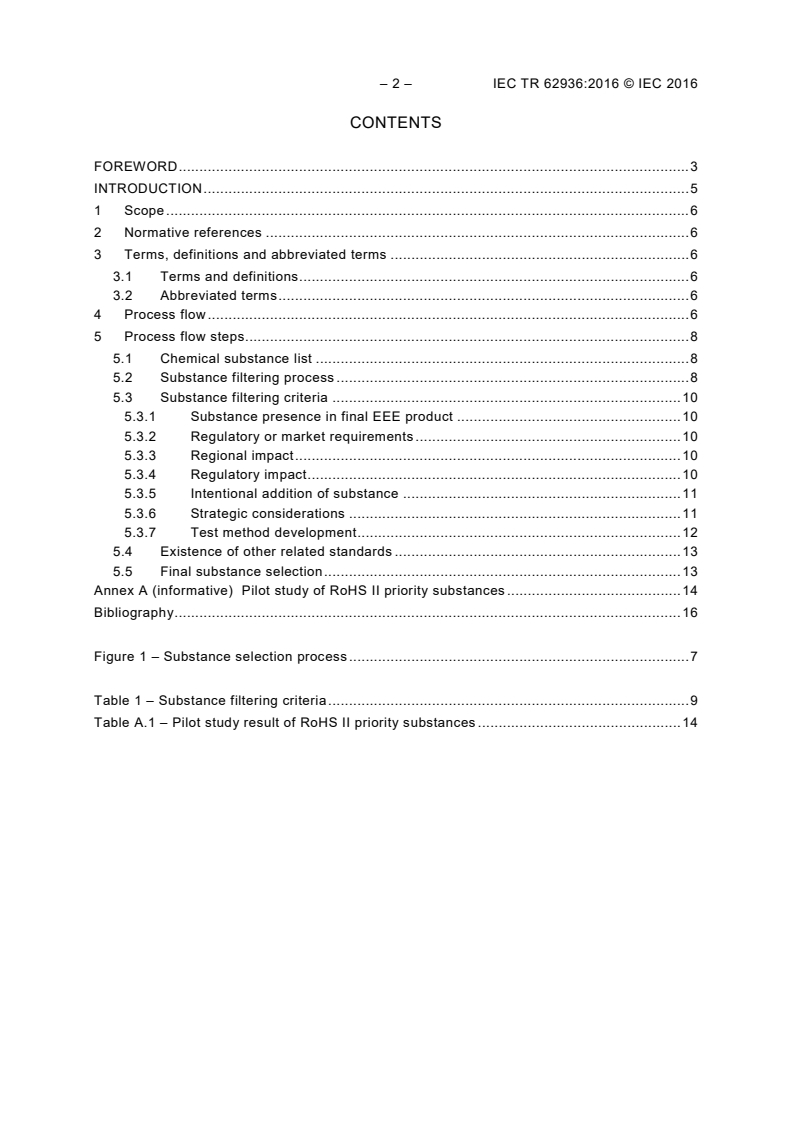
CONTENTS
FOREWORD . 3
INTRODUCTION . 5
1 Scope . 6
2 Normative references . 6
3 Terms, definitions and abbreviated terms . 6
3.1 Terms and definitions . 6
3.2 Abbreviated terms . 6
4 Process flow . 6
5 Process flow steps. 8
5.1 Chemical substance list . 8
5.2 Substance filtering process . 8
5.3 Substance filtering criteria . 10
5.3.1 Substance presence in final EEE product . 10
5.3.2 Regulatory or market requirements . 10
5.3.3 Regional impact . 10
5.3.4 Regulatory impact . 10
5.3.5 Intentional addition of substance . 11
5.3.6 Strategic considerations . 11
5.3.7 Test method development . 12
5.4 Existence of other related standards . 13
5.5 Final substance selection . 13
Annex A (informative) Pilot study of RoHS II priority substances . 14
Bibliography . 16
Figure 1 – Substance selection process . 7
Table 1 – Substance filtering criteria . 9
Table A.1 – Pilot study result of RoHS II priority substances . 14
INTERNATIONAL ELECTROTECHNICAL COMMISSION
____________
TEST METHOD DEVELOPMENT –
GUIDELINES FOR SUBSTANCE SELECTION
FOREWORD
1) The International Electrotechnical Commission (IEC) is a worldwide organization for standardization comprising
all national electrotechnical committees (IEC National Committees). The object of IEC is to promote
international co-operation on all questions concerning standardization in the electrical and electronic fields. To
this end and in addition to other activities, IEC publishes International Standards, Technical Specifications,
Technical Reports, Publicly Available Specifications (PAS) and Guides (hereafter referred to as “IEC
Publication(s)”). Their preparation is entrusted to technical committees; any IEC National Committee interested
in the subject dealt with may participate in this preparatory work. International, governmental and non-
governmental organizations liaising with the IEC also participate in this preparation. IEC collaborates closely
with the International Organization for Standardization (ISO) in accordance with conditions determined by
agreement between the two organizations.
2) The formal decisions or agreements of IEC on technical matters express, as nearly as possible, an international
consensus of opinion on the relevant subjects since each technical committee has representation from all
interested IEC National Committees.
3) IEC Publications have the form of recommendations for international use and are accepted by IEC National
Committees in that sense. While all reasonable efforts are made to ensure that the technical content of IEC
Publications is accurate, IEC cannot be held responsible for the way in which they are used or for any
misinterpretation by any end user.
4) In order to promote international uniformity, IEC National Committees undertake to apply IEC Publications
transparently to the maximum extent possible in their national and regional publications. Any divergence
between any IEC Publication and the corresponding national or regional publication shall be clearly indicated in
the latter.
5) IEC itself does not provide any attestation of conformity. Independent certification bodies provide conformity
assessment services and, in some areas, access to IEC marks of conformity. IEC is not responsible for any
services carried out by independent certification bodies.
6) All users should ensure that they have the latest edition of this publication.
7) No liability shall attach to IEC or its directors, employees, servants or agents including individual experts and
members of its technical committees and IEC National Committees for any personal injury, property damage or
other damage of any nature whatsoever, whether direct or indirect, or for costs (including legal fees) and
expenses arising out of the publication, use of, or reliance upon, this IEC Publication or any other IEC
Publications.
8) Attention is drawn to the Normative references cited in this publication. Use of the referenced publications is
indispensable for the correct application of this publication.
9) Attention is drawn to the possibility that some of the elements of this IEC Publication may be the subject of
patent rights. IEC shall not be held responsible for identifying any or all such patent rights.
The main task of IEC technical committees is to prepare International Standards. However, a
technical committee may propose the publication of a Technical Report when it has collected
data of a different kind from that which is normally published as an International Standard, for
example "state of the art".
IEC TR 62936, which is a Technical Report, has been prepared by IEC technical
committee 111: Environmental standardization for electrical and electronic products and
systems.
The text of this Technical Report is based on the following documents:
Enquiry draft Report on voting
111/410A/DTR 111/441/RVC
Full information on the voting for the approval of this Technical Report can be found in the
report on voting indicated in the above table.
– 4 – IEC TR 62936:2016 © IEC 2016
This document has been drafted in accordance with the ISO/IEC Directives, Part 2.
The committee has decided that the contents of this document will remain unchanged until the
stability date indicated on the IEC website under "http://webstore.iec.ch" in the data related to
the specific document. At this date, the document will be
• reconfirmed,
• withdrawn,
• replaced by a revised edition, or
• amended.
A bilingual version of this publication may be issued at a later date.
INTRODUCTION
The large number of chemical substances currently regulated or under consideration for
regulation necessitates the need for the development of reliable and acceptable test methods
to be used as one approach for conformity assessment. For conformance demonstration, it is
vital that interested parties agree that a particular test method is technically correct (i.e.
provide reliable analytical results), is appropriate for the samples to be analysed, tested and
vetted by technical experts, and is unbiased in its application. These criteria are generally
fulfilled by test methods that are developed and published by a standards development
organization (SDO) (e.g. IEC, ISO). Because of limited resources and the length of time
needed to develop and validate these procedures, only a limited number of substances can be
addressed at any given time for test method development.
This document provides a process for logically filtering, prioritizing and selecting candidate
substances for development of test method standards. The objective of the filtering process is
to partition the list of candidate substances into groups based on relative importance. Given
that this document is intended for electrotechnical products, the candidate substances are
largely drawn, but not exclusively, from the substance lists recorded in the IEC 62474
database [1] on material declaration. The substances listed in the database are grouped into
3 categories with brief descriptions given below:
• IEC Criteria 1 – “currently regulated” or “explicitly included within an existing national law
or regulation in an IEC member country”. The law or regulation is applicable to
electrotechnical products and goes into force at a specific date.
• IEC Criteria 2 – “for assessment” or substance or substance group that meets criteria 1
with the exception that the law or regulation does not cite a specific effective date for the
requirements.
• IEC Criteria 3 – “for information only” or does not meet requirement for either criteria 1 or
2. However, “there is a recognized industry-wide common market requirement for reporting
this substance or substance group in electrotechnical products”.
NOTE Criterion/criteria is used in this document to denote a rule/principle for evaluating a substance against a
set of requirements. The use of the term IEC criteria is specific to the regulatory status of a particular substance as
defined in the IEC 62474 standard.
In addition to those substances that are under regulatory scrutiny, market requirements may
also be of major consideration for the development of IEC test method standards. There are
several very important influences that may dictate the ability of a product to enter or be
introduced into the marketplace. Examples of market driven requirements may include ®
EPEAT (Electronic Product Environment Assessment Tool), Low Halogen initiative set by the ®
electronics industry, Energy Star for energy efficient products and others. Although there
are no legal obligations that electrotechnical equipment meet the requirements set forth in
these initiatives, failure to do so may put the supplier at a severe competitive disadvantage. In
many cases, the supplier’s product may be disqualified for purchasing consideration for failure
to meet these requirements.
The filtering process is intended to screen out the majority of substances for consideration
leaving only the “critical few” substances for further consideration. Due to the rapidly changing
regulatory environment, the criteria used for filtering may or may not be the most appropriate
for the substances under consideration. Thus, some judgement needs to be exercised in
interpreting the resulting scores. The final selection process is intended to allow the
consideration of additional requirements or criteria that are not captured in the initial filtering
process. Subjective criteria (relative importance is not measureable) may also be introduced.
No attempt has been made to try to define the criteria in the final selection process given the
changing requirements in both the regulatory and market environments.
___________
Numbers in square brackets refer to the bibliography.
EPEAT and Energy Star are registered trademarks. This information is given for the convenience of users of
this document and does not constitute an endorsement by IEC of these registered trademarks.
– 6 – IEC TR 62936:2016 © IEC 2016
TEST METHOD DEVELOPMENT –
GUIDELINES FOR SUBSTANCE SELECTION
1 Scope
This document provides guidelines for the selection of substances for the development of test
method standards. The substances and substance groups listed in the IEC 62474 database
are the primary source of candidate substances. Other substances that are under regulatory
roadmap and market requirements can also be considered for this filtering and selection
process.
2 Normative references
The following documents are referred to in the text in such a way that some or all of their
content constitutes requirements of this document. For dated references, only the edition
cited applies. For undated references, the latest edition of the referenced document (including
any amendments) applies.
IEC 62474:2012, Material declaration for products of and for the electrotechnical industry
3 Terms, definitions and abbreviated terms
3.1 Terms and definitions
No terms and definitions are listed in this document.
ISO and IEC maintain terminological databases for use in standardization at the following
addresses:
• IEC Electropedia: available at http://www.electropedia.org/
• ISO Online browsing platform: available at http://www.iso.org/obp
3.2 Abbreviated terms
CMR carcinogenic, mutagenic or toxic to reproduction
CoRAP community rolling action plan
EEE electrical and electronic equipment
REACH registration, evaluation, authorization and restriction of chemicals
RoHS restriction of hazardous substances
SDO standards development organization
SIN substitute it now
SVHC substances of very high concern
4 Process flow
Substances that are contained in the IEC 62474 database have undergone technical scrutiny
to determine applicability to electrotechnical products. This vetting process provides an
effective first screen to narrow down the potential number of substances that may be
considered for test method development within IEC. Specifically, these substances have been
evaluated by technical experts to be used in electrical and electronic equipment (EEE)
products. This type of assessment will need to be performed for substances that are not
contained in the IEC 62474 database. A conceptual flow for the general substance selection
decision making process is given in Figure 1.
Initial list of
candidate
substances
Do not
Is the substance
No
consider –
expected to be present
Done
in EEE products?
Yes
Substance
Fail
filtering
process
Done or
liaise with
SDO
Pass Yes
Applicable
Low priority: Yes
Existence of other
to electrotechnical
hold for future
related standards?
products?
consideration
No
No
Final
Fail
substance
selection
Pass
Develop
screening method
and/or
quantitative analysis
IEC 62321
(all parts)[2]
IEC
Figure 1 – Substance selection process
– 8 – IEC TR 62936:2016 © IEC 2016
5 Process flow steps
5.1 Chemical substance list
Substances under consideration for test method development are found in the IEC 62474
materials declaration database and other readily available sources. The IEC 62474 database
is generally the initial source of information since it provides a vetted and frequently updated
list of substances that is under scrutiny by either having regulatory obligations associated with
them or potentially will be in the future. Given the large number of substances either being
regulated or under consideration for regulation, this database provides an effective screening
of substances present in electrotechnical products. The IEC 62474 validation team is
responsible for maintenance of the materials declaration database.
5.2 Substance filtering process
Given the large number of substances that are potential candidates for test method
development, a systematic approach is needed for reducing the number of candidates for
consideration before final selection. This can be accomplished by employing a filtering
process. The basis of the filtering process is to apply a set of criteria that defines the
timeliness and impact for test method development for a particular substance. Important
categories for the filtering criteria include:
• presence of substance in the final product;
• regulatory or market requirements;
• regional impact;
• regulatory impact;
• intentional addition of substance;
• strategic or future impact;
• test method development.
Table 1 details the criteria and associated weighting factors to be used in the filtering process.
Note that the criteria pertaining to “regulatory or market requirements” and “regulatory impact”
are assigned scores based on the information used by the IEC 62474 validation team for
assessing which substances are added to the database. For substances not listed in the
database a similar assessment will need to be performed. The list of criteria and its relative
weighting will be revised annually since the regulatory environment is dynamic. The weighting
factors used are adopted from the Quality Function Deployment/Six Sigma methodology [3],
[4]. Although the output from this process is a scoring for the substances under consideration,
its intention is only to identify those substances where test method development would be
most impactful or provide the most value to the electrotechnical industry. Technical
Committee (TC) 111 will be tasked to determine, based on the scored list, which substances
will be included in the final selection process.
Table 1 – Substance filtering criteria
Weighting
Criterion Comments
factor
Substance presence
Is substance expected to be present in the final
...