

IEC 62132-2:2010
(Main)Integrated circuits - Measurement of electromagnetic immunity - Part 2: Measurement of radiated immunity - TEM cell and wideband TEM cell method
General Information
- Abstract
IEC 62132-2:2010 specifies a method for measuring the immunity of an integrated circuit (IC) to radio frequency (RF) radiated electromagnetic disturbances. The frequency range of this method is from 150 kHz to 1 GHz, or as limited by the characteristics of the TEM cell.
- Status
- Published
- Publication Date
- 29-Mar-2010
- Technical Committee
- SC 47A - Integrated circuits
- Drafting Committee
- WG 9 - TC 47/SC 47A/WG 9
- Current Stage
- PPUB - Publication issued
- Start Date
- 30-Mar-2010
- Completion Date
- 30-Apr-2010
Buy Documents
IEC 62132-2:2010 - Integrated circuits - Measurement of electromagnetic immunity - Part 2: Measurement of radiated immunity - TEM cell and wideband TEM cell method Released:3/30/2010
Overview
IEC 62132-2:2010 is an international standard developed by the International Electrotechnical Commission (IEC) for assessing the electromagnetic immunity of integrated circuits (ICs) against radio frequency (RF) radiated electromagnetic disturbances. This part of the IEC 62132 series specifically describes the measurement method using transverse electromagnetic (TEM) cells and wideband TEM (GTEM) cells. This standardized method is essential for ensuring the reliable performance of ICs when exposed to RF disturbances across a frequency range from 150 kHz to 1 GHz, or as determined by the properties of the TEM cell.
The standard outlines equipment requirements, test conditions, and detailed procedures for evaluating IC immunity to RF fields. Adherence to IEC 62132-2 supports improved electromagnetic compatibility (EMC) for IC manufacturers and users, enabling robust design and quality assurance in modern electronic products.
Key Topics
- Measurement Methodology: Describes the use of TEM and GTEM cells for creating repeatable and uniform electromagnetic fields for testing.
- Frequency Range: The method is applicable from 150 kHz up to 1 GHz, depending on the specific characteristics of the TEM or GTEM cell used.
- Test Equipment: Requirements for RF disturbance sources, attenuators, power amplifiers, 50 Ω terminations, and monitoring devices.
- Test Set-up: Details configuration, including the mounting of the IC on an EMC test board that is integrated into the wall port of the cell.
- DUT Orientation: The Device Under Test (DUT) is tested in four orientations to assess susceptibility from different field vectors.
- Field Strength Characterization: Procedures for calibrating the electric and magnetic field strengths inside the TEM cell to ensure accurate and reproducible results.
- Test Reporting: Specifies documentation and reporting requirements to promote consistency of test data.
Applications
IEC 62132-2:2010 is vital for:
- IC Manufacturers: Supports EMC qualification, comparative immunity benchmarking, and design validation.
- Test Laboratories: Provides a repeatable, globally recognized immunity test method for integrated circuits, facilitating regulatory compliance and product certification.
- Electronics Designers: Enables prediction of how ICs will perform in real-world RF environments, helping to identify and mitigate possible EMC issues early in product development.
- Quality Assurance: Ensures product robustness, helps reduce field failures, and supports customer confidence in electronic assemblies.
- Certification and Regulatory Approval: Demonstrates compliance with EMC requirements for products containing integrated circuits, simplifying access to international markets.
The standard applies not only to general ICs, but is also particularly relevant to automotive, industrial, telecommunications, and consumer electronics sectors, where EMC performance is critical.
Related Standards
For comprehensive electromagnetic compatibility assessment and consistent testing, consider these related IEC standards:
- IEC 62132-1: Integrated circuits - Measurement of electromagnetic immunity - Part 1: General conditions and definitions.
- IEC 61967-2: Integrated circuits - Measurement of electromagnetic emissions, 150 kHz to 1 GHz - Part 2: Measurement of radiated emissions - TEM cell and wideband TEM cell method.
- IEC 61000-4-20: Electromagnetic compatibility (EMC) - Testing and measurement techniques - Emission and immunity testing in transverse electromagnetic (TEM) waveguides.
Conclusion
IEC 62132-2:2010 provides a repeatable, reliable standard method for measuring the radiated RF immunity of integrated circuits, supporting global EMC compliance. Using TEM and GTEM cell testing ensures accurate characterizations of IC immunity, aiding industries in producing robust, high-quality electronic systems capable of resisting electromagnetic disturbances. Applying this standard assures end-users and regulators of a product's electromagnetic immunity, thus enhancing market acceptance and operational reliability.
Buy Documents
IEC 62132-2:2010 - Integrated circuits - Measurement of electromagnetic immunity - Part 2: Measurement of radiated immunity - TEM cell and wideband TEM cell method Released:3/30/2010
Frequently Asked Questions
IEC 62132-2:2010 is a standard published by the International Electrotechnical Commission (IEC). Its full title is "Integrated circuits - Measurement of electromagnetic immunity - Part 2: Measurement of radiated immunity - TEM cell and wideband TEM cell method". This standard covers: IEC 62132-2:2010 specifies a method for measuring the immunity of an integrated circuit (IC) to radio frequency (RF) radiated electromagnetic disturbances. The frequency range of this method is from 150 kHz to 1 GHz, or as limited by the characteristics of the TEM cell.
IEC 62132-2:2010 specifies a method for measuring the immunity of an integrated circuit (IC) to radio frequency (RF) radiated electromagnetic disturbances. The frequency range of this method is from 150 kHz to 1 GHz, or as limited by the characteristics of the TEM cell.
IEC 62132-2:2010 is classified under the following ICS (International Classification for Standards) categories: 01 - GENERALITIES. TERMINOLOGY. STANDARDIZATION. DOCUMENTATION; 31.200 - Integrated circuits. Microelectronics. The ICS classification helps identify the subject area and facilitates finding related standards.
IEC 62132-2:2010 is available in PDF format for immediate download after purchase. The document can be added to your cart and obtained through the secure checkout process. Digital delivery ensures instant access to the complete standard document.
Standards Content (Sample)
IEC 62132-2 ®
Edition 1.0 2010-03
INTERNATIONAL
STANDARD
NORME
INTERNATIONALE
Integrated circuits – Measurement of electromagnetic immunity –
Part 2: Measurement of radiated immunity – TEM cell and wideband TEM cell
method
Circuits intégrés – Mesure de l’immunité electromagnétique –
Partie 2: Mesure de l’immunité rayonnée – Méthode de cellule TEM et cellule
TEM à large bande
All rights reserved. Unless otherwise specified, no part of this publication may be reproduced or utilized in any form or by
any means, electronic or mechanical, including photocopying and microfilm, without permission in writing from either IEC or
IEC's member National Committee in the country of the requester.
If you have any questions about IEC copyright or have an enquiry about obtaining additional rights to this publication,
please contact the address below or your local IEC member National Committee for further information.
Droits de reproduction réservés. Sauf indication contraire, aucune partie de cette publication ne peut être reproduite
ni utilisée sous quelque forme que ce soit et par aucun procédé, électronique ou mécanique, y compris la photocopie
et les microfilms, sans l'accord écrit de la CEI ou du Comité national de la CEI du pays du demandeur.
Si vous avez des questions sur le copyright de la CEI ou si vous désirez obtenir des droits supplémentaires sur cette
publication, utilisez les coordonnées ci-après ou contactez le Comité national de la CEI de votre pays de résidence.
IEC Central Office
3, rue de Varembé
CH-1211 Geneva 20
Switzerland
Email: inmail@iec.ch
Web: www.iec.ch
About the IEC
The International Electrotechnical Commission (IEC) is the leading global organization that prepares and publishes
International Standards for all electrical, electronic and related technologies.
About IEC publications
The technical content of IEC publications is kept under constant review by the IEC. Please make sure that you have the
latest edition, a corrigenda or an amendment might have been published.
ƒ Catalogue of IEC publications: www.iec.ch/searchpub
The IEC on-line Catalogue enables you to search by a variety of criteria (reference number, text, technical committee,…).
It also gives information on projects, withdrawn and replaced publications.
ƒ IEC Just Published: www.iec.ch/online_news/justpub
Stay up to date on all new IEC publications. Just Published details twice a month all new publications released. Available
on-line and also by email.
ƒ Electropedia: www.electropedia.org
The world's leading online dictionary of electronic and electrical terms containing more than 20 000 terms and definitions
in English and French, with equivalent terms in additional languages. Also known as the International Electrotechnical
Vocabulary online.
ƒ Customer Service Centre: www.iec.ch/webstore/custserv
If you wish to give us your feedback on this publication or need further assistance, please visit the Customer Service
Centre FAQ or contact us:
Email: csc@iec.ch
Tel.: +41 22 919 02 11
Fax: +41 22 919 03 00
A propos de la CEI
La Commission Electrotechnique Internationale (CEI) est la première organisation mondiale qui élabore et publie des
normes internationales pour tout ce qui a trait à l'électricité, à l'électronique et aux technologies apparentées.
A propos des publications CEI
Le contenu technique des publications de la CEI est constamment revu. Veuillez vous assurer que vous possédez
l’édition la plus récente, un corrigendum ou amendement peut avoir été publié.
ƒ Catalogue des publications de la CEI: www.iec.ch/searchpub/cur_fut-f.htm
Le Catalogue en-ligne de la CEI vous permet d’effectuer des recherches en utilisant différents critères (numéro de référence,
texte, comité d’études,…). Il donne aussi des informations sur les projets et les publications retirées ou remplacées.
ƒ Just Published CEI: www.iec.ch/online_news/justpub
Restez informé sur les nouvelles publications de la CEI. Just Published détaille deux fois par mois les nouvelles
publications parues. Disponible en-ligne et aussi par email.
ƒ Electropedia: www.electropedia.org
Le premier dictionnaire en ligne au monde de termes électroniques et électriques. Il contient plus de 20 000 termes et
définitions en anglais et en français, ainsi que les termes équivalents dans les langues additionnelles. Egalement appelé
Vocabulaire Electrotechnique International en ligne.
ƒ Service Clients: www.iec.ch/webstore/custserv/custserv_entry-f.htm
Si vous désirez nous donner des commentaires sur cette publication ou si vous avez des questions, visitez le FAQ du
Service clients ou contactez-nous:
Email: csc@iec.ch
Tél.: +41 22 919 02 11
Fax: +41 22 919 03 00
IEC 62132-2 ®
Edition 1.0 2010-03
INTERNATIONAL
STANDARD
NORME
INTERNATIONALE
Integrated circuits – Measurement of electromagnetic immunity –
Part 2: Measurement of radiated immunity – TEM cell and wideband TEM cell
method
Circuits intégrés – Mesure de l’immunité electromagnétique –
Partie 2: Mesure de l’immunité rayonnée – Méthode de cellule TEM et cellule
TEM à large bande
INTERNATIONAL
ELECTROTECHNICAL
COMMISSION
COMMISSION
ELECTROTECHNIQUE
PRICE CODE
INTERNATIONALE
T
CODE PRIX
ICS 31.200 ISBN 978-2-88910-624-0
– 2 – 62132-2 © IEC:2010
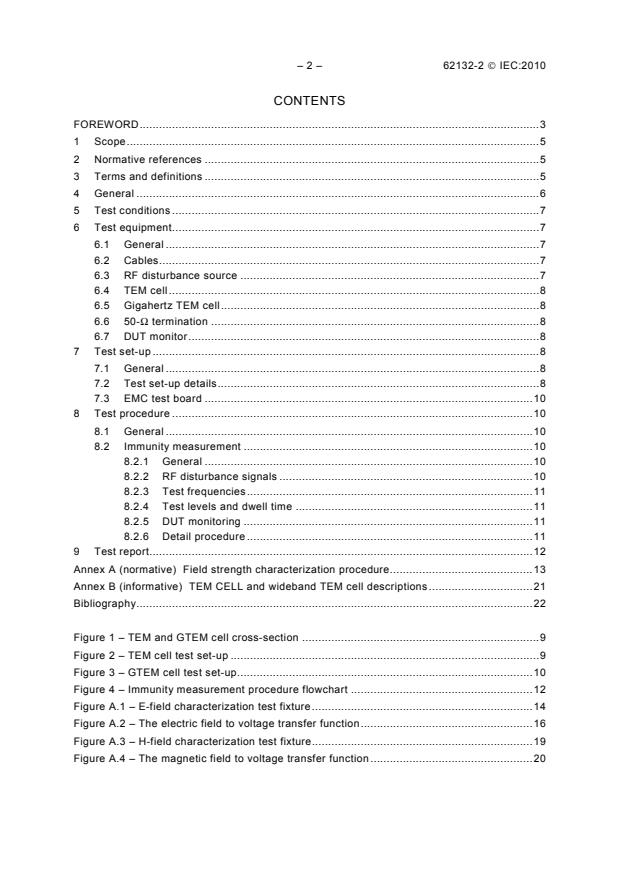
CONTENTS
FOREWORD.3
1 Scope.5
2 Normative references .5
3 Terms and definitions .5
4 General .6
5 Test conditions .7
6 Test equipment.7
6.1 General .7
6.2 Cables.7
6.3 RF disturbance source .7
6.4 TEM cell.8
6.5 Gigahertz TEM cell.8
6.6 50-Ω termination .8
6.7 DUT monitor.8
7 Test set-up .8
7.1 General .8
7.2 Test set-up details.8
7.3 EMC test board .10
8 Test procedure .10
8.1 General .10
8.2 Immunity measurement .10
8.2.1 General .10
8.2.2 RF disturbance signals .10
8.2.3 Test frequencies.11
8.2.4 Test levels and dwell time .11
8.2.5 DUT monitoring .11
8.2.6 Detail procedure .11
9 Test report.12
Annex A (normative) Field strength characterization procedure.13
Annex B (informative) TEM CELL and wideband TEM cell descriptions.21
Bibliography.22
Figure 1 – TEM and GTEM cell cross-section .9
Figure 2 – TEM cell test set-up .9
Figure 3 – GTEM cell test set-up.10
Figure 4 – Immunity measurement procedure flowchart .12
Figure A.1 – E-field characterization test fixture.14
Figure A.2 – The electric field to voltage transfer function.16
Figure A.3 – H-field characterization test fixture.19
Figure A.4 – The magnetic field to voltage transfer function .20
62132-2 © IEC:2010 – 3 –
INTERNATIONAL ELECTROTECHNICAL COMMISSION
____________
INTEGRATED CIRCUITS – MEASUREMENT OF
ELECTROMAGNETIC IMMUNITY –
Part 2: Measurement of radiated immunity –
TEM cell and wideband TEM cell method
FOREWORD
1) The International Electrotechnical Commission (IEC) is a worldwide organization for standardization comprising
all national electrotechnical committees (IEC National Committees). The object of IEC is to promote
international co-operation on all questions concerning standardization in the electrical and electronic fields. To
this end and in addition to other activities, IEC publishes International Standards, Technical Specifications,
Technical Reports, Publicly Available Specifications (PAS) and Guides (hereafter referred to as “IEC
Publication(s)”). Their preparation is entrusted to technical committees; any IEC National Committee interested
in the subject dealt with may participate in this preparatory work. International, governmental and non-
governmental organizations liaising with the IEC also participate in this preparation. IEC collaborates closely
with the International Organization for Standardization (ISO) in accordance with conditions determined by
agreement between the two organizations.
2) The formal decisions or agreements of IEC on technical matters express, as nearly as possible, an international
consensus of opinion on the relevant subjects since each technical committee has representation from all
interested IEC National Committees.
3) IEC Publications have the form of recommendations for international use and are accepted by IEC National
Committees in that sense. While all reasonable efforts are made to ensure that the technical content of IEC
Publications is accurate, IEC cannot be held responsible for the way in which they are used or for any
misinterpretation by any end user.
4) In order to promote international uniformity, IEC National Committees undertake to apply IEC Publications
transparently to the maximum extent possible in their national and regional publications. Any divergence
between any IEC Publication and the corresponding national or regional publication shall be clearly indicated in
the latter.
5) IEC itself does not provide any attestation of conformity. Independent certification bodies provide conformity
assessment services and, in some areas, access to IEC marks of conformity. IEC is not responsible for any
services carried out by independent certification bodies.
6) All users should ensure that they have the latest edition of this publication.
7) No liability shall attach to IEC or its directors, employees, servants or agents including individual experts and
members of its technical committees and IEC National Committees for any personal injury, property damage or
other damage of any nature whatsoever, whether direct or indirect, or for costs (including legal fees) and
expenses arising out of the publication, use of, or reliance upon, this IEC Publication or any other IEC
Publications.
8) Attention is drawn to the Normative references cited in this publication. Use of the referenced publications is
indispensable for the correct application of this publication.
9) Attention is drawn to the possibility that some of the elements of this IEC Publication may be the subject of
patent rights. IEC shall not be held responsible for identifying any or all such patent rights.
International Standard IEC 62132-2 has been prepared by subcommittee 47A: Integrated
circuits, of IEC technical committee 47: Semiconductor devices.
The text of this standard is based on the following documents:
FDIS Report on voting
47A/838/FDIS 47A/843/RVD
Full information on the voting for the approval of this standard can be found in the report on
voting indicated in the above table.
This publication has been drafted in accordance with the ISO/IEC Directives, Part 2.
This part of IEC 62132 is to be read in conjunction with IEC 62132-1.
– 4 – 62132-2 © IEC:2010
The committee has decided that the contents of this publication will remain unchanged until
the stability date indicated on the IEC web site under "http://webstore.iec.ch" in the data
related to the specific publication. At this date, the publication will be
• reconfirmed,
• withdrawn,
• replaced by a revised edition, or
• amended.
Future standards in this series will carry the new general title as cited above. Titles of existing
standards in this series will be updated at the time of the next edition.
62132-2 © IEC:2010 – 5 –
INTEGRATED CIRCUITS – MEASUREMENT OF
ELECTROMAGNETIC IMMUNITY –
Part 2: Measurement of radiated immunity –
TEM cell and wideband TEM cell method
1 Scope
This International Standard specifies a method for measuring the immunity of an integrated
circuit (IC) to radio frequency (RF) radiated electromagnetic disturbances. The frequency
range of this method is from 150 kHz to 1 GHz, or as limited by the characteristics of the TEM
cell.
2 Normative references
The following referenced documents are indispensable for the application of this document.
For dated references, only the edition cited applies. For undated references, the latest edition
of the referenced document (including any amendments) applies.
IEC 60050-131:2002, International Electrotechnical Vocabulary (IEV) – Part 131: Circuit
theory
IEC 60050-161:1990, International Electrotechnical Vocabulary (IEV) – Chapter 161:
Electromagnetic compatibility
IEC 61967-2, Integrated circuits – Measurement of electromagnetic emissions, 150 kHz to
1 GHz – Part 2: Measurement of radiated emissions – TEM cell and wideband TEM cell
method
IEC 62132-1:2006, Integrated circuits – Measurement of electromagnetic immunity, 150 kHz
to 1 GHz – Part 1: General conditions and definitions
3 Terms and definitions
For the purpose of this document, the definitions in IEC 62132-1, IEC 60050-131 and
IEC 60050-161, as well as the following, apply.
3.1
transverse electromagnetic mode (TEM)
waveguide mode in which the components of the electric and magnetic fields in the
propagation direction are much less than the primary field components across any transverse
cross-section
3.2
TEM waveguide
open or closed transmission line system, in which a wave is propagating in the transverse
electromagnetic mode to produce a specified field for testing purposes.
– 6 – 62132-2 © IEC:2010
3.3
TEM cell
enclosed TEM waveguide, often a rectangular coaxial line, in which a wave is propagated in
the transverse electromagnetic mode to produce a specified field for testing purposes. The
outer conductor completely encloses the inner conductor
3.4
two-port TEM waveguide
TEM waveguide with input/output measurement ports at both ends
3.5
one-port TEM waveguide
TEM waveguide with a single input/output measurement port
NOTE Such TEM waveguides typically feature a broadband line termination at the non-measurement-port end.
3.6
characteristic impedance
for any constant phase wave-front, the magnitude of the ratio of the voltage between the inner
conductor and the outer conductor to the current on either conductor
NOTE The characteristic impedance is independent of the voltage/current magnitudes and depends only on the
cross-sectional geometry of the transmission line. TEM waveguides are typically designed to have a 50 Ω
characteristic impedance. TEM waveguides with a 100 Ω characteristic impedance are often used for transient
testing.
3.7
anechoic material
material that exhibits the property of absorbing, or otherwise reducing, the level of
electromagnetic energy reflected from that material
3.8
broadband line termination
termination which combines a low-frequency discrete-component load, to match the
characteristic impedance of the TEM waveguides (typically 50 Ω), and a high-frequency
anechoic-material volume
3.9
primary (field) component
electric field component aligned with the intended test polarization
NOTE For example, in conventional two-port TEM cells, the septum is parallel to the horizontal floor, and the
primary mode electric field vector is vertical at the transverse centre of the TEM cell.
3.10
secondary (field) component
in a Cartesian coordinate system, either of the two electric field components orthogonal to the
primary field component and orthogonal to each other
4 General
The IC to be evaluated for EMC performance is referred to as the device under test (DUT).
The DUT shall be mounted on a printed circuit board (PCB), referred to as the EMC test board.
The EMC test board is provided with the appropriate measurement or monitoring points at
which the DUT response parameters can be measured.
The EMC test board is clamped to a mating port (referred to as a wall port) cut in the top or
bottom of a transverse electromagnetic mode (TEM) cell. Either a two-port TEM cell or a one-
port TEM cell may be used. Within this standard, a two-port TEM cell is referred to as a TEM
cell while a one-port TEM cell is referred to as a wideband (Gigahertz) TEM, or GTEM, cell.
62132-2 © IEC:2010 – 7 –
The test board is not positioned inside the cell, as in the conventional usage, but becomes a
part of the cell wall. This method is applicable to any TEM or GTEM cell modified to
incorporate the wall port; however, the measured response of the DUT will be affected by
many factors. The primary factor affecting the DUT’s response is the septum to EMC test
board (cell wall) spacing.
NOTE 1 This procedure was developed using a 1 GHz TEM cell with a septum to housing spacing of 45 mm and a
GTEM cell with a septum to housing spacing of 45 mm at the centre of the wall port.
The EMC test board controls the geometry and orientation of the DUT relative to the cell and
eliminates any connecting leads within the cell (these are on the backside of the board, which
is outside the cell). For the TEM cell, one of the 50 Ω ports is terminated with a 50 Ω load.
The other 50 Ω port for a TEM cell, or the single 50 Ω port for a GTEM cell, is connected to
the output of an RF disturbance generator. The injected CW disturbance signal exposes the
DUT to a plane wave electromagnetic field where the electric field component is determined
by the injected voltage and the distance between the DUT and the septum of the cell. The
relationship is given by
E = V/h
where
E is the field strength (V/m) within the cell;
V is the applied voltage (V) across the 50 Ω load; and
h is the height (m) between the septum and the centre of the IC package.
Rotating the EMC test board in the four possible orientations in the wall port of the TEM or
GTEM cell is required to determine the sensitivity of the DUT to induced magnetic fields.
Dependent upon the DUT, the response parameters of the DUT may vary (e.g. a change of
current consumption, deterioration in function performance, waveform jitter, etc.) The intent of
this test method is to provide a quantitative measure of the RF immunity of ICs for comparison
or other purposes.
NOTE 2 Additional information on the use and characterization of TEM cells for radiated immunity testing can be
found in IEC 61000-4-20.
5 Test conditions
The test conditions shall meet the requirements as described in IEC 62132-1.
6 Test equipment
6.1 General
The test equipment shall meet the requirements as described in IEC 62132-1. In addition, the
following test equipment requirements shall apply.
6.2 Cables
Double shielded or semi-rigid coaxial cable may be required depending on the local RF
ambient conditions.
6.3 RF disturbance source
The RF disturbance source may comprise an RF signal generator with a modulation function,
an RF power amplifier, and an optional variable attenuator. The gain (or attenuation) of the
RF disturbance generating equipment, without the TEM or GTEM cell, shall be known with a
tolerance of ±0,5 dB.
– 8 – 62132-2 © IEC:2010
6.4 TEM cell
The TEM cell used for this test procedure is a two-port TEM waveguide and shall be fitted
with a wall port sized to mate with the EMC test board. The TEM cell shall not exhibit higher
order modes over the frequency range being measured. For this procedure, the recommended
TEM cell frequency range is 150 kHz to the frequency of the first resonance of the lowest
higher order mode (typically <2 GHz). The frequency range being evaluated shall be covered
using only a single cell.
The VSWR of the TEM cell over the frequency range being measured shall be less than 1,5.
However, due to the potential for error when calculating the applied E-field, a TEM cell with a
VSWR of less than 1,2 is preferred. A TEM cell with a VSWR less than 1,2 does not require
field strength characterization. A TEM cell with a VSWR larger than or equal to 1,2 but less
than 1,5 shall be characterized in accordance with the procedure in Annex A. The raw TEM
cell VSWR data (over the frequency range of the measurement) shall be included in the test
report. Measurement results obtained from a TEM cell with a VSWR of less than 1,2 will
prevail over data taken from a TEM cell with a higher VSWR.
6.5 Gigahertz TEM cell
The Gigahertz, or wideband, TEM (GTEM) cell used for this test procedure is a one-port TEM
waveguide and shall be fitted with a wall port sized to mate with the EMC test board. The
GTEM cell shall not exhibit higher order modes over the frequency range being measured. For
this procedure, the recommended GTEM cell frequency range is from 150 kHz to the
frequency of the first resonance of the lowest higher order mode (typically >2 GHz). The
frequency range being evaluated shall be covered using a single cell.
The VSWR of the GTEM cell over the frequency range being measured shall be less than 1,5.
However, due to the potential for error when calculating the applied E-field, a GTEM cell with
a VSWR of less than 1,2 is preferred. A GTEM cell with a VSWR less than 1,2 does not
require field strength characterization. A GTEM cell with a VSWR larger than or equal to 1,2
but less than 1,5 shall be characterized in accordance with the procedure in Annex A. The
raw GTEM cell VSWR data (over the frequency range of the measurement) shall be included
in the test report. Measurement results obtained from a GTEM cell with a VSWR of less than
1,2 will prevail over data taken from a GTEM cell with a higher VSWR.
6.6 50 Ω termination
A 50 Ω termination with a VSWR less than 1,1 and sufficient power handling capabilities over
the frequency range of measurement is required for the TEM cell measurement port not
connected to the RF disturbance generator.
6.7 DUT monitor
The performance of the DUT shall be monitored for indications of performance degradation.
The monitoring equipment shall not be adversely affected by the injected RF disturbance
signal.
7 Test set-up
7.1 General
The test set-up shall meet the requirements as described in IEC 62132-1. In addition, the
following test set-up requirements shall apply.
7.2 Test set-up details
The EMC test board shall be mounted in the wall port of the TEM cell or GTEM cell with the
DUT facing the septum as shown in Figure 1.
62132-2 © IEC:2010 – 9 –
EMC test board
DUT
Cell septum
Cell housing
IEC 608/10
Figure 1 – TEM and GTEM cell cross-section
The test setup shall be as described in Figure 2 and Figure 3 for TEM cell and GTEM cell test
configurations, respectively. One of the TEM cell measurement ports shall be terminated with
a 50 Ω load. The remaining TEM cell measurement port, or the single GTEM measurement
port, shall be connected to the output port of the power amplifier.
RF disturbance source
Signal
generator
EMC test board
TEM cell
Attenuator
Power
(optional)
amplifier
50 Ω
termination
DUT monitor
IEC 609/10
Figure 2 – TEM cell test set-up
– 10 – 62132-2 © IEC:2010
RF disturbance source
EMC test board
Signal
generator
Attenuator
Power
(optional)
amplifier
GTEM cell
DUT monitor
IEC 610/10
Figure 3 – GTEM cell test set-up
7.3 EMC test board
The EMC test board shall be designed in accordance with the requirements in IEC 61967-2.
8 Test procedure
8.1 General
The test procedure shall be in accordance with IEC 62132-1 except as modified herein. These
default test conditions are intended to assure a consistent test environment. The following
steps shall be performed:
a) field strength characterization (see Annex A);
b) immunity measurement (see 8.2).
If the users of this procedure agree to other conditions, these conditions shall be documented
in the test report.
8.2 Immunity measurement
8.2.1 General
With the EMC test board energized and the DUT being operated in the intended test mode,
measure the immunity to the injected RF disturbance signal over the desired frequency range.
8.2.2 RF disturbance signals
The RF disturbance signals shall be
• CW (continuous wave) and
• AM (amplitude modulated CW) at 80 % depth by a 1 kHz sine wave or (optionally) pulse
modulated at 100 % depth with 50 % duty cycle and 1 kHz pulse repetition rate.
62132-2 © IEC:2010 – 11 –
NOTE The optional pulse modulation requirement is typically about 6 dB more severe than the stated amplitude
modulation requirement.
8.2.3 Test frequencies
The RF immunity of the DUT shall be evaluated at a number of discrete test frequencies from
150 kHz to 1 GHz, or as limited by the characteristics of the TEM cell. The frequencies to be
tested shall be generated from the requirements specified in Table 2 of IEC 62132-1.
In addition, the RF immunity of the DUT shall be evaluated at critical frequencies. Critical
frequencies are frequencies that are generated by, received by, or operated on by the DUT.
Critical frequencies include but are not limited to crystal frequencies, oscillator frequencies,
clock frequencies, data frequencies, etc.
8.2.4 Test levels and dwell time
The applied test level shall be increased in steps until a malfunction is observed or the
maximum signal generator setting is reached. The step size shall be documented in the test
report.
At each test level and frequency, the RF disturbance signal shall be applied for a minimum of
1 s (or at least the time necessary for the DUT to respond and the monitoring system to detect
any performance degradation).
8.2.5 DUT monitoring
The DUT shall be monitored for indications of susceptibility using the appropriate test
equipment and as required in IEC 62132-1.
8.2.6 Detail procedure
8.2.6.1 Field strength characterization
At each frequency to be tested, the signal generator setting to achieve the desired electric
field level or levels shall be determined as described in Annex A.
8.2.6.2 Immunity measurement
The test flow, including major steps, is described in Figure 4. One of two strategies may be
employed in performing this measurement as follows:
a) the output of the RF disturbance generator shall be set at a low value (e.g. 20 dB below
the desired limit) and slowly increased up to the desired limit while monitoring the DUT for
performance degradation. Any performance degradation at or below the desired limit shall
be recorded;
b) the output of the RF disturbance generator shall be set at the desired performance limit
while monitoring the DUT for performance degradation. Any performance degradation at
the desired limit shall be recorded. The output of the RF disturbance generator shall then
be reduced until normal function returns. The output of the RF disturbance generator shall
then be increased until the performance degradation occurs again. This level shall also be
recorded.
NOTE The DUT may respond differently to each of the above methods. In such a case, a method in which the
interference signal is ramped up as well as down may be required.
The RF immunity measurement shall be performed in each of the four possible orientations
resulting in four separate sets of data. The first measurement is made with the IC test board
mounted in an arbitrary orientation of the IC in the cell wall port. The second measurement is
made with the IC test board rotated 90 degrees from the orientation in the first measurement.
For each of the third and fourth measurements, the test board is rotated again to ensure
– 12 – 62132-2 © IEC:2010
immunity is measured in all four possible orientations. The four sets of data shall be
documented in the test report.
9 Test report
The test report shall be in accordance with the requirements of IEC 62132-1.
Operational
check
Record
C
data
Set initial
test frequency
B
Final
No
Increment
output
A
output voltage
Set initial
level?
output voltage
A
Yes
Enable RF output and
apply modulation
All
No
Increment
frequencies
B
frequency
done?
No
Immune?
Yes
Yes
All
No
Rotate board
polarities
No
C
Dwell time 90°
done?
met?
Yes
Yes
PASS FAIL
END
IEC 611/10
Figure 4 – Immunity measurement procedure flowchart
62132-2 © IEC:2010 – 13 –
Annex A
(normative)
Field strength characterization procedure
A.1 General
The signal level setting of the RF disturbance generator required to achieve the desired
electric field level within the TEM or GTEM cell shall be determined in accordance with this
procedure. This measurement shall be performed at each standard frequency (either linear or
logarithmic as used in the actual test) as determined in accordance with 8.2.3. The RF
disturbance signal used for characterization shall be a CW signal (e.g. no modulation shall be
applied).
A.2 Electric (E) field strength characterization
A.2.1 Electric field characterization test fixture
The electric field can be measured by using a small monopole antenna at the centre location
of the characterization board as shown in Figure A.1. It is recommended that the diameter of
2 2
the top plate capacitive load shall be small (e.g. an area of approximately 0,001 m or 10 cm )
and either circular or square. The antenna top plate shall be kept parallel to the top metallic
surface of the characterization board, which may be either a printed circuit board or metal
plate, at a height of 3,0 mm ±0,1 mm. This top plate will yield a capacitance of about 3 pF.
The centre of this plate shall be fed to a surface-mount, coaxial bulkhead connector that in
turn shall be connected to the 50 Ω input impedance of an RF voltmeter or spectrum analyser.
The resulting high-pass circuit results in an incremental slope of 20 dB/decade over the full
frequency range up to 1 GHz.
The characterization board shall be identical in size to the EMC test board to be used during
the actual radiated immunity measurements as specified in IEC 62132-1. The bulkhead
connector shall be a 50 Ω type, either SMA or SMB, and placed in the exact centre of the
characterization board.
The PCB shall be constructed with at least one conductive layer. The conductive layer should
cover the entire board forming a solid ground plane. The SMA or SMB connector should be
mounted on the side of the PCB opposite the ground plane, with its outer conductor
connected to the ground plane and the centre conductor passing through an unplated,
through-hole penetration to the other side of the board. Additional conductive PCB layers
should be assigned to ground and connected using multiple vias as shown for the EMC test
board in IEC 62132-1.
NOTE Tolerances for top plate area, capacitance and board location are under development.
A.2.2 Capacitance measurement
The top plate capacitance of the monopole shall be measured separately to assure a
capacitance of 3 pF. The capacitance shall be measured with the characterization test fixture
inserted into the TEM cell. With the impedance reference plane set at the bulkhead coaxial
connector mounted at the location where the device/IC is to be positioned, the monopole is
mounted to this bulkhead connector and the impedance (i.e. capacitance) is measured at a
reference frequency of 10 MHz. This measurement is made to ensure that the physical length
of the wire (i.e. the inductance) does not affect the characterization.
– 14 – 62132-2 © IEC:2010
Capacitive top-load plate
area ~0,001 m
PCB or
Monopole antenna
metal plate
with top-load
3,0 mm ± 0,1 mm
Surface-mount, bulkhead
SMA or SMB connector
IEC 612/10
In the case of a PCB, a ground plane is required on both sides
Figure A.1 – E field characterization test fixture
A.2.3 Electric field strength calculation
The voltage induced at the output of the monopole antenna is given by
V = h ×E (A.1)
ant ant tem
where
V is the voltage at the test fixture output port, expressed in volts (V), by the internal
ant
electric field;
E is the electric field within the TEM or GTEM cell, expressed in volts per meter (V/m);
tem
h is the height of the monopole antenna, expressed in meters (m).
ant
In addition, the electric field in the TEM or GTEM cell is also given by
V
tem
E = ⇒V = E ×h (A.2)
tem tem tem sep
h
sep
where
V is the voltage at the port of the TEM or GTEM cell, expressed in volts (V);
tem
62132-2 © IEC:2010 – 15 –
h is the distance from the antenna top load to the inner septum of the TEM or GTEM cell,
sep
expressed in meters (m).
So that the resulting transfer function (S21) is given by
V h
ant ant
S21 = = × (A.3)
V h 2
tem sep 2
(50) + Z
ant
where
|Z | is the magnitude of the antenna impedance, given by |1/(jωC)| and expressed in ohms
ant
(Ω), neglecting resistance.
The antenna impedance is given by
1 1
Z = = (A.4)
ant
ωC 2πf ×C
ant_meas ant_meas
where
C is the measured antenna capacitance, expressed in farads (F).
ant_meas
A.2.4 Example electric field strength calculation
At 10 MHz, solving for V as a function of E using Equation (A.1) gives
ant tem
−3
V = (3 ×10 )×E
ant tem
For a monopole antenna with a measured capacitance of 3 pF, the antenna impedance is
calculated from Equation (A.4):
Z = = 5305 Ω
ant,10MHz
6 −12
2π × (10 ×10 Hz) × (3 ×10 F)
So the resulting transfer function at 10 MHz for h = 45 mm – 3 mm = 42 mm is calculated
sep
using Equation (A.3) giving
−3
3 ×10 m 50
−6
S21 = ⋅ = 673,9 ×10
−3
2 2
42 ×10 m
(50) + (5305)
Converting the S21 value to decibels gives the final result as
−6
S21 = 20 ⋅ log(673,9 ×10 ) = −63,43 dB
dB
The electric field to voltage transfer function given in Equation (A.3) and converted to decibels,
for the parameters given above, is plotted in Figure A.2 and is suited for characterization up
to 1 GHz. The value of the transfer function shall be compensated for the TEM cell septum-to-
device height as given in A.4.
Due to the non-ideal nature of TEM cell and GTEM cell devices, a maximum deviation of 6 dB
is allowed for 3 % of the frequencies determined in accordance with 8.2.3. For all other
frequencies, the performance of the field strength shall be within 1 dB of the ideal curve given
– 16 – 62132-2 © IEC:2010
in Figure A.2. Frequencies at which the deviation is greater than 1 dB shall be listed in the
test report.
NOTE Any failure at a frequency with a deviation of greater than 1 dB should be ignored during qualification
testing.
Monopole antenna S21
0,00
–10,00
–20,00
–30,00
–40,00
–50,00
–60,00
–70,00
–80,00
–90,00
–100,00
6 7 8 9
1 × 10 1 × 10 1 × 10 1 × 10
Frequency (Hz)
S21 (dB)
IEC 613/10
Figure A.2 – The electric field to voltage transfer function
When the characterization needs to be performed at higher frequencies (>1 GHz), the
parameters of the probe shall be adjusted such that the linear behavior is extended
accordingly (at the cost of sensitivity at the lower frequencies).
A.3 Magnetic (H) field strength characterization
A.3.1 Magnetic field strength characterization test fixture
The magnetic field can be measured by using a small loop antenna at the centre location of
the EMC test board as shown in Figure A.3. A magnetic loop shall be constructed using wire
with a 1 mm ±0,1 mm diameter. The loop shall have a separation height of 3,3 mm ±0,1 mm
from the top conductive surface of the test fixture. The length of the loop shall be 30 mm
±0,1 mm, which results in an effective loop area of approximately 99 mm .
For the characterization, the loop shall be oriented in parallel to the propagation direction of
the EM wave in the TEM cell or GTEM cell.
The characterization board shall be identical in size to the EMC test board to be used during
the actual radiated immunity measurements as specified in IEC 62132-1. The bulkhead
connector shall be a 50 Ω type, either SMA or SMB. The bulkhead surface-mount, coaxial
connector shall be mounted 15 mm ±1,0 mm off-centre of the EMC test board.
The PCB shall be constructed with at least one conductive layer. The conductive layer should
cover the entire board forming a solid ground plane. The SMA or SMB connector should be
mounted on the side of the PCB opposite the ground plane, with its outer conductor
connected to the ground plane and the centre conductor passing through an unplated,
S21 (dB)
62132-2 © IEC:2010 – 17 –
through-hole penetration to the other side of the board. Additional conductive PCB layers
should be assigned to ground and connected using multiple vias as shown for the EMC test
board in IEC 62132-1.
A.3.2 Magnetic field strength calculation
The voltage induced at the output of the loop antenna is given by
dΦ
V = N × (A.5)
ant
dt
where
N = 1
dΦ
Φ()t = Φ × sin(ωt)⇒ = Φ × ω
dt
Φ = B × A
loop
B = μ ×H
o
E
H =
Z
o
ω = 2πf
Substituting back into Equation (A.5) gives
⎛ E ⎞
tem
⎜ ⎟
V = × μ × A × 2πf (A.6)
ant o loop
⎜ ⎟
Z
⎝ o ⎠
where
V is the voltage at the test fixture output port, expressed in volts (V), by the internal
ant
electric field;
E is the electric field within the TEM or GTEM cell, expressed in volts per meter (V/m);
tem
Z is the characteristic impedance of free space (120 π Ω or 377 Ω);
o
–7
µ is the permeability of free space (4 π × 10 H/m);
o
A is the area of the loop antenna, expressed in square meters (m );
loop
f is the frequency of interest, expressed in Hertz (Hz).
In addition, the electric field in the TEM or GTEM cell is also given by
V
tem
E = ⇒V = E ×h (A.7)
tem tem tem sep
h
sep
where
V is the voltage at the port of the TEM or GTEM cell, expressed in volts (V);
tem
– 18 – 62132-2 © IEC:2010
h is the distance from the antenna to the inner septum of the TEM or GTEM cell,
sep
expressed in meters (m).
So that the resulting transfer function (S21) is given by
μ × A × 2πf
V
o loop 50
ant
S21 = = × (A.8)
V Z ×h 2 2
tem o sep
(50) + (Z )
ant
where
|Z | is the magnitude of the antenna impedance, given by |jωL| and expressed in ohms
ant
(Ω), neglecting resistance.
The antenna impedance is given by
Z = ϖL = 2πf ×L (A.9)
ant ant_meas ant_meas
where
L is the measured inductance of the small loop antenna, expressed in henrys [H].
ant_meas
A.3.3 Example magnetic field strength calculation
For the specified loop antenna, the loop area is
−3 −3 −6 2
A = h ×l = (3,3 ×10 m)× (30 ×10 m) = 99 ×10 m
loop loop loop
where
h is the height of the loop over the PCB, expressed in meters (m).
loop
l is the length of the loop, expressed in meters (m).
loop
At 10 MHz, solving for V as a function of E using Equation (A.6) gives
ant tem
⎛ E ⎞
tem −7 −6 2 6 −6
V =⎜ ⎟ ×()4π ×10 ×(99 ×10 m)×(2π ×10 ×10 Hz) = E ×(20,1×10)
ant tem
⎜ ⎟
⎝ ⎠
For a loop antenna with a measured inductance of 73 nH, the impedance is calculated using
Equation (A.9) giving
6 −9
Z = 2π ×()10 ×10 Hz ⋅(73×10 H) = 4,58Ω
ant,10MHz
So the resulting transfer function (S21) at 10 MHz for h = 45 mm – 3,3 mm = 41,7 mm is
sep
calculated using Equation (A.8) giving
−7 −6 2 6
()4π ×10 ×(99 ×10 m)×(2π ×10 ×10 Hz) 50
−6
S21 = ⋅ = 495,1×10
−3
2 2
377 × 41,7 ⋅10 m
(50) + (4,58)
Converting the S21 value to decibels gives the final result as
−6
S21 = 20 ⋅ log()495,15×10 = −66,11 dB
dB
62132-2 © IEC:2010 – 19 –
The magnetic field to voltage transfer function given in Equation (A.8) and converted to
decibels, for the parameters given above, is plotted in Figure A.4 and is suited for
characterization up to 1 GHz. The value of the transfer function shall be compensated for the
TEM cell septum-to-device height as given in A.4.
Due to the non-ideal nature of TEM cell and GTEM cell devices, a maximum deviation of 6 dB
is allowed for 3 % of the frequencies determined in accordance with 8.2.3. For all other
frequencies, the performance of the field strength shall be within 1 dB of the ideal curve given
in Figure A.4. Frequencies at which the deviation is greater than 1 dB shall be listed in the
test report.
NOTE 1 Any failure at a frequency with a deviation of greater than 1 dB should be ignored during qualification
testing.
NOTE 2 Since the magnetic field to voltage transfer function is not continuously proportional with frequency for
the parameters given above, the electric field to voltage characterization given in A.2 is preferred.
Loop antenna
30 mm
PCB or
Loop antenna
metal plate
3,3 mm
Surface-mount, bulkhead
SMA or SMB connector
IEC 614/10
In the case of a PCB, a ground plane is required on both sides
Figure A.3 – H field characterization test fixture
– 20 – 62132-2 © IEC:2010
Lo
...