

IEC 61753-031-3:2014
(Main)Fibre optic interconnecting devices and passive components - Performance standard - Part 031-3: Non-connectorized single-mode 1×N and 2×N non-wavelength-selective branching devices for Category U - Uncontrolled environment
General Information
- Abstract
IEC 61753-031-3:2014 contains the minimum initial tests and measurement requirements and severities which a non-wavelength selective branching device (NWBD) should satisfy in order to be categorized as meeting the requirements of this standard. The requirements cover balanced bidirectional non-connectorized single-mode 1xN and 2xN non-wavelength-selective branching devices for use in an IEC category U environment (N is the number of branching ports), especially but not exclusively used for PON application. For balanced NWBD two attenuation and uniformity performance classes are considered:
- class A (premium class) which meets more restrictive requirements (i.e. for extended reach PON application) and
- class B (standard class) for standard application (i.e. for normal reach PON application). The requirements also cover unbalanced, bidirectional, non-connectorized, single-mode, non-wavelength-selective branching devices; however, the specifications of unbalanced branching devices are limited to 1 x 2 and 2 x 2 devices because they are the most commonly used. This second edition of IEC 61753-031-3 cancels and replaces the first edition published in 2009 and constitutes a technical revision. This edition includes the following significant technical changes with respect to the previous edition:
- an updated and extended scope to reflect an introduction of two attenuation and uniformity performance classes for balanced NWBD instead of branching device technologies on the market;
- an updated list of normative references;
- a more simplified introduction to the two types of spectral bands;
- Clause 5, Performance requirements, has been updated and extended to reflect the introduction of two attenuation and uniformity performance classes for balanced NWBD;
- simplified test items to exclude tests for damp heat (steady state) and impact for performance requirements;
- Annexe A has been changed to introduce the calculated and minimum requirements for attenuation and uniformity;
- Annex B has been updated to reflect revised performance requirements. Keywords: non-wavelength selective branching device (NWBD), IEC Category U environment
- Status
- Published
- Publication Date
- 15-Dec-2014
- Technical Committee
- SC 86B - Fibre optic interconnecting devices and passive components
- Drafting Committee
- WG 7 - TC 86/SC 86B/WG 7
- Current Stage
- PPUB - Publication issued
- Start Date
- 16-Dec-2014
- Completion Date
- 15-Sep-2014
Buy Documents
IEC 61753-031-3:2014 - Fibre optic interconnecting devices and passive components - Performance standard - Part 031-3: Non-connectorized single-mode 1×N and 2×N non-wavelength-selective branching devices for Category U - Uncontrolled environment Released:12/16/2014
IEC 61753-031-3:2014 - Fibre optic interconnecting devices and passive components - Performance standard - Part 031-3: Non-connectorized single-mode 1×N and 2×N non-wavelength-selective branching devices for Category U - Uncontrolled environment Released:12/16/2014
Overview
IEC 61753-031-3:2014 is an IEC performance standard for non-connectorized single‑mode non-wavelength selective branching devices (NWBD), covering 1×N and 2×N configurations intended for use in an IEC Category U environment (Uncontrolled environment). The standard defines minimum initial tests, measurement requirements and severities that NWBDs must meet to be classified for use - especially in Passive Optical Network (PON) applications. This 2nd edition introduces two performance classes for balanced devices (Class A = premium, Class B = standard) and updates test scope, spectral bands and normative references.
Key topics and technical requirements
- Device types covered
- Balanced, bidirectional non‑connectorized single‑mode 1×N and 2×N NWBDs (balanced devices include Class A and Class B performance levels).
- Unbalanced, bidirectional non‑connectorized single‑mode NWBDs limited to 1×2 and 2×2 (most commonly used unbalanced types).
- Performance metrics
- Attenuation and uniformity requirements (numerical values and calculation methods are provided in Annex A).
- Two performance classes for balanced NWBDs: Class A (premium/extended reach PON) and Class B (standard/normal reach PON).
- Test methods
- All test methods are drawn from the IEC 61300 basic test and measurement procedures (vibration, cold, dry heat, change of temperature, shock, torsion, return loss, directivity, transient loss, etc.).
- Samples must be terminated on single‑mode fibres per IEC 60793-2-50 category B1.1/B1.3/B.6.
- Devices are validated over defined spectral bands:
- Spectral band I: 1 260–1 360 nm and 1 480–1 625 nm
- Spectral band II: 1 260–1 360 nm and 1 480–1 660 nm
- Test reporting and sampling
- Fully documented test reports and evidence are required; sample sizes and test details are in Annex B and Table 1.
- During environmental monitoring, all ports of the NWBD shall be monitored.
Practical applications and users
- Targeted for manufacturers, test laboratories, product designers, system integrators and network operators working with fibre access networks and PON deployments.
- Used to qualify non-wavelength selective branching device (NWBD) components for field (Category U) installations where predictable attenuation and uniformity are critical for link budgeting and service reliability.
- Helpful for procurement and compliance teams specifying splitter/brancher performance (Class A vs Class B) for extended‑reach or standard‑reach optical networks.
Related standards
- IEC 61300 series - basic test and measurement procedures for fibre optic components.
- IEC 60793-2-50 - single‑mode fibre product specifications.
- IEC 61753 - the broader family of performance standards for fibre optic interconnecting devices and passive components.
Keywords: IEC 61753-031-3:2014, non-wavelength selective branching device (NWBD), IEC Category U environment, 1×N, 2×N, PON, attenuation, uniformity, IEC 61300.
Relations
- Effective Date
- 05-Sep-2023
Buy Documents
IEC 61753-031-3:2014 - Fibre optic interconnecting devices and passive components - Performance standard - Part 031-3: Non-connectorized single-mode 1×N and 2×N non-wavelength-selective branching devices for Category U - Uncontrolled environment Released:12/16/2014
IEC 61753-031-3:2014 - Fibre optic interconnecting devices and passive components - Performance standard - Part 031-3: Non-connectorized single-mode 1×N and 2×N non-wavelength-selective branching devices for Category U - Uncontrolled environment Released:12/16/2014
Get Certified
Connect with accredited certification bodies for this standard

IMQ S.p.A. (Certification)
Italian electrical product certification.

SLG Prüf- und Zertifizierungs GmbH
German testing and certification body.

UL Solutions
Global safety science company with testing, inspection and certification.
Sponsored listings
Frequently Asked Questions
IEC 61753-031-3:2014 is a standard published by the International Electrotechnical Commission (IEC). Its full title is "Fibre optic interconnecting devices and passive components - Performance standard - Part 031-3: Non-connectorized single-mode 1×N and 2×N non-wavelength-selective branching devices for Category U - Uncontrolled environment". This standard covers: IEC 61753-031-3:2014 contains the minimum initial tests and measurement requirements and severities which a non-wavelength selective branching device (NWBD) should satisfy in order to be categorized as meeting the requirements of this standard. The requirements cover balanced bidirectional non-connectorized single-mode 1xN and 2xN non-wavelength-selective branching devices for use in an IEC category U environment (N is the number of branching ports), especially but not exclusively used for PON application. For balanced NWBD two attenuation and uniformity performance classes are considered: - class A (premium class) which meets more restrictive requirements (i.e. for extended reach PON application) and - class B (standard class) for standard application (i.e. for normal reach PON application). The requirements also cover unbalanced, bidirectional, non-connectorized, single-mode, non-wavelength-selective branching devices; however, the specifications of unbalanced branching devices are limited to 1 x 2 and 2 x 2 devices because they are the most commonly used. This second edition of IEC 61753-031-3 cancels and replaces the first edition published in 2009 and constitutes a technical revision. This edition includes the following significant technical changes with respect to the previous edition: - an updated and extended scope to reflect an introduction of two attenuation and uniformity performance classes for balanced NWBD instead of branching device technologies on the market; - an updated list of normative references; - a more simplified introduction to the two types of spectral bands; - Clause 5, Performance requirements, has been updated and extended to reflect the introduction of two attenuation and uniformity performance classes for balanced NWBD; - simplified test items to exclude tests for damp heat (steady state) and impact for performance requirements; - Annexe A has been changed to introduce the calculated and minimum requirements for attenuation and uniformity; - Annex B has been updated to reflect revised performance requirements. Keywords: non-wavelength selective branching device (NWBD), IEC Category U environment
IEC 61753-031-3:2014 contains the minimum initial tests and measurement requirements and severities which a non-wavelength selective branching device (NWBD) should satisfy in order to be categorized as meeting the requirements of this standard. The requirements cover balanced bidirectional non-connectorized single-mode 1xN and 2xN non-wavelength-selective branching devices for use in an IEC category U environment (N is the number of branching ports), especially but not exclusively used for PON application. For balanced NWBD two attenuation and uniformity performance classes are considered: - class A (premium class) which meets more restrictive requirements (i.e. for extended reach PON application) and - class B (standard class) for standard application (i.e. for normal reach PON application). The requirements also cover unbalanced, bidirectional, non-connectorized, single-mode, non-wavelength-selective branching devices; however, the specifications of unbalanced branching devices are limited to 1 x 2 and 2 x 2 devices because they are the most commonly used. This second edition of IEC 61753-031-3 cancels and replaces the first edition published in 2009 and constitutes a technical revision. This edition includes the following significant technical changes with respect to the previous edition: - an updated and extended scope to reflect an introduction of two attenuation and uniformity performance classes for balanced NWBD instead of branching device technologies on the market; - an updated list of normative references; - a more simplified introduction to the two types of spectral bands; - Clause 5, Performance requirements, has been updated and extended to reflect the introduction of two attenuation and uniformity performance classes for balanced NWBD; - simplified test items to exclude tests for damp heat (steady state) and impact for performance requirements; - Annexe A has been changed to introduce the calculated and minimum requirements for attenuation and uniformity; - Annex B has been updated to reflect revised performance requirements. Keywords: non-wavelength selective branching device (NWBD), IEC Category U environment
IEC 61753-031-3:2014 is classified under the following ICS (International Classification for Standards) categories: 29.260.20 - Electrical apparatus for explosive atmospheres; 33.180.10 - Fibres and cables. The ICS classification helps identify the subject area and facilitates finding related standards.
IEC 61753-031-3:2014 has the following relationships with other standards: It is inter standard links to IEC 61753-031-3:2009. Understanding these relationships helps ensure you are using the most current and applicable version of the standard.
IEC 61753-031-3:2014 is available in PDF format for immediate download after purchase. The document can be added to your cart and obtained through the secure checkout process. Digital delivery ensures instant access to the complete standard document.
Standards Content (Sample)
IEC 61753-031-3 ®
Edition 2.0 2014-12
INTERNATIONAL
STANDARD
Fibre optic interconnecting devices and passive components – Performance
standard –
Part 031-3: Non-connectorized single-mode 1×N and 2×N non-wavelength-
selective branching devices for Category U – Uncontrolled environment
All rights reserved. Unless otherwise specified, no part of this publication may be reproduced or utilized in any form
or by any means, electronic or mechanical, including photocopying and microfilm, without permission in writing from
either IEC or IEC's member National Committee in the country of the requester. If you have any questions about IEC
copyright or have an enquiry about obtaining additional rights to this publication, please contact the address below or
your local IEC member National Committee for further information.
IEC Central Office Tel.: +41 22 919 02 11
3, rue de Varembé Fax: +41 22 919 03 00
CH-1211 Geneva 20 info@iec.ch
Switzerland www.iec.ch
About the IEC
The International Electrotechnical Commission (IEC) is the leading global organization that prepares and publishes
International Standards for all electrical, electronic and related technologies.
About IEC publications
The technical content of IEC publications is kept under constant review by the IEC. Please make sure that you have the
latest edition, a corrigenda or an amendment might have been published.
IEC Catalogue - webstore.iec.ch/catalogue Electropedia - www.electropedia.org
The stand-alone application for consulting the entire The world's leading online dictionary of electronic and
bibliographical information on IEC International Standards, electrical terms containing more than 30 000 terms and
Technical Specifications, Technical Reports and other definitions in English and French, with equivalent terms in 14
documents. Available for PC, Mac OS, Android Tablets and additional languages. Also known as the International
iPad. Electrotechnical Vocabulary (IEV) online.
IEC publications search - www.iec.ch/searchpub IEC Glossary - std.iec.ch/glossary
The advanced search enables to find IEC publications by a More than 55 000 electrotechnical terminology entries in
variety of criteria (reference number, text, technical English and French extracted from the Terms and Definitions
committee,…). It also gives information on projects, replaced clause of IEC publications issued since 2002. Some entries
and withdrawn publications. have been collected from earlier publications of IEC TC 37,
77, 86 and CISPR.
IEC Just Published - webstore.iec.ch/justpublished
Stay up to date on all new IEC publications. Just Published IEC Customer Service Centre - webstore.iec.ch/csc
details all new publications released. Available online and If you wish to give us your feedback on this publication or
also once a month by email. need further assistance, please contact the Customer Service
Centre: csc@iec.ch.
IEC 61753-031-3 ®
Edition 2.0 2014-12
INTERNATIONAL
STANDARD
Fibre optic interconnecting devices and passive components – Performance
standard –
Part 031-3: Non-connectorized single-mode 1×N and 2×N non-wavelength-
selective branching devices for Category U – Uncontrolled environment
INTERNATIONAL
ELECTROTECHNICAL
COMMISSION
PRICE CODE
R
ICS 33.180.10 ISBN 978-2-8322-1819-8
– 2 – IEC 61753-031-3:2014 © IEC 2014
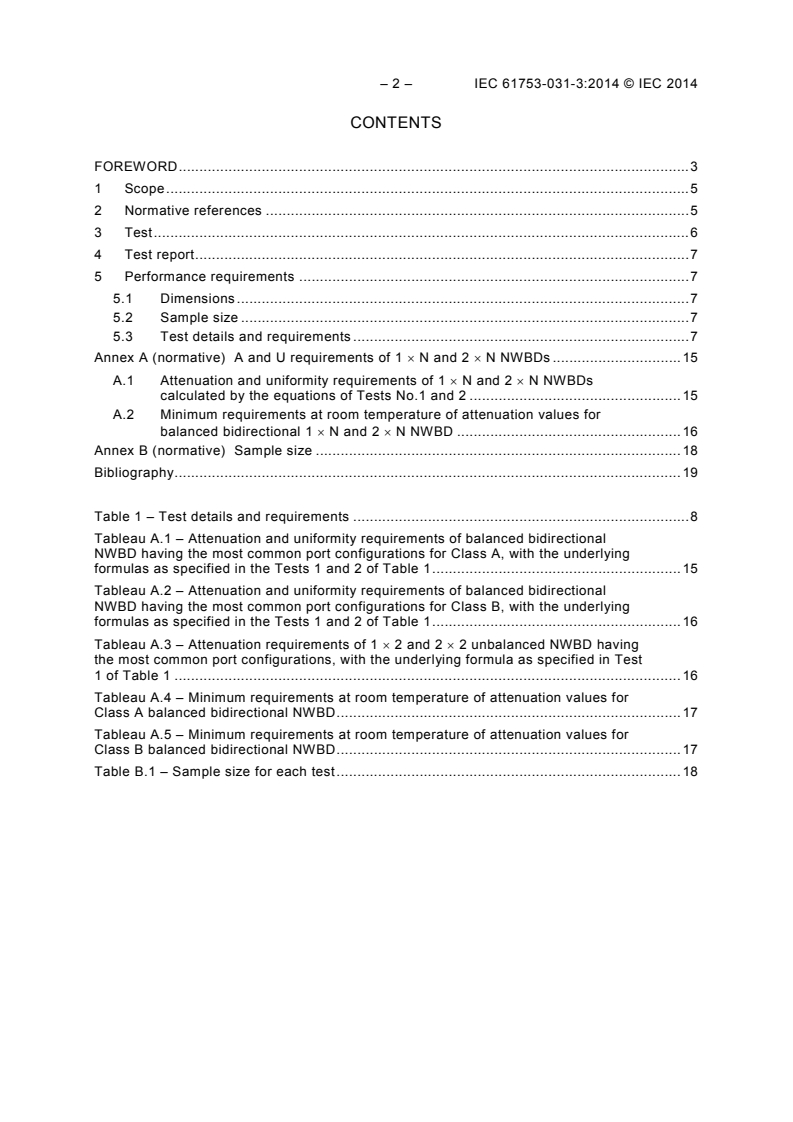
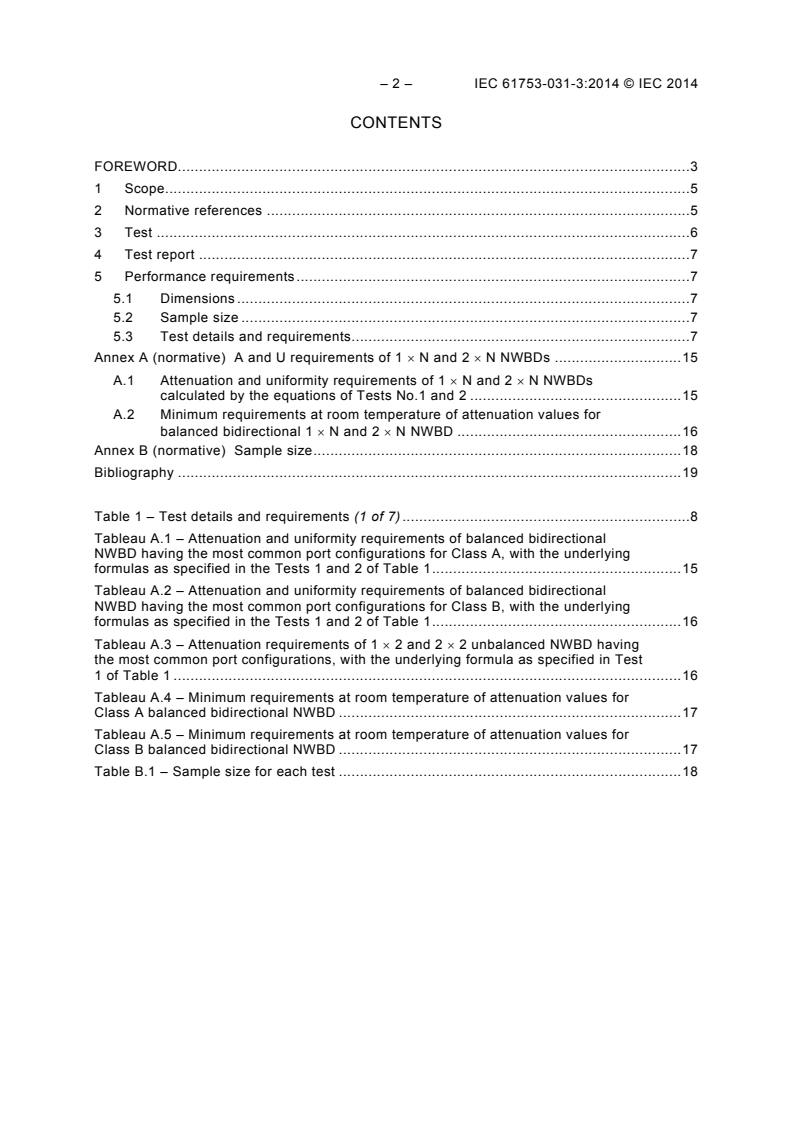
CONTENTS
FOREWORD . 3
1 Scope . 5
2 Normative references . 5
3 Test . 6
4 Test report . 7
5 Performance requirements . 7
5.1 Dimensions . 7
5.2 Sample size . 7
5.3 Test details and requirements . 7
Annex A (normative) A and U requirements of 1 × N and 2 × N NWBDs . 15
A.1 Attenuation and uniformity requirements of 1 × N and 2 × N NWBDs
calculated by the equations of Tests No.1 and 2 . 15
A.2 Minimum requirements at room temperature of attenuation values for
balanced bidirectional 1 × N and 2 × N NWBD . 16
Annex B (normative) Sample size . 18
Bibliography . 19
Table 1 – Test details and requirements . 8
Tableau A.1 – Attenuation and uniformity requirements of balanced bidirectional
NWBD having the most common port configurations for Class A, with the underlying
formulas as specified in the Tests 1 and 2 of Table 1 . 15
Tableau A.2 – Attenuation and uniformity requirements of balanced bidirectional
NWBD having the most common port configurations for Class B, with the underlying
formulas as specified in the Tests 1 and 2 of Table 1 . 16
Tableau A.3 – Attenuation requirements of 1 × 2 and 2 × 2 unbalanced NWBD having
the most common port configurations, with the underlying formula as specified in Test
1 of Table 1 . 16
Tableau A.4 – Minimum requirements at room temperature of attenuation values for
Class A balanced bidirectional NWBD . 17
Tableau A.5 – Minimum requirements at room temperature of attenuation values for
Class B balanced bidirectional NWBD . 17
Table B.1 – Sample size for each test . 18
INTERNATIONAL ELECTROTECHNICAL COMMISSION
____________
FIBRE OPTIC INTERCONNECTING
DEVICES AND PASSIVE COMPONENTS –
PERFORMANCE STANDARD –
Part 031-3: Non-connectorized single-mode 1×N and 2×N
non-wavelength-selective branching devices for Category U –
Uncontrolled environment
FOREWORD
1) The International Electrotechnical Commission (IEC) is a worldwide organization for standardization comprising
all national electrotechnical committees (IEC National Committees). The object of IEC is to promote
international co-operation on all questions concerning standardization in the electrical and electronic fields. To
this end and in addition to other activities, IEC publishes International Standards, Technical Specifications,
Technical Reports, Publicly Available Specifications (PAS) and Guides (hereafter referred to as “IEC
Publication(s)”). Their preparation is entrusted to technical committees; any IEC National Committee interested
in the subject dealt with may participate in this preparatory work. International, governmental and non-
governmental organizations liaising with the IEC also participate in this preparation. IEC collaborates closely
with the International Organization for Standardization (ISO) in accordance with conditions determined by
agreement between the two organizations.
2) The formal decisions or agreements of IEC on technical matters express, as nearly as possible, an international
consensus of opinion on the relevant subjects since each technical committee has representation from all
interested IEC National Committees.
3) IEC Publications have the form of recommendations for international use and are accepted by IEC National
Committees in that sense. While all reasonable efforts are made to ensure that the technical content of IEC
Publications is accurate, IEC cannot be held responsible for the way in which they are used or for any
misinterpretation by any end user.
4) In order to promote international uniformity, IEC National Committees undertake to apply IEC Publications
transparently to the maximum extent possible in their national and regional publications. Any divergence
between any IEC Publication and the corresponding national or regional publication shall be clearly indicated in
the latter.
5) IEC itself does not provide any attestation of conformity. Independent certification bodies provide conformity
assessment services and, in some areas, access to IEC marks of conformity. IEC is not responsible for any
services carried out by independent certification bodies.
6) All users should ensure that they have the latest edition of this publication.
7) No liability shall attach to IEC or its directors, employees, servants or agents including individual experts and
members of its technical committees and IEC National Committees for any personal injury, property damage or
other damage of any nature whatsoever, whether direct or indirect, or for costs (including legal fees) and
expenses arising out of the publication, use of, or reliance upon, this IEC Publication or any other IEC
Publications.
8) Attention is drawn to the Normative references cited in this publication. Use of the referenced publications is
indispensable for the correct application of this publication.
9) Attention is drawn to the possibility that some of the elements of this IEC Publication may be the subject of
patent rights. IEC shall not be held responsible for identifying any or all such patent rights.
International Standard IEC 61753-031-3 has been prepared by subcommittee 86B: Fibre optic
interconnecting devices and passive components, of IEC technical committee 86: Fibre optics.
This second edition of IEC 61753-031-3 cancels and replaces the first edition published in
2009 and constitutes a technical revision.
This edition includes the following significant technical changes with respect to the previous
edition:
a) an updated and extended scope to reflect an introduction of two attenuation and uniformity
performance classes for balanced NWBD instead of branching device technologies on the
market;
– 4 – IEC 61753-031-3:2014 © IEC 2014
b) an updated list of normative references;
c) a more simplified introduction to the two types of spectral bands;
d) Clause 5, Performance requirements, has been updated and extended to reflect the
introduction of two attenuation and uniformity performance classes for balanced NWBD;
e) simplified test items to exclude tests for damp heat (steady state) and impact for
performance requirements;
f) Annexe A has been changed to introduce the calculated and minimum requirements for
attenuation and uniformity;
g) Annex B has been updated to reflect revised performance requirements.
The text of this standard is based on the following documents:
FDIS Report on voting
86B/3792/FDIS 86B/3824/RVD
Full information on the voting for the approval of this standard can be found in the report on
voting indicated in the above table.
This publication has been drafted in accordance with the ISO/IEC Directives, Part 2.
IEC 61753 consists of the following parts, under the general title Fibre optic interconnecting
devices and passive components – Performance standard.
The committee has decided that the contents of this publication will remain unchanged until
the stability date indicated on the IEC web site under "http://webstore.iec.ch" in the data
related to the specific publication. At this date, the publication will be
• reconfirmed,
• withdrawn,
• replaced by a revised edition, or
• amended.
A bilingual version of this publication may be issued at a later date.
FIBRE OPTIC INTERCONNECTING
DEVICES AND PASSIVE COMPONENTS –
PERFORMANCE STANDARD –
Part 031-3: Non-connectorized single-mode 1×N and 2×N
non-wavelength-selective branching devices for Category U –
Uncontrolled environment
1 Scope
This part of IEC 61753 contains the minimum initial tests and measurement requirements and
severities which a non-wavelength selective branching device (NWBD) should satisfy in order
to be categorized as meeting the requirements of this standard.
The requirements cover balanced bidirectional non-connectorized single-mode 1 × N and
2 × N non-wavelength-selective branching devices for use in an IEC category U environment
(N is the number of branching ports), especially but not exclusively used for PON application.
For balanced NWBD two attenuation and uniformity performance classes are considered:
class A (premium class) which meets more restrictive requirements (i.e. for extended reach
PON application) and class B (standard class) for standard application (i.e. for normal reach
PON application).
The requirements also cover unbalanced, bidirectional, non-connectorized, single-mode, non-
wavelength-selective branching devices; however, the specifications of unbalanced branching
devices are limited to 1 × 2 and 2 × 2 devices because they are the most commonly used.
2 Normative references
The following documents, in whole or in part, are normatively referenced in this document and
are indispensable for its application. For dated references, only the edition cited applies. For
undated references, the latest edition of the referenced document (including any
amendments) applies.
IEC 60793-2-50:2012, Optical fibres – Part 2-50: Product specifications – Sectional
specification for class B single-mode fibres
IEC 61300-2-1, Fibre optic interconnecting devices and passive components – Basic test and
measurement procedures – Part 2-1: Tests – Vibration (sinusoidal)
IEC 61300-2-4, Fibre optic interconnecting devices and passive components – Basic test and
measurement procedures – Part 2-4: Tests – Fibre/cable retention
IEC 61300-2-5, Fibre optic interconnecting devices and passive components – Basic test and
measurement procedures – Part 2-5: Tests – Torsion
IEC 61300-2-9, Fibre optic interconnecting devices and passive components – Basic test and
measurement procedures – Part 2-9: Tests – Shock
IEC 61300-2-14, Fibre optic interconnecting devices and passive components – Basic test
and measurement procedures – Part 2-14: Tests – High optical power
– 6 – IEC 61753-031-3:2014 © IEC 2014
IEC 61300-2-17, Fibre optic interconnecting devices and passive components – Basic test
and measurement procedures – Part 2-17: Tests – Cold
IEC 61300-2-18, Fibre optic interconnecting devices and passive components – Basic test
and measurement procedures – Part 2-18: Tests – Dry heat – High temperature endurance
IEC 61300-2-22, Fibre optic interconnecting devices and passive components – Basic test
and measurement procedures – Part 2-22: Tests – Change of temperature
IEC 61300-2-42, Fibre optic interconnecting devices and passive components – Basic test
and measurement procedures – Part 2-42: Tests – Static side load for connectors
IEC 61300-2-44, Fibre optic interconnecting devices and passive components – Basic test
and measurement procedures – Part 2-44: Tests – Flexing of the strain relief of fibre optic
devices
IEC 61300-2-46, Fibre optic interconnecting devices and passive components – Basic test
and measurement procedures – Part 2-46: Tests – Damp heat, cyclic
IEC 61300-3-2:2009, Fibre optic interconnecting devices and passive components – Basic
test and measurement procedures – Part 3-2: Examination and measurements – Polarization
dependent loss in a single-mode fibre optic device
IEC 61300-3-3:2009, Fibre optic interconnecting devices and passive components – Basic
test and measurement procedures – Part 3-3: Examinations and measurements – Active
monitoring of changes in attenuation and return loss
IEC 61300-3-6:2009, Fibre optic interconnecting devices and passive components – Basic
test and measurement procedures – Part 3-6: Examinations and measurements – Return loss
IEC 61300-3-7:2009, Fibre optic interconnecting devices and passive components – Basic
test and measurement procedures – Part 3-7: Examinations and measurements – Wavelength
dependence of attenuation and return loss of single mode components
IEC 61300-3-20, Fibre optic interconnecting devices and passive components – Basic test
and measurement procedures – Part 3-20: Examinations and measurements – Directivity of
fibre optic branching devices
IEC 61300-3-28, Fibre optic interconnecting devices and passive components – Basic test
and measurement procedures – Part 3-28: Examinations and measurements – Transient loss
3 Test
All test methods are selected within the IEC 61300 series.
The samples for tests shall be terminated onto single-mode fibres according to category B1.1,
B1.3, or B.6 of IEC 60793-2-50:2012 in either coated fibres (primary and secondary) or
reinforced cable format.
All tests shall be carried out to validate performance over one of the spectral bands listed
below:
1) Spectral bands I:
1 260 nm to 1 360 nm
1 480 nm to 1 625 nm
2) Spectral bands II:
1 260 nm to 1 360 nm
1 480 nm to 1 660 nm
4 Test report
Fully documented test reports and supporting evidence shall be prepared and be available for
inspection as evidence that the tests have been carried out and complied with.
5 Performance requirements
5.1 Dimensions
Dimensions shall comply with those given in appropriate manufacturer's drawings.
5.2 Sample size
Sample sizes for the tests are defined in Annex B.
5.3 Test details and requirements
Performance requirements and details are specified in Table 1.
All optical performances are given only for non-connectorized NWBD. During the
environmental tests where monitoring of the NWBD is needed, all ports of the device shall be
monitored.
In Annex A some numerical values of attenuation and uniformity requirements of test numbers
1 and 2 for the most commonly used NWBD are shown in Tables A.1, A.2 and A.3.
In Tables A.4 and A.5 the minimum attenuation requirements at room temperature are
described by way of equations on the top of column, with the calculated values of the most
commonly used NWBD listed below.
– 8 – IEC 61753-031-3:2014 © IEC 2014
Table 1 – Test details and requirements (1 of 7)
No. Tests Requirements Details
1 Attenuation (A) Balanced NWBD Launch patchcord length
≥ 2 m
...
IEC 61753-031-3 ®
Edition 2.0 2014-12
INTERNATIONAL
STANDARD
NORME
INTERNATIONALE
Fibre optic interconnecting devices and passive components – Performance
standard –
Part 031-3: Non-connectorized single-mode 1×N and 2×N non-wavelength-
selective branching devices for Category U – Uncontrolled environment
Dispositifs d'interconnexion et composants passifs à fibres optiques – Norme
de performance –
Partie 031-3: Dispositifs de couplage indépendants de la longueur d’onde 1×N
et 2×N en unimodal, non-connectorisés, pour catégorie U –
Environnement non contrôlé
All rights reserved. Unless otherwise specified, no part of this publication may be reproduced or utilized in any form
or by any means, electronic or mechanical, including photocopying and microfilm, without permission in writing from
either IEC or IEC's member National Committee in the country of the requester. If you have any questions about IEC
copyright or have an enquiry about obtaining additional rights to this publication, please contact the address below or
your local IEC member National Committee for further information.
Droits de reproduction réservés. Sauf indication contraire, aucune partie de cette publication ne peut être reproduite
ni utilisée sous quelque forme que ce soit et par aucun procédé, électronique ou mécanique, y compris la photocopie
et les microfilms, sans l'accord écrit de l'IEC ou du Comité national de l'IEC du pays du demandeur. Si vous avez des
questions sur le copyright de l'IEC ou si vous désirez obtenir des droits supplémentaires sur cette publication, utilisez
les coordonnées ci-après ou contactez le Comité national de l'IEC de votre pays de résidence.
IEC Central Office Tel.: +41 22 919 02 11
3, rue de Varembé Fax: +41 22 919 03 00
CH-1211 Geneva 20 info@iec.ch
Switzerland www.iec.ch
About the IEC
The International Electrotechnical Commission (IEC) is the leading global organization that prepares and publishes
International Standards for all electrical, electronic and related technologies.
About IEC publications
The technical content of IEC publications is kept under constant review by the IEC. Please make sure that you have the
latest edition, a corrigenda or an amendment might have been published.
IEC Catalogue - webstore.iec.ch/catalogue Electropedia - www.electropedia.org
The stand-alone application for consulting the entire The world's leading online dictionary of electronic and
bibliographical information on IEC International Standards, electrical terms containing 20 000 terms and definitions in
Technical Specifications, Technical Reports and other English and French, with equivalent terms in 15 additional
documents. Available for PC, Mac OS, Android Tablets and languages. Also known as the International Electrotechnical
iPad. Vocabulary (IEV) online.
IEC publications search - www.iec.ch/searchpub IEC Glossary - std.iec.ch/glossary
The advanced search enables to find IEC publications by a 65 000 electrotechnical terminology entries in English and
variety of criteria (reference number, text, technical French extracted from the Terms and Definitions clause of
committee,…). It also gives information on projects, replaced IEC publications issued since 2002. Some entries have been
and withdrawn publications. collected from earlier publications of IEC TC 37, 77, 86 and
CISPR.
IEC Just Published - webstore.iec.ch/justpublished
Stay up to date on all new IEC publications. Just Published IEC Customer Service Centre - webstore.iec.ch/csc
details all new publications released. Available online and If you wish to give us your feedback on this publication or
also once a month by email. need further assistance, please contact the Customer Service
Centre: csc@iec.ch.
A propos de l'IEC
La Commission Electrotechnique Internationale (IEC) est la première organisation mondiale qui élabore et publie des
Normes internationales pour tout ce qui a trait à l'électricité, à l'électronique et aux technologies apparentées.
A propos des publications IEC
Le contenu technique des publications IEC est constamment revu. Veuillez vous assurer que vous possédez l’édition la
plus récente, un corrigendum ou amendement peut avoir été publié.
Catalogue IEC - webstore.iec.ch/catalogue Electropedia - www.electropedia.org
Application autonome pour consulter tous les renseignements
Le premier dictionnaire en ligne de termes électroniques et
bibliographiques sur les Normes internationales,
électriques. Il contient 20 000 termes et définitions en anglais
Spécifications techniques, Rapports techniques et autres
et en français, ainsi que les termes équivalents dans 15
documents de l'IEC. Disponible pour PC, Mac OS, tablettes
langues additionnelles. Egalement appelé Vocabulaire
Android et iPad.
Electrotechnique International (IEV) en ligne.
Recherche de publications IEC - www.iec.ch/searchpub
Glossaire IEC - std.iec.ch/glossary
La recherche avancée permet de trouver des publications IEC 65 000 entrées terminologiques électrotechniques, en anglais
en utilisant différents critères (numéro de référence, texte, et en français, extraites des articles Termes et Définitions des
comité d’études,…). Elle donne aussi des informations sur les publications IEC parues depuis 2002. Plus certaines entrées
projets et les publications remplacées ou retirées. antérieures extraites des publications des CE 37, 77, 86 et
CISPR de l'IEC.
IEC Just Published - webstore.iec.ch/justpublished
Service Clients - webstore.iec.ch/csc
Restez informé sur les nouvelles publications IEC. Just
Published détaille les nouvelles publications parues. Si vous désirez nous donner des commentaires sur cette
Disponible en ligne et aussi une fois par mois par email. publication ou si vous avez des questions contactez-nous:
csc@iec.ch.
IEC 61753-031-3 ®
Edition 2.0 2014-12
INTERNATIONAL
STANDARD
NORME
INTERNATIONALE
Fibre optic interconnecting devices and passive components – Performance
standard –
Part 031-3: Non-connectorized single-mode 1×N and 2×N non-wavelength-
selective branching devices for Category U – Uncontrolled environment
Dispositifs d'interconnexion et composants passifs à fibres optiques – Norme
de performance –
Partie 031-3: Dispositifs de couplage indépendants de la longueur d’onde 1×N
et 2×N en unimodal, non-connectorisés, pour catégorie U –
Environnement non contrôlé
INTERNATIONAL
ELECTROTECHNICAL
COMMISSION
COMMISSION
ELECTROTECHNIQUE
INTERNATIONALE
ICS 33.180.10 ISBN 978-2-8322-3190-6
– 2 – IEC 61753-031-3:2014 © IEC 2014
CONTENTS
FOREWORD. 3
1 Scope . 5
2 Normative references . 5
3 Test . 6
4 Test report . 7
5 Performance requirements . 7
5.1 Dimensions . 7
5.2 Sample size . 7
5.3 Test details and requirements . 7
Annex A (normative) A and U requirements of 1 × N and 2 × N NWBDs . 15
A.1 Attenuation and uniformity requirements of 1 × N and 2 × N NWBDs
calculated by the equations of Tests No.1 and 2 . 15
A.2 Minimum requirements at room temperature of attenuation values for
balanced bidirectional 1 × N and 2 × N NWBD . 16
Annex B (normative) Sample size . 18
Bibliography . 19
Table 1 – Test details and requirements (1 of 7) . 8
Tableau A.1 – Attenuation and uniformity requirements of balanced bidirectional
NWBD having the most common port configurations for Class A, with the underlying
formulas as specified in the Tests 1 and 2 of Table 1 . 15
Tableau A.2 – Attenuation and uniformity requirements of balanced bidirectional
NWBD having the most common port configurations for Class B, with the underlying
formulas as specified in the Tests 1 and 2 of Table 1 . 16
Tableau A.3 – Attenuation requirements of 1 × 2 and 2 × 2 unbalanced NWBD having
the most common port configurations, with the underlying formula as specified in Test
1 of Table 1 . 16
Tableau A.4 – Minimum requirements at room temperature of attenuation values for
Class A balanced bidirectional NWBD . 17
Tableau A.5 – Minimum requirements at room temperature of attenuation values for
Class B balanced bidirectional NWBD . 17
Table B.1 – Sample size for each test . 18
INTERNATIONAL ELECTROTECHNICAL COMMISSION
____________
FIBRE OPTIC INTERCONNECTING
DEVICES AND PASSIVE COMPONENTS –
PERFORMANCE STANDARD –
Part 031-3: Non-connectorized single-mode 1×N and 2×N
non-wavelength-selective branching devices for Category U –
Uncontrolled environment
FOREWORD
1) The International Electrotechnical Commission (IEC) is a worldwide organization for standardization comprising
all national electrotechnical committees (IEC National Committees). The object of IEC is to promote
international co-operation on all questions concerning standardization in the electrical and electronic fields. To
this end and in addition to other activities, IEC publishes International Standards, Technical Specifications,
Technical Reports, Publicly Available Specifications (PAS) and Guides (hereafter referred to as “IEC
Publication(s)”). Their preparation is entrusted to technical committees; any IEC National Committee interested
in the subject dealt with may participate in this preparatory work. International, governmental and non-
governmental organizations liaising with the IEC also participate in this preparation. IEC collaborates closely
with the International Organization for Standardization (ISO) in accordance with conditions determined by
agreement between the two organizations.
2) The formal decisions or agreements of IEC on technical matters express, as nearly as possible, an international
consensus of opinion on the relevant subjects since each technical committee has representation from all
interested IEC National Committees.
3) IEC Publications have the form of recommendations for international use and are accepted by IEC National
Committees in that sense. While all reasonable efforts are made to ensure that the technical content of IEC
Publications is accurate, IEC cannot be held responsible for the way in which they are used or for any
misinterpretation by any end user.
4) In order to promote international uniformity, IEC National Committees undertake to apply IEC Publications
transparently to the maximum extent possible in their national and regional publications. Any divergence
between any IEC Publication and the corresponding national or regional publication shall be clearly indicated in
the latter.
5) IEC itself does not provide any attestation of conformity. Independent certification bodies provide conformity
assessment services and, in some areas, access to IEC marks of conformity. IEC is not responsible for any
services carried out by independent certification bodies.
6) All users should ensure that they have the latest edition of this publication.
7) No liability shall attach to IEC or its directors, employees, servants or agents including individual experts and
members of its technical committees and IEC National Committees for any personal injury, property damage or
other damage of any nature whatsoever, whether direct or indirect, or for costs (including legal fees) and
expenses arising out of the publication, use of, or reliance upon, this IEC Publication or any other IEC
Publications.
8) Attention is drawn to the Normative references cited in this publication. Use of the referenced publications is
indispensable for the correct application of this publication.
9) Attention is drawn to the possibility that some of the elements of this IEC Publication may be the subject of
patent rights. IEC shall not be held responsible for identifying any or all such patent rights.
International Standard IEC 61753-031-3 has been prepared by subcommittee 86B: Fibre optic
interconnecting devices and passive components, of IEC technical committee 86: Fibre optics.
This second edition of IEC 61753-031-3 cancels and replaces the first edition published in
2009 and constitutes a technical revision.
This edition includes the following significant technical changes with respect to the previous
edition:
a) an updated and extended scope to reflect an introduction of two attenuation and uniformity
performance classes for balanced NWBD instead of branching device technologies on the
market;
– 4 – IEC 61753-031-3:2014 © IEC 2014
b) an updated list of normative references;
c) a more simplified introduction to the two types of spectral bands;
d) Clause 5, Performance requirements, has been updated and extended to reflect the
introduction of two attenuation and uniformity performance classes for balanced NWBD;
e) simplified test items to exclude tests for damp heat (steady state) and impact for
performance requirements;
f) Annexe A has been changed to introduce the calculated and minimum requirements for
attenuation and uniformity;
g) Annex B has been updated to reflect revised performance requirements.
This bilingual version (2016-02) corresponds to the monolingual English version, published in
2014-12.
The text of this standard is based on the following documents:
FDIS Report on voting
86B/3792/FDIS 86B/3824/RVD
Full information on the voting for the approval of this standard can be found in the report on
voting indicated in the above table.
The French version of this standard has not been voted upon.
This publication has been drafted in accordance with the ISO/IEC Directives, Part 2.
IEC 61753 consists of the following parts, under the general title Fibre optic interconnecting
devices and passive components – Performance standard.
The committee has decided that the contents of this publication will remain unchanged until
the stability date indicated on the IEC web site under "http://webstore.iec.ch" in the data
related to the specific publication. At this date, the publication will be
• reconfirmed,
• withdrawn,
• replaced by a revised edition, or
• amended.
FIBRE OPTIC INTERCONNECTING
DEVICES AND PASSIVE COMPONENTS –
PERFORMANCE STANDARD –
Part 031-3: Non-connectorized single-mode 1×N and 2×N
non-wavelength-selective branching devices for Category U –
Uncontrolled environment
1 Scope
This part of IEC 61753 contains the minimum initial tests and measurement requirements and
severities which a non-wavelength selective branching device (NWBD) should satisfy in order
to be categorized as meeting the requirements of this standard.
The requirements cover balanced bidirectional non-connectorized single-mode 1 × N and
2 × N non-wavelength-selective branching devices for use in an IEC category U environment
(N is the number of branching ports), especially but not exclusively used for PON application.
For balanced NWBD two attenuation and uniformity performance classes are considered:
class A (premium class) which meets more restrictive requirements (i.e. for extended reach
PON application) and class B (standard class) for standard application (i.e. for normal reach
PON application).
The requirements also cover unbalanced, bidirectional, non-connectorized, single-mode, non-
wavelength-selective branching devices; however, the specifications of unbalanced branching
devices are limited to 1 × 2 and 2 × 2 devices because they are the most commonly used.
2 Normative references
The following documents, in whole or in part, are normatively referenced in this document and
are indispensable for its application. For dated references, only the edition cited applies. For
undated references, the latest edition of the referenced document (including any
amendments) applies.
IEC 60793-2-50:2012, Optical fibres – Part 2-50: Product specifications – Sectional
specification for class B single-mode fibres
IEC 61300-2-1, Fibre optic interconnecting devices and passive components – Basic test and
measurement procedures – Part 2-1: Tests – Vibration (sinusoidal)
IEC 61300-2-4, Fibre optic interconnecting devices and passive components – Basic test and
measurement procedures – Part 2-4: Tests – Fibre/cable retention
IEC 61300-2-5, Fibre optic interconnecting devices and passive components – Basic test and
measurement procedures – Part 2-5: Tests – Torsion
IEC 61300-2-9, Fibre optic interconnecting devices and passive components – Basic test and
measurement procedures – Part 2-9: Tests – Shock
IEC 61300-2-14, Fibre optic interconnecting devices and passive components – Basic test
and measurement procedures – Part 2-14: Tests – High optical power
– 6 – IEC 61753-031-3:2014 © IEC 2014
IEC 61300-2-17, Fibre optic interconnecting devices and passive components – Basic test
and measurement procedures – Part 2-17: Tests – Cold
IEC 61300-2-18, Fibre optic interconnecting devices and passive components – Basic test
and measurement procedures – Part 2-18: Tests – Dry heat – High temperature endurance
IEC 61300-2-22, Fibre optic interconnecting devices and passive components – Basic test
and measurement procedures – Part 2-22: Tests – Change of temperature
IEC 61300-2-42, Fibre optic interconnecting devices and passive components – Basic test
and measurement procedures – Part 2-42: Tests – Static side load for connectors
IEC 61300-2-44, Fibre optic interconnecting devices and passive components – Basic test
and measurement procedures – Part 2-44: Tests – Flexing of the strain relief of fibre optic
devices
IEC 61300-2-46, Fibre optic interconnecting devices and passive components – Basic test
and measurement procedures – Part 2-46: Tests – Damp heat, cyclic
IEC 61300-3-2:2009, Fibre optic interconnecting devices and passive components – Basic
test and measurement procedures – Part 3-2: Examination and measurements – Polarization
dependent loss in a single-mode fibre optic device
IEC 61300-3-3:2009, Fibre optic interconnecting devices and passive components – Basic
test and measurement procedures – Part 3-3: Examinations and measurements – Active
monitoring of changes in attenuation and return loss
IEC 61300-3-6:2009, Fibre optic interconnecting devices and passive components – Basic
test and measurement procedures – Part 3-6: Examinations and measurements – Return loss
IEC 61300-3-7:2009, Fibre optic interconnecting devices and passive components – Basic
test and measurement procedures – Part 3-7: Examinations and measurements – Wavelength
dependence of attenuation and return loss of single mode components
IEC 61300-3-20, Fibre optic interconnecting devices and passive components – Basic test
and measurement procedures – Part 3-20: Examinations and measurements – Directivity of
fibre optic branching devices
IEC 61300-3-28, Fibre optic interconnecting devices and passive components – Basic test
and measurement procedures – Part 3-28: Examinations and measurements – Transient loss
3 Test
All test methods are selected within the IEC 61300 series.
The samples for tests shall be terminated onto single-mode fibres according to category B1.1,
B1.3, or B.6 of IEC 60793-2-50:2012 in either coated fibres (primary and secondary) or
reinforced cable format.
All tests shall be carried out to validate performance over one of the spectral bands listed
below:
1) Spectral bands I:
1 260 nm to 1 360 nm
1 480 nm to 1 625 nm
2) Spectral bands II:
1 260 nm to 1 360 nm
1 480 nm to 1 660 nm
4 Test report
Fully documented test reports and supporting evidence shall be prepared and be available for
inspection as evidence that the tests have been carried out and complied with.
5 Performance requirements
5.1 Dimensions
Dimensions shall comply with those given in appropriate manufacturer's drawings.
5.2 Sample size
Sample sizes for the tests are defined in Annex B.
5.3 Test details and requirements
Performance requirements and details are specified in Table 1.
All optical performances are given only for non-connectorized NWBD. During the
environmental tests where monitoring of the NWBD is needed, all ports of the device shall be
monitored.
In Annex A some numerical values of attenuation and uniformity requirements of test numbers
1 and 2 for the most commonly used NWBD are shown in Tables A.1, A.2 and A.3.
In Tables A.4 and A.5 the minimum attenuation requirements at room temperature are
described by way of equations on the top of column, with the calculated values of the most
commonly used NWBD listed below.
– 8 – IEC 61753-031-3:2014 © IEC 2014
Table 1 – Test details and requirements (1 of 7)
No. Tests Requirements Details
1 Attenuation (A) Balanced NWBD Launch patchcord length
≥ 2 m
(Insertion loss) Source type
Configuration 1 x N 2 x N Unpolarized
IEC 61300-3- Launch conditions
The wavelength of the
Performance class A B A B
7:2009 source shall be longer
Spectral band I
≤ 0,5 + 3,3log N (dB) ≤ 0,5 + 3,4log N (dB) ≤ 0,7 + 3,4log N (dB) ≤ 0,7 + 3,5log N (dB)
than the cut-off
2 2 2 2
(Method A)
wavelength of the
Spectral band II
≤ 0,5 + 3,4log N (dB) ≤ 0,5 + 3,5log N (dB) ≤ 0,7 + 3,5log N (dB) ≤ 0,7 + 3,6log N (dB)
2 2 2 2
fibre
Unbalanced NWBD
≤ ± 0,05 dB
Uncertainty
The measurement
should be performed
Spectral band I
with all combination of
≤ 22 – 10,5log P (dB)
input/output ports
where P is the nominal percentage of power associated with one port
Spectral band II
See Tables A.1, A.2
and A.3 for example
2 Uniformity (U) Balanced NWBD Launch patchcord length ≥ 2 m
IEC 61300-3- Configuration 1 x N 2 x N Source type Unpolarized
7:2009
Launch conditions
Performance Class A B A B The wavelength of the
(Method A)
source shall be longer
Spectral band I
≤ 0,1 + 0,3log N (dB) ≤ 0,2 + 0,3log N (dB) ≤ 0,4 + 0,4log N (dB) ≤ 0,5 + 0,4log N (dB)
than the cut-off
2 2 2 2
wavelength of the
Spectral band II
≤ 0,1 + 0,4log N (dB) ≤ 0,2 + 0,4log N (dB) ≤ 0,4 + 0,5log N (dB) ≤ 0,5 + 0,5log N (dB)
2 2 2 2 fibre
≤ ± 0,05 dB
Uncertainty
The measurement
should be performed
with all combination of
input/output ports
See Tables A.1 and
A.2 for example
Table 1 (2 of 7)
No. Tests Requirements Details
3 Directivity Launch
≥ 55 dB ≥ 2 m
patchcord
IEC 61300-3-20 length
Source type LD
Launch
The wavelength of the
conditions
source shall be longer
than the cut-off
wavelength of the
fibre.
Uncertainty
≤ ± 1 dB
The measurement
should be made
between all pairs of
Input/output ports.
All ports not under test
shall be terminated to
avoid unwanted
reflections contributing
to the measurement
4 Return loss (RL) ≥ 55 dB Launch ≥ 2 m
patchcord
IEC 61300-3-6:2008
length
(Method 1, OCWR)
Source type
LD
Launch The wavelength of the
conditions source shall be longer
than the cut-off
wavelength of the
fibre.
≤ ± 1 dB
Uncertainty
The measurement
should be performed
with all combination of
input/output ports.
All ports not under test
shall be terminated to
avoid unwanted
reflections contributing
to the measurement
5 Polarization For balanced NWBD: Launch ≥ 2 m
dependent loss (PDL) patchcord
1 × N 2 × N
length
IEC 61300-3-2:2009
N ≤ 4 ≤ 0,2 dB ≤ 0,3 dB
Source type
LD
4
Uncertainty
≤ ± 0,05 dB
N >16 ≤ 0,4 dB ≤ 0,5 dB
The measurement
should be performed
For unbalanced 1 × 2 and 2 × 2 NWBD
with all combination of
and for any pair of input and output ports:
input/output ports
≤ 0,7 – 0,25log P (dB)
where P is the nominal percentage of the
power associated with one port
– 10 – IEC 61753-031-3:2014 © IEC 2014
Table 1 (3 of 7)
No. Tests Requirements Details
6 High optical power Launch
P = 500 mW (+27 dBm) per port only one at ≥ 2 m
max
patchcord
the time
length
IEC 61300-2-14 During the test the change in A shall be within
± 0,5 dB of the original value under ambient
Source type Unpolarized
conditions, while on completion of the test the
Launch
The wavelength of the
change in A shall be within ± 0,3 dB of the
conditions
source shall be longer
original value
than the cut-off
During and on completion of the test the RL
wavelength of the fibre.
limit of Test No. 4 shall be met
Uncertainty
≤ 0,05 Db
A test
Uncertainty ≤ ±1 dB
RL test
Test wavelength 1 310 nm ± 20 nm
Spectral band I 1 550 nm ± 20 nm
Test wavelength
1 310 nm ± 20 nm
Spectral band II
1 625 nm ± 20 nm
Duration of the
30 min
optical power
The measurement shall
exposure at the
be performed between
each level
the common port (input
port) and the output
ports
7 Cold For balanced and unbalanced NWBD before Temperature
–25 °C ± 2 °C
and on completion of the test the A limits of
Duration of
96 h
IEC 61300-2-17 Test No. 1 shall be met.
exposure
Specimens shall be
In addition, during the test the change in A of
optically functioning.
balanced NWBD shall be within ± 0,3 dB for N
A and RL shall be
≤ 4 and within ± 0,5 dB for N > 4 of the original
measured before the
value under ambient conditions. For
test, during the test at
unbalanced NWBD the change in A during the
a maximum interval of
test shall be within ± 0,3 dB for P % > 2 % and
1 h and after the test
±0,5 dB for P % ≤ 2 % of the original value.
by the Method 3 of
IEC 61300-3-3:2009
During and after the test the RL limit of Test
No. 4 shall be met
8 Dry heat – For balanced and unbalanced NWBD before Temperature +70 °C ± 2 °C
High temperature and on completion of the test the A limits of
Duration of 96 h
endurance Test No. 1 shall be met.
exposure
Specimens shall be
In addition during the test the change in A of
IEC 61300-2-18
optically functioning.
balanced NWBD shall be within ± 0,3 dB for
A and RL shall be
N ≤ 4 and within ± 0,5 dB for N > 4 of the
measured before the
original value under ambient conditions. For
test, during the test at
unbalanced NWBD the change in A during the
a maximum interval of
test shall be within ± 0,3 dB for P % > 2 % and
1 h and after the test
±0,5 dB for P % ≤ 2 % of the original value.
by the Method 3 of
IEC 61300-3-3:2009
During and after the test the RL limit of Test
No. 4 shall be met
Table 1 (4 of 7)
No. Tests Requirements Details
9 Damp heat (cyclic) For balanced and unbalanced NWBD before High
+55 °C ± 2 °C
and on completion of the test the A limits of temperature
IEC 61300-2-46
Test No. 1 shall be met.
Low
+25 °C ± 2 °C
In addition during the test the change in A of temperature
balanced NWBD shall be within ± 0,3 dB for N
Relative
>90 %
≤ 4 and within ± 0,5 dB for N > 4 of the
humidity
original value under ambient conditions. For
unbalanced NWBD the change in A during the
Number of
test shall be within ± 0,3 dB for P % > 2 % and
cycles
±0,5 dB for P % ≤ 2 % of the original value.
Duration of
24 h
During and after the test the RL limit of Test each cycle
Specimens shall be
No. 4 shall be met
optically functioning.
A and RL shall be
measured before the
test, during the test at
a maximum interval of
10 min and after the
test by the Method 3 of
IEC 61300-3-3:2009
10 Change of For balanced and unbalanced NWBD before High +70 °C ± 2 °C
temperature and on completion of the test the A limits of temperature
Test No. 1 shall be met.
Low
–25 °C ± 2 °C
IEC 61300-2-22
In addition during the test the change in A of temperature
balanced NWBD shall be within ±0,3 dB for
Duration at
1 h
N ≤ 4 and within ±0,5 dB for N > 4 of the
extreme
original value under ambient conditions. For
temperature
unbalanced NWBD the change in A during the
test shall be within ± 0,3 dB for P % > 2 % and
Temperature
1 °C/min
±0,5 dB for P % ≤ 2 % of the original value. rate of change
During and after the test the RL limit of Test
Number of
No. 4 shall be met cycles
Specimens shall be
optically functioning.
A and RL shall be
measured before the
test, during the test at
a maximum interval of
10 min and after the
test by the Method 3 of
IEC 61300-3-3:2009
– 12 – IEC 61753-031-3:2014 © IEC 2014
Table 1 (5 of 7)
No. Tests Requirements Details
11 Vibration For balanced and unbalanced NWBD before Frequency 10 Hz to 55 Hz
(sinusoidal) and on completion of the test the A limits of range
Test No. 1 shall be met.
Number of axes 3 orthogonal
IEC 61300-2-1
In addition during the test the change in A of
Rate of change 1 octave/min.
balanced NWBD shall be within ±0,3 dB for
N ≤ 4 and within ±0,5 dB for N > 4 of the initial
Number of (10 Hz to 55 Hz to
value. For unbalanced NWBD the change in A
sweeps 10 Hz): 15
during the test shall be within ±0,3 dB for P %
Vibration 0,75 mm
> 2 % and within ±0,5 dB for P % ≤ 2 % of the
amplitude
initial value.
NWBD shall be
optically functioning.
During and after the test the RL limit of Test
A and RL shall be
No. 4 shall be met
measured before and
after the test by means
the set-ups defined in
Test No. 1 and No. 4.
In addition during the
test the change in A
shall be measured by
the IEC 61300-3-28
(transient loss) at
1 550 nm ± 25 nm
12 Static side load For balanced and unbalanced NWBD before Magnitude of 1 N for 1 h for
and on completion of the test the A limits of the load reinforced cables;
IEC 61300-2-42 Test No. 1 shall be met
0,2 N for 5 min for
In addition on completion of the test the secondary coated
change in A of balanced NWBD shall be within fibres. For primary
coated fibre the test
±0,3 dB for N ≤ 4 and within ±0,5 dB for N > 4
of the initial value. For unbalanced NWBD the can be omitted.
change in A after the test shall be within
The test shall be
±0,3 dB for P % > 2 % and within ±0,5 dB for
applied in two mutually
P % ≤ 2 % of the initial value.
perpendicular
directions as permitted
After the test the RL limit of Test No. 4 shall be
by the device design.
met
NWBD shall be
optically functioning.
A and RL shall be
measured before and
after the test by means
the setups defined in
Tests No. 1 and No. 4
Table 1 (6 of 7)
No. Tests Requirements Details
13 Fibre/cable retention For balanced and unbalanced NWBD before Magnitude and
10 N ± 1 N at a speed
and on completion of the test the A limits of rate of
of 5 N/s for reinforced
IEC 61300-2-4
Test No. 1 shall be met. application of
cable; 5 N ± 0,5 N at a
the tensile load.
speed of 0,5 N/s for
In addition on completion of the test the
secondary coated
change in A of balanced NWBD shall be within
fibres; 2 N ± 0,2 N at a
±0,3 dB for N ≤ 4 and within ±0,5 dB for N > 4
speed of 0,5 N/s for
of the initial value. For unbalanced NWBD the
primary coated fibres.
change in A after the test shall be within
±0,3 dB for P % > 2 % and within ±0,5 dB for
0,3 m from the end of
Point of
P % ≤ 2 % of the initial value. the NWBD.
application of
tensile load.
After the test the RL limit of Test No. 4 shall
be met 120 s at 10 N;
Duration of the
test
60 s at 2 N and 5 N.
(maintaining the
load)
NWBD shall be
optically functioning.
A and RL shall be
measured before and
after the test by means
the setups defined in
Tests No. 1 and No. 4
14 Flexing of strain relief For balanced and unbalanced NWBD before Magnitude of 5 N for reinforced
of fibre optic devices and on completion of the test the A limits of the load cable. For primary and
Test No. 1 shall be met. secondary coated fibre
IEC 61300-2-44
the test can be
In addition, on completion of the test the
omitted.
change in A of balanced NWBD shall be within Number of
±0,3 dB for N ≤ 4 and within ±0,5 dB for N > 4 cycles 30 at ± 90°
of the initial value. For unbalanced NWBD, the
NWBD shall be
change in A after the test shall be within
optically functioning.
±0,3 dB for P % > 2 % and within ±0,5 dB for
A and RL shall be
P % ≤ 2 % of the initial value.
measured before and
after the test by means
After the test the RL limit of Test No. 4 shall
the setups defined in
be met
Tests No. 1 and No. 4
15 Torsion/twist For balanced and unbalanced NWBD before Magnification 5 N at a speed of
and on completion of the test the A limits of and rate of 0,1 N/s for reinforced
IEC 61300-2-5
Test No. 1 shall be met application of cable terminated
the tensile load. NWBD.
In addition, on completion of the test the
change in A of balanced NWBD shall be within Point of 2 N at a speed of
±0,3 dB for N ≤ 4 and within ±0,5 dB for N > 4 application of 0,1 N/s for coated fibre
of the initial value. For unbalanced NWBD the the load. terminated NWBD.
change in A after the test shall be within
Duration of the For primary coated
±0,3 dB for P % > 2 % and within ±0,5 dB for
test fibre the test can be
P % ≤ 2 % of the initial value.
omitted.
After the test the RL limit of Test No. 4 shall
0,2 m from the end of
be met
the NWBD.
10 cycles ± 180°
NWBD shall be
optically functioning.
A and RL shall be
measured before and
after the test by means
the setups defined in
Tests No. 1 and No. 4
– 14 – IEC 61753-031-3:2014 © IEC 2014
Table 1 (7 of 7)
No. Tests Requirements Details
16 Shock For balanced and unbalanced NWBD before Acceleration Components:
and on completion of the test the A limits of forces 5 000 m/s for mass
IEC 61300-2-9
Test No. 1 shall be met. ≤ 0,125 kg.
In addition on completion of the test the Modules:
Nominal
change in A of balanced NWBD shall be within
duration
2 000 m/s for:
±0,3 dB for N ≤ 4 and within ±0,5 dB for N > 4
0,125 kg < mass
of the initial value. For unbalanced NWBD the
≤ 0,225 Kg;
change in A after the test shall be within
±0,3 dB for P % > 2 % and within ±0,5 dB for
500 m/s for: 0,225 Kg
P % ≤ 2 % of the initial value.
< mass ≤ 1 kg.
After the test the RL limit of Test No. 4 shall
1 ms, half sine pulse
be met
3 axes in 2 directions,
2 shocks per axis,
No. of shocks 12 shocks total.
NWBD shall be
optically functioning.
A and RL shall be
measured before and
after the test by means
the setups defined in
Tests No. 1 and No. 4
Annex A
(normative)
A and U requirements of 1 × N and 2 × N NWBDs
A.1 Attenuation and uniformity requirements of 1 × N and 2 × N NWBDs
calculated by the equations of Tests No.1 and 2
Tables A.1, A.2 and A.3 show the attenuation and uniformity requirements for different
classes with the underlying formulas as specified in the Tests 1 and 2 of Table 1.
Tableau A.1 – Attenuation and uniformity requirements of balanced bidirectional NWBD
having the most common port configurations for Class A, with the underlying formulas
as specified in the Tests 1 and 2 of Table 1
N°
1 × N 2 × N
Spectral band I Spectral band II Spectral band I Spectral band II
A (dB) U (dB) A (dB) U (dB) A (dB) U (dB) A (dB) U (dB)
max max max max max max max max
0,5+3,3 log N 0,1+0,3 log N 0,5+3,4 log N 0,1+0,4 log N 0,7+3,4 log N 0,4+0,4 log N 0,7+3,5 log N 0,4+0,5 log N
2 2 2 2 2 2 2 2
2 3,8 0,4 3,9 0,5 4,1 0,8 4,2 0,9
3 5,7 0,6 5,9 0,7 6,1 1,0 6,2 1,2
4 7,1 0,7 7,3 0,9 7,5 1,2 7,7 1,4
6 9,0 0,9 9,3 1,1 9,5 1,4 9,7 1,7
8 10,4 1,0 10,7 1,3 10,9 1,6 11,2 1,9
12 12,3 1,2 12,7 1,5 12,9 1,8 13,2 2,2
16 13,7 1,3 14,1 1,7 14,3 2,0 14,7 2,4
24 15,6 1,5 16,1 1,9 16,3 2,2 16,7 2,7
32 17,0 1,6 17,5 2,1 17,7 2,4 18,2 2,9
64 20,3 1,9 20,9 2,5 21,1 2,8 21,7 3,4
128 23,6 2,2 24,3 2,9 24,5 3,2 25,2 3,9
NOTE N is the number of branching ports.
– 16 – IEC 61753-031-3:2014 © IEC 2014
Tableau A.2 – Attenuation and uniformity requirements of balanced bidirectional NWBD
having the most common port configurations for Class B, with the underlying formulas
as specified in the Tests 1 and 2 of Table 1
N°
1 × N 2 × N
Spectral band I Spectral band II Spectral band I Spectral band II
A (dB) U (dB) A (dB) U (dB) A (dB) U (dB) A (dB) U (dB)
max max max max max max max max
0,5+3,4 log N 0,2+0,3 log N 0,5+3,5 log N 0,2+0,4 log N 0,7+3,5 log N 0,5+0,4 log N 0,7+3,6 log N 0,5+0,5 log N
2 2 2 2 2 2 2 2
2 3,9 0,5 4,0 0,6 4,2 0,9 4,3 1,0
3 5,9 0,7 6,0 0,8 6,2 1,1 6,4 1,3
4 7,3 0,8 7,5 1,0 7,7 1,3 7,9 1,5
6 9,3 1,0 9,5 1,2 9,7 1,5 10,0 1,8
8 10,7 1,1 11,0 1,4 11,2 1,7 11,5 2,0
12 12,7 1,3 13,0 1,6 13,2 1,9 13,6 2,3
16 14,1 1,4 14,5 1,8 14,7 2,1 15,1 2,5
24 16,1 1,6 16,5 2,0 16,7 2,3 17,2 2,8
32 17,5 1,7 18,0 2,2 18,2 2,5 18,7 3,0
64 20,9 2,0 21,5 2,6 21,7 2,9 22,3 3,5
128 24,3 2,3 25,0 3,0 25,2 3,3 25,9 4,0
NOTE N is the number of branching ports.
Tableau A.3 – Attenuation requirements of 1 × 2 and 2 × 2 unbalanced NWBD having the
most common port configurations, with the underlying formula as specified in
Test 1 of Table 1
Coupling ratio A /A
1 2
max max
P %/P % dB
1 2
(22 – 10,5log P )/(22 – 10,5log P )
10 1 10 2
40/60 5,2 / 3,3
30/70 6,5 / 2,6
20/80 8,3 / 2,0
10/90 11,5 / 1,5
5/95 14,7 / 1,2
2/98 18,8 / 1,1
1/99 22,0 / 1,0
A.2 Minimum requirements at room temperature of attenuation values for
balanced bidirectional 1 × N and 2 × N NWBD
Tables A.4 and A.5 show the minimum requirements at room temperature of attenuation
values for different classes.
Tableau A.4 – Minimum requirements at room temperature of attenuation values
for Class A balanced bidirectional NWBD
N° 1 × N 2 × N
Spectral band I Spectral band II Spectral band I Spectral band II
A (dB) A (dB) A (dB) A (dB)
max max max max
0,5+3,2 log N 0,5+3,3 log N 0,7+3,3 log N 0,7+3,4 log N
2 2 2 2
2 3,7 3,8 4,0 4,1
3 5,6 5,7 5,9 6,1
4 6,9 7,1 7,3 7,5
6 8,8 9,0 9,2 9,5
8 10,1 10,4 10,6 10,9
12 12,0 12,3 12,5 12,9
16 13,3 13,7 13,9 14,3
24 15,2 15,6 15,8 16,3
32 16,5 17,0 17,2 17,7
64 19,7 20,3 20,5 21,1
128 22,9 23,6 23,8 24,5
NOTE N is the number of branching ports.
Tableau A.5 – Minimum requirements at room temperature of attenuation values
for Class B balanced bidirectional NWBD
N
1 × N 2 × N
Spectral band I Spectral band II Spectral band I Spectral band II
A (dB) A (dB) A (dB) A (dB)
max max max max
0,5+3,3 log N 0,5+3,4 log N 0,7+3,4 log N 0,7+3,5 log N
2 2 2 2
2 3,8 3,9 4,1 4,2
3 5,7 5,9 6,1 6,2
4 7,1 7,3 7,5 7,7
6 9,0 9,3 9,5 9,7
8 10,4 10,7 10,9 11,2
12 12,3 12,7 12,9 13,2
16 13,7 14,1 14,3 14,7
24 15,6 16,1 16,3 16,7
32 17,0 17,5 17,7 18,2
64 20,3 20,9 21,1 21,7
128 23,6 24,3 24,5 25,2
NOTE N is the number of branching ports.
– 18 – IEC 61753-031-3:2014 © IEC 2014
Annex B
(normative)
Sample size
As shown in Table B.1, all samples shall be subjected to Tests 1 to 5. All other tests shall be
carried out in any of the following order. Consecutive testing on the same optical sample is
allowed, but in case of failure during the consecutive testing, a new sample shall be prepared
and the failed test shall be redone.
Table B.1 – Sample size for each test
Test number Test Sample size
1 Attenuation (insertion loss) 12
2 Uniformity 12
3 Directivity 12
4 Return loss 12
5 Polarization dependent loss 12
6 High optical power 8
7 Cold 4
8 Dry heat – High temperature endurance 4
9 Damp heat (cyclic) 4
10 Change of temperature 4
11 Vibration 4
12 Static side load 4
13 Fibre/cable retention 4
14 Flexing of strain relief of fibre optic devices 4
15 Torsion/twist 4
16 Shock 4
Bibliography
IEC 60875-1, Fibre optic interconnecting devices and passive optical components – Non-
wavelength-selective fibre optic branching devices – Part 1: Generic specification
IEC 61753-1, Fibre optic interconnecting devices and passive components performance
standard – Part 1: General and guidance for performance standard
Recommendation ITU-T G.671, Transmission characteristics of optical components and
subsystem
____________
– 20 – IEC 61753-031-3:2014 © IEC 2014
SOMMAIRE
AVANT-PROPOS . 21
1 Domaine d'application . 23
2 Références normatives . 23
3 Essai . 25
4 Rapport d’essai . 25
5 Exigences de performances . 25
5.1 Dimensions . 25
5.2 Nombre d’échantillons . 25
5.3 Exigences et détails d'essai . 25
Annexe A (normative) Exigences A et U des NWBD 1 × N et 2 × N . 34
A.1 Exigences d'affaiblissement et d'uniformité des NWBD 1 × N et 2 × N
calculées par les équations des essais N°1 et 2 . 34
A.2 Exigences mini
...