


IEC 62056-31:1999
(Main)Electricity metering - Data exchange for meter reading, tariff and load control - Part 31: Use of local area networks on twisted pair with carrier signalling
General Information
- Abstract
Describes two new architectures for local bus data exchange with stations either energized or not. For non-energized stations, the bus supplies energy for data exchange. The first architecture completes the base protocol (IEC 61142) with remote transfer services. The second architecture allows operation of DLMS services using the same physical medium and the same physical layer. This complete compatibility guarantees the possibility of using IEC 61142 and IEC 62056-31 equipment on the same bus. This standard replaces IEC 61142 (1993).
This publication is of high relevance for Smart Grid.
- Status
- Replaced
- Publication Date
- 29-Nov-1999
- Technical Committee
- TC 13 - Electrical energy measurement and control
- Drafting Committee
- WG 14 - TC 13/WG 14
- Current Stage
- DELPUB - Deleted Publication
- Start Date
- 20-Aug-2013
- Completion Date
- 28-Aug-2026
Buy Documents
IEC 62056-31:1999 - Electricity metering - Data exchange for meter reading, tariff and load control - Part 31: Use of local area networks on twisted pair with carrier signalling Released:11/30/1999
Relations
- Effective Date
- 05-Sep-2023
Buy Documents
IEC 62056-31:1999 - Electricity metering - Data exchange for meter reading, tariff and load control - Part 31: Use of local area networks on twisted pair with carrier signalling Released:11/30/1999
Get Certified
Connect with accredited certification bodies for this standard

DIBt (Deutsches Institut für Bautechnik)
German Institute for Building Technology.
DIN CERTCO
DIN Group product certification.

Aboma Certification B.V.
Specialized in construction, metal, and transport sectors.
Sponsored listings
Frequently Asked Questions
IEC 62056-31:1999 is a standard published by the International Electrotechnical Commission (IEC). Its full title is "Electricity metering - Data exchange for meter reading, tariff and load control - Part 31: Use of local area networks on twisted pair with carrier signalling". This standard covers: Describes two new architectures for local bus data exchange with stations either energized or not. For non-energized stations, the bus supplies energy for data exchange. The first architecture completes the base protocol (IEC 61142) with remote transfer services. The second architecture allows operation of DLMS services using the same physical medium and the same physical layer. This complete compatibility guarantees the possibility of using IEC 61142 and IEC 62056-31 equipment on the same bus. This standard replaces IEC 61142 (1993). This publication is of high relevance for Smart Grid.
Describes two new architectures for local bus data exchange with stations either energized or not. For non-energized stations, the bus supplies energy for data exchange. The first architecture completes the base protocol (IEC 61142) with remote transfer services. The second architecture allows operation of DLMS services using the same physical medium and the same physical layer. This complete compatibility guarantees the possibility of using IEC 61142 and IEC 62056-31 equipment on the same bus. This standard replaces IEC 61142 (1993). This publication is of high relevance for Smart Grid.
IEC 62056-31:1999 is classified under the following ICS (International Classification for Standards) categories: 33.040.40 - Data communication networks; 91.140.50 - Electricity supply systems. The ICS classification helps identify the subject area and facilitates finding related standards.
IEC 62056-31:1999 has the following relationships with other standards: It is inter standard links to IEC 62056-3-1:2013. Understanding these relationships helps ensure you are using the most current and applicable version of the standard.
IEC 62056-31:1999 is available in PDF format for immediate download after purchase. The document can be added to your cart and obtained through the secure checkout process. Digital delivery ensures instant access to the complete standard document.
Standards Content (Sample)
NORME CEI
INTERNATIONALE IEC
62056-31
INTERNATIONAL
Première édition
STANDARD
First edition
1999-11
Comptage de l'électricité – Echange de données
pour la lecture des compteurs, le contrôle des
tarifs et de la charge
Partie 31:
Utilisation des réseaux locaux sur paire torsadée
avec signal de porteuse
Electricity metering – Data exchange for meter
reading, tariff and load control
Part 31:
Use of local area networks on twisted pair with
carrier signalling
Numéro de référence
Reference number
CEI/IEC 62056-31:1999
Numéros des publications Numbering
Depuis le 1er janvier 1997, les publications de la CEI As from 1 January 1997 all IEC publications are
sont numérotées à partir de 60000. issued with a designation in the 60000 series.
Publications consolidées Consolidated publications
Les versions consolidées de certaines publications de Consolidated versions of some IEC publications
la CEI incorporant les amendements sont disponibles. including amendments are available. For example,
Par exemple, les numéros d’édition 1.0, 1.1 et 1.2 edition numbers 1.0, 1.1 and 1.2 refer, respectively, to
indiquent respectivement la publication de base, la the base publication, the base publication incor-
publication de base incorporant l’amendement 1, et la porating amendment 1 and the base publication
publication de base incorporant les amendements 1 incorporating amendments 1 and 2.
et 2.
Validité de la présente publication Validity of this publication
Le contenu technique des publications de la CEI est The technical content of IEC publications is kept
constamment revu par la CEI afin qu'il reflète l'état under constant review by the IEC, thus ensuring that
actuel de la technique. the content reflects current technology.
Des renseignements relatifs à la date de reconfir- Information relating to the date of the reconfirmation
mation de la publication sont disponibles dans le of the publication is available in the IEC catalogue.
Catalogue de la CEI.
Les renseignements relatifs à des questions à l’étude et Information on the subjects under consideration and
des travaux en cours entrepris par le comité technique work in progress undertaken by the technical
qui a établi cette publication, ainsi que la liste des committee which has prepared this publication, as well
publications établies, se trouvent dans les documents ci- as the list of publications issued, is to be found at the
dessous: following IEC sources:
• «Site web» de la CEI* • IEC web site*
• Catalogue des publications de la CEI • Catalogue of IEC publications
Publié annuellement et mis à jour Published yearly with regular updates
régulièrement (On-line catalogue)*
(Catalogue en ligne)*
• IEC Bulletin
• Bulletin de la CEI Available both at the IEC web site* and
Disponible à la fois au «site web» de la CEI* as a printed periodical
et comme périodique imprimé
Terminology, graphical and letter
Terminologie, symboles graphiques
symbols
et littéraux
For general terminology, readers are referred to
En ce qui concerne la terminologie générale, le lecteur IEC 60050: International Electrotechnical Vocabulary
se reportera à la CEI 60050: Vocabulaire Electro- (IEV).
technique International (VEI).
For graphical symbols, and letter symbols and signs
Pour les symboles graphiques, les symboles littéraux approved by the IEC for general use, readers are
et les signes d'usage général approuvés par la CEI, le referred to publications IEC 60027: Letter symbols to
lecteur consultera la CEI 60027: Symboles littéraux à be used in electrical technology, IEC 60417: Graphical
utiliser en électrotechnique, la CEI 60417: Symboles symbols for use on equipment. Index, survey and
graphiques utilisables sur le matériel. Index, relevé et compilation of the single sheets and IEC 60617:
compilation des feuilles individuelles, et la CEI 60617: Graphical symbols for diagrams.
Symboles graphiques pour schémas.
* See web site address on title page.
* Voir adresse «site web» sur la page de titre.
NORME CEI
INTERNATIONALE IEC
62056-31
INTERNATIONAL
Première édition
STANDARD
First edition
1999-11
Comptage de l'électricité – Echange de données
pour la lecture des compteurs, le contrôle des
tarifs et de la charge
Partie 31:
Utilisation des réseaux locaux sur paire torsadée
avec signal de porteuse
Electricity metering – Data exchange for meter
reading, tariff and load control
Part 31:
Use of local area networks on twisted pair with
carrier signalling
IEC 1999 Droits de reproduction réservés Copyright - all rights reserved
Aucune partie de cette publication ne peut être reproduite ni No part of this publication may be reproduced or utilized in
utilisée sous quelque forme que ce soit et par aucun procédé, any form or by any means, electronic or mechanical,
électronique ou mécanique, y compris la photo-copie et les including photocopying and microfilm, without permission in
microfilms, sans l'accord écrit de l'éditeur. writing from the publisher.
International Electrotechnical Commission 3, rue de Varembé Geneva, Switzerland
Telefax: +41 22 919 0300 e-mail: inmail@iec.ch IEC web site http://www.iec.ch
CODE PRIX
Commission Electrotechnique Internationale
XC
PRICE CODE
International Electrotechnical Commission
Pour prix, voir catalogue en vigueur
For price, see current catalogue
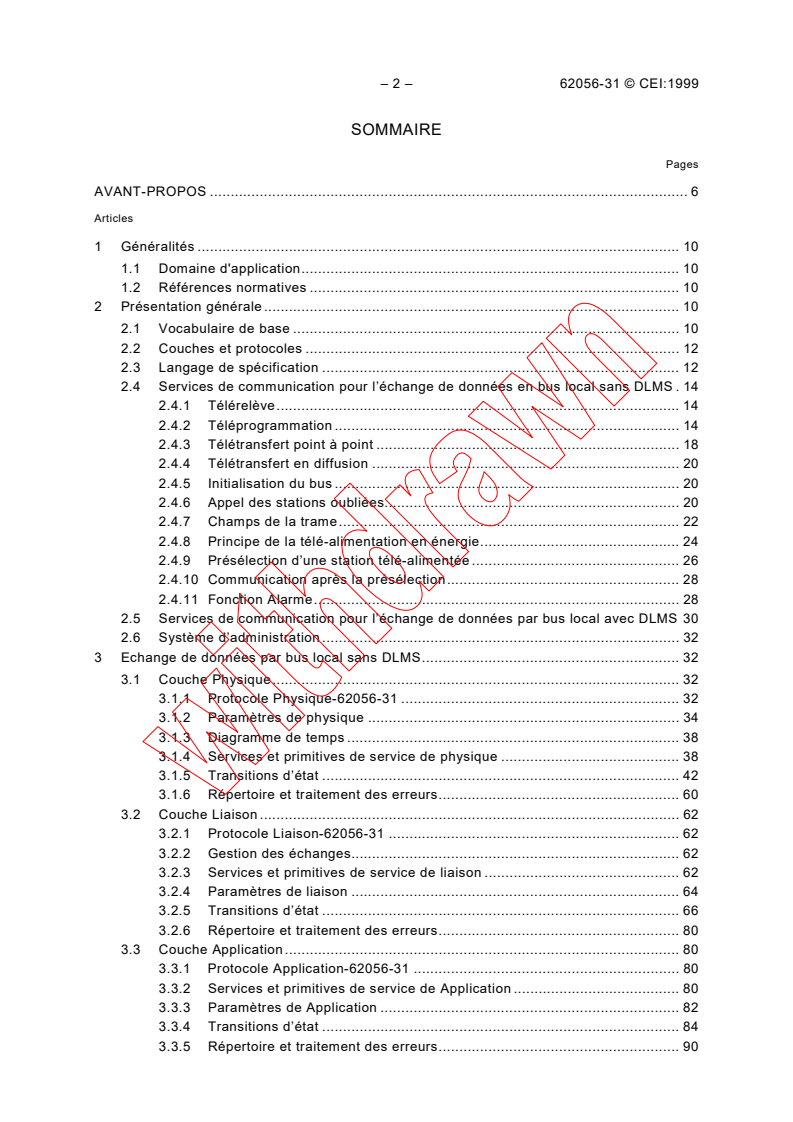
– 2 – 62056-31 © CEI:1999
SOMMAIRE
Pages
AVANT-PROPOS . 6
Articles
1 Généralités .10
1.1 Domaine d'application. 10
1.2 Références normatives . 10
2 Présentation générale. 10
2.1 Vocabulaire de base . 10
2.2 Couches et protocoles . 12
2.3 Langage de spécification . 12
2.4 Services de communication pour l’échange de données en bus local sans DLMS . 14
2.4.1 Télérelève. 14
2.4.2 Téléprogrammation . 14
2.4.3 Télétransfert point à point . 18
2.4.4 Télétransfert en diffusion . 20
2.4.5 Initialisation du bus . 20
2.4.6 Appel des stations oubliées. 20
2.4.7 Champs de la trame. 22
2.4.8 Principe de la télé-alimentation en énergie. 24
2.4.9 Présélection d’une station télé-alimentée . 26
2.4.10 Communication après la présélection. 28
2.4.11 Fonction Alarme. 28
2.5 Services de communication pour l’échange de données par bus local avec DLMS 30
2.6 Système d’administration . 32
3 Echange de données par bus local sans DLMS. 32
3.1 Couche Physique. 32
3.1.1 Protocole Physique-62056-31 . 32
3.1.2 Paramètres de physique . 34
3.1.3 Diagramme de temps . 38
3.1.4 Services et primitives de service de physique . 38
3.1.5 Transitions d’état . 42
3.1.6 Répertoire et traitement des erreurs. 60
3.2 Couche Liaison . 62
3.2.1 Protocole Liaison-62056-31 . 62
3.2.2 Gestion des échanges. 62
3.2.3 Services et primitives de service de liaison . 62
3.2.4 Paramètres de liaison . 64
3.2.5 Transitions d’état . 66
3.2.6 Répertoire et traitement des erreurs. 80
3.3 Couche Application. 80
3.3.1 Protocole Application-62056-31 . 80
3.3.2 Services et primitives de service de Application . 80
3.3.3 Paramètres de Application . 82
3.3.4 Transitions d’état . 84
3.3.5 Répertoire et traitement des erreurs. 90
62056-31 © IEC:1999 – 3 –
CONTENTS
Page
FOREWORD . 7
Clause
1 General. 11
1.1 Scope . 11
1.2 Normative references. 11
2 General description. 11
2.1 Basic vocabulary. 11
2.2 Layers and protocols. 13
2.3 Specification language. 13
2.4 Communication services for local bus data exchange without DLMS. 15
2.4.1 Remote reading exchange . 15
2.4.2 Remote programming exchange. 15
2.4.3 Point to point remote transfer exchange. 19
2.4.4 Broadcast remote transfer frame. 21
2.4.5 Bus initialization frame. 21
2.4.6 Forgotten station call exchange . 21
2.4.7 Frame fields. 23
2.4.8 Principle of the energy remote supply . 25
2.4.9 Non-energized station preselection exchange . 27
2.4.10 Communication exchange after preselection . 29
2.4.11 Alarm function. 29
2.5 Communication services for local bus data exchange with DLMS. 31
2.6 Systems management. 33
3 Local bus data exchange without DLMS. 33
3.1 Physical layer . 33
3.1.1 Physical-62056-31 protocol. 33
3.1.2 Physical parameters. 35
3.1.3 Timing diagrams . 39
3.1.4 Physical services and service primitives. 39
3.1.5 State transitions. 43
3.1.6 List and processing of errors. 61
3.2 Data Link layer. 63
3.2.1 Link-62056-31 protocol . 63
3.2.2 Management of exchanges . 63
3.2.3 Data Link services and service primitives. 63
3.2.4 Data Link parameters. 65
3.2.5 State transitions. 67
3.2.6 List and processing of errors. 81
3.3 Application layer . 81
3.3.1 Application-62056-31 protocol. 81
3.3.2 Application services and service primitives . 81
3.3.3 Application parameters . 83
3.3.4 State transitions. 85
3.3.5 List and processing of errors. 91
– 4 – 62056-31 © CEI:1999
Articles Pages
4 Echange de données par bus local avec DLMS. 90
4.1 Couche Physique. 90
4.2 Couche Liaison . 90
4.2.1 Protocole Liaison-E/D . 90
4.2.2 Gestion des échanges. 92
4.2.3 Services et primitives de service de liaison . 92
4.2.4 Paramètres de liaison . 94
4.2.5 Transitions d’état . 96
4.2.6 Répertoire et traitement des erreurs. 112
4.3 Couche Application. 112
4.3.1 Sous-couche Transport . 112
4.3.2 Sous-couche Application. 112
5 Echange des données par bus en local – Spécifications matérielles . 114
5.1 Généralités . 114
5.2 Caractéristiques générales . 114
5.2.1 Signal de transmission à 50 kHz . 114
5.2.2 Signal pour l'alimentation en énergie. 118
5.2.3 Station Secondaire simple et Station Secondaire multiple . 122
5.3 Spécification du bus. 124
5.3.1 Caractéristiques générales. 124
5.3.2 Caractéristiques du câble. 126
5.3.3 Raccordements . 128
5.4 Couplage magnétique . 128
5.4.1 Fonction. 128
5.4.2 Caractéristiques mécaniques communes. 130
5.4.3 Diagramme électrique avec couplage simple. 132
5.4.4 Diagramme électrique avec couplage alimenté. 134
5.5 Spécifications fonctionnelles de l’émetteur de la Station Primaire . 134
5.6 Spécifications fonctionnelles du récepteur de la Station Primaire. 136
5.7 Spécifications fonctionnelles de l’émetteur de la Station Secondaire . 138
5.8 Spécifications fonctionnelles du récepteur de la Station Secondaire . 138
Annexe A (normative) Langage de spécification . 142
Annexe B (normative) Types et caractéristiques des temps. 148
Annexe C (normative) Liste des erreurs fatales . 152
Annexe D (normative) Codage du champ de commande des trames . 154
Annexe E (normative) Principe du CRC. 158
Annexe F (normative) Génération de nombres aléatoires pour la réponse des stations
oubliées . 160
Annexe G (normative) Génération de nombres aléatoires pour l’authentification
(architecture sans DLMS). 162
Annexe H (normative) Implémentation du service d’administration des systèmes . 164
Annexe I (informative) Précision sur les échanges . 166
62056-31 © IEC:1999 – 5 –
Clause Page
4 Local bus data exchange with DLMS. 91
4.1 Physical layer . 91
4.2 Data Link layer. 91
4.2.1 Link-E/D protocol . 91
4.2.2 Management of exchanges . 93
4.2.3 Data Link services and service primitives. 93
4.2.4 Data Link parameters. 95
4.2.5 State transitions. 97
4.2.6 List and processing of errors. 113
4.3 Application layer . 113
4.3.1 Transport sub-layer. 113
4.3.2 Application sub-layer. 113
5 Local bus data exchange – Hardware . 115
5.1 General. 115
5.2 General characteristics . 115
5.2.1 Signal transmission at 50 kHz . 115
5.2.2 Energy supply signal transmission . 119
5.2.3 Simple Secondary Station and multiple Secondary Station. 123
5.3 Bus specification. 125
5.3.1 General characteristics . 125
5.3.2 Cable characteristics. 127
5.3.3 Wiring . 129
5.4 Magnetic plug . 129
5.4.1 Function. 129
5.4.2 Common mechanical characteristics . 131
5.4.3 Electrical Block diagram with simple plug. 133
5.4.4 Electrical Block Diagram with energy supply plug. 135
5.5 Functional specifications of Primary Station transmitter (for 50 kHz signal). 135
5.6 Functional specifications of Primary Station receiver (for 50 kHz signal) . 137
5.7 Functional specification of Secondary Station transmitter (for 50 kHz signal) . 139
5.8 Functional specifications of Secondary Station receiver (for 50 kHz signal) . 139
Annex A (normative) Specification language. 143
Annex B (normative) Timing types and characteristics. 149
Annex C (normative) List of fatal errors . 153
Annex D (normative) Coding the command code field of frames . 155
Annex E (normative) Principle of the CRC . 159
Annex F (normative) Random integer generation for response from forgotten stations. 161
Annex G (normative) Random number generation for authentication (architecture without
DLMS). 163
Annex H (normative) Systems management implementation. 165
Annex I (informative) Information about exchanges . 167
– 6 – 62056-31 © CEI:1999
COMMISSION ÉLECTROTECHNIQUE INTERNATIONALE
–––––––––––
COMPTAGE DE L’ÉLECTRICITÉ – ÉCHANGE DE DONNÉES POUR
LA LECTURE DES COMPTEURS, LE CONTRÔLE DES TARIFS ET
DE LA CHARGE –
Partie 31: Utilisation des réseaux locaux sur paire torsadée
avec signal de porteuse
AVANT-PROPOS
1) La CEI (Commission Electrotechnique Internationale) est une organisation mondiale de normalisation
composée de l'ensemble des comités électrotechniques nationaux (Comités nationaux de la CEI). La CEI a
pour objet de favoriser la coopération internationale pour toutes les questions de normalisation dans les
domaines de l'électricité et de l'électronique. A cet effet, la CEI, entre autres activités, publie des Normes
Internationales. Leur élaboration est confiée à des comités d'études, aux travaux desquels tout Comité national
intéressé par le sujet traité peut participer. Les organisations internationales, gouvernementales et non
gouvernementales, en liaison avec la CEI, participent également aux travaux. La CEI collabore étroitement
avec l'Organisation Internationale de Normalisation (ISO), selon des conditions fixées par accord entre les
deux organisations.
2) Les décisions ou accords officiels de la CEI en ce qui concerne les questions techniques, préparés par des
Comités d'Etudes où sont représentés tous les Comités nationaux s'intéressant à ces questions, expriment
dans la plus grande mesure possible un accord international sur les sujets examinés.
3) Ces décisions constituent des recommandations internationales publiées sous forme de normes, de rapports
techniques ou de guides et sont agréées comme telles par les Comités nationaux.
4) Dans le but d'encourager l'unification internationale, les Comités nationaux de la CEI s'engagent à appliquer de
façon transparente, dans toute la mesure possible, les Normes Internationales de la CEI dans leurs normes
nationales et régionales. Toute divergence entre la recommandation de la CEI et la règle nationale
correspondante doit être indiquée en termes clairs dans cette dernière.
5) La CEI n'a fixé aucune procédure concernant le marquage comme indication d'approbation et sa responsabilité
n'est pas engagée quand un matériel déclaré conforme à l'une de ses normes.
La Norme internationale CEI 62056-31 a été établie par le comité d’études 13 de la CEI:
Equipements de mesure de l’énergie électrique et de commande des charges.
Cette première édition de la CEI 62056-31 annule et remplace la première édition de la
CEI 61142 parue en 1993, et constitue une révision technique.
Le texte de cette norme est issu des documents suivants:
FDIS Rapport de vote
13/1194/FDIS 13/1203/RVD
Le rapport de vote indiqué dans le tableau ci-dessus donne toute information sur le vote ayant
abouti à l'approbation de cette norme.
La Commission Electrotechnique Internationale (CEI) attire l’attention sur le fait qu’il est
déclaré que la conformité aux dispositions de la présente Norme internationale peut impliquer
l’utilisation d’un brevet concernant le protocole sur lequel est basée la présente Norme
CEI 62056-31.
La CEI ne prend pas position quant à la preuve, la validité et la portée de ces droits de
propriété.
62056-31 © IEC:1999 – 7 –
INTERNATIONAL ELECTROTECHNICAL COMMISSION
____________
ELECTRICITY METERING – DATA EXCHANGE FOR METER READING,
TARIFF AND LOAD CONTROL –
Part 31: Use of local area networks on twisted pair
with carrier signalling
FOREWORD
1) The IEC (International Electrotechnical Commission) is a worldwide organization for standardization comprising
all national electrotechnical committees (IEC National Committees). The object of the IEC is to promote
international co-operation on all questions concerning standardization in the electrical and electronic fields. To
this end and in addition to other activities, the IEC publishes International Standards. Their preparation is
entrusted to technical committees; any IEC National Committee interested in the subject dealt with may
participate in this preparatory work. International, governmental and non-governmental organizations liaising
with the IEC also participate in this preparation. The IEC collaborates closely with the International
Organization for Standardization (ISO) in accordance with conditions determined by agreement between the
two organizations.
2) The formal decisions or agreements of the IEC on technical matters express, as nearly as possible, an
international consensus of opinion on the relevant subjects since each technical committee has representation
from all interested National Committees.
3) The documents produced have the form of recommendations for international use and are published in the form
of standards, technical reports or guides and they are accepted by the National Committees in that sense.
4) In order to promote international unification, IEC National Committees undertake to apply IEC International
Standards transparently to the maximum extent possible in their national and regional standards. Any
divergence between the IEC Standard and the corresponding national or regional standard shall be clearly
indicated in the latter.
5) The IEC provides no marking procedure to indicate its approval and cannot be rendered responsible for any
equipment declared to be in conformity with one of its standards.
International Standard IEC 62056-31 has been prepared by IEC technical committee 13:
Equipment for electrical energy measurement and load control.
This first edition of IEC 62056-31 cancels and replaces the first edition of IEC 61142,
published in 1993, and constitutes a technical revision.
The text of this standard is based on the following documents:
FDIS Report on voting
13/1194/FDIS 13/1203/RVD
Full information on the voting for the approval of this standard can be found in the report on
voting indicated in the above table.
The International Electrotechnical Commission (IEC) draws attention to the fact that it is
claimed that compliance with this International Standard may involve the use of a patent
concerning the stack of protocols on which the present standard IEC 62056-31 is based.
The IEC takes no position concerning the evidence, validity and scope of this patent right.
– 8 – 62056-31 © CEI:1999
Le détenteur de ces droits a donné l’assurance à la CEI qu’il consent à négocier des licences
avec des demandeurs du monde entier, en des termes et à des conditions raisonnables et
non discriminatoires. A ce propos, la déclaration du détenteur des droits de propriété est
enregistrée à la CEI. Des informations peuvent être obtenues auprès de:
Association EURIDIS,
Bureau P107, 1 Avenue du Général de GAULLE, 92141 Clamart Cedex, FRANCE
L’attention est par ailleurs attirée sur le fait que certains des éléments de la présente Norme
internationale peuvent faire l’objet de droits de propriété autres que ceux mentionnés ci-
dessus. La CEI ne saurait être tenue pour responsable de ne pas avoir dûment signalé tout
ou partie de ces droits de propriété.
Cette publication a été rédigée selon les Directives ISO/CEI, Partie 3.
Le comité a décidé que cette publication reste valable jusqu'en 2004.
A cette date, selon décision préalable du comité, la publication sera
• reconduite;
• supprimée;
• remplacée par une édition révisée, ou
• amendée.
Les annexes A, B, C, D, E, F, G et H font partie intégrante de cette norme.
L'annexe I est donnée uniquement à titre d'information.
62056-31 © IEC:1999 – 9 –
The holder of this patent right has assured the IEC that he is willing to negotiate licences
under reasonable and non-discriminatory terms and conditions with applicants throughout the
world. In this respect, the statement of the holder of this patent right is registered with the
IEC. Information may be obtained from:
EURIDIS Association
Bureau P107, 1 Avenue du Général de GAULLE, 92141 Clamart Cedex, FRANCE
Attention is drawn to the possibility that some of the elements of this International Standard
may be the subject of patent rights other than those identified above. IEC shall not be held
responsible for identifying any or all such patent rights.
This publication has been drafted in accordance with ISO/IEC Directives, Part 3.
The committee has decided that this publication remains valid until 2004.
At this date, in accordance with the committee's decision, the publication will be
• reconfirmed;
• withdrawn;
• replaced by a revised edition, or
• amended.
Annexes A, B, C, D, E, F, G and H form an integral part of this standard.
Annex I is for information only.
– 10 – 62056-31 © CEI:1999
COMPTAGE DE L’ÉLECTRICITÉ – ÉCHANGE DE DONNÉES POUR
LA LECTURE DES COMPTEURS, LE CONTRÔLE DES TARIFS ET
DE LA CHARGE –
Partie 31: Utilisation des réseaux locaux sur paire torsadée
avec signal de porteuse
1 Généralités
1.1 Domaine d'application
La présente partie de la CEI 62056 décrit deux nouvelles architectures d’échange de données
par bus en local avec des stations alimentées ou non en énergie. Pour les stations télé-
alimentées, c’est le bus qui fournit l’énergie pour l’échange des données.
La première architecture complète le protocole de base (CEI 61142) par des services de
téléprogrammation simplifiée alors que la seconde permet de mettre en œuvre les services
DLMS sur le même support physique et avec la même couche physique.
Cette totale compatibilité garantit qu’il est possible d’utiliser des équipements de type
CEI 61142 et CEI 62056-31 sur le même bus.
1.2 Références normatives
Les documents normatifs suivants contiennent des dispositions qui, par suite de la référence
qui y est faite, constituent des dispositions valables pour la présente Norme internationale.
Pour les références datées, les amendements ultérieurs ou les révisions de ces publications
ne s’appliquent pas. Toutefois, les parties prenantes aux accords fondés sur la présente
Norme internationale sont invitées à rechercher la possibilité d'appliquer les éditions les plus
récentes des documents normatifs indiqués ci-après. Pour les références non datées, la
dernière édition du document normatif en référence s’applique. Les membres de la CEI et de
l'ISO possèdent le registre des Normes internationales en vigueur.
CEI 62056-51:1998, Comptage de l’électricité – Echange de données pour la lecture des
compteurs, le contrôle des tarifs et de la charge – Partie 51: Protocoles de couche application
CEI 61334-4-41:1996, Automatisation de la distribution à l'aide de systèmes de
communication à courants porteurs – Partie 4: Protocoles de communication de données –
Section 41: Protocoles d'application – Spécification des messages de ligne de distribution
EIA 485:—, Standard for Electrical Characteristics of Generators and Receivers for Use in
Balanced Digital Multipoint Systems
ISO/IEC 8482:1993, Technologies de l’information – Télécommunications et échange
d’informations entre systèmes – Interconnexions multipoints par paire torsadée (Publiée
actuellement en anglais seulement)
2 Présentation générale
2.1 Vocabulaire de base
Toute communication fait intervenir deux équipements représentés par les expressions
Station Primaire et Station Secondaire. La Station Primaire est le système qui décide
62056-31 © IEC:1999 – 11 –
ELECTRICITY METERING – DATA EXCHANGE FOR METER READING,
TARIFF AND LOAD CONTROL –
Part 31: Use of local area networks on twisted pair
with carrier signalling
1 General
1.1 Scope
This part of IEC 62056 describes two new architectures for local bus data exchange with
stations either energized or not. For non-energized stations, the bus supplies energy for data
exchange.
The first architecture completes the base protocol (IEC 61142) with remote transfer services
while the second one allows operation of DLMS services using the same physical medium and
the same physical layer.
This complete compatibility guarantees the possibility of using IEC 61142 and IEC 62056-31
equipment on the same bus.
1.2 Normative references
The following normative documents contain provisions which, through reference in this text,
constitute provisions of this International Standard. For dated references, subsequent
amendments to, or revisions of, any of these publications do not apply. However, parties to
agreements based on this International Standard are encouraged to investigate the possibility
of applying the most recent editions of the normative documents indicated below. For undated
references, the latest edition of the normative document referred to applies. Members of IEC
and ISO maintain registers of currently valid International Standards.
IEC 62056-51:1998, Electricity metering – Data exchange for meter reading, tariff and load
control – Part 51: Application layer protocols
IEC 61334-4-41:1996, Distribution automation using distribution line carrier systems – Part 4:
Data communication protocols – Section 41: Application protocols – Distribution line message
specification
EIA 485: —, Standard for Electrical Characteristics of Generators and Receivers for Use in
Balanced Digital Multipoint Systems
ISO/IEC 8482:1993, Information technology – Telecommunications and information exchange
between systems – Twisted pair multipoint interconnections
2 General description
2.1 Basic vocabulary
All communication calls upon two systems called Primary Station and Secondary Station. The
Primary Station is the system that decides to initialize a communication with a remote system
called Secondary Station; these designations remain valid throughout the duration of the
communication.
– 12 – 62056-31 © CEI:1999
Une communication est décomposée en un certain nombre de transactions. Chaque
transaction se traduit par une émission de l'Emetteur vers le Récepteur. Au gré de
l'enchaînement des transactions, les systèmes Station Primaire et Station Secondaire jouent
tour à tour le rôle d'Emetteur et de Récepteur.
Dans le cas de l’architecture d’échange de données par bus local avec DLMS, les termes
Client et Serveur ont le même sens que dans le modèle DLMS (voir la CEI 61334-4-41). Le
Serveur (qui est obligatoirement une Station Secondaire) est le système qui se comporte
comme un VDE (voir la CEI 61334-4-41) pour toute soumission de requête de service
particulière. Le Client (qui est obligatoirement une Station Primaire) est le système qui utilise
le Serveur dans un but spécifique à l'aide d'une ou de plusieurs soumissions de requête de
service.
2.2 Couches et protocoles
L’architecture d’échange de données par bus local adopte un découpage en trois couches
réseau: Physique, Liaison et Application. Le protocole de la couche Physique est commun
aux deux architectures d’échanges de données par bus local, avec ou sans DLMS, ce qui
permet à tous les types de stations d’être installés sur le même bus.
Les couches Liaison et Application font l'objet de protocoles dont les noms sont donnés par le
tableau 1.
Tableau 1 – Architectures
Couches Protocoles
Architecture Application Application-62056-31
Sans DLMS Liaison Liaison-62056-31
Architecture DLMS+
Application Application+
Transport+
Avec DLMS Liaison Liaison-E/D
Les protocoles Transport+ et Application+ des sous-couches Transport et Application de la
couche Application sont décrits dans la CEI 62056-51.
Le protocole DLMS+ de la sous-couche DLMS de la couche Application est décrit dans la
CEI 61334-4-41.
2.3 Langage de spécification
Dans cette norme, le protocole de chaque couche est décrit par des transitions d'état
représentées sous forme de tableaux. La syntaxe utilisée pour la constitution de ces tableaux
est définie par un langage de spécification présenté à l'annexe A.
En cas de divergence d'interprétation entre une partie du texte et un tableau de transitions
d'état, c'est toujours le tableau qui fait référence.
62056-31 © IEC:1999 – 13 –
A communication is broken down into a certain number of transactions. Each transaction
consists of a transmission from the Transmitter to the Receiver. During the sequence of
transactions, the Primary Station and Secondary Station systems take turns to act as
Transmitter and Receiver.
For the local bus data exchange architecture with DLMS, the terms Client and Server have
the same meaning as for the DLMS model (refer to IEC 61334-4-41). The Server (which is a
Secondary Station) acts as a VDE (refer to IEC 61334-4-41) for the submission of special
service requests. The Client (which is a Primary Station) is the system that uses the Server
for a specific purpose by means of one or more service requests.
2.2 Layers and protocols
The local bus data exchange architecture uses a breakdown into three network layers:
Physical, Data Link and Application. The protocol corresponding to the Physical layer is the
same for both local bus data exchange architecture, with and without DLMS, allowing all kinds
of stations to be installed on the same bus.
The protocols corresponding to the Data Link and Application layers are defined in the table 1.
Table 1 – Architectures
Layers Protocols
Architecture Application Application-62056-31
Without DLMS Data Link Link-62056-31
Architecture DLMS+
Application Application+
Transport+
With DLMS Data Link Link-E/D
The Transport+ and Application+ protocols of the Transport and Application sub-layers of the
Application layer are described in IEC 62056-51.
The DLMS+ protocol of the DLMS sub-layer of the Application layer is described in
IEC 61334-4-41.
2.3 Specification language
In this standard, the protocol of each layer is described by state transitions represented in the
form of tables. The syntax used in making up these tables is defined by a specification
language described in annex A.
In the event of a difference in interpretation between part of the text and a state transition
table, the table is always taken as the reference.
– 14 – 62056-31 © CEI:1999
2.4 Services de communication pour l’échange de données en bus local sans DLMS
La liste des services disponibles est:
a) télérelève de données;
b) téléprogrammation de données;
c) télétransfert point à point, qui est un service de téléprogrammation simplifié;
d) télétransfert en diffusion;
e) initialisation du bus;
f) appel des stations oubliées.
2.4.1 Télérelève
L’échange de télérelève est constitué de deux trames en une seule séquence:
trame de télérelève contenant dans le champ TAB la référence des données à relever:
1 6 1 1 1 2
octet octets octet octet octet octet
s
-------------------> N ADS ADP COM TAB CRC
|
COM=ENQ (ENQuery)
trame d’acquittement positif contenant les données relevées dans le champ DATA:
1 6 1 1 1 0 à 116 2
octet octets octet octet octet octets octets
<------------------- N ADS ADP COM TAB DATA CRC
|
COM=DAT (DATa)
trame d’acquittement négatif (référence TAB inconnue)
1 6 1 1 2
octet octets octet octet octets
<------------------- N ADS ADP COM CRC
|
COM=DRJ (Data ReJected)
2.4.2 Téléprogrammation
L’échange REC est constitué de quatre trames en deux séquences. Comme il comporte une
séquence interne pour l’authentification, il apparaît du point de vue de l’application, comme
un échange de deux trames en une seule séquence:
trame de téléprogrammation contenant les données à programmer dans le champ DATA et
leur référence dans le champ TAB
1 6 1 1 8 8 1 0 à 100 2
octet octets octet octet octets octets octet octets octets
-------------------> N ADS ADP COM ZA1 ZA2 TAB DATA CRC
| NA1 0
COM=REC (RECeption)
62056-31 © IEC:1999 – 15 –
2.4 Communication services for local bus data exchange without DLMS
The list of available services is:
a) remote reading of data;
b) remote programming of data;
c) point to point remote transfer, which is a simplified remote programming service;
d) broadcast remote transfer;
e) bus initialization;
f) forgotten station call.
2.4.1 Remote reading exchange
The ENQ exchange consists of two frames arranged in one sequence:
remote reading frame containing the type of data to select in the TAB field
1 6 1 1 1 2
octet octets octet octet octet octets
-------------------> N ADS ADP COM TAB CRC
|
COM=ENQ (ENQuery)
positive acknowledgement
...