

IEC 60533:1999
(Main)Electrical and electronic installations in ships - Electromagnetic compatibility
General Information
- Abstract
Specifies minimum requirements for emission, immunity and performance criteria regarding electromagnetic compatibility (EMC) of electrical and electronic equipment for ships. It assists in meeting the requirements of IMO resolution A.813.
- Status
- Published
- Publication Date
- 15-Nov-1999
- Current Stage
- DELPUB - Deleted Publication
- Start Date
- 25-Aug-2015
- Completion Date
- 28-Aug-2026

Overview
IEC 60533:1999 - Electrical and electronic installations in ships – Electromagnetic compatibility - defines minimum requirements for electromagnetic compatibility (EMC) of shipboard electrical and electronic equipment. The standard specifies emission, immunity and performance criteria to ensure equipment operates correctly in the shipboard electromagnetic environment and helps meet IMO Resolution A.813. IEC 60533 is applicable across all ship installations and complements SOLAS and maritime navigation standards.
Key topics
- Scope and objective: Minimum requirements for emission, immunity and performance criteria for shipboard equipment; guidance on EMC planning across design and installation phases.
- EMC test plan: Configuration of equipment under test (EUT), test pre-conditioning, acceptance criteria and test reporting requirements.
- Emission requirements: Test conditions and emission limits to prevent undue electromagnetic influence between onboard systems.
- Immunity requirements: Conditions and minimum immunity performance (including handling of transients, radiated fields, conducted disturbances and power quality events).
- System aspects: Integration, interaction between equipment groups and system-level EMC considerations.
- Informative annexes:
- Annex A: IMO Resolution A.813 (1995) - general EMC requirements.
- Annex B: General EMC planning procedures - lifecycle planning, risk assessment.
- Annex C: Measures to achieve EMC - organizational and technical mitigation (layout, grounding, screening, filters).
- Normative references: Aligns test methods with CISPR 16 series and the IEC 61000 basic and testing standards, and cross-references IEC 60945 and ship installation parts (IEC 60092 series).
Applications and who uses it
IEC 60533 is practical for:
- Ship designers and naval architects - integrate EMC early in system design and cable routing.
- Marine equipment manufacturers - define product emission and immunity requirements for ship use.
- Shipyards and system integrators - implement installation measures, EMC testing and acceptance.
- Classification societies and regulators - assess compliance with IMO and SOLAS EMC expectations.
- EMC test laboratories and engineers - develop EMC test plans and produce compliant test reports.
Practical applications include EMC planning during design, specifying emission/immunity requirements for radar, navigation, power conversion, control systems and integrated shipboard systems, and guiding mitigation such as bonding, shielding and filtering.
Related standards
- IEC 61000 series (EMC testing & immunity methods)
- CISPR 16 (measurement apparatus and methods)
- IEC 60945 (maritime navigation & radiocommunication equipment)
- IEC 60092 series (ship electrical installations)
- IMO Resolution A.813 / SOLAS (maritime regulatory context)
IEC 60533 is essential for ensuring reliable, interoperable marine electronics and safe operation of modern ships in complex electromagnetic environments.
Relations
- Effective Date
- 25-Aug-2026
- Effective Date
- 25-Aug-2026
- Effective Date
- 10-Feb-2026
- Effective Date
- 10-Feb-2026
- Effective Date
- 10-Feb-2026
- Effective Date
- 10-Feb-2026
- Effective Date
- 05-Sep-2023
Get Certified
Connect with accredited certification bodies for this standard

DNV
DNV is an independent assurance and risk management provider.

Lloyd's Register
Lloyd's Register is a global professional services organisation specialising in engineering and technology.

FSC International
Forest Stewardship Council certification.
Sponsored listings
Frequently Asked Questions
IEC 60533:1999 is a standard published by the International Electrotechnical Commission (IEC). Its full title is "Electrical and electronic installations in ships - Electromagnetic compatibility". This standard covers: Specifies minimum requirements for emission, immunity and performance criteria regarding electromagnetic compatibility (EMC) of electrical and electronic equipment for ships. It assists in meeting the requirements of IMO resolution A.813.
Specifies minimum requirements for emission, immunity and performance criteria regarding electromagnetic compatibility (EMC) of electrical and electronic equipment for ships. It assists in meeting the requirements of IMO resolution A.813.
IEC 60533:1999 is classified under the following ICS (International Classification for Standards) categories: 33.100.10 - Emission; 47.020.60 - Electrical equipment of ships and of marine structures. The ICS classification helps identify the subject area and facilitates finding related standards.
IEC 60533:1999 has the following relationships with other standards: It is inter standard links to EN ISO 25197:2012, EN ISO 25197:2018, EN 60092-507:2015, EN 60092-507:2000, EN 62252:2004, EN 60945:2002, IEC 60533:2015. Understanding these relationships helps ensure you are using the most current and applicable version of the standard.
IEC 60533:1999 is available in PDF format for immediate download after purchase. The document can be added to your cart and obtained through the secure checkout process. Digital delivery ensures instant access to the complete standard document.
Standards Content (Sample)
INTERNATIONAL IEC
STANDARD
Second edition
1999-11
Electrical and electronic installations in ships –
Electromagnetic compatibility
Installations électriques et électroniques à bord des navires –
Compatibilité électromagnétique
Reference number
Numbering
As from 1 January 1997 all IEC publications are issued with a designation in the
60000 series.
Consolidated publications
Consolidated versions of some IEC publications including amendments are
available. For example, edition numbers 1.0, 1.1 and 1.2 refer, respectively, to the
base publication, the base publication incorporating amendment 1 and the base
publication incorporating amendments 1 and 2.
Validity of this publication
The technical content of IEC publications is kept under constant review by the IEC,
thus ensuring that the content reflects current technology.
Information relating to the date of the reconfirmation of the publication is available
in the IEC catalogue.
Information on the subjects under consideration and work in progress undertaken
by the technical committee which has prepared this publication, as well as the list
of publications issued, is to be found at the following IEC sources:
• IEC web site*
•
Catalogue of IEC publications
Published yearly with regular updates
(On-line catalogue)*
• IEC Bulletin
Available both at the IEC web site* and as a printed periodical
Terminology, graphical and letter symbols
For general terminology, readers are referred to IEC 60050: International
Electrotechnical Vocabulary (IEV).
For graphical symbols, and letter symbols and signs approved by the IEC for
general use, readers are referred to publications IEC 60027: Letter symbols to be
used in electrical technology, IEC 60417: Graphical symbols for use on equipment.
Index, survey and compilation of the single sheets and IEC 60617: Graphical symbols
for diagrams.
* See web site address on title page.
INTERNATIONAL IEC
STANDARD
Second edition
1999-11
Electrical and electronic installations in ships –
Electromagnetic compatibility
Installations électriques et électroniques à bord des navires –
Compatibilité électromagnétique
IEC 1999 Copyright - all rights reserved
No part of this publication may be reproduced or utilized in any form or by any means, electronic or
mechanical, including photocopying and microfilm, without permission in writing from the publisher.
International Electrotechnical Commission 3, rue de Varembé Geneva, Switzerland
Telefax: +41 22 919 0300 e-mail: inmail@iec.ch IEC web site http://www.iec.ch
Commission Electrotechnique Internationale
PRICE CODE
X
International Electrotechnical Commission
For price, see current catalogue
– 2 – 60533 © IEC:1999(E)
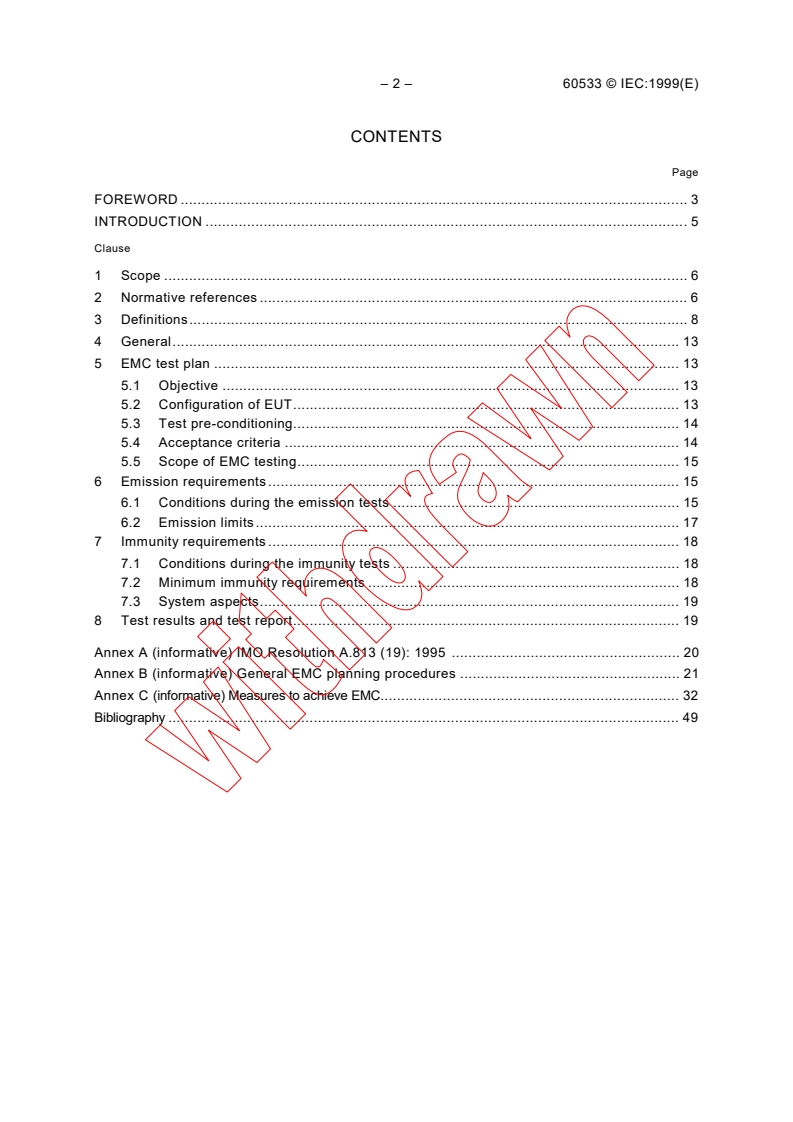
CONTENTS
Page
FOREWORD . 3
INTRODUCTION .5
Clause
1 Scope . 6
2 Normative references . 6
3 Definitions. 8
4 General. 13
5 EMC test plan . 13
5.1 Objective . 13
5.2 Configuration of EUT. 13
5.3 Test pre-conditioning. 14
5.4 Acceptance criteria . 14
5.5 Scope of EMC testing. 15
6 Emission requirements . 15
6.1 Conditions during the emission tests . 15
6.2 Emission limits. 17
7 Immunity requirements . 18
7.1 Conditions during the immunity tests . 18
7.2 Minimum immunity requirements . 18
7.3 System aspects. 19
8 Test results and test report. 19
Annex A (informative) IMO Resolution A.813 (19): 1995 . 20
Annex B (informative) General EMC planning procedures . 21
Annex C (informative) Measures to achieve EMC. 32
Bibliography . 49
60533 © IEC:1999(E) – 3 –
INTERNATIONAL ELECTROTECHNICAL COMMISSION
____________
ELECTRICAL AND ELECTRONIC INSTALLATIONS IN SHIPS –
ELECTROMAGNETIC COMPATIBILITY
FOREWORD
1) The IEC (International Electrotechnical Commission) is a worldwide organization for standardization comprising
all national electrotechnical committees (IEC National Committees). The object of the IEC is to promote
international co-operation on all questions concerning standardization in the electrical and electronic fields. To
this end and in addition to other activities, the IEC publishes International Standards. Their preparation is
entrusted to technical committees; any IEC National Committee interested in the subject dealt with may
participate in this preparatory work. International, governmental and non-governmental organizations liaising
with the IEC also participate in this preparation. The IEC collaborates closely with the International Organization for
Standardization (ISO) in accordance with conditions determined by agreement between the two organizations.
2) The formal decisions or agreements of the IEC on technical matters express, as nearly as possible, an
international consensus of opinion on the relevant subjects since each technical committee has representation
from all interested National Committees.
3) The documents produced have the form of recommendations for international use and are published in the form
of standards, technical specifications, technical reports or guides and they are accepted by the National
Committees in that sense.
4) In order to promote international unification, IEC National Committees undertake to apply IEC International
Standards transparently to the maximum extent possible in their national and regional standards. Any
divergence between the IEC Standard and the corresponding national or regional standard shall be clearly
indicated in the latter.
5) The IEC provides no marking procedure to indicate its approval and cannot be rendered responsible for any
equipment declared to be in conformity with one of its standards.
6) Attention is drawn to the possibility that some of the elements of this International Standard may be the subject
of patent rights. The IEC shall not be held responsible for identifying any or all such patent rights.
International Standard IEC 60533 has been prepared by IEC technical committee18: Electrical
installations of ships and of mobile and fixed offshore units.
This second edition cancels and replaces the first edition, published in 1977, and constitutes a
technical revision.
The following changes have been made:
– Section 7 "Methods of measurement and suppression techniques" has been deleted.
The methods of measurement have been aligned with CISPR 16-1, CISPR 16-2 and
the IEC 61000 series. The requirements of IEC 60945 and IEC 60092-101, IEC 60092-204
and IEC 60092-504 have been incorporated as far as possible.
– A new annex A "IMO Resolution A.813 (19) has been added as an informative part.
– A new annex B "General EMC planning procedures" has been prepared as an informative
part of this standard.
– A new annex C "Measures to achieve EMC" has been prepared as an informative part of
this standard. It contains guidelines and recommendations for organizational and technical
measures to achieve EMC.
– Equipment and installation groups A to E have been updated to include "non-electrical
items and equipment" and "integrated systems" in annex C.
– Chapter II "Vital interference suppression components" has been deleted. This topic is now
sufficiently described in the referenced IEC standards given in annex C.
– 4 – 60533 © IEC:1999(E)
The text of this standard is based on the following documents:
FDIS Report on voting
18/870/FDIS 18/874/RVD
Full information on the voting for the approval of this standard can be found in the report on
voting indicated in the above table.
This publication has been drafted in accordance with the ISO/IEC Directives, Part 3.
Annexes A, B and C are for information only.
A bilingual version of this standard may be issued at a later date.
The committee has decided that this publication remains valid until 2004-01.
At this date, in accordance with the committee’s decision, the publication will be
• reconfirmed;
• withdrawn;
• replaced by a revised edition, or
• amended.
60533 © IEC:1999(E) – 5 –
INTRODUCTION
Electrical installations of ships with electric and/or electronic systems need to operate under a
wide range of environmental conditions.
The control of undesired electromagnetic emission ensures that no other device on board will
be unduly influenced by the equipment under consideration. Suitable limits are specified.
On the other hand, the equipment needs to function without degradation in the normal elec-
tromagnetic environment. The limit values for immunity, specified in this standard, have been
chosen under this assumption. Equipment which is tested and installed in accordance with this
standard meets the relevant IMO requirements. Special risks, for instance lightning strikes,
transients from the operation of circuit breakers and electromagnetic radiation from radio
transmitters are also covered.
Complex electric and/or electronic systems require EMC planning in all phases of design
and installation, considering the electromagnetic environment, any special requirements and the
equipment performance.
This second edition is applicable to electromagnetic compatibility of all electrical and electronic
installations in ships.
– 6 – 60533 © IEC:1999(E)
ELECTRICAL AND ELECTRONIC INSTALLATIONS IN SHIPS –
ELECTROMAGNETIC COMPATIBILITY
1 Scope
This International Standard specifies minimum requirements for emission, immunity and perform-
ance criteria regarding electromagnetic compatibility (EMC) of electrical and electronic equipment
for ships. It assists in meeting the requirements of IMO resolution A.813 (see annex A).
Equipment which is tested and installed in accordance with this standard meets the relevant
IMO requirements.
NOTE 1 The normative part of this standard has been prepared as a product family EMC standard.
NOTE 2 Effects on human beings are not the subject of this standard.
This standard further gives guidelines and recommendations on the measures to achieve EMC
in the electrical and electronic installations of equipment groups:
a) group A: radio communication and navigation equipment;
b) group B: power generation and conversion equipment;
c) group C: equipment operating with pulsed power;
d) group D: switchgear and control systems;
e) group E: intercommunication and signal processing equipment;
f) group F: non-electrical items and equipment;
g) group G: integrated systems.
The basic EMC standard for groups A and C is IEC 60945.
NOTE This standard does not specify unsafe operation and basic safety requirements such as protection against
electric shock and dielectric tests for equipment.
2 Normative references
The following normative documents contain provisions which, through reference in this text,
constitute provisions of this International Standard. For dated references, subsequent
amendments to, or revisions of, any of these publications do not apply. However, parties to
agreements based on this International Standard are encouraged to investigate the possibility
of applying the most recent editions of the normative documents indicated below. For undated
references, the latest edition of the normative document referred to applies. Members of IEC
and ISO maintain registers of currently valid International Standards.
IEC Guide 107: Electromagnetic compatibility – Guide to the drafting of electromagnetic
compatibility publications
IEC 60050(161): International Electrotechnical Vocabulary (IEV) – Chapter 161: Electro-
magnetic compatibility
IEC 60092-101: Electrical installations in ships – Part 101: Definitions and general
requirements
60533 © IEC:1999(E) – 7 –
IEC 60092-201: Electrical installations in ships – Part 201: System design – General
IEC 60092-504: Electrical installations in ships – Part 504: Special features – Control and
instrumentation
IEC 60945: Maritime navigation and radiocommunication equipment and systems – General
requirements – Methods of testing and required test results
IEC 61000-1-1: Electromagnetic compatibility (EMC) – Part 1: General – Section 1: Application
and interpretation of fundamental definitions and terms
IEC 61000-4-1: Electromagnetic compatibility (EMC) – Part 4: Testing and measurement
techniques – Section 1: Overview of immunity tests. Basic EMC Publication
IEC 61000-4-2: Electromagnetic compatibility (EMC) – Part 4: Testing and measurement
techniques – Section 2: Electrostatic discharge immunity test. Basic EMC Publication
IEC 61000-4-3: Electromagnetic compatibility (EMC) – Part 4: Testing and measurement
techniques – Section 3: Radiated, radio-frequency, electromagnetic field immunity test
IEC 61000-4-4: Electromagnetic compatibility (EMC) – Part 4: Testing and measurement
techniques – Section 4: Electrical fast transient/burst immunity test
IEC 61000-4-5: Electromagnetic compatibility (EMC) – Part 4: Testing and measurement
techniques – Section 5: Surge immunity test
IEC 61000-4-6: Electromagnetic compatibility (EMC) – Part 4: Testing and measurement
techniques – Section 6: Immunity to conducted disturbances, induced by radio-frequency fields
IEC 61000-4-11: Electromagnetic compatibility (EMC) – Part 4: Testing and measurement
techniques – Section 11: Voltage dips, short interruptions and voltage variations immunity tests
IEC 61000-4-16: Electromagnetic compatibility (EMC) – Part 4-16: Testing and measurement
techniques – Test for immunity to conducted, common mode disturbances in the frequency
range 0 Hz to 150 kHz
CISPR 16-1: Specification for radio disturbance and immunity measuring apparatus and
methods – Part 1: Radio disturbance and immunity measuring apparatus
CISPR 16-2: Specification for radio disturbance and immunity measuring apparatus and
methods – Part 2: Methods of measurement of disturbance and immunity
SOLAS, International Convention for the Safety of Life at Sea, 1974 (as amended)
IMO Resolution A.813 (19):1995, General requirements for electromagnetic compatibility
(EMC) for all electrical and electronic ship's equipment
– 8 – 60533 © IEC:1999(E)
3 Definitions
For the purpose of this International Standard, the following definitions apply. Generic
definitions can also be found in IEC 60050(161) and in IEC 61000-1-1.
Additional definitions, not included in IEC 60050(161) but nevertheless necessary for the
application of the different tests, are given in the Basic EMC publications.
3.1
electromagnetic compatibility; EMC (abbreviation)
the ability of an equipment or system to function satisfactorily in its electromagnetic environ-
ment without introducing intolerable electromagnetic disturbances to anything in that
environment [IEV 161-01-07]
3.2
electromagnetic influence
effect of electromagnetic quantities on electrical and electronic circuits, equipment, systems or
human beings
3.3
electromagnetic interference; EMI (abbreviation)
degradation of the performance of an equipment, transmission channel or system caused by an
electromagnetic disturbance
NOTE 1 The English words "interference" and "disturbance" are often used indiscriminately.
NOTE 2 In French, the term "perturbation électromagnétique" is also used with the meaning of "brouillage
électromagnétique". [IEV 161-01-06]
3.3.1
degradation (of performance)
an undesired departure in the operational performance of any device, equipment or system
from its intended performance
NOTE The term "degradation" can apply to temporary or permanent failure. [IEV 161-01-19]
3.3.2
loss of function
loss of function of a device beyond that permissible and where the function can be restored
only by technical measures. A special case of loss of function is destruction
NOTE Loss of function may be permanent or temporary:
– technical measures to correct permanent loss require the use of tools or spare parts;
– technical measures to correct temporary loss require simple operator actions such as resetting a computer or
reswitching.
3.4
electromagnetic disturbance
any electromagnetic phenomenon which may degrade the performance of a device, equipment
or system, or adversely affect living or inert matter
electromagnetic noise unwanted signal
NOTE An electromagnetic disturbance may be an , an or a change in the
propagation medium itself [IEV 161-01-05]
60533 © IEC:1999(E) – 9 –
3.5
emitter (of electromagnetic disturbance)
device, equipment or system which gives rise to voltages, currents or electromagnetic fields
that can act as electromagnetic disturbance [IEV 161-01-23]
3.6
susceptible device
device, equipment or system whose performance can be degraded by an electromagnetic
disturbance [IEV 161-01-24]
3.7
(electromagnetic) emission
the phenomenon by which electromagnetic energy emanates from a source [IEV 161-01-08]
3.8
immunity (to a disturbance)
the ability of a device, equipment or system to perform without degradation in the presence of
an electromagnetic disturbance [IEV 161-01-20]
3.9
coupling
interaction of circuits between which energy can be transferred from one to another
3.10
insertion loss
logarithmic ratio of the magnitude of the power which a load picks up when fed directly from the
power source, to the magnitude of the power which the load picks up after inserting a four-pole
device (for example a filter) between source and load
3.11
return loss
logarithmic ratio of the reciprocal value of the reflection factor r: a = 20 × lg ; r is the ratio of
r
return wave to forward wave
r a
NOTE = 0, = ∞, if the impedance of protection circuit is matched to the wave impedance of connected cable.
3.12
EMC analysis
compilation and interpretation of EMC data to determine the degree of influence with electrical
devices
3.13
electromagnetic interference matrix (EMI matrix)
matrix where emitters of disturbance are set against susceptible device of disturbance. At the
crosspoints of lines and columns the extent of electromagnetic interference is noted
3.14
equipment under test (EUT)
equipment (devices, appliances and systems) subjected to EMC (emission and immunity)
compliance tests
3.15
equipment or subsystem
a technical device intended to perform a given function, combining a number of sub-units,
electrically and mechanically
– 10 – 60533 © IEC:1999(E)
3.16
integrated system
combination of separate items of equipment interconnected for the intended performance of a
given function
EXAMPLE – Integrated cargo monitoring system with sensors and equipment in different zones.
3.17
system
set of devices and/or components which interact according to a design. A device and/or
component of a system can be another system (called subsystem). Such devices and/or com-
ponents (subsystems) may be:
– hardware
* controlling system;
* controlled system;
– software;
– human interaction.
NOTE The total ship with its equipment may be considered to be a system.
3.18
ground (earth)
ship's metallic structure and all other metal parts conductively interconnected
NOTE 1 For protective ground (protective earth) see 3.19.
NOTE 2 For EMC purposes interconnections between metal parts equalize the different potentials and require a low
impedance in the frequency range considered. The frequency range considered includes the operating as well as
the disturbing frequencies. This frequency range and the physical size of the electrical device determines the
achievable equalization of potentials and thus the effectiveness of the ground. The ground does not in all cases
meet the personnel safety requirements of the protective earth.
NOTE 3 For ships with non-metallic structure all conductively interconnected metal parts (including ground plate if
existing) form the common ground (earth).
3.19
protective ground (protective earth)
conductor, necessary as a protective measure against currents dangerous to the human body,
which electrically connects the conductive parts of the equipment casing with one or more of
the following:
– external conductive parts;
– main grounding (earthing) terminal;
– earth point of power distribution system, if existing;
– metallic casing of other equipment.
3.20
reference ground
conductor whose potential is that to which the potentials of other conductors refer
3.21
type test
EMC test for a sample item of equipment to ascertain that its design meets the requirements
expressed in this standard
60533 © IEC:1999(E) – 11 –
3.22
port
particular interface of an equipment with the external electromagnetic environment through
which disturbances may be suscepted or emitted (see figure 1)
NOTE Conductive interfaces may also consist of cables, grounding bonds, or mechanical interfaces such as pipes
and mounting provisions.
Enclosure port
I/O signal and
control port
AC power port
EQUIPMENT
DC power port
Ground port
IEC 1521/99
Figure 1 – Examples for ports
3.23
zones
areas characterized by sensitive and/or disturbing devices located therein (see figure 2):
– deck and bridge zone: area in close proximity to receiving and/or transmitting antennas
and the wheelhouse as well as the control rooms, characterized by equipment for inter-
communication, signal processing, radio communication and navigation, auxiliary equipment
and large openings in the metallic structure;
– general power distribution zone: area characterized by normal consumers;
– special power distribution zone: area characterized by propulsion systems, bow thrusters,
etc., producing emissions exceeding the limits given in table 3;
– accommodation zone: area of ships characterized by equipment, carried on board by
passengers, crew and other persons to be operated therein.
3.24
normal consumers
equipment for ships operation such as machinery, control equipment and small static converters
3.25
cable selection
cables of similar signal types and levels are selected and assigned to the same category
– 12 – 60533 © IEC:1999(E)
G
3 ~
Special power
special
distribution
power
zone
distribution
zone
or other
Or other way
way of
M
M
of decoupling
decoupling
3 ~
3 ~
Propulsion systems,
propulsion systems,
bow thruster, etc.
bow thruster etc.
450 V
450 V
General
general
power
Normal
power
normal
distribution
consumers
distribution
consumers
zone
zone
230 V
230 V
M
Or other
3 ~
or other
way of
way of
Normal
normal
decoupling
G decoupling
consumers
consumers
3 ~
230 V
230 V
115 V
115 V
Passenger
passenger
accommodation zone
accommodation zone
Deck and
230 V
deck & bridge
230 V
bridge zone
zone
Radiocommunication and navigation,
radio communication and navigation
intercommunication, signal processing, etc.
intercommunication, signal processing etc.
IEC 1522/99
Figure 2 – Schematic diagram of zones (example)
60533 © IEC:1999(E) – 13 –
3.26
cable separation
cables of different categories routed with intermediate free space in order to reduce inter-
ference crosstalk
4 General
Ships’ equipment and systems can be subjected to various kinds of electromagnetic distur-
bances conducted by power or control lines or directly by the radiated environment. The types
and levels of disturbances depend on the particular conditions in which the system, the
subsystems or the equipment are installed and have to operate.
The individual equipment of a ship can also be a source of electromagnetic disturbances over a
wide frequency range, conducted through power and signal lines, or directly radiated, affecting
the performance of other equipment or influencing the external electromagnetic environment.
The acceptance criteria for the tests for immunity requirements are related to performance
criteria which are defined in terms of operational requirements.
For the emission limits, the objective of these requirements is to ensure that the disturbances
generated by the equipment and systems do not exceed a level which could prevent other
equipment and systems from operating as intended.
NOTE 1 The minimum immunity requirements in clause 7 represent a typical electromagnetic environment and
have been selected so as to ensure an adequate level of immunity for ships.
NOTE 2 The emission limits of this standard may not, however, provide adequate protection against interference to
radio receivers when other ship equipment is used closer than 3 m to the receiving antenna (see annex B).
NOTE 3 In special cases, for instance when highly susceptible equipment is being used closer than 3 m to a
transmitting antenna, additional mitigation measures may have to be employed to increase the electromagnetic
immunity beyond the limits specified in clause 7.
5 EMC test plan
5.1 Objective
Prior to performing the tests, an EMC test plan shall be established. It shall contain as a mini-
mum the elements given in 5.2 to 5.5.
Tests detailed in this standard are normally conducted as type tests and shall be carried out
whenever possible at an EMC test laboratory. For EMC test procedures, reference is made to
IEC basic standards. However, in cases where type tests are impracticable (dimension of EUT,
functional control, etc.), individual tests may be performed, if necessary in situ, in accordance
with a tailored test procedure.
5.2 Configuration of EUT
5.2.1 General
Ships' systems are not uniform assemblies. The type, number and installation of equipment,
whether installed individually or integrated, may vary from system to system. Hence it is not
reasonable to test every possible arrangement, however, it is recommended to carry out type tests.
For a realistic simulation of the EMC situation (related both to emission and immunity) an
assembly of EUT with its auxiliary equipment, such as cabling, power supplies, etc. shall be
built to represent a realistic installation. This assembly shall be operated as far as possible
under normal conditions (including the software).
– 14 – 60533 © IEC:1999(E)
5.2.2 Assembly of EUT
If the EUT to be type tested is a system, subsystem or equipment likely to be installed at
distributed locations, one or more typical configurations with all components of the EUT shall
be chosen to reproduce the real installations. A justification for the chosen configurations shall be
provided in the EMC test plan.
NOTE The type test certificate issued after the test is valid only for the EUT composition listed in the EMC test plan.
5.2.3 EUT interconnecting cables
A sufficient number of interconnecting cables shall be selected. At least one of each type of
interconnecting cables shall be used during testing in a representative configuration.
Interconnecting cables shall be standardized types (see table C.1). Where special cables are
required, the manufacturer of the EUT should provide the specification.
5.2.4 Auxiliary equipment
A list of all auxiliary equipment shall be provided. The auxiliary equipment enumerated shall be
sufficient to simulate all realistic operational conditions and to ensure that all feasible types of
operation can be performed.
5.2.5 Cabling and grounding
The EUT shall be connected with all necessary cables and connected to ground in accordance
with the manufacturer's specifications and the installation requirements. There shall be no
additional grounding connections.
5.3 Test pre-conditioning
5.3.1 Operational conditions
Typical operating modes of the EUT shall be defined by the manufacturer before testing,
considering that only the most typical functions of the equipment can be tested, for example
analogue signals at 0 %, 50 % and 100 % magnitude, or digital signals with typical impulse
trains. Particular attention shall be paid to the choice of critical mode.
5.3.2 Environmental conditions
EMC tests shall be conducted under normal environmental conditions. Normal environmental
conditions shall consist of any convenient combination of temperature in the range +15 °C
to +45 °C and relative humidity in the range 20 % to 75 %.
When it is impractical to perform the tests under the environmental conditions defined above, a
note to this effect stating the actual environmental conditions prevailing during the tests shall
be appended to the test report.
5.3.3 Test software
The test software used for different modes of operation shall be identified.
5.4 Acceptance criteria
Pass/fail criteria for each port and test shall be specified. The acceptance criteria shall be
specified as quantitative values where possible.
60533 © IEC:1999(E) – 15 –
For evaluation, the performance criteria are as follows:
Performance criterion A
The EUT shall continue to operate as intended during and after the test. No degradation of
performance or loss of function is allowed as defined in the relevant equipment standard
and in the technical specification published by the manufacturer.
Performance criterion B
The EUT shall continue to operate as intended after the test. No degradation of
performance or loss of function is allowed as defined in the relevant equipment standard
and in the technical specification published by the manufacturer. During the test,
degradation or loss of function or performance which is self-recoverable is however allowed
but no change of actual operating state or stored data is allowed.
Performance criterion C
Temporary degradation or loss of function or performance is allowed during and after the
test, provided the function is self-recoverable, or can be restored by the operation of
the controls as defined in the relevant equipment standard and in the technical specification
published by the manufacturer.
5.5 Scope of EMC testing
Each test to be applied shall be specified in the EMC test plan based on the equipment test
matrix in table 1. The description of tests, the test methods, the characteristics of the tests
and the test set-ups are given in the basic standards which are referred to in 6.2 and 7.2.
In addition, information needed for the practical implementation of the tests are given in this
standard. In some cases the EMC test plan should specify the application in detail.
Performance criteria for the individual tests are given in table 1.
NOTE Normally, no additional EMC tests are required beyond those stated in this standard.
6 Emission requirements
6.1 Conditions during the emission tests
Measurements shall be made with the EUT in the operating condition that produces the highest
emission level in the frequency band being investigated (see clause 5).
NOTE 1 The conducted emission limits covered here are given on a port-by-port basis.
NOTE 2 The radiated emission requirements within the range of receiving frequencies presume in the bridge and
deck zone a minimum distance of 3 m between the emitters and the receiving antennas. For smaller distances, an
extra compatibility analysis is necessary.
Measurements shall be performed in well-defined and reproducible conditions for each type of
emissions.
The description of the tests, the test methods and the test set-ups are given in the basic
standards as stated in tables 2 and 3. Measurements shall be performed with a quasi peak
detector.
The measuring bandwidth of CISPR 16-1 is 200 Hz in the frequency range 10 kHz to 150 kHz,
9 kHz in the frequency range 150 kHz to 30 MHz and 120 kHz in the frequency range 30 MHz
to 2 000 MHz. According to IEC 60945 the measuring bandwidth shall be 9 kHz in the
frequency range 156 MHz to 165 MHz.
– 16 – 60533 © IEC:1999(E)
Table 1 – Equipment test matrix
(x: test required; -: test not required)
E quipm en t- an d E xam ples of ap plicable devices
installatio n group s
R adio com m unication and navigation M aritim e radiocom m unication and Transm itters and receivers for m aritim e
xx xx xx xx xx
A equipm ent navigation equipm ent and system s radiocom m unication and navigation services
B P ow er generation and conversion E lectric m achinery Induction m otors/generators -- -- --- -- -
equipm ent S ynchronous m achines x x -- --- -- -
D C -m achines x x -- --- -- -
E l. m achines controlled by electronic equipm ent x x x x x x x x x x
S pecial electrical m achines x x x x x x x x x x
E lec tronic exiters A V R 's: A utom atic V oltage R egulators xx xx xx xx xx
A V R 's - additional equipm ent xx xx xx xx xx
C onverters C yclo-converters xx xx xx xx xx
S ynchro-converters (D C -link) xx xx xx xx xx
P ulse-w idth-converters
xx xx xx xx xx
DC-converters xx xx xx xx xx
Transform ers -- -- --- -- -
C E quipm ent operating w ith pulsed pow er M aritim e navigation equipm ent R adar and sonar system s, echosounders xx xx xx xx xx
D S w itchgear and control system s C ircuitbreakers/contactors w ithout electronics -- x - --- -- -
E lectronic control devices xx xx xx xx xx
R elay operated control devices
-- -- x - x -- -
E Intercom m unication and signal processing
E lectronic alarm m onitor xx xx xx xx xx
equipm ent
E lectronic control system xx xx xx xx xx
A utom ation system xx xx xx xx xx
C om puters, sensors xx xx xx xx xx
N on-electrical item s and equipm ent
F R igging G eneration of parasitic broadband interference not applicable
G Integrated system s C argo m onitoring system w ith sensors Tests on individual equipm ent/system s x x x x x x x x x x
and equipm ent in different zones
Integrated N avigation S ystem (IN S ) Tests on individual equipm ent/system s x x x x x x x x x x
Integrated B ridge S ystem (IB S ) Tests on individual equipm ent/system s xx xx xx xx xx
Group
Conducted emission CISPR 16-2
Radiated emission CISPR 16-2
Conducted low frequency
IEC 61000-4-16
interference
Power supply variation IEC 61000-4-11
Power supply failure IEC 61000-4-11
Electrical fast transients IEC 61000-4-4
Surge voltage IEC 61000-4-5
Conducted radio frequency
IEC 61000-4-6
interference
Electrostatic discharge (ESD) IEC 61000-4-2
Electromagnetic field IEC 61000-4-3
60533 © IEC:1999(E) – 17 –
6.2 Emission limits
NOTE 1 Equipment not permanently installed which is intended to operate in the passenger accommodation zone
is not required to comply with any emission limits.
NOTE 2 Precautions should be taken for a sufficient decoupling of the accommodation zone from all other zones.
6.2.1 Emission limits for equipment installed in the bridge and deck zone
Table 2 – Emission limits
Port Frequency range Limits Basic standard
Enclosure 150 kHz to 300 kHz 80 dBμV/m to 52 dBμV/m CISPR 16-1 *
(radiated emission)
300 kHz to 30 MHz 52 dBμV/m to 34 dBμV/m CISPR 16-2 *
30 MHz to 2 GHz 54 dBμV/m
except:
156 MHz to 165 MHz 24 dBμV/m
Power, I/O 10 kHz to 150 kHz 96 dBμV to 50 dBμV CISPR 16-1
signal and control
CISPR 16-2
(conducted emission)
150 kHz to 350 kHz 60 dBμV to 50 dBμV
350 kHz to 30 MHz 50 dBμV
* Measured in a distance of 3 m.
6.2.2 Emission limits for equipment installed in the general power distribution zone
Table 3 – Emission limits
Port Frequency range Limits Basic standard
Enclosure 150 kHz to 30 MHz 80 dBμV/m to 50 dBμV/m CISPR 16-1 *
(radiated emission)
30 MHz to 100 MHz 60 dBμV/m to 54 dBμV/m CISPR 16-2 *
100 MHz to 2 000 MHz 54 dBμV/m
except:
156 MHz to 165 MHz 24 dBμV/m
Power, I/O 10 kHz to 150 kHz 120 dBμV to 69 dBμV CISPR 16-1
signal and control
150 kHz to 500 kHz 79 dBμV CISPR 16-2
(conducted emission)
500 kHz to 30 MHz 73 dBμV
* Measured in a distance of 3 m.
NOTE 1 Between the bridge and deck zone and the general power distribution zone an RFI filter should be
installed in the power supply circuit (see figure 2) capable of achieving a decoupling of about 30 dB in the
frequency range of 10 kHz to 30 MHz.
NOTE 2 Between the general power distribution zone and the special power distribution zone, a decoupling
device should be installed in the power supply circuit (see figure 2) capable of achieving a decoupling equivalent
to the difference of the limits of the general power distribution zone and the existing emissions of equipment
installed in the special power distribution zone.
– 18 – 60533 © IEC:1999(E)
6.2.3 Emission limits for equipment installed in the special power distribution zone
For the special power distribution zone where semiconductors are connected having a total
system rating representing a significant portion of the total system rating it may not be feasible
to suppress the low frequency as well as the high frequency harmonics. Appropriate measures
should be taken to attenuate these effects on the distribution system so that safe operation is
assured. Care should be taken in selecting consumers supplied from an electric power supply
system with a higher harmonic content than specified.
NOTE An agreement should be reached between the manufacturer of the equipment and the user.
Further requirements are not defined for equipment installed in this zone.
7 Immunity requirements
7.1 Conditions during the immunity tests
The measurements shall be made with the EUT operating such that any reaction to the tests
allows the required performance criteria to be recognized (see clause 5).
The configuration and modes of operation during immunity tests shall be precisely noted in the test report.
Tests shall be applied to the relevant ports according to table 4.
The tests shall be performed in accordance with the basic standards.
7.2 Minimum immunity requirements
The minimum immunity requirements and tests are given in table 4.
Table 4 – Minimum immunity requirements for ship equipment
Port Phenomenon Basic Per- Test value
standard formance
criteria
AC power Conducted low IEC 61000-4-16 A 10 % AC supply voltage 50 Hz to 900 Hz;
frequency interference 10 % to 1 % 900 Hz to 6 000 Hz;
1 % 6 kHz to 10 kHz
Power supply variation IEC 61000-4-11 A voltage: ±20 % for 1,5 s
frequency: ±10 % for 5 s
Power supply failure IEC 61000-4-11 C 60 s interruption
3)
Electrical fast transient IEC 61000-4-4 B 2 kV
(burst)
1) 2)
Surge voltage IEC 61000-4-5 B 0,5 kV /1 kV
3) 6)
Conducted radio IEC 61000-4-6 A 3 Vrms ; (10 kHz) 150 kHz to 80 MHz
–3 7)
frequency interference sweep rate ≤1,5 × 10 decade/s
modulation 80 % AM (1 kHz)
DC power Conducted low IEC 61000-4-16 A 10 % DC supply voltage 50 Hz to 10 kHz
frequency interference
Power supply variation IEC 61000-4-11 A Voltage + 20 % / – 25 % equipment non-
connected to battery
Power supply failure IEC 61000-4-11 C 60 s interruption
3)
Electrical fast transient IEC 61000-4-4 B 2 kV
(burst)
1) 2)
Surge voltage IEC 61000-4-5 B 0,5 kV /1 kV
3) 6)
Conducted radio IEC 61000-4-6 A 3 Vrms ; (10 kHz) 150 kHz to 80 MHz
–3 7)
frequency interference sweep rate ≤1,5 × 10 decade/s
modulation 80 % AM (1 kHz)
60533 © IEC:1999(E) – 19 –
Table 4 – (continued)
Port Phenomenon Basic Per- Test value
standard formance
criteria
4)
I/O ports, Electrical fast transient IEC 61000-4-4 B 1 kV
Signal/control (burst)
3) 6)
Conducted radio IEC 61000-4-6 A 3 Vrms ; (10 kHz) 150 kHz to 80 MHz
–3
frequency interference sweep rate ≤1,5 × 10 decade/s
modulation 80 % AM (1 kHz)
Enclosure Electrostatic discharge IEC 61000-4-2 B 6 kV contact/8 kV air
(ESD)
5)
Electromagnetic field IEC 61000-4-3 A 10 V/m
80 MHz to 2 GHz
–3
sweep rate ≤1,5 × 10 decade/s
modulation 80 % AM (1 kHz)
NOTE 1 Equipment not permanently installed which is intended to operate in the passenger accommodation zone is
not required to comply with any immunity requirements.
NOTE 2 Precautions should be taken for a sufficient decoupling of the passenger accommodation zone from all
other zones.
1)
Line to line.
2)
Line to ground.
3)
Capacitive coupling.
4)
Coupling clamp.
5)
Special situations to be analyzed.
6)
Test procedure to be described in the test report.
7)
For equipment installed in the bridge and deck zone the test levels shall be increased to 10 V r.m.s. for spot fre-
quencies in accordance with IEC 60945 at 2/3/4/6,2/8,2/12,6/16,5/18,8/22/25 MHz. For screened cables a special
test set-up shall be used enabling the coupling into the cable screen.
7.3 System aspects
If higher levels or tests of other phenomena under special system aspects are necessary
(for example equipment very close to transmitting antenna) the immunity shall be increased or
mitigation measures in the installation shall be applied.
8 Test results and test report
The test results shall be recorded in a comprehensive test report. The test report shall
accurately, clearly, unambiguously and objectively present the objective, the results and all
relevant information of the tests. The test report shall clearly define the EUT, including the
cable layout, cable types and the auxiliary equipment used. Any deviation from the EMC test
plan shall be mentioned.
– 20 – 60533 © IEC:1999(E)
Annex A
(informative)
IMO Resolution A.813 (19): 1995
60533 © IEC:1999(E) – 21 –
Annex B
(informative)
General EMC planning procedures
B.1 Introduction
This annex contains guidelines for achieving EMC for ships and their equipment. The general
procedures for achieving EMC are described.
By using this standard, an adequate consideration of EMC matters in the planning, construction
and operation stages can be reached. This allows EMC measures to be realized in timely
fashion during the course of the project, whilst respecting the necessary coordination.
During the lifetime of the ship, it is important that the EMC is not impaired by maintenance
procedures and that, for modifications and extensions, maintenance is achieved by the
application of minimum requirements.
B.2 General procedures
The aim of this annex is to support the manufacturer responsible for the overall performance of
the ship in achieving the EMC of the system. Since EMC is a quality related feature, it is
necessary to treat it in the same way as general quality assurance.
Depending on the complexity of the system, EMC management needs to control and monitor
the following activities for achieving EMC:
– EMC analysis;
– planning and performing EMC measures;
– checking EMC measures on equipment;
– checking implementation and effectiveness of EMC measures in the system;
– ensuring EMC measures remain effective during the system's lifetime.
B.3 EMC management
B.3.1 General
For most merchant ships, EM
...