

IEC 62873-2:2016
(Main)Residual current operated circuit-breakers for household and similar use - Part 2: Residual current devices (RCDs) - Vocabulary
General Information
- Abstract
IEC 62873-2:2016(E) provides the terms and definitions used in RCD product standards.
- Status
- Published
- Publication Date
- 06-Sep-2016
- Technical Committee
- SC 23E - Circuit-breakers and similar equipment for household use
- Drafting Committee
- WG 2 - TC 23/SC 23E/WG 2
- Current Stage
- PPUB - Publication issued
- Start Date
- 07-Sep-2016
- Completion Date
- 15-Oct-2016
Overview
IEC 62873-2:2016 is the vocabulary part of the IEC series for residual current operated circuit‑breakers (RCDs) intended for household and similar use. Its scope is to provide the standardized terms and definitions used across RCD product standards so that manufacturers, test houses, regulators and specifiers use a single, unambiguous language when describing RCD performance, construction and testing. Where the words "voltage" or "current" are used they imply r.m.s. values unless otherwise specified. Edition: 1.0 (2016‑09).
Key topics and technical content
This standard is a glossary-style document that organizes terms by technical area relevant to RCDs and related devices (RCCB, RCBO). Major topic headings include:
- Currents flowing to earth - e.g., earth fault current, earth leakage current
- Energization and evaluation - energizing quantities and inputs used to test or operate RCDs
- Operation and functions - detection, interruption, evaluation, limiting non‑actuating time, break time
- Values and ranges - breaking capacity, conditional short‑circuit currents, making capacity, limiting values
- Arcing and timing - arcing time (pole and multipole), opening/closing and break times, joule integral
- Coordination and protection - coordination between overcurrent protective devices in series
- Influencing quantities and environmental conditions - ambient air temperature, extreme ranges, micro/macro environment
- Terminals and constructional elements - main/auxiliary/control contacts, lug terminals, exposed conductive parts
- Insulation coordination and clearances - impulse withstand voltage, creepage and clearance distances
Annex A provides a glossary of symbols. The document cross-references IEV/Electropedia and is part of the IEC 62873 series.
Practical applications
IEC 62873-2 provides the authoritative vocabulary that:
- Ensures consistent specification and interpretation of RCD product standards and test requirements
- Improves clarity in product datasheets, test reports and conformity assessment documentation
- Helps manufacturers, test laboratories and certification bodies align design, testing and reporting
- Supports standards writers, regulatory bodies and procurement teams in drafting unambiguous requirements
- Facilitates international trade by harmonizing terminology across national and regional regulations
Who should use this standard
- RCD and RCBO manufacturers and design engineers
- Test laboratories and conformity assessment/certification bodies
- Standards committees and technical writers drafting RCD product standards
- Electrical safety regulators, utilities and procurement/specification teams
- Technical translators and documentation teams needing standardized terminology
Related standards and resources
- IEC 62873‑1 (series outline and general requirements)
- IEC Electropedia and IEC Glossary for related electrotechnical definitions
Keywords: IEC 62873-2, RCD vocabulary, residual current device definitions, residual current operated circuit-breakers, RCD standard, electrical safety terminology.
Get Certified
Connect with accredited certification bodies for this standard

IMQ S.p.A. (Certification)
Italian electrical product certification.

SLG Prüf- und Zertifizierungs GmbH
German testing and certification body.

UL Solutions
Global safety science company with testing, inspection and certification.
Sponsored listings
Frequently Asked Questions
IEC 62873-2:2016 is a standard published by the International Electrotechnical Commission (IEC). Its full title is "Residual current operated circuit-breakers for household and similar use - Part 2: Residual current devices (RCDs) - Vocabulary". This standard covers: IEC 62873-2:2016(E) provides the terms and definitions used in RCD product standards.
IEC 62873-2:2016(E) provides the terms and definitions used in RCD product standards.
IEC 62873-2:2016 is classified under the following ICS (International Classification for Standards) categories: 19.040 - Environmental testing; 29.120.50 - Fuses and other overcurrent protection devices. The ICS classification helps identify the subject area and facilitates finding related standards.
IEC 62873-2:2016 is available in PDF format for immediate download after purchase. The document can be added to your cart and obtained through the secure checkout process. Digital delivery ensures instant access to the complete standard document.
Standards Content (Sample)
IEC 62873-2 ®
Edition 1.0 2016-09
INTERNATIONAL
STANDARD
Residual current operated circuit-breakers for household and similar use –
Part 2: Residual current devices (RCDs) – Vocabulary
All rights reserved. Unless otherwise specified, no part of this publication may be reproduced or utilized in any form
or by any means, electronic or mechanical, including photocopying and microfilm, without permission in writing from
either IEC or IEC's member National Committee in the country of the requester. If you have any questions about IEC
copyright or have an enquiry about obtaining additional rights to this publication, please contact the address below or
your local IEC member National Committee for further information.
IEC Central Office Tel.: +41 22 919 02 11
3, rue de Varembé Fax: +41 22 919 03 00
CH-1211 Geneva 20 info@iec.ch
Switzerland www.iec.ch
About the IEC
The International Electrotechnical Commission (IEC) is the leading global organization that prepares and publishes
International Standards for all electrical, electronic and related technologies.
About IEC publications
The technical content of IEC publications is kept under constant review by the IEC. Please make sure that you have the
latest edition, a corrigenda or an amendment might have been published.
IEC Catalogue - webstore.iec.ch/catalogue Electropedia - www.electropedia.org
The stand-alone application for consulting the entire The world's leading online dictionary of electronic and
bibliographical information on IEC International Standards, electrical terms containing 20 000 terms and definitions in
Technical Specifications, Technical Reports and other English and French, with equivalent terms in 15 additional
documents. Available for PC, Mac OS, Android Tablets and languages. Also known as the International Electrotechnical
iPad. Vocabulary (IEV) online.
IEC publications search - www.iec.ch/searchpub IEC Glossary - std.iec.ch/glossary
The advanced search enables to find IEC publications by a 65 000 electrotechnical terminology entries in English and
variety of criteria (reference number, text, technical French extracted from the Terms and Definitions clause of
committee,…). It also gives information on projects, replaced IEC publications issued since 2002. Some entries have been
and withdrawn publications. collected from earlier publications of IEC TC 37, 77, 86 and
CISPR.
IEC Just Published - webstore.iec.ch/justpublished
Stay up to date on all new IEC publications. Just Published IEC Customer Service Centre - webstore.iec.ch/csc
details all new publications released. Available online and If you wish to give us your feedback on this publication or
also once a month by email. need further assistance, please contact the Customer Service
Centre: csc@iec.ch.
IEC 62873-2 ®
Edition 1.0 2016-09
INTERNATIONAL
STANDARD
Residual current operated circuit-breakers for household and similar use –
Part 2: Residual current devices (RCDs) – Vocabulary
INTERNATIONAL
ELECTROTECHNICAL
COMMISSION
ICS 29.120.50 ISBN 978-2-8322-3612-3
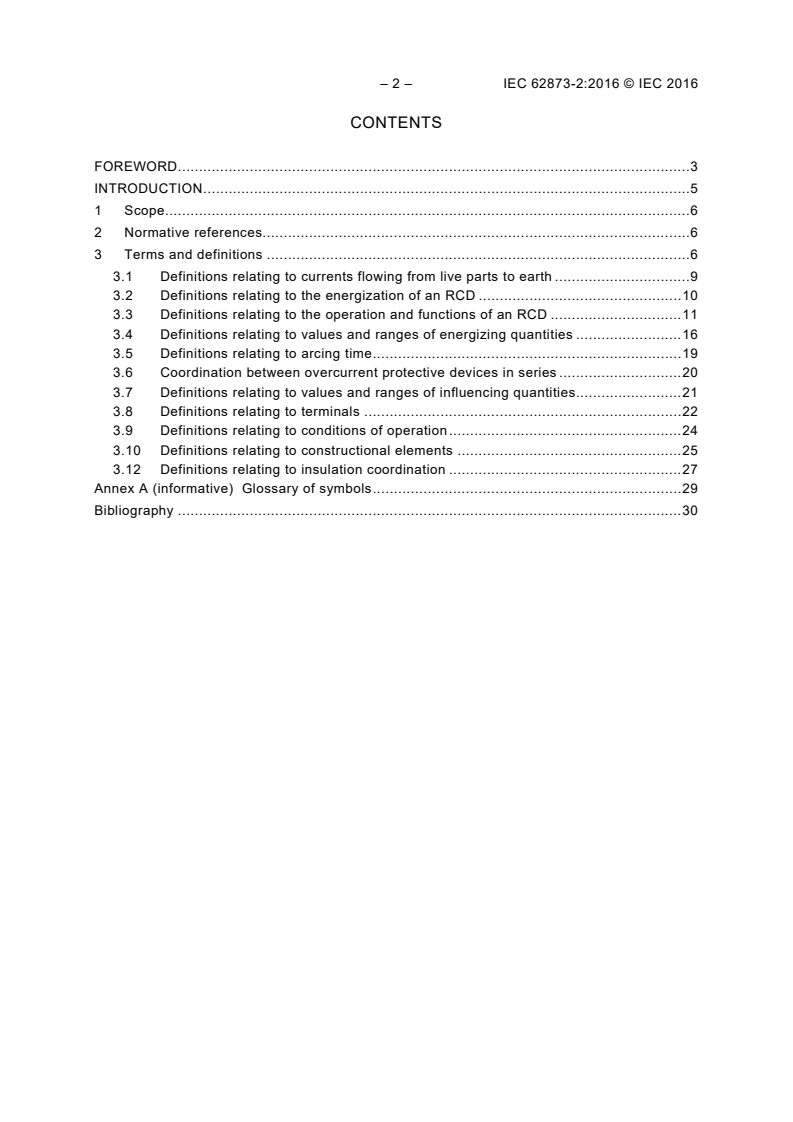
– 2 – IEC 62873-2:2016 © IEC 2016
CONTENTS
FOREWORD . 3
INTRODUCTION . 5
1 Scope . 6
2 Normative references. 6
3 Terms and definitions . 6
3.1 Definitions relating to currents flowing from live parts to earth . 9
3.2 Definitions relating to the energization of an RCD . 10
3.3 Definitions relating to the operation and functions of an RCD . 11
3.4 Definitions relating to values and ranges of energizing quantities . 16
3.5 Definitions relating to arcing time . 19
3.6 Coordination between overcurrent protective devices in series . 20
3.7 Definitions relating to values and ranges of influencing quantities . 21
3.8 Definitions relating to terminals . 22
3.9 Definitions relating to conditions of operation . 24
3.10 Definitions relating to constructional elements . 25
3.12 Definitions relating to insulation coordination . 27
Annex A (informative) Glossary of symbols . 29
Bibliography . 30
INTERNATIONAL ELECTROTECHNICAL COMMISSION
____________
RESIDUAL CURRENT OPERATED CIRCUIT-BREAKERS
FOR HOUSEHOLD AND SIMILAR USE –
Part 2: Residual current devices (RCDs) – Vocabulary
FOREWORD
1) The International Electrotechnical Commission (IEC) is a worldwide organization for standardization comprising
all national electrotechnical committees (IEC National Committees). The object of IEC is to promote
international co-operation on all questions concerning standardization in the electrical and electronic fields. To
this end and in addition to other activities, IEC publishes International Standards, Technical Specifications,
Technical Reports, Publicly Available Specifications (PAS) and Guides (hereafter referred to as “IEC
Publication(s)”). Their preparation is entrusted to technical committees; any IEC National Committee interested
in the subject dealt with may participate in this preparatory work. International, governmental and non-
governmental organizations liaising with the IEC also participate in this preparation. IEC collaborates closely
with the International Organization for Standardization (ISO) in accordance with conditions determined by
agreement between the two organizations.
2) The formal decisions or agreements of IEC on technical matters express, as nearly as possible, an international
consensus of opinion on the relevant subjects since each technical committee has representation from all
interested IEC National Committees.
3) IEC Publications have the form of recommendations for international use and are accepted by IEC National
Committees in that sense. While all reasonable efforts are made to ensure that the technical content of IEC
Publications is accurate, IEC cannot be held responsible for the way in which they are used or for any
misinterpretation by any end user.
4) In order to promote international uniformity, IEC National Committees undertake to apply IEC Publications
transparently to the maximum extent possible in their national and regional publications. Any divergence
between any IEC Publication and the corresponding national or regional publication shall be clearly indicated in
the latter.
5) IEC itself does not provide any attestation of conformity. Independent certification bodies provide conformity
assessment services and, in some areas, access to IEC marks of conformity. IEC is not responsible for any
services carried out by independent certification bodies.
6) All users should ensure that they have the latest edition of this publication.
7) No liability shall attach to IEC or its directors, employees, servants or agents including individual experts and
members of its technical committees and IEC National Committees for any personal injury, property damage or
other damage of any nature whatsoever, whether direct or indirect, or for costs (including legal fees) and
expenses arising out of the publication, use of, or reliance upon, this IEC Publication or any other IEC
Publications.
8) Attention is drawn to the Normative references cited in this publication. Use of the referenced publications is
indispensable for the correct application of this publication.
9) Attention is drawn to the possibility that some of the elements of this IEC Publication may be the subject of
patent rights. IEC shall not be held responsible for identifying any or all such patent rights.
International Standard IEC 62873-2 has been prepared by subcommittee 23E: Circuit
breakers and similar equipment for household use, of IEC technical committee 23: Electrical
accessories.
The text of this standard is based on the following documents:
FDIS Report on voting
23E/963/FDIS 23E/981/RVD
Full information on the voting for the approval of this standard can be found in the report on
voting indicated in the above table.
This publication has been drafted in accordance with the ISO/IEC Directives, Part 2.
– 4 – IEC 62873-2:2016 © IEC 2016
A list of all parts of the IEC 62873 series, published under the general title Residual current
operated circuit-breakers for household and similar use can be found on the IEC website.
The committee has decided that the contents of this publication will remain unchanged until
the stability date indicated on the IEC website under "http://webstore.iec.ch" in the data
related to the specific publication. At this date, the publication will be
• reconfirmed,
• withdrawn,
• replaced by a revised edition, or
• amended.
A bilingual version of this publication may be issued at a later date.
INTRODUCTION
This document is part of the series described in the outline document IEC 62873-1.
– 6 – IEC 62873-2:2016 © IEC 2016
RESIDUAL CURRENT OPERATED CIRCUIT-BREAKERS
FOR HOUSEHOLD AND SIMILAR USE –
Part 2: Residual current devices (RCDs) – Vocabulary
1 Scope
This part of IEC 62873 provides the terms and definitions used in RCD product standards.
2 Normative references
There are no normative references in this document.
3 Terms and definitions
For the purposes of this document, the following terms and definitions apply.
Where the terms "voltage" or "current" are used, they imply r.m.s. values, unless otherwise
specified.
NOTE Reference to IEV definitions is also made when the term "device" or "mechanical switching device" has
been replaced by the term "RCCB", "RCBO" or "RCD".
Alphabetical index of definitions
Reference
A
ambient air temperature . 3.7.6
applied voltage . 3.5.5
arcing contact . 3.10.2
arcing time . 3.5.2
arcing time . 3.5.1
auxiliary circuit . 3.3.25
auxiliary contact . 3.10.4
B
break time . 3.5.3
break time . 3.3.15
breaking capacity . 3.4.12
breaking current . 3.4.18
C
circuit-breaker . 3.3.3
clearance . 3.12.12
closed position . 3.3.19
closing operation . 3.9.2
conditional residual short-circuit current . 3.4.19
conditional short-circuit current . 3.4.15
conductive part . 3.10.10
control circuit . 3.3.24
Reference
control contact . 3.10.3
conventional non-tripping current . 3.6.3
conventional tripping current . 3.6.4
creepage distance . 3.12.13
current delay angle . 3.1.4
D
dependent manual operation . 3.9.4
detection . 3.3.6
direct overcurrent release . 3.10.8
E
earth fault current . 3.1.1
earth leakage current . 3.1.2
energizing input-quantity . 3.2.2
energizing quantity . 3.2.1
evaluation . 3.3.7
exposed conductive part . 3.10.11
extreme range of an influencing quantity . 3.7.5
F
fuse . 3.3.4
I
I t characteristic . 3.5.9
impulse withstand voltage . 3.12.4
independent manual operation . 3.9.5
influencing quantity . 3.7.1
instantaneous tripping current . 3.6.5
insulation coordination . 3.12.1
interruption . 3.3.8
inverse time-delay overcurrent release . 3.10.7
isolating distance . 3.12.11
isolation . 3.12.10
J
joule integral . 3.5.4
L
limiting non-actuating time . 3.3.16
limiting value of the non-operating current in case of single phase overcurrent . 3.4.3
loss of supply . 3.4.20
lug terminal . 3.8.7
– 8 – IEC 62873-2:2016 © IEC 2016
Reference
M
macro-environment . 3.12.6
main circuit . 3.3.23
main contact . 3.10.1
making capacity . 3.4.11
maximum prospective peak current . 3.4.9
mechanical switching device . 3.3.2
micro-environment . 3.12.7
minimum operating voltage . 3.4.21
O
open position . 3.3.20
opening operation . 3.9.3
opening time . 3.4.22
operating cycle . 3.9.6
operation . 3.9.1
overcurrent . 3.4.2
overcurrent protected poles . 3.3.21.1
overcurrent release . 3.10.6
overcurrent unprotected pole . 3.3.21.2
overload current . 3.4.4
overload release . 3.10.9
overvoltage . 3.12.3
overvoltage category. 3.12.5
P
pillar terminal . 3.8.3
pole . 3.3.21
pollution . 3.12.8
pollution degree . 3.12.9
power-frequency recovery voltage . 3.5.8
preferred range of an influencing quantity . 3.7.4
prospective current . 3.4.7
prospective peak current . 3.4.8
pulsating direct current . 3.1.3
R
r.c. unit . 3.3.9
rated value . 3.4.1
RCD type A . 3.3.27
RCD type AC . 3.3.26
RCD type B . 3.3.29
RCD type F . 3.3.28
RCD functionally dependent on line voltage . 3.3.13
RCD functionally independent of line voltage . 3.3.12
recovery voltage . 3.5.6
reference ambient air temperature . 3.7.7
reference conditions of influencing quantities . 3.7.3
reference value of an influencing quantity . 3.7.2
release . 3.10.5
reset RCD . 3.3.18
residual current . 3.2.3
residual current device . 3.3.5
Reference
residual current . 3.2.6
residual current operated circuit-breaker with integral overcurrent protection . 3.3.11
residual current operated circuit-breaker without integral overcurrent protection . 3.3.10
residual making and breaking capacity . 3.4.13
residual non-operating current. 3.2.5
residual operating current . 3.2.4
residual short-circuit withstand current . 3.4.6
routine tests . 3.11.2
S
saddle terminal . 3.8.6
screw terminal . 3.8.4
screwless terminal . 3.8.8
screw-type terminal . 3.8.2
selectivity-limit current . 3.6.1
sequence of operations . 3.9.7
service short-circuit breaking capacity . 3.4.16
short-circuit (making and breaking) capacity . 3.4.10
short-circuit current . 3.4.5
short-circuit protective device . 3.4.14
smooth direct current . 3.1.5
stud terminal . 3.8.5
switched neutral pole . 3.3.21.3
switching device . 3.3.1
T
take-over current . 3.6.2
tapping screw . 3.8.9
temporary overvoltage . 3.4.23
terminal . 3.8.1
test device . 3.3.30
thread cutting tapping screw . 3.8.11
thread forming tapping screw . 3.8.10
time-delay RCD . 3.3.17
transient recovery voltage . 3.5.7
Reference
trip-free RCD . 3.3.14
type test . 3.11.1
U
ultimate short-circuit breaking capacity . 3.4.17
uninterrupted duty . 3.9.8
uninterrupted neutral . 3.3.22
W
working voltage . 3.12.2
3.1 Definitions relating to currents flowing from live parts to earth
3.1.1
earth fault current
current flowing to earth due to an insulation fault
[SOURCE: IEC 60050-442:1998, 442-01-23]
– 10 – IEC 62873-2:2016 © IEC 2016
3.1.2
earth leakage current
current flowing from the live parts of the installation to earth, in the absence of an insulation
fault
[SOURCE: IEC 60050-442:1998, 442-01-24]
3.1.3
pulsating direct current
current of pulsating wave form which assumes, in each period of the rated power frequency,
the value 0 during one single interval of time, expressed in angular measure, of at least 180°
Note 1 to entry: The adjective "pulsating" is defined in IEC 60050-103:2009, 103-06-07.
3.1.4
current delay angle
α
time, expressed in angular measure, by which the starting instant of current conduction is
delayed by phase control
[SOURCE: IEC 60050-442:1998, 442-05-42, modified – In the definition, "the phase angle
representing the time" has been replaced by "time, expressed in angular measure,".]
3.1.5
smooth direct current
direct current which is ripple free
Note 1 to entry: A current is considered to be ripple free when the coefficient of ripple is below 10 %.
3.2 Definitions relating to the energization of an RCD
3.2.1
energizing quantity
electrical excitation quantity which, alone or in combination with other such quantities, is
applied to an RCD to enable it to accomplish its function under specified conditions
3.2.2
energizing input-quantity
energizing quantity by which the RCD is activated when it is applied under specified
conditions
Note 1 to entry: These conditions involve, for example, the energizing of certain auxiliary elements.
3.2.3
residual current
I
∆
r.m.s. value of the vector sum of the instantaneous values of the currents flowing through the
main circuit of the RCD
[SOURCE: IEC 60050-442:1998, 442-05-19, modified – “of the instantaneous values” has
been inserted.]
3.2.4
residual operating current
I
∆n
value of residual current which causes the RCD to operate under specified conditions
[SOURCE: IEC 60050-442:1998, 442-05-20]
3.2.5
residual non-operating current
I
∆no
value of residual current at which (and below which) the RCD does not operate under
specified conditions
[SOURCE: IEC 60050-442:1998, 442-05-21]
3.2.6
residual current
I
∆t
value of residual current which is the lower limit of the overcurrent
instantaneous tripping range
3.3 Definitions relating to the operation and functions of an RCD
3.3.1
switching device
device designed to make or break the current in one or more electric circuits
[SOURCE: IEC 60050-441:2000, 441-14-01]
3.3.2
mechanical switching device
switching device designed to close and open one or more electric circuits by means of
separable contacts
[SOURCE IEC 60050-441:2000, 441-14-02, modified – Note has been deleted.]
3.3.3
circuit-breaker
mechanical switching device, capable of making, carrying and breaking currents under normal
circuit conditions and also making, carrying for a specified duration and breaking currents
under specified abnormal circuit conditions such as those of short-circuit
[SOURCE: IEC 60050-441:2000, 441-14-20]
3.3.4
fuse
a device that by the fusing of one or more of its specially designed and proportioned
components, opens the circuit in which it is inserted by breaking the current when this
exceeds a given value for a sufficient time. The fuse comprises all the parts that form the
complete device
[SOURCE: IEC 60050-441:2000, 441-18-01]
3.3.5
residual current device
RCD
mechanical switching device or association of devices designed to make, carry and break
currents under normal service conditions and to cause the opening of the contacts when the
residual current attains a given value under specified conditions
[SOURCE: IEC 60050-442:1998, 442-05-02, modified – “or association of devices” has been
inserted and the Note has been deleted.]
– 12 – IEC 62873-2:2016 © IEC 2016
3.3.6
detection
function consisting in sensing the presence of a residual
current
Note 1 to entry: This function can be performed, for example, by a transformer integrating the vector sum of the
currents.
[SOURCE: IEC 60050-442:1998, 442-05-24]
3.3.7
evaluation
function consisting in giving to the residual current device the
possibility to operate, when the detected residual current exceeds a specified reference value
[SOURCE: IEC 60050-442:1998, 442-05-25]
3.3.8
interruption
function consisting in bringing automatically the main contacts
of the residual current device from the closed position into the open position, thereby
interrupting the current(s) flowing through them
[SOURCE: IEC 60050-442:1998, 442-05-26]
3.3.9
r.c. unit
device performing simultaneously the functions of detection of the residual current and of
comparison of the value of this current with the residual operating value, and incorporating
the means of operating the tripping mechanism of a circuit-breaker with which it is designed to
be assembled or associated
3.3.10
residual current operated circuit-breaker without integral overcurrent protection
RCCB
residual current operated circuit-breaker not designed to perform the functions of protection
against overloads and/or short circuits
[SOURCE: IEC 60050-442:1998, 442-05-03, modified – "switching device" has been replaced
by "circuit-breaker".]
3.3.11
residual current operated circuit-breaker with integral overcurrent protection
RCBO
residual current operated circuit-breaker designed to perform the functions of protection
against overloads and/or short circuits
[SOURCE: IEC 60050-442:1998, 442-05-04, modified – "switching device" has been replaced
by "circuit-breaker".]
3.3.12
RCD functionally independent of line voltage
RCD for which the functions of detection, evaluation and interruption do not depend on the
line voltage
[SOURCE: IEC 60050-442:1998, 442-05-08]
3.3.13
RCD functionally dependent on line voltage
RCD for which the functions of detection, evaluation or interruption depend on the line voltage
Note 1 to entry: It is understood that the line voltage is applied to the RCD, for detection, evaluation or
interruption.
[SOURCE: IEC 60050-442:1998, 442-05-09]
3.3.14
trip-free RCD
RCD the moving contacts of which return to and remain in the open position when the
automatic opening operation is initiated after the initiation of the closing operation, even if the
closing command is maintained
Note 1 to entry: To ensure proper breaking of the current which has been established, it could be necessary that
the contacts momentarily reach the closed position.
[SOURCE: IEC 60050-441:2000, 441-16-31, modified – "mechanical switching device" has
been replaced by "RCD" and the word "automatic" has been inserted.]
3.3.15
break time
time which elapses between the instant when the residual operating current is
suddenly attained and the instant of arc extinction in all poles
3.3.16
limiting non-actuating time
maximum delay during which a value of residual current higher than the residual non-
operating current can be applied to the RCD without causing it to operate
[SOURCE: IEC 60050-442:1998, 442-05-23, modified – In the definition, "bringing it actually"
has been replaced by "causing it".]
3.3.17
time-delay RCD
RCD specially designed to attain a predetermined value of limiting non-actuating time,
corresponding to a given value of residual current
[SOURCE: IEC 60050-442:1998, 442-05-05]
3.3.18
reset RCD
residual current device which must be intentionally reset prior to reclosing by a means
different from the operation means to be able to be reclosed and to operate again
[SOURCE: IEC 60050-442:1998, 442-05-10, modified – In the definition, "prior to reclosing"
has been introduced, "operating" has been replaced by "operation", and "to operate on the
occurrence of a residual current" has been replaced by “to be reclosed and to operate again”.]
3.3.19
closed position
position in which the predetermined continuity of the main
circuit of the RCD is secured
[SOURCE: IEC 60050-441:2000, 441-16-22, modified – In the definition, "device" has been
replaced by "RCD".]
– 14 – IEC 62873-2:2016 © IEC 2016
3.3.20
open position
position in which the predetermined clearance between
open contacts in the main circuit of the RCD is secured
[SOURCE: IEC 60050-441:2000, 441-16-23, modified – In the definition, "device" has been
replaced by "RCD".]
3.3.21
pole
part of an RCD associated exclusively with one electrically separated conducting path of its
main circuit provided with contacts intended to connect and disconnect the main circuit itself
and excluding those portions which provide a means for mounting and operating the poles
together
[SOURCE: IEC 60050-441:2000, 441-15-01, modified – The term and first part of the
definition have been reviewed and the Note has been deleted.]
3.3.21.1
overcurrent protected pole
protected pole
pole provided with an overcurrent release
[SOURCE: IEC 60050-442:1998, 442-05-40, modified – The second preferred term has been
added.]
3.3.21.2
overcurrent unprotected pole
unprotected pole
pole without an overcurrent release, but otherwise generally capable of the same performance
as a protected pole of the same RCBO
Note 1 to entry: To ensure this requirement, the unprotected pole may be of the same construction as the
protected pole(s), or of a particular construction.
Note 2 to entry: If the short-circuit capacity of the unprotected pole is different from that of the protected pole(s),
this should be indicated by the manufacturer.
[SOURCE: IEC 60050-442:1998, 442-05-41, modified – The second preferred term and Notes
to entry have been added.]
3.3.21.3
switched neutral pole
pole only intended to switch the neutral and not intended to have a short-circuit capacity
[SOURCE: IEC 60050-442:1998, 442-05-45]
3.3.22
uninterrupted neutral
current path, not interrupted and not overcurrent protected, intended to be connected to the
neutral conductor of the installation
[SOURCE: IEC 60050-442:1998, 442-01-51]
3.3.23
main circuit
all the conductive parts of an RCD included in the current paths
[SOURCE: IEC 60050-441:2000, 441-15-02, modified – In the definition, "switching device"
has been replaced by "RCD" and the last part has been deleted.]
3.3.24
control circuit
circuit (other than a path of the main circuit) intended for the closing operation
or the opening operation, or both, of the RCD
Note 1 to entry: The circuits intended for the test device are included in this definition.
3.3.25
auxiliary circuit
all the conductive parts of an RCD which are intended to be included in a circuit
other than the main circuit and the control circuit of the RCD
[SOURCE: IEC 60050-441:2000, 441-15-04, modified – In the definition, "switching device"
and "device" have been replaced by "RCD", and the Note has been deleted.]
3.3.26
RCD type AC
RCD for which tripping is ensured for residual sinusoidal alternating currents, whether
suddenly applied or slowly rising
3.3.27
RCD type A
RCD for which tripping is ensured for residual sinusoidal alternating currents and residual
pulsating direct currents, whether suddenly applied or slowly rising, and in addition for
residual pulsating direct currents superimposed on smooth direct current up to 6 mA
3.3.28
RCD type F
residual current device for which tripping is ensured as for type A as applicable, and in
addition:
– for composite residual currents, whether suddenly applied or slowly rising intended for
circuit supplied between phase and neutral or phase and earthed middle conductor;
– for residual pulsating direct currents superimposed on smooth direct current up to 10 mA
Note 1 to entry: The tripping for type A is according to IEC 61008-1 or IEC 61009-1.
3.3.29
RCD type B
residual current device for which tripping is ensured as for type F and in addition:
– for residual sinusoidal alternating currents up to 1 000 Hz;
– for residual alternating currents superimposed on a smooth direct current equal to 0,4 I
∆n
or 10 mA, whichever is the higher value;
– for residual pulsating direct currents superimposed on a smooth direct current;
– for residual pulsating rectified direct current which results from two or more phases;
– for residual smooth direct currents whether suddenly applied or slowly increased
independent of polarity
3.3.30
test device
device incorporated in the RCD simulating the residual current conditions for the operation of
the RCD under specified conditions
– 16 – IEC 62873-2:2016 © IEC 2016
3.4 Definitions relating to values and ranges of energizing quantities
3.4.1
rated value
quantity value assigned, generally by a manufacturer, for a specified operating condition of an
RCD
[SOURCE: IEC 60050-441:2000, 441-18-35, modified – In the definition, "a component,
device or equipment" has been replaced by "an RCD", and the Note has been deleted.]
3.4.2
overcurrent
current exceeding the rated current
[SOURCE: IEC 60050-442:1998, 442-01-20]
3.4.3
limiting value of the non-operating current in case of single phase overcurrent
maximum value of single phase overcurrent which, in the absence of a residual current, can
flow through an RCD (whatever the number of poles) without causing it to operate
Note 1 to entry: In the case of overcurrent in the main circuit, in the absence of residual current, operation of the
detecting device may occur as a consequence of asymmetry existing in the detecting device itself.
3.4.4
overload current
overcurrent occurring in an electrically undamaged circuit
Note 1 to entry: An overload current may cause damage if sustained for a sufficient time.
3.4.5
short-circuit current
overcurrent resulting from a fault of negligible impedance between points intended to be at
different potentials in normal service
Note 1 to entry: A short-circuit current could result from a fault or from an incorrect connection.
3.4.6
residual short-circuit withstand current
maximum value of the residual current for which the operation of the RCCB is ensured under
specified conditions and above which the device may undergo irreversible alterations
3.4.7
prospective current
current that would flow in the circuit, if each main current path of the RCD and of the
overcurrent protective device, if any, were replaced by a conductor of negligible impedance
Note 1 to entry: The prospective current can be qualified in the same manner as an actual current, for example:
prospective breaking current, prospective peak current, prospective residual current, etc.
[SOURCE: IEC 60050-442:1998, 442-01-47, modified – In the definition, "switching device"
has been replaced by "RCD".]
3.4.8
prospective peak current
peak value of a prospective current during the transient period following initiation
Note 1 to entry: The definition assumes that the current is made by an ideal RCBO, i.e. with instantaneous
transition from i
...