

IEC 62698:2013
(Main)Multimedia home server systems - Rights information interoperability for IPTV
General Information
- Abstract
IEC 62698:2013 defines the common semantics and core elements on rights information interoperability for IPTV systems/equipment that is subject to multimedia content to be used across different platforms legally. The rights information includes rights and security related metadata that is described in ITU-T Recommendation H.750.
- Status
- Published
- Publication Date
- 10-Mar-2013
- Technical Committee
- TA 18 - Multimedia home systems and applications for end-user networks
- Current Stage
- PPUB - Publication issued
- Start Date
- 11-Mar-2013
- Completion Date
- 31-Mar-2013
Overview
IEC 62698:2013, titled Multimedia Home Server Systems – Rights Information Interoperability for IPTV, is an international standard developed by the International Electrotechnical Commission (IEC). This standard addresses the interoperability of rights information in IPTV systems and related multimedia home server equipment. It defines common semantics and core metadata elements required to manage rights and security information legally across different platforms.
The rights information metadata aligns with ITU-T Recommendation H.750, ensuring a harmonized and secure approach to digital content rights management within IPTV ecosystems. IEC 62698:2013 facilitates the consistent exchange and enforcement of usage permissions between content providers, service operators, and end-user devices, fostering trust and legal compliance in digital content distribution.
Key Topics
Rights Information Interoperability (RII) Environment
The standard defines the ecosystem where rights information operates, including mechanisms for permissions, limits, and management within IPTV services.Permission Subjects and Identifiers
Clarifies entities such as content identifiers, issuer identifiers, and receiver identifiers required to specify rights and track permissions accurately.Permission Classification
Covers classifications for permissions based on purpose, disclosure class, charge models, usage conditions, geographic territories, sponsorship, and compilation characteristics.Permission Limit Components
Details components that set limits on permissions such as quality limits, lifetime limits, simultaneous output restrictions, and permission management system constraints.Security Metadata and Rights Management
The standard incorporates security-related metadata necessary to uphold digital rights and prevent unauthorized usage, based on recognized encryption and rights management frameworks.Data Management and Export Conditions
Specifies conditions under which content and rights data may be managed or exported, ensuring secure and compliant content distribution and playback.Interoperability with Existing DRM Systems
Annexes provide mappings and technical considerations to integrate IEC 62698 rights metadata with popular Digital Rights Management (DRM) technologies like Marlin, Windows Media DRM, OMA DRM, and AACS.
Applications
IEC 62698:2013 is critical for stakeholders involved in the IPTV and multimedia content distribution ecosystem, including:
Content Creators and Rights Holders
To define and communicate usage rights consistently across different IPTV service platforms and devices.Service Providers and IPTV Operators
To implement interoperable rights enforcement, ensuring secured and legal content distribution that respects licensing agreements and territorial restrictions.Manufacturers of Multimedia Home Server Systems
To integrate standardized rights metadata handling functionalities, enabling devices to process permission information and enforce rights uniformly.Software Developers and DRM Solution Providers
To align their products with international interoperability standards facilitating wider adoption and seamless content exchange.
The standard supports the evolving needs of digital content distribution by enabling flexibility, legal compliance, and seamless user experiences across heterogenous IPTV environments.
Related Standards
ITU-T Recommendation H.750 – Provides the foundational rights and security-related metadata descriptions referenced by IEC 62698.
ITU-T Recommendation H.751 – Addresses metadata for rights information interoperability within IPTV services and supplements IEC 62698.
ISO/IEC DRM Standards – International standards focusing on digital rights management techniques and encryption compatibility.
Marlin DRM Specifications – Often cited in annexes for interoperability mappings with IEC 62698 rights information.
OMA DRM v2.0 – Specifies rules for rights management in mobile and IPTV platforms, related for cross-compatible implementation.
Practical Value
By implementing IEC 62698:2013, IPTV ecosystems gain:
Legal Content Usage Assurance
Facilitates legally sound exchange and consumption of multimedia content through standard metadata.Cross-Platform Compatibility
Ensures diverse IPTV systems and devices can interpret and enforce rights metadata consistently.Enhanced Security and Trust
Supports secure rights information exchange, reducing risks of copyright infringement and unauthorized distribution.Simplified Rights Management
Provides a common framework simplifying the development and deployment of interoperable digital rights solutions.
IEC 62698:2013 is essential for enabling a robust, secure, and user-trusted IPTV content ecosystem that promotes innovation and cooperation among content providers, distributors, and consumers worldwide.
Get Certified
Connect with accredited certification bodies for this standard

BSI Group
BSI (British Standards Institution) is the business standards company that helps organizations make excellence a habit.

NYCE
Mexican standards and certification body.

ANCE
Mexican certification and testing association.
Sponsored listings
Frequently Asked Questions
IEC 62698:2013 is a standard published by the International Electrotechnical Commission (IEC). Its full title is "Multimedia home server systems - Rights information interoperability for IPTV". This standard covers: IEC 62698:2013 defines the common semantics and core elements on rights information interoperability for IPTV systems/equipment that is subject to multimedia content to be used across different platforms legally. The rights information includes rights and security related metadata that is described in ITU-T Recommendation H.750.
IEC 62698:2013 defines the common semantics and core elements on rights information interoperability for IPTV systems/equipment that is subject to multimedia content to be used across different platforms legally. The rights information includes rights and security related metadata that is described in ITU-T Recommendation H.750.
IEC 62698:2013 is classified under the following ICS (International Classification for Standards) categories: 33.160.60 - Multimedia systems and teleconferencing equipment; 35.240.99 - IT applications in other fields. The ICS classification helps identify the subject area and facilitates finding related standards.
IEC 62698:2013 is available in PDF format for immediate download after purchase. The document can be added to your cart and obtained through the secure checkout process. Digital delivery ensures instant access to the complete standard document.
Standards Content (Sample)
IEC 62698 ®
Edition 1.0 2013-03
INTERNATIONAL
STANDARD
NORME
INTERNATIONALE
colour
inside
Multimedia home server systems – Rights information interoperability for IPTV
Systèmes de serveur domestique multimédia – Interopérabilité d'information des
droits pour TVIP
All rights reserved. Unless otherwise specified, no part of this publication may be reproduced or utilized in any form
or by any means, electronic or mechanical, including photocopying and microfilm, without permission in writing from
either IEC or IEC's member National Committee in the country of the requester.
If you have any questions about IEC copyright or have an enquiry about obtaining additional rights to this publication,
please contact the address below or your local IEC member National Committee for further information.
Droits de reproduction réservés. Sauf indication contraire, aucune partie de cette publication ne peut être reproduite ni
utilisée sous quelque forme que ce soit et par aucun procédé, électronique ou mécanique, y compris la photocopie et les
microfilms, sans l'accord écrit de la CEI ou du Comité national de la CEI du pays du demandeur.
Si vous avez des questions sur le copyright de la CEI ou si vous désirez obtenir des droits supplémentaires sur cette
publication, utilisez les coordonnées ci-après ou contactez le Comité national de la CEI de votre pays de résidence.
IEC Central Office Tel.: +41 22 919 02 11
3, rue de Varembé Fax: +41 22 919 03 00
CH-1211 Geneva 20 info@iec.ch
Switzerland www.iec.ch
About the IEC
The International Electrotechnical Commission (IEC) is the leading global organization that prepares and publishes
International Standards for all electrical, electronic and related technologies.
About IEC publications
The technical content of IEC publications is kept under constant review by the IEC. Please make sure that you have the
latest edition, a corrigenda or an amendment might have been published.
Useful links:
IEC publications search - www.iec.ch/searchpub Electropedia - www.electropedia.org
The advanced search enables you to find IEC publications The world's leading online dictionary of electronic and
by a variety of criteria (reference number, text, technical electrical terms containing more than 30 000 terms and
committee,…). definitions in English and French, with equivalent terms in
It also gives information on projects, replaced and additional languages. Also known as the International
withdrawn publications. Electrotechnical Vocabulary (IEV) on-line.
IEC Just Published - webstore.iec.ch/justpublished Customer Service Centre - webstore.iec.ch/csc
Stay up to date on all new IEC publications. Just Published If you wish to give us your feedback on this publication
details all new publications released. Available on-line and or need further assistance, please contact the
also once a month by email. Customer Service Centre: csc@iec.ch.
A propos de la CEI
La Commission Electrotechnique Internationale (CEI) est la première organisation mondiale qui élabore et publie des
Normes internationales pour tout ce qui a trait à l'électricité, à l'électronique et aux technologies apparentées.
A propos des publications CEI
Le contenu technique des publications de la CEI est constamment revu. Veuillez vous assurer que vous possédez
l’édition la plus récente, un corrigendum ou amendement peut avoir été publié.
Liens utiles:
Recherche de publications CEI - www.iec.ch/searchpub Electropedia - www.electropedia.org
La recherche avancée vous permet de trouver des Le premier dictionnaire en ligne au monde de termes
publications CEI en utilisant différents critères (numéro de électroniques et électriques. Il contient plus de 30 000
référence, texte, comité d’études,…). termes et définitions en anglais et en français, ainsi que
Elle donne aussi des informations sur les projets et les les termes équivalents dans les langues additionnelles.
publications remplacées ou retirées. Egalement appelé Vocabulaire Electrotechnique
International (VEI) en ligne.
Just Published CEI - webstore.iec.ch/justpublished
Service Clients - webstore.iec.ch/csc
Restez informé sur les nouvelles publications de la CEI.
Just Published détaille les nouvelles publications parues. Si vous désirez nous donner des commentaires sur
Disponible en ligne et aussi une fois par mois par email. cette publication ou si vous avez des questions
contactez-nous: csc@iec.ch.
IEC 62698 ®
Edition 1.0 2013-03
INTERNATIONAL
STANDARD
NORME
INTERNATIONALE
colour
inside
Multimedia home server systems – Rights information interoperability for IPTV
Systèmes de serveur domestique multimédia – Interopérabilité d'information des
droits pour TVIP
INTERNATIONAL
ELECTROTECHNICAL
COMMISSION
COMMISSION
ELECTROTECHNIQUE
PRICE CODE
INTERNATIONALE
CODE PRIX XB
ICS 33.160.60; 35.240.99 ISBN 978-2-83220-684-3
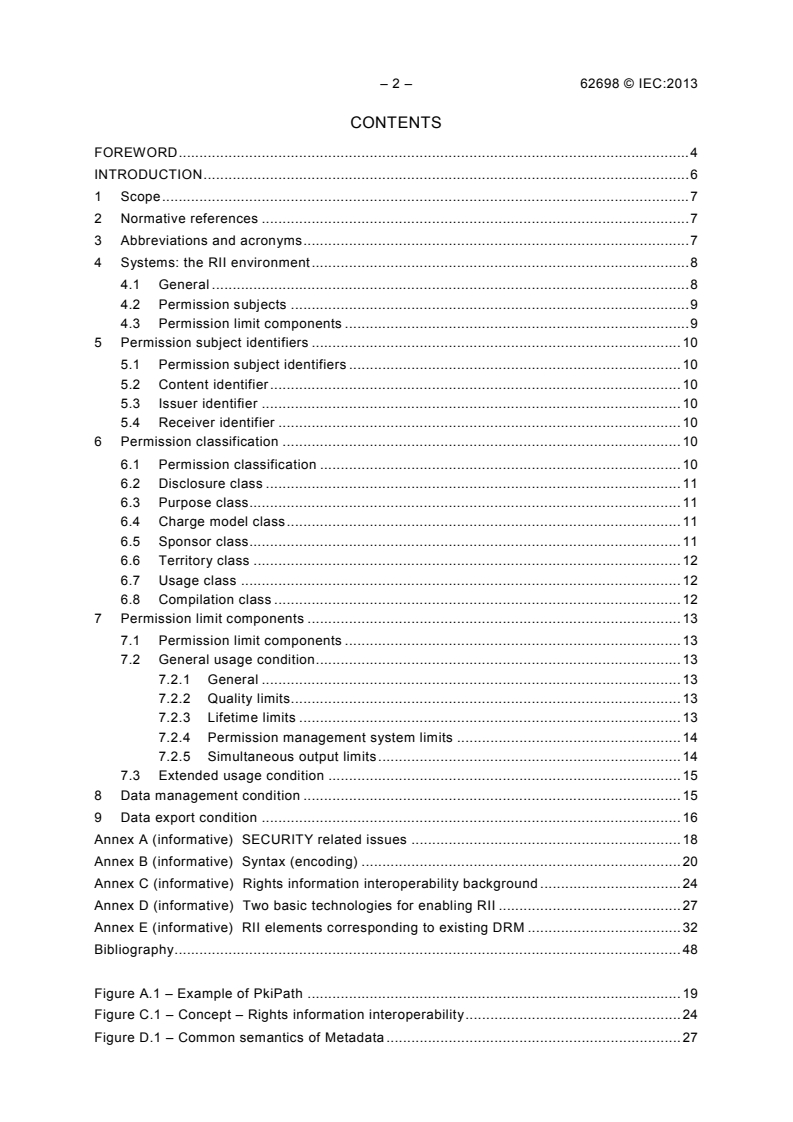
– 2 – 62698 © IEC:2013
CONTENTS
FOREWORD . 4
INTRODUCTION . 6
1 Scope . 7
2 Normative references . 7
3 Abbreviations and acronyms . 7
4 Systems: the RII environment . 8
4.1 General . 8
4.2 Permission subjects . 9
4.3 Permission limit components . 9
5 Permission subject identifiers . 10
5.1 Permission subject identifiers . 10
5.2 Content identifier . 10
5.3 Issuer identifier . 10
5.4 Receiver identifier . 10
6 Permission classification . 10
6.1 Permission classification . 10
6.2 Disclosure class . 11
6.3 Purpose class. 11
6.4 Charge model class . 11
6.5 Sponsor class. 11
6.6 Territory class . 12
6.7 Usage class . 12
6.8 Compilation class . 12
7 Permission limit components . 13
7.1 Permission limit components . 13
7.2 General usage condition . 13
7.2.1 General . 13
7.2.2 Quality limits . 13
7.2.3 Lifetime limits . 13
7.2.4 Permission management system limits . 14
7.2.5 Simultaneous output limits . 14
7.3 Extended usage condition . 15
8 Data management condition . 15
9 Data export condition . 16
Annex A (informative) SECURITY related issues . 18
Annex B (informative) Syntax (encoding) . 20
Annex C (informative) Rights information interoperability background . 24
Annex D (informative) Two basic technologies for enabling RII . 27
Annex E (informative) RII elements corresponding to existing DRM . 32
Bibliography . 48
Figure A.1 – Example of PkiPath . 19
Figure C.1 – Concept – Rights information interoperability . 24
Figure D.1 – Common semantics of Metadata . 27
62698 © IEC:2013 – 3 –
Figure D.2 – The necessity of information consolidation for content distribution . 28
Figure D.3 – Common semantics for RII . 30
Figure D.4 – Core elements and common semantics for RII . 31
Table A.1 – Rough composition of distribution format data . 18
Table B.1 – Permission actors and permission classifications . 21
Table B.2 – Playback usage conditions . 22
Table B.3 – Printout usage conditions . 22
Table B.4 – Execution usage conditions . 22
Table B.5 – Data management conditions . 22
Table B.6 – Data output conditions . 23
Table E.1 – Marlin BB (broadband) . 32
Table E.2 – Marlin IPTV-ES (end-point service), Download license, EXPORT for Copy
with Direct Key Delivery . 34
Table E.3 – Marlin IPTV-ES, Download license, EXTRACT with Direct Key Delivery,
Download. 35
Table E.4 – Marlin IPTV-ES, Download license, EXTRACT with Direct Key Delivery,
VOD streaming . 37
Table E.5 – Marlin IPTV-ES, Broadcast license, EXTRACT with IndirectKey Delivery
license, Terrestrial re-distribution/BS (broadcasting satellite) re-distribution . 38
Table E.6 – Marlin IPTV-ES, Broadcast license, EXTRACT with DirectKey Delivery
license, IP multicast . 39
Table E.7 – Marlin IPTV-ES, VOD license, EXTRACT with Simple Key Delivery license . 41
Table E.8 – WM-DRM (Windows Media DRM) . 42
Table E.9 – OMA DRM v2.0 . 43
Table E.10 – AACS, basic . 45
Table E.11 – AACS, extended . 46
– 4 – 62698 © IEC:2013
INTERNATIONAL ELECTROTECHNICAL COMMISSION
____________
MULTIMEDIA HOME SERVER SYSTEMS –
RIGHTS INFORMATION INTEROPERABILITY FOR IPTV
FOREWORD
1) The International Electrotechnical Commission (IEC) is a worldwide organization for standardization comprising
all national electrotechnical committees (IEC National Committees). The object of IEC is to promote
international co-operation on all questions concerning standardization in the electrical and electronic fields. To
this end and in addition to other activities, IEC publishes International Standards, Technical Specifications,
Technical Reports, Publicly Available Specifications (PAS) and Guides (hereafter referred to as “IEC
Publication(s)”). Their preparation is entrusted to technical committees; any IEC National Committee interested
in the subject dealt with may participate in this preparatory work. International, governmental and non-
governmental organizations liaising with the IEC also participate in this preparation. IEC collaborates closely
with the International Organization for Standardization (ISO) in accordance with conditions determined by
agreement between the two organizations.
2) The formal decisions or agreements of IEC on technical matters express, as nearly as possible, an international
consensus of opinion on the relevant subjects since each technical committee has representation from all
interested IEC National Committees.
3) IEC Publications have the form of recommendations for international use and are accepted by IEC National
Committees in that sense. While all reasonable efforts are made to ensure that the technical content of IEC
Publications is accurate, IEC cannot be held responsible for the way in which they are used or for any
misinterpretation by any end user.
4) In order to promote international uniformity, IEC National Committees undertake to apply IEC Publications
transparently to the maximum extent possible in their national and regional publications. Any divergence
between any IEC Publication and the corresponding national or regional publication shall be clearly indicated in
the latter.
5) IEC itself does not provide any attestation of conformity. Independent certification bodies provide conformity
assessment services and, in some areas, access to IEC marks of conformity. IEC is not responsible for any
services carried out by independent certification bodies.
6) All users should ensure that they have the latest edition of this publication.
7) No liability shall attach to IEC or its directors, employees, servants or agents including individual experts and
members of its technical committees and IEC National Committees for any personal injury, property damage or
other damage of any nature whatsoever, whether direct or indirect, or for costs (including legal fees) and
expenses arising out of the publication, use of, or reliance upon, this IEC Publication or any other IEC
Publications.
8) Attention is drawn to the Normative references cited in this publication. Use of the referenced publications is
indispensable for the correct application of this publication.
9) Attention is drawn to the possibility that some of the elements of this IEC Publication may be the subject of
patent rights. IEC shall not be held responsible for identifying any or all such patent rights.
International Standard IEC 62698 has been prepared by technical area 8: Multimedia home
server systems, of IEC technical committee 100: Audio, video and multimedia systems and
equipment.
Parts of the text of this standard have been developed in collaboration with ITU-T/Study
Group 16: Multimedia application platforms and end systems for IPTV.
NOTE The ITU-T Recommendation, which is the parallel text of this standard, is ITU-T Recommendation H.751
"Metadata for rights information interoperability in IPTV services" and is under revision/approval. See ITU website
for more details.
62698 © IEC:2013 – 5 –
The text of this standard is based on the following documents:
CDV Report on voting
100/1947/CDV 100/1998/RVC
Full information on the voting for the approval of this standard can be found in the report on
voting indicated in the above table.
This publication has been drafted in accordance with the ISO/IEC Directives, Part 2.
The committee has decided that the contents of this publication will remain unchanged until
the stability date indicated on the IEC web site under "http://webstore.iec.ch" in the data
related to the specific publication. At this date, the publication will be
• reconfirmed,
• withdrawn,
• replaced by a revised edition, or
• amended.
IMPORTANT – The 'colour inside' logo on the cover page of this publication indicates
that it contains colours which are considered to be useful for the correct
understanding of its contents. Users should therefore print this document using a
colour printer.
– 6 – 62698 © IEC:2013
INTRODUCTION
At present, there are no mechanisms or rules for flexible digital distribution that allow the easy
exchange of content based on individual commitments between content creators and
consumers. This is because a technological and social environment where there is a sense of
trust between copyright holders and consumers who feel safe about information distribution is
not always perfectly provided.
To provide content creators and consumers with this type of content usage environment, to
give them more opportunities for all kinds of digital content regardless of the support they use
to store it, interoperability is required that will enable the IPTV systems and equipment that
make up the envisioned value chain to communicate and work with each other across
different systems which manage content distribution.
Rights Information Interoperability (RII) solves these issues by helping to provide content
rights holders and consumers with common semantics and core elements that extend across
different systems which manage content distribution.
62698 © IEC:2013 – 7 –
MULTIMEDIA HOME SERVER SYSTEMS –
RIGHTS INFORMATION INTEROPERABILITY FOR IPTV
1 Scope
This International Standard defines the common semantics and core elements on rights
information interoperability for IPTV systems/equipment that is subject to multimedia content
to be used across different platforms legally.
The rights information includes rights and security related metadata that is described in
ITU-T Recommendation H.750.
Rights related information, such as content ID, permission issuer ID and permission receiver
ID, which is used to bridge between rights related metadata, is considered in this standard.
On the other hand, rights management and content protection technology are beyond the
scope of this standard.
2 Normative references
The following documents, in whole or in part, are normatively referenced in this document and
are indispensable for its application. For dated references, only the edition cited applies. For
undated references, the latest edition of the referenced document (including any
amendments) applies.
IEC 62227:2008, Multimedia home server systems – Digital rights permission code
IEC/TR 62636:2009, Multimedia home server systems – Implementation of digital rights
permission code
ISO 3166-1, Codes for the representation of names of countries and their subdivisions –
Part 1: Country codes
ITU-T Recommendation H.750:2009, High-level specification of metadata for IPTV services
ITU-T Recommendation X.509, Information technology – Open systems interconnection –
The Directory: Public-key and attribute certificate frameworks
3 Abbreviations and acronyms
For the purposes of this document, the following abbreviations and acronyms apply.
AAC Advanced Audio Coding
AACS Advanced Access Content System
CD Compact Disc
CGMS Copy Generation Management System
CM Commercial Message
CPRM Content Protection for Recordable Media
DCF DRM Content Format
DRM Digital Rights Management
– 8 – 62698 © IEC:2013
DRPC Digital Rights Permission Code
DSA Digital Signature Algorithm
DTCP Digital Transmission Content Protection
DVD Digital Versatile Disk
EC-DSA Elliptic Curve Digital Signature Algorithm
GC Group Content
GIF Graphic Interchange Format
HD High Definition
HDCP High-bandwidth Digital Content Protection
HDD Hard Disk Drive
ID Identifier
IPTV Internet Profile TeleVision
JPEG Joint Photographic Experts Group
MP3 MPEG Audio Layer-3
MPEG Moving Picture Experts Group
MTMO Marlin Trust Management Organization
OMA Open Mobile Alliance
PCM Pulse Code Modulation
PNG Portable Network Graphics
RII Rights Information Interoperability
RSA Rivest Shamir Adleman
SAFIA Security Architecture For Intelligent Attachment
SHA Secure Hash Algorithm
VCPS Video Content Protection System
VOD Video On Demand
WIPO World Intellectual Property Organization
4 Systems: the RII environment
4.1 General
This standard gives the high-level standard of the metadata for rights information
interoperability, including representation of the minimum required elements.
The RII metadata provides descriptive and contextual classification for representing rights
information using the permission framework.
RII is concerned with finding the greatest common denominators in rights expressions that
include the minimum required components when trying to implement the mutual use of rights
information.
It is about conveying rights information in units of groups of context expressions called
permissions.
Here we consider the constituent components of permissions. Permissions can encode “what
from whom to whom under what conditions” using context expressions. When permissions are
sent to a terminal, the minimum required components are the subject information in the
permissions that corresponds to the “what from whom to whom” part, and the content usage
information that corresponds to the “under what conditions” part.
62698 © IEC:2013 – 9 –
4.2 Permission subjects
One permission subject is the issuer information that expresses the “from whom” part of the
permissions. This information is held by the service provider, and in RII, its minimum required
component is the rights holder ID.
Only the issuer ID is included because in RII, it is sufficient if the service provider and the
terminal can identify who is granting the permissions. It is not necessary to send all of the
issuer information from the server to the terminal. Therefore, the rights holder ID corresponds
to the Issuer ID in RII context expressions. The service provider receives the digital rights
permission code from the terminal and loads the rights holder ID included in the Issuer ID to
identify the rights holder who granted the permissions.
Another permission subject is receiver information that expresses the “to whom” part of the
permissions. In RII, that minimum required component is the User ID/Device ID.
Only the receiver ID is included because in RII, it is sufficient if the service provider and the
terminal can identify to whom the permissions are being granted. Therefore, the User
ID/Device ID corresponds to the Receiver ID in RII context expressions. The terminal receives
the digital rights permission code from the service provider and determines whether or not the
User ID/Device ID included in the Receiver ID corresponds to the local terminal, or the service
provider receives the digital rights permission code from the terminal and loads the User
ID/Device ID included in the Receiver ID to identify the user to whom permissions were
granted.
Another permission subject is information about the content for which permissions are being
granted, which is expressed in the “what” part. In RII, that minimum required component is the
Content ID.
Only the Content ID is included in RII because it is sufficient for the service provider and the
terminal to be able to identify the content for which permissions are being granted. The
terminal receives the digital rights permission code from the service provider and determines
that the content that corresponds to the Content ID is being granted.
4.3 Permission limit components
One permission limit component is the type of the permissions (hereinafter referred to as “the
permission classification component”), which expresses stipulations about what is being
granted. These permissions are agreed upon between the issuer and the receiver. This is
information that the receiver needs to be able to check offline. In RII, those minimum required
components are the following: a type that indicates whether the permission content being
granted is public or not (hereinafter referred to as “the disclosure class”), a type that indicates
the purpose of use being granted (hereinafter referred to as the “purpose class”), a type that
indicates the billing format being granted (hereinafter referred to as the “charge model class”),
a type that indicates the request format being granted (hereinafter referred to as the “request
class”), a type that indicates the sponsor format being granted (hereinafter referred to as the
“sponsor class”, a type that indicates the usage format being granted (hereinafter referred to
as the “usage class”), and a type that indicates the territory being granted, (hereinafter
referred to as the "territory class”). These permission limit components are included in RII
because it is necessary to be able to see that information even in an offline environment that
is not connected to a network. This is so that the terminal can determine what type of
permissions are being granted between the service provider and the terminal.
Another permission limit component contains limiting conditions that are in addition to the
restrictions in the items granted above. These are mainly items of information that limit the
type of permissions stipulated by the usage class. In RII, those minimum required
components are the permission usage format and its limiting conditions (hereinafter referred
to as "normal usage limits”), content usage limits for compliant terminals (hereinafter referred
to as the “permission management system limits”), and the limits on output of the content to
non-compliant terminals or media (hereinafter referred to as the “simultaneous output limits”).
– 10 – 62698 © IEC:2013
These permission limit components are included in RII, because it is necessary for the rights
they correspond to, to be seen on the terminal even in an offline environment that is not
connected to a network. This is so that the terminal can determine under what conditions the
types of permissions are limited between the service provider and the terminal.
RII does not provide a method of encoding context expressions for permissions. The encoding
method is already standardized using existing standard technology. Instead, Clause B.2
shows the example of adding context expressions expressed using natural language in
IEC 62227 (DRPC).
RII is a set of items to be considered when each content is distributed and permission for
such distribution is generated.
Therefore RII is not defined from a technical perspective, but rather on the basis of
permission information that rights holders actually employ in the field. RII itself does not have
the ability to regulate content usage behaviour.
Restricting the use of content to terms specified in the permission is an administrative issue
or a DRM systems issue. RII does not have exclusive policy. Implementers of each DRM or
content distribution systems can choose their own subset and usage scheme of RII, based on
their necessity and resource. They can even limit the application to a simple displaying of
permission and not use their rights management.
5 Permission subject identifiers
5.1 Permission subject identifiers
Permission subject identifiers is comprised of three identifiers: Content identifier assigned to
the subject content, Issuer identifier and Receiver identifier respectively, assigned to each
permission issuer and receiver.
5.2 Content identifier
Content identifier is information to uniquely identify the content. It is required to be assigned
to each content that is subject to permission. IEC 62227:2008, 5.5.4, specifies permission
subject content identifiers.
5.3 Issuer identifier
Issuer identifier is information to uniquely identify the permission issuer. Issuer identifier may
be used not only to identify a rights holder, a service provider and a home server, but also for
consumption tracking, rights report and content management. IEC 62227:2008, 5.5.5,
specifies permission subject issuer identifiers.
5.4 Receiver identifier
Receiver identifier is information to uniquely identify the permission receiver. Receiver
identifier may be used to identify an end-user, a device and a set of end-users.
IEC 62227:2008,5.5.6, specifies permission subject receiver identifiers.
6 Permission classification
6.1 Permission classification
Permission classification indicates the class of the permission. It should be described
according to the conditions indicated in the permission agreement.
62698 © IEC:2013 – 11 –
6.2 Disclosure class
Disclosure class includes classification indicating whether a given permission is a closed
permission for a specified player or an open permission for an unspecified group of players.
The closed permission information can be accessed by the permission issuer and receiver.
Possible values are “open permission”, “closed permission” and “other”. Open permission is
the permission that is received according to previously arranged default conditions. Closed
permission is the permission that is received through a separate, individually negotiated
contract.
IEC 62227:2008, 5.6.4, specifies a permission classification for signalling and carrying
disclosure information. Clause B.2 of IEC/TR 62636:2009, provides use-case scenarios to
implement the disclosure class.
6.3 Purpose class
Purpose class includes classification indicating the purpose of content usage, such as
commercial, public, education, not-for-profit and promotion. To ensure the consumption of
content under the condition could be subject to domain management. Possible values are
“commercial”, “public”, “non-profit”, “promotion”, “education” and “other”.
Commercial permission is the permission for a business use. Public permission is the
permission for a public use. Non-profit permission is the permission for a public use.
Promotion permission is the permission for a promotion use. Education permission is the
permission for an education use.
IEC 62227:2008, 5.6.5, specifies a permission classification for signalling and carrying usage
purpose information. Clause B.2 of IEC/TR 62636:2009, provides use-case scenarios to
implement the usage purpose class.
6.4 Charge model class
Charge model class includes classification including the charge method such as free-of-
charge and for-charge. The charge model class might include “pay-per-view” (charged per
viewing), and “subscription” (fixed periodic charge). Both of these conditions should not be
used at the same time, but rather if one is selected the other is not used. Possible values are
“free of charge”, “pay per use”, “subscription”, “coupon”.
IEC 62227:2008, 5.6.6, specifies a permission classification for signalling and carrying charge
model information. Clause B.2 of IEC/TR 62636:2009, provides use-case scenarios to
implement the charge model class.
6.5 Sponsor class
Sponsor class includes classification indicating the sponsor type such as advertising model,
premium model, coupon model and consumption information disclosure model.
Advertising model describes the condition of viewing ads in the content consumption.
Premium model, coupon model and consumption information disclosure model describe the
conditions for the content acquisition. In the premium model there can be a specific advertiser
to sponsor specific content. In the coupon model there can be multiple advertisers to sponsor
the content. In disclosure model the content can be exchanged for end-user consumption
information. The control of trick play and the function of point exchange are required to be
implemented for these models. Possible values are “No sponsor”, “Advertisement model
without force viewing”, “Advertisement model with force viewing”, “Advertisement model with
pre/post viewing”, “Advertisement model with alternative viewing”, “Advertisement model with
blanket viewing”, “Premium model”, “Coupon model”, “Privacy information disclosure model”
and “Other”.
– 12 – 62698 © IEC:2013
IEC 62227:2008, 5.6.9, specifies a permission classification for signalling and carrying
sponsor information. IEC/TR 62636:2009, 5.17, and IEC/TR 62636:2009, 5.18, provide use-
case scenarios to implement the sponsor class.
6.6 Territory class
Territory class includes classification indicating the territory of content consumption such as
country and region. It is required to implement the technology, such as domain management,
to specify the territory in which content is consumed. Possible values are region code, country
code (ISO 3166-1) and Zip code.
IEC 62227:2008, 5.6.10, specifies a permission classification for signalling and carrying
territory information. Clause B.2 of IEC/TR 62636:2009, provides use-case scenarios to
implement the territory class.
6.7 Usage class
Usage class includes classification indicating the usage type such as transmission type, store
type, reuse type, and redistribution type based on usage environment.
IEC 62227:2008, 5.6.11, specifies a permission classification for signalling and carrying
usage information. Clause B.2 of IEC/TR 62636:2009, provides use-case scenarios to
implement the usage class.
Elements required in usage class are listed below.
• Transmission type expresses an distribution form of content into target domains and
comformance devices. For example, if the value is "download", the content can be
downloaded into conformance devices. Possible values are "broadcast", "streaming",
"download" and "physical media".
– IEC 62227:2008, 5.6.11.2, usage_type, specifies a permission classification for
signalling and carrying usage class information.
• Store type expresses an accumulation form of content in target domains and conformance
devices. For example, if the value is "fixation", the content can be stored in conformance
devices. Possible values are "fixation" and "non-fixation".
– IEC 62227:2008, 5.6.11.2, usage_type, specifies a permission classification for
signalling and carrying usage class information.
• Reuse type expresses the secondary usage type of content in target domains and
compliance devices. Possible values are enable or disable of secondary usage, move,
copy, export, share, edit, modify and super distribution.
– IEC 62227:2008, 5.6.11.4, move_flag, 5.6.11.5, copy_flag, 5.6.11.6, export_flag,
5.6.11.7, share_flag, 5.6.11.8, edit_flag, 5.6.11.9, modify_flag, 5.6.11.10,
super_distribution_flag, specifies a permission classification for signalling and carrying
usage class information.
• Redistribution type expresses the forwarding type of content from target domains and
compliance devices (e.g. enable or disable).
– IEC 62227:2008, 5.6.11.3, redistribution_type, specifies a permission classification for
signalling and carrying usage class information.
6.8 Compilation class
Compilation class includes classification indicating content depending on whether or not the
permission issuer is allowed to combine and sell multiple pieces of content. It is required to
ensure consistency in playback with playlist. Possible values are true if play-list is enabled,
false, if play-list is disabled.
IEC 62227:2008, 5.7.3.2.6, playlist_parameter, specifies a permission condition for signalling
and carrying compilation information.
62698 © IEC:2013 – 13 –
7 Permission limit components
7.1 Permission limit components
Classification limit components include information indicating the restriction of the permission
conditions that is described in the permission classification. It can be described for restricting
the conditions indicated in the permission agreement.
7.2 General usage condition
7.2.1 General
General usage condition is an element comprising a usage form and its limit conditions under
which the content can be permitted to be used in target domains and compliant devices. It
includes information restricting the usage condition for content consumption such as playback
usage, print usage and execute usage.
Playback usage is an element of the usage form that the content can be rendered temporarily
under keeping perceptible. Playback usage condition expresses the limit that the content can
be permitted to playback in target domains and compliance devices.
IEC 62227:2008, 5.7.3.2, specifies a permission constraint for signalling and carrying
playback condition.
Print usage is an element of the usage form that the content can be rendered permanently on
the physically fixed object. Print usage condition expresses the limit that the content can be
permitted to print in target domains and compliance devices.
IEC 62227:2008, 5.7.3.3, specifies a permission constraint for signalling and carrying print
condition.
Execution usage is an element of the usage form that the content can be rendered temporarily
with the calculation process. Execution usage condition expresses the limit that the content
can be permitted to execute in target domains and compliance devices.
IEC 62227:2008, 5.7.3.4, specifies a permission constraint for signalling and carrying
execution condition.
7.2.2 Quality limits
Quality limits includes information indicating the quality of distributed content. Permission
issuers typically represent it as qualitative levels such as LEVEL1 (high quality), LEVEL2
(standard quality), LEVEL3 (low quality) and LEVEL4 (other). For example, if the value is
"LEVEL1", the content can be permitted to use (play, print or execute) with the best quality.
Possible values are "LEVEL1", "LEVEL2", "LEVEL3" and "LEVEL4".
IEC 62227:2008, 5.7.3.2.4, quality_parameter, specifies a quality condition for playback
usage. IEC 62227:2008, 5.7.3.3.4, quality_parameter, specifies a quality condition for print
usage. IEC 62227:2008, 5.7.3.4.4, service_level_parameter, specifies a quality condition for
execution usage.
7.2.3 Lifetime limits
Lifetime limits includes information indicating the lifetime of distributed content. Permission
issuers typically specify time period, day count and date period.
Elements required in lifetime limits are listed below.
NOTE Unless otherwise specified, the subclause references within the same dashed paragraph all refer to
IEC 62227:2008, as indicated at the beginning of each dashed item.
• Time period expresses the number of hours during which the content is permitted to be
used (play, print or execute) in target domains and compliance devices. For example, if
the value is twenty-four, the content can be used for 24 h after its reception in compliance
devices. Possible values are natural numbers and the unit is hour (e.g., 24 h, 48 h).
– 14 – 62698 © IEC:2013
– IEC 62227:2008, 5.7.3.2.13, time_period_parameter, can describe the element with the
same meaning on playback usage. 5.7.3.3.11 time_period_parameter can describe the
element with the same meaning on print usage. 5.7.3.4.12 time_period_parameter can
describe the element with the same meaning on playback usage.
• Day count expresses the number of dates during which the content is permitted to be used
(play, print or execute) in target domains and compliance devices. For example, if the
value is seven, the content can be used for 7 days after its reception in compliance
devices. Possible values are natural values and the unit is day (e.g. 1 day, 7 days).
– IEC 62227:2008, 5.7.3.2.14, day_count_parameter, can describe the element with the
same meaning on playback usage. 5.7.3.3.12 day_count_parameter can describe the
element with the same meaning on print usage. 5.7.3.4.13
day_count_control_parameter can describe the element with the same meaning on
excution usage.
• Date period expresses the term limit until which the content is permitted to be used (play,
print or execute) in target domain and compliant devices. For example, if the value is from
2010/11/01 to 2010/11/30, the content can be used from 1st November 2010 to 30th
November 2010. Possible values are dates (start date and end date) and the unit is date
(e.g., period from start date to end date).
– IEC 62227:2008, 5.7.3.2.15, start_date_parameter, can describe the element with the
same meaning as for playback usage. 5.7.3.3.13, start_date_parameter, can describe
the element with the same meaning as for on print usage. 5.7.3.4.14,
start_date_parameter, can describe the element with the same meaning as for on
playback usage.
– IEC 62227:2008, 5.7.3.2.16, end_date_parameter, can describe the element with the
same meaning as for on playback usage. 5.7.3.3.14, end_date_parameter, can
describe the element with the same meaning as for on print usage. 5.7.3.4.15,
end_date_parameter, can describe the element with the same meaning as for on
playback usage.
7.2.4 Permission management system limits
Permission management system limits includes information indicating which content
management method should be used for the permission management such as digital
watermark, rights report and digital copy protection.
For example, if the value is "digital copy protection", a compliance device, on its usage time
(playing, printing or executing), is required to protect the content using a DRM. Possible
values are "digital copy protection", "digital watermark" and "rights report". It may take a value
of –1 for the meaning "other".
IEC 62227:2008, 5.7.3.2.5, permission_management_model_parameter, can describe the
element with the same meaning as for on playback usage. IEC 62227:2008, 5.7.3.3.5,
permission_management_model_parameter, can describe the element with the same meaning
on print usage and IEC 62227:2008, 5.7.3.4.5, permissi
...