

IEC 62933-4-3:2025
(Main)Electrical energy storage (EES) systems - Part 4-3: Protection requirements of battery-based energy storage systems (BESS) according to environmental conditions
General Information
- Abstract
IEC 62933-4-3:2025 applies to the effects of the environmental conditions on Battery Energy Storage Systems (BESS). This document addresses these effects and identifies causes, chain of events and final effects on the BESS. Based on those effects, preventative or mitigating measures are described. Typical environmental effects on the BESS include, but are not limited to, the effects of lightning, seismic activities, water, air, flora, fauna, and humans. The described measures focus as a guideline on the entire BESS including all power and communication connections and its Point of Connections (POCs).
The scope of this document is limited to BESS specific requirements and operating conditions. Specific design or safety requirements of individual BESS subsystems are excluded from this document.
- Status
- Published
- Publication Date
- 19-Oct-2025
- Technical Committee
- TC 120 - Electrical Energy Storage (EES) systems
- Drafting Committee
- WG 4 - TC 120/WG 4
- Current Stage
- PPUB - Publication issued
- Start Date
- 20-Oct-2025
- Completion Date
- 22-Aug-2025
Buy Documents
IEC 62933-4-3:2025 - Electrical energy storage (EES) systems - Part 4-3: Protection requirements of battery-based energy storage systems (BESS) according to environmental conditions Released:10/20/2025
IEC 62933-4-3:2025 - Systemes de stockage de l’énergie électrique (EES) - Partie 4-3: Exigences de protection des systemes de stockage de l’énergie sur batterie (BESS) en fonction des conditions environnementales Released:10/20/2025
IEC 62933-4-3:2025 - Electrical energy storage (EES) systems - Part 4-3: Protection requirements of battery-based energy storage systems (BESS) according to environmental conditions Released:10/20/2025
Overview
IEC 62933-4-3:2025 - Electrical energy storage (EES) systems - Part 4-3 - defines protection requirements for battery-based energy storage systems (BESS) with respect to environmental conditions. The standard addresses how environmental factors (for example lightning, seismic activity, water, air, flora, fauna and human factors) can affect BESS performance and safety. It identifies cause–effect chains, prescribes risk analysis and documents preventative and mitigating measures for the complete BESS installation, including power and communication connections and the point(s) of connection (POCs). The scope is limited to BESS-specific operating requirements; detailed design or subsystem safety rules are excluded.
Key topics and technical requirements
- Environmental factors analysis: Categorizes and analyses environmental influences on BESS installations, based on IEC TS 62933-4-1.
- Risk analysis and documentation: Systematic identification of hazards, estimation of risk, and reporting format (Annex A) prior to installation.
- Preventative and mitigating measures: Guidance for measures addressing water ingress, air quality, biological intrusion (flora/fauna), lightning protection, seismic resilience, vibration and other disasters.
- Whole-system focus: Measures apply to the entire BESS architecture shown in the standard (cells/modules, BMS functions, power electronics, communication links and POCs).
- Normative references and terminology: Uses vocabulary from IEC 62933-1:2024 and defines terms such as BMS, arcing, water leakage, EMC and seismic action.
- Examples and tables: Includes example tables of environmental factors, risks and protection measures to assist implementers.
Practical applications - who uses this standard
- BESS system integrators and installers: for pre-installation site assessment, specifying environmental protections and documenting mitigations.
- Asset owners and operators: to develop operation & maintenance (O&M) procedures that address environmental risks and ensure safe, reliable operation.
- Project engineers and consultants: for risk assessments, specifying requirements for enclosures, drainage, lightning protection, vibration mitigation and intrusion prevention.
- Regulators, insurers and safety auditors: to evaluate site-specific environmental risk management and compliance for utility-scale and distributed BESS projects.
- Procurement teams: to include environmental protection requirements in purchase specifications and tenders.
Related standards
- IEC 62933-1:2024 - Electrical energy storage (EES) systems - Vocabulary (referenced for terminology).
- IEC TS 62933-4-1:2017 - Environmental factors for EES systems (used as baseline for factor classification).
IEC 62933-4-3:2025 is a practical, site-focused standard for addressing environmental resilience of BESS installations, helping stakeholders reduce risk and improve operational continuity through structured risk analysis and targeted mitigation measures. Keywords: IEC 62933-4-3, BESS, battery energy storage systems, environmental conditions, protection requirements, risk analysis, mitigation measures.
Buy Documents
IEC 62933-4-3:2025 - Electrical energy storage (EES) systems - Part 4-3: Protection requirements of battery-based energy storage systems (BESS) according to environmental conditions Released:10/20/2025
IEC 62933-4-3:2025 - Systemes de stockage de l’énergie électrique (EES) - Partie 4-3: Exigences de protection des systemes de stockage de l’énergie sur batterie (BESS) en fonction des conditions environnementales Released:10/20/2025
IEC 62933-4-3:2025 - Electrical energy storage (EES) systems - Part 4-3: Protection requirements of battery-based energy storage systems (BESS) according to environmental conditions Released:10/20/2025
Get Certified
Connect with accredited certification bodies for this standard

DNV
DNV is an independent assurance and risk management provider.

BSI Group
BSI (British Standards Institution) is the business standards company that helps organizations make excellence a habit.

Bureau Veritas
Bureau Veritas is a world leader in laboratory testing, inspection and certification services.
Sponsored listings
Frequently Asked Questions
IEC 62933-4-3:2025 is a standard published by the International Electrotechnical Commission (IEC). Its full title is "Electrical energy storage (EES) systems - Part 4-3: Protection requirements of battery-based energy storage systems (BESS) according to environmental conditions". This standard covers: IEC 62933-4-3:2025 applies to the effects of the environmental conditions on Battery Energy Storage Systems (BESS). This document addresses these effects and identifies causes, chain of events and final effects on the BESS. Based on those effects, preventative or mitigating measures are described. Typical environmental effects on the BESS include, but are not limited to, the effects of lightning, seismic activities, water, air, flora, fauna, and humans. The described measures focus as a guideline on the entire BESS including all power and communication connections and its Point of Connections (POCs). The scope of this document is limited to BESS specific requirements and operating conditions. Specific design or safety requirements of individual BESS subsystems are excluded from this document.
IEC 62933-4-3:2025 applies to the effects of the environmental conditions on Battery Energy Storage Systems (BESS). This document addresses these effects and identifies causes, chain of events and final effects on the BESS. Based on those effects, preventative or mitigating measures are described. Typical environmental effects on the BESS include, but are not limited to, the effects of lightning, seismic activities, water, air, flora, fauna, and humans. The described measures focus as a guideline on the entire BESS including all power and communication connections and its Point of Connections (POCs). The scope of this document is limited to BESS specific requirements and operating conditions. Specific design or safety requirements of individual BESS subsystems are excluded from this document.
IEC 62933-4-3:2025 is classified under the following ICS (International Classification for Standards) categories: 13.020.30 - Environmental impact assessment; 27.010 - Energy and heat transfer engineering in general. The ICS classification helps identify the subject area and facilitates finding related standards.
IEC 62933-4-3:2025 is available in PDF format for immediate download after purchase. The document can be added to your cart and obtained through the secure checkout process. Digital delivery ensures instant access to the complete standard document.
Standards Content (Sample)
IEC 62933-4-3 ®
Edition 1.0 2025-10
INTERNATIONAL
STANDARD
Electrical energy storage(EES) systems -
Part 4-3: Protection requirements of battery-based energy storage systems
(BESS) according to environmental conditions
ICS 13.020.30; 27.010 ISBN 978-2-8327-0623-7
All rights reserved. Unless otherwise specified, no part of this publication may be reproduced or utilized in any form or
by any means, electronic or mechanical, including photocopying and microfilm, without permission in writing from either
IEC or IEC's member National Committee in the country of the requester. If you have any questions about IEC copyright
or have an enquiry about obtaining additional rights to this publication, please contact the address below or your local
IEC member National Committee for further information.
IEC Secretariat Tel.: +41 22 919 02 11
3, rue de Varembé info@iec.ch
CH-1211 Geneva 20 www.iec.ch
Switzerland
About the IEC
The International Electrotechnical Commission (IEC) is the leading global organization that prepares and publishes
International Standards for all electrical, electronic and related technologies.
About IEC publications
The technical content of IEC publications is kept under constant review by the IEC. Please make sure that you have the
latest edition, a corrigendum or an amendment might have been published.
IEC publications search - IEC Products & Services Portal - products.iec.ch
webstore.iec.ch/advsearchform Discover our powerful search engine and read freely all the
The advanced search enables to find IEC publications by a publications previews, graphical symbols and the glossary.
variety of criteria (reference number, text, technical With a subscription you will always have access to up to date
committee, …). It also gives information on projects, content tailored to your needs.
replaced and withdrawn publications.
Electropedia - www.electropedia.org
The world's leading online dictionary on electrotechnology,
IEC Just Published - webstore.iec.ch/justpublished
Stay up to date on all new IEC publications. Just Published containing more than 22 500 terminological entries in English
details all new publications released. Available online and and French, with equivalent terms in 25 additional languages.
once a month by email. Also known as the International Electrotechnical Vocabulary
(IEV) online.
IEC Customer Service Centre - webstore.iec.ch/csc
If you wish to give us your feedback on this publication or
need further assistance, please contact the Customer
Service Centre: sales@iec.ch.
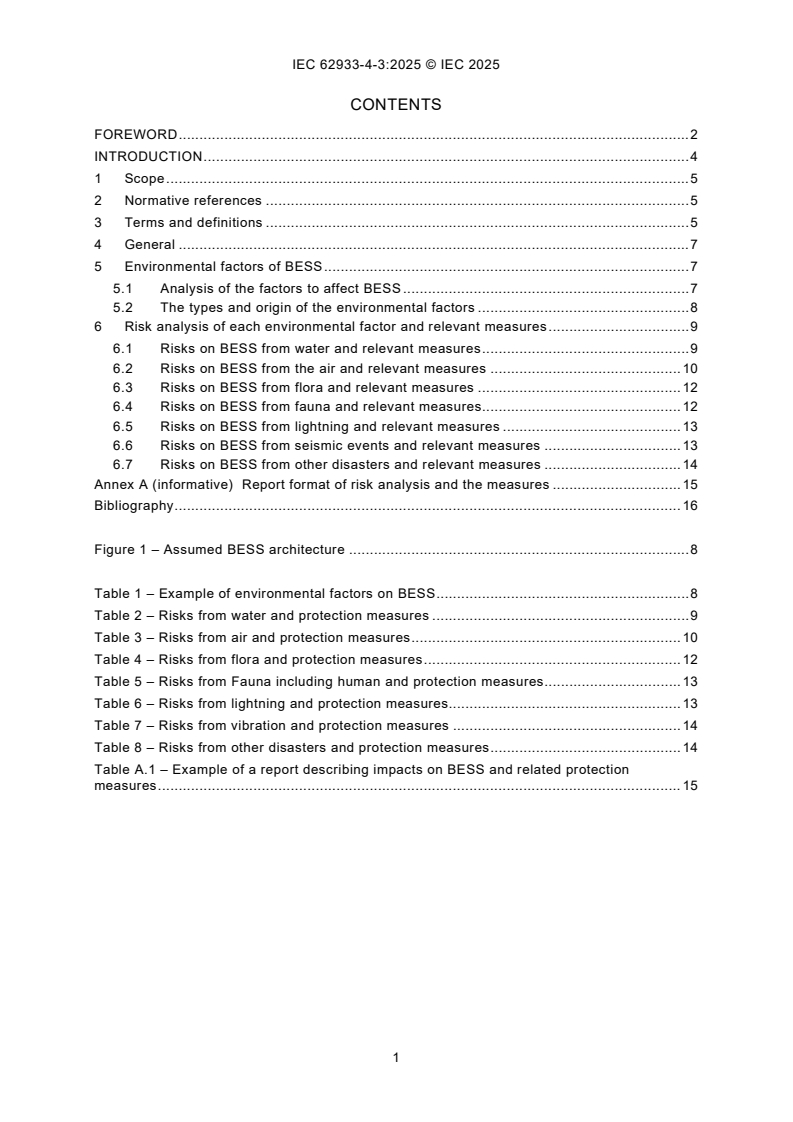
CONTENTS
FOREWORD . 2
INTRODUCTION . 4
1 Scope . 5
2 Normative references . 5
3 Terms and definitions . 5
4 General . 7
5 Environmental factors of BESS . 7
5.1 Analysis of the factors to affect BESS . 7
5.2 The types and origin of the environmental factors . 8
6 Risk analysis of each environmental factor and relevant measures . 9
6.1 Risks on BESS from water and relevant measures . 9
6.2 Risks on BESS from the air and relevant measures . 10
6.3 Risks on BESS from flora and relevant measures . 12
6.4 Risks on BESS from fauna and relevant measures. 12
6.5 Risks on BESS from lightning and relevant measures . 13
6.6 Risks on BESS from seismic events and relevant measures . 13
6.7 Risks on BESS from other disasters and relevant measures . 14
Annex A (informative) Report format of risk analysis and the measures . 15
Bibliography . 16
Figure 1 – Assumed BESS architecture . 8
Table 1 – Example of environmental factors on BESS . 8
Table 2 – Risks from water and protection measures . 9
Table 3 – Risks from air and protection measures . 10
Table 4 – Risks from flora and protection measures . 12
Table 5 – Risks from Fauna including human and protection measures . 13
Table 6 – Risks from lightning and protection measures. 13
Table 7 – Risks from vibration and protection measures . 14
Table 8 – Risks from other disasters and protection measures . 14
Table A.1 – Example of a report describing impacts on BESS and related protection
measures . 15
INTERNATIONAL ELECTROTECHNICAL COMMISSION
____________
Electrical energy storage (EES) systems -
Part 4-3: Protection requirements of battery-based energy storage
systems (BESS) according to environmental conditions
FOREWORD
1) The International Electrotechnical Commission (IEC) is a worldwide organization for standardization comprising
all national electrotechnical committees (IEC National Committees). The object of IEC is to promote international
co-operation on all questions concerning standardization in the electrical and electronic fields. To this end and
in addition to other activities, IEC publishes International Standards, Technical Specifications, Technical Reports,
Publicly Available Specifications (PAS) and Guides (hereafter referred to as “IEC Publication(s)”). Their
preparation is entrusted to technical committees; any IEC National Committee interested in the subject dealt with
may participate in this preparatory work. International, governmental and non-governmental organizations liaising
with the IEC also participate in this preparation. IEC collaborates closely with the International Organization for
Standardization (ISO) in accordance with conditions determined by agreement between the two organizations.
2) The formal decisions or agreements of IEC on technical matters express, as nearly as possible, an international
consensus of opinion on the relevant subjects since each technical committee has representation from all
interested IEC National Committees.
3) IEC Publications have the form of recommendations for international use and are accepted by IEC National
Committees in that sense. While all reasonable efforts are made to ensure that the technical content of IEC
Publications is accurate, IEC cannot be held responsible for the way in which they are used or for any
misinterpretation by any end user.
4) In order to promote international uniformity, IEC National Committees undertake to apply IEC Publications
transparently to the maximum extent possible in their national and regional publications. Any divergence between
any IEC Publication and the corresponding national or regional publication shall be clearly indicated in the latter.
5) IEC itself does not provide any attestation of conformity. Independent certification bodies provide conformity
assessment services and, in some areas, access to IEC marks of conformity. IEC is not responsible for any
services carried out by independent certification bodies.
6) All users should ensure that they have the latest edition of this publication.
7) No liability shall attach to IEC or its directors, employees, servants or agents including individual experts and
members of its technical committees and IEC National Committees for any personal injury, property damage or
other damage of any nature whatsoever, whether direct or indirect, or for costs (including legal fees) and
expenses arising out of the publication, use of, or reliance upon, this IEC Publication or any other IEC
Publications.
8) Attention is drawn to the Normative references cited in this publication. Use of the referenced publications is
indispensable for the correct application of this publication.
9) IEC draws attention to the possibility that the implementation of this document may involve the use of (a)
patent(s). IEC takes no position concerning the evidence, validity or applicability of any claimed patent rights in
respect thereof. As of the date of publication of this document, IEC had not received notice of (a) patent(s), which
may be required to implement this document. However, implementers are cautioned that this may not represent
the latest information, which may be obtained from the patent database available at https://patents.iec.ch. IEC
shall not be held responsible for identifying any or all such patent rights.
IEC 62933-4-3 has been prepared by IEC technical committee TC120: Electrical Energy
Storage (EES) systems. It is an International Standard.
The text of this International Standard is based on the following documents:
Draft Report on voting
120/419/FDIS 120/433/RVD
Full information on the voting for its approval can be found in the report on voting indicated in
the above table.
The language used for the development of this International Standard is English.
This document was drafted in accordance with ISO/IEC Directives, Part 2, and developed in
accordance with ISO/IEC Directives, Part 1 and ISO/IEC Directives, IEC Supplement available
at www.iec.ch/members_experts/refdocs. The main document types developed by IEC are
described in greater detail at www.iec.ch/publications.
A list of all parts in the IEC 62933 series, published under the general title Electrical energy
storage (EES) systems, can be found on the IEC website.
The committee has decided that the contents of this document will remain unchanged until the
stability date indicated on the IEC website under webstore.iec.ch in the data related to the
specific document. At this date, the document will be
• reconfirmed,
• withdrawn, or
• revised.
INTRODUCTION
According to reports over the world, BESS have been influenced by environmental and climatic
conditions of the areas where they are installed. The BESS can be particularly affected by
temperature, humidity, and vibration and natural disasters. In order to minimize the impacts,
this document is expected to be of great help in stable installation and operation by presenting
the causes, risk factors and the appropriate measures for each environmental condition when
installing the BESS.
1 Scope
This part of IEC 62933 applies to the effects of the environmental conditions on battery-based
energy storage systems (BESS). This document addresses these effects and identifies causes,
chains of events and final effects on the BESS. Based on those effects, preventative or
mitigating measures are described. Typical environmental effects on the BESS include, but are
not limited to, the effects of lightning, seismic activities, water, air, flora, fauna, and humans.
The described measures focus on the entire BESS including all power and communication
connections and their point of connections (POCs).
The scope of this document is limited to BESS specific requirements and operating conditions.
Specific design or safety requirements of individual BESS subsystems are excluded from this
document.
2 Normative references
The following documents are referred to in the text in such a way that some or all of their content
constitutes requirements of this document. For dated references, only the edition cited applies.
For undated references, the latest edition of the referenced document (including any
amendments) applies.
IEC 62933-1:2024, Electrical energy storage (EES) systems - Part 1: Vocabulary
3 Terms and definitions
For the purposes of this document, the terms and definitions given in IEC 62933-1 and the
following apply.
ISO and IEC maintain terminology databases for use in standardization at the following
addresses:
• IEC Electropedia: available at https://www.electropedia.org/
• ISO Online browsing platform: available at https://www.iso.org/obp
3.1
environmental factor
physical, social and attitudinal environment in which people live and conduct their lives
[SOURCE: ISO 9999:2022, 3.7]
3.2
risk analysis
systematic use of available information to identify hazards and to estimate the risk
[SOURCE: ISO/IEC Guide 51:2014, 3.10]
3.3
seismic action
action caused by earthquake ground motions
[SOURCE: ISO 2394:2015, 2.3.15]
3.4
human factors
environmental, organisational, and job factors that influence behaviour of work in a way that
can affect health and safety outcomes including the performance of critical safety systems
[SOURCE: ISO 13702:2024, 3.26]
3.5
arcing
luminous discharge of electricity across an insulating medium, usually accompanied by the
partial volatilization of the electrodes
Note 1 to entry: A complete sinusoidal current half-cycle is not considered to be an arcing half-cycle.
[SOURCE: IEC 62606:2013, 3.1, modified – the preferred term “arc” has been removed.]
3.6
internal resistance
opposition to the flow of current within a cell or a battery, that is, sum of electronic resistance
and ionic resistance with the contribution to total effective resistance including
inductive/capacitive properties
[SOURCE: ISO 17546:2024, 3.17]
3.7
battery management system
BMS
set of protection functions associated with a battery to prevent overcharge, overcurrent, over-
temperature, under-temperature and, if applicable, overdischarge and which monitors and/or
manages its state, calculates secondary data, reports that data and/or controls its environment
to influence the battery’s safety, performance and/or service life’
[SOURCE: IEC 63056:2020, 3.12, modified – the notes have been removed.]
3.8
water leakage
water drop or flow that spills out from the closed pipe and container
[SOURCE: ISO 2710-2:2019, 3.4.37]
3.9
electromagnetic compatibility
EMC
ability of equipment or a system to function satisfactorily in its electromagnetic environment
without introducing intolerable electromagnetic disturbances to anything in that environment
[SOURCE: IEC 60050-161:2018,161-01-07]
3.10
high voltage
voltage having a value above a conventionally adopted limit
Note 1 to entry: An example is the set of upper voltage values used in bulk power systems.
[SOURCE: IEC 60050-151:2001, 151-15-05]
3.11
salinity
quantification of any dissolved salts in water, expressed as either a percentage or a
concentration
[SOURCE: ISO/TR 12748:2015, 2.50]
3.12
stem
portion of a standing tree above ground, excluding branches
[SOURCE: ISO 8965:2022, 3.4.1]
3.13
mould
woolly or powdery fungal growth that can form on the surface of wood in damp conditions
[SOURCE: ISO 24294:2021, 13.17]
3.14
point of connection
POC
reference point on the electric power system where an EES system is connected
[SOURCE: IEC 62933-1:2024, 4.1.3, modified – the note has been removed.]
4 General
The impact on battery energy storage systems (BESS) from environmental factors depends on
the location of the BESS installation. This document provides guidelines on the environmental
factors and requirements for identifying potential impacts on BESS installed in the described
environmental areas.
When a BESS operator or system integrator installs the system in a specified area, the
environmental factors are analysed and documented in accordance with Clause 5 and Clause 6
together with an example shown in Annex A before the BESS is installed at a designated area.
The environmental factors referenced in this document are in accordance with
IEC TS 62933-4-1. IEC TS 62933-4-1:2017, 6.3, identifies environmental factors such as
lightning, seismic risk, flooding, water, rain, temperature, pressure, wind, ice and snow, life
form invasion, vibration/resonance, dust, smoke, fire, external fire, external electromagnetic
source, humidity, salt mist/salt water/erosive chemical, corrosion, solar irradiation, sediment
build up. Clause 5 categorizes these factors based on IEC TS 62933-4-1 and classifies them
with detailed risk factors.
Clause 5 and Clause 6 describe the risk analysis of each environmental factor and the relevant
measures. The relevant measures are examples and not limited to the ones listed.
5 Environmental factors of BESS
5.1 Analysis of the factors to affect BESS
BESS are installed and operated around the world for various purposes. When they are installed
in many different areas, the factors which are listed in IEC TS 62933-4-1, can have an effect
on the BESS. In this document, the typical environmental effects on the BESS include, but are
not limited to, the effects of lightning, seismic activities, water, air, flora, fauna, and humans. In
order to operate the BESS stably, it is important to address the problems that can arise due to
these factors and take the appropriate measures to solve the problems.
This document describes the types of environmental factors and the ways they adversely affect
the BESS.
The assumed BESS architecture shown in Figure 1 is used for the risk analysis in Clause 6.
Figure 1 – Assumed BESS architecture
The operator or system integrator of the BESS should refer to the environmental factors
described in this document. The risk analysis and related measures shall be performed prior to
the installation.
5.2 The types and origin of the environmental factors
According to 5.1, the environmental factors listed are lightning, seismic activities, water, air,
flora, fauna, and humans. Each factor can take on different forms, but this is not an exhaustive
list. Additional types of each factor can be additionally analysed by the BESS integrator or
operator. The main factors are shown in the Table 1.
Table 1 – Example of environmental factors on BESS
Type of factors Risk factors
Water Water leak, flooding, moisture and condensation, tsunami, heavy snow
Air Dust, chemical gas, salinity, strong storm (wind), ambient temperature (heat wave and
cold wave), altitude (pressure)
Flora Roots, stems, pollen, moss and mould, weeds
Fauna including human Invading, colliding, laying, gnawing
Lightning Natural environment, high voltage
Vibration Transportation, surrounding location of the factory
Others Forest fire, grass fire and wild fire, external fire (near combustible factory),
earthquake
The water environmental risk factors consist of the following risk types: water leak, flooding,
moisture, condensation, tsunamis, heavy snow and ice. Water leaks arise from rain or
malfunctioning of air conditioners mounted on the ceiling of the BESS enclosure. Flooding
comes from heavy rain. Moisture and condensation are generated due to the temperature
difference between inside and outside the BESS. A tsunami occurs due to an earthquake or
similar natural disaster.
The air environmental risk factors consist of the following risk types: dust, chemical gas, salinity,
strong storm (wind) and ambient temperature. Dust enters into the BESS from outside or can
accumulate on components or printed circuit board (PCB). Specifically, chemical gas can be
induced into the BESS from outside due to natural disaster, such as fire or is generated from
the BESS by itself. The salinity comes from the sea. High temperature or low temperature can
happen due to the weather or by the malfunctioning of heating, ventilation, and air conditioning
(HVAC) system. The altitude risk occurs in countries with high elevations.
The flora environmental risk factors consist of the
...
IEC 62933-4-3 ®
Edition 1.0 2025-10
NORME
INTERNATIONALE
Systèmes de stockage de l’énergie électrique (EES) -
Partie 4-3: Exigences de protection des systèmes de stockage de l’énergie sur
batterie (BESS) en fonction des conditions environnementales
ICS 13.020.30; 27.010 ISBN 978-2-8327-0623-7
Droits de reproduction réservés. Sauf indication contraire, aucune partie de cette publication ne peut être reproduite ni
utilisée sous quelque forme que ce soit et par aucun procédé, électronique ou mécanique, y compris la photocopie et
les microfilms, sans l'accord écrit de l'IEC ou du Comité national de l'IEC du pays du demandeur. Si vous avez des
questions sur le copyright de l'IEC ou si vous désirez obtenir des droits supplémentaires sur cette publication, utilisez
les coordonnées ci-après ou contactez le Comité national de l'IEC de votre pays de résidence.
IEC Secretariat Tel.: +41 22 919 02 11
3, rue de Varembé info@iec.ch
CH-1211 Geneva 20 www.iec.ch
Switzerland
A propos de l'IEC
La Commission Electrotechnique Internationale (IEC) est la première organisation mondiale qui élabore et publie des
Normes internationales pour tout ce qui a trait à l'électricité, à l'électronique et aux technologies apparentées.
A propos des publications IEC
Le contenu technique des publications IEC est constamment revu. Veuillez vous assurer que vous possédez l’édition la
plus récente, un corrigendum ou amendement peut avoir été publié.
Recherche de publications IEC - IEC Products & Services Portal - products.iec.ch
webstore.iec.ch/advsearchform Découvrez notre puissant moteur de recherche et consultez
La recherche avancée permet de trouver des publications gratuitement tous les aperçus des publications, symboles
IEC en utilisant différents critères (numéro de référence, graphiques et le glossaire. Avec un abonnement, vous aurez
texte, comité d’études, …). Elle donne aussi des toujours accès à un contenu à jour adapté à vos besoins.
informations sur les projets et les publications remplacées
ou retirées. Electropedia - www.electropedia.org
Le premier dictionnaire d'électrotechnologie en ligne au
IEC Just Published - webstore.iec.ch/justpublished monde, avec plus de 22 500 articles terminologiques en
Restez informé sur les nouvelles publications IEC. Just anglais et en français, ainsi que les termes équivalents
dans 25 langues additionnelles. Egalement appelé
Published détaille les nouvelles publications parues.
Disponible en ligne et une fois par mois par email. Vocabulaire Electrotechnique International (IEV) en ligne.
Service Clients - webstore.iec.ch/csc
Si vous désirez nous donner des commentaires sur cette
publication ou si vous avez des questions contactez-
nous: sales@iec.ch.
SOMMAIRE
AVANT-PROPOS . 2
INTRODUCTION . 4
1 Domaine d’application . 5
2 Références normatives . 5
3 Termes et définitions . 5
4 Généralités . 7
5 Facteurs d’environnement d’un BESS . 8
5.1 Analyse des facteurs affectant le BESS . 8
5.2 Types et origine des facteurs d’environnement . 8
6 Analyse du risque de chaque facteur d’environnement et mesures pertinentes . 10
6.1 Risques créés par l’eau sur le BESS et mesures pertinentes . 10
6.2 Risques créés par l’air sur le BESS et mesures pertinentes . 11
6.3 Risques créés par la flore sur le BESS et mesures pertinentes . 12
6.4 Risques créés par la faune sur le BESS et mesures pertinentes . 13
6.5 Risques créés par la foudre sur le BESS et mesures pertinentes . 14
6.6 Risques créés par l’activité sismique sur le BESS et mesures pertinentes . 14
6.7 Risques créés par les autres sinistres sur le BESS et mesures pertinentes . 15
Annexe A (informative) Configuration type d’un rapport d’analyse du risque et des
mesures . 17
Bibliographie . 18
Figure 1 – Architecture supposée du BESS . 8
Tableau 1 – Exemple de facteurs d’environnement du BESS . 9
Tableau 2 – Risques liés à l’eau et mesures de protection . 10
Tableau 3 – Risques liés à l’air et aux mesures de protection . 11
Tableau 4 – Risques liés à la flore et mesures de protection . 13
Tableau 5 – Risques créés par la faune, êtres humains inclus, et mesures de
protection . 14
Tableau 6 – Risques liés à la foudre et mesures de protection . 14
Tableau 7 – Risques liés aux vibrations et mesures de protection . 15
Tableau 8 – Risques liés aux autres sinistres et mesures de protection . 15
Tableau A.1 – Exemple de rapport décrivant les impacts sur le BESS et les mesures
de protection associées . 17
COMMISSION ÉLECTROTECHNIQUE INTERNATIONALE
____________
Systèmes de stockage de l’énergie électrique (EES) -
Partie 4-3: Exigences de protection des systèmes de stockage
de l’énergie sur batterie (BESS) en fonction des conditions
environnementales
AVANT-PROPOS
1) La Commission Electrotechnique Internationale (IEC) est une organisation mondiale de normalisation composée
de l’ensemble des comités électrotechniques nationaux (Comités nationaux de l’IEC). L’IEC a pour objet de
favoriser la coopération internationale pour toutes les questions de normalisation dans les domaines de
l’électricité et de l’électronique. À cet effet, l’IEC – entre autres activités – publie des Normes internationales,
des Spécifications techniques, des Rapports techniques, des Spécifications accessibles au public (PAS) et des
Guides (ci-après dénommés "Publication(s) de l’IEC"). Leur élaboration est confiée à des comités d’études, aux
travaux desquels tout Comité national intéressé par le sujet traité peut participer. Les organisations
internationales, gouvernementales et non gouvernementales, en liaison avec l’IEC, participent également aux
travaux. L’IEC collabore étroitement avec l’Organisation Internationale de Normalisation (ISO), selon des
conditions fixées par accord entre les deux organisations.
2) Les décisions ou accords officiels de l’IEC concernant les questions techniques représentent, dans la mesure du
possible, un accord international sur les sujets étudiés, étant donné que les Comités nationaux de l’IEC intéressés
sont représentés dans chaque comité d’études.
3) Les Publications de l’IEC se présentent sous la forme de recommandations internationales et sont agréées
comme telles par les Comités nationaux de l’IEC. Tous les efforts raisonnables sont entrepris afin que l’IEC
s’assure de l’exactitude du contenu technique de ses publications; l’IEC ne peut pas être tenue responsable de
l’éventuelle mauvaise utilisation ou interprétation qui en est faite par un quelconque utilisateur final.
4) Dans le but d’encourager l’uniformité internationale, les Comités nationaux de l’IEC s’engagent, dans toute la
mesure possible, à appliquer de façon transparente les Publications de l’IEC dans leurs publications nationales
et régionales. Toutes divergences entre toutes Publications de l’IEC et toutes publications nationales ou
régionales correspondantes doivent être indiquées en termes clairs dans ces dernières.
5) L’IEC elle-même ne fournit aucune attestation de conformité. Des organismes de certification indépendants
fournissent des services d’évaluation de conformité et, dans certains secteurs, accèdent aux marques de
conformité de l’IEC. L’IEC n’est responsable d’aucun des services effectués par les organismes de certification
indépendants.
6) Tous les utilisateurs doivent s’assurer qu’ils sont en possession de la dernière édition de cette publication.
7) Aucune responsabilité ne doit être imputée à l’IEC, à ses administrateurs, employés, auxiliaires ou mandataires,
y compris ses experts particuliers et les membres de ses comités d’études et des Comités nationaux de l’IEC,
pour tout préjudice causé en cas de dommages corporels et matériels, ou de tout autre dommage de quelque
nature que ce soit, directe ou indirecte, ou pour supporter les coûts (y compris les frais de justice) et les dépenses
découlant de la publication ou de l’utilisation de cette Publication de l’IEC ou de toute autre Publication de l’IEC,
ou au crédit qui lui est accordé.
8) L’attention est attirée sur les références normatives citées dans cette publication. L’utilisation de publications
référencées est obligatoire pour une application correcte de la présente publication.
9) L’IEC attire l’attention sur le fait que la mise en application du présent document peut entraîner l’utilisation d’un
ou de plusieurs brevets. L’IEC ne prend pas position quant à la preuve, à la validité et à l’applicabilité de tout
droit de brevet revendiqué à cet égard. À la date de publication du présent document, l’IEC n’avait pas reçu
notification qu’un ou plusieurs brevets pouvaient être nécessaires à sa mise en application. Toutefois, il y a lieu
d’avertir les responsables de la mise en application du présent document que des informations plus récentes
sont susceptibles de figurer dans la base de données de brevets, disponible à l’adresse https://patents.iec.ch.
L’IEC ne saurait être tenue pour responsable de ne pas avoir identifié de tels droits de brevet.
L’IEC 62933-4-3 a été établie par le comité technique TC 120 de l’IEC: Systèmes de stockage
de l’énergie électrique. Il s’agit d’une Norme internationale.
Le texte de cette Norme internationale est issu des documents suivants:
Projet Rapport de vote
120/419/FDIS 120/433/RVD
Le rapport de vote indiqué dans le tableau ci-dessus donne toute information sur le vote ayant
abouti à son approbation.
La langue employée pour l’élaboration de cette Norme internationale est l’anglais.
Ce document a été rédigé selon les Directives ISO/IEC, Partie 2, il a été développé selon les
Directives ISO/IEC, Partie 1 et les Directives ISO/IEC, Supplément IEC, disponibles sous
www.iec.ch/members_experts/refdocs. Les principaux types de documents développés par
l’IEC sont décrits plus en détail sous www.iec.ch/publications.
Une liste de toutes les parties de la série IEC 62933, publiées sous le titre général Systèmes
de stockage de l’énergie électrique (EES), se trouve sur le site web de l’IEC.
Le comité a décidé que le contenu de ce document ne sera pas modifié avant la date de stabilité
indiquée sur le site Web de l’IEC sous webstore.iec.ch dans les données relatives au document
recherché. À cette date, le document sera
• reconduit,
• supprimé, ou
• révisé.
INTRODUCTION
Les rapports du monde entier indiquent que les BESS sont influencés par les conditions
environnementales et climatiques des zones où ils sont installés. Ils peuvent être
particulièrement affectés par la température, l’humidité, les vibrations et les catastrophes
naturelles. Pour limiter le plus possible les impacts, le présent document est destiné à apporter
une aide substantielle pour une installation et un fonctionnement stables des BESS, en
présentant les causes, les facteurs de risque et les mesures appropriées pour chaque condition
environnementale.
1 Domaine d’application
La présente partie de l’IEC 62933 s’applique aux effets des conditions environnementales sur
les systèmes de stockage de l’énergie sur batterie (BESS). Le présent document examine ces
effets et identifie les causes, les chaînes des événements et les effets finaux sur les BESS. Sur
la base de ces effets, des mesures de prévention ou d’atténuation sont décrites. Les effets
environnementaux types sur les BESS comprennent, mais sans s’y limiter, les effets de la
foudre, des activités sismiques, de l’eau, de l’air, de la flore, de la faune et des êtres humains.
Les mesures décrites portent essentiellement sur l’ensemble des BESS, y compris toutes les
connexions d’alimentation et de communication et leurs points de connexion.
Le domaine d’application du présent document se limite aux exigences et conditions de
fonctionnement spécifiques aux BESS. Les exigences spécifiques en matière de conception ou
de sécurité des sous-systèmes individuels des BESS sont exclues du présent document.
2 Références normatives
Les documents suivants sont cités dans le texte de sorte qu’ils constituent, pour tout ou partie
de leur contenu, des exigences du présent document. Pour les références datées, seule
l’édition citée s’applique. Pour les références non datées, la dernière édition du document de
référence s’applique (y compris les éventuels amendements).
IEC 62933-1:2024, Systèmes de stockage de l’énergie électrique (EES) - Partie 1: Vocabulaire
3 Termes et définitions
Pour les besoins du présent document, les termes et les définitions de l’IEC 62933-1 ainsi que
les suivants s’appliquent.
L’ISO et l’IEC tiennent à jour des bases de données terminologiques destinées à être utilisées
en normalisation, consultables aux adresses suivantes:
• IEC Electropedia: disponible à l’adresse https://www.electropedia.org/
• ISO Online browsing platform : disponible à l’adresse https://www.iso.org/obp
3.1
facteur d’environnement
environnement physique, social et psychologique dans lequel les personnes vivent et mènent
leur vie
[SOURCE: ISO 9999:2022, 3.7]
3.2
analyse du risque
utilisation des informations disponibles pour identifier les phénomènes dangereux et estimer le
risque
[SOURCE: Guide ISO/IEC 51:2014, 3.10]
3.3
action sismique
action due à des mouvements sismiques du sol
[SOURCE: ISO 2394:2015, 2.3.15]
3.4
facteurs humains
facteurs environnementaux, organisationnels et professionnels qui influencent le comportement
au travail d’une manière pouvant nuire à la santé et à la sécurité, y compris la performance des
systèmes de sécurité critiques
[SOURCE: ISO 13702:2024, 3.26]
3.5
production d’arc électrique
décharge lumineuse d’électricité à travers un milieu isolant, en général accompagnée d’une
volatilité partielle des électrodes
Note 1 à l’article: Un demi-cycle de courant sinusoïdal complet n’est pas considéré comme un demi-cycle de
production d’arc électrique.
[SOURCE: IEC 62606:2013, 3.1, modifié – le terme recommandé "arc" a été supprimé.]
3.6
résistance interne
opposition à la circulation du courant à l’intérieur d’un élément ou d’une batterie, c’est-à-dire la
somme de la résistance électronique et de la résistance ionique avec la contribution à la
résistance effective totale incluant les propriétés inductives/capacitives
[SOURCE: ISO 17546:2024, 3.17]
3.7
système de gestion de batterie
BMS
ensemble de fonctions de protection associé à une batterie pour empêcher les cas de
surcharge, de surintensité, de température excessive, de sous-température et, le cas échéant,
de décharge excessive et qui surveille et/ou gère son état, calcule les données secondaires,
signale ces données et/ou régule son environnement afin d’influencer la sécurité, les
performances et/ou la durée en service de la batterie
[SOURCE: IEC 63056:2020, 3.12, modifié – les notes ont été supprimées.]
3.8
fuite d’eau
égouttement ou écoulement d’eau qui provient d’un tuyau et d’un récipient fermés
[SOURCE: ISO 2710-2:2019, 3.4.37]
3.9
compatibilité électromagnétique
CEM
aptitude d’un équipement ou d’un système à fonctionner dans son environnement
électromagnétique de façon satisfaisante et sans produire lui-même des perturbations
électromagnétiques intolérables pour tout ce qui se trouve dans cet environnement
[SOURCE: IEC 60050-161:2018,161-01-07]
3.10
haute tension
tension électrique de valeur supérieure à une limite adoptée par convention
Note 1 à l’article: Un exemple est l’ensemble des tensions les plus élevées utilisées dans les réseaux de production-
transport d’énergie électrique.
[SOURCE: IEC 60050-151:2001, 151-15-05]
3.11
salinité
quantification des sels non dissous dans l’eau, exprimée en pourcentage ou en concentration
[SOURCE: ISO/TR 12748:2015, 2.50]
3.12
tronc
partie de l’arbre au-dessus du sol, branches exclues
[SOURCE: ISO 8965:2022, 3.4.1]
3.13
moisissure
développement fongique sous forme duveteuse et poudreuse qui peut se former à la surface
du bois en atmosphère humide
[SOURCE: ISO 24294:2021, 13.17]
3.14
point de connexion
POC
point de référence sur le réseau d’énergie électrique auquel un système EES est raccordé
[SOURCE: IEC 62933-1:2024, 4.1.3, modifié – la note a été supprimée.]
4 Généralités
L’impact des facteurs d’environnement sur les systèmes de stockage de l’énergie sur batterie
(BESS) dépend du lieu où sont installés les BESS. Le présent document fournit des lignes
directrices sur les facteurs d’environnement et les exigences permettant d’identifier les impacts
potentiels sur les BESS installés dans les zones environnementales décrites.
Lorsqu’un opérateur ou un intégrateur de système BESS installe le système dans une zone
spécifiée, les facteurs d’environnement sont analysés et documentés conformément aux
Articles 5 et 6 avec un exemple indiqué dans l’Annexe A avant d’installer le BESS dans une
zone désignée.
Les facteurs d’environnement référencés dans le présent document sont conformes à l’IEC
TS 62933-4-1. L’IEC TS 62933-4-1:2017, 6.3, identifie des facteurs tels que la foudre, le risque
sismique, les inondations, l’eau, la pluie, la température, la pression, le vent, la glace et la
neige, toute forme d’invasion d’organismes vivants, les vibrations/la résonance, la poussière,
la fumée, le feu, un incendie voisin, les sources électromagnétiques externes, l’humidité, le
brouillard salin/l’eau salée/les produits chimiques érosifs, la corrosion, l’irradiation solaire et
l’accumulation de sédiments. L’Article 5 classe ces facteurs sur la base de l’IEC TS 62933-4-1
en utilisant des facteurs de risque détaillés.
Les Articles 5 et 6 décrivent l’analyse du risque de chaque facteur d’environnement et les
mesures pertinentes. Les mesures pertinentes sont des exemples et ne se limitent pas aux
mesures énumérées.
5 Facteurs d’environnement d’un BESS
5.1 Analyse des facteurs affectant le BESS
Les BESS sont installés et exploités dans le monde entier pour divers usages. Lorsqu’ils sont
installés dans de nombreuses zones différentes, les facteurs énumérés dans l’IEC TS 62933-
4-1 peuvent avoir un effet sur celui-ci. Dans le présent document, les effets environnementaux
types sur le BESS comprennent, mais sans s’y limiter, les effets de la foudre, des activités
sismiques, de l’eau, de l’air, de la flore, de la faune et des êtres humains. Pour que le BESS
fonctionne de manière stable, il est important de traiter les problèmes qui peuvent survenir en
raison de ces facteurs et de prendre les mesures appropriées pour les résoudre.
Le présent document décrit les types de facteurs d’environnement et leurs impacts négatifs sur
le BESS.
L’architecture supposée du BESS représentée à la Figure 1 est utilisée pour l’analyse du risque
de l’Article 6.
Figure 1 – Architecture supposée du BESS
Il convient que l’opérateur ou l’intégrateur du système du BESS se réfère aux facteurs
d’environnement décrits dans le présent document. L’analyse du risque et les mesures
associées doivent être effectuées avant l’installation.
5.2 Types et origine des facteurs d’environnement
Conformément au paragraphe 5.1, les facteurs d’environnement énumérés sont la foudre, les
activités sismiques, l’eau, l’air, la flore, la faune et les êtres humains. Chaque facteur peut
prendre différentes formes, mais cette liste n’est pas exhaustive. Les types supplémentaires de
risque de chaque facteur peuvent en outre être analysés par l’intégrateur ou l’opérateur du
BESS. Les principaux facteurs sont présentés dans le Tableau 1.
Tableau 1 – Exemple de facteurs d’environnement du BESS
Type de facteurs Facteurs de risque
Eau Fuites d’eau, inondation, humidité et condensation, tsunami, neige abondante
Air Poussière, gaz chimique, salinité, grosse tempête (vent), température ambiante
(vague de chaleur et vague de froid), altitude (pression)
Flore Racines, troncs, pollen, mousse et moisissures, mauvaises herbes
Faune, êtres humains Invasion, collision, ponte, grignotement
inclus
Foudre Environnement naturel, haute tension
Vibrations Transport, milieu environnant de l’usine
Autres Feu de forêt, feu d’herbe et autre incendie de végétation, incendie voisin (usine à
combustible proche), séisme
Les facteurs de risque environnemental liés à l’eau comprennent les types de risque suivants:
fuites d’eau, inondation, humidité, condensation, tsunami, neige abondante et verglas. Les
fuites d’eau résultent de la pluie ou d’un dysfonctionnement des climatiseurs montés au plafond
de l’enveloppe du BESS. Les inondations découlent de fortes pluies. L’humidité et la
condensation sont générées en raison de la différence de température entre l’intérieur et
l’extérieur du BESS. Un tsunami se produit à la suite d’un tremblement de terre ou d’une
catastrophe naturelle similaire.
Les facteurs de risque environnemental liés à l’air comprennent les types de risque suivants:
poussière, gaz chimique, salinité, tempête violente (vent) et température ambiante. La
poussière provenant de l’extérieur pénètre dans le BESS ou peut s’accumuler sur les
composants ou les circuits imprimés. Plus spécifiquement, du gaz chimique peut être induit
dans le BESS de l’extérieur en raison d’une catastrophe naturelle, telle qu’un incendie, ou est
généré par le BESS lui-même. La salinité provient de la mer. Une température élevée ou basse
peut apparaître en raison des conditions météorologiques ou du dysfonctionnement du système
de chauffage, de ventilation et de climatisation (CVC). Le risque lié à l’altitude apparaît dans
les pays où les altitudes sont élevées.
Les facteurs de risque environnemental liés à la flore comprennent les types de risque suivants:
racines, troncs, pollen, mousse et moisissures. Les racines et les tiges envahissent le BESS
depuis les arbres situés à l’extérieur. Le pollen est produit par les fleurs à l’extérieur et peut
s’accumuler sur les composants. La mousse et les moisissures se développent à l’intérieur du
BESS en raison de l’humidité.
Les facteurs de risque environnemental liés à la faune comprennent les types de risque suivants:
les actions des animaux telles que l’invasion, la collision, la ponte et le grignotement. Les
serpents peuvent pénétrer dans les ensembles du BESS et les rongeurs peuvent grignoter les
fils ou les connecteurs. Même de gros animaux peuvent entrer en collision avec les ensembles
ou l’envelopp
...
IEC 62933-4-3 ®
Edition 1.0 2025-10
INTERNATIONAL
STANDARD
NORME
INTERNATIONALE
Electrical energy storage(EES) systems -
Part 4-3: Protection requirements of battery-based energy storage systems
(BESS) according to environmental conditions
Systèmes de stockage de l’énergie électrique (EES) -
Partie 4-3: Exigences de protection des systèmes de stockage de l’énergie sur
batterie (BESS) en fonction des conditions environnementales
ICS 13.020.30, 27.010 ISBN 978-2-8327-0623-7
All rights reserved. Unless otherwise specified, no part of this publication may be reproduced or utilized in any form or
by any means, electronic or mechanical, including photocopying and microfilm, without permission in writing from either
IEC or IEC's member National Committee in the country of the requester. If you have any questions about IEC copyright
or have an enquiry about obtaining additional rights to this publication, please contact the address below or your local
IEC member National Committee for further information.
Droits de reproduction réservés. Sauf indication contraire, aucune partie de cette publication ne peut être reproduite ni
utilisée sous quelque forme que ce soit et par aucun procédé, électronique ou mécanique, y compris la photocopie et
les microfilms, sans l'accord écrit de l'IEC ou du Comité national de l'IEC du pays du demandeur. Si vous avez des
questions sur le copyright de l'IEC ou si vous désirez obtenir des droits supplémentaires sur cette publication, utilisez
les coordonnées ci-après ou contactez le Comité national de l'IEC de votre pays de résidence.
IEC Secretariat Tel.: +41 22 919 02 11
3, rue de Varembé info@iec.ch
CH-1211 Geneva 20 www.iec.ch
Switzerland
About the IEC
The International Electrotechnical Commission (IEC) is the leading global organization that prepares and publishes
International Standards for all electrical, electronic and related technologies.
About IEC publications
The technical content of IEC publications is kept under constant review by the IEC. Please make sure that you have the
latest edition, a corrigendum or an amendment might have been published.
IEC publications search - IEC Products & Services Portal - products.iec.ch
webstore.iec.ch/advsearchform Discover our powerful search engine and read freely all the
The advanced search enables to find IEC publications by a publications previews, graphical symbols and the glossary.
variety of criteria (reference number, text, technical With a subscription you will always have access to up to date
committee, …). It also gives information on projects, content tailored to your needs.
replaced and withdrawn publications.
Electropedia - www.electropedia.org
IEC Just Published - webstore.iec.ch/justpublished The world's leading online dictionary on electrotechnology,
Stay up to date on all new IEC publications. Just Published containing more than 22 500 terminological entries in English
details all new publications released. Available online and and French, with equivalent terms in 25 additional languages.
once a month by email. Also known as the International Electrotechnical Vocabulary
(IEV) online.
IEC Customer Service Centre - webstore.iec.ch/csc
If you wish to give us your feedback on this publication or
need further assistance, please contact the Customer
Service Centre: sales@iec.ch.
A propos de l'IEC
La Commission Electrotechnique Internationale (IEC) est la première organisation mondiale qui élabore et publie des
Normes internationales pour tout ce qui a trait à l'électricité, à l'électronique et aux technologies apparentées.
A propos des publications IEC
Le contenu technique des publications IEC est constamment revu. Veuillez vous assurer que vous possédez l’édition la
plus récente, un corrigendum ou amendement peut avoir été publié.
Recherche de publications IEC - IEC Products & Services Portal - products.iec.ch
webstore.iec.ch/advsearchform Découvrez notre puissant moteur de recherche et consultez
La recherche avancée permet de trouver des publications gratuitement tous les aperçus des publications, symboles
IEC en utilisant différents critères (numéro de référence, graphiques et le glossaire. Avec un abonnement, vous aurez
texte, comité d’études, …). Elle donne aussi des toujours accès à un contenu à jour adapté à vos besoins.
informations sur les projets et les publications remplacées
ou retirées. Electropedia - www.electropedia.org
Le premier dictionnaire d'électrotechnologie en ligne au
IEC Just Published - webstore.iec.ch/justpublished monde, avec plus de 22 500 articles terminologiques en
Restez informé sur les nouvelles publications IEC. Just anglais et en français, ainsi que les termes équivalents
Published détaille les nouvelles publications parues. dans 25 langues additionnelles. Egalement appelé
Disponible en ligne et une fois par mois par email. Vocabulaire Electrotechnique International (IEV) en ligne.
Service Clients - webstore.iec.ch/csc
Si vous désirez nous donner des commentaires sur cette
publication ou si vous avez des questions contactez-
nous: sales@iec.ch.
CONTENTS
FOREWORD . 2
INTRODUCTION . 4
1 Scope . 5
2 Normative references . 5
3 Terms and definitions . 5
4 General . 7
5 Environmental factors of BESS . 7
5.1 Analysis of the factors to affect BESS . 7
5.2 The types and origin of the environmental factors . 8
6 Risk analysis of each environmental factor and relevant measures . 9
6.1 Risks on BESS from water and relevant measures . 9
6.2 Risks on BESS from the air and relevant measures . 10
6.3 Risks on BESS from flora and relevant measures . 12
6.4 Risks on BESS from fauna and relevant measures. 12
6.5 Risks on BESS from lightning and relevant measures . 13
6.6 Risks on BESS from seismic events and relevant measures . 13
6.7 Risks on BESS from other disasters and relevant measures . 14
Annex A (informative) Report format of risk analysis and the measures . 15
Bibliography . 16
Figure 1 – Assumed BESS architecture . 8
Table 1 – Example of environmental factors on BESS . 8
Table 2 – Risks from water and protection measures . 9
Table 3 – Risks from air and protection measures . 10
Table 4 – Risks from flora and protection measures . 12
Table 5 – Risks from Fauna including human and protection measures . 13
Table 6 – Risks from lightning and protection measures. 13
Table 7 – Risks from vibration and protection measures . 14
Table 8 – Risks from other disasters and protection measures . 14
Table A.1 – Example of a report describing impacts on BESS and related protection
measures . 15
INTERNATIONAL ELECTROTECHNICAL COMMISSION
____________
Electrical energy storage (EES) systems -
Part 4-3: Protection requirements of battery-based energy storage
systems (BESS) according to environmental conditions
FOREWORD
1) The International Electrotechnical Commission (IEC) is a worldwide organization for standardization comprising
all national electrotechnical committees (IEC National Committees). The object of IEC is to promote international
co-operation on all questions concerning standardization in the electrical and electronic fields. To this end and
in addition to other activities, IEC publishes International Standards, Technical Specifications, Technical Reports,
Publicly Available Specifications (PAS) and Guides (hereafter referred to as “IEC Publication(s)”). Their
preparation is entrusted to technical committees; any IEC National Committee interested in the subject dealt with
may participate in this preparatory work. International, governmental and non-governmental organizations liaising
with the IEC also participate in this preparation. IEC collaborates closely with the International Organization for
Standardization (ISO) in accordance with conditions determined by agreement between the two organizations.
2) The formal decisions or agreements of IEC on technical matters express, as nearly as possible, an international
consensus of opinion on the relevant subjects since each technical committee has representation from all
interested IEC National Committees.
3) IEC Publications have the form of recommendations for international use and are accepted by IEC National
Committees in that sense. While all reasonable efforts are made to ensure that the technical content of IEC
Publications is accurate, IEC cannot be held responsible for the way in which they are used or for any
misinterpretation by any end user.
4) In order to promote international uniformity, IEC National Committees undertake to apply IEC Publications
transparently to the maximum extent possible in their national and regional publications. Any divergence between
any IEC Publication and the corresponding national or regional publication shall be clearly indicated in the latter.
5) IEC itself does not provide any attestation of conformity. Independent certification bodies provide conformity
assessment services and, in some areas, access to IEC marks of conformity. IEC is not responsible for any
services carried out by independent certification bodies.
6) All users should ensure that they have the latest edition of this publication.
7) No liability shall attach to IEC or its directors, employees, servants or agents including individual experts and
members of its technical committees and IEC National Committees for any personal injury, property damage or
other damage of any nature whatsoever, whether direct or indirect, or for costs (including legal fees) and
expenses arising out of the publication, use of, or reliance upon, this IEC Publication or any other IEC
Publications.
8) Attention is drawn to the Normative references cited in this publication. Use of the referenced publications is
indispensable for the correct application of this publication.
9) IEC draws attention to the possibility that the implementation of this document may involve the use of (a)
patent(s). IEC takes no position concerning the evidence, validity or applicability of any claimed patent rights in
respect thereof. As of the date of publication of this document, IEC had not received notice of (a) patent(s), which
may be required to implement this document. However, implementers are cautioned that this may not represent
the latest information, which may be obtained from the patent database available at https://patents.iec.ch. IEC
shall not be held responsible for identifying any or all such patent rights.
IEC 62933-4-3 has been prepared by IEC technical committee TC120: Electrical Energy
Storage (EES) systems. It is an International Standard.
The text of this International Standard is based on the following documents:
Draft Report on voting
120/419/FDIS 120/433/RVD
Full information on the voting for its approval can be found in the report on voting indicated in
the above table.
The language used for the development of this International Standard is English.
This document was drafted in accordance with ISO/IEC Directives, Part 2, and developed in
accordance with ISO/IEC Directives, Part 1 and ISO/IEC Directives, IEC Supplement available
at www.iec.ch/members_experts/refdocs. The main document types developed by IEC are
described in greater detail at www.iec.ch/publications.
A list of all parts in the IEC 62933 series, published under the general title Electrical energy
storage (EES) systems, can be found on the IEC website.
The committee has decided that the contents of this document will remain unchanged until the
stability date indicated on the IEC website under webstore.iec.ch in the data related to the
specific document. At this date, the document will be
• reconfirmed,
• withdrawn, or
• revised.
INTRODUCTION
According to reports over the world, BESS have been influenced by environmental and climatic
conditions of the areas where they are installed. The BESS can be particularly affected by
temperature, humidity, and vibration and natural disasters. In order to minimize the impacts,
this document is expected to be of great help in stable installation and operation by presenting
the causes, risk factors and the appropriate measures for each environmental condition when
installing the BESS.
1 Scope
This part of IEC 62933 applies to the effects of the environmental conditions on battery-based
energy storage systems (BESS). This document addresses these effects and identifies causes,
chains of events and final effects on the BESS. Based on those effects, preventative or
mitigating measures are described. Typical environmental effects on the BESS include, but are
not limited to, the effects of lightning, seismic activities, water, air, flora, fauna, and humans.
The described measures focus on the entire BESS including all power and communication
connections and their point of connections (POCs).
The scope of this document is limited to BESS specific requirements and operating conditions.
Specific design or safety requirements of individual BESS subsystems are excluded from this
document.
2 Normative references
The following documents are referred to in the text in such a way that some or all of their content
constitutes requirements of this document. For dated references, only the edition cited applies.
For undated references, the latest edition of the referenced document (including any
amendments) applies.
IEC 62933-1:2024, Electrical energy storage (EES) systems - Part 1: Vocabulary
3 Terms and definitions
For the purposes of this document, the terms and definitions given in IEC 62933-1 and the
following apply.
ISO and IEC maintain terminology databases for use in standardization at the following
addresses:
• IEC Electropedia: available at https://www.electropedia.org/
• ISO Online browsing platform: available at https://www.iso.org/obp
3.1
environmental factor
physical, social and attitudinal environment in which people live and conduct their lives
[SOURCE: ISO 9999:2022, 3.7]
3.2
risk analysis
systematic use of available information to identify hazards and to estimate the risk
[SOURCE: ISO/IEC Guide 51:2014, 3.10]
3.3
seismic action
action caused by earthquake ground motions
[SOURCE: ISO 2394:2015, 2.3.15]
3.4
human factors
environmental, organisational, and job factors that influence behaviour of work in a way that
can affect health and safety outcomes including the performance of critical safety systems
[SOURCE: ISO 13702:2024, 3.26]
3.5
arcing
luminous discharge of electricity across an insulating medium, usually accompanied by the
partial volatilization of the electrodes
Note 1 to entry: A complete sinusoidal current half-cycle is not considered to be an arcing half-cycle.
[SOURCE: IEC 62606:2013, 3.1, modified – the preferred term “arc” has been removed.]
3.6
internal resistance
opposition to the flow of current within a cell or a battery, that is, sum of electronic resistance
and ionic resistance with the contribution to total effective resistance including
inductive/capacitive properties
[SOURCE: ISO 17546:2024, 3.17]
3.7
battery management system
BMS
set of protection functions associated with a battery to prevent overcharge, overcurrent, over-
temperature, under-temperature and, if applicable, overdischarge and which monitors and/or
manages its state, calculates secondary data, reports that data and/or controls its environment
to influence the battery’s safety, performance and/or service life’
[SOURCE: IEC 63056:2020, 3.12, modified – the notes have been removed.]
3.8
water leakage
water drop or flow that spills out from the closed pipe and container
[SOURCE: ISO 2710-2:2019, 3.4.37]
3.9
electromagnetic compatibility
EMC
ability of equipment or a system to function satisfactorily in its electromagnetic environment
without introducing intolerable electromagnetic disturbances to anything in that environment
[SOURCE: IEC 60050-161:2018,161-01-07]
3.10
high voltage
voltage having a value above a conventionally adopted limit
Note 1 to entry: An example is the set of upper voltage values used in bulk power systems.
[SOURCE: IEC 60050-151:2001, 151-15-05]
3.11
salinity
quantification of any dissolved salts in water, expressed as either a percentage or a
concentration
[SOURCE: ISO/TR 12748:2015, 2.50]
3.12
stem
portion of a standing tree above ground, excluding branches
[SOURCE: ISO 8965:2022, 3.4.1]
3.13
mould
woolly or powdery fungal growth that can form on the surface of wood in damp conditions
[SOURCE: ISO 24294:2021, 13.17]
3.14
point of connection
POC
reference point on the electric power system where an EES system is connected
[SOURCE: IEC 62933-1:2024, 4.1.3, modified – the note has been removed.]
4 General
The impact on battery energy storage systems (BESS) from environmental factors depends on
the location of the BESS installation. This document provides guidelines on the environmental
factors and requirements for identifying potential impacts on BESS installed in the described
environmental areas.
When a BESS operator or system integrator installs the system in a specified area, the
environmental factors are analysed and documented in accordance with Clause 5 and Clause 6
together with an example shown in Annex A before the BESS is installed at a designated area.
The environmental factors referenced in this document are in accordance with
IEC TS 62933-4-1. IEC TS 62933-4-1:2017, 6.3, identifies environmental factors such as
lightning, seismic risk, flooding, water, rain, temperature, pressure, wind, ice and snow, life
form invasion, vibration/resonance, dust, smoke, fire, external fire, external electromagnetic
source, humidity, salt mist/salt water/erosive chemical, corrosion, solar irradiation, sediment
build up. Clause 5 categorizes these factors based on IEC TS 62933-4-1 and classifies them
with detailed risk factors.
Clause 5 and Clause 6 describe the risk analysis of each environmental factor and the relevant
measures. The relevant measures are examples and not limited to the ones listed.
5 Environmental factors of BESS
5.1 Analysis of the factors to affect BESS
BESS are installed and operated around the world for various purposes. When they are installed
in many different areas, the factors which are listed in IEC TS 62933-4-1, can have an effect
on the BESS. In this document, the typical environmental effects on the BESS include, but are
not limited to, the effects of lightning, seismic activities, water, air, flora, fauna, and humans. In
order to operate the BESS stably, it is important to address the problems that can arise due to
these factors and take the appropriate measures to solve the problems.
This document describes the types of environmental factors and the ways they adversely affect
the BESS.
The assumed BESS architecture shown in Figure 1 is used for the risk analysis in Clause 6.
Figure 1 – Assumed BESS architecture
The operator or system integrator of the BESS should refer to the environmental factors
described in this document. The risk analysis and related measures shall be performed prior to
the installation.
5.2 The types and origin of the environmental factors
According to 5.1, the environmental factors listed are lightning, seismic activities, water, air,
flora, fauna, and humans. Each factor can take on different forms, but this is not an exhaustive
list. Additional types of each factor can be additionally analysed by the BESS integrator or
operator. The main factors are shown in the Table 1.
Table 1 – Example of environmental factors on BESS
Type of factors Risk factors
Water Water leak, flooding, moisture and condensation, tsunami, heavy snow
Air Dust, chemical gas, salinity, strong storm (wind), ambient temperature (heat wave and
cold wave), altitude (pressure)
Flora Roots, stems, pollen, moss and mould, weeds
Fauna including human Invading, colliding, laying, gnawing
Lightning Natural environment, high voltage
Vibration Transportation, surrounding location of the factory
Others Forest fire, grass fire and wild fire, external fire (near combustible factory),
earthquake
The water environmental risk factors consist of the following risk types: water leak, flooding,
moisture, condensation, tsunamis, heavy snow and ice. Water leaks arise from rain or
malfunctioning of air conditioners mounted on the ceiling of the BESS enclosure. Flooding
comes from heavy rain. Moisture and condensation are generated due to the temperature
difference between inside and outside the BESS. A tsunami occurs due to an earthquake or
similar natural disaster.
The air environmental risk factors consist of the following risk types: dust, chemical gas, salinity,
strong storm (wind) and ambient temperature. Dust enters into the BESS from outside or can
accumulate on components or printed circuit board (PCB). Specifically, chemical gas can be
induced into the BESS from outside due to natural disaster, such as fire or is generated from
the BESS by itself. The salinity comes from the sea. High temperature or low temperature can
happen due to the weather or by the malfunctioning of heating, ventilation, and air conditioning
(HVAC) system. The altitude risk occurs in countries with high elevations.
The flora environmental risk factors consist of the following risk types: roots, stems, pollen,
moss and mould. Roots and the stems invade BESS from trees outside. Pollen is produced
from flowers outside and can accumulate on components. Moss and mould grow inside the
BESS due to the humidity.
The fauna environmental risk factors consist of the following risk types: animals’ actions, such
as invading, colliding, laying and gnawing. Snakes can enter BESS assemblies, and rodents
gnaw the wires or connectors. Even large animals can collide with BESS assemblies or
enclosure.
The lightning environmental risk factors consist of the following risk types: natural environments
and the high voltage which are induced from external facilities.
The vibration environmental risk factors consist of the following risk types: transportation or
factory site location which induce constant vibration.
In addition, a forest fire, a grass fire or a wild fire occur due to a natural disaster, which can
affect the BESS by the high temperature or the inflow of smoke or flames.
6 Risk analysis of each environmental factor and relevant measures
6.1 Risks on BESS from water and relevant measures
The water environmental risk factors have the risk types of water leak, flooding, moisture,
condensation, tsunamis and heavy snow according to 5.2. Table 2 summarizes the risks from
water and the appropriate protection measures.
Table 2 – Risks from water and protection measures
Risk factors Risks Protection measures
IP rating evaluation, humidity
Corrosion, weakness of insulation,
Water leak sensor, pneumatic test, sealed
communication failure
structure, waterproof coating
Evaluation of the environment
Corrosion, insulation breaking, condition, supports on the BESS,
Flooding
battery internal short circuit drainage facility, different levels on
the concrete
Humidity sensor, moisture remover,
Moisture or condensation Arcing, insulation breakdown arc protection device, thermal
insulation
Mechanism impact, insulation
breakdown, communication
Tsunami or heavy snow Reinforced structure
disconnection, facility collapse
When there is an aperture on the enclosure of the BESS or the BESS enclosure has a low IP
rating, the water leak can be introduced from inside or from outside of the BESS. The water
leak can cause internal corrosion and result in weakening of the insulation of the BESS by
decreasing the insulation distances when the water leak drops on the PCB or bare connectors.
Communication errors and failures can be caused from water intrusion on active circuitry.
Potential measures include communication protocol protection.
To minimize the risk of the water leak, the IP rating should be considered to be adequate for
the environmental condition of the installation.
Extreme weather condition resulting in internal flooding of the BESS can create electrical short
circuits.
The system integrator or operator should consider evaluating the environmental conditions
where the BESS is installed and preventing flooding with supports on the BESS or proper
methods to adjust the height. The system integrator or operator should also consider equipping
the BESS with drainage facilities or installing it in an area with a good drainage environment.
When the BESS is installed on concrete, it should be considered to be at a different level from
the soil.
Moisture or condensation can cause arcing or insulation breakdown of the BESS.
To prevent damage from moisture, humidity sensors should be considered to be installed inside
of the BESS to monitor the humidity and operate the HVAC system, ventilation system or heater
to dehumidify. Consideration should also be given to the installation of a moisture remover in
the ventilation of the BESS to prevent it from entering. Additionally, the use of the arc protection
device should be considered to prevent arcing from moisture, or the use of thermal insulation
material should be considered to reduce the moisture.
Natural disasters, such as tsunami or heavy snow can cause mechanical impacts, insulation
breakdown, and communication disconnection. Particularly heavy snow can cause the BESS
facilities to collapse.
To prevent damage from tsunami or heavy snow, reinforcement of a design measure for the
structure should be considered. Calculation of reinforced structure design should also be
considered together with the snow load.
6.2 Risks on BESS from the air and relevant measures
The air factors have the risk types of dust, chemical gas, salinity, strong storm (wind), ambient
temperature, altitude (pressure) according to 5.2. Table 3 summarizes the risks by the air and
the appropriate protection measures.
Table 3 – Risks from air and protection measures
Risk factors Risks Protection measures
Dust filter, IP rating evaluation,
Weakness of insulation, short circuit,
Dust installation away from the power plant,
decrease of components’ life span
gasket
Salinity filter, IP rating evaluation,
Corrosion, short circuit, decrease of protective arc device, sensor, sealed
Salinity
components’ life span, arc structure, positive pressure structure,
enclosure painting
Corrosion, explosion, weakness of life span Ventilation system, coating, sensor
Combustible gas
or insulation, short circuit installation
Ambient Deterioration, thermal runaway, decrease of
temperature (heat the capacity, decrease of components’ life
Air conditioning with temperature sensor
wave and cold span, leakage of the battery cell electrolyte,
wave) dendrite of battery cell
Strong wind or
Reinforced structure Fixing device, anchor or wire
tornado
HVAC system to control the air, decrease
Cooling effect, temperature rise leading to of air density or PCS, control of the HAVC
High altitude
battery short circuit or reducing the capacity of PCS, increase
of the clearance distance
The dust entering through a ventilation or any aperture of the BESS can cause the insulation to
weaken, resulting in a short circuit. It also decreases the life span of components such as fans
with motors. The decrease of the components’ life span can result in the breakdown of the
BESS.
To protect from dust, consideration should be given to installing a dust filter in the ventilation
or evaluating the IP rating for protection. Particularly the conductive dust from the power plant
can cause the short circuit. Installation away from the power plant should be considered, or
using a gasket at the door of the BESS container should be considered.
The salinity can cause corrosion on the components, which results in a short circuit or a
reduction of the life span of the components. When salinity enters into the BESS connection
panel, it can cause the parallel arcs and lead to a fire.
To protect from the direct effects of salinity, consideration should be given to installing a filter
in the ventilation or evaluating the IP rating for salinity protection. To protect the BESS from
arcs caused by salinity, the use of protective devices at the design level or their installation at
the BESS should be considered. Another measure to protect from the direct effects of salinity,
consideration should also be given to installing a sensor for the detection of salinity and
operating the HVAC system accordingly. A sealed structure or a positive pressure structure can
be used at the design level. Painting the external enclosure with protective paint systems
against salinity should be considered.
Combustible gas can cause corrosion or an explosion and weaken the lifespan or the insulation,
resulting in short circuit.
Consideration should be given to installing an appropriate ventilation system to exhaust the gas
when a sensor detects it. To reduce the risk, coating of the materials should be considered at
the design level or applied to the BESS system during installation. Installing sensors to detect
gas and send the alarm signal to the EMS or an operator should be considered.
The ambient temperature, specifically high temperature such as a heat wave, can cause
deterioration, thermal runaway of battery cells and a decrease in the capacity of the BESS
battery and the PCS. It also can result in the leakage of the battery cell electrolyte and in the
reduction of the lifespan of BESS components or fans. Additionally the ambient temperature
can be low such as in a cold wave, and it can cause dendrite in the BESS which is composed
of a lithium ion battery, as well as low capacity and system malfunctions. Specifically the
dendrite can result in internal short circuit, leading to thermal runaway.
To protect from high and low temperatures, consideration should be given to installing an HVAC
system inside the BESS to accommodate proper temperature control.
In an area where strong winds or tornadoes can occur, consideration should be given to
reinforcing the BESS structure or installing additional fixing devices through anchoring
(mechanical devise) or with wire.
Where the BESS is installed at a high altitude, the cooling effect inside the BESS can decrease
and it can cause the temperature rise which can deteriorate the BESS battery cells or lead to a
fire.
At high altitudes, consideration should be given to applying appropriate measures, such as
decreasing air density or PCS capacity. Either increasing the output of the HVAC system to
control the temperature or reducing the capacity of BESS components such as PCS should be
considered. Increasing the clearance distance in accordance with IEC 62477-1:2022, Annex E,
should also be considered.
6.3 Risks on BESS from flora and relevant measures
The flora factors have the risk types of roots, stems, pollen, moss and mould according to 5.2.
Table 4 summarizes the risks from flora and the appropriate protection measures.
Table 4 – Risks from flora and protection measures
Risk factors Risks Protection measures
Sufficient distance from the plants,
Roots or stems Short circuit, fire
repellents, IP rating evaluation
Breakdown of insulation, short circuit, Filter, IP rating evaluation, Humidity
Pollen
decrease of components’ life span sensor
Moss and mould Breakdown of insulation, short circuit Humidity sensor, repellents
Keep BESS clear from weeds according
to vegetation control. (Consideration
should be given to clearing combustible
Weeds Fire
vegetation and other combustible growth
within a sufficient distance on each side
of outdoor BESS)
The roots or the stems of the plants around the BESS can invade the BESS and cause the short
circuit.
To prevent plant ingress, consideration should be given to installing the BESS with a sufficient
distance from surrounding plants or by using repellents to discourage plant growth in the vicinity.
The evaluation on the IP rating of the BESS enclosure for the roots or stems invasion should
be considered.
The pollen hovers and is settled on the components, resulting in destruction of the internal
insulation of the BESS and reduction of the lifespan of the ventilation fans or BESS components
and leading to short circuit or system malfunction.
To prevent pollen from entering the BESS, consideration should be given to installing a dust
filter mesh on the ventilation unit. The evaluation of the IP rating of the BESS enclosure for the
pollen rating should be considered. When the BESS is installed, it should be considered that
the humidity sensor controls it.
The moss and mould growth on plants due to uncontrolled humidity can also destroy the BESS's
internal insulation and cause short circuits.
To prevent moss or mould, consideration should be given to installing the humidity sensor to
control humidity and activate ventilation or the heater. Alternatively, moss and mould repellents
can be used at the appropriate locations in the BESS to minimise their occurrence.
Weeds can cause fires which affect the BESS, particularly in summer. To prevent fire,
consideration should be given to installing the BESS with a sufficient distance away from any
weeds or potential weed growth areas.
6.4 Risks on BESS from fauna and relevant measures
The fauna factors have the risk types of animals’ actions, such as invading, colliding, laying
and gnawing according to 5.2. Table 5 summarizes the risks from fauna and the appropriate
protection measures.
Table 5 – Risks from Fauna including human and protection measures
Risk factors Risks Protection measures
Animal intrusion
Short circuit, attack on people IP rating evaluation, physical barrier
(snakes)
Rodents Disconnection of the connector, short circuit Traps, repellents, UV
Animal intrusions can directly cause a short circuit of the BESS with their own bodies when they
enter through any holes of the BESS and lay down across the bus bar.
To prevent animal intrusions, the evaluation on the IP rating of the BESS should be considered.
Rodents can cause an open circuit by disconnecting the connectors and a short circuit by
making the connectors bare.
To prevent damages by the rodents, traps, repellents or UV should be considered for use
around the BESS area.
6.5 Risks on BESS from lightning and relevant measures
The lightning factors have the risk types of the natural environment, high voltage and EMC
occurring around the factory facilities according to 5.2. Table 6 summarizes the risks from
lightning and the appropriate protection measures.
Table 6 – Risks from lightning and protection measures
Risk factors Risks Protection measures
Insulation breakdown, external short circuit,
Natural environment Surge protection device (SPD)
communication malfunction, system
(lightning) installation, checking ceraunic maps
shutdown, internal component failure
High voltage BMS malfunction Immunity on BMS, strength of grounding
The lightning can cause the insulation breakdown, a ground fault leading to an external short
circuit. The communication malfunction can be generated and it can lead to system shut down.
To prevent this, the installation of a surge protective device should be considered.
In particular, communication devices such as BMS can be affected by electromagnetic waves
caused by surrounding factory facilities, so consideration should be given to minimising the
effects of such lightning strikes and electromagnetic waves by strengthening the immunity of
BMS or strengthening the grounding design at the design stage.
6.6 Risks on BESS from seismic events and relevant measures
The seismic factors have the risk types of transportation, earthquake and factory sites according
to 5.2. Table 7 summarizes the risks from seismic events and the appropriate protection
measures.
Table 7 – Risks from vibration and protection measures
Risk factors Risks Protection measures
Transportation
Screw fastening, earthquake-resistant
Surrounding
Arc, external short circuit, destruction design, AC internal resistance
location of the
measurement, arc fault circuit interrupter
factory
The vibration can cause the connection to loosen and cause impacts on the BESS. The
connection problems can lead to arcing of the contacts or an external short circuit of the BESS.
The impacts can lead to the destruction of the BESS structure.
To prevent such risks, the strengthening of screw fastenings should be considered. The AC
internal resistance can be measured periodically to prevent the internal battery problems in
advance. Additionally, the installation of an arc fault circuit interrupter should be considered.
6.7 Risks on BESS from other disasters and relevant measures
The other factors have the risk types of forest fire, external fire and earthquake according to
5.2. Table 8 summarizes the risks from other disasters and the appropriate protection measures.
Table 8 – Risks from other disasters and protection measures
Risk factors Risks Measures
Similar risks from air, dust, gas, and bush
Forest fire Analysis on the terrain of the areas
fire
Keep BESS clear from weeds according
to vegetation control. (Consideration
External fire (near should be given to clearing combustible
External fire
combustible factory) vegetation and other combustible growth
within a sufficient distance on each side
of outdoor BESS)
Screw fastening, earthquake-resistant
Earthquake Arc, external short circuit, destruction design, AC internal resistance
measurement, arc prevention breaker
The risks which can be originated by forest fire are similar to the risks from the air, dust or gas.
To prevent natural disasters, an analysis of the terrain of the areas where the BESS will be
installed should be considered before the installation. After the analysis, the appropriate
measures should be taken into account by the BESS system integrator or the operator.
An external fire is one of the risk factors which can be caused by a combustible factory being
near the BESS.
To prevent an external fire, consideration should be given to installing the BESS with a sufficient
distance away from the sources of the external fire.
An earthquake can cause the connection to loosen and cause impacts on the BESS. The
connection problems can lead to arcing of the contacts or an external short circuit of the BESS.
The impacts can lead to the destruction of the BESS structure.
To prevent such risks, the strengthening of screw fastenings should be considered and the
applying earthquake-resistant designs should be considered at the design levels where
earthquakes can occur. The AC internal resistance can be measured periodically to prevent
internal battery problems in advance. Additionally, the installation of an arc prevention breaker
should be considered.
Annex A
(informative)
Report format of risk analysis and the measures
When the BESS is installed, the environmental factors are considered to be analysed and
described with the related measures by the BESS system integrator or operator as described
in the main body of this document.
An example of the format for the risk analysis and protection measures is given in Table A.1.
For each factor, the system integrator or operator can add their own risk types depending on
the area where the BESS is installed.
Table A.1 – Example of a report describing impacts on BESS
and related protection measures
Environmental Identification Risk Impact on
Protection measures Note
factors of hazard analysis BESS
Adequate selection of IP
rating based on
Installation
environments
Insulation distance
Insulation
Short circuit margin design
breakdown
considering severe
Avoid direct
marine environments
exposure from
Marine Salt fog
Applying leakage the BESS to
environment invasion
current monitoring the marine
devices
environment
Adequate selection of IP
rating based on
Mechanical
Installation
Rust strength
environments
weakness
Applying coating/plating
for enclosure of BESS
Adequate selection of IP
rating based on
Conduct an
Installation
environmental
environments
Water / survey and
Insulation
Flood moisture Short circuit Mounting for proper analysis of the
breakdown
invasion height on ground installation
area prior to
Applying leakage
installation
current monitoring
devices
Bibliography
IEC 60050-151:2001, International Electrotechnical Vocabulary (IEV) - Part 151: Electrical and
magnetic devices
IEC 60050-161:1990, International Electrotechnical Vocabulary (IEV) - Part 161:
Electromagnetic compatibility
IEC 60050-631:2024, International Electrotechnical Vocabulary (IEV) - Part 631: Electrical
energy storage systems
IEC 62477-1:2022, Safety requirements for power electronic converter systems and
equipment - Part 1: General
IEC 62606:2013, General requirements for arc fault
...