

IEC TS 61850-80-1:2016
(Main)Communication networks and systems for power utility automation - Part 80-1: Guideline to exchanging information from a CDC-based data model using IEC 60870-5-101 or IEC 60870-5-104
General Information
- Abstract
IEC TS 61850-80-1:2016(E) gives a guideline on how to exchange information from a CDC-based data model (for example IEC 61850) using IEC 60870-5-101 or IEC 60870-5-104 between substation(s) and control center(s). Mostly guidelines for functions needed in a substation gateway device are given. The goal of this technical specification is to describe standardized mapping of device-oriented data models (for example IEC 61850) with already defined attributes of CDCs and services (for example IEC 61850-7) onto the already defined ASDUs and services of IEC 60870-5-104 or IEC 60870-5-101. This second edition includes the following significant technical changes with respect to the previous edition: it makes reference to Edition 2 standards of the IEC 61850 series, more particularly to IEC 61850-7-3:2010, which introduces new Common Data Classes (CDCs).
- Status
- Published
- Publication Date
- 27-Jul-2016
- Technical Committee
- TC 57 - Power systems management and associated information exchange
- Drafting Committee
- WG 10 - TC 57/WG 10
- Current Stage
- PPUB - Publication issued
- Start Date
- 28-Jul-2016
- Completion Date
- 15-Oct-2016
Buy Documents
IEC TS 61850-80-1:2016 - Communication networks and systems for power utility automation - Part 80-1: Guideline to exchanging information from a CDC-based data model using IEC 60870-5-101 or IEC 60870-5-104 Released:7/28/2016
Overview
IEC TS 61850-80-1:2016 provides guidelines for exchanging information from a CDC‑based data model (for example IEC 61850) using IEC 60870-5-101 or IEC 60870-5-104 between substations and control centers. This Technical Specification (Edition 2, 2016) focuses on standardized mapping of device-oriented data models and Common Data Classes (CDCs) onto the ASDUs and services of IEC 60870-5 protocols. It is especially targeted at functionality needed in substation gateway devices and references the IEC 61850 Edition 2 CDCs (notably IEC 61850-7-3:2010).
Key topics and technical requirements
- Mapping architecture: Conceptual mappings from IEC 61850 logical devices/ nodes and CDCs to IEC 60870-5 ASDUs, Information Object Addresses (IOA) and Type Identifiers (TI).
- Common Data Classes (CDC) mapping: Detailed guidance for numerous CDCs (examples in the document include SPS, DPS, INS, MV, CMV, SEQ, HMV, SPC, APC, ENC, BCR and many more).
- Service mapping: Mapping of services and control models (direct control, SBO - select-before-operate, enhanced security variants) and report/control block mappings.
- Protocol selection and interoperability: Recommendations for protocol stack selections and interoperability considerations for IEC 60870-5-101 (serial) and IEC 60870-5-104 (TCP/IP).
- Gateway and IED use cases: Conceptual architectures and use cases for gateway devices and optional IED direct WAN connections.
- SCL integration: Annex A shows use of SCL (Substation Configuration Language) to include IEC 60870-5-101/104 configuration and private sections for automated configuration exchange.
- Security and status handling: Guidance on status updates, security enhanced control flows and error/negative case handling in control operations.
Applications and users
Who uses IEC TS 61850-80-1:
- Utility engineers and substation automation designers mapping IEC 61850-based substations to legacy control center protocols.
- Gateway and IED manufacturers implementing protocol converters and secure control mappings between IEC 61850 and IEC 60870-5 systems.
- System integrators and control center operators ensuring interoperable data exchange, correct ASDU/IOA assignments and SCL-based configuration.
- Project architects migrating from IEC 60870-5 to IEC 61850 or supporting hybrid environments.
Practical applications:
- Interfacing modern IEC 61850 substations with legacy SCADA using IEC 60870-5-101/104.
- Implementing gateway device firmware that maps CDCs to ASDUs for monitoring, metering and protection data exchange.
- Automating configuration using SCL to reduce integration errors and speed deployment.
Related standards
- IEC 61850 series (particularly IEC 61850-7-3 for CDCs)
- IEC 60870-5-101 and IEC 60870-5-104 (ASDU and SCADA protocol specifications)
- SCL (Substation Configuration Language) usage as specified in IEC 61850 documentation
Keywords: IEC TS 61850-80-1, IEC 61850, IEC 60870-5-101, IEC 60870-5-104, CDC mapping, gateway, substation automation, SCL, ASDU, IOA, IED.
Relations
- Effective Date
- 05-Sep-2023
Buy Documents
IEC TS 61850-80-1:2016 - Communication networks and systems for power utility automation - Part 80-1: Guideline to exchanging information from a CDC-based data model using IEC 60870-5-101 or IEC 60870-5-104 Released:7/28/2016
Get Certified
Connect with accredited certification bodies for this standard

ANCE
Mexican certification and testing association.

BSMI (Bureau of Standards, Metrology and Inspection)
Taiwan's standards and inspection authority.

Intertek Slovenia
Intertek testing, inspection, and certification services in Slovenia.
Sponsored listings
Frequently Asked Questions
IEC TS 61850-80-1:2016 is a technical specification published by the International Electrotechnical Commission (IEC). Its full title is "Communication networks and systems for power utility automation - Part 80-1: Guideline to exchanging information from a CDC-based data model using IEC 60870-5-101 or IEC 60870-5-104". This standard covers: IEC TS 61850-80-1:2016(E) gives a guideline on how to exchange information from a CDC-based data model (for example IEC 61850) using IEC 60870-5-101 or IEC 60870-5-104 between substation(s) and control center(s). Mostly guidelines for functions needed in a substation gateway device are given. The goal of this technical specification is to describe standardized mapping of device-oriented data models (for example IEC 61850) with already defined attributes of CDCs and services (for example IEC 61850-7) onto the already defined ASDUs and services of IEC 60870-5-104 or IEC 60870-5-101. This second edition includes the following significant technical changes with respect to the previous edition: it makes reference to Edition 2 standards of the IEC 61850 series, more particularly to IEC 61850-7-3:2010, which introduces new Common Data Classes (CDCs).
IEC TS 61850-80-1:2016(E) gives a guideline on how to exchange information from a CDC-based data model (for example IEC 61850) using IEC 60870-5-101 or IEC 60870-5-104 between substation(s) and control center(s). Mostly guidelines for functions needed in a substation gateway device are given. The goal of this technical specification is to describe standardized mapping of device-oriented data models (for example IEC 61850) with already defined attributes of CDCs and services (for example IEC 61850-7) onto the already defined ASDUs and services of IEC 60870-5-104 or IEC 60870-5-101. This second edition includes the following significant technical changes with respect to the previous edition: it makes reference to Edition 2 standards of the IEC 61850 series, more particularly to IEC 61850-7-3:2010, which introduces new Common Data Classes (CDCs).
IEC TS 61850-80-1:2016 is classified under the following ICS (International Classification for Standards) categories: 17.140.50 - Electroacoustics; 33.200 - Telecontrol. Telemetering. The ICS classification helps identify the subject area and facilitates finding related standards.
IEC TS 61850-80-1:2016 has the following relationships with other standards: It is inter standard links to IEC TS 61850-80-1:2008. Understanding these relationships helps ensure you are using the most current and applicable version of the standard.
IEC TS 61850-80-1:2016 is available in PDF format for immediate download after purchase. The document can be added to your cart and obtained through the secure checkout process. Digital delivery ensures instant access to the complete standard document.
Standards Content (Sample)
IEC TS 61850-80-1 ®
Edition 2.0 2016-07
TECHNICAL
SPECIFICATION
colour
inside
Communication networks and systems for power utility automation –
Part 80-1: Guideline to exchanging information from a CDC-based data model
using IEC 60870-5-101 or IEC 60870-5-104
All rights reserved. Unless otherwise specified, no part of this publication may be reproduced or utilized in any form
or by any means, electronic or mechanical, including photocopying and microfilm, without permission in writing from
either IEC or IEC's member National Committee in the country of the requester. If you have any questions about IEC
copyright or have an enquiry about obtaining additional rights to this publication, please contact the address below or
your local IEC member National Committee for further information.
IEC Central Office Tel.: +41 22 919 02 11
3, rue de Varembé Fax: +41 22 919 03 00
CH-1211 Geneva 20 info@iec.ch
Switzerland www.iec.ch
About the IEC
The International Electrotechnical Commission (IEC) is the leading global organization that prepares and publishes
International Standards for all electrical, electronic and related technologies.
About IEC publications
The technical content of IEC publications is kept under constant review by the IEC. Please make sure that you have the
latest edition, a corrigenda or an amendment might have been published.
IEC Catalogue - webstore.iec.ch/catalogue Electropedia - www.electropedia.org
The stand-alone application for consulting the entire The world's leading online dictionary of electronic and
bibliographical information on IEC International Standards, electrical terms containing 20 000 terms and definitions in
Technical Specifications, Technical Reports and other English and French, with equivalent terms in 15 additional
documents. Available for PC, Mac OS, Android Tablets and languages. Also known as the International Electrotechnical
iPad. Vocabulary (IEV) online.
IEC publications search - www.iec.ch/searchpub IEC Glossary - std.iec.ch/glossary
The advanced search enables to find IEC publications by a 65 000 electrotechnical terminology entries in English and
variety of criteria (reference number, text, technical French extracted from the Terms and Definitions clause of
committee,…). It also gives information on projects, replaced IEC publications issued since 2002. Some entries have been
and withdrawn publications. collected from earlier publications of IEC TC 37, 77, 86 and
CISPR.
IEC Just Published - webstore.iec.ch/justpublished
Stay up to date on all new IEC publications. Just Published IEC Customer Service Centre - webstore.iec.ch/csc
details all new publications released. Available online and If you wish to give us your feedback on this publication or
also once a month by email. need further assistance, please contact the Customer Service
Centre: csc@iec.ch.
IEC TS 61850-80-1 ®
Edition 2.0 2016-07
TECHNICAL
SPECIFICATION
colour
inside
Communication networks and systems for power utility automation –
Part 80-1: Guideline to exchanging information from a CDC-based data model
using IEC 60870-5-101 or IEC 60870-5-104
INTERNATIONAL
ELECTROTECHNICAL
COMMISSION
ICS 33.200 ISBN 978-2-8322-3535-5
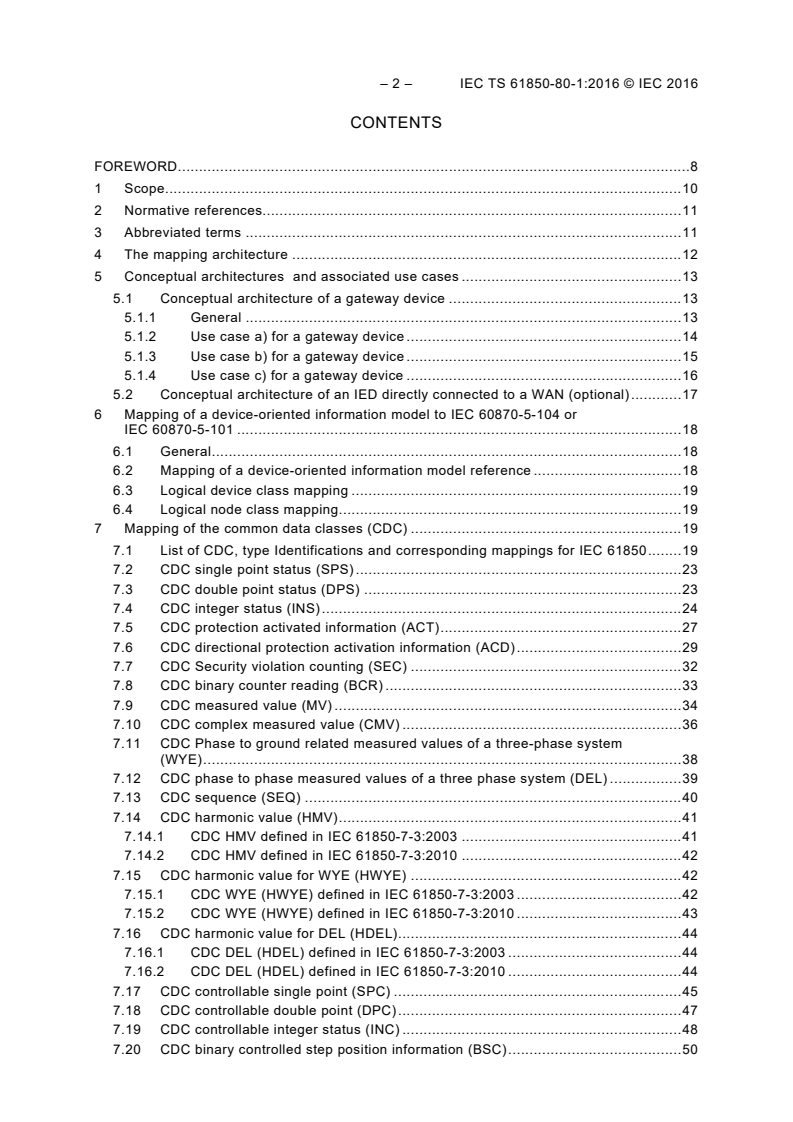
– 2 – IEC TS 61850-80-1:2016 © IEC 2016
CONTENTS
FOREWORD . 8
1 Scope . 10
2 Normative references. 11
3 Abbreviated terms . 11
4 The mapping architecture . 12
5 Conceptual architectures and associated use cases . 13
5.1 Conceptual architecture of a gateway device . 13
5.1.1 General . 13
5.1.2 Use case a) for a gateway device . 14
5.1.3 Use case b) for a gateway device . 15
5.1.4 Use case c) for a gateway device . 16
5.2 Conceptual architecture of an IED directly connected to a WAN (optional) . 17
6 Mapping of a device-oriented information model to IEC 60870-5-104 or
IEC 60870-5-101 . 18
6.1 General . 18
6.2 Mapping of a device-oriented information model reference . 18
6.3 Logical device class mapping . 19
6.4 Logical node class mapping . 19
7 Mapping of the common data classes (CDC) . 19
7.1 List of CDC, type Identifications and corresponding mappings for IEC 61850 . 19
7.2 CDC single point status (SPS) . 23
7.3 CDC double point status (DPS) . 23
7.4 CDC integer status (INS) . 24
7.5 CDC protection activated information (ACT) . 27
7.6 CDC directional protection activation information (ACD) . 29
7.7 CDC Security violation counting (SEC) . 32
7.8 CDC binary counter reading (BCR) . 33
7.9 CDC measured value (MV) . 34
7.10 CDC complex measured value (CMV) . 36
7.11 CDC Phase to ground related measured values of a three-phase system
(WYE) . 38
7.12 CDC phase to phase measured values of a three phase system (DEL) . 39
7.13 CDC sequence (SEQ) . 40
7.14 CDC harmonic value (HMV) . 41
7.14.1 CDC HMV defined in IEC 61850-7-3:2003 . 41
7.14.2 CDC HMV defined in IEC 61850-7-3:2010 . 42
7.15 CDC harmonic value for WYE (HWYE) . 42
7.15.1 CDC WYE (HWYE) defined in IEC 61850-7-3:2003 . 42
7.15.2 CDC WYE (HWYE) defined in IEC 61850-7-3:2010 . 43
7.16 CDC harmonic value for DEL (HDEL) . 44
7.16.1 CDC DEL (HDEL) defined in IEC 61850-7-3:2003 . 44
7.16.2 CDC DEL (HDEL) defined in IEC 61850-7-3:2010 . 44
7.17 CDC controllable single point (SPC) . 45
7.18 CDC controllable double point (DPC) . 47
7.19 CDC controllable integer status (INC) . 48
7.20 CDC binary controlled step position information (BSC) . 50
7.21 CDC integer-controlled step position information (ISC) . 53
7.22 CDC controllable analogue set point information (APC) . 55
7.22.1 CDC APC defined in IEC 61850-7-3:2003 . 55
7.22.2 CDC APC defined in IEC 61850-7-3:2010 . 56
7.23 CDC Single point setting (SPG) . 59
7.24 CDC integer status setting (ING) . 60
7.25 CDC analogue settings (ASG) . 61
7.26 CDC enumerated status (ENS) . 61
7.27 CDC Histogramm (HST) . 63
7.28 CDC controllable enumerated status (ENC) . 64
7.29 CDC Enumerated status setting (ENG) . 68
7.30 CDC Binary controlled analog process value (BAC) . 68
7.31 CDC Curve shape setting (CSG) . 69
8 Mapping of services . 70
8.1 List of service models and corresponding mappings . 70
8.2 Server class mapping . 72
8.3 Association class mapping . 73
8.4 Logical node class mapping . 73
8.5 Data class mapping . 74
8.6 Setting group class mapping . 75
8.7 Report control block class mapping . 76
8.8 Control class mapping . 77
8.8.1 General . 77
8.8.2 Direct control with normal security (optional) . 79
8.8.3 Direct control with enhanced security . 86
8.8.4 SBO control with enhanced security . 91
9 Protocol stack selections for IEC 60870-5-101 and IEC 60870-5-104 . 100
9.1 General . 100
9.2 Structure of application data . 100
9.2.1 General . 100
9.2.2 Structure of application data defined in IEC 60870-5-101 . 101
9.2.3 Structure of application data defined in IEC 60870-5-104 . 101
9.3 IEC 60870-5 interoperability . 102
9.3.1 IEC 60870-5-101 interoperability . 102
9.3.2 IEC 60870-5-104 interoperability . 112
Annex A (informative) Use of SCL (substation configuration language) to include
IEC 60870-5-101 or IEC 60870-5-104 information . 126
A.1 SCL information model hierarchy . 126
A.1.1 General . 126
A.1.2 Mapping of the common address of ASDU . 127
A.1.3 Mapping of the IOA (information object address) . 127
A.1.4 Mapping of the type identifiers (TI) . 127
A.2 Use of the SCL elements . 127
A.2.1 General . 127
A.2.2 IED . 127
A.2.3 AccessPoint . 127
A.2.4 Server . 127
A.2.5 LDevice . 127
A.2.6 LN . 128
– 4 – IEC TS 61850-80-1:2016 © IEC 2016
A.2.7 DOI . 128
A.2.8 SDI . 128
A.2.9 DAI . 128
A.2.10 DA/BDA/SDO . 128
A.2.11 Control model . 129
A.3 IEC 60870-5-101 or IEC 60870-5-104 private section syntax . 129
A.3.1 General . 129
A.3.2 IEC 60870-5-101 private section schema . 129
A.3.3 IEC 60870-5-104 Private section schema . 130
A.3.4 Use of Private section examples . 131
A.4 IEC 60870-5-101 communication parameters configuration using SCL . 167
A.5 IEC 60870-5-104 communication parameters configuration using SCL . 169
Bibliography . 173
Figure 1 – Conceptual architecture of a gateway device . 13
Figure 2 – Use case a) for a gateway device . 14
Figure 3 – Use case b) for a gateway device . 15
Figure 4 – Use case c) for a gateway device . 16
Figure 5 – Conceptual architecture of an IED . 17
Figure 6 – Mapping architecture (conceptual) . 19
Figure 7 – Direct control with normal security with status update – positive case
applied to gateway device . 79
Figure 8 – Direct control with normal security with status update – positive case
applied to IED . 80
Figure 9 – Direct control with normal security in general – negative case a) applied to
gateway device . 80
Figure 10 – Direct control with normal security in general – negative case a) applied to IED . 81
Figure 11 – Direct control with normal security in general – negative case b) applied to
gateway device . 81
Figure 12 – Direct control with normal security in general – negative case b) applied to IED . 82
Figure 13 – Direct control with normal security with status update – negative case c)
applied to gateway device . 82
Figure 14 – Direct control with normal security with status update – negative case c)
applied to IED . 83
Figure 15 – Direct control with normal security without status update – positive case
applied to gateway device . 83
Figure 16 – Direct control with normal security without status update – positive case
applied to IED . 84
Figure 17 – Direct control with enhanced security – positive case applied to gateway
device . 86
Figure 18 – Direct control with enhanced security – positive case applied to IED . 87
Figure 19 – Direct control with enhanced security – negative case c) applied to
gateway device . 88
Figure 20 – Direct control with enhanced security – negative case c) applied to IED . 88
Figure 21 – Direct control with enhanced security – negative case d) applied to
gateway device . 89
Figure 22 – Direct control with enhanced security – negative case d) applied to IED . 89
Figure 23 – SBOw control – positive case applied to gateway device . 91
Figure 24 – SBOw control – positive case applied to IED . 91
Figure 25 – SBOw control – negative case a) applied to gateway device . 92
Figure 26 – SBOw control – negative case a) applied to IED . 92
Figure 27 – SBOw control – negative case b) applied to gateway device . 93
Figure 28 – SBOw control – negative case b) applied to IED . 93
Figure 29 – SBOw control – negative case c) applied to gateway device . 94
Figure 30 – SBOw control – negative case c) applied to IED . 94
Figure 31 – SBO with enhanced security – positive case applied to gateway device . 95
Figure 32 – SBO with enhanced security – positive case applied to IED . 96
Figure 33 – SBO with enhanced security – negative case a) applied to gateway device . 96
Figure 34 – SBO with enhanced security – negative case a) applied to IED . 97
Figure 35 – SBO with enhanced security – negative case b) applied to gateway device . 97
Figure 36 – SBO with enhanced security – negative case b) applied to IED . 98
Table 1 – Mapping structure CDC onto ASDU type . 20
Table 2 – CDC: Single point status (SPS) . 23
Table 3 – CDC: Single point status (SPS) mapping . 23
Table 4 – CDC: Double point status (DPS) . 24
Table 5 – CDC: Double point status (DPS) mapping . 24
Table 6 – CDC: Integer status (INS) . 25
Table 7 – CDC: Integer status (INS) mapping . 26
Table 8 – CDC: Protection activated information (ACT) . 27
Table 9 – CDC: Protection activated information (ACT) mapping . 28
Table 10 – CDC: Protection activated information (ACD) . 30
Table 11 – CDC: Directional protection activated information (ACD) mapping . 31
Table 12 – CDC: Security violation counting (SEC) . 33
Table 13 – CDC: Security violation counting (SEC) mapping . 33
Table 14 – CDC: Binary counter reading (BCR) . 33
Table 15 – CDC: Binary counter reading (BCR) mapping . 34
Table 16 – CDC: Measured value (MV) . 35
Table 17 – CDC: Measured value (MV) mapping . 35
Table 18 – CDC: Complex measured value (CMV) . 36
Table 19 – CDC: Complex measured value (CMV) mapping . 37
Table 20 – CDC: Phase to ground related measured values of a three-phase system
(WYE) . 38
Table 21 – CDC: Phase to phase measured values of a three phase system (DEL) . 39
Table 22 – CDC: Sequence (SEQ) . 40
Table 23 – CDC: Harmonic value (HMV) Ed.1 . 41
Table 24 – CDC: Harmonic value (HMV) Ed.1 mapping . 41
Table 25 – CDC: Harmonic value (HMV) Ed.2 . 42
Table 26 – CDC: Harmonic value for WYE (HWYE) Ed.1 . 43
Table 27 – CDC: Harmonic value for WYE (HWYE) Ed.2 . 43
Table 28 – CDC: Harmonic value for DEL (HDEL) . 44
– 6 – IEC TS 61850-80-1:2016 © IEC 2016
Table 29 – CDC: Harmonic value for DEL (HDEL) Ed.2 . 44
Table 30 – CDC: Controllable single point (SPC) . 45
Table 31 – CDC: Controllable single point (SPC) mapping . 46
Table 32 – CDC: Controllable double point (DPC) . 47
Table 33 – CDC: Controllable double point (DPC) mapping . 48
Table 34 – CDC: Controllable integer status (INC) . 49
Table 35 – CDC: Controllable integer status (INC) mapping . 50
Table 36 – CDC: Binary controlled step position information (BSC) . 51
Table 37 – CDC: Binary controlled step position information (BSC) mapping of data
attributes of the functional constraint ST . 52
Table 38 – CDC: Binary controlled step position information (BSC) mapping of data
attributes of the functional constraint CO . 53
Table 39 – CDC: Integer-controlled step position information (ISC) . 54
Table 40 – CDC: Integer-controlled step position information (ISC) mapping . 55
Table 41 – CDC: Controllable analogue set point information (APC) (Ed.1) . 56
Table 42 – CDC: Controllable analogue set point information (APC) (Ed.2) . 57
Table 43 – CDC: Controllable analogue set point information (APC) mapping of data
attributes of the functional constraint MX . 58
Table 44 – CDC: Controllable analogue set point information (APC) mapping of data
attributes of the functional constraint SP . 59
Table 45 – CDC: Single point setting (SPG) . 60
Table 46 – CDC: Integer status setting (ING) . 60
Table 47 – CDC: Analogue settings (ASG) . 61
Table 48 – CDC: Enumerated status (ENS) . 62
Table 49 – CDC: Enumerated status (ENS) mapping . 63
Table 50 – CDC: Histogramm (HST) . 64
Table 51 – CDC: Controllable enumerated status (ENC) . 65
Table 52 – CDC: Controllable enumerated status (ENC) mapping . 66
Table 53 – CDC: Enumerated status setting (ENG) . 68
Table 54 – CDC Binary controlled analog process value (BAC) . 68
Table 55 – CDC: Binary controlled analog process value (BAC) mapping of data
attributes of the functional constraint MX . 69
Table 56 – CDC: Curve shape setting CSG . 70
Table 57 – Services requiring client/server communication profile . 71
Table 58 – Server services mapping . 73
Table 59 – Association services mapping . 73
Table 60 – Logical nodes services mapping . 74
Table 61 – Data services mapping . 75
Table 62 – Setting group services mapping . 76
Table 63 – Report control block services mapping . 77
Table 64 – Direct control with normal security services mapping . 85
Table 65 – Direct control with enhanced security services mapping . 90
Table 66 – SBO control with enhanced security services mapping . 99
Table A.1 – Extension of the “P” element types to hold IEC 60870-5-101 information . 167
Table A.2 – Extension of the “P” element types to hold IEC 60870-5-104 information . 170
Table A.3 – Extension of the “P” element types using redundancy groups . 171
– 8 – IEC TS 61850-80-1:2016 © IEC 2016
INTERNATIONAL ELECTROTECHNICAL COMMISSION
____________
COMMUNICATION NETWORKS AND
SYSTEMS FOR POWER UTILITY AUTOMATION –
Part 80-1: Guideline to exchanging information from a CDC-based
data model using IEC 60870-5-101 or IEC 60870-5-104
FOREWORD
1) The International Electrotechnical Commission (IEC) is a worldwide organization for standardization comprising
all national electrotechnical committees (IEC National Committees). The object of IEC is to promote
international co-operation on all questions concerning standardization in the electrical and electronic fields. To
this end and in addition to other activities, IEC publishes International Standards, Technical Specifications,
Technical Reports, Publicly Available Specifications (PAS) and Guides (hereafter referred to as “IEC
Publication(s)”). Their preparation is entrusted to technical committees; any IEC National Committee interested
in the subject dealt with may participate in this preparatory work. International, governmental and non-
governmental organizations liaising with the IEC also participate in this preparation. IEC collaborates closely
with the International Organization for Standardization (ISO) in accordance with conditions determined by
agreement between the two organizations.
2) The formal decisions or agreements of IEC on technical matters express, as nearly as possible, an international
consensus of opinion on the relevant subjects since each technical committee has representation from all
interested IEC National Committees.
3) IEC Publications have the form of recommendations for international use and are accepted by IEC National
Committees in that sense. While all reasonable efforts are made to ensure that the technical content of IEC
Publications is accurate, IEC cannot be held responsible for the way in which they are used or for any
misinterpretation by any end user.
4) In order to promote international uniformity, IEC National Committees undertake to apply IEC Publications
transparently to the maximum extent possible in their national and regional publications. Any divergence
between any IEC Publication and the corresponding national or regional publication shall be clearly indicated in
the latter.
5) IEC itself does not provide any attestation of conformity. Independent certification bodies provide conformity
assessment services and, in some areas, access to IEC marks of conformity. IEC is not responsible for any
services carried out by independent certification bodies.
6) All users should ensure that they have the latest edition of this publication.
7) No liability shall attach to IEC or its directors, employees, servants or agents including individual experts and
members of its technical committees and IEC National Committees for any personal injury, property damage or
other damage of any nature whatsoever, whether direct or indirect, or for costs (including legal fees) and
expenses arising out of the publication, use of, or reliance upon, this IEC Publication or any other IEC
Publications.
8) Attention is drawn to the Normative references cited in this publication. Use of the referenced publications is
indispensable for the correct application of this publication.
9) Attention is drawn to the possibility that some of the elements of this IEC Publication may be the subject of
patent rights. IEC shall not be held responsible for identifying any or all such patent rights.
The main task of IEC technical committees is to prepare International Standards. In
exceptional circumstances, a technical committee may propose the publication of a technical
specification when
• the required support cannot be obtained for the publication of an International Standard,
despite repeated efforts, or
• the subject is still under technical development or where, for any other reason, there is the
future but no immediate possibility of an agreement on an International Standard.
Technical specifications are subject to review within three years of publication to decide
whether they can be transformed into International Standards.
IEC 61850-80-1, which is a technical specification, has been prepared by IEC technical
committee 57: Power systems management and associated information exchange.
This second edition cancels and replaces the first edition published in 2008. This edition
constitutes a technical revision.
This edition includes the following significant technical changes with respect to the previous
edition:
a) IEC TS 61850-80-1:2008 is based on the definitions of IEC 61850 Edition 1. After the
publication of IEC TS 61850-80-1:2008 the standard series IEC 61850 was updated to
Edition 2 (almost all parts);
b) In particular, IEC 61850-7-3:2010 introduces new Common Data Classes (CDCs) which
are currently not mapped to IEC 60870-5-101 or IEC 60870-5-104 in IEC 61850-80-
1:2008. Those new CDCs are: ENS, HST, VSS, ENC, BAC, ENG, ORG, TSG, CUG, VSG,
CSG. IEC 61400-25-4, which is currently being updated, makes reference to IEC TS
61850-80-1:2008 and therefore needs to be updated according to the definitions of this
second edition of IEC 61850. The following CDCs are missing in the IEC 61850-80-1:2008
and have therefore been added to this new edition for IEC 61400-25-4 Edition 2: ENS,
ENC, ENG, ORG.
The text of this technical specification is based on the following documents:
Enquiry draft Report on voting
57/1649/DTS 57/1726/RVC
Full information on the voting for the approval of this technical specification can be found in
the report on voting indicated in the above table.
This publication has been drafted in accordance with the ISO/IEC Directives, Part 2.
A list of all parts of the IEC 61850 series, published under the general title Communication
networks and systems for power utility automation, can be found on the IEC website.
The committee has decided that the contents of this publication will remain unchanged until
the stability date indicated on the IEC website under "http://webstore.iec.ch" in the data
related to the specific publication. At this date, the publication will be
• transformed into an International standard,
• reconfirmed,
• withdrawn,
• replaced by a revised edition, or
• amended.
A bilingual edition of this document may be issued at a later date.
IMPORTANT – The 'colour inside' logo on the cover page of this publication indicates
that it contains colours which are considered to be useful for the correct
understanding of its contents. Users should therefore print this document using a
colour printer.
– 10 – IEC TS 61850-80-1:2016 © IEC 2016
COMMUNICATION NETWORKS AND
SYSTEMS FOR POWER UTILITY AUTOMATION –
Part 80-1: Guideline to exchanging information from a CDC-based
data model using IEC 60870-5-101 or IEC 60870-5-104
1 Scope
This part of IEC 61850, which is a technical specification, gives a guideline on how to
exchange information from a CDC-based data model (for example IEC 61850) using
IEC 60870-5-101 or IEC 60870-5-104 between substation(s) and control center(s). Mostly
guidelines for functions needed in a substation gateway device are given.
The goal of this technical specification is to describe standardized mapping of device-oriented
data models (for example IEC 61850) with already defined attributes of CDCs and services
(for example IEC 61850-7) onto the already defined ASDUs and services of IEC 60870-5-104
or IEC 60870-5-101. It is not the goal of this technical specification to add any extensions to
published standards (for example IEC 61850 or IEC 60870-5-104 or IEC 60870-5-101).
After an introduction giving a basic description of the mapping, the mapping of the information
model with associated data classes, and the mapping of services are described. Clause 9
shows how the mapped data and services according to the IEC 60870-5-104 and
IEC 60870-5-101 protocol are marked (selected) in the interoperability sheet.
The scope of this technical specification is to achieve real-time exchange of process
information required for operational purposes between a substation using a CDC-based data
model (for example IEC 61850) and (a) control center(s) using a communication link over a
wide area network (WAN) compliant to the definitions of IEC 60870-5-101 or IEC 60870-5-
104. The amount of real-time information provided by the substation-gateway device can vary
dependent on the operational needs. Actors could be regional and nationwide control centers
that receive real-time information in order to monitor and control geographically widespread
processes. The described mapping can be used for several fields of application of power
utilities, such as substations, hydro and wind power plants, and decentralized energy
resources DER. The mapping is based on the definitions of the IEC 61850 series and
IEC 60870-5-104:2006/IEC 60870-5-101:2003. The scope of the mapped IEC 60870-5-104
and IEC 60870-5-101 subset is given in Clause 9.
This technical specification focuses mainly on defining rules and functions of a gateway
device as a part of the substation. However, the rules and functions are also valid when an
IED may optionally be connected directly to a WAN compliant with IEC 60870-5-101 or
IEC 60870-5-104 and therefore, the mapping has to be done inside the IED.
To enable an automated database management approach, which aims to ensure consistency
between the databases of substations and control centers, the SCD file (substation
configuration description) can be extended with IEC 60870-5-101/IEC 60870-5-104 specific
information to configure the 61850 to 101/104 gateway. How the SCD file can be extended is
described in Annex A.
The extended substation configuration description (SCD+) is recommended to be used to
configure any gateway in a vendor independent format.
2 Normative references
The following documents are referred to in the text in such a way that some or all of their
content constitutes requirements of this document. For dated references, only the edition
cited applies. For undated references, the latest edition of the referenced document (including
any amendments) applies.
IEC 60870-5-3, Telecontrol equipment and systems – Part 5: Transmission protocols –
Section 3: General structure of application data
IEC 60870-5-4:1993, Telecontrol equipment and systems – Part 5: Transmission protocols –
Section 4: Definition and coding of application information elements
IEC 60870-5-5:1995, Telecontrol equipment and systems – Part 5: Transmission protocols –
Section 5: Basic application functions
IEC 60870-5-101, Telecontrol equipment and systems – Part 5-101: Transmission protocols –
Companion standard for basic telecontrol tasks
IEC 60870-5-104:2006, Telecontrol equipment and systems – Part 5-104: Transmission
protocols – Network access for IEC 60870-5-101 using standard transport profiles
IEC 61850 (all parts), Communication networks and systems for power utility automation
IEC 61850-6, Communication networks and systems for power utility automation – Part 6:
Configuration description language for communication in electrical substations related to IEDs
IEC 61850-7-2:2003, Communication networks and systems in substations – Part 7-2: Basic
information and communication structure for substation and feeder equipment – Abstract
communication service interface (ACSI)
IEC 61850-7-2:2010, Communication networks and systems for power utility automation –
Part 7-2: Basic information and communication structure for substation and feeder equipment
– Abstract communication service interface (ACSI)
IEC 61850-7-3:2003, Communication networks and systems in substations – Part 7-3: Basic
communication structure – Common data classes
IEC 61850-7-3:2010, Communication networks and systems for power utility automation –
Part 7-3: Basic communication structure – Common data classes
IEC 61850-8-1, Communication networks and systems for power utility automation – Part 8-1:
Specific communication service mapping (SCSM) – Mappings to MMS (ISO 9506-1 and
ISO 9506-2) and to ISO/IEC 8802-3
IEEE 754:2008, IEEE Standard for Binary Floating-Point Arithmetic
RFC 2200, Internet Official Protocol Standards, Request for Comments 2200 (June 1997)
3 Abbreviated terms
For the purposes of this document, the following abbreviated terms apply.
ACSI Abstract communication service interface (defined for example in IEC 61850-7-2)
ASDU Application service data unit
– 12 – IEC TS 61850-80-1:2016 © IEC 2016
CASDU Common address of ASDU
CDC Common data class (defined for example in IEC 61850-7-3)
CI Counter interrogation
COT Cause of transmission
GI General interrogation
GOOSE Generic object oriented substation event
HMI Human machine interface
IED Intelligent electronic device
IOA Information object address
LD Logical device
LN Logical node
PI Process image
P/N Positive/negative
QOI Qualifier of interrogation
QDS Quality descriptor
RFC Request for comments
S/E Select/execute
SCL Substation configuration language (defined for example in IEC 61850-6)
TI Type Identification
TISSUE Technical issue as part of the maintenance process of IEC 61850
WAN Wide area network
XML Extensible mark-up language
4 The mapping architecture
The mapping architecture consists of five parts:
1) conceptual architecture of a gateway device and associated use cases;
2) conceptual architecture of an IED directly connected to a WAN (optional);
3) mapping of the information model;
4) mapping of the data (which is in fact part of the information model);
5) mapping of the services.
5 Conceptual architectures and associated use cases
5.1 Conceptual architecture of a gateway device
5.1.1 General
IEC
Figure 1 – Conceptual architecture of a gateway device
Figure 1 describes the conceptual architecture of a gateway device within a substation. The
gateway device is decoupling the IEC 61850 station bus from the IEC 60870-5-101 or
IEC 60870-5-104 WAN via a process image (PI). The advantage of this approach is that only
services for control model interaction need to be mapped.
The PI is organized according the data model of IEC 61850 (LDs, LNs, CDCs).
The IEC 61850 client/GOOSE subscriber is used to update the PI with process data made
available by the IEDs.
The IEC 61850 server/proxy is used to:
• make process data coming from remote devices available for IEDs inside the substation;
• retrieve the data model for:
– IEC
...