

IEC 60034-18-1:2010
(Main)Rotating electrical machines - Part 18-1: Functional evaluation of insulation systems - General guidelines
General Information
- Abstract
IEC 60034-18-1:2010 deals with the general guidelines for functional evaluation of electrical insulation systems, used or proposed to be used in rotating electrical machines within the scope of IEC 60034-1, in order to qualify them. The main changes of this new edition with respect to the previous one are as follows:
- provides general guidelines for functional evaluation of different types of windings as before but beyond that for electrical evaluation of windings which are electrically stressed by converter-supply;
- is now focused on general guidelines with all technical details of procedures and qualification principles moved to the subsequent parts;
- details additional general aspects of functional evaluation, particularly the statistical procedure for comparison between reference and candidate insulation systems and the evaluation of minor component or manufacturing changes;
- contains a new acceptance test for verifying the expected production quality level of the insulation systems;
- restricts the classification of insulation systems as a result of the functional evaluation to thermal classification.
- Status
- Published
- Publication Date
- 09-Mar-2010
- Technical Committee
- TC 2 - Rotating machinery
- Current Stage
- DELPUB - Deleted Publication
- Start Date
- 22-Dec-2022
- Completion Date
- 31-Jul-2019
Buy Documents
IEC 60034-18-1:2010 - Rotating electrical machines - Part 18-1: Functional evaluation of insulation systems - General guidelines
IEC 60034-18-1:2010 - Rotating electrical machines - Part 18-1: Functional evaluation of insulation systems - General guidelines
Overview
IEC 60034-18-1:2010 is an International Electrotechnical Commission (IEC) standard providing general guidelines for the functional evaluation of insulation systems in rotating electrical machines. Applicable to machines within the scope of IEC 60034-1, this standard aims to qualify insulation systems used in electrical machinery by outlining benchmark procedures. The 2010 edition refined its scope by focusing on high-level guidelines, with procedural and technical qualification details moved to subsequent IEC 60034-18 series parts. It expands on previous editions by addressing windings subjected to electrical stresses from converter-supplied systems and introduces a new framework for acceptance and comparison of insulation systems.
Key Topics
- Functional Evaluation Principles: Establishes general methodologies for comparing insulation systems, introducing candidate and reference systems tested under equivalent conditions.
- Ageing Factors and Test Classification: Considers thermal, electrical, mechanical, and environmental stresses affecting the longevity and functionality of insulation in rotating machines.
- Statistical Evaluation Procedures: Describes statistical approaches for comparing test results, ensuring reliable differentiation between candidate and reference systems.
- Thermal Classification: Limits the outcome of insulation qualification to a thermal class, using established methods for thermal assessment based on IEC 60085 and other key references.
- Minor Component and Manufacturing Changes: Provides guidelines on how minor modifications in materials or manufacturing processes require renewed evaluation to ensure continued qualification.
- Acceptance Testing: Introduces a new acceptance test aimed at verifying production quality levels of insulation systems rather than full qualification.
Applications
IEC 60034-18-1:2010 serves as a foundational document for manufacturers, designers, and test laboratories engaged in the evaluation and qualification of insulation systems for rotating electrical machines. Practical applications include:
- Insulation System Qualification: Assists manufacturers in demonstrating the suitability of new or modified insulation systems for specific machine types or operating conditions.
- Material and Design Selection: Guides the choice of insulation materials and system layouts by emphasizing the importance of functional evaluation over mere material endurance.
- Quality Assurance: Supports the implementation of acceptance testing for insulation system components during production, ensuring conformity to expected performance standards.
- Change Management: Directs how proposed minor changes in insulation design or manufacturing require re-evaluation to maintain system reliability and compliance.
- Converter-fed Machine Evaluation: Enhances procedures for insulation systems subjected to electrical stresses from modern converter (inverter/drive) supplies-critical for high-efficiency, variable-speed machines.
- Comparative Assessment: Encourages the use of service-proven reference systems to validate innovations through robust comparative testing.
Related Standards
The guidelines of IEC 60034-18-1:2010 are closely aligned with several companion and reference standards that provide either more detailed test procedures or foundational methodologies, including:
- IEC 60034-1: General rating and performance requirements for rotating electrical machines.
- IEC 60085: Guidance on thermal evaluation and designation of insulation systems, including definitions of thermal classes.
- IEC 60505: Principles for evaluating and qualifying electrical insulation systems under various ageing factors.
- IEC 60216 (series): Methods for determining thermal endurance properties of insulating materials.
- IEC 60493-1 & IEC 62539: Statistical methods for analysing test results related to ageing and breakdown data.
- IEC 60034-18 (parts 21, 22, 31, 32, 33, 34, 41, 42): Specific procedures for wire-wound, form-wound, and converter-stressed windings, and evaluation types (thermal, electrical, multifactor, mechanical).
Conclusion
By following the IEC 60034-18-1:2010 guidelines, organizations ensure that insulation systems in rotating electrical machines are robust, reliable, and fit for purpose across a range of applications. These general principles set the stage for more detailed evaluation and certification, promoting international uniformity and safety in industrial and utility electrical equipment. For manufacturers and test professionals, adherence to this standard is crucial for compliance, market access, and long-term performance assurance.
Relations
- Effective Date
- 25-Aug-2026
- Effective Date
- 05-Sep-2023
- Effective Date
- 05-Sep-2023
- Effective Date
- 05-Sep-2023
Buy Documents
IEC 60034-18-1:2010 - Rotating electrical machines - Part 18-1: Functional evaluation of insulation systems - General guidelines
IEC 60034-18-1:2010 - Rotating electrical machines - Part 18-1: Functional evaluation of insulation systems - General guidelines
Get Certified
Connect with accredited certification bodies for this standard

IMQ S.p.A. (Certification)
Italian electrical product certification.

SLG Prüf- und Zertifizierungs GmbH
German testing and certification body.

UL Solutions
Global safety science company with testing, inspection and certification.
Sponsored listings
Frequently Asked Questions
IEC 60034-18-1:2010 is a standard published by the International Electrotechnical Commission (IEC). Its full title is "Rotating electrical machines - Part 18-1: Functional evaluation of insulation systems - General guidelines". This standard covers: IEC 60034-18-1:2010 deals with the general guidelines for functional evaluation of electrical insulation systems, used or proposed to be used in rotating electrical machines within the scope of IEC 60034-1, in order to qualify them. The main changes of this new edition with respect to the previous one are as follows: - provides general guidelines for functional evaluation of different types of windings as before but beyond that for electrical evaluation of windings which are electrically stressed by converter-supply; - is now focused on general guidelines with all technical details of procedures and qualification principles moved to the subsequent parts; - details additional general aspects of functional evaluation, particularly the statistical procedure for comparison between reference and candidate insulation systems and the evaluation of minor component or manufacturing changes; - contains a new acceptance test for verifying the expected production quality level of the insulation systems; - restricts the classification of insulation systems as a result of the functional evaluation to thermal classification.
IEC 60034-18-1:2010 deals with the general guidelines for functional evaluation of electrical insulation systems, used or proposed to be used in rotating electrical machines within the scope of IEC 60034-1, in order to qualify them. The main changes of this new edition with respect to the previous one are as follows: - provides general guidelines for functional evaluation of different types of windings as before but beyond that for electrical evaluation of windings which are electrically stressed by converter-supply; - is now focused on general guidelines with all technical details of procedures and qualification principles moved to the subsequent parts; - details additional general aspects of functional evaluation, particularly the statistical procedure for comparison between reference and candidate insulation systems and the evaluation of minor component or manufacturing changes; - contains a new acceptance test for verifying the expected production quality level of the insulation systems; - restricts the classification of insulation systems as a result of the functional evaluation to thermal classification.
IEC 60034-18-1:2010 is classified under the following ICS (International Classification for Standards) categories: 19.080 - Electrical and electronic testing; 29.160.01 - Rotating machinery in general. The ICS classification helps identify the subject area and facilitates finding related standards.
IEC 60034-18-1:2010 has the following relationships with other standards: It is inter standard links to EN ISO 13631:2002, IEC 60034-18-1:1992, IEC 60034-18-1:1992/AMD1:1996, IEC 60034-18-1:2022. Understanding these relationships helps ensure you are using the most current and applicable version of the standard.
IEC 60034-18-1:2010 is available in PDF format for immediate download after purchase. The document can be added to your cart and obtained through the secure checkout process. Digital delivery ensures instant access to the complete standard document.
Standards Content (Sample)
IEC 60034-18-1 ®
Edition 2.0 2010-03
INTERNATIONAL
STANDARD
NORME
INTERNATIONALE
Rotating electrical machines –
Part 18-1: Functional evaluation of insulation systems – General guidelines
Machines électriques tournantes –
Partie 18-1: Evaluation fonctionnelle des systèmes d’isolation – Principes
directeurs généraux
All rights reserved. Unless otherwise specified, no part of this publication may be reproduced or utilized in any form or by
any means, electronic or mechanical, including photocopying and microfilm, without permission in writing from either IEC or
IEC's member National Committee in the country of the requester.
If you have any questions about IEC copyright or have an enquiry about obtaining additional rights to this publication,
please contact the address below or your local IEC member National Committee for further information.
Droits de reproduction réservés. Sauf indication contraire, aucune partie de cette publication ne peut être reproduite
ni utilisée sous quelque forme que ce soit et par aucun procédé, électronique ou mécanique, y compris la photocopie
et les microfilms, sans l'accord écrit de la CEI ou du Comité national de la CEI du pays du demandeur.
Si vous avez des questions sur le copyright de la CEI ou si vous désirez obtenir des droits supplémentaires sur cette
publication, utilisez les coordonnées ci-après ou contactez le Comité national de la CEI de votre pays de résidence.
IEC Central Office
3, rue de Varembé
CH-1211 Geneva 20
Switzerland
Email: inmail@iec.ch
Web: www.iec.ch
About the IEC
The International Electrotechnical Commission (IEC) is the leading global organization that prepares and publishes
International Standards for all electrical, electronic and related technologies.
About IEC publications
The technical content of IEC publications is kept under constant review by the IEC. Please make sure that you have the
latest edition, a corrigenda or an amendment might have been published.
ƒ Catalogue of IEC publications: www.iec.ch/searchpub
The IEC on-line Catalogue enables you to search by a variety of criteria (reference number, text, technical committee,…).
It also gives information on projects, withdrawn and replaced publications.
ƒ IEC Just Published: www.iec.ch/online_news/justpub
Stay up to date on all new IEC publications. Just Published details twice a month all new publications released. Available
on-line and also by email.
ƒ Electropedia: www.electropedia.org
The world's leading online dictionary of electronic and electrical terms containing more than 20 000 terms and definitions
in English and French, with equivalent terms in additional languages. Also known as the International Electrotechnical
Vocabulary online.
ƒ Customer Service Centre: www.iec.ch/webstore/custserv
If you wish to give us your feedback on this publication or need further assistance, please visit the Customer Service
Centre FAQ or contact us:
Email: csc@iec.ch
Tel.: +41 22 919 02 11
Fax: +41 22 919 03 00
A propos de la CEI
La Commission Electrotechnique Internationale (CEI) est la première organisation mondiale qui élabore et publie des
normes internationales pour tout ce qui a trait à l'électricité, à l'électronique et aux technologies apparentées.
A propos des publications CEI
Le contenu technique des publications de la CEI est constamment revu. Veuillez vous assurer que vous possédez
l’édition la plus récente, un corrigendum ou amendement peut avoir été publié.
ƒ Catalogue des publications de la CEI: www.iec.ch/searchpub/cur_fut-f.htm
Le Catalogue en-ligne de la CEI vous permet d’effectuer des recherches en utilisant différents critères (numéro de référence,
texte, comité d’études,…). Il donne aussi des informations sur les projets et les publications retirées ou remplacées.
ƒ Just Published CEI: www.iec.ch/online_news/justpub
Restez informé sur les nouvelles publications de la CEI. Just Published détaille deux fois par mois les nouvelles
publications parues. Disponible en-ligne et aussi par email.
ƒ Electropedia: www.electropedia.org
Le premier dictionnaire en ligne au monde de termes électroniques et électriques. Il contient plus de 20 000 termes et
définitions en anglais et en français, ainsi que les termes équivalents dans les langues additionnelles. Egalement appelé
Vocabulaire Electrotechnique International en ligne.
ƒ Service Clients: www.iec.ch/webstore/custserv/custserv_entry-f.htm
Si vous désirez nous donner des commentaires sur cette publication ou si vous avez des questions, visitez le FAQ du
Service clients ou contactez-nous:
Email: csc@iec.ch
Tél.: +41 22 919 02 11
Fax: +41 22 919 03 00
IEC 60034-18-1 ®
Edition 2.0 2010-03
INTERNATIONAL
STANDARD
NORME
INTERNATIONALE
Rotating electrical machines –
Part 18-1: Functional evaluation of insulation systems – General guidelines
Machines électriques tournantes –
Partie 18-1: Evaluation fonctionnelle des systèmes d’isolation – Principes
directeurs généraux
INTERNATIONAL
ELECTROTECHNICAL
COMMISSION
COMMISSION
ELECTROTECHNIQUE
PRICE CODE
INTERNATIONALE
Q
CODE PRIX
ICS 29.160 ISBN 978-2-88910-019-4
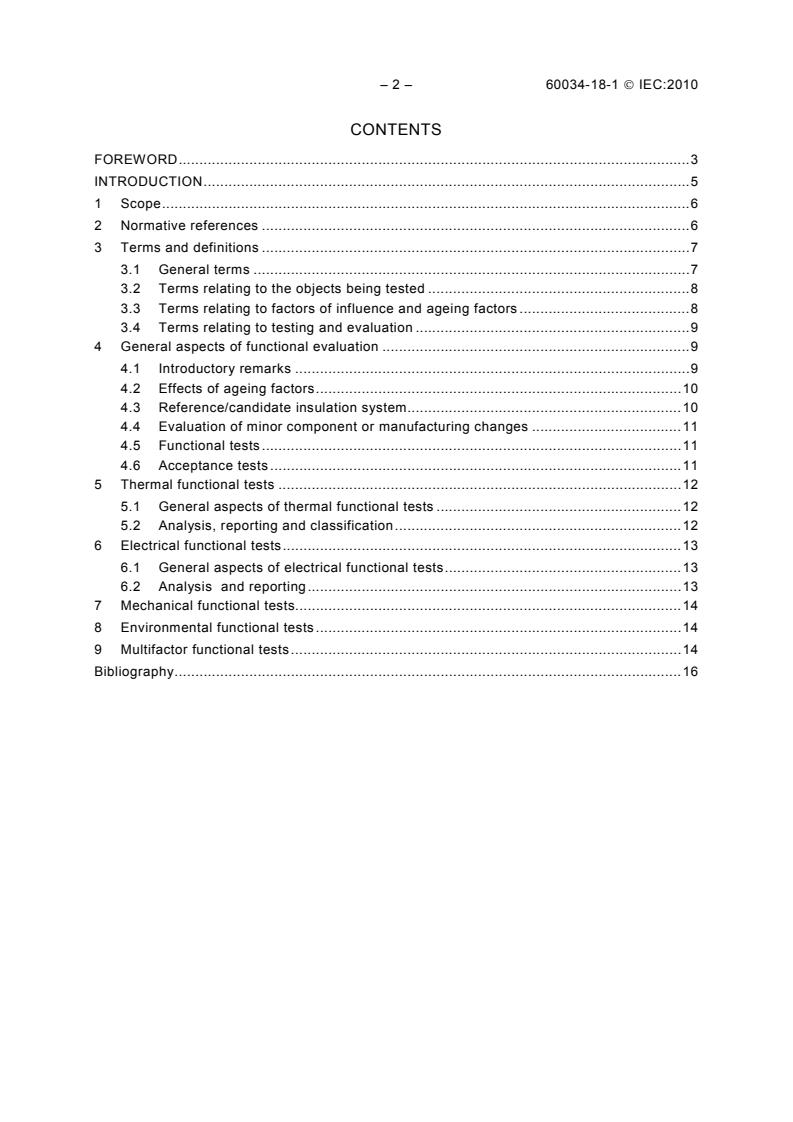
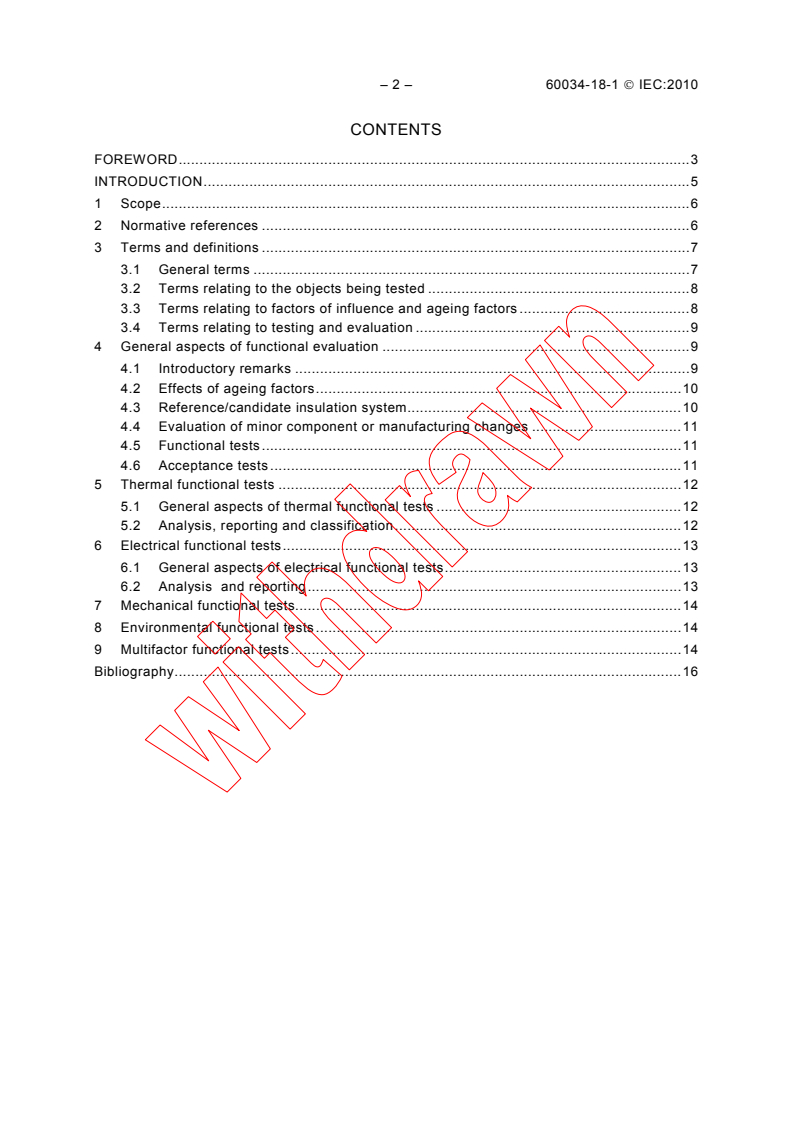
– 2 – 60034-18-1 © IEC:2010
CONTENTS
FOREWORD.3
INTRODUCTION.5
1 Scope.6
2 Normative references .6
3 Terms and definitions .7
3.1 General terms .7
3.2 Terms relating to the objects being tested .8
3.3 Terms relating to factors of influence and ageing factors .8
3.4 Terms relating to testing and evaluation .9
4 General aspects of functional evaluation .9
4.1 Introductory remarks .9
4.2 Effects of ageing factors.10
4.3 Reference/candidate insulation system.10
4.4 Evaluation of minor component or manufacturing changes .11
4.5 Functional tests.11
4.6 Acceptance tests.11
5 Thermal functional tests .12
5.1 General aspects of thermal functional tests .12
5.2 Analysis, reporting and classification.12
6 Electrical functional tests.13
6.1 General aspects of electrical functional tests.13
6.2 Analysis and reporting.13
7 Mechanical functional tests.14
8 Environmental functional tests.14
9 Multifactor functional tests.14
Bibliography.16
60034-18-1 © IEC:2010 – 3 –
INTERNATIONAL ELECTROTECHNICAL COMMISSION
____________
ROTATING ELECTRICAL MACHINES –
Part 18-1: Functional evaluation of insulation systems –
General guidelines
FOREWORD
1) The International Electrotechnical Commission (IEC) is a worldwide organization for standardization comprising
all national electrotechnical committees (IEC National Committees). The object of IEC is to promote interna-
tional co-operation on all questions concerning standardization in the electrical and electronic fields. To this
end and in addition to other activities, IEC publishes International Standards, Technical Specifications, Techni-
cal Reports, Publicly Available Specifications (PAS) and Guides (hereafter referred to as “IEC Publication(s)”).
Their preparation is entrusted to technical committees; any IEC National Committee interested in the subject
dealt with may participate in this preparatory work. International, governmental and non-governmental organiza-
tions liaising with the IEC also participate in this preparation. IEC collaborates closely with the International Or-
ganization for Standardization (ISO) in accordance with conditions determined by agreement between the two
organizations.
2) The formal decisions or agreements of IEC on technical matters express, as nearly as possible, an international
consensus of opinion on the relevant subjects since each technical committee has representation from all inter-
ested IEC National Committees.
3) IEC Publications have the form of recommendations for international use and are accepted by IEC National
Committees in that sense. While all reasonable efforts are made to ensure that the technical content of IEC
Publications is accurate, IEC cannot be held responsible for the way in which they are used or for any misinter-
pretation by any end user.
4) In order to promote international uniformity, IEC National Committees undertake to apply IEC Publications
transparently to the maximum extent possible in their national and regional publications. Any divergence be-
tween any IEC Publication and the corresponding national or regional publication shall be clearly indicated in
the latter.
5) IEC itself does not provide any attestation of conformity. Independent certification bodies provide conformity
assessment services and, in some areas, access to IEC marks of conformity. IEC is not responsible for any
services carried out by independent certification bodies.
6) All users should ensure that they have the latest edition of this publication.
7) No liability shall attach to IEC or its directors, employees, servants or agents including individual experts and
members of its technical committees and IEC National Committees for any personal injury, property damage or
other damage of any nature whatsoever, whether direct or indirect, or for costs (including legal fees) and ex-
penses arising out of the publication, use of, or reliance upon, this IEC Publication or any other IEC Publica-
tions.
8) Attention is drawn to the Normative references cited in this publication. Use of the referenced publications is
indispensable for the correct application of this publication.
9) Attention is drawn to the possibility that some of the elements of this IEC Publication may be the subject of pat-
ent rights. IEC shall not be held responsible for identifying any or all such patent rights.
International Standard IEC 60034-18-1 has been prepared by IEC technical committee 2:
Rotating machinery.
This second edition cancels and replaces the first edition, published in 1992, and its amend-
ment 1 published in 1996, and constitutes a technical revision.
This edition includes the following significant technical changes with respect to the previous
edition:
– provides general guidelines for functional evaluation of different types of windings as be-
fore but beyond that for electrical evaluation of windings which are electrically stressed by
converter-supply;
– is now focused on general guidelines with all technical details of procedures and qualifica-
tion principles moved to the subsequent parts;
– 4 – 60034-18-1 © IEC:2010
– details additional general aspects of functional evaluation, particularly the statistical pro-
cedure for comparison between reference and candidate insulation systems and the
evaluation of minor component or manufacturing changes;
– contains a new acceptance test for verifying the expected production quality level of the
insulation systems;
– restricts the classification of insulation systems as a result of the functional evaluation to
thermal classification. Other kinds of classifications (classes) of insulation systems no
longer exist.
The text of this standard is based on the following documents:
FDIS Report on voting
2/1583/FDIS 2/1592/RVD
Full information on the voting for the approval of this standard can be found in the report on
voting indicated in the above table.
This publication has been drafted in accordance with the ISO/IEC Directives, Part 2.
NOTE A list of cross-references of all IEC TC 2 publications can be found in the IEC TC 2 dashboard on the IEC
website.
The committee has decided that the contents of this amendment and the base publication will
remain unchanged until the stability date indicated on the IEC web site under
"http://webstore.iec.ch" in the data related to the specific publication. At this date, the publica-
tion will be
• reconfirmed,
• withdrawn,
• replaced by a revised edition, or
• amended.
60034-18-1 © IEC:2010 – 5 –
INTRODUCTION
IEC 60034-18 comprises several parts, dealing with different types of functional evaluation
and special kinds of test procedures for insulation systems of rotating electrial machines.
IEC 60034-18-1 provides general guidelines for such procedures and qualification principles,
whereas the subsequent parts IEC 60034-18-21, IEC 60034-18-22, IEC 60034-18-31,
IEC 60034-18-32, IEC 60034-18-33, IEC 60034-18-34, IEC 60034-18-41 and IEC 60034-18-
42 give detailed procedures for the various types of windings. Beyond that, part IEC 60034-
18-41 and IEC 60034-18-42 contain special test procedures for electrical evaluation of
windings electrically stressed by converter-supply.
The following standards provide the basis and background for the development of the
previous standards:
IEC 60505 establishes the basis for estimating the ageing of electrical insulation systems
under conditions of either electrical, thermal, mechanical, environmental stresses or
combinations of these (multifactor stresses). It specifies the general principles and
procedures that should be followed defining functional test and evaluation procedures.
The IEC 60216 series deals with the determination of thermal endurance properties of single
insulating materials. On the assumption, that the Arrhenius equations describe the rate of
thermal ageing, test procedures and analyzing instructions for getting characteristic
parameters like the “Temperature index” (TI), the “Halving interval” (HIC) and the “Relative
thermal endurance index” (RTE) are given. For all these parameters selected properties and
accepted end-point-criteria are specified. Consequently, a material may be assigned with
more than one temperature index, derived from the measurement of different properties and
the use of different end-point criteria.
IEC 60085 deals with thermal evaluation of insulation systems used in electrical equipment. In
particular, thermal classes of insulation systems are defined and designations are given,
such as 130 (B), 155 (F) and 180 (H) for use in rotating machines belonging to IEC 60034-1.
In the past, materials for insulation systems were often selected solely on the basis of thermal
endurance of individual materials performed according to the IEC 60216 series. However,
IEC 60085 recognizes that such selection may be used only for screening materials prior to
further functional evaluation of a new insulation system which is not service-proven. Evalua-
tion is performed on the basis of a comparison with a service-proven reference insulation sys-
tem. Service experience is the preferred basis for assessing the thermal endurance of an in-
sulation system.
IEC 62539 defines statistical methods to analyse times to breakdown and breakdown voltage
data obtained from electrical testing of solid insulation materials, for the purposes of
characterization of the system and comparison with other insulation systems. The methods of
analysis are described for the Weibull-distribution but other distributions are also presented.
– 6 – 60034-18-1 © IEC:2010
ROTATING ELECTRICAL MACHINES –
Part 18-1: Functional evaluation of insulation systems –
General guidelines
1 Scope
This part of IEC 60034 deals with the general guidelines for functional evaluation of electrical
insulation systems, used or proposed to be used in rotating electrical machines within the
scope of IEC 60034-1, in order to qualify them.
2 Normative references
The following referenced documents are indispensable for the application of this document.
For dated references, only the edition cited applies. For undated references, the latest edition
of the referenced document (including any amendments) applies.
IEC 60034-1, Rotating electrical machines – Part 1: Rating and performance
IEC 60034-18-21, Rotating electrical machines – Part 18-21: Functional evaluation of insula-
tion systems – Test procedures for wire-wound windings – Thermal evaluation and classifica-
tion
IEC 60034-18-22, Rotating electrical machines – Part 18-22: Functional evaluation of insula-
tion systems – Test procedures for wire-wound windings – Classification of changes and insu-
lation component substitutions
IEC 60034-18-31, Rotating electrical machines – Part 18-31: Functional evaluation of insula-
tion systems – Test procedures for form-wound windings – Thermal evaluation and classifica-
tion of insulation systems used in machines up to and including 50 MVA and 15 kV
IEC 60034-18-32, Rotating electrical machines – Part 18-32: Functional evaluation of insula-
tion systems – Test procedures for form-wound windings – Evaluation of electrical endurance
of insulation systems used in machines up to and including 50 MVA and 15 kV
IEC 60034-18-33, Rotating electrical machines – Part 18-33: Functional evaluation of insula-
tion systems – Test procedures for form-wound windings – Multifactor functional evaluation –
Endurance under combined thermal and electrical stresses of insulation systems used in ma-
chines up to and including 50 MVA and 15 kV
IEC 60034-18-34, Rotating electrical machines – Part 18-34: Functional evaluation of insula-
tion systems – Test procedures for form-wound windings – Evaluation of thermomechanical
endurance of insulation systems
IEC 60034-18-41, Rotating electrical machines – Part 18-41: Qualification and type tests for
Type I electrical insulation systems used in rotating electrical machines fed from voltage con-
verters
IEC/TS 60034-18-42, Rotating electrical machines – Part 18-42: Qualification and acceptance
tests for partial discharge resistant electrical insulation systems (Type II) used in rotating
electrical machines fed from voltage converters
IEC 60085, Thermal evaluation and designation of electrical insulation
60034-18-1 © IEC:2010 – 7 –
IEC 60216 (all parts), Electrical insulating materials – Properties of thermal endurance
IEC 60493-1, Guide for the statistical analysis of ageing test data – Part 1: Methods based on
mean values of normally distributed test results
IEC 60505:2004, Evaluation and qualification of electrical insulation systems
IEC 62539, Guide for the statistical analysis of electrical insulation breakdown data
3 Terms and definitions
For the purposes of this document, the following terms and definitions apply.
3.1 General terms
3.1.1
class temperature
temperature for which the insulation system is suitable, as defined by the thermal class in
and as used in IEC 60505
IEC 60085
3.1.2
insulation system
insulating structure containing one or more electrical insulating materials applied over con-
ducting parts employed in rotating electrical machines
[IEC 60505:2004, 3.1.1, modified]
NOTE 1 There may be several insulation components within the windings, each being designed for different
stresses in service, i.e. turn insulation, slot insulation and end-winding insulation. Different criteria may be applied
to the various components within the overall system.
NOTE 2 There may be more than one insulation system in a particular type of machine. These insulation systems
may have different thermal classes (e.g. stator and rotor windings).
3.1.3
candidate insulation system
insulation system being tested to determine its capability with respect to ageing factors
[IEC 60050-411, Amendment 1:2007, 411-39-26, modified]
3.1.4
reference insulation system
insulation system whose performance has been established by satisfactory service
experience
[IEC 60050-411, Amendment 1:2007, 411-39-27]
3.1.5
coil
one or more turns of insulated conductors connected in series and surrounded by common
insulation, arranged to link or produce magnetic flux
[IEC 60050-411:1996, 411-38-03, modified]
3.1.6
bar
either of two parts which, after placed in their slots and when connected together, will form
the complete form-wound coil (see 3.1.8) and which comprise a coil side and an appropriate
end winding
– 8 – 60034-18-1 © IEC:2010
[IEC 60050-411:1996, 411-38-05, modified]
NOTE Large a.c. machines commonly use bars, and usually, though not always, they form single-turn coils in a
two-layer winding.
3.1.7
wire-wound winding
winding which is wound with one or several insulated conductors and in which the individual
conductors occupy random positions in the coil side
NOTE It is usually random-wound with round conductors.
[IEC 60050-411:1996, 411-38-13, modified]
3.1.8
form-wound winding
winding consisting of coils or bars which are preformed to shape, insulated and substantially
completed before they are inserted into their final places
NOTE Coils or bars are usually wound with rectangular conductors.
[IEC 60050-411:1996, 411-38-11, modified]
3.2 Terms relating to the objects being tested
3.2.1
test object
unit being tested
NOTE 1 It may be an actual machine or part thereof or a special test model (see 3.2.3 and 3.2.4) which can be
subjected to functional tests.
NOTE 2 A test object may contain more than one test specimen (see 3.2.2).
3.2.2
test specimen
individual component within a test object which can be used to generate one piece of test
data (e.g. time to failure)
NOTE A test specimen may contain more than one insulation component (e.g. turn insulation and conductor to
earth insulation), any one of which can provide that piece of data.
3.2.3
formette
special test model used for the evaluation of the insulation systems for form-wound windings
[IEC 60050-411, Amendment 1:2007, 411-53-64]
3.2.4
motorette
special test model used for the evaluation of the insulation systems for wire-wound (random-
wound) windings
[IEC 60050-411, Amendment 1:2007, 411-53-65]
3.3 Terms relating to factors of influence and ageing factors
3.3.1
factor of influence
stress imposed by conditions of operation, environment or test that may affect ageing or life of
an insulation system
60034-18-1 © IEC:2010 – 9 –
3.3.2
ageing factor
factor of influence that causes ageing
NOTE In the winding of an electrical machine, different factors of influence or ageing factors can be dominant in
different parts (e.g. turn insulation and end-winding insulation). Therefore, different criteria may be used to assess
those parts of the insulation. It can also be appropriate to apply different procedures of functional evaluation to
these parts.
3.4 Terms relating to testing and evaluation
3.4.1
diagnostic factor
variable or fixed stress applied to an insulation component of a test specimen in order to es-
tablish its condition after ageing without significantly adding to the ageing
[IEC 60505:2004, 3.3.7, modified]
3.4.2
functional test
comparative test in which the candidate and the reference insulation systems are exposed to
ageing and diagnostic factors in order to qualify the candidate system
3.4.3
endurance test
test in which the insulation system of a test object is exposed to one or more ageing factors
related to service conditions and where changes in specific properties are evaluated by
diagnostic tests
3.4.4
diagnostic test
test in which the insulation system of a test object is exposed to one or more diagnostic
factors in order to discern its condition through measurements or proof tests and to determine
when the end-point criterion has been reached
3.4.5
end-point criterion
selected value of a characteristic of a test object indicating the end of its test life or arbitrarily
chosen for the purpose of the comparison of insulation systems
3.4.6
end-point
end of a test as defined by the end-point criterion
3.4.7
classification
set of actions leading to determination of the thermal class of an insulation system
4 General aspects of functional evaluation
4.1 Introductory remarks
All functional tests given in the IEC 60034-18 series are comparative. The performance of a
candidate system is compared with that of a reference system when both are subjected to
equivalent test conditions with respect to test objects, methods of ageing and diagnostic tests.
At the end of every functional test, the functional evaluation shall be made. This means it is
necessary to compare the diagnostic data obtained from the candidate and the reference
system, usually to compare the mean times to failure.
– 10 – 60034-18-1 © IEC:2010
If the data from the candidate system is no worse than from the reference system, the
candidate system is considered to be qualified. This is true if the 90 % confidence interval of
that percentile of the used probability distribution which represents the mean value falls above
or within that obtained from the reference system (see IEC 60493-1 and IEC 62539).
The large differences found in rotating electrical machine windings, in terms of size, voltage
and operating conditions, necessitate the use of different procedures for functional evaluation
to evaluate various types of windings. These procedures can also be of different complexity,
the simplest being based on a single ageing factor (e.g. thermal or electrical).
The procedures for functional evaluation will permit comparisons and allow qualification of
candidate insulation systems. However, they cannot completely determine the merits of any
particular insulation system. Such information can be obtained in general only from extended
service experience.
4.2 Effects of ageing factors
All ageing factors, i.e. thermal, electrical, environmental and mechanical, affect the life of all
types of machines but the significance of each factor varies with the type of machine and the
expected duty. In some cases, one of these ageing factors is considered to be dominant.
In other cases, several ageing factors may be acting significantly. These different conditions
have to be considered in choosing the appropriate functional test according to this standard.
Insulation of small or medium low-voltage line-fed machines is degraded primarily by
temperature and environment, with electrical and mechanical stresses being of less
importance.
Medium to large machines, using form-wound windings, are also affected by temperature and
environment but, in addition, the electrical and mechanical stresses can be important ageing
factors.
Very large machines, which generally utilize form-wound (with bars) windings and which can
operate in a special environment such as hydrogen, are normally most affected by mechanical
stresses or electrical stresses, or both. Temperature and environment can be less significant
ageing factors.
The winding insulation of small, medium, large and very large converter fed machines may be
substantially electrically stressed (see IEC 60034-18-41 and IEC 60034-8-42).
4.3 Reference/candidate insulation system
An insulation system qualifies to be used as a reference insulation system if its performance
has been established by satisfactory service experience. This means:
– it has shown successful operation over suitably long periods of time at operating
conditions characteristic of the rating (or class) and in typical applications of that insul-
ation system;
– its service experience is based on a sufficient number of machines.
A reference insulation system shall be tested together with the candidate system using the
same test procedure and the same test equipment, preferably in the same laboratory.
If it is necessary to verify results in another laboratory it can be found that the test-life values
differ if the conditions in the original test are not duplicated precisely. However, a comparison
of results between qualified laboratories should show the same relative performance between
candidate and reference systems.
60034-18-1 © IEC:2010 – 11 –
4.4 Evaluation of minor component or manufacturing changes
Any substitution of components (insulating materials) or any relevant change in manufacturing
process changes a reference system into a candidate system with the need for a new
functional evaluation, unless the new component can be considered to be chemically and
physically identical (generically identical) and the intended changes in the manufacturing
process are not expected to have any influence on the electrical insulation system properties.
In respect of the dominant ageing factor, or combinations of ageing factors, it may be that the
change proposed is only minor. Such a minor change is the substitution of a component or a
change in the manufacturing process which is expected to have no significant effect on the
performance of the insulation system and may be the justification to use, instead of a full
functional evaluation, merely a reduced functional evaluation or special endurance tests (see
IEC 60034-18-22 together with IEC 60034-18-21, IEC 60034-18-31, IEC 60034-18-32 and
IEC 60034-18-33).
It is the machine manufacturer's responsibility to determine the need for verification and to
justify the use of a reduced functional evaluation or how special endurance tests should be
undertaken. Full or reduced functional evaluation or special endurance tests may be neces-
sary.
In the documentation on insulation system, the manufacturer should include this verification of
a minor change when it is used in the system.
4.5 Functional tests
As defined in 3.4.2, functional tests are used to qualify the insulation systems. They are per-
formed by endurance test cycles, each cycle consisting of an ageing sub-cycle and a diagnos-
tic sub-cycle. In the ageing sub-cycle, test specimens are exposed to the specified ageing
factor, intensified appropriately to accelerate ageing. In the diagnostic sub-cycle, test speci-
mens are subjected to appropriate diagnostic tests to determine the end of test life or to
measure relevant properties of the insulation system at that time. In some cases, the ageing
factor itself can act as the diagnostic factor and produce the end-point.
Not all diagnostic tests need be applied in all cases. Special considerations may render
inapplicable certain diagnostic tests.
The outcome of these tests is comparative and does not allow an estimate to be made, e.g.
by extrapolation or calculation, of a definite lifetime in service because additional factors of
influence can intervene.
4.6 Acceptance tests
Acceptance tests may be performed to verify that the insulation materials used and the manu-
facturing procedure employed are of the expected production quality level. In so far, the
acceptance tests in themselves do not qualify an insulation system.
The decision as to whether acceptance tests are undertaken or not, shall be agreed between
the manufacturer and purchaser.
In cases where there is no chance to make the acceptance tests with test objects produced
together with those winding elements to be sold according to the contract, the acceptance test
may be a type test.
– 12 – 60034-18-1 © IEC:2010
5 Thermal functional tests
5.1 General aspects of thermal functional tests
The purpose of the thermal functional tests in this standard is to provide data which may be
used to establish the thermal class of a new insulation system before it is service-proven.
These guidelines are used in conjunction with IEC 60034-18-21, IEC 60034-18-22 and
IEC 60034-18-31 for the specific type of winding being considered and where the thermal
ageing factor shall be considered dominant in comparison to the other ageing factors.
The concepts implemented in this standard are based on IEC 60085, IEC 60493-1, IEC 60505
and IEC 62539.
The thermal ageing processes in the insulation system of rotating electrical machines can be
complex in nature. Since the insulation systems of rotating machines are complicated in vary-
ing degrees, simple systems referred to in IEC 60085 do not exist in rotating machines.
If the intended thermal class of the candidate system differs from the known thermal class of
the reference system, different ageing temperatures, sub-cycle lengths and (when technically
justified) different diagnostic values shall be used in an appropriate manner.
Diagnostic tests (such as mechanical, moisture and voltage tests) shall be applied after each
thermal ageing sub-cycle to check the condition of the insulation system.
It should be recognized that greater mechanical stress and higher concentration of the prod-
ucts of decomposition can occur during ageing tests above the service temperature. Also, it
is recognized that failures from abnormally high mechanical or voltage stresses are generally
of a different character to those failures which are produced in long service.
5.2 Analysis, reporting and classification
The end of insulation test life is assumed to have occurred at the mid-point-time of the ageing
sub-cycle between the last two consecutive diagnostic sub-cycles.
The total number of hours of thermal ageing to the end of test shall be recorded for each
specimen and for each temperature.
A thermal endurance graph is drawn using the results of ageing, according to the guidelines
given in IEC 60493-1 and IEC 62539 for both the candidate system and reference systems.
Having chosen a distribution to represent the test results of ageing, it is necessary to check
that the distribution is adequate for this purpose.
If, in special cases of application, the requirements for the expected life time of the candidate
insulation system essentially differ from that of the reference insulation system within the
same thermal class, then the classification can be made, taking account of this fact (see
IEC 60034-18-21 and IEC 60034-18-31). This shall be stated in the report together with an
appropriate justification.
If the thermal endurance graphs of the reference and candidate systems have clearly dissimi-
lar slopes, it is evident that their ageing processes are significantly different and it is thus
doubtful whether a valid classification can be made from the comparison.
When reporting, it is useful to record all relevant details of the test, including those in the
following list:
– references to IEC test standards;
– description of the insulation systems tested (the reference and candidate systems);
60034-18-1 © IEC:2010 – 13 –
– ageing temperatures and ageing sub-cycle lengths for each insulation system;
– diagnostic tests used with applied test or stress levels for each insulation system;
– construction of the test specimens and test objects;
– number of specimens at each temperature for each insulation system;
– method of applying the ageing temperatures and the way in which the temperatures have
been measured (including oven type, etc.);
– rate of oven air replacement;
– individual times to failure and failure modes;
– mean log times to failure and the log standard deviation, or the lower confidence limits for
each ageing temperature and for each insulation system;
– thermal endurance graph with log mean points and regression line;
– thermal class of the reference system;
– thermal class of the candidate system as determined by the test.
6 Electrical functional tests
6.1 General aspects of electrical functional tests
Insulation systems are subjected to electrical ageing by applying a voltage between parts
operating at different electric potentials and where the electrical ageing factor is to be
considered dominant in comparison to the other ageing factors. Qualification procedures for
these conditions are given in detail in IEC 60034-18-32, IEC 60034-18-41 and IEC 60034-18-
42.
The ageing process can be accelerated by raising the electrical stress and/or increasing the
frequency of the test voltage. End of life is manifested either as breakdown during exposure
to electrical ageing or as failure in a diagnostic test.
If it is necessary to adapt the design of single components of the insulation systems to make
the electrical functional test practicable (e.g. the stress grading system), then for these
components special endurance or acceptance tests are recommended.
By conducting tests at different voltages, a relationship of test life versus electrical stress can
be plotted. Note that increased frequency has often been used to accelerate electrical ageing,
with the assumption that the test acceleration is proportional to frequency. However, this as-
sumption does not always hold. A discussion on this issue is given in IEC 60034-18-42.
Test life normally exhibits a widespread variation for any particular voltage stress level.
Therefore, it is essential that a statistically significant number of failure times be obtained at
each electrical ageing stress.
In certain cases, special endurance or acceptance tests, e.g. non-destructive PD
measurements, can be used for electrical qualification, see IEC 60034-18-41.
Specimens should be at room temperature or at the thermal class temperature. Care should
be taken that dielectric losses at high stress or at increased frequency do not raise insulation
temperature enough to affect the results.
6.2 Analysis and reporting
An electrical endurance graph is drawn using the results of ageing, according to the
guidelines given in IEC 62539 for both the candidate system and reference systems. Having
chosen a distribution to represent the test results of ageing, it is necessary to check that the
distribution is adequate for this purpose. According to present experience it would normally be
the Weibull distribution.
– 14 – 60034-18-1 © IEC:2010
When reporting, it is useful to record all relevant details of the test, including those in the
following list:
– maximum intended rated voltage of the system;
– test temperature;
– description of the insulation systems tested (the reference and the candidate systems);
– ageing voltages, frequencies and ageing sub-cycle lengths if appropriate;
– diagnostic tests including the values of the diagnostic factors used;
– construction of the test object;
– number of test specimens at each voltage (fixed voltage test);
– individual times to failure and failure modes;
– method of statistical treatment used for the test data (preferably the Weibull-distribution)
to determine the mean time to failure (63 % value in the case of Weibull) and the confi-
dence limits, see IEC 62539;
– electrical endurance graph with mean or median points for each electrical ageing stress
and regression line.
7 Mechanical functional tests
It is recognized that mechanical stress in some applications acts as an ageing factor, either
alone or in combination with other ageing factors. Mechanical ageing can be a consequence
of vibrational stresses, stresses caused by electrodynamic forces or thermomechanical
stresses due to very large number of considerable load changes during normal operation,
see IEC 60034-18-34.
Sufficient technical information is not available at the present time to permit standard me-
chanical ageing test procedures with dominant mechanical ageing factors to be presented.
NOTE An approach of an empirical life model and test procedures are discussed in IEC 60505.
8 Environmental functional tests
It is recognized that environmental factors in some applications act as ageing factors.
Environmental ageing factors include chemically/physically active or electrically conductive
substances in industrial atmospheres, exceptionally high moisture content of the ambient air,
fungus or microbe-contaminated environments, or mechanically abrasive materials (e.g. sand)
in the cooling air.
Such chemical/physical environmental ageing factors can e.g. also be the effect of refriger-
ants in hermetic motors or the ionizing radiation in nuclear power plants. For insulation sys-
tems of these special applications, extensive endurance test procedures beyond the
IEC 60034-18 series exist.
Sufficient technical information is not available at the present time to permit standard
environmental ageing test procedures with dominant environmental ageing factors to be
presented.
9 Multifactor functional tests
It is recognized that more than one factor of influence, e.g. thermal and electrical, can affect
the performance of insulation systems, particularly when these factors act simultaneously, see
IEC 60034-18-33.
60034-18-1 © IEC:2010 – 15 –
Such multifactor ageing can occur in mechanically or thermomechanically high-stressed low
and high voltage machines.
In general, for multifactor functional tests, the following principles which are derived from
IEC 60505 shall be considered:
a) Simultaneously acting factors of influence in service should preferably be simulated in
simultaneous ageing tests, while sequentially acting factors of influence should preferably
be simulated with sequential ageing cycles, to ensure that possible direct or indirect
interactions between the different ageing factors during the funtional test act as in service.
b) When one of the ageing factors is known to be more important than the others, then the
multifactor tests may be performed by accelerating the effects of that factor only and
keeping other factors at service levels.
c) In other cases, all the important ageing factors should be accelerated. It is recommended
that the acceleration factor (relative rate of ageing) be similar for each ageing factor and
that the levels of the ageing factors be established on the basis of single-factor ageing
tests until experience is obtained.
d) It is recommended that the reference operating conditions be established. This is the set
of the service conditions for which the machine and its insulation system have been
designed.
The levels of the factors of influence in the set of reference operating conditions serve as
the basis for estimating the acceleration factors during the ageing sub-cycle a
...
IEC 60034-18-1 ®
Edition 2.0 2010-03
INTERNATIONAL
STANDARD
NORME
INTERNATIONALE
Rotating electrical machines –
Part 18-1: Functional evaluation of insulation systems – General guidelines
Machines électriques tournantes –
Partie 18-1: Evaluation fonctionnelle des systèmes d’isolation – Principes
directeurs généraux
All rights reserved. Unless otherwise specified, no part of this publication may be reproduced or utilized in any form or by
any means, electronic or mechanical, including photocopying and microfilm, without permission in writing from either IEC or
IEC's member National Committee in the country of the requester.
If you have any questions about IEC copyright or have an enquiry about obtaining additional rights to this publication,
please contact the address below or your local IEC member National Committee for further information.
Droits de reproduction réservés. Sauf indication contraire, aucune partie de cette publication ne peut être reproduite
ni utilisée sous quelque forme que ce soit et par aucun procédé, électronique ou mécanique, y compris la photocopie
et les microfilms, sans l'accord écrit de la CEI ou du Comité national de la CEI du pays du demandeur.
Si vous avez des questions sur le copyright de la CEI ou si vous désirez obtenir des droits supplémentaires sur cette
publication, utilisez les coordonnées ci-après ou contactez le Comité national de la CEI de votre pays de résidence.
IEC Central Office
3, rue de Varembé
CH-1211 Geneva 20
Switzerland
Email: inmail@iec.ch
Web: www.iec.ch
About the IEC
The International Electrotechnical Commission (IEC) is the leading global organization that prepares and publishes
International Standards for all electrical, electronic and related technologies.
About IEC publications
The technical content of IEC publications is kept under constant review by the IEC. Please make sure that you have the
latest edition, a corrigenda or an amendment might have been published.
ƒ Catalogue of IEC publications: www.iec.ch/searchpub
The IEC on-line Catalogue enables you to search by a variety of criteria (reference number, text, technical committee,…).
It also gives information on projects, withdrawn and replaced publications.
ƒ IEC Just Published: www.iec.ch/online_news/justpub
Stay up to date on all new IEC publications. Just Published details twice a month all new publications released. Available
on-line and also by email.
ƒ Electropedia: www.electropedia.org
The world's leading online dictionary of electronic and electrical terms containing more than 20 000 terms and definitions
in English and French, with equivalent terms in additional languages. Also known as the International Electrotechnical
Vocabulary online.
ƒ Customer Service Centre: www.iec.ch/webstore/custserv
If you wish to give us your feedback on this publication or need further assistance, please visit the Customer Service
Centre FAQ or contact us:
Email: csc@iec.ch
Tel.: +41 22 919 02 11
Fax: +41 22 919 03 00
A propos de la CEI
La Commission Electrotechnique Internationale (CEI) est la première organisation mondiale qui élabore et publie des
normes internationales pour tout ce qui a trait à l'électricité, à l'électronique et aux technologies apparentées.
A propos des publications CEI
Le contenu technique des publications de la CEI est constamment revu. Veuillez vous assurer que vous possédez
l’édition la plus récente, un corrigendum ou amendement peut avoir été publié.
ƒ Catalogue des publications de la CEI: www.iec.ch/searchpub/cur_fut-f.htm
Le Catalogue en-ligne de la CEI vous permet d’effectuer des recherches en utilisant différents critères (numéro de référence,
texte, comité d’études,…). Il donne aussi des informations sur les projets et les publications retirées ou remplacées.
ƒ Just Published CEI: www.iec.ch/online_news/justpub
Restez informé sur les nouvelles publications de la CEI. Just Published détaille deux fois par mois les nouvelles
publications parues. Disponible en-ligne et aussi par email.
ƒ Electropedia: www.electropedia.org
Le premier dictionnaire en ligne au monde de termes électroniques et électriques. Il contient plus de 20 000 termes et
définitions en anglais et en français, ainsi que les termes équivalents dans les langues additionnelles. Egalement appelé
Vocabulaire Electrotechnique International en ligne.
ƒ Service Clients: www.iec.ch/webstore/custserv/custserv_entry-f.htm
Si vous désirez nous donner des commentaires sur cette publication ou si vous avez des questions, visitez le FAQ du
Service clients ou contactez-nous:
Email: csc@iec.ch
Tél.: +41 22 919 02 11
Fax: +41 22 919 03 00
IEC 60034-18-1 ®
Edition 2.0 2010-03
INTERNATIONAL
STANDARD
NORME
INTERNATIONALE
Rotating electrical machines –
Part 18-1: Functional evaluation of insulation systems – General guidelines
Machines électriques tournantes –
Partie 18-1: Evaluation fonctionnelle des systèmes d’isolation – Principes
directeurs généraux
INTERNATIONAL
ELECTROTECHNICAL
COMMISSION
COMMISSION
ELECTROTECHNIQUE
PRICE CODE
INTERNATIONALE
Q
CODE PRIX
ICS 29.160 ISBN 978-2-88910-019-4
– 2 – 60034-18-1 © IEC:2010
CONTENTS
FOREWORD.3
INTRODUCTION.5
1 Scope.6
2 Normative references .6
3 Terms and definitions .7
3.1 General terms .7
3.2 Terms relating to the objects being tested .8
3.3 Terms relating to factors of influence and ageing factors .8
3.4 Terms relating to testing and evaluation .9
4 General aspects of functional evaluation .9
4.1 Introductory remarks .9
4.2 Effects of ageing factors.10
4.3 Reference/candidate insulation system.10
4.4 Evaluation of minor component or manufacturing changes .11
4.5 Functional tests.11
4.6 Acceptance tests.11
5 Thermal functional tests .12
5.1 General aspects of thermal functional tests .12
5.2 Analysis, reporting and classification.12
6 Electrical functional tests.13
6.1 General aspects of electrical functional tests.13
6.2 Analysis and reporting.13
7 Mechanical functional tests.14
8 Environmental functional tests.14
9 Multifactor functional tests.14
Bibliography.16
60034-18-1 © IEC:2010 – 3 –
INTERNATIONAL ELECTROTECHNICAL COMMISSION
____________
ROTATING ELECTRICAL MACHINES –
Part 18-1: Functional evaluation of insulation systems –
General guidelines
FOREWORD
1) The International Electrotechnical Commission (IEC) is a worldwide organization for standardization comprising
all national electrotechnical committees (IEC National Committees). The object of IEC is to promote interna-
tional co-operation on all questions concerning standardization in the electrical and electronic fields. To this
end and in addition to other activities, IEC publishes International Standards, Technical Specifications, Techni-
cal Reports, Publicly Available Specifications (PAS) and Guides (hereafter referred to as “IEC Publication(s)”).
Their preparation is entrusted to technical committees; any IEC National Committee interested in the subject
dealt with may participate in this preparatory work. International, governmental and non-governmental organiza-
tions liaising with the IEC also participate in this preparation. IEC collaborates closely with the International Or-
ganization for Standardization (ISO) in accordance with conditions determined by agreement between the two
organizations.
2) The formal decisions or agreements of IEC on technical matters express, as nearly as possible, an international
consensus of opinion on the relevant subjects since each technical committee has representation from all inter-
ested IEC National Committees.
3) IEC Publications have the form of recommendations for international use and are accepted by IEC National
Committees in that sense. While all reasonable efforts are made to ensure that the technical content of IEC
Publications is accurate, IEC cannot be held responsible for the way in which they are used or for any misinter-
pretation by any end user.
4) In order to promote international uniformity, IEC National Committees undertake to apply IEC Publications
transparently to the maximum extent possible in their national and regional publications. Any divergence be-
tween any IEC Publication and the corresponding national or regional publication shall be clearly indicated in
the latter.
5) IEC itself does not provide any attestation of conformity. Independent certification bodies provide conformity
assessment services and, in some areas, access to IEC marks of conformity. IEC is not responsible for any
services carried out by independent certification bodies.
6) All users should ensure that they have the latest edition of this publication.
7) No liability shall attach to IEC or its directors, employees, servants or agents including individual experts and
members of its technical committees and IEC National Committees for any personal injury, property damage or
other damage of any nature whatsoever, whether direct or indirect, or for costs (including legal fees) and ex-
penses arising out of the publication, use of, or reliance upon, this IEC Publication or any other IEC Publica-
tions.
8) Attention is drawn to the Normative references cited in this publication. Use of the referenced publications is
indispensable for the correct application of this publication.
9) Attention is drawn to the possibility that some of the elements of this IEC Publication may be the subject of pat-
ent rights. IEC shall not be held responsible for identifying any or all such patent rights.
International Standard IEC 60034-18-1 has been prepared by IEC technical committee 2:
Rotating machinery.
This second edition cancels and replaces the first edition, published in 1992, and its amend-
ment 1 published in 1996, and constitutes a technical revision.
This edition includes the following significant technical changes with respect to the previous
edition:
– provides general guidelines for functional evaluation of different types of windings as be-
fore but beyond that for electrical evaluation of windings which are electrically stressed by
converter-supply;
– is now focused on general guidelines with all technical details of procedures and qualifica-
tion principles moved to the subsequent parts;
– 4 – 60034-18-1 © IEC:2010
– details additional general aspects of functional evaluation, particularly the statistical pro-
cedure for comparison between reference and candidate insulation systems and the
evaluation of minor component or manufacturing changes;
– contains a new acceptance test for verifying the expected production quality level of the
insulation systems;
– restricts the classification of insulation systems as a result of the functional evaluation to
thermal classification. Other kinds of classifications (classes) of insulation systems no
longer exist.
The text of this standard is based on the following documents:
FDIS Report on voting
2/1583/FDIS 2/1592/RVD
Full information on the voting for the approval of this standard can be found in the report on
voting indicated in the above table.
This publication has been drafted in accordance with the ISO/IEC Directives, Part 2.
NOTE A list of cross-references of all IEC TC 2 publications can be found in the IEC TC 2 dashboard on the IEC
website.
The committee has decided that the contents of this amendment and the base publication will
remain unchanged until the stability date indicated on the IEC web site under
"http://webstore.iec.ch" in the data related to the specific publication. At this date, the publica-
tion will be
• reconfirmed,
• withdrawn,
• replaced by a revised edition, or
• amended.
60034-18-1 © IEC:2010 – 5 –
INTRODUCTION
IEC 60034-18 comprises several parts, dealing with different types of functional evaluation
and special kinds of test procedures for insulation systems of rotating electrial machines.
IEC 60034-18-1 provides general guidelines for such procedures and qualification principles,
whereas the subsequent parts IEC 60034-18-21, IEC 60034-18-22, IEC 60034-18-31,
IEC 60034-18-32, IEC 60034-18-33, IEC 60034-18-34, IEC 60034-18-41 and IEC 60034-18-
42 give detailed procedures for the various types of windings. Beyond that, part IEC 60034-
18-41 and IEC 60034-18-42 contain special test procedures for electrical evaluation of
windings electrically stressed by converter-supply.
The following standards provide the basis and background for the development of the
previous standards:
IEC 60505 establishes the basis for estimating the ageing of electrical insulation systems
under conditions of either electrical, thermal, mechanical, environmental stresses or
combinations of these (multifactor stresses). It specifies the general principles and
procedures that should be followed defining functional test and evaluation procedures.
The IEC 60216 series deals with the determination of thermal endurance properties of single
insulating materials. On the assumption, that the Arrhenius equations describe the rate of
thermal ageing, test procedures and analyzing instructions for getting characteristic
parameters like the “Temperature index” (TI), the “Halving interval” (HIC) and the “Relative
thermal endurance index” (RTE) are given. For all these parameters selected properties and
accepted end-point-criteria are specified. Consequently, a material may be assigned with
more than one temperature index, derived from the measurement of different properties and
the use of different end-point criteria.
IEC 60085 deals with thermal evaluation of insulation systems used in electrical equipment. In
particular, thermal classes of insulation systems are defined and designations are given,
such as 130 (B), 155 (F) and 180 (H) for use in rotating machines belonging to IEC 60034-1.
In the past, materials for insulation systems were often selected solely on the basis of thermal
endurance of individual materials performed according to the IEC 60216 series. However,
IEC 60085 recognizes that such selection may be used only for screening materials prior to
further functional evaluation of a new insulation system which is not service-proven. Evalua-
tion is performed on the basis of a comparison with a service-proven reference insulation sys-
tem. Service experience is the preferred basis for assessing the thermal endurance of an in-
sulation system.
IEC 62539 defines statistical methods to analyse times to breakdown and breakdown voltage
data obtained from electrical testing of solid insulation materials, for the purposes of
characterization of the system and comparison with other insulation systems. The methods of
analysis are described for the Weibull-distribution but other distributions are also presented.
– 6 – 60034-18-1 © IEC:2010
ROTATING ELECTRICAL MACHINES –
Part 18-1: Functional evaluation of insulation systems –
General guidelines
1 Scope
This part of IEC 60034 deals with the general guidelines for functional evaluation of electrical
insulation systems, used or proposed to be used in rotating electrical machines within the
scope of IEC 60034-1, in order to qualify them.
2 Normative references
The following referenced documents are indispensable for the application of this document.
For dated references, only the edition cited applies. For undated references, the latest edition
of the referenced document (including any amendments) applies.
IEC 60034-1, Rotating electrical machines – Part 1: Rating and performance
IEC 60034-18-21, Rotating electrical machines – Part 18-21: Functional evaluation of insula-
tion systems – Test procedures for wire-wound windings – Thermal evaluation and classifica-
tion
IEC 60034-18-22, Rotating electrical machines – Part 18-22: Functional evaluation of insula-
tion systems – Test procedures for wire-wound windings – Classification of changes and insu-
lation component substitutions
IEC 60034-18-31, Rotating electrical machines – Part 18-31: Functional evaluation of insula-
tion systems – Test procedures for form-wound windings – Thermal evaluation and classifica-
tion of insulation systems used in machines up to and including 50 MVA and 15 kV
IEC 60034-18-32, Rotating electrical machines – Part 18-32: Functional evaluation of insula-
tion systems – Test procedures for form-wound windings – Evaluation of electrical endurance
of insulation systems used in machines up to and including 50 MVA and 15 kV
IEC 60034-18-33, Rotating electrical machines – Part 18-33: Functional evaluation of insula-
tion systems – Test procedures for form-wound windings – Multifactor functional evaluation –
Endurance under combined thermal and electrical stresses of insulation systems used in ma-
chines up to and including 50 MVA and 15 kV
IEC 60034-18-34, Rotating electrical machines – Part 18-34: Functional evaluation of insula-
tion systems – Test procedures for form-wound windings – Evaluation of thermomechanical
endurance of insulation systems
IEC 60034-18-41, Rotating electrical machines – Part 18-41: Qualification and type tests for
Type I electrical insulation systems used in rotating electrical machines fed from voltage con-
verters
IEC/TS 60034-18-42, Rotating electrical machines – Part 18-42: Qualification and acceptance
tests for partial discharge resistant electrical insulation systems (Type II) used in rotating
electrical machines fed from voltage converters
IEC 60085, Thermal evaluation and designation of electrical insulation
60034-18-1 © IEC:2010 – 7 –
IEC 60216 (all parts), Electrical insulating materials – Properties of thermal endurance
IEC 60493-1, Guide for the statistical analysis of ageing test data – Part 1: Methods based on
mean values of normally distributed test results
IEC 60505:2004, Evaluation and qualification of electrical insulation systems
IEC 62539, Guide for the statistical analysis of electrical insulation breakdown data
3 Terms and definitions
For the purposes of this document, the following terms and definitions apply.
3.1 General terms
3.1.1
class temperature
temperature for which the insulation system is suitable, as defined by the thermal class in
and as used in IEC 60505
IEC 60085
3.1.2
insulation system
insulating structure containing one or more electrical insulating materials applied over con-
ducting parts employed in rotating electrical machines
[IEC 60505:2004, 3.1.1, modified]
NOTE 1 There may be several insulation components within the windings, each being designed for different
stresses in service, i.e. turn insulation, slot insulation and end-winding insulation. Different criteria may be applied
to the various components within the overall system.
NOTE 2 There may be more than one insulation system in a particular type of machine. These insulation systems
may have different thermal classes (e.g. stator and rotor windings).
3.1.3
candidate insulation system
insulation system being tested to determine its capability with respect to ageing factors
[IEC 60050-411, Amendment 1:2007, 411-39-26, modified]
3.1.4
reference insulation system
insulation system whose performance has been established by satisfactory service
experience
[IEC 60050-411, Amendment 1:2007, 411-39-27]
3.1.5
coil
one or more turns of insulated conductors connected in series and surrounded by common
insulation, arranged to link or produce magnetic flux
[IEC 60050-411:1996, 411-38-03, modified]
3.1.6
bar
either of two parts which, after placed in their slots and when connected together, will form
the complete form-wound coil (see 3.1.8) and which comprise a coil side and an appropriate
end winding
– 8 – 60034-18-1 © IEC:2010
[IEC 60050-411:1996, 411-38-05, modified]
NOTE Large a.c. machines commonly use bars, and usually, though not always, they form single-turn coils in a
two-layer winding.
3.1.7
wire-wound winding
winding which is wound with one or several insulated conductors and in which the individual
conductors occupy random positions in the coil side
NOTE It is usually random-wound with round conductors.
[IEC 60050-411:1996, 411-38-13, modified]
3.1.8
form-wound winding
winding consisting of coils or bars which are preformed to shape, insulated and substantially
completed before they are inserted into their final places
NOTE Coils or bars are usually wound with rectangular conductors.
[IEC 60050-411:1996, 411-38-11, modified]
3.2 Terms relating to the objects being tested
3.2.1
test object
unit being tested
NOTE 1 It may be an actual machine or part thereof or a special test model (see 3.2.3 and 3.2.4) which can be
subjected to functional tests.
NOTE 2 A test object may contain more than one test specimen (see 3.2.2).
3.2.2
test specimen
individual component within a test object which can be used to generate one piece of test
data (e.g. time to failure)
NOTE A test specimen may contain more than one insulation component (e.g. turn insulation and conductor to
earth insulation), any one of which can provide that piece of data.
3.2.3
formette
special test model used for the evaluation of the insulation systems for form-wound windings
[IEC 60050-411, Amendment 1:2007, 411-53-64]
3.2.4
motorette
special test model used for the evaluation of the insulation systems for wire-wound (random-
wound) windings
[IEC 60050-411, Amendment 1:2007, 411-53-65]
3.3 Terms relating to factors of influence and ageing factors
3.3.1
factor of influence
stress imposed by conditions of operation, environment or test that may affect ageing or life of
an insulation system
60034-18-1 © IEC:2010 – 9 –
3.3.2
ageing factor
factor of influence that causes ageing
NOTE In the winding of an electrical machine, different factors of influence or ageing factors can be dominant in
different parts (e.g. turn insulation and end-winding insulation). Therefore, different criteria may be used to assess
those parts of the insulation. It can also be appropriate to apply different procedures of functional evaluation to
these parts.
3.4 Terms relating to testing and evaluation
3.4.1
diagnostic factor
variable or fixed stress applied to an insulation component of a test specimen in order to es-
tablish its condition after ageing without significantly adding to the ageing
[IEC 60505:2004, 3.3.7, modified]
3.4.2
functional test
comparative test in which the candidate and the reference insulation systems are exposed to
ageing and diagnostic factors in order to qualify the candidate system
3.4.3
endurance test
test in which the insulation system of a test object is exposed to one or more ageing factors
related to service conditions and where changes in specific properties are evaluated by
diagnostic tests
3.4.4
diagnostic test
test in which the insulation system of a test object is exposed to one or more diagnostic
factors in order to discern its condition through measurements or proof tests and to determine
when the end-point criterion has been reached
3.4.5
end-point criterion
selected value of a characteristic of a test object indicating the end of its test life or arbitrarily
chosen for the purpose of the comparison of insulation systems
3.4.6
end-point
end of a test as defined by the end-point criterion
3.4.7
classification
set of actions leading to determination of the thermal class of an insulation system
4 General aspects of functional evaluation
4.1 Introductory remarks
All functional tests given in the IEC 60034-18 series are comparative. The performance of a
candidate system is compared with that of a reference system when both are subjected to
equivalent test conditions with respect to test objects, methods of ageing and diagnostic tests.
At the end of every functional test, the functional evaluation shall be made. This means it is
necessary to compare the diagnostic data obtained from the candidate and the reference
system, usually to compare the mean times to failure.
– 10 – 60034-18-1 © IEC:2010
If the data from the candidate system is no worse than from the reference system, the
candidate system is considered to be qualified. This is true if the 90 % confidence interval of
that percentile of the used probability distribution which represents the mean value falls above
or within that obtained from the reference system (see IEC 60493-1 and IEC 62539).
The large differences found in rotating electrical machine windings, in terms of size, voltage
and operating conditions, necessitate the use of different procedures for functional evaluation
to evaluate various types of windings. These procedures can also be of different complexity,
the simplest being based on a single ageing factor (e.g. thermal or electrical).
The procedures for functional evaluation will permit comparisons and allow qualification of
candidate insulation systems. However, they cannot completely determine the merits of any
particular insulation system. Such information can be obtained in general only from extended
service experience.
4.2 Effects of ageing factors
All ageing factors, i.e. thermal, electrical, environmental and mechanical, affect the life of all
types of machines but the significance of each factor varies with the type of machine and the
expected duty. In some cases, one of these ageing factors is considered to be dominant.
In other cases, several ageing factors may be acting significantly. These different conditions
have to be considered in choosing the appropriate functional test according to this standard.
Insulation of small or medium low-voltage line-fed machines is degraded primarily by
temperature and environment, with electrical and mechanical stresses being of less
importance.
Medium to large machines, using form-wound windings, are also affected by temperature and
environment but, in addition, the electrical and mechanical stresses can be important ageing
factors.
Very large machines, which generally utilize form-wound (with bars) windings and which can
operate in a special environment such as hydrogen, are normally most affected by mechanical
stresses or electrical stresses, or both. Temperature and environment can be less significant
ageing factors.
The winding insulation of small, medium, large and very large converter fed machines may be
substantially electrically stressed (see IEC 60034-18-41 and IEC 60034-8-42).
4.3 Reference/candidate insulation system
An insulation system qualifies to be used as a reference insulation system if its performance
has been established by satisfactory service experience. This means:
– it has shown successful operation over suitably long periods of time at operating
conditions characteristic of the rating (or class) and in typical applications of that insul-
ation system;
– its service experience is based on a sufficient number of machines.
A reference insulation system shall be tested together with the candidate system using the
same test procedure and the same test equipment, preferably in the same laboratory.
If it is necessary to verify results in another laboratory it can be found that the test-life values
differ if the conditions in the original test are not duplicated precisely. However, a comparison
of results between qualified laboratories should show the same relative performance between
candidate and reference systems.
60034-18-1 © IEC:2010 – 11 –
4.4 Evaluation of minor component or manufacturing changes
Any substitution of components (insulating materials) or any relevant change in manufacturing
process changes a reference system into a candidate system with the need for a new
functional evaluation, unless the new component can be considered to be chemically and
physically identical (generically identical) and the intended changes in the manufacturing
process are not expected to have any influence on the electrical insulation system properties.
In respect of the dominant ageing factor, or combinations of ageing factors, it may be that the
change proposed is only minor. Such a minor change is the substitution of a component or a
change in the manufacturing process which is expected to have no significant effect on the
performance of the insulation system and may be the justification to use, instead of a full
functional evaluation, merely a reduced functional evaluation or special endurance tests (see
IEC 60034-18-22 together with IEC 60034-18-21, IEC 60034-18-31, IEC 60034-18-32 and
IEC 60034-18-33).
It is the machine manufacturer's responsibility to determine the need for verification and to
justify the use of a reduced functional evaluation or how special endurance tests should be
undertaken. Full or reduced functional evaluation or special endurance tests may be neces-
sary.
In the documentation on insulation system, the manufacturer should include this verification of
a minor change when it is used in the system.
4.5 Functional tests
As defined in 3.4.2, functional tests are used to qualify the insulation systems. They are per-
formed by endurance test cycles, each cycle consisting of an ageing sub-cycle and a diagnos-
tic sub-cycle. In the ageing sub-cycle, test specimens are exposed to the specified ageing
factor, intensified appropriately to accelerate ageing. In the diagnostic sub-cycle, test speci-
mens are subjected to appropriate diagnostic tests to determine the end of test life or to
measure relevant properties of the insulation system at that time. In some cases, the ageing
factor itself can act as the diagnostic factor and produce the end-point.
Not all diagnostic tests need be applied in all cases. Special considerations may render
inapplicable certain diagnostic tests.
The outcome of these tests is comparative and does not allow an estimate to be made, e.g.
by extrapolation or calculation, of a definite lifetime in service because additional factors of
influence can intervene.
4.6 Acceptance tests
Acceptance tests may be performed to verify that the insulation materials used and the manu-
facturing procedure employed are of the expected production quality level. In so far, the
acceptance tests in themselves do not qualify an insulation system.
The decision as to whether acceptance tests are undertaken or not, shall be agreed between
the manufacturer and purchaser.
In cases where there is no chance to make the acceptance tests with test objects produced
together with those winding elements to be sold according to the contract, the acceptance test
may be a type test.
– 12 – 60034-18-1 © IEC:2010
5 Thermal functional tests
5.1 General aspects of thermal functional tests
The purpose of the thermal functional tests in this standard is to provide data which may be
used to establish the thermal class of a new insulation system before it is service-proven.
These guidelines are used in conjunction with IEC 60034-18-21, IEC 60034-18-22 and
IEC 60034-18-31 for the specific type of winding being considered and where the thermal
ageing factor shall be considered dominant in comparison to the other ageing factors.
The concepts implemented in this standard are based on IEC 60085, IEC 60493-1, IEC 60505
and IEC 62539.
The thermal ageing processes in the insulation system of rotating electrical machines can be
complex in nature. Since the insulation systems of rotating machines are complicated in vary-
ing degrees, simple systems referred to in IEC 60085 do not exist in rotating machines.
If the intended thermal class of the candidate system differs from the known thermal class of
the reference system, different ageing temperatures, sub-cycle lengths and (when technically
justified) different diagnostic values shall be used in an appropriate manner.
Diagnostic tests (such as mechanical, moisture and voltage tests) shall be applied after each
thermal ageing sub-cycle to check the condition of the insulation system.
It should be recognized that greater mechanical stress and higher concentration of the prod-
ucts of decomposition can occur during ageing tests above the service temperature. Also, it
is recognized that failures from abnormally high mechanical or voltage stresses are generally
of a different character to those failures which are produced in long service.
5.2 Analysis, reporting and classification
The end of insulation test life is assumed to have occurred at the mid-point-time of the ageing
sub-cycle between the last two consecutive diagnostic sub-cycles.
The total number of hours of thermal ageing to the end of test shall be recorded for each
specimen and for each temperature.
A thermal endurance graph is drawn using the results of ageing, according to the guidelines
given in IEC 60493-1 and IEC 62539 for both the candidate system and reference systems.
Having chosen a distribution to represent the test results of ageing, it is necessary to check
that the distribution is adequate for this purpose.
If, in special cases of application, the requirements for the expected life time of the candidate
insulation system essentially differ from that of the reference insulation system within the
same thermal class, then the classification can be made, taking account of this fact (see
IEC 60034-18-21 and IEC 60034-18-31). This shall be stated in the report together with an
appropriate justification.
If the thermal endurance graphs of the reference and candidate systems have clearly dissimi-
lar slopes, it is evident that their ageing processes are significantly different and it is thus
doubtful whether a valid classification can be made from the comparison.
When reporting, it is useful to record all relevant details of the test, including those in the
following list:
– references to IEC test standards;
– description of the insulation systems tested (the reference and candidate systems);
60034-18-1 © IEC:2010 – 13 –
– ageing temperatures and ageing sub-cycle lengths for each insulation system;
– diagnostic tests used with applied test or stress levels for each insulation system;
– construction of the test specimens and test objects;
– number of specimens at each temperature for each insulation system;
– method of applying the ageing temperatures and the way in which the temperatures have
been measured (including oven type, etc.);
– rate of oven air replacement;
– individual times to failure and failure modes;
– mean log times to failure and the log standard deviation, or the lower confidence limits for
each ageing temperature and for each insulation system;
– thermal endurance graph with log mean points and regression line;
– thermal class of the reference system;
– thermal class of the candidate system as determined by the test.
6 Electrical functional tests
6.1 General aspects of electrical functional tests
Insulation systems are subjected to electrical ageing by applying a voltage between parts
operating at different electric potentials and where the electrical ageing factor is to be
considered dominant in comparison to the other ageing factors. Qualification procedures for
these conditions are given in detail in IEC 60034-18-32, IEC 60034-18-41 and IEC 60034-18-
42.
The ageing process can be accelerated by raising the electrical stress and/or increasing the
frequency of the test voltage. End of life is manifested either as breakdown during exposure
to electrical ageing or as failure in a diagnostic test.
If it is necessary to adapt the design of single components of the insulation systems to make
the electrical functional test practicable (e.g. the stress grading system), then for these
components special endurance or acceptance tests are recommended.
By conducting tests at different voltages, a relationship of test life versus electrical stress can
be plotted. Note that increased frequency has often been used to accelerate electrical ageing,
with the assumption that the test acceleration is proportional to frequency. However, this as-
sumption does not always hold. A discussion on this issue is given in IEC 60034-18-42.
Test life normally exhibits a widespread variation for any particular voltage stress level.
Therefore, it is essential that a statistically significant number of failure times be obtained at
each electrical ageing stress.
In certain cases, special endurance or acceptance tests, e.g. non-destructive PD
measurements, can be used for electrical qualification, see IEC 60034-18-41.
Specimens should be at room temperature or at the thermal class temperature. Care should
be taken that dielectric losses at high stress or at increased frequency do not raise insulation
temperature enough to affect the results.
6.2 Analysis and reporting
An electrical endurance graph is drawn using the results of ageing, according to the
guidelines given in IEC 62539 for both the candidate system and reference systems. Having
chosen a distribution to represent the test results of ageing, it is necessary to check that the
distribution is adequate for this purpose. According to present experience it would normally be
the Weibull distribution.
– 14 – 60034-18-1 © IEC:2010
When reporting, it is useful to record all relevant details of the test, including those in the
following list:
– maximum intended rated voltage of the system;
– test temperature;
– description of the insulation systems tested (the reference and the candidate systems);
– ageing voltages, frequencies and ageing sub-cycle lengths if appropriate;
– diagnostic tests including the values of the diagnostic factors used;
– construction of the test object;
– number of test specimens at each voltage (fixed voltage test);
– individual times to failure and failure modes;
– method of statistical treatment used for the test data (preferably the Weibull-distribution)
to determine the mean time to failure (63 % value in the case of Weibull) and the confi-
dence limits, see IEC 62539;
– electrical endurance graph with mean or median points for each electrical ageing stress
and regression line.
7 Mechanical functional tests
It is recognized that mechanical stress in some applications acts as an ageing factor, either
alone or in combination with other ageing factors. Mechanical ageing can be a consequence
of vibrational stresses, stresses caused by electrodynamic forces or thermomechanical
stresses due to very large number of considerable load changes during normal operation,
see IEC 60034-18-34.
Sufficient technical information is not available at the present time to permit standard me-
chanical ageing test procedures with dominant mechanical ageing factors to be presented.
NOTE An approach of an empirical life model and test procedures are discussed in IEC 60505.
8 Environmental functional tests
It is recognized that environmental factors in some applications act as ageing factors.
Environmental ageing factors include chemically/physically active or electrically conductive
substances in industrial atmospheres, exceptionally high moisture content of the ambient air,
fungus or microbe-contaminated environments, or mechanically abrasive materials (e.g. sand)
in the cooling air.
Such chemical/physical environmental ageing factors can e.g. also be the effect of refriger-
ants in hermetic motors or the ionizing radiation in nuclear power plants. For insulation sys-
tems of these special applications, extensive endurance test procedures beyond the
IEC 60034-18 series exist.
Sufficient technical information is not available at the present time to permit standard
environmental ageing test procedures with dominant environmental ageing factors to be
presented.
9 Multifactor functional tests
It is recognized that more than one factor of influence, e.g. thermal and electrical, can affect
the performance of insulation systems, particularly when these factors act simultaneously, see
IEC 60034-18-33.
60034-18-1 © IEC:2010 – 15 –
Such multifactor ageing can occur in mechanically or thermomechanically high-stressed low
and high voltage machines.
In general, for multifactor functional tests, the following principles which are derived from
IEC 60505 shall be considered:
a) Simultaneously acting factors of influence in service should preferably be simulated in
simultaneous ageing tests, while sequentially acting factors of influence should preferably
be simulated with sequential ageing cycles, to ensure that possible direct or indirect
interactions between the different ageing factors during the funtional test act as in service.
b) When one of the ageing factors is known to be more important than the others, then the
multifactor tests may be performed by accelerating the effects of that factor only and
keeping other factors at service levels.
c) In other cases, all the important ageing factors should be accelerated. It is recommended
that the acceleration factor (relative rate of ageing) be similar for each ageing factor and
that the levels of the ageing factors b
...