


IEC 60034-2-2:2010
(Main)Rotating electrical machines - Part 2-2: Specific methods for determining separate losses of large machines from tests - Supplement to IEC 60034-2-1
General Information
- Abstract
IEC 60034-2-2:2010 applies to large rotating electrical machines and establishes additional methods of determining separate losses and to define an efficiency supplementing IEC 60034-2-1. These methods apply when full-load testing is not practical and result in a greater uncertainty.
- Status
- Published
- Publication Date
- 15-Mar-2010
- Technical Committee
- TC 2 - Rotating machinery
- Drafting Committee
- WG 28 - TC 2/WG 28
- Current Stage
- DELPUB - Deleted Publication
- Start Date
- 12-Mar-2024
- Completion Date
- 04-Apr-2022
Buy Documents
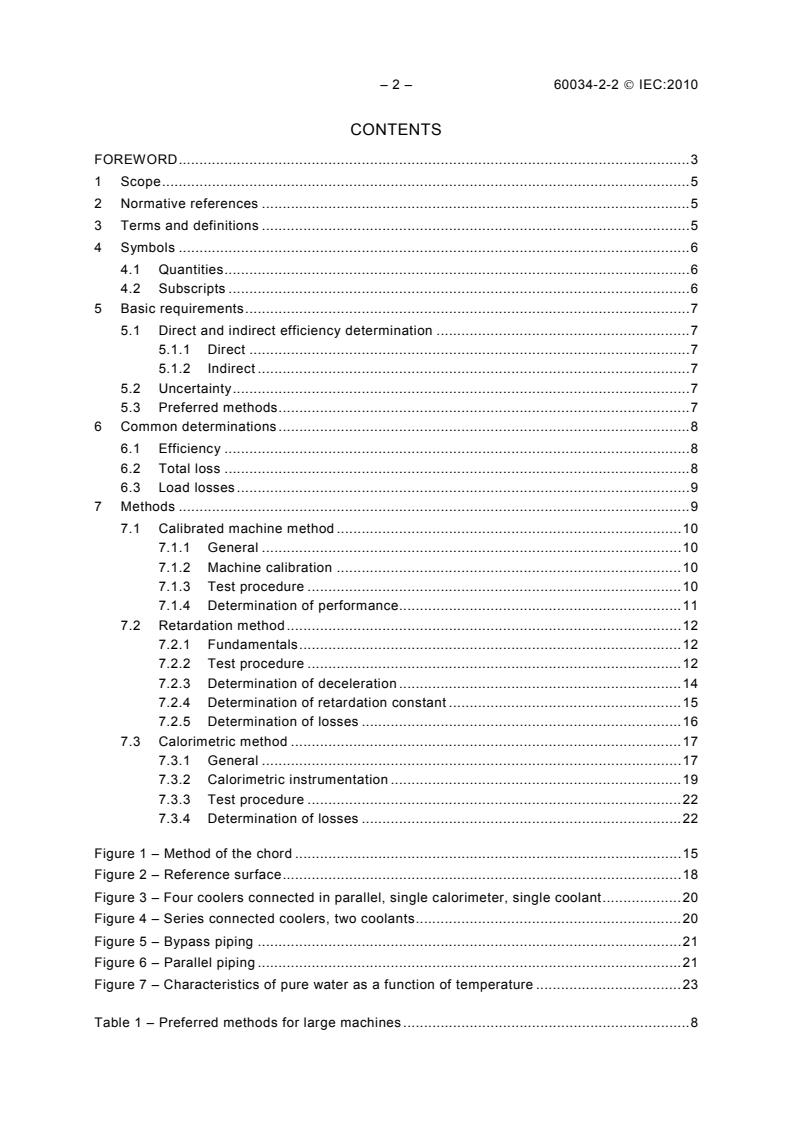
IEC 60034-2-2:2010 - Rotating electrical machines - Part 2-2: Specific methods for determining separate losses of large machines from tests - Supplement to IEC 60034-2-1 Released:3/16/2010
Overview
IEC 60034-2-2:2010 is an international standard published by the International Electrotechnical Commission (IEC) that provides specific methods for determining separate losses in large rotating electrical machines. This document serves as a supplement to IEC 60034-2-1 and is particularly relevant when full-load testing of such machines is impractical. The standard introduces additional techniques to assess efficiency by estimating losses, acknowledging that these methods may incur greater uncertainty compared to direct full-load testing. It is an essential resource for engineers and professionals involved in the testing and performance evaluation of large electrical machinery.
Key Topics
Scope and Application
IEC 60034-2-2 applies specifically to large rotating electrical machines where standard full-load testing methods may not be feasible. It supplements the procedures described in IEC 60034-2-1 with additional loss determination methods tailored for such circumstances.Loss Determination Methods
The standard introduces three main methods to determine machine losses:- Calibrated-Machine Method: This indirect approach uses a calibrated reference machine coupled to the test machine to infer losses based on measured electrical input and output.
- Retardation Method: Losses are deduced from the deceleration rate of the rotating components, measuring the speed decline when the machine runs down without load.
- Calorimetric Method: This approach estimates losses by measuring the heat generated and transferred through the cooling medium surrounding the machine.
Efficiency Determination The document distinguishes between direct efficiency measurement-through input-output power calculations-and indirect measurement, which relies on the assessment of individual losses. For large machines where direct full-load testing is challenging, indirect methods serve as valuable alternatives.
Uncertainty Considerations
The standard notes that methods in IEC 60034-2-2 typically yield greater uncertainty than full-load tests, necessitating careful application and interpretation of results.Test Procedures and Conditions
Detailed procedures outline how to conduct loss measurements, account for thermal equilibrium, and perform calculations. Symbols, terminology, and measurement symbols are standardized to facilitate uniform application internationally.
Applications
Industrial Power Generation
Accurate efficiency and loss determination of large generators and motors used in power plants, where full operational load testing may be restricted due to operational constraints.Electrical Machine Manufacturing and Quality Control
Manufacturers can apply these methods during prototype development or when full-scale testing environments are unavailable, supporting product certification and performance validation.Maintenance and In-Situ Testing
The calorimetric method enables in-situ testing to monitor machine health and efficiency without dismantling or disrupting normal operation, particularly useful in large installations.Research and Development
Engineers and researchers utilize these loss determination techniques to analyze performance loss components, optimize designs, and improve machine operating efficiency.Energy Efficiency Compliance
Provides standardized test methodologies to support compliance with energy efficiency regulations and standards for large electrical rotating machines.
Related Standards
IEC 60034-1: Rotating Electrical Machines - Part 1: Rating and Performance
Establishes fundamental definitions, ratings, and performance criteria applicable to electrical machines, providing foundational terminology for IEC 60034-2-2.IEC 60034-2-1: Rotating Electrical Machines - Part 2-1: Standard Methods for Determining Losses and Efficiency from Tests (Excluding Machines for Traction Vehicles)
The primary standard for testing machine efficiency and losses through full-load methods, to which IEC 60034-2-2 acts as a supplemental guide for large machines.ISO/IEC Directives, Part 2
Provides the procedural framework for drafting and publishing standards like IEC 60034-2-2, ensuring harmonized international standardization practices.
Keywords: IEC 60034-2-2, rotating electrical machines, loss determination, large machines, efficiency testing, calibrated-machine method, retardation method, calorimetric method, electrical machine testing, separate losses, indirect efficiency measurement, machine thermal equilibrium, electrical motor standards, IEC publications.
Relations
- Effective Date
- 25-Aug-2026
- Effective Date
- 05-Sep-2023
Buy Documents
IEC 60034-2-2:2010 - Rotating electrical machines - Part 2-2: Specific methods for determining separate losses of large machines from tests - Supplement to IEC 60034-2-1 Released:3/16/2010
Get Certified
Connect with accredited certification bodies for this standard

DVS-ZERT GmbH
German welding certification society.

IMQ S.p.A. (Certification)
Italian electrical product certification.

SLG Prüf- und Zertifizierungs GmbH
German testing and certification body.
Sponsored listings
Frequently Asked Questions
IEC 60034-2-2:2010 is a standard published by the International Electrotechnical Commission (IEC). Its full title is "Rotating electrical machines - Part 2-2: Specific methods for determining separate losses of large machines from tests - Supplement to IEC 60034-2-1". This standard covers: IEC 60034-2-2:2010 applies to large rotating electrical machines and establishes additional methods of determining separate losses and to define an efficiency supplementing IEC 60034-2-1. These methods apply when full-load testing is not practical and result in a greater uncertainty.
IEC 60034-2-2:2010 applies to large rotating electrical machines and establishes additional methods of determining separate losses and to define an efficiency supplementing IEC 60034-2-1. These methods apply when full-load testing is not practical and result in a greater uncertainty.
IEC 60034-2-2:2010 is classified under the following ICS (International Classification for Standards) categories: 25.140.20 - Electric tools; 29.160.01 - Rotating machinery in general. The ICS classification helps identify the subject area and facilitates finding related standards.
IEC 60034-2-2:2010 has the following relationships with other standards: It is inter standard links to EN ISO 13631:2002, IEC 60034-2-2:2024. Understanding these relationships helps ensure you are using the most current and applicable version of the standard.
IEC 60034-2-2:2010 is available in PDF format for immediate download after purchase. The document can be added to your cart and obtained through the secure checkout process. Digital delivery ensures instant access to the complete standard document.
Standards Content (Sample)
IEC 60034-2-2 ®
Edition 1.0 2010-03
INTERNATIONAL
STANDARD
NORME
INTERNATIONALE
Rotating electrical machines –
Part 2-2: Specific methods for determining separate losses of large machines
from tests – Supplement to IEC 60034-2-1
Machines électriques tournantes –
Partie 2-2: Méthodes spécifiques pour déterminer les pertes séparées des
machines de grande taille à partir d’essais – Complément à la CEI 60034-2-1
All rights reserved. Unless otherwise specified, no part of this publication may be reproduced or utilized in any form or by
any means, electronic or mechanical, including photocopying and microfilm, without permission in writing from either IEC or
IEC's member National Committee in the country of the requester.
If you have any questions about IEC copyright or have an enquiry about obtaining additional rights to this publication,
please contact the address below or your local IEC member National Committee for further information.
Droits de reproduction réservés. Sauf indication contraire, aucune partie de cette publication ne peut être reproduite
ni utilisée sous quelque forme que ce soit et par aucun procédé, électronique ou mécanique, y compris la photocopie
et les microfilms, sans l'accord écrit de la CEI ou du Comité national de la CEI du pays du demandeur.
Si vous avez des questions sur le copyright de la CEI ou si vous désirez obtenir des droits supplémentaires sur cette
publication, utilisez les coordonnées ci-après ou contactez le Comité national de la CEI de votre pays de résidence.
IEC Central Office
3, rue de Varembé
CH-1211 Geneva 20
Switzerland
Email: inmail@iec.ch
Web: www.iec.ch
About the IEC
The International Electrotechnical Commission (IEC) is the leading global organization that prepares and publishes
International Standards for all electrical, electronic and related technologies.
About IEC publications
The technical content of IEC publications is kept under constant review by the IEC. Please make sure that you have the
latest edition, a corrigenda or an amendment might have been published.
ƒ Catalogue of IEC publications: www.iec.ch/searchpub
The IEC on-line Catalogue enables you to search by a variety of criteria (reference number, text, technical committee,…).
It also gives information on projects, withdrawn and replaced publications.
ƒ IEC Just Published: www.iec.ch/online_news/justpub
Stay up to date on all new IEC publications. Just Published details twice a month all new publications released. Available
on-line and also by email.
ƒ Electropedia: www.electropedia.org
The world's leading online dictionary of electronic and electrical terms containing more than 20 000 terms and definitions
in English and French, with equivalent terms in additional languages. Also known as the International Electrotechnical
Vocabulary online.
ƒ Customer Service Centre: www.iec.ch/webstore/custserv
If you wish to give us your feedback on this publication or need further assistance, please visit the Customer Service
Centre FAQ or contact us:
Email: csc@iec.ch
Tel.: +41 22 919 02 11
Fax: +41 22 919 03 00
A propos de la CEI
La Commission Electrotechnique Internationale (CEI) est la première organisation mondiale qui élabore et publie des
normes internationales pour tout ce qui a trait à l'électricité, à l'électronique et aux technologies apparentées.
A propos des publications CEI
Le contenu technique des publications de la CEI est constamment revu. Veuillez vous assurer que vous possédez
l’édition la plus récente, un corrigendum ou amendement peut avoir été publié.
ƒ Catalogue des publications de la CEI: www.iec.ch/searchpub/cur_fut-f.htm
Le Catalogue en-ligne de la CEI vous permet d’effectuer des recherches en utilisant différents critères (numéro de référence,
texte, comité d’études,…). Il donne aussi des informations sur les projets et les publications retirées ou remplacées.
ƒ Just Published CEI: www.iec.ch/online_news/justpub
Restez informé sur les nouvelles publications de la CEI. Just Published détaille deux fois par mois les nouvelles
publications parues. Disponible en-ligne et aussi par email.
ƒ Electropedia: www.electropedia.org
Le premier dictionnaire en ligne au monde de termes électroniques et électriques. Il contient plus de 20 000 termes et
définitions en anglais et en français, ainsi que les termes équivalents dans les langues additionnelles. Egalement appelé
Vocabulaire Electrotechnique International en ligne.
ƒ Service Clients: www.iec.ch/webstore/custserv/custserv_entry-f.htm
Si vous désirez nous donner des commentaires sur cette publication ou si vous avez des questions, visitez le FAQ du
Service clients ou contactez-nous:
Email: csc@iec.ch
Tél.: +41 22 919 02 11
Fax: +41 22 919 03 00
IEC 60034-2-2 ®
Edition 1.0 2010-03
INTERNATIONAL
STANDARD
NORME
INTERNATIONALE
Rotating electrical machines –
Part 2-2: Specific methods for determining separate losses of large machines
from tests – Supplement to IEC 60034-2-1
Machines électriques tournantes –
Partie 2-2: Méthodes spécifiques pour déterminer les pertes séparées des
machines de grande taille à partir d’essais – Complément à la CEI 60034-2-1
INTERNATIONAL
ELECTROTECHNICAL
COMMISSION
COMMISSION
ELECTROTECHNIQUE
PRICE CODE
INTERNATIONALE
U
CODE PRIX
ICS 29.160 ISBN 978-2-88910-017-0
– 2 – 60034-2-2 © IEC:2010
CONTENTS
FOREWORD.3
1 Scope.5
2 Normative references .5
3 Terms and definitions .5
4 Symbols .6
4.1 Quantities.6
4.2 Subscripts .6
5 Basic requirements.7
5.1 Direct and indirect efficiency determination .7
5.1.1 Direct .7
5.1.2 Indirect .7
5.2 Uncertainty.7
5.3 Preferred methods.7
6 Common determinations.8
6.1 Efficiency .8
6.2 Total loss .8
6.3 Load losses.9
7 Methods .9
7.1 Calibrated machine method .10
7.1.1 General .10
7.1.2 Machine calibration .10
7.1.3 Test procedure .10
7.1.4 Determination of performance.11
7.2 Retardation method.12
7.2.1 Fundamentals.12
7.2.2 Test procedure .12
7.2.3 Determination of deceleration .14
7.2.4 Determination of retardation constant .15
7.2.5 Determination of losses .16
7.3 Calorimetric method .17
7.3.1 General .17
7.3.2 Calorimetric instrumentation .19
7.3.3 Test procedure .22
7.3.4 Determination of losses .22
Figure 1 – Method of the chord .15
Figure 2 – Reference surface.18
Figure 3 – Four coolers connected in parallel, single calorimeter, single coolant.20
Figure 4 – Series connected coolers, two coolants.20
Figure 5 – Bypass piping .21
Figure 6 – Parallel piping .21
Figure 7 – Characteristics of pure water as a function of temperature .23
Table 1 – Preferred methods for large machines .8
60034-2-2 © IEC:2010 – 3 –
INTERNATIONAL ELECTROTECHNICAL COMMISSION
____________
ROTATING ELECTRICAL MACHINES –
Part 2-2: Specific methods for determining
separate losses of large machines from tests –
Supplement to IEC 60034-2-1
FOREWORD
1) The International Electrotechnical Commission (IEC) is a worldwide organization for standardization comprising
all national electrotechnical committees (IEC National Committees). The object of IEC is to promote
international co-operation on all questions concerning standardization in the electrical and electronic fields. To
this end and in addition to other activities, IEC publishes International Standards, Technical Specifications,
Technical Reports, Publicly Available Specifications (PAS) and Guides (hereafter referred to as “IEC
Publication(s)”). Their preparation is entrusted to technical committees; any IEC National Committee interested
in the subject dealt with may participate in this preparatory work. International, governmental and non-
governmental organizations liaising with the IEC also participate in this preparation. IEC collaborates closely
with the International Organization for Standardization (ISO) in accordance with conditions determined by
agreement between the two organizations.
2) The formal decisions or agreements of IEC on technical matters express, as nearly as possible, an international
consensus of opinion on the relevant subjects since each technical committee has representation from all
interested IEC National Committees.
3) IEC Publications have the form of recommendations for international use and are accepted by IEC National
Committees in that sense. While all reasonable efforts are made to ensure that the technical content of IEC
Publications is accurate, IEC cannot be held responsible for the way in which they are used or for any
misinterpretation by any end user.
4) In order to promote international uniformity, IEC National Committees undertake to apply IEC Publications
transparently to the maximum extent possible in their national and regional publications. Any divergence
between any IEC Publication and the corresponding national or regional publication shall be clearly indicated in
the latter.
5) IEC itself does not provide any attestation of conformity. Independent certification bodies provide conformity
assessment services and, in some areas, access to IEC marks of conformity. IEC is not responsible for any
services carried out by independent certification bodies.
6) All users should ensure that they have the latest edition of this publication.
7) No liability shall attach to IEC or its directors, employees, servants or agents including individual experts and
members of its technical committees and IEC National Committees for any personal injury, property damage or
other damage of any nature whatsoever, whether direct or indirect, or for costs (including legal fees) and
expenses arising out of the publication, use of, or reliance upon, this IEC Publication or any other IEC
Publications.
8) Attention is drawn to the Normative references cited in this publication. Use of the referenced publications is
indispensable for the correct application of this publication.
9) Attention is drawn to the possibility that some of the elements of this IEC Publication may be the subject of
patent rights. IEC shall not be held responsible for identifying any or all such patent rights.
International Standard IEC 60034-2-2 has been prepared by IEC technical committee 2:
Rotating machinery.
The text of this standard is based on the following documents:
FDIS Report on voting
2/1585/FDIS 2/1595/RVD
Full information on the voting for the approval of this standard can be found in the report on
voting indicated in the above table.
This publication has been drafted in accordance with the ISO/IEC Directives, Part 2.
– 4 – 60034-2-2 © IEC:2010
NOTE A table of cross-references of all IEC TC 2 publications can be found in the IEC TC 2 dashboard on the
IEC website.
The committee has decided that the contents of this amendment and the base publication will
remain unchanged until the stability date indicated on the IEC web site under
"http://webstore.iec.ch" in the data related to the specific publication. At this date, the
publication will be
• reconfirmed,
• withdrawn,
• replaced by a revised edition, or
• amended.
60034-2-2 © IEC:2010 – 5 –
ROTATING ELECTRICAL MACHINES –
Part 2-2: Specific methods for determining
separate losses of large machines from tests –
Supplement to IEC 60034-2-1
1 Scope
This part of IEC 60034 applies to large rotating electrical machines and establishes additional
methods of determining separate losses and to define an efficiency supplementing
IEC 60034-2-1. These methods apply when full-load testing is not practical and result in a
greater uncertainty.
NOTE In situ testing according to the calorimetric method for full-load conditions is recognized.
The specific methods described are:
– Calibrated-machine method.
– Retardation method.
– Calorimetric method.
2 Normative references
The following referenced documents are indispensable for the application of this document.
For dated references, only the edition cited applies. For undated references, the latest edition
of the referenced document (including any amendments) applies.
IEC 60034-1, Rotating electrical machines – Part 1: Rating and performance
IEC 60034-2-1, Rotating electrical machines – Part 2-1: Standard methods for determining
losses and efficiency from tests (excluding machines for traction vehicles)
3 Terms and definitions
For the purposes of this document, the terms and definitions given in IEC 60034-1 and
IEC 60034-2-1 apply, as well as the following.
3.1
calibrated machine
machine whose mechanical power input/output is determined, with low uncertainty, using
measured electrical output/input values according to a defined test procedure
3.2
calibrated-machine method
method in which the mechanical input/output to/from an electrical machine under test is
determined from the measurement of the electrical input/output of a calibrated machine
mechanically coupled to the test machine
3.3
retardation method
method in which the separate losses in a machine under test are deduced from the
measurements of the deceleration rate of its rotating components when only these losses are
present
– 6 – 60034-2-2 © IEC:2010
3.4
calorimetric method
method in which the losses in a machine are deduced from the measurements of the heat
generated by them
3.5
thermal equilibrium
the state reached when the temperature rises of the several parts of the machine do not vary
by more than a gradient of 2 K per hour
[IEV 411-51-08]
4 Symbols
In addition to the symbols in IEC 60034-2-1, the following apply.
4.1 Quantities
A is an area, m ,
2 2
C is the retardation constant, kg m min ,
c is the specific heat capacity of the cooling medium, J/(kg K),
p
h is the coefficient of heat transfer, W/(m K),
J is the moment of inertia, kg m ,
–1
n is the speed, min ,
P is the excitation power supplied by a separate source, W,
1E
is the constant loss, W,
P
k
P is the electrical power, excluding excitation, W,
el
P is the excitation power, W,
e
P is the iron loss, W,
Fe
P is the friction and windage loss, W,
fw
P is the short-circuit loss, W,
sc
P is the mechanical power, W,
mech
P is the total loss, W,
T
Q is the volume rate of flow of the cooling medium, m /s,
t is the time, s,
v is the exit velocity of cooling medium, m/s,
Δp is the difference between the static pressure in the intake nozzle and ambient
pressure, N/m ,
Δθ is the temperature rise of the cooling medium, or the temperature difference
between the machine reference surface and the external ambient temperature, K,
δ is the per unit deviation of rotational speed from rated speed,
ρ is the density of the cooling medium, kg/m ,
θ is the temperature, °C.
4.2 Subscripts
irs for inside reference surface,
ers for outside reference surface,
E for exciter,
c for the cooling circuit,
60034-2-2 © IEC:2010 – 7 –
N for rated values,
rs for the reference surface,
t for a test procedure,
1 for input or initial condition,
2 for output condition.
5 Basic requirements
5.1 Direct and indirect efficiency determination
Tests can be grouped in the following categories.
5.1.1 Direct
Input-output measurements on a single machine are considered to be direct. This involves the
measurement of electrical or mechanical power into, and mechanical or electrical power out of
a machine.
5.1.2 Indirect
Measurements of the separate losses in a machine under a particular condition are
considered to be indirect. This is not usually the total loss but comprises certain loss
components. The method may, however, be used to calculate the total loss or to calculate a
loss component.
The determination of total loss shall be carried out by one of the following methods:
– direct measurement of total loss;
– summation of separate losses.
NOTE The methods for determining the efficiency of machines are based on a number of assumptions. Therefore,
it is not possible to make a comparison between the values of efficiency obtained by different methods.
5.2 Uncertainty
Uncertainty as used in this standard is the uncertainty of determining a true efficiency. It
reflects variations in the test procedure and the test equipment.
Although uncertainty should be expressed as a numerical value, such a requirement needs
sufficient testing to determine representative and comparative values. This standard uses the
following relative uncertainty terms:
– "low" applies to efficiency determinations based solely upon test results;
– "medium" applies to efficiency determinations based upon limited approximations;
– "high" applies to efficiency determinations based upon assumptions.
5.3 Preferred methods
It is difficult to establish specific rules for the determination of efficiency. The choice of test to
be made depends on the information required, the accuracy required, the type and size of the
machine involved and the available field test equipment (supply, load or driving machine).
Preferred methods for large machines are given in Table 1.
– 8 – 60034-2-2 © IEC:2010
Table 1 – Preferred methods for large machines
Quantity to be
Test method Clause Uncertainty
determined
Direct efficiency Calibrated machine 7. 1. 4. 1 m edi um
Total losses 7. 3. 3 d) l o w / m edi um
Calorimetric
Friction and windage loss Calibrated machine 7. 1. 4. 2a) m edi um
Retardation 7. 2. 5. 2 m edi um
Calorimetric 7. 3. 3 a) l o w / m edi um
Active iron loss, and additional open-circuit Calibrated machine 7. 1. 4. 2b) m edi um
losses in d.c. and synchronous machines
Retardation 7. 2. 5. 3 m edi um
Calorimetric 7. 3. 3 b) l o w / m edi um
Winding and additional-load losses Calibrated machine 7. 1. 4. 2c ) m edi um
Retardation 7. 2. 5. 5 m edi um
Calorimetric 7. 3. 3c ) l o w / m edi um
6 Common determinations
These determinations are applicable to more than one of the listed methods.
6.1 Efficiency
Efficiency is:
P + P − P
P
1 1 T
E 2
η = =
P + P P + P
1 1E 2 T
where
P is the input power excluding excitation power from a separate source;
P is the output power;
P is the excitation power supplied by a separate source;
1E
P is the total loss according to 6.2.
T
NOTE 1 Input power P and output power P are as follows:
1 2
in motor operation: P = P ; P = P ;
1 el 2 mech
in generator operation: P = P ; P = P
1 mech 2 el.
NOTE 2 P includes the excitation power P of the machine where applicable.
T e
6.2 Total loss
When the total loss is determined as the sum of the separate losses the following formulae
apply:
For direct current machines:
P = P + P + P + P + P
T k a b LL e
___________
If the relative error in P (see 7.3.1) is likely to be greater than 3 %, the calorimetric method is not
irs
recommended.
60034-2-2 © IEC:2010 – 9 –
P = P + P
e f E
P = P + P
k fw Fe
For induction machines:
P = P + P + P + P
T k s r LL
P = P + P
k fw Fe
For synchronous machines:
P = P + P + P + P
T k a LL e
P = P + P + P
e f E b
P = P + P
k fw Fe
where:
P is the I R armature-winding loss (interpole, compensation and series field winding
a
loss in case of d.c. machines),
P is the brush loss,
b
P is the exciter loss,
E
P is the excitation power,
e
P is the excitation (field winding) loss,
f
P is the iron loss,
Fe
P is the friction and windage loss,
fw
P is the constant loss,
k
P is the additional load loss,
LL
P is the I R rotor winding loss,
r
P is the stator I R winding loss,
s
P is the total loss.
T
6.3 Load losses
Losses relative to machine load (with lowest uncertainty) are best determined from actual
measurements. For example: measurements of current, resistance, etc. under full-load
operation.
When this is not possible, these values shall be obtained from calculation of the parameters
during the design stage.
Determination of losses not itemized in this part may be found in IEC 60034-2-1.
7 Methods
For the determination of performance when machine load and/or size exceed test capabilities
(described in IEC 60034-2-1), the following test methods may be used.
NOTE These methods are generally applicable to large machines where the facility cost for other methods is not
economical.
– 10 – 60034-2-2 © IEC:2010
7.1 Calibrated machine method
The calibrated machine method may be used to determine the test machine efficiency either
directly or by separate losses.
7.1.1 General
This method is generally applied as a factory test.
This method requires a calibrated machine mechanically coupled to the machine under test
and is used when neither a torque meter nor dynamometer is available. The mechanical input
of the tested machine is calculated from the electrical input of the calibrated machine.
7.1.2 Machine calibration
When a gear-box is directly connected to the machine it shall be considered as part of the
calibrated machine.
Calibrate an electric machine, preferably a direct-current machine, according to one of the
procedures in IEC 60034-2-1 at a sufficient number of thermally stable loads (including no-
load) to determine an accurate relationship of output power as a function of input power
adjusted for the temperature of the cooling air/medium at inlet. This is generally developed in
the form of a curve.
NOTE It is generally advisable to take several readings of all instruments at each load-point during short periods
of time and average the results to obtain a more accurate test value.
7.1.3 Test procedure
The tested machine shall be equipped with winding ETDs.
The tested machine shall be completely assembled with essential components as for normal
operation.
Before starting the test, record the winding resistances and the ambient temperature.
The machine for which the performance is to be determined shall be mechanically coupled to
the calibrated machine and be operated at a speed equivalent to its synchronous/rated speed.
Operate the calibrated machine with the test machine at either rated-load, partial-load; no-
load not excited, with or without brushes; no-load excited at rated voltage; or short-circuited,
which enables specific categories of losses to be determined.
When the test machine is operated at each specified test condition and has reached thermal
stability, record:
NOTE The following example represents testing with a motor as the calibrated machine.
– for the calibrated machine
P = power
U = input voltage
I = current
θ = temperature of inlet cooling air
1c
θ = winding temperature (by variation of resistance if possible)
1w
n = speed
– for the test machine (direct determination as a generator)
P = output power
60034-2-2 © IEC:2010 – 11 –
U = output voltage
I = armature load current
θ = windings temperature (either directly by ETDs or by resistance variation)
2w
n = speed
– for the unloaded test machine (as a generator)
U = armature voltage (when excited open-circuit)
I = armature current (when excited short-circuit)
θ = windings temperature (either directly by ETDs or by resistance variation)
2w
n = speed
Upon completion of each test, stop the machines and record in the given order:
– test machine winding resistance;
– calibrated machine winding resistance.
Finally operate the calibrated machine without electrical connection to the test machine and
record as specified above.
7.1.4 Determination of performance
From the curve developed in 7.1.2 and using the calibrated machine input values, select the
appropriate output power to the test machine.
Adjust the output power for the standardized coolant temperature.
Determination of excitation power shall be in accordance with IEC 60034-2-1.
7.1.4.1 Direct efficiency determination
When tested according to 7.1.3 the test machine efficiency is:
P
η = test machine working as a generator, calibrated machine working as a motor
P
where
P is the output power of test generator
P is the calculated input power to the test generator according to 7. 1. 3.
and:
P
η = test machine working as a motor, calibrated machine working as a generator
P
where
P is the input power to test motor
P is the calculated output power from the test motor.
7.1.4.2 Separate losses
Using values of P determined from the calibrated machine curve, it is possible to determine
the power dissipated by the test machine for other selected conditions that may be used to
determine efficiency according to 6.1.
– 12 – 60034-2-2 © IEC:2010
a) Friction and windage loss at rated speed (when the test machine is not electrically
connected);
b) Active iron loss, and additional open-circuit losses in d.c. and synchronous machines,
(when tested at no-load, open-circuit, excited at rated voltage, minus the windage and
friction loss). Field losses from a separate source;
c) Armature-winding loss and additional-load loss in synchronous machines, (when tested
under short-circuit conditions, excited at rated armature current, minus the windage and
friction loss). Field losses from a separate source.
7.2 Retardation method
The retardation method can be used in determining the separate losses of rotating electrical
machines having an appreciable rotational inertia.
The retardation method is used to determine:
– sum of the friction loss and windage loss ("mechanical losses") in machines of all
types;
– sum of losses in active iron and additional open-circuit losses in d.c. and synchronous
machines;
– sum of I R losses in an operating winding and additional-load losses ("short-circuit
losses") in synchronous machines.
7.2.1 Fundamentals
The recorded test loss P which retards the machine is proportional to the product of the
t
speed at which this loss corresponds and the deceleration at that speed:
dn
P = −Cn
t
dt
where:
P is the loss being measured, W;
t
C is the retardation constant according to 7. 2. 4;
–1
n is the speed, min ;
dn/dt is the deceleration from 7. 2. 3 .
NOTE The accuracy of the retardation method is directly related to the accuracy of the retardation constant C
which depends solely on the moment of inertia J (see 7. 2. 4).
7.2.2 Test procedure
7.2.2.1 Assembly of test machine
The test machine shall be assembled, with all essential components, as for normal operation,
but uncoupled from other rotating parts. A suitable speed sensor shall be attached to the
rotating element.
NOTE When the machine cannot be uncoupled, all possible steps should be taken to reduce the mechanical
losses in other rotating parts, e.g. by partial dismantling or in the case of a water turbine, by preventing water in
the runner chamber. Rotation of the runner in air produces a windage loss which should be determined either
experimentally or from calculations.
7.2.2.2 Machine preparation for test
Electrically connect the test machine as a motor (on no-load) fed from a separate power
source having a wide range of variable frequency. Any excitation shall be obtained from a
separate source with a rapid and precise voltage control.
60034-2-2 © IEC:2010 – 13 –
NOTE 1 The test machine may be driven by its normal prime mover, e.g. by Pelton turbine when the water supply
to the runner can be cut off instantly.
NOTE 2 Excitation from a mechanically-coupled exciter is not recommended, but may be permitted when the
value of the deviation of speed δ does not exceed 0,05. Losses in exciters coupled to the shaft of the test machine
are to be taken into account.
The bearing temperatures shall be adjusted to the normal temperature at which the bearings
operate with rated load, by adjusting the coolant flow.
The air temperature shall be adjusted, whenever possible, to the normal temperature at which
the windage loss measurement is required by throttling the air coolant flow.
7.2.2.3 Testing preparation
Retardation tests shall be conducted as a series without interruption, whenever possible. It is
recommended that the series start and finish with retardation tests of the test machine
unexcited.
All tests shall be repeated several times at the preset rated values of open-circuit voltage or
short-circuit current. The arithmetic mean value obtained from each series of measurements
shall be assumed to be the appropriate loss value of that category of loss.
Select a value of δ (the per unit deviation of rotational speed from rated speed) which shall
not be greater than 0,1 and may have to be less than this, depending on the characteristics of
the machine.
7.2.2.4 Tests
Rapidly accelerate the test machine to a speed above n (1 + δ). Disconnect the machine
N
from its supply source. Sufficient time delay shall separate the switching off of the supply and
starting the measurements to allow electromagnetic transients to decay.
During deceleration to n (1 – δ) place the test machine in the required condition, according to
N
the following tests:
When moment of inertia is known.
a) running unexcited;
b) running open-circuited, excited at rated voltage;
c) running with the armature terminals short-circuited, and the excitation set to give the
rated armature current.
NOTE As an alternate, tests may be carried out at various values within limits of the order of 95 % to 105 % of
either the rated voltage or rated short-circuit current.
Additional tests, when the moment of inertia is unknown, shall be conducted at the same
values as determined in b) and c) according to either d) e) or f).
d) with the field suppressed, connect the test machine to a transformer previously set
under no-load condition and excited to the preset values of current or open-circuit
voltage;
e) with the field suppressed, connect the test machine to a transformer previously set
under short-circuit;
f) with the field suppressed, simultaneously load the exciter or the auxiliary generator
with a ballast resistance at a predetermined load.
Each retardation test shall be repeated at least twice.
– 14 – 60034-2-2 © IEC:2010
7.2.2.5 Measurements
Measurements of voltage and current shall be taken at the instant when the test machine
passes through rated speed, except in the case of an unexcited retardation test.
NOTE Excitation circuit power should be measured, if excitation is not provided by a separate source.
The measured values of open-circuit voltage or short-circuit current shall not differ from the
preset values by more than ± 2 %. The calculated final value of the speed derivative in time
for each of the tests shall be adjusted proportionally by the ratio of the square of the preset
value to the measured value.
Highly accurate recording instruments shall be used either with continuous or with discrete
recording of test values of speed and time.
For each test category, take sufficient measurements to accurately locate the points n (1 + δ)
N
and n (1 – δ) as a function of time.
N
7.2.2.5.1 All tests
For all tests, record
n as a function of t (the armature circuit being short-circuited);
θ = winding temperatures (either directly or by resistance variation);
w
θ = inlet/outlet temperature of the primary cooling medium.
a
For the following tests record additionally:
where the numbered subscript denotes the specific test number.
7.2.2.5.2 Test 2
P during initial operation at rated voltage (see 7. 2. 4.2 . 1 ) ;
U open-circuit rated voltage.
7.2.2.5.3 Test 3 (for synchronous machines)
I armature current.
a
7.2.2.5.4 Test 4
P transformer no-load loss;
U open-circuit rated voltage.
7.2.2.5.5 Test 5
P transformer short-circuit loss;
I armature current.
a
7.2.2.5.6 Test 6
P exciter or auxiliary generator load.
7.2.3 Determination of deceleration
This chord method requires the measurement of the time interval (t – t ) during which the
2 1
speed of the tested machine changes from n (1 + δ) to n (1 – δ), see Figure 1. The ratio of
N N
speed interval 2 δ n to (t – t ) is approximately the deceleration at rated speed:
N 2 1
2δ n dn
N
≈ −
n = n
t − t dt
2 1 N
60034-2-2 © IEC:2010 – 15 –
where
δ is the per unit deviation of rotational speed from rated speed.
n
(1+δ)n
N
n
N
(1–δ)n
N
t
t t
1 2
IEC 448/10
Figure 1 – Method of the chord
Determine the deceleration for the required tests and record as:
dn
t
dt
Where:
t is the number of the test according to 7. 2. 2. 4.
NOTE According to the definition in 7.2.3 dn/dt is a negative value.
7.2.4 Determination of retardation constant
7.2.4.1 Known moment of inertia
When the moment of inertia of a machine rotating-part has been previously determined by
either measurement (preferred) or by design calculation, the retardation constant is calculated
from:
π
4 J
−3
C = = 10,97 ×10 J
where:
J is the moment of inertia, in kg·m .
7.2.4.2 Unknown moment of inertia
7.2.4.2.1 Operation as an unloaded motor
When the test machine is operated as an unloaded motor, the input power is equal to the sum
of the mechanical loss P and iron loss P (the armature circuit I R loss is ignored), then the
fw Fe
retardation constant C is determined from the formula:
– 16 – 60034-2-2 © IEC:2010
P + P
fw Fe
C = −
dn
n 2
N
dt
7.2.4.2.2 Retarded by open-circuited transformer
When the test machine is retarded by the transformer open-circuit loss, with the ohmic I R
loss according to the transformer open-circuit current ignored, then:
dn
P + P + P = −Cn 4
fw Fe 4 N
dt
hence
P
C = −
⎧ ⎫
dn dn
n 4 − 2
N⎨ ⎬
dt dt
⎩ ⎭
7.2.4.2.3 Retarded by short-circuited transformer
When the test machine is retarded by the transformer short-circuit loss, with the iron loss
corresponding to magnetic flux in the short-circuited transformer ignored, then
dn
P + P + P = −Cn 5
fw sc 5 N
dt
hence
P
C = −
⎧ ⎫
dn dn
n 5 − 3
N⎨ ⎬
dt dt
⎩ ⎭
7.2.4.2.4 Retardation by exciter or auxiliary generator
When the test machine is retarded by the exciter or auxiliary generator loaded with a ballast
resistance, the retardation losses consist only of the test machine mechanical loss P and
fw
the measured load P (with allowance for efficiency of the exciter or auxiliary generator which
can be determined by calculations). Then:
dn
P + P = −Cn 6
fw 6 N
dt
hence
P
C = −
⎧ ⎫
dn dn
n 6 − 1
⎨ ⎬
N
dt dt
⎩ ⎭
7.2.5 Determination of losses
7.2.5.1 General
The tested loss P which retards the machine is:
t
dn
P = −Cn t
t N
dt
Where:
60034-2-2 © IEC:2010 – 17 –
–1
n is rated speed, in min ;
N
P is tested loss, in W;
t
C is retardation constant according to 7.2.4;
dn
t is the deceleration from test t, where t is the specific test number according to 7. 2. 2.4 .
dt
7.2.5.2 Friction and windage loss
The friction and windage (mechanical) loss P of the test machine are:
fw
dn
P = −Cn 1
fw N
dt
7.2.5.3 Iron loss
The iron loss P is:
Fe
dn
P = −Cn 2 − P
Fe N fw
dt
NOTE Excitation should be provided by a separate source according to 7.2.2.2.
7.2.5.4 Short-circuit loss
The short-circuit loss P is:
sc
dn
P = −Cn 3 − P
sc N fw
dt
NOTE Excitation should be provided by a separate source according to 7.2.2.2.
7.2.5.5 Separation of additional and short-circuit losses
The sum of the I R loss and the additional loss in the armature circuit is determined as the
difference of losses measured in the third and first test. Separation of this sum into
components, if required, is done by subtracting from it the I R loss in the armature circuit
calculated from the armature circuit resistance corresponding to the test temperature.
7.2.5.6 Measurement of losses in bearings
Losses in common bearings should be stated separately, whether or not such bearings are
supplied with the machine.
The losses in bearings and thrust bearings shall be subtracted from the total sum of the
mechanical losses. If the tested machine uses direct-flow cooling of the bearings, these
losses are distributed between the tested machine and any other coupled to it mechanically,
such as turbine, in proportion to the masses of their rotating parts. If there is no direct-flow
cooling, the distribution of bearing losses shall be determined from empirical formulae.
7.3 Calorimetric method
7.3.1 General
The calorimetric method may be used to determine the efficiency of large electrical rotating
machinery:
a) either by the determination of the total loss on load, or
b) by the determination of the segregated losses.
– 18 – 60034-2-2 © IEC:2010
In the calorimetric method losses are determined from the product of the amount of coolant
and its temperature rise, and the heat dissipated in the surrounding media.
Calorimetric losses of the machine consist of:
– losses inside the reference surface P ,
irs
– losses outside the reference surface P (for example external bearings, excitation
ers
equipment, external motors for water-cooling pumps).
The loss inside the reference surface P is determined from:
irs
P = P + P
irs irs,1 irs,2
where:
P is the loss measured calorimetrically;
irs,1
P is the loss dissipated through the “reference surface” by conduction,
irs,2
convection, radiation, leakage, etc.
The "reference surface" is a surface completely surrounding the machine such that all losses
produced inside it (P ), and not measured calorimetrically, are dissipated through it to the
irs
outside (see Figure 2).
The excitation equipment may or may not be inside the reference surface. When outside the
reference surface the excitation equipment losses should be determined separately either by
measurement or by calculation.
NOTE P may be negative and therefore subtracted when heat from surrounding ambient flows into
irs,2
the reference surface.
Reference surface
Radiation to walls
Convection to air +
Excitation
Ambient air
–
Cooler for
thrust bearing
Main coolers
Cooling air
Conduction to foundation
Conduction to turbine runner
IEC 449/10
Figure 2 – Reference surface
60034-2-2 © IEC:2010 – 19 –
7.3.2 Calorimetric instrumentation
7.3.2.1 Flowmeters
The volume rate of flow of fluids is best measured by volumetric or velocity type flowmeters.
Other measuring methods with the same or greater accuracy may be used.
Install the flowmeters in accordance with manufacturer's instructions (straight sections up and
downstream, position, etc.). It is recommended to control the flow of the cooling fluid by
operating a valve placed downstream from the flowmeter.
Care should be taken that no air bubbles be present in the water.
The flowmeters shall be calibrated before and after the measurements in conditions similar to
those prevailing during the test measurements.
In the case of volumetric measurements, the time shall be measured by means of an electrical
timing device. The measuring time shall be at least 5 min during at least 2 intervals. The
average values shall be recorded.
When measurement is made with a direct-reading flowmeter, 20 readings shall be recorded
and an average value determined.
Provisions shall be made to measure both water pressure and temperature at the flowmeter.
7.3.2.2 Thermal detectors
Thermal measurements shall be made preferably by platinum resistance temperature
detectors placed directly in the liquid coolant, and positioned in-line with each other so as to
obtain direct readings for determination of the temperature rise of the liquid coolant (water,
oil).
NOTE Thermocouples are permitted, but their improper use could increase the uncertainty. Thermal detectors
placed in oil-filled thermometric pockets are also permitted but add additional uncertainty.
The thermal instruments shall be calibrated before and after the tests.
Recording instruments shall be used.
Where possible, water pipes should be insulated from the reference surface and well behind
the measuring point to avo
...