

IEC 60375:2018
(Main)Conventions concerning electric circuits
General Information
- Abstract
IEC 60375:2018 specifies the rules for signs and reference directions and reference polarities for electric currents and voltages in electric networks.
- Status
- Published
- Publication Date
- 07-May-2018
- Technical Committee
- TC 25 - Quantities and units
- Drafting Committee
- MT 8 - TC 25/MT 8
- Current Stage
- PPUB - Publication issued
- Start Date
- 08-May-2018
- Completion Date
- 04-May-2018
Overview
IEC 60375:2018, titled "Conventions concerning electric circuits," is an international standard published by the International Electrotechnical Commission (IEC). This standard defines the widely accepted rules and conventions related to the signs, reference directions, and reference polarities applied to electric currents and voltages within electric networks. By standardizing these conventions, IEC 60375:2018 ensures consistent and unambiguous documentation, analysis, and interpretation of electrical circuit diagrams worldwide.
The document plays a critical role in harmonizing the orientation of geometrical objects, currents, voltages, power flow, passive elements, and electrical sources in electric circuits. It supports engineers, designers, educators, and standardization bodies by providing clear guidelines to depict electrical quantities uniformly, thereby facilitating accurate communication and interoperability.
Key Topics
IEC 60375:2018 covers a comprehensive range of essential subjects related to electric circuit conventions, including:
Orientation of Geometrical Objects
Guidance on defining orientations for curves, surfaces, and arrows used in graphical symbols to represent electrical components.Conventions for Currents
Definitions of physical and reference directions for electric currents, including how to indicate these directions in circuit diagrams. It integrates Kirchhoff's current law for nodes illustrating current balance.Conventions for Voltages
Clarifies the physical polarity of voltages and specifies methods to denote reference polarity between node pairs in electric networks. It also applies Kirchhoff’s voltage law for meshes.Power Direction and Conventions
Establishes conventions for the physical and reference directions of power, including motor and generator conventions, and the indication methods in circuit schematics.Two-Port Networks
Sets reference conventions for representing two-port networks, essential for modeling and analysis of network parameters.Sources of Energy
Standardizes the depiction of independent and controlled voltage and current sources, ensuring clear recognition of their reference directions and control relationships.Passive Elements
Provides conventions for representing resistive, capacitive, and inductive elements, covering both two-terminal and multi-terminal configurations.Complex Notation for Sinusoidal Quantities
Addresses the conventions related to sinusoidal steady-state analysis using phasors, including reference directions, polarities, graphical phasor representation, phase differences, and complex power.
The standard also incorporates detailed figures to illustrate each concept, supporting visual understanding and practical application in documentation.
Applications
IEC 60375:2018 is fundamental for professionals in electrical engineering and related fields, with practical applications including:
Electrical Circuit Design and Analysis
Ensuring uniform interpretation of current directions, voltage polarities, and power flow enhances circuit simulation accuracy and reliability.Technical Documentation and Schematics
Provides a universal standard to draft circuit diagrams and instructional materials, improving clarity and reducing errors across industries and regions.Education and Training
Serves as a foundational resource for teaching consistent electric circuit representation to engineering students and trainees.Standardization and Compliance Testing
Assists manufacturers and testing bodies in applying consistent electrical conventions crucial for product certification and regulatory compliance.Software Development for Electrical Tools
Facilitates incorporation of standardized circuit representation rules in computer-aided design (CAD) and simulation software for electric networks.
By adhering to IEC 60375:2018, stakeholders achieve enhanced communication, interoperability, and quality assurance in electric circuit design and documentation globally.
Related Standards
Professionals using IEC 60375:2018 should consider complementary IEC publications and resources that support and extend its guidance:
IEC 60617 - Graphical Symbols for Diagrams: Provides standardized symbols used alongside conventions defined in IEC 60375.
IEC 61082 - Preparation of Documents Used in Electrotechnology: Covers general rules for preparing electrical documents, including diagrams and schematics.
IEC Electropedia and IEC Glossary: Comprehensive online dictionaries of electrotechnical terminology that align with IEC 60375 conventions to ensure consistent language use.
Standards on Specific Components and Circuits: Including those on transformers, switchgear, and electronic components that reference or align with IEC 60375 conventions.
Utilizing these related standards alongside IEC 60375:2018 ensures cohesive and robust standardization of electrical circuit practices internationally.
By implementing the clear, globally harmonized conventions established by IEC 60375:2018, electrical industry professionals can streamline design, analysis, and communications concerning electric circuits-ultimately enhancing efficiency, reducing errors, and supporting interoperability across electrical engineering disciplines.
Relations
- Effective Date
- 05-Sep-2023
Get Certified
Connect with accredited certification bodies for this standard

IMQ S.p.A. (Certification)
Italian electrical product certification.

SLG Prüf- und Zertifizierungs GmbH
German testing and certification body.

UL Solutions
Global safety science company with testing, inspection and certification.
Sponsored listings
Frequently Asked Questions
IEC 60375:2018 is a standard published by the International Electrotechnical Commission (IEC). Its full title is "Conventions concerning electric circuits". This standard covers: IEC 60375:2018 specifies the rules for signs and reference directions and reference polarities for electric currents and voltages in electric networks.
IEC 60375:2018 specifies the rules for signs and reference directions and reference polarities for electric currents and voltages in electric networks.
IEC 60375:2018 is classified under the following ICS (International Classification for Standards) categories: 01.060 - Quantities and units; 01.080.40 - Graphical symbols for use on electrical and electronics engineering drawings, diagrams, charts and in relevant technical product documentation; 17.240 - Radiation measurements; 29.035.01 - Insulating materials in general. The ICS classification helps identify the subject area and facilitates finding related standards.
IEC 60375:2018 has the following relationships with other standards: It is inter standard links to IEC 60375:2003. Understanding these relationships helps ensure you are using the most current and applicable version of the standard.
IEC 60375:2018 is available in PDF format for immediate download after purchase. The document can be added to your cart and obtained through the secure checkout process. Digital delivery ensures instant access to the complete standard document.
Standards Content (Sample)
IEC 60375 ®
Edition 3.0 2018-05
INTERNATIONAL
STANDARD
NORME
INTERNATIONALE
Conventions concerning electric circuits
Conventions concernant les circuits électriques
All rights reserved. Unless otherwise specified, no part of this publication may be reproduced or utilized in any form
or by any means, electronic or mechanical, including photocopying and microfilm, without permission in writing from
either IEC or IEC's member National Committee in the country of the requester. If you have any questions about IEC
copyright or have an enquiry about obtaining additional rights to this publication, please contact the address below or
your local IEC member National Committee for further information.
Droits de reproduction réservés. Sauf indication contraire, aucune partie de cette publication ne peut être reproduite
ni utilisée sous quelque forme que ce soit et par aucun procédé, électronique ou mécanique, y compris la photocopie
et les microfilms, sans l'accord écrit de l'IEC ou du Comité national de l'IEC du pays du demandeur. Si vous avez des
questions sur le copyright de l'IEC ou si vous désirez obtenir des droits supplémentaires sur cette publication, utilisez
les coordonnées ci-après ou contactez le Comité national de l'IEC de votre pays de résidence.
IEC Central Office Tel.: +41 22 919 02 11
3, rue de Varembé info@iec.ch
CH-1211 Geneva 20 www.iec.ch
Switzerland
About the IEC
The International Electrotechnical Commission (IEC) is the leading global organization that prepares and publishes
International Standards for all electrical, electronic and related technologies.
About IEC publications
The technical content of IEC publications is kept under constant review by the IEC. Please make sure that you have the
latest edition, a corrigenda or an amendment might have been published.
IEC Catalogue - webstore.iec.ch/catalogue Electropedia - www.electropedia.org
The stand-alone application for consulting the entire The world's leading online dictionary of electronic and
bibliographical information on IEC International Standards, electrical terms containing 21 000 terms and definitions in
Technical Specifications, Technical Reports and other English and French, with equivalent terms in 16 additional
documents. Available for PC, Mac OS, Android Tablets and languages. Also known as the International Electrotechnical
iPad. Vocabulary (IEV) online.
IEC publications search - webstore.iec.ch/advsearchform IEC Glossary - std.iec.ch/glossary
The advanced search enables to find IEC publications by a 67 000 electrotechnical terminology entries in English and
variety of criteria (reference number, text, technical French extracted from the Terms and Definitions clause of
committee,…). It also gives information on projects, replaced IEC publications issued since 2002. Some entries have been
and withdrawn publications. collected from earlier publications of IEC TC 37, 77, 86 and
CISPR.
IEC Just Published - webstore.iec.ch/justpublished
Stay up to date on all new IEC publications. Just Published IEC Customer Service Centre - webstore.iec.ch/csc
details all new publications released. Available online and If you wish to give us your feedback on this publication or
also once a month by email. need further assistance, please contact the Customer Service
Centre: sales@iec.ch.
A propos de l'IEC
La Commission Electrotechnique Internationale (IEC) est la première organisation mondiale qui élabore et publie des
Normes internationales pour tout ce qui a trait à l'électricité, à l'électronique et aux technologies apparentées.
A propos des publications IEC
Le contenu technique des publications IEC est constamment revu. Veuillez vous assurer que vous possédez l’édition la
plus récente, un corrigendum ou amendement peut avoir été publié.
Catalogue IEC - webstore.iec.ch/catalogue Electropedia - www.electropedia.org
Application autonome pour consulter tous les renseignements
Le premier dictionnaire en ligne de termes électroniques et
bibliographiques sur les Normes internationales,
électriques. Il contient 21 000 termes et définitions en anglais
Spécifications techniques, Rapports techniques et autres
et en français, ainsi que les termes équivalents dans 16
documents de l'IEC. Disponible pour PC, Mac OS, tablettes
langues additionnelles. Egalement appelé Vocabulaire
Android et iPad.
Electrotechnique International (IEV) en ligne.
Recherche de publications IEC -
Glossaire IEC - std.iec.ch/glossary
webstore.iec.ch/advsearchform
67 000 entrées terminologiques électrotechniques, en anglais
La recherche avancée permet de trouver des publications IEC et en français, extraites des articles Termes et Définitions des
en utilisant différents critères (numéro de référence, texte, publications IEC parues depuis 2002. Plus certaines entrées
comité d’études,…). Elle donne aussi des informations sur les antérieures extraites des publications des CE 37, 77, 86 et
projets et les publications remplacées ou retirées. CISPR de l'IEC.
IEC Just Published - webstore.iec.ch/justpublished Service Clients - webstore.iec.ch/csc
Restez informé sur les nouvelles publications IEC. Just Si vous désirez nous donner des commentaires sur cette
Published détaille les nouvelles publications parues. publication ou si vous avez des questions contactez-nous:
Disponible en ligne et aussi une fois par mois par email. sales@iec.ch.
IEC 60375 ®
Edition 3.0 2018-05
INTERNATIONAL
STANDARD
NORME
INTERNATIONALE
Conventions concerning electric circuits
Conventions concernant les circuits électriques
INTERNATIONAL
ELECTROTECHNICAL
COMMISSION
COMMISSION
ELECTROTECHNIQUE
INTERNATIONALE
ICS 01.060; 01.080.40 ISBN 978-2-8322-5597-1
– 2 – IEC 60375:2018 © IEC 2018
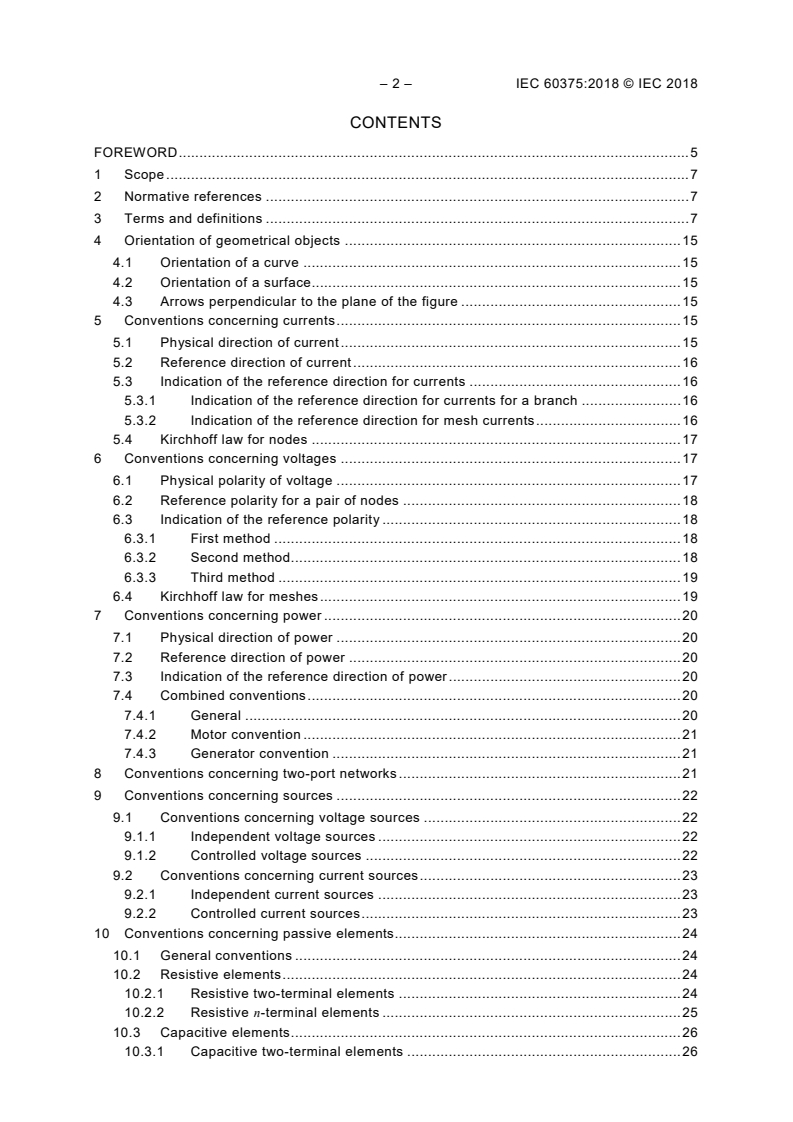
CONTENTS
FOREWORD . 5
1 Scope . 7
2 Normative references . 7
3 Terms and definitions . 7
4 Orientation of geometrical objects . 15
4.1 Orientation of a curve . 15
4.2 Orientation of a surface. 15
4.3 Arrows perpendicular to the plane of the figure . 15
5 Conventions concerning currents . 15
5.1 Physical direction of current . 15
5.2 Reference direction of current . 16
5.3 Indication of the reference direction for currents . 16
5.3.1 Indication of the reference direction for currents for a branch . 16
5.3.2 Indication of the reference direction for mesh currents . 16
5.4 Kirchhoff law for nodes . 17
6 Conventions concerning voltages . 17
6.1 Physical polarity of voltage . 17
6.2 Reference polarity for a pair of nodes . 18
6.3 Indication of the reference polarity . 18
6.3.1 First method . 18
6.3.2 Second method. 18
6.3.3 Third method . 19
6.4 Kirchhoff law for meshes . 19
7 Conventions concerning power . 20
7.1 Physical direction of power . 20
7.2 Reference direction of power . 20
7.3 Indication of the reference direction of power . 20
7.4 Combined conventions . 20
7.4.1 General . 20
7.4.2 Motor convention . 21
7.4.3 Generator convention . 21
8 Conventions concerning two-port networks . 21
9 Conventions concerning sources . 22
9.1 Conventions concerning voltage sources . 22
9.1.1 Independent voltage sources . 22
9.1.2 Controlled voltage sources . 22
9.2 Conventions concerning current sources . 23
9.2.1 Independent current sources . 23
9.2.2 Controlled current sources . 23
10 Conventions concerning passive elements. 24
10.1 General conventions . 24
10.2 Resistive elements . 24
10.2.1 Resistive two-terminal elements . 24
10.2.2 Resistive n-terminal elements . 25
10.3 Capacitive elements . 26
10.3.1 Capacitive two-terminal elements . 26
10.3.2 Capacitive n-terminal elements . 27
10.4 Inductive elements . 29
10.4.1 Inductive two-terminal elements . 29
10.4.2 Inductive n-port elements . 30
11 Complex notation . 32
11.1 General . 32
11.2 Conventions concerning complex representation of sinusoidal quantities . 32
11.3 Reference direction of a complex current . 32
11.4 Reference polarity for a complex voltage . 33
11.5 Complex representation of Ohm's law . 34
11.6 Conventions concerning the graphical representation of phasors . 35
11.7 Conventions concerning phase differences . 35
11.8 Conventions concerning power . 36
11.8.1 Time-dependent electric power . 36
11.8.2 Complex power . 36
Bibliography . 37
Figure 1 – Orientation of a curve . 15
Figure 2 – Orientation of a surface . 15
Figure 3 – Indication of the reference direction for a current by an arrow . 16
Figure 4 – Indication of the reference direction using the node names . 16
Figure 5 – Indication of the reference direction for mesh currents . 17
Figure 6 – Examples of the Kirchhoff law for nodes . 17
Figure 7 – Indication of the reference polarity by means of plus and minus signs . 18
Figure 8 – Simplified indication of the reference polarity by means of plus signs . 18
Figure 9 – Indication of the reference polarity by an arrow . 18
Figure 10 – Indication of the reference polarity using the node names . 19
Figure 11 – Simplified indication of the reference polarity using the node names . 19
Figure 12 – Examples of the Kirchhoff law for meshes . 20
Figure 13 – Indication of the reference direction of power . 20
Figure 14 – Examples of motor conventions . 21
Figure 15 – Examples of generator conventions . 21
Figure 16 – A reference convention for a two-port network. 22
Figure 17 – Graphical representation of an independent voltage source . 22
Figure 18 – Graphical representation of a voltage source controlled by a voltage:
u =αu . 22
s c
Figure 19 – Graphical representation of a voltage source controlled by a current:
u =β i . 23
s c
Figure 20 – Graphical representation of an independent current source . 23
Figure 21 – Graphical representation of a current source controlled by a voltage:
i =γ u . 24
s c
Figure 22 – Graphical representation of a current source controlled by a current:
i =δ i . 24
s c
Figure 23 – Examples of graphical representations of a two-terminal resistive element . 25
– 4 – IEC 60375:2018 © IEC 2018
Figure 24 – Examples of the graphical representation of a four-terminal resistive
element. 25
Figure 25 – Examples of the graphical representation of a two-terminal capacitive
element. 26
Figure 26 – Examples of the graphical representation of a four-terminal capacitive
element. 27
Figure 27 – Examples of the graphical representation of a two-terminal inductive
element. 29
Figure 28 – Examples of the graphical representation of a three-port inductive element . 30
Figure 29 – Examples of the Kirchhoff law for nodes in complex notation . 33
Figure 30 – Examples of the Kirchhoff law for meshes in complex notation . 34
Figure 31 – Examples of graphical representation of reference directions and polarities
in Ohm's law for a complex two-terminal element . 35
Figure 32 – Graphical representation of a phasor in the complex plane . 35
Figure 33 – Graphical representation of phase difference in the complex plane . 35
Figure 34 – Examples of the reference directions for time-dependent electric power . 36
Figure 35 – Examples of the reference directions for the complex power . 36
INTERNATIONAL ELECTROTECHNICAL COMMISSION
____________
CONVENTIONS CONCERNING ELECTRIC CIRCUITS
FOREWORD
1) The International Electrotechnical Commission (IEC) is a worldwide organization for standardization comprising
all national electrotechnical committees (IEC National Committees). The object of IEC is to promote
international co-operation on all questions concerning standardization in the electrical and electronic fields. To
this end and in addition to other activities, IEC publishes International Standards, Technical Specifications,
Technical Reports, Publicly Available Specifications (PAS) and Guides (hereafter referred to as “IEC
Publication(s)”). Their preparation is entrusted to technical committees; any IEC National Committee interested
in the subject dealt with may participate in this preparatory work. International, governmental and non-
governmental organizations liaising with the IEC also participate in this preparation. IEC collaborates closely
with the International Organization for Standardization (ISO) in accordance with conditions determined by
agreement between the two organizations.
2) The formal decisions or agreements of IEC on technical matters express, as nearly as possible, an international
consensus of opinion on the relevant subjects since each technical committee has representation from all
interested IEC National Committees.
3) IEC Publications have the form of recommendations for international use and are accepted by IEC National
Committees in that sense. While all reasonable efforts are made to ensure that the technical content of IEC
Publications is accurate, IEC cannot be held responsible for the way in which they are used or for any
misinterpretation by any end user.
4) In order to promote international uniformity, IEC National Committees undertake to apply IEC Publications
transparently to the maximum extent possible in their national and regional publications. Any divergence
between any IEC Publication and the corresponding national or regional publication shall be clearly indicated in
the latter.
5) IEC itself does not provide any attestation of conformity. Independent certification bodies provide conformity
assessment services and, in some areas, access to IEC marks of conformity. IEC is not responsible for any
services carried out by independent certification bodies.
6) All users should ensure that they have the latest edition of this publication.
7) No liability shall attach to IEC or its directors, employees, servants or agents including individual experts and
members of its technical committees and IEC National Committees for any personal injury, property damage or
other damage of any nature whatsoever, whether direct or indirect, or for costs (including legal fees) and
expenses arising out of the publication, use of, or reliance upon, this IEC Publication or any other IEC
Publications.
8) Attention is drawn to the Normative references cited in this publication. Use of the referenced publications is
indispensable for the correct application of this publication.
9) Attention is drawn to the possibility that some of the elements of this IEC Publication may be the subject of
patent rights. IEC shall not be held responsible for identifying any or all such patent rights.
International Standard IEC 60375 has been prepared by IEC technical committee 25:
Quantities and units, and their letter symbols.
This third edition cancels and replaces the second edition issued in 2003. This edition
constitutes a technical revision.
This edition includes the following significant technical changes with respect to the previous
edition:
a) the clause on conventions concerning magnetic circuits has been removed; accordingly
the title of the document has been abbreviated to read “Conventions concerning electric
circuits”;
b) text and figures have been revised and homogenised;
c) Clause 3 has been structured into subclauses;
d) Clause 4 – Orientation of geometrical objects – has been inserted, and thus the clause
numbering has been altered.
– 6 – IEC 60375:2018 © IEC 2018
The text of this standard is based on the following documents:
FDIS Report on voting
25/620/FDIS 25/622/RVD
Full information on the voting for the approval of this standard can be found in the report on
voting indicated in the above table.
This publication has been drafted in accordance with the ISO/IEC Directives, Part 2.
The committee has decided that the contents of this publication will remain unchanged until
the stability date indicated on the IEC website under "http://webstore.iec.ch" in the data
related to the specific publication. At this date, the publication will be
• reconfirmed,
• withdrawn,
• replaced by a revised edition, or
• amended.
CONVENTIONS CONCERNING ELECTRIC CIRCUITS
1 Scope
This International Standard specifies the rules for signs and reference directions and
reference polarities for electric currents and voltages in electric networks.
In Clauses 3 to 10, the time dependence is arbitrary. It is assumed that the wavelength of the
highest frequency involved is larger than the largest distance between two points of the
network; processes are considered to be quasi-static. Clause 11 specifies the rules and
recommendations for complex notation.
2 Normative references
The following documents are referred to in the text in such a way that some or all of their
content constitutes requirements of this document. For dated references, only the edition
cited applies. For undated references, the latest edition of the referenced document (including
any amendments) applies.
IEC 60617, Graphical symbols for diagrams
3 Terms and definitions
For the purposes of this document, the following terms and definitions apply.
ISO and IEC maintain terminological databases for use in standardization at the following
addresses:
• IEC Electropedia: available at http://www.electropedia.org/
• ISO Online browsing platform: available at http://www.iso.org/obp
3.1
orientation
property of a curve described by the position vector r(u) which is associated with
increasing or decreasing values of the parameter u
[SOURCE: IEC 60050-102:2007, 102-04-19]
3.2
orientation
for a surface having a tangent plane at any point, property determined by the
choice, continuously from point to point, of one of the two normal unit vectors at each point
[SOURCE: IEC 60050-102:2007, 102-04-36, modified – Note 1 to entry omitted.]
3.3
electric charge
additive scalar quantity, associated with elementary particles and with macroscopic matter
that characterizes their electromagnetic interactions
_____________
IEC 60617 is a database containing symbols referenced in the form (IEC 60617-Sxxxxx) where Sxxxxx is the
identity number of the symbol.
– 8 – IEC 60375:2018 © IEC 2018
Note 1 to entry: The (electric) charge of a capacitor is defined in IEC 60050-131:2002, 131-12-11 differently by
q= i(τ )dτ ; where it is used in this document, it is marked with this source in square brackets.
∫
[SOURCE: IEC 60050-121:1998, 121-11-01, modified – Note 1 to entry has been replaced
and Note 2 to entry has been omitted.]
3.4
positive electric charge
electric charge which is of the same sign as that attributed by convention to a proton
[SOURCE: IEC 60050-113:2011, 113-02-12]
3.5
quasi-infinitesimal
for a system of elementary entities distributed in space, qualifies the length, the area, or the
volume of an element of space, all the geometrical dimensions of which are small compared
with those of the system under consideration but sufficiently large for the element of space to
contain a large number of elementary entities; qualifies also an extensive quantity when
summed for all elementary entities within such an element of space
[SOURCE: IEC 60050-121:1998, 121-11-06, modified – Notes to entry omitted.]
3.6
electric current
current
conduction current
scalar quantity equal to the flux of the electric current density J through a given oriented
surface S:
d
d
I= J⋅e dA
n
∫
S
d
where e dA is the vector surface element
n
[SOURCE: IEC 60050-121:1998, 121-11-13, modified – Notes to entry omitted.]
3.7
integral quantity
line, surface or volume integral of a quantity associated with an electromagnetic field
[SOURCE: IEC 60050-131:2002, 131-11-01, modified – Notes to entry omitted.]
3.8
circuit theory
study of electric and magnetic systems in which the electric and magnetic phenomena are
described in terms of integral quantities
[SOURCE: IEC 60050-131:2002, 131-11-02, modified – Note to entry omitted.]
3.9
circuit element
in electromagnetism, mathematical model of a device characterized by one or more relations
between integral quantities
[SOURCE: IEC 60050-131:2002, 131-11-03]
3.10
electric circuit element
circuit element for which only relations between electric integral quantities are considered
[SOURCE: IEC 60050-131:2002, 131-11-04]
3.11
circuit
set of interconnected circuit elements
[SOURCE: IEC 60050-131:2002, 131-11-06]
3.12
electric circuit
circuit consisting of electric circuit elements only
[SOURCE: IEC 60050-131:2002, 131-11-07, modified – Synonym "electric network" and notes
to entry omitted.]
3.13
terminal
point of interconnection of an electric circuit element, an electric circuit or a network with
other electric circuit elements, electric circuits or networks
[SOURCE: IEC 60050-131:2002, 131-11-11, modified – Notes to entry omitted.]
3.14
n-terminal
qualifies an electric circuit element, an electric circuit or a network having n terminals with n
generally greater than two
[SOURCE: IEC 60050-131:2002, 131-11-12]
3.15
n-terminal circuit element
electric circuit element having n terminals with n generally greater than two
[SOURCE: IEC 60050-131:2002, 131-11-13, modified – Note to entry omitted.]
3.16
n-terminal circuit
electric circuit having n terminals with n generally greater than two
[SOURCE: IEC 60050-131:2002, 131-11-14, modified – Note to entry omitted.]
3.17
two-terminal circuit
electric circuit having two terminals
[SOURCE: IEC 60050-131:2002, 131-11-15]
3.18
two-terminal element
electric circuit element having two terminals
[SOURCE: IEC 60050-131:2002, 131-11-16]
– 10 – IEC 60375:2018 © IEC 2018
3.19
phasor
representation of a sinusoidal integral quantity by a complex quantity whose argument is
equal to the initial phase and whose modulus is equal to the root-mean-square value
[SOURCE: IEC 60050-131:2002, 131-11-26, modified – Notes to entry omitted.]
3.20
direction of electric current
by convention, the direction of the net flow of positive electric charge transferred from one
terminal to another terminal
[SOURCE: IEC 60050-131:2002, 131-11-29, modified – Note to entry omitted.]
3.21
passive
qualifies a circuit element or a circuit for which the time integral of the instantaneous power
cannot be negative over any time interval beginning at an instant before the first supply of
electric energy
[SOURCE: IEC 60050-131:2002, 131-11-34, modified – Notes to entry omitted.]
3.22
complex power
under sinusoidal conditions, product of the phasor representing the voltage between the
U
terminals of a linear two-terminal element or two-terminal circuit and the complex conjugate of
∗
the phasor I representing the electric current in the element or circuit: S= U⋅ I
[SOURCE: IEC 60050-131:2002, 131-11-39, modified – Notes to entry omitted.]
3.23
apparent power
product of the RMS voltage U between the terminals of a two-terminal element or two-terminal
circuit and the RMS electric current I in the element or circuit: S= UI
[SOURCE: IEC 60050-131:2002, 131-11-41, modified – Notes to entry omitted.]
3.24
active power
under periodic conditions, mean value, taken over one period T, of the instantaneous power P:
T
P= pdt
∫
T
[SOURCE: IEC 60050-131:2002, 131-11-42, modified – Notes to entry omitted.]
3.25
reactive power
for a linear two-terminal element or two-terminal circuit, under sinusoidal conditions, quantity
equal to the product of the apparent power S and the sine of the displacement angle ϕ
Q= S sinϕ
[SOURCE: IEC 60050-131: 2002, 131-11-44, modified – Notes to entry omitted.]
3.26
displacement angle
under sinusoidal conditions, phase difference between the voltage applied to a linear two-
terminal element or two-terminal circuit and the electric current in the element or circuit
[SOURCE: IEC 60050-131:2002, 131-11-48, modified – Note to entry omitted.]
3.27
voltage
between two terminals A and B, quantity u equal to the difference of the
AB
electric potentials V at A and V at B:
A B
u = V −V
AB A B
[SOURCE: IEC 60050-131:2002, 131-11-56, modified – Note to entry omitted.]
3.28
resistive n-terminal element
passive n-terminal circuit element characterized by functional relations between the voltages
between any two terminals and the electric currents at the terminals
[SOURCE: IEC 60050-131:2002, 131-12-01, modified – Note to entry omitted.]
3.29
resistive two-terminal element
passive two-terminal element characterized by a functional relation between the voltage
between the terminals and the electric current in the element
[SOURCE: IEC 60050-131:2002, 131-12-02, modified – Note to entry omitted.]
3.30
ideal resistor
linear resistive two-terminal element
[SOURCE: IEC 60050-131:2002, 131-12-03, modified – Notes to entry omitted.]
3.31
resistance
for a resistive two-terminal element or two-terminal circuit with terminals A and B, quotient of
the voltage u between the terminals by the electric current i in the element or circuit:
AB
u
AB
R=
i
where the electric current is taken as positive if its direction is from A to B and negative in the
opposite case
[SOURCE: IEC 60050-131:2002, 131-12-04, modified – Notes to entry omitted.]
3.32
conductance
for a resistive two-terminal element or two-terminal circuit with terminals A and B, quotient of
the electric current i in the element or circuit by the voltage u between the terminals:
AB
– 12 – IEC 60375:2018 © IEC 2018
i
G=
u
AB
where the electric current is taken as positive if its direction is from A to B and negative in the
opposite case
[SOURCE: IEC 60050-131:2002, 131-12-06, modified – Notes to entry omitted.]
3.33
capacitive n-terminal element
passive n-terminal circuit element characterized by n – 1 functional relations between the
voltages between each of n – 1 terminals and the remaining terminal, and the electric charges
[IEC 60050-131: 2002, 131-12-11] at these n – 1 terminals
[SOURCE: IEC 60050-131:2002, 131-12-09, modified – Notes to entry omitted.]
3.34
capacitive two-terminal element
passive two-terminal element characterized by a functional relation between the voltage
between the terminals and the time integral of the electric current in the element
[SOURCE: IEC 60050-131:2002, 131-12-10, modified – Note to entry omitted.]
3.35
inductive m-terminal-pair element
passive m-terminal-pair circuit element characterized by functional relations between the
instantaneous electric currents at each pair of terminals and the linked fluxes between the
terminals of each pair
[SOURCE: IEC 60050-131:2002, 131-12-15, modified – Note to entry omitted.]
3.36
inductive two-terminal element
passive two-terminal element characterized by a functional relation between the electric
current in the element and the time integral of the voltage between the terminals
[SOURCE: IEC 60050-131:2002, 131-12-16, modified – Note to entry omitted.]
3.37
linked flux
time integral of the voltage u between two terminals A and B of a two-
AB
terminal or n-terminal element:
t
Ψ (t)= u (τ )dτ
AB
∫
AB
t
where t is any instant before the first supply of electric energy
[SOURCE: IEC 60050-131:2002, 131-12-17, modified – Notes to entry omitted.]
3.38
ideal voltage source
two-terminal element for which the voltage between its terminals is independent of the electric
current in the element
[SOURCE: IEC 60050-131:2002, 131-12-21, modified – Note to entry omitted.]
3.39
source voltage
source tension
voltage between the terminals of an ideal voltage source
[SOURCE: IEC 60050-131:2002, 131-12-22, modified – Note to entry omitted.]
3.40
ideal current source
two-terminal element for which the electric current is independent of the voltage between its
terminals
[SOURCE: IEC 60050-131:2002, 131-12-23, modified – Note to entry omitted.]
3.41
source current
electric current in an ideal current source
[SOURCE: IEC 60050-131:2002, 131-12-24]
3.42
independent source
ideal voltage source or ideal current source, the output quantity of which does not depend on
any external voltage or electric current
[SOURCE: IEC 60050-131:2002, 131-12-25]
3.43
controlled source
ideal voltage source or ideal current source the output quantity of which depends on an
external voltage or electric current
[SOURCE: IEC 60050-131:2002, 131-12-26, modified – Note to entry omitted.]
3.44
coupling
interaction between circuit elements characterized by a relation between an
integral quantity in one element and an integral quantity in another element
[SOURCE: IEC 60050-131:2002, 131-12-30]
3.45
n-port
multiport
device or network with a specified number n of separate ports
[SOURCE: IEC 60050-131:2002, 131-12-68, modified – Note to entry omitted.]
3.46
network
in network topology, set of ideal circuit elements and their interconnections, considered as
a whole
[SOURCE: IEC 60050-131:2002, 131-13-03, modified – Note to entry omitted.]
– 14 – IEC 60375:2018 © IEC 2018
3.47
branch
subset of a network, considered as a two-terminal circuit, consisting of a circuit element or
a combination of circuit elements
[SOURCE: IEC 60050-131:2002, 131-13-06]
3.48
node
vertex, US
end-point of a branch connected or not to one or more other branches
[SOURCE: IEC 60050-131:2002, 131-13-07]
3.49
loop
closed path passing only once through any node
[SOURCE: IEC 60050-131:2002, 131-13-12, modified – Note to entry omitted and "through
any node" replaces "through every node in the path".]
3.50
tree
connected set of branches joining all the nodes of a network without forming a loop
[SOURCE: IEC 60050-131:2002, 131-13-13, modified – Note to entry omitted.]
3.51
co-tree
set of the branches of a network not included in a chosen tree
[SOURCE: IEC 60050-131:2002, 131-13-14, modified – Note to entry omitted.]
3.52
link
branch of a co-tree
[SOURCE: IEC 60050-131:2002, 131-13-15, modified – Note to entry omitted.]
3.53
mesh
set of branches forming a loop and containing only one link of a given co-tree
[SOURCE: IEC 60050-131:2002, 131-13-16, modified – Note to entry omitted.]
3.54
Kirchhoff law for nodes
circuit-theory theorem stating that the algebraic sum of the branch currents towards any node
of an electric network is zero
[SOURCE: IEC 60050-131:2002, 131-15-09]
3.55
Kirchhoff law for meshes
circuit-theory theorem stating that, along any closed path in an electric network, the algebraic
sum of the voltages at the terminals of the passive circuit elements and the source voltages is
zero
[SOURCE: IEC 60050-131:2002, 131-15-10]
4 Orientation of geometrical objects
4.1 Orientation of a curve
An arbitrary orientation can be assigned to every curve. That orientation is usually indicated
by an arrow. It applies to curves from a point "a" to another point "b" (see Figure 1a) and also
to closed curves (see Figure 1b).
b
a
IEC
IEC
Figure 1a – Point to point curve Figure 1b – Closed curve
Figure 1 – Orientation of a curve
4.2 Orientation of a surface
The parts of surfaces generally considered in mathematical physics have two sides. One can
give them an arbitrary orientation. That orientation is usually indicated by an arrow. This
applies to surfaces limited by a curve and also to closed surfaces. In the case of closed
surfaces, the direction is normally taken as being away from the enclosed three-dimensional
domain (see Figure 2).
IEC
Figure 2 – Orientation of a surface
The orientation of the surface delimited by a closed curve is generally related to the
orientation of the curve such that, at any point of the curve, the vector line element defining
the orientation of the curve, the unit vector normal to the surface defining its orientation, and
the unit vector normal to these two vectors and oriented towards the exterior of the curve,
form a right-handed trihedron.
4.3 Arrows perpendicular to the plane of the figure
It is evident that one cannot read the direction of arrows that are perpendicular to the plane of
the figure. For that reason, two additional symbols have to be defined. An arrow directed
away from the observer is represented by a small circle with a cross ⊗ (U+2A02). An arrow
directed to the observer is represented by a small circle with a dot ʘ (U+2A00).
5 Conventions concerning currents
5.1 Physical direction of current
The net flow of electric charge through a surface is referred to as electric current. By
convention, the physical direction of the current i is defined as the direction corresponding to
the movement of positive charge. If the quasi-infinitesimal charge dq passes through a
predetermined surface, for example the cross-section of a conductor, during the duration dt
the electric current is
– 16 – IEC 60375:2018 © IEC 2018
dq
i=
dt
NOTE The direction of electric current in metallic conductors corresponds to the opposite direction of the net flow
of free carriers of negative electric charge transferred from one terminal to another terminal.
5.2 Reference direction of current
The reference direction for the current in a branch or in a mesh is a direction fixed arbitrarily
along the branch or around the mesh. A current is taken positively or negatively in equations
according to whether its physical direction corresponds or not to the reference direction.
5.3 Indication of the reference direction for currents
5.3.1 Indication of the reference direction for currents for a branch
In a diagram, the orientation of a branch is indicated by an arrow. This arrow can be placed
on the curve (see Figures 3a and 3b), or near the curve that represents the conductor of the
branch (see Figure 3c) or near the branch (see Figure 3d).
i
i
i
i
IEC
IEC IEC IEC
Figure 3a – Figure 3b – Figure 3c – Figure 3d –
On the curve In the branch Near the curve Near the branch
Figure 3 – Indication of the reference direction for a current by an arrow
Another possibility is to give a symbol (letter, figure or other) to each extremity of the branch.
This pair of symbols is used for a double subscript to the letter symbol of the current (see
Figure 4); the first subscript corresponds to the tail and the second subscript corresponds to
the head of the arrow.
i
ab
a b
i
a ab b
IEC IEC
Figure 4a – Near the curve Figure 4b – Near the branch
Figure 4 – Indication of the reference direction using the node names
One should be aware that the nature of the orientation of a branch, indicated by an arrow or
by a pair of subscripts, is geometrical and not electrical. It keeps its whole meaning even
when no current circulates. It can be chosen arbitrarily, but it should never be changed after it
has been chosen.
5.3.2 Indication of the reference direction for mesh currents
To indicate in a diagram the reference direction for the current around a mesh, a curved arrow
having a corresponding direction is placed in the mesh so as to follow its contour. In Figure 5,
an example shows the connection between mesh currents and branch currents.
i
i = i
1 a
i
i = i – i
2 a c
i i
a b
i = i – i
3 b c
i = i
i
4 b
i i = i – i
5 5 b a
i
i i = i
2 6 c
i
c
+
IEC
Figure 5 – Indication of the reference direction for mesh currents
5.4 Kirchhoff law for nodes
The Kirchhoff law for nodes states that the algebraic sum of the branch currents towards any
node of an electric network is zero (see 3.54). According to the currents defined in Figure 6a,
this means that the Kirchhoff law for nodes applied to the central node reads
i + i + i + i = 0
1 2 3 4
If the reference direction of a current, for example the current i in Figure 6b, is chosen as
away from the node, the corresponding current shall be taken with the opposite sign. In that
case, the Kirchhoff law for nodes states:
i + i − i + i = 0
1 2 3 4
i i
2 2
i i
1 1
i i
3 i 3 i
4 4
IEC IEC
Figure 6a – All currents towards node Figure 6b – One current away from node
Figure 6 – Examples of the Kirchhoff law for nodes
6 Conventions concerning voltages
6.1 Physical polarity of voltage
In an electric network, a voltage between two ordered nodes, "a" and "b", is the difference of
the electric potentials at
...