


IEC PAS 62515:2007
(Main)Requirements concerning the interoperability between electromechanical and electrical applications in CAx-systems
General Information
- Abstract
This PAS is intended to serve as a checklist and guideline for the evaluation of CAx-software for applications within the electromechanical field by users in industry. This PAS provides a set of data element types required in the context of electromechanical applications, especially in the context of electrical applications and their mechanical represen-tations in the real or virtual three-dimensional world.
- Status
- Withdrawn
- Publication Date
- 29-Aug-2007
- Withdrawal Date
- 02-May-2017
- Current Stage
- WPUB - Publication withdrawn
- Start Date
- 28-Apr-2017
- Completion Date
- 03-May-2017

Get Certified
Connect with accredited certification bodies for this standard

BSI Group
BSI (British Standards Institution) is the business standards company that helps organizations make excellence a habit.

NYCE
Mexican standards and certification body.
Sponsored listings
Frequently Asked Questions
IEC PAS 62515:2007 is a technical specification published by the International Electrotechnical Commission (IEC). Its full title is "Requirements concerning the interoperability between electromechanical and electrical applications in CAx-systems". This standard covers: This PAS is intended to serve as a checklist and guideline for the evaluation of CAx-software for applications within the electromechanical field by users in industry. This PAS provides a set of data element types required in the context of electromechanical applications, especially in the context of electrical applications and their mechanical represen-tations in the real or virtual three-dimensional world.
This PAS is intended to serve as a checklist and guideline for the evaluation of CAx-software for applications within the electromechanical field by users in industry. This PAS provides a set of data element types required in the context of electromechanical applications, especially in the context of electrical applications and their mechanical represen-tations in the real or virtual three-dimensional world.
IEC PAS 62515:2007 is classified under the following ICS (International Classification for Standards) categories: 35.240.10 - Computer-aided design (CAD). The ICS classification helps identify the subject area and facilitates finding related standards.
IEC PAS 62515:2007 is available in PDF format for immediate download after purchase. The document can be added to your cart and obtained through the secure checkout process. Digital delivery ensures instant access to the complete standard document.
Standards Content (Sample)
IEC/PAS 62515
Edition 1.0 2007-08
PUBLICLY AVAILABLE
SPECIFICATION
PRE-STANDARD
Requirements concerning the interoperability between electromechanical and
electrical applications in CAx-systems
IEC/PAS 62515:2007(E)
All rights reserved. Unless otherwise specified, no part of this publication may be reproduced or utilized in any form
or by any means, electronic or mechanical, including photocopying and microfilm, without permission in writing from
either IEC or IEC's member National Committee in the country of the requester.
If you have any questions about IEC copyright or have an enquiry about obtaining additional rights to this publication,
please contact the address below or your local IEC member National Committee for further information.
IEC Central Office
3, rue de Varembé
CH-1211 Geneva 20
Switzerland
Email: inmail@iec.ch
Web: www.iec.ch
About the IEC
The International Electrotechnical Commission (IEC) is the leading global organization that prepares and publishes
International Standards for all electrical, electronic and related technologies.
About IEC publications
The technical content of IEC publications is kept under constant review by the IEC. Please make sure that you have the
latest edition, a corrigenda or an amendment might have been published.
ƒ Catalogue of IEC publications: www.iec.ch/searchpub
The IEC on-line Catalogue enables you to search by a variety of criteria (reference number, text, technical committee,…).
It also gives information on projects, withdrawn and replaced publications.
ƒ IEC Just Published: www.iec.ch/online_news/justpub
Stay up to date on all new IEC publications. Just Published details twice a month all new publications released. Available
on-line and also by email.
ƒ Electropedia: www.electropedia.org
The world's leading online dictionary of electronic and electrical terms containing more than 20 000 terms and definitions
in English and French, with equivalent terms in additional languages. Also known as the International Electrotechnical
Vocabulary online.
ƒ Customer Service Centre: www.iec.ch/webstore/custserv
If you wish to give us your feedback on this publication or need further assistance, please visit the Customer Service
Centre FAQ or contact us:
Email: csc@iec.ch
Tel.: +41 22 919 02 11
Fax: +41 22 919 03 00
IEC/PAS 62515
Edition 1.0 2007-08
PUBLICLY AVAILABLE
SPECIFICATION
PRE-STANDARD
Requirements concerning the interoperability between electromechanical and
electrical applications in CAx-systems
INTERNATIONAL
ELECTROTECHNICAL
COMMISSION
PRICE CODE
V
ICS 35.240.10 ISBN 2-8318-0000-0
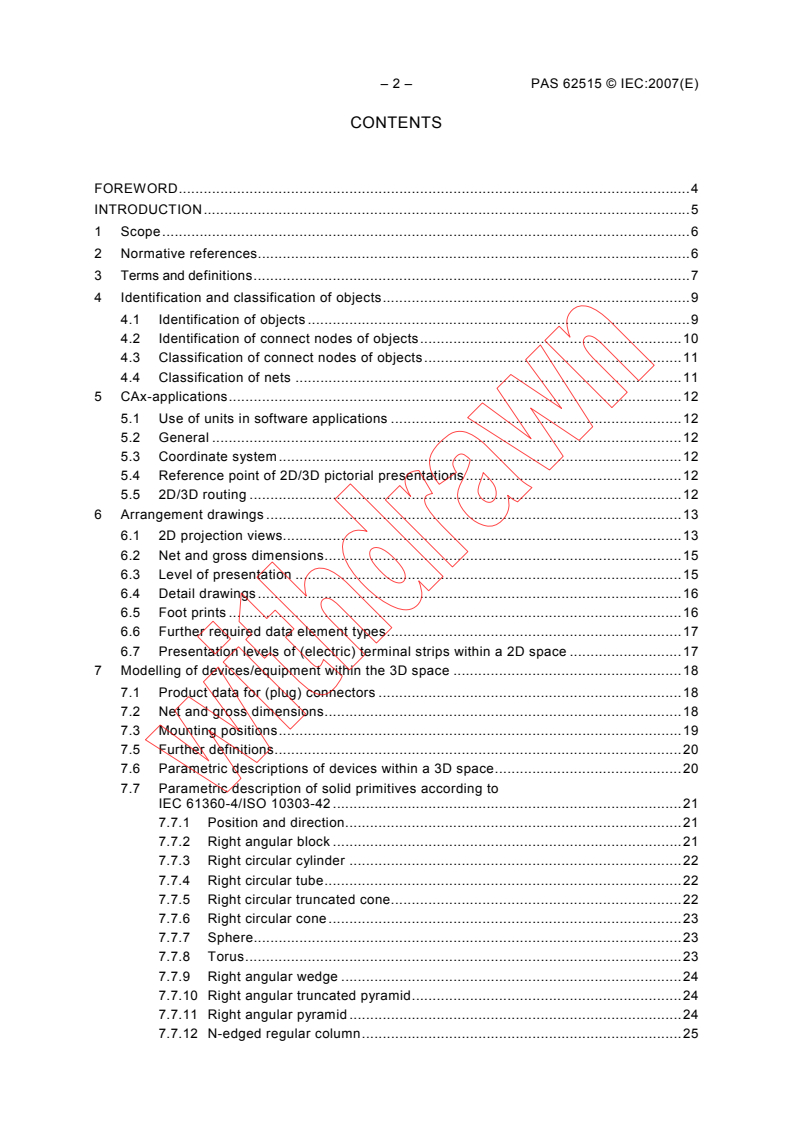
– 2 – PAS 62515 © IEC:2007(E)
CONTENTS
FOREWORD.4
INTRODUCTION.5
1 Scope.6
2 Normative references.6
3 Terms and definitions.7
4 Identification and classification of objects.9
4.1 Identification of objects .9
4.2 Identification of connect nodes of objects.10
4.3 Classification of connect nodes of objects.11
4.4 Classification of nets .11
5 CAx-applications.12
5.1 Use of units in software applications .12
5.2 General .12
5.3 Coordinate system.12
5.4 Reference point of 2D/3D pictorial presentations.12
5.5 2D/3D routing .12
6 Arrangement drawings .13
6.1 2D projection views.13
6.2 Net and gross dimensions.15
6.3 Level of presentation .15
6.4 Detail drawings.16
6.5 Foot prints .16
6.6 Further required data element types.17
6.7 Presentation levels of (electric) terminal strips within a 2D space .17
7 Modelling of devices/equipment within the 3D space .18
7.1 Product data for (plug) connectors .18
7.2 Net and gross dimensions.18
7.3 Mounting positions.19
7.5 Further definitions.20
7.6 Parametric descriptions of devices within a 3D space.20
7.7 Parametric description of solid primitives according to
IEC 61360-4/ISO 10303-42 .21
7.7.1 Position and direction.21
7.7.2 Right angular block .21
7.7.3 Right circular cylinder .22
7.7.4 Right circular tube.22
7.7.5 Right circular truncated cone.22
7.7.6 Right circular cone.23
7.7.7 Sphere.23
7.7.8 Torus.23
7.7.9 Right angular wedge .24
7.7.10 Right angular truncated pyramid.24
7.7.11 Right angular pyramid .24
7.7.12 N-edged regular column.25
PAS 62515 © IEC:2007(E) – 3 –
7.7.13 Half sphere.25
7.7.13 Spherical segment .25
8 General product data .26
8.1 Additional data.27
8.2 General data for conductors and cables .27
8.3 General data per connect node .29
8.4 Thermal data .30
8.5 Environmental data.30
9 Requested functionality of an E-CAD layout system.30
9.1 General .30
9.2 General 3D-requirements.32
Figure 1 – Definition of projection views based on ISO 128 with indication of reference
point .14
Figure 2 – Levels of presentation.16
– 4 – PAS 62515 © IEC:2007(E)
INTERNATIONAL ELECTROTECHNICAL COMMISSION
___________
REQUIREMENTS CONCERNING THE INTEROPERABILITY
BETWEEN ELECTROMECHANICAL AND ELECTRICAL APPLICATIONS
IN CAx-SYSTEMS
FOREWORD
1) The International Electrotechnical Commission (IEC) is a worldwide organization for standardization comprising all
national electrotechnical committees (IEC National Committees). The object of IEC is to promote international co-
operation on all questions concerning standardization in the electrical and electronic fields. To this end and in addi-
tion to other activities, IEC publishes International Standards, Technical Specifications, Technical Reports, Publicly
Available Specifications (PAS) and Guides (hereafter referred to as “IEC Publication(s)”). Their preparation is en-
trusted to technical committees; any IEC National Committee interested in the subject dealt with may participate in
this preparatory work. International, governmental and non-governmental organizations liaising with the IEC also
participate in this preparation. IEC collaborates closely with the International Organization for Standardization (ISO)
in accordance with conditions determined by agreement between the two organizations.
2) The formal decisions or agreements of IEC on technical matters express, as nearly as possible, an international
consensus of opinion on the relevant subjects since each technical committee has representation from all inter-
ested IEC National Committees.
3) IEC Publications have the form of recommendations for international use and are accepted by IEC National Com-
mittees in that sense. While all reasonable efforts are made to ensure that the technical content of IEC Publications
is accurate, IEC cannot be held responsible for the way in which they are used or for any misinterpretation by any
end user.
4) In order to promote international uniformity, IEC National Committees undertake to apply IEC Publications trans-
parently to the maximum extent possible in their national and regional publications. Any divergence between any
IEC Publication and the corresponding national or regional publication shall be clearly indicated in the latter.
5) IEC provides no marking procedure to indicate its approval and cannot be rendered responsible for any equipment
declared to be in conformity with an IEC Publication.
6) All users should ensure that they have the latest edition of this publication.
7) No liability shall attach to IEC or its directors, employees, servants or agents including individual experts and mem-
bers of its technical committees and IEC National Committees for any personal injury, property damage or other
damage of any nature whatsoever, whether direct or indirect, or for costs (including legal fees) and expenses aris-
ing out of the publication, use of, or reliance upon, this IEC Publication or any other IEC Publications.
8) Attention is drawn to the Normative references cited in this publication. Use of the referenced publications is indis-
pensable for the correct application of this publication.
9) Attention is drawn to the possibility that some of the elements of this IEC Publication may be the subject of patent
rights. IEC shall not be held responsible for identifying any or all such patent rights.
A PAS is a technical specification not fulfilling the requirements for a standard but made avail-
able to the public.
IEC-PAS 62515 has been processed by technical committee 3: Information structures, docu-
mentation and graphical symbols.
The text of this PAS is based on the This PAS was approved for publica-
following document: tion by the P-members of the com-
mittee concerned as indicated in the
following document
Draft PAS Report on voting
3/837/NP 3/855/RVN
Following publication of this PAS, which is a pre-standard publication, the technical committee
or subcommittee concerned will transform it into an International Standard.
This PAS shall remain valid for an initial maximum period of three years starting from
2007-09. The validity may be extended for a single three-year period, following which it shall be
revised to become another type of normative document or shall be withdrawn.
PAS 62515 © IEC:2007(E) – 5 –
INTRODUCTION
During the preparation of several international IEC standards, especially ISO/IEC 10303-212,
the question arose as to how to deal with the requirements concerning the physical layout of
cubicles, panels, boards, in which devices of different size and of any product class are used,
defining the requirements for their installation, service and operation.
The existing definitions on the national level as well as the definitions on the international level
do not suffice to supply, process and exchange the data in a computer-sensible form with part-
ners in a process chain. This includes, for example, the installation of devices using robots as
well as the semi- or automatic wiring in cubicles.
At the same time, software suppliers requested the German Electrotechnical Commission
within VDE (DKE) to define related specifications. For this purpose a task-force has been es-
tablished, consisting of members of the following companies.
ABB Calor-Emag Schaltanalagen AG Mannheim
Robert Bosch GmbH Crailsheim and Stuttgart
Klöckner-Moeller GmbH Bonn
L. Schuler GmbH Goeppingen
Siemens AG Erlangen
During the specification period members of the task force established the request to specify a
list of minimum requirements for a software system concerning the needs within electrotechni-
cal applications.
The results of the task force concerning data element types are already widely included within
IEC 61360-4.
– 6 – PAS 62515 © IEC:2007(E)
REQUIREMENTS CONCERNING THE INTEROPERABILITY
BETWEEN ELECTROMECHANICAL AND ELECTRICAL APPLICATIONS
IN CAx-SYSTEMS
1 Scope
This PAS is intended to serve as a checklist and guideline for the evaluation of CAx-software
for applications within the electromechanical field by users in industry.
This PAS provides a set of data element types required in the context of electromechanical
applications, especially in the context of electrical applications and their mechanical represen-
tations in the real or virtual three-dimensional world.
Where possible, existing internationally standardized data element types have been taken from
the existing data element repository as listed in the data base of IEC 61360 available under the
URL http://std.iec.ch/iec61360
Available data element types are indicated by their identity number, followed by its name and
the definition as given in the data base at the time of publication of this document.
The application of standardized data element types supports the automatization of design
processes during the development of products, systems and plants.
2 Normative references
The following referenced documents are indispensable for the application of this document. For
dated references, only the edition cited applies. For undated references, the latest edition of
the referenced document (including any amendments) applies.
IEC 60027 (all parts), Letter symbols to be used in electrical technology
IEC 60715:1981, Dimensions of low-voltage switchgear and controlgear – Standardized mount-
ing on rails for mechanical support of electrical devices in switchgear and controlgear instal-
lations
IEC 61346-1:1996, Industrial systems, installations and equipment and industrial products –
Structuring principles and reference designations – Part 1: Basic rules
IEC 61360-4:DB, Standard data element types with associated classification scheme for elec-
tric components – Part 4: IEC reference collection of standard data element types and compo-
nent classes
IEC 61666:1997, Industrial systems – Installations and equipment and industrial products –
Identification of terminals within a system
IEC 81714-3:2004, Design of graphical symbols for use in the technical documentation of prod-
ucts – Part 3: Classification of connect nodes, networks and their encoding
ISO 31 (all parts), Quantities and units
ISO 128 (all parts), Technical drawings – General principles of presentation
PAS 62515 © IEC:2007(E) – 7 –
ISO 129, Technical drawings – Indication of dimensions and tolerances
ISO 406:1987, Technical drawings – Tolerancing of linear and angular dimensions
ISO 3098 (all parts), Technical product documentation – Lettering
ISO 5455:1979, Technical drawings – Scales
ISO 5457:1999, Technical product documentation – Sizes and layout of drawing sheets
ISO 6428:1982, Technical drawings – Requirements for microcopying
ISO 7200:2004, Technical product documentation – Data fields in title blocks and document
headers
ISO 10303-42:2003, Industrial automation systems and integration – Product data represen-
tation and exchange – Part 42: Integrated generic resource: Geometric and topological rep-
resentation
ISO 10303-212:2001, Industrial automation systems and integration – Product data rep-
resentation and exchange – Part 212: Application protocol: Electrotechnical design and instal-
lation
ISO 10303-214:2003, Industrial automation systems and integration – Product data rep-
resentation and exchange – Part 214: Application protocol: Core data for automotive mechani-
cal design processes
3 Terms and definitions
For the purposes of this document, the following terms and definitions apply.
3.1
object
entity treated in the process of design, engineering, realization, operation, maintenance and
demolition
NOTE 1 The entity may refer to an abstract or physical object or to a set of information associated with it.
NOTE 2 Depending on its purpose, an object may be viewed in different ways, called “aspects”.
[IEC 61346-1, 3.1]
3.2
system
set of interrelated objects
NOTE 1 Examples of a system: a drive system, a water supply system, a stereo system, a computer.
NOTE 2 When a system is a part of another system, it may be considered as an object.
[IEC 61346-1, 3.2]
3.3
aspect
specific way of selecting information on or describing a system or an aspect of a system
– 8 – PAS 62515 © IEC:2007(E)
NOTE Such ways may be:
– what the system is doing (function viewpoint);
– how the system or object is constructed (product viewpoint);
– where the system is located (location viewpoint).
[IEC 61346-1, 3.2]
3.4
function
purpose related to an object
[IEC 61346-1, 3.4]
3.5
product
intended or accomplished result of labour or of a natural or artificial process
NOTE 1 A product usually has a part number, order number, type number, and/or a name.
NOTE 2 A technical system or plant can be considered as a product.
[IEC 61346-1, 3.5]
3.6
structure
organization of relations among objects of a system describing constituency relationships
(”consist of”/”is a part of”)
[IEC 61346-1, 3.6]
3.7
reference designation
identifier of a specific object with respect to the system of which it is a constituent, based on
one or more aspects of that system
[IEC 61360-1, 3.7]
3.8
terminal
point of access to an object intended for connection
NOTE The connection may refer to
a) a physical interface between conductors and/ or contacts to provide a signal or energy path;
b) an association of functional nature established between logical elements, software modules, etc. for conveying
information.
3.9
terminal designation
identifier of a terminal with respect to the object to which it belongs, related to one aspect of
the object
[IEC 61666, 3.8]
3.10
terminal function designation
identifier of a terminal with respect to the function of the object to which it belongs, related to
one aspect of the object
PAS 62515 © IEC:2007(E) – 9 –
3.11
terminal product designation
identifier of a terminal with respect to the product of the object to which it belongs, related to
one aspect of the object
3.12
terminal location designation
identifier of a terminal with respect to the location of the object to which it belongs, related to
one aspect of the object
3.13
terminal strip
assembly of different terminals with a common identification
3.14
connect node
node designed for connection to a specific kind of net, for example, electrical
[IEC 81714-2, DB]
3.15
2D Cartesian coordinate space
type of Cartesian coordinate space that is defined by two mutually perpendicular axis
[ISO 10303-201]
3.16
3D Cartesian coordinate space
type of Cartesian coordinate space that is defined by three mutually perpendicular axis
[ISO 10303-201]
4 Identification and classification of objects
The following requirements concerning the identification of objects within a plant or system are
based on IEC 61346-1.
4.1 Identification of objects
Each object within a context may be identified according to the aspects regarding
– its function-oriented structure; and/or
– its location-oriented structure; and/or
– its product-oriented structure.
At least one of these reference designations is required in order to identify an object unambi-
guously within its context. There may also be cases where all three reference designations are
provided. Each of these reference designations may be unambiguous on its own or all together
may uniquely identify the object.
As all reference aspects via their reference designations are related to the same object, these
have been collected within the reference designation set.
As there is an increasing need for interoperability of data between mechanical and electrical
CAx-systems, the common use of the reference designations is needed in order to identify
– 10 – PAS 62515 © IEC:2007(E)
identical objects in both application environments as identical objects during data exchange or
within a data base.
During the concurrent phases of development of a plant under participation of different disci-
plines several sets of designation and the knowledge of their origin is needed. At the latest if
data are merged together in a single consistent data base the reference designations need to
be unique.
A physical layout, for example, of a constructional unit including the components to be built into
it, can be prepared without knowing the final physical or virtual wiring among the components
based on a wiring list or a circuit diagram or knowledge of the final reference designations of
which the constructional unit is a part.
In these cases, only the parts list exists with the indication of the quantity and identifying posi-
tion numbers.
For these cases, the identifying position number could serve as a special kind of a reference
designation (here the location reference designation), seen from the mechanical or process
discipline views as it collects all items under the location aspect. This results in the request
that an object, for specific periods of time, may be associated with more than one reference
designation set; however, precisely one associated with a discipline dependent on the context.
For safety and economic reasons, however, at the latest for the phases of installation, commis-
sioning and operation of a plant, only a SINGLE consistent reference designation set is rec-
ommended, which needs to be accorded among the participating disciplines.
The following data element types are required to an object.
reference designation set
set of reference designations of which at least one unambiguously identifies the object of inter-
est [IEC 61346-1]
being composed of
– product-oriented reference designation;
– function-oriented reference designation;
– location-oriented reference designation.
NOTE Other members of the set need not necessarily identify the object of interest but other objects of which it is
a constituent.
4.2 Identification of connect nodes of objects
Each object may be associated with zero; one or many connect nodes, i.e. terminals (term
used in electrotechnology), or connections (term used in the non-electrical area), like piping,
etc. which connect it with its surrounding context.
This PAS deals with those classes of connect nodes which connect an object via nets of elec-
trical, optical or any other type to other objects; see IEC 81714-3. A connect node of an object
does not need to be associated with a graphical representation.
Each connect node may, as the object itself, be identified according to the aspects regarding
– its function-oriented structure; and/or
– its location-oriented structure; and/or
– its product-oriented structure.
PAS 62515 © IEC:2007(E) – 11 –
At least one of these reference designations is required in order to identify an object unambi-
guously within its context. There may also be cases where all three reference designations are
provided. Each of these reference designations may be unambiguous on its own or all together
may uniquely identify the object.
As all reference aspects via their reference designations may occur related to the same object,
these have been collected within the terminal designation set.
As interoperability of data between mechanical and electrical CAx-systems is required, the
common use of the terminal designations is needed in order to identify identical objects in both
application environments as identical objects during data exchange or within a data base.
The following data element types are required to each connect node.
terminal designation set
set of terminal designations each identifying the same terminal from different aspect of the
object [IEC 61666]
being composed of
– product terminal designation
alphanumerical characters used to identify uniquely a specific terminal to a net of a product
assembly [IEC 61666]
– function terminal designation
alphanumerical characters used to identify uniquely a specific function to a net of a function
assembly [IEC 61666]
– location terminal designation
alphanumerical characters used to identify uniquely a specific location to a net of a location
assembly [IEC 61666]
4.3 Classification of connect nodes of objects
As in the majority of cases available products have more than only electrical connect nodes,
and also connect nodes of other classes, it is required that a connect node be associated with
a classification of its type. This is covered by the data element type AAF391 connect node
code.
It is possible to connect only connect nodes of the same class.
The following data element types are applicable.
AAF391
connect-node code
code of the type of connect node of a component
NOTE For full information, see IEC 81714-3.
4.4 Classification of nets
The net connecting the participating connect nodes needs to be the appropriate one and shall
correspond to the same class as that to which the connect nodes belong.
The classification of connect nodes and nets allows the integral management of all connect
nodes of components and of nets. This is of high importance for the interoperability between
mechanical and electrotechnical CAx-systems.
– 12 – PAS 62515 © IEC:2007(E)
The following data element types are applicable.
coded net class
code of the type of a network
NOTE For full information, see IEC 81714-3.
5 CAx-applications
This clause specifies general issues which need to be taken into account.
5.1 Use of units in software applications
With respect to the data element types listed here, respectively referring the IEC data diction-
ary IEC 61360-4, all quantitative data elements are shown with its basic SI-units (for example,
m, kg, s) according to ISO 31 or IEC 60027, without any decimal prefix sign.
In a software tool, a variety of decimal prefix signs may be needed according to the habits of
the user or the industrial environment. Therefore, it is advised that the software allows the user
to adapt the presentation of a quantitative data element type with any of those prefix signs as
listed in ISO 31 or IEC 27 respectively according to his needs, although the system is storing
the value in the basic SI-unit.
5.2 General
The application of the following International Standards is considered as a prerequisite:
ISO 128, ISO 129, ISO 406, ISO 3098, ISO 5455, ISO 5457, ISO 6428, and ISO 7200.
5.3 Coordinate system
Pictorial presentations for layout purposes are laid down in the normal projection method within
a 2D Cartesian coordinate space.
When presenting a 2D pictorial presentation on a drawing page, the local reference point over-
writes those data of the local coordinate system. of the pictorial presentation.
As the origin of the coordinate system of a drawing (landscape, portrait), the left lower corner
of the cut sheet is defined (see ISO 5457).
5.4 Reference point of 2D/3D pictorial presentations
The origin of the 2D Cartesian model space is defined as the reference point for a pictorial
presentation for layout purposes in a 2D space (see Figure 1). This reference point remains
unchanged for all projection views of an object.
The same reference point is applied also within the 3D Cartesian model space.
5.5 2D/3D routing
In order to allow a computer-supported routing of connections within a CAx-system, each con-
nect node needs to be associated to the appropriate class.
As a consequence, for example within a 2D/3D geometry modeller, it is required that the posi-
tion of a connect node be associated with specific data, for example, connect node class and
connecting direction. When the logical data from a net list, produced by an electric CAx-
system, are combined with the data of the geometry modeller, a routing process of the net may
start. This applies for each type of net.
PAS 62515 © IEC:2007(E) – 13 –
The connecting directions assigned to a connect node are either defined as sectors within the
2D-space or by a vector within a 3D-space.
The connection information – which connect node is connected to others – is defined when
specifying the connectivity, for example, within a circuit diagram. When assigning a component
to this functional connection during the routing process, the connection may carry the cross-
section, colour and bending radius, etc. of the specified component type.This information can
be used when defining the layout of components installed for example within a constructional
unit.
The routing result is either an open polyline in the 2D or in the 3D space, defining the geomet-
rical route of each connection between two connect nodes as a sequence of 2D points (or 3D
points) within a 2D space (or 3D space). During the routing process, the relevant data element
types such as AAF352 terminal to contact angle specifying the direction how a conductor may
access the connect node, criticality providing a weighting factor for routing, AAF470 bending
radius, AAE022 outside diameter of the cable etc. need to be taken into account.
The data element type AAF391 connect node code is required for those cases when different
product classes have been assigned or will be assigned to a product, for example, an electric
driven pneumatic valve having electrical and pneumatic connect nodes, or a hydraulic brake
controller in a car with electrical and hydraulic connect nodes. If no value has been assigned
to the data element connect node code, the value E is assumed representing an electrical con-
nect node.
The classification supports an overall look at the occurring connect node classes for the instal-
lation within a constructional unit. The information of the connect node class allows also a se-
lective presentation and management of different classes of nets in analogy with the connect
node classes at components.
NOTE The routing of connections within this context may be different from the routing on printed circuit boards.
6 Arrangement drawings
In order to prepare arrangement drawings, the possibilities applied in industry for dimensioning,
such as, for example, chain dimensioning, based on the scale associated with the presentation
of the object, need to be available in the CAx system (see ISO 5455).
6.1 2D projection views
This clause establishes the data requirements for the presentation of components in a 2D
space in constructional units, for example, in a cubicle.
Within a lot of industrial electrotechnical applications the presentation in a 2D space is suffi-
cient. In other cases, where, for example, for quality reasons, collision or other installation in-
vestigations are needed, it is recommended that a model in a 3D-space be applied.
In this context the views in the 2D space correspond to the projection views established in ac-
cordance with ISO 128. See Figure 1.
The reference point is defined as the three-dimensional point to which the geometric figures of
a component/device are related.
– 14 – PAS 62515 © IEC:2007(E)
Figure 1 – Definition of projection views based on ISO 128 with indication
of reference point
It is a convention that the view from the front of a body always be established as the x/y-space
of a 3D space.
As each projection view is associated with a given product, or product class, respectively, it
reflects within a 2D space (eventually calculated by a scale factor) the real dimensions of the
considered body.
All projection views including details may be associated with several product types. This leads
to a reduction of storage capacity within a library.
The following data element types are applicable.
AAF392
project view code
coded abbreviation of the two-dimensional projection view of an item
AAF396
scale
the value of the denominator of the real things magnitude of the magnitude of the model
PAS 62515 © IEC:2007(E) – 15 –
6.2 Net and gross dimensions
For each projection view of a component there is a need to differentiate among different levels
of presentation; those pictorial presentations serving for the presentation of the net dimensions
and those of the gross dimensions.
Pictorial presentations based on the net values represent the real dimensions of the physical
body, reduced or enlarged by a scale factor.
Pictorial presentations based on the gross values represent the dimensions covering the addi-
tional space required for
– the wiring/connection of the terminals;
– the blasting space for switching devices;
– the space required for the installation, operation, service and decommissioning of the de-
vice;
– the minimum distances to neighbouring objects caused by heating dissipation of the object.
The simplified presentation level for the gross (net) dimensions of a device corresponds to the
common enclosing envelope of all gross (net) dimensions.
This is applicable also to presentations in a 3D space.
The following data element types are applicable.
AAF397
net area
value of the area (in m ) of a two-dimensional plane defining the effective physical contour of a
geometrical object
AAF398
gross area
value of the area (in m ) of a two-dimensional plane associated with a geometrical object due
to installation, protection, operation, service and maintenance reasons
AAF399
net space
value of the volume (in m ) of a three-dimensional space defining the effective physical con-
tours of a geometrical object
AAF400
gross space
value of the volume (in m ) of a three-dimensional space associated with a geometrical object
due to installation, protection, operation, service and maintenance reasons
REMARKS
1 The gross space encloses completely the net space of the geometrical object.
2 The gross space is normally not possible to be occupied by other geometrical objects.
6.3 Level of presentation
In order to keep investments low for the preparation of the geometry model, reduce storage
capacity and shorten reaction time of a system, each projection view may be presented either
in a simplified or detailed level of presentation. The simplified presentation is limited generally
to the presentation of a graphical primitive, such as rectangle, circle, whereas the detailed level
of presentation depicts the complete body contours in the projection view. See Figure 2.
– 16 – PAS 62515 © IEC:2007(E)
Figure 2 – Levels of presentation
When applying the simplified level of presentation, the data element types of the relevant solid
model need to be supplied together with the data element type AAF396 scale along with the
front view.
With these data, the receiving system may generate the missing projection views automatically
or generate a simple 3D geometry model reduced or enlarged by the associated scale value.
6.4 Detail drawings
A projection view (see data element type AAF392, project view code), independent of its level
of presentation may be associated with a list of zero, one or many detail drawings, each of
which may be associated with a separate scale value. It is recommended, however, always to
apply the same scale value for these drawings.
6.5 Foot prints
Foot prints serve for the presentation of installation requirements of devices or component
types. By positioning of a constructional unit at a defined physical location, the fixing points and
the mounting features are known, for example, via screws, rivets, C-profiles, and may therefore
be transferred to an NC system for the manufacturing of the supporting metal sheet.
Information about predefined foot prints with associated patterns can be found in the IEC com-
ponents data base under the class tree: geometry/package outline
In the case of the arrangement of a cubicle on a wall or floor or any other constructional item in
a building, the mounting figures show in graphical form data for through-holes or excavations
on the floor level. These requirements may, therefore, be referenced by a civil engineer for use
in a CAx system for structural engineering and underground and surface level construction.
PAS 62515 © IEC:2007(E) – 17 –
mounting figure; foot print
Depending on the mounting feature, a device may be associated with one or more figures indi-
cating the mounting requirements designed to fasten a device to its seating plane.
Example 1
Figure showing the drilling holes needed, its dimensions and further information concerning, for
example, the use of NC-tools for the manufacturing of the base plane the device is planned to
be mounted upon.
Example 2
Figure showing the cut-out of a front plane of a control panel needed for the mounting of a me-
tering instrument.
Example 3:
Figure showing the cut-outs in the basement intended for the cabling from and to a cubicle.
The requirements with respect to the data transfer for example for the NC manufacturing of
mounting plates, supporting metal sheet, or the transfer of data to structural engineering and
underground and surface level construction are not part of this report.
6.6 Further required data element types
As the data base of IEC 61360-4 is a resource of data element types associated with products,
not all data element types listed here will be made available in the data base.
AAG001
distance of seating plane
distance between the surface plane (in m) on which the component/device is mounted in rela-
tion to the reference plane of the constructional unit it is built in or on
keep-out-area
two-dimensional closed plane intended for future installation of components/devices
keep-out-space
three-dimensional closed space intended for future installation of components/devices
routing area
two-dimensional area exclusively reserved for the physical routing of cables and wires
NOTE This virtual area is defined independently of the physical existence of, for example, cable trays. Such items
may be placed within such areas but not exceed them. However, an item, for example, a cable duct, or tray may
also be defined as a routing area.
routing space
three-dimensional space exclusively reserved for the physical routing of cables and wires
NOTE This virtual space is defined independently of the physical existence of, for example, cable trays. Such
items may be placed within such spaces but not exceed them. However, an item, for example, a cable duct, or tray
may also be defined as a routing space.
6.7 Presentation levels of (electric) terminal strips within a 2D space
For economic reasons, two presentation levels have been defined.
– detailed
Each terminal type being a constituent of the terminal strip is associated with a separate
geometry.
– simplified
The simplified presentation in the 2D-space is done by a simple rectangular or as a right
angular block in the 3D-space.
– 18 – PAS 62515 © IEC:2007(E)
Based on the view from the front, the total net length (along the x-axis) of the terminal strip is
calculated from the widths of each of the terminal types composing the terminal strip. The total
height (along the y-axis) of the terminal strip is taken as the maximum height of all terminal
types composing the strip. The maximum depth (along the z-axis) of the terminal strip is taken
as the maximum depth of all terminal types composing the strip.
These data may be generated by the CAx-system.
In any case the terminal strip is being considered as an assembly of components, of which the
single terminals follow each other in a specified sequence (list of).
NOTE If there is the need to allocate separate terminal strips for example on a single C-bar, and it is desired that
all terminal strips on that bar be handled as a unit, then it is recommended that a separate reference designation be
assigned to each terminal strip. This allows the establishment of a hierarchical assembly structure providing the
possibility to identify the assembly, each of the terminal strips within the assembly and each terminal within each
terminal strip: for example -X1X2X30A, where -X1 is the assembly of terminal strips on the C-bar, -X2 one of the
many terminal strips within -X1, -X30 a terminal within -X2, and A one of the physically available connect nodes of
the terminal -X2. This example assumes that a terminal has at least two connect nodes.
A terminal respective terminal strip may be provided by the supplier with several fixing possi-
bilities, see AAE006 mounting features; however, only one possibility can be applied.
7 Modelling of devices/equipment within the 3D space
Thi
...