

IEC 62150-3:2015
(Main)Fibre optic active components and devices - Test and measurement procedures - Part 3: Optical power variation induced by mechanical disturbance in optical receptacles and transceiver interfaces
General Information
- Abstract
IEC 62150-3:2015 It has been found that some optical transceivers and receptacles are susceptible to fibre optic cable induced stress when side forces are applied to the mated cable-connector assembly, resulting in variations in the transmitted optical power. The purpose of this part of IEC 62150 is to define physical stress tests to ensure that such optical connections (cable and receptacle) can continue to function within specifications. This standard specifies the test requirements and procedures for qualifying optical devices for sensitivity to coupled power variations induced by mechanical disturbance at the optical ports of the device. This standard applies to active devices with optical receptacle interfaces. This standard describes the testing of transceivers for use with single-mode connectors having either 2,5 mm or 1,25 mm ferrules. This second edition cancels and replaces the first edition published in 2012 and constitutes a technical revision. This edition includes the following significant technical changes with respect to the previous edition:
- extension of application field to SC connector interface transceivers in addition to LC connector interface transceivers specified in the first edition as both transceiver interfaces are very important in the industry;
- addition of a new Annex E dealing with load value difference for connector type in Method A.
Keywords: fibre optic cable induced stress, power variations induced by mechanical disturbance
- Status
- Published
- Publication Date
- 06-May-2015
- Technical Committee
- SC 86C - Fibre optic systems, sensing and active devices
- Current Stage
- PPUB - Publication issued
- Start Date
- 07-May-2015
- Completion Date
- 15-Jun-2015
Buy Documents
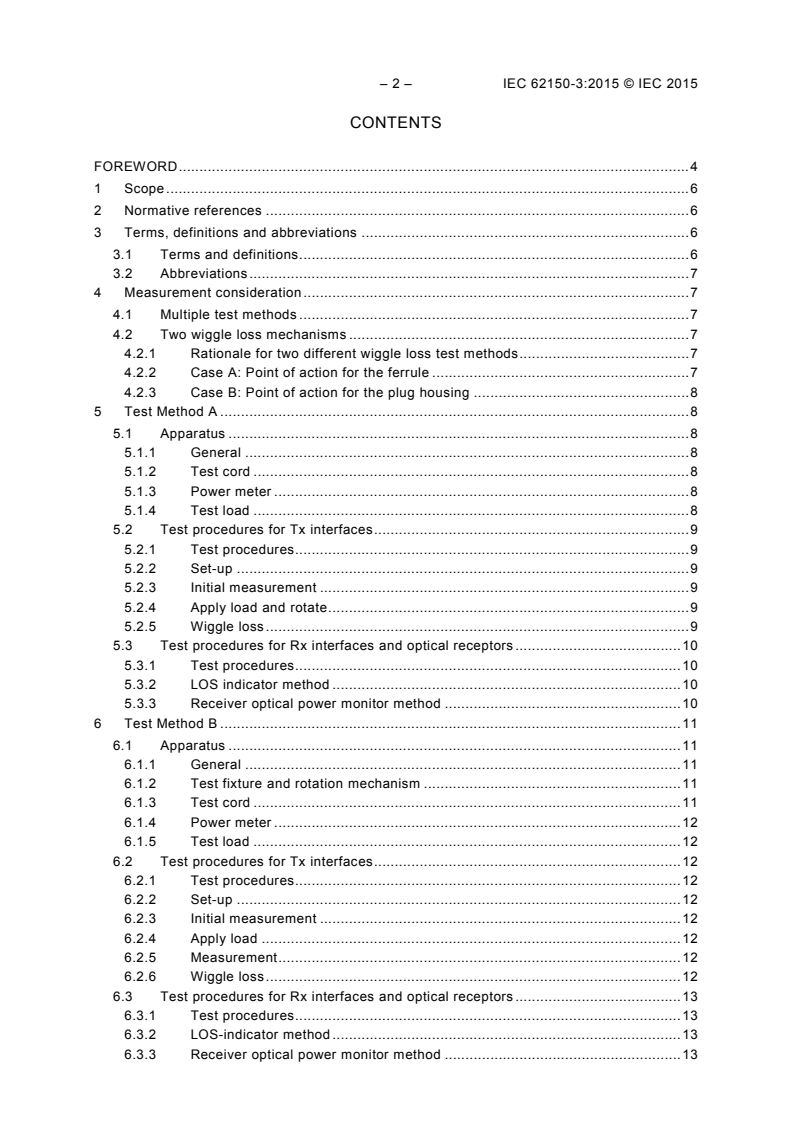
IEC 62150-3:2015 - Fibre optic active components and devices - Test and measurement procedures - Part 3: Optical power variation induced by mechanical disturbance in optical receptacles and transceiver interfaces
IEC 62150-3:2015 - Fibre optic active components and devices - Test and measurement procedures - Part 3: Optical power variation induced by mechanical disturbance in optical receptacles and transceiver interfaces Released:5/7/2015
Overview
IEC 62150-3:2015 - Fibre optic active components and devices - Test and measurement procedures - Part 3 - specifies test procedures to assess optical power variation induced by mechanical disturbance in optical receptacles and transceiver interfaces. The standard addresses issues where fibre optic cable induced stress (side forces on a mated cable-connector assembly) causes variations in transmitted optical power. It applies to active devices with optical receptacle interfaces, and specifically covers single‑mode transceivers using 2.5 mm and 1.25 mm ferrule connectors (SC and LC interfaces).
Key Topics
- Purpose: Define repeatable physical stress tests to qualify devices for sensitivity to power variations caused by mechanical disturbance at optical ports.
- Test scope: Active transceivers and receptacles with single‑mode connector interfaces (LC and SC).
- Two wiggle-loss mechanisms: The standard distinguishes two failure/measurement cases (point of action on ferrule vs. on plug housing) and provides rationale for using multiple test methods.
- Test methods: Method A and Method B are described with apparatus and procedures for transmit (Tx) and receive (Rx) interfaces. Equipment elements include a wiggle test cord, power meter or receiver optical power monitor, test loads, and rotation/force application mechanisms.
- Normative annexes: Include load requirements, summary of test conditions, test cord characteristics, floating tolerance, and an informative annex on load value differences for connector types (Annex E).
Applications
- Product qualification: Manufacturers of optical transceivers, receptacles and line cards use IEC 62150-3 to validate that devices maintain specified optical performance under cable‑induced mechanical stress.
- Test laboratories: Environmental and optical test labs implement the described procedures (Methods A/B) to provide compliance and performance reports.
- Design and quality engineering: Hardware designers and QA engineers use the standard to identify mechanical‑optical sensitivity early in development and to set manufacturing acceptance criteria.
- System integrators & OEMs: Ensure selected transceivers and receptacles will remain within link budgets in real‑world cabling conditions where side loads occur.
Practical value
- Ensures repeatable, industry‑accepted methods for measuring power variations induced by mechanical disturbance, reducing field failures and intermittent link degradation.
- Helps correlate mechanical interface design choices (connector/plug geometry, receptacle retention) with optical stability under stress.
- Provides prescriptive setup items (test cord, load, measurement points) so results are comparable across suppliers and labs.
Related standards
- IEC 62150 series - other parts in the fibre optic active components and devices test series.
- IEC 61753 (all parts) - referenced normative standard for fibre optic interconnecting devices and passive components.
Keywords: fibre optic cable induced stress, power variations induced by mechanical disturbance, IEC 62150-3, wiggle loss, optical receptacle testing.
Relations
- Effective Date
- 05-Sep-2023
Buy Documents
IEC 62150-3:2015 - Fibre optic active components and devices - Test and measurement procedures - Part 3: Optical power variation induced by mechanical disturbance in optical receptacles and transceiver interfaces
IEC 62150-3:2015 - Fibre optic active components and devices - Test and measurement procedures - Part 3: Optical power variation induced by mechanical disturbance in optical receptacles and transceiver interfaces Released:5/7/2015
Get Certified
Connect with accredited certification bodies for this standard

TÜV Rheinland
TÜV Rheinland is a leading international provider of technical services.

TÜV SÜD
TÜV SÜD is a trusted partner of choice for safety, security and sustainability solutions.

DEKRA Certification Inc.
DEKRA US certification services.
Sponsored listings
Frequently Asked Questions
IEC 62150-3:2015 is a standard published by the International Electrotechnical Commission (IEC). Its full title is "Fibre optic active components and devices - Test and measurement procedures - Part 3: Optical power variation induced by mechanical disturbance in optical receptacles and transceiver interfaces". This standard covers: IEC 62150-3:2015 It has been found that some optical transceivers and receptacles are susceptible to fibre optic cable induced stress when side forces are applied to the mated cable-connector assembly, resulting in variations in the transmitted optical power. The purpose of this part of IEC 62150 is to define physical stress tests to ensure that such optical connections (cable and receptacle) can continue to function within specifications. This standard specifies the test requirements and procedures for qualifying optical devices for sensitivity to coupled power variations induced by mechanical disturbance at the optical ports of the device. This standard applies to active devices with optical receptacle interfaces. This standard describes the testing of transceivers for use with single-mode connectors having either 2,5 mm or 1,25 mm ferrules. This second edition cancels and replaces the first edition published in 2012 and constitutes a technical revision. This edition includes the following significant technical changes with respect to the previous edition: - extension of application field to SC connector interface transceivers in addition to LC connector interface transceivers specified in the first edition as both transceiver interfaces are very important in the industry; - addition of a new Annex E dealing with load value difference for connector type in Method A. Keywords: fibre optic cable induced stress, power variations induced by mechanical disturbance
IEC 62150-3:2015 It has been found that some optical transceivers and receptacles are susceptible to fibre optic cable induced stress when side forces are applied to the mated cable-connector assembly, resulting in variations in the transmitted optical power. The purpose of this part of IEC 62150 is to define physical stress tests to ensure that such optical connections (cable and receptacle) can continue to function within specifications. This standard specifies the test requirements and procedures for qualifying optical devices for sensitivity to coupled power variations induced by mechanical disturbance at the optical ports of the device. This standard applies to active devices with optical receptacle interfaces. This standard describes the testing of transceivers for use with single-mode connectors having either 2,5 mm or 1,25 mm ferrules. This second edition cancels and replaces the first edition published in 2012 and constitutes a technical revision. This edition includes the following significant technical changes with respect to the previous edition: - extension of application field to SC connector interface transceivers in addition to LC connector interface transceivers specified in the first edition as both transceiver interfaces are very important in the industry; - addition of a new Annex E dealing with load value difference for connector type in Method A. Keywords: fibre optic cable induced stress, power variations induced by mechanical disturbance
IEC 62150-3:2015 is classified under the following ICS (International Classification for Standards) categories: 29.140.20 - Incandescent lamps; 33.180.20 - Fibre optic interconnecting devices; 43.040.20 - Lighting, signalling and warning devices. The ICS classification helps identify the subject area and facilitates finding related standards.
IEC 62150-3:2015 has the following relationships with other standards: It is inter standard links to IEC 62150-3:2012. Understanding these relationships helps ensure you are using the most current and applicable version of the standard.
IEC 62150-3:2015 is available in PDF format for immediate download after purchase. The document can be added to your cart and obtained through the secure checkout process. Digital delivery ensures instant access to the complete standard document.
Standards Content (Sample)
IEC 62150-3 ®
Edition 2.0 2015-05
INTERNATIONAL
STANDARD
colour
inside
Fibre optic active components and devices – Test and measurement
procedures –
Part 3: Optical power variation induced by mechanical disturbance
in optical receptacles and transceiver interfaces
All rights reserved. Unless otherwise specified, no part of this publication may be reproduced or utilized in any form
or by any means, electronic or mechanical, including photocopying and microfilm, without permission in writing from
either IEC or IEC's member National Committee in the country of the requester. If you have any questions about IEC
copyright or have an enquiry about obtaining additional rights to this publication, please contact the address below or
your local IEC member National Committee for further information.
IEC Central Office Tel.: +41 22 919 02 11
3, rue de Varembé Fax: +41 22 919 03 00
CH-1211 Geneva 20 info@iec.ch
Switzerland www.iec.ch
About the IEC
The International Electrotechnical Commission (IEC) is the leading global organization that prepares and publishes
International Standards for all electrical, electronic and related technologies.
About IEC publications
The technical content of IEC publications is kept under constant review by the IEC. Please make sure that you have the
latest edition, a corrigenda or an amendment might have been published.
IEC Catalogue - webstore.iec.ch/catalogue Electropedia - www.electropedia.org
The stand-alone application for consulting the entire The world's leading online dictionary of electronic and
bibliographical information on IEC International Standards, electrical terms containing more than 30 000 terms and
Technical Specifications, Technical Reports and other definitions in English and French, with equivalent terms in 15
documents. Available for PC, Mac OS, Android Tablets and additional languages. Also known as the International
iPad. Electrotechnical Vocabulary (IEV) online.
IEC publications search - www.iec.ch/searchpub IEC Glossary - std.iec.ch/glossary
The advanced search enables to find IEC publications by a More than 60 000 electrotechnical terminology entries in
variety of criteria (reference number, text, technical English and French extracted from the Terms and Definitions
committee,…). It also gives information on projects, replaced clause of IEC publications issued since 2002. Some entries
and withdrawn publications. have been collected from earlier publications of IEC TC 37,
77, 86 and CISPR.
IEC Just Published - webstore.iec.ch/justpublished
Stay up to date on all new IEC publications. Just Published IEC Customer Service Centre - webstore.iec.ch/csc
details all new publications released. Available online and If you wish to give us your feedback on this publication or
also once a month by email. need further assistance, please contact the Customer Service
Centre: csc@iec.ch.
IEC 62150-3 ®
Edition 2.0 2015-05
INTERNATIONAL
STANDARD
colour
inside
Fibre optic active components and devices – Test and measurement
procedures –
Part 3: Optical power variation induced by mechanical disturbance
in optical receptacles and transceiver interfaces
INTERNATIONAL
ELECTROTECHNICAL
COMMISSION
ICS 33.180.20 ISBN 978-2-8322-2670-4
– 2 – IEC 62150-3:2015 © IEC 2015
CONTENTS
FOREWORD . 4
1 Scope . 6
2 Normative references . 6
3 Terms, definitions and abbreviations . 6
3.1 Terms and definitions . 6
3.2 Abbreviations . 7
4 Measurement consideration . 7
4.1 Multiple test methods . 7
4.2 Two wiggle loss mechanisms . 7
4.2.1 Rationale for two different wiggle loss test methods . 7
4.2.2 Case A: Point of action for the ferrule . 7
4.2.3 Case B: Point of action for the plug housing . 8
5 Test Method A . 8
5.1 Apparatus . 8
5.1.1 General . 8
5.1.2 Test cord . 8
5.1.3 Power meter . 8
5.1.4 Test load . 8
Test procedures for Tx interfaces . 9
5.2
5.2.1 Test procedures . 9
5.2.2 Set-up . 9
5.2.3 Initial measurement . 9
5.2.4 Apply load and rotate . 9
5.2.5 Wiggle loss . 9
Test procedures for Rx interfaces and optical receptors . 10
5.3
5.3.1 Test procedures . 10
5.3.2 LOS indicator method . 10
5.3.3 Receiver optical power monitor method . 10
6 Test Method B . 11
6.1 Apparatus . 11
6.1.1 General . 11
6.1.2 Test fixture and rotation mechanism . 11
6.1.3 Test cord . 11
6.1.4 Power meter . 12
6.1.5 Test load . 12
6.2 Test procedures for Tx interfaces . 12
6.2.1 Test procedures . 12
6.2.2 Set-up . 12
6.2.3 Initial measurement . 12
6.2.4 Apply load . 12
6.2.5 Measurement . 12
6.2.6 Wiggle loss . 12
6.3 Test procedures for Rx interfaces and optical receptors . 13
6.3.1 Test procedures . 13
6.3.2 LOS-indicator method . 13
6.3.3 Receiver optical power monitor method . 13
7 Test results . 14
Annex A (normative) Load requirements . 15
A.1 Loads for Method A . 15
A.2 Loads for Method B . 15
Annex B (normative) Summary of test conditions . 16
Annex C (normative) Characteristics of the test cord . 17
Annex D (normative) Floating tolerance . 20
Annex E (informative) Load value difference for connector type in Method A . 21
Bibliography . 22
Figure 1 – Equipment setup of Method A for Tx interfaces . 10
Figure 2 – Equipment set-up of Method A for Rx interfaces and optical receptors . 11
Figure 3 – Equipment set-up of Method B for Tx interfaces . 13
Figure 4 – Equipment set-up of Method B for Rx interface and optical receptors . 14
Figure C.1 – Wiggle test cord interface (LC connector) . 17
Figure C.2 – Wiggle test cord interface (SC connector) . 18
Figure D.1 – Floating tolerance . 20
Figure E.1 – Floating tolerance . 21
Table 1 – Multiple test methods . 7
Table A.1 – Method A: Loads applied for devices using connector cords with 1,25 mm
ferrule and 2,5 mm ferrule . 15
Table A.2 – Method B: Loads applied for devices using connector cords with 1,25 mm
ferrule and 2,5 mm ferrule . 15
Table B.1 – Summary of test conditions for Method A (normative) . 16
Table B.2 – Summary of test conditions for Method B (normative) . 16
Table C.1 – Wiggle test cord specification (LC connector) . 17
Table C.2 – Dimensions of the wiggle test cord interface . 18
Table C.3 – Wiggle test cord specification (SC connector) . 18
Table C.4 – Dimensions of the wiggle test cord interface . 19
– 4 – IEC 62150-3:2015 © IEC 2015
INTERNATIONAL ELECTROTECHNICAL COMMISSION
____________
FIBRE OPTIC ACTIVE COMPONENTS AND DEVICES –
TEST AND MEASUREMENT PROCEDURES –
Part 3: Optical power variation induced by mechanical
disturbance in optical receptacles and transceiver interfaces
FOREWORD
1) The International Electrotechnical Commission (IEC) is a worldwide organization for standardization comprising
all national electrotechnical committees (IEC National Committees). The object of IEC is to promote
international co-operation on all questions concerning standardization in the electrical and electronic fields. To
this end and in addition to other activities, IEC publishes International Standards, Technical Specifications,
Technical Reports, Publicly Available Specifications (PAS) and Guides (hereafter referred to as “IEC
Publication(s)”). Their preparation is entrusted to technical committees; any IEC National Committee interested
in the subject dealt with may participate in this preparatory work. International, governmental and non-
governmental organizations liaising with the IEC also participate in this preparation. IEC collaborates closely
with the International Organization for Standardization (ISO) in accordance with conditions determined by
agreement between the two organizations.
2) The formal decisions or agreements of IEC on technical matters express, as nearly as possible, an international
consensus of opinion on the relevant subjects since each technical committee has representation from all
interested IEC National Committees.
3) IEC Publications have the form of recommendations for international use and are accepted by IEC National
Committees in that sense. While all reasonable efforts are made to ensure that the technical content of IEC
Publications is accurate, IEC cannot be held responsible for the way in which they are used or for any
misinterpretation by any end user.
4) In order to promote international uniformity, IEC National Committees undertake to apply IEC Publications
transparently to the maximum extent possible in their national and regional publications. Any divergence
between any IEC Publication and the corresponding national or regional publication shall be clearly indicated in
the latter.
5) IEC itself does not provide any attestation of conformity. Independent certification bodies provide conformity
assessment services and, in some areas, access to IEC marks of conformity. IEC is not responsible for any
services carried out by independent certification bodies.
6) All users should ensure that they have the latest edition of this publication.
7) No liability shall attach to IEC or its directors, employees, servants or agents including individual experts and
members of its technical committees and IEC National Committees for any personal injury, property damage or
other damage of any nature whatsoever, whether direct or indirect, or for costs (including legal fees) and
expenses arising out of the publication, use of, or reliance upon, this IEC Publication or any other IEC
Publications.
8) Attention is drawn to the Normative references cited in this publication. Use of the referenced publications is
indispensable for the correct application of this publication.
9) Attention is drawn to the possibility that some of the elements of this IEC Publication may be the subject of
patent rights. IEC shall not be held responsible for identifying any or all such patent rights.
International Standard IEC 62150-3 has been prepared by subcommittee 86C: Fibre optic
systems and active devices, of IEC technical committee 86: Fibre optics.
This second edition cancels and replaces the first edition published in 2012 and constitutes a
technical revision.
This edition includes the following significant technical changes with respect to the previous
edition:
– extension of application field to SC connector interface transceivers in addition to LC
connector interface transceivers specified in the first edition as both transceiver interfaces
are very important in the industry;
– addition of a new Annex E dealing with load value difference for connector type in
Method A.
The text of this standard is based on the following documents:
FDIS Report on voting
86C/1311/FDIS 86C/1330/RVD
Full information on the voting for the approval of this standard can be found in the report on
voting indicated in the above table.
This publication has been drafted in accordance with the ISO/IEC Directives, Part 2.
A list of all parts in the IEC 62150 series, published under the general title Fibre optic active
components and devices – Test and measurement procedures, can be found on the IEC
website.
The committee has decided that the contents of this publication will remain unchanged until
the stability date indicated on the IEC web site under "http://webstore.iec.ch" in the data
related to the specific publication. At this date, the publication will be
• reconfirmed,
• withdrawn,
• replaced by a revised edition, or
• amended.
A bilingual version of this publication may be issued at a later date.
IMPORTANT – The 'colour inside' logo on the cover page of this publication indicates
that it contains colours which are considered to be useful for the correct
understanding of its contents. Users should therefore print this document using a
colour printer.
– 6 – IEC 62150-3:2015 © IEC 2015
FIBRE OPTIC ACTIVE COMPONENTS AND DEVICES –
TEST AND MEASUREMENT PROCEDURES –
Part 3: Optical power variation induced by mechanical
disturbance in optical receptacles and transceiver interfaces
1 Scope
It has been found that some optical transceivers and receptacles are susceptible to fibre optic
cable induced stress when side forces are applied to the mated cable-connector assembly,
resulting in variations in the transmitted optical power. The purpose of this part of IEC 62150
is to define physical stress tests to ensure that such optical connections (cable and receptacle)
can continue to function within specifications.
This standard specifies the test requirements and procedures for qualifying optical devices for
sensitivity to coupled power variations induced by mechanical disturbance at the optical ports
of the device.
This standard applies to active devices with optical receptacle interfaces.
This standard describes the testing of transceivers for use with single-mode connectors
having either 2,5 mm or 1,25 mm ferrules.
2 Normative references
The following documents, in whole or in part, are normatively referenced in this document and
are indispensable for its application. For dated references, only the edition cited applies. For
undated references, the latest edition of the referenced document (including any
amendments) applies.
IEC 61753 (all parts), Fibre optic interconnecting devices and passive components
performance standard
IEC 61753-021-6, Fibre optic interconnecting devices and passive components performance
standard – Part 021-6: Grade B/2 single-mode fibre optic connectors for category O –
Uncontrolled environment
IEC 61754 (all parts), Fibre optic interconnecting devices and passive components – Fibre
optic connector interfaces
3 Terms, definitions and abbreviations
3.1 Terms and definitions
For the purposes of this document, the following terms and definitions apply.
3.1.1
wiggle
mechanical disturbances that induce coupled optical power variation in the optical receptacle
and transceiver interface
3.1.2
wiggle loss
variation in coupled output power (with respect to a no-load, non-rotated measurement)
induced in an optical module or receptacle when the mated connector is laterally stressed
3.2 Abbreviations
DUT device under test
LOS loss of signal
Rx receiver
Tx transmitter
4 Measurement consideration
4.1 Multiple test methods
Since the wiggle loss mechanisms are categorized into two different cases, Case A and B,
this standard defines two measurement methods, Method A and B, as shown in Table 1.
Method A and B are applicable to the tests for the mechanical endurance of transceivers
under wiggle Case A and B, respectively.
Table 1 – Multiple test methods
Test Applicable to Example of parameters to be included
methods
Method A Wiggle Case A: test for optical transceivers use Test procedure, test fixture, test jumper, test
with patchcord terminated to connectors which load
meet interface standards (IEC 61754 series)
Method B Wiggle Case B: test for optical transceivers use Test procedure, test fixture, test jumper, test
with patchcord terminated to connectors which load
meet both interface standards (IEC 61754
series) and performance standards (IEC 61753
series)
4.2 Two wiggle loss mechanisms
4.2.1 Rationale for two different wiggle loss test methods
Some optical transceivers and receptacles are susceptible to fibre optic cable induced stress
when forces are applied to the mated cable-connector assembly. Depending on the structure
of fibre-optic connectors, t
...
IEC 62150-3 ®
Edition 2.0 2015-05
INTERNATIONAL
STANDARD
NORME
INTERNATIONALE
colour
inside
Fibre optic active components and devices –
Test and measurement procedures –
Part 3: Optical power variation induced by mechanical disturbance
in optical receptacles and transceiver interfaces–
Composants et dispositifs actifs fibroniques –
Procédures d’essais et de mesures –
Partie 3: Variation de puissance optique induite par des perturbations
mécaniques dans les interfaces d'embases et d'émetteurs-récepteurs optiques
IEC 62150-3: 2015-05 (en-fr)
All rights reserved. Unless otherwise specified, no part of this publication may be reproduced or utilized in any form
or by any means, electronic or mechanical, including photocopying and microfilm, without permission in writing from
either IEC or IEC's member National Committee in the country of the requester. If you have any questions about IEC
copyright or have an enquiry about obtaining additional rights to this publication, please contact the address below or
your local IEC member National Committee for further information.
Droits de reproduction réservés. Sauf indication contraire, aucune partie de cette publication ne peut être reproduite ni
utilisée sous quelque forme que ce soit et par aucun procédé, électronique ou mécanique, y compris la photocopie et
les microfilms, sans l'accord écrit de l'IEC ou du Comité national de l'IEC du pays du demandeur. Si vous avez des
questions sur le copyright de l'IEC ou si vous désirez obtenir des droits supplémentaires sur cette publication, utilisez
les coordonnées ci-après ou contactez le Comité national de l'IEC de votre pays de résidence.
IEC Central Office Tel.: +41 22 919 02 11
3, rue de Varembé info@iec.ch
CH-1211 Geneva 20 www.iec.ch
Switzerland
About the IEC
The International Electrotechnical Commission (IEC) is the leading global organization that prepares and publishes
International Standards for all electrical, electronic and related technologies.
About IEC publications
The technical content of IEC publications is kept under constant review by the IEC. Please make sure that you have the
latest edition, a corrigendum or an amendment might have been published.
IEC publications search - webstore.iec.ch/advsearchform Electropedia - www.electropedia.org
The advanced search enables to find IEC publications by a The world's leading online dictionary on electrotechnology,
variety of criteria (reference number, text, technical containing more than 22 000 terminological entries in English
committee,…). It also gives information on projects, replaced and French, with equivalent terms in 16 additional languages.
and withdrawn publications. Also known as the International Electrotechnical Vocabulary
(IEV) online.
IEC Just Published - webstore.iec.ch/justpublished
Stay up to date on all new IEC publications. Just Published IEC Glossary - std.iec.ch/glossary
details all new publications released. Available online and once 67 000 electrotechnical terminology entries in English and
a month by email. French extracted from the Terms and Definitions clause of IEC
publications issued since 2002. Some entries have been
IEC Customer Service Centre - webstore.iec.ch/csc collected from earlier publications of IEC TC 37, 77, 86 and
If you wish to give us your feedback on this publication or need CISPR.
further assistance, please contact the Customer Service
Centre: sales@iec.ch.
A propos de l'IEC
La Commission Electrotechnique Internationale (IEC) est la première organisation mondiale qui élabore et publie des
Normes internationales pour tout ce qui a trait à l'électricité, à l'électronique et aux technologies apparentées.
A propos des publications IEC
Le contenu technique des publications IEC est constamment revu. Veuillez vous assurer que vous possédez l’édition la
plus récente, un corrigendum ou amendement peut avoir été publié.
Recherche de publications IEC - Le premier dictionnaire d'électrotechnologie en ligne au monde,
webstore.iec.ch/advsearchform avec plus de 22 000 articles terminologiques en anglais et en
La recherche avancée permet de trouver des publications IEC français, ainsi que les termes équivalents dans 16 langues
en utilisant différents critères (numéro de référence, texte, additionnelles. Egalement appelé Vocabulaire
comité d’études,…). Elle donne aussi des informations sur les Electrotechnique International (IEV) en ligne.
projets et les publications remplacées ou retirées.
Glossaire IEC - std.iec.ch/glossary
IEC Just Published - webstore.iec.ch/justpublished 67 000 entrées terminologiques électrotechniques, en anglais
Restez informé sur les nouvelles publications IEC. Just et en français, extraites des articles Termes et Définitions des
Published détaille les nouvelles publications parues. publications IEC parues depuis 2002. Plus certaines entrées
Disponible en ligne et une fois par mois par email. antérieures extraites des publications des CE 37, 77, 86 et
CISPR de l'IEC.
Service Clients - webstore.iec.ch/csc
Si vous désirez nous donner des commentaires sur cette
publication ou si vous avez des questions contactez-nous:
sales@iec.ch.
Electropedia - www.electropedia.org
IEC 62150-3 ®
Edition 2.0 2015-05
INTERNATIONAL
STANDARD
NORME
INTERNATIONALE
colour
inside
Fibre optic active components and devices –
Test and measurement procedures –
Part 3: Optical power variation induced by mechanical disturbance
in optical receptacles and transceiver interfaces–
Composants et dispositifs actifs fibroniques –
Procédures d’essais et de mesures –
Partie 3: Variation de puissance optique induite par des perturbations
mécaniques dans les interfaces d'embases et d'émetteurs-récepteurs optiques
INTERNATIONAL
ELECTROTECHNICAL
COMMISSION
COMMISSION
ELECTROTECHNIQUE
INTERNATIONALE
ICS 33.180.20 ISBN 978-2-8322-7179-7
– 2 – IEC 62150-3:2015 © IEC 2015
CONTENTS
CONTENTS . 2
FOREWORD . 4
1 Scope . 6
2 Normative references . 6
3 Terms, definitions and abbreviations . 6
3.1 Terms and definitions . 6
3.2 Abbreviations . 7
4 Measurement consideration . 7
4.1 Multiple test methods . 7
4.2 Two wiggle loss mechanisms . 7
4.2.1 Rationale for two different wiggle loss test methods . 7
4.2.2 Case A: Point of action for the ferrule . 7
4.2.3 Case B: Point of action for the plug housing . 8
5 Test Method A . 8
5.1 Apparatus . 8
5.1.1 General . 8
5.1.2 Test cord . 8
5.1.3 Power meter . 8
5.1.4 Test load . 8
5.2 Test procedures for Tx interfaces . 8
5.2.1 Test procedures . 8
5.2.2 Set-up . 9
5.2.3 Initial measurement . 9
5.2.4 Apply load and rotate . 9
5.2.5 Wiggle loss . 9
5.3 Test procedures for Rx interfaces and optical receptors . 10
5.3.1 Test procedures . 10
5.3.2 LOS indicator method . 10
5.3.3 Receiver optical power monitor method . 10
6 Test Method B . 11
6.1 Apparatus . 11
6.1.1 General . 11
6.1.2 Test fixture and rotation mechanism . 11
6.1.3 Test cord . 11
6.1.4 Power meter . 11
6.1.5 Test load . 11
6.2 Test procedures for Tx interfaces . 11
6.2.1 Test procedures . 11
6.2.2 Set-up . 11
6.2.3 Initial measurement . 12
6.2.4 Apply load . 12
6.2.5 Measurement . 12
6.2.6 Wiggle loss . 12
6.3 Test procedures for Rx interfaces and optical receptors . 12
6.3.1 Test procedures . 12
6.3.2 LOS-indicator method . 13
6.3.3 Receiver optical power monitor method . 13
7 Test results . 13
Annex A (normative) Load requirements . 15
A.1 Loads for Method A . 15
A.2 Loads for Method B . 15
Annex B (normative) Summary of test conditions . 16
Annex C (normative) Characteristics of the test cord . 17
Annex D (normative) Floating tolerance . 20
Annex E (informative) Load value difference for connector type in Method A . 21
Bibliography . 22
Figure 1 – Equipment setup of Method A for Tx interfaces . 9
Figure 2 – Equipment set-up of Method A for Rx interfaces and optical receptors . 10
Figure 3 – Equipment set-up of Method B for Tx interfaces . 12
Figure 4 – Equipment set-up of Method B for Rx interface and optical receptors . 13
Figure C.1 – Wiggle test cord interface (LC connector) . 17
Figure C.2 – Wiggle test cord interface (SC connector) . 18
Figure D.1 – Floating tolerance . 20
Figure E.1 – Floating tolerance . 21
Table 1 – Multiple test methods . 7
Table A.1 – Method A: Loads applied for devices using connector cords with 1,25 mm
ferrule and 2,5 mm ferrule . 15
Table A.2 – Method B: Loads applied for devices using connector cords with 1,25 mm
ferrule and 2,5 mm ferrule . 15
Table B.1 – Summary of test conditions for Method A (normative) . 16
Table B.2 – Summary of test conditions for Method B (normative) . 16
Table C.1 – Wiggle test cord specification (LC connector) . 17
Table C.2 – Dimensions of the wiggle test cord interface . 18
Table C.3 – Wiggle test cord specification (SC connector) . 18
Table C.4 – Dimensions of the wiggle test cord interface . 19
– 4 – IEC 62150-3:2015 © IEC 2015
INTERNATIONAL ELECTROTECHNICAL COMMISSION
____________
FIBRE OPTIC ACTIVE COMPONENTS AND DEVICES –
TEST AND MEASUREMENT PROCEDURES –
Part 3: Optical power variation induced by mechanical
disturbance in optical receptacles and transceiver interfaces
FOREWORD
1) The International Electrotechnical Commission (IEC) is a worldwide organization for standardization comprising
all national electrotechnical committees (IEC National Committees). The object of IEC is to promote international
co-operation on all questions concerning standardization in the electrical and electronic fields. To this end and
in addition to other activities, IEC publishes International Standards, Technical Specifications, Technical Reports,
Publicly Available Specifications (PAS) and Guides (hereafter referred to as “IEC Publication(s)”). Their
preparation is entrusted to technical committees; any IEC National Committee interested in the subject dealt with
may participate in this preparatory work. International, governmental and non-governmental organizations liaising
with the IEC also participate in this preparation. IEC collaborates closely with the International Organization for
Standardization (ISO) in accordance with conditions determined by agreement between the two organizations.
2) The formal decisions or agreements of IEC on technical matters express, as nearly as possible, an international
consensus of opinion on the relevant subjects since each technical committee has representation from all
interested IEC National Committees.
3) IEC Publications have the form of recommendations for international use and are accepted by IEC National
Committees in that sense. While all reasonable efforts are made to ensure that the technical content of IEC
Publications is accurate, IEC cannot be held responsible for the way in which they are used or for any
misinterpretation by any end user.
4) In order to promote international uniformity, IEC National Committees undertake to apply IEC Publications
transparently to the maximum extent possible in their national and regional publications. Any divergence between
any IEC Publication and the corresponding national or regional publication shall be clearly indicated in the latter.
5) IEC itself does not provide any attestation of conformity. Independent certification bodies provide conformity
assessment services and, in some areas, access to IEC marks of conformity. IEC is not responsible for any
services carried out by independent certification bodies.
6) All users should ensure that they have the latest edition of this publication.
7) No liability shall attach to IEC or its directors, employees, servants or agents including individual experts and
members of its technical committees and IEC National Committees for any personal injury, property damage or
other damage of any nature whatsoever, whether direct or indirect, or for costs (including legal fees) and
expenses arising out of the publication, use of, or reliance upon, this IEC Publication or any other IEC Publications.
8) Attention is drawn to the Normative references cited in this publication. Use of the referenced publications is
indispensable for the correct application of this publication.
9) Attention is drawn to the possibility that some of the elements of this IEC Publication may be the subject of patent
rights. IEC shall not be held responsible for identifying any or all such patent rights.
International Standard IEC 62150-3 has been prepared by subcommittee 86C: Fibre optic
systems and active devices, of IEC technical committee 86: Fibre optics.
This second edition cancels and replaces the first edition published in 2012 and constitutes a
technical revision.
This edition includes the following significant technical changes with respect to the previous
edition:
– extension of application field to SC connector interface transceivers in addition to LC
connector interface transceivers specified in the first edition as both transceiver interfaces
are very important in the industry;
– addition of a new Annex E dealing with load value difference for connector type in Method A.
This bilingual version (2019-07) corresponds to the monolingual English version, published in
2015-05.
The text of this standard is based on the following documents:
FDIS Report on voting
86C/1311/FDIS 86C/1330/RVD
Full information on the voting for the approval of this standard can be found in the report on
voting indicated in the above table.
The French version of this standard has not been voted upon.
This publication has been drafted in accordance with the ISO/IEC Directives, Part 2.
A list of all parts in the IEC 62150 series, published under the general title Fibre optic active
components and devices – Test and measurement procedures, can be found on the IEC website.
The committee has decided that the contents of this publication will remain unchanged until the
stability date indicated on the IEC web site under "http://webstore.iec.ch" in the data related to
the specific publication. At this date, the publication will be
• reconfirmed,
• withdrawn,
• replaced by a revised edition, or
• amended.
IMPORTANT – The 'colour inside' logo on the cover page of this publication indicates
that it contains colours which are considered to be useful for the correct understanding
of its contents. Users should therefore print this document using a colour printer.
– 6 – IEC 62150-3:2015 © IEC 2015
FIBRE OPTIC ACTIVE COMPONENTS AND DEVICES –
TEST AND MEASUREMENT PROCEDURES –
Part 3: Optical power variation induced by mechanical
disturbance in optical receptacles and transceiver interfaces
1 Scope
It has been found that some optical transceivers and receptacles are susceptible to fibre optic
cable induced stress when side forces are applied to the mated cable-connector assembly,
resulting in variations in the transmitted optical power. The purpose of this part of IEC 62150 is
to define physical stress tests to ensure that such optical connections (cable and receptacle)
can continue to function within specifications.
This standard specifies the test requirements and procedures for qualifying optical devices for
sensitivity to coupled power variations induced by mechanical disturbance at the optical ports
of the device.
This standard applies to active devices with optical receptacle interfaces.
This standard describes the testing of transceivers for use with single-mode connectors having
either 2,5 mm or 1,25 mm ferrules.
2 Normative references
The following documents, in whole or in part, are normatively referenced in this document and
are indispensable for its application. For dated references, only the edition cited applies. For
undated references, the latest edition of the referenced document (including any amendments)
applies.
IEC 61753 (all parts), Fibre optic interconnecting devices and passive components performance
standard
IEC 61753-021-6, Fibre optic interconnecting devices and passive components performance
standard – Part 021-6: Grade B/2 single-mode fibre optic connectors for category O –
Uncontrolled environment
IEC 61754 (all parts), Fibre optic interconnecting devices and passive components – Fibre optic
connector interfaces
3 Terms, definitions and abbreviations
3.1 Terms and definitions
For the purposes of this document, the following terms and definitions apply.
3.1.1
wiggle
mechanical disturbances that induce coupled optical power variation in the optical receptacle
and transceiver interface
3.1.2
wiggle loss
variation in coupled output power (with respect to a no-load, non-rotated measurement) induced
in an optical module or receptacle when the mated connector is laterally stressed
3.2 Abbreviations
DUT device under test
LOS loss of signal
Rx receiver
Tx transmitter
4 Measurement consideration
4.1 Multiple test methods
Since the wiggle loss mechanisms are categorized into two different cases, Case A and B, this
standard defines two measurement methods, Method A and B, as shown in Table 1. Method A
and B are applicable to the tests for the mechanical endurance of transceivers under wiggle
Case A and B, respectively.
Table 1 – Multiple test methods
Test Applicable to Example of parameters to be included
methods
Method A Wiggle Case A: test for optical transceivers use Test procedure, test fixture, test jumper, test
with patchcord terminated to connectors which load
meet interface standards (IEC 61754 series)
Method B Wiggle Case B: test for optical transceivers use Test procedure, test fixture, test jumper, test
with patchcord terminated to connectors which load
meet both interface standards (IEC 61754
series) and performance standards (IEC 61753
series)
4.2 Two wiggle loss mechanisms
4.2.1 Rationale for two different wiggle loss test methods
Some optical transceivers and receptacles are susceptible to fibre optic cable induced stress
when forces are applied to the mated cable-connector assembly. Depending on the structure of
fibre-optic connectors, two different points of action for the receptacle cause two different types
of wiggle loss.
The intention of Method A is to help ensure that the transceiver port design is robust enough to
work with a variety of cables that meet interface standards available in the field. The intention
of Method B is to ensure port designs are robust enough to endure potential side loads during
operation and installation with cables of known performance.
To guarantee the mechanical robustness of optical transceivers both Methods A and B or either
Method A or B shall be chosen as appropriate.
4.2.2 Case A: Point of action for the ferrule
When the ferrule floating tolerance is insufficient (see Annex D), external side forces applied to
the patchcord can cause deformation of the sleeve of the receptacle caused by the ferrule
bending moment. This causes variations in the transmitted optical power of transceivers. In this
case, the mechanical robustness of transceivers depends on the sleeve, receptacle port, and
optical sub-assembly design. There are also some patchcords which have insufficient ferrule
floating tolerance, as this is not specified in interface standards.
– 8 – IEC 62150-3:2015 © IEC 2015
4.2.3 Case B: Point of action for the plug housing
When the ferrule floating tolerance is sufficient, external forces applied to the patchcord cause
deformation of the receptacle housing caused by the plug bending moment. This causes
variations in the transmitted optical power of transceivers. In this case, the mechanical
endurance of transceivers depends on the design of the receptacle housings. Sufficient ferrule
floating tolerance can be guaranteed by patchcord performance standards as specified in Annex
C, Method B.
5 Test Method A
5.1 Apparatus
5.1.1 General
An example of the test apparatus is shown in Figure 1. Details of the elements are given in the
following subclauses. Measurement wavelength is in accordance with the wavelength of
transceiver specifications, and the test data is obtained at room temperature.
The exact details of the test fixture will depend on the type of DUT. For example, if an optical
transceiver is being evaluated, a test board capable of securing and powering up the transceiver
may be used. In this case, it is centre-mounted to the spindle of a rotation mechanism so that
it can be rotated symmetrically over 360°.
5.1.2 Test cord
In order to simulate the wiggle loss mechanism of Case A, specially designed test patchcords
called simulated wiggle test cords are used in Method A. Detail specifications of the simulated
wiggle test cord are defined in Annex C.
In Figure 1, the test cord is connected to the transceiver under test. The test jumper has a
weight applied to the end of the test cord to stress the connection to the DUT. The test cord is
connected to a power meter at the other end to record the transmitted power variations.
5.1.3 Power meter
The power meter is used to measure variations in the coupled power from the DUT. It is set-up
to record the maximum peak-to-peak excursions in power level normalized around the initial
no-load measurement. In the case of Test Method A, the following measurement set-up is
recommended. Both the rotation mechanism (e.g. stepper motor) and power meter are
interfaced to a computer for control and data logging purposes. Ideally, the controller software
can manipulate the direction of rotation, speed and step increments of the stepper motor. During
the 360° continuous rotation, the instrumentation should be capable of collecting at least one
data point for every 2,5 degrees of rotation, which equates to a response time of better than
100 ms for the measuring instrumentation.
5.1.4 Test load
The test load or weight should be applied to the end of the test cord. The test load is defined in
Annex A.
5.2 Test procedures for Tx interfaces
5.2.1 Test procedures
The test is conducted with a suitable fixture, as illustrated in Figure 1. (Figure 1 is an example
of the case using a 1,25 mm ferrule connector.) This example utilizes an optical transceiver (Tx)
port or other connectorized optical source. The simulated wiggle test cord (fibre cord and
connector) is flexed at the point of entry to the connector on the DUT by applying a load in the
form of a weight to the fibre while rotating the test fixture. The test is conducted as follows.
5.2.2 Set-up
Mount the connector/optical assembly as shown in Figure 1 and connect the simulated wiggle
test cord from the device output port/Tx port to the power meter. If the DUT contains more than
one port (for example a Tx port and an Rx port in the case of a transceiver), only one port
should be analysed at a time. Hence, only a single simulated wiggle test cord should be
connected to the device at any given time.
5.2.3 Initial measurement
Without applying any load and without rotating the fixture, measure and record the output power
of the DUT when mounted in the fixture. The power meter should be reset at this point so that
all measurements are normalized around this output level.
5.2.4 Apply load and rotate
Apply the appropriate load to the simulated wiggle test cord as shown in Figure 1.
The fixture/DUT to which the load is attached shall rotate both clockwise and anticlockwise.
Allow for a settling time of 10 s after the load is attached or disturbed and before and after each
rotation.
With a 360° rotation at a speed of 4 r/min (or less), record the power meter readings after the
clockwise and anticlockwise rotations have completed.
5.2.5 Wiggle loss
The wiggle loss is defined as the maximum peak-to-peak delta of the measured power during
the loading process of 5.2.4, including the initial measurement value of 5.2.3.
Stepper motor
Test fixture
Motor control
Load DUT
Load
−5,67 dBm
Power meter
Test jumper
IEC
NOTE The details of the loading point are described in Annex C.
Figure 1 – Equipment setup of Method A for Tx interfaces
– 10 – IEC 62150-3:2015 © IEC 2015
5.3 Test procedures for Rx interfaces and optical receptors
5.3.1 Test procedures
In the case of Rx interfaces or optical receptors (for example a transceiver Rx connector test
or where the DUT does not contain a light source), the DUT is mounted in a test fixture as
shown in Figure 2, with one of the following test methods applied. (Figure 2 is an example of
the case using a 1,25 mm ferrule connector.)
5.3.2 LOS indicator method
The procedure is as follows:
a) adjust the input power to the receptacle to find the LOS threshold;
b) increase the input power by 1,5 dB;
c) apply the relevant load specified in Table A.1 and rotate the test fixture from 0° to 360° with
continuous motion in clockwise and anticlockwise directions;
d) if LOS is detected, then the device fails the test; if no LOS is detected, the device passes.
5.3.3 Receiver optical power monitor method
The receiver optical power monitor method can be implemented on transceivers or other optical
receptors that support digital diagnostic monitoring. The robustness of the optical port to wiggle
is determined by monitoring changes in the received optical power reported by the digital
diagnostics. The procedure is as follows:
a) set the input power to the receiver to a level at which the receiver power monitor is in its
most accurate range;
b) apply the relevant load specified in Table A.1 and rotate the test fixture from 0° to 360° with
continuous motion in clockwise and anticlockwise directions while monitoring the digital
diagnostics for receiver optical power;
c) record the maximum change in receiver optical power in dB; wiggle loss is defined as the
maximum peak-to-peak delta of the measured power during the measurement from a)
through b).
Stepper motor
Test fixture
Motor control
Load DUT
Load
−5,67 dBm
Attenuator
Test jumper Light source
IEC
NOTE The details of the loading point are described in Annex C.
Figure 2 – Equipment set-up of Method A for Rx interfaces and optical receptors
6 Test Method B
6.1 Apparatus
6.1.1 General
An example of the test apparatus is shown in Figure 3. Details of the elements are given in the
following subclauses. Measurement wavelength is in accordance with the wavelength of
transceiver specifications, and the test data is obtained at room temperature.
6.1.2 Test fixture and rotation mechanism
The exact details of the test fixture will depend on the type of DUT. For example, if an optical
transceiver is being evaluated, a test board capable of securing and powering up the transceiver
may be used. In this case, it is centre-mounted to the spindle of a rotation mechanism so that
it can be rotated symmetrically over 360°. In Test Method B, the rotation function is not
absolutely necessary if the test fixture enables measurement at every 90° interval around the
spindle (0°, 90°, 180°, 270°).
6.1.3 Test cord
In order to simulate the wiggle loss mechanism of Case B, normal patchcords which satisfy both
interface standards (see IEC 61754 series) and performance standards (see IEC 61753 series)
are used in Method B.
In Figure 3, the test cord is connected to the transceiver under test. The test jumper has a
weight applied to the end of test cord to stress the connection to the DUT. The test cord is
connected to a power meter at the other end to record the transmitted power variations.
6.1.4 Power meter
The power meter is used to measure variations in the coupled power from the DUT. It is set-up
to record the maximum peak-to-peak excursions in power level normalized around the initial
no-load measurement.
6.1.5 Test load
The test load or weight shall be applied to the end of the test cord. The test load is defined in
Annex A.
6.2 Test procedures for Tx interfaces
6.2.1 Test procedures
The test is conducted with a suitable fixture, as illustrated in Figure 3 (Figure 3 is an example
of the case using a 1,25mm ferrule connector.) This example utilizes an optical transceiver (Tx)
port or other connectorized optical source. The standard test cord (fibre cord and connector) is
flexed at the point of entry to the connector on the DUT by applying a load in the form of a
weight to the fibre while rotating the test fixture. The continuous rotation mechanism is not
absolutely necessary if the test fixture enables measurement at each of the 90° directions
around the spindle (0°, 90°, 180°, 270°). The test is conducted as follows.
6.2.2 Set-up
Mount the connector/optical assembly as shown in Figure 3 and connect a standard test cord
from the device output port/Tx port to the power meter. If the DUT contains more than one port
(for example, a Tx port and an Rx port in the case of a transceiver), only one port should be
analysed at a time. Hence, only a single standard test cord should be connected to the device
at any given time.
– 12 – IEC 62150-3:2015 © IEC 2015
6.2.3 Initial measurement
Without applying any load and without rotating the fixture, measure and record the output power
of the DUT when mounted in the fixture. The power meter should be reset at this point so that
all measurements are normalized around this output level.
6.2.4 Apply load
Apply the appropriate load as specified in Table A.2 to the standard test cord as shown in Figure
3.
6.2.5 Measurement
Record the power meter after the positioning of four angular directions (0°, 90°, 18°, 270°) has
completed.
6.2.6 Wiggle loss
The wiggle loss is defined as the maximum peak-to-peak delta of the measured power during
the measurement of 6.2.5 including the initial measurement value of 6.2.3.
Stepper motor
0°
Test fixture
Motor control
90°
−5,67 dBm
Load
Power meter
180°
Test jumper
270°
IEC
Figure 3 – Equipment set-up of Method B for Tx interfaces
6.3 Test procedures for Rx interfaces and optical receptors
6.3.1 Test procedures
In the case of Rx interfaces or optical receptors (for example, a transceiver Rx connector test
or where the DUT does not contain a light source), the DUT is mounted in a test fixture as
shown in Figure 4, and one of the following test methods is applied. (Figure 4 is an example of
the case using a 1,25 mm ferrule.)
6.3.2 LOS-indicator method
The procedure is as follows:
a) adjust the input power to the receptacle to find the LOS threshold;
b) increase the input power by 1,5 dB;
c) apply the relevant load specified in Table A.2 and rotate the test fixture at angles of 0°, 90°,
180° and 270°;
d) if LOS is detected, then the device fails the test. If no LOS is detected, the device passes.
6.3.3 Receiver optical power monitor method
The receiver optical power monitor method can be implemented on transceivers or other optical
receptors that support digital diagnostic monitoring. The robustness of the optical port to wiggle
is determined by monitoring changes in the received optical power reported by the digital
diagnostics.
a) set the input power to the receiver to a level at which the receiver power monitor is in its
most accurate range;
b) apply the relevant load specified in Table A.2 and rotate the test fixture at angles of 0°, 90°,
180° and 270° while monitoring the digital diagnostics for receiver optical power;
c) record the maximum change in receiver optical power in dB. Wiggle loss is defined as the
maximum peak-to-peak delta of the measured power during the measurement from a) to b).
Stepper motor
0°
Test fixture
Motor control
90°
Load −5,67 dBm
Attenuator
180°
Test jumper
Light source
270°
IEC
Figure 4 – Equipment set-up of Method B for Rx interface and optical receptors
7 Test results
The test results shall provide the following details:
a) The method used (Method A and/or Method B)
b) The load value
c) Wiggle loss
– 14 – IEC 62150-3:2015 © IEC 2015
d) Pass or fail
e) Receiver optical power variation
f) Sample size
g) Number of cords
Annex A
(normative)
Load requirements
See Table A.1 and Table A.2.
A.1 Loads for Method A
Table A.1 – Method A: Loads applied for devices using
connector cords with 1,25 mm ferrule and 2,5 mm ferrule
Connector type Load Angles
N °
LC 1,5 0 to 360
SC 0,5 0 to 360
A.2 Loads for Method B
Table A.2 – Method B: Loads applied for devices using
connector cords with 1,25 mm ferrule and 2,5 mm ferrule
Connector type Load Angles
N °
LC 4,5 0, 90, 180, 270
SC 4,5 0, 90, 180, 270
– 16 – IEC 62150-3:2015 © IEC 2015
Annex B
(normative)
Summary of test conditions
See Table B.1 and Table B.2.
Table B.1 – Summary of test conditions for Method A (normative)
Connector Port Measurement Load Sample Number Failures
Test cord Pass/fail criteria
style (Rx/Tx) parameters N size of cords allowed
Max wiggle loss
Tx Tx power
<1,5 dB
LC
Depends on
(single- Clause C.1 1,5 11 5 0
method used: no
LOS power delta
mode)
Rx LOS or received
or bit errors
power delta
<1,5 dB
Max wiggle loss
Tx Tx power
<1,5 dB
SC
Depends on
(single- Clause C.2 0,5 11 5 0
method used: no
LOS power delta
mode)
Rx LOS or received
or bit errors
power delta
<1,5 dB
Table B.2 – Summary of test conditions for Method B (normative)
Connector Port Measurement Load Sample Number Failures
Test cord Pass/fail criteria
style (Rx/Tx) parameters N size of cords allowed
Max wiggle loss
Tx Tx power
<1,5 dB
LC
Depends on
(single- Clause C.1 4,5 11 5 0
method used: no
LOS,power delta
mode)
Rx LOS or received
or bit errors
power delta
<1,5 dB
Max wiggle loss
Tx Tx power
<1,5 dB
SC
Depends on
(single- Clause C.2 4,5 11 5 0
method used: no
LOS power delta
mode)
LOS or received
Rx
or bit errors
power delta
<1,5 dB
Annex C
(normative)
Characteristics of the test cord
See Figure C.1, Figure C.2, Table C.1, Table C.2, Table C.3 and Table C.4.
Table C.1 – Wiggle test cord specification (LC connector)
Test method Specifications for wiggle test cord
Method A The details of this test cord are in Figure C.1 and Table C.2
Method B (standard test cord) IEC 61753-021-6
IEC
Figure C.1 – Wiggle test cord interface (LC connector)
– 18 – IEC 62150-3:2015 © IEC 2015
Table C.2 – Dimensions of the wiggle test cord interface
Dimensions
Reference Notes
Minimum Maximum
A 1,49 mm 1,51 mm
B 1,89 mm 1,91 mm
C 26,85 mm 27,05 mm
D 10,3 mm 10,5 mm
E 12,97 mm 13,17 mm
F 2,35 mm 2,45 mm
G 7,03 mm 7,23 mm
H 7,46 mm 7,54 mm
I 7,76 mm 7,84 mm
J 21,9 mm 22,1 mm
K 0,5 mm 0,7 mm
L 0,2 mm 0,4 mm
M 1,75 mm 1,85 mm
N 2,46 mm 2,54 mm
O 25° 35° Degrees
P 2,46 mm 2,54 mm
Q 0,06 mm 0,14 mm
NOTE The interface dimensions other than those specified in Table C.2 are compliant with IEC 61754-20.
Table C.3 – Wiggle test cord specification (SC connector)
Test method Specifications for wiggle test cord
Method A The details of this test cord are in Figure C.2 and Table C.4
Method B (standard test cord) IEC 61753-021-6
K
L
C
IEC
Figure C.2 – Wiggle test cord interface (SC connector)
A
M
B
Table C.4 – Dimensions of the wiggle test cord interface
Dimensions
mm
Reference Notes
Minimum Maximum
A 1,49 1,51
B 2,8 3,0
C 32,5 33,5
K 0,5 0,7
L 0,4 0,8
M 1,75 1,85
NOTE The interface dimensions other than those specified in Table C.4 are compliant with IEC 61754-4.
– 20 – IEC 62150-3:2015 © IEC 2015
Annex D
(normative)
Floating tolerance
In order to control the loss induced by wiggle, it is necessary to keep the accurate relative
positioning of the ferrule in the housing. This is true even in the case where external housing
deformation is caused by the optical cable bending, as shown in Figure D.1. In this situation,
the ferrule floating mechanism called “floating tolerance” is necessary. The precise dimensions
of this tolerance are not quantified in this standard as they depend upon the design, construction
and materials of both connector and housing.
However, if the floating tolerance is not sufficient, the ferrule comes into contact with housing
as the deformation increases causing wiggle loss. Therefore guaranteeing sufficient floating
tolerance is required by the detailed design of the housing and/or connector in order to meet
the performance requirements of this test method.
Floating tolerance
The ferrule comes into contact with housing
Bending force
IEC
Figure D.1 – Floating tolerance
Annex E
(informative)
Load value difference for connector type in Method A
As specified in Table A.1, there is a specified load value difference in test Method A, depending
on the type of connector. The reason for this difference comes from the effective torque load
difference between the two
...