

IEC 62949:2017
(Main)Particular safety requirements for equipment to be connected to information and communication technology networks
General Information
- Abstract
IEC 62949:2017 applies to the interface of equipment designed and intended to be connected as a communication terminal to an information and communication technology (ICT) network termination.
This document does not apply to:
- equipment covered by IEC 62368-1; or
- interfaces to other networks.
This document specifies the safety requirements of the interface to the ICT network only. Requirements additional to those specified in this document may be necessary for equipment intended for operation while exposed, for example, to extremes of temperature, to excessive dust, moisture, or vibration, to flammable gases, to corrosive or explosive atmospheres and electro medical applications with physical connections to the patient. The following requirements are not covered by this document:
- functional safety of equipment;
- functional reliability of equipment;
- communication facilities with remote supply using hazardous voltage;
- protection of equipment connected to ICT networks from functional damage.
- Status
- Published
- Publication Date
- 19-Jan-2017
- Technical Committee
- TC 108 - Safety of electronic equipment within the field of audio/video, information technology and communication technology
- Drafting Committee
- WG 11 - TC 108/WG 11
- Current Stage
- PPUB - Publication issued
- Start Date
- 20-Jan-2017
- Completion Date
- 18-Jan-2017
Overview
IEC 62949:2017, titled "Particular safety requirements for equipment to be connected to information and communication technology networks," is an international standard published by the International Electrotechnical Commission (IEC). It focuses on safety requirements for equipment interfaces intended to connect as communication terminals to ICT (Information and Communication Technology) network terminations. This standard specifically addresses the interface safety aspects and excludes equipment already covered by IEC 62368-1 or equipment interfaces to other networks.
The standard aims to protect users, service personnel, and network equipment by establishing limits on voltages and currents, defining protection measures against hazardous electrical conditions, and specifying criteria for safe interconnection with ICT networks. It serves as a complement to other safety standards by concentrating on hazards encountered at the equipment-to-network interface.
Key Topics
Scope and Application
IEC 62949:2017 applies only to equipment interfaces connecting to ICT network terminations, excluding equipment governed by IEC 62368-1 and interfaces to other network types such as HBES/BACS.Safety Requirements
The standard emphasizes three key safety areas:- Protecting equipment users from hazards arising within the equipment itself (covered by other standards).
- Safeguarding skilled persons and instructed personnel handling ICT network connections from hazardous network voltages or conditions.
- Protecting equipment users from voltage surges or overvoltages present on ICT networks.
Classification of Circuits (ES1, ES2, ES3)
The document defines limits and protection methods for different types of telecommunication circuits designated as ES1, ES2, and ES3, each bearing specific electrical characteristics and risk profiles.Protection Measures
Measures include limiting touch current, ensuring proper isolation of ICT network circuits from earth, and preventing overheating of the network wiring system.Testing and Compliance
IEC 62949 specifies compliance criteria and test methods aligned with the safety principles outlined in IEC 62368-1 but tailored for ICT network interfaces. It also involves reference to IEC TS 60479 for electrical hazard evaluation.Informative Annexes
The document includes annexes covering relevant related safety standards, ICT network voltages and signals, terminology comparison across IEC standards, and an overview of network types. These provide additional context for implementation.
Applications
IEC 62949:2017 is essential for manufacturers, designers, and testing laboratories involved in developing or certifying information and communication technology equipment such as:
- Communication terminals connecting to PSTN, ISDN, or other ICT networks
- Network termination devices in telephony systems
- Data communication devices that interface with ICT infrastructures
- Equipment used in environments where network signal voltages and currents require strict safety compliance
- Devices requiring protection against contact with hazardous voltages or overvoltages in communication lines
This standard enhances device reliability and user safety by ensuring that equipment interfaces meet internationally recognized safety criteria before reaching the market. It is particularly relevant in sectors where ICT communication devices are widespread, including telecom, enterprise networking, and consumer electronics.
Related Standards
IEC 62949:2017 should be used in conjunction with other pivotal standards, for a comprehensive safety framework:
- IEC 62368-1: Covers safety for audio/video, information, and communication technology equipment but excludes some ICT interface specifics addressed by IEC 62949.
- IEC TS 60479: Provides guidelines on the effects of current passing through the human body, foundational for establishing electrical hazard limits.
- EN 50491-3: Governs Home and Building Electronic Systems/Building Automation and Control Systems, representing network types excluded from IEC 62949's scope.
- Other standards listed in Annex A of IEC 62949 cover additional safety aspects that may apply depending on environmental conditions such as temperature extremes, moisture, vibration, or specialized industry requirements.
Conclusion
IEC 62949:2017 is a specialized international safety standard that ensures the safe interconnection of equipment to ICT networks by defining stringent interface requirements. Its focus on electrical safety at the communication terminal interface and protection against hazardous voltages or currents makes it an indispensable resource for ICT device manufacturers, safety engineers, and compliance officers worldwide. Adhering to IEC 62949 enhances product safety, user protection, and overall system reliability in telecommunications and data communication domains.
Keywords: IEC 62949, ICT network safety, communication terminal interface, electrical safety standards, equipment safety requirements, network termination equipment, IEC standards, overvoltage protection, telecommunication safety.
Get Certified
Connect with accredited certification bodies for this standard

BSI Group
BSI (British Standards Institution) is the business standards company that helps organizations make excellence a habit.

NYCE
Mexican standards and certification body.

ANCE
Mexican certification and testing association.
Sponsored listings
Frequently Asked Questions
IEC 62949:2017 is a standard published by the International Electrotechnical Commission (IEC). Its full title is "Particular safety requirements for equipment to be connected to information and communication technology networks". This standard covers: IEC 62949:2017 applies to the interface of equipment designed and intended to be connected as a communication terminal to an information and communication technology (ICT) network termination. This document does not apply to: - equipment covered by IEC 62368-1; or - interfaces to other networks. This document specifies the safety requirements of the interface to the ICT network only. Requirements additional to those specified in this document may be necessary for equipment intended for operation while exposed, for example, to extremes of temperature, to excessive dust, moisture, or vibration, to flammable gases, to corrosive or explosive atmospheres and electro medical applications with physical connections to the patient. The following requirements are not covered by this document: - functional safety of equipment; - functional reliability of equipment; - communication facilities with remote supply using hazardous voltage; - protection of equipment connected to ICT networks from functional damage.
IEC 62949:2017 applies to the interface of equipment designed and intended to be connected as a communication terminal to an information and communication technology (ICT) network termination. This document does not apply to: - equipment covered by IEC 62368-1; or - interfaces to other networks. This document specifies the safety requirements of the interface to the ICT network only. Requirements additional to those specified in this document may be necessary for equipment intended for operation while exposed, for example, to extremes of temperature, to excessive dust, moisture, or vibration, to flammable gases, to corrosive or explosive atmospheres and electro medical applications with physical connections to the patient. The following requirements are not covered by this document: - functional safety of equipment; - functional reliability of equipment; - communication facilities with remote supply using hazardous voltage; - protection of equipment connected to ICT networks from functional damage.
IEC 62949:2017 is classified under the following ICS (International Classification for Standards) categories: 33.160 - Audio, video and audiovisual engineering; 35.020 - Information technology (IT) in general. The ICS classification helps identify the subject area and facilitates finding related standards.
IEC 62949:2017 is available in PDF format for immediate download after purchase. The document can be added to your cart and obtained through the secure checkout process. Digital delivery ensures instant access to the complete standard document.
Standards Content (Sample)
IEC 62949 ®
Edition 1.0 2017-01
INTERNATIONAL
STANDARD
NORME
INTERNATIONALE
colour
inside
Particular safety requirements for equipment to be connected to information
and communication networks
Exigences de sécurité spécifiques pour les équipements destinés à être
connectés aux réseaux d’information et de communication
All rights reserved. Unless otherwise specified, no part of this publication may be reproduced or utilized in any form
or by any means, electronic or mechanical, including photocopying and microfilm, without permission in writing from
either IEC or IEC's member National Committee in the country of the requester. If you have any questions about IEC
copyright or have an enquiry about obtaining additional rights to this publication, please contact the address below or
your local IEC member National Committee for further information.
Droits de reproduction réservés. Sauf indication contraire, aucune partie de cette publication ne peut être reproduite
ni utilisée sous quelque forme que ce soit et par aucun procédé, électronique ou mécanique, y compris la photocopie
et les microfilms, sans l'accord écrit de l'IEC ou du Comité national de l'IEC du pays du demandeur. Si vous avez des
questions sur le copyright de l'IEC ou si vous désirez obtenir des droits supplémentaires sur cette publication, utilisez
les coordonnées ci-après ou contactez le Comité national de l'IEC de votre pays de résidence.
IEC Central Office Tel.: +41 22 919 02 11
3, rue de Varembé Fax: +41 22 919 03 00
CH-1211 Geneva 20 info@iec.ch
Switzerland www.iec.ch
About the IEC
The International Electrotechnical Commission (IEC) is the leading global organization that prepares and publishes
International Standards for all electrical, electronic and related technologies.
About IEC publications
The technical content of IEC publications is kept under constant review by the IEC. Please make sure that you have the
latest edition, a corrigenda or an amendment might have been published.
IEC Catalogue - webstore.iec.ch/catalogue Electropedia - www.electropedia.org
The stand-alone application for consulting the entire The world's leading online dictionary of electronic and
bibliographical information on IEC International Standards, electrical terms containing 20 000 terms and definitions in
Technical Specifications, Technical Reports and other English and French, with equivalent terms in 16 additional
documents. Available for PC, Mac OS, Android Tablets and languages. Also known as the International Electrotechnical
iPad. Vocabulary (IEV) online.
IEC publications search - www.iec.ch/searchpub IEC Glossary - std.iec.ch/glossary
The advanced search enables to find IEC publications by a 65 000 electrotechnical terminology entries in English and
variety of criteria (reference number, text, technical French extracted from the Terms and Definitions clause of
committee,…). It also gives information on projects, replaced IEC publications issued since 2002. Some entries have been
and withdrawn publications. collected from earlier publications of IEC TC 37, 77, 86 and
CISPR.
IEC Just Published - webstore.iec.ch/justpublished
Stay up to date on all new IEC publications. Just Published IEC Customer Service Centre - webstore.iec.ch/csc
details all new publications released. Available online and If you wish to give us your feedback on this publication or
also once a month by email. need further assistance, please contact the Customer Service
Centre: csc@iec.ch.
A propos de l'IEC
La Commission Electrotechnique Internationale (IEC) est la première organisation mondiale qui élabore et publie des
Normes internationales pour tout ce qui a trait à l'électricité, à l'électronique et aux technologies apparentées.
A propos des publications IEC
Le contenu technique des publications IEC est constamment revu. Veuillez vous assurer que vous possédez l’édition la
plus récente, un corrigendum ou amendement peut avoir été publié.
Catalogue IEC - webstore.iec.ch/catalogue Electropedia - www.electropedia.org
Application autonome pour consulter tous les renseignements
Le premier dictionnaire en ligne de termes électroniques et
bibliographiques sur les Normes internationales,
électriques. Il contient 20 000 termes et définitions en anglais
Spécifications techniques, Rapports techniques et autres
et en français, ainsi que les termes équivalents dans 16
documents de l'IEC. Disponible pour PC, Mac OS, tablettes
langues additionnelles. Egalement appelé Vocabulaire
Android et iPad.
Electrotechnique International (IEV) en ligne.
Recherche de publications IEC - www.iec.ch/searchpub
Glossaire IEC - std.iec.ch/glossary
65 000 entrées terminologiques électrotechniques, en anglais
La recherche avancée permet de trouver des publications IEC
en utilisant différents critères (numéro de référence, texte, et en français, extraites des articles Termes et Définitions des
comité d’études,…). Elle donne aussi des informations sur les publications IEC parues depuis 2002. Plus certaines entrées
projets et les publications remplacées ou retirées. antérieures extraites des publications des CE 37, 77, 86 et
CISPR de l'IEC.
IEC Just Published - webstore.iec.ch/justpublished
Service Clients - webstore.iec.ch/csc
Restez informé sur les nouvelles publications IEC. Just
Published détaille les nouvelles publications parues. Si vous désirez nous donner des commentaires sur cette
Disponible en ligne et aussi une fois par mois par email. publication ou si vous avez des questions contactez-nous:
csc@iec.ch.
IEC 62949 ®
Edition 1.0 2017-01
INTERNATIONAL
STANDARD
NORME
INTERNATIONALE
colour
inside
Particular safety requirements for equipment to be connected to information
and communication networks
Exigences de sécurité spécifiques pour les équipements destinés à être
connectés aux réseaux d’information et de communication
INTERNATIONAL
ELECTROTECHNICAL
COMMISSION
COMMISSION
ELECTROTECHNIQUE
INTERNATIONALE
ICS 33.160; 35.020 ISBN 978-2-8322-3790-8
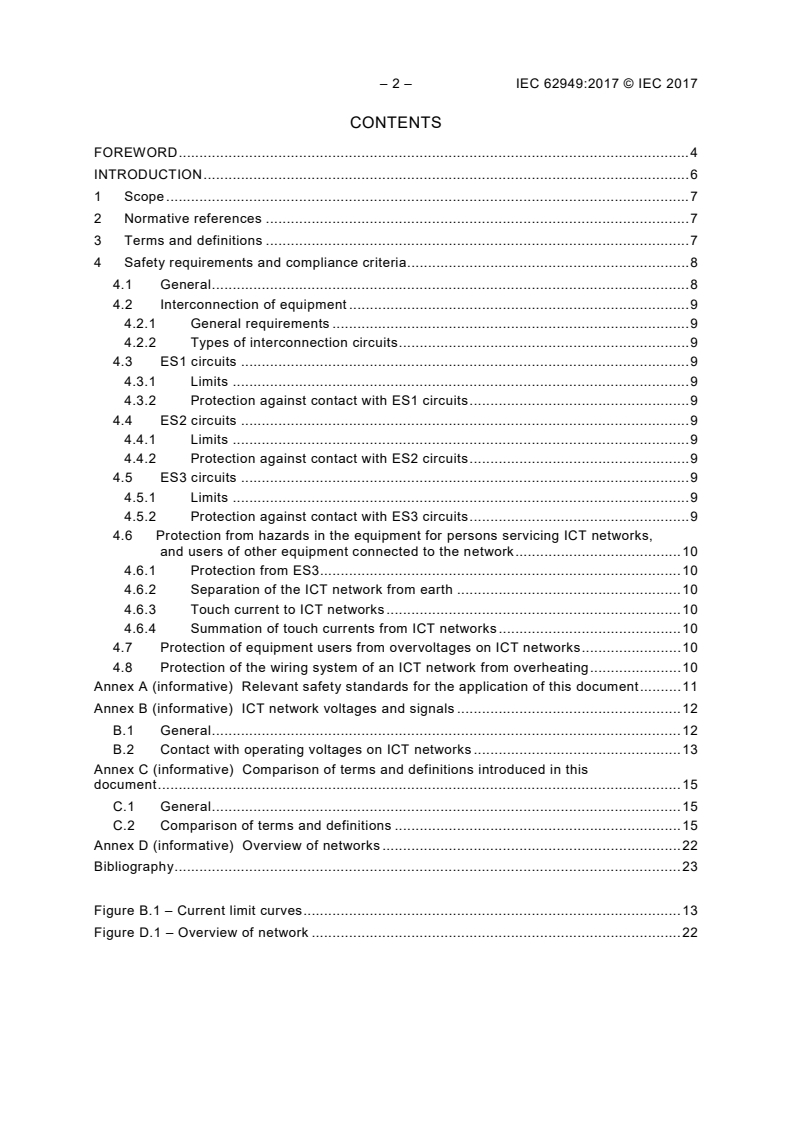
– 2 – IEC 62949:2017 © IEC 2017
CONTENTS
FOREWORD . 4
INTRODUCTION . 6
1 Scope . 7
2 Normative references . 7
3 Terms and definitions . 7
4 Safety requirements and compliance criteria. 8
4.1 General . 8
4.2 Interconnection of equipment . 9
4.2.1 General requirements . 9
4.2.2 Types of interconnection circuits . 9
4.3 ES1 circuits . 9
4.3.1 Limits . 9
4.3.2 Protection against contact with ES1 circuits . 9
4.4 ES2 circuits . 9
4.4.1 Limits . 9
4.4.2 Protection against contact with ES2 circuits . 9
4.5 ES3 circuits . 9
4.5.1 Limits . 9
4.5.2 Protection against contact with ES3 circuits . 9
4.6 Protection from hazards in the equipment for persons servicing ICT networks,
and users of other equipment connected to the network . 10
4.6.1 Protection from ES3. 10
4.6.2 Separation of the ICT network from earth . 10
4.6.3 Touch current to ICT networks . 10
4.6.4 Summation of touch currents from ICT networks . 10
4.7 Protection of equipment users from overvoltages on ICT networks . 10
4.8 Protection of the wiring system of an ICT network from overheating . 10
Annex A (informative) Relevant safety standards for the application of this document . 11
Annex B (informative) ICT network voltages and signals . 12
B.1 General . 12
B.2 Contact with operating voltages on ICT networks . 13
Annex C (informative) Comparison of terms and definitions introduced in this
document . 15
C.1 General . 15
C.2 Comparison of terms and definitions . 15
Annex D (informative) Overview of networks . 22
Bibliography . 23
Figure B.1 – Current limit curves . 13
Figure D.1 – Overview of network . 22
Table C.1 – Comparison of terms and definitions in IEC 60950-1:2005 and
IEC 62368-1:2014 . 16
Table C.2 – Comparison of terms and definitions in IEC 62151:2000 and IEC 62368-
1:2014 . 19
– 4 – IEC 62949:2017 © IEC 2017
INTERNATIONAL ELECTROTECHNICAL COMMISSION
____________
PARTICULAR SAFETY REQUIREMENTS FOR EQUIPMENT TO BE
CONNECTED TO INFORMATION AND COMMUNICATION NETWORKS
FOREWORD
1) The International Electrotechnical Commission (IEC) is a worldwide organization for standardization comprising
all national electrotechnical committees (IEC National Committees). The object of IEC is to promote
international co-operation on all questions concerning standardization in the electrical and electronic fields. To
this end and in addition to other activities, IEC publishes International Standards, Technical Specifications,
Technical Reports, Publicly Available Specifications (PAS) and Guides (hereafter referred to as “IEC
Publication(s)”). Their preparation is entrusted to technical committees; any IEC National Committee interested
in the subject dealt with may participate in this preparatory work. International, governmental and non-
governmental organizations liaising with the IEC also participate in this preparation. IEC collaborates closely
with the International Organization for Standardization (ISO) in accordance with conditions determined by
agreement between the two organizations.
2) The formal decisions or agreements of IEC on technical matters express, as nearly as possible, an international
consensus of opinion on the relevant subjects since each technical committee has representation from all
interested IEC National Committees.
3) IEC Publications have the form of recommendations for international use and are accepted by IEC National
Committees in that sense. While all reasonable efforts are made to ensure that the technical content of IEC
Publications is accurate, IEC cannot be held responsible for the way in which they are used or for any
misinterpretation by any end user.
4) In order to promote international uniformity, IEC National Committees undertake to apply IEC Publications
transparently to the maximum extent possible in their national and regional publications. Any divergence
between any IEC Publication and the corresponding national or regional publication shall be clearly indicated in
the latter.
5) IEC itself does not provide any attestation of conformity. Independent certification bodies provide conformity
assessment services and, in some areas, access to IEC marks of conformity. IEC is not responsible for any
services carried out by independent certification bodies.
6) All users should ensure that they have the latest edition of this publication.
7) No liability shall attach to IEC or its directors, employees, servants or agents including individual experts and
members of its technical committees and IEC National Committees for any personal injury, property damage or
other damage of any nature whatsoever, whether direct or indirect, or for costs (including legal fees) and
expenses arising out of the publication, use of, or reliance upon, this IEC Publication or any other IEC
Publications.
8) Attention is drawn to the Normative references cited in this publication. Use of the referenced publications is
indispensable for the correct application of this publication.
9) Attention is drawn to the possibility that some of the elements of this IEC Publication may be the subject of
patent rights. IEC shall not be held responsible for identifying any or all such patent rights.
International Standard IEC 62949 has been prepared by IEC technical committee 108: Safety
of electronic equipment within the field of audio/video, information technology and
communication technology.
The text of this standard is based on the following documents:
FDIS Report on voting
108/664/FDIS 108/676/RVD
Full information on the voting for the approval of this International Standard can be found in
the report on voting indicated in the above table.
This document has been drafted in accordance with the ISO/IEC Directives, Part 2.
In this standard, the following print types are used:
• requirements proper and normative annexes: in roman type;
• compliance statements and test specifications: in italic type;
• notes and other informative matter: in smaller roman type;
• normative conditions within tables: in smaller roman type;
• Terms that are defined in Clause 3: bold.
The committee has decided that the contents of this document will remain unchanged until the
stability date indicated on the IEC website under "http://webstore.iec.ch" in the data related to
the specific document. At this date, the document will be
• reconfirmed,
• withdrawn,
• replaced by a revised edition, or
• amended.
IMPORTANT – The 'colour inside' logo on the cover page of this publication indicates
that it contains colours which are considered to be useful for the correct
understanding of its contents. Users should therefore print this document using a
colour printer.
– 6 – IEC 62949:2017 © IEC 2017
INTRODUCTION
This document is applicable for products intended to be connected as communication
terminal to an ICT network not covered by the scope of IEC 62368-1. It is to be used in
conjunction with other product safety standards, examples of which are listed in Annex A.
This document, in accordance with the 'principles of safety' given in the introduction of
IEC 62368-1, covers the requirements and compliance criteria under three headings.
• Protection of equipment users from hazards in the equipment. The users are considered to
be protected from hazards in the equipment if the equipment complies with a relevant
safety standard, for example one of those listed in Annex A, but compliance with those
standards is not part of this document.
NOTE An equipment user could be an ordinary person or an instructed person.
• Protection of skilled persons or instructed persons working on an ICT network and
other users of an ICT network, from hazardous conditions on an ICT network resulting
from the connection of the equipment.
• Protection of equipment users from voltages on an ICT network.
Upper limits for ICT networks signals have been defined. They include also telephone ringing
signals which have been defined taking into account voltages commonly used in the different
networks. The electrical hazard criteria have been chosen to be in accordance with
IEC TS 60479 (all parts).
Test levels used for the equipment take account of the possibility that overvoltages may occur
on ICT networks. Special consideration has been given to equipment parts expected to be
held or touched during normal use, e.g. telephone handsets.
It is recognised that in high overvoltages risk areas, requirements of this document may not
be sufficient. Additional protective devices, not covered by this document, may be installed in
the ICT networks to better meet extreme conditions.
A comparison of terms introduced in this document with existing IEC standards is given in
Annex C.
PARTICULAR SAFETY REQUIREMENTS FOR EQUIPMENT TO BE
CONNECTED TO INFORMATION AND COMMUNICATION NETWORKS
1 Scope
This document applies to the interface of equipment designed and intended to be connected
as a communication terminal to an information and communication technology (ICT)
network termination.
This document does not apply to:
• equipment covered by IEC 62368-1; and
• interfaces to other networks.
NOTE 1 An example of ‘other networks’ is a dedicated Home and Building Electronic Systems/Building
Automation and Control Systems HBES/BACS network covered by EN 50491-3.
This document specifies the safety requirements of the interface to the ICT network only.
NOTE 2 See Annex D.
Requirements additional to those specified in this document may be necessary for
• equipment intended for operation while exposed, for example, to extremes of temperature,
to excessive dust, moisture, or vibration, to flammable gases, to corrosive or explosive
atmospheres,
• electro medical applications with physical connections to the patient.
The following requirements are not covered by this document:
• functional safety of equipment;
• functional reliability of equipment;
• communication facilities with remote supply using hazardous voltage;
• protection of equipment connected to ICT networks from functional damage.
2 Normative references
The following documents are referred to in the text in such a way that some or all of their
content constitutes requirements of this document. For dated references, only the edition
cited applies. For undated references, the latest edition of the referenced document (including
any amendments) applies.
NOTE Lists of other related documents can be found in Annex A and in the Bibliography.
IEC 62368-1:2014, Audio/video, information and communication technology equipment –
Part 1: Safety requirements
3 Terms and definitions
For the purposes of this document, the terms and definitions given in IEC 62368-1and the
following apply.
– 8 – IEC 62949:2017 © IEC 2017
ISO and IEC maintain terminological databases for use in standardization at the following
addresses:
• IEC Electropedia: available at http://www.electropedia.org/
• ISO Online browsing platform: available at http://www.iso.org/obp
NOTE Defined terms are printed in bold.
3.1
information and communication technology network
ICT network
metallically terminated transmission medium consisting of paired conductors intended for
communication between equipment that may be located in separate buildings, excluding:
• the mains system for supply, transmission and distribution of electrical power, if used as a
communication transmission medium;
• a dedicated HBES/BACS networks;
• external circuits operating at ES1 levels connecting units of audio/video, information and
communication technology equipment
Note 1 to entry: This network may include twisted pairs, and may include circuits, which are subjected to
transients as indicated in Table 14 of IEC 62368-1:2014, ID1 (assumed to be 1,5 kV).
Note 2 to entry: An ICT network may be:
• public or privately owned;
• subject to longitudinal (common mode) voltages induced from nearby power lines or electric traction lines.
Note 3 to entry: Examples of ICT networks are:
• a public switched telephone network;
• a public data network;
• an Integrated Services Digital Network (ISDN);
• a private network with electrical interface characteristics similar to the above.
Note 4 to entry: For information about circuit voltages and signals, which may be present, see Annex B.
3.2
communication terminal
equipment connected to an ICT network to provide access to one or more specific
information transfer services
Note 1 to entry: A communication terminal may be characterized, for example, as a user's communication
terminal, a communication terminal providing services, a communication terminal acting as an interface between
ICT networks.
Note 2 to entry: A communication terminal may have to translate the signals received from or sent to the
network according to the service considered.
4 Safety requirements and compliance criteria
4.1 General
It is assumed that adequate measures according to ITU-T Recommendation K.11 have been
taken to reduce the likelihood that the overvoltages presented to the equipment from the ICT
network exceed 1,5 kV peak. In installations where overvoltages presented to the equipment
may exceed 1,5 kV peak, additional measures such as surge suppression may be necessary.
The general conditions for tests of Annex B of IEC 62368-1:2014 apply, unless specified in
the relevant product safety standard.
The references to the requirements of 4.4.4.5, 5.4.2.6 and 5.4.3.2 of IEC 62368-1:2014, may
be replaced by the corresponding requirements in other relevant safety standards listed in
Annex A, if the equipment is designed to comply with one of these standards.
4.2 Interconnection of equipment
4.2.1 General requirements
Where an equipment is intended to be electrically connected to another equipment via an ICT
network, interconnection circuits shall be selected to provide continued conformance to the
requirements of 5.2 of IEC 62368-1:2014 for ES1 or ES2 circuits, after making connections.
NOTE This is normally achieved by connecting ES2 circuits to ES2 circuits and ES1circuits to ES1 circuits.
4.2.2 Types of interconnection circuits
Interconnection circuits to ICT networks shall be ES1 circuits or ES2 circuits according to 5.2
of IEC 62368-1:2014.
4.3 ES1 circuits
4.3.1 Limits
The limits of 5.2.1 of IEC 62368-1:2014 for ES1 apply.
4.3.2 Protection against contact with ES1 circuits
There is no protection required for ES1 circuits.
4.4 ES2 circuits
4.4.1 Limits
The limits of 5.2.2 of IEC 62368-1:2014 for ES2 apply.
4.4.2 Protection against contact with ES2 circuits
For ES2 circuits, the requirements of 5.3.1 and 5.3.2.1 of IEC 62368-1:2014 apply for an
ordinary person and an instructed person.
For ES2 circuits, the requirements of 5.3.1 of IEC 62368-1:2014 apply for a skilled person.
4.5 ES3 circuits
4.5.1 Limits
The limits of 5.2.2 of IEC 62368-1:2014 for ES3 apply.
4.5.2 Protection against contact with ES3 circuits
For ES3 circuits, the requirements of 5.3.2.1 of IEC 62368-1:2014 apply for an ordinary
person and an instructed person.
For ES3 circuits, the requirements of 5.3.1 of IEC 62368-1:2014 apply for a skilled person.
– 10 – IEC 62949:2017 © IEC 2017
4.6 Protection from hazards in the equipment for persons servicing ICT networks,
and users of other equipment connected to the network
4.6.1 Protection from ES3
Subclause 5.7.6.2 of IEC 62368-1:2014 applies.
4.6.2 Separation of the ICT network from earth
Subclause 5.4.11 of IEC 62368-1:2014 applies.
4.6.3 Touch current to ICT networks
Subclause 5.7.6.2 of IEC 62368-1:2014 applies.
4.6.4 Summation of touch currents from ICT networks
Subclause 5.7.7 of IEC 62368-1:2014 applies.
4.7 Protection of equipment users from overvoltages on ICT networks
Subclause 5.4.10 of IEC 62368-1:2014 applies.
4.8 Protection of the wiring system of an ICT network from overheating
Subclause 6.5.3 of IEC 62368-1:2014 applies.
Annex A
(informative)
Relevant safety standards for the application of this document
This annex lists some examples of IEC product safety standards with which this document
may be used.
Publication Title
IEC 60601-1 (all parts) Medical electrical equipment – Part 1: General requirements for basic safety and
essential performance
IEC 61010 (all parts) Safety requirements for electrical equipment for measurement, control, and laboratory
use
IEC 62504:2014 General lighting – Light emitting diode (LED) products and related equipment – Terms
and definitions
– 12 – IEC 62949:2017 © IEC 2017
Annex B
(informative)
ICT network voltages and signals
B.1 General
Certain voltages within ICT networks often exceed the steady state, safe to touch limits set
within general safety standards.
NOTE Years of practical experience by world-wide network operators have found ringing and other operating
voltages to be electrically safe. Records of accident statistics indicate that electrical injuries are not caused by
operating voltages.
Access to connectors carrying such signals with the standard test finger is permitted, provided
that inadvertent access is unlikely. The likelihood of inadvertent access is limited by
forbidding access with the test probe (Figure V.3 of IEC 62368-1:2014) which has a 6 mm
radius tip.
This requirement ensures that:
a) contact by a large part of the human body, such as the back of the hand, is impossible;
b) contact is possible only by deliberately inserting a small part of the body, less than 12 mm
across, such as a fingertip, which presents a high impedance;
c) the possibility of being unable to let-go the part in contact does not arise.
This applies both to contact with signals arriving from the network and to signals generated
internally in the equipment.
Ventricular fibrillation of the heart is considered to be the main cause of death by electric
shock.
of Figure B.1 (curve c of Figure 20 of IEC TS 60479-1:2005) is the threshold of
Curve c
1 1
ventricular fibrillation. The point 500 mA/100 ms has been found to correspond to a fibrillation
probability of the order of 0,14 %. Curve b on Figure B.1 (curve b of Figure 20 of
IEC TS 60479-1:2005) may be described as the 'let-go' limit curve. Some experts consider
curve c to be the appropriate limit for safe design, but use of this curve shall be considered
as an absolute limit.
Curve b’
at 16 mA
10 000
a b
c c c
1 2 3
5 000
AC-4.1
AC-4.2
2 000
AC-4.3
1 000
AC-1 AC-2 AC-3 AC-4
0,1 0,2 0,5 1 2 5 10 20 50 100 200 500 2 000 10 000
1 000 5 000
Body current I , mA
B
IEC
Figure B.1 – Current limit curves
B.2 Contact with operating voltages on ICT networks
Total body impedance consists of two parts, the internal body resistance of blood and tissue
and the skin impedance. Operation voltages on ICT networks hardly reach the level where
skin impedance begins to rapidly decrease due to breakdown. The skin impedance is high at
low voltages, its value varying widely. The effects of skin capacitance are negligible at ringing
frequencies.
IEC TS 60479-1 body impedance figures are based upon a relatively large contact area of
2 2
50 cm to 100 cm , which is a realistic value for mains operated domestic appliances.
Practical telecommunication contact is likely to be much less than this, typically 10 cm to
2 2
15 cm for uninsulated wiring pliers or similar tools and less than 1 cm for finger contact with
pins of a telephone wall socket. For contact with thin wires, wiring tags or contact with tools
where fingers move beyond insulated handles, the area of contact will again be of the order of
1 cm or less. These much smaller areas of contact with the body produce significantly higher
values of body impedance than the IEC TS 60479-1 figures.
For contact with operation voltages on ICT networks a body model value of 5 kΩ is used, to
provide a margin of safety compared with the higher practical values of body impedance for
typical contact areas for equipment connected to ICT networks.
The curve b' in Figure B.1 is a version of curve b modified to cover practical situations, where
the current limit is maintained constant at 16 mA above 1 667 ms. This 16 mA limit is still well
within the minimum current value of curve a.
Duration of current flow t, ms
– 14 – IEC 62949:2017 © IEC 2017
The difficulties of defining conditions which will avoid circumstances that prevent let-go have
led to a very restricted contact area being allowed.
Contact with areas up to 10 cm can be justified and means of specifying this and still
ensuring let-go are for further study.
Annex C
(informative)
Comparison of terms and definitions introduced in this document
C.1 General
IEC 62368-1:2014 introduces new safety terms associated with the new safety concepts.
This annex identifies the relevant terms in this document together with the IEC 62368-1 terms
and, where different, compares them to IEC 60950-1:2005, see Table C.1 and the basic
safety publication IEC 62151:2000, see Table C.2.
Terms not in the tables below are either the same or substantially the same as in other IEC
standards.
C.2 Comparison of terms and definitions
In the tables below, the text quoted from IEC 60950-1 and IEC 62151 are in normal font.
Remarks about IEC 62368-1 are in italic font.
– 16 – IEC 62949:2017 © IEC 2017
Table C.1 – Comparison of terms and definitions
in IEC 60950-1:2005 and IEC 62368-1:2014
IEC 60950-1:2005 terms IEC 62368-1:2014 terms
1.2.8.8 5.2.1.1
SELV circuit ES1
secondary circuit that is so designed and ES1 is a class 1 electrical energy source with
protected that under normal operating
current or voltage levels
conditions and single fault conditions, its
– not exceeding ES1 limits under
voltages do not exceed a safe value
• normal operating conditions, and
• abnormal operating conditions, and
• single fault conditions of a
component, device or insulation not
serving as a safeguard; and
– not exceeding ES2 limits under single
fault conditions of a basic safeguard.
1.2.8.11 Not defined,
TNV circuit
but see TNV-1; TNV-2 and TNV-3
circuit that is in the equipment and to which
the accessible area of contact is limited and
that is so designed and protected that, under
normal operating conditions and single fault
1:2005),
conditions (see 1.4.14 of IEC 60950-
the voltages do not exceed specified limit
values.
A TNV circuit is considered to be a
secondary circuit in the meaning of this
standard
1.2.8.12 5.2.1.1
TNV-1 circuit ES1
TNV circuit ES1 is a class 1 electrical energy source with
– whose normal operating voltages do not
current or voltage levels
exceed the limits for an SELV circuit
– not exceeding ES1 limits under
under normal operating conditions and
• normal operating conditions, and
– on which overvoltages from
telecommunication networks and cable
• abnormal operating conditions, and
distribution systems are possible
• single fault conditions of a
component, device or insulation not
serving as a safeguard; and
not exceeding ES2 limits under single fault
conditions of a basic safeguard.
ES1 on which transients according to
Table 14 ID numbers 1, 2 and 3 are possible.
IEC 60950-1:2005 terms IEC 62368-1:2014 terms
1.2.8.13 5.2.1.2
TNV-2 circuit ES2
TNV circuit ES2 is a class 2 electrical energy source
– whose normal operating voltages exceed
where
the limits for an SELV circuit under
– both the prospective touch voltage and
normal operating conditions and
the touch current exceed the limits for
– which is not subject to overvoltages from
ES1; and
telecommunication networks
– under
• normal operating conditions, and
• abnormal operating conditions, and
• single fault conditions,
either the prospective touch voltage or the
touch current does not exceed the limit for
ES2.
1.2.8.14 5.2.1.2
TNV-3 circuit ES2
TNV circuit ES2 is a class 2 electrical energy source
– whose normal operating voltages exceed where
the limits for an SELV circuit under
– both the prospective touch voltage and
normal operating conditions and
the touch current exceed the limits for
– on which overvoltages from
ES1; and
telecommunication networks and cable
– under
distribution systems are possible
• normal operating conditions, and
• abnormal operating conditions, and
• single fault conditions,
either the prospective touch voltage or the
touch current does not exceed the limit for
ES2.
ES2 on which transients according to
Table 14, ID numbers 1, 2 and 3 are possible.
1.2.13.6 3.3.8.2
USER ordinary person
any person, other than a service person person who is neither a skilled person nor
an instructed person
The term user in this standard is the same as
the term operator and the two terms can be
interchanged.
1.2.13.7 See 3.3.8.2 above.
operator
see user (1.2.13.6 of IEC 60950-1:2005)
– 18 – IEC 62949:2017 © IEC 2017
IEC 60950-1:2005 terms IEC 62368-1:2014 terms
1.2.13.8 3.3.1.1
telecommunication network external circuit
metallically terminated transmission medium electrical circuit that is external to the
intended for communication between equipment and is not mains
equipment that may be located in separate
buildings, excluding:
The relevant external circuits are identified
in Table 14.
– the mains system for supply, transmission
and distribution of electrical power, if
used as a telecommunication
transmission medium;
– cable distribution systems;
– SELV circuits connecting units of
information technology equipment
Note 1 to entry: The term telecommunication
network is defined in terms of its functionality, not its
electrical characteristics. A telecommunication
network is not itself defined as being either an SELV
circuit or a TNV circuit. Only the circuits in the
equipment are so classified.
Note 2 to entry: A telecommunication network may be:
– publicly or privately owned:
– subject to transient overvoltages due to
atmospheric discharges and faults in power
distribution systems;
– subject to longitudinal (common mode) voltages
induced from nearby power lines or electric traction
lines.
Note 3 to entry: Examples of telecommunication
networks are:
– a public switched telephone network:
– a public data network:
– an integrated Services Digital Network (ISDN);
– a private network with electrical interface
characteristics similar to the above.
None 3.3.8.1
instructed person
a person instructed or supervised by a
skilled person as to energy sources and who
can responsibly use equipment safeguards
and precautionary safeguards with respect
to those energy sources
Note 1 to entry: Supervised, as used in the definition,
means having the direction and oversight of the
performance of others.
1.2.13.5 3.3.8.3
service person skilled person
person having appropriate technical training person with relevant education or experience
and experience necessary to be aware of to enable him or her to identify hazards and
hazards to which that person may be to take appropriate actions to reduce the
exposed in performing a task and of risks of injuries to themselves or others
measures to minimize the risks to that person
or other persons
Table C.2 – Comparison of terms and definitions
in IEC 62151:2000 and IEC 62368-1:2014
IEC 62151:2000 terms IEC 62368-1:2014 terms
3.1.3 3.3.1.1
telecommunication network external circuit
a metallically terminated transmission electrical circuit that is external to the
medium intended for communication between equipment and is not mains
equipments that may be located in separate
buildings, excluding:
The relevant external circuits are identified
in Table 14.
– the mains systems for supply,
transmission and distribution of electrical
power, if used as a telecommunication
transmission medium;
– television distribution systems using
cable.
Note 1 to entry: The term telecommunication net-
work is defined in terms of its functionality, not its
electrical characteristics. A telecommunication
network is not itself defined as being a TNV circuit.
Only the circuits in equipment are so classified.
Note 2 to entry: A telecommunication network may be
– publicly or privately owned;
– subject to transient overvoltages due to
atmospheric discharges and faults in power
distribution systems;
– subject to permanent longitudinal (common mode)
voltages induced from nearby power lines or
electric traction lines.
Note 3 to entry: Examples of telecommunication
networks are
– a public switched telephone network;
– a public data network;
– an ISDN network;
– a private network with electrical interface
characteristics similar to the above.
3.5.4 5.2.1.1
TNV-0 circuit ES1
a TNV circuit: ES1 is a class 1 electrical energy source with
current or voltage levels
– whose normal operating voltages do not
exceed a safe value under normal – not exceeding ES1 limits under
operating conditions and under single
• normal operating conditions, and
fault conditions;
• abnormal operating conditions, and
– which is not subject to overvoltages from
telecommunication networks
• single fault conditions of a
component, device or insulation not
Note 1 to entry: The limiting values of voltage under
serving as a safeguard; and
normal operating and single fault conditions are
specified in 4.1 of IEC 62151:2000.
– not exceeding ES2 limits under single
fault conditions of a basic safeguard.
– 20 – IEC 62949:2017 © IEC 2017
IEC 62151:2000 terms IEC 62368-1:2014 terms
3.5.3 Not defined,
TNV circuit
but see TNV-1; TNV-2 and TNV-3
a circuit which is in the equipment and to
which the accessible area of contact is
limited (except for a TNV-0 circuit) and that
is so designed and protected that, under
normal operating and single fault conditions,
the voltages do not exceed specified limiting
values
A TNV circuit is considered to be a
secondary circuit in the meaning of this
standard.
Note 1 to entry: The voltage relationships between
TNV circuits are shown in Table 1 of IEC 62151:2000.
3.5.5 5.2.1.1
TNV-1 circuit ES1
a TNV circuit: ES1 is a class 1 electrical energy source with
current or voltage levels
– whose normal operating voltages do not
exceed the limits for a TNV-0 circuit – not exceeding ES1 limits under
under normal operating conditions; and
• normal operating conditions, and
– on which overvoltages from
• abnormal operating conditions, and
telecommunication networks are
possible • single fault conditions of a
component, device or insulation not
serving as a safeguard; and
not exceeding ES2 limits under single fault
conditions of a basic safeguard.
ES1 on which transients according to
Table 14 ID numbers 1, 2 and 3 are possible.
3.5.6 5.2.1.2
TNV-2 circuit ES2
a TNV circuit: ES2 is a class 2 electrical energy source
where
– whose normal operating voltages exceed
the limits for a TNV-0 circuit under – both the prospective touch voltage and
normal operating conditions; and the touch current exceed the limits for
ES1; and
– which is not subject to overvoltages from
telecommunication networks – under
• normal operating conditions, and
• abnormal operating conditions, and
• single fault conditions,
either the prospective touch voltage or the
touch current does not exceed the limit for
ES2.
IEC 62151:2000 terms IEC 62368-1:2014 terms
3.5.7 5.2.1.2
TNV-3 circuit ES2
a TNV circuit: ES2 is a class 2 electrical energy source
where
– whose normal operating voltages exceed
the limits for a TNV-0 circuit under – both the prospective touch voltage and
normal operating conditions; and the touch current exceed the limits for
ES1; and
– on which overvoltages from
telecommunication networks are – under
possible
• normal operating conditions, and
• abnormal operating conditions, and
• single fault conditions,
either the prospective touch voltage or the
touch current does not exceed the limit for
ES2.
ES1 on which transients according to
Table 14 ID numbers 1, 2 and 3 are possible.
– 22 – IEC 62949:2017 © IEC 2017
Annex D
(informative)
Overview of networks
This annex lists some examples of IEC product safety standards with which this document
may be used.
This annex shows different kind of networks and the possible interconnection between these
networks.
Figure D.1 shows as graph the scope of this document (IEC 62949), which is the interface
(and only the interface) of equipment connected to IT and CT networks
IEC 62368-1
IT network
IEC abcde/
(Ethernet)
EN 50491-3
CT network
(Telephone)
HBES/BACS
network
(e.g. KNX)
IEC 62949 (Draft)
Other
Cable network
network(s)
(Coax)
(???)
IEC
IT networks and CT networks are both subsets of ICT networks.
Figure D.1 – Overview of network
IEC 62949 covers interfaces to ICT networks:
in the figure: IT network (e.g. Ethernet) and CT network (e.g. telephone)
IEC 62949 does not address interfaces to to cable networks:
in the figure: Cable network (coax)
IEC 62949 does not cover interfaces to other networks:
in the figure: Other network (????)
IEC 62949 does not cover interfaces to HBES/BAC networks:
in the figure: HBES/BACS (e.g. KNX)
Bibliography
IEC 60065:2014, Audio, video and sim
...