


IEC 61000-4-1:2006
(Main)Electromagnetic compatibility (EMC) - Part 4-1: Testing and measurement techniques - Overview of IEC 61000-4 series
General Information
- Abstract
The object of this part of IEC 61000 is to give applicability assistance to the technical committees of IEC or other bodies, users and manufacturers of electrical and electronic equipment on EMC standards within the IEC 61000-4 series on testing and measurement techniques and to provide general recommendations concerning the choice of relevant tests. This standard has the status of a basic EMC publication in accordance with IEC Guide 107.
- Status
- Replaced
- Publication Date
- 24-Oct-2006
- Technical Committee
- TC 77 - Electromagnetic compatibility
- Current Stage
- DELPUB - Deleted Publication
- Start Date
- 27-Apr-2016
- Completion Date
- 28-Aug-2026
Relations
- Effective Date
- 05-Sep-2023
- Effective Date
- 25-Aug-2026
- Effective Date
- 25-Aug-2026
- Effective Date
- 05-Sep-2023
Get Certified
Connect with accredited certification bodies for this standard

ANCE
Mexican certification and testing association.

Intertek Slovenia
Intertek testing, inspection, and certification services in Slovenia.

LNE (Laboratoire National de Métrologie et d'Essais)
French national laboratory for metrology and testing.
Sponsored listings
Frequently Asked Questions
IEC 61000-4-1:2006 is a standard published by the International Electrotechnical Commission (IEC). Its full title is "Electromagnetic compatibility (EMC) - Part 4-1: Testing and measurement techniques - Overview of IEC 61000-4 series". This standard covers: The object of this part of IEC 61000 is to give applicability assistance to the technical committees of IEC or other bodies, users and manufacturers of electrical and electronic equipment on EMC standards within the IEC 61000-4 series on testing and measurement techniques and to provide general recommendations concerning the choice of relevant tests. This standard has the status of a basic EMC publication in accordance with IEC Guide 107.
The object of this part of IEC 61000 is to give applicability assistance to the technical committees of IEC or other bodies, users and manufacturers of electrical and electronic equipment on EMC standards within the IEC 61000-4 series on testing and measurement techniques and to provide general recommendations concerning the choice of relevant tests. This standard has the status of a basic EMC publication in accordance with IEC Guide 107.
IEC 61000-4-1:2006 is classified under the following ICS (International Classification for Standards) categories: 33.100.01 - Electromagnetic compatibility in general; 33.100.20 - Immunity. The ICS classification helps identify the subject area and facilitates finding related standards.
IEC 61000-4-1:2006 has the following relationships with other standards: It is inter standard links to IEC TR 61000-4-1:2016, EN ISO 4064-2:2017, EN ISO 4064-2:2014, IEC 61000-4-1:2000. Understanding these relationships helps ensure you are using the most current and applicable version of the standard.
IEC 61000-4-1:2006 is available in PDF format for immediate download after purchase. The document can be added to your cart and obtained through the secure checkout process. Digital delivery ensures instant access to the complete standard document.
Standards Content (Sample)
IEC 61000-4-1
Edition 3.0 2006-10
INTERNATIONAL
STANDARD
NORME
INTERNATIONALE
BASIC EMC PUBLICATION
PUBLICATION FONDAMENTALE EN CEM
Electromagnetic compatibility (EMC) –
Part 4-1: Testing and measurement techniques – Overview of IEC 61000-4 series
Compatibilité électromagnétique (CEM) –
Partie 4-1: Techniques d’essai et de mesure – Vue d’ensemble de la série
CEI 61000-4
All rights reserved. Unless otherwise specified, no part of this publication may be reproduced or utilized in any form or by
any means, electronic or mechanical, including photocopying and microfilm, without permission in writing from either IEC or
IEC's member National Committee in the country of the requester.
If you have any questions about IEC copyright or have an enquiry about obtaining additional rights to this publication,
please contact the address below or your local IEC member National Committee for further information.
Droits de reproduction réservés. Sauf indication contraire, aucune partie de cette publication ne peut être reproduite
ni utilisée sous quelque forme que ce soit et par aucun procédé, électronique ou mécanique, y compris la photocopie
et les microfilms, sans l'accord écrit de la CEI ou du Comité national de la CEI du pays du demandeur.
Si vous avez des questions sur le copyright de la CEI ou si vous désirez obtenir des droits supplémentaires sur cette
publication, utilisez les coordonnées ci-après ou contactez le Comité national de la CEI de votre pays de résidence.
IEC Central Office
3, rue de Varembé
CH-1211 Geneva 20
Switzerland
Email: inmail@iec.ch
Web: www.iec.ch
About the IEC
The International Electrotechnical Commission (IEC) is the leading global organization that prepares and publishes
International Standards for all electrical, electronic and related technologies.
About IEC publications
The technical content of IEC publications is kept under constant review by the IEC. Please make sure that you have the
latest edition, a corrigenda or an amendment might have been published.
ƒ Catalogue of IEC publications: www.iec.ch/searchpub
The IEC on-line Catalogue enables you to search by a variety of criteria (reference number, text, technical committee,…).
It also gives information on projects, withdrawn and replaced publications.
ƒ IEC Just Published: www.iec.ch/online_news/justpub
Stay up to date on all new IEC publications. Just Published details twice a month all new publications released. Available
on-line and also by email.
ƒ Electropedia: www.electropedia.org
The world's leading online dictionary of electronic and electrical terms containing more than 20 000 terms and definitions
in English and French, with equivalent terms in additional languages. Also known as the International Electrotechnical
Vocabulary online.
ƒ Customer Service Centre: www.iec.ch/webstore/custserv
If you wish to give us your feedback on this publication or need further assistance, please visit the Customer Service
Centre FAQ or contact us:
Email: csc@iec.ch
Tel.: +41 22 919 02 11
Fax: +41 22 919 03 00
A propos de la CEI
La Commission Electrotechnique Internationale (CEI) est la première organisation mondiale qui élabore et publie des
normes internationales pour tout ce qui a trait à l'électricité, à l'électronique et aux technologies apparentées.
A propos des publications CEI
Le contenu technique des publications de la CEI est constamment revu. Veuillez vous assurer que vous possédez
l’édition la plus récente, un corrigendum ou amendement peut avoir été publié.
ƒ Catalogue des publications de la CEI: www.iec.ch/searchpub/cur_fut-f.htm
Le Catalogue en-ligne de la CEI vous permet d’effectuer des recherches en utilisant différents critères (numéro de référence,
texte, comité d’études,…). Il donne aussi des informations sur les projets et les publications retirées ou remplacées.
ƒ Just Published CEI: www.iec.ch/online_news/justpub
Restez informé sur les nouvelles publications de la CEI. Just Published détaille deux fois par mois les nouvelles
publications parues. Disponible en-ligne et aussi par email.
ƒ Electropedia: www.electropedia.org
Le premier dictionnaire en ligne au monde de termes électroniques et électriques. Il contient plus de 20 000 termes et
définitions en anglais et en français, ainsi que les termes équivalents dans les langues additionnelles. Egalement appelé
Vocabulaire Electrotechnique International en ligne.
ƒ Service Clients: www.iec.ch/webstore/custserv/custserv_entry-f.htm
Si vous désirez nous donner des commentaires sur cette publication ou si vous avez des questions, visitez le FAQ du
Service clients ou contactez-nous:
Email: csc@iec.ch
Tél.: +41 22 919 02 11
Fax: +41 22 919 03 00
IEC 61000-4-1
Edition 3.0 2006-10
INTERNATIONAL
STANDARD
NORME
INTERNATIONALE
BASIC EMC PUBLICATION
PUBLICATION FONDAMENTALE EN CEM
Electromagnetic compatibility (EMC) –
Part 4-1: Testing and measurement techniques – Overview of IEC 61000-4 series
Compatibilité électromagnétique (CEM) –
Partie 4-1: Techniques d’essai et de mesure – Vue d’ensemble de la série
CEI 61000-4
INTERNATIONAL
ELECTROTECHNICAL
COMMISSION
COMMISSION
ELECTROTECHNIQUE
PRICE CODE
INTERNATIONALE
P
CODE PRIX
ICS 33.100.01; 33.100.20 ISBN 2-8318-8815-8
61000-4-1 © IEC:2006 – 3 – – 2 – 61000-4-1 © IEC:2006
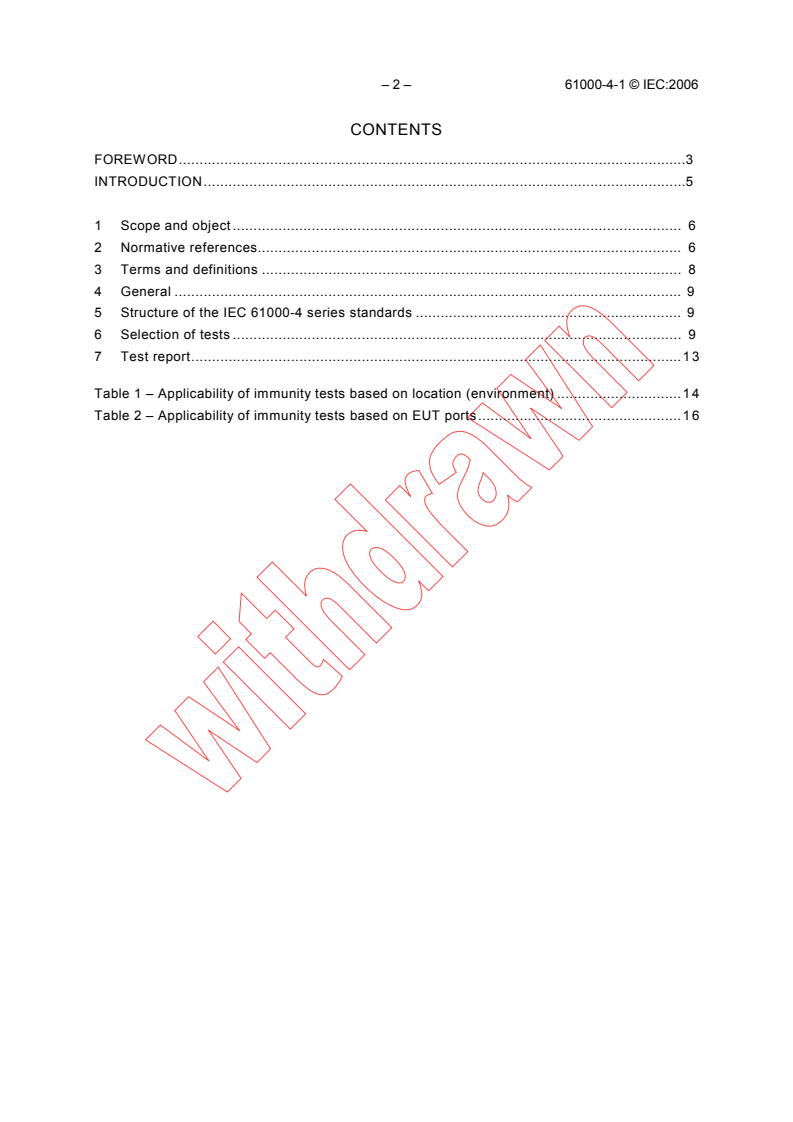
CONTENTS
FOREWORD.3
INTRODUCTION.5
1 Scope and object . 6
2 Normative references. 6
3 Terms and definitions . 8
4 General . 9
5 Structure of the IEC 61000-4 series standards . 9
6 Selection of tests . 9
7 Test report.13
Table 1 – Applicability of immunity tests based on location (environment) .14
Table 2 – Applicability of immunity tests based on EUT ports.16
61000-4-1 © IEC:200661000-4-1 © IEC:2006 – 5 – – 3 –
INTERNATIONAL ELECTROTECHNICAL COMMISSION
___________
ELECTROMAGNETIC COMPATIBILITY (EMC) –
Part 4-1: Testing and measurement techniques –
Overview of IEC 61000-4 series
FOREWORD
1) The International Electrotechnical Commission (IEC) is a worldwide organization for standardization comprising
all national electrotechnical committees (IEC National Committees). The object of IEC is to promote
international co-operation on all questions concerning standardization in the electrical and electronic fields. To
this end and in addition to other activities, IEC publishes International Standards, Technical Specifications,
Technical Reports, Publicly Available Specifications (PAS) and Guides (hereafter referred to as “IEC
Publication(s)”). Their preparation is entrusted to technical committees; any IEC National Committee interested
in the subject dealt with may participate in this preparatory work. International, governmental and non-
governmental organizations liaising with the IEC also participate in this preparation. IEC collaborates closely
with the International Organization for Standardization (ISO) in accordance with conditions determined by
agreement between the two organizations.
2) The formal decisions or agreements of IEC on technical matters express, as nearly as possible, an international
consensus of opinion on the relevant subjects since each technical committee has representation from all
interested IEC National Committees.
3) IEC Publications have the form of recommendations for international use and are accepted by IEC National
Committees in that sense. While all reasonable efforts are made to ensure that the technical content of IEC
Publications is accurate, IEC cannot be held responsible for the way in which they are used or for any
misinterpretation by any end user.
4) In order to promote international uniformity, IEC National Committees undertake to apply IEC Publications
transparently to the maximum extent possible in their national and regional publications. Any divergence
between any IEC Publication and the corresponding national or regional publication shall be clearly indicated in
the latter.
5) IEC provides no marking procedure to indicate its approval and cannot be rendered responsible for any
equipment declared to be in conformity with an IEC Publication.
6) All users should ensure that they have the latest edition of this publication.
7) No liability shall attach to IEC or its directors, employees, servants or agents including individual experts and
members of its technical committees and IEC National Committees for any personal injury, property damage or
other damage of any nature whatsoever, whether direct or indirect, or for costs (including legal fees) and
expenses arising out of the publication, use of, or reliance upon, this IEC Publication or any other IEC
Publications.
8) Attention is drawn to the Normative references cited in this publication. Use of the referenced publications is
indispensable for the correct application of this publication.
9) Attention is drawn to the possibility that some of the elements of this IEC Publication may be the subject of
patent rights. IEC shall not be held responsible for identifying any or all such patent rights.
International Standard IEC 61000-4-1 has been prepared by IEC technical committee 77:
Electromagnetic compatibility.
This standard forms Part 4-1 of IEC 61000. It has the status of a basic EMC publication in
accordance with IEC Guide 107.
This third edition cancels and replaces the second edition, published in 2000. It constitutes a
technical revision. Changes introduced in this third edition are for the purpose of updating the
text to include reference to the latest publications of the IEC 61000-4 series.
61000-4-1 © IEC:2006 – 7 – – 4 – 61000-4-1 © IEC:2006
The text of this standard is based on the following documents:
FDIS Report on voting
77/319/FDIS 77/324/RVD
Full information on the voting for the approval of this standard can be found in the report on
voting indicated in the above table.
This publication has been drafted in accordance with the ISO/IEC Directives, Part 2.
The committee has decided that the contents of this publication will remain unchanged until the
maintenance result date indicated on the IEC web site under "http://webstore.iec.ch" in the data
related to the specific publication. At this date, the publication will be
• reconfirmed;
• withdrawn;
• replaced by a revised edition, or
• amended.
61000-4-1 © IEC:200661000-4-1 © IEC:2006 – 9 – – 5 –
INTRODUCTION
The IEC 61000 series is published in several parts according to the following structure:
Part 1: General
General consideration (introduction, fundamental principles)
Definitions, terminology
Part 2: Environment
Description of the environment
Classification of the environment
Compatibility levels
Part 3: Limits
Emission limits
Immunity test levels (in so far as they do not fall under the responsibility of the product
committees)
Part 4: Testing and measurement techniques
Measurement techniques
Testing techniques
Part 5: Installation and mitigation guidelines
Installation guidelines
Mitigation methods and devices
Part 6: Generic standards
Part 9: Miscellaneous
Each part is further subdivided into several parts, published either as International Standards,
technical specifications or technical reports, some of which have already been published as
sections. Others will be published with the part number followed by a dash and completed by a
second number identifying the subdivision (example: 61000-6-1).
61000-4-1 © IEC:2006 – 11 – – 6 – 61000-4-1 © IEC:2006
ELECTROMAGNETIC COMPATIBILITY (EMC) –
Part 4-1: Testing and measurement techniques –
Overview of IEC 61000-4 series
1 Scope and object
This part of IEC 61000 covers testing and measuring techniques for electric and electronic
equipment (apparatus and systems) in its electromagnetic environment.
The object of this part is to give applicability assistance to the technical committees of IEC
or other bodies, users and manufacturers of electrical and electronic equipment on EMC
standards within the IEC 61000-4 series on testing and measurement techniques and to
provide general recommendations concerning the choice of relevant tests.
2 Normative references
The following referenced documents are indispensable for the application of this document. For
dated references, only the edition cited applies. For undated references, the latest edition of
the referenced document (including any amendments) applies.
IEC 60050(161), International Electrotechnical Vocabulary (IEV) – Chapter 161: Electro-
magnetic compatibility
IEC 61000-1-1, Electromagnetic Compatibility (EMC) – Part 1-1: General – Application and
interpretation of fundamental definitions and terms
IEC 61000-2-5, Electromagnetic Compatibility (EMC) – Part 2: Environment – Classification of
electromagnetic environments
IEC 61000-3-2, Electromagnetic compatibility (EMC) – Part 3-2: Limits –Limits for harmonic
current emissions (equipment input current ≤16 A per phase)
IEC 61000-3-3, Electromagnetic compatibility (EMC) – Part 3-3: Limits –Limitation of voltage
changes, voltage fluctuations and flicker in public low-voltage supply systems, for equipment
with rated current ≤16 A per phase and not subject to conditional connection
IEC/TS 61000-3-4, Electromagnetic compatibility (EMC) – Part 3-4: Limits – Limitation of
emission of harmonic currents in low-voltage power supply systems for equipment with rated
current greater than 16 A
IEC/TR 61000-3-5, Electromagnetic compatibility (EMC) – Part 3-5: Limits – Limitation of
voltage fluctuations and flicker in low-voltage power supply systems for equipment with rated
current greater than 16 A
IEC 61000-3-6, Electromagnetic compatibility (EMC) – Part 3: Limits – Section 6: Assessment
of emission limits for distorting loads in MV and HV power systems
61000-4-1 © IEC:200661000-4-1 © IEC:2006 – 13 – – 7 –
IEC 61000-3-11, Electromagnetic compatibility (EMC) – Part 3-11: Limits – Limitation of voltage
changes, voltage fluctuations and flicker in public low-voltage supply systems – Equipment with
rated current ≤75 A and subject to conditional connection
IEC 61000-3-12, Electromagnetic compatibility (EMC) – Part 3-12: Limits – Limits for harmonic
currents produced by equipment connected to public low-voltage systems with input current
>16 A and ≤75 A per phase
IEC 61000-4-2, Electromagnetic compatibility (EMC) – Part 4-2: Testing and measurement
techniques – Electrostatic discharge immunity test
IEC 61000-4-3, Electromagnetic compatibility (EMC) – Part 4-3: Testing and measurement
techniques – Radiated, radio-frequency, electromagnetic field immunity test
IEC 61000-4-4, Electromagnetic compatibility (EMC) – Part 4-4: Testing and measurement
techniques – Electrical fast transient/burst immunity test
IEC 61000-4-5, Electromagnetic compatibility (EMC) – Part 4-5: Testing and measurement
techniques – Surge immunity test
IEC 61000-4-6, Electromagnetic compatibility (EMC) – Part 4-6: Testing and measurement
techniques – Immunity to conducted disturbances, induced by radio-frequency fields
IEC 61000-4-7, Electromagnetic compatibility (EMC) – Part 4-7: Testing and measurement
techniques – General guide on harmonics and interharmonics measurements and
instrumentation, for power supply systems and equipment connected thereto
IEC 61000-4-8, Electromagnetic compatibility (EMC) – Part 4-8: Testing and measurement
techniques – Power frequency magnetic field immunity test
IEC 61000-4-9, Electromagnetic compatibility (EMC) – Part 4-9: Testing and measurement
techniques – Pulse magnetic field immunity test
IEC 61000-4-10, Electromagnetic compatibility (EMC) – Part 4-10: Testing and measurement
techniques – Damped oscillatory magnetic field immunity test
IEC 61000-4-11, Electromagnetic compatibility (EMC) – Part 4-11: Testing and measurement
techniques – Voltage dips, short interruptions and voltage variations immunity test
IEC 61000-4-12, Electromagnetic compatibility (EMC) – Part 4-12: Testing and measurement
techniques – Oscillatory waves immunity test
IEC 61000-4-13, Electromagnetic compatibility (EMC) – Part 4-13: Testing and measurement
techniques – Harmonics and interharmonics including mains signalling at a.c. power port, low
frequency immunity tests
IEC 61000-4-14, Electromagnetic compatibility (EMC) – Part 4-14: Testing and measurement
techniques – Voltage fluctuation immunity test
IEC 61000-4-15, Electromagnetic compatibility (EMC) – Part 4-15: Testing and measurement
techniques – Flickermeter – Functional and design specifications
IEC 61000-4-16, Electromagnetic compatibility (EMC) – Part 4-16: Testing and measurement
techniques – Test for immunity to conducted common mode disturbances in the frequency
range 0 Hz to 150 kHz immunity test
___________
Revision of IEC 60868.
61000-4-1 © IEC:2006 – 15 – – 8 – 61000-4-1 © IEC:2006
IEC 61000-4-17, Electromagnetic compatibility (EMC) – Part 4-17: Testing and measurement
techniques – Ripple on d.c. input power port immunity test
IEC 61000-4-18, Electromagnetic Compatibility (EMC) – Part 4-18: Testing and measurement
techniques – Oscillatory wave immunity test
IEC 61000-4-20, Electromagnetic compatibility (EMC) – Part 4-20: Testing and measurement
techniques – Emission and immunity testing in transverse electromagnetic (TEM) waveguides
IEC 61000-4-21, Electromagnetic compatibility (EMC) – Part 4-21: Testing and measurement
techniques – Reverberation chamber test methods
IEC 61000-4-23, Electromagnetic compatibility (EMC) – Part 4-23: Testing and measurement
techniques – Test methods for protective devices for HEMP and other radiated disturbances
IEC 61000-4-24, Electromagnetic compatibility (EMC) – Part 4: Testing and measurement
techniques – Section 24: Test methods for protective devices for HEMP conducted disturbance
IEC 61000-4-25, Electromagnetic compatibility (EMC) – Part 4-25: Testing and measurement
techniques – HEMP immunity test methods for equipment and systems
IEC 61000-4-27, Electromagnetic compatibility (EMC) – Part 4-27 : Testing and measurement
techniques – Unbalance, immunity test
IEC 61000-4-28, Electromagnetic compatibility (EMC) – Part 4-28: Testing and measurement
techniques – Variation of power frequency, immunity test
IEC 61000-4-29, Electromagnetic compatibility (EMC) – Part 4-29: Testing and measurement
techniques – Voltage dips, short interruptions and voltage variations on d.c. input power port
immunity tests
IEC 61000-4-30, Electromagnetic compatibility (EMC) – Part 4-30: Testing and measurement
techniques –Power quality measurement methods
IEC 61000-4-32, Electromagnetic compatibility (EMC) – Part 4-32: Testing and measurement
techniques – High-altitude electromagnetic pulse (HEMP) simulator compendium
IEC 61000-4-33, Electromagnetic compatibility (EMC) – Part 4-33: Testing and measurement
techniques – Measurement methods for high power transient parameters
IEC 61000-4-34, Electromagnetic compatibility (EMC) – Part 4-34: Testing and measurement
techniques – Voltage dips, short interruptions and voltage variations immunity tests for
equipment with input current more than 16 A per phase
3 Terms and definitions
For the purposes of this document, the definitions in IEC 60050(161) apply.
61000-4-1 © IEC:200661000-4-1 © IEC:2006 – 17 – – 9 –
4 General
In the past, electromechanical devices and systems were generally not sensitive to
electromagnetic disturbances (i.e. conducted and radiated electromagnetic disturbances and
electrostatic discharge). The electronic components and equipment now in use are much more
sensitive to these disturbances, particularly to "high-frequency" and "transient" phenomena.
The tremendous expansion in the use of electronic components and equipment has increased
the danger and importance of malfunctioning, damage, etc. which can arise from electric and
electromagnetic disturbances.
The product committees (or users and manufacturers of equipment) remain responsible for the
appropriate choice of the immunity tests from the IEC 61000-4 series and the test level to be
applied to their equipment. However, to enhance the task of coordination and standardization,
the product committees or users and manufacturers should consider the recommendations
given in this standard.
5 Structure of the IEC 61000-4 series standards
The structure of standards within the IEC 61000-4 series in general follows the guidance given
in IEC Guide 107. For the basic testing standards of the series, that structure is as follows:
1. Scope
2. Normative references
3. Terms and definitions
4. General
5. Test levels/limits
6. Test equipment
7. Test set-up
8. Test procedures
9. Evaluation of test results
10. Test report
There are standards within the IEC 61000-4 series, which are not basic testing standards (for
example IEC 61000-4-7). They are standards related to measurement (instrumentation and
procedures), which do not necessarily follow the above-mentioned structure.
6 Selection of tests
Tests can be applied to equipment for many reasons, for example
• design tests during development;
• type tests;
• acceptance tests;
• production tests.
Equipment should be subjected to all tests necessary to provide the required reliability, but, for
economic reasons, the number of tests may be limited to a reasonable minimum. It is
acceptable that the number of tests for acceptance or production testing is reduced in
comparison with type tests.
61000-4-1 © IEC:2006 – 19 – – 10 – 61000-4-1 © IEC:2006
The selection of the tests to be applied to a particular equipment depends on several factors,
such as
• types of disturbances affecting the equipment;
• environmental conditions;
• required reliability and behaviour;
• economic constraints;
• equipment characteristics.
With regard to the variety of equipment and environmental conditions to be considered, it is
difficult to indicate exact rules concerning the selection of tests. This selection is primarily
the responsibility of the product committee concerned (based on their experience). In special
cases, this can be fixed by agreement between the manufacturer and the user. In all cases,
knowledge of the electromagnetic environment (the IEC 61000-2 series, especially IEC 61000-2-5)
and awareness of the statistical aspects explained in IEC 61000-1-1 will be helpful.
If there is an existing applicable generic standard, product family standard or a dedicated
product standard, these standards have the following priority (see IEC Guide 107):
• dedicated product standard;
• product family standard;
• generic standard.
If it is considered that these standards are not applicable to a particular type of equipment, the
following short explanation of each part of the IEC 61000-4 series may be helpful. A summary
is also given in Tables 1 and 2.
• Test according to IEC 61000-4-2 (Electrostatic discharge immunity test)
In general, the electrostatic discharge test is applicable to all equipment which is used in an
environment where electrostatic discharges may occur. Direct and indirect discharges shall
be considered. Exclusions may include equipment limited for use in ESD-controlled
environmental conditions and non-electrical or electronic products.
• Test according to IEC 61000-4-3 (Radiated, radio-frequency, electromagnetic field
immunity test)
In general, the radiated immunity test is applicable to all products, where radio-frequency
fields are present. Exclusions may include equipment limited for use in electromagnetic-
controlled conditions or low electromagnetic field environment and non-electrical or electronic
products.
• Test according to IEC 61000-4-4 (Electrical fast transient/burst immunity test)
In general, the fast transient test is applicable to products which are connected to mains or
have cables (signal or control) in close proximity to mains.
• Test according to IEC 61000-4-5 (Surge immunity test)
The surge test is applicable to products which are connected to networks leaving the
building or mains in general.
61000-4-1 © IEC:200661000-4-1 © IEC:2006 – 21 – – 11 –
• Test according to IEC 61000-4-6 (Immunity test to conducted disturbances induced by
radio-frequency fields)
In general, the conducted immunity test is applicable to products, where radio-frequency
fields are present and which are connected to mains or other networks (signal or control
lines).
• IEC 61000-4-7 (General guide on harmonics and interharmonics measurements and
instrumentation, for power supply systems and equipment connected thereto)
This technical report defines the measurement method of harmonics and interharmonics.
It compares the characteristics of an analogue measuring equipment and of a digital
measuring equipment. It provides also the accuracy awaited and the test set-up. It is
applicable to voltage or current measurements in the d.c. frequency range up to 2 500 Hz,
especially with regard to the emission requirements according to IEC 61000-3-2,
IEC 61000-3-4, IEC 61000-3-6, IEC 61000-3-12 and IEC 61000-4-30.
• Test according to IEC 61000-4-8 (Power frequency magnetic field immunity test)
In general, this test should be limited to products which are susceptible to magnetic fields
(for example Hall effect devices, CRT and special products to be installed in high magnetic
field environments). Exclusions include equipment which is intended for use in a low
magnetic field environment.
• Test according to IEC 61000-4-9 (Pulse magnetic field immunity test)
This test is mainly applicable to products to be installed in electrical plants (for example
telecontrol centres in close proximity to switchgear).
• Test according to IEC 61000-4-10 (Damped oscillatory magnetic field immunity test)
This test is mainly applicable to products to be installed in high-voltage substations.
• Test according to IEC 61000-4-11 (Voltage dips, short interruptions and voltage variations
immunity test)
This document defines the test methods to evaluate the immunity of an equipment
connected to the LV system, to voltage dips, short interruptions and voltage variations. This
test is applicable to equipment with a rated input current of less than 16 A per phase,
connected to a.c. mains. The standard describes also different levels of tests, four
performance criteria, the operating condition when the equipment is tested and the test set-
up. It is a basic standard which can be used as a tool for the product committees which are
defining their own EMC immunity standard.
• Test according to IEC 61000-4-12 (Oscillatory wave immunity test)
The ring wave test is applicable to equipment connected to a.c. mains in certain countries
(for example the mains network in the USA). The damped oscillatory wave test is applicable
to equipment used in power plants and high-voltage substations (for example static relays).
• Test according to IEC 61000-4-13 (Harmonics, interharmonics including mains signalling
at a.c. power port, low-frequency immunity tests)
This test may be applied to equipment sensitive to precise zero crossing in time on the a.c.
mains or to specific harmonic components.
61000-4-1 © IEC:2006 – 23 – – 12 – 61000-4-1 © IEC:2006
• Test according to IEC 61000-4-14 (Voltage fluctuation immunity test)
In general, voltage fluctuations have an amplitude not exceeding 10 %; therefore, most
equipment is not disturbed by voltage fluctuations. However, this test may be applicable to
equipment intended to be installed at locations where the mains have larger fluctuations.
• Test according to IEC 61000-4-15 (Flickermeter – Functional and design specifications)
This is a specification for a flickermeter, intended to indicate correct flicker perception level
for all practical voltage fluctuation waveforms, especially with regard to the emission
requirements according to IEC 61000-3-3, IEC 61000-3-5 and IEC 61000-3-11.
• Test according to IEC 61000-4-16 (Test for immunity to conducted, common mode
disturbances in the frequency range 0 Hz to 150 kHz)
This test shall only be used for very special equipment in large installations (for example
industrial plants). This document defines the test method to evaluate the immunity of an
equipment to conducted, common mode disturbances in the frequency range 0 Hz to
150 kHz. The standard describes also different levels of tests, four performance criteria,
the operating condition when the equipment is tested and the test set-up. It is a basic
standard which can be used as a tool for the product committees which are defining their
own EMC immunity standard.
• Test according to IEC 61000-4-17 (Ripple on d.c. input power port immunity test)
This test applies to equipment connected to d.c. distribution systems with external batteries
charged during the operation of the equipment.
• Test according to IEC 61000-4-20 (Emission and immunity testing in transverse
electromagnetic (TEM) waveguides)
This standard specifies equipment and test procedures for testing to radiated
electromagnetic fields in TEM cells.
• Test according to IEC 61000-4-21 (Reverberation chambers)
This standard specifies equipment and test procedures for testing to radiated
electromagnetic fields in reverberation chambers.
• Test according to IEC 61000-4-23 (Test methods for protective devices for HEMP and
other radiated disturbance)
This standard covers testing of protective elements designed to reduce the level of radiated
electromagnetic fields from HEMP and other high power transients.
• Test according to IEC 61000-4-24 (Test methods for protective devices for HEMP
conducted disturbance)
This standard covers testing of voltage breakdown and voltage-limiting characteristics of
HEMP protective devices
• Test according to IEC 61000-4-25 (HEMP immunity test and test methods for equipment
and systems)
This standard specifies the basic HEMP test methods and levels appropriate for radiated
and conducted immunity testing. It is applicable for equipment and systems intended to
survive a HEMP.
• Test according to IEC 61000-4-27 (Unbalance immunity test)
This test may be applicable to three-phase equipment with a rated input current up to 16 A
per phase, connected to a three-phase a.c. mains. However, this test is not applicable to
equipment taking three-phase power but using it in a single-phase manner.
61000-4-1 © IEC:200661000-4-1 © IEC:2006 – 25 – – 13 –
• Test according to IEC 61000-4-28 (Variation of power frequency, immunity test)
In general, the test for variation of the power frequency is not applicable. However, it may
apply to equipment intended to be installed at locations where the power frequency has
large variations (for example equipment connected to an emergency power supply).
• Test according to IEC 61000-4-29 (Voltage dips, interruptions and voltage variations on
d.c. input power ports, immunity tests)
In general, this test is applicable for d.c. input power ports.
• Test according to IEC 61000-4-30 (Measurements of power quality parameters)
This standard gives clarification on the measurement of power quality parameters.
• Test according to IEC 61000-4-32 (HEMP simulator compendium)
This technical report provides information on the world wide availability and applicability of
large scale HEMP simulators.
• Test according to IEC 61000-4-33 (Measurement methods for high power transient
parameters)
This standard provides a basic description of the methods and means of measuring
responses from high power transient electromagnetic radiated and conducted disturbances
• Test according to IEC 61000-4-34 (Voltage dips short interruptions and voltage variations
immunity tests for equipment with input current more than 16 A per phase)
This test is applicable to equipment with a rated input current greater than 16 A per phase,
connected to a.c. mains.
A guide to the applicability of the various standards is given in Table 1.
When any of the standards listed in Table 1 is applied, the corresponding entry in Table 2 gives
a guide to the selection of the EUT ports to be tested.
7 Test report
The test report shall contain all the information necessary to reproduce the test. In particular,
the following shall be recorded:
• identification of the EUT and any associated equipment, for example, brand name, product
type, serial number;
• identification of the test equipment, for example, brand name, product type, serial number;
• any special environmental conditions in which the test was performed, for example,
shielded enclosure;
• any specific conditions necessary to enable the test to be performed;
• performance level defined by the manufacturer, requestor or purchaser;
• performance criterion specified in the generic, product or product-family standard;
• any effects on the EUT observed during or after the application of the test disturbance, and
the duration for which these effects persist;
61000-4-1 © IEC:2006 – 27 – – 14 – 61000-4-1 © IEC:2006
• the rationale for the pass/fail decision (based on the performance criterion specified in the
generic, product or product-family standard, or agreed between the manufacturer and the
purchaser);
• any specific conditions of use, for example cable length or type, shielding or grounding, or
EUT operating conditions, which are required to achieve compliance.
Table 1 – Applicability of immunity tests based on location (environment)
a
Applicability
Residential, Industrial Special (e.g.
Basic standard Description
commercial and area power plant)
light industrial
61000-4-2 ESD g.a. g.a. g.a.
61000-4-3 Radiated electromagnetic field g.a. g.a. g.a.
61000-4-4 EFT/Burst g.a. g.a. g.a.
61000-4-5 Surge g.a. g.a. g.a.
61000-4-6 Conducted disturbances by RF fields g.a. g.a. g.a.
61000-4-7 General guide on harmonics and n.i.s. n.i.s. n.i.s.
interharmonics measurements
and instrumentation
61000-4-8 50/60 Hz magnetic field may may g.a.
61000-4-9 Pulse magnetic field g.n.a. g.n.a. g.a.
61000-4-10 Damped oscillatory magnetic field g.n.a. g.n.a. g.a.
61000-4-11 Voltage dips and short interruptions g.a. g.a. g.a.
61000-4-12 Oscillatory waves "ring wave" may may may
61000-4-13 Harmonics, interharmonics, main signalling may may may
61000-4-14 Voltage fluctuations may may may
61000-4-15 Flickermeter n.i.s. n.i.s. n.i.s.
61000-4-16 Conducted common mode disturbances in g.n.a. may g.n.a.
the range of 0 Hz to 150 kHz
61000-4-17 Ripple on DC power supply g.n.a. may g.n.a.
61000-4-18 Oscillatory waves immunity test g.n.a. may may
61000-4-19 Free
b b b
61000-4-20 TEM waveguides
b b b
61000-4-21 Reverberation chambers
61000-4-22 Free
61000-4-23 Test methods for protective device; HEMP g.n.a. g.n.a. g.n.a.
radiated disturbance
61000-4-24 Test methods for protective device; HEMP g.n.a. g.n.a. g.n.a.
conducted disturbance
61000-4-25 Test methods for equipment and systems; g.n.a. g.n.a. g.n.a.
HEMP
61000-4-27 Unbalance in three-phase mains may may may
61000-4-28 Variation of power frequency g.n.a. g.n.a. g.n.a.
61000-4-1 © IEC:200661000-4-1 © IEC:2006 – 29 – – 15 –
Table 1 (continued)
a
Applicability
Basic standard Description Residential, Industrial Special (e.g.
commercial and area power plant)
light industrial
61000-4-29 Voltage dips, interruptions and voltage may may may
variations on DC power ports
61000-4-30 Measurement of power quality parameters n.i.s. n.i.s. n.i.s.
61000-4-32 HEMP simulator compendium n.i.s. n.i.s. n.i.s.
61000-4-33 Measurement methods for high power n.i.s. n.i.s. n.i.s.
transient parameters
61000-4-34 Voltage dips and interruption g.a. g.a. g.a.
a
Applicability explanation:
n.i.s. = not an immunity standard
g.a. = generally applicable except in special cases
g.n.a. = generally not applicable except in special cases
may = may be applicable in certain circumstances.
b
Test method which is subject to restrictions given in the basic standard.
61000-4-1 © IEC:2006 – 31 – – 16 – 61000-4-1 © IEC:2006
Table 2 – Applicability of immunity tests based on EUT ports
a
Applicability
Basic standard Description
AC DC En- Signal Earth
power power closure data
61000-4-2 ESD — g.n.a. g.a. g.n.a. g.n.a.
61000-4-3 Radiated electromagnetic field g.n.a. g.n.a. g.a. g.n.a. g.n.a.
61000-4-4 EFT/Burst g.a. g.a. __ g.a. g.a.
61000-4-5 Surge g.a. may __ may may
61000-4-6 Conducted disturbances by RF fields g.a. g.a. __ g.a. g.a.
61000-4-7 General guide on harmonics and n.i.s. n.i.s. n.i.s. n.i.s. n.i.s.
interharmonics measurements
and instrumentation
61000-4-8 50/60 Hz magnetic field — — may — —
61000-4-9 Pulse magnetic field — — may — —
61000-4-10 Oscillatory magnetic field — — may — —
61000-4-11 Voltage dips and interruption g.a. — — — —
61000-4-12 Oscillatory waves "ring wave" may g.n.a. — may g.n.a.
61000-4-13 Harmonics, interharmonics, mains may — — may —
signalling
61000-4-14 Voltage fluctuations g.n.a. — — — —
61000-4-15 Flickermeter n.i.s. n.i.s. n.i.s. n.i.s. n.i.s.
61000-4-16 Conducted disturbances in the range 0 Hz g.n.a. g.n.a. — g.n.a. —
to 150 kHz
61000-4-17 Ripple on DC power supply — may — — —
61000-4-18 Oszillatory waves immunity test may may may may
61000-4-19 Free
61000-4-20 TEM waveguides — — — — —
61000-4-21 Reverberation chambers — — — — —
61000-4-22 Free
61000-4-23 Test methods for protective device; HEMP g.n.a. g.n.a. g.n.a. g.n.a. g.n.a.
radiated disturbance
61000-4-24 Test methods for protective device; HEMP g.n.a. g.n.a. g.n.a. g.n.a. g.n.a.
conducted disturbance
61000-4-25 Test methods for equipment and systems; g.n.a. g.n.a. g.n.a. g.n.a. g.n.a.
HEMP
61000-4-27 Unbalance in three-phase mains may — — — —
61000-4-28 Variation of power frequency g.n.a. — — — —
61000-4-29 Voltage dips, interruptions and voltage — may — — —
variations on DC power ports
61000-4-30 Measurement of power quality parameters n.i.s. n.i.s. n.i.s. n.i.s. n.i.s.
61000-4-32 HEMP simulator compendium n.i.s. n.i.s. n.i.s. n.i.s. n.i.s.
61000-4-33 Measurement methods for high power n.i.s. n.i.s. n.i.s. n.i.s. n.i.s.
transient parameters
61000-4-34 Voltage dips and interruption g.a. — — — —
a
Applicability explanation:
n.i.s. = not an immunity standard
g.a. = generally applicable except in special cases
g.n.a. = generally not applicable except in special cases
may = may be applicable in certain circumstances.
(–) means not applicable.
___________
– 18 –– 2 – 61000-61000-4-1 © CEI:20064-1 © CEI:2006
SOMMAIRE
AVANT-PROPOS .19
INTRODUCTION.21
1 Domaine d'application et objet .22
2 Références normatives .22
3 Termes et définitions .24
4 Généralités.25
5 Structure des normes de la série CEI 61000-4 .25
6 Choix des essais .25
7 Rapport d’essai.29
Tableau 1 – Application des essais d’immunité basée sur l’emplacement (environnement).30
Tableau 2 – Application des essais d’immunité basée sur les accès de l’appareil en essai .32
61000-4-1 © CEI:2006 – 19 –– 4 – 61000-4-1 © CEI:2006
COMMISSION ÉLECTROTECHNIQUE INTERNATIONALE
___________
COMPATIBILITÉ ÉLECTROMAGNÉTIQUE (CEM) –
Partie 4-1: Techniques d'essai et de mesure –
Vue d’ensemble de la série CEI 61000-4
AVANT-PROPOS
1) La CEI (Commission Electrotechnique Internationale) est une organisation mondiale de normalisation composée
de l'ensemble des comités électrotechniques nationaux (Comités nationaux de la CEI). La CEI a pour objet de
favoriser la coopération internationale pour toutes les questions de normalisation dans les domaines de
l'électricité et de l'électronique. A cet effet, la CEI – entre autres activités – publie des Normes internationales,
des Spécifications techniques, des Rapports techniques, des Spécifications accessibles au public (PAS) et des
Guides (ci-après dénommés "Publication(s) de la CEI"). Leur élaboration est confiée à des comités d'études,
aux travaux desquels tout Comité national intéressé par le sujet traité peut participer. Les organisations
internationales, gouvernementales et non gouvernementales, en liaison avec la CEI, participent également aux
travaux. La CEI collabore étroitement avec l'Organisation Internationale de Normalisation (ISO), selon des
conditions fixées par accord entre les deux organisations.
2) Les décisions ou accords officiels de la CEI concernant les questions techniques, représentent, dans la mesure
du possible un accord international sur les sujets étudiés, étant donné que les Comités nationaux intéressés
sont représentés dans chaque comité d’études.
3) Les publications de la CEI se présentent sous la forme de recommandations internationales et sont agréées
comme tels par les Comités nationaux de la CEI. Tous les efforts raisonnables sont entrepris afin que la CEI
s'assure de l'exactitude du contenu technique de ses publications; la CEI ne peut pas être tenue responsable de
l'éventuelle mauvaise utilisation ou interprétation qui en est faite par un quelconque utilisateur final
4) Dans le but d'encourager l'uniformité internationale, les Comités nationaux de la CEI s'engagent, dans toute la
mesure possible, à appliquer de façon transparente les Publications de la CEI dans leurs publications
nationales et régionales. Toute divergence entre la norme de la CEI et la norme nationale ou régionale
correspondante doit être indiquée en termes clairs dans cette dernière.
5) La CEI n’a fixé aucune procédure concernant le marquage comme indication d’approbation et sa responsabilité
n’est pas engagée quand un matériel est déclaré conforme à l’une de ses normes.
6) Tous les utilisateurs doivent s'assurer qu'ils sont en possession de la dernière édition de cette publication.
7) Aucune responsabilité ne doit être i
...