

IEC 60974-9:2018
(Main)Arc welding equipment - Part 9: Installation and use
General Information
- Abstract
IEC 60974-9:2018 is applicable to requirements for installation and instructions for use of equipment for arc welding and allied processes designed in accordance with safety requirements of IEC 60974-1, IEC 60974-6 or equivalent. This standard cancels and replaces the first edition published in 2010. This edition constitutes a technical revision. This edition includes the following significant technical changes with respect to the previous edition:
- addition of a new Clause 8;
- addition of interpolation details in Table 1.
- Status
- Published
- Publication Date
- 26-Apr-2018
- Technical Committee
- TC 26 - Electric welding
- Drafting Committee
- WG 1 - TC 26/WG 1
- Current Stage
- PPUB - Publication issued
- Start Date
- 27-Apr-2018
- Completion Date
- 11-May-2018
Buy Documents
IEC 60974-9:2018 RLV - Arc welding equipment - Part 9: Installation and use Released:4/27/2018
IEC 60974-9:2018 - Arc welding equipment - Part 9: Installation and use Released:4/27/2018
Overview - IEC 60974-9:2018 (Arc welding equipment - Installation and use)
IEC 60974-9:2018 provides safety and practical guidance for the installation and use of arc welding equipment and allied processes. It applies to equipment designed to the safety requirements of IEC 60974-1, IEC 60974-6 or equivalent standards. This second edition (2018) cancels the 2010 edition and includes technical revisions such as the addition of a new Clause 8 (battery-powered welding power sources) and interpolation details added to Table 1.
Key topics and technical requirements
The standard focuses on installation, operator information and safe operation. Major technical topics include:
- Installation requirements (Clause 4): selection and routing of supply cables, supply disconnecting devices and emergency stopping.
- Welding circuit: isolation from input supply, summation of no‑load voltages, welding cable selection and connections, earthing of the workpiece, and gas cylinder location.
- Electromagnetic compatibility (EMC) (Clause 5): assessment of the installation area and methods to reduce emissions (cabling, bonding, screening).
- Electromagnetic fields (EMF) (Clause 6): assessment of exposure and mitigation measures for personnel.
- Use, inspection and maintenance (Clause 7): routine and periodic inspections, disconnection procedures, guards, operator information, protective measures and special environments (confined spaces, elevated positions).
- Battery-powered welding power sources (Clause 8): safety recommendations and transportation considerations for portable/battery devices.
- Annexes: informative guidance on hazards (fume control, arc radiation, fire/explosion, noise), voltage drops and cable current ratings (Table 1 / interpolation details).
Practical applications - who uses IEC 60974-9
This standard is used by:
- Welding engineers, installation contractors and maintenance technicians specifying and installing welding systems.
- Health & safety managers, site supervisors and instructors developing safe work procedures and training.
- Equipment manufacturers for user instructions and compliance information.
- Certification bodies, inspectors and auditors verifying safe installation, EMC/EMF mitigation and operator guidance.
Practical benefits include improved electrical safety (earthing, isolation), reduced electromagnetic interference, controlled exposure to EMF and fumes, and clearer operator instructions for safer welding operations.
Related standards
- IEC 60974-1 (safety requirements for welding power sources)
- IEC 60974-6 (occupational practical requirements / requirements for specific equipment)
- Applicable national electrical and occupational safety standards for EMC, EMF and confined space work
For sourcing the full technical text and normative figures/tables (e.g., Table 1 current ratings and voltage drop tables), consult the official IEC publication.
Relations
- Effective Date
- 05-Sep-2023
Buy Documents
IEC 60974-9:2018 RLV - Arc welding equipment - Part 9: Installation and use Released:4/27/2018
IEC 60974-9:2018 - Arc welding equipment - Part 9: Installation and use Released:4/27/2018
Get Certified
Connect with accredited certification bodies for this standard

DVS-ZERT GmbH
German welding certification society.

ANCE
Mexican certification and testing association.
CARES (UK Certification Authority for Reinforcing Steels)
UK certification for reinforcing steels and construction.
Sponsored listings
Frequently Asked Questions
IEC 60974-9:2018 is a standard published by the International Electrotechnical Commission (IEC). Its full title is "Arc welding equipment - Part 9: Installation and use". This standard covers: IEC 60974-9:2018 is applicable to requirements for installation and instructions for use of equipment for arc welding and allied processes designed in accordance with safety requirements of IEC 60974-1, IEC 60974-6 or equivalent. This standard cancels and replaces the first edition published in 2010. This edition constitutes a technical revision. This edition includes the following significant technical changes with respect to the previous edition: - addition of a new Clause 8; - addition of interpolation details in Table 1.
IEC 60974-9:2018 is applicable to requirements for installation and instructions for use of equipment for arc welding and allied processes designed in accordance with safety requirements of IEC 60974-1, IEC 60974-6 or equivalent. This standard cancels and replaces the first edition published in 2010. This edition constitutes a technical revision. This edition includes the following significant technical changes with respect to the previous edition: - addition of a new Clause 8; - addition of interpolation details in Table 1.
IEC 60974-9:2018 is classified under the following ICS (International Classification for Standards) categories: 25.160.30 - Welding equipment; 31.080.01 - Semiconductor devices in general; 31.260 - Optoelectronics. Laser equipment; 33.180.01 - Fibre optic systems in general. The ICS classification helps identify the subject area and facilitates finding related standards.
IEC 60974-9:2018 has the following relationships with other standards: It is inter standard links to IEC 60974-9:2010. Understanding these relationships helps ensure you are using the most current and applicable version of the standard.
IEC 60974-9:2018 is available in PDF format for immediate download after purchase. The document can be added to your cart and obtained through the secure checkout process. Digital delivery ensures instant access to the complete standard document.
Standards Content (Sample)
IEC 60974-9 ®
Edition 2.0 2018-04
REDLINE VERSION
INTERNATIONAL
STANDARD
colour
inside
Arc welding equipment –
Part 9: Installation and use
All rights reserved. Unless otherwise specified, no part of this publication may be reproduced or utilized in any form
or by any means, electronic or mechanical, including photocopying and microfilm, without permission in writing from
either IEC or IEC's member National Committee in the country of the requester. If you have any questions about IEC
copyright or have an enquiry about obtaining additional rights to this publication, please contact the address below or
your local IEC member National Committee for further information.
IEC Central Office Tel.: +41 22 919 02 11
3, rue de Varembé info@iec.ch
CH-1211 Geneva 20 www.iec.ch
Switzerland
About the IEC
The International Electrotechnical Commission (IEC) is the leading global organization that prepares and publishes
International Standards for all electrical, electronic and related technologies.
About IEC publications
The technical content of IEC publications is kept under constant review by the IEC. Please make sure that you have the
latest edition, a corrigenda or an amendment might have been published.
IEC Catalogue - webstore.iec.ch/catalogue Electropedia - www.electropedia.org
The stand-alone application for consulting the entire The world's leading online dictionary of electronic and
bibliographical information on IEC International Standards, electrical terms containing 21 000 terms and definitions in
Technical Specifications, Technical Reports and other English and French, with equivalent terms in 16 additional
documents. Available for PC, Mac OS, Android Tablets and languages. Also known as the International Electrotechnical
iPad. Vocabulary (IEV) online.
IEC publications search - webstore.iec.ch/advsearchform IEC Glossary - std.iec.ch/glossary
The advanced search enables to find IEC publications by a 67 000 electrotechnical terminology entries in English and
variety of criteria (reference number, text, technical French extracted from the Terms and Definitions clause of
committee,…). It also gives information on projects, replaced IEC publications issued since 2002. Some entries have been
and withdrawn publications. collected from earlier publications of IEC TC 37, 77, 86 and
CISPR.
IEC Just Published - webstore.iec.ch/justpublished
Stay up to date on all new IEC publications. Just Published IEC Customer Service Centre - webstore.iec.ch/csc
details all new publications released. Available online and If you wish to give us your feedback on this publication or
also once a month by email. need further assistance, please contact the Customer Service
Centre: sales@iec.ch.
IEC 60974-9 ®
Edition 2.0 2018-04
REDLINE VERSION
INTERNATIONAL
STANDARD
colour
inside
Arc welding equipment –
Part 9: Installation and use
INTERNATIONAL
ELECTROTECHNICAL
COMMISSION
ICS 25.160.30 ISBN 978-2-8322-5667-1
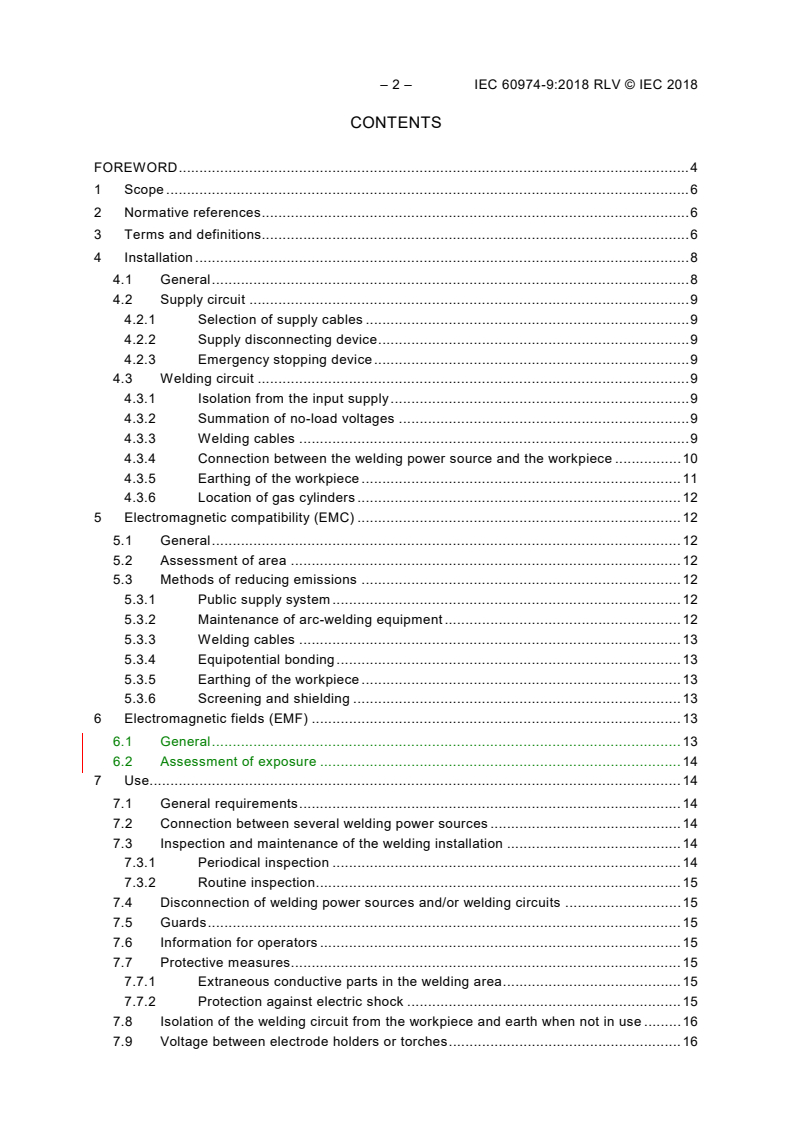
– 2 – IEC 60974-9:2018 RLV © IEC 2018
CONTENTS
FOREWORD . 4
1 Scope . 6
2 Normative references . 6
3 Terms and definitions. 6
4 Installation . 8
4.1 General . 8
4.2 Supply circuit . 9
4.2.1 Selection of supply cables . 9
4.2.2 Supply disconnecting device . 9
4.2.3 Emergency stopping device . 9
4.3 Welding circuit . 9
4.3.1 Isolation from the input supply . 9
4.3.2 Summation of no-load voltages . 9
4.3.3 Welding cables . 9
4.3.4 Connection between the welding power source and the workpiece . 10
4.3.5 Earthing of the workpiece . 11
4.3.6 Location of gas cylinders . 12
5 Electromagnetic compatibility (EMC) . 12
5.1 General . 12
5.2 Assessment of area . 12
5.3 Methods of reducing emissions . 12
5.3.1 Public supply system . 12
5.3.2 Maintenance of arc-welding equipment . 12
5.3.3 Welding cables . 13
5.3.4 Equipotential bonding . 13
5.3.5 Earthing of the workpiece . 13
5.3.6 Screening and shielding . 13
6 Electromagnetic fields (EMF) . 13
6.1 General . 13
6.2 Assessment of exposure . 14
7 Use. 14
7.1 General requirements . 14
7.2 Connection between several welding power sources . 14
7.3 Inspection and maintenance of the welding installation . 14
7.3.1 Periodical inspection . 14
7.3.2 Routine inspection . 15
7.4 Disconnection of welding power sources and/or welding circuits . 15
7.5 Guards . 15
7.6 Information for operators . 15
7.7 Protective measures . 15
7.7.1 Extraneous conductive parts in the welding area . 15
7.7.2 Protection against electric shock . 15
7.8 Isolation of the welding circuit from the workpiece and earth when not in use . 16
7.9 Voltage between electrode holders or torches . 16
7.10 Welding in an environment with increased hazard risk of electric shock . 18
7.11 Use of shoulder slings . 18
7.12 Welding at elevated positions . 19
7.13 Welding with suspended welding equipment . 19
8 Battery-powered welding power sources . 19
8.1 Safety recommendations . 19
8.2 Transportation . 19
Annex A (informative) Hazards associated with arc welding . 20
A.1 General . 20
A.2 Equipment condition and maintenance . 20
A.3 Operation . 20
A.4 Training . 20
A.5 Arc radiation. 20
A.5.1 General . 20
A.5.2 Eye and face protection (see also A.9) . 21
A.5.3 Body protection (see also A.9) . 21
A.5.4 Protection of persons in the vicinity of an arc . 21
A.6 EMF . 21
A.6.1 General . 21
A.6.2 Body protection . 21
A.6.3 Protection of persons in the vicinity of the welding operation . 21
A.7 Welding fume . 21
A.8 Noise . 22
A.9 Fire and explosion . 24
A.9.1 General . 24
A.9.2 Fire . 24
A.9.3 Explosion . 24
A.10 General protective clothing . 24
A.11 Confined spaces . 24
Annex B (informative) Voltage drops in the welding circuit . 26
Bibliography . 28
Figure 1 – Example of DC voltage between electrode holders or torches . 17
Figure 2 – Example of AC voltage between electrode holders or torches – Single-phase
supply from the same pair of lines of a three-phase mains supply . 17
Figure 3 – Example of AC voltage between electrode holders or torches – Single-phase
supply from different pairs of lines of a three-phase mains supply . 17
Figure 4 – Example of AC voltage between electrode holders connected between
different lines of output . 18
Figure A.1 – Steps for the control of welding fumes . 23
Figure A.2 – Example steps of operation for work in confined spaces . 25
Figure B.1 – Example of MIG/MAG equipment . 26
Table 1 – Current ratings for copper welding cables . 10
Table B.1 – Voltage drop in copper and aluminium welding cables at normal and
elevated temperatures . 27
– 4 – IEC 60974-9:2018 RLV © IEC 2018
INTERNATIONAL ELECTROTECHNICAL COMMISSION
____________
ARC WELDING EQUIPMENT –
Part 9: Installation and use
FOREWORD
1) The International Electrotechnical Commission (IEC) is a worldwide organization for standardization comprising
all national electrotechnical committees (IEC National Committees). The object of IEC is to promote
international co-operation on all questions concerning standardization in the electrical and electronic fields. To
this end and in addition to other activities, IEC publishes International Standards, Technical Specifications,
Technical Reports, Publicly Available Specifications (PAS) and Guides (hereafter referred to as "IEC
Publication(s)"). Their preparation is entrusted to technical committees; any IEC National Committee interested
in the subject dealt with may participate in this preparatory work. International, governmental and non-
governmental organizations liaising with the IEC also participate in this preparation. IEC collaborates closely
with the International Organization for Standardization (ISO) in accordance with conditions determined by
agreement between the two organizations.
2) The formal decisions or agreements of IEC on technical matters express, as nearly as possible, an international
consensus of opinion on the relevant subjects since each technical committee has representation from all
interested IEC National Committees.
3) IEC Publications have the form of recommendations for international use and are accepted by IEC National
Committees in that sense. While all reasonable efforts are made to ensure that the technical content of IEC
Publications is accurate, IEC cannot be held responsible for the way in which they are used or for any
misinterpretation by any end user.
4) In order to promote international uniformity, IEC National Committees undertake to apply IEC Publications
transparently to the maximum extent possible in their national and regional publications. Any divergence
between any IEC Publication and the corresponding national or regional publication shall be clearly indicated in
the latter.
5) IEC itself does not provide any attestation of conformity. Independent certification bodies provide conformity
assessment services and, in some areas, access to IEC marks of conformity. IEC is not responsible for any
services carried out by independent certification bodies.
6) All users should ensure that they have the latest edition of this publication.
7) No liability shall attach to IEC or its directors, employees, servants or agents including individual experts and
members of its technical committees and IEC National Committees for any personal injury, property damage or
other damage of any nature whatsoever, whether direct or indirect, or for costs (including legal fees) and
expenses arising out of the publication, use of, or reliance upon, this IEC Publication or any other IEC
Publications.
8) Attention is drawn to the Normative references cited in this publication. Use of the referenced publications is
indispensable for the correct application of this publication.
9) Attention is drawn to the possibility that some of the elements of this IEC Publication may be the subject of
patent rights. IEC shall not be held responsible for identifying any or all such patent rights.
This redline version of the official IEC Standard allows the user to identify the changes
made to the previous edition. A vertical bar appears in the margin wherever a change
has been made. Additions are in green text, deletions are in strikethrough red text.
International Standard IEC 60974-9 has been prepared by IEC technical committee 26: Electric
welding.
This standard cancels and replaces the first edition published in 2010. This edition constitutes
a technical revision.
This edition includes the following significant technical changes with respect to the previous
edition:
a) addition of a new Clause 8;
b) addition of interpolation details in Table 1.
The text of this International Standard is based on the following documents:
FDIS Report on voting
26/648/FDIS 26/649/RVD
Full information on the voting for the approval of this International Standard can be found in the
report on voting indicated in the above table.
This document has been drafted in accordance with the ISO/IEC Directives, Part 2.
In this standard, the following print types are used:
– terms defined in Clause 3: in bold type.
A list of all the parts of the IEC 60974 series can be found, under the general title Arc welding
equipment, on the IEC website.
The committee has decided that the contents of this document will remain unchanged until the
stability date indicated on the IEC website under "http://webstore.iec.ch" in the data related to
the specific document. At this date, the document will be
• reconfirmed,
• withdrawn,
• replaced by a revised edition, or
• amended.
IMPORTANT – The “colour inside” logo on the cover page of this publication indicates
that it contains colours which are considered to be useful for the correct understanding
of its contents. Users should therefore print this publication using a colour printer.
– 6 – IEC 60974-9:2018 RLV © IEC 2018
ARC WELDING EQUIPMENT –
Part 9: Installation and use
1 Scope
This document is applicable to requirements for installation and instructions for use of
equipment for arc welding and allied processes designed in accordance with safety
requirements of IEC 60974-1, IEC 60974-6 or equivalent.
This document is applicable for the guidance of instructors, operators, welders, managers, and
supervisors in the safe installation and use of equipment for arc welding and allied processes
and the safe performance of welding and cutting operations.
National and local regulations take precedence over this document.
2 Normative references
The following documents are referred to in the text in such a way that some or all of their
content constitutes requirements of this document. For dated references, only the edition cited
applies. For undated references, the latest edition of the referenced document (including any
amendments) applies.
IEC 60245-6, Rubber insulated cables – Rated voltages up to and including 450/750 V – Part 6:
Arc welding electrode cables
IEC/TR 60755, General requirements for residual current operated protective devices
IEC 60974-1:2005, Arc welding equipment – Part 1: Welding power sources
IEC 60974-4, Arc welding equipment – Part 4: In-service Periodic inspection and testing
IEC 60974-6, Arc welding equipment – Part 6: Limited duty manual metal arc welding power
sources
IEC 60974-10, Arc welding equipment – Part 10: Electromagnetic compatibility (EMC)
requirements
IEC 60974-11, Arc welding equipment – Part 11: Electrode holders
IEC 60974-12, Arc welding equipment – Part 12: Coupling devices for welding cables
IEC 60974-13, Arc welding equipment – Part 13: Welding clamp
3 Terms and definitions
For the purposes of this document, the following terms and definitions apply.
ISO and IEC maintain terminological databases for use in standardization at the following
addresses:
• IEC Electropedia: available at http://www.electropedia.org/
• ISO Online browsing platform: available at http://www.iso.org/obp
3.1
welding circuit
circuit that includes all conductive material through which the welding current is intended to
flow
Note 1 to entry: In arc welding, the arc is a part of the welding circuit.
Note 2 to entry: In certain arc welding processes, the arc may can be established between two electrodes. In such
a case, the workpiece is not necessarily a part of the welding circuit.
[SOURCE: IEC 60974-1:2005, 3.11 IEC 60050-851:2008, 851-14-10]
3.2
extraneous conductive part
conductive part not forming part of the electrical installation and liable to introduce an electric
potential, generally the earth potential
Note 1 to entry: Electrical installation includes the welding circuit.
[SOURCE: IEC 60050-851:2008, 851-14-57]
3.3
workpiece
metal piece or pieces on which welding or allied processes are performed
[SOURCE: IEC 60050-851:2008, 851-11-19]
3.4
protective clothing
protective accessories
protective clothing and accessories (e.g. gloves, hand shields, head masks and filter lenses)
used in order to diminish electric shock risks and the effects of fume and spatter and to protect
the skin and eyes against arc radiation
[SOURCE: IEC 60050-851:2008, 851-11-18]
3.5
environments with increased hazard risk of electric shock
environments where the hazard of electric shock by arc welding is increased in relation to
normal arc welding conditions
Note 1 to entry: Such environments are found for example
a) locations in which freedom of movement is restricted, so that the operator is forced to perform the welding in a
cramped (for example kneeling, sitting, lying) position with physical contact with conductive parts;
b) in locations which are fully or partially limited by conductive elements and in which there is a high risk of
unavoidable or accidental contact by the operator;
c) in wet, damp or hot locations where humidity or perspiration considerably reduces the skin resistance of the
human body and the insulating properties of protective accessories.
Note 2 to entry: Environments with increased hazard risk of electric shock are not meant to include places
where electrically conductive parts in the near vicinity of the operator which can cause increased hazard have been
insulated.
[SOURCE: IEC 60974-1:2005, 3.46 IEC 60050-851:2008, 851-15-09]
– 8 – IEC 60974-9:2018 RLV © IEC 2018
3.6
industrial and professional use
use intended only for experts or instructed persons
[IEC 60974-1:2005, 3.2]
3.6
expert
competent person
skilled person
person who can judge the work assigned and recognize possible hazards on the basis of
professional training, knowledge, experience and knowledge of the relevant equipment
Note 1 to entry: Several years of practice in the relevant technical field may can be taken into consideration in
assessment of professional training.
[SOURCE: IEC 60974-1:2005, 3.3 IEC 60050-851:2008, 851-11-10]
3.7
wire feeder
equipment that delivers filler wire to the arc or weld zone which includes the wire-feed control
and means to apply motion to the filler wire and may also include the filler wire supply
Note 1 to entry: The wire feeder may also include the wire-feed control, the filler wire supply, devices for gas
control, indicators and remote connectors.
[SOURCE: IEC 60974-5:2007, 3.11 IEC 60050-851:2008, 851-14-39]
3.8
auxiliary power output
circuit of a welding power source designed to provide electrical power to auxiliary equipment
4 Installation
4.1 General
Welding equipment used in arc welding installations shall be intended for the purpose and shall
be built in accordance with IEC 60974-1, IEC 60974-4, IEC 60974-6, IEC 60974-10, IEC 60974-
11 and IEC 60974-12 (see Clause 2), as given on the rating plate.
Electromagnetic compatibility (EMC) requirements shall be taken into consideration during
installation, see Clause 5.
The requirements of national and local regulations shall be taken into consideration during
installation, including grounding or protective earth connections, fuses, supply disconnecting
device, type of supply circuit, etc.
Read the manufacturer's instruction manual before installing the equipment. Full use shall be
made of the technical information relevant to the welding equipment.
Specific advice may be obtained from the welding equipment manufacturer, if necessary.
4.2 Supply circuit
4.2.1 Selection of supply cables
Supply cables for welding equipment and their overload protection, if not provided by the
manufacturer, shall be selected in accordance with the information given in the manufacturer's
instruction manual.
NOTE Examples of local regulations are given in the Bibliography, e.g. EN 50525-2-21, Electrical code NFPA 70
(SE, SO, ST, STO or other extra hard usage cable) or CSA C22.1. PVC insulation has been proven not suitable for
the application.
Supply cables shall be placed so that they cannot be damaged in use. If that cannot be
achieved, a sensitive residual current circuit breaker device (RCD), capable of operating at a
leakage current not exceeding 30 mA in accordance with IEC/TR 60755, shall be used to
reduce the risk of electric shock.
4.2.2 Supply disconnecting device
The installer shall ensure that a supply disconnecting device is fitted at the point of supply.
NOTE A plug may can be used as supply disconnecting device in accordance with national or local regulation.
4.2.3 Emergency stopping device
When an emergency stopping device is required by a national regulation (e.g. automatic
welding equipment), it shall conform to the relevant IEC standard.
For welding in an environment with increased hazard risk of electric shock, see 7.10.
4.3 Welding circuit
4.3.1 Isolation from the input supply
The welding circuit and circuits electrically connected to the welding circuit shall be
electrically isolated from the mains supply.
Verification shall be carried out by an expert.
4.3.2 Summation of no-load voltages
If more than one welding power source is in use at the same time, their no-load voltages can
be cumulative and could create an increased hazard of electric shock. Welding power sources
shall be installed so as to minimize this risk. Guidance is given in 7.9.
NOTE In the case of two welding transformers connected to the same lines, the resulting output voltage may can
be the sum of both no-load voltages. This can be avoided by using a suitable input or output connection (see 7.9).
NOTE Where more than one welding power source is installed, individual welding power
sources with their separate controls and connections should be clearly identified to show which
items belong to any one welding circuit.
4.3.3 Welding cables
Welding cables shall comply with IEC 60245-6. Copper conductor welding cables shall be
selected in accordance with the duty cycle and national regulations or, when inexistant, the
current rating given in Table 1. Where long cable runs are involved, it may can be necessary to
choose the cable size on the basis of voltage drop, see Annex B.
– 10 – IEC 60974-9:2018 RLV © IEC 2018
Table 1 – Current ratings for copper welding cables
a
Current ratings for specified duty cycle at an ambient temperature of 25 °C
Nominal cross-
b
sectional area
100 % 85 % 80 % 60 % 35 % 20 % 8 %
mm A A A A A A A
10 100 100 100 101 106 118 158
16 135 136 136 139 150 174 243
25 180 182 183 190 213 254 366
35 225 229 231 243 279 338 497
50 285 293 296 316 371 457 681
70 355 367 373 403 482 602 908
95 430 448 456 498 606 765 1 164
120 500 524 534 587 721 917 1 404
150 580 610 622 689 853 1 090 1 676
185 665 702 717 797 995 1 277 1 971
a
For higher ambient temperatures, a correction factor shall be applied:
0,96 (30 °C); 0,91 (35 °C); 0,87 (40 °C); 0,82 (45 °C). No interpolation is allowed for duty cycle values.
b
For intermediate values of nominal cross-section areas, interpolation is allowed.
NOTE Table originates from EN 50565-1:2014.
4.3.4 Connection between the welding power source and the workpiece
When the welding current does not flow entirely in the welding circuit, stray currents, which
are components of the welding current, occur. These can cause damage and may be
eliminated to electrical systems of buildings and to other sensitive systems in buildings and can
be minimized by the following means:
a) the electrical connection between the welding power source and the workpieces shall be
made as direct as practicable by means of an insulated return cable having an adequate
current-carrying capacity;
b) extraneous conductive parts, such as metal rails, pipes and frames shall not be used as
part of the welding circuit, unless they constitute the workpiece itself;
c) the return welding clamp shall be as near as practicable to the welding arc;
NOTE 1 When the return clamp is removed, it should be electrically isolated from parts connected to earth,
e.g. metallic enclosures with protective earth connection (class I), metal floors, building services.
d) the welding clamp disconnected from the workpiece shall be electrically isolated from
parts connected to earth, e.g. metallic enclosures with protective earth connection (class I),
metal floors, building services;
NOTE 1 The welding clamp can cause an electrical shock when welding current is flowing or when the
electrode circuit is in contact with the electrical ground circuit or work piece.
e) the welding circuit shall not be earthed unless required by national or local regulations
(see 4.3.5);
f) connection of the return cable to the workpiece shall be ensured by the use of devices
having suitable means for cable connection, a fastening system not liable to come loose
accidentally, and good electrical contact. Magnetic devices only present a good electrical
contact if the contact surfaces of the magnetic device and the contact area of the
workpiece are sufficiently large, even, conductive and clean (e.g. free from rust and
primer) and if the contact area of the workpiece is magnetic;
NOTE 2 If workpieces are on a welding bench or a work-handling device, the return cable may can be
connected to the bench or the device.
g) connection devices for non-stationary flexible welding cables in the welding circuit shall:
1) have an adequate covering of insulating material to prevent inadvertent contact with live
parts, when connected, with the exception of the return welding clamp at the workpiece
itself;
2) be suitable for the sizes of cables used and the welding current;
3) be effectively connected to the welding cables and in good electrical contact with them.
h) Welding, control and mains cables shall be protected from spatter and heat to prohibit
unintentional damage to the insulation.
Both the welding cable and the connection device shall be used within their specified current
rating. The connection device shall not be fitted with a cable smaller in diameter than specified
by the manufacturer of the connection device.
When coupling devices or welding clamps are used, they shall comply with IEC 60974-12 or
IEC 60974-13, respectively.
4.3.5 Earthing of the workpiece
The welding circuit should not be earthed, since it can increase the risk of stray welding
currents (see 4.3.3). Earthing of the welding circuit can also increase the area of metal
through which a person in contact with the welding circuit (e.g. the welding electrode) could
receive an electric shock.
NOTE 1 There are workpieces that have an inherent connection to earth, e.g. steel structures, ships, pipelines
etc. When these are welded, the possibility of stray currents is increased.
NOTE 2 In some cases, the workpiece may can be in permanent contact with earth, e.g. with protection class I
equipment which itself has protective conductors connected to earth. Such a workpiece is considered to be
inherently connected to earth.
An assessment of the welding circuit and the welding area shall be made to ensure that a
stray welding current will not flow through any object connected to earth and that is not
intended or capable of carrying the welding current (e.g. protective earth connection).
If electrical hand tools are used that may could come into contact with the workpiece, then
those tools shall be class II equipment (i.e. with double or reinforced insulation without
protective earth connection).
If earthing is required by national or local regulations, the earth connection shall be made by a
separate dedicated cable or conductor with a rating of at least that of the return cable and
connected directly to the workpiece.
Precautions shall be taken to insulate the operator from earth as well as from the workpiece
(see 7.7.2).
NOTE Where external radio frequency noise suppression networks are connected to the
welding circuit, an expert should shall assess whether the welding circuit can still be
regarded as insulated from earth.
NOTE 3 External radio frequency noise suppression networks could consist of a number of different components,
for example, LCR filters (inductance/capacitance/resistance).
– 12 – IEC 60974-9:2018 RLV © IEC 2018
4.3.6 Location of gas cylinders
Care shall be taken to prevent gas cylinders in the vicinity of the workpiece from becoming
part of the welding circuit.
5 Electromagnetic compatibility (EMC)
5.1 General
The user is responsible for installing and using the arc welding equipment in accordance with
the manufacturer’s instructions. If electromagnetic disturbances are detected, then it shall be
the responsibility of the user of the arc welding equipment to resolve the situation with the
technical assistance of the manufacturer.
5.2 Assessment of area
Before installing arc welding equipment, the user shall make an assessment of potential
electromagnetic interferences in the surrounding area. The following shall be taken into
account:
a) other supply cables, control cables, signalling and telephone cables, above, below and
adjacent to the arc welding equipment;
b) radio and television transmitters and receivers;
c) computer and other control equipment;
d) safety-critical equipment, for example, guarding of industrial equipment;
e) the health of the people around, for example, the use of pacemakers and hearing aids
wearable medical devices and implants;
f) equipment used for calibration or measurement;
g) the immunity of other equipment in the environment. The user shall ensure that other
equipment being used in the environment is compatible. This may can require additional
protection measures;
h) the time of day that welding or other activities are to be carried out.
The size of the surrounding area to be considered will depend on the structure of the building
and other activities that are taking place. The surrounding area may can extend beyond the
boundaries of the premises.
5.3 Methods of reducing emissions
5.3.1 Public supply system
The arc-welding equipment shall be connected to the public supply system in accordance with
the manufacturer’s recommendations. If interference occurs, it may can be necessary to take
additional precautions, such as filtering of the supply system. Consideration shall be given to
shielding the supply cable of permanently installed arc-welding equipment, in a metallic conduit
or equivalent. Shielding shall be electrically continuous throughout its length. The shielding
shall be connected to the welding power source so that good electrical contact is maintained
between the conduit and the welding power source enclosure.
5.3.2 Maintenance of arc-welding equipment
The arc-welding equipment shall be routinely maintained in accordance with IEC 60974-4 and
the manufacturer’s instructions. All access and service doors and covers shall be closed and
properly fastened when the arc-welding equipment is in operation. The arc-welding equipment
shall not be modified in any way, except for those changes and adjustments covered in the
manufacturer’s instructions. In particular, the spark gaps of arc striking and stabilising devices
shall be adjusted and maintained in accordance with the manufacturer’s instructions.
5.3.3 Welding cables
The welding cables shall be kept as short as possible and shall be positioned as close as
possible to each other, running at or close to the floor level. The welding cables shall never be
coiled during welding.
5.3.4 Equipotential bonding
Bonding of all metallic objects in the surrounding area should be considered for the purpose of
reducing emissions. However, metallic objects bonded to the workpiece will increase the risk
that the operator could receive an electric shock by touching these metallic objects and the
electrode at the same time. The operator shall be insulated from all such bonded metallic
objects.
5.3.5 Earthing of the workpiece
Where the workpiece is not bonded to earth for electrical safety, a connection bonding the
workpiece to earth may can reduce emissions in some, but not all instances. Care should be
taken to prevent the earthing of the workpiece increasing the risk of injury to users, or damage
to other electrical equipment. Where necessary, the connection of the workpiece to earth
should be made by a direct connection to the workpiece, but in some countries where direct
connection is not permitted, the bonding should be achieved by suitable capacitance, selected
in accordance with national and local regulations.
5.3.6 Screening and shielding
Selective screening and shielding of other cables and equipment in the surrounding area may
can alleviate problems of interference. Screening of the entire welding area may be considered
for special applications.
6 Electromagnetic fields (EMF)
6.1 General
Electric current flowing through any conductor causes localized electric and magnetic fields
(EMF). All welders should use the following procedures in order to minimize the risk associated
with exposure to EMFs from the welding circuit:
– route the welding cables together – secure them with tape when possible;
– place your torso and head body as far away as possible from the welding circuit;
– never coil welding cables around your body;
– do not place your body between welding cables. Keep both welding cables on the same
side of your body;
– connect the return cable to the workpiece as close as possible to the area being welded;
– do not work next to, sit or lean on the welding power source;
– do not weld whilst carrying the welding power source or wire feeder.
EMFs may can also interfere with wearable medical devices and implants, e.g. pacemakers.
Protective measures for persons with wearable medical devices and implants shall be taken.
For example, access restrictions for passers-by or individual risk-evaluations for welders. Risk
assessment and recommendation for users of wearable medical devices and implants shall be
made by a medical expert.
– 14 – IEC 60974-9:2018 RLV © IEC 2018
6.2 Assessment of exposure
When arc-welding equipment is configured an assessment of potential effects of
electromagnetic fields in the surrounding area shall be done. The following shall be taken into
account:
a) the datasheet regarding EMFs and special instructions in the user manual of the arc-
welding equipment;
b) busbars and other conductors carrying high voltages and/or currents;
c) other equipment generating high field strengths;
d) the health of the people around, for example the use of pacemakers and hearing aids.
The size of the surrounding area to be considered will depend on the structure of the building
and other activities that are taking place. The surrounding area can extend beyond the
boundaries of the premises.
7 Use
7.1 General requirements
User shall ensure that arc-welding equipment and accessories conform to the relevant parts of
IEC 60974, see Clause 2, as given on the rating plate. These documents contain necessary
information for health and safety to be included in instructions and manuals.
Before welding equipment is put into service, the user shall read and understand the
instructions provided by the manufacturer, national or local regulation, trade association and
occupational recommendations, national health and safety recommendations.
Consideration shall be given to the environment in which the welding equipment is used as
additional precautions may can need to be taken e.g. increased hazard of electric shock;
confined spaces; flammable area, asphyxiation (further references to specific hazards, see
Annex A).
7.2 Connection between several welding power sources
If welding power sources are to be connected in parallel or in series, this shall be carried out by
an expert and in accordance with the manufacturer's recommendations. The equipment shall
be approved for arc-welding operations only after a check has been carried out to ensure that
the permissible no-load voltage cannot be exceeded.
When one welding power source connected in parallel or series is taken out of service, that
power source shall be disconnected from the mains supply and from the welding circuit, so as
to prevent any hazards that might be caused by feedback voltages.
7.3 Inspection and maintenance of the welding installation
7.3.1 Periodical inspection
On installation, and periodically thereafter, an expert nominated for the task shall check that
the welding equipment has been correctly selected and connected for the work to be carried
out in accordance with IEC 60974-4 and the manufacturer's instructions and that all
connections are clean and tight and the welding equipment is in good condition.
In addition, all protective earthing shall be checked for effectiveness. Any defects found shall
be repaired.
7.3.2 Routine inspection
The operator shall be instructed to check all external connections daily and each time a
reconnection is made. Particular attention shall be paid to the installation of supply and welding
cables, electrode holders and coupling devices. Any defects found shall be reported, and faulty
equipment shall not be used until it has been repaired.
The return welding clamp shall be connected directly to the workpiece as close as practicable
to the point of welding or to the welding bench on which the workpiece is situated or to the
work-handling device.
For plasma cutting the no-load voltages are higher than with welding. This shall be considered
during inspection and maintenance procedures. Particular attention shall be paid to the
watercooling equipment to ensure that any leaks do not affect the insulation.
Before car
...
IEC 60974-9 ®
Edition 2.0 2018-04
INTERNATIONAL
STANDARD
NORME
INTERNATIONALE
Arc welding equipment –
Part 9: Installation and use
Matériel de soudage à l’arc –
Partie 9: Installation et utilisation
All rights reserved. Unless otherwise specified, no part of this publication may be reproduced or utilized in any form
or by any means, electronic or mechanical, including photocopying and microfilm, without permission in writing from
either IEC or IEC's member National Committee in the country of the requester. If you have any questions about IEC
copyright or have an enquiry about obtaining additional rights to this publication, please contact the address below or
your local IEC member National Committee for further information.
Droits de reproduction réservés. Sauf indication contraire, aucune partie de cette publication ne peut être reproduite
ni utilisée sous quelque forme que ce soit et par aucun procédé, électronique ou mécanique, y compris la photocopie
et les microfilms, sans l'accord écrit de l'IEC ou du Comité national de l'IEC du pays du demandeur. Si vous avez des
questions sur le copyright de l'IEC ou si vous désirez obtenir des droits supplémentaires sur cette publication, utilisez
les coordonnées ci-après ou contactez le Comité national de l'IEC de votre pays de résidence.
IEC Central Office Tel.: +41 22 919 02 11
3, rue de Varembé info@iec.ch
CH-1211 Geneva 20 www.iec.ch
Switzerland
About the IEC
The International Electrotechnical Commission (IEC) is the leading global organization that prepares and publishes
International Standards for all electrical, electronic and related technologies.
About IEC publications
The technical content of IEC publications is kept under constant review by the IEC. Please make sure that you have the
latest edition, a corrigenda or an amendment might have been published.
IEC Catalogue - webstore.iec.ch/catalogue Electropedia - www.electropedia.org
The stand-alone application for consulting the entire The world's leading online dictionary of electronic and
bibliographical information on IEC International Standards, electrical terms containing 21 000 terms and definitions in
Technical Specifications, Technical Reports and other English and French, with equivalent terms in 16 additional
documents. Available for PC, Mac OS, Android Tablets and languages. Also known as the International Electrotechnical
iPad. Vocabulary (IEV) online.
IEC publications search - webstore.iec.ch/advsearchform IEC Glossary - std.iec.ch/glossary
The advanced search enables to find IEC publications by a 67 000 electrotechnical terminology entries in English and
variety of criteria (reference number, text, technical French extracted from the Terms and Definitions clause of
committee,…). It also gives information on projects, replaced IEC publications issued since 2002. Some entries have been
and withdrawn publications. collected from earlier publications of IEC TC 37, 77, 86 and
CISPR.
IEC Just Published - webstore.iec.ch/justpublished
Stay up to date on all new IEC publications. Just Published IEC Customer Service Centre - webstore.iec.ch/csc
details all new publications released. Available online and If you wish to give us your feedback on this publication or
also once a month by email. need further assistance, please contact the Customer Service
Centre: sales@iec.ch.
A propos de l'IEC
La Commission Electrotechnique Internationale (IEC) est la première organisation mondiale qui élabore et publie des
Normes internationales pour tout ce qui a trait à l'électricité, à l'électronique et aux technologies apparentées.
A propos des publications IEC
Le contenu technique des publications IEC est constamment revu. Veuillez vous assurer que vous possédez l’édition la
plus récente, un corrigendum ou amendement peut avoir été publié.
Catalogue IEC - webstore.iec.ch/catalogue Electropedia - www.electropedia.org
Application autonome pour consulter tous les renseignements
Le premier dictionnaire en ligne de termes électroniques et
bibliographiques sur les Normes internationales,
électriques. Il contient 21 000 termes et définitions en anglais
Spécifications techniques, Rapports techniques et autres
et en français, ainsi que les termes équivalents dans 16
documents de l'IEC. Disponible pour PC, Mac OS, tablettes
langues additionnelles. Egalement appelé Vocabulaire
Android et iPad.
Electrotechnique International (IEV) en ligne.
Recherche de publications IEC -
Glossaire IEC - std.iec.ch/glossary
webstore.iec.ch/advsearchform
67 000 entrées terminologiques électrotechniques, en anglais
La recherche avancée permet de trouver des publications IEC et en français, extraites des articles Termes et Définitions des
en utilisant différents critères (numéro de référence, texte, publications IEC parues depuis 2002. Plus certaines entrées
comité d’études,…). Elle donne aussi des informations sur les antérieures extraites des publications des CE 37, 77, 86 et
projets et les publications remplacées ou retirées. CISPR de l'IEC.
IEC Just Published - webstore.iec.ch/justpublished Service Clients - webstore.iec.ch/csc
Restez informé sur les nouvelles publications IEC. Just Si vous désirez nous donner des commentaires sur cette
Published détaille les nouvelles publications parues. publication ou si vous avez des questions contactez-nous:
Disponible en ligne et aussi une fois par mois par email. sales@iec.ch.
IEC 60974-9 ®
Edition 2.0 2018-04
INTERNATIONAL
STANDARD
NORME
INTERNATIONALE
Arc welding equipment –
Part 9: Installation and use
Matériel de soudage à l’arc –
Partie 9: Installation et utilisation
INTERNATIONAL
ELECTROTECHNICAL
COMMISSION
COMMISSION
ELECTROTECHNIQUE
INTERNATIONALE
ICS 25.160.30 ISBN 978-2-8322-5635-0
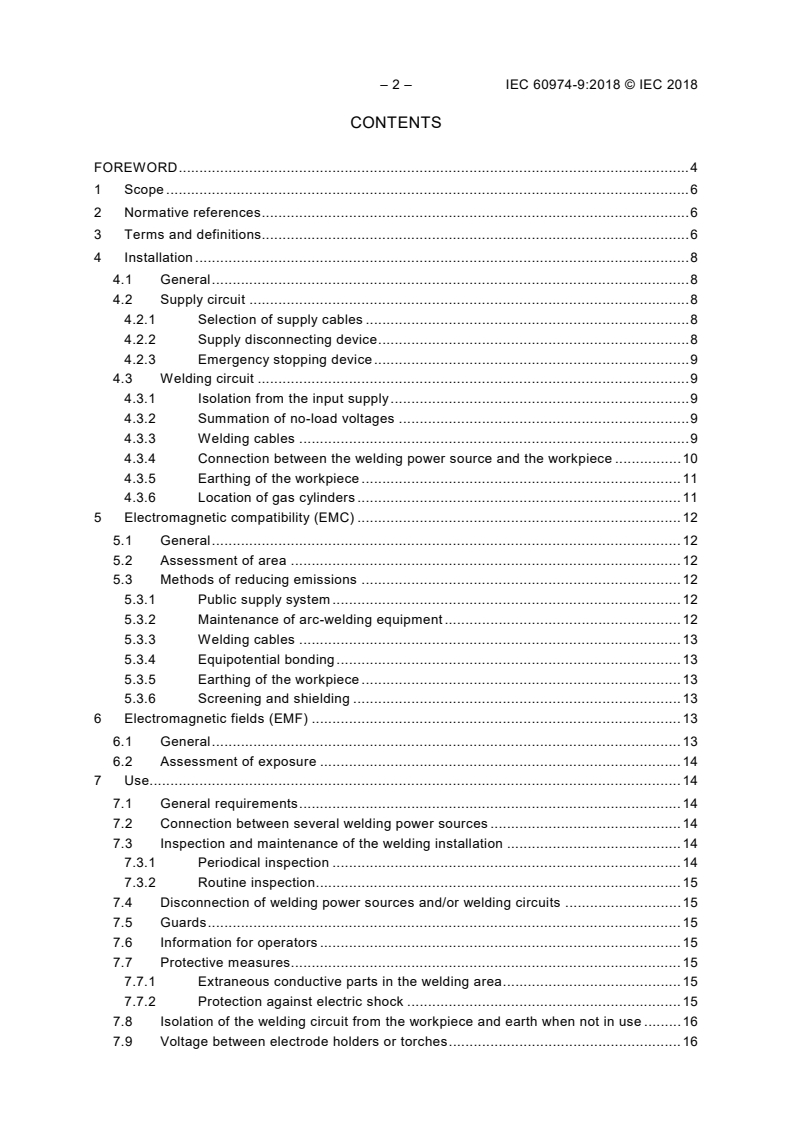
– 2 – IEC 60974-9:2018 © IEC 2018
CONTENTS
FOREWORD . 4
1 Scope . 6
2 Normative references . 6
3 Terms and definitions. 6
4 Installation . 8
4.1 General . 8
4.2 Supply circuit . 8
4.2.1 Selection of supply cables . 8
4.2.2 Supply disconnecting device . 8
4.2.3 Emergency stopping device . 9
4.3 Welding circuit . 9
4.3.1 Isolation from the input supply . 9
4.3.2 Summation of no-load voltages . 9
4.3.3 Welding cables . 9
4.3.4 Connection between the welding power source and the workpiece . 10
4.3.5 Earthing of the workpiece . 11
4.3.6 Location of gas cylinders . 11
5 Electromagnetic compatibility (EMC) . 12
5.1 General . 12
5.2 Assessment of area . 12
5.3 Methods of reducing emissions . 12
5.3.1 Public supply system . 12
5.3.2 Maintenance of arc-welding equipment . 12
5.3.3 Welding cables . 13
5.3.4 Equipotential bonding . 13
5.3.5 Earthing of the workpiece . 13
5.3.6 Screening and shielding . 13
6 Electromagnetic fields (EMF) . 13
6.1 General . 13
6.2 Assessment of exposure . 14
7 Use. 14
7.1 General requirements . 14
7.2 Connection between several welding power sources . 14
7.3 Inspection and maintenance of the welding installation . 14
7.3.1 Periodical inspection . 14
7.3.2 Routine inspection . 15
7.4 Disconnection of welding power sources and/or welding circuits . 15
7.5 Guards . 15
7.6 Information for operators . 15
7.7 Protective measures . 15
7.7.1 Extraneous conductive parts in the welding area . 15
7.7.2 Protection against electric shock . 15
7.8 Isolation of the welding circuit from the workpiece and earth when not in use . 16
7.9 Voltage between electrode holders or torches . 16
7.10 Welding in an environment with increased risk of electric shock . 18
7.11 Use of shoulder slings . 18
7.12 Welding at elevated positions . 19
7.13 Welding with suspended welding equipment . 19
8 Battery-powered welding power sources . 19
8.1 Safety recommendations . 19
8.2 Transportation . 19
Annex A (informative) Hazards associated with arc welding . 20
A.1 General . 20
A.2 Equipment condition and maintenance . 20
A.3 Operation . 20
A.4 Training . 20
A.5 Arc radiation. 20
A.5.1 General . 20
A.5.2 Eye and face protection (see also A.9) . 21
A.5.3 Body protection (see also A.9) . 21
A.5.4 Protection of persons in the vicinity of an arc . 21
A.6 EMF . 21
A.6.1 General . 21
A.6.2 Body protection . 21
A.6.3 Protection of persons in the vicinity of the welding operation . 21
A.7 Welding fume . 21
A.8 Noise . 22
A.9 Fire and explosion . 24
A.9.1 General . 24
A.9.2 Fire . 24
A.9.3 Explosion . 24
A.10 General protective clothing . 24
A.11 Confined spaces . 24
Annex B (informative) Voltage drops in the welding circuit . 26
Bibliography . 28
Figure 1 – Example of DC voltage between electrode holders or torches . 17
Figure 2 – Example of AC voltage between electrode holders or torches – Single-phase
supply from the same pair of lines of a three-phase mains supply . 17
Figure 3 – Example of AC voltage between electrode holders or torches – Single-phase
supply from different pairs of lines of a three-phase mains supply . 17
Figure 4 – Example of AC voltage between electrode holders connected between
different lines of output . 18
Figure A.1 – Steps for the control of welding fumes . 23
Figure A.2 – Example steps of operation for work in confined spaces . 25
Figure B.1 – Example of MIG/MAG equipment . 26
Table 1 – Current ratings for copper welding cables . 10
Table B.1 – Voltage drop in copper and aluminium welding cables at normal and
elevated temperatures . 27
– 4 – IEC 60974-9:2018 © IEC 2018
INTERNATIONAL ELECTROTECHNICAL COMMISSION
____________
ARC WELDING EQUIPMENT –
Part 9: Installation and use
FOREWORD
1) The International Electrotechnical Commission (IEC) is a worldwide organization for standardization comprising
all national electrotechnical committees (IEC National Committees). The object of IEC is to promote
international co-operation on all questions concerning standardization in the electrical and electronic fields. To
this end and in addition to other activities, IEC publishes International Standards, Technical Specifications,
Technical Reports, Publicly Available Specifications (PAS) and Guides (hereafter referred to as "IEC
Publication(s)"). Their preparation is entrusted to technical committees; any IEC National Committee interested
in the subject dealt with may participate in this preparatory work. International, governmental and non-
governmental organizations liaising with the IEC also participate in this preparation. IEC collaborates closely
with the International Organization for Standardization (ISO) in accordance with conditions determined by
agreement between the two organizations.
2) The formal decisions or agreements of IEC on technical matters express, as nearly as possible, an international
consensus of opinion on the relevant subjects since each technical committee has representation from all
interested IEC National Committees.
3) IEC Publications have the form of recommendations for international use and are accepted by IEC National
Committees in that sense. While all reasonable efforts are made to ensure that the technical content of IEC
Publications is accurate, IEC cannot be held responsible for the way in which they are used or for any
misinterpretation by any end user.
4) In order to promote international uniformity, IEC National Committees undertake to apply IEC Publications
transparently to the maximum extent possible in their national and regional publications. Any divergence
between any IEC Publication and the corresponding national or regional publication shall be clearly indicated in
the latter.
5) IEC itself does not provide any attestation of conformity. Independent certification bodies provide conformity
assessment services and, in some areas, access to IEC marks of conformity. IEC is not responsible for any
services carried out by independent certification bodies.
6) All users should ensure that they have the latest edition of this publication.
7) No liability shall attach to IEC or its directors, employees, servants or agents including individual experts and
members of its technical committees and IEC National Committees for any personal injury, property damage or
other damage of any nature whatsoever, whether direct or indirect, or for costs (including legal fees) and
expenses arising out of the publication, use of, or reliance upon, this IEC Publication or any other IEC
Publications.
8) Attention is drawn to the Normative references cited in this publication. Use of the referenced publications is
indispensable for the correct application of this publication.
9) Attention is drawn to the possibility that some of the elements of this IEC Publication may be the subject of
patent rights. IEC shall not be held responsible for identifying any or all such patent rights.
International Standard IEC 60974-9 has been prepared by IEC technical committee 26: Electric
welding.
This standard cancels and replaces the first edition published in 2010. This edition constitutes
a technical revision.
This edition includes the following significant technical changes with respect to the previous
edition:
a) addition of a new Clause 8;
b) addition of interpolation details in Table 1.
The text of this International Standard is based on the following documents:
FDIS Report on voting
26/648/FDIS 26/649/RVD
Full information on the voting for the approval of this International Standard can be found in the
report on voting indicated in the above table.
This document has been drafted in accordance with the ISO/IEC Directives, Part 2.
In this standard, the following print types are used:
– terms defined in Clause 3: in bold type.
A list of all the parts of the IEC 60974 series can be found, under the general title Arc welding
equipment, on the IEC website.
The committee has decided that the contents of this document will remain unchanged until the
stability date indicated on the IEC website under "http://webstore.iec.ch" in the data related to
the specific document. At this date, the document will be
• reconfirmed,
• withdrawn,
• replaced by a revised edition, or
• amended.
– 6 – IEC 60974-9:2018 © IEC 2018
ARC WELDING EQUIPMENT –
Part 9: Installation and use
1 Scope
This document is applicable to requirements for installation and instructions for use of
equipment for arc welding and allied processes designed in accordance with safety
requirements of IEC 60974-1, IEC 60974-6 or equivalent.
This document is applicable for the guidance of instructors, operators, welders, managers, and
supervisors in the safe installation and use of equipment for arc welding and allied processes
and the safe performance of welding and cutting operations.
National and local regulations take precedence over this document.
2 Normative references
The following documents are referred to in the text in such a way that some or all of their
content constitutes requirements of this document. For dated references, only the edition cited
applies. For undated references, the latest edition of the referenced document (including any
amendments) applies.
IEC 60245-6, Rubber insulated cables – Rated voltages up to and including 450/750 V – Part 6:
Arc welding electrode cables
IEC 60755, General requirements for residual current operated protective devices
IEC 60974-1, Arc welding equipment – Part 1: Welding power sources
IEC 60974-4, Arc welding equipment – Part 4: Periodic inspection and testing
IEC 60974-11, Arc welding equipment – Part 11: Electrode holders
IEC 60974-12, Arc welding equipment – Part 12: Coupling devices for welding cables
IEC 60974-13, Arc welding equipment – Part 13: Welding clamp
3 Terms and definitions
For the purposes of this document, the following terms and definitions apply.
ISO and IEC maintain terminological databases for use in standardization at the following
addresses:
• IEC Electropedia: available at http://www.electropedia.org/
• ISO Online browsing platform: available at http://www.iso.org/obp
3.1
welding circuit
conductive material through which the welding current is intended to flow
Note 1 to entry: In arc welding, the arc is a part of the welding circuit.
Note 2 to entry: In certain arc welding processes, the arc can be established between two electrodes. In such a
case, the workpiece is not necessarily a part of the welding circuit.
[SOURCE: IEC 60050-851:2008, 851-14-10]
3.2
extraneous conductive part
conductive part not forming part of the electrical installation and liable to introduce an electric
potential, generally the earth potential
Note 1 to entry: Electrical installation includes the welding circuit.
[SOURCE: IEC 60050-851:2008, 851-14-57]
3.3
workpiece
metal piece or pieces on which welding or allied processes are performed
[SOURCE: IEC 60050-851:2008, 851-11-19]
3.4
protective clothing
protective accessories
protective clothing and accessories (e.g. gloves, hand shields, head masks and filter lenses)
used in order to diminish electric shock risks and the effects of fume and spatter and to protect
the skin and eyes against arc radiation
[SOURCE: IEC 60050-851:2008, 851-11-18]
3.5
environment with increased risk of electric shock
environment where the hazard of electric shock by arc welding is increased in relation to
normal arc welding conditions
Note 1 to entry: Such environments are found for example
a) locations in which freedom of movement is restricted, so that the operator is forced to perform the welding in a
cramped (for example kneeling, sitting, lying) position with physical contact with conductive parts;
b) in locations which are fully or partially limited by conductive elements and in which there is a high risk of
unavoidable or accidental contact by the operator;
c) in wet, damp or hot locations where humidity or perspiration considerably reduces the skin resistance of the
human body and the insulating properties of protective accessories.
Note 2 to entry: Environments with increased risk of electric shock are not meant to include places where
electrically conductive parts in the near vicinity of the operator which can cause increased hazard have been
insulated.
[SOURCE: IEC 60050-851:2008, 851-15-09]
3.6
expert
competent person
skilled person
person who can judge the work assigned and recognize possible hazards on the basis of
professional training, knowledge, experience and knowledge of the relevant equipment
– 8 – IEC 60974-9:2018 © IEC 2018
Note 1 to entry: Several years of practice in the relevant technical field can be taken into consideration in
assessment of professional training.
[SOURCE: IEC 60050-851:2008, 851-11-10]
3.7
wire feeder
equipment that delivers filler wire to the arc or weld zone which includes means to apply motion
to the filler wire
Note 1 to entry: The wire feeder may also include the wire-feed control, the filler wire supply, devices for gas
control, indicators and remote connectors.
[SOURCE: IEC 60050-851:2008, 851-14-39]
4 Installation
4.1 General
Welding equipment used in arc welding installations shall be intended for the purpose as given
on the rating plate.
Electromagnetic compatibility (EMC) requirements shall be taken into consideration during
installation, see Clause 5.
The requirements of national and local regulations shall be taken into consideration during
installation, including grounding or protective earth connections, fuses, supply disconnecting
device, type of supply circuit, etc.
Read the manufacturer's instruction manual before installing the equipment. Full use shall be
made of the technical information relevant to the welding equipment.
Specific advice may be obtained from the welding equipment manufacturer, if necessary.
4.2 Supply circuit
4.2.1 Selection of supply cables
Supply cables for welding equipment and their overload protection, if not provided by the
manufacturer, shall be selected in accordance with the information given in the manufacturer's
instruction manual.
NOTE Examples of local regulations are given in the Bibliography, e.g. EN 50525-2-21, Electrical code NFPA 70
(SE, SO, ST, STO or other extra hard usage cable) or CSA C22.1. PVC insulation has been proven not suitable for
the application.
Supply cables shall be placed so that they cannot be damaged in use. If that cannot be
achieved, a residual current device (RCD), capable of operating at a leakage current not
exceeding 30 mA in accordance with IEC 60755, shall be used to reduce the risk of electric
shock.
4.2.2 Supply disconnecting device
The installer shall ensure that a supply disconnecting device is fitted at the point of supply.
NOTE A plug can be used as supply disconnecting device in accordance with national or local regulation.
4.2.3 Emergency stopping device
When an emergency stopping device is required by a national regulation (e.g. automatic
welding equipment), it shall conform to the relevant IEC standard.
For welding in an environment with increased risk of electric shock, see 7.10.
4.3 Welding circuit
4.3.1 Isolation from the input supply
The welding circuit and circuits electrically connected to the welding circuit shall be
electrically isolated from the mains supply.
Verification shall be carried out by an expert.
4.3.2 Summation of no-load voltages
If more than one welding power source is in use at the same time, their no-load voltages can
be cumulative and could create an increased hazard of electric shock. Welding power sources
shall be installed so as to minimize this risk. Guidance is given in 7.9.
NOTE In the case of two welding transformers connected to the same lines, the resulting output voltage can be
the sum of both no-load voltages. This can be avoided by using a suitable input or output connection (see 7.9).
Where more than one welding power source is installed, individual welding power sources with
their separate controls and connections should be clearly identified to show which items belong
to any one welding circuit.
4.3.3 Welding cables
Welding cables shall comply with IEC 60245-6. Copper conductor welding cables shall be
selected in accordance with the duty cycle and national regulations or, when inexistant, the
current rating given in Table 1. Where long cable runs are involved, it can be necessary to
choose the cable size on the basis of voltage drop, see Annex B.
– 10 – IEC 60974-9:2018 © IEC 2018
Table 1 – Current ratings for copper welding cables
a
Current ratings for specified duty cycle at an ambient temperature of 25 °C
Nominal cross-
b
sectional area
100 % 85 % 80 % 60 % 35 % 20 % 8 %
mm A A A A A A A
10 100 100 100 101 106 118 158
16 135 136 136 139 150 174 243
25 180 182 183 190 213 254 366
35 225 229 231 243 279 338 497
50 285 293 296 316 371 457 681
70 355 367 373 403 482 602 908
95 430 448 456 498 606 765 1 164
120 500 524 534 587 721 917 1 404
150 580 610 622 689 853 1 090 1 676
185 665 702 717 797 995 1 277 1 971
a
For higher ambient temperatures, a correction factor shall be applied:
0,96 (30 °C); 0,91 (35 °C); 0,87 (40 °C); 0,82 (45 °C). No interpolation is allowed for duty cycle values.
b
For intermediate values of nominal cross-section areas, interpolation is allowed.
NOTE Table originates from EN 50565-1:2014.
4.3.4 Connection between the welding power source and the workpiece
When the welding current does not flow entirely in the welding circuit, stray currents, which
are components of the welding current, occur. These can cause damage to electrical systems
of buildings and to other sensitive systems in buildings and can be minimized by the following
means:
a) the electrical connection between the welding power source and the workpieces shall be
made as direct as practicable by means of an insulated return cable having an adequate
current-carrying capacity;
b) extraneous conductive parts, such as metal rails, pipes and frames shall not be used as
part of the welding circuit, unless they constitute the workpiece itself;
c) the welding clamp shall be as near as practicable to the welding arc;
d) the welding clamp disconnected from the workpiece shall be electrically isolated from parts
connected to earth, e.g. metallic enclosures with protective earth connection (class I), metal
floors, building services;
NOTE 1 The welding clamp can cause an electrical shock when welding current is flowing or when the
electrode circuit is in contact with the electrical ground circuit or work piece.
e) the welding circuit shall not be earthed unless required by national or local regulations
(see 4.3.5);
f) connection of the return cable to the workpiece shall be ensured by the use of devices
having suitable means for cable connection, a fastening system not liable to come loose
accidentally, and good electrical contact. Magnetic devices only present a good electrical
contact if the contact surfaces of the magnetic device and the contact area of the
workpiece are sufficiently large, even, conductive and clean (e.g. free from rust and
primer) and if the contact area of the workpiece is magnetic;
NOTE 2 If workpieces are on a welding bench or a work-handling device, the return cable can be connected
to the bench or the device.
g) connection devices for non-stationary flexible welding cables in the welding circuit shall:
1) have an adequate covering of insulating material to prevent inadvertent contact with live
parts, when connected, with the exception of the welding clamp at the workpiece itself;
2) be suitable for the sizes of cables used and the welding current;
3) be effectively connected to the welding cables and in good electrical contact with them.
h) Welding, control and mains cables shall be protected from spatter and heat to prohibit
unintentional damage to the insulation.
Both the welding cable and the connection device shall be used within their specified current
rating. The connection device shall not be fitted with a cable smaller in diameter than specified
by the manufacturer of the connection device.
When coupling devices or welding clamps are used, they shall comply with IEC 60974-12 or
IEC 60974-13, respectively.
4.3.5 Earthing of the workpiece
The welding circuit should not be earthed, since it can increase the risk of stray welding
currents (see 4.3.3). Earthing of the welding circuit can also increase the area of metal
through which a person in contact with the welding circuit (e.g. the welding electrode) could
receive an electric shock.
NOTE 1 There are workpieces that have an inherent connection to earth, e.g. steel structures, ships, pipelines.
When these are welded, the possibility of stray currents is increased.
NOTE 2 In some cases, the workpiece can be in permanent contact with earth, e.g. with protection class I
equipment which itself has protective conductors connected to earth. Such a workpiece is considered to be
inherently connected to earth.
An assessment of the welding circuit and the welding area shall be made to ensure that a
stray welding current will not flow through any object connected to earth that is not intended or
capable of carrying the welding current (e.g. protective earth connection).
If electrical hand tools are used that could come into contact with the workpiece, then those
tools shall be class II equipment (i.e. with double or reinforced insulation without protective
earth connection).
If earthing is required by national or local regulations, the earth connection shall be made by a
separate dedicated cable or conductor with a rating of at least that of the return cable and
connected directly to the workpiece.
Precautions shall be taken to insulate the operator from earth as well as from the workpiece
(see 7.7.2).
Where external radio frequency noise suppression networks are connected to the welding
circuit, an expert shall assess whether the welding circuit can still be regarded as insulated
from earth.
NOTE 3 External radio frequency noise suppression networks could consist of a number of different components,
for example, LCR filters (inductance/capacitance/resistance).
4.3.6 Location of gas cylinders
Care shall be taken to prevent gas cylinders in the vicinity of the workpiece from becoming
part of the welding circuit.
– 12 – IEC 60974-9:2018 © IEC 2018
5 Electromagnetic compatibility (EMC)
5.1 General
The user is responsible for installing and using the arc welding equipment in accordance with
the manufacturer’s instructions. If electromagnetic disturbances are detected, then it shall be
the responsibility of the user of the arc welding equipment to resolve the situation with the
technical assistance of the manufacturer.
5.2 Assessment of area
Before installing arc welding equipment, the user shall make an assessment of potential
electromagnetic interferences in the surrounding area. The following shall be taken into
account:
a) other supply cables, control cables, signalling and telephone cables, above, below and
adjacent to the arc welding equipment;
b) radio and television transmitters and receivers;
c) computer and other control equipment;
d) safety-critical equipment, for example, guarding of industrial equipment;
e) the health of the people around, for example, the use of wearable medical devices and
implants;
f) equipment used for calibration or measurement;
g) the immunity of other equipment in the environment. The user shall ensure that other
equipment being used in the environment is compatible. This can require additional
protection measures;
h) the time of day that welding or other activities are to be carried out.
The size of the surrounding area to be considered will depend on the structure of the building
and other activities that are taking place. The surrounding area can extend beyond the
boundaries of the premises.
5.3 Methods of reducing emissions
5.3.1 Public supply system
The arc-welding equipment shall be connected to the public supply system in accordance with
the manufacturer’s recommendations. If interference occurs, it can be necessary to take
additional precautions, such as filtering of the supply system. Consideration shall be given to
shielding the supply cable of permanently installed arc-welding equipment, in a metallic conduit
or equivalent. Shielding shall be electrically continuous throughout its length. The shielding
shall be connected to the welding power source so that good electrical contact is maintained
between the conduit and the welding power source enclosure.
5.3.2 Maintenance of arc-welding equipment
The arc-welding equipment shall be routinely maintained in accordance with IEC 60974-4 and
the manufacturer’s instructions. All access and service doors and covers shall be closed and
properly fastened when the arc-welding equipment is in operation. The arc-welding equipment
shall not be modified in any way, except for those changes and adjustments covered in the
manufacturer’s instructions. In particular, the spark gaps of arc striking and stabilising devices
shall be adjusted and maintained in accordance with the manufacturer’s instructions.
5.3.3 Welding cables
The welding cables shall be kept as short as possible and shall be positioned as close as
possible to each other, running at or close to the floor level. The welding cables shall never be
coiled during welding.
5.3.4 Equipotential bonding
Bonding of all metallic objects in the surrounding area should be considered for the purpose of
reducing emissions. However, metallic objects bonded to the workpiece will increase the risk
that the operator could receive an electric shock by touching these metallic objects and the
electrode at the same time. The operator shall be insulated from all such bonded metallic
objects.
5.3.5 Earthing of the workpiece
Where the workpiece is not bonded to earth for electrical safety, a connection bonding the
workpiece to earth can reduce emissions in some, but not all instances. Care should be taken
to prevent the earthing of the workpiece increasing the risk of injury to users, or damage to
other electrical equipment. Where necessary, the connection of the workpiece to earth should
be made by a direct connection to the workpiece, but in some countries where direct
connection is not permitted, the bonding should be achieved by suitable capacitance, selected
in accordance with national and local regulations.
5.3.6 Screening and shielding
Selective screening and shielding of other cables and equipment in the surrounding area can
alleviate problems of interference. Screening of the entire welding area may be considered for
special applications.
6 Electromagnetic fields (EMF)
6.1 General
Electric current flowing through any conductor causes localized electric and magnetic fields
(EMF). All welders should use the following procedures in order to minimize the risk associated
with exposure to EMFs from the welding circuit:
– route the welding cables together – secure them with tape when possible;
– place your body as far away as possible from the welding circuit;
– never coil welding cables around your body;
– do not place your body between welding cables. Keep both welding cables on the same
side of your body;
– connect the return cable to the workpiece as close as possible to the area being welded;
– do not work next to, sit or lean on the welding power source;
– do not weld whilst carrying the welding power source or wire feeder.
EMFs can also interfere with wearable medical devices and implants. Protective measures for
persons with wearable medical devices and implants shall be taken. For example, access
restrictions for passers-by or individual risk-evaluations for welders. Risk assessment and
recommendation for users of wearable medical devices and implants shall be made by a
medical expert.
– 14 – IEC 60974-9:2018 © IEC 2018
6.2 Assessment of exposure
When arc-welding equipment is configured an assessment of potential effects of
electromagnetic fields in the surrounding area shall be done. The following shall be taken into
account:
a) the datasheet regarding EMFs and special instructions in the user manual of the arc-
welding equipment;
b) busbars and other conductors carrying high voltages and/or currents;
c) other equipment generating high field strengths;
d) the health of the people around, for example the use of pacemakers and hearing aids.
The size of the surrounding area to be considered will depend on the structure of the building
and other activities that are taking place. The surrounding area can extend beyond the
boundaries of the premises.
7 Use
7.1 General requirements
User shall ensure that arc-welding equipment and accessories conform to the relevant parts of
IEC 60974, see Clause 2, as given on the rating plate. These documents contain necessary
information for health and safety to be included in instructions and manuals.
Before welding equipment is put into service, the user shall read and understand the
instructions provided by the manufacturer, national or local regulation, trade association and
occupational recommendations, national health and safety recommendations.
Consideration shall be given to the environment in which the welding equipment is used as
additional precautions can need to be taken e.g. increased hazard of electric shock; confined
spaces; flammable area, asphyxiation (further references to specific hazards, see Annex A).
7.2 Connection between several welding power sources
If welding power sources are to be connected in parallel or in series, this shall be carried out by
an expert and in accordance with the manufacturer's recommendations. The equipment shall
be approved for arc-welding operations only after a check has been carried out to ensure that
the permissible no-load voltage cannot be exceeded.
When one welding power source connected in parallel or series is taken out of service, that
power source shall be disconnected from the mains supply and from the welding circuit, so as
to prevent any hazards that might be caused by feedback voltages.
7.3 Inspection and maintenance of the welding installation
7.3.1 Periodical inspection
On installation, and periodically thereafter, an expert nominated for the task shall check that
the welding equipment has been correctly selected and connected for the work to be carried
out in accordance with IEC 60974-4 and the manufacturer's
...