

IEC 80601-2-78:2019
(Main)Medical electrical equipment - Part 2-78: Particular requirements for basic safety and essential performance of medical robots for rehabilitation, assessment, compensation or alleviation
General Information
- Abstract
IEC 80601-2-78:2019 applies to the general requirements for BASIC SAFETY and ESSENTIAL PERFORMANCE of MEDICAL ROBOTS that physically interact with a PATIENT with an IMPAIRMENT to support or perform REHABILITATION, ASSESSMENT, COMPENSATION or ALLEVIATION related to the PATIENT’S MOVEMENT FUNCTIONS, as intended by the MANUFACTURER.
IEC 80601-2-78:2019 does not apply to
• external limb prosthetic devices (use ISO 22523),
• electric wheelchairs (use ISO 7176 (all parts)),
• diagnostic imaging equipment (e.g. MRI, use IEC 60601-2-33), and
• personal care ROBOTS (use ISO 13482).
- Status
- Published
- Publication Date
- 11-Mar-2024
- Technical Committee
- SC 62D - Particular medical equipment, software, and systems
- Drafting Committee
- JWG 36 - TC 62/SC 62D/JWG 36
- Current Stage
- PPUB - Publication issued
- Start Date
- 09-Jul-2019
- Completion Date
- 28-Jun-2019
Buy Documents
IEC 80601-2-78:2019 - Medical electrical equipment - Part 2-78: Particular requirements for basic safety and essential performance of medical robots for rehabilitation, assessment, compensation or alleviation Released:7/9/2019
IEC 80601-2-78:2019+AMD1:2024 CSV - Medical electrical equipment - Part 2-78: Particular requirements for basic safety and essential performance of medical robots for rehabilitation, assessment, compensation or alleviation Released:3/12/2024
Overview
IEC 80601-2-78:2019 is an international standard published by the International Electrotechnical Commission (IEC) that specifies particular requirements for the basic safety and essential performance of medical robots used in rehabilitation, assessment, compensation, or alleviation of movement impairments. This standard ensures that medical electrical equipment in the form of rehabilitation robots meets rigorous safety and functionality criteria when interacting physically with patients.
The scope of IEC 80601-2-78:2019 covers medical robots designed to assist patients with movement-related impairments. It establishes a framework for evaluating risks and performance to enhance patient safety and device reliability. However, this standard does not apply to external limb prosthetic devices, electric wheelchairs, diagnostic imaging equipment, or personal care robots, which are covered by other specialized standards such as ISO 22523, ISO 7176, IEC 60601-2-33, and ISO 13482 respectively.
Key Topics
Basic Safety Requirements
IEC 80601-2-78:2019 mandates protection from electrical, mechanical, and radiation hazards related to medical rehabilitation robots. It addresses potential hazards that could arise during the operation of these devices to safeguard patients and operators.Essential Performance Criteria
The standard defines essential performance attributes necessary to ensure that rehabilitation robots operate as intended. This includes accuracy of control systems, reliability of sensors, and maintaining functionality under various operational conditions.Risk Management and Usability
Emphasizing patient safety, the document incorporates risk management processes aligning with ISO 14971 and usability engineering in accordance with IEC 62366-1. This ensures that design decisions consider potential risk factors and support user-friendly interfaces for patients and healthcare providers.Testing and Validation
IEC 80601-2-78 outlines specific testing methods to verify electrical safety, mechanical integrity, electromagnetic compatibility, and alarm system functions. These tests confirm that rehabilitation robots meet stringent quality and safety benchmarks before clinical use.Programmable Electrical Medical Systems (PEMS)
The standard includes requirements for programmable aspects of medical robots to ensure software reliability and safe operation during adaptive or autonomous functioning.
Applications
IEC 80601-2-78:2019 is applicable to a broad range of medical robots engaged in:
Rehabilitation
Robots designed to support patient recovery and physical therapy by facilitating movement exercises or neuromuscular retraining.Assessment
Devices that measure and evaluate patient movement capabilities to inform clinicians about functional impairments and recovery progress.Compensation
Assistive robots that help patients perform movements they are unable to complete independently, aiding daily living activities.Alleviation
Systems aimed at reducing the impact of movement disabilities through external support or adaptive technologies.
This standard is critical for manufacturers developing rehabilitation robots ensuring compliance with internationally recognized safety norms, enabling market access worldwide, and enhancing patient outcomes.
Related Standards
- ISO 22523 – Requirements for external limb prosthetic devices
- ISO 7176 (all parts) – Standards for electric wheelchairs
- IEC 60601-2-33 – Particular requirements for diagnostic imaging equipment such as MRI
- ISO 13482 – Safety requirements for personal care robots
- ISO 14971 – Medical device risk management
- IEC 62366-1 – Usability engineering for medical devices
By adhering to IEC 80601-2-78:2019, manufacturers integrate robust safety and performance protocols within medical robotics, fostering reliable assistive technologies that support patient mobility and functional independence. The standard plays a pivotal role in defining best practices for the safe development, deployment, and clinical use of rehabilitation robotics worldwide.
Relations
- Effective Date
- 05-Sep-2023
Buy Documents
IEC 80601-2-78:2019 - Medical electrical equipment - Part 2-78: Particular requirements for basic safety and essential performance of medical robots for rehabilitation, assessment, compensation or alleviation Released:7/9/2019
IEC 80601-2-78:2019+AMD1:2024 CSV - Medical electrical equipment - Part 2-78: Particular requirements for basic safety and essential performance of medical robots for rehabilitation, assessment, compensation or alleviation Released:3/12/2024
Get Certified
Connect with accredited certification bodies for this standard

BSI Group
BSI (British Standards Institution) is the business standards company that helps organizations make excellence a habit.

TÜV Rheinland
TÜV Rheinland is a leading international provider of technical services.

TÜV SÜD
TÜV SÜD is a trusted partner of choice for safety, security and sustainability solutions.
Sponsored listings
Frequently Asked Questions
IEC 80601-2-78:2019 is a standard published by the International Electrotechnical Commission (IEC). Its full title is "Medical electrical equipment - Part 2-78: Particular requirements for basic safety and essential performance of medical robots for rehabilitation, assessment, compensation or alleviation". This standard covers: IEC 80601-2-78:2019 applies to the general requirements for BASIC SAFETY and ESSENTIAL PERFORMANCE of MEDICAL ROBOTS that physically interact with a PATIENT with an IMPAIRMENT to support or perform REHABILITATION, ASSESSMENT, COMPENSATION or ALLEVIATION related to the PATIENT’S MOVEMENT FUNCTIONS, as intended by the MANUFACTURER. IEC 80601-2-78:2019 does not apply to • external limb prosthetic devices (use ISO 22523), • electric wheelchairs (use ISO 7176 (all parts)), • diagnostic imaging equipment (e.g. MRI, use IEC 60601-2-33), and • personal care ROBOTS (use ISO 13482).
IEC 80601-2-78:2019 applies to the general requirements for BASIC SAFETY and ESSENTIAL PERFORMANCE of MEDICAL ROBOTS that physically interact with a PATIENT with an IMPAIRMENT to support or perform REHABILITATION, ASSESSMENT, COMPENSATION or ALLEVIATION related to the PATIENT’S MOVEMENT FUNCTIONS, as intended by the MANUFACTURER. IEC 80601-2-78:2019 does not apply to • external limb prosthetic devices (use ISO 22523), • electric wheelchairs (use ISO 7176 (all parts)), • diagnostic imaging equipment (e.g. MRI, use IEC 60601-2-33), and • personal care ROBOTS (use ISO 13482).
IEC 80601-2-78:2019 is classified under the following ICS (International Classification for Standards) categories: 11.040.01 - Medical equipment in general; 29.060.10 - Wires. The ICS classification helps identify the subject area and facilitates finding related standards.
IEC 80601-2-78:2019 has the following relationships with other standards: It is inter standard links to IEC 80601-2-78:2019/AMD1:2024. Understanding these relationships helps ensure you are using the most current and applicable version of the standard.
IEC 80601-2-78:2019 is available in PDF format for immediate download after purchase. The document can be added to your cart and obtained through the secure checkout process. Digital delivery ensures instant access to the complete standard document.
Standards Content (Sample)
IEC 80601-2-78
Edition 1.0 2019-07
INTERNATIONAL
STANDARD
NORME
INTERNATIONALE
colour
inside
Medical electrical equipment –
Part 2-78: Particular requirements for basic safety and essential performance of
medical robots for rehabilitation, assessment, compensation or alleviation
Appareils électromédicaux –
Partie 2-78: Exigences particulières pour la sécurité de base et les performances
essentielles des robots médicaux dédiés à la rééducation, l'évaluation, la
compensation ou l'atténuation
All rights reserved. Unless otherwise specified, no part of this publication may be reproduced or utilized in any form
or by any means, electronic or mechanical, including photocopying and microfilm, without permission in writing from
either IEC or IEC's member National Committee in the country of the requester. If you have any questions about IEC
copyright or have an enquiry about obtaining additional rights to this publication, please contact the address below or
your local IEC member National Committee for further information.
Droits de reproduction réservés. Sauf indication contraire, aucune partie de cette publication ne peut être reproduite
ni utilisée sous quelque forme que ce soit et par aucun procédé, électronique ou mécanique, y compris la photocopie
et les microfilms, sans l'accord écrit de l'IEC ou du Comité national de l'IEC du pays du demandeur. Si vous avez des
questions sur le copyright de l'IEC ou si vous désirez obtenir des droits supplémentaires sur cette publication, utilisez
les coordonnées ci-après ou contactez le Comité national de l'IEC de votre pays de résidence.
IEC Central Office Tel.: +41 22 919 02 11
3, rue de Varembé info@iec.ch
CH-1211 Geneva 20 www.iec.ch
Switzerland
About the IEC
The International Electrotechnical Commission (IEC) is the leading global organization that prepares and publishes
International Standards for all electrical, electronic and related technologies.
About IEC publications
The technical content of IEC publications is kept under constant review by the IEC. Please make sure that you have the
latest edition, a corrigendum or an amendment might have been published.
IEC publications search - webstore.iec.ch/advsearchform Electropedia - www.electropedia.org
The advanced search enables to find IEC publications by a The world's leading online dictionary on electrotechnology,
variety of criteria (reference number, text, technical containing more than 22 000 terminological entries in English
committee,…). It also gives information on projects, replaced and French, with equivalent terms in 16 additional languages.
and withdrawn publications. Also known as the International Electrotechnical Vocabulary
(IEV) online.
IEC Just Published - webstore.iec.ch/justpublished
Stay up to date on all new IEC publications. Just Published IEC Glossary - std.iec.ch/glossary
details all new publications released. Available online and 67 000 electrotechnical terminology entries in English and
once a month by email. French extracted from the Terms and Definitions clause of
IEC publications issued since 2002. Some entries have been
IEC Customer Service Centre - webstore.iec.ch/csc collected from earlier publications of IEC TC 37, 77, 86 and
If you wish to give us your feedback on this publication or CISPR.
need further assistance, please contact the Customer Service
Centre: sales@iec.ch.
A propos de l'IEC
La Commission Electrotechnique Internationale (IEC) est la première organisation mondiale qui élabore et publie des
Normes internationales pour tout ce qui a trait à l'électricité, à l'électronique et aux technologies apparentées.
A propos des publications IEC
Le contenu technique des publications IEC est constamment revu. Veuillez vous assurer que vous possédez l’édition la
plus récente, un corrigendum ou amendement peut avoir été publié.
Recherche de publications IEC - Electropedia - www.electropedia.org
webstore.iec.ch/advsearchform Le premier dictionnaire d'électrotechnologie en ligne au
La recherche avancée permet de trouver des publications IEC monde, avec plus de 22 000 articles terminologiques en
en utilisant différents critères (numéro de référence, texte, anglais et en français, ainsi que les termes équivalents dans
comité d’études,…). Elle donne aussi des informations sur les 16 langues additionnelles. Egalement appelé Vocabulaire
projets et les publications remplacées ou retirées. Electrotechnique International (IEV) en ligne.
IEC Just Published - webstore.iec.ch/justpublished Glossaire IEC - std.iec.ch/glossary
Restez informé sur les nouvelles publications IEC. Just 67 000 entrées terminologiques électrotechniques, en anglais
Published détaille les nouvelles publications parues. et en français, extraites des articles Termes et Définitions des
Disponible en ligne et une fois par mois par email. publications IEC parues depuis 2002. Plus certaines entrées
antérieures extraites des publications des CE 37, 77, 86 et
Service Clients - webstore.iec.ch/csc CISPR de l'IEC.
Si vous désirez nous donner des commentaires sur cette
publication ou si vous avez des questions contactez-nous:
sales@iec.ch.
IEC 80601-2-78
Edition 1.0 2019-07
INTERNATIONAL
STANDARD
NORME
INTERNATIONALE
colour
inside
Medical electrical equipment –
Part 2-78: Particular requirements for basic safety and essential performance of
medical robots for rehabilitation, assessment, compensation or alleviation
Appareils électromédicaux –
Partie 2-78: Exigences particulières pour la sécurité de base et les performances
essentielles des robots médicaux dédiés à la rééducation, l'évaluation, la
compensation ou l'atténuation
INTERNATIONAL
ELECTROTECHNICAL
COMMISSION
COMMISSION
ELECTROTECHNIQUE
INTERNATIONALE
ICS 11.040.01 ISBN 978-2-8322-7000-4
– 2 – IEC 80601-2-78:2019 © IEC 2019
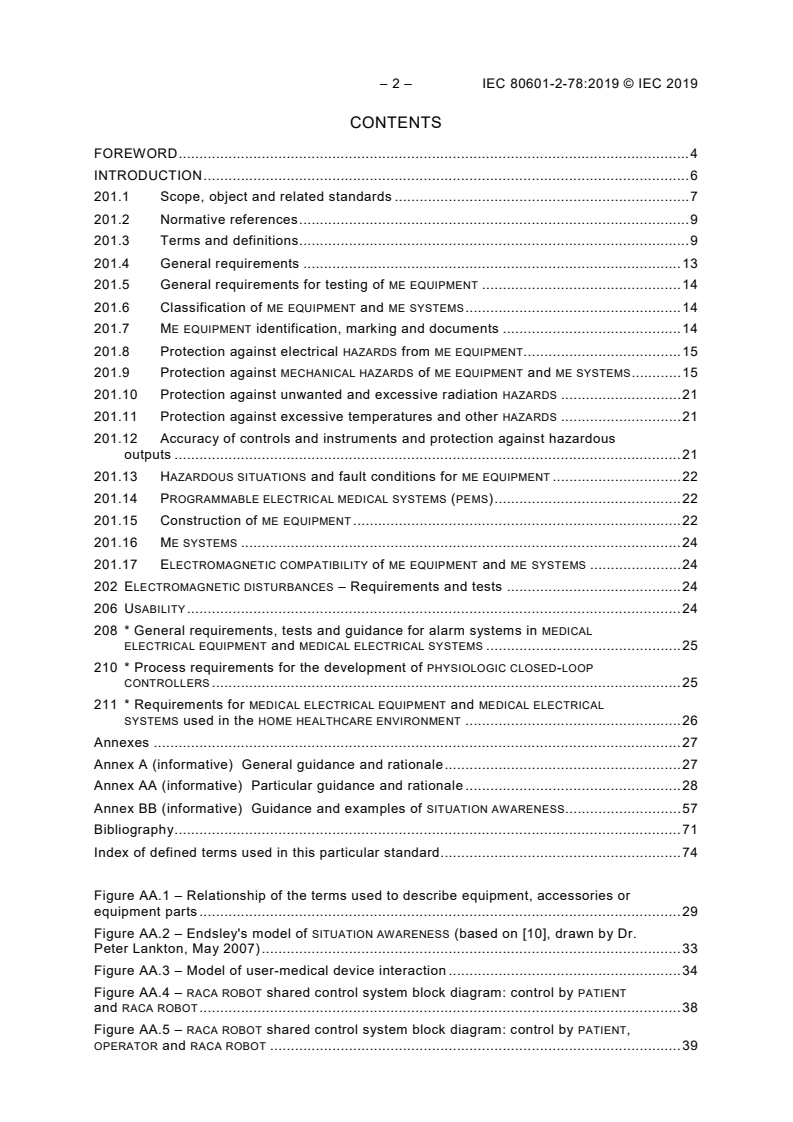
CONTENTS
FOREWORD . 4
INTRODUCTION . 6
201.1 Scope, object and related standards . 7
201.2 Normative references . 9
201.3 Terms and definitions . 9
201.4 General requirements . 13
201.5 General requirements for testing of ME EQUIPMENT . 14
201.6 Classification of ME EQUIPMENT and ME SYSTEMS . 14
201.7 ME EQUIPMENT identification, marking and documents . 14
201.8 Protection against electrical HAZARDS from ME EQUIPMENT. 15
201.9 Protection against MECHANICAL HAZARDS of ME EQUIPMENT and ME SYSTEMS . 15
201.10 Protection against unwanted and excessive radiation HAZARDS . 21
201.11 Protection against excessive temperatures and other HAZARDS . 21
201.12 Accuracy of controls and instruments and protection against hazardous
outputs . 21
201.13 HAZARDOUS SITUATIONS and fault conditions for ME EQUIPMENT . 22
201.14 PROGRAMMABLE ELECTRICAL MEDICAL SYSTEMS (PEMS) . 22
201.15 Construction of ME EQUIPMENT . 22
201.16 ME SYSTEMS . 24
201.17 ELECTROMAGNETIC COMPATIBILITY of ME EQUIPMENT and ME SYSTEMS . 24
202 ELECTROMAGNETIC DISTURBANCES – Requirements and tests . 24
206 USABILITY . 24
208 * General requirements, tests and guidance for alarm systems in MEDICAL
ELECTRICAL EQUIPMENT and MEDICAL ELECTRICAL SYSTEMS . 25
210 * Process requirements for the development of PHYSIOLOGIC CLOSED-LOOP
CONTROLLERS . 25
211 * Requirements for MEDICAL ELECTRICAL EQUIPMENT and MEDICAL ELECTRICAL
SYSTEMS used in the HOME HEALTHCARE ENVIRONMENT . 26
Annexes . 27
Annex A (informative) General guidance and rationale . 27
Annex AA (informative) Particular guidance and rationale . 28
Annex BB (informative) Guidance and examples of SITUATION AWARENESS . 57
Bibliography . 71
Index of defined terms used in this particular standard . 74
Figure AA.1 – Relationship of the terms used to describe equipment, accessories or
equipment parts . 29
Figure AA.2 – Endsley's model of SITUATION AWARENESS (based on [10], drawn by Dr.
Peter Lankton, May 2007) . 33
Figure AA.3 – Model of user-medical device interaction . 34
Figure AA.4 – RACA ROBOT shared control system block diagram: control by PATIENT
and RACA ROBOT . 38
Figure AA.5 – RACA ROBOT shared control system block diagram: control by PATIENT,
OPERATOR and RACA ROBOT . 39
Figure AA.6 – RACA ROBOT shared control system block diagram: control by PATIENT
and RACA ROBOT, and control modulation by OPERATOR . 40
Figure AA.7 – WALKING RACA ROBOT using motion-related biosignal input . 41
Figure AA.8 – System block diagram of a WALKING RACA ROBOT using a motion-related
biosignal as input . 41
Figure AA.9 – RACA ROBOT that is an arm exoskeleton for REHABILITATION that applies a
PATIENT-cooperative shared control strategy . 42
Figure AA.10 – System block diagram of an arm exoskeleton for REHABILITATIOn that
applies a PATIENT-cooperative shared control strategy . 43
Figure AA.11 – Cane-type RACA ROBOT for REHABILITATION of walking . 44
Figure AA.12 – System block diagram of a cane-type RACA ROBOT . 44
Figure AA.13 – Example of ROBOT arm type RACA ROBOT for lower extremities . 45
Figure AA.14 – Example of ROBOT arm type RACA ROBOT for upper extremities . 46
Figure AA.15 – Example of exoskeleton type RACA ROBOT for upper extremities . 47
Figure AA.16 – Example of exoskeleton type RACA ROBOT for knee joint . 49
Figure AA.17 – Example of soft artificial muscle-type RACA ROBOT for knee joint . 50
Figure AA.18 – Example of exoskeleton-type WALKING RACA ROBOT . 51
Figure AA.19 – Example of RACA ROBOT for balance control . 52
Figure AA.20 – Example of a body-weight support-type RACA ROBOT with gait following
function . 54
Figure BB.1 – All the proximate causes of loss of SITUATION AWARENESS [19] . 58
Figure BB.2 – Relationship between SITUATION AWARENESS, the RISK MANAGEMENT
PROCESS (ISO 14971:2007) and the USABILITY ENGINEERING PROCESS (IEC 62366-
1:2015) . 60
Figure BB.3 – Relationship between GDTA and RISK MANAGEMENT and USABILITY
........................................................................................................ 63
ENGINEERING PROCESSES
Figure BB.4 – WALKING exoskeleton RACA ROBOT . 69
Table 201.101 – List of potential ESSENTIAL PERFORMANCEs . 14
Table 19 – MECHANICAL HAZARDS covered by this clause . 16
Table 201.102 – Overview of different stopping procedures . 16
Table 28 – Mechanical strength test applicability . 23
Table 1 – Mechanical strength test applicability, non-TRANSIT-OPERABLE . 26
Table 2 – Mechanical strength test applicability, TRANSIT-OPERABLE . 26
Table AA.1 – Correlation mapping between Figure AA.2 and Figure AA.3 . 35
Table BB.1 – Example of using GDTA in BB.5.2 . 64
Table BB.2 – Example of using GDTA in BB.5.3 . 66
Table BB.3 – Example of using GDTA in BB.5.4 . 68
Table BB.4 – Example of using GDTA in BB.5.5 . 70
– 4 – IEC 80601-2-78:2019 © IEC 2019
INTERNATIONAL ELECTROTECHNICAL COMMISSION
____________
MEDICAL ELECTRICAL EQUIPMENT –
Part 2-78: Particular requirements for basic safety and essential
performance of medical robots for rehabilitation, assessment,
compensation or alleviation
FOREWORD
1) The International Electrotechnical Commission (IEC) is a worldwide organization for standardization comprising
all national electrotechnical committees (IEC National Committees). The object of IEC is to promote
international co-operation on all questions concerning standardization in the electrical and electronic fields. To
this end and in addition to other activities, IEC publishes International Standards, Technical Specifications,
Technical Reports, Publicly Available Specifications (PAS) and Guides (hereafter referred to as "IEC
Publication(s)"). Their preparation is entrusted to technical committees; any IEC National Committee interested
in the subject dealt with may participate in this preparatory work. International, governmental and non-
governmental organizations liaising with the IEC also participate in this preparation. IEC collaborates closely
with the International Organization for Standardization (ISO) in accordance with conditions determined by
agreement between the two organizations.
2) The formal decisions or agreements of IEC on technical matters express, as nearly as possible, an international
consensus of opinion on the relevant subjects since each technical committee has representation from all
interested IEC National Committees.
3) IEC Publications have the form of recommendations for international use and are accepted by IEC National
Committees in that sense. While all reasonable efforts are made to ensure that the technical content of IEC
Publications is accurate, IEC cannot be held responsible for the way in which they are used or for any
misinterpretation by any end user.
4) In order to promote international uniformity, IEC National Committees undertake to apply IEC Publications
transparently to the maximum extent possible in their national and regional publications. Any divergence
between any IEC Publication and the corresponding national or regional publication shall be clearly indicated in
the latter.
5) IEC itself does not provide any attestation of conformity. Independent certification bodies provide conformity
assessment services and, in some areas, access to IEC marks of conformity. IEC is not responsible for any
services carried out by independent certification bodies.
6) All users should ensure that they have the latest edition of this publication.
7) No liability shall attach to IEC or its directors, employees, servants or agents including individual experts and
members of its technical committees and IEC National Committees for any personal injury, property damage or
other damage of any nature whatsoever, whether direct or indirect, or for costs (including legal fees) and
expenses arising out of the publication, use of, or reliance upon, this IEC Publication or any other IEC
Publications.
8) Attention is drawn to the Normative references cited in this publication. Use of the referenced publications is
indispensable for the correct application of this publication.
9) Attention is drawn to the possibility that some of the elements of this IEC Publication may be the subject of
patent rights. IEC shall not be held responsible for identifying any or all such patent rights.
International standard IEC 80601-2-78 has been prepared by IEC subcommittee 62D:
Electromedical equipment, of IEC Technical Committee 62: Electrical equipment in medical
practice, and ISO Technical Committee 299: Robotics.
This publication is published as a double logo standard.
The text of this International Standard is based on the following documents:
FDIS Report on voting
62D/1676/FDIS 62D/1688/RVD
Full information on the voting for the approval of this International Standard can be found in
the report on voting indicated in the above table.
This document has been drafted in accordance with the ISO/IEC Directives, Part 2.
In this document, the following print types are used:
– requirements and definitions: roman type;
– test specifications: italic type;
informative material appearing outside of tables, such as notes, examples and references in smaller type.
–
Normative text of tables is also in a smaller type;
– TERMS DEFINED IN CLAUSE 3 OF THE GENERAL STANDARD, IN THIS PARTICULAR STANDARD OR AS
NOTED: SMALL CAPITALS.
In referring to the structure of this document, the term
– "clause" means one of the seventeen numbered divisions within the table of contents,
inclusive of all subdivisions (e.g. Clause 7 includes subclauses 7.1, 7.2, etc.);
– "subclause" means a numbered subdivision of a clause (e.g. 7.1, 7.2 and 7.2.1 are all
subclauses of Clause 7).
References to clauses within this document are preceded by the term "Clause" followed by the
clause number. References to subclauses within this particular standard are by number only.
In this document, the conjunctive "or" is used as an "inclusive or" so a statement is true if any
combination of the conditions is true.
The verbal forms used in this document conform to usage described in Clause 7 of the
ISO/IEC Directives, Part 2. For the purposes of this document, the auxiliary verb:
– "shall" means that compliance with a requirement or a test is mandatory for compliance
with this document;
– "should" means that compliance with a requirement or a test is recommended but is not
mandatory for compliance with this document;
– "may" is used to describe a permissible way to achieve compliance with a requirement or
test.
An asterisk (*) as the first character of a title or at the beginning of a paragraph or table title
indicates that there is guidance or rationale related to that item in Annex AA.
A list of all parts of the IEC 80601 and IEC 60601 International Standard, published under the
general title Medical electrical equipment, can be found on the IEC website.
The committee has decided that the contents of this document will remain unchanged until the
stability date indicated on the IEC website under "http://webstore.iec.ch" in the data related to
the specific document. At this date, the document will be
• reconfirmed,
• withdrawn,
• replaced by a revised edition, or
• amended.
NOTE The attention of users of this document is drawn to the fact that equipment manufacturers and testing
organizations may need a transitional period following publication of a new, amended or revised IEC publication in
which to make products in accordance with the new requirements and to equip themselves for conducting new or
revised tests. It is the recommendation of the committees that the content of this publication be adopted for
implementation nationally not earlier than 3 years from the date of publication.
IMPORTANT – The 'colour inside' logo on the cover page of this publication indicates
that it contains colours which are considered to be useful for the correct
understanding of its contents. Users should therefore print this document using a
colour printer.
– 6 – IEC 80601-2-78:2019 © IEC 2019
INTRODUCTION
This part of IEC 80601 International Standard was written at a time when technical evolution
of MEDICAL ROBOTS was in rapid progress and the scientific foundation of safe use was still
being expanded.
This document is the result of work that began in ISO/TC 184/SC 2/WG 7 in October 2006 on
personal care ROBOTS, to address an emerging type of MEDICAL ROBOT that was used outside
of an industrial environment. That group was working on a new standard, ISO 13482, which
was published as an International Standard (IS) in 2014. While initially focused on non-
medical applications, WG 7 recognized that work was needed on medical devices utilizing
robotic technology. In October 2009, ISO/TC 184/SC 2 established a WG 7, Study Group (SG)
on Medical care robots, comprised of experts from Canada, France, Germany, Japan, Korea,
Romania, Switzerland, UK and USA.
The work of ISO/TC 184/SC 2/WG 7 SG cumulated in a proposal to form a Joint Working
Group (JWG 9) with IEC/TC 62/SC 62A focusing on MEDICAL ELECTRICAL EQUIPMENT using
robotic technology. This JWG began developing a technical report (IEC TR 60601-4-1)
dealing with degree of autonomy. While developing this document, a particular standard was
deemed required for REHABILITATION type ROBOTS. This led to the creation of a Joint Working
Group 36 (MEDICAL ROBOTS for REHABILITATION) in April, 2015 within IEC/TC 62/SC 62D to
develop particular requirements of SAFETY of MEDICAL ELECTRICAL EQUIPMENT and MEDICAL
ELECTRICAL SYSTEMS for REHABILITATION type ROBOTS. ISO/TC 184/SC 2 has since been
promoted to ISO/TC 299, and JWG 9 has merged with JWG35 and 36 to form JWG 5
(MEDICAL ROBOT Safety) on the ISO side. This proposal was approved from both IEC and
ISO and work began.
The minimum safety requirements specified in this particular standard are presented to
provide for an acceptable degree of BASIC SAFETY and ESSENTIAL PERFORMANCE for MEDICAL
ROBOTS that physically interact with a PATIENT with an IMPAIRMENT, to support or perform
REHABILITATION, ASSESSMENT, COMPENSATION or ALLEVIATION related to the PATIENT’S MOVEMENT
FUNCTIONS .
The requirements are followed by particular specifications for the relevant tests.
MEDICAL ELECTRICAL EQUIPMENT –
Part 2-78: Particular requirements for basic safety and essential
performance of medical robots for rehabilitation, assessment,
compensation or alleviation
201.1 Scope, object and related standards
Clause 1 of the general standard applies, except as follows:
201.1.1 Scope
Replacement:
This part of IEC 80601 applies to the general requirements for BASIC SAFETY and ESSENTIAL
PERFORMANCE of MEDICAL ROBOTS that physically interact with a PATIENT with an IMPAIRMENT to
support or perform REHABILITATION, ASSESSMENT, COMPENSATION or ALLEVIATION related to the
PATIENT’S MOVEMENT FUNCTIONS, as intended by the MANUFACTURER.
If a clause or subclause is specifically intended to be applicable to ME EQUIPMENT only, or to
ME SYSTEMS only, the title and content of that clause or subclause will say so. If that is not the
case, the clause or subclause applies both to ME EQUIPMENT and to ME SYSTEMS, as relevant.
NOTE See also 4.2 of the general standard.
This particular standard does not apply to
• external limb prosthetic devices (use ISO 22523),
• electric wheelchairs (use ISO 7176 (all parts)),
• diagnostic imaging equipment (e.g. MRI, use IEC 60601-2-33), and
• personal care ROBOTS (use ISO 13482).
201.1.2 Object
Replacement:
BASIC SAFETY and ESSENTIAL
The object of this particular standard is to establish particular
PERFORMANCE requirements for MEDICAL ROBOTS that physically interact with a PATIENT with an
IMPAIRMENT, to support or perform REHABILITATION, ASSESSMENT, COMPENSATION or ALLEVIATION
related to the PATIENT’S MOVEMENT FUNCTIONS.
201.1.3 Collateral standards
Addition:
This particular standard refers to those applicable collateral standards that are listed in
Clause 2 of the general standard and Clause 201.2 of this particular standard.
____________
The general standard is IEC 60601-1:2005 and IEC 60601-1:2005/AMD1:2012, Medical electrical equipment –
Part 1: General requirements for basic safety and essential performance.
– 8 – IEC 80601-2-78:2019 © IEC 2019
IEC 60601-1-2:2014, IEC 60601-1-6:2010 and IEC 60601-1-6:2010/AMD1:2013, IEC 60601-1-
8:2006 and IEC 60601-1-8:2006/AMD1:2012, IEC 60601-1-10:2007 and IEC 60601-1-
10:2007/AMD1:2013, and IEC 60601-1-11:2015 apply as modified in Clauses 202, 206, 208,
210 and 211 respectively. IEC 60601-1-3 and IEC 60601-1-12 do not apply. All other
published collateral standards in the IEC 60601-1 series apply as published.
201.1.4 Particular standards
Replacement:
In the IEC 60601 series, particular standards may modify, replace or delete requirements
contained in the general standard and collateral standards as appropriate for the particular
ME EQUIPMENT under consideration, and may add other BASIC SAFETY and ESSENTIAL
PERFORMANCE requirements.
A requirement of a particular standard takes priority over the general standard.
For brevity, IEC 60601-1:2005 and IEC 60601-1:2005/AMD1:2012 are referred to in this
particular standard as the general standard. Collateral standards are referred to by their
document number.
The numbering of clauses and subclauses of this particular standard corresponds to that of
the general standard with the prefix "201" (e.g. 201.1 in this document addresses the content
of Clause 1 of the general standard) or applicable collateral standard with the prefix "20x"
where x is the final digit(s) of the collateral standard document number (e.g. 202.4 in this
particular standard addresses the content of Clause 4 of the 60601-1-2 collateral standard,
203.4 in this particular standard addresses the content of Clause 4 of the IEC 60601-1-3
collateral standard, etc.). The changes to the text of the general standard are specified by the
use of the following words:
"Replacement" means that the clause or subclause of the general standard or applicable
collateral standard is replaced completely by the text of this particular standard.
"Addition" means that the text of this particular standard is additional to the requirements of
the general standard or applicable collateral standard.
"Amendment" means that the clause or subclause of the general standard or applicable
collateral standard is amended as indicated by the text of this particular standard.
Subclauses, figures or tables which are additional to those of the general standard are
numbered starting from 201.101. However, due to the fact that definitions in the general
standard are numbered 3.1 through 3.147, additional definitions in this document are
numbered beginning from 201.3.201. Additional Annexes are lettered AA, BB, etc., and
additional items aa), bb), etc.
Subclauses, figures or tables which are additional to those of a collateral standard are
numbered starting from 20x, where "x" is the number of the collateral standard, e.g. 202 for
IEC 60601-1-2, 203 for IEC 60601-1-3, etc.
The term "this document" is used to make reference to the general standard, any applicable
collateral standards and this particular standard taken together.
Where there is no corresponding clause or subclause in this particular standard, the clause or
subclause of the general standard or applicable collateral standard, although possibly not
relevant, applies without modification; where it is intended that any part of the general
standard or applicable collateral standard, although possibly relevant, is not to be applied, a
statement to that effect is given in this particular standard.
201.2 Normative references
NOTE Informative references are listed in the Bibliography.
Clause 2 of the general standard applies, except as follows:
Replacement:
IEC 60601-1-2:2014, Medical electrical equipment – Part 1-2: General requirements for basic
safety and essential performance – Collateral Standard: Electromagnetic disturbances –
Requirements and tests
IEC 60601-1-6:2010, Medical electrical equipment – Part 1-6: General requirements for basic
safety and essential performance – Collateral standard: Usability
IEC 60601-1-6:2010/AMD1:2013
IEC 60601-1-8:2006, Medical electrical equipment – Part 1-8: General requirements for safety
and essential performance – Collateral Standard: General requirements, tests and guidance
for alarm systems in medical electrical equipment and medical electrical systems
IEC 60601-1-8:2006/AMD1:2012
ISO 14971:2007, Medical devices – Application of risk management to medical devices
Addition:
IEC 60601-1-10:2007, Medical electrical equipment – Part 1-10: General requirements for
basic safety and essential performance – Collateral Standard: Requirements for the
development of physiologic closed-loop controllers
IEC 60601-1-10:2007/AMD1:2013
IEC 60601-1-11:2015, Medical electrical equipment – Part 1-11: General requirements for
basic safety and essential performance – Collateral Standard: Requirements for medical
electrical equipment and medical electrical systems used in the home healthcare environment
IEC 62366-1:2015, Medical devices – Part 1: Application of usability engineering to medical
devices
ISO 22523:2006, External limb prostheses and external orthoses – Requirements and test
methods
201.3 Terms and definitions
For the purposes of this document, the terms and definitions given in IEC 60601-1:2005 and
IEC 60601-1:2005/AMD1:2012 apply.
ISO and IEC maintain terminological databases for use in standardization at the following
addresses:
• IEC Electropedia: available at http://www.electropedia.org/
• ISO Online browsing platform: available at http://www.iso.org/obp
NOTE An Index of defined terms is found beginning on page 74.
Amendment:
– 10 – IEC 80601-2-78:2019 © IEC 2019
201.3.63
* MEDICAL ELECTRICAL EQUIPMENT
ME EQUIPMENT
Addition:
Note 1 to entry: See Figure AA.1.
201.3.65
MOBILE
Addition:
Note 1 to entry: MOBILE also includes equipment intended to support the movement of a PATIENT from one location
to another.
201.3.144
* BODY-WORN
Replacement:
PORTABLE equipment whose INTENDED USE includes operation while being worn by a PATIENT or
attached to a PATIENT’S clothing
Addition:
201.3.201
*ACTUATED APPLIED PART
subcategory of APPLIED PART that is intended to provide actively controlled physical
interactions with the PATIENT that are related to the PATIENT’s MOVEMENT FUNCTIONS, to perform
a CLINICAL FUNCTION of a RACA ROBOT
Note 1 to entry: "Actively controlled" as used above is intended to mean controlled by the RACA ROBOT, including
shared control with the PATIENT or OPERATOR.
Note 2 to entry: Actively controlled physical interactions include position control, force control, impedance control,
admittance control, or any other controls that regulate the interaction between a RACA ROBOT and the PATIENT.
Note 3 to entry: Each ACTUATED APPLIED PART is part of an actuation system according to 9.8.1 of the general
standard.
201.3.202
ALLEVIATION
treatment to ease symptoms due to an IMPAIRMENT of a PATIENT
Note 1 to entry: An example of ALLEVIATION is physical therapy performed by a RACA ROBOT to reduce pain or
other secondary effects of an IMPAIRMENT.
201.3.203
* ASSESSMENT
procedure to quantify or to aid in the qualification of the level of IMPAIRMENT of a PATIENT.
Note 1 to entry: The term "ASSESSMENT" should not be confused with the term "RISK ASSESSMENT’"
Note 2 to entry: ASSESSMENT in this definition focuses on the level of IMPAIRMENT of body functions and structures
and not of activity limitations or participation restrictions ([1] , Chapter 4).
Note 3 to entry: ASSESSMENT can be distinguished from both measurement and diagnosis. Measurement typically
refers to the physiological parameter being measured (e.g. PATIENT hand position by a RACA ROBOT) and is typically
related to, or is the direct output of a transducer. Those measurements are then used to quantify an IMPAIRMENT
(e.g., proprioception, planning of a movement, etc). Because IMPAIRMENTs are not the same as the underlying
pathology, but are the manifestations of an underlying pathology, an ASSESSMENT that quantifies the IMPAIRMENT
____________
Numbers in square brackets refer to the Bibliography.
can then be used by a clinician to support a diagnosis that identifies the pathology, or to monitor the progression of
a pathology or recovery from an injury. See Annex AA for an example.
201.3.204
CLINICAL FUNCTION
clinically significant operation that the ME EQUIPMENT or ME SYSTEM is intended to perform, as
specified by the MANUFACTURER
Note 1 to entry: CLINICAL FUNCTION is generally a subset of the INTENDED USE of the ME EQUIPMENT or ME SYSTEM
and is related to the PATIENT.
Note 2 to entry: In the context of this document, a clinically significant operation refers to:
• support of the diagnosis of a PATIENT with an IMPAIRMENT,
• treatment, mitigation, or monitoring of an IMPAIRMENT of a PATIENT.
[SOURCE: IEC TR 60601-4-1:2017, 3.6, modified – In the definition, the words "medical
operation" have been replaced by "clinically significant operation", and Note 2 to entry has
been added.]
201.3.205
COMPENSATION
mitigation of IMPAIRMENT of a PATIENT through support of body structures or through support or
replacement of body functions
Note 1 to entry: COMPENSATION could be provided by, for example, externally powered orthoses. COMPENSATION
does not include the improvement of MOVEMENT FUNCTIONS related to an IMPAIRMENT, which is defined as
REHABILITATION.
201.3.206
EMERGENCY STOP
manually initiated interruption of operation intended to stop the RACA ROBOT to prevent HARM
Note 1 to entry: EMERGENCY STOP is meant as a last resort when no other means to reduce RISK are available.
Note 2 to entry: EMERGENCY STOP does not allow an automatic restart, in contrast to a PROTECTIVE STOP.
Note 3 to entry: The activation of an EMERGENCY STOP does not necessarily shut down all the power in a RACA
ROBOT. Refer to 9.2.4 of the general standard for further clarification.
201.3.207
* IMPAIRMENT
problem in body function or structure, such as significant deviation or loss
Note 1 to entry: "Problems" here is used to refer to a (negative) deviation from generally accepted population
normality levels in the biomedical status of the body and its functions. Notification of the constituents of IMPAIRMENT
is undertaken primarily by those qualified to judge functioning according to the generally accepted normality levels.
An IMPAIRMENT usually follows a disease or accident, but also includes birth defects.
Note 2 to entry: This document only concerns ME EQUIPMENT or ME SYSTEM, meaning that it addresses IMPAIRMENT
of a PATIENT and not normal age-related IMPAIRMENTS.
[SOURCE: ISO 9999:2016, 2.11, modified – The term is here in singular instead of plural. The
notes to entry have been added.]
201.3.208
MEDICAL ROBOT
ROBOT intended to be used as ME EQUIPMENT or ME SYSTEM
[SOURCE: IEC TR 60601-4-1:2017, 3.20]
– 12 – IEC 80601-2-78:2019 © IEC 2019
201.3.209
MOVEMENT FUNCTION
function consisting of one or more of sensory, neuromusculoskeletal or movement-related
body functions that comprise PATIENT motor control
Note 1 to entry: ”Sensory”, "neuromusculoskeletal" and "movement-related" come from the body functions
classification presented in [1].
Note 2 to entry: A RACA ROBOT does not need to address all of these aspects.
201.3.210
* PROTECTIVE STOP
interruption of operation automatically initiated by the RACA ROBOT, that allows a cessation of
motion for BASIC SAFETY and ESSENTIAL PERFORMANCE purposes, which could allow the
PROGRAMMABLE ELECTRICAL MEDICAL SYSTEM (PEMS)/PROGRAMMABLE ELECTRONIC SUBSYSTEM
(PESS) to facilitate a restart
Note 1 to entry: See also ISO 8373:2012, 5.17.
Note 2 to entry: A PROTECTIVE STOP is defined in contrast to an EMERGENCY STOP or a normal stop; clarification is
provided in Table 201.102.
Note 3 to entry: “Automatically initiated” means that the RACA ROBOT is detecting a potentially HAZARDOUS
SITUATION and as a result of this detection the RACA ROBOT then initiates a stopping procedure
Note 4 to entry: The defined term is related to FALLBACK MODE defined in IEC 60601-1-10:2007, 3.11.
Note 5 to entry: Even during the cessation of motion, the actuators are not necessarily deactivated. In certain
conditions, the actuators may hold the PATIENT or PATIENT’S limbs in a stable position.
201.3.211
* REHABILITATION
treatment to improve MOVEMENT FUNCTIONS related to an IMPAIRMENT of a PATIENT
EXAMPLE Relearning of motor control of the upper or lower extremities, restoration of muscle strength and
endurance.
Note 1 to entry: REHABILITATION can be carried out in situations where a PATIENT has an IMPAIRMENT due to an
accident or disease or congenital conditions (e.g. cerebral palsy) or can be used to slow down the expected loss of
body functions due to neurodegenerative diseases (e.g. Parkinson’s, multiple sclerosis).
Note 2 to entry: This definition differs from the World Health Organization (WHO) definition and covers only a
subset of that definition, in order to agree with the scope of this document.
201.3.212
REHABILITATION, ASSESSMENT, COMPENSATION AND ALLEVIATION ROBOT
RACA ROBOT
MEDICAL ROBOT intended by its MANUFACTURER to perform REHABILITATION, ASSESSMENT,
COMPENSATION or ALLEVIATION comprising an ACTUATED APPLIED PART
201.3.213
*ROBOT
programmed actuated mechanism with a degree of autonomy, moving within its environment,
to perform intended tasks
201.3.214
* SITUATION AWARENESS
OPERATOR’S perception, comprehension and projection of a RACA ROBOT’s behaviour in its
environment
Note 1 to entry: SITUATION AWARENESS allows the OPERATOR of the RACA ROBOT to react appropriately and timely
to the RACA ROBOT's behaviour both under NORMAL USE and in the case of a SINGLE FAULT CONDITION.
Note 2 to entry: SITUATION AWARENESS has a direct link to USABILITY ENGINEERING PROCESS. However,
IEC 62366-1:2015 relates to SITUATION AWARENESS through the use of the concepts of "perception" and "cognition".
Annex AA provides additional information.
201.3.215
* WALKING
MOBILE equipment that, once installed and placed into service, is intended to move from one
location to another, by making reciprocating motion having intermittent contact with the travel
surface and the RACA ROBOT
EXAMPLE A powered exoskeleton for the lower limbs is an example of a WALKING RACA ROBOT that is intended by
the MANUFACTURER to ambulate the PATIENT.
Note 1 to entry: WALKING is a new subcategory of TRANSPORTABLE ME EQUIPMENT and ME SYSTEM as shown in
Figure AA.1.
201.4 General requirements
Clause 4 of the general standard applies, except as follows:
201.4.2.3 Evaluating RISK
Additional subclauses before 4.2.3.1:
201.4.2.3.101 General
In performing a RISK MANAGEMENT PROCESS, the degree of autonomy of the RACA ROBOT shall
be taken into consideration.
NOTE 1 IEC TR 60601-4-1 provides considerations on the effects that the degree of autonomy could have on the
RISK MANAGEMENT PROCESS. For example, RACA ROBOTs could accomplish a task fully autonomously with less RISK
than an OPERATOR performing the same intended task, or vice versa.
NOTE 2 Degree of autonomy has the potential for increasing performance, adding functionality or improving
USABILITY of RACA ROBOTS. However, a higher degree of autonomy can increase the complexity of the system and
thus can increase the number and complexity of HAZARDOUS SITUATIONS. It is important the MANUFACTURER takes
this complexity into account in its RISK MANAGEMENT PROCESS. As one or more PESS provide the autonomy, these
PESS deserve specific scrutiny.
NOTE 3 The role of the OPERATOR can differ depending on their tasks and interactions with the RACA ROBOT. The
SITUATION AWARENESS of the OPERATOR can become more important for RACA ROBOTS with a higher degree of
autonomy.
Compliance is checked by inspection of the RISK MANAGEMENT FILE.
201.4.2.3.102 * RISK MANAGEMENT and SITUATION AWARENESS
The MANUFACTURER shall identify the HAZARDS or HAZARDOUS SITUATIONS that could occur
following a loss of SITUATION AWARENESS in the RISK MANAGEMENT PROCESS, when an OPERATOR
is needed to supervise a task of, or interact with, a RACA ROBOT to reduce RISK to an
acceptable level. The MANUFACTURER shall include the necessary information in the
ACCOMPANYING DOCUMENTS.
Compliance shall be checked by inspection of the RISK MANAGEMENT FILE and, where
applicable, of the ACCOMPANYING DOCUMENTS.
.5 requires HAZARD-RELATED USE SCENARIOS to be evaluated using a
IEC 62366-1:2015, 5
SUMMATIVE EVALUATION. Because of the subjective nature of evaluating SITUATION AWARENESS,
it can be considered sufficient to perform a FORMATIVE EVALUATION of this HAZARD-RELATED USE
SCENARIO instead.
NOTE Additional guidance can be found in Annex BB.
201.4.3 ESSENTIAL PERFORMANCE
Addition:
– 14 – IEC 80601-2-78:2019 © IEC 2019
Table 201.101 lists potential sources of unacceptable RISK identified to characterize the
ESSENTIAL PERFORMANCE of RACA ROBOTs and the subclauses in which the requirements are
found.
Table 201.101 – List of potential ESSENTIAL PERFORMANCEs
Potential ESSENTIAL PERFORMANCE
...
IEC 80601-2-78
Edition 1.1 2024-03
CONSOLIDATED VERSION
INTERNATIONAL
STANDARD
NORME
INTERNATIONALE
colour
inside
Medical electrical equipment –
Part 2-78: Particular requirements for basic safety and essential performance of
medical robots for rehabilitation, assessment, compensation or alleviation
Appareils électromédicaux –
Partie 2-78: Exigences particulières pour la sécurité de base et les performances
essentielles des robots médicaux dédiés à la rééducation, l’évaluation, la
compensation ou l'atténuation
All rights reserved. Unless otherwise specified, no part of this publication may be reproduced or utilized in any form
or by any means, electronic or mechanical, including photocopying and microfilm, without permission in writing from
either IEC or IEC's member National Committee in the country of the requester. If you have any questions about IEC
copyright or have an enquiry about obtaining additional rights to this publication, please contact the address below or
your local IEC member National Committee for further information.
Droits de reproduction réservés. Sauf indication contraire, aucune partie de cette publication ne peut être reproduite ni
utilisée sous quelque forme que ce soit et par aucun procédé, électronique ou mécanique, y compris la photocopie et
les microfilms, sans l'accord écrit de l'IEC ou du Comité national de l'IEC du pays du demandeur. Si vous avez des
questions sur le copyright de l'IEC ou si vous désirez obtenir des droits supplémentaires sur cette publication, utilisez
les coordonnées ci-après ou contactez le Comité national de l'IEC de votre pays de résidence.
IEC Secretariat Tel.: +41 22 919 02 11
3, rue de Varembé info@iec.ch
CH-1211 Geneva 20 www.iec.ch
Switzerland
About the IEC
The International Electrotechnical Commission (IEC) is the leading global organization that prepares and publishes
International Standards for all electrical, electronic and related technologies.
About IEC publications
The technical content of IEC publications is kept under constant review by the IEC. Please make sure that you have the
latest edition, a corrigendum or an amendment might have been published.
IEC publications search - webstore.iec.ch/advsearchform IEC Products & Services Portal - products.iec.ch
The advanced search enables to find IEC publications by a Discover our powerful search engine and read freely all the
variety of criteria (reference number, text, technical publications previews, graphical symbols and the glossary.
committee, …). It also gives information on projects, replaced With a subscription you will always have access to up to date
and withdrawn publications. content tailored to your needs.
IEC Just Published - webstore.iec.ch/justpublished
Electropedia - www.electropedia.org
Stay up to date on all new IEC publications. Just Published
The world's leading online dictionary on electrotechnology,
details all new publications released. Available online and once
containing more than 22 500 terminological entries in English
a month by email.
and French, with equivalent terms in 25 additional languages.
Also known as the International Electrotechnical Vocabulary
IEC Customer Service Centre - webstore.iec.ch/csc
(IEV) online.
If you wish to give us your feedback on this publication or need
further assistance, please contact the Customer Service
Centre: sales@iec.ch.
A propos de l'IEC
La Commission Electrotechnique Internationale (IEC) est la première organisation mondiale qui élabore et publie des
Normes internationales pour tout ce qui a trait à l'électricité, à l'électronique et aux technologies apparentées.
A propos des publications IEC
Le contenu technique des publications IEC est constamment revu. Veuillez vous assurer que vous possédez l’édition la
plus récente, un corrigendum ou amendement peut avoir été publié.
Recherche de publications IEC - Découvrez notre puissant moteur de recherche et consultez
webstore.iec.ch/advsearchform gratuitement tous les aperçus des publications, symboles
La recherche avancée permet de trouver des publications IEC graphiques et le glossaire. Avec un abonnement, vous aurez
en utilisant différents critères (numéro de référence, texte, toujours accès à un contenu à jour adapté à vos besoins.
comité d’études, …). Elle donne aussi des informations sur les
projets et les publications remplacées ou retirées. Electropedia - www.electropedia.org
Le premier dictionnaire d'électrotechnologie en ligne au monde,
IEC Just Published - webstore.iec.ch/justpublished
avec plus de 22 500 articles terminologiques en anglais et en
Restez informé sur les nouvelles publications IEC. Just
français, ainsi que les termes équivalents dans 25 langues
Published détaille les nouvelles publications parues.
additionnelles. Egalement appelé Vocabulaire
Disponible en ligne et une fois par mois par email.
Electrotechnique International (IEV) en ligne.
Service Clients - webstore.iec.ch/csc
Si vous désirez nous donner des commentaires sur cette
publication ou si vous avez des questions contactez-nous:
sales@iec.ch.
IEC Products & Services Portal - products.iec.ch
IEC 80601-2-78
Edition 1.1 2024-03
CONSOLIDATED VERSION
INTERNATIONAL
STANDARD
NORME
INTERNATIONALE
colour
inside
Medical electrical equipment –
Part 2-78: Particular requirements for basic safety and essential performance of
medical robots for rehabilitation, assessment, compensation or alleviation
Appareils électromédicaux –
Partie 2-78: Exigences particulières pour la sécurité de base et les performances
essentielles des robots médicaux dédiés à la rééducation, l’évaluation, la
compensation ou l'atténuation
INTERNATIONAL
ELECTROTECHNICAL
COMMISSION
COMMISSION
ELECTROTECHNIQUE
INTERNATIONALE
ICS 11.040.01 ISBN 978-2-8322-8522-0
REDLINE VERSION – 2 – IEC 80601-2-78:2019+AMD1:2024 CSV
© IEC 2024
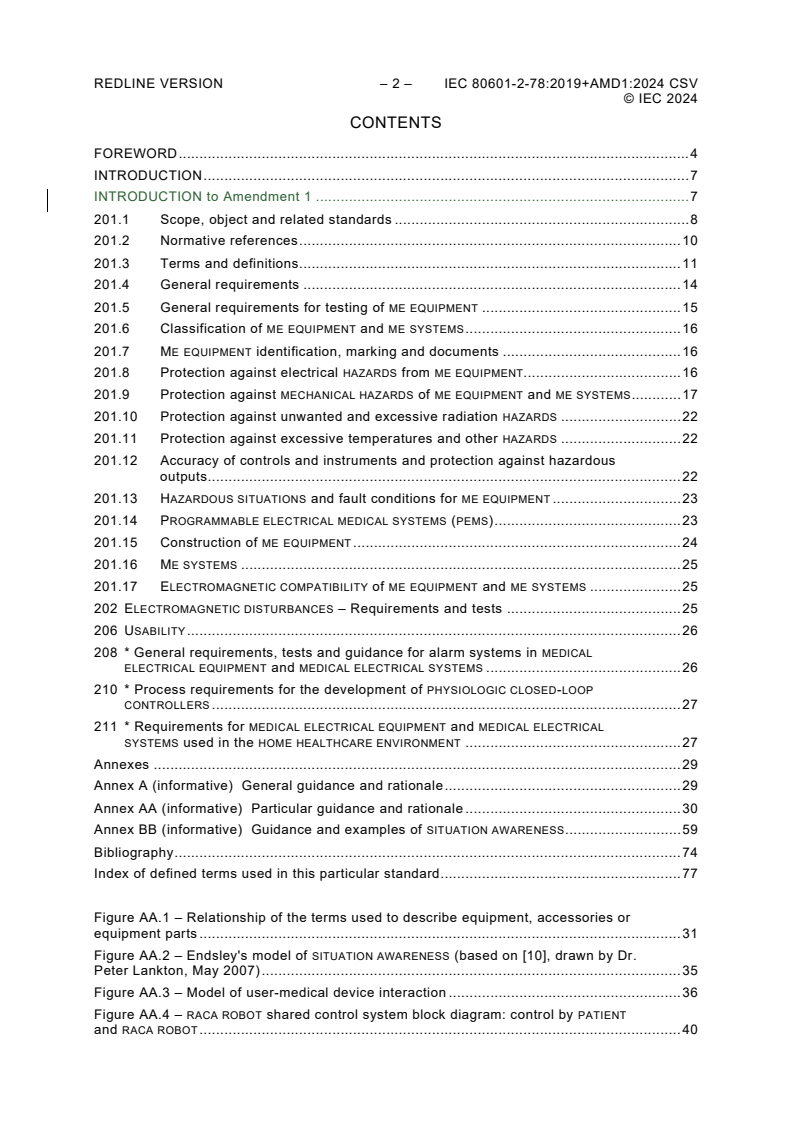
CONTENTS
FOREWORD . 4
INTRODUCTION . 7
INTRODUCTION to Amendment 1 . 7
201.1 Scope, object and related standards . 8
201.2 Normative references . 10
201.3 Terms and definitions . 11
201.4 General requirements . 14
201.5 General requirements for testing of ME EQUIPMENT . 15
201.6 Classification of ME EQUIPMENT and ME SYSTEMS . 16
201.7 ME EQUIPMENT identification, marking and documents . 16
201.8 Protection against electrical HAZARDS from ME EQUIPMENT. 16
201.9 Protection against MECHANICAL HAZARDS of ME EQUIPMENT and ME SYSTEMS . 17
201.10 Protection against unwanted and excessive radiation HAZARDS . 22
201.11 Protection against excessive temperatures and other HAZARDS . 22
201.12 Accuracy of controls and instruments and protection against hazardous
outputs. 22
201.13 HAZARDOUS SITUATIONS and fault conditions for ME EQUIPMENT . 23
201.14 PROGRAMMABLE ELECTRICAL MEDICAL SYSTEMS (PEMS) . 23
201.15 Construction of ME EQUIPMENT . 24
201.16 ME SYSTEMS . 25
201.17 ELECTROMAGNETIC COMPATIBILITY of ME EQUIPMENT and ME SYSTEMS . 25
202 ELECTROMAGNETIC DISTURBANCES – Requirements and tests . 25
206 USABILITY . 26
208 * General requirements, tests and guidance for alarm systems in MEDICAL
ELECTRICAL EQUIPMENT and MEDICAL ELECTRICAL SYSTEMS . 26
210 * Process requirements for the development of PHYSIOLOGIC CLOSED-LOOP
CONTROLLERS . 27
211 * Requirements for MEDICAL ELECTRICAL EQUIPMENT and MEDICAL ELECTRICAL
SYSTEMS used in the HOME HEALTHCARE ENVIRONMENT . 27
Annexes . 29
Annex A (informative) General guidance and rationale . 29
Annex AA (informative) Particular guidance and rationale . 30
Annex BB (informative) Guidance and examples of SITUATION AWARENESS . 59
Bibliography . 74
Index of defined terms used in this particular standard . 77
Figure AA.1 – Relationship of the terms used to describe equipment, accessories or
equipment parts . 31
Figure AA.2 – Endsley's model of SITUATION AWARENESS (based on [10], drawn by Dr.
Peter Lankton, May 2007) . 35
Figure AA.3 – Model of user-medical device interaction . 36
Figure AA.4 – RACA ROBOT shared control system block diagram: control by PATIENT
and RACA ROBOT . 40
© IEC 2024
Figure AA.5 – RACA ROBOT shared control system block diagram: control by PATIENT,
OPERATOR and RACA ROBOT . 41
Figure AA.6 – RACA ROBOT shared control system block diagram: control by PATIENT
RACA ROBOT, and control modulation by OPERATOR . 42
and
Figure AA.7 – WALKING RACA ROBOT using motion-related biosignal input . 43
Figure AA.8 – System block diagram of a WALKING RACA ROBOT using a motion-related
biosignal as input . 43
Figure AA.9 – RACA ROBOT that is an arm exoskeleton for REHABILITATION that applies a
PATIENT-cooperative shared control strategy . 44
Figure AA.10 – System block diagram of an arm exoskeleton for REHABILITATIOn that
applies a PATIENT-cooperative shared control strategy . 45
Figure AA.11 – Cane-type RACA ROBOT for REHABILITATION of walking . 46
Figure AA.12 – System block diagram of a cane-type RACA ROBOT . 46
Figure AA.13 – Example of ROBOT arm type RACA ROBOT for lower extremities . 47
Figure AA.14 – Example of ROBOT arm type RACA ROBOT for upper extremities . 48
Figure AA.15 – Example of exoskeleton type RACA ROBOT for upper extremities . 49
Figure AA.16 – Example of exoskeleton type RACA ROBOT for knee joint . 51
Figure AA.17 – Example of soft artificial muscle-type RACA ROBOT for knee joint . 52
Figure AA.18 – Example of exoskeleton-type WALKING RACA ROBOT . 53
Figure AA.19 – Example of RACA ROBOT for balance control . 54
Figure AA.20 – Example of a body-weight support-type RACA ROBOT with gait following
function . 56
Figure BB.1 – All the proximate causes of loss of SITUATION AWARENESS [19] . 60
Figure BB.2 – Relationship between SITUATION AWARENESS, the RISK MANAGEMENT
PROCESS (ISO 14971:20072019) and the USABILITY ENGINEERING PROCESS (IEC 62366-
1:2015 and IEC 62366-1:2015/AMD1:2020) . 63
Figure BB.3 – Relationship between GDTA and RISK MANAGEMENT and USABILITY
ENGINEERING PROCESSES. 66
Figure BB.4 – WALKING exoskeleton RACA ROBOT . 72
Table 201.101 – List of potential ESSENTIAL PERFORMANCEs . 15
Table 19 – MECHANICAL HAZARDS covered by this clause . 17
Table 201.102 – Overview of different stopping procedures . 17
Table 28 – Mechanical strength test applicability . 24
Table 1 – Mechanical strength test applicability, non-TRANSIT-OPERABLE . 27
Table 2 – Mechanical strength test applicability, TRANSIT-OPERABLE . 28
Table AA.1 – Correlation mapping between Figure AA.2 and Figure AA.3 . 37
Table BB.1 – Example of using GDTA in BB.5.2 . 68
Table BB.2 – Example of using GDTA in BB.5.3 . 69
Table BB.3 – Example of using GDTA in BB.5.4 . 71
Table BB.4 – Example of using GDTA in BB.5.5 . 73
REDLINE VERSION – 4 – IEC 80601-2-78:2019+AMD1:2024 CSV
© IEC 2024
INTERNATIONAL ELECTROTECHNICAL COMMISSION
____________
MEDICAL ELECTRICAL EQUIPMENT –
Part 2-78: Particular requirements for basic safety and essential
performance of medical robots for rehabilitation, assessment,
compensation or alleviation
FOREWORD
1) The International Electrotechnical Commission (IEC) is a worldwide organization for standardization comprising
all national electrotechnical committees (IEC National Committees). The object of IEC is to promote
international co-operation on all questions concerning standardization in the electrical and electronic fields. To
this end and in addition to other activities, IEC publishes International Standards, Technical Specifications,
Technical Reports, Publicly Available Specifications (PAS) and Guides (hereafter referred to as “IEC
Publication(s)”). Their preparation is entrusted to technical committees; any IEC National Committee interested
in the subject dealt with may participate in this preparatory work. International, governmental and non-
governmental organizations liaising with the IEC also participate in this preparation. IEC collaborates closely
with the International Organization for Standardization (ISO) in accordance with conditions determined by
agreement between the two organizations.
2) The formal decisions or agreements of IEC on technical matters express, as nearly as possible, an international
consensus of opinion on the relevant subjects since each technical committee has representation from all
interested IEC National Committees.
3) IEC Publications have the form of recommendations for international use and are accepted by IEC National
Committees in that sense. While all reasonable efforts are made to ensure that the technical content of IEC
Publications is accurate, IEC cannot be held responsible for the way in which they are used or for any
misinterpretation by any end user.
4) In order to promote international uniformity, IEC National Committees undertake to apply IEC Publications
transparently to the maximum extent possible in their national and regional publications. Any divergence
between any IEC Publication and the corresponding national or regional publication shall be clearly indicated in
the latter.
5) IEC itself does not provide any attestation of conformity. Independent certification bodies provide conformity
assessment services and, in some areas, access to IEC marks of conformity. IEC is not responsible for any
services carried out by independent certification bodies.
6) All users should ensure that they have the latest edition of this publication.
7) No liability shall attach to IEC or its directors, employees, servants or agents including individual experts and
members of its technical committees and IEC National Committees for any personal injury, property damage or
other damage of any nature whatsoever, whether direct or indirect, or for costs (including legal fees) and
expenses arising out of the publication, use of, or reliance upon, this IEC Publication or any other IEC
Publications.
8) Attention is drawn to the Normative references cited in this publication. Use of the referenced publications is
indispensable for the correct application of this publication.
9) IEC and ISO draw attention to the possibility that the implementation of this document may involve the use of (a)
patent(s). IEC and ISO take no position concerning the evidence, validity or applicability of any claimed patent
rights in respect thereof. As of the date of publication of this document, IEC and ISO had not received notice of
(a) patent(s), which may be required to implement this document. However, implementers are cautioned that
this may not represent the latest information, which may be obtained from the patent database available at
https://patents.iec.ch and www.iso.org/patents. IEC and ISO shall not be held responsible for identifying any or
all such patent rights.
This consolidated version of the official IEC Standard and its amendment has been
prepared for user convenience.
IEC 80601-2-78 edition 1.1 contains the first edition (2019-07) [documents
62D/1676/FDIS and 62D/1688/RVD] and its amendment 1 (2024-03) [documents
62D/2085A/FDIS and 62D/2109/RVD].
In this Redline version, a vertical line in the margin shows where the technical content
is modified by amendment 1. Additions are in green text, deletions are in strikethrough
red text. A separate Final version with all changes accepted is available in this
publication.
© IEC 2024
International standard IEC 80601-2-78 has been prepared by IEC subcommittee 62D:
Electromedical equipment, of IEC Technical Committee 62: Electrical equipment in medical
practice, and ISO Technical Committee 299: Robotics.
This publication is published as a double logo standard.
This document has been drafted in accordance with the ISO/IEC Directives, Part 2.
In this document, the following print types are used:
– requirements and definitions: roman type;
– test specifications: italic type;
– informative material appearing outside of tables, such as notes, examples and references in smaller type.
Normative text of tables is also in a smaller type;
– TERMS DEFINED IN CLAUSE 3 OF THE GENERAL STANDARD, IN THIS PARTICULAR STANDARD OR AS
NOTED: SMALL CAPITALS.
In referring to the structure of this document, the term
– "clause" means one of the seventeen numbered divisions within the table of contents,
inclusive of all subdivisions (e.g. Clause 7 includes subclauses 7.1, 7.2, etc.);
– "subclause" means a numbered subdivision of a clause (e.g. 7.1, 7.2 and 7.2.1 are all
subclauses of Clause 7).
References to clauses within this document are preceded by the term "Clause" followed by the
clause number. References to subclauses within this particular standard are by number only.
In this document, the conjunctive "or" is used as an "inclusive or" so a statement is true if any
combination of the conditions is true.
The verbal forms used in this document conform to usage described in Clause 7 of the
ISO/IEC Directives, Part 2. For the purposes of this document, the auxiliary verb:
– "shall" means that compliance with a requirement or a test is mandatory for compliance
with this document;
– "should" means that compliance with a requirement or a test is recommended but is not
mandatory for compliance with this document;
– "may" is used to describe a permissible way to achieve compliance with a requirement or
test.
An asterisk (*) as the first character of a title or at the beginning of a paragraph or table title
indicates that there is guidance or rationale related to that item in Annex AA.
A list of all parts of the IEC 80601 and IEC 60601 International Standard, published under the
general title Medical electrical equipment, can be found on the IEC website.
REDLINE VERSION – 6 – IEC 80601-2-78:2019+AMD1:2024 CSV
© IEC 2024
The committee has decided that the contents of this document and its amendment will remain
unchanged until the stability date indicated on the IEC website under webstore.iec.ch in the
data related to the specific document. At this date, the document will be
• reconfirmed,
• withdrawn, or
• revised.
NOTE The attention of users of this document is drawn to the fact that equipment manufacturers and testing
organizations may need a transitional period following publication of a new, amended or revised IEC publication in
which to make products in accordance with the new requirements and to equip themselves for conducting new or
revised tests. It is the recommendation of the committees that the content of this publication be adopted for
implementation nationally not earlier than 3 years from the date of publication.
IMPORTANT – The 'colour inside' logo on the cover page of this publication indicates
that it contains colours which are considered to be useful for the correct
understanding of its contents. Users should therefore print this document using a
colour printer.
© IEC 2024
INTRODUCTION
This part of IEC 80601 International Standard was written at a time when technical evolution
of MEDICAL ROBOTS was in rapid progress and the scientific foundation of safe use was still
being expanded.
This document is the result of work that began in ISO/TC 184/SC 2/WG 7 in October 2006 on
personal care ROBOTS, to address an emerging type of MEDICAL ROBOT that was used outside
of an industrial environment. That group was working on a new standard, ISO 13482, which
was published as an International Standard (IS) in 2014. While initially focused on non-
medical applications, WG 7 recognized that work was needed on medical devices utilizing
robotic technology. In October 2009, ISO/TC 184/SC 2 established a WG 7, Study Group (SG)
on Medical care robots, comprised of experts from Canada, France, Germany, Japan, Korea,
Romania, Switzerland, UK and USA.
The work of ISO/TC 184/SC 2/WG 7 SG cumulated in a proposal to form a Joint Working
Group (JWG 9) with IEC/TC 62/SC 62A focusing on MEDICAL ELECTRICAL EQUIPMENT using
robotic technology. This JWG began developing a technical report (IEC TR 60601-4-1)
dealing with degree of autonomy. While developing this document, a particular standard was
deemed required for REHABILITATION type ROBOTS. This led to the creation of a Joint Working
Group 36 (MEDICAL ROBOTS for REHABILITATION) in April, 2015 within IEC/TC 62/SC 62D to
develop particular requirements of SAFETY of MEDICAL ELECTRICAL EQUIPMENT and MEDICAL
ELECTRICAL SYSTEMS for REHABILITATION type ROBOTS. ISO/TC 184/SC 2 has since been
promoted to ISO/TC 299, and JWG 9 has merged with JWG35 and 36 to form JWG 5
(MEDICAL ROBOT Safety) on the ISO side. This proposal was approved from both IEC and
ISO and work began.
The minimum safety requirements specified in this particular standard are presented to
provide for an acceptable degree of BASIC SAFETY and ESSENTIAL PERFORMANCE for MEDICAL
ROBOTS that physically interact with a PATIENT with an IMPAIRMENT, to support or perform
REHABILITATION, ASSESSMENT, COMPENSATION or ALLEVIATION related to the PATIENT’S MOVEMENT
FUNCTIONS .
The requirements are followed by particular specifications for the relevant tests.
INTRODUCTION to Amendment 1
At the October 2019 meeting of IEC SC 62D in Shanghai, China, the subcommittee discussed
the need for administrative/technical changes to most 62D standards after completion of the
amendment projects within the IEC 60601-1 series. Those projects were all completed and
the amendments published in 2020.
The full list of IEC SC 62D documents that will be amended or revised can be found within the
IEC document 62D/1792/DC. The results and comments on the DC can be found within
62D/1808/INF. The review report for this amendment is 62D/1882/RR.
REDLINE VERSION – 8 – IEC 80601-2-78:2019+AMD1:2024 CSV
© IEC 2024
MEDICAL ELECTRICAL EQUIPMENT –
Part 2-78: Particular requirements for basic safety and essential
performance of medical robots for rehabilitation, assessment,
compensation or alleviation
201.1 Scope, object and related standards
Clause 1 of the general standard applies, except as follows:
201.1.1 Scope
Replacement:
This part of IEC 80601 applies to the general requirements for BASIC SAFETY and ESSENTIAL
PERFORMANCE of MEDICAL ROBOTS that physically interact with a PATIENT with an IMPAIRMENT to
support or perform REHABILITATION, ASSESSMENT, COMPENSATION or ALLEVIATION related to the
PATIENT’S MOVEMENT FUNCTIONS, as intended by the MANUFACTURER.
If a clause or subclause is specifically intended to be applicable to ME EQUIPMENT only, or to
ME SYSTEMS only, the title and content of that clause or subclause will say so. If that is not the
case, the clause or subclause applies both to ME EQUIPMENT and to ME SYSTEMS, as relevant.
NOTE See also 4.2 of the general standard.
This particular standard does not apply to
• external limb prosthetic devices (use ISO 22523),
• electric wheelchairs (use ISO 7176 (all parts)),
• diagnostic imaging equipment (e.g. MRI, use IEC 60601-2-33), and
• personal care ROBOTS (use ISO 13482).
201.1.2 Object
Replacement:
BASIC SAFETY and ESSENTIAL
The object of this particular standard is to establish particular
PERFORMANCE requirements for MEDICAL ROBOTS that physically interact with a PATIENT with an
IMPAIRMENT, to support or perform REHABILITATION, ASSESSMENT, COMPENSATION or ALLEVIATION
related to the PATIENT’S MOVEMENT FUNCTIONS.
201.1.3 Collateral standards
Addition:
This particular standard refers to those applicable collateral standards that are listed in
Clause 2 of the general standard and Clause 201.2 of this particular standard.
____________
The general standard is IEC 60601-1:2005, IEC 60601-1:2005/AMD1:2012 and IEC 60601-1:2005/AMD2:2020,
Medical electrical equipment – Part 1: General requirements for basic safety and essential performance.
© IEC 2024
IEC 60601-1-2:2014 and IEC 60601-1-2:2014/AMD1:2020, IEC 60601-1-6:2010, IEC 60601-1-
6:2010/AMD1:2013 and IEC 60601-1-6:2010/AMD2:2020, IEC 60601-1-8:2006, IEC 60601-1-
8:2006/AMD1:2012 and IEC 60601-1-8:2006/AMD2:2020, IEC 60601-1-10:2007, IEC 60601-
1-10:2007/AMD1:2013 and IEC 60601-1-10:2007/AMD2:2020, and IEC 60601-1-11:2015 and
IEC 60601-1-11:2015/AMD1:2020 apply as modified in Clauses 202, 206, 208, 210 and 211
respectively. IEC 60601-1-3 and IEC 60601-1-12 do not apply. All other published collateral
standards in the IEC 60601-1 series apply as published.
201.1.4 Particular standards
Replacement:
In the IEC 60601 series, particular standards may modify, replace or delete requirements
contained in the general standard and collateral standards as appropriate for the particular
ME EQUIPMENT under consideration, and may add other BASIC SAFETY and ESSENTIAL
PERFORMANCE requirements.
A requirement of a particular standard takes priority over the general standard.
For brevity, IEC 60601-1:2005 and IEC 60601-1:2005/AMD1:2012 and
IEC 60601-1:2005/AMD2:2020 are referred to in this particular standard as the general
standard. Collateral standards are referred to by their document number.
The numbering of clauses and subclauses of this particular standard corresponds to that of
the general standard with the prefix "201" (e.g. 201.1 in this document addresses the content
of Clause 1 of the general standard) or applicable collateral standard with the prefix "20x"
where x is the final digit(s) of the collateral standard document number (e.g. 202.4 in this
particular standard addresses the content of Clause 4 of the 60601-1-2 collateral standard,
203.4 in this particular standard addresses the content of Clause 4 of the IEC 60601-1-3
collateral standard, etc.). The changes to the text of the general standard are specified by the
use of the following words:
"Replacement" means that the clause or subclause of the general standard or applicable
collateral standard is replaced completely by the text of this particular standard.
"Addition" means that the text of this particular standard is additional to the requirements of
the general standard or applicable collateral standard.
"Amendment" means that the clause or subclause of the general standard or applicable
collateral standard is amended as indicated by the text of this particular standard.
Subclauses, figures or tables which are additional to those of the general standard are
numbered starting from 201.101. However, due to the fact that definitions in the general
standard are numbered 3.1 through 3.147, additional definitions in this document are
numbered beginning from 201.3.201. Additional Annexes are lettered AA, BB, etc., and
additional items aa), bb), etc.
Subclauses, figures or tables which are additional to those of a collateral standard are
numbered starting from 20x, where "x" is the number of the collateral standard, e.g. 202 for
IEC 60601-1-2, 203 for IEC 60601-1-3, etc.
The term "this document" is used to make reference to the general standard, any applicable
collateral standards and this particular standard taken together.
Where there is no corresponding clause or subclause in this particular standard, the clause or
subclause of the general standard or applicable collateral standard, although possibly not
relevant, applies without modification; where it is intended that any part of the general
REDLINE VERSION – 10 – IEC 80601-2-78:2019+AMD1:2024 CSV
© IEC 2024
standard or applicable collateral standard, although possibly relevant, is not to be applied, a
statement to that effect is given in this particular standard.
201.2 Normative references
NOTE Informative references are listed in the Bibliography.
Clause 2 of the general standard applies, except as follows:
Replacement:
IEC 60601-1-2:2014, Medical electrical equipment – Part 1-2: General requirements for basic
safety and essential performance – Collateral Standard: Electromagnetic disturbances –
Requirements and tests
IEC 60601-1-2:2014/AMD1:2020
IEC 60601-1-6:2010, Medical electrical equipment – Part 1-6: General requirements for basic
safety and essential performance – Collateral standard: Usability
IEC 60601-1-6:2010/AMD1:2013
IEC 60601-1-6:2010/AMD2:2020
IEC 60601-1-8:2006, Medical electrical equipment – Part 1-8: General requirements for basic
safety and essential performance – Collateral Standard: General requirements, tests and
guidance for alarm systems in medical electrical equipment and medical electrical systems
IEC 60601-1-8:2006/AMD1:2012
IEC 60601-1-8:2006/AMD2:2020
ISO 14971:20072019, Medical devices – Application of risk management to medical devices
Addition:
IEC 60601-1:2005, Medical electrical equipment – Part 1: General requirements for basic
safety and essential performance
IEC 60601-1:2005/AMD1:2012
IEC 60601-1:2005/AMD2:2020
IEC 60601-1-10:2007, Medical electrical equipment – Part 1-10: General requirements for
basic safety and essential performance – Collateral Standard: Requirements for the
development of physiologic closed-loop controllers
IEC 60601-1-10:2007/AMD1:2013
IEC 60601-1-10:2007/AMD2:2020
IEC 60601-1-11:2015, Medical electrical equipment – Part 1-11: General requirements for
basic safety and essential performance – Collateral Standard: Requirements for medical
electrical equipment and medical electrical systems used in the home healthcare environment
IEC 60601-1-11:2015/AMD1:2020
IEC 62366-1:2015, Medical devices – Part 1: Application of usability engineering to medical
devices
IEC 62366-1:2015/AMD1:2020
ISO 22523:2006, External limb prostheses and external orthoses – Requirements and test
methods
© IEC 2024
201.3 Terms and definitions
For the purposes of this document, the terms and definitions given in IEC 60601-1:2005,
IEC 60601-1:2005/AMD1:2012 and IEC 60601-1:2005/AMD1:2020 apply.
ISO and IEC maintain terminological databases for use in standardization at the following
addresses:
• IEC Electropedia: available at http://www.electropedia.org/
• ISO Online browsing platform: available at http://www.iso.org/obp
NOTE An Index of defined terms is found beginning on page 77.
Amendment:
201.3.63
* MEDICAL ELECTRICAL EQUIPMENT
ME EQUIPMENT
Addition:
Note 1 to entry: See Figure AA.1.
201.3.65
MOBILE
Addition:
Note 1 to entry: MOBILE also includes equipment intended to support the movement of a PATIENT from one location
to another.
201.3.144
* BODY-WORN
Replacement:
PORTABLE equipment whose INTENDED USE includes operation while being worn by a PATIENT or
attached to a PATIENT’S clothing
Addition:
201.3.201
*ACTUATED APPLIED PART
subcategory of APPLIED PART that is intended to provide actively controlled physical
interactions with the PATIENT that are related to the PATIENT’s MOVEMENT FUNCTIONS, to perform
a CLINICAL FUNCTION of a RACA ROBOT
Note 1 to entry: "Actively controlled" as used above is intended to mean controlled by the RACA ROBOT, including
shared control with the PATIENT or OPERATOR.
Note 2 to entry: Actively controlled physical interactions include position control, force control, impedance control,
admittance control, or any other controls that regulate the interaction between a RACA ROBOT and the PATIENT.
Note 3 to entry: Each ACTUATED APPLIED PART is part of an actuation system according to 9.8.1 of the general
standard.
201.3.202
ALLEVIATION
treatment to ease symptoms due to an IMPAIRMENT of a PATIENT
Note 1 to entry: An example of ALLEVIATION is physical therapy performed by a RACA ROBOT to reduce pain or
other secondary effects of an IMPAIRMENT.
REDLINE VERSION – 12 – IEC 80601-2-78:2019+AMD1:2024 CSV
© IEC 2024
201.3.203
* ASSESSMENT
procedure to quantify or to aid in the qualification of the level of IMPAIRMENT of a PATIENT.
Note 1 to entry: The term "ASSESSMENT" should not be confused with the term "RISK ASSESSMENT’"
Note 2 to entry: ASSESSMENT in this definition focuses on the level of IMPAIRMENT of body functions and structures
and not of activity limitations or participation restrictions ([1] , Chapter 4).
Note 3 to entry: ASSESSMENT can be distinguished from both measurement and diagnosis. Measurement typically
refers to the physiological parameter being measured (e.g. PATIENT hand position by a RACA ROBOT) and is typically
related to, or is the direct output of a transducer. Those measurements are then used to quantify an IMPAIRMENT
(e.g., proprioception, planning of a movement, etc). Because IMPAIRMENTs are not the same as the underlying
pathology, but are the manifestations of an underlying pathology, an ASSESSMENT that quantifies the IMPAIRMENT
can then be used by a clinician to support a diagnosis that identifies the pathology, or to monitor the progression of
a pathology or recovery from an injury. See Annex AA for an example.
201.3.204
CLINICAL FUNCTION
clinically significant operation that the ME EQUIPMENT or ME SYSTEM is intended to perform, as
specified by the MANUFACTURER
Note 1 to entry: CLINICAL FUNCTION is generally a subset of the INTENDED USE of the ME EQUIPMENT or ME SYSTEM
and is related to the PATIENT.
Note 2 to entry: In the context of this document, a clinically significant operation refers to:
• support of the diagnosis of a PATIENT with an IMPAIRMENT,
• treatment, mitigation, or monitoring of an IMPAIRMENT of a PATIENT.
[SOURCE: IEC TR 60601-4-1:2017, 3.6, modified – In the definition, the words "medical
operation" have been replaced by "clinically significant operation", and Note 2 to entry has
been added.]
201.3.205
COMPENSATION
mitigation of IMPAIRMENT of a PATIENT through support of body structures or through support or
replacement of body functions
Note 1 to entry: COMPENSATION could be provided by, for example, externally powered orthoses. COMPENSATION
does not include the improvement of MOVEMENT FUNCTIONS related to an IMPAIRMENT, which is defined as
REHABILITATION.
201.3.206
EMERGENCY STOP
manually initiated interruption of operation intended to stop the RACA ROBOT to prevent HARM
Note 1 to entry: EMERGENCY STOP is meant as a last resort when no other means to reduce RISK are available.
Note 2 to entry: EMERGENCY STOP does not allow an automatic restart, in contrast to a PROTECTIVE STOP.
Note 3 to entry: The activation of an EMERGENCY STOP does not necessarily shut down all the power in a RACA
ROBOT. Refer to 9.2.4 of the general standard for further clarification.
201.3.207
* IMPAIRMENT
problem in body function or structure, such as significant deviation or loss
Note 1 to entry: "Problems" here is used to refer to a (negative) deviation from generally accepted population
normality levels in the biomedical status of the body and its functions. Notification of the constituents of IMPAIRMENT
is undertaken primarily by those qualified to judge functioning according to the generally accepted normality levels.
An IMPAIRMENT usually follows a disease or accident, but also includes birth defects.
____________
Numbers in square brackets refer to the Bibliography.
© IEC 2024
Note 2 to entry: This document only concerns ME EQUIPMENT or ME SYSTEM, meaning that it addresses IMPAIRMENT
of a PATIENT and not normal age-related IMPAIRMENTS.
[SOURCE: ISO 9999:2016, 2.11, modified – The term is here in singular instead of plural. The
notes to entry have been added.]
201.3.208
MEDICAL ROBOT
ROBOT intended to be used as ME EQUIPMENT or ME SYSTEM
[SOURCE: IEC TR 60601-4-1:2017, 3.20]
201.3.209
MOVEMENT FUNCTION
function consisting of one or more of sensory, neuromusculoskeletal or movement-related
body functions that comprise PATIENT motor control
Note 1 to entry: ”Sensory”, "neuromusculoskeletal" and "movement-related" come from the body functions
classification presented in [1].
Note 2 to entry: A RACA ROBOT does not need to address all of these aspects.
201.3.210
* PROTECTIVE STOP
interruption of operation automatically initiated by the RACA ROBOT, that allows a cessation of
BASIC SAFETY and ESSENTIAL PERFORMANCE purposes, which could allow the
motion for
PROGRAMMABLE ELECTRICAL MEDICAL SYSTEM (PEMS)/PROGRAMMABLE ELECTRONIC SUBSYSTEM
(PESS) to facilitate a restart
Note 1 to entry: See also ISO 8373:2012, 5.17.
Note 2 to entry: A PROTECTIVE STOP is defined in contrast to an EMERGENCY STOP or a normal stop; clarification is
provided in Table 201.102.
Note 3 to entry: “Automatically initiated” means that the RACA ROBOT is detecting a potentially HAZARDOUS
SITUATION and as a result of this detection the RACA ROBOT then initiates a stopping procedure
Note 4 to entry: The defined term is related to FALLBACK MODE defined in IEC 60601-1-10:2007, 3.11.
Note 5 to entry: Even during the cessation of motion, the actuators are not necessarily deactivated. In certain
conditions, the actuators may hold the PATIENT or PATIENT’S limbs in a stable position.
201.3.211
* REHABILITATION
treatment to improve MOVEMENT FUNCTIONS related to an IMPAIRMENT of a PATIENT
EXAMPLE Relearning of motor control of the upper or lower extremities, restoration of muscle strength and
endurance.
Note 1 to entry: REHABILITATION can be carried out in situations where a PATIENT has an IMPAIRMENT due to an
accident or disease or congenital conditions (e.g. cerebral palsy) or can be used to slow down the expected loss of
body functions due to neurodegenerative diseases (e.g. Parkinson’s, multiple sclerosis).
Note 2 to entry: This definition differs from the World Health Organization (WHO) definition and covers only a
subset of that definition, in order to agree with the scope of this document.
201.3.212
REHABILITATION, ASSESSMENT, COMPENSATION AND ALLEVIATION ROBOT
RACA ROBOT
MEDICAL ROBOT intended by its MANUFACTURER to perform REHABILITATION, ASSESSMENT,
COMPENSATION or ALLEVIATION comprising an ACTUATED APPLIED PART
REDLINE VERSION – 14 – IEC 80601-2-78:2019+AMD1:2024 CSV
© IEC 2024
201.3.213
*ROBOT
programmed actuated mechanism with a degree of autonomy, moving within its environment,
to perform intended tasks
201.3.214
SITUATION AWARENESS
*
OPERATOR’S perception, comprehension and projection of a RACA ROBOT’s behaviour in its
environment
Note 1 to entry: SITUATION AWARENESS allows the OPERATOR of the RACA ROBOT to react appropriately and timely
to the RACA ROBOT's behaviour both under NORMAL USE and in the case of a SINGLE FAULT CONDITION.
Note 2 to entry: SITUATION AWARENESS has a direct link to USABILITY ENGINEERING PROCESS. However,
IEC 62366-1:2015 relates to SITUATION AWARENESS through the use of the concepts of "perception" and "cognition".
Annex AA provides additional information.
201.3.215
* WALKING
MOBILE equipment that, once installed and placed into service, is intended to move from one
location to another, by making reciprocating motion having intermittent contact with the travel
surface and the RACA ROBOT
EXAMPLE A powered exoskeleton for the lower limbs is an example of a WALKING RACA ROBOT that is intended by
the MANUFACTURER to ambulate the PATIENT.
Note 1 to entry: WALKING is a new subcategory of TRANSPORTABLE ME EQUIPMENT and ME SYSTEM as shown in
Figure AA.1.
201.4 General requirements
Clause 4 of the general standard applies, except as follows:
201.4.2.3 Evaluating RISK
Additional subclauses before 4.2.3.1:
201.4.2.3.101 Gener
...