


IEC 62741:2015
(Main)Demonstration of dependability requirements - The dependability case
Demonstration of dependability requirements - The dependability case
IEC 62741:2015 gives guidance on the content and application of a dependability case and establishes general principles for the preparation of a dependability case. This standard is written in a basic project context where a customer orders a system that meets dependability requirements from a supplier and then manages the system until its retirement. The methods provided in this standard may be modified and adapted to other situations as needed. The dependability case is normally produced by the customer and supplier but can also be used and updated by other organizations. For example, certification bodies and regulators may examine the submitted case to support their decisions and users of the system may update/expand the case, particularly where they use the system for a different purpose. Keywords: dependability, reliability, availability, maintainability, supportability, usability, testability, durability.
Démonstration des exigences de sûreté de fonctionnement - Argumentaire dans le cadre de la sûreté de fonctionnement
L'IEC 62741:2015 fournit des lignes directrices concernant le contenu et l'application d'une étude de sûreté de fonctionnement et établit les principes généraux pour la préparation d'une étude de sûreté de fonctionnement. La présente norme est rédigée dans le cadre d'un projet de base où un client commande un système qui satisfait aux exigences de sûreté de fonctionnement d'un fournisseur et gère alors le système jusqu'à sa mise hors service. Les méthodes fournies dans cette norme peuvent être modifiées et adaptées aux autres situations, si nécessaire. L'étude de sûreté de fonctionnement est normalement produite par le client et le fournisseur et peut également être utilisée et mise à jour par d'autres organisations. Par exemple, les organismes de certification et législateurs peuvent examiner l'étude soumise pour étayer leurs décisions et les utilisateurs du système peuvent mettre à jour/développer l'étude, notamment lorsqu'ils utilisent le système à une autre fin. Mots clés: sûreté de fonctionnement, la fiabilité, la disponibilité, la maintenabilité, l'aptitude au soutien, l'utilisation, la testability, la durabilité.
General Information
- Status
- Published
- Publication Date
- 16-Feb-2015
- Technical Committee
- TC 56 - Dependability
- Current Stage
- PPUB - Publication issued
- Start Date
- 17-Feb-2015
- Completion Date
- 28-Feb-2015
Overview
IEC 62741:2015, titled Demonstration of Dependability Requirements - The Dependability Case, is an international standard developed by the International Electrotechnical Commission (IEC). This standard provides comprehensive guidance on creating, applying, and maintaining a dependability case throughout the lifecycle of a system. The dependability case serves as an evidence-based, traceable argument to demonstrate that a system meets specified dependability requirements, including reliability, availability, maintainability, supportability, usability, testability, and durability.
The standard is intended for use in scenarios where a customer commissions a supplier to deliver a system that adheres to clear dependability requirements and continues through the management of the system until its retirement. IEC 62741:2015 also accommodates adaptations for different application contexts, such as regulatory review or ongoing operational updates.
Key Topics
Dependability Requirements
- Definition and establishment of system dependability goals aligned with customer and stakeholder needs.
- Incorporation of key properties: reliability, availability, maintainability, supportability, usability, testability, and durability.
Structure of the Dependability Case
- Presentation of a structured, reasoned argument supported by evidence gathered throughout the system’s lifecycle.
- Inclusion of claims, sub-claims, and supporting arguments about dependability, clearly linked to documented evidence.
Evidence Framework
- Systematic identification of what evidence will be, or has been, produced to show that risks have been addressed and requirements met.
- Utilization of evidence from a variety of sources such as testing, operation data, expert opinion, modeling, and previous usage.
Progressive Assurance
- The dependability case is developed and updated through all stages: concept, development, realization, utilization, enhancement, and retirement.
- The standard emphasizes reducing uncertainty by progressively building a body of evidence.
Stakeholder Involvement and Communication
- The dependability case acts as a central communication tool among customers, suppliers, users, regulators, and certification bodies.
- Roles and responsibilities are clarified for all participants across the system’s lifecycle.
Applications
IEC 62741:2015 is practically valuable across a wide range of industries and projects where dependability assurance is critical:
- Supply Chain Contracts: Ensures that the supplier delivers a system meeting agreed dependability standards, reducing risk of failure and associated costs.
- Certification and Regulatory Review: Certification bodies and regulators use the dependability case to assess compliance for approval or licensing.
- Lifecycle Management: Facilitates ongoing monitoring, updates, and evidence gathering to address changes in requirements, environment, or system use.
- Complex Systems and Novel Technologies: Especially beneficial for high-value, low-volume systems where direct dependability testing may be impractical.
- Operational Adaptation: Supports users who modify or extend a system’s application by enabling updates to the dependability case, ensuring continued compliance.
Related Standards
IEC 62741:2015 complements and is often used alongside other international standards related to dependability, risk management, and quality assurance, including:
- IEC 60050-192: International Electrotechnical Vocabulary – Dependability
- IEC 60300-1: Dependability Management – Guidance for Management and Application
- ISO 31000: Risk Management – Principles and Guidelines
These standards provide foundational terminology, management processes, and risk assessment methodologies that underpin the development and maintenance of a robust dependability case.
Keywords: dependability case, IEC 62741, dependability requirements, reliability, availability, maintainability, supportability, usability, testability, durability, evidence framework, progressive assurance, lifecycle management, certification, risk management, dependability standards.
Get Certified
Connect with accredited certification bodies for this standard

BSI Group
BSI (British Standards Institution) is the business standards company that helps organizations make excellence a habit.

Bureau Veritas
Bureau Veritas is a world leader in laboratory testing, inspection and certification services.

DNV
DNV is an independent assurance and risk management provider.
Sponsored listings
Frequently Asked Questions
IEC 62741:2015 is a standard published by the International Electrotechnical Commission (IEC). Its full title is "Demonstration of dependability requirements - The dependability case". This standard covers: IEC 62741:2015 gives guidance on the content and application of a dependability case and establishes general principles for the preparation of a dependability case. This standard is written in a basic project context where a customer orders a system that meets dependability requirements from a supplier and then manages the system until its retirement. The methods provided in this standard may be modified and adapted to other situations as needed. The dependability case is normally produced by the customer and supplier but can also be used and updated by other organizations. For example, certification bodies and regulators may examine the submitted case to support their decisions and users of the system may update/expand the case, particularly where they use the system for a different purpose. Keywords: dependability, reliability, availability, maintainability, supportability, usability, testability, durability.
IEC 62741:2015 gives guidance on the content and application of a dependability case and establishes general principles for the preparation of a dependability case. This standard is written in a basic project context where a customer orders a system that meets dependability requirements from a supplier and then manages the system until its retirement. The methods provided in this standard may be modified and adapted to other situations as needed. The dependability case is normally produced by the customer and supplier but can also be used and updated by other organizations. For example, certification bodies and regulators may examine the submitted case to support their decisions and users of the system may update/expand the case, particularly where they use the system for a different purpose. Keywords: dependability, reliability, availability, maintainability, supportability, usability, testability, durability.
IEC 62741:2015 is classified under the following ICS (International Classification for Standards) categories: 03.120.01 - Quality in general; 21.020 - Characteristics and design of machines, apparatus, equipment; 33.160.40 - Video systems. The ICS classification helps identify the subject area and facilitates finding related standards.
IEC 62741:2015 is available in PDF format for immediate download after purchase. The document can be added to your cart and obtained through the secure checkout process. Digital delivery ensures instant access to the complete standard document.
Standards Content (Sample)
IEC 62741 ®
Edition 1.0 2015-02
INTERNATIONAL
STANDARD
NORME
INTERNATIONALE
Demonstration of dependability requirements – The dependability case
Démonstration des exigences de sûreté de fonctionnement – Argumentaire dans
le cadre de la sûreté de fonctionnement
All rights reserved. Unless otherwise specified, no part of this publication may be reproduced or utilized in any form
or by any means, electronic or mechanical, including photocopying and microfilm, without permission in writing from
either IEC or IEC's member National Committee in the country of the requester. If you have any questions about IEC
copyright or have an enquiry about obtaining additional rights to this publication, please contact the address below or
your local IEC member National Committee for further information.
Droits de reproduction réservés. Sauf indication contraire, aucune partie de cette publication ne peut être reproduite
ni utilisée sous quelque forme que ce soit et par aucun procédé, électronique ou mécanique, y compris la photocopie
et les microfilms, sans l'accord écrit de l'IEC ou du Comité national de l'IEC du pays du demandeur. Si vous avez des
questions sur le copyright de l'IEC ou si vous désirez obtenir des droits supplémentaires sur cette publication, utilisez
les coordonnées ci-après ou contactez le Comité national de l'IEC de votre pays de résidence.
IEC Central Office Tel.: +41 22 919 02 11
3, rue de Varembé Fax: +41 22 919 03 00
CH-1211 Geneva 20 info@iec.ch
Switzerland www.iec.ch
About the IEC
The International Electrotechnical Commission (IEC) is the leading global organization that prepares and publishes
International Standards for all electrical, electronic and related technologies.
About IEC publications
The technical content of IEC publications is kept under constant review by the IEC. Please make sure that you have the
latest edition, a corrigenda or an amendment might have been published.
IEC Catalogue - webstore.iec.ch/catalogue Electropedia - www.electropedia.org
The stand-alone application for consulting the entire The world's leading online dictionary of electronic and
bibliographical information on IEC International Standards, electrical terms containing more than 30 000 terms and
Technical Specifications, Technical Reports and other definitions in English and French, with equivalent terms in 15
documents. Available for PC, Mac OS, Android Tablets and additional languages. Also known as the International
iPad. Electrotechnical Vocabulary (IEV) online.
IEC publications search - www.iec.ch/searchpub IEC Glossary - std.iec.ch/glossary
The advanced search enables to find IEC publications by a More than 60 000 electrotechnical terminology entries in
variety of criteria (reference number, text, technical English and French extracted from the Terms and Definitions
committee,…). It also gives information on projects, replaced clause of IEC publications issued since 2002. Some entries
and withdrawn publications. have been collected from earlier publications of IEC TC 37,
77, 86 and CISPR.
IEC Just Published - webstore.iec.ch/justpublished
Stay up to date on all new IEC publications. Just Published IEC Customer Service Centre - webstore.iec.ch/csc
details all new publications released. Available online and If you wish to give us your feedback on this publication or
also once a month by email. need further assistance, please contact the Customer Service
Centre: csc@iec.ch.
A propos de l'IEC
La Commission Electrotechnique Internationale (IEC) est la première organisation mondiale qui élabore et publie des
Normes internationales pour tout ce qui a trait à l'électricité, à l'électronique et aux technologies apparentées.
A propos des publications IEC
Le contenu technique des publications IEC est constamment revu. Veuillez vous assurer que vous possédez l’édition la
plus récente, un corrigendum ou amendement peut avoir été publié.
Catalogue IEC - webstore.iec.ch/catalogue Electropedia - www.electropedia.org
Application autonome pour consulter tous les renseignements
Le premier dictionnaire en ligne de termes électroniques et
bibliographiques sur les Normes internationales,
électriques. Il contient plus de 30 000 termes et définitions en
Spécifications techniques, Rapports techniques et autres
anglais et en français, ainsi que les termes équivalents dans
documents de l'IEC. Disponible pour PC, Mac OS, tablettes
15 langues additionnelles. Egalement appelé Vocabulaire
Android et iPad.
Electrotechnique International (IEV) en ligne.
Recherche de publications IEC - www.iec.ch/searchpub
Glossaire IEC - std.iec.ch/glossary
Plus de 60 000 entrées terminologiques électrotechniques, en
La recherche avancée permet de trouver des publications IEC
en utilisant différents critères (numéro de référence, texte, anglais et en français, extraites des articles Termes et
comité d’études,…). Elle donne aussi des informations sur les Définitions des publications IEC parues depuis 2002. Plus
projets et les publications remplacées ou retirées. certaines entrées antérieures extraites des publications des
CE 37, 77, 86 et CISPR de l'IEC.
IEC Just Published - webstore.iec.ch/justpublished
Service Clients - webstore.iec.ch/csc
Restez informé sur les nouvelles publications IEC. Just
Published détaille les nouvelles publications parues. Si vous désirez nous donner des commentaires sur cette
Disponible en ligne et aussi une fois par mois par email. publication ou si vous avez des questions contactez-nous:
csc@iec.ch.
IEC 62741 ®
Edition 1.0 2015-02
INTERNATIONAL
STANDARD
NORME
INTERNATIONALE
Demonstration of dependability requirements – The dependability case
Démonstration des exigences de sûreté de fonctionnement – Argumentaire
dans le cadre de la sûreté de fonctionnement
INTERNATIONAL
ELECTROTECHNICAL
COMMISSION
COMMISSION
ELECTROTECHNIQUE
INTERNATIONALE
ICS 03.120.01; 21.020 ISBN 978-2-8322-2247-8
– 2 – IEC 62741:2015 © IEC 2015
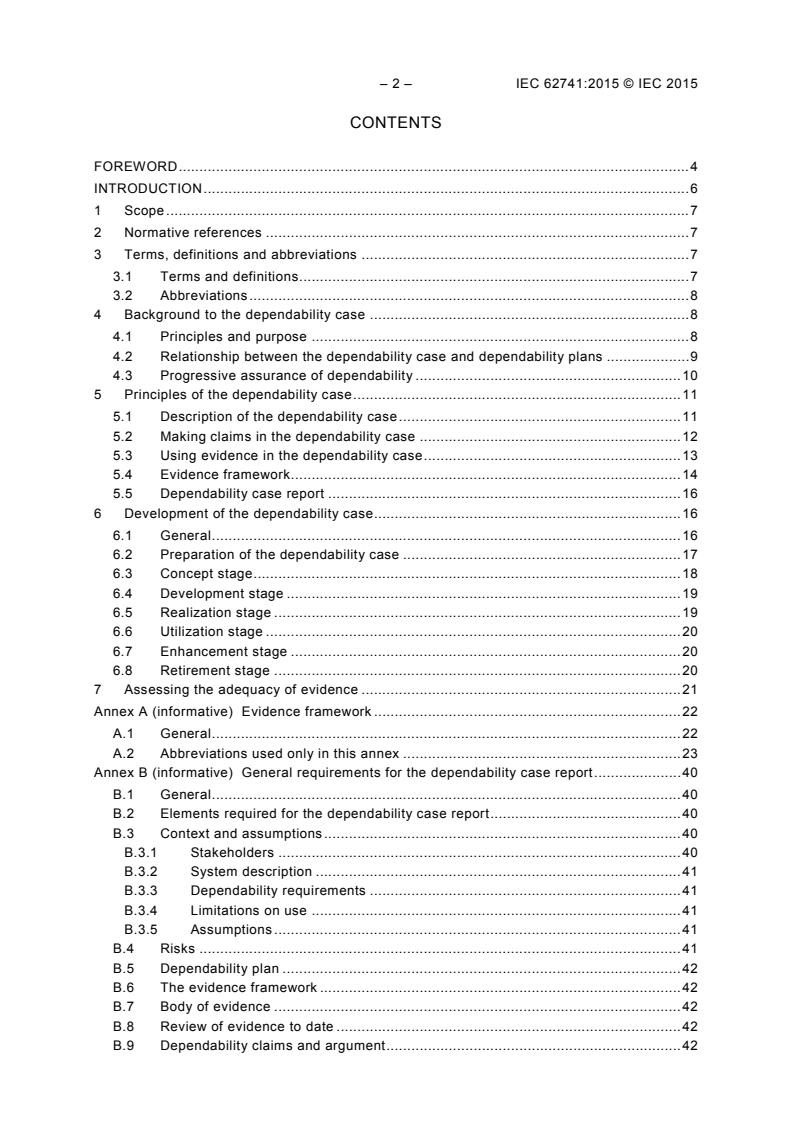
CONTENTS
FOREWORD . 4
INTRODUCTION . 6
1 Scope . 7
2 Normative references . 7
3 Terms, definitions and abbreviations . 7
3.1 Terms and definitions . 7
3.2 Abbreviations . 8
4 Background to the dependability case . 8
4.1 Principles and purpose . 8
4.2 Relationship between the dependability case and dependability plans . 9
4.3 Progressive assurance of dependability . 10
5 Principles of the dependability case . 11
5.1 Description of the dependability case . 11
5.2 Making claims in the dependability case . 12
5.3 Using evidence in the dependability case . 13
5.4 Evidence framework . 14
5.5 Dependability case report . 16
6 Development of the dependability case . 16
6.1 General . 16
6.2 Preparation of the dependability case . 17
6.3 Concept stage . 18
6.4 Development stage . 19
6.5 Realization stage . 19
6.6 Utilization stage . 20
6.7 Enhancement stage . 20
6.8 Retirement stage . 20
7 Assessing the adequacy of evidence . 21
Annex A (informative) Evidence framework . 22
A.1 General . 22
A.2 Abbreviations used only in this annex . 23
Annex B (informative) General requirements for the dependability case report . 40
B.1 General . 40
B.2 Elements required for the dependability case report . 40
B.3 Context and assumptions . 40
B.3.1 Stakeholders . 40
B.3.2 System description . 41
B.3.3 Dependability requirements . 41
B.3.4 Limitations on use . 41
B.3.5 Assumptions . 41
B.4 Risks . 41
B.5 Dependability plan . 42
B.6 The evidence framework . 42
B.7 Body of evidence . 42
B.8 Review of evidence to date . 42
B.9 Dependability claims and argument . 42
B.10 Conclusions and recommendations . 42
Annex C (informative) Checklist of points for assessing the adequacy of evidence . 44
Bibliography . 45
Figure 1 – Illustration of progressive assurance process . 11
Figure 2 – The development of claims . 12
Figure 3 – Establishment and development of the evidence framework . 15
Table A.1 – Evidence framework for system “X” . 24
Table A.2 – Evidence framework for system Y . 28
– 4 – IEC 62741:2015 © IEC 2015
INTERNATIONAL ELECTROTECHNICAL COMMISSION
______________
DEMONSTRATION OF DEPENDABILITY REQUIREMENTS –
THE DEPENDABILITY CASE
FOREWORD
1) The International Electrotechnical Commission (IEC) is a worldwide organization for standardization comprising
all national electrotechnical committees (IEC National Committees). The object of IEC is to promote
international co-operation on all questions concerning standardization in the electrical and electronic fields. To
this end and in addition to other activities, IEC publishes International Standards, Technical Specifications,
Technical Reports, Publicly Available Specifications (PAS) and Guides (hereafter referred to as “IEC
Publication(s)”). Their preparation is entrusted to technical committees; any IEC National Committee interested
in the subject dealt with may participate in this preparatory work. International, governmental and non-
governmental organizations liaising with the IEC also participate in this preparation. IEC collaborates closely
with the International Organization for Standardization (ISO) in accordance with conditions determined by
agreement between the two organizations.
2) The formal decisions or agreements of IEC on technical matters express, as nearly as possible, an international
consensus of opinion on the relevant subjects since each technical committee has representation from all
interested IEC National Committees.
3) IEC Publications have the form of recommendations for international use and are accepted by IEC National
Committees in that sense. While all reasonable efforts are made to ensure that the technical content of IEC
Publications is accurate, IEC cannot be held responsible for the way in which they are used or for any
misinterpretation by any end user.
4) In order to promote international uniformity, IEC National Committees undertake to apply IEC Publications
transparently to the maximum extent possible in their national and regional publications. Any divergence
between any IEC Publication and the corresponding national or regional publication shall be clearly indicated in
the latter.
5) IEC itself does not provide any attestation of conformity. Independent certification bodies provide conformity
assessment services and, in some areas, access to IEC marks of conformity. IEC is not responsible for any
services carried out by independent certification bodies.
6) All users should ensure that they have the latest edition of this publication.
7) No liability shall attach to IEC or its directors, employees, servants or agents including individual experts and
members of its technical committees and IEC National Committees for any personal injury, property damage or
other damage of any nature whatsoever, whether direct or indirect, or for costs (including legal fees) and
expenses arising out of the publication, use of, or reliance upon, this IEC Publication or any other IEC
Publications.
8) Attention is drawn to the Normative references cited in this publication. Use of the referenced publications is
indispensable for the correct application of this publication.
9) Attention is drawn to the possibility that some of the elements of this IEC Publication may be the subject of
patent rights. IEC shall not be held responsible for identifying any or all such patent rights.
International Standard IEC 62741 has been prepared by IEC technical committee 56:
Dependability.
The text of this standard is based on the following documents:
FDIS Report on voting
56/1591/FDIS 56/1609/RVD
Full information on the voting for the approval of this standard can be found in the report on
voting indicated in the above table.
This publication has been drafted in accordance with the ISO/IEC Directives, Part 2.
The committee has decided that the contents of this publication will remain unchanged until
the stability date indicated on the IEC website under "http://webstore.iec.ch" in the data
related to the specific publication. At this date, the publication will be
• reconfirmed,
• withdrawn,
• replaced by a revised edition, or
• amended.
– 6 – IEC 62741:2015 © IEC 2015
INTRODUCTION
Dependability is the ability to perform as and when required. Acceptable levels of
dependability are therefore essential for continued performance and optimized life cycle
costs.
In order to achieve dependability of a system, dependability requirements should be
established, the risks of not meeting them identified and a suitable set of activities developed
to meet and demonstrate the requirements and manage the risks. A dependability case
provides a convenient and convincing means of recording the output of these activities in a
single location and presenting an argument, supported by evidence, that risks have been
treated and that the necessary dependability has been or will be achieved and will continue to
be achieved over time. It serves as the main means of communication on dependability
among customers, suppliers and other stakeholders and promotes cooperation among them.
This is essential for dependability achievement and providing assurance as part of the
customer/supplier relationship.
Preparing a dependability case can also improve dependability through the actions taken to
prepare and develop the argument within the dependability case. It can improve the cost
effectiveness of a dependability programme because if an activity does not provide evidence
to support the case, this may indicate that the activity is not necessary.
The activities required for the achievement of dependability depend on the nature and
development state of the system and are likely to vary significantly from one project to
another.
Throughout this International Standard, the term "dependability" includes all aspects of
reliability, availability, maintainability and supportability, as well as other attributes such as
usability, testability and durability. In addition, dependability of a system includes all aspects
of that system, including components, processes, hardware, software and the interfaces
between them.
This standard is intended as guidance: the guidelines are not prescriptive in nature, they are
generic, they should be tailored to the specific objectives and are not exhaustive.
This standard does not address safety or the environment.
DEMONSTRATION OF DEPENDABILITY REQUIREMENTS –
THE DEPENDABILITY CASE
1 Scope
This International Standard gives guidance on the content and application of a dependability
case and establishes general principles for the preparation of a dependability case.
This standard is written in a basic project context where a customer orders a system that
meets dependability requirements from a supplier and then manages the system until its
retirement. The methods provided in this standard may be modified and adapted to other
situations as needed.
The dependability case is normally produced by the customer and supplier but can also be
used and updated by other organizations. For example, certification bodies and regulators
may examine the submitted case to support their decisions and users of the system may
update/expand the case, particularly where they use the system for a different purpose.
2 Normative references
The following documents, in whole or in part, are normatively referenced in this document and
are indispensable for its application. For dated references, only the edition cited applies. For
undated references, the latest edition of the referenced document (including any
amendments) applies.
IEC 60050-192, International Electrotechnical Vocabulary – Part 192: Dependability
IEC 60300-1, Dependability management – Part 1: Guidance for management and application
ISO 31000, Risk management – Principles and guidelines
3 Terms, definitions and abbreviations
For the purposes of this document, the terms and definitions given in IEC 60050-192, as well
as the following, apply.
3.1 Terms and definitions
3.1.1
dependability case
evidence-based, reasoned, traceable argument created to support the contention that a
defined system does and/or will satisfy the dependability requirements
3.1.2
evidence framework
structure identifying what evidence will be/has been produced and when
_____________
To be published.
– 8 – IEC 62741:2015 © IEC 2015
3.1.3
off-the-shelf
OTS
non-developmental item of supply that is both commercial and sold in substantial quantities in
the commercial marketplace
Note 1 to entry: Sometimes referred to as COTS (commercial off-the-shelf) or MOTS (modified off-the-shelf).
3.1.4
customer
party which orders or specifies the item, including the dependability requirements
Note 1 to entry: This could be an organization, sponsor, department, company or an individual and can change
through the life cycle.
3.1.5
subsystem
part of a system, which is itself a system
3.1.6
supplier
party which supplies the item, which meets its dependability requirement
Note 1 to entry: This could be an organization, department, company or an individual and can change through the
life cycle.
3.1.7
system
defined set of items that collectively fulfil a requirement
Note 1 to entry: A system is considered to have a defined real or abstract boundary.
Note 2 to entry: External resources (from outside the system boundary) may be required for the system to
operate.
Note 3 to entry: A system structure may be hierarchical, e.g. system, subsystem, component, etc.
Note 4 to entry: Conditions of use and maintenance should be expressed or implied within the requirement.
3.2 Abbreviations
COTS Commercial off-the-shelf
FEM Finite element modelling
FMECA Failure mode, effects and criticality analysis
FTA Fault tree analysis
MOTS Modified off-the-shelf
OTS Off-the-shelf
4 Background to the dependability case
4.1 Principles and purpose
A dependability case provides a reasoned and traceable argument based on evidence that a
system satisfies the requirements and will continue to do so over time. It demonstrates why
certain activities have been undertaken and how they can be judged to be successful. For
maximum effectiveness it should be initiated at the concept stage, revised progressively
during a system life cycle and is typically summarized in dependability case reports at
predefined milestones. It records progress in obtaining evidence that dependability
requirements are met and remains with the system throughout its life cycle until retirement.
The dependability case is of the greatest benefit for high value, low quantity systems where
direct evidence of dependability may be difficult or expensive to obtain. Since these systems
are often highly complex, involve novel technologies and have wide-ranging stakeholders, an
explicit argument is necessary in order to demonstrate their detailed dependability claims with
suitable evidence.
4.2 Relationship between the dependability case and dependability plans
Effective management of dependability requires organizational arrangements to implement
policy, activities implemented in dependability programmes and plans and processes for
performance evaluation, assurance and review.
A dependability programme involves
a) dependability plans, that define the activities, techniques and resources required to
achieve dependability,
b) methods for measurement and assessment,
c) assurance and review.
The objectives of a dependability plan include ensuring that
1) the dependability requirements of the customer are determined and demonstrated to be
understood by both the customer and supplier,
2) activities are planned, agreed and implemented to satisfy and demonstrate the
requirements and treat the risks of failure,
3) the customer is provided with assurance that the dependability requirements are being, or
will be, satisfied and that uncertainty in the dependability decreases over the course of the
plan.
The dependability case provides progressive assurance that dependability requirements are
being or will be satisfied and that uncertainty in the dependability is decreasing. In addition,
the case demonstrates that the activities in the plan achieve the requirements and treat the
risks. This forms part of the argument and evidence for why the system is, or will be,
dependable. The plan is usually based on standards and the organization’s experience in
managing dependability and is tailored, taking into account factors such as the relevant life
cycle stages, the organization’s context, resources available and the risks that need to be
managed.
The dependability plan and dependability case are often developed concurrently as both
include consideration of the risks of not meeting the requirements. However, the system might
meet the dependability requirements but it might not be possible to demonstrate that these
requirements have been met. This might be because there is no appropriate activity which
can demonstrate that the requirements have been met, or the cost or time required to do so
might be excessive. Therefore the dependability plan may also include activities specifically
intended to treat the risks of not being able to demonstrate that the requirements have been
met and these activities also provide evidence in the dependability case.
A register of risks produced as part of a dependability case should be coordinated with the
risks identified as part of planning the dependability programme and with the project risk
register. Activities proposed to treat the risks are included in the dependability plan and
examined as sources of evidence that risks have been treated. As the dependability plan is
implemented, the dependability case is populated with evidence of the successful
implementation of the plan. This provides progressive assurance that requirements are being
met. If sufficient evidence is not able to be obtained, then the dependability plan should be
modified accordingly.
In a well managed project, the dependability plan and dependability case are fully integrated
with overall project management. In such a project, the use of the dependability case does not
incur an increase in overall workload, since the cost of constructing the case is recouped by
– 10 – IEC 62741:2015 © IEC 2015
the saving from avoided miscommunication, avoided reworking caused by late discovery of
faults, avoided activities without demonstrable benefits and so forth.
In addition, preparing a dependability case assists the development of a cost-effective
dependability plan because evidence sought in support of the argument in the dependability
case can suggest activities which will improve the dependability plan. In addition, if an activity
in the plan is not part of an argument in the dependability case, it should be reviewed to
check that it performs a useful function in the plan. (Note that some activities in the
dependability plan are included to support other disciplines such as safety which do not
normally form part of the dependability case.)
The dependability plan and dependability case should be reviewed and updated in the event
of significant changes to the following:
– customer requirements or expectations;
– environment or interfacing systems;
– conditions of use or design intent;
– design;
– actual performance.
4.3 Progressive assurance of dependability
The dependability case provides an expanding body of evidence which aims to progressively
decrease the uncertainty around the achievement of the dependability requirements.
However, it is the norm rather than the exception that requirements, environments, etc.
change during the system life cycle. Therefore uncertainty might not always decrease. There
might be occasions, for example, when a different design option renders a proportion of the
evidence obsolete, leading to increased uncertainty. There might also be periods when no
evidence is provided, for example during testing prior to the release of test results, when
uncertainty remains unchanged. In addition, if new evidence conflicts with the existing
evidence, this might increase uncertainty.
Figure 1 illustrates two types of product development: new development and MOTS. The
vertical axis represents the level of uncertainty identified at any point in the project. As the
quantity of dependability evidence increases, the uncertainty generally reduces and
progressive assurance is obtained.
The horizontal axis represents the time into the project, from the start of the concept stage
"a", through start of development "b", to the end of the realization stage "c", end of utilization
“d”, and "e", possible enhancement, and beyond.
New development solution
Modified OTS solution
Re-design increases risk
Enhancement
(technology insertion)
increases risk
Plateau (awaiting
further evidence)
Evidence increasing
Uncertainty reducing
a b c d e
Time into project
Concept Development Realization Entry into Enhancement
stage stage utilization
IEC
Figure 1 – Illustration of progressive assurance process
At time "a" (start of concept stage) the level of uncertainty is relatively high, but this
uncertainty decreases as the project progresses. At time "c", namely at the transition from the
realization stage to the utilization stage, the body of evidence is sufficient to assure the
dependability to the degree that warrants this transition. The body of evidence (assurance)
should continue to build in utilization as successful trials and usage are recorded and the
remaining risks can be seen to reduce still further.
Having gone through its own new development period, a MOTS solution is often considered
less uncertain than new development as in Figure 1, provided all other things are equal. This
is not the case for an OTS solution in new applications or in a new environment and a careful
re-assessment is required.
Finally, many changes to uncertainty will be step-changes rather than progressive changes.
5 Principles of the dependability case
5.1 Description of the dependability case
The dependability case starts with an initial statement of dependability requirements. These
requirements might include customer’s and supplier’s internal goals, market strategies,
explicitly stated by the customer.
regulatory requirements, etc. as well as requirements
The dependability case then makes a top level claim explicitly stating the contention that the
system meets the requirements (see 5.2). The dependability case then provides a multi-level
structure of claims, sub-claims and connecting sub-arguments that are ultimately based on
evidence (see 5.3) and assumptions.
The evidence is presented in the evidence framework (see 5.4) and summarized and
referenced in the argument in the dependability case report (see 5.5).
Dependability uncertainty
– 12 – IEC 62741:2015 © IEC 2015
5.2 Making claims in the dependability case
The dependability case uses evidence in order to create an argument for the claims that the
dependability requirements have been or will be met.
Figure 2 illustrates the process of building and arguing the claims in the dependability case
using the evidence sources.
Collect evidence from
multiple sources
Performance in
Identify Identify
previous usage
assumptions context
Design
calculations
Testing/trials
data and results
Develop reasoned
argument that
dependability is
Simulations
achieved and risks
results treated
Analysis
results
Expert
opinion
Assurance that
dependability
Management and
claims are met
development processes
Operational and
maintenance data
Component and sub-
system dependability
cases
IEC
Figure 2 – The development of claims
Any assumptions necessary to make the argument should be identified and explicitly stated,
along with the activities planned to validate them. These might include assumptions regarding
the conditions of use, the environment in which the system is used or the nature and type of
maintenance.
Arguments can fall into one of two categories:
a) arguments that all identified risks to the claim are eliminated or sufficiently treated,
supported by evidence of successful treatments and by evidence that risk identification is
comprehensive;
b) arguments that there are sufficient grounds for the claim, supported by evidence of truth
of each and by evidence of adequacy.
The former requires that consideration is given to all significant sources of risks, areas of
impacts, events (including changes in circumstances) and their causes and their potential
consequences. The latter requires that the aspects covered by the evidence are sufficient to
provide assurance of the claim.
It is also necessary to identify the context and background for which the argument is made as
this identifies the limitations of the dependability case. The context includes the stakeholders
who might be interested in the system, the objectives and performance requirements, the
system being considered and any proposed limitations on the system’s use.
Should any of the assumptions or context change, then the argument and claims in the
dependability case will need to be reviewed.
During the implementation of the dependability plan, the key assumptions should be validated,
where possible, effectively replacing each with substantiated evidence. Similarly, the contexts
in which the argument is made should be validated to match the actual or intended application
of the system and the dependability case.
From these sources of evidence and explicitly stated assumptions, a reasoned argument
demonstrates how the dependability claims are substantiated. Documents and data relating to
all of these make up the dependability case.
5.3 Using evidence in the dependability case
Evidence in the dependability case can be of two sorts. The first is direct evidence that the
dependability requirements have been demonstrated. The second is evidence that activities
designed to treat the risks that the dependability requirements are not met or demonstrated
have been successful.
A wide range of sources of evidence should be used. These can include
a) performance in previous usage/operation,
b) design or other calculations,
c) test and trial data results,
d) simulation results (e.g. FEM or Monte Carlo),
e) results from analysis (e.g. FMECA and FTA) including predictions and modelling,
f) expert opinion, including previously recorded success of the supplier,
g) management and development processes including
– correct implementation of best practice,
– the management activities and systems processes followed,
h) operational and maintenance data,
i) dependability cases of components/subsystems provided by their suppliers.
It can also include evidence from activities and tasks carried out for purposes other than the
implementation of the dependability plan, such as safety or logistic support analysis.
Before undertaking a dependability activity, its objectives should be fully understood, i.e. how
does the activity help achieve dependability, how does it provide evidence for the
dependability case, and what are the success criteria for the activity. The success criteria are
applied to the records and outputs of the activity to judge if it has achieved its objectives.
Evidence that the criteria are met (including the records and outputs) substantiates the claims
that the objectives are achieved. Where applicable, the success criteria include that the risks
have been adequately treated.
– 14 – IEC 62741:2015 © IEC 2015
Quantified success criteria are preferred as determining success is simpler and less open to
interpretation.
However, quantified success criteria cannot be produced for all activities. In such cases
qualitative criteria based on the objectives of the activity should be defined and should include
evidence that the activity, as well as the ouput of the activity, are appropriate and correct. For
example, the success criteria for modelling are not simply that the predictions and modelling
demonstrate compliance with requirements, but that the model itself is an adequate
representation of the system, and that all system or system elements (e.g. software) have
been included in the modelling. The model should also address the robustness of the design
against variations in usage conditions and manufacturing conditions and manufacturing
tolerances.
Assurance and evidence does not just result from the outputs of a dependability activity, but
also from the timeliness of the activity and any actions which arise. Undertaking the activity at
the appropriate time so that it influences the design of the system is very important and
activities should be carried out in parallel with the design process. Therefore, the evidence
from an analysis activity should include the documentation showing that the activities and
actions have been implemented in a timely manner.
5.4 Evidence framework
The evidence framework presents the evidence used to demonstrate the claims and support
the argument and is generally presented as a table. The evidence framework captures the
current set of compliance and assurance activities (and their success or acceptance criteria)
which demonstrate that dependability is achieved and that risks to dependability have been
treated.
Figure 3 illustrates the steps to establish and develop the evidence framework. Each
dependability case report should base its claims and argument for them on the latest status of
the evidence framework.
Identify context
and stakeholder
objectives
Analyse
requirements
Managing and treating
the risks
Identify risks of not
demonstrating
dependability
requirements
Demonstrating the
dependability
requirements Analyse risks
Identify risk
treatments
Implement
Review and evaluation
activities
Review and evaluation
Evidence framework
A matrix of activities, success
criteria, timescales and reports
IEC
Figure 3 – Establishment and development of the evidence framework
The evidence framework should be tailored to the project. It will vary through the life cycle but
should identify or contain
a) the dependability activities, including measurements and tests, which provide evidence
for the dependability case,
b) the success or acceptance criteria for the evidence,
c) links to the risks that the activity is intended to treat or the claim which the activity
supports (as applicable),
d) the dates/milestones when the activity should be complete and the evidence available,
e) references or links to the evidence actually provided,
– 16 – IEC 62741:2015 © IEC 2015
f) confirmation of its acceptance (or rejection) (when applicable).
Annex A contains examples of evidence frameworks.
5.5 Dependability case report
In practice, the collation of all documentation into a single document is unmanageable,
particularly where there are many and diverse sources of evidence. An acceptable solution is
to present periodic updates to the dependability case as dependability case reports. The
dependability case is then the body of accumulated dependability case reports which, in turn,
refer to source evidence.
Dependability case reports are usually issued at pre-agreed points. They report on the
evidence and conclusions drawn from work done so far (referring to papers and data sources
where necessary), provide an assessment of overall dependability achievement/progress and
a review and evaluation of the dependability activities. At the beginning of each stage, the
supplier and customer should agree on the requirements to be satisfied at the end of that
stage, i.e. the gate the project must pass before proceeding to the next stage. The agreement
may include trade-offs between different competing requirements. The risks arising from this
trade-off should be included in the evidence framework. Standards describing processes that
could be used to reach robust agreements between customer and supplier are listed in the
Bibliography.
When required by a contract, they can be used to provide sufficient detail for stakeholders or
the customer to make a decision of whether to proceed from one stage of a project life cycle
to the next. Annex B contains a description of the possible contents of a dependability case
report.
The dependability case report can be presented as a narrative document but, if a more formal
presentation of the argument is required, there are several techniques available which can be
used to structure the argument and claims made from the evidence collected. The
Bibliography provides informative references to some techniques.
6 Development of the dependability case
6.1 General
This standard primarily describes a project which follows the V-model life cycle where the
supplier develops or proposes a system to meet the customer’s requirements and the
customer manages it according to the changing needs until its retirement.
In projects using other project management processes, such as spiral models or SCRUM
models, the requirements are defined as the project progresses and the guidance in this
standard should be tailored to each project. However it is still important to agree on the
requirements for the next stage and what is required by the end of that stage (e.g. a stable
and functional product release).
The dependability case does not belong solely to the customer or supplier but is a joint body
of evidence which is developed and added to by different parties at different life cycle stages.
Developing the dependability case enhances communication between the customer and the
supplier. For example, a possible cause of failure to meet customer requirements is lack of
understanding by the supplier of customer needs. Treating this risk requires the customer and
supplier to communicate to reach a common understanding of requirements. Treating this risk
early also minimizes costs.
6.2 Preparation of the dependability case
While the dependability case is most effective if started at the concept stage, it may be
started at any life cycle stage. This subclause describes the activities which are required at
whichever life cycle stage the dependability case is first developed. Subsequent subclauses
describe how the dependability case might be developed throughout the project life cycle. For
simplicity, it is written in the context of the project starting at the concept stage, where the
supplier(s) might develop multiple solutions, one of which is se
...
Questions, Comments and Discussion
Ask us and Technical Secretary will try to provide an answer. You can facilitate discussion about the standard in here.
Loading comments...