


IEC 61755-2-5:2015
(Main)Fibre optic interconnecting devices and passive components - Connector optical interfaces - Part 2-5: Connection parameters of non-dispersion shifted single-mode physically contacting fibres - Angled for reference connection applications
Fibre optic interconnecting devices and passive components - Connector optical interfaces - Part 2-5: Connection parameters of non-dispersion shifted single-mode physically contacting fibres - Angled for reference connection applications
IEC 61755-2-5:2015 defines a set of prescribed conditions that should be maintained in order to satisfy the requirements of angled polished reference connections. The prescribed conditions include dimensional limits and optical fibre requirements of the optical interface to meet specific requirements for reference connection (plugs and adaptors) used for attenuation measurements. Two different grades for reference connections are defined in this standard. The use of each of these grades depends on the application and on the targeted attenuation measurement uncertainty. The model uses a Gaussian distribution of light intensity over the specified restricted mode field diameter (MFD) range. This standard is intended to be used for shipping and acceptance inspections. The reference connector plug is specified for B1.1, B1.3 and B6 fibres as specified in IEC 60793-2-50. The use of the reference connector plug would not be recommended where classification of fibre is difficult, for example construction and maintenance of cable plant. Keywords: angled polished reference connections, plugs and adaptors, attenuation measurements
Dispositifs d’interconnexion et composants passifs fibroniques - Interfaces optiques de connecteurs - Partie 2-5: Paramètres de connexion de fibres unimodales à dispersion non décalée en contact physique - Avec angle pour applications en tant que connecteurs de référence
IEC 61755-2-5:2015 définit un ensemble de conditions prescrites qu’il convient de respecter afin de satisfaire aux exigences relatives aux connexions de référence avec angle, avec polissage. Les conditions prescrites comprennent les limites dimensionnelles et les exigences relatives aux fibres optiques de l’interface optique en vue de satisfaire aux exigences spécifiques relatives aux connexions de référence (fiches et raccords) utilisées pour les mesures de l’affaiblissement. Deux classes différentes de connexions de référence sont définies dans la présente norme. L’utilisation de chacune de ces classes dépend de l’application et de l’incertitude de mesure de l’affaiblissement visée. Le modèle utilise une distribution gaussienne de l’intensité du rayonnement lumineux sur la plage de diamètres du champ de mode (MFD[1], mode field diameter) restreinte spécifiée. La présente norme est destinée à être utilisée pour les contrôles d’expédition et de réception. La fiche de connecteur de référence est spécifiée pour les fibres B1.1, B1.3 et B6 comme spécifié dans l’IEC 60793-2-50. L’utilisation de la fiche de connecteur de référence n’est pas recommandée dans le cas où la classification des fibres est difficile, par exemple concernant la construction et la maintenance de câbles installés.
Mots clés: aux connexions de référence avec angle, fiches et raccords, mesures de l’affaiblissement
General Information
- Status
- Published
- Publication Date
- 07-Jan-2015
- Technical Committee
- SC 86B - Fibre optic interconnecting devices and passive components
- Current Stage
- PPUB - Publication issued
- Start Date
- 08-Jan-2015
- Completion Date
- 31-Jan-2015
Overview
IEC 61755-2-5:2015 is an international standard published by the International Electrotechnical Commission (IEC) that defines precise connection parameters for non-dispersion shifted single-mode physically contacting optical fibres with angled polished interfaces. Specifically, this part of the IEC 61755 series addresses angled polished reference connections used in reference plugs and adaptors, which are essential in measuring attenuation in fibre optic links.
The standard specifies dimensional limits and optical fibre requirements for these reference connectors to ensure highly reproducible and reliable attenuation measurements. Two performance grades are established based on the targeted attenuation measurement uncertainty, enhancing calibration accuracy in fibre optic systems.
Key Topics
Angled Polished Reference Connections
This standard defines the physical and optical characteristics of angled single-mode fibre connectors designed for attenuation measurements, improving back-reflection management and mating performance.Dimensional and Optical Fibre Specifications
Tight tolerances on fibre core alignment, fibre core axis angle, and mode field diameter (MFD) ensure consistent connector performance. IEC 61755-2-5 applies to specific fibre types B1.1, B1.3, and B6 as per IEC 60793-2-50.Two Performance Grades
- Grade R1: Attenuation ≤0.1 dB, measurement uncertainty ±0.1 dB
- Grade R2: Attenuation ≤0.2 dB, measurement uncertainty ±0.2 dB
These grades allow users to select a reference connector quality level based on application requirements and permissible uncertainty.
Attenuation Measurement and Uncertainty
The standard offers detailed models based on Gaussian distribution of light intensity over restricted MFD ranges for rigorously calculating coupling efficiency and insertion loss. This helps quantify the contribution of reference connectors to the overall measurement uncertainty.Use Cases and Limitations
IEC 61755-2-5 is intended primarily for shipping and acceptance inspections, laboratory referencing, and high-precision attenuation measurements. It is not recommended for cable plant construction or maintenance where fibre classification is difficult.
Applications
Optical Attenuation Calibration
Laboratories and manufacturers use these standardized angled polished reference connectors to calibrate optical loss test sets, ensuring repeatable attenuation measurements in optical fibre networks.Quality Control in Fibre Optic Components
The standard guides the production and acceptance testing of optical connectors and adaptors designed for low-loss, angled physical contact, crucial for high-quality interconnect assemblies.Research & Development in Fibre Optics
Engineers leverage the precise geometric and optical definitions to develop and test components compliant with international measurement standards for single-mode fibre connections.Telecommunication Infrastructure
The defined reference connections help maintain consistent measurement protocols when verifying attenuation in deployed fibre optic systems, especially in environments requiring low back reflection and stable optical coupling.
Related Standards
IEC 60793-2-50 – Fibre optic product specifications covering single-mode fibres B1.1, B1.3, and B6, referenced for fibre types in IEC 61755-2-5.
IEC 61300-3-4 – Basic test and measurement procedures including attenuation measurements that rely on the use of reference connectors.
IEC 61755-2-1 and IEC 61755-2-2 – Define connection parameters for non-angled and angled polished single-mode physically contacting fibres for other applications.
IEC TR 62627-04 – Technical report providing examples of uncertainty calculation for attenuation measurements relevant to reference connectors.
Summary
IEC 61755-2-5:2015 is a critical standard for professionals involved in fibre optic measurement, testing, and quality assurance. It ensures that angled physical contact fibre optic connectors used in references for attenuation measurements meet stringent dimensional and optical parameters. This guarantees high measurement accuracy and repeatability, minimizing uncertainty in optical fibre loss testing. Using these standards facilitates interoperability, traceability, and reliability in global fibre optic communication networks and instrumentation.
Keywords: angled polished reference connections, fibre optic connectors, physical contact fibre, single-mode fibre, attenuation measurement, measurement uncertainty, optical fibre standards, IEC 61755-2-5, reference connector plug, fibre core alignment, mode field diameter.

IEC 61755-2-5:2015 - Fibre optic interconnecting devices and passive components - Connector optical interfaces - Part 2-5: Connection parameters of non-dispersion shifted single-mode physically contacting fibres - Angled for reference connection applications Released:1/8/2015 Isbn:9782832221945
IEC 61755-2-5:2015 - Fibre optic interconnecting devices and passive components - Connector optical interfaces - Part 2-5: Connection parameters of non-dispersion shifted single-mode physically contacting fibres - Angled for reference connection applications
Get Certified
Connect with accredited certification bodies for this standard

TL 9000 QuEST Forum
Telecommunications quality management system.

ANCE
Mexican certification and testing association.

Intertek Slovenia
Intertek testing, inspection, and certification services in Slovenia.
Sponsored listings
Frequently Asked Questions
IEC 61755-2-5:2015 is a standard published by the International Electrotechnical Commission (IEC). Its full title is "Fibre optic interconnecting devices and passive components - Connector optical interfaces - Part 2-5: Connection parameters of non-dispersion shifted single-mode physically contacting fibres - Angled for reference connection applications". This standard covers: IEC 61755-2-5:2015 defines a set of prescribed conditions that should be maintained in order to satisfy the requirements of angled polished reference connections. The prescribed conditions include dimensional limits and optical fibre requirements of the optical interface to meet specific requirements for reference connection (plugs and adaptors) used for attenuation measurements. Two different grades for reference connections are defined in this standard. The use of each of these grades depends on the application and on the targeted attenuation measurement uncertainty. The model uses a Gaussian distribution of light intensity over the specified restricted mode field diameter (MFD) range. This standard is intended to be used for shipping and acceptance inspections. The reference connector plug is specified for B1.1, B1.3 and B6 fibres as specified in IEC 60793-2-50. The use of the reference connector plug would not be recommended where classification of fibre is difficult, for example construction and maintenance of cable plant. Keywords: angled polished reference connections, plugs and adaptors, attenuation measurements
IEC 61755-2-5:2015 defines a set of prescribed conditions that should be maintained in order to satisfy the requirements of angled polished reference connections. The prescribed conditions include dimensional limits and optical fibre requirements of the optical interface to meet specific requirements for reference connection (plugs and adaptors) used for attenuation measurements. Two different grades for reference connections are defined in this standard. The use of each of these grades depends on the application and on the targeted attenuation measurement uncertainty. The model uses a Gaussian distribution of light intensity over the specified restricted mode field diameter (MFD) range. This standard is intended to be used for shipping and acceptance inspections. The reference connector plug is specified for B1.1, B1.3 and B6 fibres as specified in IEC 60793-2-50. The use of the reference connector plug would not be recommended where classification of fibre is difficult, for example construction and maintenance of cable plant. Keywords: angled polished reference connections, plugs and adaptors, attenuation measurements
IEC 61755-2-5:2015 is classified under the following ICS (International Classification for Standards) categories: 31.040.10 - Fixed resistors; 33.180.20 - Fibre optic interconnecting devices. The ICS classification helps identify the subject area and facilitates finding related standards.
IEC 61755-2-5:2015 is available in PDF format for immediate download after purchase. The document can be added to your cart and obtained through the secure checkout process. Digital delivery ensures instant access to the complete standard document.
Standards Content (Sample)
IEC 61755-2-5 ®
Edition 1.0 2015-01
INTERNATIONAL
STANDARD
colour
inside
Fibre optic interconnecting devices and passive components – Connector
optical interfaces –
Part 2-5: Connection parameters of non-dispersion shifted single-mode
physically contacting fibres – Angled for reference connection applications
All rights reserved. Unless otherwise specified, no part of this publication may be reproduced or utilized in any form
or by any means, electronic or mechanical, including photocopying and microfilm, without permission in writing from
either IEC or IEC's member National Committee in the country of the requester. If you have any questions about IEC
copyright or have an enquiry about obtaining additional rights to this publication, please contact the address below or
your local IEC member National Committee for further information.
IEC Central Office Tel.: +41 22 919 02 11
3, rue de Varembé Fax: +41 22 919 03 00
CH-1211 Geneva 20 info@iec.ch
Switzerland www.iec.ch
About the IEC
The International Electrotechnical Commission (IEC) is the leading global organization that prepares and publishes
International Standards for all electrical, electronic and related technologies.
About IEC publications
The technical content of IEC publications is kept under constant review by the IEC. Please make sure that you have the
latest edition, a corrigenda or an amendment might have been published.
IEC Catalogue - webstore.iec.ch/catalogue Electropedia - www.electropedia.org
The stand-alone application for consulting the entire The world's leading online dictionary of electronic and
bibliographical information on IEC International Standards, electrical terms containing more than 30 000 terms and
Technical Specifications, Technical Reports and other definitions in English and French, with equivalent terms in 15
documents. Available for PC, Mac OS, Android Tablets and additional languages. Also known as the International
iPad. Electrotechnical Vocabulary (IEV) online.
IEC publications search - www.iec.ch/searchpub IEC Glossary - std.iec.ch/glossary
The advanced search enables to find IEC publications by a More than 60 000 electrotechnical terminology entries in
variety of criteria (reference number, text, technical English and French extracted from the Terms and Definitions
committee,…). It also gives information on projects, replaced clause of IEC publications issued since 2002. Some entries
and withdrawn publications. have been collected from earlier publications of IEC TC 37,
77, 86 and CISPR.
IEC Just Published - webstore.iec.ch/justpublished
Stay up to date on all new IEC publications. Just Published IEC Customer Service Centre - webstore.iec.ch/csc
details all new publications released. Available online and If you wish to give us your feedback on this publication or
also once a month by email. need further assistance, please contact the Customer Service
Centre: csc@iec.ch.
IEC 61755-2-5 ®
Edition 1.0 2015-01
INTERNATIONAL
STANDARD
colour
inside
Fibre optic interconnecting devices and passive components – Connector
optical interfaces –
Part 2-5: Connection parameters of non-dispersion shifted single-mode
physically contacting fibres – Angled for reference connection applications
INTERNATIONAL
ELECTROTECHNICAL
COMMISSION
ICS 33.180.20 ISBN 978-2-8322-2194-5
– 2 – IEC 61755-2-5:2015 © IEC 2015
CONTENTS
FOREWORD . 3
1 Scope . 5
2 Normative references . 5
3 Performance grades . 6
4 Description . 6
5 Criteria for a fit within performance grades . 7
5.1 General . 7
5.2 Attenuation grades and criteria . 7
6 Use of selected fibre to assemble reference connector plugs . 9
7 Reference adaptor . 9
8 Attenuation measurement uncertainty contribution . 9
Annex A (informative) Example of determination of the attenuation measurement
uncertainty . 10
Figure 1 – Representation of fibre core position of single connector plug under the
assumption of worst case alignment with identical connector plug. 8
Figure A.1 – Attenuation measurement uncertainty contribution for Grade 1 reference
connectors . 10
Table 1 – Single-mode attenuation grades at 1 310 nm (dB) . 6
Table 2 – Mode field diameter and fibre core nominal index of refraction for fibre to be
used in reference connector plugs . 7
Table 3 – Measurement uncertainty contribution of reference connectors . 9
INTERNATIONAL ELECTROTECHNICAL COMMISSION
____________
FIBRE OPTIC INTERCONNECTING
DEVICES AND PASSIVE COMPONENTS –
CONNECTOR OPTICAL INTERFACES –
Part 2-5: Connection parameters of non-dispersion
shifted single-mode physically contacting fibres –
Angled for reference connection applications
FOREWORD
1) The International Electrotechnical Commission (IEC) is a worldwide organization for standardization comprising
all national electrotechnical committees (IEC National Committees). The object of IEC is to promote
international co-operation on all questions concerning standardization in the electrical and electronic fields. To
this end and in addition to other activities, IEC publishes International Standards, Technical Specifications,
Technical Reports, Publicly Available Specifications (PAS) and Guides (hereafter referred to as “IEC
Publication(s)”). Their preparation is entrusted to technical committees; any IEC National Committee interested
in the subject dealt with may participate in this preparatory work. International, governmental and non-
governmental organizations liaising with the IEC also participate in this preparation. IEC collaborates closely
with the International Organization for Standardization (ISO) in accordance with conditions determined by
agreement between the two organizations.
2) The formal decisions or agreements of IEC on technical matters express, as nearly as possible, an international
consensus of opinion on the relevant subjects since each technical committee has representation from all
interested IEC National Committees.
3) IEC Publications have the form of recommendations for international use and are accepted by IEC National
Committees in that sense. While all reasonable efforts are made to ensure that the technical content of IEC
Publications is accurate, IEC cannot be held responsible for the way in which they are used or for any
misinterpretation by any end user.
4) In order to promote international uniformity, IEC National Committees undertake to apply IEC Publications
transparently to the maximum extent possible in their national and regional publications. Any divergence
between any IEC Publication and the corresponding national or regional publication shall be clearly indicated in
the latter.
5) IEC itself does not provide any attestation of conformity. Independent certification bodies provide conformity
assessment services and, in some areas, access to IEC marks of conformity. IEC is not responsible for any
services carried out by independent certification bodies.
6) All users should ensure that they have the latest edition of this publication.
7) No liability shall attach to IEC or its directors, employees, servants or agents including individual experts and
members of its technical committees and IEC National Committees for any personal injury, property damage or
other damage of any nature whatsoever, whether direct or indirect, or for costs (including legal fees) and
expenses arising out of the publication, use of, or reliance upon, this IEC Publication or any other IEC
Publications.
8) Attention is drawn to the Normative references cited in this publication. Use of the referenced publications is
indispensable for the correct application of this publication.
9) Attention is drawn to the possibility that some of the elements of this IEC Publication may be the subject of
patent rights. IEC shall not be held responsible for identifying any or all such patent rights.
International Standard IEC 61755-2-5 has been prepared by subcommittee 86B: Fibre optic
interconnecting devices and passive components, of IEC technical committee 86: Fibre optics.
The text of this standard is based on the following documents:
FDIS Report on voting
86B/3846/FDIS 86B/3867/RVD
Full information on the voting for the approval of this standard can be found in the report on
voting indicated in the above table.
– 4 – IEC 61755-2-5:2015 © IEC 2015
This publication has been drafted in accordance with the ISO/IEC Directives, Part 2.
A list of all parts in the IEC 61755 series, published under the general title Fibre optic
interconnecting devices and passive components – Connector optical interfaces, can be found
on the IEC website.
Future standards in this series will carry the new general title as cited above. Titles of existing
standards in this series will be updated at the time of the next edition.
The committee has decided that the contents of this publication will remain unchanged until
the stability date indicated on the IEC web site under "http://webstore.iec.ch" in the data
related to the specific publication. At this date, the publication will be
• reconfirmed,
• withdrawn,
• replaced by a revised edition, or
• amended.
A bilingual version of this publication may be issued at a later date.
IMPORTANT – The 'colour inside' logo on the cover page of this publication indicates
that it contains colours which are considered to be useful for the correct
understanding of its contents. Users should therefore print this document using a
colour printer.
FIBRE OPTIC INTERCONNECTING
DEVICES AND PASSIVE COMPONENTS –
CONNECTOR OPTICAL INTERFACES –
Part 2-5: Connection parameters of non-dispersion
shifted single-mode physically contacting fibres –
Angled for reference connection applications
1 Scope
This part of IEC 61755 defines a set of prescribed conditions that should be maintained in
order to satisfy the requirements of angled polished reference connections.
The prescribed conditions include dimensional limits and optical fibre requirements of the
optical interface to meet specific requirements for reference connection (plugs and adaptors)
used for attenuation measurements.
Two different grades for reference connections are defined in this standard. The use of each
of these grades depends on the application and on the targeted attenuation measurement
uncertainty. The model uses a Gaussian distribution of light intensity over the specifi
...
IEC 61755-2-5 ®
Edition 1.0 2015-01
INTERNATIONAL
STANDARD
NORME
INTERNATIONALE
colour
inside
Fibre optic interconnecting devices and passive components – Connector
optical interfaces –
Part 2-5: Connection parameters of non-dispersion shifted single-mode
physically contacting fibres – Angled for reference connection applications
Dispositifs d’interconnexion et composants passifs fibroniques – Interfaces
optiques de connecteurs –
Partie 2-5: Paramètres de connexion de fibres unimodales à dispersion non
décalée en contact physique – Avec angle pour applications en tant que
connecteurs de référence
All rights reserved. Unless otherwise specified, no part of this publication may be reproduced or utilized in any form
or by any means, electronic or mechanical, including photocopying and microfilm, without permission in writing from
either IEC or IEC's member National Committee in the country of the requester. If you have any questions about IEC
copyright or have an enquiry about obtaining additional rights to this publication, please contact the address below or
your local IEC member National Committee for further information.
Droits de reproduction réservés. Sauf indication contraire, aucune partie de cette publication ne peut être reproduite ni
utilisée sous quelque forme que ce soit et par aucun procédé, électronique ou mécanique, y compris la photocopie et
les microfilms, sans l'accord écrit de l'IEC ou du Comité national de l'IEC du pays du demandeur. Si vous avez des
questions sur le copyright de l'IEC ou si vous désirez obtenir des droits supplémentaires sur cette publication, utilisez
les coordonnées ci-après ou contactez le Comité national de l'IEC de votre pays de résidence.
IEC Central Office Tel.: +41 22 919 02 11
3, rue de Varembé info@iec.ch
CH-1211 Geneva 20 www.iec.ch
Switzerland
About the IEC
The International Electrotechnical Commission (IEC) is the leading global organization that prepares and publishes
International Standards for all electrical, electronic and related technologies.
About IEC publications
The technical content of IEC publications is kept under constant review by the IEC. Please make sure that you have the
latest edition, a corrigendum or an amendment might have been published.
IEC publications search - webstore.iec.ch/advsearchform Electropedia - www.electropedia.org
The advanced search enables to find IEC publications by a The world's leading online dictionary on electrotechnology,
variety of criteria (reference number, text, technical containing more than 22 000 terminological entries in English
committee,…). It also gives information on projects, replaced and French, with equivalent terms in 16 additional languages.
and withdrawn publications. Also known as the International Electrotechnical Vocabulary
(IEV) online.
IEC Just Published - webstore.iec.ch/justpublished
Stay up to date on all new IEC publications. Just Published IEC Glossary - std.iec.ch/glossary
details all new publications released. Available online and once 67 000 electrotechnical terminology entries in English and
a month by email. French extracted from the Terms and Definitions clause of IEC
publications issued since 2002. Some entries have been
IEC Customer Service Centre - webstore.iec.ch/csc collected from earlier publications of IEC TC 37, 77, 86 and
If you wish to give us your feedback on this publication or need CISPR.
further assistance, please contact the Customer Service
Centre: sales@iec.ch.
A propos de l'IEC
La Commission Electrotechnique Internationale (IEC) est la première organisation mondiale qui élabore et publie des
Normes internationales pour tout ce qui a trait à l'électricité, à l'électronique et aux technologies apparentées.
A propos des publications IEC
Le contenu technique des publications IEC est constamment revu. Veuillez vous assurer que vous possédez l’édition la
plus récente, un corrigendum ou amendement peut avoir été publié.
Recherche de publications IEC - Le premier dictionnaire d'électrotechnologie en ligne au monde,
webstore.iec.ch/advsearchform avec plus de 22 000 articles terminologiques en anglais et en
La recherche avancée permet de trouver des publications IEC français, ainsi que les termes équivalents dans 16 langues
en utilisant différents critères (numéro de référence, texte, additionnelles. Egalement appelé Vocabulaire
comité d’études,…). Elle donne aussi des informations sur les Electrotechnique International (IEV) en ligne.
projets et les publications remplacées ou retirées.
Glossaire IEC - std.iec.ch/glossary
IEC Just Published - webstore.iec.ch/justpublished 67 000 entrées terminologiques électrotechniques, en anglais
Restez informé sur les nouvelles publications IEC. Just et en français, extraites des articles Termes et Définitions des
Published détaille les nouvelles publications parues. publications IEC parues depuis 2002. Plus certaines entrées
Disponible en ligne et une fois par mois par email. antérieures extraites des publications des CE 37, 77, 86 et
CISPR de l'IEC.
Service Clients - webstore.iec.ch/csc
Si vous désirez nous donner des commentaires sur cette
publication ou si vous avez des questions contactez-nous:
sales@iec.ch.
Electropedia - www.electropedia.org
IEC 61755-2-5 ®
Edition 1.0 2015-01
INTERNATIONAL
STANDARD
NORME
INTERNATIONALE
colour
inside
Fibre optic interconnecting devices and passive components – Connector
optical interfaces –
Part 2-5: Connection parameters of non-dispersion shifted single-mode
physically contacting fibres – Angled for reference connection applications
Dispositifs d’interconnexion et composants passifs fibroniques – Interfaces
optiques de connecteurs –
Partie 2-5: Paramètres de connexion de fibres unimodales à dispersion non
décalée en contact physique – Avec angle pour applications en tant que
connecteurs de référence
INTERNATIONAL
ELECTROTECHNICAL
COMMISSION
COMMISSION
ELECTROTECHNIQUE
INTERNATIONALE
ICS 33.180.20 ISBN 978-2-8322-7277-0
– 2 – IEC 61755-2-5:2015 © IEC 2015
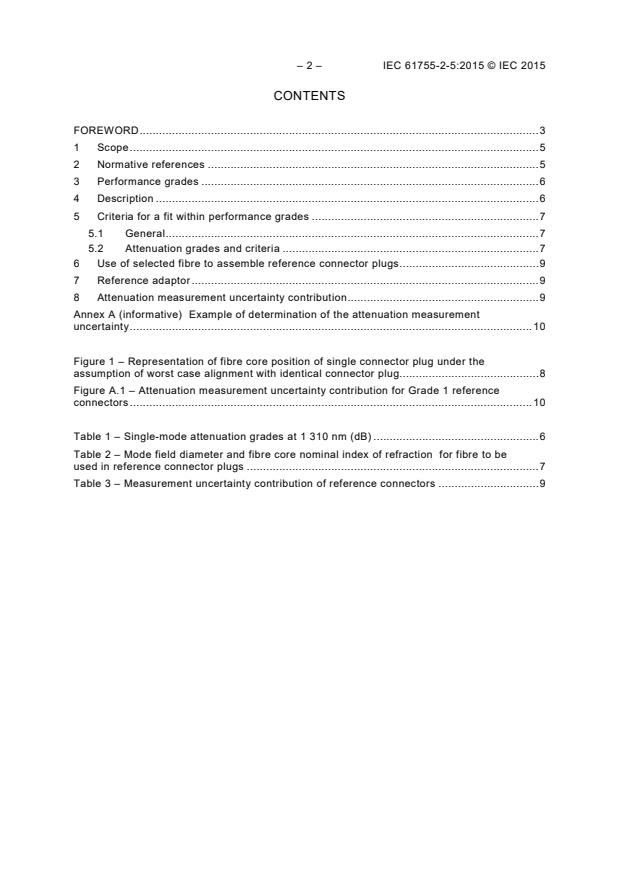
CONTENTS
FOREWORD . 3
1 Scope . 5
2 Normative references . 5
3 Performance grades . 6
4 Description . 6
5 Criteria for a fit within performance grades . 7
5.1 General . 7
5.2 Attenuation grades and criteria . 7
6 Use of selected fibre to assemble reference connector plugs . 9
7 Reference adaptor . 9
8 Attenuation measurement uncertainty contribution . 9
Annex A (informative) Example of determination of the attenuation measurement
uncertainty . 10
Figure 1 – Representation of fibre core position of single connector plug under the
assumption of worst case alignment with identical connector plug. 8
Figure A.1 – Attenuation measurement uncertainty contribution for Grade 1 reference
connectors . 10
Table 1 – Single-mode attenuation grades at 1 310 nm (dB) . 6
Table 2 – Mode field diameter and fibre core nominal index of refraction for fibre to be
used in reference connector plugs . 7
Table 3 – Measurement uncertainty contribution of reference connectors . 9
INTERNATIONAL ELECTROTECHNICAL COMMISSION
____________
FIBRE OPTIC INTERCONNECTING
DEVICES AND PASSIVE COMPONENTS –
CONNECTOR OPTICAL INTERFACES –
Part 2-5: Connection parameters of non-dispersion
shifted single-mode physically contacting fibres –
Angled for reference connection applications
FOREWORD
1) The International Electrotechnical Commission (IEC) is a worldwide organization for standardization comprising
all national electrotechnical committees (IEC National Committees). The object of IEC is to promote international
co-operation on all questions concerning standardization in the electrical and electronic fields. To this end and
in addition to other activities, IEC publishes International Standards, Technical Specifications, Technical Reports,
Publicly Available Specifications (PAS) and Guides (hereafter referred to as “IEC Publication(s)”). Their
preparation is entrusted to technical committees; any IEC National Committee interested in the subject dealt with
may participate in this preparatory work. International, governmental and non-governmental organizations liaising
with the IEC also participate in this preparation. IEC collaborates closely with the International Organization for
Standardization (ISO) in accordance with conditions determined by agreement between the two organizations.
2) The formal decisions or agreements of IEC on technical matters express, as nearly as possible, an international
consensus of opinion on the relevant subjects since each technical committee has representation from all
interested IEC National Committees.
3) IEC Publications have the form of recommendations for international use and are accepted by IEC National
Committees in that sense. While all reasonable efforts are made to ensure that the technical content of IEC
Publications is accurate, IEC cannot be held responsible for the way in which they are used or for any
misinterpretation by any end user.
4) In order to promote international uniformity, IEC National Committees undertake to apply IEC Publications
transparently to the maximum extent possible in their national and regional publications. Any divergence between
any IEC Publication and the corresponding national or regional publication shall be clearly indicated in the latter.
5) IEC itself does not provide any attestation of conformity. Independent certification bodies provide conformity
assessment services and, in some areas, access to IEC marks of conformity. IEC is not responsible for any
services carried out by independent certification bodies.
6) All users should ensure that they have the latest edition of this publication.
7) No liability shall attach to IEC or its directors, employees, servants or agents including individual experts and
members of its technical committees and IEC National Committees for any personal injury, property damage or
other damage of any nature whatsoever, whether direct or indirect, or for costs (including legal fees) and
expenses arising out of the publication, use of, or reliance upon, this IEC Publication or any other IEC Publications.
8) Attention is drawn to the Normative references cited in this publication. Use of the referenced publications is
indispensable for the correct application of this publication.
9) Attention is drawn to the possibility that some of the elements of this IEC Publication may be the subject of patent
rights. IEC shall not be held responsible for identifying any or all such patent rights.
International Standard IEC 61755-2-5 has been prepared by subcommittee 86B: Fibre optic
interconnecting devices and passive components, of IEC technical committee 86: Fibre optics.
This bilingual version (2019-08) corresponds to the monolingual English version, published in
2015-01.
The text of this standard is based on the following documents:
FDIS Report on voting
86B/3846/FDIS 86B/3867/RVD
Full information on the voting for the approval of this standard can be found in the report on
voting indicated in the above table.
– 4 – IEC 61755-2-5:2015 © IEC 2015
The French version of this standard has not been voted upon.
This publication has been drafted in accordance with the ISO/IEC Directives, Part 2.
A list of all parts in the IEC 61755 series, published under the general title Fibre optic
interconnecting devices and passive components – Connector optical interfaces, can be found
on the IEC website.
Future standards in this series will carry the new general title as cited above. Titles of existing
standards in this series will be updated at the time of the next edition.
The committee has decided that the contents of this publication will remain unchanged until the
stability date indicated on the IEC web site under "http://webstore.iec.ch" in the data related to
the specific publication. At this date, the publication will be
• reconfirmed,
• withdrawn,
• replaced by a revised edition, or
• amended.
IMPORTANT – The 'colour inside' logo on the cover page of this publication indicates
that it contains colours which are considered to be useful for the correct understanding
of its contents. Users should therefore print this document using a colour printer.
FIBRE OPTIC INTERCONNECTING
DEVICES AND PASSIVE COMPONENTS –
CONNECTOR OPTICAL INTERFACES –
Part 2-5: Connection parameters of non-dispersion
shifted single-mode physically contacting fibres –
Angled for reference connection applications
1 Scope
This part of IEC 61755 defines a set of prescribed conditions that should be maintained in order
to satisfy the requirements of angled polished reference connections.
The prescribed conditions include dimensional limits and optical fibre requirements of the
optical interface to meet specific requirements for reference connection (plugs and adaptors)
used for attenuation measurements.
Two different grades for reference connections are defined in this standard. The use of each of
these grades depends on the application and on the targeted attenuation measurement
uncertainty. The model uses a Gaussian distribution of light intensity over the specified
restricted mode field diameter (MFD) range.
This standard is intended to be used for shipping and acceptance inspections.
The reference connector plug is specified for B1.1, B1.3 and B6 fibres as specified in
IEC 60793-2-50.
The use of the reference connector plug would not be recommended where classification of
fibre is difficult, for example construction and maintenance of cable plant.
2 Normative references
The following documents, in whole or in part, are normatively referenced in this document and
are indispensable for its application. For dated references, only the edition cited applies. For
undated references, the latest edition of the referenced document (including any amendments)
applies.
IEC 60793-2-50, Optical fibres – Part 2-50: Product specifications – Sectional specification for
class B single-mode fibres
IEC 61300-3-4, Fibre optic interconnecting devices and passive components – Basic test and
measurement procedures – Part 3-4: Examinations and measurements – Attenuation
IEC 61300-3-42, Fibre optic interconnecting devices and passive components – Basic test and
measurement procedures – Part 3-42: Examinations and measurements – Attenuation of single
mode alignment sleeves and or adaptors with resilient alignment sleeves
IEC 61755-2-1, Fibre optic interconnecting devices and passive components –Connector optical
interfaces – Part 2-1: Connection parameters of non-dispersion shifted single-mode physically
contacting fibres – Non-angled
– 6 – IEC 61755-2-5:2015 © IEC 2015
IEC 61755-2-2, Fibre optic interconnecting devices and passive components –Connector
optical interfaces – Part 2-2: Connection parameters of non-dispersion shifted single-mode
physically contacting fibres – Angled
IEC 61755-3 (all parts), Fibre optic interconnecting devices and passive components –
Connector optical interfaces – Part 3-x: Connector parameters of non-dispersion shifted single-
mode physically contacting fibres
IEC TR 62627-04, Fibre optic interconnecting devices and passive components – Technical
report – Part 04: Example of uncertainty calculation: Measurement of the attenuation of an
optical connector.
3 Performance grades
Performance grades for APC polished reference connectors are given in Table 1. The specified
attenuation for each grade is obtained when the reference plugs are connected to each other
with the reference adaptor.
Table 1 – Single-mode attenuation grades at 1 310 nm (dB)
a a b
Reference grade Attenuation Contribution to measurement uncertainty
dB dB
R1
≤0,1 ±0,1
R2 ≤0,2 ±0,2
a
Under the assumption of worst case alignment with identical connector plug. Expected attenuation measured
when connecting two plugs of the same grade may be higher due to significant measurement uncertainty
b
As described in Clause 8.
4 Description
Optical reference connector plugs are connector plugs manufactured with restricted tolerances
for dimensions relevant to lateral and angular offset. These connector plugs are used for
attenuation measurement purposes according to IEC 61300-3-4, and shall be considered as
part of the measurement set-up since they strongly contribute to its measurement uncertainty
(for example see IEC TR 62627-04). The attenuation measurement uncertainty contributions
for both grades of reference connectors are listed in Table 3.
The principal performance of a reference connector plug is given by its contribution to
measurement uncertainty (estimated based on the reproducibility of an attenuation
measurement of the same device performed using multiple different reference connector plugs
of the same grade) which is determined by the accuracy with which the core of the optical fibre
is aligned to the optical datum target and determines the random attenuation performance of a
reference connector population.
The main parameters influencing the performance of the reference connector plugs are fibre
core location, fibre core axis angle and mode field diameter variability. Figure 1 represents the
fibre alignment tolerances for the two different reference grades described in this standard,
under the assumption of using selected reference fibre, described in Table 2.
The design curves given in Figure 1 each represent maximum allowable combinations of a given
specific fibre core location and an associated fibre core axis angle to not exceed the specified
attenuation of any single considered connection. The design curves shown represent the
determination of the parameters under a worst case mismatch of the mode field diameter of the
selected fibres as given in Table 3, i.e. 9,1/9,3 µm and a wavelength of 1 310 nm. These mode
field diameter ranges are selected within the IEC 60793-2-50 family specification for single-
mode, non-dispersion shifted fibres as given in Table 2.
5 Criteria for a fit within performance grades
5.1 General
Figure 1 and Table 2 give the criteria for meeting the performance grades listed above in Table
1. The parameters chosen for the criteria definition are based on the degree of significance in
affecting the performance under test.
5.2 Attenuation grades and criteria
Considering a beam with a Gaussian distribution, the coupling efficiency, η, of two single mode
fibres is given by Equation (1).
Table 2 – Mode field diameter and fibre core nominal index of refraction
for fibre to be used in reference connector plugs
a
MFD
Nominal
n
µm 0
Fibre type wavelength
(core)
nm
Min. Max.
Dispersion unshifted fibre 1 310 9,1 9,3 1,452 0
a
MFD as specified here has a narrow tolerance compared to tolerance field in IEC 60793-2-50.
The attenuation (also referred to as insertion loss, IL, or coupling efficiency) of the fibres equals
η Attenuation η is expressed as in Equation (1) below:
combined. combined .
2 2 2 2 2
(2ω ω ) − 2 ×d n (ω ω )
2 1 2 0 2 1 2
η = −10log exp − 2π sin (θ ) (1)
combined
2 2 2 2 2 2
2 2
ω + ω λ (ω + ω )
(ω + ω ) 2 1 2 1
2 1
where
d is the total lateral offset;
θ is the angular misalignment between fibre cores;
λ is the wavelength of transmitted light in vacuum;
n is the index of refraction of the fibre core;
ω is the transmit fibre mode field radius;
ω is the receive fibre mode field radius.
The definition of reference connector grades is based on worst case calculation (unlike the
other level 2 optical interface standards, IEC 61755-2-1 and IEC 61755-2-2, where the
definition of performance grades is based on a statistical approach defining parameter values
to reach the given random attenuation in 97 % of the connections).
Equation (2), which has been used to calculate the curves displayed in Figure 1, is derived from
Equation (1) where the total lateral offset (d) has been replaced by the double of the fibre core
location ( ) and the angular misalignment by the double of the fibre core axis angle ( ),
2 ×F 2 ×E
the input fibre has maximum fibre mode field radius (4,65 µm) and the output fibre the minimum
fibre mode field radius (4,55 µm) specified in Table 2. That way, Equation (2) calculated the
attenuation in the case of worst case alignment of identical plugs. It shall be noted that Figure
1 can be used as a design graph for reference connector plugs, from where fibre core location
and angular misalignment can be directly read. For the definition of fibre core location and fibre
core axis angle refer to the relevant level 3 optical inferface standards (see the IEC 61755-3
series).
– 8 – IEC 61755-2-5:2015 © IEC 2015
2 2 2 2
(2ω ω ) − 2 × (2 ×F) n (ω ω )
2 1 2 0 2 1 2
η = −10log exp − 2π sin (2 ×E)
combined
(2)
2 2 2 2 2 2
2 2
ω + ω λ (ω + ω )
2 1 2 1
(ω + ω )
2 1
where
F is the fibre core location (µm);
E is the fibre core axis angle (rad);
λ is the wavelength of transmitted light in vacuum (here 1,310 µm);
n is the index of refraction of the fibre core (here 1,452 0);
ω is the transmit fibre mode field radius (here 4,55 µm);
ω is the receive fibre mode field radius (here 4,65 µm).
The shown design curves represent the determination of the parameters under a worst case
mismatch of the mode field diameter of the selected fibres as given in Table 2, i.e. 9,1/9,3 µm
and a wavelength of 1 310 nm. These mode field diameter ranges are selected within the
IEC 60793-2-50 product specification for single-mode non-dispersion shifted fibres as given in
Table 2. The equation is also applicable to 1 550 nm and 1 625 nm, but the design curves are
not shown in Figure 1.
0,2 dB
0,3
0,1 dB
0,2
0,1
0,0
0,0 0,1 0,2 0,3 0,4
Dimension F: Fibre core position (µm)
IEC
Figure 1 – Representation of fibre core position of single connector plug under the
assumption of worst case alignment with identical connector plug
For cylindrical ferrule connectors, the performance presented in Figure 1 can only be achieved
when limiting the ferrule diameter tolerance to
• 1,249 0 to 1,249 5 mm for 1,25 mm ferrules, and
• 2,499 0 to 2,499 5 mm for 2,5 mm ferrules.
For terminated APC connectors, the measurement of core position and angular misalignment
are “for further study”.
Dimension E: Fibre core axis angle (°)
6 Use of selected fibre to assemble reference connector plugs
In order to limit the variability of attenuation measurement using reference connectors, it is
mandatory to use selected fibre with restricted tolerances on mode field diameter (MFD) to 9,2
µm ± 0,1 µm, measured at 1 310 nm. Using this type of fibre and the tolerance parameters
published in this standard it is possible to reach measurement values that are repeatable within
± ,1 dB when randomly varying the reference connector plug (valid for reference Grade 1).
7 Reference adaptor
In case of a cylindrical ferrule connector, selected reference adaptors shall be used. It is
recommended to use reference connector plugs and measure them according to
IEC 61300-3-42 with an attenuation variation smaller than 0,03 dB.
8 Attenuation measurement uncertainty contribution
When performing an attenuation measurement using a reference connector plug and adaptor,
these shall be considered as part of the measurement set-up. The goal of a reference
measurement is to qualify a device under test (DUT, which may be an optical connector or
another optical component that has an input connector) by measuring the attenuation of the
DUT connected to the reference connector plug and adaptor. Since the reference connector
plug and adaptor properties vary as a function of measurement situation, this variability has to
be considered as a contribution to the attenuation measurement uncertainty of such a set-up.
The following contributions, as shown in Table 3 and in Figure A.1 have been determined as a
function of reference connector grade.
Table 3 – Measurement un
...
Questions, Comments and Discussion
Ask us and Technical Secretary will try to provide an answer. You can facilitate discussion about the standard in here.
Loading comments...