

IEC 62516-3:2013
(Main)Terrestrial digital multimedia broadcasting (T-DMB) receivers - Part 3: Common API
General Information
- Abstract
IEC 62516-3:2013 describes the T-DMB common application program interface (API). It provides a software platform that, when combined with the T-DMB O/S, forms a universal interface for application programs. This interface allows application programs to be written in such a way that they run on any T-DMB receiver unit, as described in IEC 62516-1:2009 and IEC 62516-2:2011 regardless of its manufacturer. It also defines a software environment that allows multiple application programs to be interoperable on a single receiver unit by sharing the fixed resources of the receiver, and it provides a set of interfaces that the T-DMB middleware and the ASIC specific software use.
- Status
- Published
- Publication Date
- 10-Mar-2013
- Technical Committee
- TA 1 - Terminals for audio, video and data services and content
- Current Stage
- PPUB - Publication issued
- Start Date
- 11-Mar-2013
- Completion Date
- 31-May-2013
Overview
IEC 62516-3:2013 is an international standard published by the International Electrotechnical Commission (IEC) that specifies the common application program interface (API) for Terrestrial Digital Multimedia Broadcasting (T-DMB) receivers. This standard defines a universal software platform that enables application programs to operate across any T-DMB receiver unit, regardless of the manufacturer. By standardizing the API, IEC 62516-3 facilitates interoperability, portability, and efficient resource sharing among multiple applications on a single device.
The standard is part three of the IEC 62516 series covering T-DMB receivers and complements IEC 62516-1:2009 (basic requirements) and IEC 62516-2:2011 (interactive data services using BIFS). It supports a modular software environment, including middleware and ASIC-specific software components, which jointly manage the terrestrial digital multimedia broadcast reception.
Key Topics
T-DMB Receiver Architecture
The standard outlines the typical architecture of a T-DMB receiver, including crucial hardware and software components:- The T-DMB Receiver ASIC Block: Implements physical layer operations such as RF reception, analog-to-digital conversion (ADC), demodulation, and error correction based on ETSI EN 300 401 standards.
- The Host Processor Block: Handles the processing of multiplexed broadcast data delivered by the ASIC. This block includes:
- T-DMB Driver (Hardware Abstraction Layer - HAL)
- ASIC-specific software modules
- The T-DMB common API layer
- Middleware enabling application interoperability
Common API Functions
The standard defines a set of APIs supporting essential receiver functions:- Retrieving receiver capabilities
- Tuning and frequency management
- Searching and scanning broadcast services
- Selecting T-DMB services and associated dynamic content such as slideshows and broadcast websites
- Monitoring reception quality metrics
Software Environment
IEC 62516-3 establishes a framework for multiple applications to share fixed device resources seamlessly, promoting interoperability without conflicts. It also ensures that middleware and underlying hardware-specific software layers can reliably communicate through the common API.Command Types and Patterns
Various command patterns are standardized for consistent communication methods within the receiver’s software stack, ensuring predictable interface behavior.
Applications
The IEC 62516-3 standard is essential for manufacturers, developers, and integrators of T-DMB receiver devices and applications, enabling:
- Cross-device application development: Developers can create T-DMB applications that are hardware-agnostic, improving market reach and reducing fragmentation.
- Consumer electronics: Digital radios, mobile TVs, and infotainment systems benefit from standardized APIs to deliver rich multimedia broadcast services.
- Broadcast service providers: The standardized interface facilitates integration of interactive services like real-time news, dynamic labels, slideshows, and broadcast websites.
- Middleware vendors: Provides guidelines to develop middleware that supports multiple applications simultaneously on T-DMB receivers, optimizing resource management.
- Quality monitoring tools: Enables manufacturers to implement reception quality monitoring features that enhance user experience through adaptive tuning and error management.
Related Standards
IEC 62516-3 is part of a series focused on T-DMB technology, and references several key documents:
- IEC 62516-1:2009 – Specifies the basic functional and performance requirements for T-DMB receivers.
- IEC 62516-2:2011 – Defines interactive data services using BIFS (Binary Format for Scenes), which complements the common API.
- ETSI EN 300 401 v1.3.3 – The European Telecommunications Standards Institute specification for Digital Audio Broadcasting (DAB) physical layer, which the T-DMB ASIC layer implements.
- ISO/IEC Directives, Part 2 – Governs the drafting and formatting of IEC publications ensuring consistency and quality.
By adhering to these interconnected standards, ecosystem participants can develop interoperable, high-quality digital multimedia broadcasting receivers and applications.
Keywords: IEC 62516-3, T-DMB common API, Terrestrial Digital Multimedia Broadcasting, T-DMB receiver, T-DMB middleware, hardware abstraction layer, ASIC, digital broadcasting standards, multimedia receiver API, DAB physical layer, broadcast service interoperability, application programming interface for T-DMB
Get Certified
Connect with accredited certification bodies for this standard

ANCE
Mexican certification and testing association.

Intertek Slovenia
Intertek testing, inspection, and certification services in Slovenia.

LNE (Laboratoire National de Métrologie et d'Essais)
French national laboratory for metrology and testing.
Sponsored listings
Frequently Asked Questions
IEC 62516-3:2013 is a standard published by the International Electrotechnical Commission (IEC). Its full title is "Terrestrial digital multimedia broadcasting (T-DMB) receivers - Part 3: Common API". This standard covers: IEC 62516-3:2013 describes the T-DMB common application program interface (API). It provides a software platform that, when combined with the T-DMB O/S, forms a universal interface for application programs. This interface allows application programs to be written in such a way that they run on any T-DMB receiver unit, as described in IEC 62516-1:2009 and IEC 62516-2:2011 regardless of its manufacturer. It also defines a software environment that allows multiple application programs to be interoperable on a single receiver unit by sharing the fixed resources of the receiver, and it provides a set of interfaces that the T-DMB middleware and the ASIC specific software use.
IEC 62516-3:2013 describes the T-DMB common application program interface (API). It provides a software platform that, when combined with the T-DMB O/S, forms a universal interface for application programs. This interface allows application programs to be written in such a way that they run on any T-DMB receiver unit, as described in IEC 62516-1:2009 and IEC 62516-2:2011 regardless of its manufacturer. It also defines a software environment that allows multiple application programs to be interoperable on a single receiver unit by sharing the fixed resources of the receiver, and it provides a set of interfaces that the T-DMB middleware and the ASIC specific software use.
IEC 62516-3:2013 is classified under the following ICS (International Classification for Standards) categories: 33.160.25 - Television receivers; 33.170 - Television and radio broadcasting. The ICS classification helps identify the subject area and facilitates finding related standards.
IEC 62516-3:2013 is available in PDF format for immediate download after purchase. The document can be added to your cart and obtained through the secure checkout process. Digital delivery ensures instant access to the complete standard document.
Standards Content (Sample)
IEC 62516-3 ®
Edition 1.0 2013-03
INTERNATIONAL
STANDARD
NORME
INTERNATIONALE
colour
inside
Terrestrial digital multimedia broadcasting (T-DMB) receivers –
Part 3: Common API
Récepteurs pour diffusion multimédia numérique terrestre (T-DMB) –
Partie 3: API commune
All rights reserved. Unless otherwise specified, no part of this publication may be reproduced or utilized in any form
or by any means, electronic or mechanical, including photocopying and microfilm, without permission in writing from
either IEC or IEC's member National Committee in the country of the requester.
If you have any questions about IEC copyright or have an enquiry about obtaining additional rights to this publication,
please contact the address below or your local IEC member National Committee for further information.
Droits de reproduction réservés. Sauf indication contraire, aucune partie de cette publication ne peut être reproduite ni
utilisée sous quelque forme que ce soit et par aucun procédé, électronique ou mécanique, y compris la photocopie et les
microfilms, sans l'accord écrit de la CEI ou du Comité national de la CEI du pays du demandeur.
Si vous avez des questions sur le copyright de la CEI ou si vous désirez obtenir des droits supplémentaires sur cette
publication, utilisez les coordonnées ci-après ou contactez le Comité national de la CEI de votre pays de résidence.
IEC Central Office Tel.: +41 22 919 02 11
3, rue de Varembé Fax: +41 22 919 03 00
CH-1211 Geneva 20 info@iec.ch
Switzerland www.iec.ch
About the IEC
The International Electrotechnical Commission (IEC) is the leading global organization that prepares and publishes
International Standards for all electrical, electronic and related technologies.
About IEC publications
The technical content of IEC publications is kept under constant review by the IEC. Please make sure that you have the
latest edition, a corrigenda or an amendment might have been published.
Useful links:
IEC publications search - www.iec.ch/searchpub Electropedia - www.electropedia.org
The advanced search enables you to find IEC publications The world's leading online dictionary of electronic and
by a variety of criteria (reference number, text, technical electrical terms containing more than 30 000 terms and
committee,…). definitions in English and French, with equivalent terms in
It also gives information on projects, replaced and additional languages. Also known as the International
withdrawn publications. Electrotechnical Vocabulary (IEV) on-line.
IEC Just Published - webstore.iec.ch/justpublished Customer Service Centre - webstore.iec.ch/csc
Stay up to date on all new IEC publications. Just Published If you wish to give us your feedback on this publication
details all new publications released. Available on-line and or need further assistance, please contact the
also once a month by email. Customer Service Centre: csc@iec.ch.
A propos de la CEI
La Commission Electrotechnique Internationale (CEI) est la première organisation mondiale qui élabore et publie des
Normes internationales pour tout ce qui a trait à l'électricité, à l'électronique et aux technologies apparentées.
A propos des publications CEI
Le contenu technique des publications de la CEI est constamment revu. Veuillez vous assurer que vous possédez
l’édition la plus récente, un corrigendum ou amendement peut avoir été publié.
Liens utiles:
Recherche de publications CEI - www.iec.ch/searchpub Electropedia - www.electropedia.org
La recherche avancée vous permet de trouver des Le premier dictionnaire en ligne au monde de termes
publications CEI en utilisant différents critères (numéro de électroniques et électriques. Il contient plus de 30 000
référence, texte, comité d’études,…). termes et définitions en anglais et en français, ainsi que
Elle donne aussi des informations sur les projets et les les termes équivalents dans les langues additionnelles.
publications remplacées ou retirées. Egalement appelé Vocabulaire Electrotechnique
International (VEI) en ligne.
Just Published CEI - webstore.iec.ch/justpublished
Service Clients - webstore.iec.ch/csc
Restez informé sur les nouvelles publications de la CEI.
Just Published détaille les nouvelles publications parues. Si vous désirez nous donner des commentaires sur
Disponible en ligne et aussi une fois par mois par email. cette publication ou si vous avez des questions
contactez-nous: csc@iec.ch.
IEC 62516-3 ®
Edition 1.0 2013-03
INTERNATIONAL
STANDARD
NORME
INTERNATIONALE
colour
inside
Terrestrial digital multimedia broadcasting (T-DMB) receivers –
Part 3: Common API
Récepteurs pour diffusion multimédia numérique terrestre (T-DMB) –
Partie 3: API commune
INTERNATIONAL
ELECTROTECHNICAL
COMMISSION
COMMISSION
ELECTROTECHNIQUE
PRICE CODE
INTERNATIONALE
CODE PRIX U
ICS 33.160.25; 33.170 ISBN 978-2-83220-685-0
– 2 – 62516-3 © IEC:2013
CONTENTS
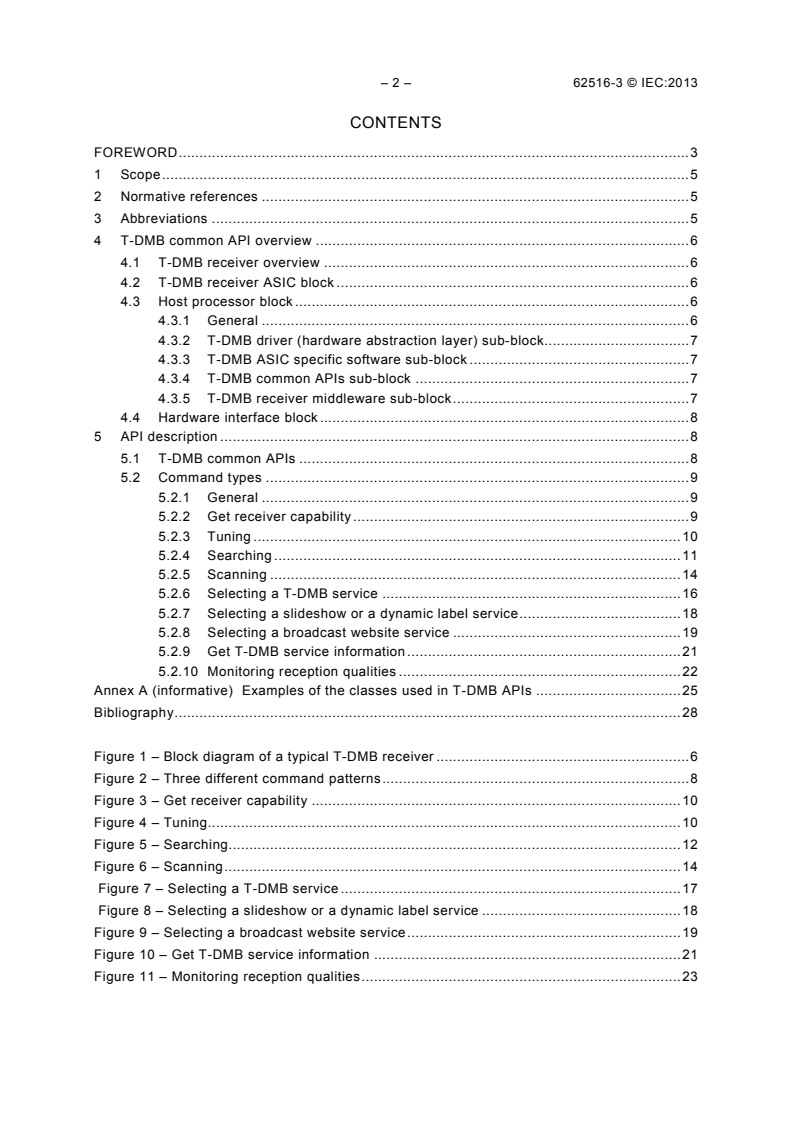
FOREWORD . 3
1 Scope . 5
2 Normative references . 5
3 Abbreviations . 5
4 T-DMB common API overview . 6
4.1 T-DMB receiver overview . 6
4.2 T-DMB receiver ASIC block . 6
4.3 Host processor block . 6
4.3.1 General . 6
4.3.2 T-DMB driver (hardware abstraction layer) sub-block . 7
4.3.3 T-DMB ASIC specific software sub-block . 7
4.3.4 T-DMB common APIs sub-block . 7
4.3.5 T-DMB receiver middleware sub-block . 7
4.4 Hardware interface block . 8
5 API description . 8
5.1 T-DMB common APIs . 8
5.2 Command types . 9
5.2.1 General . 9
5.2.2 Get receiver capability . 9
5.2.3 Tuning . 10
5.2.4 Searching . 11
5.2.5 Scanning . 14
5.2.6 Selecting a T-DMB service . 16
5.2.7 Selecting a slideshow or a dynamic label service . 18
5.2.8 Selecting a broadcast website service . 19
5.2.9 Get T-DMB service information . 21
5.2.10 Monitoring reception qualities . 22
Annex A (informative) Examples of the classes used in T-DMB APIs . 25
Bibliography . 28
Figure 1 – Block diagram of a typical T-DMB receiver . 6
Figure 2 – Three different command patterns . 8
Figure 3 – Get receiver capability . 10
Figure 4 – Tuning. 10
Figure 5 – Searching. 12
Figure 6 – Scanning . 14
Figure 7 – Selecting a T-DMB service . 17
Figure 8 – Selecting a slideshow or a dynamic label service . 18
Figure 9 – Selecting a broadcast website service . 19
Figure 10 – Get T-DMB service information . 21
Figure 11 – Monitoring reception qualities . 23
62516-3 © IEC:2013 – 3 –
INTERNATIONAL ELECTROTECHNICAL COMMISSION
____________
TERRESTRIAL DIGITAL MULTIMEDIA
BROADCASTING (T-DMB) RECEIVERS –
Part 3: Common API
FOREWORD
1) The International Electrotechnical Commission (IEC) is a worldwide organization for standardization comprising
all national electrotechnical committees (IEC National Committees). The object of IEC is to promote
international co-operation on all questions concerning standardization in the electrical and electronic fields. To
this end and in addition to other activities, IEC publishes International Standards, Technical Specifications,
Technical Reports, Publicly Available Specifications (PAS) and Guides (hereafter referred to as “IEC
Publication(s)”). Their preparation is entrusted to technical committees; any IEC National Committee interested
in the subject dealt with may participate in this preparatory work. International, governmental and non-
governmental organizations liaising with the IEC also participate in this preparation. IEC collaborates closely
with the International Organization for Standardization (ISO) in accordance with conditions determined by
agreement between the two organizations.
2) The formal decisions or agreements of IEC on technical matters express, as nearly as possible, an international
consensus of opinion on the relevant subjects since each technical committee has representation from all
interested IEC National Committees.
3) IEC Publications have the form of recommendations for international use and are accepted by IEC National
Committees in that sense. While all reasonable efforts are made to ensure that the technical content of IEC
Publications is accurate, IEC cannot be held responsible for the way in which they are used or for any
misinterpretation by any end user.
4) In order to promote international uniformity, IEC National Committees undertake to apply IEC Publications
transparently to the maximum extent possible in their national and regional publications. Any divergence
between any IEC Publication and the corresponding national or regional publication shall be clearly indicated in
the latter.
5) IEC itself does not provide any attestation of conformity. Independent certification bodies provide conformity
assessment services and, in some areas, access to IEC marks of conformity. IEC is not responsible for any
services carried out by independent certification bodies.
6) All users should ensure that they have the latest edition of this publication.
7) No liability shall attach to IEC or its directors, employees, servants or agents including individual experts and
members of its technical committees and IEC National Committees for any personal injury, property damage or
other damage of any nature whatsoever, whether direct or indirect, or for costs (including legal fees) and
expenses arising out of the publication, use of, or reliance upon, this IEC Publication or any other IEC
Publications.
8) Attention is drawn to the Normative references cited in this publication. Use of the referenced publications is
indispensable for the correct application of this publication.
9) Attention is drawn to the possibility that some of the elements of this IEC Publication may be the subject of
patent rights. IEC shall not be held responsible for identifying any or all such patent rights.
International Standard IEC 62516-3 has been prepared by technical area 1: Terminals for
audio, video and data services and contents, of IEC technical committee 100: Audio, video
and multimedia systems and equipment.
The text of this standard is based on the following documents:
CDV Report on voting
100/2020/CDV 100/2110/RVC
Full information on the voting for the approval of this standard can be found in the report on
voting indicated in the above table.
This publication has been drafted in accordance with the ISO/IEC Directives, Part 2.
A list of all parts in the IEC 62516 series, published under the general title Terrestrial digital
multimedia broadcasting (T-DMB) receivers, can be found on the IEC website.
– 4 – 62516-3 © IEC:2013
The committee has decided that the contents of this publication will remain unchanged until
the stability date indicated on the IEC web site under "http://webstore.iec.ch" in the data
related to the specific publication. At this date, the publication will be
• reconfirmed,
• withdrawn,
• replaced by a revised edition, or
• amended.
IMPORTANT – The 'colour inside' logo on the cover page of this publication
indicates that it contains colours which are considered to be useful for the correct
understanding of its contents. Users should therefore print this document using a
colour printer.
62516-3 © IEC:2013 – 5 –
TERRESTRIAL DIGITAL MULTIMEDIA
BROADCASTING (T-DMB) RECEIVERS –
Part 3: Common API
1 Scope
This part of IEC 62516 describes the T-DMB common application program interface (API). It
provides a software platform that, when combined with the T-DMB O/S, forms a universal
interface for application programs. This interface allows application programs to be written in
such a way that they run on any T-DMB receiver unit, as described in IEC 62516-1:2009 and
IEC 62516-2:2011 regardless of its manufacturer.
This part of IEC 62516 also defines a software environment that allows multiple application
programs to be interoperable on a single receiver unit by sharing the fixed resources of the
receiver, and it provides a set of interfaces that the T-DMB middleware and the ASIC specific
software use.
2 Normative references
The following documents, in whole or in part, are normatively referenced in this document and
are indispensable for its application. For dated references, only the edition cited applies. For
undated references, the latest edition of the referenced document (including any
amendments) applies.
IEC 62516-1:2009, Terrestrial digital multimedia broadcasting (T-DMB) receivers – Part 1:
Basic requirements
IEC 62516-2:2011, Terrestrial digital multimedia broadcasting (T-DMB) receivers – Part 2:
Interactive data services using BIFS
ETSI EN 300 401 v1.3.3, Radio Broadcasting Systems; Digital Audio Broadcasting (DAB) to
mobile, portable and fixed receivers
3 Abbreviations
ADC Analog to Digital Converter
API Application Programming Interface
ASIC Application Specific Integrated Circuit
FIC Fast Information Channel
HAL Hardware Abstraction Layer
ISR Interrupt Service Routine
MAC Media Access Control
PAD Program Associated Data
RF Radio Frequency
R-S Reed Solomon
SDIO Secure Digital Input/Output
SI Service Identifier
T-DMB Terrestrial-Digital Multimedia Broadcasting
– 6 – 62516-3 © IEC:2013
O/S Operating System
4 T-DMB common API overview
4.1 T-DMB receiver overview
A T-DMB receiver provides the device functionality specified in the T-DMB receivers (see
IEC 62516-1:2009 and IEC 62516-2:2011). Figure 1 shows the block diagram of a typical T-
DMB receiver. For the T-DMB receiver depicted in Figure 1, only those blocks that conform to
the scope of this standard are shown.
Figure 1 also shows the T-DMB common API with respect to the T-DMB receiver block
diagram.
Host Processor Block
T-DMB Receiver middleware
Sub-block
T-DMB Common APIs Sub-block
T-DMB ASIC Specific Software Sub-block
T-DMB Driver (Hardware
Abstraction Layer)
Sub-block
Hardware Interface Block
T-DMB Receiver ASIC Block
IEC 562/13
Figure 1 – Block diagram of a typical T-DMB receiver
4.2 T-DMB receiver ASIC block
The T-DMB receiver ASIC block represents the semiconductor hardware that provides the
functionality of demodulating a T-DMB signal and retrieving data carried by the T-DMB
physical layer. This block provides functionality like RF front-end, ADC, timing and frequency
estimation, channel estimation, viterbi decoding, etc. In short this block provides the complete
physical layer implementation of ETSI EN 300 401 v1.3.3. Depending upon the
implementation, this block can also provide outer decoding functionality (e.g. R-S decoding
and/or convolutional de-interleaving).
4.3 Host processor block
4.3.1 General
The host processor block represents the T-DMB functionality provided by the host processor
based device. In other words, this represents the host processor hardware and
in a T-DMB
the software implementation residing in the host processor. The host processor block retrieves
and processes the T-DMB information obtained from the T-DMB receiver ASIC block. The T-
DMB information retrieved consists of multiplex configuration information received on fast
62516-3 © IEC:2013 – 7 –
information channel (FIC), content received on the main service channel. This block
communicates with the T-DMB receiver ASIC block to retrieve the information received from
the T-DMB signal. The host processor block consists of the following functional sub-blocks.
4.3.2 T-DMB driver (hardware abstraction layer) sub-block
The T-DMB Driver or hardware abstraction layer (HAL) Block represents the driver level
software in the main processor that directly interfaces with the T-DMB receiver ASIC block.
The T-DMB driver sub-block provides controller functions (e.g. turning on or turning off the T-
DMB receiver ASIC block) and data exchange functions (e.g. retrieving the data from the T-
DMB receiver ASIC block or conveying the characteristics of a sub-channel to be received) for
a given T-DMB receiver ASIC hardware. The T-DMB Driver software is specific to the type of
hardware interface mechanism that exists between the Host Processor Block and the T-DMB
Receiver ASIC block.
For example, the T-DMB driver software will be different depending upon whether the
hardware interface between the main processor and the T-DMB receiver ASIC block is
interrupt driven, implemented with memory mapped address/registers or packet based
transaction interface like SDIO. Some examples of tasks performed by T-DMB driver sub-
block are:
• hardware interactions such as initialization, sleep or wakeup triggers;
• data exchange with hardware such as emptying hardware buffers into main memory or
providing ISR implementation.
The T-DMB driver software functions are tightly coupled with the T-DMB receiver ASIC
hardware and are considered time sensitive in nature. Therefore the T-DMB driver software is
typically given a higher priority with respect to other sub-blocks shown. For example, the T-
DMB driver performs the tasks of retrieving the data received by the T-DMB receiver ASIC
block or instructing the T-DMB receiver ASIC block to tune to a frequency as requested by the
application layer.
4.3.3 T-DMB ASIC specific software sub-block
T-DMB ASIC specific software sub-block provides the MAC layer functionality not covered by
the T-DMB driver sub-block. Depending upon the division of MAC layer functionality across
different sub-blocks, it may provide complete or partial MAC layer functionality. At the least,
the T-DMB ASIC specific software sub-block is expected to provide high level MAC layer
functionality that is not practical to be delegated to T-DMB driver sub-block. It interfaces with
the T-DMB receiver middleware sub-block using the T-DMB common APIs.
4.3.4 T-DMB common APIs sub-block
The T-DMB common APIs sub-block defines the interfaces that allow the T-DMB ASIC
specific software sub-block to communicate with the T-DMB receiver middleware. Any T-DMB
receiver middleware that adheres to the interfaces defined by the T-DMB common APIs will
work with any T-DMB ASIC specific software sub-block that adheres to these interfaces as
well. More details on this interface are provided in the rest of this standard.
4.3.5 T-DMB receiver middleware sub-block
The T-DMB receiver middleware sub-block communicates with the T-DMB ASIC specific
software sub-block using the T-DMB common APIs. The T-DMB receiver middleware
implements the control and stream layer and provides the interface with application layer
protocols. It triggers the T-DMB ASIC specific software to receive the specified contents as
requested by the application layer. It acts on the notifications or content provided by the T-
DMB ASIC specific software. It delivers any content received from the T-DMB ASIC specific
software to the application layer protocols.
– 8 – 62516-3 © IEC:2013
4.4 Hardware interface block
The hardware interface block represents the hardware interface mechanism that exists
between the host processor block and the T-DMB receiver ASIC block. This interface provides
the communication and data exchange functionality. The T-DMB driver sub-block uses this
block to exchange commands and data with the T-DMB receiver ASIC block. The hardware
interface block can be any desired interface, such as proprietary bus interface or a standard
based interface (e.g. SDIO).
5 API description
5.1 T-DMB common APIs
This clause provides a detailed description of each T-DMB common API. The API function
prototype details are provided along with defined types needed by the T-DMB common APIs.
Commands are executed by sending requests, confirmations and notifications. Figure 2 shows
three different command patterns. These are used in the T-DMB common APIs.
If commands are interleaved which means two commands running at the same time, an
arbitrary sequence of message types is possible.
IEC 563/13
Figure 2 – Three different command patterns
62516-3 © IEC:2013 – 9 –
5.2 Command types
5.2.1 General
The commands supported by the T-DMB common APIs can be categorized as follows.
• API-inquiry functions:
– GetAPIVersion: Returns the API version.
– Get T-DMBCapability: Returns API’s T-DMB receiver capabilities and properties.
• Selecting an ensemble:
– Tune: Tunes directly to a specified frequency.
– Search: Searches for an ensemble.
• Accessing service directory:
– SelectSI: Subscribes to service directory information.
– GetEnsembleInfo: Gets information about a specified ensemble.
– GetServiceInfo: Gets information about a specified service.
– GetComponentInfo: Gets information about a specified component.
• Monitoring reception conditions:
– SelectReceptionInfo: Subscribes to reception condition information.
• Selecting services:
– SelectComponent: Starts or stops a service. In case of an audio/video service
decoding of audio/video samples is started automatically. In case of a data service, the
service can be accessed with the SelectObject command.
– SelectApplication: Launches a T-DMB application.
– SelectComponentStream: Gets access to the packet stream of the component.
• Selecting objects:
– SelectObject: Requests data objects for delivery with or without automatic updating.
• Scanning for T-DMB services:
– Scan: Scans a specified frequency range for T-DMB ensembles and updates the
service directory.
• Miscellaneous:
– OperationControl: accesses and modifies parameters of the receiver.
– GetLocationInfo: retrieves location information from the receiver.
5.2.2 Get receiver capability
Figure 3 shows the get receiver capability. The T-DMB common APIs asks the T-DMB
receiver for its capabilities.
– 10 – 62516-3 © IEC:2013
IEC 564/13
Figure 3 – Get receiver capability
void capabilityReq ()
The T-DMB Common APIs asks the T-DMB receiver for its capabilities.
Parameters
None
void capabilityCnf(ReceiverCapability)
T-DMB receiver provides its capabilities to the API.
5.2.3 Tuning
Figure 4 shows the tuning. The T-DMB receiver is tuned by calling tuneReq. The receiver
tunes to the requested frequency and responds afterwards with tuneCnf confirmation. The
confirmation contains information about the reception quality.
IEC 565/13
Figure 4 – Tuning
void tuneReq(int tuneFrequency,int transmissionMode)
The tuneReq request initiates the Tune command. The Tune command sets directly a
specified T-DMB frequency. A T-DMB receiver shall be tuned to a T-DMB frequency and
synchronized in order to get access to T-DMB services. A tuned T-DMB receiver tries
automatically to synchronize on a T-DMB ensemble. The Tune command is used to select a
62516-3 © IEC:2013 – 11 –
specified T-DMB frequency. Depending on the specification for the transmissionMode it is
tested if a T-DMB ensemble can be detected. If the connected T-DMB receiver supports
automatic detection the default setting for transmissionMode can be used. Otherwise it has to
be specified which transmission modes should be tested. The result of the command is
delivered by the tuneCnf confirmation. All currently existing selections of audio and data
services or selections of data objects are automatically stopped before tuning is performed by
the T-DMB receiver.
Parameters
• tuneFrequency – This parameter specifies the frequency the T-DMB receiver will be tuned
to in hertz.
• transmissionModes –
This parameter specifies the transmission modes a T-DMB receiver tests for T-DMB
ensembles. The default value is T-DMBConstants.transmissionModeAutomatic which
means that the receiver is automatically detecting the transmission mode. The parameter
is a flag field supporting the following flags which can be specified together:
– T-DMBConstants.transmissionModeAutomatic: The transmission mode is automatically
detected. All other flags are ignored in this case.
– T-DMBConstants.transmissionMode1: At the specified frequency it is tested if a T-DMB
ensemble is sent in transmission mode 1.
– T-DMBConstants.transmissionMode2: At the specified frequency it is tested if a T-DMB
ensemble is sent in transmission mode 2.
– T-DMBConstants.transmissionMode3: At the specified frequency it is tested if a T-DMB
ensemble is sent in transmission mode 3.
– T-DMBConstants.transmissionMode4: At the specified frequency it is tested if a T-DMB
ensemble is sent in transmission mode 4.
void tuneCnf(TuneCnfEvent e)
The TuneCnf method finalizes a Tune command and is sent as a response to a TuneReq
message. It provides information about the currently selected T-DMBfrequency and reception
conditions. The Tune command is used to select a specified T-DMBfrequency. The tuneReq
request initiates the Tune command. The tuneCnf finalizes the Tune command and provides
information about the reception state. This includes the selected frequency, the detected
transmission mode and the synchronization state of the receiver.
5.2.4 Searching
Figure 5 shows the searching. To search for some ensemble, the application calls searchReq.
The T-DMB common APIs respond with a notification that the search has started. Other
notifications are sent in between depending on the search method (e.g., a 16 kHz step was
made). The transaction ends with a searchCnf confirmation containing the resulting state of
the search process.
– 12 – 62516-3 © IEC:2013
IEC 566/13
Figure 5 – Searching
void searchReq(
int searchMode,
int tables,
int startFrequency,
int stopFrequency,
int transmissionModes,
int notifications)
The searchReq request initiates a Search command. The Search command searches for a T-
DMB ensemble according to a specified search mode. After a successful execution of the
Search command a T-DMB ensemble has been found, the state Tuned is entered and the T-
DMB receiver tries to synchronize automatically to the found T-DMB ensemble. The Search
command is used to search for a T-DMB ensemble. The searchReq request initiates the
search and specifies the frequencies and transmission modes to test. Additionally, the
notifications that the T-DMB client gets can be specified while the command is executed.
Searching for an ensemble may require a substantial amount of time from only a second up to
several minutes. This depends also on the search mode specified. If the reception conditions
are bad it is possible that no T-DMB ensemble at all is detected. In order to stop searching for
a T-DMB ensemble the Tune command can be used which tunes the T-DMB receiver to a
certain frequency independent from the reception conditions. The start of searching is
indicated by a SearchNtf event with a status code 'Started'. In this case the state machine of
the Tune state enters the searching state (see Figure 5). If the previous state has been tuned
all currently existing selections of services or objects are stopped automatically. While
searching is performed, several notifications delivering information about the current status
are sent to the client. The command ends with a SearchCnf event.
Parameters
• searchMode – This parameter specifies the way the T-DMB receiver is searching for a T-
DMB ensemble. The default value is SearchModeAutomatic which means it is searching
according to a default method. The parameter is a flag field supporting the following flags
which can be specified together
– T-DMBConstants.SearchModeAutomatic: default method
62516-3 © IEC:2013 – 13 –
– T-DMBConstants.SearchMode16kHzSteps: The frequency range is searched in 16 kHz
steps. This is a very intensive search which means that command execution can take a
large amount of time.
– T-DMBConstants.SearchModeUp: The search direction is from low to high frequencies.
– T-DMBConstants.SearchModeDown: The search direction is from high to low
frequencies.
– T-DMBConstants.SearchModeUseTables: The search is based on the specified
frequency tables.
– T-DMBConstants.SearchModeUseFrequencyRange: The search is based on the
specified frequency range.
– T-DMBConstants.SearchModeContinuous: The search is looping over the specified
frequency range until a T-DMB ensemble has been found. The default is to stop after
the specified frequency range has been checked once.
• tables – This parameter specifies frequency tables the receiver uses in order to search for
T-DMB ensembles. The parameter is a flag field supporting the following flags which can
be specified together:
– T-DMBConstants.searchCEPTFrequencyTableBandIII: The frequencies according to
the CEPT frequency table for Band III are tested for T-DMB Ensembles.
– T-DMBConstants.SearchCEPTFrequencyTableLBand: The frequencies according to
the CEPT L-Band table are tested for T-DMB ensembles.
– T-DMBConstants.SearchCanadaFrequencyTableLBand: The frequencies according to
the Canadian L-Band table are tested for T-DMB ensembles.
• transmissionModes – This parameter specifies the transmission modes a T-DMB
receiver tests for T-DMB ensembles. The default value is T-
DMBConstants.transmissionModeAutomatic which means that the receiver is automatically
detecting the transmission mode. The parameter is a flag field supporting the following
flags which can be specified together:
– transmissionModeAutomatic: The transmission mode is automatically detected. All
other flags are ignored.
– transmissionMode1: At the specified frequency it is tested if a T-DMB ensemble is sent
in transmission mode 1.
– transmissionMode2: At the specified frequency it is tested if a T-DMB ensemble is sent
in transmission mode 2.
– transmissionMode3: At the specified frequency it is tested if a T-DMB ensemble is sent
in transmission mode 3.
– transmissionMode4: At the specified frequency it is tested if a T-DMB ensemble is sent
in transmission mode 4.
• notifications – This parameter specifies the type of notifications the client wants to get
while the Seek command is performed. The parameter is a flag field supporting the
following flags which can be specified together:
– notificationsOff: No intermediate notifications are sent. Only a SearchNtf notification
which informs about the start of searching is sent.
– notifications16kHzSteps: With each 16 kHz step a notification is sent. This is used only
if 16 kHz step searching is specified as search mode.
– notificationsTableEntry: With each table entry frequency a notification is sent. This is
the default value.
void searchCnf(SearchCnfEvent e)
The searchCnf method finalizes a Search command and provides information about the
command status, currently selected T-DMB frequency and current reception conditions. The
Search command is used in order to search for a T-DMB ensemble according to a specified
search mode. Searching for a T-DMB ensemble can take a large amount of time. The start of
searching is indicated by a 'Started' searchNtf message. Other searchNtf messages inform a
– 14 – 62516-3 © IEC:2013
T-DMB client about search progress. It is finalized by delivery of the searchCnf message. It
informs about the command status, the selected frequency and the synchronization state. No
further searchNtf messages will be delivered after the searchCnf message.
void searchNtf(SearchNtfEvent e)
The SearchNtf event is sent after a search for a T-DMB Ensemble was started searchReq. It
informs about the start of searching and about the progress of searching. A SearchCnf event
finalizes a Search command. No more SearchNtf events are sent after a SearchCnf event was
sent. The SearchNtf event is sent after the searching for a T-DMB ensemble has been started
and while searching is in progress in order to provide information about the current status of
searching. The 'Started' notification is sent in any case. Progress notifications are only sent if
notifications have been requested with the related SearchReq message. No further
notifications will be sent after a SearchCnf message is delivered.
5.2.5 Scanning
Figure 6 shows the scanning. The scanning means looking for ensembles in a specified range.
Essentially, it is like searching except that the scanning process looks for all ensembles in the
range. When the command has been issued, notification will be sent, after the scanning has
been started. Further notifications are sent during the scan, which inform about the progress.
When the scan is terminated, a confirmation is sent, which contains information about the
scan and the state of the receiver.
IEC 567/13
Figure 6 – Scanning
void scanReq(
int searchMode,
int tables,
int startFrequency,
int stopFrequency,
int tansmissionModes,
int notifications)
The ScanReq request initiates a Scan command. The Scan command is used in order to
perform a search for all available T-DMB ensembles in a specified frequency range.
Depending on the frequency range and the search mode this operation may require a
substantial amount of time from only a second up to several minutes. The command is started
by the ScanReq request and is finished with the ScanCnf confirmation. In between ScanNtf
62516-3 © IEC:2013 – 15 –
notification are sent in order to inform about the current status of scanning if notifications are
requested. In case of searching from lower to higher frequencies (searchMode= T-
DMBConstants.searchModeUp).
The value of startFrequency is not allowed to be larger than the value of stopFrequency. In
case of searching from higher to lower frequencies (searchMode= T-
DMBConstants.searchModeDown) the value of startFrequency is not allowed to be smaller
than the value of stopFrequency.
Parameters
• searchMode – This parameter specifies the way the T-DMB receiver is searching for a T-
DMB ensemble. The default value is T-DMBConstants.searchModeAutomatic which means
it is searching according to a default method. The parameter is a flag field supporting the
following flags which can be specified together:
– T-DMBConstants.searchModeAutomatic: default method
– T-DMBConstants.searchMode16kHzSteps: The frequency range is searched in 16 kHz
steps.
– T-DMBConstants.searchModeUp: The search direction is from low to high frequencies.
– T-DMBConstants.searchModeDown: The search direction is from high to low
frequencies.
– T-DMBConstants.searchModeUseTables: The search is based on the specified
frequency tables.
– T-DMBConstants.searchModeUseFrequencyRange: The search is based on the
specified frequency range.
– T-DMBConstants.searchModeContinuous: The search is looping over the specified
frequency range until a T-DMB Ensemble has been found. The default is to stop after
the specified frequency range has been checked once.
• tables – This parameter specifies frequency tables the receiver uses in order to search for
T-DMB ensembles. The parameter is a flag field supporting the following flags which can
be specified together:
– T-DMBConstants.searchCEPTFrequencyTableBandIII: The frequencies according to
the CEPT frequency table for Band III are tested for T-DMB ensembles.
– T-DMBConstants.searchCEPTFrequencyTableLBand: The frequencies according to
the CEPT L-Band table are tested for T-DMB ensembles.
– T-DMBConstants.searchCanadaFrequencyTableLBand: The frequencies according to
the Canadian L-Band table are tested for T-DMB ensembles.
• startFrequency – This parameter specifies the start frequency at which the T-DMB
receiver starts its search for T-DMB ensembles.
• stopFrequency – This parameter specifies the stop frequency at which the T-DMB
receiver stops its search for T-DMB ensembles.
• transmissionModes – This parameter specifies the transmission modes a T-DMB
receiver should look for T-DMB ensembles. The default value is T-
DMBConstants.transmissionModeAutomatic which means that the receiver is automatically
detecting the transmission mode. The parameter is a flag field supporting the following
flags which can be specified together:
– T-DMBConstants.transmissionModeAutomatic: The transmission mode is automatically
detected.
– T-DMBConstants.transmissionMode1: At the specified frequency it is tested if a T-DMB
ensemble is sent in transmission mode 1.
– T-DMBConstants.transmissionMode2: At the specified frequency it is tested if a T-DMB
ensemble is sent in transmission mode 2.
– 16 – 62516-3 © IEC:2013
– T-DMBConstants.transmissionMode3: At the specified frequency it is tested if a T-DMB
ensemble is sent in transmission mode 3.
– T-DMBConstants.transmissionMode4: At the specified frequency it is tested if a T-DMB
ensemble is sent in transmission mode 4.
– notifications – This parameter specifies the type of notifications wanted by the
application while the Seek command is performed. The parameter is a flag field
supporting the following flags which can be specified together:
– T-DMBConstants.notificationsOff: No notifications are sent.
– T-DMBConstants.notifications16kHzSteps: With each 16 kHz step a notification is sent.
– T-DMBConstants.notificationsTableEntry: With each table entry frequency a
notification is sent. This is the default value.
void scanCnf(ScanCnfEvent e)
The ScanCnf message finalizes a Scan command. It informs about the result of scanning and
the current tune state. The Scan command is used in order to perform a search for all
available T-DMB ensembles in a specified frequency range. Depending on the frequency
range and the search mode this operation may require a substantial amount of time from only
a second up to several minutes. The command is started by the ScanReq message and is
finished with the ScanCnf message. In between ScanNtf messages are sent in order to inform
about the current status of searching if notifications are requested.
The ScanCnf message indicates that the Scan command is finished and informs about the
current tune state. As a result of performing the Scan command the service information
database is filled with information. If a SI subscription is running several SINtf messages are
delivered to the connected application.
void scanNtf(ScanNtfEvent e)
The ScanNtf message is sent after a search for all available T-DMB Ensembles in a specified
frequency range is started by the ScanReq message. The ScanNtf message provides
information about the current status of searching for all available T-DMB Ensembles in a
specified frequency range. It is delivered to the connected application after the search has
been started by the ScanReq message and notifications have been requested. No further
notifications will be sent after a ScanCnf message is delivered.
5.2.6 Selecting a T-DMB service
Figure 7 shows the selecting a T-DMB service. An audio/video service is started with the
SelectComponent command. The application calls selectComponentReq passing the identifier
of the audio/video component. The T-DMB common APIs will start the audio/video service and
send back a confirmation. To stop this audio/video service, the application calls
selectComponentReq again now specifying that the component has to be removed. When the
T-DMB common APIs respond with a confirmation, the audio/video service has been stopped.
62516-3 © IEC:2013 – 17 –
IEC 568/13
Figure 7 – Selecting a T-DMB service
void selectComponentReq(
ComponentId id,
int selectionMode)
The selectComponentReq request initiates the SelectComponent command. The
SelectComponent command starts or stops an application delivered in a T-DMB component.
The SelectComponent command allows to start or stop applications delivered in T-DMB
components. In general, more than one component of the same T-DMB ensemble can be
selected simultaneously. It is possible to select one audio component, all programme-
associated data components of the selected audio component and more than one
independent data component at the same time. The selection of a component is requested by
the selectComponentReq request and is confirmed by the selectComponentCnf confirmation.
It is possible that a component is removed from a T-DMB ensemble which means it is no
longer broadcast and therefore no longer available. This is indicated by a SINtf call and
means that the selection
...