

IEC 62485-3:2014
(Main)Safety requirements for secondary batteries and battery installations - Part 3: Traction batteries
General Information
- Abstract
IEC 62485-3:2014 applies to secondary batteries and battery installations used for electric vehicles, e.g. in electric industrial trucks (including lift trucks, tow trucks, cleaning machines, automatic guided vehicles), in battery powered locomotives, in electric vehicles (e.g. goods vehicles, golf carts, bicycles, wheelchairs), and does not cover the design of such vehicles. It provides requirements on safety aspects associated with the installation, use, inspection, maintenance and disposal of batteries. This edition includes the following significant technical changes with respect to the previous edition:
a) a comprehensive revision of Clause 6, presenting a unified and changed formula for the calculation of the required ventilation air flow during battery charging;
b) addition of requirements for properties of floor material and battery changing equipment in Clause 9.
- Status
- Published
- Publication Date
- 09-Jul-2014
- Technical Committee
- TC 21 - Secondary cells and batteries
- Current Stage
- PPUB - Publication issued
- Start Date
- 10-Jul-2014
- Completion Date
- 31-Jul-2014
Overview
IEC 62485-3:2014, published by the International Electrotechnical Commission (IEC), specifies safety requirements for secondary batteries and battery installations used in traction applications. This standard focuses on secondary batteries employed in electric vehicles such as industrial trucks, tow trucks, automated guided vehicles, battery-powered locomotives, golf carts, bicycles, and wheelchairs. The document addresses safety concerns linked to installation, operation, inspection, maintenance, and disposal of traction batteries but explicitly excludes vehicle design considerations.
A key update in this 2014 edition is a revised method for calculating ventilation requirements during battery charging to mitigate explosion risks from gas emissions. Additionally, new provisions cover properties of floor materials and battery changing equipment to enhance operational safety.
Key Topics
Protection Against Electric Shock
The standard outlines measures to prevent direct and indirect electrical contact during both battery discharge and charging phases, ensuring user safety.Short Circuit Prevention
Requirements for cables, cell connectors, battery insulation, and maintenance procedures aim to minimize risks related to electrical short circuits.Explosion Hazard Mitigation Through Ventilation
IEC 62485-3 introduces a unified formula for calculating minimum ventilation airflow during charging to safely dissipate gases such as hydrogen emitted from secondary batteries.Electrolyte Handling and Hazard Prevention
Guidelines cover management of electrolyte substances, including the use of protective clothing, first aid instructions for accidental contact, and safety aspects of battery accessories.Battery Containers and Installations
The standard provides specifications for battery enclosures, ensuring mechanical protection and containment of hazardous substances.Charging and Maintenance Facilities
Detailed requirements address floor materials and equipment design for safe battery changing and maintenance environments.Battery Peripheral Equipment
Safety features related to monitoring systems, water filling systems, degassing, thermal management, and connectors are included to support safe and efficient battery operation.Identification and Labeling
Clear requirements for warning labels, identification labels, and instructions for installation, use, and maintenance promote consistent communication of battery hazards and safe handling procedures.Environmental and Disposal Requirements
The standard emphasizes proper packaging, transporting, disassembly, disposal, and recycling to support environmental sustainability and compliance with regulations.Inspection and Monitoring
Routine inspection practices and monitoring protocols are recommended for ongoing battery safety and performance assurance.
Applications
IEC 62485-3:2014 is essential for manufacturers, operators, maintenance personnel, and safety inspectors involved with:
- Electric Industrial Vehicles including forklifts, cleaning machines, and autonomous guided vehicles
- Battery-Powered Locomotives and Trains where traction batteries power propulsion systems
- Electric Mobility Devices such as electric bikes, wheelchairs, and golf carts
- Battery Installation Planning and Safety Audits to ensure compliance with international safety standards
- Design of Charging Stations and Battery Maintenance Facilities ensuring adequate ventilation and hazard controls
- Battery Recycling and Disposal Operations supporting environmental safety and legal compliance
By providing a comprehensive framework for safe battery use, IEC 62485-3 helps prevent electrical hazards, explosion risks, and chemical exposure during the lifecycle of traction batteries.
Related Standards
IEC 62485-3 forms part of the wider IEC 62485 series, which addresses safety requirements for secondary batteries and their installations, including:
- IEC 62485-1: Safety requirements for stationary batteries
- IEC 62485-2: Safety requirements for motive power batteries
- Complementary IEC standards on battery performance, testing, and transport regulations
For complete compliance and enhanced safety, users should refer to the latest editions of related IEC standards and consider regional adaptations.
Keywords: IEC 62485-3, traction batteries, secondary batteries safety, battery installations, electric vehicles, battery ventilation, battery maintenance, battery explosion safety, electric industrial trucks, battery disposal, battery charging safety, battery labeling standards, IEC standards for batteries.
Relations
- Effective Date
- 05-Sep-2023
Get Certified
Connect with accredited certification bodies for this standard

TÜV Rheinland
TÜV Rheinland is a leading international provider of technical services.

TÜV SÜD
TÜV SÜD is a trusted partner of choice for safety, security and sustainability solutions.

DEKRA Certification Inc.
DEKRA US certification services.
Sponsored listings
Frequently Asked Questions
IEC 62485-3:2014 is a standard published by the International Electrotechnical Commission (IEC). Its full title is "Safety requirements for secondary batteries and battery installations - Part 3: Traction batteries". This standard covers: IEC 62485-3:2014 applies to secondary batteries and battery installations used for electric vehicles, e.g. in electric industrial trucks (including lift trucks, tow trucks, cleaning machines, automatic guided vehicles), in battery powered locomotives, in electric vehicles (e.g. goods vehicles, golf carts, bicycles, wheelchairs), and does not cover the design of such vehicles. It provides requirements on safety aspects associated with the installation, use, inspection, maintenance and disposal of batteries. This edition includes the following significant technical changes with respect to the previous edition: a) a comprehensive revision of Clause 6, presenting a unified and changed formula for the calculation of the required ventilation air flow during battery charging; b) addition of requirements for properties of floor material and battery changing equipment in Clause 9.
IEC 62485-3:2014 applies to secondary batteries and battery installations used for electric vehicles, e.g. in electric industrial trucks (including lift trucks, tow trucks, cleaning machines, automatic guided vehicles), in battery powered locomotives, in electric vehicles (e.g. goods vehicles, golf carts, bicycles, wheelchairs), and does not cover the design of such vehicles. It provides requirements on safety aspects associated with the installation, use, inspection, maintenance and disposal of batteries. This edition includes the following significant technical changes with respect to the previous edition: a) a comprehensive revision of Clause 6, presenting a unified and changed formula for the calculation of the required ventilation air flow during battery charging; b) addition of requirements for properties of floor material and battery changing equipment in Clause 9.
IEC 62485-3:2014 is classified under the following ICS (International Classification for Standards) categories: 29.220.20 - Acid secondary cells and batteries; 29.220.30 - Alkaline secondary cells and batteries; 43.040.10 - Electrical and electronic equipment. The ICS classification helps identify the subject area and facilitates finding related standards.
IEC 62485-3:2014 has the following relationships with other standards: It is inter standard links to IEC 62485-3:2010. Understanding these relationships helps ensure you are using the most current and applicable version of the standard.
IEC 62485-3:2014 is available in PDF format for immediate download after purchase. The document can be added to your cart and obtained through the secure checkout process. Digital delivery ensures instant access to the complete standard document.
Standards Content (Sample)
IEC 62485-3 ®
Edition 2.0 2014-07
INTERNATIONAL
STANDARD
NORME
INTERNATIONALE
Safety requirements for secondary batteries and battery installations –
Part 3: Traction batteries
Exigences de sécurité pour les batteries d’accumulateurs et les installations
de batteries –
Partie 3: Batteries de traction
All rights reserved. Unless otherwise specified, no part of this publication may be reproduced or utilized in any form
or by any means, electronic or mechanical, including photocopying and microfilm, without permission in writing from
either IEC or IEC's member National Committee in the country of the requester. If you have any questions about IEC
copyright or have an enquiry about obtaining additional rights to this publication, please contact the address below or
your local IEC member National Committee for further information.
Droits de reproduction réservés. Sauf indication contraire, aucune partie de cette publication ne peut être reproduite
ni utilisée sous quelque forme que ce soit et par aucun procédé, électronique ou mécanique, y compris la photocopie
et les microfilms, sans l'accord écrit de l'IEC ou du Comité national de l'IEC du pays du demandeur. Si vous avez des
questions sur le copyright de l'IEC ou si vous désirez obtenir des droits supplémentaires sur cette publication, utilisez
les coordonnées ci-après ou contactez le Comité national de l'IEC de votre pays de résidence.
IEC Central Office Tel.: +41 22 919 02 11
3, rue de Varembé Fax: +41 22 919 03 00
CH-1211 Geneva 20 info@iec.ch
Switzerland www.iec.ch
About the IEC
The International Electrotechnical Commission (IEC) is the leading global organization that prepares and publishes
International Standards for all electrical, electronic and related technologies.
About IEC publications
The technical content of IEC publications is kept under constant review by the IEC. Please make sure that you have the
latest edition, a corrigenda or an amendment might have been published.
IEC Catalogue - webstore.iec.ch/catalogue Electropedia - www.electropedia.org
The stand-alone application for consulting the entire The world's leading online dictionary of electronic and
bibliographical information on IEC International Standards, electrical terms containing more than 30 000 terms and
Technical Specifications, Technical Reports and other definitions in English and French, with equivalent terms in 14
documents. Available for PC, Mac OS, Android Tablets and additional languages. Also known as the International
iPad. Electrotechnical Vocabulary (IEV) online.
IEC publications search - www.iec.ch/searchpub IEC Glossary - std.iec.ch/glossary
The advanced search enables to find IEC publications by a More than 55 000 electrotechnical terminology entries in
variety of criteria (reference number, text, technical English and French extracted from the Terms and Definitions
committee,…). It also gives information on projects, replaced clause of IEC publications issued since 2002. Some entries
and withdrawn publications. have been collected from earlier publications of IEC TC 37,
77, 86 and CISPR.
IEC Just Published - webstore.iec.ch/justpublished
Stay up to date on all new IEC publications. Just Published IEC Customer Service Centre - webstore.iec.ch/csc
details all new publications released. Available online and If you wish to give us your feedback on this publication or
also once a month by email. need further assistance, please contact the Customer Service
Centre: csc@iec.ch.
A propos de l'IEC
La Commission Electrotechnique Internationale (IEC) est la première organisation mondiale qui élabore et publie des
Normes internationales pour tout ce qui a trait à l'électricité, à l'électronique et aux technologies apparentées.
A propos des publications IEC
Le contenu technique des publications IEC est constamment revu. Veuillez vous assurer que vous possédez l’édition la
plus récente, un corrigendum ou amendement peut avoir été publié.
Catalogue IEC - webstore.iec.ch/catalogue Electropedia - www.electropedia.org
Application autonome pour consulter tous les renseignements
Le premier dictionnaire en ligne de termes électroniques et
bibliographiques sur les Normes internationales,
électriques. Il contient plus de 30 000 termes et définitions en
Spécifications techniques, Rapports techniques et autres
anglais et en français, ainsi que les termes équivalents dans
documents de l'IEC. Disponible pour PC, Mac OS, tablettes
14 langues additionnelles. Egalement appelé Vocabulaire
Android et iPad.
Electrotechnique International (IEV) en ligne.
Recherche de publications IEC - www.iec.ch/searchpub
Glossaire IEC - std.iec.ch/glossary
Plus de 55 000 entrées terminologiques électrotechniques, en
La recherche avancée permet de trouver des publications IEC
en utilisant différents critères (numéro de référence, texte, anglais et en français, extraites des articles Termes et
comité d’études,…). Elle donne aussi des informations sur les Définitions des publications IEC parues depuis 2002. Plus
projets et les publications remplacées ou retirées. certaines entrées antérieures extraites des publications des
CE 37, 77, 86 et CISPR de l'IEC.
IEC Just Published - webstore.iec.ch/justpublished
Service Clients - webstore.iec.ch/csc
Restez informé sur les nouvelles publications IEC. Just
Published détaille les nouvelles publications parues. Si vous désirez nous donner des commentaires sur cette
Disponible en ligne et aussi une fois par mois par email. publication ou si vous avez des questions contactez-nous:
csc@iec.ch.
IEC 62485-3 ®
Edition 2.0 2014-07
INTERNATIONAL
STANDARD
NORME
INTERNATIONALE
Safety requirements for secondary batteries and battery installations –
Part 3: Traction batteries
Exigences de sécurité pour les batteries d’accumulateurs et les installations
de batteries –
Partie 3: Batteries de traction
INTERNATIONAL
ELECTROTECHNICAL
COMMISSION
COMMISSION
ELECTROTECHNIQUE
PRICE CODE
INTERNATIONALE
CODE PRIX S
ICS 29.220.20; 29.220.30; 43.040.10 ISBN 978-2-8322-1690-3
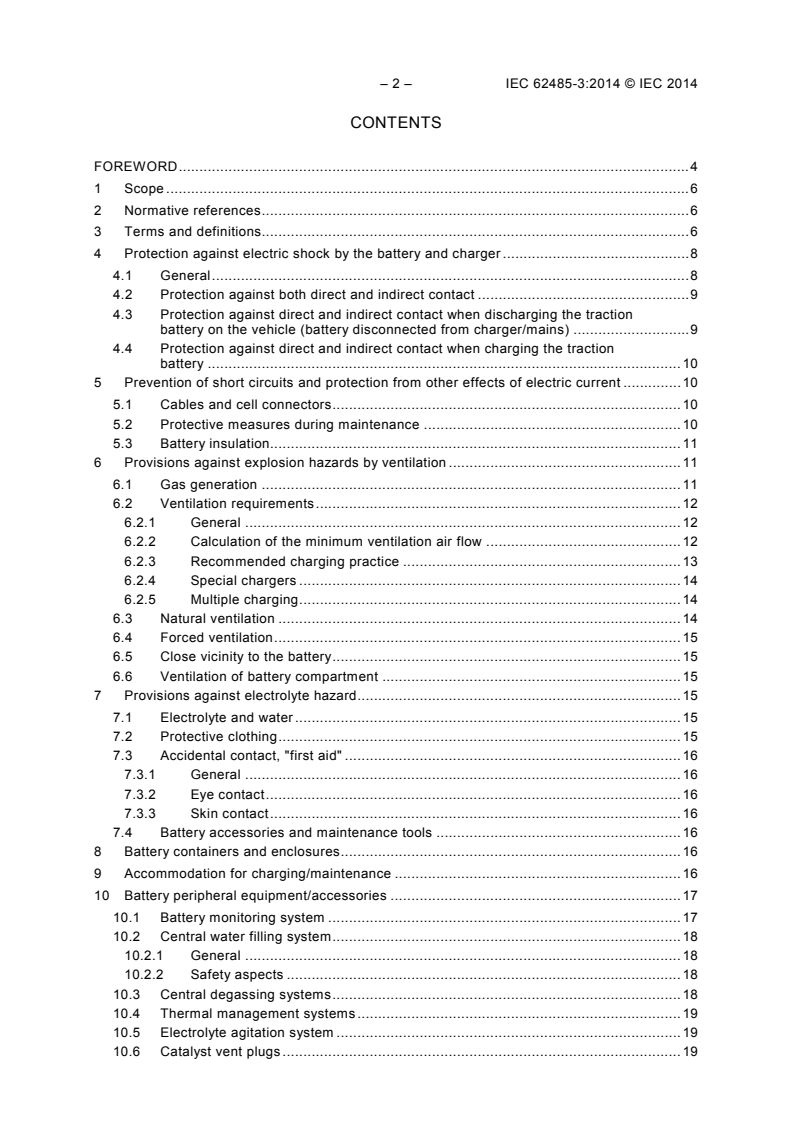
– 2 – IEC 62485-3:2014 © IEC 2014
CONTENTS
FOREWORD . 4
1 Scope . 6
2 Normative references . 6
3 Terms and definitions. 6
4 Protection against electric shock by the battery and charger . 8
4.1 General . 8
4.2 Protection against both direct and indirect contact . 9
4.3 Protection against direct and indirect contact when discharging the traction
battery on the vehicle (battery disconnected from charger/mains) . 9
4.4 Protection against direct and indirect contact when charging the traction
battery . 10
5 Prevention of short circuits and protection from other effects of electric current . 10
5.1 Cables and cell connectors . 10
5.2 Protective measures during maintenance . 10
5.3 Battery insulation. 11
6 Provisions against explosion hazards by ventilation . 11
6.1 Gas generation . 11
6.2 Ventilation requirements . 12
6.2.1 General . 12
6.2.2 Calculation of the minimum ventilation air flow . 12
6.2.3 Recommended charging practice . 13
6.2.4 Special chargers . 14
6.2.5 Multiple charging . 14
6.3 Natural ventilation . 14
6.4 Forced ventilation . 15
6.5 Close vicinity to the battery . 15
6.6 Ventilation of battery compartment . 15
7 Provisions against electrolyte hazard . 15
7.1 Electrolyte and water . 15
7.2 Protective clothing . 15
7.3 Accidental contact, "first aid" . 16
7.3.1 General . 16
7.3.2 Eye contact . 16
7.3.3 Skin contact . 16
7.4 Battery accessories and maintenance tools . 16
8 Battery containers and enclosures . 16
9 Accommodation for charging/maintenance . 16
10 Battery peripheral equipment/accessories . 17
10.1 Battery monitoring system . 17
10.2 Central water filling system . 18
10.2.1 General . 18
10.2.2 Safety aspects . 18
10.3 Central degassing systems . 18
10.4 Thermal management systems . 19
10.5 Electrolyte agitation system . 19
10.6 Catalyst vent plugs . 19
10.7 Connectors (plugs/sockets) . 19
11 Identification labels, warning notices and instructions for use, installation and
maintenance . 19
11.1 Warning labels . 19
11.2 Identification label . 20
11.3 Instructions . 20
11.4 Other labels . 20
12 Transportation, storage, disposal and environmental aspects . 20
12.1 Packing and transport . 20
12.2 Disassembly, disposal, and recycling of batteries . 21
13 Inspection and monitoring . 21
Bibliography . 22
Table 1 – Guideline: Maximum final charging current in A per 100 Ah during normal
conditions of use . 14
– 4 – IEC 62485-3:2014 © IEC 2014
INTERNATIONAL ELECTROTECHNICAL COMMISSION
_____________
SAFETY REQUIREMENTS FOR SECONDARY BATTERIES
AND BATTERY INSTALLATIONS –
Part 3: Traction batteries
FOREWORD
1) The International Electrotechnical Commission (IEC) is a worldwide organization for standardization comprising
all national electrotechnical committees (IEC National Committees). The object of IEC is to promote
international co-operation on all questions concerning standardization in the electrical and electronic fields. To
this end and in addition to other activities, IEC publishes International Standards, Technical Specifications,
Technical Reports, Publicly Available Specifications (PAS) and Guides (hereafter referred to as “IEC
Publication(s)”). Their preparation is entrusted to technical committees; any IEC National Committee interested
in the subject dealt with may participate in this preparatory work. International, governmental and non-
governmental organizations liaising with the IEC also participate in this preparation. IEC collaborates closely
with the International Organization for Standardization (ISO) in accordance with conditions determined by
agreement between the two organizations.
2) The formal decisions or agreements of IEC on technical matters express, as nearly as possible, an international
consensus of opinion on the relevant subjects since each technical committee has representation from all
interested IEC National Committees.
3) IEC Publications have the form of recommendations for international use and are accepted by IEC National
Committees in that sense. While all reasonable efforts are made to ensure that the technical content of IEC
Publications is accurate, IEC cannot be held responsible for the way in which they are used or for any
misinterpretation by any end user.
4) In order to promote international uniformity, IEC National Committees undertake to apply IEC Publications
transparently to the maximum extent possible in their national and regional publications. Any divergence
between any IEC Publication and the corresponding national or regional publication shall be clearly indicated in
the latter.
5) IEC itself does not provide any attestation of conformity. Independent certification bodies provide conformity
assessment services and, in some areas, access to IEC marks of conformity. IEC is not responsible for any
services carried out by independent certification bodies.
6) All users should ensure that they have the latest edition of this publication.
7) No liability shall attach to IEC or its directors, employees, servants or agents including individual experts and
members of its technical committees and IEC National Committees for any personal injury, property damage or
other damage of any nature whatsoever, whether direct or indirect, or for costs (including legal fees) and
expenses arising out of the publication, use of, or reliance upon, this IEC Publication or any other IEC
Publications.
8) Attention is drawn to the Normative references cited in this publication. Use of the referenced publications is
indispensable for the correct application of this publication.
9) Attention is drawn to the possibility that some of the elements of this IEC Publication may be the subject of
patent rights. IEC shall not be held responsible for identifying any or all such patent rights.
International Standard IEC 62485-3 has been prepared by IEC technical committee 21:
Secondary cells and batteries.
This second edition cancels and replaces the first edition published in 2010. This edition
constitutes a technical revision.
This edition includes the following significant technical changes with respect to the previous
edition:
a) a comprehensive revision of Clause 6, presenting a unified and changed formula for the
calculation of the required ventilation air flow during battery charging;
b) addition of requirements for properties of floor material and battery changing equipment in
Clause 9.
The text of this standard is based on the following documents:
FDIS Report on voting
21/834/FDIS 21/843/RVD
Full information on the voting for the approval of this standard can be found in the report on
voting indicated in the above table.
This publication has been drafted in accordance with the ISO/IEC Directives, Part 2.
A list of all parts of the IEC 62485 series can be found, under the general title Safety
requirements for secondary batteries and battery installations, on the IEC website.
The committee has decided that the contents of this publication will remain unchanged until the
stability date indicated on the IEC web site under "http://webstore.iec.ch" in the data related to
the specific publication. At this date, the publication will be
• reconfirmed,
• withdrawn,
• replaced by a revised edition, or
• amended.
– 6 – IEC 62485-3:2014 © IEC 2014
SAFETY REQUIREMENTS FOR SECONDARY BATTERIES
AND BATTERY INSTALLATIONS –
Part 3: Traction batteries
1 Scope
This part of the IEC 62485 applies to secondary batteries and battery installations used for
electric vehicles, e.g. in electric industrial trucks (including lift trucks, tow trucks, cleaning
machines, automatic guided vehicles), in battery powered locomotives, in electric vehicles (e.g.
goods vehicles, golf carts, bicycles, wheelchairs), and does not cover the design of such
vehicles.
This International Standard covers lead dioxide-lead (lead-acid), nickel oxide-cadmium, nickel-
oxide-metal hydride and other alkaline secondary batteries. Safety aspects of secondary lithium
batteries in such applications will be covered in their own appropriate standards.
The nominal voltages are limited to 1 000 V a.c. and 1 500 V d.c. respectively and the principal
measures for protection against hazards generally from electricity, gas emission and electrolyte
are described.
It provides requirements on safety aspects associated with the installation, use, inspection,
maintenance and disposal of batteries.
2 Normative references
The following documents, in whole or in part, are normatively referenced in this document and
are indispensable for its application. For dated references, only the edition cited applies. For
undated references, the latest edition of the referenced document (including any amendments)
applies.
IEC 60204-1, Safety of machinery – Electrical equipment of machines – Part 1: General
requirements
IEC 60364-4-41:2005, Low-voltage electrical installations – Part 4-41: Protection for safety –
Protection against electric shock
IEC 60900, Live working – Hand tools for use up to 1 000 V a.c. and 1 500 V d.c.
IEC 61140, Protection against electric shock – Common aspects for installation and equipment
ISO 3864 (all parts), Graphical symbols – Safety colours and safety signs
3 Terms and definitions
For the purposes of this document, the following terms and definitions apply.
3.1
secondary cell
cell which is designed to be electrically recharged
Note 1 to entry: The recharge is accomplished by way of a reversible chemical reaction.
3.2
lead dioxide lead battery
accumulators (deprecated)
secondary battery with an aqueous electrolyte based on dilute sulphuric acid, a positive
electrode of lead dioxide and a negative electrode of lead
3.3
nickel oxide cadmium battery
secondary battery with an alkaline electrolyte, a positive electrode containing nickel oxide and
a negative electrode of cadmium
3.4
vented cell
a secondary cell having a cover provided with an opening through which products of
electrolysis and evaporation are allowed to escape freely from the cell to the atmosphere
3.5
valve regulated lead-acid battery
VRLA
secondary battery in which cells are closed but have a valve which allows the escape of gas if
the internal pressure exceeds a predetermined value
Note 1 to entry: The cell cannot normally receive addition to the electrolyte.
3.6
gas-tight sealed cell
gas-tight sealed secondary cell
secondary cell which remains closed and does not release either gas or liquid when operated
within the limits of charge and temperature specified by the manufacturer
Note 1 to entry: The cell may be equipped with a safety device to prevent dangerously high internal pressure.
Note 2 to entry: The cell does not require addition to the electrolyte and is designed to operate during its life in its
original sealed state.
3.7
secondary battery
two or more secondary cells connected together and used as a source of electrical energy
3.8
traction battery
secondary battery which is designed to provide the propulsion energy for electric vehicles
3.9
monobloc battery
battery with multiple separate but electrically connected cell compartments each of which is
designed to house an assembly of electrodes, electrolyte, terminals and interconnections and
possible separator
Note 1 to entry: The cells in a monobloc battery can be connected in series or parallel.
3.10
electrolyte
liquid or solid substance containing mobile ions which render it ionically conductive
Note 1 to entry: The electrolyte may be a liquid, solid or a gel.
3.11
gassing of a cell
evolution of gas resulting from the electrolysis of water in the electrolyte of the cell
– 8 – IEC 62485-3:2014 © IEC 2014
3.12
charging of a battery
operation during which a secondary cell or battery is supplied with electrical energy from an
external circuit which results in chemical changes within the cell and thus storage of energy as
chemical energy
3.13
equalisation charge
extended charge to ensure an equal state of charge of all cells in a battery
3.14
opportunity charging
use of free time during a work period to top up the charge and thus extend the work period of a
battery whilst avoiding excessive discharge
3.15
overcharge
continued charging of a fully charged secondary cell or battery
Note 1 to entry: Overcharge is also the act of charging beyond a certain limit specified by the manufacturer.
3.16
discharge
discharge of a battery
operation during which a battery delivers, to an external circuit and under specified conditions,
electrical energy produced in the cells
3.17
peripheral equipment
battery peripheral equipment
equipment installed on the battery, which supports or monitors the operation of the battery
Note 1 to entry: Examples are a central water filling system, an electrolyte agitation system, a battery monitoring
system, a central de-gassing system, the battery connectors (plugs and sockets), a thermal management system,
etc.
3.18
charging room
room or closed area intended specifically for recharging batteries
Note 1 to entry: The room may also be used for battery maintenance.
3.19
charging area
open area designated and made suitable for recharging batteries
Note 1 to entry: The area may also be used for maintenance of batteries and battery related equipment.
4 Protection against electric shock by the battery and charger
4.1 General
Measures shall be taken on traction batteries and in traction battery charging installations for
protection against either direct contact or indirect contact, or against both direct and indirect
contact.
These measures are described in detail in IEC 60364-4-41 and IEC 61140. The following
clauses and the resulting amendments describe the typical measures to be taken for traction
battery installations.
The appropriate equipment standard IEC 61140 applies to batteries and direct current
distribution circuits located inside equipment.
4.2 Protection against both direct and indirect contact
On batteries and in battery charging installations protection against direct contact with live
parts shall be ensured in accordance with IEC 60364-4-41.
The following protective measures against direct contact apply:
– protection by insulation of live parts;
– protection by barriers or enclosures;
– protection by obstacles;
– protection by placing out of reach.
The following protective measures against indirect contact apply:
– protection by automatic disconnection or signalling;
– protection by protective insulation;
– protection by earth-free local equipotential bonding;
– protection by electrical separation.
4.3 Protection against direct and indirect contact when discharging the traction
battery on the vehicle (battery disconnected from charger/mains)
4.3.1 For batteries having a nominal voltage up to and including 60 V d.c., protection against
electric shock caused by direct contact is not formally required, as long as the whole
installation corresponds to the conditions for safety extra low voltage (SELV) and protective
extra low voltage (PELV).
NOTE The nominal voltage of a lead dioxide - lead cell (lead acid) is 2,0 V, that of a nickel oxide – cadmium or
nickel oxide - metal hydride cell is 1,2 V. When these cells are boost charged, their voltage can reach 2,7 V in lead
acid or 1,6 V in nickel oxide based systems.
However, for other reasons, e.g. short circuits, mechanical damage etc., all batteries in
electrical vehicles shall be protected against direct contact of live parts, even if the battery
nominal voltage is 60 V d.c. or less.
4.3.2 For batteries having a nominal voltage above 60 V d.c. and up to and including 120 V
d.c., protection against electric shock caused by direct contact is required.
NOTE Batteries with nominal voltage up to and including 120 V d.c. are regarded as safe power sources for SELV-
systems (safety extra low voltage) or PELV-systems (protective extra low voltage), see IEC 60364-4-41:2005,411.1.
The following protective measures apply:
– protection by insulation of live parts;
– protection by barriers or enclosures
– protection by obstacles;
– protection by placing out of reach.
If the protection against direct contact of live parts is ensured only by obstacles or placing out
of reach, access to the battery accommodation shall be restricted to trained and authorized
personnel only, and the battery accommodation shall be marked by appropriate warning labels
(see Clause 11).
For batteries having a nominal voltage exceeding 120 V d.c., protective measures against both
direct and indirect contact are required.
– 10 – IEC 62485-3:2014 © IEC 2014
Battery compartments with batteries having a nominal voltage exceeding 120 V d.c. shall be
locked and have access restricted to trained and authorized personnel only and shall be
marked by appropriate warning labels (see Clause 11).
For batteries with a nominal voltage exceeding 120 V d.c., the following protective measures
against indirect contact apply:
– protection by electrical insulation of live parts;
– protection by earth-free equipotential local bonding;
– protection by automatic disconnection or signalling.
4.4 Protection against direct and indirect contact when charging the traction battery
When battery chargers with safe galvanic separation from the feeding mains are used
according to IEC 61140, the protective measures SELV or PELV shall be applied. If the
nominal voltage of the battery does not exceed 60 V d.c. protection against direct contact is not
formally required, as long as the total installation corresponds to conditions of SELV or PELV.
When the battery charger does not comply with these requirements, then the protective
measures against direct and indirect contact shall be applied according to IEC 60364-4-41.
However, for other reasons, e.g. short circuits, mechanical damage etc., all batteries in
electrical vehicles shall be protected against direct contact of live parts, even if the battery
nominal voltage is 60 V d.c. or less.
5 Prevention of short circuits and protection from other effects of electric
current
5.1 Cables and cell connectors
Cables and cell connectors shall be insulated to prevent short circuits.
If protection against short circuits cannot be provided by over-current protection devices for
battery-specific reasons, then the connecting cables between charger, respective battery fuse,
and battery, and between battery and vehicle shall be protected against short circuits and earth
fault.
The cables shall meet the requirements of IEC 60204-1.
When a trailing cable is used, the protection against short circuits shall be improved by the use
of single core cable according to IEC 60204-1. However, where the battery nominal voltage is
less than or equal to 120 V d.c., a trailing cable of grade H01N2D, for higher flexibility, can be
used.
The battery terminal cables shall be fixed in a manner that prevents tensile and torsional strain
on the battery terminals.
Insulation shall be resistant to the effects of ambient influences such as temperature,
electrolyte, water, dust, commonly occurring chemicals, gasses, steam and mechanical stress.
5.2 Protective measures during maintenance
In order to minimize the risk of injury during work on live equipment, only insulated tools
according to IEC 60900 shall be used and the following appropriate procedures shall be
implemented:
– batteries shall not be connected or disconnected before the load or charging current has
been switched off;
– battery terminal and connector covers shall be provided which allow routine maintenance
whilst minimizing exposure of energized conductive parts;
– all metallic personal objects shall be removed from the operator’s hands, wrists and neck
before starting work;
– for battery systems where the nominal voltage is above 120 V d.c., insulated protective
clothing and/or local insulated coverings shall be required to prevent personnel making
contact with the floor or parts bonded to earth. Insulated protective clothing and floor
covering material shall be anti-static.
For reasons of safety, it is strongly advisable that batteries having a nominal voltage above
120 V d.c. are divided into sections of 120 V d.c. (nominal) or less before maintenance work is
commenced.
5.3 Battery insulation
5.3.1 This subclause does not apply to batteries used in electrically propelled road vehicles
where the battery insulation requirement is covered by particular standards for that application.
5.3.2 A new, filled and charged battery shall have an insulation resistance of at least 1 MΩ
when measured between a battery terminal and metallic tray, vehicle frame or other conductive
supporting structure. Where the battery is fitted into more than one container, this requirement
applies with the sections, including metal battery containers, electrically connected.
5.3.3 A battery in use, having a nominal voltage not higher than 120 V d.c., shall have an
insulation resistance of at least 50 Ω multiplied by the nominal battery voltage but not less than
1 kΩ when measured between a battery terminal and metallic tray, vehicle frame or other
conductive supporting structure. If the nominal battery voltage exceeds 120 V d.c. an isolation
resistance of at least 500 Ω multiplied by the nominal battery voltage is required. Where the
battery is fitted into more than one container, this requirement applies with the sections,
including metal battery containers, electrically connected.
5.3.4 The insulation resistance of the vehicle and traction battery shall be checked separately.
The resistance test voltage shall be equal to or higher than the nominal voltage of the battery,
but no more than 100 V d.c. or three times the nominal voltage (also see EN 1175-1).
NOTE Measurement can be implemented according to the procedure described in EN 1987-1:1997, 6.2.1.
6 Provisions against explosion hazards by ventilation
6.1 Gas generation
During charge processes, gases are emitted from all secondary cells and batteries using
aqueous electrolyte, with the exception of gastight (secondary) cells. This is a result of the
electrolysis of the water by the overcharging current. Gases produced are hydrogen and
oxygen. When emitted into the surrounding atmosphere, an explosive mixture is created if the
hydrogen concentration exceeds 4 % hydrogen in air.
In order to avoid abusive charging and/or excessive gassing, the charger type, its rating and
characteristics shall be properly matched to the battery type in accordance with the
manufacturer’s instructions. In particular for valve-regulated lead-acid batteries and other types
of recombination type batteries it is crucial that an appropriate charger type is used. Also see
6.2.3.
When gas emission is determined experimentally with battery test standards and the value
found is lower than that used in the present standard, then no reduction of the ventilation
requirements shall be admissible. If the experimental gas emission value is higher than the
value assumed in the present standard, then the ventilation requirements shall be adapted i.e.
increased.
– 12 – IEC 62485-3:2014 © IEC 2014
When a cell reaches its fully charged state, water electrolysis occurs according to the
Faraday‘s law. Under standard conditions i.e at 0 °C and 1 013 hPA (STP under IUPAC):
− 1 Ah decomposes 0,336 g H O into 0,42 l H + 0,21 l O ;
2 2 2
− 3 Ah decompose 1 cm (1 g) of H O;
When the operation of the charge equipment is stopped, the emission of gas from the cells will
substantially subside within one hour. However, precautions are still necessary after this time,
as gas trapped within the cells can be released suddenly due to movement of the battery when
it is refitted to the vehicle or when the vehicle moves in service. Some additional gas also can
be produced during service e.g. owing to regenerative braking.
6.2 Ventilation requirements
6.2.1 General
The ventilation requirements of this subclause shall be met whether the battery is charged on
or off the vehicle.
The purpose of ventilating a battery location or enclosure is to maintain the hydrogen
concentration below the 4 % hydrogen threshold. Battery accommodation rooms are to be
considered as safe from explosions, when by natural or forced ventilation, the concentration of
hydrogen is kept below this limit.
The required minimum ventilation airflow for a battery charging room, charging area or battery
compartment shall be calculated by use of the formula presented in 6.2.2. Where local
regulations call for lower average hydrogen concentration, e.g. for environmental hygienic
reasons, the rate of ventilation shall be increased accordingly. Also see 6.3.
VRLA cells and monobloc batteries used for traction purpose enter their service life with an
excess of electrolyte and with incomplete oxygen recombination and thus may basically
produce the same amount of hydrogen as flooded cells or batteries until they reach a mature
operational stage after a number of service cycles. The possible need of increased ventilation
in connection with this shall be considered by the user.
6.2.2 Calculation of the minimum ventilation air flow
The following formula for the calculation of the required minimum ventilation air flow Q shall,
with the exception of special chargers (see 6.2.4), be used with any type of properly matched
unregulated or regulated battery charger when charging vented or valve-regulated lead-acid
batteries or vented nickel-cadmium batteries:
Q = v × q × s × n × I [m /h]
gas
where
Q is the ventilation air flow in m /h;
(100 % − 4 %)
v is the necessary dilution of hydrogen: = 24 ;
4 %
–3 3
q = 0,42 × 10 m /Ah generated hydrogen at 0 °C;
For calculations at 25 °C, the value of q at 0 °C shall be multiplied by factor 1,091 5; this
factor being derived from the general expression (T+273)/273, where T is the
temperature in °C;
s = 5, general safety factor;
n is the number of cells;
I is the gassing current value to be used for the calculation of ventilation air flow, see
gas
below.
The ventilation air flow calculation formula can be resolved into the following:
Q = 0,055 × n × I [m /h]
gas
The formula is basically valid at 25 °C, but may, considering the safety factor used, be applied
with no further adjustment up to the maximum operating temperature of the battery.
For the determination of I , the following applies:
gas
a) Where a regulated charger having an output characteristics independent of occurring input
mains voltage variations is used, and for which the accurate value of charging current
during the last portion of charging is known with certainty, then this value may be used for
I in the ventilation air flow calculation.
gas
If the value of charging current during the last portion of charging is not known with
certainty, and a regulated multi-volt charger is used, then use the highest final charging
current value it is capable of supplying for I .
gas
The regulated charger manufacturer should be consulted for the value of charging current
during the last portion of charging, when no values are known, to enable the use of this
value for I in the ventilation air flow calculation.
gas
NOTE 1 A 48 V lead-acid traction battery consisting of 24 cells is to be charged from a regulated charger
delivering an end of charge current of maximum 30 A. According to the above definitions, the value of I = 30
gas
A. The ventilation air flow requirement at 25 °C amounts to Q = 0,055 × 24 × 30 = 39,6 [m /h].
b) For unregulated chargers and in all other cases where the end of charge current is not
known with certainty, I shall be set equal to 40% of the rated charger output current I :
n
gas
I = 0,4 × I [A].
gas n
NOTE 2 A 48 V lead-acid traction battery consisting of 24 cells is to be charged from a unregulated charger
with an output rating of 48 V/ 100 A. According to the above definitions, the value of I = 0,4 x 100 = 40 A.
gas
The ventilation air flow requirement at 25 °C amounts to Q = 0,055 × 24 × 40 = 52,8 [m /h].
6.2.3 Recommended charging practice
In order to reduce the risk of accidents and to ensure correct charging takes place it is
essential that the charger and battery are properly matched. The manufacturer´s directions and
recommendations for the selection of charger type, characteristics and size shall be followed.
It is of prime importance that the charging current during the last portion of the charging
procedure is kept at a level appropriate for the battery type used. For flooded batteries,
abusive charging will cause abnormal temperature rise, excessive gassing and increased water
consumption resulting in risk to safety of operation, increased maintenance work and reduced
battery service life. Batteries working with recombination such as valve-regulated lead-acid
(VRLA) batteries also run the risk of total destruction and explosion by thermal runaway. For
the VRLA and other recombination batteries, the use of a controlled charger of appropriate size
is essential.
If not otherwise stated by the battery manufacturer, the values presented in Table 1 can be
used as a guideline for maximum charging current to be applied during the last portion of
charging. The values shown in Table 1 are not intended for use as I in the calculation of the
gas
required ventilation air flow (see 6.2.2).
– 14 – IEC 62485-3:2014 © IEC 2014
Table 1 – Guideline: Maximum final charging current in A per 100 Ah
during normal conditions of use
Charger Vented lead acid Valve regulated lead Vented nickel- Sealed nickel-
characteristics battery cells acid cells cadmium cells
cadmium or nickel
(VRLA) metal hydride cells
Taper charging 7 Not applicable Not applicable Not applicable
(2,4 V/cell max.) (2,4 V/cell max) (1,55 V/cell max)
IU charging
Consult manufacturer
2 1,0 5
of cells and charger
IUI charging 5 1,5 5
6.2.4 Special chargers
Where pulse chargers or other special chargers, e. g. those known as “fast chargers” or where
other charger types with unconventional charging characteristics or performance are used, the
value of I shall be specified by the charger manufacturer. For charging regimes implying
gas
pulses during the end of charging in order to accelerate the reversal of the acid stratification,
an averaged value should then be applied as I .
gas
6.2.5 Multiple charging
When two or more batteries are simultaneously being charged in the same room, then the
ventilation requirement shall be the sum of the individual ventilation air flow needs.
6.3 Natural ventilation
The required amount of ventilation air flow should be ensured by natural ventilation. In case
there is any doubt about the sufficiency of the natural ventilation, it should be checked by
measurement and the positions and readings recorded to enable comparisons with future
measurements. Forced (artificial) ventilation shall be implemented where needed to obtain the
required ventilation air flow as stated in 6.2.2.
As a guideline, charging rooms and charging areas require an air inlet and an air outlet with a
minimum free area of opening calculated by the following formula, based on the condition that
the natural air velocity in the inlets and outlets is at least 0,1 [m/s]:
A = 28 × Q
where
Q is the required ventilation flow rate of fresh air [m /h];
A is the free area of opening in air inlet and outlet [cm ].
The air inlet and outlet shall be located at the best possible location to create best conditions
for exchange of air, i.e. with
− openings on opposite walls;
− minimum separation distance of 2 m between openings on the same wall.
In particular, care should be given to bring about adequate ventilation in the close vicinity of the
batteries being charged. Also see 6.5.
In naturally vented charging rooms or areas having a free volume of at least 2,5 × Q [m ] no
forced ventilation is required unless particular technical or environmental hygienic reasons call
for it.
The air extracted from the charging area/room shall be exhausted to the atmosphere outside
the building.
IEC 6
...