


IEC 62929:2014
(Main)Cleaning robots for household use - Dry cleaning: Methods of measuring performance
General Information
- Abstract
IEC 62929:2014 is applicable to dry cleaning robots for household use in or under conditions similar to those in households. The purpose of this standard is to specify the essential performance characteristics of dry cleaning robots and to describe methods for measuring these characteristics. This standard is neither concerned with safety nor with performance requirements.
- Status
- Replaced
- Publication Date
- 21-Jul-2014
- Technical Committee
- SC 59F - Surface cleaning appliances
- Drafting Committee
- JWG 5 - TC 59/SC 59F/JWG 5
- Current Stage
- DELPUB - Deleted Publication
- Start Date
- 28-Oct-2020
- Completion Date
- 28-Aug-2026
Relations
- Effective Date
- 05-Sep-2023
Get Certified
Connect with accredited certification bodies for this standard

ANCE
Mexican certification and testing association.

Intertek Slovenia
Intertek testing, inspection, and certification services in Slovenia.

LNE (Laboratoire National de Métrologie et d'Essais)
French national laboratory for metrology and testing.
Sponsored listings
Frequently Asked Questions
IEC 62929:2014 is a standard published by the International Electrotechnical Commission (IEC). Its full title is "Cleaning robots for household use - Dry cleaning: Methods of measuring performance". This standard covers: IEC 62929:2014 is applicable to dry cleaning robots for household use in or under conditions similar to those in households. The purpose of this standard is to specify the essential performance characteristics of dry cleaning robots and to describe methods for measuring these characteristics. This standard is neither concerned with safety nor with performance requirements.
IEC 62929:2014 is applicable to dry cleaning robots for household use in or under conditions similar to those in households. The purpose of this standard is to specify the essential performance characteristics of dry cleaning robots and to describe methods for measuring these characteristics. This standard is neither concerned with safety nor with performance requirements.
IEC 62929:2014 is classified under the following ICS (International Classification for Standards) categories: 33.060.20 - Receiving and transmitting equipment; 33.200 - Telecontrol. Telemetering; 97.080 - Cleaning appliances. The ICS classification helps identify the subject area and facilitates finding related standards.
IEC 62929:2014 has the following relationships with other standards: It is inter standard links to IEC/ASTM 62885-7:2020. Understanding these relationships helps ensure you are using the most current and applicable version of the standard.
IEC 62929:2014 is available in PDF format for immediate download after purchase. The document can be added to your cart and obtained through the secure checkout process. Digital delivery ensures instant access to the complete standard document.
Standards Content (Sample)
IEC 62929 ®
Edition 1.0 2014-07
INTERNATIONAL
STANDARD
NORME
INTERNATIONALE
colour
inside
Cleaning robots for household use – Dry-cleaning: Methods of measuring
performance
Robots de nettoyage à usage domestique – Nettoyage à sec: Méthodes
de mesure de l'aptitude à la fonction
All rights reserved. Unless otherwise specified, no part of this publication may be reproduced or utilized in any form
or by any means, electronic or mechanical, including photocopying and microfilm, without permission in writing from
either IEC or IEC's member National Committee in the country of the requester. If you have any questions about IEC
copyright or have an enquiry about obtaining additional rights to this publication, please contact the address below or
your local IEC member National Committee for further information.
Droits de reproduction réservés. Sauf indication contraire, aucune partie de cette publication ne peut être reproduite
ni utilisée sous quelque forme que ce soit et par aucun procédé, électronique ou mécanique, y compris la photocopie
et les microfilms, sans l'accord écrit de l'IEC ou du Comité national de l'IEC du pays du demandeur. Si vous avez des
questions sur le copyright de l'IEC ou si vous désirez obtenir des droits supplémentaires sur cette publication, utilisez
les coordonnées ci-après ou contactez le Comité national de l'IEC de votre pays de résidence.
IEC Central Office Tel.: +41 22 919 02 11
3, rue de Varembé Fax: +41 22 919 03 00
CH-1211 Geneva 20 info@iec.ch
Switzerland www.iec.ch
About the IEC
The International Electrotechnical Commission (IEC) is the leading global organization that prepares and publishes
International Standards for all electrical, electronic and related technologies.
About IEC publications
The technical content of IEC publications is kept under constant review by the IEC. Please make sure that you have the
latest edition, a corrigenda or an amendment might have been published.
IEC Catalogue - webstore.iec.ch/catalogue Electropedia - www.electropedia.org
The stand-alone application for consulting the entire The world's leading online dictionary of electronic and
bibliographical information on IEC International Standards, electrical terms containing more than 30 000 terms and
Technical Specifications, Technical Reports and other definitions in English and French, with equivalent terms in 14
documents. Available for PC, Mac OS, Android Tablets and additional languages. Also known as the International
iPad. Electrotechnical Vocabulary (IEV) online.
IEC publications search - www.iec.ch/searchpub IEC Glossary - std.iec.ch/glossary
The advanced search enables to find IEC publications by a More than 55 000 electrotechnical terminology entries in
variety of criteria (reference number, text, technical English and French extracted from the Terms and Definitions
committee,…). It also gives information on projects, replaced clause of IEC publications issued since 2002. Some entries
and withdrawn publications. have been collected from earlier publications of IEC TC 37,
77, 86 and CISPR.
IEC Just Published - webstore.iec.ch/justpublished
Stay up to date on all new IEC publications. Just Published IEC Customer Service Centre - webstore.iec.ch/csc
details all new publications released. Available online and If you wish to give us your feedback on this publication or
also once a month by email. need further assistance, please contact the Customer Service
Centre: csc@iec.ch.
A propos de l'IEC
La Commission Electrotechnique Internationale (IEC) est la première organisation mondiale qui élabore et publie des
Normes internationales pour tout ce qui a trait à l'électricité, à l'électronique et aux technologies apparentées.
A propos des publications IEC
Le contenu technique des publications IEC est constamment revu. Veuillez vous assurer que vous possédez l’édition la
plus récente, un corrigendum ou amendement peut avoir été publié.
Catalogue IEC - webstore.iec.ch/catalogue Electropedia - www.electropedia.org
Application autonome pour consulter tous les renseignements
Le premier dictionnaire en ligne de termes électroniques et
bibliographiques sur les Normes internationales,
électriques. Il contient plus de 30 000 termes et définitions en
Spécifications techniques, Rapports techniques et autres
anglais et en français, ainsi que les termes équivalents dans
documents de l'IEC. Disponible pour PC, Mac OS, tablettes
14 langues additionnelles. Egalement appelé Vocabulaire
Android et iPad.
Electrotechnique International (IEV) en ligne.
Recherche de publications IEC - www.iec.ch/searchpub
Glossaire IEC - std.iec.ch/glossary
Plus de 55 000 entrées terminologiques électrotechniques, en
La recherche avancée permet de trouver des publications IEC
en utilisant différents critères (numéro de référence, texte, anglais et en français, extraites des articles Termes et
comité d’études,…). Elle donne aussi des informations sur les Définitions des publications IEC parues depuis 2002. Plus
projets et les publications remplacées ou retirées. certaines entrées antérieures extraites des publications des
CE 37, 77, 86 et CISPR de l'IEC.
IEC Just Published - webstore.iec.ch/justpublished
Service Clients - webstore.iec.ch/csc
Restez informé sur les nouvelles publications IEC. Just
Published détaille les nouvelles publications parues. Si vous désirez nous donner des commentaires sur cette
Disponible en ligne et aussi une fois par mois par email. publication ou si vous avez des questions contactez-nous:
csc@iec.ch.
IEC 62929 ®
Edition 1.0 2014-07
INTERNATIONAL
STANDARD
NORME
INTERNATIONALE
colour
inside
Cleaning robots for household use – Dry-cleaning: Methods of measuring
performance
Robots de nettoyage à usage domestique – Nettoyage à sec: Méthodes
de mesure de l'aptitude à la fonction
INTERNATIONAL
ELECTROTECHNICAL
COMMISSION
COMMISSION
ELECTROTECHNIQUE
PRICE CODE
INTERNATIONALE
CODE PRIX XA
ICS 97.080 ISBN 978-2-8322-1685-9
– 2 – IEC 62929:2014 © IEC 2014
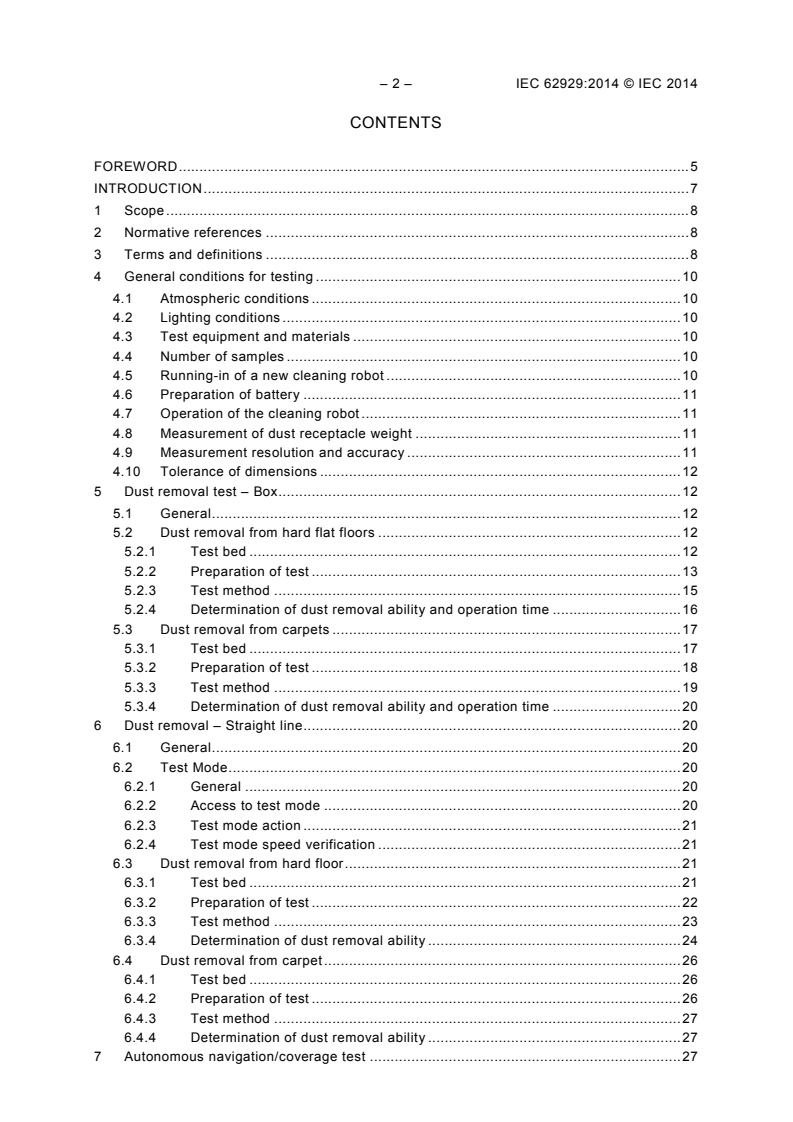
CONTENTS
FOREWORD . 5
INTRODUCTION . 7
1 Scope . 8
2 Normative references . 8
3 Terms and definitions . 8
4 General conditions for testing . 10
4.1 Atmospheric conditions . 10
4.2 Lighting conditions . 10
4.3 Test equipment and materials . 10
4.4 Number of samples . 10
4.5 Running-in of a new cleaning robot . 10
4.6 Preparation of battery . 11
4.7 Operation of the cleaning robot . 11
4.8 Measurement of dust receptacle weight . 11
4.9 Measurement resolution and accuracy . 11
4.10 Tolerance of dimensions . 12
5 Dust removal test – Box . 12
5.1 General . 12
5.2 Dust removal from hard flat floors . 12
5.2.1 Test bed . 12
5.2.2 Preparation of test . 13
5.2.3 Test method . 15
5.2.4 Determination of dust removal ability and operation time . 16
5.3 Dust removal from carpets . 17
5.3.1 Test bed . 17
5.3.2 Preparation of test . 18
5.3.3 Test method . 19
5.3.4 Determination of dust removal ability and operation time . 20
Dust removal – Straight line . 20
6.1 General . 20
6.2 Test Mode . 20
6.2.1 General . 20
6.2.2 Access to test mode . 20
6.2.3 Test mode action . 21
6.2.4 Test mode speed verification . 21
6.3 Dust removal from hard floor . 21
6.3.1 Test bed . 21
6.3.2 Preparation of test . 22
6.3.3 Test method . 23
6.3.4 Determination of dust removal ability . 24
6.4 Dust removal from carpet . 26
6.4.1 Test bed . 26
6.4.2 Preparation of test . 26
6.4.3 Test method . 27
6.4.4 Determination of dust removal ability . 27
7 Autonomous navigation/coverage test . 27
7.1 General . 27
7.2 Test bed . 27
7.2.1 Test conditions . 27
7.2.2 Floor configuration . 27
7.2.3 Wall and ceiling configuration . 33
7.2.4 General conditions . 38
7.3 Preparation of test . 39
7.4 Test method . 40
7.5 Performance measurement . 41
8 Average robot speed . 43
8.1 Test bed . 43
8.2 Preparation . 44
8.2.1 Preconditioning of test floor . 44
8.2.2 Pre-treatment of cleaning robot . 44
8.2.3 Visual tracking system (VTS) . 44
8.3 Test method . 44
8.4 Determination of average speed . 45
9 Instructions for use . 46
Annex A (informative) Calculation of coverage . 47
A.1 Robot metrics . 47
A.2 Calculating robot coverage . 47
Annex B (informative) Comprehensive cleaning performance metric . 50
Bibliography . 51
Figure 1 – Dust removal from hard flat floor test bed configuration . 14
Figure 2 – Dust distribution devices . 14
Figure 3 – Starting positions and orientations . 15
Figure 4 – Dust removal (box test) from carpet floor test bed configuration . 18
Figure 5 – Description of test mode action . 22
Figure 6 – Straight line dust removal from hard floor test bed configuration . 22
Figure 7 – Straight line dust removal from carpet floor test bed configuration . 26
Figure 8 – Navigation/Coverage test bed configuration . 28
Figure 9 – Details of obstacles around table . 29
Figure 10 – Illustration of metal transition installation . 31
Figure 11 – Illustration of wood transition Installation . 31
Figure 12 – Detail view of checker board and transitions. 32
Figure 13 – Configuration of four walls and ceiling . 33
Figure 14 – Illustration of four-panel door . 36
Figure 15 – Illustration of window . 36
Figure 16 – Illustration of baseboard . 37
Figure 17 – Illustration of pendant light . 37
Figure 18 – Illustration of clock . 38
Figure 19 – Illustration of mirror . 39
Figure 20 – Illustration of picture . 39
Figure 21 – Illustration of curtains . 39
– 4 – IEC 62929:2014 © IEC 2014
Figure 22 – Starting positions for navigation test. 41
Figure 23 – Exemplary graph of coverage test result. 43
Figure 24 – Location of average speed test area within coverage test environment . 44
Figure A.1 – Robot coordinate frame . 47
Figure A.2 – The first coverage step . 48
Figure A.3 – Incremental coverage step . 48
Table 1 – Tolerance of dimensions . 12
Table 2 – Dimensions of furniture and obstacles . 30
Table 3 – Wall and ceiling furniture . 34
INTERNATIONAL ELECTROTECHNICAL COMMISSION
____________
CLEANING ROBOTS FOR HOUSEHOLD USE –
DRY-CLEANING: METHODS OF MEASURING PERFORMANCE
FOREWORD
1) The International Electrotechnical Commission (IEC) is a worldwide organization for standardization comprising
all national electrotechnical committees (IEC National Committees). The object of IEC is to promote
international co-operation on all questions concerning standardization in the electrical and electronic fields. To
this end and in addition to other activities, IEC publishes International Standards, Technical Specifications,
Technical Reports, Publicly Available Specifications (PAS) and Guides (hereafter referred to as “IEC
Publication(s)”). Their preparation is entrusted to technical committees; any IEC National Committee interested
in the subject dealt with may participate in this preparatory work. International, governmental and non-
governmental organizations liaising with the IEC also participate in this preparation. IEC collaborates closely
with the International Organization for Standardization (ISO) in accordance with conditions determined by
agreement between the two organizations.
2) The formal decisions or agreements of IEC on technical matters express, as nearly as possible, an international
consensus of opinion on the relevant subjects since each technical committee has representation from all
interested IEC National Committees.
3) IEC Publications have the form of recommendations for international use and are accepted by IEC National
Committees in that sense. While all reasonable efforts are made to ensure that the technical content of IEC
Publications is accurate, IEC cannot be held responsible for the way in which they are used or for any
misinterpretation by any end user.
4) In order to promote international uniformity, IEC National Committees undertake to apply IEC Publications
transparently to the maximum extent possible in their national and regional publications. Any divergence
between any IEC Publication and the corresponding national or regional publication shall be clearly indicated in
the latter.
5) IEC itself does not provide any attestation of conformity. Independent certification bodies provide conformity
assessment services and, in some areas, access to IEC marks of conformity. IEC is not responsible for any
services carried out by independent certification bodies.
6) All users should ensure that they have the latest edition of this publication.
7) No liability shall attach to IEC or its directors, employees, servants or agents including individual experts and
members of its technical committees and IEC National Committees for any personal injury, property damage or
other damage of any nature whatsoever, whether direct or indirect, or for costs (including legal fees) and
expenses arising out of the publication, use of, or reliance upon, this IEC Publication or any other IEC
Publications.
8) Attention is drawn to the Normative references cited in this publication. Use of the referenced publications is
indispensable for the correct application of this publication.
9) Attention is drawn to the possibility that some of the elements of this IEC Publication may be the subject of
patent rights. IEC shall not be held responsible for identifying any or all such patent rights.
International Standard IEC 62929 has been prepared by subcommittee 59F: Surface cleaning
appliances, of IEC technical committee 59: Performance of household and similar electrical
appliances.
The text of this standard is based on the following documents:
FDIS Report on voting
59F/258/FDIS 59F/262/RVD
Full information on the voting for the approval of this standard can be found in the report on
voting indicated in the above table.
This publication has been drafted in accordance with the ISO/IEC Directives, Part 2.
In this standard, the following print types are used:
– bold for terms defined in Clause 3.
– 6 – IEC 62929:2014 © IEC 2014
The committee has decided that the contents of this publication will remain unchanged until
the stability date indicated on the IEC web site under "http://webstore.iec.ch" in the data
related to the specific publication. At this date, the publication will be
• reconfirmed,
• withdrawn,
• replaced by a revised edition, or
• amended.
IMPORTANT – The 'colour inside' logo on the cover page of this publication indicates
that it contains colours which are considered to be useful for the correct
understanding of its contents. Users should therefore print this document using a
colour printer.
INTRODUCTION
In addition to the performance measurement methods which are included in this International
Standard, a few more performance items have been reviewed and considered. The list of the
performance items which have been discussed over time but have not yet been included
comprises corner/edge dust pick-up, noise, docking, fall-off prevention, fibre pick-up and
emissions.
The performance items which have been left out in this edition will be continuously reviewed
and will soon be included in future editions of this standard.
– 8 – IEC 62929:2014 © IEC 2014
CLEANING ROBOTS FOR HOUSEHOLD USE –
DRY-CLEANING: METHODS OF MEASURING PERFORMANCE
1 Scope
This International Standard is applicable to dry cleaning robots for household use in or
under conditions similar to those in households.
The purpose of this standard is to specify the essential performance characteristics of dry
cleaning robots and to describe methods for measuring these characteristics.
This standard is neither concerned with safety nor with performance requirements.
2 Normative references
The following documents, in whole or in part, are normatively referenced in this document and
are indispensable for its application. For dated references, only the edition cited applies. For
undated references, the latest edition of the referenced document (including any
amendments) applies.
IEC 60312-1:2010, Vacuum cleaners for household use – Part 1: Dry vacuum cleaners –
Methods for measuring the performance
IEC 60312-1:2010/AMD1:2011
ISO 554, Standard atmospheres for conditioning and/or testing – Specifications
ISO 679:2009, Cement – Test methods – Determination of strength
ISO 2768-1:1989, General tolerances -- Part 1: Tolerances for linear and angular dimensions
without individual tolerance indications
3 Terms and definitions
For the purposes of this document, the terms and definitions given in IEC 60312-1, as well as
the following apply.
3.1
cleaning robot
automatic battery-powered cleaners
automatic floor cleaner that operates autonomously without human intervention within a
defined perimeter
Note 1 to entry: The cleaning robot consists of a mobile part and may have a docking station and/or other
accessories to assist its operation.
3.2
dry cleaning robot
cleaning robot that is intended to remove only non-liquid material from the floor using by
means other than with the aid of solutions or liquids
______________
There is a consolidated edition 1.1 (2011), that includes IEC 60312-1:2010 and its amendment IEC 60312-
1:2010/AMD1:2011.
Note 1 to entry: Typical means of cleaning include vacuum, brush(es), pad(s) and duster.
3.3
cleaning head
air intake nozzle at the bottom of the cleaning robot
Note 1 to entry: The width of the cleaning head is the width of the air intake nozzle in the direction of forward
travel.
Note 2 to entry: It does not include any agitation device.
3.4
agitation device
motorized mechanical part or an air-blower attached to the cleaning robot used to assist dirt
removal
3.5
docking station
base unit
unit that may provide manual or automatic battery charging facilities, dust removal from the
robot, data processing facility or other robot support functions
3.6
passive cleaning head
cleaning head without agitation device
[SOURCE: IEC 60312-1:2010, 3.5, modified – "nozzle" has been replaced by "cleaning
head".]
3.7
visual tracking system
VTS
measurement system which enables the tracking of robot position and orientation
3.8
secondary collection system
peripheral device outside of the robot that collects the dust from the cleaning robot
3.9
dust receptacle
container inside of the robot used to hold the collected dust
3.10
test
entirety / superset of all (test) runs and (test) trials of all samples to be measured for a
single robot
3.11
trial
single instance of a performance measurement carried out under identical conditions that can
be repeated multiple times
3.12
run
subset of a trial where one or more factors affecting the test results is (are) changed
3.13
pass
traverse of the cleaning head over the test area
– 10 – IEC 62929:2014 © IEC 2014
Note 1 to entry: The number of passes refers to the number of times the same test area has been traversed by
the cleaning head.
3.14
dust area
area where the test dust is distributed for the dust removal test
4 General conditions for testing
4.1 Atmospheric conditions
Unless otherwise specified, the test procedures and measurements shall be carried out under
the following atmospheric conditions (in accordance with ISO 554):
Temperature: (23 ± 2) °C
Relative humidity: (50 ± 5) %
Air pressure: 86 kPa to 106 kPa
Temperature and humidity conditions within the specified ranges are required for good
repeatability and reproducibility. Care shall be taken to avoid changes during a test.
4.2 Lighting conditions
Unless otherwise specified, the test procedures and measurements shall be carried out under
the following lighting conditions:
Intensity: (200 ± 50) lx
Colour temperature: 2 000 K to 6 000 K
Measurements shall be made on the floor level.
4.3 Test equipment and materials
To minimize the influence of electrostatic phenomena, measurements on carpets shall be
carried out on a level floor consisting of a smooth untreated pine plywood or equivalent panel,
at least 15 mm thick and of a size appropriate for the test.
Equipment and materials for measurements (devices, test carpets, test dust, etc.) to be used
in a test shall, prior to the test, be kept for at least 16 h at standard atmospheric conditions
according to 4.1.
Carpets that have already been used shall be stored unbeaten at standard atmospheric
conditions according to 4.1.
When not in use, carpets shall be hanging free, or lying flat, pile upwards and uncovered.
Carpets shall not be rolled when stored between testing. Carpets that have been rolled shall
be laid flat for a minimum of 16 h before use.
4.4 Number of samples
All measurements of performance shall be carried out on the same sample(s) of the cleaning
robot with its attachments, if any. During a set of tests the sample robot shall not be changed.
A minimum of three samples of the same model shall be tested.
4.5 Running-in of a new cleaning robot
Prior to the first test on a new cleaning robot it shall be kept running on a clean hard floor
for at least 10 min to ensure adequate running-in.
Prior to conducting any series of tests, the age, condition, and history of the product shall be
recorded.
4.6 Preparation of battery
Any unused battery shall need to go through at least one full charge and complete discharge
cycle prior to conducting any series of tests.
Complete discharge shall be done by carrying out a normal cleaning operation following the
manufacturer’s instructions.
4.7 Operation of the cleaning robot
Unless otherwise specified,
• the cleaning robot, its attachments, the docking station and any accessories shall be
used and adjusted in accordance with the manufacturer's instructions for normal operation
before a test is carried out, and
• the operation mode of the robot can be selected and adjusted according to the
manufacturer's published instructions only before the test to fit the environment to be
cleaned.
Any safety-related device shall be able to operate.
4.8 Measurement of dust receptacle weight
For the dust removal test, it is required to weigh the dust receptacle. If the dust receptacle
is removable the receptacle shall be carefully removed from the robot and the receptacle shall
be weighed.
If the dust receptacle is not removable and a secondary collection system needs to be
used to remove the dust collected in the receptacle the weight increase of the removable
receptacle in the secondary collection system shall be weighed and recorded.
For the robot that does not have a dust receptacle and only uses wiping pad the weight of
the pad shall be measured instead of the dust receptacle.
If the dust receptacle is not removable and a secondary collection system is not used to
remove the dust collected in the receptacle the complete cleaning robot shall be reweighed.
4.9 Measurement resolution and accuracy
Unless specified in the test methods the resolution and the accuracy of the measurement
device shall be as follows.
Weight measurement:
Resolution ≤ 0,01 g
Accuracy ≤ 0,02 g
Position measurement by vision:
Coverage test
Position resolution ≤ 3 cm
Position accuracy ≤ 5 cm
Sampling rate ≥ 30 Hz
Straight line test
Position resolution ≤ 1 cm
– 12 – IEC 62929:2014 © IEC 2014
Position accuracy ≤ 1 cm
Sampling rate ≥ 30 Hz
Average speed test
Position resolution ≤ 1 cm
Position accuracy < 1 cm
Sampling rate ≥ 30 Hz
Time measurement:
Resolution ≤ 0,01 s
Accuracy ≤ 0,02 s
4.10 Tolerance of dimensions
For all dimensions which are not presented as a range and no tolerance is specified the
tolerance shall be determined as Table 1.
Table 1 – Tolerance of dimensions
Nominal size range Tolerance
mm mm
3 ≤ 6 ± 0,5
> 6 ≤ 30 ± 1,0
> 30 ≤ 120 ± 1,5
> 120 ≤ 400 ± 2,5
> 400 ≤ 1 000 ± 4,0
> 1 000 ≤ 2 000 ± 6,0
> 2 000 ≤ 5 000 ± 8,0
NOTE Values are taken from Table 1 of ISO 2768-1:1989.
5 Dust removal test – Box
5.1 General
This test is designed to give indicative data on the dust removal capability of a robotic cleaner,
while allowing it to function and move in an autonomous way in an open area with no
obstacles. Navigation strategies differ, so the dust removal result shall always be reported
with time taken to deliver that score, to allow for relative comparison between different
products.
NOTE 1 Dust removal scores are a factor of both the unit’s dust removal system and navigation strategy so
cannot be directly compared with dust removal results from manually operated vacuum cleaners as per
IEC 60312-1.
NOTE 2 As robotic cleaners can and will make autonomous decisions about how best to navigate the box test
area, it is unlikely that any two runs of a robot with same test conditions will ever follow exactly the same cleaning
pattern. As such, it is understood that there will be a level of inherent variation in this test that cannot be designed
out, which could be reflected in the dust pick up scores even over the same length of time from the same start
position.
5.2 Dust removal from hard flat floors
5.2.1 Test bed
The length and the width of the test bed shall be 2 000 mm × 1 150 mm as specified in
Figure 1. The height of the wall surrounding the test bed floor shall be 300 mm tall. The inner
side of the wall shall be untreated pine wood colour. The ceiling height of the room in which
the test is executed shall not be higher than 3 500 mm. The test bed has one dust area of
1 300 mm × 500 mm centred in the test bed as shown in Figure 1. The test floor shall be
untreated laminated pine tree plate or equivalent (more detail of the floor specification is
under consideration) and its thickness shall be at least 15 mm.
To prevent the entrapment of the test dust beneath the wall during the test the gap between
the wall and the floor shall be properly sealed.
5.2.2 Preparation of test
5.2.2.1 Preconditioning of test floor
The test floor shall be cleaned so that no dust remains prior to any subsequent test.
5.2.2.2 Pre-treatment of cleaning robot
If the cleaning robot is designed to be used with disposable dust receptacles it shall, prior
to each test, be equipped with a new dust receptacle of the type recommended or supplied
by the manufacturer of the cleaning robot.
If the cleaning robot is provided with a reusable dust receptacle (as the sole original dust
receptacle or as an enclosure for disposable dust receptacles) the dust receptacle shall,
prior to each measurement, be cleaned according to the manufacturer’s instructions until its
weight is within 1 % of its original weight.
A dust receptacle made of textile is not permitted to be cleaned by brush and water.
A plastic dust receptacle shall be cleaned following the instructions in the user manual. If the
dust receptacle is cleaned with water it shall be dried well before any test and measurement.
Some reusable receptacles consist of a rigid container and an integral filter. In this case the
container and the filter are considered to be the receptacle and shall be treated as if they
were a single component.
Any replaceable filters and dust collection parts (e.g. dust pad) shall be preconditioned as
instructed in each test procedure.
Dust collecting parts shall be pre-treated in order to minimize the influence of humidity.
Prior to each test run, replaceable filter(s) and dust collection parts (e.g. wiping pad) in the
robot (or in the secondary collection system) shall be replaced with new ones.
The battery shall be fully re-charged prior to each run following the manufacturer’s
instructions.
5.2.2.3 Distribution of test dust
The test dust shall consist of dolomite sand with the grain size distribution as defined in the
Mineral dust – Type 1 table in 7.2.2.1 of IEC 60312-1:2010.
– 14 – IEC 62929:2014 © IEC 2014
Dimensions in millimetres
2 000
1 300
Dust area
untreated laminated pine tree plate
or equivalent
IEC
Figure 1 – Dust removal from hard flat floor test bed configuration
The test dust shall be distributed only within the dust area with a mean coverage of 50 g/m
as uniformly as possible.
NOTE 1 For uniform distribution of the test dust, a manual dust spreader as described in Figure 2 can be used.
NOTE 2 To ensure the distribution of the test dust only within the dust area, a masking frame with size of the
dust area or marker can be used.
IEC
Figure 2 – Dust distribution devices
1 150
325 500
RUT
Dimensions in millimetres
Dust area
40,0°
S
S
IEC
The arrow indicates the forward direction of the robot.
Key
RUT robot under test
Figure 3 – Starting positions and orientations
5.2.3 Test method
After the preparation process is completed according to 5.2.2 the dust receptacle shall be
weighed (m ) as specified in 4.8.
0,i,j
A single cleaning trial consists of a run from each of the two starting positions specified in
Figure 3. The starting positions are defined as follows.
S : At 45° pointing into the test bed starting at the bottom right hand corner
S : Parallel to the long side of the test bed starting at the bottom left hand corner.
Each of the two runs for each trial shall be performed with a fully charged battery.
Additional equipment which is not attached as part of the cleaning robot shall not be placed
inside the test bed during the test. If a docking station is required in order to start the
cleaning operation it may be placed inside the test bed. After the start of the robot the
docking station and other additional equipment shall be removed, if no longer required.
The operation mode of the cleaning robot shall be set according to the manufacturer’s
recommendations for the environment to be cleaned. Then the autonomous operation of the
cleaning robot shall be started according to the instruction of manufacturer.
The operation mode used in the test shall be one of the modes normally available to the
users and the mode used in the test shall be reported in the test result.
RUT
– 16 – IEC 62929:2014 © IEC 2014
If the cleaning robot stops operating its active cleaning function within 15 min the
measurement is finished and the operation time shall be recorded.
If the cleaning robot is still operating at 15 min the cleaning robot movement, including dust
collecting function, shall be stopped using the method provided by the manufacturer. The
operation time shall be recorded as 15 min.
After the cleaning robot movement has stopped the receptacle shall be carefully removed
and reweighed as specified in 4.8.
During the test it shall be ensured that the robot is not affected by any electro-magnetic and
physical interference. Dynamic changes within the test environment which may influence
optical sensors or vision based navigation systems shall be minimized.
For each run the dust removal ability shall be determined according to 5.2.4.
Prior to subsequent run, the test bed and the robot shall be prepared for the next run
according to 5.2.2.
The cleaning trial (with two runs) shall be repeated twice more. Before each trial the robot
and the test bed shall be conditioned according to 5.2.2.
If the spread (maximum value minus the minimum value) of the three runs per position is
greater than 10 % of the mean dust removal rate (K ) defined in 5.2.4 two more trials for that
i
position shall be added and all five trial data shall be used for the determination of dust
removal ability specified in 5.2.4.
NOTE One run means one operation of the robot from one starting position. One trial consists of one run from
each of the two starting positions. A single test consists of three trials per robot.
5.2.4 Determination of dust removal ability and operation time
The dust removal ability is calculated as the ratio of the weight increase of the dust
receptacle (or the weight of other alternative parts of the robot as specified in 4.8) from its
initial weight to the weight of the test dust distributed on the dust area.
The mean dust removal rate for the starting position S shall be calculated as follows using the
i
three measurements obtained from the three trials
K = (K + K + K )/3
i i1 i2 i3
or if five trials were executed
K = (K + K + K + K + K )/5
i i1 i2 i3 i4 i5
where
K is the mean dust removal for starting condition S over three (or five) trials (%)
i i
K is the dust removal with starting condition S for the jth trial (%)
i,j i
K = (m – m ) × 100 / m
i,j f,i,j 0,i,j D
m is the weight of the dust distributed on the dust area (g)
D
m is the weight of the preconditioned dust receptacle before the run for the starting
0,i,j
position S in the jth trial (alternative options for how to measure the dust receptacle
i
are specified in 4.8) (g)
m is the weight of the dust receptacle at the end of the run for the starting position S in
f,i,j i
the jth trial (alternative options for how to measure the dust receptacle are specified
in 4.8) after cleaning (g).
The mean operation time of the robot for the starting position S shall be calculated as follows
i
using the three measurements obtained from the three trials:
t = (t + t + t ) / 3
i i,1 i,2 i,3
or if five trials were executed
t = (t + t + t + t + t ) / 5
i i,1 i,2 i,3 i,4 i,5
where
t is the operation time for starting condition S for the jth trial (minutes)
i,j i
t is the mean operation time for starting condition S over three trials (minutes).
i i
The overall mean dust pickup value K is then calculated as
(K + K )
1 2
K=
The overall mean operation time t is calculated as
(t + t )
1 2
t=
The dust pickup value K and the mean operation time t shall be recorded as the final result.
5.3 Dust removal from carpets
5.3.1 Test bed
The test bed is identical to that defined in 5.2.1 except the floor is covered with test carpet
which is the Wilton type carpet in accordance with IEC 60312-1:2010, Clause C.1 – Wilton
Carpet.
The pile direction of the carpet shall be installed as specified in Figure 4.
– 18 – IEC 62929:2014 © IEC 2014
Dimensions in millimetres
2 000
1 300
Dust area
Wilton carpet Pile direction
IEC
Figure 4 – Dust removal (box test) from carpet floor test bed configuration
5.3.2 Preparation of test
5.3.2.1 Pre-treatment of test carpet
A new carpet shall be pre-conditioned in the following manner before recordable testing is
carried out.
Using a suitable vacuum cleaner all loose pile and fibre is removed over the entire surface of
the carpet until an amount no greater than 0,5 g/m is removed during a 5 min cleaning
process.
Using an in-house reference vacuum cleaner, a dust removal test according to 7.2.1.4 in
IEC 60312-1:2010 is carried out and the result recorded and plotted on a graph.
This is repeated until the resulting curve is parallel with the horizontal axis and the difference
between th
...