


IEC 62645:2014
(Main)Nuclear power plants - Instrumentation and control systems - Requirements for security programmes for computer-based systems
General Information
- Abstract
IEC 62645:2014 establishes requirements and provides guidance for the development and management of effective security programmes for I&C computer-based systems for NPPs, possibly integrating HPD (HDL (Hardware Description Language) Programmed Devices), hereinafter named I&C CB&HPD systems. Inherent to these requirements and guidance is the criterion that the power plant I&C CB&HPD system security programme complies with the applicable country's I&C CB&HPD security requirements. The primary objective of this standard is to define adequate programmatic measures for the prevention of, detection of and reaction to malicious acts by digital means (cyber attacks) on I&C CB&HPD systems. This includes any unsafe situation, and equipment damage or plant performance degradation.
The contents of the corrigendum of March 2015 have been included in this copy.
- Status
- Published
- Publication Date
- 20-Aug-2014
- Technical Committee
- SC 45A - Instrumentation, control and electrical power systems of nuclear facilities
- Drafting Committee
- WG 9 - TC 45/SC 45A/WG 9
- Current Stage
- DELPUB - Deleted Publication
- Start Date
- 13-Nov-2019
- Completion Date
- 28-Aug-2026
Overview
IEC 62645:2014 is an international standard published by the International Electrotechnical Commission (IEC) focusing on security programmes for computer-based instrumentation and control (I&C) systems in nuclear power plants (NPPs). This standard defines requirements and provides guidance for developing and managing effective security measures that protect I&C computer-based and hardware description language programmed devices (CB&HPD systems) used in nuclear facilities. Its primary goal is to prevent, detect, and respond to cyber attacks that could lead to unsafe conditions, equipment damage, or degraded plant performance.
This standard is critical to ensuring the cybersecurity integrity of digital control systems in nuclear power plants, facilitating compliance with national security requirements while promoting global best practices. IEC 62645 integrates risk management principles and calls for a comprehensive lifecycle approach to security, applicable from system design through retirement.
Key Topics
- Security Programme Establishment and Management: Requirements for defining security policies, scope, roles, responsibilities, documentation, and management approval.
- Lifecycle Implementation: Security considerations applied throughout the entire I&C system life cycle including design, implementation, validation, operation, maintenance, change management, and retirement.
- Risk Assessment and Graded Approach: Emphasis on risk-based security degree assignments considering safety categories and operational impacts.
- Security Controls: Thematic areas such as asset management, physical security, communications management, access control, incident management, human resources security, and compliance.
- Monitoring and Continuous Improvement: Guidelines for measuring programme effectiveness, training, awareness, and periodic reassessment to maintain and improve security posture.
- Integration with National and International Requirements: Alignments with ISO/IEC 27001:2005 and NIST SP 800-82 for comprehensive cybersecurity frameworks.
- Attack Scenario Awareness: Understanding attacker profiles and potential cyber threats specific to nuclear I&C systems.
Applications
IEC 62645:2014 is designed for use by nuclear facility operators, system integrators, and regulators to:
- Develop and manage robust security programmes protecting NPP computer-based I&C and HPD systems.
- Implement programmatic and technical controls that mitigate cyber risks and ensure safety integrity.
- Support compliance with nuclear cybersecurity regulations and national security policies.
- Guide security planning from early design phases through system operation and decommissioning.
- Enhance preparedness against cyber attacks that could compromise plant availability, safety, or performance.
- Facilitate harmonization and interoperability with existing information security management systems such as ISO 27001.
This standard is essential in strengthening the resilience of nuclear power infrastructure against evolving digital threats, making it a cornerstone for nuclear cybersecurity.
Related Standards
IEC 62645 aligns with and complements several key international standards and frameworks:
- ISO/IEC 27001:2005: Provides guidelines on information security management systems; IEC 62645 incorporates relevant controls with nuclear industry specificity.
- NIST SP 800-82: Guide for Industrial Control Systems security; IEC 62645 references it for cyber security practices applicable to I&C systems.
- IEC 60880: Standard for software important to safety in nuclear power plants, which complements the security focus of IEC 62645.
- IEC 61513: General requirements for I&C systems in nuclear facilities, providing safety assurance foundation supporting IEC 62645’s security controls.
By integrating these standards, IEC 62645 ensures nuclear I&C cybersecurity programmes are comprehensive, internationally recognized, and implemented according to best practices.
Keywords: IEC 62645, nuclear power plant cybersecurity, instrumentation and control system security, I&C computer-based systems, nuclear cybersecurity standard, security programmes, cyber attack prevention, nuclear plant safety, IEC standard for nuclear security, nuclear instrumentation control cybersecurity.
Relations
- Effective Date
- 05-Sep-2023
- Effective Date
- 05-Sep-2023
Get Certified
Connect with accredited certification bodies for this standard

DNV
DNV is an independent assurance and risk management provider.

Lloyd's Register
Lloyd's Register is a global professional services organisation specialising in engineering and technology.
DNV Energy Systems
Energy and renewable energy certification.
Sponsored listings
Frequently Asked Questions
IEC 62645:2014 is a standard published by the International Electrotechnical Commission (IEC). Its full title is "Nuclear power plants - Instrumentation and control systems - Requirements for security programmes for computer-based systems". This standard covers: IEC 62645:2014 establishes requirements and provides guidance for the development and management of effective security programmes for I&C computer-based systems for NPPs, possibly integrating HPD (HDL (Hardware Description Language) Programmed Devices), hereinafter named I&C CB&HPD systems. Inherent to these requirements and guidance is the criterion that the power plant I&C CB&HPD system security programme complies with the applicable country's I&C CB&HPD security requirements. The primary objective of this standard is to define adequate programmatic measures for the prevention of, detection of and reaction to malicious acts by digital means (cyber attacks) on I&C CB&HPD systems. This includes any unsafe situation, and equipment damage or plant performance degradation. The contents of the corrigendum of March 2015 have been included in this copy.
IEC 62645:2014 establishes requirements and provides guidance for the development and management of effective security programmes for I&C computer-based systems for NPPs, possibly integrating HPD (HDL (Hardware Description Language) Programmed Devices), hereinafter named I&C CB&HPD systems. Inherent to these requirements and guidance is the criterion that the power plant I&C CB&HPD system security programme complies with the applicable country's I&C CB&HPD security requirements. The primary objective of this standard is to define adequate programmatic measures for the prevention of, detection of and reaction to malicious acts by digital means (cyber attacks) on I&C CB&HPD systems. This includes any unsafe situation, and equipment damage or plant performance degradation. The contents of the corrigendum of March 2015 have been included in this copy.
IEC 62645:2014 is classified under the following ICS (International Classification for Standards) categories: 17.240 - Radiation measurements; 27.120.20 - Nuclear power plants. Safety. The ICS classification helps identify the subject area and facilitates finding related standards.
IEC 62645:2014 has the following relationships with other standards: It is inter standard links to IEC 62645:2014/COR1:2015, IEC 62645:2019. Understanding these relationships helps ensure you are using the most current and applicable version of the standard.
IEC 62645:2014 is available in PDF format for immediate download after purchase. The document can be added to your cart and obtained through the secure checkout process. Digital delivery ensures instant access to the complete standard document.
Standards Content (Sample)
IEC 62645 ®
Edition 1.0 2014-08
INTERNATIONAL
STANDARD
NORME
INTERNATIONALE
colour
inside
Nuclear power plants – Instrumentation and control systems – Requirements for
security programmes for computer-based systems
Centrales nucléaires de puissance – Systèmes d’instrumentation et de contrôle-
commande – Exigences relatives aux programmes de sécurité applicables aux
systèmes programmés
All rights reserved. Unless otherwise specified, no part of this publication may be reproduced or utilized in any form
or by any means, electronic or mechanical, including photocopying and microfilm, without permission in writing from
either IEC or IEC's member National Committee in the country of the requester. If you have any questions about IEC
copyright or have an enquiry about obtaining additional rights to this publication, please contact the address below or
your local IEC member National Committee for further information.
Droits de reproduction réservés. Sauf indication contraire, aucune partie de cette publication ne peut être reproduite
ni utilisée sous quelque forme que ce soit et par aucun procédé, électronique ou mécanique, y compris la photocopie
et les microfilms, sans l'accord écrit de l'IEC ou du Comité national de l'IEC du pays du demandeur. Si vous avez des
questions sur le copyright de l'IEC ou si vous désirez obtenir des droits supplémentaires sur cette publication, utilisez
les coordonnées ci-après ou contactez le Comité national de l'IEC de votre pays de résidence.
IEC Central Office Tel.: +41 22 919 02 11
3, rue de Varembé Fax: +41 22 919 03 00
CH-1211 Geneva 20 info@iec.ch
Switzerland www.iec.ch
About the IEC
The International Electrotechnical Commission (IEC) is the leading global organization that prepares and publishes
International Standards for all electrical, electronic and related technologies.
About IEC publications
The technical content of IEC publications is kept under constant review by the IEC. Please make sure that you have the
latest edition, a corrigenda or an amendment might have been published.
IEC Catalogue - webstore.iec.ch/catalogue Electropedia - www.electropedia.org
The stand-alone application for consulting the entire The world's leading online dictionary of electronic and
bibliographical information on IEC International Standards, electrical terms containing more than 30 000 terms and
Technical Specifications, Technical Reports and other definitions in English and French, with equivalent terms in 14
documents. Available for PC, Mac OS, Android Tablets and additional languages. Also known as the International
iPad. Electrotechnical Vocabulary (IEV) online.
IEC publications search - www.iec.ch/searchpub IEC Glossary - std.iec.ch/glossary
The advanced search enables to find IEC publications by a More than 55 000 electrotechnical terminology entries in
variety of criteria (reference number, text, technical English and French extracted from the Terms and Definitions
committee,…). It also gives information on projects, replaced clause of IEC publications issued since 2002. Some entries
and withdrawn publications. have been collected from earlier publications of IEC TC 37,
77, 86 and CISPR.
IEC Just Published - webstore.iec.ch/justpublished
Stay up to date on all new IEC publications. Just Published IEC Customer Service Centre - webstore.iec.ch/csc
details all new publications released. Available online and If you wish to give us your feedback on this publication or
also once a month by email. need further assistance, please contact the Customer Service
Centre: csc@iec.ch.
A propos de l'IEC
La Commission Electrotechnique Internationale (IEC) est la première organisation mondiale qui élabore et publie des
Normes internationales pour tout ce qui a trait à l'électricité, à l'électronique et aux technologies apparentées.
A propos des publications IEC
Le contenu technique des publications IEC est constamment revu. Veuillez vous assurer que vous possédez l’édition la
plus récente, un corrigendum ou amendement peut avoir été publié.
Catalogue IEC - webstore.iec.ch/catalogue Electropedia - www.electropedia.org
Application autonome pour consulter tous les renseignements
Le premier dictionnaire en ligne de termes électroniques et
bibliographiques sur les Normes internationales,
électriques. Il contient plus de 30 000 termes et définitions en
Spécifications techniques, Rapports techniques et autres
anglais et en français, ainsi que les termes équivalents dans
documents de l'IEC. Disponible pour PC, Mac OS, tablettes
14 langues additionnelles. Egalement appelé Vocabulaire
Android et iPad.
Electrotechnique International (IEV) en ligne.
Recherche de publications IEC - www.iec.ch/searchpub
Glossaire IEC - std.iec.ch/glossary
La recherche avancée permet de trouver des publications IEC Plus de 55 000 entrées terminologiques électrotechniques, en
en utilisant différents critères (numéro de référence, texte, anglais et en français, extraites des articles Termes et
comité d’études,…). Elle donne aussi des informations sur les Définitions des publications IEC parues depuis 2002. Plus
projets et les publications remplacées ou retirées. certaines entrées antérieures extraites des publications des
CE 37, 77, 86 et CISPR de l'IEC.
IEC Just Published - webstore.iec.ch/justpublished
Service Clients - webstore.iec.ch/csc
Restez informé sur les nouvelles publications IEC. Just
Published détaille les nouvelles publications parues. Si vous désirez nous donner des commentaires sur cette
Disponible en ligne et aussi une fois par mois par email. publication ou si vous avez des questions contactez-nous:
csc@iec.ch.
IEC 62645 ®
Edition 1.0 2014-08
INTERNATIONAL
STANDARD
NORME
INTERNATIONALE
colour
inside
Nuclear power plants – Instrumentation and control systems – Requirements for
security programmes for computer-based systems
Centrales nucléaires de puissance – Systèmes d’instrumentation et de contrôle-
commande – Exigences relatives aux programmes de sécurité applicables aux
systèmes programmés
INTERNATIONAL
ELECTROTECHNICAL
COMMISSION
COMMISSION
ELECTROTECHNIQUE
PRICE CODE
INTERNATIONALE
X
CODE PRIX
ICS 27.120.20 ISBN 978-2-8322-1810-5
– 2 – IEC 62645:2014 © IEC 2014
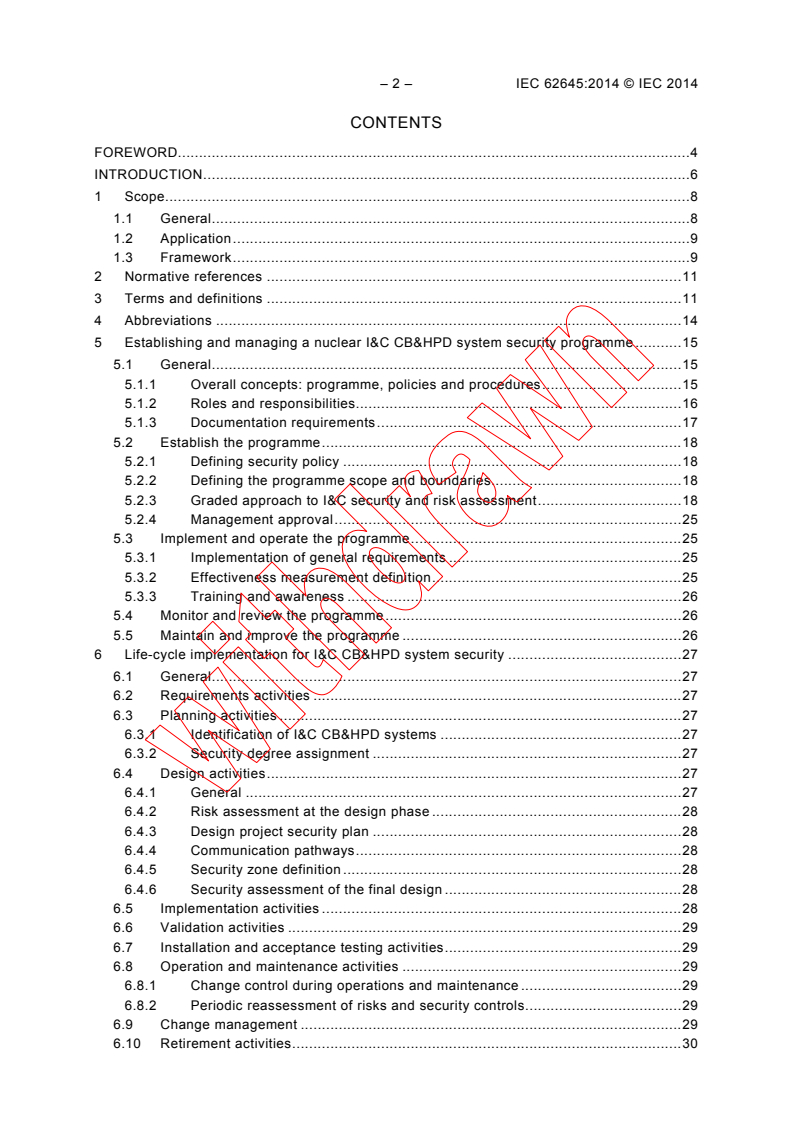
CONTENTS
FOREWORD. 4
INTRODUCTION . 6
1 Scope . 8
1.1 General . 8
1.2 Application . 9
1.3 Framework . 9
2 Normative references . 11
3 Terms and definitions . 11
4 Abbreviations . 14
5 Establishing and managing a nuclear I&C CB&HPD system security programme . 15
5.1 General . 15
5.1.1 Overall concepts: programme, policies and procedures . 15
5.1.2 Roles and responsibilities . 16
5.1.3 Documentation requirements . 17
5.2 Establish the programme . 18
5.2.1 Defining security policy . 18
5.2.2 Defining the programme scope and boundaries . 18
5.2.3 Graded approach to I&C security and risk assessment . 18
5.2.4 Management approval . 25
5.3 Implement and operate the programme . 25
5.3.1 Implementation of general requirements . 25
5.3.2 Effectiveness measurement definition . 25
5.3.3 Training and awareness . 26
5.4 Monitor and review the programme . 26
5.5 Maintain and improve the programme . 26
6 Life-cycle implementation for I&C CB&HPD system security . 27
6.1 General . 27
6.2 Requirements activities . 27
6.3 Planning activities . 27
6.3.1 Identification of I&C CB&HPD systems . 27
6.3.2 Security degree assignment . 27
6.4 Design activities . 27
6.4.1 General . 27
6.4.2 Risk assessment at the design phase . 28
6.4.3 Design project security plan . 28
6.4.4 Communication pathways . 28
6.4.5 Security zone definition . 28
6.4.6 Security assessment of the final design . 28
6.5 Implementation activities . 28
6.6 Validation activities . 29
6.7 Installation and acceptance testing activities . 29
6.8 Operation and maintenance activities . 29
6.8.1 Change control during operations and maintenance . 29
6.8.2 Periodic reassessment of risks and security controls . 29
6.9 Change management . 29
6.10 Retirement activities . 30
7 Security controls . 30
7.1 General . 30
7.2 Security thematic areas . 30
7.2.1 Security policy . 30
7.2.2 Organizing security . 30
7.2.3 Asset management . 31
7.2.4 Human resources security . 31
7.2.5 Physical and environmental security . 32
7.2.6 Communications and operations management . 32
7.2.7 Access control . 32
7.2.8 I&C systems acquisition, development and maintenance . 32
7.2.9 I&C security incident management . 33
7.2.10 Operation continuity management . 33
7.2.11 Complianc e . 33
Annex A (informative) Generic considerations about the security degrees . 35
A.1 Rationale for three security degrees . 35
A.1.1 General . 35
A.1.2 Safety categories as input to security degree assignment . 35
A.1.3 Impact on plant availability and performance as input to security degree . 35
A.1.4 Resulting security degree assignment approach . 36
A.2 Considerations about tools associated to on-line systems . 36
A.3 Practical design and implementation . 36
Annex B (informative) Correspondence with ISO/IEC 27001:2005 . 37
Annex C (informative) Correspondence with NIST security framework . 39
C.1 Scope . 39
C.2 Correspondence between IEC 62645 and NIST SP 800-82 . 39
Annex D (informative) Attackers profiles and attack scenarios . 44
Bibliography . . 45
Figure 1 – Overall framework of IEC 62645 . 10
Table B.1 – Correspondence between IEC 62645 and ISO/IEC 27001:2005 on a
structural level . . 37
Table C.1 – Correspondence between IEC 62645 and NIST SP 800-82 on a
structural level . . 40
– 4 – IEC 62645:2014 © IEC 2014
INTERNATIONAL ELECTROTECHNICAL COMMISSION
____________
NUCLEAR POWER PLANTS –
INSTRUMENTATION AND CONTROL SYSTEMS –
REQUIREMENTS FOR SECURITY PROGRAMMES
FOR COMPUTER-BASED SYSTEMS
FOREWORD
1) The International Electrotechnical Commission (IEC) is a worldwide organization for standardization comprising
all national electrotechnical committees (IEC National Committees). The object of IEC is to promote
international co-operation on all questions concerning standardization in the electrical and electronic fields. To
this end and in addition to other activities, IEC publishes International Standards, Technical Specifications,
Technical Reports, Publicly Available Specifications (PAS) and Guides (hereafter referred to as “IEC
Publication(s)”). Their preparation is entrusted to technical committees; any IEC National Committee interested
in the subject dealt with may participate in this preparatory work. International, governmental and non-
governmental organizations liaising with the IEC also participate in this preparation. IEC collaborates closely
with the International Organization for Standardization (ISO) in accordance with conditions determined by
agreement between the two organizations.
2) The formal decisions or agreements of IEC on technical matters express, as nearly as possible, an international
consensus of opinion on the relevant subjects since each technical committee has representation from all
interested IEC National Committees.
3) IEC Publications have the form of recommendations for international use and are accepted by IEC National
Committees in that sense. While all reasonable efforts are made to ensure that the technical content of IEC
Publications is accurate, IEC cannot be held responsible for the way in which they are used or for any
misinterpretation by any end user.
4) In order to promote international uniformity, IEC National Committees undertake to apply IEC Publications
transparently to the maximum extent possible in their national and regional publications. Any divergence
between any IEC Publication and the corresponding national or regional publication shall be clearly indicated in
the latter.
5) IEC itself does not provide any attestation of conformity. Independent certification bodies provide conformity
assessment services and, in some areas, access to IEC marks of conformity. IEC is not responsible for any
services carried out by independent certification bodies.
6) All users should ensure that they have the latest edition of this publication.
7) No liability shall attach to IEC or its directors, employees, servants or agents including individual experts and
members of its technical committees and IEC National Committees for any personal injury, property damage or
other damage of any nature whatsoever, whether direct or indirect, or for costs (including legal fees) and
expenses arising out of the publication, use of, or reliance upon, this IEC Publication or any other IEC
Publications.
8) Attention is drawn to the Normative references cited in this publication. Use of the referenced publications is
indispensable for the correct application of this publication.
9) Attention is drawn to the possibility that some of the elements of this IEC Publication may be the subject of
patent rights. IEC shall not be held responsible for identifying any or all such patent rights.
International Standard IEC 62645 has been prepared by subcommittee 45A: Instrumentation,
control and electrical systems of nuclear facilities, of IEC technical committee 45: Nuclear
instrumentation.
The text of this standard is based on the following documents:
FDIS Report on voting
45A/961/FDIS 45A/975/RVD
Full information on the voting for the approval of this standard can be found in the report on
voting indicated in the above table.
This publication has been drafted in accordance with the ISO/IEC Directives, Part 2.
The committee has decided that the contents of this publication will remain unchanged until
the stability date indicated on the IEC web site under "http://webstore.iec.ch" in the data
related to the specific publication. At this date, the publication will be
reconfirmed,
withdrawn,
replaced by a revised edition, or
amended.
The contents of the corrigendum of March 2015 have been included in this copy.
IMPORTANT – The 'colour inside' logo on the cover page of this publication indicates
that it contains colours which are considered to be useful for the correct
understanding of its contents. Users should therefore print this document using a
colour printer.
– 6 – IEC 62645:2014 © IEC 2014
INTRODUCTION
a) Technical background, main issues and organisation of the standard
This standard specifically focuses on the issue of requirements for computer security
programmes and system development processes to prevent and/or minimize the impact of
attacks against I&C computer-based systems possibly integrating HPD (HDL (Hardware
Description Language) Programmed Devices), hereinafter named I&C CB&HPD systems.
This standard was prepared and based on the ISO/IEC 27000 series, IAEA and country
specific guidance in this expanding technical and security focus area.
It is intended that the Standard be used by designers and operators of nuclear power
plants (NPPs) (utilities), licensees, systems evaluators, vendors and subcontractors, and
by licensors.
b) Situation of the current Standard in the structure of the IEC SC 45A standard series
IEC 62645 is a second level IEC SC 45A document, tackling the generic issue of NPP I&C
cybersecurity.
IEC 62645 is considered formally as a second level document with respect to IEC 61513,
although IEC 61513 needs revisions to actually ensure proper reference to and
consistency with IEC 62645. IEC 62645 is the top-level document with respect to cyber
security in the SC 45A standard series. Other documents will be developed under
IEC 62645 and will correspond to third level documents in the IEC SC 45A standards.
This IEC Standard is expected to coordinate more closely with the IEC 62443
(Bibliography) series in the next few years.
For more details on the structure of the IEC SC 45A standard series, see item d) of this
introduction.
c) Recommendations and limitations regarding the application of this standard
This standard establishes requirements for I&C CB&HPD systems, with regard to
computer security, and clarifies the processes that I&C CB&HPD systems are designed,
developed and operated under in NPPs.
It is recognized that this standard addresses an evolving area of regulatory requirements,
due to the changing and evolving nature of computer security threats. Therefore, the
standard defines the framework within which the evolving country specific requirements
may be developed and applied. An upcoming process for this standard is anticipated in
the near term, to address these evolving issues. It is intended to take into account
coordination with new IEC and ISO standards, evolving and new national regulations, best
practices and technical advances from IEC members on issues including graded approach
and security degrees, refined consideration of security requirements to meet plant
performance objectives, risk assessment or cybersecurity of legacy systems.
It is also recognized that products derived from application of this subject matter require
protection. Release of the standard’s country specific requirements should be controlled
to limit the extent to which organizations or individuals intending to access nuclear plant
systems illegally, improperly or without authorization may benefit from this information.
d) Description of the structure of the IEC SC 45A standard series and relationships
with other IEC documents and other bodies documents (IAEA, ISO)
The top-level document of the IEC SC 45A standard series is IEC 61513. It provides
general requirements for I&C systems and equipment that are used to perform functions
important to safety in NPPs. IEC 61513 structures the IEC SC 45A standard series.
IEC 61513 refers directly to other IEC SC 45A standards for general topics related to
categorization of functions and classification of systems, qualification, separation of
systems, defence against common cause failure, software aspects of computer-based
systems, hardware aspects of computer-based systems, and control room design. The
standards referenced directly at this second level should be considered together with
IEC 61513 as a consistent document set.
At a third level, IEC SC 45A standards not directly referenced by IEC 61513 are standards
related to specific equipment, technical methods, or specific activities. Usually these
documents, which make reference to second-level documents for general topics, can be
used on their own.
A fourth level extending the IEC SC 45A standard series corresponds to the Technical
Reports which are not normative.
IEC 61513 has adopted a presentation format similar to the basic safety publication
IEC 61508 with an overall safety life-cycle framework and a system life-cycle framework.
Regarding nuclear safety, it provides the interpretation of the general requirements of
IEC 61508-1, IEC 61508-2 and IEC 61508-4, for the nuclear application sector, regarding
nuclear safety. In this framework IEC 60880 and IEC 62138 correspond to IEC 61508-3 for
the nuclear application sector. IEC 61513 refers to ISO as well as to IAEA GS-R-3 and
IAEA GS-G-3.1 and IAEA GS-G-3.5 for topics related to quality assurance (QA).
The IEC SC 45A standards series consistently implements and details the principles and
basic safety aspects provided in the IAEA code on the safety of NPPs and in the IAEA
safety series, in particular the Requirements SSR-2/1, establishing safety requirements
related to the design of Nuclear Power Plants, and the Safety Guide NS-G-1.3 dealing with
instrumentation and control systems important to safety in Nuclear Power Plants. The
terminology and definitions used by SC 45A standards are consistent with those used by
the IAEA.
NOTE It is assumed that for the design of I&C systems in NPPs that implement conventional safety functions
(e.g. to address worker safety, asset protection, chemical hazards, process energy hazards) international or
national standards would be applied, that are based on the requirements of a standard such as IEC 61508.
– 8 – IEC 62645:2014 © IEC 2014
NUCLEAR POWER PLANTS –
INSTRUMENTATION AND CONTROL SYSTEMS –
REQUIREMENTS FOR SECURITY PROGRAMMES
FOR COMPUTER-BASED SYSTEMS
1 Scope
1.1 General
This International Standard establishes requirements and provides guidance for the
development and management of effective security programmes for I&C computer-based
systems for NPPs, possibly integrating HPD (HDL (Hardware Description Language)
Programmed Devices), hereinafter named I&C CB&HPD systems. Inherent to these
requirements and guidance is the criterion that the power plant I&C CB&HPD system security
programme complies with the applicable country’s I&C CB&HPD security requirements.
The primary objective of this standard is to define adequate programmatic measures for the
prevention of, detection of and reaction to malicious acts by digital means (cyber attacks) on
I&C CB&HPD systems. This includes any unsafe situation, equipment damage or plant
performance degradation that could result from such an act, such as:
• malicious modifications affecting system integrity,
• malicious interference with information, data or resources that could compromise the
delivery of or performance of the required I&C CB&HPD functions,
• malicious interference with information, data or resources that could compromise operator
displays or lead to loss of management of I&C CB&HPD systems,
• malicious changes to hardware, firmware or software at the programmable logic controller
(PLC) level.
Effective security policies need to implement a graded protection scheme, as described in this
standard for assets subject to computer-based security, based on their relevance to the
overall plant safety, availability, and equipment protection.
Excluded from the scope of this standard are considerations related to:
• non-malevolent actions and events such as accidental failures, human errors and natural
events. In particular, good practices for managing applications and data software,
including back-up and restoration related to accidental failure, which should be
implemented even if I&C CB&HPD system security was not studied, are out of scope;
NOTE 1 Although such aspects may be considered as covered by security programme in other normative
contexts (e.g., in the ISO/IEC 27000 series, the IEC 62443 series or the NIST framework), this standard is only
focused on the protection against malicious acts by digital means (cyber attacks) on I&C CB&HPD systems.
This is made to provide the maximum consistency and the minimum overlap with other nuclear standards and
practices, which already cover accidental failures, unintentional human errors, natural events, etc.
• site physical security and room access control and site security surveillance systems.
These issues, while not addressed in this standard, should still be addressed by plant
operating procedures and programmes.
NOTE 2 This exclusion does not deny that cyber security has clear dependencies on the security of the
physical environment (e.g., physical protection, power, heating/ventilation/air-conditioning systems (HVAC) ,
etc.).
Standards such as ISO/IEC 27001 and ISO/IEC 27002 are not directly applicable to the cyber
protection of nuclear I&C CB&HPD systems. This is mainly due to the specificities of these
systems, including the regulatory and safety requirements inherent to nuclear facilities.
However, this standard builds upon the valid high level principles and main concepts of
ISO/IEC 27001 and 27002, adapts them and completes them to fit the nuclear context.
Particular differentiators that justify a targeted NPP I&C CB&HPD system standard include:
These systems are required to comply with IEC safety standards related to nuclear power
plant I&C systems.
A cyber attack could lead to significant adverse effects on plant equipment, reliable plant
operation, or safety and may result in major impact to surrounding population, plant
personnel and the environment.
Target of cyber threats are typically equipment and process, but may include I&C
CB&HPD systems. I&C CB&HPD systems may also be used as the attack vectors.
The unavailability of a NPP’s I&C system due to cyber attack may place the plant in an
unacceptable safety position and increase the likelihood of nuclear accidents.
The effect of a cyber attack may jeopardize or degrade critical devices such as the turbo-
generator set or the line transformer, and thus may generate expensive repairs and cause
long plant unavailability.
A nuclear facility operates at a high level of safety and requires rapid, real time responses
to emerging situations. An operator shall respond quickly to inputs and available data and
shall be able to rely on what information is available.
The possible damage resulting from a cyber attack at a nuclear facility has the potential for
much greater impact than that occurring at other industrial facilities. Therefore, while existing
and future industrial cyber security guidance may provide information and procedures
beneficial to nuclear facilities, a targeted nuclear standard is still required.
NOTE This edition of IEC 62645 is aligned to the defined editions of ISO/IEC 27000, ISO/IEC 27001 and ISO/IEC
27002. A future revision will update this standard to align to the new editions of these standards. In the meantime,
the user should exercise caution in reconciling the technical differences between these documents.
1.2 Application
This standard is limited to computer security of I&C CB&HPD systems (including non-safety
systems) used in a NPP. This standard is intended for use in evaluating or changing
established NPP security programmes for I&C CB&HPD systems, and in establishing new
programmes. This standard is applied to all NPP I&C CB&HPD systems throughout the life
cycles of these systems, as specified in this standard. It may also be applicable to other
types of nuclear facilities.
NOTE The term NPP is understood in its site acceptance, NPP I&C CB&HPD system including systems within the
NPP buildings, but also systems in the nuclear plant switchyard, water treatment facilities, etc.
1.3 Framework
Figure 1 presents the overall framework of this standard, with its normative clauses:
Clause 5 deals with a security life-cycle on the programme level; its approach is consistent
with the ISO/IEC 27001 Plan Do Check Act (PDCA) loop (with “security programme” here
corresponding to “ISMS” in ISO/IEC 27001). Moreover, the graded approach and security
categorization subclauses are organized in a similar way to IEC 61226.
Clause 6 deals with a security life-cycle on a system level.
Clause 7 deals with security thematic areas on a control level; its structure is consistent
with the ISO/IEC 27002:2005 organization (and ISO/IEC 27001:2005, normative Annex A).
NOTE Annex B provides a correspondence table between the IEC 62645 structure and the ISO/IEC 27001:2005
structure. Annex C provides the same kind of correspondence with the NIST SP800-82 framework.
– 10 – IEC 62645:2014 © IEC 2014
Security thematic areas
Programme level
PLAN
7.2.1 Security policy
5.2
Establish the
programme
7.2.2. Organizing security
5.5 5.3
Maintain and Implement and
ACT
DO
improve the operate the
7.2.3. Asset management
programme programme
5.4
7.2.4. Human resources security
Monitor and
review the
programme
7.2.5. Physical and environmental
security
CHECK
7.2.6. Communications and
System level
operations management
6.2 6.7 Installation, and
Requirements acceptance testing
7.2.7. Access control
6.3 6.8 Operation and
Planning maintenance
7.2.8. I&C systems acquisition,
development and maintenance
6.4 6.9 Change
Design management
7.2.9. I&C Security incident
management
6.5 6.10
Implementation Retirement
7.2.10. Operation continuity
management
6.6
Validation
7.2.11. Compliance
IEC
Figure 1 – Overall framework of IEC 62645
IEC 61513 addresses the concept of a safety life cycle for the total I&C system architecture,
and a safety life cycle for the individual systems. As part of the overall framework, IEC 61513
calls for establishment of an overall security plan to specify the procedural and technical
measures to be taken to protect the architecture of I&C systems from digital attacks that may
jeopardise functions important to safety. The provisions of the overall security plan may
differentiate between requirements for systems supporting category A, B or C functions, as
defined in IEC 61226 and include the establishment of controls for electronic and physical
access. This standard provides more detailed requirements for the overall security plan, as
called for in IEC 61513.
Additional requirements for software of systems supporting category A functions are provided
in IEC 60880 and IEC 62566. Additional requirements for software of systems supporting
category B and C functions are provided in IEC 62138.
This standard also covers security requirements for I&C CB&HPD systems which are not in
the scope of IEC 61513, IEC 60880, IEC 62138 and IEC 62566 but have a potential impact on
plant equipment, availability and performance.
2 Normative references
The following documents, in whole or in part, are normatively referenced in this document and
are indispensable for its application. For dated references, only the edition cited applies. For
undated references, the latest edition of the referenced document (including any
amendments) applies.
IEC 60880:2006, Nuclear power plants – Instrumentation and control systems important to
safety – Software aspects for computer-based systems performing category A functions
IEC 61226, Nuclear power plants – Instrumentation and control important to safety –
Classification of instrumentation and control functions
IEC 61513, Nuclear power plants – Instrumentation and control important to safety – General
requirements for systems
IEC 62138, Nuclear power plants – Instrumentation and control important for safety –
Software aspects for computer-based systems performing category B or C functions
IEC 62566, Nuclear power plants – Instrumentation and control important for safety –
Development of HDL-programmed integrated circuits for systems performing category A
functions
ISO/IEC 27000:2009, Information technology – Security techniques – Information security
management systems – Overview and vocabulary
ISO/IEC 27001:2005, Information technology – Security techniques – Information security
management systems – Requirements
ISO/IEC 27002:2005, Information technology – Security techniques – Code of practice for
information security management
ISO/IEC 27005:2011, Information technology – Security techniques – Information security risk
management
3 Terms and definitions
For the purposes of this document, the following terms and definitions apply.
3.1
attack vector
path or means by which an attacker or malicious program can gain access to a computer-
based system
3.2
authorization
function of specifying access rights to resources, which is related to information security and
computer security in general and to access control in particular
3.3
availability
the property of being accessible and usable upon demand by an authorized entity
Note 1 to entry: This definition is different from the one used in the other IEC standards in the field of
instrumentation and control of nuclear facilities which is “ability of an item to be in a state to perform a required
function under given conditions at a given instant of time or over a given time interval, assuming that the required
external resources are provided”.
– 12 – IEC 62645:2014 © IEC 2014
[SOURCE: IAEA Nuclear Security Series No. 17:2011]
3.4
computer-based system
I&C system whose functions are mostly dependent on, or completely performed by using,
microprocessors, programmed electronic equipment or computers
Note 1 to entry: In the context of this standard, computer, computer-based system, digital system, digital device,
software-based system, and programmed system are all synonymous.
Note 2 to entry: In the context of this standard, I&C CB&HPD systems include computer-based sub systems but
also possibly HPD based sub systems and all components susceptible to electronic compromises. See also
definition of HPD.
[SOURCE: IEC 60880:2006, 3.11]
3.5
confidentiality
the property that information is not made available or disclosed to unauthorized individuals,
entities, or processes
[SOURCE: IAEA Nuclear Security Series No. 17:2011]
3.6
cybersecurity
set of activities and measures whose objective is to prevent, detect, and react to digital
attacks that have the intent to cause:
• disclosures that could be used to perform malicious acts which could lead to an accident,
an unsafe situation or plant performance degradation (confidentiality),
• malicious modifications of functions that may compromise the delivery or integrity of the
required service by I&C CB&HPD systems (incl. loss of control) which could lead to an
accident, an unsafe situation or plant performance degradation (integrity),
• malicious withholding or prevention of access to or communication of information, data or
resources (incl. loss of view) that could compromise the delivery of the required service by
I&C systems which could lead to an accident, an unsafe situation or plant performance
degradation (availability).
Note 1 to entry: This definition is tailored with respect to the standard scope, focusing on the prevention of,
detection of and reaction to malicious acts by digital means on I&C CB&HPD systems. It is recognized that the
term “cybersecurity” has a broader meaning in other standards and guidance, often including non-malevolent
threats, human errors and protection against natural disasters, which are all out of the scope of this standard (see
1.1)
Note 2 to entry: In the frame of this standard, “computer security” is synonymous with “cybersecurity” and
“unauthorized accesses” is synonymous with “unauthorized logical accesses”.
3.7
design
the process and the result of developing a concept, detailed plans, supporting calculations
and specifications for a facility and its parts
[SOURCE: IAEA Safety glossary, 2007 edition]
3.8
Design Basis Threat
DBT
attributes and characteristics of potential insider and/or external adversaries, who might
attempt unauthorized removal of nuclear material or sabotage, against which a physical
protection system is designed and evaluated
Note 1 to entry: Cyber attacks and related adversaries are not considered, in an equivalent manner in DBTs; this
depends on each national approach and legal framework. Moreover, the content of a nuclear DBT is treated as
highly confidential.
[SOURCE: IAEA INFCIRC/225/Rev.4:1999, modified]
3.9
HDL-Programmed Device
HPD
integrated circuit configured (for NPP I&C systems), with Hardware Description Languages
and related software tools
Note 1 to entry: HDLs and related tools (e.g. simulator, synthesizer) are used to implement the requirements in a
proper assembly of pre-developed micro-electronic resources.
Note 2 to entry: The development of HPDs can use Pre-Developed Blocks.
Note 3 to entry: HPDs are typically based on blank FPGAs, PLDs or similar micro-electronic technologies.
[SOURCE: IEC 62566:2012, 3.7]
3.10
I&C function
function to control, operate and/or monitor a defined part of the process
[SOURCE: IEC 61513:2011, 3.28]
3.11
I&C system
system, based on electrical and/or electronic and/or programmable electronic technology,
performing I&C functions as well as service and monitoring functions related to the operation
of the system itself
The term is used as a general term which encompasses all elements of the system such as
internal power supplies, sensors and other input devices, data highways and other
communication paths, interfaces to actuators and other output devices. The different functions
within a system may use dedicated or shared resources.
Note 1 to entry: See also “I&C function”.
Note 2 to entry: Any network either is part of an I&C system or is an I&C system by itself.
[SOURCE: IEC 61513:2011, 3.29]
3.12
integrity
the property of protecting the accuracy and completeness of assets
[SOURCE: IAEA Nuclear Security Series No. 17:2011 and ISO/IEC 27000:2009]
3.13
risk
the potential that a given threat will exploit vulnerabilities of an asset or group of assets and
thereby cause harm to the organization
It is measured in terms of a combination of the likelihood of an event and the severity of its
consequences.
[SOURCE: IAEA Nuclear Security Series No. 17:2011]
– 14 – IEC 62645:2014 © IEC 2014
3.14
risk assessment
overall process of systematically identifying, estimating, analysing and evaluating risk
[SOURCE: IAEA Nuclear Security Series No. 17:2011]
3.15
security controls
means of managing security which can be administrative, technical, or management
3.16
security degree
gradation of security protection with associated sets of requ
...