

IEC 62899-301-3:2024
(Main)Printed Electronics - Part 301-3: Equipment - Contact printing - Rigid master - Method to measure the shape errors of printing plate rollers
General Information
- Abstract
IEC 62899-301-3:2024 defines measurement terms and methods related to the shape errors of printing plate rollers. Measurement terms include radius, total run-out, and three kinds of shape errors of printing plate rollers that are axial deviation, radial deviation, and cross-sectional deviation. The remaining shape error excluding the three errors mentioned above is defined as a residual shape error.
This document applies to printing plate rollers with or without patterns while excluding the pattern area for the measurement.
- Status
- Published
- Publication Date
- 26-Sep-2024
- Technical Committee
- TC 119 - Printed Electronics
- Drafting Committee
- WG 3 - TC 119/WG 3
- Current Stage
- PPUB - Publication issued
- Start Date
- 27-Sep-2024
- Completion Date
- 18-Oct-2024
Overview
IEC 62899-301-3:2024 - Printed Electronics, Part 301-3: Equipment - Contact printing - Rigid master - Method to measure the shape errors of printing plate rollers - is an International Electrotechnical Commission (IEC) standard that defines measurement terms and methods for quantifying the geometric shape errors of printing plate rollers used in contact printing for printed electronics.
This standard specifies how to measure and report key geometrical parameters such as radius, total run‑out, and three primary shape errors: axial deviation, radial deviation, and cross‑sectional deviation. Any remaining variation beyond these three is defined as the residual shape error. Measurement excludes the pattern area and applies to printing plate rollers with or without patterns.
Key topics and technical requirements
- Defined measurement terms: radius, total run‑out, axial deviation, radial deviation, cross‑sectional deviation, residual shape error.
- Scope limitation: applies to rigid master printing plate rollers; excludes patterned areas for measurement.
- Measurement methods (Clause 4):
- General principles for measuring shape errors.
- Requirements for the measuring instrument and recommended measurement setup.
- Measuring process steps to capture circumferential and axial data points.
- Reporting requirements and example report formats.
- Numerical procedures (Annex B, normative): procedures to extract the least‑squares reference circle, remove axial and radial deviations, compute cross‑sectional deviation, and calculate residual shape errors.
- Supplementary guidance:
- Annex A (informative): relationship between roller shape and printing force variation.
- Annex C (informative): worked examples of reports and graphical outputs.
- Metrology detail: guidance on sample points per circumference and data handling (table and figures provided), but no specific acceptance/tolerance levels are prescribed in this document.
Practical applications and who uses this standard
- Printed electronics manufacturers and production engineers use the standard to assess master quality and control printed feature fidelity (critical when printing features <20 µm).
- Printing plate roller manufacturers and tooling suppliers for quality assurance and product specifications.
- Equipment vendors and metrology labs to design measurement fixtures, select instruments, and produce standardized reports.
- R&D teams working on high‑resolution contact printing methods to separate roller-induced dynamic errors from bearing/motion or loading effects.
- Use cases include reducing printing registration errors, minimizing linewidth variations, and improving mass‑production yield for printed circuits and devices.
Related standards
- Part of the IEC 62899 series - Printed Electronics. Users should consult other parts of IEC 62899 for related measurement, process, and equipment requirements in printed electronics. For implementation details, refer to the normative references listed in the standard.
Get Certified
Connect with accredited certification bodies for this standard

IMP NDT d.o.o.
Non-destructive testing services. Radiography, ultrasonic, magnetic particle, penetrant, visual inspection.
Inštitut za kovinske materiale in tehnologije
Institute of Metals and Technology. Materials testing, metallurgical analysis, NDT.
Q Techna d.o.o.
NDT and quality assurance specialist. 30+ years experience. NDT personnel certification per ISO 9712, nuclear and thermal power plant inspections, QA/
Sponsored listings
Frequently Asked Questions
IEC 62899-301-3:2024 is a standard published by the International Electrotechnical Commission (IEC). Its full title is "Printed Electronics - Part 301-3: Equipment - Contact printing - Rigid master - Method to measure the shape errors of printing plate rollers". This standard covers: IEC 62899-301-3:2024 defines measurement terms and methods related to the shape errors of printing plate rollers. Measurement terms include radius, total run-out, and three kinds of shape errors of printing plate rollers that are axial deviation, radial deviation, and cross-sectional deviation. The remaining shape error excluding the three errors mentioned above is defined as a residual shape error. This document applies to printing plate rollers with or without patterns while excluding the pattern area for the measurement.
IEC 62899-301-3:2024 defines measurement terms and methods related to the shape errors of printing plate rollers. Measurement terms include radius, total run-out, and three kinds of shape errors of printing plate rollers that are axial deviation, radial deviation, and cross-sectional deviation. The remaining shape error excluding the three errors mentioned above is defined as a residual shape error. This document applies to printing plate rollers with or without patterns while excluding the pattern area for the measurement.
IEC 62899-301-3:2024 is classified under the following ICS (International Classification for Standards) categories: 19.080 - Electrical and electronic testing; 37.100.01 - Graphic technology in general. The ICS classification helps identify the subject area and facilitates finding related standards.
IEC 62899-301-3:2024 is available in PDF format for immediate download after purchase. The document can be added to your cart and obtained through the secure checkout process. Digital delivery ensures instant access to the complete standard document.
Standards Content (Sample)
IEC 62899-301-3 ®
Edition 1.0 2024-09
INTERNATIONAL
STANDARD
Printed Electronics –
Part 301-3: Equipment – Contact printing – Rigid master – Method to measure
the shape errors of printing plate rollers
All rights reserved. Unless otherwise specified, no part of this publication may be reproduced or utilized in any form
or by any means, electronic or mechanical, including photocopying and microfilm, without permission in writing from
either IEC or IEC's member National Committee in the country of the requester. If you have any questions about IEC
copyright or have an enquiry about obtaining additional rights to this publication, please contact the address below or
your local IEC member National Committee for further information.
IEC Secretariat Tel.: +41 22 919 02 11
3, rue de Varembé info@iec.ch
CH-1211 Geneva 20 www.iec.ch
Switzerland
About the IEC
The International Electrotechnical Commission (IEC) is the leading global organization that prepares and publishes
International Standards for all electrical, electronic and related technologies.
About IEC publications
The technical content of IEC publications is kept under constant review by the IEC. Please make sure that you have the
latest edition, a corrigendum or an amendment might have been published.
IEC publications search - webstore.iec.ch/advsearchform IEC Products & Services Portal - products.iec.ch
The advanced search enables to find IEC publications by a Discover our powerful search engine and read freely all the
variety of criteria (reference number, text, technical publications previews, graphical symbols and the glossary.
committee, …). It also gives information on projects, replaced With a subscription you will always have access to up to date
and withdrawn publications. content tailored to your needs.
IEC Just Published - webstore.iec.ch/justpublished
Electropedia - www.electropedia.org
Stay up to date on all new IEC publications. Just Published
The world's leading online dictionary on electrotechnology,
details all new publications released. Available online and once
containing more than 22 500 terminological entries in English
a month by email.
and French, with equivalent terms in 25 additional languages.
Also known as the International Electrotechnical Vocabulary
IEC Customer Service Centre - webstore.iec.ch/csc
(IEV) online.
If you wish to give us your feedback on this publication or need
further assistance, please contact the Customer Service
Centre: sales@iec.ch.
IEC 62899-301-3 ®
Edition 1.0 2024-09
INTERNATIONAL
STANDARD
Printed Electronics –
Part 301-3: Equipment – Contact printing – Rigid master – Method to measure
the shape errors of printing plate rollers
INTERNATIONAL
ELECTROTECHNICAL
COMMISSION
ICS 19.080; 37.100.01 ISBN 978-2-8322-9717-9
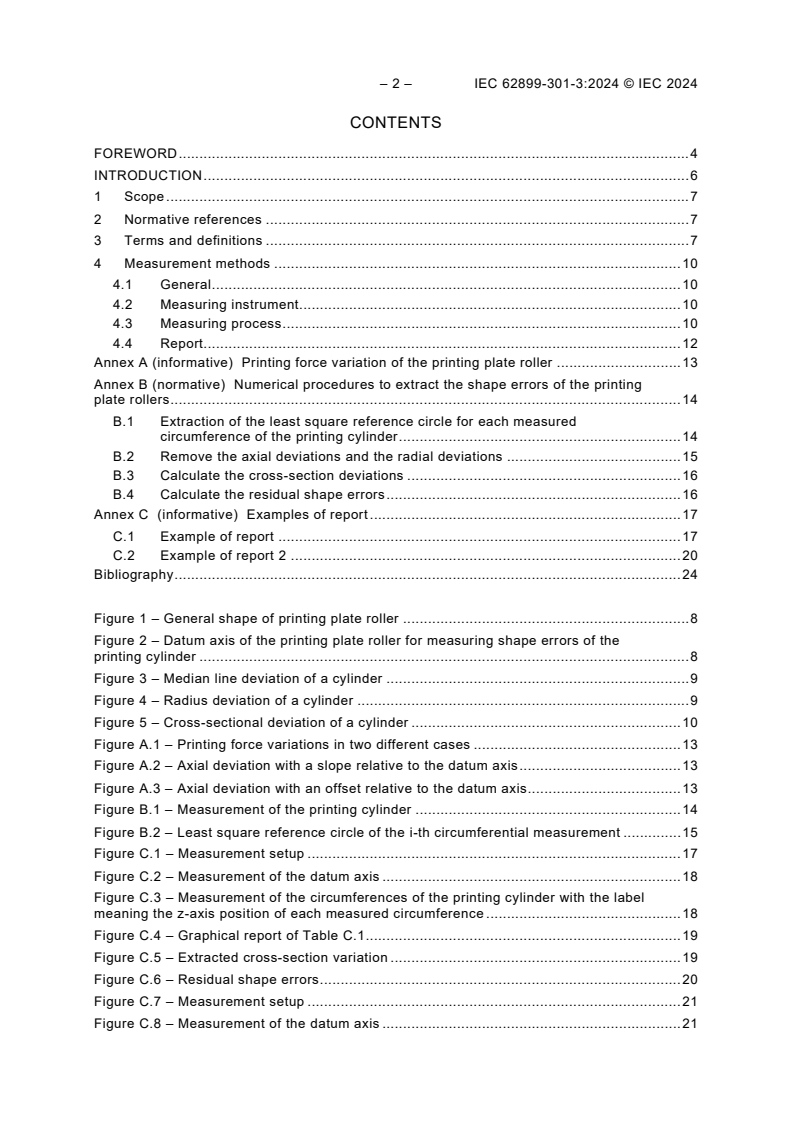
– 2 – IEC 62899-301-3:2024 © IEC 2024
CONTENTS
FOREWORD . 4
INTRODUCTION . 6
1 Scope . 7
2 Normative references . 7
3 Terms and definitions . 7
4 Measurement methods . 10
4.1 General . 10
4.2 Measuring instrument. 10
4.3 Measuring process . 10
4.4 Report. 12
Annex A (informative) Printing force variation of the printing plate roller . 13
Annex B (normative) Numerical procedures to extract the shape errors of the printing
plate rollers . 14
B.1 Extraction of the least square reference circle for each measured
circumference of the printing cylinder . 14
B.2 Remove the axial deviations and the radial deviations . 15
B.3 Calculate the cross-section deviations . 16
B.4 Calculate the residual shape errors . 16
Annex C (informative) Examples of report . 17
C.1 Example of report . 17
C.2 Example of report 2 . 20
Bibliography . 24
Figure 1 – General shape of printing plate roller . 8
Figure 2 – Datum axis of the printing plate roller for measuring shape errors of the
printing cylinder . 8
Figure 3 – Median line deviation of a cylinder . 9
Figure 4 – Radius deviation of a cylinder . 9
Figure 5 – Cross-sectional deviation of a cylinder . 10
Figure A.1 – Printing force variations in two different cases . 13
Figure A.2 – Axial deviation with a slope relative to the datum axis . 13
Figure A.3 – Axial deviation with an offset relative to the datum axis . 13
Figure B.1 – Measurement of the printing cylinder . 14
Figure B.2 – Least square reference circle of the i-th circumferential measurement . 15
Figure C.1 – Measurement setup . 17
Figure C.2 – Measurement of the datum axis . 18
Figure C.3 – Measurement of the circumferences of the printing cylinder with the label
meaning the z-axis position of each measured circumference . 18
Figure C.4 – Graphical report of Table C.1 . 19
Figure C.5 – Extracted cross-section variation . 19
Figure C.6 – Residual shape errors . 20
Figure C.7 – Measurement setup . 21
Figure C.8 – Measurement of the datum axis . 21
Figure C.9 – Measurement of the circumferences of the printing cylinder with the label
meaning the z-axis position of each measured circumference . 22
Figure C.10 – Graphical report of Table C.2 . 22
Figure C.11 – Extracted cross-section variation . 23
Figure C.12 – Residual shape errors . 23
Table 1 – Guideline for the sample points on each circumferential measurement . 11
Table B.1 – Report form for the axial deviations and radial deviations of the printing
cylinder . 15
Table C.1 – Report for the axial deviations and radial deviations of the printing cylinder
fitted from measured circumferences given in Figure C.3 . 19
Table C.2 – Report for the axial deviations and radial deviations of the printing cylinder
fitted from measured circumferences given in Figure C.9 . 22
– 4 – IEC 62899-301-3:2024 © IEC 2024
INTERNATIONAL ELECTROTECHNICAL COMMISSION
____________
PRINTED ELECTRONICS –
Part 301-3: Equipment – Contact printing – Rigid master –
Method to measure the shape errors of printing plate rollers
FOREWORD
1) The International Electrotechnical Commission (IEC) is a worldwide organization for standardization comprising
all national electrotechnical committees (IEC National Committees). The object of IEC is to promote international
co-operation on all questions concerning standardization in the electrical and electronic fields. To this end and
in addition to other activities, IEC publishes International Standards, Technical Specifications, Technical Reports,
Publicly Available Specifications (PAS) and Guides (hereafter referred to as “IEC Publication(s)”). Their
preparation is entrusted to technical committees; any IEC National Committee interested in the subject dealt with
may participate in this preparatory work. International, governmental and non-governmental organizations liaising
with the IEC also participate in this preparation. IEC collaborates closely with the International Organization for
Standardization (ISO) in accordance with conditions determined by agreement between the two organizations.
2) The formal decisions or agreements of IEC on technical matters express, as nearly as possible, an international
consensus of opinion on the relevant subjects since each technical committee has representation from all
interested IEC National Committees.
3) IEC Publications have the form of recommendations for international use and are accepted by IEC National
Committees in that sense. While all reasonable efforts are made to ensure that the technical content of IEC
Publications is accurate, IEC cannot be held responsible for the way in which they are used or for any
misinterpretation by any end user.
4) In order to promote international uniformity, IEC National Committees undertake to apply IEC Publications
transparently to the maximum extent possible in their national and regional publications. Any divergence between
any IEC Publication and the corresponding national or regional publication shall be clearly indicated in the latter.
5) IEC itself does not provide any attestation of conformity. Independent certification bodies provide conformity
assessment services and, in some areas, access to IEC marks of conformity. IEC is not responsible for any
services carried out by independent certification bodies.
6) All users should ensure that they have the latest edition of this publication.
7) No liability shall attach to IEC or its directors, employees, servants or agents including individual experts and
members of its technical committees and IEC National Committees for any personal injury, property damage or
other damage of any nature whatsoever, whether direct or indirect, or for costs (including legal fees) and
expenses arising out of the publication, use of, or reliance upon, this IEC Publication or any other IEC
Publications.
8) Attention is drawn to the Normative references cited in this publication. Use of the referenced publications is
indispensable for the correct application of this publication.
9) IEC draws attention to the possibility that the implementation of this document may involve the use of (a)
patent(s). IEC takes no position concerning the evidence, validity or applicability of any claimed patent rights in
respect thereof. As of the date of publication of this document, IEC had not received notice of (a) patent(s), which
may be required to implement this document. However, implementers are cautioned that this may not represent
the latest information, which may be obtained from the patent database available at https://patents.iec.ch. IEC
shall not be held responsible for identifying any or all such patent rights.
IEC 62899-302-3 has been prepared by IEC technical committee 119: Printed Electronics. It is
an International Standard.
The text of this International Standard is based on the following documents:
Draft Report on voting
119/505/FDIS 119/511/RVD
Full information on the voting for its approval can be found in the report on voting indicated in
the above table.
The language used for the development of this International Standard is English.
This document was drafted in accordance with ISO/IEC Directives, Part 2, and developed in
accordance with ISO/IEC Directives, Part 1 and ISO/IEC Directives, IEC Supplement, available
at www.iec.ch/members_experts/refdocs. The main document types developed by IEC are
described in greater detail at www.iec.ch/publications.
A list of all parts in the IEC 62899 series, published under the general title Printed electronics,
can be found on the IEC website.
The committee has decided that the contents of this document will remain unchanged until the
stability date indicated on the IEC website under webstore.iec.ch in the data related to the
specific document. At this date, the document will be
• reconfirmed,
• withdrawn, or
• revised.
IMPORTANT – The "colour inside" logo on the cover page of this document indicates
that it contains colours which are considered to be useful for the correct understanding
of its contents. Users should therefore print this document using a colour printer.
– 6 – IEC 62899-301-3:2024 © IEC 2024
INTRODUCTION
The term "printed electronics" can be easily understood in that this industry involves electronic
devices and products that are manufactured by using state-of-the-art printing techniques,
otherwise known as additive processes. Printing methods have been widely used in textile and
paper type substrates for centuries. In the past, the advent of mass producible printouts had a
significant impact on how knowledge is stored, transferred and reproduced. At this current stage
of technological development, printing on either rigid or flexible substrates is considered to
supplement or replace traditional electronic device manufacturing processes. The difference
between media printing and printed electronics stems from the fact that media print is used to
convey information for humans to process using their eyes while printed electronics requires
machines to process electronic information; the level of resolution and functionality required
makes the difference. Some of the widely used functional materials for printed electronics are,
but not limited to, nano- or micro-size metal particles, semiconductive polymers, and dielectric
materials. Due to the available and required readout resolution, small feature sizes below 20 µm
will necessarily be printed. Layer thickness and registration accuracy of printed products are
closely related to the quality control of electronic devices with ink materials requiring a high
level of quality. Overall, printing tolerance is much smaller in printed electronics.
There are two main categories in the printing process for printed electronics. One is a non-
contact printing process, such as inkjet printing or an electrostatic discharge (ESD) printing
process. The other is a contact printing process, such as gravure printing, gravure offset printing,
reverse offset printing and screen printing. This document provides a proposal for measuring
and assessing the printing master. Therefore, the scope is limited to the printing process using
the printing master.
The quality of the printing master is important because the ink is transferred from the printing
master to the substrate directly in these processes, which means that the quality of the results
of the printed circuit depends on the quality of the printing master. For the mass production of
printed electronic devices, many companies, such as device manufacturers, printing master
manufacturers and printing master manufacturing equipment vendors, are related to
manufacturing and thus they will use a printing master and standardized measurement and
assessment methods.
Printed electronics requires more precise dimensional control than conventional media printing
as mentioned above. It means that the evaluation of printing plate rollers is critical to achieving
the reliable production of high-resolution patterns and the reduction of printing registration
errors. One of the most important performance parameters of the printing plate roller is the
dynamic error in actual printing equipment during actual printing. The dynamic error of the
printing plate roller causes the changes in the printing process condition, such as the printing
pressure and the synchronization error between the roller and the substrate. Such a dynamic
error results in printed linewidth variations and printing registration errors. The dynamic error is
the combined results of the shape errors of the printing plate roller, the motion guiding error of
the bearing assembly, and the unexpected deformation of the roller by the external load
including self-gravity load. To reduce the occurrence of dynamic errors of the printing plate
roller, each contributor to the dynamic error of the printing plate roller will be evaluated. For the
first step to evaluate the dynamic error of the printing plate roller, this document focuses on
measuring the shape errors of the printing plate roller.
PRINTED ELECTRONICS –
Part 301-3: Equipment – Contact printing – Rigid master –
Method to measure the shape errors of printing plate rollers
1 Scope
This part of IEC 62899 defines measurement terms and methods related to the shape errors of
printing plate rollers. Measurement terms include radius, total run-out, and three kinds of shape
errors of printing plate rollers that are axial deviation, radial deviation, and cross-sectional
deviation. The remaining shape error excluding the three errors mentioned above is defined as
a residual shape error.
This document applies to printing plate rollers with or without patterns while excluding the
pattern area for the measurement.
2 Normative references
The following documents are referred to in the text in such a way that some or all of their content
constitutes requirements of this document. For dated references, only the edition cited applies.
For undated references, the latest edition of the referenced document (including any
amendments) applies.
ISO 1101, Geometrical product specifications (GPS) – Geometrical tolerancing – Tolerances of
form, orientation, location and run-out
ISO 12180-1:2011, Geometrical product specifications (GPS) – Cylindricity – Part 1: Vocabulary
and parameters of cylindrical form
ISO 12180-2, Geometrical product specifications (GPS) – Cylindricity – Part 2: Specification
operators
ISO 12181-2, Geometrical product specifications (GPS) – Roundness – Part 2: Specification
operators
3 Terms and definitions
For the purposes of this document, the following terms and definitions apply.
ISO and IEC maintain terminology databases for use in standardization at the following
addresses:
• IEC Electropedia: available at http
...