

IEC 60746-3:2002
(Main)Expression of performance of electrochemical analyzers - Part 3: Electrolytic conductivity
General Information
- Abstract
IEC 60746-3:2002 is intended to specify terminology, definitions and requirements for statements by manufacturers for analyzers, sensor units, and electronic units used for the determination of the electrolytic conductivity of aqueous solutions; to establish performance tests for such analyzers, sensor units and electronic units; to provide basic documents to support the applications of quality assurance standards.
This publication is to be read in conjunction with IEC 60746-1:2003.
- Status
- Published
- Publication Date
- 23-Jun-2002
- Technical Committee
- SC 65B - Measurement and control devices
- Drafting Committee
- WG 14 - TC 65/SC 65B/WG 14
- Current Stage
- PPUB - Publication issued
- Start Date
- 24-Jun-2002
- Completion Date
- 15-Aug-2002
Buy Documents
IEC 60746-3:2002 - Expression of performance of electrochemical analyzers - Part 3: Electrolytic conductivity Released:6/24/2002
IEC 60746-3:2002 - Expression of performance of electrochemical analyzers - Part 3: Electrolytic conductivity Released:6/24/2002
Overview
IEC 60746-3:2002 - "Expression of performance of electrochemical analyzers - Part 3: Electrolytic conductivity" specifies terminology, definitions and manufacturer statement requirements for electrolytic conductivity analyzers, sensor units and electronic units. It establishes performance tests, calibration and verification procedures, and supporting documents intended to underpin quality assurance for conductivity measurement of aqueous solutions. This part is to be read in conjunction with IEC 60746-1: General.
Key topics and technical requirements
- Terminology and definitions: clear definitions for electrolytic conductance, electrolytic conductivity (κ), cell constant (K), polarization, temperature coefficient, cell capacitance and leakage currents.
- Sensor and electronic unit specification: requirements for stating cell type (flow‑through, dip, inductive/capacitive), cell constant and tolerance, temperature compensator type, measuring frequency(ies), and cell constant adjustment range.
- Performance tests and verification: procedures for calibration, recommended test solutions, simulation of sensors (resistor simulators), and verification of values for specific sensor–electronics combinations.
- Temperature effects and compensation: guidance on temperature coefficients and sample temperature compensation techniques for accurate conductivity reporting.
- Response time and dynamic tests: alternative procedures for measuring response times (delay, rise/fall and 90% times) are provided (Annex C).
- Reference data and annexes: Annex A (KCl calibration solutions and pure water conductivity), Annex B (NaCl solution conductivities), Annex D (conductivity cell descriptions) supply reference values and practical guidance.
Practical applications
IEC 60746-3 is designed to ensure consistent, traceable and comparable expression of performance for conductivity measurement equipment. Typical uses include:
- Calibration and metrology laboratories performing conductivity analyzer verification and calibration.
- Manufacturers of conductivity sensors, conductivity meters and electrochemical analyzers preparing product datasheets and performance statements.
- Quality assurance and procurement teams specifying minimum performance criteria for process and laboratory monitoring.
- Process control, water treatment, ultrapure water monitoring, chemical, pharmaceutical and environmental monitoring where reliable conductivity measurement and temperature compensation are critical.
Who should use this standard
- Instrument and sensor manufacturers (to define performance claims and test methods)
- Calibration labs and testing houses (to perform verification and report results)
- OEMs and system integrators (to specify compatible sensor–electronics combinations)
- QA/Regulatory personnel and procurement specialists (to assess product conformity and suitability)
Related standards
- IEC 60746-1:2003 - General requirements and procedures that must be read alongside IEC 60746-3 for complete guidance on expression of performance of electrochemical analyzers.
Keywords: IEC 60746-3, electrolytic conductivity, electrochemical analyzers, conductivity sensors, cell constant, temperature compensation, calibration, performance tests, conductivity measurement.
Relations
- Effective Date
- 05-Sep-2023
Buy Documents
IEC 60746-3:2002 - Expression of performance of electrochemical analyzers - Part 3: Electrolytic conductivity Released:6/24/2002
IEC 60746-3:2002 - Expression of performance of electrochemical analyzers - Part 3: Electrolytic conductivity Released:6/24/2002
Get Certified
Connect with accredited certification bodies for this standard

ECOCERT
Organic and sustainability certification.

BSMI (Bureau of Standards, Metrology and Inspection)
Taiwan's standards and inspection authority.

Eurofins Food Testing Global
Global leader in food, environment, and pharmaceutical product testing.
Sponsored listings
Frequently Asked Questions
IEC 60746-3:2002 is a standard published by the International Electrotechnical Commission (IEC). Its full title is "Expression of performance of electrochemical analyzers - Part 3: Electrolytic conductivity". This standard covers: IEC 60746-3:2002 is intended to specify terminology, definitions and requirements for statements by manufacturers for analyzers, sensor units, and electronic units used for the determination of the electrolytic conductivity of aqueous solutions; to establish performance tests for such analyzers, sensor units and electronic units; to provide basic documents to support the applications of quality assurance standards. This publication is to be read in conjunction with IEC 60746-1:2003.
IEC 60746-3:2002 is intended to specify terminology, definitions and requirements for statements by manufacturers for analyzers, sensor units, and electronic units used for the determination of the electrolytic conductivity of aqueous solutions; to establish performance tests for such analyzers, sensor units and electronic units; to provide basic documents to support the applications of quality assurance standards. This publication is to be read in conjunction with IEC 60746-1:2003.
IEC 60746-3:2002 is classified under the following ICS (International Classification for Standards) categories: 17.020 - Metrology and measurement in general; 71.040.40 - Chemical analysis. The ICS classification helps identify the subject area and facilitates finding related standards.
IEC 60746-3:2002 has the following relationships with other standards: It is inter standard links to IEC 60746-3:2002/COR1:2003. Understanding these relationships helps ensure you are using the most current and applicable version of the standard.
IEC 60746-3:2002 is available in PDF format for immediate download after purchase. The document can be added to your cart and obtained through the secure checkout process. Digital delivery ensures instant access to the complete standard document.
Standards Content (Sample)
INTERNATIONAL IEC
STANDARD
60746-3
Second edition
2002-06
Expression of performance of
electrochemical analyzers –
Part 3:
Electrolytic conductivity
Expression des qualités de fonctionnement
des analyseurs électrochimiques –
Partie 3:
Conductivité électrolytique
Reference number
Publication numbering
As from 1 January 1997 all IEC publications are issued with a designation in the
60000 series. For example, IEC 34-1 is now referred to as IEC 60034-1.
Consolidated editions
The IEC is now publishing consolidated versions of its publications. For example,
edition numbers 1.0, 1.1 and 1.2 refer, respectively, to the base publication, the
base publication incorporating amendment 1 and the base publication incorporating
amendments 1 and 2.
Further information on IEC publications
The technical content of IEC publications is kept under constant review by the IEC,
thus ensuring that the content reflects current technology. Information relating to
this publication, including its validity, is available in the IEC Catalogue of
publications (see below) in addition to new editions, amendments and corrigenda.
Information on the subjects under consideration and work in progress undertaken
by the technical committee which has prepared this publication, as well as the list
of publications issued, is also available from the following:
• IEC Web Site (www.iec.ch)
• Catalogue of IEC publications
The on-line catalogue on the IEC web site (www.iec.ch/catlg-e.htm) enables
you to search by a variety of criteria including text searches, technical
committees and date of publication. On-line information is also available on
recently issued publications, withdrawn and replaced publications, as well as
corrigenda.
• IEC Just Published
This summary of recently issued publications (www.iec.ch/JP.htm) is also
available by email. Please contact the Customer Service Centre (see below) for
further information.
• Customer Service Centre
If you have any questions regarding this publication or need further assistance,
please contact the Customer Service Centre:
Email: custserv@iec.ch
Tel: +41 22 919 02 11
Fax: +41 22 919 03 00
INTERNATIONAL IEC
STANDARD
60746-3
Second edition
2002-06
Expression of performance of
electrochemical analyzers –
Part 3:
Electrolytic conductivity
Expression des qualités de fonctionnement
des analyseurs électrochimiques –
Partie 3:
Conductivité électrolytique
IEC 2002 Copyright - all rights reserved
No part of this publication may be reproduced or utilized in any form or by any means, electronic or
mechanical, including photocopying and microfilm, without permission in writing from the publisher.
International Electrotechnical Commission, 3, rue de Varembé, PO Box 131, CH-1211 Geneva 20, Switzerland
Telephone: +41 22 919 02 11 Telefax: +41 22 919 03 00 E-mail: inmail@iec.ch Web: www.iec.ch
PRICE CODE
Commission Electrotechnique Internationale
Q
International Electrotechnical Commission
Международная Электротехническая Комиссия
For price, see current catalogue
– 2 – 60746-3 IEC:2002(E)
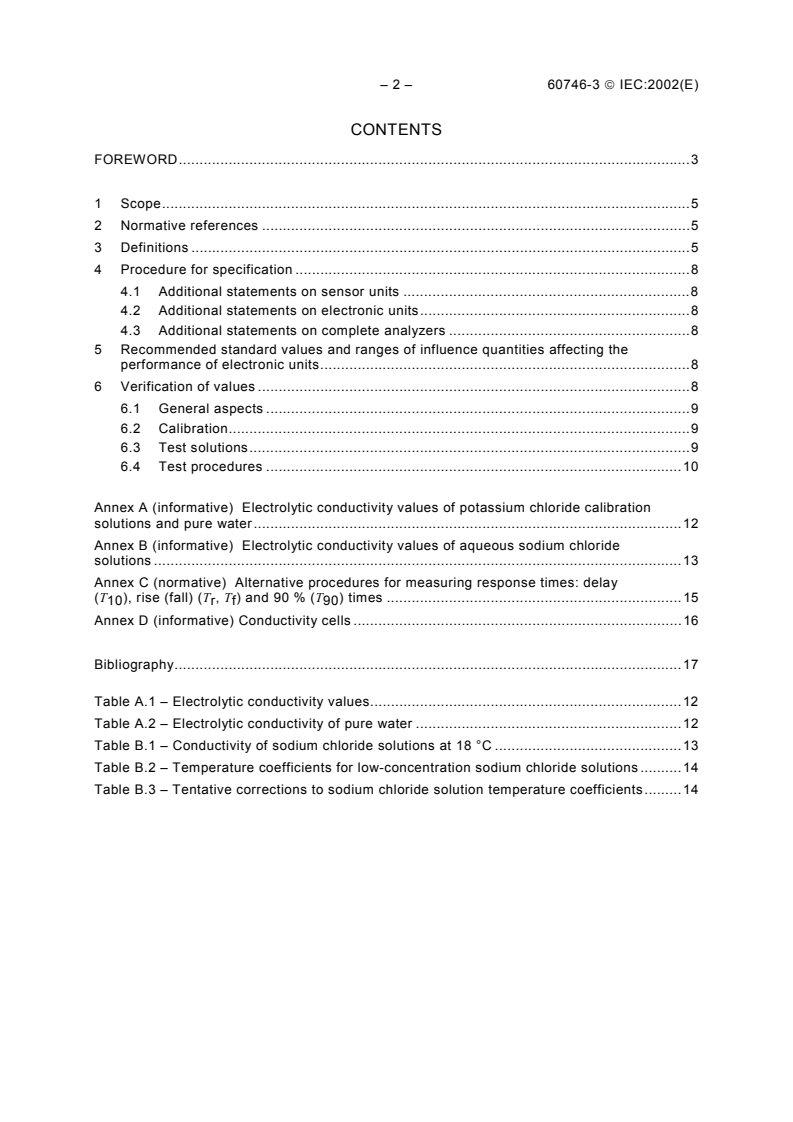
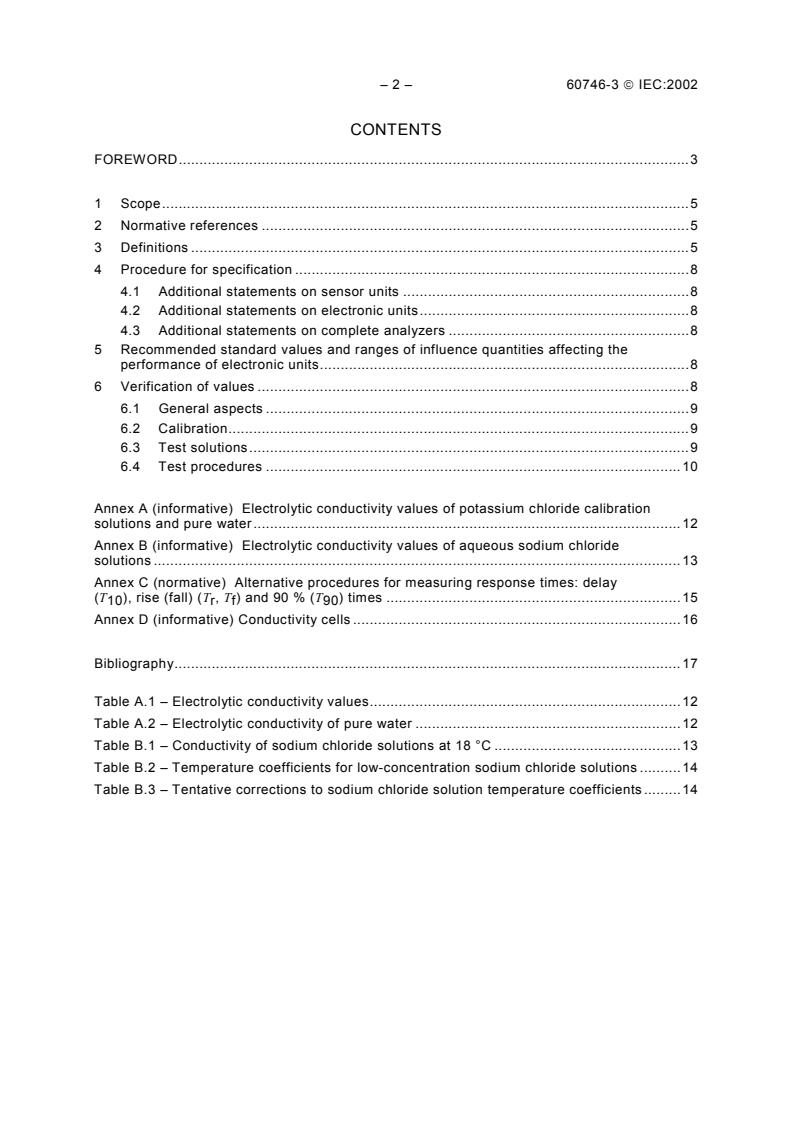
CONTENTS
FOREWORD.3
1 Scope.5
2 Normative references .5
3 Definitions .5
4 Procedure for specification .8
4.1 Additional statements on sensor units .8
4.2 Additional statements on electronic units.8
4.3 Additional statements on complete analyzers .8
5 Recommended standard values and ranges of influence quantities affecting the
performance of electronic units.8
6 Verification of values .8
6.1 General aspects .9
6.2 Calibration.9
6.3 Test solutions.9
6.4 Test procedures .10
Annex A (informative) Electrolytic conductivity values of potassium chloride calibration
solutions and pure water.12
Annex B (informative) Electrolytic conductivity values of aqueous sodium chloride
solutions .13
Annex C (normative) Alternative procedures for measuring response times: delay
(T ), rise (fall) (T , T ) and 90 % (T ) times .15
10 r f 90
Annex D (informative) Conductivity cells .16
Bibliography.17
Table A.1 – Electrolytic conductivity values.12
Table A.2 – Electrolytic conductivity of pure water .12
Table B.1 – Conductivity of sodium chloride solutions at 18 °C .13
Table B.2 – Temperature coefficients for low-concentration sodium chloride solutions .14
Table B.3 – Tentative corrections to sodium chloride solution temperature coefficients.14
60746-3 IEC:2002(E) – 3 –
INTERNATIONAL ELECTROTECHNICAL COMMISSION
____________
EXPRESSION OF PERFORMANCE
OF ELECTROCHEMICAL ANALYZERS –
Part 3: Electrolytic conductivity
FOREWORD
1) The IEC (International Electrotechnical Commission) is a worldwide organization for standardization comprising
all national electrotechnical committees (IEC National Committees). The object of the IEC is to promote
international co-operation on all questions concerning standardization in the electrical and electronic fields. To
this end and in addition to other activities, the IEC publishes International Standards. Their preparation is
entrusted to technical committees; any IEC National Committee interested in the subject dealt with may
participate in this preparatory work. International, governmental and non-governmental organizations liaising
with the IEC also participate in this preparation. The IEC collaborates closely with the International
Organization for Standardization (ISO) in accordance with conditions determined by agreement between the
two organizations.
2) The formal decisions or agreements of the IEC on technical matters express, as nearly as possible, an
international consensus of opinion on the relevant subjects since each technical committee has representation
from all interested National Committees.
3) The documents produced have the form of recommendations for international use and are published in the form
of standards, technical specifications, technical reports or guides and they are accepted by the National
Committees in that sense.
4) In order to promote international unification, IEC National Committees undertake to apply IEC International
Standards transparently to the maximum extent possible in their national and regional standards. Any
divergence between the IEC Standard and the corresponding national or regional standard shall be clearly
indicated in the latter.
5) The IEC provides no marking procedure to indicate its approval and cannot be rendered responsible for any
equipment declared to be in conformity with one of its standards.
6) Attention is drawn to the possibility that some of the elements of this International Standard may be the subject
of patent rights. The IEC shall not be held responsible for identifying any or all such patent rights.
International Standard IEC 60746-3 has been prepared by subcommittee 65D: Analyzing
equipment, of IEC technical committee 65: Industrial-process measurement and control.
This second edition cancels and replaces the first edition, published in 1985, and constitutes
a technical revision.
This standard shall be used in conjunction with IEC 60746-1.
The text of this standard is based on the following documents:
FDIS Report on voting
65D/85/FDIS 65D/87/RVD
Full information on the voting for the approval of this standard can be found in the report on
voting indicated in the above table.
This publication has been drafted in accordance with the ISO/IEC Directives, Part 3.
Annex C forms an integral part of this standard.
Annexes A, B and D are for information only.
– 4 – 60746-3 IEC:2002(E)
IEC 60746 consists of the following parts, under the general title Expression of performance
of electrochemical analyzers:
Part 1: General
Part 2: pH value
Part 3: Electrolytic conductivity
Part 4: Dissolved oxygen in water measured by membrane covered amperometric sensors
Part 5: Oxidation-reduction potential or redox potential
1)
Part 6: Conductivity effect of foreign ions in ultrapure waters, from combined conductivity and pH
The committee has decided that the contents of this publication will remain unchanged until
2007. At this date, the publication will be
• reconfirmed;
• withdrawn;
• replaced by a revised edition, or
• amended.
A bilingual version of this publication may be issued at a later date.
The contents of the corrigendum of January 2003 have been included in this copy.
________
1)
Under consideration.
60746-3 IEC:2002(E) – 5 –
EXPRESSION OF PERFORMANCE
OF ELECTROCHEMICAL ANALYZERS –
Part 3: Electrolytic conductivity
1 Scope
This part of IEC 60746 is intended
– to specify terminology, definitions and requirements for statements by manufacturers for
analyzers, sensor units, and electronic units used for the determination of the electrolytic
conductivity of aqueous solutions;
– to establish performance tests for such analyzers, sensor units and electronic units;
– to provide basic documents to support the applications of quality assurance standards.
2 Normative references
The following referenced documents are indispensable for the application of this document.
For dated references, only the edition cited applies. For undated references, the latest edition
of the referenced document (including any amendments) applies.
IEC 60746-1, Expression of performance of electrochemical analyzers – Part 1: General
3 Definitions
For the purpose of this part of IEC 60746, the definitions of IEC 60746-1 apply, together with
the following definitions.
3.1
electrolytic conductance
current divided by the potential difference in the case of ionic charge transport within an
electrolytic solution filling a conductivity cell:
I
G =
U
where
I is the current through the electrolyte, in amperes (A);
U is the potential difference applied across the electrodes, in volts (V);
G is the electrolytic conductance, in siemens (S).
Electrolytic resistance is the reciprocal of electrolytic conductance with the ohm (Ω) as the
unit of measurement
– 6 – 60746-3 IEC:2002(E)
3.2
electrolytic conductivity
formerly called specific conductance, is defined by the equation:
j
κ =
E
where
–2
j is the electric current density, in A⋅m ;
–1
E is the electric field strength, in V⋅m .
–1
The unit of electrolytic conductivity, κ, is siemens per metre (S⋅m ). Electrolytic resistivity is
the reciprocal of electrolytic conductivity with the unit of ohmmeter (Ω⋅m)
–1
NOTE In practical use, the most commonly employed conductivity unit is microsiemens per centimetre (μS⋅cm )
.
or the corresponding resistivity unit, megohm per centimetre (MΩ cm)
–1 –4 –1
1 μS⋅cm = 10 S⋅m = 1 MΩ⋅cm.
3.3
cell constant of the sensor unit
an electrolytic conductor of a uniform cross-section X and length L is defined by the equation:
L
κ =
cell
X
–1
where K is the cell constant, in m (see Note 1).
cell
It is usual to measure electrolytic conductivity by means of cells without a uniform cross-
section, in which case the K should be determined by means of a reference solution of
cell
known electrolytic conductivity.
The relationship between electrolytic conductance and electrolytic conductivity is defined by
the equation:
κ = K × G
cell
where
–1
κ is the electrolytic conductivity, in S⋅m ;
G is the electrolytic conductance, in S;
–1
K is the cell constant, in m .
cell
–1 –1
NOTE 1 In practical use, K is generally expressed in cm , κ in μS⋅cm and G in μS (see 3.2).
cell
NOTE 2 The cell constant will normally have a constant value over a stated range (see 4.1). Outside this range, it
should be expected that polarization or other effects will produce errors (see 3.4 and annex D).
3.4
polarization
effect which occurs at electrode surfaces in an electrolytic solution when the current between
the electrodes is such as to produce electrolysis and consequent partial insulation of the
electrode surface
To avoid this uncertainty, different measuring methods can be applied (see 3.7, 3.8 and
annex D):
a) a.c. measurements with a frequency high enough to avoid polarization effects;
b) four or six electrode measurements with separated current transporting and potential
measuring electrodes;
c) inductive or capacitive measurements by coupling between the electrolytic conductor and
the electrical measuring circuit through non-conductive media.
60746-3 IEC:2002(E) – 7 –
In each case, the relationship between the electrolytic conductivity and the measured output
quantity is established by the cell constant.
3.5
temperature coefficient
relative increase (or decrease) of the electrolytic conductivity of a solution per kelvin
temperature change. The temperature coefficient is dependent on the reference temperature
and the nature of the solution.
The following approximate equation can be applied for strong electrolyte solutions where
–4 –1 –1
κ > 10 S⋅m (1 μS⋅cm )
κ = κ ×()1 + αΔt
t tr
where
κ is the electrolytic conductivity at temperature t;
t
κ is the electrolytic conductivity at reference temperature tr;
tr
Δt is the temperature difference t − tr;
α is the temperature coefficient.
In practice, this formula is sufficiently accurate over a small temperature range. For large
temperature ranges, it is usually necessary to add higher terms of a polynomial series (such
2 3
as β(Δt) + γ(Δt) +.) to the above equation, to obtain sufficient accuracy. The percentage
temperature coefficient, which is the percentage relative deviation per kelvin from the
reference value κ , is often used so that
tr
α (%) = 100 α
NOTE The manufacturer’s literature should be consulted for details of sample temperature compensation
technique(s) applied.
3.6
simulator
a series of non-inductive resistors (preferably step-variable, e.g., a decade resistance box),
used for the performance tests of conductimetric electronic units, simulating two- and three-
electrode sensors
NOTE The minimum step should preferably be 0,01 R, where R is the reciprocal value of the nominal full range
conductivity value. Analogously, the highest resistance value should correspond to the lower limit of the measuring
range: if the range begins at zero, the resistance value should be at least 10 R for testing at 10 % of the range.
For multi-electrode sensor simulator design, the manufacturer must be consulted.
The temperature sensor may be simulated by another variable precision resistor, e.g., a
variable decade resistance box.
3.7
cell capacitance
produced by the electrostatic field existing between the sensor's measuring electrodes due to
the high dielectric constant of water. Its value is inversely proportional to the cell constant and
expressed by the approximate relationship:
C Ψ
cell
K
cell
where
–12
C is the cell capacitance, in picofarads (pF: 1 pF = 10 F);
cell
–1;
K is the cell constant, in cm
cell
C may disturb low conductivity measurements made with two- or three-electrode cells
cell
when too high a frequency is used. The effect can be reduced by means of phase
discrimination within the electronic unit.
– 8 – 60746-3 IEC:2002(E)
3.8
leakage currents
a.c. currents at the measuring frequency flowing from the cell electrodes to local conductive
parts in contact with the sample solution.
They effectively alter the cell constant causing measuring uncertainties and arise principally in
symmetrical cells, i.e., with similar electrodes side by side.
4 Procedure for specif
...
IEC 60746-3 ®
Edition 2.0 2002-06
INTERNATIONAL
STANDARD
NORME
INTERNATIONALE
Expression of performance of electrochemical analyzers –
Part 3: Electrolytic conductivity
Expression des qualités de fonctionnement des analyseurs électrochimiques –
Partie 3: Conductivité électrolytique
All rights reserved. Unless otherwise specified, no part of this publication may be reproduced or utilized in any form
or by any means, electronic or mechanical, including photocopying and microfilm, without permission in writing from
either IEC or IEC's member National Committee in the country of the requester.
If you have any questions about IEC copyright or have an enquiry about obtaining additional rights to this publication,
please contact the address below or your local IEC member National Committee for further information.
Droits de reproduction réservés. Sauf indication contraire, aucune partie de cette publication ne peut être reproduite ni
utilisée sous quelque forme que ce soit et par aucun procédé, électronique ou mécanique, y compris la photocopie et les
microfilms, sans l'accord écrit de la CEI ou du Comité national de la CEI du pays du demandeur.
Si vous avez des questions sur le copyright de la CEI ou si vous désirez obtenir des droits supplémentaires sur cette
publication, utilisez les coordonnées ci-après ou contactez le Comité national de la CEI de votre pays de résidence.
IEC Central Office Tel.: +41 22 919 02 11
3, rue de Varembé Fax: +41 22 919 03 00
CH-1211 Geneva 20 info@iec.ch
Switzerland www.iec.ch
About the IEC
The International Electrotechnical Commission (IEC) is the leading global organization that prepares and publishes
International Standards for all electrical, electronic and related technologies.
About IEC publications
The technical content of IEC publications is kept under constant review by the IEC. Please make sure that you have the
latest edition, a corrigenda or an amendment might have been published.
Useful links:
IEC publications search - www.iec.ch/searchpub Electropedia - www.electropedia.org
The advanced search enables you to find IEC publications The world's leading online dictionary of electronic and
by a variety of criteria (reference number, text, technical electrical terms containing more than 30 000 terms and
committee,…). definitions in English and French, with equivalent terms in
It also gives information on projects, replaced and additional languages. Also known as the International
withdrawn publications. Electrotechnical Vocabulary (IEV) on-line.
IEC Just Published - webstore.iec.ch/justpublished Customer Service Centre - webstore.iec.ch/csc
Stay up to date on all new IEC publications. Just Published If you wish to give us your feedback on this publication
details all new publications released. Available on-line and or need further assistance, please contact the
also once a month by email. Customer Service Centre: csc@iec.ch.
A propos de la CEI
La Commission Electrotechnique Internationale (CEI) est la première organisation mondiale qui élabore et publie des
Normes internationales pour tout ce qui a trait à l'électricité, à l'électronique et aux technologies apparentées.
A propos des publications CEI
Le contenu technique des publications de la CEI est constamment revu. Veuillez vous assurer que vous possédez
l’édition la plus récente, un corrigendum ou amendement peut avoir été publié.
Liens utiles:
Recherche de publications CEI - www.iec.ch/searchpub Electropedia - www.electropedia.org
La recherche avancée vous permet de trouver des Le premier dictionnaire en ligne au monde de termes
publications CEI en utilisant différents critères (numéro de électroniques et électriques. Il contient plus de 30 000
référence, texte, comité d’études,…). termes et définitions en anglais et en français, ainsi que
Elle donne aussi des informations sur les projets et les les termes équivalents dans les langues additionnelles.
publications remplacées ou retirées. Egalement appelé Vocabulaire Electrotechnique
International (VEI) en ligne.
Just Published CEI - webstore.iec.ch/justpublished
Service Clients - webstore.iec.ch/csc
Restez informé sur les nouvelles publications de la CEI.
Just Published détaille les nouvelles publications parues. Si vous désirez nous donner des commentaires sur
Disponible en ligne et aussi une fois par mois par email. cette publication ou si vous avez des questions
contactez-nous: csc@iec.ch.
IEC 60746-3 ®
Edition 2.0 2002-06
INTERNATIONAL
STANDARD
NORME
INTERNATIONALE
Expression of performance of electrochemical analyzers –
Part 3: Electrolytic conductivity
Expression des qualités de fonctionnement des analyseurs électrochimiques –
Partie 3: Conductivité électrolytique
INTERNATIONAL
ELECTROTECHNICAL
COMMISSION
COMMISSION
ELECTROTECHNIQUE
PRICE CODE
INTERNATIONALE
Q
CODE PRIX
ICS 17.020; 71.040 ISBN 978-2-83220-536-5
– 2 – 60746-3 IEC:2002
CONTENTS
FOREWORD . 3
1 Scope . 5
2 Normative references . 5
3 Definitions . 5
4 Procedure for specification . 8
4.1 Additional statements on sensor units . 8
4.2 Additional statements on electronic units . 8
4.3 Additional statements on complete analyzers . 8
5 Recommended standard values and ranges of influence quantities affecting the
performance of electronic units . 8
6 Verification of values . 8
6.1 General aspects . 9
6.2 Calibration . 9
6.3 Test solutions . 9
6.4 Test procedures . 10
Annex A (informative) Electrolytic conductivity values of potassium chloride calibration
solutions and pure water . 12
Annex B (informative) Electrolytic conductivity values of aqueous sodium chloride
solutions . 13
Annex C (normative) Alternative procedures for measuring response times: delay
(T ), rise (fall) (T , T ) and 90 % (T ) times . 15
10 r f 90
Annex D (informative) Conductivity cells . 16
Bibliography . 17
Table A.1 – Electrolytic conductivity values . 12
Table A.2 – Electrolytic conductivity of pure water . 12
Table B.1 – Conductivity of sodium chloride solutions at 18 °C . 13
Table B.2 – Temperature coefficients for low-concentration sodium chloride solutions . 14
Table B.3 – Tentative corrections to sodium chloride solution temperature coefficients . 14
60746-3 IEC:2002 – 3 –
INTERNATIONAL ELECTROTECHNICAL COMMISSION
____________
EXPRESSION OF PERFORMANCE
OF ELECTROCHEMICAL ANALYZERS –
Part 3: Electrolytic conductivity
FOREWORD
1) The IEC (International Electrotechnical Commission) is a worldwide organization for standardization comprising
all national electrotechnical committees (IEC National Committees). The object of the IEC is to promote
international co-operation on all questions concerning standardization in the electrical and electronic fields. To
this end and in addition to other activities, the IEC publishes International Standards. Their preparation is
entrusted to technical committees; any IEC National Committee interested in the subject dealt with may
participate in this preparatory work. International, governmental and non-governmental organizations liaising
with the IEC also participate in this preparation. The IEC collaborates closely with the International
Organization for Standardization (ISO) in accordance with conditions determined by agreement between the
two organizations.
2) The formal decisions or agreements of the IEC on technical matters express, as nearly as possible, an
international consensus of opinion on the relevant subjects since each technical committee has representation
from all interested National Committees.
3) The documents produced have the form of recommendations for international use and are published in the form
of standards, technical specifications, technical reports or guides and they are accepted by the National
Committees in that sense.
4) In order to promote international unification, IEC National Committees undertake to apply IEC International
Standards transparently to the maximum extent possible in their national and regional standards. Any
divergence between the IEC Standard and the corresponding national or regional standard shall be clearly
indicated in the latter.
5) The IEC provides no marking procedure to indicate its approval and cannot be rendered responsible for any
equipment declared to be in conformity with one of its standards.
6) Attention is drawn to the possibility that some of the elements of this International Standard may be the subject
of patent rights. The IEC shall not be held responsible for identifying any or all such patent rights.
International Standard IEC 60746-3 has been prepared by subcommittee 65D: Analyzing
equipment, of IEC technical committee 65: Industrial-process measurement and control.
This second edition cancels and replaces the first edition, published in 1985, and constitutes
a technical revision.
This standard shall be used in conjunction with IEC 60746-1.
This bilingual version (2012-12) corresponds to the monolingual English version, published in
2002-06.
The text of this standard is based on the following documents:
FDIS Report on voting
65D/85/FDIS 65D/87/RVD
Full information on the voting for the approval of this standard can be found in the report on
voting indicated in the above table.
The French version of this standard has not been voted upon.
This publication has been drafted in accordance with the ISO/IEC Directives, Part 3.
Annex C forms an integral part of this standard.
– 4 – 60746-3 IEC:2002
Annexes A, B and D are for information only.
IEC 60746 consists of the following parts, under the general title Expression of performance
of electrochemical analyzers:
Part 1: General
Part 2: pH value
Part 3: Electrolytic conductivity
Part 4: Dissolved oxygen in water measured by membrane covered amperometric sensors
Part 5: Oxidation-reduction potential or redox potential
1)
Part 6: Conductivity effect of foreign ions in ultrapure waters, from combined conductivity and pH
The committee has decided that the contents of this publication will remain unchanged until
2007. At this date, the publication will be
• reconfirmed;
• withdrawn;
• replaced by a revised edition, or
• amended.
The contents of the corrigendum of January 2003 have been included in this copy.
________
1)
Under consideration.
60746-3 IEC:2002 – 5 –
EXPRESSION OF PERFORMANCE
OF ELECTROCHEMICAL ANALYZERS –
Part 3: Electrolytic conductivity
1 Scope
This part of IEC 60746 is intended
– to specify terminology, definitions and requirements for statements by manufacturers for
analyzers, sensor units, and electronic units used for the determination of the electrolytic
conductivity of aqueous solutions;
– to establish performance tests for such analyzers, sensor units and electronic units;
– to provide basic documents to support the applications of quality assurance standards.
2 Normative references
The following referenced documents are indispensable for the application of this document.
For dated references, only the edition cited applies. For undated references, the latest edition
of the referenced document (including any amendments) applies.
IEC 60746-1, Expression of performance of electrochemical analyzers – Part 1: General
3 Definitions
For the purpose of this part of IEC 60746, the definitions of IEC 60746-1 apply, together with
the following definitions.
3.1
electrolytic conductance
current divided by the potential difference in the case of ionic charge transport within an
electrolytic solution filling a conductivity cell:
I
G =
U
where
I is the current through the electrolyte, in amperes (A);
U is the potential difference applied across the electrodes, in volts (V);
G is the electrolytic conductance, in siemens (S).
Electrolytic resistance is the reciprocal of electrolytic conductance with the ohm (Ω) as the
unit of measurement
– 6 – 60746-3 IEC:2002
3.2
electrolytic conductivity
formerly called specific conductance, is defined by the equation:
j
κ =
E
where
–2
j is the electric current density, in A⋅m ;
–1
E is the electric field strength, in V⋅m .
–1
The unit of electrolytic conductivity, κ, is siemens per metre (S⋅m ). Electrolytic resistivity is
the reciprocal of electrolytic conductivity with the unit of ohmmeter (Ω⋅m)
–1
NOTE In practical use, the most commonly employed conductivity unit is microsiemens per centimetre (µS⋅cm )
.
or the corresponding resistivity unit, megohm per centimetre (MΩ cm)
–1 –4 –1
1 µS⋅cm = 10 S⋅m = 1 MΩ⋅cm.
3.3
cell constant of the sensor unit
an electrolytic conductor of a uniform cross-section X and length L is defined by the equation:
L
κ =
cell
X
–1
is the cell constant, in m (see Note 1).
where K
cell
It is usual to measure electrolytic conductivity by means of cells without a uniform cross-
section, in which case the K should be determined by means of a reference solution of
cell
known electrolytic conductivity.
The relationship between electrolytic conductance and electrolytic conductivity is defined by
the equation:
κ = K × G
cell
where
–1
κ is the electrolytic conductivity, in S⋅m ;
G is the electrolytic conductance, in S;
–1
K is the cell constant, in m .
cell
–1 –1
NOTE 1 In practical use, K is generally expressed in cm , κ in µS⋅cm and G in µS (see 3.2).
cell
NOTE 2 The cell constant will normally have a constant value over a stated range (see 4.1). Outside this range, it
should be expected that polarization or other effects will produce errors (see 3.4 and annex D).
3.4
polarization
effect which occurs at electrode surfaces in an electrolytic solution when the current between
the electrodes is such as to produce electrolysis and consequent partial insulation of the
electrode surface
To avoid this uncertainty, different measuring methods can be applied (see 3.7, 3.8 and
annex D):
a) a.c. measurements with a frequency high enough to avoid polarization effects;
b) four or six electrode measurements with separated current transporting and potential
measuring electrodes;
c) inductive or capacitive measurements by coupling between the electrolytic conductor and
the electrical measuring circuit through non-conductive media.
60746-3 IEC:2002 – 7 –
In each case, the relationship between the electrolytic conductivity and the measured output
quantity is established by the cell constant.
3.5
temperature coefficient
relative increase (or decrease) of the electrolytic conductivity of a solution per kelvin
temperature change. The temperature coefficient is dependent on the reference temperature
and the nature of the solution.
The following approximate equation can be applied for strong electrolyte solutions where
–4 –1 –1
κ > 10 S⋅m (1 µS⋅cm )
κ =κ ×(1+α∆t)
t tr
where
κ is the electrolytic conductivity at temperature t;
t
κ is the electrolytic conductivity at reference temperature tr;
tr
∆t is the temperature difference t − tr;
α is the temperature coefficient.
In practice, this formula is sufficiently accurate over a small temperature range. For large
temperature ranges, it is usually necessary to add higher terms of a polynomial series (such
2 3
as β(∆t) + γ(∆t) +.) to the above equation, to obtain sufficient accuracy. The percentage
temperature coefficient, which is the percentage relative deviation per kelvin from the
reference value κ , is often used so that
tr
α (%) = 100 α
NOTE The manufacturer’s literature should be consulted for details of sample temperature compensation
technique(s) applied.
3.6
simulator
a series of non-inductive resistors (preferably step-variable, e.g., a decade resistance box),
used for the performance tests of conductimetric electronic units, simulating two- and three-
electrode sensors
NOTE The minimum step should preferably be 0,01 R, where R is the reciprocal value of the nominal full range
conductivity value. Analogously, the highest resistance value should correspond to the lower limit of the measuring
range: if the range begins at zero, the resistance value should be at least 10 R for testing at 10 % of the range.
For multi-electrode sensor simulator design, the manufacturer must be consulted.
The temperature sensor may be simulated by another variable precision resistor, e.g., a
variable decade resistance box.
3.7
cell capacitance
produced by the electrostatic field existing between the sensor's measuring electrodes due to
the high dielectric constant of water. Its value is inversely proportional to the cell constant and
expressed by the approximate relationship:
C Ψ
cell
K
cell
where
–12
C is the cell capacitance, in picofarads (pF: 1 pF = 10 F);
cell
–1;
K is the cell constant, in cm
cell
C may disturb low conductivity measurements made with two- or three-electrode cells
cell
when too high a frequency is used. The effect can be reduced by means of phase
discrimination within the electronic unit.
– 8 – 60746-3 IEC:2002
3.8
leakage currents
a.c. currents at the measuring frequency flowing from the cell electrodes to local conductive
parts in contact with the sample solution.
They effectively alter the cell constant causing measuring uncertainties and arise principally in
symmetrical cells, i.e., with similar electrodes side by side.
4 Procedure for specification
See Clause 5 of IEC 60746-1, plus the following.
4.1 Additional statements on sensor units
a) Type, i.e., flow-through, dip or insertion unit, number of electrodes, if electrodeless
whether inductive or capacitive cell (common types of cell are described in annex D).
b) Cell constant, tolerance and corresponding range of measurement (see 4.3a)).
c) Type of temperature compensator (for example, Pt100).
d) Sensor dimensions, mounting and connection details.
4.2 Additional statements on electronic units
a) Measuring frequency/frequencies.
b) Cell constant adjustment range.
c) Type of temperature compensator sensor to which the electronic unit can be connected
and maximum permitted resistance of compensator plus connection leads.
d) Reference temperature adjustment range; if fixed, state temperature.
e) Range of temperature coefficient adjustment and details of sample temperature
compensation that may be applied. If fixed, state value.
f) Installation details.
4.3 Additional statements on complete analyzers
a) Measuring ranges (rated and effective).
NOTE Some analyzers employ concentration units, for example, mass % NaCl, g NaOH per litre, etc.
For such analyzers, the rated range should be specified on the measurement unit as well as the corresponding
conductivity at the rated reference temperature.
b) Reference temperature for the measurement.
c) Installation details.
5 Recommended standard values and ranges of influence quantities
affecting the performance of electronic units
See annex A of IEC 60746-1.
6 Verification of values
See clause 6 of IEC 60746-1
60746-3 IEC:2002 – 9 –
6.1 General aspects
The parameters required to be set in the electronic unit for the specific combination of the
electronic unit and sensor shall be established. These shall include
– the range to be measured and the units for display (if a display is fitted);
– the range and type of any transmitted output;
– the type of sample, i.e., a flow-through sample and its flow rate, or a static sample into
which the sensor is immersed and its minimum depth;
– the type and range of sample temperature compensation for which verification is required,
if applicable.
6.2 Calibration
For accurate calibration of a conductivity analyzer the following parameters are required for
adjustment on the electronic unit:
a) the cell constant (see 3.3 and 4.2 b));
b) the reference temperature (see 4.2d));
c) the temperature coefficient or appropriate algorithm (see 4.2e)).
NOTE The exact value of the cell constant can be determined using an appropriate calibration solution (see
annex A).
6.3 Test solutions
Test solutions shall be applied in a manner suited to the design of the sensor.
For flow-through sensors, the solutions shall be applied at a flow rate within the manu-
facturer’s stated rated range.
For sensors which can be immersed into test solutions, it is essential that the sensor unit is
rinsed several times with water of negligible conductivity (in comparison with the range to be
tested) after immersion in one solution prior to immersion in a fresh solution. A good
procedure is to keep a second container of each test solution concentration to be used for the
final rinse prior to immersion in each respective accurate test solution.
The immersion of sensor probes into containers of test solution exposed to air is not
–1
appropriate for measurements below 100 µS⋅cm .
NOTE De-ionized water in an open container absorbs CO ; a typical equilibrium conductivity of approximately
–1
0,9 µS⋅cm is eventually reached.
Examples of test solutions are tabulated in annex B.
–1
For low-conductivity solutions below about 100 µS⋅cm (at 25 °C), it is essential that flowing
solutions of appropriate conductivities are generated by continuous injection of, e.g., NaCl
solutions into a pure water stream at a controlled flow rate. Required concentrations may be
determined by extrapolation of values in annex B.
Pure water can only be generated by a circulatory de-ionization system: standard test
solutions shall be generated from such water.
– 10 – 60746-3 IEC:2002
6.4 Test procedures
The following test procedures shall be carried out as described in IEC 60746-1, using the
appropriate test solutions.
a) Intrinsic uncertainty
b) Linearity uncertainty
NOTE 1 Deviations from linearity of the sensor unit may be produced at high conductivities by polarization
with too low a measuring frequency, and at low conductivities by cell capacitance with too high a frequency.
Conductivity analyzers that incorporate frequency selection permit simple verification. For analyzers without
frequency selection, polarization errors can be revealed by using test solutions at the upper range
(approximately 80 % – 100 %). Capacitance uncertainties may be demonstrated by parallel connection of a
capacitor of approximately the value given by the equation in 3.7 to the electronic unit input, i.e., to the cell
electrodes (for four- and six-electrode cells, the inner voltage electrodes): if an increase of displayed value is
observed, the capacitance uncertainty is about the same.
c) Repeatability
d) Output fluctuation
e) Warm-up time
f) Drift
NOTE 2 Drift is generally reported as a linear regression in two ways, short term over a period in the range of
1 h to 24 h and for a longer period in the range of 30 days to 100 days.
g) Response times
NOTE 3 These are given in detail in annex C, where method A is the preferred and the only method
appropriate to flow-through cells.
h) Sample temperature
Uncertainties caused by variation of the sample temperature shall be determined at two
points near the lower and higher limits of the measuring range. Measurements shall be
made at the reference sample temperature, then at the lowest temperature within the
compensation range (see 4.2d) and 4.2e)), and repeated at the highest temperature within
that range.
NOTE 4 For flowing samples, this may be achieved by passage of the solution through a stainless-steel heat
exchanger prior to the sensor.
i) Primary influence quantities
Response to the following influence quantities will generally need to be determined using
two test solutions near the higher and lower ends of the range. Influence quantities should
first be applied at the reference value then the two limits (upper and lower) of the rated
range. Final measurement should be made when the quantity is returned to the reference
value.
Variations in electrical supply characteristics usually affect the electronics unit only and
may be tested with only one solution at the mid-point of the span. These tests may be
carried out on the electronics unit alone, using resistors to simulate the mid-point of the
range for conductivity and the temperature sensor.
– Ambient temperature
– Humidity
– Sample flow-rate
– Sample pressure
– Sample outlet pressure (if different from above)
– Vibration
– Supply voltage
– AC supply frequency, or
– DC supply ripple and impedance
– Electromagnetic compatibility
60746-3 IEC:2002 – 11 –
Additional influence quantities which may require verification for specific applications are
listed in IEC 60746-1. In addition to those listed, the following parameters may require
verification.
j) Range of cell constant adjustment (electronic unit)
Using a test solution near the mid-point of the range, verify the possibility of increasing
and/or reducing the displayed value within a variation range not less than the manu-
facturer's stated adjustment range. Repeat with other test solutions near the lower and
higher limits of the measuring range. An appropriate simulator may be used (see 3.6).
– 12 – 60746-3 IEC:2002
Annex A
(informative)
Electrolytic conductivity values of potassium chloride
calibration solutions and pure water
Table A.1 – Electrolytic conductivity values
Molal
Calibration concentration Mass of KCl Temperature Conductivity Temperature
–1
solution m (mol KCl per kg water °C µS⋅cm coefficient
per kg water)
A 1 74,551 g 25 111 070
B [1] 0,1 7,455 1 g 0 7 115,85 0,030 5
(or 107,456 g solution A 25 12 824,6 0,019 0
and 900 g water) 50 19 180,9 0,013 5
C [1] 0,01 0,745 6 g 0 772,921 0,031 2
(or 100,746 g solution B 25 1 408,23 0,019 6
and 900 g water) 50 2 123,43 0,013 8
D 0,001 0,074 6 g 25 146,87
(or 100,075 g solution C
and 900 g water)
E [2] 0,000 5 0,037 3 g 25 73,87
(or 100,075 g solution C
and 900 g water)
Intermediate conductivity values at temperatures within ±20 °C of stated reference temperatures can be obtained
with an accuracy of better than 1 % using the relationship:
κ = κ (1 + α∆t)
t tr
where
κ is the conductivity at temperature, t;
t
κ is the tabulated value of nearest reference temperature tr;
tr
α is the temperature coefficient at tr;
∆t = t – tr
For the preparation of the solution, KCl of analytical grade dried for at least 2 h at 220 °C to 240 °C shall be
used. De-ionized water, with negligible conductivity compared with the stated value and preferably lower than
–1
1 µS⋅cm (at 25 °C) shall be used (see 6.3).
Tabulated conductivity values include the contribution of water: for solutions D and E, the conductivity of the
de-ionized water must be taken into account.
NOTE In the absence of a low-conductivity standard solution, solution E is included.
Table A.2 – Electrolytic conductivity of pure water
Temperature Conductivity Temperature Conductivity
–1 –1
°C °C
µS⋅cm µS⋅cm
0 0,010 74 50 0,174 4
10 0,022 55 60 0,251 7
20 0,042 01 70 0,349 2
25 0,055 44 80 0,467 0
30 0,072 02 90 0,605 9
40 0,114 9 100 0,763 1
1).
NOTE Data are selected from [3]
1)
Figures in square brackets refer to the bibliography.
60746-3 IEC:2002 – 13 –
Annex B
(informative)
Electrolytic conductivity values of aqueous sodium chloride solutions
Conductivity values have been interpolated from the data developed by G.F. Hewitt [4], [5]
with a stated accuracy of ±0,25 %.
For the preparation of the solutions, de-ionized water with negligible conductivity compared
with the stated value shall be used and sodium chloride of analytical grade dried for at least
2 h at 220 °C to 240 °C.
Tabulated values are for a temperature of 18 °C. Values for other temperatures can be
calculated from the equation
κ = κ [1 + α(t – 18)]
t 18
where α is the temperature coefficient (table B.2 corrected by table B.3).
Table B.1 – Conductivity of sodium chloride solutions at 18 °C
Molal Molal Molal
concentration concentration concentration
Conductivity Conductivity Conductivity
m m m
–1 –1 –1
µS⋅cm µS⋅cm µS⋅cm
a a a
(mol NaCl (mol NaCl (mol NaCl
per kg water) per kg water) per kg water)
–4 –2
21,5 1 016 1,0 73 290
2 × 10 1 × 10
–4 –2
42,91 1 983 1,2 86 270
4 × 10 2 × 10
–4 –2
64,14 3 853 1,4 96 240
6 × 10 4 × 10
–4 85,30 –2 5 669 1,6 106 700
8 × 10 6 × 10
106,4 7 444 1,8 116 600
–3 –2
1 × 10 8 × 10
210,7 9 190 2,0 125 400
–3 –1
2 × 10 1 × 1 0
415,9 17 430
2,5 145 700
–3 –1
4 × 10 2 × 10
618,0 32 720 3,0 163 800
–3 –1
6 × 10 4 × 10
817,8 47 150 3,5 179 000
–3 –1
8 × 10 6 × 10
60 650 4,0 190 900
–1
8 × 10
4,5 200 000
5,0 206 800
5,5 211 800
6,0 215 400
a 1 mol NaCl = 58,443 g.
– 14 – 60746-3 IEC:2002
Table B.2 – Temperature coefficients for low-concentration
sodium chloride solutions
Temperature Temperature
Temperature Temperature
coefficient coefficient
°C α °C α
0 0,021 1 80 0,026 1
8 8
10 0,021 9 90 0,026 4
8 3
20 0,022 7 100 0,026 6
7 0
30 0,023 5 110 0,026 6
3 9
40 0,024 2 120 0,026 7
3 4
50 0,024 8 130 0,026 7
6 5
60 0,025 3 140 0,026 7
9 8
70 0,025 8 150 0,026 8
4 4
Table B.3 – Tentative corrections to sodium chloride solution
temperature coefficients
Molal concentration NaCI
Temperature
m
°
C
0,01 0,1 0,2 0,5 1,0
0 –0,000 1 –0,000 4 –0,000 9 –0,001 2 –0,001 0
50 –0,000 1 –0,000 4 –0,000 7 –0,000 6 –0,000 4
100 –0,000 1 –0,000 2 –0,000 4 –0,000 6 +0,000 4
60746-3 IEC:2002 – 15 –
Annex C
(normative)
Alternative procedures for measuring response times:
delay (T ), rise (fall) (T , T ) and 90 % (T ) times
10 r f 90
C.1 Procedure A
A recorder is connected to the output terminals of the analyzer. The inlet of the flow-through
sensor is fitted with a two-way stopcock to supply alternate test solutions. An insertion sensor
may be suitably mounted within, e.g., a tube, preferably plastic, fitted with an inlet equipped
with a two-way stopcock, and outlet. A test solution representing the minimum rated value (or
approximately 2-5 % above) is supplied until a constant reading on the recorder is obtained.
The two-way stopcock is switched to supply a test solution representing the maximum rated
value (or approximately 2-5 % below) and a mark is made on the recorder chart. The
maximum value test solution is supplied until a constant reading is obtained. The stopcock is
switched back to the minimum value solution and a second mark is made on the recorder
chart: the minimum value solution is supplied until a constant reading is obtained
For flow-through sensors, the flow rate of the solutions shall be adjusted to the maximum
specified by the manufacturer for the equipment. The temperature of solutions and sensor unit
shall be constant within ±0,5 °C and shall be reported with other results.
The values for delay time (T ) and 90 % time (T ), for both increasing and decreasing step
10 90
changes, rise time (T ) and fall time (T ), are determined from the chart speed. The larger of
r f
the two delay, rise or fall and 90 % times are reported.
C.2 Procedure B
Procedure B is similar to procedure A except that the sensor unit is immersed alternately in
two tanks, one containing a stirred test solution representing the minimum rated electrolytic
conductivity value and the other containing a stirred test solution representing the maximum
rated electrolytic conductivity value. When transferring the sensor unit from one tank to the
other, the sensor unit is shaken but neither wiped nor rinsed. The sensor unit is left in the
tanks until constant readings are obtained.
– 16 – 60746-3 IEC:2002
Annex D
(informative)
Conductivity cells
D.1 Multiple electrode sensors
Lower conductivity range sensors are designed with two electrodes in contact with the
solution, those for the lowest range of cell constants with large, concentric, metal electrodes.
Sensors with larger cell constants require a reduction in area and an increase in separation
(see 3.3), which is often achieved with two rings of conductor inset into an insulating tube.
Two-electrode sensors offer no electrical isolation from the bulk of the sample. To overcome
this problem three-electrode sensors use two outer guard electrodes connected together
forming the low input to the electronics unit. To measure the very highest conductivities these
guard electrodes themselves have to be isolated from the analyzer signal path leading to four-
electrode and six-electrode designs with two outer guard electrodes, two current-sourcing
electrodes and two voltage-sensing electrodes as the innermost conductors.
For a full description of these techniques, the reader should consult specialist texts [6], [7]. All
these designs may be specified and receive performance verification by procedures in this
standard.
D.2 Inductive conductivity sensors
This type of sensor, often called electrodeless, is generally only suitable for conductivities
–1
above 100 µS⋅cm and offers complete electrical insulation from the sample. The sensor
consists of an electrical transformer with the primary winding excited by the electronics unit.
The secondary is effectively a shorted turn of sample solution within an insulating tube. As the
solution conductivity rises, the shorted turn draws more current from the primary winding.
For a comprehensive explanation of the theoretical aspects, the reader should refer to
specialist texts.
Inductive conductivity sensors may be specified and tested by procedures in this document
but verification tests are generally easier to carry out with actual solutions than with a
simulation circuit.
D.3 Capacitive conductivity sensors (also termed electrodeless)
The measurement cell is mounted between the plates of a capacitor in a resonance circuit.
The current flowing in the circuit is a function, not generally linear, of sample conductivity.
The method is rarely used for process analyzers.
60746-3 IEC:2002 – 17 –
Bibliography
[1] Wu, Y.P., Koch, W.F., Pratt, K.W., J. Res. Natl. Inst. Stand. Technol., 1991, 96, 191
[2] Harned, H.S., Owen, B.B., The Physical Chemistry of Electrolytic Solutions, 2nd ed.,
Reinhold, New York 1958, p. 537
[3] Mussini, P.R., Meyer, G., Mussini, T., Chimica Oggi/Chemistry Today, 1995, September
[4] Hewitt, G.F., PhD Thesis, University of Manchester, 1957
[5] Hewitt, G.F., Report R3497, UKAEA, Harwell, 1960
[6] Lopatin, B.A., Conductivity and Oscillometry, Israel Programme for Scientific Trans-
lations, 1971
[7] Shedlovsky T., The Electrical Conductivity of Some Univalent Electrolytes in Water at
25 °C, J. Amer. Chem. Soc., Vol. 54, 1411, 1932
___________
– 18 – 60746-3 CEI:2002
SOMMAIRE
AVANT-PROPOS . 19
1 Domaine d’application . 21
2 Références normatives . 21
3 Définitions . 21
4 Procédure pour la spécification. 24
4.1 Informations complémentaires concernant les détecteurs . 24
4.2 Informations complémentaires concernant les unités électroniques . 24
4.3 Informations complémentaires concernant les analyseurs complets. 24
5 Valeurs et domaines normalisés recommandés pour les grandeurs d’influence
affectant les qualités de fonctionnement des unités électroniques . 25
6 Vérification des valeurs . 25
6.1 Considérations générales . 25
6.2 Etalonnage . 25
6.3 Solutions d'essai . 25
6.4 Procédures d’essai . 26
Annexe A (informative) Valeurs de conductivité électrolytique de solutions
d’étalonnage de chlorure de potassium et d'eau pure . 28
Annexe B (informative) Valeurs de conductivité électrolytique de solutions aqueuses
de chlorure de sodium . 29
Annexe C (normative) Autres procédures pour la mesure des temps de réponse:
temps de retard (T ), temps de montée (descente) (T , T ) et temps de réponse à 90
10 r f
% (T ) . 31
Annexe D (informative) Cellules de conductivité . 32
Bibliographie . 33
Tableau A.1 – Valeurs de conductivité électrolytique . 28
Tableau A.2 – Conductivité électrolytique de l'eau pure . 28
Tableau B.1 – Conductivité des solutions de chlorure de sodium à 18 °C . 29
Tableau B.2 – Coefficients de température des solutions de chlorure de sodium à
faible concentration . 30
Tableau B.3 – Corrections provisoires des coefficients de température d'une solution
de chlorure de sodium . 30
60746-3 CEI:2002 – 19 –
COMMISSION ÉLECTROTECHNIQUE INTERNATIONALE
____________
EXPRESSION DES QUALITÉS DE FONCTIONNEMENT
DES ANALYSEURS ÉLECTROCHIMIQUES –
Partie 3: Conductivité électrolytique
AVANT-PROPOS
1) La Commission Electrotechnique Internationale (CEI) est une organisation mondiale de normalisation
composée de l'ensemble des comités électrotechniques nationaux (Comités nationaux de la CEI). La CEI a
pour objet de favoriser la coopération internationale pour toutes les questions de normalisation dans les
domaines de l'électricité et de l'électronique. A cet effet, la CEI – entre autres activités – publie des Normes
internationales, des Spécifications techniques, des Rapports techniques, des Spécifications accessibles au
public (PAS) et des Guides (ci-après dénommés "Publication(s) de la CEI"). Leur élaboration est confiée à des
comités d'études, aux travaux desquels tout Comité national intéressé par le sujet traité peut participer. Les
organisations internationales, gouvernementales et non gouvernementales, en liaison avec la CEI, participent
également aux travaux. La CEI collabore étroitement avec l'Organisation Internationale de Normalisation (ISO),
selon des conditions fixées par accord entre les deux organisations.
2) Les décisions ou accords officiels de la CEI concernant les questions techniques représentent, dans la mesure
du possible, un accord international sur les sujets étudiés, étant donné que les Comités nationaux de la CEI
intéressés sont représentés dans chaque comité d’études.
3) Les Publications de la CEI se présentent sous la forme de recommandations internationales et sont agréées
comme telles par les Comités nationaux de la CEI. Tous les efforts raisonnables sont entrepris afin que la CEI
s'assure de l'exactitude du contenu technique de ses publications; la CEI ne peut pas être tenue responsable
de l'éventuelle mauvaise utilisation ou interprétation qui en est faite par un quelconque utilisateur final.
4) Dans le but d'encourager l'uniformité internationale, les Comités nationaux de la CEI s'engagent, dans toute la
mesure possible, à appliquer de façon transparente les Publications de la CEI dans leurs publications
nationales et régionales. Toutes divergences entre toutes Publications de la CEI et toutes publications
nationales ou régionales correspondantes doivent être indiquées en termes clairs dans ces dernières.
5) La CEI elle-même ne fournit aucune attestation de conformité. Des organismes de certification indépendants
fournissent des services d'évaluation de conformité et, dans certains secteurs, accèdent aux marques de
conformité de la CEI. La CEI n'est responsable d'aucun des services effectués par les organismes de
certification indépendants.
6) Tous les utilisateurs doivent s'assurer qu'ils sont en possession de la dernière édition de cette publication.
La Norme internationale CEI 60746-3 a été établie par le sous-comité 65D: Appareils pour
l’ana
...