

IEC 61966-12-2:2024
(Main)Multimedia systems and equipment - Colour measurement and management - Part 12-2: Simple metadata format for identification of colour gamut
General Information
- Abstract
IEC 61966-12-2:2024 specifies the colour gamut metadata format for video systems intended for use in CE (consumer electronics) devices. The metadata specified in this part of IEC 61966-12 is limited to the gamut description for display types comprising the three primary additive colours, whose white and black points have the same chromaticity. It is fundamentally based on the conventional VESA-EDID format.
When associated with content, the simple metadata format defines the gamut for which the content was created. It can be used by the display for controlled colour reproduction even if the display’s colour gamut is different from that of the content. When associated with a display, the simple metadata format defines the display colour gamut. It can be used during content creation to enable improved colour reproduction.
This document provides the simplest, but unambiguous solution for typical CE devices that are based on colour gamut information communication.
IEC 61966-12-2:2024 cancels and replaces the first edition published in 2014. This edition constitutes a technical revision.
This edition includes the following significant technical changes with respect to the previous edition:
a) the number of bits of metadata format has been extended in Clause 4;
b) Annex C has been added for handling HDR content.
- Status
- Published
- Publication Date
- 21-Oct-2024
- Technical Committee
- TA 2 - Colour measurement and management
- Drafting Committee
- MT 61966-12-2 - TC 100/TA 2/TA 2/MT 61966-12-2
- Current Stage
- PPUB - Publication issued
- Start Date
- 22-Oct-2024
- Completion Date
- 08-Nov-2024
Buy Documents
IEC 61966-12-2:2024 - Multimedia systems and equipment - Colour measurement and management - Part 12-2: Simple metadata format for identification of colour gamut Released:10/22/2024
REDLINE IEC 61966-12-2:2024 RLV - Multimedia systems and equipment - Colour measurement and management - Part 12-2: Simple metadata format for identification of colour gamut/22/2024
Overview
IEC 61966-12-2:2024 - "Multimedia systems and equipment - Colour measurement and management - Part 12-2: Simple metadata format for identification of colour gamut" - defines a compact, unambiguous metadata format to identify the colour gamut for video systems targeted at consumer electronics (CE) devices. The standard is a technical revision of the 2014 edition and is fundamentally based on the conventional VESA-EDID format. It provides a lightweight Gamut ID suitable for displays and content that use three primary additive colours whose white and black points share the same chromaticity.
Key topics and technical requirements
- Simple gamut description: Encodes the chromaticities of the three primaries (R, G, B) plus white using CIE-xy values in a fixed-point representation derived from VESA-EDID.
- Encoding details:
- CIE-xy values for R, G, B and white are provided in a 10-bit fixed-point form (range 0.0–1.0).
- White Absolute Luminance (WAL) is encoded as a 16-bit unsigned integer (cd/m²).
- Black Level Ratio (BLR) is encoded as a 32-bit fixed-point value (range 0.0–1.0).
- Assumptions and scope:
- Intended only for device types with three additive primaries and identical white/black chromaticity.
- Designed for CE devices with limited CPU/software resources - provides the simplest unambiguous metadata profile for interoperability.
- Updates in 2024 edition:
- Extended number of bits in metadata (Clause 4) to better support wider dynamic ranges.
- Annex C added to address handling of HDR content.
- Interoperability: Works when associated with either content (to describe content creation gamut) or displays (to describe device gamut), enabling controlled colour reproduction and improved gamut mapping.
Applications and who uses it
- CE manufacturers (TVs, set-top boxes, projectors, monitors): embed or read simple Gamut ID metadata to improve out-of-box colour reproduction.
- Content creators and post-production houses: tag video with the gamut for which content was authored to guide display rendering.
- Display engineers and color management system developers: implement simplified gamut exchange in devices with limited processing resources.
- Streaming services and broadcasters: include lightweight gamut metadata with delivered content to ensure more predictable colour across diverse displays, including HDR-aware workflows.
Related standards
- IEC 61966-12-1 - Metadata for identification of colour gamut (full/medium/simple profiles)
- VESA EDID - EDID structure used as a basis for CIE-xy encoding
- Video colour and HDR standards referenced in IEC guidance: ITU‑R BT.2100, BT.2020, BT.709, and IEC 61966-2-4 (xvYCC)
IEC 61966-12-2:2024 is a practical standard for lightweight gamut metadata, bridging content creators and CE displays to improve colour fidelity, interoperability, and HDR-aware reproduction in consumer ecosystems.
Relations
- Effective Date
- 05-Sep-2023
Buy Documents
IEC 61966-12-2:2024 - Multimedia systems and equipment - Colour measurement and management - Part 12-2: Simple metadata format for identification of colour gamut Released:10/22/2024
REDLINE IEC 61966-12-2:2024 RLV - Multimedia systems and equipment - Colour measurement and management - Part 12-2: Simple metadata format for identification of colour gamut/22/2024
Get Certified
Connect with accredited certification bodies for this standard

ANCE
Mexican certification and testing association.

BSMI (Bureau of Standards, Metrology and Inspection)
Taiwan's standards and inspection authority.

Intertek Slovenia
Intertek testing, inspection, and certification services in Slovenia.
Sponsored listings
Frequently Asked Questions
IEC 61966-12-2:2024 is a standard published by the International Electrotechnical Commission (IEC). Its full title is "Multimedia systems and equipment - Colour measurement and management - Part 12-2: Simple metadata format for identification of colour gamut". This standard covers: IEC 61966-12-2:2024 specifies the colour gamut metadata format for video systems intended for use in CE (consumer electronics) devices. The metadata specified in this part of IEC 61966-12 is limited to the gamut description for display types comprising the three primary additive colours, whose white and black points have the same chromaticity. It is fundamentally based on the conventional VESA-EDID format. When associated with content, the simple metadata format defines the gamut for which the content was created. It can be used by the display for controlled colour reproduction even if the display’s colour gamut is different from that of the content. When associated with a display, the simple metadata format defines the display colour gamut. It can be used during content creation to enable improved colour reproduction. This document provides the simplest, but unambiguous solution for typical CE devices that are based on colour gamut information communication. IEC 61966-12-2:2024 cancels and replaces the first edition published in 2014. This edition constitutes a technical revision. This edition includes the following significant technical changes with respect to the previous edition: a) the number of bits of metadata format has been extended in Clause 4; b) Annex C has been added for handling HDR content.
IEC 61966-12-2:2024 specifies the colour gamut metadata format for video systems intended for use in CE (consumer electronics) devices. The metadata specified in this part of IEC 61966-12 is limited to the gamut description for display types comprising the three primary additive colours, whose white and black points have the same chromaticity. It is fundamentally based on the conventional VESA-EDID format. When associated with content, the simple metadata format defines the gamut for which the content was created. It can be used by the display for controlled colour reproduction even if the display’s colour gamut is different from that of the content. When associated with a display, the simple metadata format defines the display colour gamut. It can be used during content creation to enable improved colour reproduction. This document provides the simplest, but unambiguous solution for typical CE devices that are based on colour gamut information communication. IEC 61966-12-2:2024 cancels and replaces the first edition published in 2014. This edition constitutes a technical revision. This edition includes the following significant technical changes with respect to the previous edition: a) the number of bits of metadata format has been extended in Clause 4; b) Annex C has been added for handling HDR content.
IEC 61966-12-2:2024 is classified under the following ICS (International Classification for Standards) categories: 17.180.20 - Colours and measurement of light; 33.160.40 - Video systems. The ICS classification helps identify the subject area and facilitates finding related standards.
IEC 61966-12-2:2024 has the following relationships with other standards: It is inter standard links to IEC 61966-12-2:2014. Understanding these relationships helps ensure you are using the most current and applicable version of the standard.
IEC 61966-12-2:2024 is available in PDF format for immediate download after purchase. The document can be added to your cart and obtained through the secure checkout process. Digital delivery ensures instant access to the complete standard document.
Standards Content (Sample)
IEC 61966-12-2 ®
Edition 2.0 2024-10
INTERNATIONAL
STANDARD
Multimedia systems and equipment – Colour measurement and management –
Part 12-2: Simple metadata format for identification of colour gamut
All rights reserved. Unless otherwise specified, no part of this publication may be reproduced or utilized in any form
or by any means, electronic or mechanical, including photocopying and microfilm, without permission in writing from
either IEC or IEC's member National Committee in the country of the requester. If you have any questions about IEC
copyright or have an enquiry about obtaining additional rights to this publication, please contact the address below or
your local IEC member National Committee for further information.
IEC Secretariat Tel.: +41 22 919 02 11
3, rue de Varembé info@iec.ch
CH-1211 Geneva 20 www.iec.ch
Switzerland
About the IEC
The International Electrotechnical Commission (IEC) is the leading global organization that prepares and publishes
International Standards for all electrical, electronic and related technologies.
About IEC publications
The technical content of IEC publications is kept under constant review by the IEC. Please make sure that you have the
latest edition, a corrigendum or an amendment might have been published.
IEC publications search - webstore.iec.ch/advsearchform IEC Products & Services Portal - products.iec.ch
The advanced search enables to find IEC publications by a Discover our powerful search engine and read freely all the
variety of criteria (reference number, text, technical publications previews, graphical symbols and the glossary.
committee, …). It also gives information on projects, replaced With a subscription you will always have access to up to date
and withdrawn publications. content tailored to your needs.
IEC Just Published - webstore.iec.ch/justpublished
Electropedia - www.electropedia.org
Stay up to date on all new IEC publications. Just Published
The world's leading online dictionary on electrotechnology,
details all new publications released. Available online and once
containing more than 22 500 terminological entries in English
a month by email.
and French, with equivalent terms in 25 additional languages.
Also known as the International Electrotechnical Vocabulary
IEC Customer Service Centre - webstore.iec.ch/csc
(IEV) online.
If you wish to give us your feedback on this publication or need
further assistance, please contact the Customer Service
Centre: sales@iec.ch.
IEC 61966-12-2 ®
Edition 2.0 2024-10
INTERNATIONAL
STANDARD
Multimedia systems and equipment – Colour measurement and management –
Part 12-2: Simple metadata format for identification of colour gamut
INTERNATIONAL
ELECTROTECHNICAL
COMMISSION
ICS 17.180.20; 33.160.40 ISBN 978-2-8322-9821-3
– 2 – IEC 61966-12-2:2024 © IEC 2024
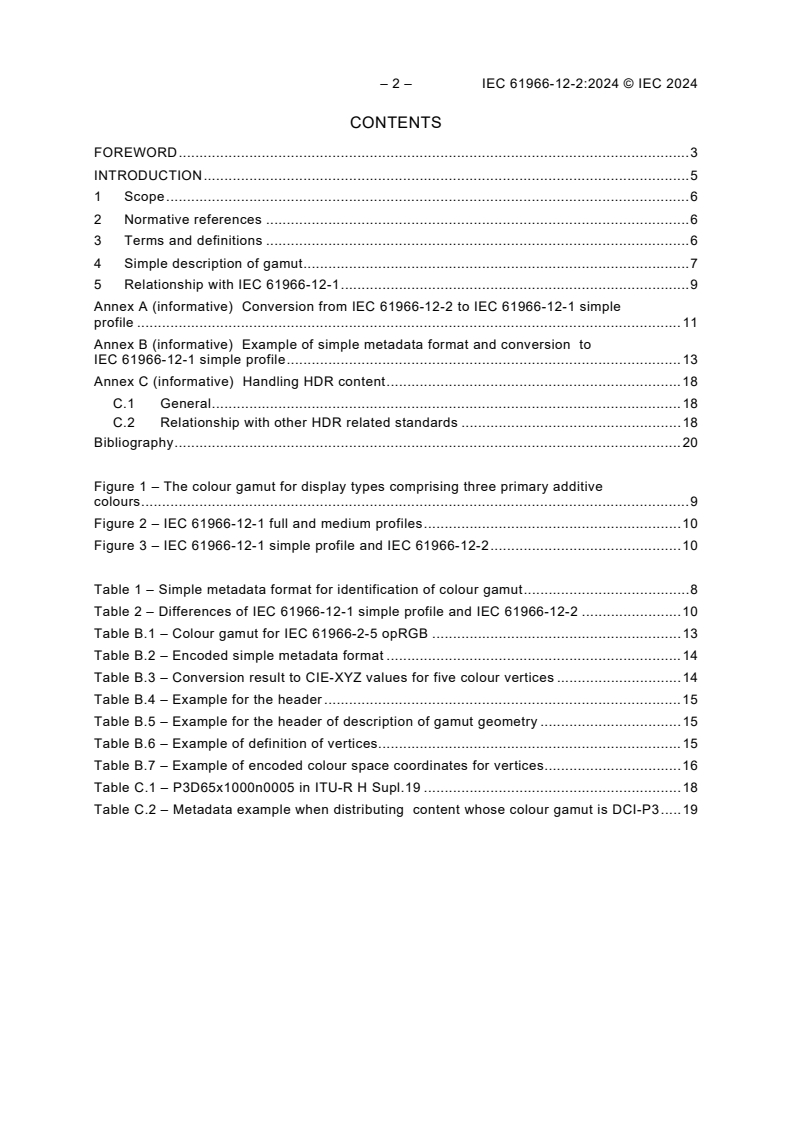
CONTENTS
FOREWORD . 3
INTRODUCTION . 5
1 Scope . 6
2 Normative references . 6
3 Terms and definitions . 6
4 Simple description of gamut . 7
5 Relationship with IEC 61966-12-1 . 9
Annex A (informative) Conversion from IEC 61966-12-2 to IEC 61966-12-1 simple
profile . 11
Annex B (informative) Example of simple metadata format and conversion to
IEC 61966-12-1 simple profile . 13
Annex C (informative) Handling HDR content . 18
C.1 General . 18
C.2 Relationship with other HDR related standards . 18
Bibliography . 20
Figure 1 – The colour gamut for display types comprising three primary additive
colours . 9
Figure 2 – IEC 61966-12-1 full and medium profiles . 10
Figure 3 – IEC 61966-12-1 simple profile and IEC 61966-12-2 . 10
Table 1 – Simple metadata format for identification of colour gamut . 8
Table 2 – Differences of IEC 61966-12-1 simple profile and IEC 61966-12-2 . 10
Table B.1 – Colour gamut for IEC 61966-2-5 opRGB . 13
Table B.2 – Encoded simple metadata format . 14
Table B.3 – Conversion result to CIE-XYZ values for five colour vertices . 14
Table B.4 – Example for the header . 15
Table B.5 – Example for the header of description of gamut geometry . 15
Table B.6 – Example of definition of vertices. 15
Table B.7 – Example of encoded colour space coordinates for vertices. 16
Table C.1 – P3D65x1000n0005 in ITU-R H Supl.19 . 18
Table C.2 – Metadata example when distributing content whose colour gamut is DCI-P3 . 19
INTERNATIONAL ELECTROTECHNICAL COMMISSION
____________
MULTIMEDIA SYSTEMS AND EQUIPMENT –
COLOUR MEASUREMENT AND MANAGEMENT –
Part 12-2: Simple metadata format for identification of colour gamut
FOREWORD
1) The International Electrotechnical Commission (IEC) is a worldwide organization for standardization comprising
all national electrotechnical committees (IEC National Committees). The object of IEC is to promote international
co-operation on all questions concerning standardization in the electrical and electronic fields. To this end and
in addition to other activities, IEC publishes International Standards, Technical Specifications, Technical Reports,
Publicly Available Specifications (PAS) and Guides (hereafter referred to as “IEC Publication(s)”). Their
preparation is entrusted to technical committees; any IEC National Committee interested in the subject dealt with
may participate in this preparatory work. International, governmental and non-governmental organizations liaising
with the IEC also participate in this preparation. IEC collaborates closely with the International Organization for
Standardization (ISO) in accordance with conditions determined by agreement between the two organizations.
2) The formal decisions or agreements of IEC on technical matters express, as nearly as possible, an international
consensus of opinion on the relevant subjects since each technical committee has representation from all
interested IEC National Committees.
3) IEC Publications have the form of recommendations for international use and are accepted by IEC National
Committees in that sense. While all reasonable efforts are made to ensure that the technical content of IEC
Publications is accurate, IEC cannot be held responsible for the way in which they are used or for any
misinterpretation by any end user.
4) In order to promote international uniformity, IEC National Committees undertake to apply IEC Publications
transparently to the maximum extent possible in their national and regional publications. Any divergence between
any IEC Publication and the corresponding national or regional publication shall be clearly indicated in the latter.
5) IEC itself does not provide any attestation of conformity. Independent certification bodies provide conformity
assessment services and, in some areas, access to IEC marks of conformity. IEC is not responsible for any
services carried out by independent certification bodies.
6) All users should ensure that they have the latest edition of this publication.
7) No liability shall attach to IEC or its directors, employees, servants or agents including individual experts and
members of its technical committees and IEC National Committees for any personal injury, property damage or
other damage of any nature whatsoever, whether direct or indirect, or for costs (including legal fees) and
expenses arising out of the publication, use of, or reliance upon, this IEC Publication or any other IEC
Publications.
8) Attention is drawn to the Normative references cited in this publication. Use of the referenced publications is
indispensable for the correct application of this publication.
9) IEC draws attention to the possibility that the implementation of this document may involve the use of (a)
patent(s). IEC takes no position concerning the evidence, validity or applicability of any claimed patent rights in
respect thereof. As of the date of publication of this document, IEC had not received notice of (a) patent(s), which
may be required to implement this document. However, implementers are cautioned that this may not represent
the latest information, which may be obtained from the patent database available at https://patents.iec.ch. IEC
shall not be held responsible for identifying any or all such patent rights.
IEC 61966-12-2 has been prepared by technical area 2: Colour measurement and management,
of IEC technical committee 100: Audio, video and multimedia systems and equipment. It is an
International Standard.
This second edition cancels and replaces the first edition published in 2014. This edition
constitutes a technical revision.
This edition includes the following significant technical changes with respect to the previous
edition:
a) the number of bits of metadata format has been extended in Clause 4;
b) Annex C has been added for handling HDR content.
– 4 – IEC 61966-12-2:2024 © IEC 2024
The text of this International Standard is based on the following documents:
Draft Report on voting
100/3847/CDV 100/4109/RVC
Full information on the voting for its approval can be found in the report on voting indicated in
the above table.
The language used for the development of this International Standard is English.
This document was drafted in accordance with ISO/IEC Directives, Part 2, and developed in
accordance with ISO/IEC Directives, Part 1 and ISO/IEC Directives, IEC Supplement, available
at www.iec.ch/members_experts/refdocs. The main document types developed by IEC are
described in greater detail at www.iec.ch/publications.
A list of all parts of the IEC 61966 series, published under the general title Multimedia systems
and equipment – Colour measurement and management, can be found on the IEC website.
The committee has decided that the contents of this document will remain unchanged until the
stability date indicated on the IEC website under webstore.iec.ch in the data related to the
specific document. At this date, the document will be
• reconfirmed,
• withdrawn, or
• revised.
INTRODUCTION
New technologies in capturing and displaying wide-gamut colour images enable a new market
of wide-gamut video colour content creation. Recent video standards for wide gamut colour
space encoding such as ITU-R BT.2100 (HDR), ITU-R BT.2020 (UHDTV) and IEC 61966-2-4
(xvYCC) were developed in order to be able to distribute content with a colour gamut that is
extended with respect to classical colour gamuts such as those defined by standards ITU-R
BT.601 (standard-definition television) and ITU-R BT.709 (high-definition television). With the
increasing popularity of wide gamut and high dynamic range content and displays, the variety
of colour gamuts of displays is expected to increase. This issue can be an obstacle to adoption
of wide-gamut video colour content in professional content creation since the compatibility of
the content to the employed displays, as well as the compatibility among different displays, is
not ensured. The term "display" includes here any video colour reproduction equipment, such
as direct view displays and projectors. Thanks to improvements in technology, the variety of
colour gamuts and colour reproduction capacities of displays are increasing while the colour
gamut and the colour encoding rules of existing colour space encoding standards are fixed.
To address this issue, IEC 61966-12-1 (Metadata for identification of colour gamut (Gamut ID))
specifies a colour gamut metadata scheme for video systems including information for colour
reproduction. This metadata can apply to video content or displays. More specifically,
improvements can be achieved if the wide-gamut colour content is created with the knowledge
of the display colour gamut and if the colour reproduction in the display is done with the
knowledge of the colour gamut of the pictorial content.
IEC 61966-12-1 has the capability to describe arbitrary 3D colour gamuts in a given colour
space and include the full/medium profile for professional use and the simple profile for
consumer use with easier product implementation. This approach is effective, but some
ambiguities can occur in practical use, for example if typical CE devices are able to decode the
simple profile only owing to CPU and software limitations.
In this case, even if a sender device and a receiver device are based on IEC 61966-12-1:
a) the receiver device cannot handle the Gamut ID of incoming content, if the sender device
sends only a full or a medium profile;
b) the sender device should convert a full profile to a simple one for CE devices if the receiver
can receive the simple profile only, but the conversion is not possible for all the cases.
Therefore, a simple Gamut ID profile standard based on this document has been developed to
address this problem.
This second edition extends the number of bits of "back level ratio" in the metadata format to
accommodate the wider dynamic range content and displays.
– 6 – IEC 61966-12-2:2024 © IEC 2024
MULTIMEDIA SYSTEMS AND EQUIPMENT –
COLOUR MEASUREMENT AND MANAGEMENT –
Part 12-2: Simple metadata format for identification of colour gamut
1 Scope
This part of IEC 61966-12 specifies the colour gamut metadata format for video systems
intended for use in CE (consumer electronics) devices. The metadata specified in this part of
IEC 61966-12 is limited to the gamut description for display types comprising the three primary
additive colours, whose white and black points have the same chromaticity. It is fundamentally
based on the conventional VESA-EDID format.
When associated with content, the simple metadata format defines the gamut for which the
content was created. It can be used by the display for controlled colour reproduction even if the
display’s colour gamut is different from that of the content.
When associated with a display, the simple metadata format defines the display colour gamut.
It can be used during content creation to enable improved colour reproduction.
This document provides the simplest, but unambiguous solution for typical CE devices that are
based on colour gamut information communication.
2 Normative references
The following documents are referred to in the text in such a way that some or all of their content
constitutes requirements of this document. For dated references, only the edition cited applies.
For undated references, the latest edition of the referenced document (including any
amendments) applies.
IEC 60050-845, International Electrotechnical Vocabulary – Part 845: Lighting
IEC 61966-12-1, Multimedia systems and equipment – Colour measurement and management
– Part 12-1: Metadata for identification of colour gamut (Gamut ID)
ISO 15076-1, Image technology colour management – Architecture, profile format and data
structure – Part 1: Based on ICC.2010
3 Terms and definitions
For the purposes of this document, the terms and definitions given in IEC 60050-845 and the
following apply.
ISO and IEC maintain terminology databases for use in standardization at the following
addresses:
• IEC Electropedia: available at https://www.electropedia.org/
• ISO Online browsing platform: available at https://www.iso.org/obp
3.1
content
set of video signals in production, post-production or consumption
3.2
colour gamut
range of colours achievable on a given colour reproduction medium (or present in an image of
that medium) under a given set of viewing conditions
Note 1 to entry: It is a volume in colour space.
3.3
gamut mapping
mapping of the colour-space coordinates of the elements of a source image to colour-space
coordinates of the elements of a reproduction to compensate for differences in the source and
output medium colour gamut capability
4 Simple description of gamut
The three primary additive colours gamut can be specified by four combinations of CIE-xy
chromaticity values of red, green, blue and white. The gamut is assumed to have the
characteristic that combining equal amounts of the three primaries (red, green, blue) produces
the chromaticity of white. These values can be encoded according to the gamut CIE-xy
chromaticity values used in Vesa Enhanced Extended Display Identification Data Standard
(Defines EDID Structure Version 1, Revision 4). The description includes eight values (CIE-xy
chromaticity values for each red, green, blue and white) with 10-bit fixed point form in the range
of 0,0 to 1,0. These display primary and the white
...
IEC 61966-12-2 ®
Edition 2.0 2024-10
REDLINE VERSION
INTERNATIONAL
STANDARD
colour
inside
Multimedia systems and equipment – Colour measurement and management –
Part 12-2: Simple metadata format for identification of colour gamut
All rights reserved. Unless otherwise specified, no part of this publication may be reproduced or utilized in any form
or by any means, electronic or mechanical, including photocopying and microfilm, without permission in writing from
either IEC or IEC's member National Committee in the country of the requester. If you have any questions about IEC
copyright or have an enquiry about obtaining additional rights to this publication, please contact the address below or
your local IEC member National Committee for further information.
IEC Secretariat Tel.: +41 22 919 02 11
3, rue de Varembé info@iec.ch
CH-1211 Geneva 20 www.iec.ch
Switzerland
About the IEC
The International Electrotechnical Commission (IEC) is the leading global organization that prepares and publishes
International Standards for all electrical, electronic and related technologies.
About IEC publications
The technical content of IEC publications is kept under constant review by the IEC. Please make sure that you have the
latest edition, a corrigendum or an amendment might have been published.
IEC publications search - webstore.iec.ch/advsearchform IEC Products & Services Portal - products.iec.ch
The advanced search enables to find IEC publications by a Discover our powerful search engine and read freely all the
variety of criteria (reference number, text, technical publications previews, graphical symbols and the glossary.
committee, …). It also gives information on projects, replaced With a subscription you will always have access to up to date
and withdrawn publications. content tailored to your needs.
IEC Just Published - webstore.iec.ch/justpublished
Electropedia - www.electropedia.org
Stay up to date on all new IEC publications. Just Published
The world's leading online dictionary on electrotechnology,
details all new publications released. Available online and once
containing more than 22 500 terminological entries in English
a month by email.
and French, with equivalent terms in 25 additional languages.
Also known as the International Electrotechnical Vocabulary
IEC Customer Service Centre - webstore.iec.ch/csc
(IEV) online.
If you wish to give us your feedback on this publication or need
further assistance, please contact the Customer Service
Centre: sales@iec.ch.
IEC 61996-12-2 ®
Edition 2.0 2024-10
REDLINE VERSION
INTERNATIONAL
STANDARD
colour
inside
Multimedia systems and equipment – Colour measurement and management –
Part 12-2: Simple metadata format for identification of colour gamut
INTERNATIONAL
ELECTROTECHNICAL
COMMISSION
ICS 17.180.20; 33.160.40 ISBN 978-2-8322-9961-6
– 2 – IEC 61966-12-2:2024 RLV © IEC 2024
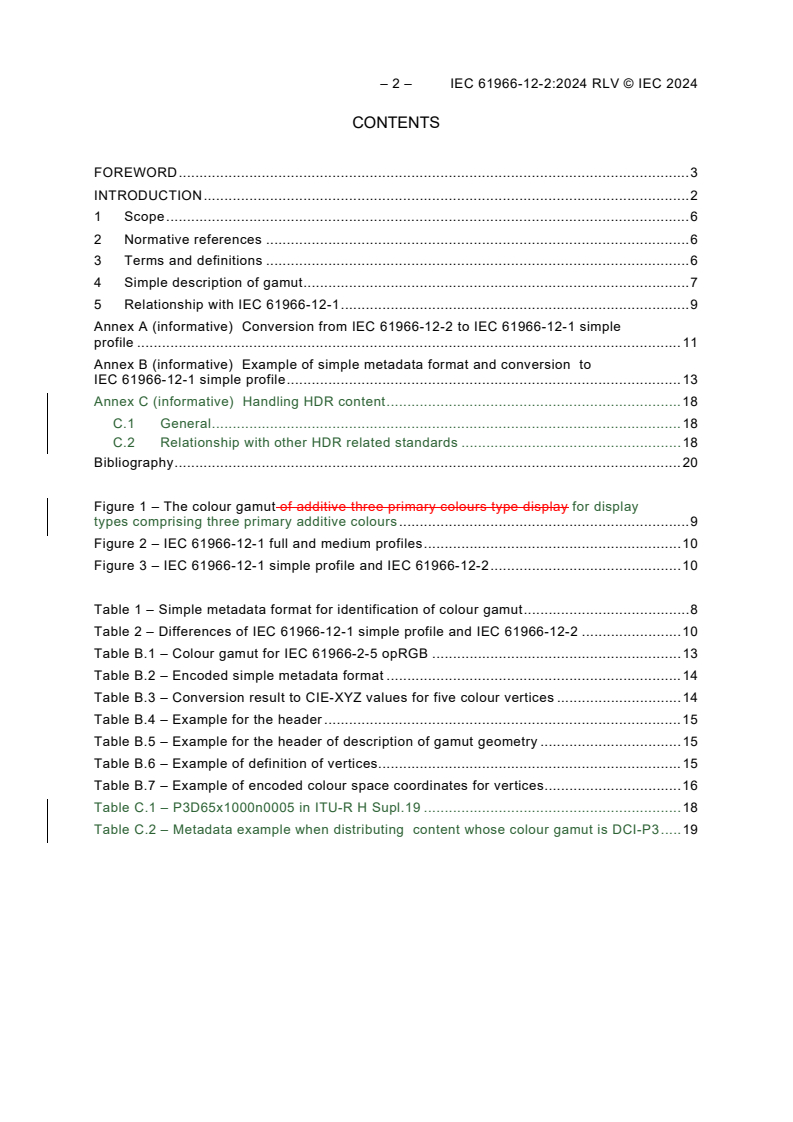
CONTENTS
FOREWORD . 3
INTRODUCTION . 2
1 Scope . 6
2 Normative references . 6
3 Terms and definitions . 6
4 Simple description of gamut . 7
5 Relationship with IEC 61966-12-1 . 9
Annex A (informative) Conversion from IEC 61966-12-2 to IEC 61966-12-1 simple
profile . 11
Annex B (informative) Example of simple metadata format and conversion to
IEC 61966-12-1 simple profile . 13
Annex C (informative) Handling HDR content . 18
C.1 General . 18
C.2 Relationship with other HDR related standards . 18
Bibliography . 20
Figure 1 – The colour gamut of additive three primary colours type display for display
types comprising three primary additive colours . 9
Figure 2 – IEC 61966-12-1 full and medium profiles . 10
Figure 3 – IEC 61966-12-1 simple profile and IEC 61966-12-2 . 10
Table 1 – Simple metadata format for identification of colour gamut . 8
Table 2 – Differences of IEC 61966-12-1 simple profile and IEC 61966-12-2 . 10
Table B.1 – Colour gamut for IEC 61966-2-5 opRGB . 13
Table B.2 – Encoded simple metadata format . 14
Table B.3 – Conversion result to CIE-XYZ values for five colour vertices . 14
Table B.4 – Example for the header . 15
Table B.5 – Example for the header of description of gamut geometry . 15
Table B.6 – Example of definition of vertices. 15
Table B.7 – Example of encoded colour space coordinates for vertices. 16
Table C.1 – P3D65x1000n0005 in ITU-R H Supl.19 . 18
Table C.2 – Metadata example when distributing content whose colour gamut is DCI-P3 . 19
INTERNATIONAL ELECTROTECHNICAL COMMISSION
____________
MULTIMEDIA SYSTEMS AND EQUIPMENT –
COLOUR MEASUREMENT AND MANAGEMENT –
Part 12-2: Simple metadata format for identification of colour gamut
FOREWORD
1) The International Electrotechnical Commission (IEC) is a worldwide organization for standardization comprising
all national electrotechnical committees (IEC National Committees). The object of IEC is to promote international
co-operation on all questions concerning standardization in the electrical and electronic fields. To this end and
in addition to other activities, IEC publishes International Standards, Technical Specifications, Technical Reports,
Publicly Available Specifications (PAS) and Guides (hereafter referred to as “IEC Publication(s)”). Their
preparation is entrusted to technical committees; any IEC National Committee interested in the subject dealt with
may participate in this preparatory work. International, governmental and non-governmental organizations liaising
with the IEC also participate in this preparation. IEC collaborates closely with the International Organization for
Standardization (ISO) in accordance with conditions determined by agreement between the two organizations.
2) The formal decisions or agreements of IEC on technical matters express, as nearly as possible, an international
consensus of opinion on the relevant subjects since each technical committee has representation from all
interested IEC National Committees.
3) IEC Publications have the form of recommendations for international use and are accepted by IEC National
Committees in that sense. While all reasonable efforts are made to ensure that the technical content of IEC
Publications is accurate, IEC cannot be held responsible for the way in which they are used or for any
misinterpretation by any end user.
4) In order to promote international uniformity, IEC National Committees undertake to apply IEC Publications
transparently to the maximum extent possible in their national and regional publications. Any divergence between
any IEC Publication and the corresponding national or regional publication shall be clearly indicated in the latter.
5) IEC itself does not provide any attestation of conformity. Independent certification bodies provide conformity
assessment services and, in some areas, access to IEC marks of conformity. IEC is not responsible for any
services carried out by independent certification bodies.
6) All users should ensure that they have the latest edition of this publication.
7) No liability shall attach to IEC or its directors, employees, servants or agents including individual experts and
members of its technical committees and IEC National Committees for any personal injury, property damage or
other damage of any nature whatsoever, whether direct or indirect, or for costs (including legal fees) and
expenses arising out of the publication, use of, or reliance upon, this IEC Publication or any other IEC
Publications.
8) Attention is drawn to the Normative references cited in this publication. Use of the referenced publications is
indispensable for the correct application of this publication.
9) IEC draws attention to the possibility that the implementation of this document may involve the use of (a)
patent(s). IEC takes no position concerning the evidence, validity or applicability of any claimed patent rights in
respect thereof. As of the date of publication of this document, IEC had not received notice of (a) patent(s), which
may be required to implement this document. However, implementers are cautioned that this may not represent
the latest information, which may be obtained from the patent database available at https://patents.iec.ch. IEC
shall not be held responsible for identifying any or all such patent rights.
This redline version of the official IEC Standard allows the user to identify the changes
made to the previous edition IEC 61966-12-2:2014. A vertical bar appears in the margin
wherever a change has been made. Additions are in green text, deletions are in
strikethrough red text.
– 4 – IEC 61966-12-2:2024 RLV © IEC 2024
IEC 61966-12-2 has been prepared by technical area 2: Colour measurement and management,
of IEC technical committee 100: Audio, video and multimedia systems and equipment. It is an
International Standard.
This second edition cancels and replaces the first edition published in 2014. This edition
constitutes a technical revision.
This edition includes the following significant technical changes with respect to the previous
edition:
a) the number of bits of metadata format has been extended in Clause 4;
b) Annex C has been added for handling HDR content.
The text of this International Standard is based on the following documents:
Draft Report on voting
100/3847/CDV 100/4109/RVC
Full information on the voting for its approval can be found in the report on voting indicated in
the above table.
The language used for the development of this International Standard is English.
This document was drafted in accordance with ISO/IEC Directives, Part 2, and developed in
accordance with ISO/IEC Directives, Part 1 and ISO/IEC Directives, IEC Supplement, available
at www.iec.ch/members_experts/refdocs. The main document types developed by IEC are
described in greater detail at www.iec.ch/publications.
A list of all parts of the IEC 61966 series, published under the general title Multimedia systems
and equipment – Colour measurement and management, can be found on the IEC website.
The committee has decided that the contents of this document will remain unchanged until the
stability date indicated on the IEC website under webstore.iec.ch in the data related to the
specific document. At this date, the document will be
• reconfirmed,
• withdrawn, or
• revised.
IMPORTANT – The "colour inside" logo on the cover page of this document indicates
that it contains colours which are considered to be useful for the correct understanding
of its contents. Users should therefore print this document using a colour printer.
INTRODUCTION
New technologies in capturing and displaying wide-gamut colour images enable a new market
of wide-gamut video colour content creation. Recent video standards for wide gamut colour
space encoding such as ITU-R BT.2100 (HDR), ITU-R BT.2020 (UHDTV) and IEC 61966-2-4
(xvYCC) were developed in order to be able to distribute content with a colour gamut that is
extended with respect to classical colour gamuts such as those defined by standards ITU-R
BT.601 (standard-definition television) and ITU-R BT.709 (high-definition television). With the
increasing popularity of wide gamut and high dynamic range content and displays, the variety
of colour gamuts of displays is expected to increase. This issue can be an obstacle to adoption
of wide-gamut video colour content in professional content creation since the compatibility of
the content to the employed displays, as well as the compatibility among different displays, is
not ensured. The term "display" includes here any video colour reproduction equipment, such
as direct view displays and projectors. Thanks to improvements in technology, the variety of
colour gamuts and colour reproduction capacities of displays are increasing while the colour
gamut and the colour encoding rules of existing colour space encoding standards are fixed.
To address this issue, IEC 61966-12-1 (Metadata for identification of colour gamut (Gamut ID))
specifies a colour gamut metadata scheme for video systems including information for colour
reproduction. This metadata can apply to video content or displays. More specifically,
improvements can be achieved if the wide-gamut colour content is created with the knowledge
of the display colour gamut and if the colour reproduction in the display is done with the
knowledge of the colour gamut of the pictorial content.
IEC 61966-12-1 has the capability to describe arbitrary 3D colour gamuts in a given colour
space and include the full/medium profile for professional use and the simple profile for
consumer use with easier product implementation. This approach is effective, but some
ambiguities can occur in practical use, for example if typical CE devices are able to decode the
simple profile only owing to CPU and software limitations.
In this case, even if a sender device and a receiver device are based on IEC 61966-12-1:
a) the receiver device cannot handle the Gamut ID of incoming content, if the sender device
sends only a full or a medium profile;
b) the sender device should convert a full profile to a simple one for CE devices if the receiver
can receive the simple profile only, but the conversion is not possible for all the cases.
Therefore, a simple Gamut ID profile standard based on this document has been developed to
address this problem.
For published parts of this series of standards refer to the IEC website.
This second edition extends the number of bits of "back level ratio" in the metadata format to
accommodate the wider dynamic range content and displays.
– 6 – IEC 61966-12-2:2024 RLV © IEC 2024
MULTIMEDIA SYSTEMS AND EQUIPMENT –
COLOUR MEASUREMENT AND MANAGEMENT –
Part 12-2: Simple metadata format for identification of colour gamut
1 Scope
This part of IEC 61966-12 specifies the colour gamut metadata format for video systems
intended for use in CE (consumer electronics) devices. The metadata specified in this part of
IEC 61966-12 is limited to the gamut description of additive three primary colours type displays
for display types comprising the three primary additive colours, whose white and black points
have the same chromaticity. It is fundamentally based on the conventional VESA-EDID format.
When associated with content, the simple metadata format defines the gamut for which the
content was created. It can be used by the display for controlled colour reproduction even if the
display’s colour gamut is different from that of the content.
When associated with a display, the simple metadata format defines the display colour gamut.
It can be used during content creation to enable improved colour reproduction.
This document provides the simplest, but unambiguous solution for typical CE devices that are
based on colour gamut information communication.
2 Normative references
The following documents are referred to in the text in such a way that some or all of their content
constitutes requirements of this document. For dated references, only the edition cited applies.
For undated references, the latest edition of the referenced document (including any
amendments) applies.
IEC 60050-845, International Electrotechnical Vocabulary – Part 845: Lighting
IEC 61966-12-1:2011, Multimedia systems and equipment – Colour measurement and
management – Part 12-1: Metadata for identification of colour gamut (Gamut ID)
IEC 61966-2-4, Multimedia systems and equipment – Colour measurement and management
– Part 2-4: Colour management – Extended-gamut YCC colour space for video applications –
xvYCC
ISO 15076-1:2005, Image technology colour management – Architecture, profile format and
data structure – Part 1: Based on ICC.2004-102010
3 Terms and definitions
For the purposes of this document, the terms and definitions given in IEC 60050-845 and the
following apply.
ISO and IEC maintain terminology databases for use in standardization at the following
addresses:
• IEC Electropedia: available at https://www.electropedia.org/
• ISO Online browsing platform: available at https://www.iso.org/obp
3.1
content
set of video signals in production, post-production or consumption
3.2
colour gamut
range of colours achievable on a given colour reproduction medium (or present in an image of
that medium) under a given set of viewing conditions
Note 1 to entry: It is a volume in colour space.
3.3
gamut mapping
mapping of the colour-space coordinates of the elements of a source image to colour-space
coordinates of the elements of a reproduction to compensate for differences in the source and
output medium colour gamut capability
4 Simple description of gamut
Additive The three primary additive colours gamut can be specified by four combinations of CIE-
xy chromaticity values of red, green, blue and white. The gamut is assumed to have the
characteristic that combining equal amounts of the three primaries (red, green, blue) produces
the chromaticity of white. These values can be encoded according to the gamut CIE-xy
chromaticity values used in Vesa Enhanced Extended Display Identification Data Standard
(Defines EDID Structure Version 1, Revision 4). The description includes eight values (CIE-xy
chromaticity values for each red, green, blue and white) with 10-bit fixed point form in the range
of 0,0 to 1,0. These display primary and the white point CIE-xy chromaticity values should be
measured in such a way as to minimize the contribution from the display black. In addition to
VESA-EDID format, the information of White Absolute Luminance (WAL) and Black Level Ratio
(BLR) are included. WAL value is defined in cd/m and denoted as Y , and encoded into 16-bit
W
unsigned integer form. BLR is defined as Equation (1), and encoded into 1632-bit fixed point
form in the range of 0,0 to 1,0.
(1)
BLR = (Y / Y )
K W
where
Y is the luminance of black shown in Figure 1;
K
Y is the luminance of white shown in Figure 1.
W
Table 1 shows the total metadata which includes the VESA–EDID compatible CIE-xy
chromaticity values of red, green, blue and white and BLR and WAL value. The total size of this
format is 1416 B.
Refer to Annex C for information about handling HDR content.
– 8 – IEC 61966-12-2:2024 RLV © IEC 2024
Table 1 – Simple metadata format for identification of colour gamut
Byte# Size Colour Description
hex B characteristic
7 6 5 4 3 2 1 0
Red_x, Red_y,
Green_x,
00 1 Rx1 Rx0 Ry1 Ry0 Gx1 Gx0 Gy1 Gy0
Green_y
Bits1 & bits0
Blue_x, Blue_y,
01 1 Bx1 Bx0 By1 By0 Wx1 Wx0 Wy1 Wy1
White_x, White_y
bits1 & bits0
02 1 Red_x bit9 – bit2 Rx9 Rx8 Rx7 Rx6 Rx5 Rx4 Rx3 Rx2
03 1 Red_y bit9 – bit2 Ry9 Ry8 Ry7 Ry6 Ry5 Ry4 Ry3 Ry2
Green_x bit9 –
04 1 Gx9 Gx8 Gx7 Gx6 Gx5 Gx4 Gx3 Gx2
bit2
Green_y bit9 –
05 1 Gy9 Gy8 Gy7 Gy6 Gy5 Gy4 Gy3 Gy2
bit2
06 1 Blue_x bit9 – bit2 Bx9 Bx8 Bx7 Bx6 Bx5 Bx4 Bx3 Bx2
07 1 Blue_y bit9 – bit2 By9 By8 By7 By6 By5 By4 By3 By2
White_x bit9 –
08 1 Wx9 Wx8 Wx7 Wx6 Wx5 Wx4 Wx3 Wx2
bit2
White_y bit9 –
09 1 Wy9 Wy8 Wy7 Wy6 Wy5 Wy4 Wy3 Wy2
bit2
White absolute
luminance
Bit15 – bit8
0A 1 WAL15 WAL14 WAL13 WAL12 WAL11 WAL10 WAL9 WAL8
(16 bit unsigned
Integer)
White absolute
luminance
Bit7 – bit0
0B 1 WAL7 WAL6 WAL5 WAL4 WAL3 WAL2 WAL1 WAL0
(16 bit unsigned
Integer)
Black level ratio
0C 1 bit15 - bit8 (16 bit BLR15 BLR14 BLR13 BLR12 BLR11 BLR10 BLR9 BLR8
fixed point)
Black level ratio
0D 1 bit7 - bit0 (16 bit BLR7 BLR6 BLR5 BLR4 BLR3 BLR2 BLR1 BLR0
fixed point)
Black level ratio
0C 1 BLR31 BLR30 BLR29 BLR28 BLR27 BLR26 BLR25 BLR24
Bit31 – bit24 (32-
bit fixed point)
Black level ratio
0D 1 BLR23 BLR22 BLR21 BLR20 BLR19 BLR18 BLR17 BLR16
Bit23 – bit16 (32-
bit fixed point)
Black level ratio
Bit15 – bit8
0E 1 BLR15 BLR14 BLR13 BLR12 BLR11 BLR10 BLR9 BLR8
(32-bit fixed
point)
Black level ratio
0F 1 BLR7 BLR6 BLR5 BLR4 BLR3 BLR2 BLR1 BLR0
Bit7 – bit0 (32-bit
fixed point)
NOTE The metadata format in this document has backward compatibility with IEC 61966-12-2:2014 because
addresses "0C" and "0D" indicate same bits.
Figure 1 – The colour gamut of additive three primary colours type display for display
types comprising three primary additive colours
5 Relationship with IEC 61966-12-1
A content gamut is usually smaller than a colour encoding gamut of today’s extended-gamut
colour space, such as IEC 61966-2-4 xvYCC. If there is no description of an actual colour gamut
for some content, it is possible that gamut mapping will use the colour encoding gamut as the
content gamut, which can cause some problems. IEC 61966-12-1 solves this problem by
associating an explicit description of an actual content gamut to content. IEC 61966-12-1 has
a full, medium and simple profile.
The full profile and the medium profile have high flexibility for describing 3D-shapes of
complicated content gamuts in a colour space as shown in Figure 2. Consequently,
IEC 61966-12-1 full and medium profiles are well suited for some professional use applications,
such as content production. In addition, IEC 61966-12-1 provides simple profile formats that
are limited to three primary type colour gamuts, as shown in Figure 3.
However, the IEC 61966-12-1 simple profile is 77 B and still large for CE devices. This
document is therefore limited to the CIE-xy chromaticity values of additive the three primary
additive colour gamuts and has a reduced size of 1416 B.
Refer to Annex A for more details about the conversion from IEC 61966-12-2 to the
IEC 61966-12-1 simple profile. Refer to Annex B for an example of simple metadata format and
conversion to the IEC 61966-12-1 simple profile.
– 10 – IEC 61966-12-2:2024 RLV © IEC 2024
Figure 2 – IEC 61966-12-1 full and medium profiles
Figure 3 – IEC 61966-12-1 simple profile and IEC 61966-12-2
Table 2 – Differences of IEC 61966-12-1 simple profile and IEC 61966-12-2
IEC 61966-12-1 simple profile IEC 61966-12-2
Size 77 B (Header: 17 B 1416 B
+ Gamut description: 60 B) (Gamut description only)
Coordinate's format – CIE-XYZ tristimulus values of 5 colours – CIE-xy chromaticity values of four
(red, green, blue, white, black) colours (red, green, blue, white)
– s15Fixed16Number (see ICC profiles in – VESA–EDID compatible
ISO 15076-1:2005)
– 16-bit unsigned integer form
– 1632-bit fixed point form in the range of
0,0 to 1,0
Annex A
(informative)
Conversion from IEC 61966-12-2 to IEC 61966-12-1 simple profile
IEC 61966-12-2 can be converted to the IEC 61966-12-1 simple profile. This annex shows an
example of the conversion method. The conversion equations calculate five CIE-XYZ tristimulus
values of red, green, blue, white and black colour vertices from four CIE-xy chromaticity values
of the red, green, blue and white colour vertices, WAL and BLR values. It should be noted that
The inverse conversion cannot be uniquely defined when the additivity rule of the three primary
colours mixture is not guaranteed.
x and y are x,y coordinates of colours described in IEC 61966-12-2. X , Y and Z are X,Y,Z
i i i i i
coordinates of IEC 61966-12-1 simple profile. In both coordinate systems, i = R,G,B,W, or K,
which denotes red, green, blue, white or black colour vertices.
The conversion process has the following four steps:
a) In the first step, X,Y,Z values for white colour are calculated. Here, absolute Y value
W
information from IEC 61966-12-2 should be used. We can calculate X,Y,Z values using Y
W
value and x,y chromaticity coordinates for white colour as Equation (A.1).
x
W
X y
W W
YY= 1
(A.1)
WW
Z 1−−xy
W WW
y
W
b) In the second step, X,Y,Z values for black colour are calculated. First, Y can be obtained
K
from Y and BLR values in Equation (A.2).
W
(A.2)
Y = BLR × Y
K W
Then, X,Y,Z values for black can be Y and x,y chromaticity coordinates can be calculated
K
as Equation (A.3) for we assume black has the same chromaticity as white.
x
W
X y
W
K
YY= 1
(A.3)
KK
Z 1−−xy
K WW
y
W
c) Then in the third step, assuming additive three primary additive colours, Y values for red,
green and blue colours without the offset value by black are estimated using the calculated
value of white and black colours as Equation (A.4). Here, −1 denotes the inverse of the 3 ×
3 matrix.
– 12 – IEC 61966-12-2:2024 RLV © IEC 2024
−1
xxx
RBG
y y y
YY−−X X
R GB
RK W K
(A.4)
YY 1 11 Y− Y
GK W K
YY− 11− x − y 1−−x y −−xy Z −Z
B K R R G G BB WK
y y y
R GB
d) In the last step, X,Y,Z values of red, green and blue colours are calculated using the
estimated luminance of each colour in step two, and then black offset values are added as
shown in Equations (A.5), (A.6) and (A.7).
x
R
XXy
RKR
Y 1 YY−+ Y
( ) (A.5)
R RK K
Z 1−−xy Z
R RR K
y
R
x
G
y
XX
G
GK
Y 1 YY−+ Y
( ) (A.6)
G GK K
Z 1−−xy Z
G GG K
y
G
x
B
y
XX
B
BK
Y 1 YY−+ Y
( ) (A.7)
B BK K
Z 1−−xy Z
B BB K
y
B
At this step, all five CIE-XYZ tristimulus values of red, green, blue, white and black colour
vertices which are needed in the IEC 61966-12-1 simple profile are defined. Each X,Y,Z
value should be encoded in the s15Fixed16Number format.
=
=
=
−=
Annex B
(informative)
Example of simple metadata format and conversion
to IEC 61966-12-1 simple profile
This annex provides an example of the simple metadata format. This example describes the
theoretical gamut of IEC 61966-2-5 opRGB and the encoded data. Table B.1 shows the CIE-xy
chromaticity coordinates for four colour vertices: white, red, green, blue of opRGB colour space.
Table B.1 – Colour gamut for IEC 61966-2-5 opRGB
CIE-x CIE-y
White 0,312 7 0,329 0
Red 0,640 0 0,330 0
Green 0,210 0 0,710 0
Blue 0,150 0 0,060 0
2 2
White absolute luminance values of white and black level are160 cd/m and 0,4 cd/m .
The simple metadata format calculated from the chromaticity values CIE-xy coordinates for the
above four colour vertices is shown in Table B.2. The x,y chromaticity values for red, green,
blue and white colour vertices are encoded into fixed 10-bit values. The white absolute
luminance is encoded into a 16-bit unsigned integer form and the black level ratio is encoded
into a 1632-bit fixed point form in the range of 0,0 to 1,0.
– 14 – IEC 61966-12-2:2024 RLV © IEC 2024
Table B.2 – Encoded simple metadata format
Byte# Size B Colour characteristic Description
hex
7 6 5 4 3 2 1 0
00 1 Red/Green bits1 and bits0 1 1 1 0 1 1 1 1
01 1 Blue/White bits1 and bits0 1 0 0 1 0 0 0 1
02 1 Red_x bit9 to bit2 1 0 1 0 0 0 1 1
03 1 Red_y bit9 to bit2 0 1 0 1 0 1 0 0
04 1 Green_x bit9 to bit2 0 0 1 1 0 1 0 1
05 1 Green_y bit9 to bit2 1 0 1 1 0 1 0 1
06 1 Blue_x bit9 to bit2 0 0 1 0 0 1 1 0
07 1 Blue_y bit9 to bit2 0 0 0 0 1 1 1 1
08 1 White_x bit9 to bit2 0 1 0 1 0 0 0 0
09 1 White_y bit9 to bit2 0 1 0 1 0 1 0 0
White absolute luminance bit15 – bit8 (16-bit unsigned
0A 1 0 0 0 0 0 0 0 0
integer)
White absolute luminance bit7 – bit0 (16-bit unsigned
0B 1 1 0 1 0 0 0 0 0
integer)
0C 1 Black level ratio bit15 - bit8 (16-bit fixed point) 0 0 0 0 0 0 0 0
0D 1 Black level ratio bit7 - bit0 (16-bit fixed point) 1 0 1 0 0 1 0 0
0C 1 Black level ratio bit31 – bit24 (32-bit fixed point) 0 0 0 0 0 0 0 0
0D 1 Black level ratio bit23 – bit16 (32-bit fixed point) 1 0 1 0 0 0 1 1
0E 1 Black level ratio bit15 – bit8 (32-bit fixed point) 1 1 0 1 0 1 1 1
0F 1 Black level ratio bit7 – bit0 (32-bit fixed point) 0 0 0 0 1 0 1 0
The XYZ tristimulus values for five colour vertices: white, black, red, green, blue of the opRGB
colour space can be decoded in accordance with Annex A (see Table B.3).
Table B.3 – Conversion result to CIE-XYZ values for five colour vertices
CIE-X CIE-Y CIE-Z
White 151,928 783 160,000 000 174,243 323
Black 0,380 193 0,400 391 0,436 034
Red 92,156 976 47,760 013 4,779 668
Green 30,047 025 100,715 680 11,750 826
Blue 30,485 168 12,325 089 158,584 898
The resultant converted Gamut ID metadata in the simple profile of IEC 61966-12-1 format is
shown below. This format includes three headers described in Table B.4, Table B.5, and
Table B.6 and CIE XYZ tristimulus values of five colours in Table B.7. These XYZ values are
basically the same values as in Table B.3, and encoded in the s15Fixed 16Number format.
Table B.4 – Example for the header
Byte # Size Symbols Description Values
hex B
7 6 5 4 3 2 1 0
00 1 N, P 0 1 0 0 0 0 1 1
R
01 1 0h00
Byte # of start of the description of gamut
ID_G
geometry
02 1 0h09
03 1 0h00
Byte # of start of the description of colour
ID_E
reproduction
04 1 0h00
05 1 0h00
Reserved. Shall be zero.
06 1 0h00
07 1 0h00
Reserved. Shall be zero.
08 1 0h00
Table B.5 – Example for the header of description of gamut geometry
Byte # Size Symbol Description Values
hex B
09 1 0h00
ID_V Byte # of start of vertices
0A 1 0h0D
0B 1 Reserved 0h00
0C 1 Reserved 0h00
Table B.6 – Example of definition of vertices
Byte # hex Size B Symbol Description Values
0D 1 0h00
V Total number of vertices
0E 1 0h05
0F 1 0h00
R Shall be zero
10 1 0h00
[3VN / 8] = 3V encoded colour space See Table D.5 of
60 coordinates defining V vertices IEC 61966-1:20112020
ID_PROFILE
ID_PRECISION
ID_GBD SPACE
– 16 – IEC 61966-12-2:2024 RLV © IEC 2024
Table B.7 – Example of encoded colour space coordinates for vertices
Byte # hex Value hex Description
11 00
12 97
White X
13 ED
14 C4
15 00
16 A0
White Y
17 00
18 00
19 00
1A AE
White Z
1B 3E
1C 4A
1D 00
1E 00
Black X
1F 61
20 54
21 00
22 00
Black Y
23 66
24 80
25 00
26 00
Black Z
27 6F
28 9F
29 00
2A 5C
Red X
2B 28
2C 2F
2D 00
2E 2F
Red Y
2F C2
30 90
31 00
32 04
Red Z
33 C7
34 98
35 00
36 1E
Green X
37 0C
38 09
39 00
3A 64
Green Y
3B B7
3C 36
3D 00
3E 0B
Green Z
3F C0
40 36
Byte # hex Value hex Description
41 00
42 1E
Blue X
43 7C
44 33
45 00
46 0C
Blue Y
47 53
48 39
49 00
4A 9E
Blue Z
4B 95
4C BB
– 18 – IEC 61966-12-2:2024 RLV © IEC 2024
Annex C
(informative)
Handling HDR content
C.1 General
Recently, WCG (wide colour gamut) colour encoding standards, such as ITU-R BT.2020, and
HDR (high dynamic range) colour encoding standards, such as ITU-R BT.2100, are widely used
to provide WCG/HDR content, whose colour ranges exceed the provisions of traditional colour
encoding standards, such as ITU-R BT.709.
However, since the wide colour gamut defined by ITU-R BT.2020 is based on single-wavelength
primaries, it is technically difficult to manufacture reasonably priced displays that can fully
express the ITU-R BT.2020 colour gamut. Therefore, in the current market, displays with
DCI-P3 colour gamut (defined by SMPTE ST 2113) are widely used as WCG displays.
This annex shows an example of metadata when using content which has these wide gamut
colour spaces.
C.2 Relationship with other HDR related standards
SMPTE ST.2086 defines Mastering Display Colour Volume (MDCV), which could be added to
video content as metadata. This MDCV standard defines the colour gamut of the mastering
display that was used to edit/verify the WCG video content. The metadata defined in SMPTE
ST. 2086 consists of display primaries, chromaticity of white point, maximum display mastering
luminance and minimum display mastering luminance.
This document would be suitable for describing MDCV, since its simple structure is necessary
and sufficient to express MDCV. On the other hand, IEC 61966-12-1 would be more appropriate
for describing complex video content colour volume (CCV), since its description flexibility is
much higher than that of this document.
Table C.1 indicates P3D65x1000n0005 in ITU-R H Supl.19 (Clause 7.3) which is defined as the
HDR mastering display colour volume description. Table C.2 indicates an example for the
MDCV description in the format outlined by this document.
Table C.1 – P3D65x1000n0005 in ITU-R H Supl.19
Value
Colour x y
White 0,312 7 0,329 0
Red 0,680 0 0,320 0
Green 0,265 0 0,690 0
Blue 0,150 0 0,060 0
White luminance 1 000
Black luminance 0,000 5
Table C.2 – Metadata example when distributing
content whose colour gamut is DCI-P3
Byte# Colour Description
Hex Characteristic
7 6 5 4 3 2 1 0
00 Red_x, Red_y, Rx1 Rx0 Ry1 Ry0 Gx1 Gx0 Gy1 Gy0
Green_x, Green_y,
0 0 1 1 1 1 1 0
bits1 & bits0
01 Blue_x, Blue_y, Bx1 Bx0 By1 By0 Wx1 Wx0 Wy1 Wy0
White_x, White_y,
0 1 0 1 0 0 0 0
bits1 & bits0
02 Red_x bit9 – bit2 Rx9 Rx8 Rx7 Rx6 Rx5 Rx4 Rx3 Rx2
1 0 1 0 1 1 1 0
03 Red_y bit9 – bit2 Ry9 Ry8 Ry7 Ry6 Ry5 Ry4 Ry3 Ry2
0 1 0 1 0 0 0 1
04 Green_x bit9 – bit2 Gx9 Gx8 Gx7 Gx6 Gx5 Gx4 Gx3 Gx2
0 1 0 0 0 0 1 1
05 Green_y bit9 – bit2 Gy9 Gy8 Gy7 Gy6 Gy5 Gy4 Gy3 Gy2
1 0 1 1 0 0 0 0
06 Blue_x bit9 – bit2 Bx9 Bx8 Bx7 Bx6 Bx5 Bx4 Bx3 Bx2
0 0 1 0 0 1 1 0
07 Blue_y bit9 – bit2 By9 By8 By7 By6 By5 By4 By3 By2
0 0 0 0 1 1 1 1
08 White_x bit9 – bit2 Wx9 Wx8 Wx7 Wx6 Wx5 Wx4 Wx3 Wx2
0 1 0 1 0 0 0 0
09 White_y bit9 – bit2 Wy9 Wy8 Wy7 Wy6 Wy5 Wy4 Wy3 Wy2
0 1 0 1 0 1 0 1
White Absolute
0A WAL15 WAL14 WAL13 WAL12 WAL11 WAL10 WAL9 WAL8
Luminance
0 0 0 0 0 0 1 1
bit15 – bit8
0B White Absolute WAL7 WAL6 WAL5 WAL4 WAL3 WAL2 WAL1 WAL0
Luminance
1 1 1 0 1 0 0 0
bit7 – bit0
0C Black Level Ratio BLR31 BLR30 BLR29 BLR28 BLR27 BLR26 BLR25 BLR24
Bit31 – bit24 0 0 0 0 0 0 0 0
0D Black Level Ratio BLR23 BLR22 BLR21 BLR20 BLR19 BLR18 BLR17 BLR16
Bit23 – bit16
0 0 0 0 0 0 0 0
0C Black Level Ratio BLR15 BLR14 BLR13 BLR12 BLR11 BLR10 BLR9 BLR8
bit15 – bit8 0 0 0 0 1 0 0 0
0D Black Level Ratio BLR7 BLR6 BLR5 BLR4 BLR3 BLR2 BLR1 BLR0
bit7 – bit0
0 1 1 0 0 0 1 1
– 20 – IEC 61966-12-2:2024 RLV © IEC 2024
Bibliography
IEC 61966-2-4, Multimedia systems and equipment – Colour measurement and management –
Part 2-4: Colour management – Extended-gamut YCC colour space for video applications –
xvYCC
IEC 61966-2-5, Multimedia systems and equipment – Colour measurement and management –
Part 2-5: Colour management – Optional RGB colour space – opRGB
ISO 22028-1, Photography and graphic technology – Extended colour encodings for digital
image storage, manipulation and interchange – Part 1: Architecture and requirements
ITU-R BT.601, Studio encoding parameters of digital television for standard 4:3 and wide screen
16:9 aspect ratios
ITU-R BT.709, Parameter values for the HDTV standards for production and international
programme exchange
ITU-R BT.2020, Parameter values for ultra-high-definition television systems for production and
international programme exchange
ITU-R BT.2100, Image parameter values for high dynamic range television for use in production
and international programme exchange
ITU-T Series H Supplement 19, Series H: Audiovisual and multimedia systems, Usage of video
signal type code points
SMPTE ST 2086:2014, SMPTE Standard – Mastering Display Color Volume Metadata
Supporting High Luminance and Wide Color Gamut Images
SMPTE ST 2113:2018 – SMPTE Standard – Colorimetry of P3 Color Spaces
VESA ENHANCED EXTENDED DISPLAY IDENTIFICATION DATA STANDARD (Defines EDID
Structure Version 1, Revision 4)
___________
IEC 61966-12-2 ®
Edition 2.0 2024-10
INTERNATIONAL
STANDARD
Multimedia systems and equipment – Colour measurement and management –
Part 12-2: Simple metadata format for identification of colour gamut
– 2 – IEC 61966-12-2:2024 © IEC 2024
CONTENTS
FOREWORD . 3
INTRODUCTION . 5
1 Scope . 6
2 Normative references . 6
3 Terms and definitions . 6
4 Simple description of gamut . 7
5 Relationship with IEC 61966-12-1 . 9
Annex A (informative) Conversion from IEC 61966-12-2 to IEC 61966-12-1 simple
profile . 11
Annex B (informative) Example of simple metadata format and conversion to
IEC 61966-12-1 simple profile . 13
Annex C (informative) Handling HDR content . 18
C.1 General . 18
C.2 Relationship with other HDR related standards . 18
Bibliography . 20
Figure 1 – The colour gamut for display types comprising three primary additive
colours . 9
Figure 2 – IEC 61966-12-1 full and medium profiles . 10
Figure 3 – IEC 61966-12-1 simple profile and IEC 61966-12-2 . 10
Table 1 – Simple metadata format for identification of colour gamut . 8
Table 2 – Differences of IEC 61966-12-1 simple profile and IEC 61966-12-2 . 10
Table B.1 – Colour gamut for IEC 61966-2-5 opRGB . 13
Table B.2 – Encoded simple metadata format . 14
Table B.3 – Conversion result to CIE-XYZ values for five colour vertices . 14
Table B.4 – Example for the header . 15
Table B.5 – Example for the header of description of gamut geometry . 15
Table B.6 – Example of definition of vertices. 15
Table B.7 – Example of encoded colour space coordinates for vertices. 16
Table C.1 – P3D65x1000n0005 in ITU-R H Supl.19 . 18
Table C.2 – Metadata example when distributing content whose colour gamut is DCI-P3 . 19
INTERNATIONAL ELECTROTECHNICAL COMMISSION
____________
MULTIMEDIA SYSTEMS AND EQUIPMENT –
COLOUR MEASUREMENT AND MANAGEMENT –
Part 12-2: Simple metadata format for identification of colour gamut
FOREWORD
1) The International Electrotechnical Commission (IEC) is a worldwide organization for standardization comprising
all national electrotechnical committees (IEC National Committees). The object of IEC is to promote international
co-operation on all questions concerning standardization in the electrical and electronic fields. To this end and
in addition to other activities, IEC publishes International Standards, Technical Specifications, Technical Reports,
Publicly Available Specifications (PAS) and Guides (hereafter referred to as “IEC Publication(s)”). Their
preparation is entrusted to technical committees; any IEC National Committee interested in the subje
...