


IEC 62676-1-2:2013
(Main)Video surveillance systems for use in security applications - Part 1-2: System requirements - Performance requirements for video transmission
Video surveillance systems for use in security applications - Part 1-2: System requirements - Performance requirements for video transmission
IEC 62676-1-2:2013 introduces general requirements on video transmission. This standard covers the general requirements for video transmissions on performance, security and conformance to basic IP connectivity, based on available, well-known, international standards.
Systèmes de vidéosurveillance destinés à être utilisés dans les applications de sécurité - Partie 1-2: Exigences systèmes - Exigences de performances pour la transmission vidéo
La CEI 62676-1-2:2013 décrit les exigences générales pour la vidéotransmission. La présente norme couvre les exigences générales pour les vidéotransmissions relatives à la performance, la sécurité et la conformité à la connectivité IP de base, fondées sur les normes internationales existantes bien connues.
General Information
- Status
- Published
- Publication Date
- 28-Oct-2013
- Technical Committee
- TC 79 - Alarm and electronic security systems
- Current Stage
- PPUB - Publication issued
- Start Date
- 29-Oct-2013
- Completion Date
- 15-Nov-2013
Overview
IEC 62676-1-2:2013 is an international standard developed by the International Electrotechnical Commission (IEC) that defines system requirements for video surveillance systems used in security applications. This part of the standard specifically focuses on performance requirements for video transmission over IP networks. It provides critical guidelines and general requirements for ensuring effective, secure, and reliable video transmission, supporting interoperability and conformance with widely recognized IP connectivity standards.
The scope of IEC 62676-1-2 includes performance metrics, timing synchronization, network design, control protocols, and security measures that apply to video transmission in surveillance systems. By adhering to this standard, organizations can enhance the quality, robustness, and security of their surveillance video streams, improving overall situational awareness.
Key Topics
Performance Requirements
The standard outlines key performance parameters such as latency, jitter, packet loss, and throughput, which influence the quality and reliability of video transmission. It emphasizes the importance of timing accuracy and real-time network services to maintain synchronization and video integrity.Network Design Guidelines
IEC 62676-1-2 provides architecture principles for IP video transmission networks, covering small unicast and multicast networks, hierarchical network structures, redundancy strategies, and the use of wireless interconnections. The guidance supports effective capacity planning and ensures continuous video availability.IP Connectivity and Protocols
The document specifies general IP layer requirements, including addressing schemes, Internet Control Message Protocol (ICMP) diagnostics, and Internet Group Management Protocol (IGMP) for multicast management. It further details requirements around Real-Time Streaming Protocol (RTSP) and streaming specifics such as JPEG over RTP or HTTP.Device Management and Security
It addresses device discovery, event management, network device management via Simple Network Management Protocol (SNMP), and trap requirements for event notifications. Security protocols ensuring transport-level protection for video streams are also highlighted to safeguard video data from interception or tampering.Metadata and Stream Control
The standard supports streaming metadata alongside video using XML payloads and defines control mechanisms to facilitate efficient interaction with video streams and system components.
Applications
IEC 62676-1-2 applies to a broad range of video surveillance systems in security contexts, including but not limited to:
- Public safety surveillance networks in urban environments
- Critical infrastructure monitoring such as transportation hubs and utilities
- Commercial and industrial facility security systems
- Government and military security installations requiring stringent video transmission standards
- Wireless and IP-based video surveillance deployments ensuring low-latency and high-quality video streams
By implementing this standard, organizations ensure their video surveillance systems deliver consistent, high-performance video transmission with robust network design and enhanced security, essential for proactive and reactive security measures.
Related Standards
IEC 62676-1-2 forms part of the IEC 62676 series, which covers comprehensive aspects of video surveillance systems, including:
- IEC 62676-1: System requirements for video surveillance systems
- IEC 62676-2: Video transmission systems - specifying video encoding and compression
- IEC 62676-4: Interoperability and data exchange standards for video surveillance
Additionally, this standard complements ISO/IEC standards related to IP networking, streaming protocols (such as RTP and RTSP), and network security, providing a holistic framework for designing and operating modern IP-based video surveillance systems.
Keywords: IEC 62676-1-2, video transmission performance, video surveillance systems, IP video streaming, network design, video surveillance security, RTSP protocol, video streaming quality, video transmission latency, IP connectivity, network redundancy, SNMP device management, video metadata streaming.



Get Certified
Connect with accredited certification bodies for this standard

NSF International
Global independent organization facilitating standards development and certification.

BSMI (Bureau of Standards, Metrology and Inspection)
Taiwan's standards and inspection authority.
CIS Institut d.o.o.
Personal Protective Equipment (PPE) certification body. Notified Body NB-2890 for EU Regulation 2016/425 PPE.
Sponsored listings
Frequently Asked Questions
IEC 62676-1-2:2013 is a standard published by the International Electrotechnical Commission (IEC). Its full title is "Video surveillance systems for use in security applications - Part 1-2: System requirements - Performance requirements for video transmission". This standard covers: IEC 62676-1-2:2013 introduces general requirements on video transmission. This standard covers the general requirements for video transmissions on performance, security and conformance to basic IP connectivity, based on available, well-known, international standards.
IEC 62676-1-2:2013 introduces general requirements on video transmission. This standard covers the general requirements for video transmissions on performance, security and conformance to basic IP connectivity, based on available, well-known, international standards.
IEC 62676-1-2:2013 is classified under the following ICS (International Classification for Standards) categories: 13.320 - Alarm and warning systems; 17.240 - Radiation measurements. The ICS classification helps identify the subject area and facilitates finding related standards.
IEC 62676-1-2:2013 is available in PDF format for immediate download after purchase. The document can be added to your cart and obtained through the secure checkout process. Digital delivery ensures instant access to the complete standard document.
Standards Content (Sample)
IEC 62676-1-2 ®
Edition 1.0 2013-10
INTERNATIONAL
STANDARD
NORME
INTERNATIONALE
colour
inside
Video surveillance systems for use in security applications –
Part 1-2: System requirements – Performance requirements for video
transmission
Systèmes de vidéosurveillance destinés à être utilisés dans les applications de
sécurité –
Partie 1-2: Exigences systèmes – Exigences de performances pour la
transmission vidéo
All rights reserved. Unless otherwise specified, no part of this publication may be reproduced or utilized in any form
or by any means, electronic or mechanical, including photocopying and microfilm, without permission in writing from
either IEC or IEC's member National Committee in the country of the requester.
If you have any questions about IEC copyright or have an enquiry about obtaining additional rights to this publication,
please contact the address below or your local IEC member National Committee for further information.
Droits de reproduction réservés. Sauf indication contraire, aucune partie de cette publication ne peut être reproduite ni
utilisée sous quelque forme que ce soit et par aucun procédé, électronique ou mécanique, y compris la photocopie et les
microfilms, sans l'accord écrit de la CEI ou du Comité national de la CEI du pays du demandeur.
Si vous avez des questions sur le copyright de la CEI ou si vous désirez obtenir des droits supplémentaires sur cette
publication, utilisez les coordonnées ci-après ou contactez le Comité national de la CEI de votre pays de résidence.
IEC Central Office Tel.: +41 22 919 02 11
3, rue de Varembé Fax: +41 22 919 03 00
CH-1211 Geneva 20 info@iec.ch
Switzerland www.iec.ch
About the IEC
The International Electrotechnical Commission (IEC) is the leading global organization that prepares and publishes
International Standards for all electrical, electronic and related technologies.
About IEC publications
The technical content of IEC publications is kept under constant review by the IEC. Please make sure that you have the
latest edition, a corrigenda or an amendment might have been published.
Useful links:
IEC publications search - www.iec.ch/searchpub Electropedia - www.electropedia.org
The advanced search enables you to find IEC publications The world's leading online dictionary of electronic and
by a variety of criteria (reference number, text, technical electrical terms containing more than 30 000 terms and
committee,…). definitions in English and French, with equivalent terms in
It also gives information on projects, replaced and additional languages. Also known as the International
withdrawn publications. Electrotechnical Vocabulary (IEV) on-line.
IEC Just Published - webstore.iec.ch/justpublished Customer Service Centre - webstore.iec.ch/csc
Stay up to date on all new IEC publications. Just Published If you wish to give us your feedback on this publication
details all new publications released. Available on-line and or need further assistance, please contact the
also once a month by email. Customer Service Centre: csc@iec.ch.
A propos de la CEI
La Commission Electrotechnique Internationale (CEI) est la première organisation mondiale qui élabore et publie des
Normes internationales pour tout ce qui a trait à l'électricité, à l'électronique et aux technologies apparentées.
A propos des publications CEI
Le contenu technique des publications de la CEI est constamment revu. Veuillez vous assurer que vous possédez
l’édition la plus récente, un corrigendum ou amendement peut avoir été publié.
Liens utiles:
Recherche de publications CEI - www.iec.ch/searchpub Electropedia - www.electropedia.org
La recherche avancée vous permet de trouver des Le premier dictionnaire en ligne au monde de termes
publications CEI en utilisant différents critères (numéro de électroniques et électriques. Il contient plus de 30 000
référence, texte, comité d’études,…). termes et définitions en anglais et en français, ainsi que
Elle donne aussi des informations sur les projets et les les termes équivalents dans les langues additionnelles.
publications remplacées ou retirées. Egalement appelé Vocabulaire Electrotechnique
International (VEI) en ligne.
Just Published CEI - webstore.iec.ch/justpublished
Service Clients - webstore.iec.ch/csc
Restez informé sur les nouvelles publications de la CEI.
Just Published détaille les nouvelles publications parues. Si vous désirez nous donner des commentaires sur
Disponible en ligne et aussi une fois par mois par email. cette publication ou si vous avez des questions
contactez-nous: csc@iec.ch.
IEC 62676-1-2 ®
Edition 1.0 2013-10
INTERNATIONAL
STANDARD
NORME
INTERNATIONALE
colour
inside
Video surveillance systems for use in security applications –
Part 1-2: System requirements – Performance requirements for video
transmission
Systèmes de vidéosurveillance destinés à être utilisés dans les applications de
sécurité –
Partie 1-2: Exigences systèmes – Exigences de performances pour la
transmission vidéo
INTERNATIONAL
ELECTROTECHNICAL
COMMISSION
COMMISSION
ELECTROTECHNIQUE
PRICE CODE
INTERNATIONALE
CODE PRIX XA
ICS 13.320 ISBN 978-2-8322-1158-8
– 2 – 62676-1-2 © IEC:2013
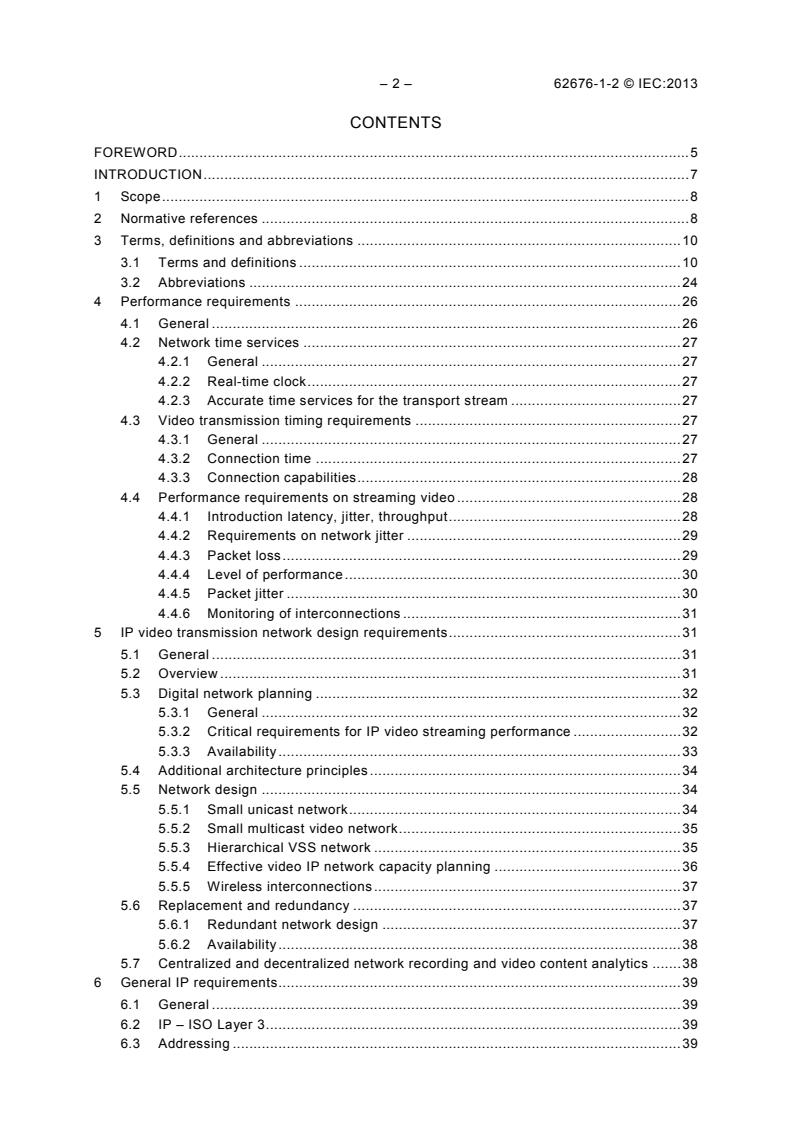
CONTENTS
FOREWORD . 5
INTRODUCTION . 7
1 Scope . 8
2 Normative references . 8
3 Terms, definitions and abbreviations . 10
3.1 Terms and definitions . 10
3.2 Abbreviations . 24
4 Performance requirements . 26
4.1 General . 26
4.2 Network time services . 27
4.2.1 General . 27
4.2.2 Real-time clock . 27
4.2.3 Accurate time services for the transport stream . 27
4.3 Video transmission timing requirements . 27
4.3.1 General . 27
4.3.2 Connection time . 27
4.3.3 Connection capabilities . 28
4.4 Performance requirements on streaming video . 28
4.4.1 Introduction latency, jitter, throughput . 28
4.4.2 Requirements on network jitter . 29
4.4.3 Packet loss . 29
4.4.4 Level of performance . 30
4.4.5 Packet jitter . 30
4.4.6 Monitoring of interconnections . 31
5 IP video transmission network design requirements . 31
5.1 General . 31
5.2 Overview . 31
5.3 Digital network planning . 32
5.3.1 General . 32
5.3.2 Critical requirements for IP video streaming performance . 32
5.3.3 Availability . 33
5.4 Additional architecture principles . 34
5.5 Network design . 34
5.5.1 Small unicast network . 34
5.5.2 Small multicast video network . 35
5.5.3 Hierarchical VSS network . 35
5.5.4 Effective video IP network capacity planning . 36
5.5.5 Wireless interconnections . 37
5.6 Replacement and redundancy . 37
5.6.1 Redundant network design . 37
5.6.2 Availability . 38
5.7 Centralized and decentralized network recording and video content analytics . 38
6 General IP requirements . 39
6.1 General . 39
6.2 IP – ISO Layer 3 . 39
6.3 Addressing . 39
62676-1-2 © IEC:2013 – 3 –
6.4 Internet control message protocol (ICMP) . 40
6.4.1 General . 40
6.4.2 Diagnostic requirements . 40
6.5 Diagnostics . 41
6.6 IP multicast . 41
6.6.1 General . 41
6.6.2 Internet group multicast protocol (IGMP) requirements . 41
7 Video streaming requirements . 41
7.1 General . 41
7.2 Transport protocol . 42
7.2.1 General . 42
7.2.2 JPEG over RTP . 42
7.2.3 JPEG over HTTP . 42
7.3 Documentation and specification . 43
7.3.1 General . 43
7.3.2 Non-compliant, proprietary and vendor specific payload formats . 43
7.3.3 Receiving unsupported RTP payload formats. 44
7.4 Streaming of metadata . 44
7.4.1 General . 44
7.4.2 XML documents as payload . 44
7.4.3 General . 44
8 Video stream control requirements . 45
8.1 General . 45
8.2 Usage of RTSP in video transmission devices . 45
8.2.1 General . 45
8.2.2 The use of RTSP with multicast . 45
8.3 RTSP standards track requirements . 46
8.3.1 General . 46
8.3.2 High level IP video streaming and control interfaces . 46
8.3.3 Minimal RTSP method and header implementation . 46
8.3.4 RTSP authentication . 46
9 Device discovery and description requirements . 46
10 Eventing requirements . 47
11 Network device management requirements. 47
11.1 General . 47
11.2 IP video MIB example . 48
11.3 The SNMP agent and manager for video transmission devices . 48
11.4 Performance requirements on the SNMP agent . 49
11.5 VSS SNMP trap requirements for event management . 50
12 Network security requirements . 50
12.1 General . 50
12.2 Transport level security requirements for SG4 transmission . 51
Bibliography . 52
Figure 1 – Network buffer . 29
Figure 2 – Network latency, jitter, loss . 33
Figure 3 – System design . 34
– 4 – 62676-1-2 © IEC:2013
Figure 4 – Small network . 35
Figure 5 – Multicast network . 35
Figure 6 – Hierarchical network. 36
Figure 7 – Redundant network . 38
Figure 8 – MIB structure . 48
Table 1 – Time service accuracy for video transport stream . 27
Table 2 – Interconnections – Timing requirements . 28
Table 3 – Video transmission network requirements . 28
Table 4 – Video transmission network requirements . 28
Table 5 – Performance requirements video streaming and stream display . 30
Table 6 – Video stream network packet jitter . 31
Table 7 – Monitoring of interconnections . 31
62676-1-2 © IEC:2013 – 5 –
INTERNATIONAL ELECTROTECHNICAL COMMISSION
____________
VIDEO SURVEILLANCE SYSTEMS
FOR USE IN SECURITY APPLICATIONS –
Part 1-2: System requirements –
Performance requirements for video transmission
FOREWORD
1) The International Electrotechnical Commission (IEC) is a worldwide organization for standardization comprising
all national electrotechnical committees (IEC National Committees). The object of IEC is to promote
international co-operation on all questions concerning standardization in the electrical and electronic fields. To
this end and in addition to other activities, IEC publishes International Standards, Technical Specifications,
Technical Reports, Publicly Available Specifications (PAS) and Guides (hereafter referred to as “IEC
Publication(s)”). Their preparation is entrusted to technical committees; any IEC National Committee interested
in the subject dealt with may participate in this preparatory work. International, governmental and non-
governmental organizations liaising with the IEC also participate in this preparation. IEC collaborates closely
with the International Organization for Standardization (ISO) in accordance with conditions determined by
agreement between the two organizations.
2) The formal decisions or agreements of IEC on technical matters express, as nearly as possible, an international
consensus of opinion on the relevant subjects since each technical committee has representation from all
interested IEC National Committees.
3) IEC Publications have the form of recommendations for international use and are accepted by IEC National
Committees in that sense. While all reasonable efforts are made to ensure that the technical content of IEC
Publications is accurate, IEC cannot be held responsible for the way in which they are used or for any
misinterpretation by any end user.
4) In order to promote international uniformity, IEC National Committees undertake to apply IEC Publications
transparently to the maximum extent possible in their national and regional publications. Any divergence
between any IEC Publication and the corresponding national or regional publication shall be clearly indicated in
the latter.
5) IEC itself does not provide any attestation of conformity. Independent certification bodies provide conformity
assessment services and, in some areas, access to IEC marks of conformity. IEC is not responsible for any
services carried out by independent certification bodies.
6) All users should ensure that they have the latest edition of this publication.
7) No liability shall attach to IEC or its directors, employees, servants or agents including individual experts and
members of its technical committees and IEC National Committees for any personal injury, property damage or
other damage of any nature whatsoever, whether direct or indirect, or for costs (including legal fees) and
expenses arising out of the publication, use of, or reliance upon, this IEC Publication or any other IEC
Publications.
8) Attention is drawn to the Normative references cited in this publication. Use of the referenced publications is
indispensable for the correct application of this publication.
9) Attention is drawn to the possibility that some of the elements of this IEC Publication may be the subject of
patent rights. IEC shall not be held responsible for identifying any or all such patent rights.
International Standard IEC 62676-1-2 has been prepared by IEC technical committee 79:
Alarm and electronic security systems.
The text of this standard is based on the following documents:
FDIS Report on voting
79/433/FDIS 79/446/RVD
Full information on the voting for the approval of this standard can be found in the report on
voting indicated in the above table.
This publication has been drafted in accordance with the ISO/IEC Directives, Part 2.
A list of all parts in the IEC 62676, published under the general title Video surveillance
systems for use in security applications, can be found on the IEC website.
– 6 – 62676-1-2 © IEC:2013
The committee has decided that the contents of this publication will remain unchanged until
the stability date indicated on the IEC web site under "http://webstore.iec.ch" in the data
related to the specific publication. At this date, the publication will be
• reconfirmed,
• withdrawn,
• replaced by a revised edition, or
• amended.
IMPORTANT – The 'colour inside' logo on the cover page of this publication indicates
that it contains colours which are considered to be useful for the correct
understanding of its contents. Users should therefore print this document using a
colour printer.
62676-1-2 © IEC:2013 – 7 –
INTRODUCTION
The IEC Technical Committee 79 in charge of alarm and electronic security systems together
with many governmental organisations, test houses and equipment manufacturers have
defined a common framework for video surveillance transmission in order to achieve
interoperability between products.
The IEC 62676 series of standards on video surveillance system is divided into 4 independent
parts:
Part 1: System requirements
Part 2: Video transmission protocols
Part 3: Analog and digital video interfaces
Part 4: Application guidelines (to be published)
Each part has its own clauses on scope, references, definitions and requirements.
This IEC 62676-1 series consists of 2 subparts, numbered parts 1-1 and 1-2 respectively:
IEC 62676-1-1, System requirements – General
IEC 62676-1-2, System requirements – Performance requirements for video transmission
The second subpart of this IEC 62676-1 series applies to video transmission. The purpose of
the transmission system in a Video Surveillance System (VSS) installation is to provide
reliable transmission of video signals between the different types of VSS equipment in
security, safety and monitoring applications.
Today VSS reside in security networks using IT infrastructure, equipment and connections
within the protected site itself.
– 8 – 62676-1-2 © IEC:2013
VIDEO SURVEILLANCE SYSTEMS
FOR USE IN SECURITY APPLICATIONS –
Part 1-2: System requirements –
Performance requirements for video transmission
1 Scope
This part of IEC 62676 introduces general requirements on video transmission. This standard
covers the general requirements for video transmissions on performance, security and
conformance to basic IP connectivity, based on available, well-known, international standards.
Clauses 4 and 5 of this standard define the minimum performance requirements on video
transmission for security applications in IP networks. In surveillance applications the
requirements on timing, quality and availability are strict and defined in the last section of this
standard. Guidelines for network architecture are given, how these requirements can be
fulfilled.
Clause 6 and the next clauses of this standard define requirements on basic IP connectivity of
video transmission devices to be used in security applications. If a video transmission device
is used in security, certain basic requirements apply. First of all a basic understanding of IP
connectivity needs to be introduced which requests the device to be compliant to fundamental
network protocols. These could be requirements which may be applied to all IP security
devices even beyond IP video. For this reason requirements are introduced in a second step
for compliance to basic streaming protocols, used in this standard for video streaming and
stream control. Since security applications need high availability and reliability, general
means for the transmission of the video status and health check events have to be covered.
These are defined in general requirements on eventing and network device management. In
security proper maintenance and setup is essential for the functioning of the video
transmission device. Locating streaming devices and their capabilities is a basic requirement
and covered in ´device discovery and description´.
2 Normative references
The following documents, in whole or in part, are normatively referenced in this document and
are indispensable for its application. For dated references, only the edition cited applies. For
undated references, the latest edition of the referenced document (including any
amendments) applies.
IEC 61709, Electric components – Reliability – Reference conditions for failure rates and
stress models for conversion
IEC/TR 62380, Reliability data handbook – Universal model for reliability prediction of
electronics components, PCBs and equipment
IEC 62676-1-1, Video surveillance systems for use in security applications – Part 1-1: System
requirements – General
IEC 62676-2-1, Video surveillance systems for use in security applications – Part 2-1: Video
transmission protocols – General requirements
ISO/IEC 10646, Information technology – Universal multiple-octet coded character set (UCS)
62676-1-2 © IEC:2013 – 9 –
ISO/IEC 13818-9, Information technology – Generic coding of moving pictures and associated
audio information – Part 9: Extension for real time interface for systems decoders
ISO/IEC 14496-2, Information technology – Coding of audio-visual objects – Part 2: Visual
ISO/IEC 14496-3, Information technology – Coding of audio-visual objects – Part 3: Audio
ISO/IEC 14496-10, Information technology – Coding of audio-visual objects – Part 10:
Advanced Video Coding
ITU-T Rec. G.711, Pulse code modulation (PCM) of voice frequencies
ITU-T Rec. G.726, 40, 32, 24, 16 kbit/s adaptive differential pulse code modulation (ADPCM)
IEEE Std 1413.1, IEEE Guide for selecting and using reliability predictions based on
IEEE 1413
IETF RFC 1122, Requirements for Internet Hosts – communication Layers
IETF RFC 1157, Simple Network Management Protocol
IETF RFC 1441, Introduction to version 2 of the Internet-standard Network Management
Framework
IETF RFC 2030, Simple Network Time Protocol (SNTP) Version 4 for IPv4, IPv6 and OSI
RFC 2069, Digest Access Authentication
IETF RFC 2131, Dynamic Host Configuration Protocol
IETF RFC 2246, The TLS Protocol Version 1.0
IETF RFC 2326:1998, Real Time Streaming Protocol (RTSP)
IETF RFC 2435, RTP Payload Format for JPEG-compressed Video
IETF RFC 2453, RIP - Routing Information Protocol
IETF RFC 2617, HTTP Authentication Basic and Digest Access Authentication, June 1999.
IETF RFC 3016, RTP Payload Format for MPEG-4 Audio/Visual Streams.
IETF RFC 3268, Advanced Encryption Standard (AES) Cipher suites for Transport Layer
Security (TLS)
IETF RFC 3315, Dynamic Host Configuration Protocol for IPv6 (DHCPv6)
IETF RFC 3410, Introduction and Applicability Statements for Internet Standard Management
Framework
IETF RFC 3550, RTP A Transport Protocol for Real-Time Applications
IETF RFC 3551, RTP Profile for Audio and Video Conferences with Minimal Control
– 10 – 62676-1-2 © IEC:2013
IETF RFC 3984, RTP Payload Format for H.264 Video.
IETF RFC 4346, The Transport Layer Security (TLS) Protocol Version 1.1
IETF RFC 4541, IGMP and MLD Snooping Switches
IETF RFC 4566, SDP Session Description Protocol
IETF RFC 4607, Source Specific Multicast for IP
IETF RFC 4862, IPv6 Stateless Address Auto configuration
3 Terms, definitions and abbreviations
For the purposes of this document, the following terms, definitions and abbreviations apply.
3.1 Terms and definitions
3.1.1
adaptive jitter buffering
queuing of packets in switched networks exposed to unwanted variations in the
communications signal to ensure the continuous video transmission over a network supported
by the 'Adaptive' ability to adjust the size of the jitter buffer based on the measured jitter in
the network
EXAMPLE: If the jitter increases, the buffer becomes larger and can store more packets; if the jitter decreases, the
buffer becomes smaller and stores fewer packets.
3.1.2
advanced encryption standard
NIST encryption standard, also known as Rijndael, specified as unclassified, publicly-
disclosed, symmetric encryption algorithm with a fixed block size of 128 bits and a key size of
128, 192 or 256 bits according to the Federal Information Processing Standards Publication
3.1.3
American Standard Code for Information Interchange
de-facto world-wide standard for the code numbers used by computers to represent all the
upper and lower-case characters
3.1.4
asymmetric algorithm
algorithm used in the asymmetric cryptography, in which a pair of keys (a private key and a
public key) is used to encrypt and decrypt a message to ensure the privacy of
communications
3.1.5
authentication
process where an operators or systems identity is checked within a network
EXAMPLE: In networks, authentication is commonly done through the use of logon passwords.
3.1.6
authentication server
device used in network access control
Note 1 to entry: It stores the usernames and passwords that identify the clients logging on or it may hold the
algorithms for access. For access to specific network resources, the server may itself store user permissions and
62676-1-2 © IEC:2013 – 11 –
company policies or provide access to directories that contain the information. Protocols such as RADIUS,
Kerberos and TACACS+, and 802.1x are implemented in an authentication server to perform user authentications.
3.1.7
authenticity
integrity and trustworthiness of data or an entity; validity and conformance of the information,
or identity of a user
Note 1 to entry: The authenticity can be secured and verified using cryptographic methods.
3.1.8
authorization
approval, permission, or empowerment for a user or a component to do something
3.1.9
backbone
high-speed line or series of connections that forms a major pathway within a network
3.1.10
backbone layer
larger transmission line that carries data gathered from smaller communication lines that
interconnect with it, e.g. a line or set of lines that local area networks connect to, in order to
span distances efficiently e.g. between buildings
3.1.11
Bit/s
bit per second
unit of measurement of how fast data is transferred from one node to another
3.1.12
bridge
device that is used to connect two networks including passing data packets between them
using the same protocols
3.1.13
client
component that contacts and obtains data from a server
3.1.14
client/server
communication system providing services e.g. video streams, storage, logon access, data
communication management and clients (workstations) subscribing these services
3.1.15
codec
compression-decompression or enCOder/DECoder process
3.1.16
common gateway interface
CGI
standardized method of communication between a client, e.g. web browser, and a server, e.g.
web server
Note 1 to entry: This note applies to the French language only.
3.1.17
compression delay
delay caused by the compression of data
– 12 – 62676-1-2 © IEC:2013
3.1.18
congestion
situation in which the traffic presents on the network exceeds available network throughput/
capacity
3.1.19
core layer
part of the network providing optimal transport between sites or system functionality e.g.
recording
3.1.20
data encryption standard
DES
cryptographic algorithm method developed by the US National Bureau Standards
Note 1 to entry: This note applies to the French language only.
3.1.21
dynamic host configuration protocol
DHCP
protocol by which a network component obtains an IP address (and other network
configuration information) from a server on the local network
Note 1 to entry: This note applies to the French language only.
3.1.22
distribution layer
part of the network providing policy-based connectivity
3.1.23
domain name system
DNS
system that translates Internet domain names into IP addresses
Note 1 to entry: This note applies to the French language only.
3.1.24
dual homing
single device offering two or more network interfaces
3.1.25
dynamic jitter buffer
collecting and storing video data packets for processing them in evenly spaced intervals to
reduce distortions in the display
3.1.26
encryption
type of network security used to encode data so that only the intended destination can access
or decode the information
3.1.27
fail-over
the capability of an application to recover from a failure on an entity by automatically
switching over to a surviving instance, providing no loss of data or continuity, also known as
‘run-time failover’ and often used in connection with
3.1.28
forensics
field of science of applying digital technologies to legal questions arising from criminal
investigations
62676-1-2 © IEC:2013 – 13 –
3.1.29
frame
data structure that collectively represents a transmission stream including headers, data, and
the payload and provides information necessary for the correct delivery of the data
3.1.30
gateway
hardware or software set-up that translates between two dissimilar protocols
3.1.31
H.261
ITU video coding standard originally designed for ISDN lines and data rate with multiples of
64 Kbit/s using real time protocol (RTP)
3.1.32
H.263
ITU standard supporting video compression (coding) for streaming video via RTP based on
and replacing the H.261 codec
3.1.33
H.264
ISO ITU-T MPEG-4 Part 10 standard, also named Advanced Video Coding (AVC) supporting
video compression (coding) from low bit-rate network streaming applications to HD video
applications with near-lossless coding for network-friendly video representation
3.1.34
host
computer on a network that is a repository for services available to other components on the
network
3.1.35
hot-swap
property of controller which allows circuit boards or other devices to be removed and replaced
while the system remains powered up and in operation
3.1.36
Hyper Text Mark-up Language
HTML
coding language used to create Hypertext documents for use on the World Wide Web
Note 1 to entry: This note applies to the French language only.
3.1.37
Hypertext Transfer Protocol
HTTP
connection oriented protocol for transmitting data over a network or protocol for moving hyper
text files across the Internet
Note 1 to entry: This note applies to the French language only.
3.1.38
Hypertext Transfer Protocol Secure
HTTPS
encrypts and authenticates communication between server and clients
Note 1 to entry: This note applies to the French language only.
– 14 – 62676-1-2 © IEC:2013
3.1.39
Internet Control Message Protocol
ICMP
error protocol indicating, for instance, that a requested service is not available or that a host
or router could not be reached
Note 1 to entry: This note applies to the French language only.
3.1.40
identification
ID
a machine-readable character string
3.1.41
IEEE 802.1x
method for authentication and authorization in IEEE-802 networks using an authentication
server e.g. RADIUS server
3.1.42
Institute of electrical and electronics engineers
IEEE
professional association of engineers for the advancement of technology
3.1.43
Internet group management protocol
IGMP
communications protocol used to manage the membership of IP multicast groups
Note 1 to entry: This note applies to the French language only.
3.1.44
Internet protocol
IP
network layer 3 protocol in the OSI model containing addressing and control information to
enable data packets to be routed in a network and primary network layer protocol in the
TCP/IP protocol suite according to IETF RFC 791
Note 1 to entry: This note applies to the French language only.
3.1.45
Internet protocol address
IP address
address of a host computer used in the Internet Protocol
Note 1 to entry: The IP address corresponds to a fully qualified domain name. At present, it consists of 32 bits
and is generally represented by a sequence of four decimal numbers (each in the range from 0 to 255), separated
by dots. The IP address of a computer usually comprises two parts: a part corresponding to the network number of
the network on which this computer is located, and a part identifying the computer within its network. In the new
version IPv6 of the Internet Protocol, the IP address consists of 128 bits.
Note 2 to entry: The Internet protocol is not limited to the Internet, and may be used on other networks.
3.1.46
IP
Internet protocol
main protocol used in conjunction with TCP (Transfer Control Protocol)
SEE: TCP/IP.
62676-1-2 © IEC:2013 – 15 –
3.1.47
Images per second
IPS
measurement or unit for the rate of pictures transmitted or displayed to create a video stream
Note 1 to entry: A rate of 25 IPS (PAL) or 30 IPS (NTSC) is considered to be real-time or full motion video.
3.1.48
Internet Protocol, version 4
IPv4
most widely used version of the Internet Protocol (the "IP" part of TCP/IP)
3.1.49
Internet Protocol Version 6
IPv6
successor to IPv4
Note 1 to entry: Already deployed in some cases and gradually spreading, IPv6 provides a huge number of
available IP Numbers – over a sextillion addresses. IPv6 allows every device on the planet to have its own IP
Number.
3.1.50
jitter
delay variation or continuity the packets arrive at their destination
Note 1 to entry: ´The received flow variation or pumping of stream´.
3.1.51
kilobits per second
kbit/s
unit of data transmission rate
3.1.52
latency
time that elapses between the initiation of a network request for data and the start of the
actual data transfer
3.1.53
layer 2 switch
OSI (Open Systems Architecture) data link layer device responsible for transmitting data
across the physical links in a network
3.1.54
layer 3 device
OSI device that determines network addresses, routes for information transport
EXAMPLE: A router is a layer 3 device; switches can also have layer 3 capability.
3.1.55
local area network
LAN
communications network serving users and devices within a limited geographical area, such
as a building or a protected area
Note 1 to entry: This note applies to the French language only.
3.1.56
local-access layer
part of the network bringing edge devices into the network and providing operator access
– 16 – 62676-1-2 © IEC:2013
3.1.57
login
account name used to gain access to a component to be used in combination with a password
or the act of connecting to a component or system by giving valid credentials (usually
“username" and "password")
3.1.58
managed switch
switch that can be monitored and administered in the network via its own IP address
3.1.59
media access control address
MAC address
unique identifier attached to network adapters i.e a name for a particular adapter
Note 1 to entry: This note applies to the French language only.
3.1.60
management information base
MIB
a structured collection of information for remote servicing using the SNMP protocol
Note 1 to entry: This note applies to the French language only.
3.1.61
multipurpose Internet mail extensions
MIME
standard for defining the type of payload streamed from a server to a client
Note 1 to entry: This note applies to the French language only.
EXAMPLE: ´video/h264´ is used for streaming H.264 encoded video.
3.1.62
MJPEG
motion JPEG
ISO/IEC digital video encoding standard, where each video frame is separately compressed
into a JPEG image
3.1.63
MPEG-4
digital video encoding and compression standard that uses interframe encoding to
significantly reduce the size of the video stream being transmitted compared to intraframe
only encoding
Note 1 to entry: In interframe coding, a video sequence is made up of so called I- or key-frames that contain the
entire image. In between the key-frames are delta frames, which are encoded with only the incremental
differences. This often provides substantial compression because in many surveillance video sequences, only a
small part of the pixel is different from one frame to another.
3.1.64
multicast
throughput-conserving technology that reduces throughput usage by simultaneously delivering
a single stream of information, here video content, to multiple network recipients
3.1.65
N+1 fail-over
fail-over capability of N identical applications in operation by automatically switching over to 1
unused application instance
62676-1-2 © IEC:2013 – 17 –
3.1.66
N+n redundancy
capacity of a parallel redundant system with N representing the number of applications
needed to meet the critical load and n is the number of extra applications for redundancy
purposes
3.1.67
network connectivity
the physical (wired or wireless) and logical (protocol) connection of a computer network or an
individual device to a network
3.1.68
network design
way of arrangement of the various clients and servers in a network for the purposes of
connectivity, performance, and security
3.1.69
network layer
Layer 3 of the OSI reference model, controlling communication links and data routing across
one or more links
3.1.70
network management
administrative services performed in managing a network, such as network topology and
software configuration, monitoring network performance, maintaining network operations, and
diagnosis and troubleshooting problems
3.1.71
network performance
to stream data in accordance with requests from the security application
Note 1 to entry: Since video streaming is mostly real-time, it is critical to be delivered within a specific time.
3.1.72
network topology
pattern of connection between nodes in a network, e.g. hierarchical topology
3.1.73
node
communication device attached to a network or end point of a network connection such as a
device attached to a network such as a workstation, IP video device, printer, etc
...
Questions, Comments and Discussion
Ask us and Technical Secretary will try to provide an answer. You can facilitate discussion about the standard in here.
Loading comments...