

IEC 62386-221:2018
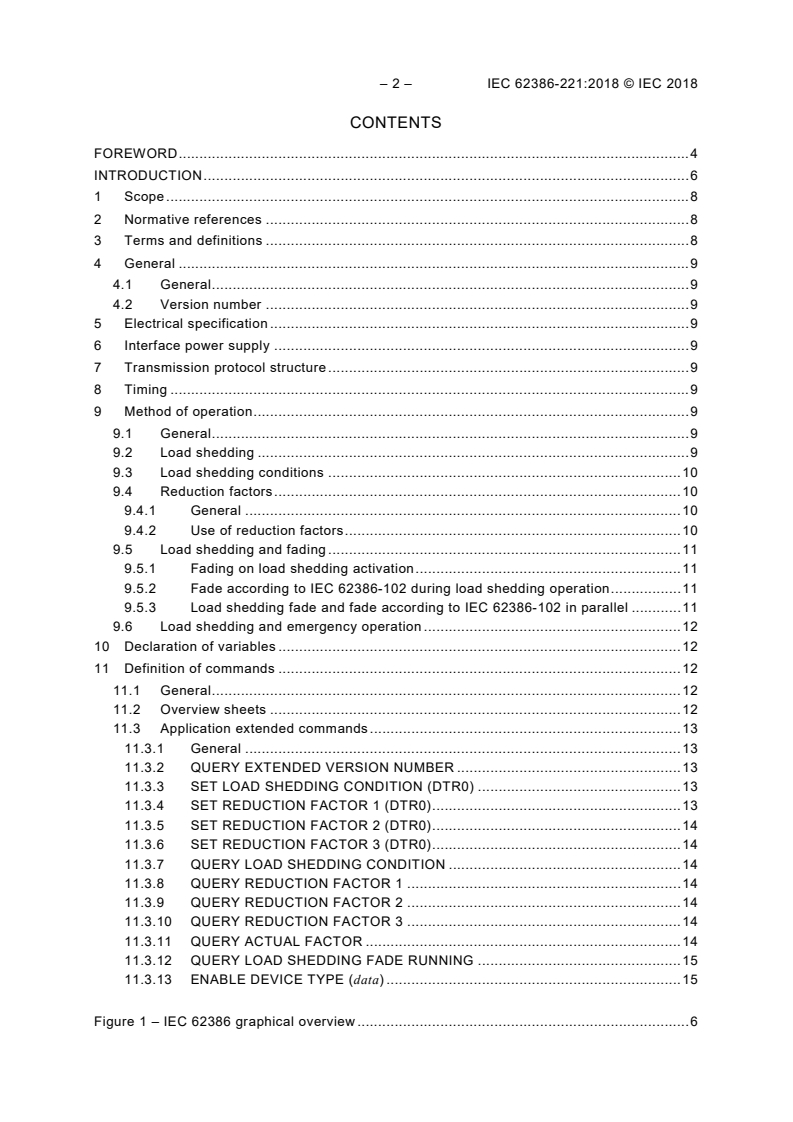
(Main)Digital addressable lighting interface - Part 221: Particular requirements for control gear - Demand response (device type 20)
General Information
- Abstract
IEC 62386-221:2018 specifies the methodology of demand response which focuses on the curtailment of electric loads during peak demand times thus avoiding the requirement to find new sources of generation capacity. By using load shedding, the lighting system responds to the demands of the energy supply.
This document is applicable to control gear supporting the demand response functionality.
- Status
- Published
- Publication Date
- 17-Jun-2018
- Technical Committee
- SC 34C - Auxiliaries for lamps
- Drafting Committee
- WG 11 - TC 34/WG 11
- Current Stage
- PPUB - Publication issued
- Start Date
- 18-Jun-2018
- Completion Date
- 03-Jul-2018
Overview
IEC 62386-221:2018 is an international standard developed by the International Electrotechnical Commission (IEC) focusing on the Digital Addressable Lighting Interface (DALI), specifically Part 221. It defines particular requirements for control gear implementing demand response functionality (device type 20). The primary goal of this standard is to enable lighting systems to participate in demand response strategies-curtailing electric loads during peak energy demand periods to mitigate the need for additional generation capacity. By specifying methodologies such as load shedding within lighting control gear, IEC 62386-221 supports smarter, energy-efficient lighting management that helps stabilize power grids and reduce energy costs.
Key Topics
Demand Response Methodology
The standard outlines detailed procedures for control gear to perform load shedding, which involves selectively reducing lighting power consumption in response to signals during peak demand periods. This helps balance energy supply and demand effectively.Load Shedding Conditions and Reduction Factors
IEC 62386-221 specifies how control gear should interpret load shedding commands, including different reduction factors to apply varying levels of power dimming or switching off loads. The standard details conditions and permissible reduction steps.Transmission Protocol and Control Commands
It defines the communication protocol for sending demand response commands to lighting control gear. This includes commands for setting load shedding conditions, querying current status, and enabling device functionality related to demand response.Integration with Other IEC 62386 Parts
Part 221 is designed to be used in conjunction with other IEC 62386 parts such as 101 (general system component requirements) and 102 (general control gear requirements) to ensure comprehensive control gear interoperability and functionality.Fade and Emergency Operation Compatibility
The standard addresses how load shedding fades should operate, including interaction with emergency lighting functions and fade timing consistent with IEC 62386-102 specifications.
Applications
IEC 62386-221:2018 is crucial for sectors aiming to implement energy-efficient smart lighting systems with demand response capabilities:
Commercial Buildings and Offices
Enables lighting systems to reduce consumption during peak demand without significant user impact, contributing to lower utility costs and enhanced sustainability.Industrial Facilities
Industrial sites with substantial lighting loads can implement automated load shedding to optimize energy use dynamically, supporting grid stability.Smart Cities and Public Infrastructure
Supports integration of street lighting and public area illumination into demand response programs, fostering smarter city ecosystems with real-time energy management.Energy Management Systems (EMS)
Lighting control gear conforming to IEC 62386-221 can be seamlessly integrated with broader EMS to participate in demand response programs, improving overall demand-side management effectiveness.
Related Standards
IEC 62386-101: General requirements for system components within the DALI framework, providing foundational parameters applicable also to Part 221 control gear.
IEC 62386-102: General requirements specific to control gear, important for detailed operational and safety requirements linked to demand response devices.
IEC 62386 (Series): The full series defines the complete set of requirements for Digital Addressable Lighting Interface systems-critical for ensuring interoperability and standardized control across lighting components.
Demand Response Standards (general): IEC 62386-221 complements broader energy demand response and load management frameworks promoting grid resilience and energy efficiency.
Implementing IEC 62386-221 compliant control gear allows manufacturers and system integrators to deliver advanced lighting solutions that actively support demand response initiatives. This contributes to energy savings, peak load management, and sustainable building operation-making it a key standard for the future of intelligent lighting and energy management systems worldwide.
Get Certified
Connect with accredited certification bodies for this standard

IMQ S.p.A. (Certification)
Italian electrical product certification.

SLG Prüf- und Zertifizierungs GmbH
German testing and certification body.

UL Solutions
Global safety science company with testing, inspection and certification.
Sponsored listings
Frequently Asked Questions
IEC 62386-221:2018 is a standard published by the International Electrotechnical Commission (IEC). Its full title is "Digital addressable lighting interface - Part 221: Particular requirements for control gear - Demand response (device type 20)". This standard covers: IEC 62386-221:2018 specifies the methodology of demand response which focuses on the curtailment of electric loads during peak demand times thus avoiding the requirement to find new sources of generation capacity. By using load shedding, the lighting system responds to the demands of the energy supply. This document is applicable to control gear supporting the demand response functionality.
IEC 62386-221:2018 specifies the methodology of demand response which focuses on the curtailment of electric loads during peak demand times thus avoiding the requirement to find new sources of generation capacity. By using load shedding, the lighting system responds to the demands of the energy supply. This document is applicable to control gear supporting the demand response functionality.
IEC 62386-221:2018 is classified under the following ICS (International Classification for Standards) categories: 01.120 - Standardization. General rules; 29.020 - Electrical engineering in general; 29.140.50 - Lighting installation systems; 29.140.99 - Other standards related to lamps; 33.100 - Electromagnetic compatibility (EMC). The ICS classification helps identify the subject area and facilitates finding related standards.
IEC 62386-221:2018 is available in PDF format for immediate download after purchase. The document can be added to your cart and obtained through the secure checkout process. Digital delivery ensures instant access to the complete standard document.
Standards Content (Sample)
IEC 62386-221 ®
Edition 1.0 2018-06
INTERNATIONAL
STANDARD
NORME
INTERNATIONALE
colour
inside
Digital addressable lighting interface –
Part 221: Particular requirements for control gear – Demand response
(device type 20)
Interface d’éclairage adressable numérique –
Partie 221: Exigences particulières pour les appareillages de commande –
Réaction à la demande (dispositifs de type 20)
All rights reserved. Unless otherwise specified, no part of this publication may be reproduced or utilized in any form
or by any means, electronic or mechanical, including photocopying and microfilm, without permission in writing from
either IEC or IEC's member National Committee in the country of the requester. If you have any questions about IEC
copyright or have an enquiry about obtaining additional rights to this publication, please contact the address below or
your local IEC member National Committee for further information.
Droits de reproduction réservés. Sauf indication contraire, aucune partie de cette publication ne peut être reproduite
ni utilisée sous quelque forme que ce soit et par aucun procédé, électronique ou mécanique, y compris la photocopie
et les microfilms, sans l'accord écrit de l'IEC ou du Comité national de l'IEC du pays du demandeur. Si vous avez des
questions sur le copyright de l'IEC ou si vous désirez obtenir des droits supplémentaires sur cette publication, utilisez
les coordonnées ci-après ou contactez le Comité national de l'IEC de votre pays de résidence.
IEC Central Office Tel.: +41 22 919 02 11
3, rue de Varembé info@iec.ch
CH-1211 Geneva 20 www.iec.ch
Switzerland
About the IEC
The International Electrotechnical Commission (IEC) is the leading global organization that prepares and publishes
International Standards for all electrical, electronic and related technologies.
About IEC publications
The technical content of IEC publications is kept under constant review by the IEC. Please make sure that you have the
latest edition, a corrigenda or an amendment might have been published.
IEC Catalogue - webstore.iec.ch/catalogue Electropedia - www.electropedia.org
The stand-alone application for consulting the entire The world's leading online dictionary of electronic and
bibliographical information on IEC International Standards, electrical terms containing 21 000 terms and definitions in
Technical Specifications, Technical Reports and other English and French, with equivalent terms in 16 additional
documents. Available for PC, Mac OS, Android Tablets and languages. Also known as the International Electrotechnical
iPad. Vocabulary (IEV) online.
IEC publications search - webstore.iec.ch/advsearchform IEC Glossary - std.iec.ch/glossary
The advanced search enables to find IEC publications by a 67 000 electrotechnical terminology entries in English and
variety of criteria (reference number, text, technical French extracted from the Terms and Definitions clause of
committee,…). It also gives information on projects, replaced IEC publications issued since 2002. Some entries have been
and withdrawn publications. collected from earlier publications of IEC TC 37, 77, 86 and
CISPR.
IEC Just Published - webstore.iec.ch/justpublished
Stay up to date on all new IEC publications. Just Published IEC Customer Service Centre - webstore.iec.ch/csc
details all new publications released. Available online and If you wish to give us your feedback on this publication or
also once a month by email. need further assistance, please contact the Customer Service
Centre: sales@iec.ch.
A propos de l'IEC
La Commission Electrotechnique Internationale (IEC) est la première organisation mondiale qui élabore et publie des
Normes internationales pour tout ce qui a trait à l'électricité, à l'électronique et aux technologies apparentées.
A propos des publications IEC
Le contenu technique des publications IEC est constamment revu. Veuillez vous assurer que vous possédez l’édition la
plus récente, un corrigendum ou amendement peut avoir été publié.
Catalogue IEC - webstore.iec.ch/catalogue Electropedia - www.electropedia.org
Application autonome pour consulter tous les renseignements
Le premier dictionnaire en ligne de termes électroniques et
bibliographiques sur les Normes internationales,
électriques. Il contient 21 000 termes et définitions en anglais
Spécifications techniques, Rapports techniques et autres
et en français, ainsi que les termes équivalents dans 16
documents de l'IEC. Disponible pour PC, Mac OS, tablettes
langues additionnelles. Egalement appelé Vocabulaire
Android et iPad.
Electrotechnique International (IEV) en ligne.
Recherche de publications IEC -
Glossaire IEC - std.iec.ch/glossary
webstore.iec.ch/advsearchform
67 000 entrées terminologiques électrotechniques, en anglais
La recherche avancée permet de trouver des publications IEC et en français, extraites des articles Termes et Définitions des
en utilisant différents critères (numéro de référence, texte, publications IEC parues depuis 2002. Plus certaines entrées
comité d’études,…). Elle donne aussi des informations sur les antérieures extraites des publications des CE 37, 77, 86 et
projets et les publications remplacées ou retirées. CISPR de l'IEC.
IEC Just Published - webstore.iec.ch/justpublished Service Clients - webstore.iec.ch/csc
Restez informé sur les nouvelles publications IEC. Just Si vous désirez nous donner des commentaires sur cette
Published détaille les nouvelles publications parues. publication ou si vous avez des questions contactez-nous:
Disponible en ligne et aussi une fois par mois par email. sales@iec.ch.
IEC 62386-221 ®
Edition 1.0 2018-06
INTERNATIONAL
STANDARD
NORME
INTERNATIONALE
colour
inside
Digital addressable lighting interface –
Part 221: Particular requirements for control gear – Demand response
(device type 20)
Interface d’éclairage adressable numérique –
Partie 221: Exigences particulières pour les appareillages de commande –
Réaction à la demande (dispositifs de type 20)
INTERNATIONAL
ELECTROTECHNICAL
COMMISSION
COMMISSION
ELECTROTECHNIQUE
INTERNATIONALE
ICS 29.140.50; 29.140.99 ISBN 978-2-8322-5792-0
– 2 – IEC 62386-221:2018 © IEC 2018
CONTENTS
FOREWORD . 4
INTRODUCTION . 6
1 Scope . 8
2 Normative references . 8
3 Terms and definitions . 8
4 General . 9
4.1 General . 9
4.2 Version number . 9
5 Electrical specification . 9
6 Interface power supply . 9
7 Transmission protocol structure . 9
8 Timing . 9
9 Method of operation . 9
9.1 General . 9
9.2 Load shedding . 9
9.3 Load shedding conditions . 10
9.4 Reduction factors . 10
9.4.1 General . 10
9.4.2 Use of reduction factors . 10
9.5 Load shedding and fading . 11
9.5.1 Fading on load shedding activation . 11
9.5.2 Fade according to IEC 62386-102 during load shedding operation . 11
9.5.3 Load shedding fade and fade according to IEC 62386-102 in parallel . 11
9.6 Load shedding and emergency operation . 12
10 Declaration of variables . 12
11 Definition of commands . 12
11.1 General . 12
11.2 Overview sheets . 12
11.3 Application extended commands . 13
11.3.1 General . 13
11.3.2 QUERY EXTENDED VERSION NUMBER . 13
11.3.3 SET LOAD SHEDDING CONDITION (DTR0) . 13
11.3.4 SET REDUCTION FACTOR 1 (DTR0) . 13
11.3.5 SET REDUCTION FACTOR 2 (DTR0) . 14
11.3.6 SET REDUCTION FACTOR 3 (DTR0) . 14
11.3.7 QUERY LOAD SHEDDING CONDITION . 14
11.3.8 QUERY REDUCTION FACTOR 1 . 14
11.3.9 QUERY REDUCTION FACTOR 2 . 14
11.3.10 QUERY REDUCTION FACTOR 3 . 14
11.3.11 QUERY ACTUAL FACTOR . 14
11.3.12 QUERY LOAD SHEDDING FADE RUNNING . 15
11.3.13 ENABLE DEVICE TYPE (data) . 15
Figure 1 – IEC 62386 graphical overview . 6
Table 1 – Load shedding conditions and reduction factors . 10
Table 2 – Declaration of additional variables . 12
Table 3 – Application extended commands for this device type (20) . 13
– 4 – IEC 62386-221:2018 © IEC 2018
INTERNATIONAL ELECTROTECHNICAL COMMISSION
____________
DIGITAL ADDRESSABLE LIGHTING INTERFACE –
Part 221: Particular requirements for control gear –
Demand response (device type 20)
FOREWORD
1) The International Electrotechnical Commission (IEC) is a worldwide organization for standardization comprising
all national electrotechnical committees (IEC National Committees). The object of IEC is to promote
international co-operation on all questions concerning standardization in the electrical and electronic fields. To
this end and in addition to other activities, IEC publishes International Standards, Technical Specifications,
Technical Reports, Publicly Available Specifications (PAS) and Guides (hereafter referred to as “IEC
Publication(s)”). Their preparation is entrusted to technical committees; any IEC National Committee interested
in the subject dealt with may participate in this preparatory work. International, governmental and non-
governmental organizations liaising with the IEC also participate in this preparation. IEC collaborates closely
with the International Organization for Standardization (ISO) in accordance with conditions determined by
agreement between the two organizations.
2) The formal decisions or agreements of IEC on technical matters express, as nearly as possible, an international
consensus of opinion on the relevant subjects since each technical committee has representation from all
interested IEC National Committees.
3) IEC Publications have the form of recommendations for international use and are accepted by IEC National
Committees in that sense. While all reasonable efforts are made to ensure that the technical content of IEC
Publications is accurate, IEC cannot be held responsible for the way in which they are used or for any
misinterpretation by any end user.
4) In order to promote international uniformity, IEC National Committees undertake to apply IEC Publications
transparently to the maximum extent possible in their national and regional publications. Any divergence
between any IEC Publication and the corresponding national or regional publication shall be clearly indicated in
the latter.
5) IEC itself does not provide any attestation of conformity. Independent certification bodies provide conformity
assessment services and, in some areas, access to IEC marks of conformity. IEC is not responsible for any
services carried out by independent certification bodies.
6) All users should ensure that they have the latest edition of this publication.
7) No liability shall attach to IEC or its directors, employees, servants or agents including individual experts and
members of its technical committees and IEC National Committees for any personal injury, property damage or
other damage of any nature whatsoever, whether direct or indirect, or for costs (including legal fees) and
expenses arising out of the publication, use of, or reliance upon, this IEC Publication or any other IEC
Publications.
8) Attention is drawn to the Normative references cited in this publication. Use of the referenced publications is
indispensable for the correct application of this publication.
9) Attention is drawn to the possibility that some of the elements of this IEC Publication may be the subject of
patent rights. IEC shall not be held responsible for identifying any or all such patent rights.
International Standard IEC 62386-221 has been prepared by IEC technical committee 34:
Lamps and related equipment.
The text of this International Standard is based on the following documents:
CDV Report on voting
34/409/CDV 34/488A/RVC
Full information on the voting for the approval of this International Standard can be found in
the report on voting indicated in the above table.
This document has been drafted in accordance with the ISO/IEC Directives, Part 2.
This Part 221 of IEC 62386 is intended to be used in conjunction with:
• Part 101, which contains general requirements for system components;
• Part 102, which contains general requirements for control gear.
A list of all parts in the IEC 62386 series, published under the general title Digital addressable
lighting interface can be found on the IEC website.
The committee has decided that the contents of this document will remain unchanged until the
stability date indicated on the IEC website under "http://webstore.iec.ch" in the data related to
the specific document. At this date, the document will be
• reconfirmed,
• withdrawn,
• replaced by a revised edition, or
• amended.
IMPORTANT – The 'colour inside' logo on the cover page of this publication indicates
that it contains colours which are considered to be useful for the correct
understanding of its contents. Users should therefore print this document using a
colour printer.
– 6 – IEC 62386-221:2018 © IEC 2018
INTRODUCTION
IEC 62386 contains several parts, referred to as series. The 1xx series includes the basic
specifications. Part 101 contains general requirements for system components, Part 102
extends this information with general requirements for control gear and Part 103 extends it
further with general requirements for control devices.
The 2xx parts extend the general requirements for control gear with lamp specific extensions
(mainly for backward compatibility with Edition 1 of IEC 62386) and with control gear specific
features.
The 3xx parts extend the general requirements for control devices with input device specific
extensions describing the instance types as well as some common features that can be
combined with multiple instance types.
This first edition of IEC 62386-221 is intended to be used in conjunction with
IEC 62386-101:2014, IEC 62386-101:2014/AMD1:2018, IEC 62386-102:2014 and
IEC 62386-102:2014/AMD1:—. The division of IEC 62386 into separately published parts
provides for ease of future amendments and revisions. Additional requirements will be added
as and when a need for them is recognized.
The setup of the standards is graphically represented in Figure 1 below.
2xx 2xx 2xx 2xx 2xx 3xx 3xx 3xx 3xx 3xx
102 General requirements - 103 General requirements -
Control gear Control devices
104 General requirements -
Wireless system components
101 General requirements -
System components
IEC
Figure 1 – IEC 62386 graphical overview
This document, and the other parts that make up the IEC 62386-2xx series, in referring to any
of the clauses of IEC 62386-1XX or IEC 62386-2XX, specifies the extent to which such a
clause is applicable and the order in which the tests are to be performed. The parts also
include additional requirements, as necessary.
Where the requirements of any of the clauses of IEC 62386-101 or IEC 62386-102 are
referred to in this document by the sentence "The requirements of IEC 62386-1XX, Clause “n”
apply”, this sentence is to be interpreted as meaning that all requirements of the clause in
question of Part 101 or Part 102 apply, except any which are inapplicable to the specific type
of lamp control gear covered by Part 221.
All numbers used in this document are decimal numbers unless otherwise noted. Hexadecimal
numbers are given in the format 0xVV, where VV is the value. Binary numbers are given in
the format XXXXXXXXb or in the format XXXX XXXX, where X is 0 or 1; "x" in binary numbers
means "don't care".
The following typographic expressions are used:
Variables: “variableName” or “variableName[3:0]”, giving only bits 3 to 0 of “variableName”.
Range of values: [lowest, highest]
Command: “COMMAND NAME”
– 8 – IEC 62386-221:2018 © IEC 2018
DIGITAL ADDRESSABLE LIGHTING INTERFACE –
Part 221: Particular requirements for control gear –
Demand response (device type 20)
1 Scope
This part of IEC 62386 specifies the methodology of demand response which focuses on the
curtailment of electric loads during peak demand times thus avoiding the requirement to find
new sources of generation capacity. By using load shedding, the lighting system responds to
the demands of the energy supply.
This document is applicable to control gear supporting the demand response functionality.
2 Normative references
The following documents are referred to in the text in such a way that some or all of their
content constitutes requirements of this document. For dated references, only the edition
cited applies. For undated references, the latest edition of the referenced document (including
any amendments) applies.
IEC 62386-101:2014, Digital addressable lighting interface – Part 101: General requirements
– System components
IEC 62386-101:2014/AMD1:2018
IEC 62386-102:2014, Digital addressable lighting interface – Part 102: General requirements
– Control gear
IEC 62386-102:2014/AMD1:—
3 Terms and definitions
For the purposes of this document, the terms and definitions given in IEC 62386-101 and
IEC 62386-102 and the following apply.
ISO and IEC maintain terminological databases for use in standardization at the following
addresses:
• IEC Electropedia: available at http://www.electropedia.org/
• ISO Online browsing platform: available at http://www.iso.org/obp
3.1
load shedding
temporary reduction of light output with the intention of reducing mains power consumption
3.2
normal light output
expected light output representing the variable “actualLevel” as determined by the currently
selected dimming curve
___________
Under preparation. Stage at the time of publication: IEC CFDIS 62386-102/AMD1:2018.
3.3
load shedding light output
resultant light output determined by the normal light output after the application of the load
shedding reduction factor
4 General
4.1 General
The requirements of IEC 62386-102:2014 and IEC 62386-102:2014/AMD1:—, Clause 4 apply,
with the restrictions, changes and additions identified below.
4.2 Version number
In 4.2 of IEC 62386-102:2014 and IEC 62386-102:2014/AMD1:—, “102” shall be replaced by
“221”, “version number” shall be replaced by “extended version number” and the current
version number shall be replaced by "2.0".
5 Electrical specification
The requirements of IEC 62386-102:2014 and IEC 62386-102:2014/AMD1:—, Clause 5 apply.
6 Interface power supply
The requirements of IEC 62386-102:2014 and IEC 62386-102:2014/AMD1:—, Clause 6 apply.
7 Transmission protocol structure
The requirements of IEC 62386-102:2014 and IEC 62386-102:2014/AMD1:—, Clause 7 apply.
8 Timing
The requirements of IEC 62386-102:2014 and IEC 62386-102:2014/AMD1:—, Clause 8 apply.
9 Method of operation
9.1 General
The requirements of IEC 62386-102:2014 and IEC 62386-102:2014/AMD1:—, Clause 9 apply
with the following restrictions, changes and additions.
9.2 Load shedding
The application of the load shedding functionality is intended to achieve a rapid reduction in
the current lighting system electrical power load of a building, in response to an abnormal
condition in the mains electrical generation and distribution system.
As load shedding functionality is only a temporary state of the lighting system, its application
shall be without any impact on IEC 62386-102 control gear variables and functionalities,
unless explicitly stated otherwise. Enabling load shedding shall only affect the generated light
output of the control gear, whereas other photometric properties shall remain unchanged.
– 10 – IEC 62386-221:2018 © IEC 2018
The application controller might separately need to adjust the daylight set point during
daylight harvesting operations to prevent an inadvertent increase in light level and energy
consumed when a change to a load shedding condition has occurred.
NOTE 1 Examples of IEC 62386-102 control gear variables are “actualLevel”, and “targetLevel”.
NOTE 2 Examples of photometric properties are luminous colour, colour rendering index Ra.
9.3 Load shedding conditions
A control gear which conforms to this document shall support four load shedding conditions
with associated reduction factors as shown in Table 1.
Table 1 – Load shedding conditions and reduction factors
“loadSheddingCondition” Load shedding reduction factors
0 “actualFactor” = 0 (no reduction)
1 “actualFactor” = “reductionFactor1”
2 “actualFactor” = “reductionFactor2”
3 “actualFactor” = “reductionFactor3”
An application controller may select the load shedding condition by means of the instruction
“SET LOAD SHEDDING CONDITION (DTR0)”. The current load shedding condition can be
queried by means of the query “QUERY LOAD SHEDDING CONDITION”.
9.4 Reduction factors
9.4.1 General
The reduction factors can be set by means of instructions “SET REDUCTION FACTOR 1
(DTR0)”, “SET REDUCTION FACTOR 2 (DTR0)”, and “SET REDUCTION FACTOR 3 (DTR0)”.
The reduction factor of “loadSheddingCondtion”: 0 is fixed to zero and cannot be changed.
The reduction factors can be queried by means of queries QUERY REDUCTION FACTOR 1,
QUERY REDUCTION FACTOR 2 and QUERY REDUCTION FACTOR 3.
“SET LOAD SHEDDING CONDITION (DTR0)” shall cause “actualFactor” to be set to the
corresponding load shedding reduction factor from Table 1.
To determine either the currently set reduction factor of a single gear or if there is currently
any load shedding functionality enabled, QUERY ACTUAL FACTOR can be used.
9.4.2 Use of reduction factors
The control gear shall operate the lamp(s) with a reduced arc power calculated according to
the following formula:
""actualFactor
load shedding light output=1−× normal light output
100
If the “actualFactor” is less than 100 and will result in a reduction of the arc power below the
“minLevel”, the control gear shall operate the lamp at a reduced arc power that corresponds
to the “PHM” of the control gear.
An “actualFactor” of 100 shall cause the control gear to turn the lamp(s) off after fading to the
light output that corresponds to the ”PHM”.
9.5 Load shedding and fading
9.5.1 Fading on load shedding activation
If the control gear is not capable of fading (i.e. non-dimmable control gear), then the control
gear will turn off the lamps immediately after “actualFactor” is set to 100 % and will set the
load shedding light output to match the normal light output immediately if “actualFactor” is set
to less than 100 %.
If the control gear is capable of fading then whenever “actualFactor” is set to a new value, the
transition from normal light output to load shedding light output shall be made using a linear
fade with a nominal duration of eight seconds with a tolerance of ±10 %. During the transition
“loadSheddingFadeRunning” shall be set to TRUE. “loadSheddingFadeRunning” can be queried by
means of the query “QUERY LOAD SHEDDING FADE RUNNING.
During a load shedding fade, the step from light output equalling "PHM" to lamp off, shall not
contribute to the load shedding fade time. The step from light output equalling “PHM” to lamp
off, shall be taken immediately after the load shedding fade time has elapsed. If a lamp is off
at the beginning of the load shedding fade and dimmed to a certain load shedding light output,
the step from lamp off to light output equalling “PHM” shall not contribute to the load
shedding fade time. This means that the load shedding fade time starts when the lamp is on.
In the case where the normal light output equals zero when “actualFactor” is changed, no
load shedding fade time shall be applied and the new “actualFactor” shall be applied
immediately.
9.5.2 Fade according to IEC 62386-102 during load shedding operation
As long as a load shedding condition with “actualFactor” > 0 is active, fading shall be carried
out as described in IEC 62386-102:2014 and IEC 62386-102:2014/AMD1:—, 9.5 with the
exception that normal light output shall be replaced by the nearest possible load shedding
light output throughout the whole fade.
9.5.3 Load shedding fade and fade according to IEC 62386-102 in parallel
In the case where
• a load shedding condition is set during a running fade indicated by the “fadeRunning”
variable being TRUE, or
• a fade according to IEC 62386-102:2014 and IEC 62386-102:2014/AMD1:—, 9.5 is initiated
during a running load shedding fade indicated by “loadSheddingFadeRunning” being TRUE,
the following behaviour applies.
The two fades shall be processed in parallel, resulting in a linear transition at the end of which
“targetLevel” is reached and the load shedding light output according to the applied
“actualFactor” is emitted. The corresponding individual light outputs at specific points in time
during those two running fades shall be determined in the following way.
The normal light output at the examined point in time shall be calculated according to the fade
time calculation described in IEC 62386-102:2014 and IEC 62386-102:2014/AMD1:—, 9.3 and
9.5.1. The current interim reduction factor at the examined point in time shall be calculated
according to the reduction factor formula in 9.4.2 multiplied by the quotient of the elapsed
load shedding fade time, divided by the total load shedding fade time.
– 12 – IEC 62386-221:2018 © IEC 2018
The load shedding light output at the examined point in time is determined by applying the
current reduction factor to the corresponding normal light output. The result is rounded down
to the nearest producible light output of the control gear.
9.6 Load shedding and emergency operation
In the case where emergency lighting and load shedding functionality are integrated in the
same bus unit, the emergency operation shall always take precedence over the load shedding
functionality.
10 Declaration of variables
The requirements of IEC 62386-102:2014 and IEC 62386-102:2014/AMD1:—, Clause 10 apply,
with the following additional variables for this device type (20), as indicated in Table 2.
Table 2 – Declaration of additional variables
Variable Default value Reset value Power-on value Range of Memory
(factory) validity type
”extendedVersionNumber" 2.0 no change no change 00001000b ROM
"deviceType" 20 no change no change 20 ROM
“loadSheddingCondition” 0 0 0 [0, 3] RAM
“reductionFactor1” 30 (30 %) 30 (30 %) no change [0, 100] NVM
“reductionFactor2” 50 (50 %) 50 (50 %) no change [0, 100] NVM
“reductionFactor3” 70 (70 %) 70 (70 %) no change [0, 100] NVM
“actualFactor” 0 0 0 [0, 100] RAM
“loadSheddingFadeRunning” FALSE FALSE FALSE [FALSE, TRUE] RAM
11 Definition of commands
11.1 General
The requirements of IEC 62386-102:2014 and IEC 62386-102:2014/AMD1:—, Clause 11 apply,
with the following restrictions, changes and additions.
11.2 Overview sheets
Table 3 defines the application extended commands for this device type (20):
Table 3 – Application extended commands for this device type (20)
Command name Address Opcode References Command
byte byte reference
SET LOAD SHEDDING CONDITION Device 1 0xE0 9.3 11.3.3
(DTR0)
SET REDUCTION FACTOR 1 (DTR0) Device 1 0xE1 9.4.1 11.3.4
SET REDUCTION FACTOR 2 (DTR0) Device 1 0xE2 9.4.1 11.3.5
SET REDUCTION FACTOR 3 (DTR0) Device 1 0xE3 9.4.1 11.3.6
QUERY LOAD SHEDDING Device 1 0xF9 9.3 11.3.7
CONDITION
QUERY REDUCTION FACTOR 1 Device 1 0xFA 9.4.1 11.3.8
QUERY REDUCTION FACTOR 2 Device 1 0xFB 9.4.1 11.3.9
QUERY REDUCTION FACTOR 3 Device 1 0xFC 9.4.1 11.3.10
QUERY ACTUAL FACTOR Device 1 0xFD 9.4.1 11.3.11
QUERY LOAD SHEDDING FADE Device 1 0xFE 9.5.1 11.3.12
RUNNING
11.3 Application extended commands
11.3.1 General
Replace “data” by “deviceType”.
11.3.2 QUERY EXTENDED VERSION NUMBER
The answer shall be “extendedVersionNumber” when device type 20 “deviceType” has been
enabled.
Refer to 4.2 for further information.
11.3.3 SET LOAD SHEDDING CONDITION (DTR0)
The instruction shall be executed only if 0 ≤ “DTR0” ≤ 3 and ignored otherwise. See Table 1.
When the instruction is executed, the content of “DTR0” shall be stored as a new
“loadSheddingCondition”.
Refer to 9.3 for additional information.
11.3.4 SET REDUCTION FACTOR 1 (DTR0)
The instruction shall be ignored unless it is received twice according to the requirements as
stated in IEC 62386-101:2014 and IEC 62386-101:2014/AMD1:2018, 9.3.
When the instruction is executed, “reductionFactor1” shall be set to:
• if 0 ≤ “DTR0” ≤ 100: “DTR0”;
• if “DTR0” > 100: 100.
Selector bit
Command number
DTR0
DTR1
DTR2
Answer
Send twice
– 14 – IEC 62386-221:2018 © IEC 2018
Refer to 9.4.1 for additional information.
11.3.5 SET REDUCTION FACTOR 2 (DTR0)
The instruction shall be ignored unless it is received twice according to the requirements as
stated in IEC 62386-101:2014 and IEC 62386-101:2014/AMD1:2018, 9.3.
When the instruction is executed “reductionFactor2” shall be set to:
• if 0 ≤ “DTR0” ≤ 100: “DTR0”;
• if “DTR0” > 100: 100.
Refer to 9.4.1 for additional information.
11.3.6 SET REDUCTION FACTOR 3 (DTR0)
The instruction shall be ignored unless it is received twice according to the requirements as
stated in IEC 62386-101:2014 and IEC 62386-101:2014/AMD1:2018, 9.3.
When the instruction is executed “reductionFactor3” shall be set to:
• if 0 ≤ “DTR0” ≤ 100: “DTR0”;
• if “DTR0” > 100: 100.
Refer to 9.4.1 for additional information.
11.3.7 QUERY LOAD SHEDDING CONDITION
The answer shall be “loadSheddingCondition”.
Refer to 9.3 for additional information.
11.3.8 QUERY REDUCTION FACTOR 1
The answer shall be “reductionFactor1”.
Refer to 9.4.1 for additional information.
11.3.9 QUERY REDUCTION FACTOR 2
The answer shall be “reductionFactor2”.
Refer to 9.4.1 for additional information.
11.3.10 QUERY REDUCTION FACTOR 3
The answer shall be “reductionFactor3”.
Refer to 9.4.1 for additional information.
11.3.11 QUERY ACTUAL FACTOR
The answer shall be in case
• 1 ≤ “loadSheddingCondition” ≤ 3: “actualFactor”;
• 0 = “loadSheddingCondition”: NO.
Refer to 9.4.1 for additional information.
NOTE This query makes it possible to quickly check whether the load shedding functionality in any control gear in
the system is enabled.
11.3.12 QUERY LOAD SHEDDING FADE RUNNING
The answer shall be YES if “loadSheddingFadeRunning” is TRUE and NO otherwise.
11.3.13 ENABLE DEVICE TYPE (data)
The value of data shall be equal to 20 to enable the command set as defined in this document.
___________
– 16 – IEC 62386-221:2018 © IEC 2018
SOMMAIRE
AVANT-PROPOS . 18
INTRODUCTION . 20
1 Domaine d’application . 22
2 Références normatives . 22
3 Termes et définitions . 22
4 Généralités . 23
4.1 Généralités . 23
4.2 Numéro de version . 23
5 Spécifications électriques . 23
6 Alimentation électrique de l’interface . 23
7 Structure du protocole de transmission . 23
8 Cadencement . 23
9 Méthode de fonctionnement . 23
9.1 Généralités . 23
9.2 Délestage . 24
9.3 Conditions de délestage . 24
9.4 Facteurs de réduction . 24
9.4.1 Généralités . 24
9.4.2 Utilisation des facteurs de réduction . 25
9.5 Délestage et modification de l’intensité lumineuse . 25
9.5.1 Modification de l’intensité lumineuse par activation du délestage . 25
9.5.2 Modification de l'intensité lumineuse selon l’IEC 62386-102 pendant les
opérations de délestage . 26
9.5.3 Modification de l’intensité lumineuse de délestage et modification de
l’intensité lumineuse selon l’IEC 62386-102 en parallèle . 26
9.6 Délestage et opération d’urgence . 26
10 Déclaration des variables . 26
11 Définition des commandes . 27
11.1 Généralités . 27
11.2 Fiches de vue d’ensemble . 27
11.3 Commandes d'application étendues . 28
11.3.1 Généralités . 28
11.3.2 QUERY EXTENDED VERSION NUMBER . 28
11.3.3 SET LOAD SHEDDING CONDITION (DTR0) . 28
11.3.4 SET REDUCTION FACTOR 1 (DTR0) . 28
11.3.5 SET REDUCTION FACTOR 2 (DTR0) . 29
11.3.6 SET REDUCTION FACTOR 3 (DTR0) . 29
11.3.7 QUERY LOAD SHEDDING CONDITION . 29
11.3.8 QUERY REDUCTION FACTOR 1 . 29
11.3.9 QUERY REDUCTION FACTOR 2 . 29
11.3.10 QUERY REDUCTION FACTOR 3 . 29
11.3.11 QUERY ACTUAL FACTOR . 30
11.3.12 QUERY LOAD SHEDDING FADE RUNNING . 30
11.3.13 ENABLE DEVICE TYPE (data) . 30
Figure 1 – Présentation graphique générale de l’IEC 62386 . 20
Tableau 1 – Conditions de délestage et facteurs de réduction associés . 24
Tableau 2 – Déclaration des variables supplémentaires . 27
Tableau 3 – Commandes d’application étendues pour ce type de dispositif (20) . 28
– 18 – IEC 62386-221:2018 © IEC 2018
COMMISSION ÉLECTROTECHNIQUE INTERNATIONALE
____________
INTERFACE D’ÉCLAIRAGE ADRESSABLE NUMÉRIQUE –
Partie 221: Exigences particulières pour les appareillages de commande –
Réaction à la demande (dispositifs de type 20)
AVANT-PROPOS
1) La Commission Electrotechnique Internationale (IEC) est une organisation mondiale de normalisation
composée de l'ensemble des comités électrotechniques nationaux (Comités nationaux de l’IEC). L’IEC a pour
objet de favoriser la coopération internationale pour toutes les questions de normalisation dans les domaines
de l'électricité et de l'électronique. A cet effet, l’IEC – entre autres activités – publie des Normes
internationales, des Spécifications techniques, des Rapports techniques, des Spécifications accessibles au
public (PAS) et des Guides (ci-après dénommés "Publication(s) de l’IEC"). Leur élaboration est confiée à des
comités d'études, aux travaux desquels tout Comité national intéressé par le sujet traité peut participer. Les
organisations internationales, gouvernementales et non gouvernementales, en liaison avec l’IEC, participent
également aux travaux. L’IEC collabore étroitement avec l'Organisation Internationale de Normalisation (ISO),
selon des conditions fixées par accord entre les deux organisations.
2) Les décisions ou accords officiels de l’IEC concernant les questions techniques représentent, dans la mesure
du possible, un accord international sur les sujets étudiés, étant donné que les Comités nationaux de l’IEC
intéressés sont représentés dans chaque comité d’études.
3) Les Publications de l’IEC se présentent sous la forme de recommandations internationales et sont agréées
comme telles par les Comités nationaux de l’IEC. Tous les efforts raisonnables sont entrepris afin que l’IEC
s'assure de l'exactitude du contenu technique de ses publications; l’IEC ne peut pas être tenue responsable de
l'éventuelle mauvaise utilisation ou interprétation qui en est faite par un quelconque utilisateur final.
4) Dans le but d'encourager l'uniformité internationale, les Comités nationaux de l’IEC s'engagent, dans toute la
mesure possible, à appliquer de façon transparente les Publications de l’IEC dans leurs publications nationales
et régionales. Toutes divergences entre toutes Publications de l’IEC et toutes publications nationales ou
régionales correspondantes doivent être indiquées en termes clairs dans ces dernières.
5) L’IEC elle-même ne fournit aucune attestation de conformité. Des organismes de certification indépendants
fournissent des services d'évaluation de conformité et, dans certains secteurs, accèdent aux marques de
conformité de l’IEC. L’IEC n'est responsable d'aucun des services effectués par les organismes de certification
indépendants.
6) Tous les utilisateurs doivent s'assurer qu'ils sont en possession de la dernière édition de cette publication.
7) Aucune responsabilité ne doit être imputée à l’IEC, à ses administrateurs, employés, auxiliaires ou
mandataires, y compris ses experts particuliers et les membres de ses comités d'études et des Comités
nationaux de l’IEC, pour tout préjudice causé en cas de dommages corporels et matériels, ou de tout autre
dommage de quelque nature que ce soit, directe ou indirecte, ou pour supporter les coûts (y compris les frais
de justice) et les dépenses découlant de la publicat
...