

IEC SRD 63416:2023
(Main)Ethical considerations of artificial intelligence (AI) when applied in the active assisted living (AAL) context
General Information
- Abstract
IEC SRD 63416:2023 describes ethical considerations that are relevant when developing AAL systems and AAL services.
This document covers AAL-specific issues related to AI that supplement those ethical considerations already addressed in other AI documents. Examples include the WHO and OECD principles of AI and those of the High-Level Expert Group on Artificial Intelligence set up by the European Commission.
This document analyses whether these frameworks for the governance of AI are sufficient to meet the requirements of the AAL environment and in particular to meet the needs of AAL care recipients.
The objective of the ethical assessment is to create concrete and clear ethical guidelines that can be used as checklists in AAL service and system platform design, development and implementation.
- Status
- Published
- Publication Date
- 14-Sep-2023
- Technical Committee
- SyC AAL - Active Assisted Living
- Drafting Committee
- WG 1 - SyC AAL/WG 1
- Current Stage
- PPUB - Publication issued
- Start Date
- 15-Sep-2023
- Completion Date
- 06-Oct-2023
Overview - IEC SRD 63416:2023 (Ethical AI for AAL)
IEC SRD 63416:2023 provides ethical guidance specifically for the use of artificial intelligence (AI) in Active Assisted Living (AAL) systems and services. It supplements existing high‑level AI ethics frameworks (WHO, OECD, EU HLEG, etc.) by analysing AAL‑specific risks and by turning ethical assessment into concrete, actionable guidelines and checklists for system and service platform design, development and implementation. The document focuses on protecting AAL care recipients as they age and on ensuring AI systems behave appropriately as physical, cognitive and social needs change.
Key topics and technical requirements
- AAL‑specific ethical considerations: issues unique to assisted living such as dignity, autonomy, changing capabilities of care recipients and consent under cognitive decline.
- AAL use cases analysed: health and wellness monitoring, self‑management of daily activities, social interaction support, mobility assistance, and chronic condition prevention/management.
- Trustworthy AI requirements (summarized):
- Lawful AI - compliance with applicable laws and human rights.
- Ethical AI - adoption of moral principles governing system behaviour.
- Human agency & autonomy - preserve decision‑making rights of care recipients.
- Human dignity - designs that respect dignity and enable vulnerable groups to participate in society.
- Diversity, non‑discrimination & fairness - avoid bias that marginalizes older adults or disabled users.
- Privacy & data governance - clear control over personal data collection, use and access.
- Technical, operational and governance considerations: requirements for algorithm transparency, robustness, validation, monitoring, data management and operational governance tailored to AAL deployments.
- Deliverable format: concrete checklists and ethical assessment tools intended for practical integration into AAL system lifecycle.
Practical applications and who should use it
- Product and platform designers - integrate ethics checklists in requirements, architecture and UX decisions.
- AI/ML developers and system integrators - apply AAL‑specific constraints to model design, training data selection and validation.
- Service providers and caregivers - evaluate AI behaviours, consent flows and privacy measures.
- Procurement teams and policymakers - use the guidelines for sourcing, regulation and compliance of AAL solutions.
- Certification and conformity assessors - assess whether AAL products meet ethical and governance expectations.
Practical uses include ethics‑by‑design workflows, risk assessments, user consent frameworks, bias mitigation plans, and operational governance policies for deployed AAL systems.
Related standards and references
- IEC TS 63134:2020 (AAL use cases)
- IEC 63240‑1 / IEC 63240‑2 (AAL reference architecture and model)
- ISO/IEC TR 24368 and international AI ethics frameworks (WHO, OECD, EU HLEG)
Keywords: IEC SRD 63416:2023, ethical AI, Active Assisted Living, AAL, trustworthy AI, AI governance, AAL care recipients, AI ethics checklist.
Get Certified
Connect with accredited certification bodies for this standard

BSI Group
BSI (British Standards Institution) is the business standards company that helps organizations make excellence a habit.

TÜV SÜD
TÜV SÜD is a trusted partner of choice for safety, security and sustainability solutions.

Bureau Veritas
Bureau Veritas is a world leader in laboratory testing, inspection and certification services.
Sponsored listings
Frequently Asked Questions
IEC SRD 63416:2023 is a standardization document published by the International Electrotechnical Commission (IEC). Its full title is "Ethical considerations of artificial intelligence (AI) when applied in the active assisted living (AAL) context". This standard covers: IEC SRD 63416:2023 describes ethical considerations that are relevant when developing AAL systems and AAL services. This document covers AAL-specific issues related to AI that supplement those ethical considerations already addressed in other AI documents. Examples include the WHO and OECD principles of AI and those of the High-Level Expert Group on Artificial Intelligence set up by the European Commission. This document analyses whether these frameworks for the governance of AI are sufficient to meet the requirements of the AAL environment and in particular to meet the needs of AAL care recipients. The objective of the ethical assessment is to create concrete and clear ethical guidelines that can be used as checklists in AAL service and system platform design, development and implementation.
IEC SRD 63416:2023 describes ethical considerations that are relevant when developing AAL systems and AAL services. This document covers AAL-specific issues related to AI that supplement those ethical considerations already addressed in other AI documents. Examples include the WHO and OECD principles of AI and those of the High-Level Expert Group on Artificial Intelligence set up by the European Commission. This document analyses whether these frameworks for the governance of AI are sufficient to meet the requirements of the AAL environment and in particular to meet the needs of AAL care recipients. The objective of the ethical assessment is to create concrete and clear ethical guidelines that can be used as checklists in AAL service and system platform design, development and implementation.
IEC SRD 63416:2023 is classified under the following ICS (International Classification for Standards) categories: 03.100.02 - Governance and ethics; 11.020.10 - Health care services in general. The ICS classification helps identify the subject area and facilitates finding related standards.
IEC SRD 63416:2023 is available in PDF format for immediate download after purchase. The document can be added to your cart and obtained through the secure checkout process. Digital delivery ensures instant access to the complete standard document.
Standards Content (Sample)
IEC SRD 63416 ®
Edition 1.0 2023-09
SYSTEMS
REFERENCE DELIVERABLE
Ethical considerations of artificial intelligence (AI) when applied in the active
assisted living (AAL) context
All rights reserved. Unless otherwise specified, no part of this publication may be reproduced or utilized in any form
or by any means, electronic or mechanical, including photocopying and microfilm, without permission in writing from
either IEC or IEC's member National Committee in the country of the requester. If you have any questions about IEC
copyright or have an enquiry about obtaining additional rights to this publication, please contact the address below or
your local IEC member National Committee for further information.
IEC Secretariat Tel.: +41 22 919 02 11
3, rue de Varembé info@iec.ch
CH-1211 Geneva 20 www.iec.ch
Switzerland
About the IEC
The International Electrotechnical Commission (IEC) is the leading global organization that prepares and publishes
International Standards for all electrical, electronic and related technologies.
About IEC publications
The technical content of IEC publications is kept under constant review by the IEC. Please make sure that you have the
latest edition, a corrigendum or an amendment might have been published.
IEC publications search - webstore.iec.ch/advsearchform IEC Products & Services Portal - products.iec.ch
The advanced search enables to find IEC publications by a Discover our powerful search engine and read freely all the
variety of criteria (reference number, text, technical publications previews. With a subscription you will always have
committee, …). It also gives information on projects, replaced access to up to date content tailored to your needs.
and withdrawn publications.
Electropedia - www.electropedia.org
IEC Just Published - webstore.iec.ch/justpublished
The world's leading online dictionary on electrotechnology,
Stay up to date on all new IEC publications. Just Published
containing more than 22 300 terminological entries in English
details all new publications released. Available online and once
and French, with equivalent terms in 19 additional languages.
a month by email.
Also known as the International Electrotechnical Vocabulary
(IEV) online.
IEC Customer Service Centre - webstore.iec.ch/csc
If you wish to give us your feedback on this publication or need
further assistance, please contact the Customer Service
Centre: sales@iec.ch.
IEC SRD 63416 ®
Edition 1.0 2023-09
SYSTEMS
REFERENCE DELIVERABLE
Ethical considerations of artificial intelligence (AI) when applied in the active
assisted living (AAL) context
INTERNATIONAL
ELECTROTECHNICAL
COMMISSION
ICS 03.100.02; 11.020.10 ISBN 978-2-8322-7479-8
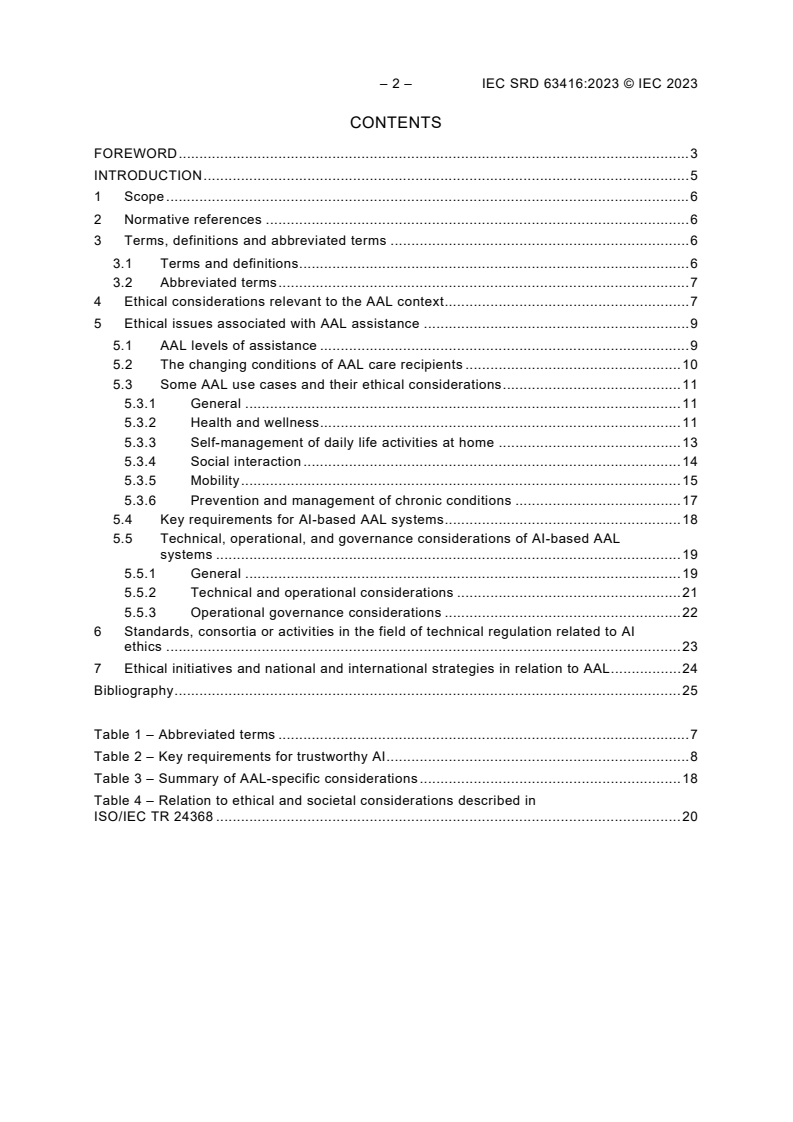
– 2 – IEC SRD 63416:2023 © IEC 2023
CONTENTS
FOREWORD . 3
INTRODUCTION . 5
1 Scope . 6
2 Normative references . 6
3 Terms, definitions and abbreviated terms . 6
3.1 Terms and definitions . 6
3.2 Abbreviated terms . 7
4 Ethical considerations relevant to the AAL context . 7
5 Ethical issues associated with AAL assistance . 9
5.1 AAL levels of assistance . 9
5.2 The changing conditions of AAL care recipients . 10
5.3 Some AAL use cases and their ethical considerations . 11
5.3.1 General . 11
5.3.2 Health and wellness. 11
5.3.3 Self-management of daily life activities at home . 13
5.3.4 Social interaction . 14
5.3.5 Mobility . 15
5.3.6 Prevention and management of chronic conditions . 17
5.4 Key requirements for AI-based AAL systems . 18
5.5 Technical, operational, and governance considerations of AI-based AAL
systems . 19
5.5.1 General . 19
5.5.2 Technical and operational considerations . 21
5.5.3 Operational governance considerations . 22
6 Standards, consortia or activities in the field of technical regulation related to AI
ethics . 23
7 Ethical initiatives and national and international strategies in relation to AAL . 24
Bibliography . 25
Table 1 – Abbreviated terms . 7
Table 2 – Key requirements for trustworthy AI . 8
Table 3 – Summary of AAL-specific considerations . 18
Table 4 – Relation to ethical and societal considerations described in
ISO/IEC TR 24368 . 20
INTERNATIONAL ELECTROTECHNICAL COMMISSION
____________
ETHICAL CONSIDERATIONS OF ARTIFICIAL INTELLIGENCE (AI) WHEN
APPLIED IN THE ACTIVE ASSISTED LIVING (AAL) CONTEXT
FOREWORD
1) The International Electrotechnical Commission (IEC) is a worldwide organization for standardization comprising
all national electrotechnical committees (IEC National Committees). The object of IEC is to promote international
co-operation on all questions concerning standardization in the electrical and electronic fields. To this end and
in addition to other activities, IEC publishes International Standards, Technical Specifications, Technical Reports,
Publicly Available Specifications (PAS) and Guides (hereafter referred to as “IEC Publication(s)”). Their
preparation is entrusted to technical committees; any IEC National Committee interested in the subject dealt with
may participate in this preparatory work. International, governmental and non-governmental organizations liaising
with the IEC also participate in this preparation. IEC collaborates closely with the International Organization for
Standardization (ISO) in accordance with conditions determined by agreement between the two organizations.
2) The formal decisions or agreements of IEC on technical matters express, as nearly as possible, an international
consensus of opinion on the relevant subjects since each technical committee has representation from all
interested IEC National Committees.
3) IEC Publications have the form of recommendations for international use and are accepted by IEC National
Committees in that sense. While all reasonable efforts are made to ensure that the technical content of IEC
Publications is accurate, IEC cannot be held responsible for the way in which they are used or for any
misinterpretation by any end user.
4) In order to promote international uniformity, IEC National Committees undertake to apply IEC Publications
transparently to the maximum extent possible in their national and regional publications. Any divergence between
any IEC Publication and the corresponding national or regional publication shall be clearly indicated in the latter.
5) IEC itself does not provide any attestation of conformity. Independent certification bodies provide conformity
assessment services and, in some areas, access to IEC marks of conformity. IEC is not responsible for any
services carried out by independent certification bodies.
6) All users should ensure that they have the latest edition of this publication.
7) No liability shall attach to IEC or its directors, employees, servants or agents including individual experts and
members of its technical committees and IEC National Committees for any personal injury, property damage or
other damage of any nature whatsoever, whether direct or indirect, or for costs (including legal fees) and
expenses arising out of the publication, use of, or reliance upon, this IEC Publication or any other IEC
Publications.
8) Attention is drawn to the Normative references cited in this publication. Use of the referenced publications is
indispensable for the correct application of this publication.
9) IEC draws attention to the possibility that the implementation of this document may involve the use of (a)
patent(s). IEC takes no position concerning the evidence, validity or applicability of any claimed patent rights in
respect thereof. As of the date of publication of this document, IEC had not received notice of (a) patent(s), which
may be required to implement this document. However, implementers are cautioned that this may not represent
the latest information, which may be obtained from the patent database available at https://patents.iec.ch. IEC
shall not be held responsible for identifying any or all such patent rights.
IEC 63416 has been prepared by IEC systems committee AAL: Active Assisted Living. It is a
Systems Reference Deliverable.
The text of this Systems Reference Deliverable is based on the following documents:
Draft Report on voting
SyCAAL/301/DTS SyCAAL/319/RVDTS
Full information on the voting for the approval of its can be found in the report on voting indicated
in the above table.
The language used for the development of this Systems Reference Deliverable is English.
– 4 – IEC SRD 63416:2023 © IEC 2023
This document was drafted in accordance with ISO/IEC Directives, Part 2, and developed in
accordance with ISO/IEC Directives, Part 1 and ISO/IEC Directives, IEC Supplement, available
at www.iec.ch/members_experts/refdocs. The main document types developed by IEC are
described in greater detail at www.iec.ch/publications.
The committee has decided that the contents of this document will remain unchanged until the
stability date indicated on the IEC website under "http://webstore.iec.ch" in the data related to
the specific document. At this date, the document will be
• reconfirmed,
• withdrawn, or
• revised.
INTRODUCTION
This document deals with the ethical implications and moral questions that arise from the
development and implementation of artificial intelligence (AI) technologies applied in the active
assisted living (AAL) context.
The population in all countries is increasingly ageing. Reducing the burden of long-term care
for older persons is a major policy issue in every country. Active assisted living (AAL) systems
help older persons with daily living activities so that they can live independently as long as
possible. AAL can be a solution to this demographic issue.
AAL may use AI technologies to understand the condition of an AAL care recipient and their
environment and provide appropriate services at appropriate times. AI-enabled systems must
be aware of the decline of the AAL care recipient's physical/cognitive/judgment abilities as they
age, and these systems must act appropriately. For instance, AI can determine a life-
threatening risk to the AAL care recipient and a privacy concern regarding obtaining and using
personal information.
The three issues around AI in general are as follows: concerns about the algorithms and
particularly those that have been created by machine learning technology without human
intervention; the extent to which these algorithms result in misidentification and misinformation;
and the misuse of personal data leading to consequences and harm to individuals.
It is, therefore, necessary to develop general guidelines for the use of AI applied in the AAL
context. This document deals with the ethical implications and moral questions that arise from
the development and implementation of AI in AAL.
– 6 – IEC SRD 63416:2023 © IEC 2023
ETHICAL CONSIDERATIONS OF ARTIFICIAL INTELLIGENCE (AI) WHEN
APPLIED IN THE ACTIVE ASSISTED LIVING (AAL) CONTEXT
1 Scope
This document describes ethical considerations that are relevant when developing AAL systems
and AAL services.
This document covers AAL-specific issues related to AI that supplement those ethical
considerations already addressed in other AI documents. Examples include the WHO and
OECD principles of AI and those of the High-Level Expert Group on Artificial Intelligence set up
by the European Commission.
This document analyses whether these frameworks for the governance of AI are sufficient to
meet the requirements of the AAL environment and in particular to meet the needs of AAL care
recipients.
The objective of the ethical assessment is to create concrete and clear ethical guidelines that
can be used as checklists in AAL service and system platform design, development and
implementation.
2 Normative references
The following documents are referred to in the text in such a way that some or all of their content
constitutes requirements of this document. For dated references, only the edition cited applies.
For undated references, the latest edition of the referenced document (including any
amendments) applies.
IEC TS 63134:2020, Active assisted living (AAL) use cases
IEC TS 63134:2020/AMD1:2022
IEC 63240-1, Active assisted living (AAL) reference architecture and architecture model –
Part 1: Reference architecture
IEC 63240-2, Active assisted living (AAL) reference architecture and architecture model –
Part 2: Architecture model
3 Terms, definitions and abbreviated terms
For the purposes of this document, the following terms and definitions apply.
ISO and IEC maintain terminological databases for use in standardization at the following
addresses:
• IEC Electropedia: available at http://www.electropedia.org/
• ISO Online browsing platform: available at http://www.iso.org/obp
3.1 Terms and definitions
3.1.1
ethics
moral principles that govern an actor's (person or technical system) behaviour or their conduct
of an activity
3.1.2
artificial intelligence
AI
branch of computer science devoted to developing data processing systems that perform
functions normally associated with human intelligence, such as reasoning and learning
[SOURCE: IEC 60050-171:2019, 171-09-16, modified – The domain "" has been
omitted.]
3.1.3
AAL service
active assisted living service
action or function of an AAL system creating an added value for customers
EXAMPLE 1 Configuration and maintenance of AAL systems.
EXAMPLE 2 Assistant systems to support the home environment.
[SOURCE: IEC 60050-871:2018, 871-01-04, modified – The note to entry has been deleted.]
3.1.4
AAL user
active assisted living user
person who uses or benefits from, or uses and benefits from, AAL devices, systems or services
[SOURCE: IEC 60050-871:2018, 871-02-05]
3.1.5
AAL care recipient
person who receives and consumes AAL care services
3.2 Abbreviated terms
The abbreviated terms are given in Table 1.
Table 1 – Abbreviated terms
Abbreviated term Full term
EU European Union
IEEE Institute of Electrical and Electronics Engineers
OECD Organization for Economic Cooperation and
Development
WHO World Health Organization
4 Ethical considerations relevant to the AAL context
Many national organizations and international consortia have investigated and published
proposed sets of requirements or criteria (for example the EU paper on Trustworthy AI [1] ,
IEEE paper on Ethically Aligned Design [2], OECD Principles [3], WHO Guidance [4] and
ISO/IEC TR 24368 [5]) for the creation of AI enabled and autonomous systems encompassing
capabilities such as natural language processing, machine vision, machine learning, artificial
neural networks, and their related algorithm development.
___________
Numbers in square brackets refer to the Bibliography.
– 8 – IEC SRD 63416:2023 © IEC 2023
These requirements are proposed with the goal of enabling these systems to be "trustworthy"
(EU [1] and OECD [3] use this terminology) and acceptable for use by a broader society.
A common set of requirements emphasized in these activities, based both on the
abovementioned sources and including requirements of this document as well, is summarized
in Table 2.
Table 2 – Key requirements for trustworthy AI
Category Requirement Description
Lawful AI International and national laws and human rights can apply
Ethical AI Ethics are moral principles that govern an actor's (person or technical system) behaviour
or the conduct of an activity
Human agency and autonomy Individuals have the right to decide how and for
what purpose(s) they are using the technology.
Human dignity Individuals shall be respected, and technical
solutions shall not violate their dignity as human
beings and, as importantly, allow vulnerable
groups to participate in society.
Moreover, humans should be aware that they
are interacting with an AI system and must be
informed of the system's capabilities and
limitations.
Diversity, non-discrimination, and Unfair bias must be avoided, as it could have
fairness multiple negative implications, from the
marginalization of vulnerable groups such as the
ageing population and the disabled, to the
exacerbation of prejudice and discrimination.
Privacy and data governance Individuals shall be able to control access to
their personal information and the use of the
information by the AI system and system
developers and operators.
Individual and societal well-being AI systems should adopt increased individual
human and societal well-being as a primary
success criterion, benefiting all human beings,
including future generations. It should be
ensured they are sustainable and
environmentally friendly.
Category Requirement Description
Technical dependability AI systems should be technically dependable and reliable in their operation, secure
and robustness from cybernetic and access controls perspectives, and do not pose unreasonable
safety risk to an AAL care recipient's physical or mental health.
Reliability, safety and security AI systems should be safe and secure
throughout their entire lifecycle in conditions of
normal use, foreseeable misuse, or abnormal
conditions
Human oversight and control AI and autonomous systems should be subject
to human oversight and control at a system level
and certain important decisions should remain
subject to human review and approval/denial.
Transparency The basis of a particular AI system decision (the
data, algorithms and business model) should
always be discoverable and transparent.
Furthermore, AI systems shall be created and
operated with the ability to provide an
unambiguous rationale for all decisions made
and accountability for their outcomes.
Moreover, AI systems and their decisions should
be explained in a manner adapted to the
stakeholder concerned, including an AAL care
recipient.
Accountability If something goes wrong with an AI or
autonomous technology, there should be
accountability. Appropriate mechanisms should
be available for redress for individuals and
groups that are adversely affected by decisions
based on algorithms.
Auditability, which enables the assessment of
algorithms, data and design processes plays a
key role in accountability.
The discussion of AI and autonomous systems being used in an AAL context that follows in
Clause 5 assumes that all AI-enabled AAL systems will be implemented in a lawful manner. The
focus, therefore, is on key ethical aspects as they apply to individual AAL care recipients and
users (human agency and autonomy, human dignity; diversity, non-discrimination and fairness;
privacy and data governance) and specific safety and human oversight concerns as they should
be considered during the design and construction of the AI or autonomous system.
5 Ethical issues associated with AAL assistance
5.1 AAL levels of assistance
AAL systems serve AAL care recipients on four categories or "levels of assistance" based on
the physical and cognitive condition of the care recipient and their resulting needs:
• Independent (Level 0) – The care recipient is able to live independently with minimal
assistance.
• Some assistance (Level 1) – The care recipient is able to live independently with some
assistance required periodically.
• Assistance with IADL (Level 2) – Assistance is required with tasks related to instrumental
activities of daily living (IADLs).
– Examples of IADLs include use of transportation, answering the phone, cooking,
housekeeping, cleaning, medication management, financial management, etc.
– 10 – IEC SRD 63416:2023 © IEC 2023
• Assistance with ADL (Level 3) – Assistance is required with tasks related to activities of
daily living (ADLs).
– Examples of ADLs include the most basic human functions such as walking and moving
around, bathing, grooming and getting dressed, continence, food preparation and eating.
The broader category of AAL users include not only those receiving AAL assistance, but also
those caregivers supporting the care recipients (e.g. family caregivers/carers, other informal
caregivers, formally trained caregivers, medical professionals), or technical AAL systems
operators. Irrespective of the type of AAL user, an AI-enabled AAL system shall be aware of
the level of assistance required by the AAL care recipient and act ethically as appropriate to
their needs.
The increasing physical limitations (declining ability to speak clearly, deterioration in hearing,
reduced mobility, reduced visual acuity) typically associated with the increasing levels of
assistance imply that systems shall not expect proficient levels of interaction (e.g. clarity of
speech for natural language processing systems) from AAL care recipients and machine
learning systems shall be trained with appropriate data representative of the AAL care recipient
community.
More importantly, cognition, or more precisely the decline in cognitive ability of the AAL care
recipient because of progressive dementia or Alzheimer's disease, is a key aspect of the
increasing level of assistance required. Cognitive decline will impact how the care recipient can
effectively interact with an AI-enabled system and how the system should interact with, and
consider actions taken toward the care recipients, while also considering the requests and
instructions of the caregivers.
Therefore, in addition to ensuring that the ethical concerns expressed in the use cases in 5.2
are addressed, systems shall (i) ensure data representative of the AAL care recipient
community for AI systems based on machine-learning is used in any training sets; and (ii) be
sufficiently configurable to handle the cognitive limitations of the care recipients and the role
and control of any designated caregivers or substitute decision makers on behalf of the care
recipients.
5.2 The changing conditions of AAL care recipients
Irrespective of the level of assistance required, not all AAL care recipients will require
assistance with all tasks within a category. For example, some may be able to eat on their own
but may require assistance for bathing and grooming. Furthermore, the AAL care recipients'
conditions may change from level 0 to level 3 over the years. With this change, their degree of
physical activity may decline and simultaneously their cognition and decision-making ability
may also decline.
These declines, in both physical condition and cognition and self-judgment ability, also affect
how AI-enabled systems should learn and react. A couple of simple examples are as follows.
• Since many AAL systems use the AAL care recipient's personal data to provide services to
the AAL care recipient, the consent of the AAL care recipient should be obtained in advance
regarding the use of the AAL system. For an AAL care recipient in level 0, the prior consent
of the user is obtained without problem. On the other hand, in the case of a Level 3 AAL
care recipient, it is appropriate to seek the consent of not only the AAL care recipient but
also of designated parties such as his/her family members or other substitute decision
makers. No matter what level the AAL care recipient is, the principle of protecting the dignity
of that person shall not be violated.
• All individuals have the right to engage in activities that can involve putting themselves at
risk. However, as cognition declines, it is possible that users will make a request of a system
that puts their own safety at a higher level of risk. In this case, the AI/autonomous system
shall determine if the level of risk is still appropriate before acting (or allowing the activity
through inaction) while maximizing the AAL care recipient's autonomy. Two use cases where
different decisions can be made are as follows:
– the AAL care recipient requests assistance to go for walk outside on a cold day; the AI
system allows this without notifying other family members (respecting autonomy and
privacy); while conversely,
– the AAL care recipient, in greater pain one morning, requests the dispensation of a
quantity of pain medication which can be harmful from an AI-governed dispenser; the AI
system should deny this request to minimize potential harm to the care recipient.
• As a care recipient's cognitive and judgement abilities continue to decline, there can be an
increased need to have a human review the user requests and the AI decisions to ensure
they remain appropriate for the individual.
5.3 Some AAL use cases and their ethical considerations
5.3.1 General
Some key use cases of an AAL system involving AI-enabled, autonomous, and machine
learning systems are described in 5.3.2 to provide context and assist potential AAL system
developers and operators to understand the ethical considerations and potential questions that
can arise. For convenience and consistency, the use cases described in IEC TS 63134 shall be
referred to; the use cases are grouped together in this document (although ordered differently)
into the same five categories as are given in IEC TS 63134:2020, and
IEC TS 63134:2020/AMD1:2022.
These are illustrative examples only and are not all-inclusive by any scope of consideration.
See IEC TS 63134:2020 and IEC TS 63134:2020/AMD1:2022 for additional examples of
general AAL system use cases.
5.3.2 Health and wellness
a) Personal health check
– Short description: the care recipient wears, or is monitored by, sensors that collect
his/her vital signs and transmit these to a monitoring centre. The system uses AI to
monitor the incoming data, assessing any changes in ongoing physical or cognitive
health or potential concerns, notifying the user and/or physician of these concerns.
– Ethical considerations
• Respect for autonomy: should the AI system limit the potential movement or other
actions of the AAL care recipient due to a decline in abilities? Should government
authorities be informed of changes that may impact broader population safety (e.g.
flag for suspension of an AAL care recipien's automobile driver's licence)?
• Diversity, non-discrimination, and fairness: decisions and actions should be
consistent for all users, but how do (should?) actions change with decline in cognitive
ability?
• Data privacy: should the AI system warn family members of negative changes? Who
should see the care recipient's data beyond the monitoring clinician?
• Safety: when and under what conditions should the AI system act (e.g. send
notifications) to minimize danger/increase safety of the care recipient?
• Human oversight and control: this should be left to the individual user, if capable, or
the monitoring clinician, to decide as to who is informed of the AAL care recipient's
personal health information.
– 12 – IEC SRD 63416:2023 © IEC 2023
b) Advanced medication dispensing and monitoring
– Short description: the AI system controls the dispensing of medication to the care
recipient including reminding the user of prescribed medications, tracking that
medication has been taken (adherence), and potentially informing others of the level of
adherence. The smart dispenser may also provide "on demand" medication such as that
to reduce pain.
– Ethical considerations
• Respect for autonomy: how much control should the AI-enabled system exert over
the dispensing of optional medication? Who determines what this threshold is (user?
physician? drug company?)
• Data privacy: who should the AI system warn if the care recipient is not adhering to
prescribed medications, or requests too much? When do safety concerns override
privacy?
• Safety: as the care recipient's levels of cognition decline, should the system cease
to dispense certain medications? Should it allow the dispensing of a high, potentially
dangerous amount of medication? In countries where physician-assisted death is
legal, should there be any limit and should this change the AI system's actions?
• Human oversight and control: the AI system should "be aware" of when safety
concerns such as potential overdose occur and not act (dispense additional
medication) without approval of the physician or pharmacist overseeing the AI
system.
c) Falls detection and notification
– Short description: a system monitors the care recipient within their home and notifies a
caregiver or service when the AAL care recipient has fallen. More advanced systems
may analyse the data, learn AAL care recipient patterns, and potentially begin to predict
a greater likelihood of falls and/or recommend preventive measures such as falls
prevention exercises or use of a walker.
– Ethical considerations
• Respect for autonomy: care recipients have the right to put themselves at risk
(although not other persons) even in situations of cognitive decline. For example,
society does not limit patients to their beds even if they have a high risk of falling
when getting up from bed. The system should not take actions that can impact these
rights.
• Human dignity: should the AI system (if capable) warn the care recipient of potentially
risky behaviour?
• Data privacy: should falls that have no consequences (e.g. injuries, inability to get
up) be tracked and reported? If so, to whom? Should changes in mobility that an AI
may detect also be reported or could this end up in inappropriate restrictions being
placed on the AAL care recipient's mobility within the home?
• Safety: while caregiver notifications in the case of safety issues (e.g. falls with injury)
are expected, how does the AI determine what is a safety issue and what is not?
• Human oversight and control: it should be left to the individual user if capable, or
monitoring clinician, to decide as to who is informed of the AAL care recipient's
personal health information. When a human can be kept in the loop (notified of a fall)
it is possible that an action such as calling an ambulance or other response will have
to be subject to human approval.
5.3.3 Self-management of daily life activities at home
a) Safety monitoring and control of appliances use
– Short description: appliances such as stoves or toasters are monitored to ensure they
are used properly and safely, and turned off when not in use.
– Ethical considerations
• Respect for autonomy: should the monitoring and control system restrict the user
from turning on the appliance (e.g., a stove and kettle) if there is chance the user
will injure themselves? Is there a threshold of danger?
• Human dignity: the user should not perceive themselves as being "under the control
of" the AI system when all they want to do is make tea!
• Data privacy: should external caregivers be informed if the AAL care recipient leaves
the stovetop or oven turned on? Is there a pattern or threshold where safety concerns
override privacy concerns?
• Safety: what controls should exist to ensure the safety of the user while allowing
respect for autonomy and dignity as above?
b) Assistance with eating (cueing)
– Short description: as cognitive ability declines, care recipients often lose interest in
eating or drinking. AI-enabled devices, often in human-like form, have been shown to be
effective in verbally cueing AAL care recipients to continue to eat their meals.
– Ethical considerations
• Respect for autonomy: an AAL care recipient should always have the right not to eat
even though this may put them at risk. How "forceful" should the AI system be in its
efforts to encourage behaviour? Should caregivers be notified if the AAL care
recipient continues not to eat or drink?
• Human dignity: the language that is used in the cueing shall be respectful of the AAL
care recipient, not be berating or disrespectful. Furthermore, the AAL care recipient
should be fully aware (to the extent to which they able to understand) that the AI
system is not a human even if in human-like form.
• Diversity, non-discrimination, and fairness: language used in cueing shall be
culturally sensitive, which may change in accordance with the background. Also
specific diets can be culture-specific, and this should be considered in the creation
of the algorithms.
In the context of AAL, there would be specific considerations as to language used
and diets in the specific AAL cueing application, even though language is a
consideration in all AI applications.
• Data privacy: what data should be reported to the caregivers?
c) Behaviour monitoring
– Short description: in the early stages of assistance (level 0 or 1) the care recipient's
behaviour is monitored and the AI builds an understanding of behaviour patterns,
mobility and balance, eating and drinking, security and safety activities (e.g., locking
their door), and potentially risky behaviours. It is assumed that this is being done to
increase the ability of the AAL care recipient to continue to live on their own in their own
home for longer.
– Ethical considerations
• Respect for autonomy: should the system be able to limit the AAL care recipient's
actions (see examples, such as moving or using appliances) or report actions without
the permission of the AAL care recipient? Given a sufficient level of cognitive ability,
the user should be able to determine what gets controlled and reported.
• Human dignity: the user should not feel that they are being aggressively monitored
and therefore be afraid to act in case the action is reported to the caregiver.
– 14 – IEC SRD 63416:2023 © IEC 2023
• Diversity, non-discrimination, and fairness: monitoring and system actions shall
consider race (e.g. facial recognitions) and cultural background.
The consideration of race in facial recognitions and cultural sensitivity is applicable
in all AI applications and hence is not AAL specific, however it should be reinforced
in the context of AAL.
• Data privacy: there shall be limits on who can see the behavioural data. Should AAL
care recipients' cognition continue to decline, who controls the ability to set data
reporting limits?
• Safety: the monitoring system should not present any increased safety issues to the
AAL care recipients. Moreover, when can an AI-enabled system determine there is
a potential safety issue with the monitored person and take action?
• Human oversight and control: in the context where a system may have control as
well as monitoring ability, significant system actions (perhaps excluding time-
sensitive safety concerns) should be subject to human review and control.
5.3.4 Social interaction
a) Social interaction via a smart TV
– Short description: an AI-enabled TV set has the ability to establish two-way audio and
visual communication between the care recipient and external parties. This will likely be
done under voice control (rather than touch). This is not different technically from other
devices today, but the TV display and camera will likely be mounted in a prominent
position in the AAL care recipient's living space.
– Ethical considerations
• Respect for autonomy: the audio/video connections, initiating or accepting a call,
shall be under the control of the user in all (or perhaps only most) cases.
• Human dignity: the system should not automatically enable the camera, leaving it to
the control of the AAL care recipient, in case the AAL care recipient is in an
inappropriate condition (e.g., improperly dressed).
• Diversity, non-discrimination, and fairness: the system shall allow for different
accents in voice control and use of the control language. As ability to clearly speak
can decline in AAL care recipients, the system should learn about this decline and
react appropriately.
In the context of AAL, while any AI-based voice control application shall consider a
variety of accents and choice of language (cultural) and would not be specific to AAL,
the declining ability to speak clearly and/or limits to the choice of vocabulary would
be very AAL specific (so the example is partly non-AAL specific, but partly AAL
specific).
• Data privacy: limits shall be placed on who has access to the call data and this shall
only be released under the control of the user. Moreover, the users should have the
ability to limit the visual information conveyed (e.g. background and living space),
possibly limited by default.
• Safety: could a situation arise when an AI-enabled device might initiate an outbound
call, or allow an inbound call to connect, if the AAL care recipient is incapable (like
the falls and behavioural monitoring systems above)? In the case of an incoming
fraudulent call, should the AI consider the cognitive ability of the AAL care recipient
and be allowed to block (audio, video or both) these potential calls?
• Human oversight and control: it may be appropriate to flag certain incoming calls and
call patterns (e.g., scam calls, inappropriate telemarketing) to human oversight to
allow setting conditions to block these calls in the future to protect this vulnerable
population.
b) Social robots
– Short description: the development of robots that provide social interaction is well
underway. Social robots engage the care recipient in conversations, observe and try to
interpret facial expressions (e.g. emerging anger), and can take human form and have
facial expressions of their own.
– Ethical considerations
• Respect for autonomy: should the AAL care recipient develop emotional attachment
to the social robot, who would deem whether this is acceptable? The user should
have the autonomy to refuse the use of the robot, or they should be able to refuse
that the robot be taken away once introduced.
• Human dignity: should the AI-enabled system appear to be a human, or should it be
made clear that the AAL care recipient is interacting with an AI/robot that only looks
human? Would this affect the efficacy of the AAL system?
• Diversity, non-discrimination, and fairness: social robots should consider the cultural
background of the AAL care recipient, languages, and understand facial expressions.
Moreover, the system shall ensure that ongoing machine learning does not allow the
system to make discriminatory or insulting cultural references irrespective of the
interactions with the AAL care recipients.
• Data privacy: all discussions or other interactions between the AAL care recipient
and the social robot shall be kept confidential.
• Safety: in the case of autonomous robots, the devices shall adhere to all safety
protocols and standards associated with human interaction. For conversational
robots the use of any therapeutic approaches (e.g. cognitive or behavioural) shall be
limited and used only with the knowledge of the AAL care recipient or responsible
caregiver.
• Human oversight and control: the social robots should monitor the interactions/types
of interactions and if deemed potentially inappropriate then they should be reviewed
by a human. It is possible that changes will need to be made to the system or how it
interacts if interactions are deemed inappropriate.
5.3.5 Mobility
a) Smart walker
– Short description: a wheeled walker not only assists the AAL care recipient with the
physical aspects of their mobility but has the capability to understand the AAL care
recipient's desired destination and is able to provide directions and lead the individual
to that destination.
– Ethical considerations
• Respect for autonomy: the device should permit the user to select any destination,
with very limited restrictions.
• Human dignity: the device should be able to assist the AAL care recipient if they
become lost or confused, learning appropriate ways to gently guide the AAL care
recipient to their home or to another known or safe location.
• Diversity, non-discrimination, and fairness: if a natural language interface is used the
system shall deal with accents, specific cultural ways of speaking, and speech
deficits. Also, the system should allow for different levels of physical deficiency and
limitations to mobility.
• Data privacy: access to location records and other information on where the AAL
care recipient has been, or currently is, shall be restricted, private data. Only an
override by a limited number of individual(s) in the case of a potential safety issue
should allow this to be unblocked.
• Safety: the device shall understand the physical capabilities/limitations of the AAL
care recipient and not allow them to be put at physical risk (e.g. navigate the AAL
care recipient into the middle of a busy street that they cannot cross in time).
– 16 – IEC SRD 63416:2023 © IEC 2023
• Human oversight and control: should the AAL care recipient request to be taken to a
destination that may be unsafe, or the route may be unsafe, the request
...