

IEC 80000-13:2025
(Main)Quantities and units - Part 13: Information science and technology
General Information
- Abstract
IEC 80000-13:2025 specifies names, symbols and definitions for quantities and units used in information science and technology. Where appropriate, conversion factors are also given. Prefixes for binary multiples are also given. International Standard IEC 80000-13 has been prepared by IEC technical committee 25: Quantities and units in close cooperation with ISO/TC 12: Quantities and units.
This second edition cancels and replaces the first edition published in 2008. This edition constitutes a technical revision.
This edition includes the following significant technical changes with respect to the previous edition:
addition of new prefixes for binary multiples.
- Status
- Published
- Publication Date
- 10-Feb-2025
- Technical Committee
- TC 25 - Quantities and units
- Drafting Committee
- JWG 2 - TC 25/JWG 2
- Current Stage
- PPUB - Publication issued
- Start Date
- 11-Feb-2025
- Completion Date
- 21-Feb-2025
Overview
IEC 80000-13:2025 is the international standard for quantities and units in information science and technology, published by the International Electrotechnical Commission (IEC). This document establishes globally consistent names, symbols, and definitions for quantities and units widely used in ICT, telecommunications, data science, and related fields. It also introduces and standardizes prefixes for binary multiples, ensuring accurate reference and communication for data measurement and transfer.
The 2025 edition supersedes the 2008 version and notably includes new prefixes for binary multiples, reflecting ongoing developments in data storage and transfer. Developed in close cooperation with ISO/TC 12, it is part of the broader IEC 80000 and ISO 80000 series on standardized quantities and units.
Key Topics
- Quantities and Units in ICT
IEC 80000-13:2025 covers essential quantities such as storage capacity, transfer rates, probability measures, entropy, redundancy, information content (shannon, hartley, nat), channel capacity, and more. - Unit Systems
The standard specifies the use of SI units and symbols, as well as non-SI units commonly accepted in information technology, including bit (bit), octet (o), byte (B), and erlang (E). - Prefixes for Binary Multiples
Reflecting modern practices, the standard defines binary prefixes such as kibi (Ki), mebi (Mi), gibi (Gi), tebi (Ti), and extends to larger prefixes like robi (Ri) and quebi (Qi). This eliminates ambiguity between decimal and binary multiples for data quantities. - Terminology and Definitions
Clear definitions and recommended symbols for terms like bit rate (bit/s), storage size, modulation rate (baud), error probability, and entropy are provided to facilitate uniform usage internationally. - Practical Tables
Comprehensive tables enumerate quantities, recommended symbols, units, examples, and application notes, aiding practitioners and standard developers.
Applications
IEC 80000-13:2025 is widely applicable across industries and organizations that handle data and digital systems. Its main uses include:
- Data Storage and Transmission
Standardized units and prefixes (e.g., kibibyte, megabit per second) ensure accuracy and clarity in technical documentation, product specifications, and compliance testing. - Telecommunications
Telephony traffic modeling and measurement (e.g., using the erlang) rely on these definitions for network design and capacity planning. - Software Development & Data Science
Precise naming and measurement of information content, entropy, and data size support algorithm design, analytics, and reliable results communication. - International Trade and Compliance
Global consistency in units and terminology reduces misinterpretation and errors in product labeling, technical contracts, and regulatory submissions involving digital products and services. - Education and Research
Consistent use of standardized quantities and terms supports accurate teaching materials and scientific publications.
Related Standards
- ISO 80000 Series – General framework for quantities and units, with cross-references for physical and mathematical quantities.
- IEC 80000-1 – General principles, including SI usage and symbol conventions.
- BIPM SI Brochure – The International System of Units (SI), underpinning the basis for unit standardization.
- IEC Electropedia (electropedia.org) – Comprehensive online dictionary of electrotechnical vocabulary.
- Other parts of IEC 80000 – Cover specific domains like electromagnetism, acoustics, and mechanics.
For professionals in information science, telecommunications, or data engineering, implementing IEC 80000-13:2025 delivers practical benefits in clarity, interoperability, international compliance, and accurate technical communication throughout the ICT domain.
Relations
- Effective Date
- 05-Sep-2023
Frequently Asked Questions
IEC 80000-13:2025 is a standard published by the International Electrotechnical Commission (IEC). Its full title is "Quantities and units - Part 13: Information science and technology". This standard covers: IEC 80000-13:2025 specifies names, symbols and definitions for quantities and units used in information science and technology. Where appropriate, conversion factors are also given. Prefixes for binary multiples are also given. International Standard IEC 80000-13 has been prepared by IEC technical committee 25: Quantities and units in close cooperation with ISO/TC 12: Quantities and units. This second edition cancels and replaces the first edition published in 2008. This edition constitutes a technical revision. This edition includes the following significant technical changes with respect to the previous edition: addition of new prefixes for binary multiples.
IEC 80000-13:2025 specifies names, symbols and definitions for quantities and units used in information science and technology. Where appropriate, conversion factors are also given. Prefixes for binary multiples are also given. International Standard IEC 80000-13 has been prepared by IEC technical committee 25: Quantities and units in close cooperation with ISO/TC 12: Quantities and units. This second edition cancels and replaces the first edition published in 2008. This edition constitutes a technical revision. This edition includes the following significant technical changes with respect to the previous edition: addition of new prefixes for binary multiples.
IEC 80000-13:2025 is classified under the following ICS (International Classification for Standards) categories: 01.040.35 - Information technology (Vocabularies); 01.060 - Quantities and units. The ICS classification helps identify the subject area and facilitates finding related standards.
IEC 80000-13:2025 has the following relationships with other standards: It is inter standard links to IEC 80000-13:2008. Understanding these relationships helps ensure you are using the most current and applicable version of the standard.
IEC 80000-13:2025 is available in PDF format for immediate download after purchase. The document can be added to your cart and obtained through the secure checkout process. Digital delivery ensures instant access to the complete standard document.
Standards Content (Sample)
IEC 80000-13
Edition 2.0 2025-02
INTERNATIONAL
STANDARD
NORME
INTERNATIONALE
Quantities and units –
Part 13: Information science and technology
Grandeurs et unités –
Partie 13: Science et technologies de l'information
All rights reserved. Unless otherwise specified, no part of this publication may be reproduced or utilized in any form
or by any means, electronic or mechanical, including photocopying and microfilm, without permission in writing from
either IEC or IEC's member National Committee in the country of the requester. If you have any questions about IEC
copyright or have an enquiry about obtaining additional rights to this publication, please contact the address below or
your local IEC member National Committee for further information.
Droits de reproduction réservés. Sauf indication contraire, aucune partie de cette publication ne peut être reproduite ni
utilisée sous quelque forme que ce soit et par aucun procédé, électronique ou mécanique, y compris la photocopie et
les microfilms, sans l'accord écrit de l'IEC ou du Comité national de l'IEC du pays du demandeur. Si vous avez des
questions sur le copyright de l'IEC ou si vous désirez obtenir des droits supplémentaires sur cette publication, utilisez
les coordonnées ci-après ou contactez le Comité national de l'IEC de votre pays de résidence.
IEC Secretariat Tel.: +41 22 919 02 11
3, rue de Varembé info@iec.ch
CH-1211 Geneva 20 www.iec.ch
Switzerland
About the IEC
The International Electrotechnical Commission (IEC) is the leading global organization that prepares and publishes
International Standards for all electrical, electronic and related technologies.
About IEC publications
The technical content of IEC publications is kept under constant review by the IEC. Please make sure that you have the
latest edition, a corrigendum or an amendment might have been published.
IEC publications search - webstore.iec.ch/advsearchform IEC Products & Services Portal - products.iec.ch
The advanced search enables to find IEC publications by a Discover our powerful search engine and read freely all the
variety of criteria (reference number, text, technical publications previews, graphical symbols and the glossary.
committee, …). It also gives information on projects, replaced With a subscription you will always have access to up to date
and withdrawn publications. content tailored to your needs.
IEC Just Published - webstore.iec.ch/justpublished
Electropedia - www.electropedia.org
Stay up to date on all new IEC publications. Just Published
The world's leading online dictionary on electrotechnology,
details all new publications released. Available online and once
containing more than 22 500 terminological entries in English
a month by email.
and French, with equivalent terms in 25 additional languages.
Also known as the International Electrotechnical Vocabulary
IEC Customer Service Centre - webstore.iec.ch/csc
(IEV) online.
If you wish to give us your feedback on this publication or need
further assistance, please contact the Customer Service
Centre: sales@iec.ch.
A propos de l'IEC
La Commission Electrotechnique Internationale (IEC) est la première organisation mondiale qui élabore et publie des
Normes internationales pour tout ce qui a trait à l'électricité, à l'électronique et aux technologies apparentées.
A propos des publications IEC
Le contenu technique des publications IEC est constamment revu. Veuillez vous assurer que vous possédez l’édition la
plus récente, un corrigendum ou amendement peut avoir été publié.
Recherche de publications IEC - Découvrez notre puissant moteur de recherche et consultez
webstore.iec.ch/advsearchform gratuitement tous les aperçus des publications, symboles
La recherche avancée permet de trouver des publications IEC graphiques et le glossaire. Avec un abonnement, vous aurez
en utilisant différents critères (numéro de référence, texte, toujours accès à un contenu à jour adapté à vos besoins.
comité d’études, …). Elle donne aussi des informations sur les
projets et les publications remplacées ou retirées. Electropedia - www.electropedia.org
Le premier dictionnaire d'électrotechnologie en ligne au monde,
IEC Just Published - webstore.iec.ch/justpublished
avec plus de 22 500 articles terminologiques en anglais et en
Restez informé sur les nouvelles publications IEC. Just
français, ainsi que les termes équivalents dans 25 langues
Published détaille les nouvelles publications parues.
additionnelles. Egalement appelé Vocabulaire
Disponible en ligne et une fois par mois par email.
Electrotechnique International (IEV) en ligne.
Service Clients - webstore.iec.ch/csc
Si vous désirez nous donner des commentaires sur cette
publication ou si vous avez des questions contactez-nous:
sales@iec.ch.
IEC Products & Services Portal - products.iec.ch
IEC 80000-13
Edition 2.0 2025-02
INTERNATIONAL
STANDARD
NORME
INTERNATIONALE
Quantities and units –
Part 13: Information science and technology
Grandeurs et unités –
Partie 13: Science et technologies de l'information
INTERNATIONAL
ELECTROTECHNICAL
COMMISSION
COMMISSION
ELECTROTECHNIQUE
INTERNATIONALE
ICS 01.060; 01.040.35 ISBN 978-2-8327-0160-7
– 2 – IEC 80000-13:2025 © IEC 2025
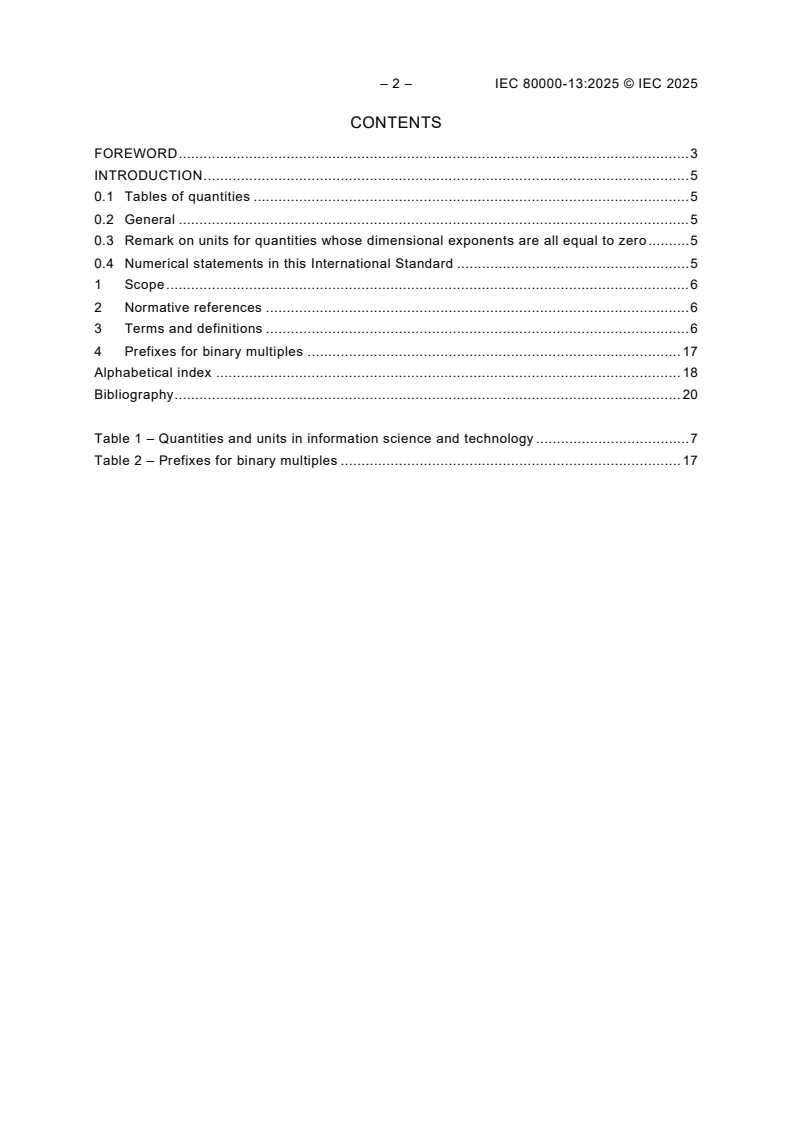
CONTENTS
FOREWORD . 3
INTRODUCTION . 5
0.1 Tables of quantities . 5
0.2 General . 5
0.3 Remark on units for quantities whose dimensional exponents are all equal to zero . 5
0.4 Numerical statements in this International Standard . 5
1 Scope . 6
2 Normative references . 6
3 Terms and definitions . 6
4 Prefixes for binary multiples . 17
Alphabetical index . 18
Bibliography . 20
Table 1 – Quantities and units in information science and technology . 7
Table 2 – Prefixes for binary multiples . 17
INTERNATIONAL ELECTROTECHNICAL COMMISSION
____________
QUANTITIES AND UNITS –
Part 13: Information science and technology
FOREWORD
1) The International Electrotechnical Commission (IEC) is a worldwide organization for standardization comprising
all national electrotechnical committees (IEC National Committees). The object of IEC is to promote international
co-operation on all questions concerning standardization in the electrical and electronic fields. To this end and
in addition to other activities, IEC publishes International Standards, Technical Specifications, Technical Reports,
Publicly Available Specifications (PAS) and Guides (hereafter referred to as "IEC Publication(s)"). Their
preparation is entrusted to technical committees; any IEC National Committee interested in the subject dealt with
may participate in this preparatory work. International, governmental and non-governmental organizations liaising
with the IEC also participate in this preparation. IEC collaborates closely with the International Organization for
Standardization (ISO) in accordance with conditions determined by agreement between the two organizations.
2) The formal decisions or agreements of IEC on technical matters express, as nearly as possible, an international
consensus of opinion on the relevant subjects since each technical committee has representation from all
interested IEC National Committees.
3) IEC Publications have the form of recommendations for international use and are accepted by IEC National
Committees in that sense. While all reasonable efforts are made to ensure that the technical content of IEC
Publications is accurate, IEC cannot be held responsible for the way in which they are used or for any
misinterpretation by any end user.
4) In order to promote international uniformity, IEC National Committees undertake to apply IEC Publications
transparently to the maximum extent possible in their national and regional publications. Any divergence between
any IEC Publication and the corresponding national or regional publication shall be clearly indicated in the latter.
5) IEC itself does not provide any attestation of conformity. Independent certification bodies provide conformity
assessment services and, in some areas, access to IEC marks of conformity. IEC is not responsible for any
services carried out by independent certification bodies.
6) All users should ensure that they have the latest edition of this publication.
7) No liability shall attach to IEC or its directors, employees, servants or agents including individual experts and
members of its technical committees and IEC National Committees for any personal injury, property damage or
other damage of any nature whatsoever, whether direct or indirect, or for costs (including legal fees) and
expenses arising out of the publication, use of, or reliance upon, this IEC Publication or any other IEC
Publications.
8) Attention is drawn to the Normative references cited in this publication. Use of the referenced publications is
indispensable for the correct application of this publication.
9) IEC and ISO draw attention to the possibility that the implementation of this document may involve the use of (a)
patent(s). IEC and ISO take no position concerning the evidence, validity or applicability of any claimed patent
rights in respect thereof. As of the date of publication of this document, IEC and ISO had not received notice of
(a) patent(s), which may be required to implement this document. However, implementers are cautioned that this
may not represent the latest information, which may be obtained from the patent database available at
https://patents.iec.ch or www.iso.org/patents. IEC and ISO shall not be held responsible for identifying any or all
such patent rights.
IEC 80000-13 has been prepared by IEC technical committee 25: Quantities and units in close
cooperation with ISO/TC 12 Quantities and units. It is an International Standard.
This second edition cancels and replaces the first edition published in 2008. This edition
constitutes a technical revision.
This edition includes the following significant technical changes with respect to the previous
edition:
a) addition of new prefixes for binary multiples.
– 4 – IEC 80000-13:2025 © IEC 2025
The text of this International Standard is based on the following documents:
Draft Report on voting
25/811/FDIS 25/823/RVD
Full information on the voting for its approval can be found in the report on voting indicated in
the above table.
The language used for the development of this International Standard is English.
A list of all parts in the ISO 80000 and IEC 80000 series, published under the general title
Quantities and units, can be found on the ISO and IEC websites.
This document was drafted in accordance with ISO/IEC Directives, Part 2, and developed in
accordance with ISO/IEC Directives, Part 1 and ISO/IEC Directives, IEC Supplement, available
at www.iec.ch/members_experts/refdocs. The main document types developed by IEC are
described in greater detail at www.iec.ch/publications.
The committee has decided that the contents of this document will remain unchanged until the
stability date indicated on the IEC website under webstore.iec.ch in the data related to the
specific document. At this date, the document will be
• reconfirmed,
• withdrawn, or
• revised.
INTRODUCTION
0.1 Tables of quantities
In most cases, only one name and only one symbol for the quantity are given; where two or
more names or two or more symbols are given for one quantity and no special distinction is
made, they are on an equal footing. When two types of italic letters exist (for example as with
ϑ and θ; φ and φ; a and a; g and g), only one of these is given. This does not mean that the
other is not equally acceptable. It is recommended that such variants should not be given
different meanings. A symbol within parenthesis implies that it is a reserve symbol, to be used
when, in a particular context, the main symbol is in use with a different meaning.
0.2 General
The names of units for the corresponding quantities are given together with the international
symbols and the definitions. These unit names are language-dependent, but the symbols are
th
international and the same in all languages. For further information, see the SI Brochure (9
edition 2019, updated in 2024) from BIPM and ISO 80000-1.
The units are arranged in the following way:
• The coherent SI units are given first. The SI units have been adopted by the General
Conference on Weights and Measures (Conférence Générale des Poids et Mesures,
CGPM). The use of coherent SI units, and their decimal multiples and submultiples formed
with the SI prefixes are recommended, although the decimal multiples and submultiples are
not explicitly mentioned.
• Some non-SI units are then given, being those accepted by the International Committee for
Weights and Measures (Comité International des Poids et Mesures, CIPM), or by the
International Organization of Legal Metrology (Organisation Internationale de Métrologie
Légale, OIML), or by ISO and IEC, for use with the SI. Such units are separated from the SI
units in the item by use of a broken line between the SI units and the other units.
0.3 Remark on units for quantities whose dimensional exponents are all equal
to zero
The coherent unit for any quantity whose dimensional exponents are equal to zero is the number
one, symbol 1. When the value of such a quantity is expressed, the unit symbol 1 is generally
not written out explicitly. Quantities that are ratios of quantities of the same kind (for example
length ratios and amount fractions) have the option of being expressed with units (m/m, mol/mol)
to aid the understanding of the quantity being expressed and also allow the use of SI prefixes,
if this is desirable (μm/m, nmol/mol).
EXAMPLE 1
Refractive index n = 1,53 × 1 = 1,53
Prefixes shall not be used to form multiples or submultiples of this unit. Instead of prefixes,
powers of 10 are recommended.
EXAMPLE 2
Reynolds number Re = 1,32 × 10
0.4 Numerical statements in this International Standard
The sign = is used to denote "is exactly equal to", the sign ≈ is used to denote "is approximately
equal to", and the sign := is used to denote "is by definition equal to".
– 6 – IEC 80000-13:2025 © IEC 2025
QUANTITIES AND UNITS –
Part 13: Information science and technology
1 Scope
This document specifies names, symbols and definitions for quantities and units used in
information science and technology. Where appropriate, conversion factors are also given.
Prefixes for binary multiples are also given.
2 Normative references
There are no normative references in this document.
3 Terms and definitions
For the purposes of this document, the following terms and definitions apply.
ISO and IEC maintain terminology databases for use in standardization at the following
addresses:
• IEC Electropedia: available at https://www.electropedia.org/
• ISO Online browsing platform: available at https://www.iso.org/obp
The names, definitions and symbols for quantities and units of information science and
technology are given in Table 1 on the following pages.
Table 1 – Quantities and units in information science and technology
Item No. Quantity Unit Remarks
Name Symbol Definition Name Symbol
13-1 traffic intensity A number of simultaneously busy 1 E corresponds to the occupancy of one resource.
resources in a particular pool of
erlang E The name "erlang" was given to the traffic intensity
resources
unit in 1946 by the International Telephone
Consultative Committee (CCIF), in honour of the
Danish mathematician, A. K. Erlang (1878-1929), who
was the founder of traffic theory in telephony.
See IEV 715-05-02.
13-2 traffic offered intensity A traffic intensity (item 13-1) of the traffic 1 E corresponds to the occupancy of one resource.
o
that would have been generated by the
erlang E See IEV 715-05-05.
users of a pool of resources if their use
had not been limited by the size of the
pool
13-3 traffic carried intensity, Y traffic intensity (item 13-1) of the traffic 1 E corresponds to the occupancy of one resource.
traffic load served by a particular pool of resources
erlang E General practice is to estimate the traffic intensity as
an average over a specified time interval, e.g. the
busy hour.
See IEV 715-05-04.
13-4 mean queue length L, (Ω) time average of queue length one 1 For the unit one, see the Introduction.
See IEV 171-02-34.
13-5 loss probability B probability for losing a call attempt one 1 For the unit one, see the Introduction.
13-6 waiting probability W probability for waiting for a resource one 1 For the unit one, see the Introduction.
−1
13-7 call intensity, λ number of call attempts over a specified second to the See IEV 715-03-13.
s
calling rate time interval divided by the duration power of
(ISO 80000-3:2019, item 3-9) of this minus one
interval
inverse
second
−1
13-8 completed call intensity μ call intensity (item 13-7) for the call second to the For a definition of the complete call attempt,
s
attempts that result in the transmission power of see IEV 715-03-11.
of an answer signal minus one
inverse
second
– 8 – IEC 80000-13:2025 © IEC 2025
Item No. Quantity Unit Remarks
Name Symbol Definition Name Symbol
13-9 storage capacity, storage M amount of data that can be contained in one 1 For the unit one, see the Introduction.
size a storage device, expressed as a number
bit bit The specified data elements depend on the
of specified data elements
organization of the storage device, for example,
octet o
binary elements (also called "bits"), octets (also
called "bytes"), words of a given number of bits,
byte B
blocks. A subscript referring to a specified data
element can be added to the symbol.
EXAMPLES:
storage capacity for bits, M
bit
storage capacity for octets, M or M .
o B
For registers, the term "register length" is used with
the same meaning.
Although in this context the designation "bit", symbol
bit, is not really a unit, it is often used like a unit, e.g.
M = 32 000, where the unit one is implicit, is often
bit
written as M = 32 000 bit. Similarly, although the
designation octet or byte, symbols o and B,
respectively, are not units, they are often used like
units, e.g., M = 4 000 or M = 4 000, where the unit
o B
one is implicit, are often written M = 4 000 o or
M = 4 000 B.
When used to express a storage capacity or an
equivalent binary storage capacity, the bit and the
octet (or byte) may be combined with SI prefixes or
prefixes for binary multiples.
In English, the name "byte", symbol B, is used as a
synonym for "octet". Here, "byte" means an eight-bit
byte. However, "byte" has been used for numbers of
bits other than eight. To avoid the risk of confusion, it
is strongly recommended that the name "byte" and
the symbol B be used only for eight-bit bytes.
The symbol B for byte is not international and is not
to be confused with the symbol B for bel.
Item No. Quantity Unit Remarks
Name Symbol Definition Name Symbol
13-10 equivalent binary storage M M = lb n one 1 For the unit one, see the Introduction.
e e
capacity
bit bit The minimum storage capacity of a bit-organized
where n is the number of possible states
storage device which would contain the amount of
of the given device
data in the given storage device is equal to the
smallest integer greater than or equal to the
equivalent binary storage capacity.
When used to express a storage capacity or an
equivalent binary storage capacity, the bit may be
combined with SI prefixes or prefixes for binary
multiples (see Clause 4).
In this context, “bit” is a special name as well as
symbol for the coherent unit one. For the unit one,
see the Introduction.
−1
13-11 transfer rate r, (ν) quotient of the number of specified data second to the The symbol ν is the Greek letter nu.
s
elements transferred in a time interval by power of
A subscript referring to a specified data element can
the duration of this interval minus one
be added to the symbol.
inverse
EXAMPLES:
second
digit rate, r or ν (see IEV 702-05-23 and IEV
d d
digit per
704-16-06);
second
transfer rate for octets (or bytes), r , r , v , or v ;
o B o B
binary digit rate or bit rate (item 13-13).
octet per o/s, B/s
second, byte
In English, the name "byte", symbol B, is used as a
per second
synonym for "octet". Here "byte" means an eight-bit
byte. See remarks in item 13-9.
The octet per second (or byte per second) may be
combined with prefixes, for example kilooctet per
second, symbol ko/s (or kilobyte per second, symbol
kB/s).
– 10 – IEC 80000-13:2025 © IEC 2025
Item No. Quantity Unit Remarks
Name Symbol Definition Name Symbol
13-12 period of data elements, T T = 1 / r where r is the transfer rate second s A subscript referring to a specified data element can
be added to the symbol.
(item 13-11) when the data elements are
period duration of data
transmitted in series EXAMPLES:
elements
period of digits, T ;
d
period of octets (or bytes), T or T .
o B
For the unit second, see IEV 112-02-04.
See IEV 171-06-05.
−1
binary digit rate,
13-13 transfer rate (item 13-11) where the data second to the In English, the systematic name would be "transfer
s
r , (ν )
bit bit
bit rate elements are binary digits power of rate for binary digits".
minus one
The bit per second may be combined with prefixes,
inverse for example megabit per second, symbol Mbit/s.
second
bit per second bit/s See IEV 704-16-07.
13-14 period of binary digits, T T = 1 / r where r is the binary digit second s See IEV 171-06-06.
bit bit bit bit
rate (item 13-13) when the binary digits
period duration of binary
are transmitted in series
digits,
bit period
−1
13-15 equivalent binary binary digit rate (item 13-13) equivalent second to the In English, the systematic name would be "equivalent
s
r , (ν )
e e
digit rate, to a transfer rate (item 13-11) for power of binary transfer rate".
equivalent bit rate specified data elements minus one
See IEV 704-17-05.
inverse
second
bit per second bit/s
−1
13-16 modulation rate, r , u inverse of the shortest duration of a second to the The term "modulation rate" is used in conventional
s
m
line digit rate signal element power of telegraphy and data transmission. In isochronous
minus one digital transmission, the term "line digit rate" is
generally used.
inverse
−1
second
1 Bd := s
baud Bd Baud is a special name for the second to the power of
minus one for this quantity.
The baud may be combined with prefixes, for example
kilobaud, symbol kBd, megabaud, symbol MBd.
See IEV 704-17-03.
Item No. Quantity Unit Remarks
Name Symbol Definition Name Symbol
13-17 quantizing distortion T distortion of a signal resulting from the watt W For the unit watt, see IEV 113-03-55.
Q
process of quantizing an original signal
See IEV 704-24-13.
when the values to be quantized are
within the working range of the quantizer
The unit of the quantizing distortion is the same as
the unit of the signal. This may not always be the
watt.
13-18 carrier power P , C power supplied to the antenna feed line watt W See IEV 713-09-20.
c
by a radio transmitter taken under the
condition of no modulation
13-19 signal energy per binary E E = P T joule J For the unit joule, see IEV 113-03-46.
bit bit c bit
digit
See IEV 171-06-07.
where P is carrier power (item 13-18)
c
and T is period of binary digits (item
bit
13-14)
13-20 error probability P probability that a data element be one 1 For the unit one, see the Introduction.
incorrectly received
A subscript referring to a specified data element can
be added to the symbol.
EXAMPLES:
error probability for binary digits or bit error
probability, P ;
bit
block error probability, P .
bl
The measured value is designated as "error ratio",
whereas "error rate" is deprecated, for example, "bit
error ratio" (BER), "block error ratio".
See IEV 171-06-08.
13-21 Hamming distance d number of digit positions in which the one 1 For the unit one, see the Introduction.
n
corresponding digits of two words of the
See IEV 721-08-25.
same length are different
13-22 clock frequency, f frequency at which a clock oscillates hertz Hz For the unit hertz, see IEV 103-06-18.
cl
clock rate
13-23 decision content D D = log n one 1 For the unit one, see the Introduction.
a a a
When the same base is used for the same number of
where a is the number of possibilities at
events then D = H , where H is maximum entropy
each decision and n the number of
a 0 0
events (item 13-26).
See IEV 171-07-10.
– 12 – IEC 80000-13:2025 © IEC 2025
Item No. Quantity Unit Remarks
Name Symbol Definition Name Symbol
13-24 information content I(x) One shannon is the quantity value when the argument
Ix( )
is equal to two.
shannon Sh
1 Sh ≈ 0,693 nat ≈ 0,301 Hart
= lb Sh
hartley Hart
p( x)
One hartley is the quantity value when the argument
is equal to ten.
1 natural unit of nat
1 Hart ≈ 3,322 Sh ≈ 2,303 nat
= lg Hart
information
p( x)
One natural unit of information is the quantity value
when the argument is equal to e, Euler's number.
= ln nat
1 nat ≈ 1,433 Sh ≈ 0,434 Hart
p( x)
See IEV 171-07-14.
where p(x) is the probability of event x
13-25 entropy H See IEV 171-07-15.
n
H( X)= px( ) I( x) for the set
∑
ii
shannon Sh
i=1
hartley Hart
XX={ ,, X}
1 n
natural unit of nat
information
where px( ) is the probability, and
i
Ix( ) is the information content of event
i
x
i
13-26 maximum entropy H , maximum entropy occurs when The maximum entropy is sometimes called "decision
content" because the value is the same when the
px = 1/ n for i = 1,…,n
( )
( H ) i
shannon Sh
max
base is an integer, for the same number of events.
See item 13-23.
hartley Hart
See IEV 171-07-16.
natural unit of nat
information
13-27 relative entropy H H = H / H one 1 See IEV 171-07-17.
r r 0
where H is entropy (item 13-25) and H
is maximum entropy (item 13-26)
13-28 redundancy R R = H − H See IEV 171-07-18.
shannon Sh
where H is entropy (item 13-25) and H
is maximum entropy (item 13-26)
hartley Hart
natural unit of nat
information
Item No. Quantity Unit Remarks
Name Symbol Definition Name Symbol
13-29 relative redundancy r r = R / H one 1 For the unit one, see the Introduction.
See IEV 171-07-19.
where R is redundancy (item 13-28) and
H is maximum entropy (item 13-26)
13-30 joint information content I(x,y) See IEV 171-07-20.
I( xy, )
shannon Sh
= lb Sh
hartley Hart
p( xy, )
natural unit of nat
= lg Hart
information
p( xy, )
= ln nat
p( xy, )
is the joint probability of events x and y
13-31 conditional information I(x|y) information content (item 13-2) of event x See IEV 171-07-21.
content under the condition that y has occurred:
shannon Sh
I(x|y) = I(x,y) − I(y)
hartley Hart
natural unit of nat
information
13-32 conditional entropy, H(X|Y) See IEV 171-07-23.
nm
mean conditional
H( X Y)= p( x , y ) I( x y )
∑∑
i j i j
shannon Sh
information content,
ij11
average conditional
hartley Hart
information content
where px , y is the joint probability of
( )
i j
natural unit of nat
information
events x and y , and Ix y is
( )
i j ij
conditional information content (item
13-31)
==
– 14 – IEC 80000-13:2025 © IEC 2025
Item No. Quantity Unit Remarks
Name Symbol Definition Name Symbol
13-33 equivocation H (X|Y) conditional entropy (item 13-32) of a set Equivocation is a quantitative measure of the loss of
+
X of emitted characters given the set Y of information due to noise.
shannon Sh
received characters
See IEV 171-07-24.
hartley Hart
natural unit of nat
information
13-34 irrelevance H (Y|X) conditional entropy (item 13-32) of a set Irrelevance is a quantitative measure of the
−
Y of received characters given the set X information added to the emitted information owing to
shannon Sh
of emitted characters: distortion.
hartley Hart
H (Y|X) = H (X|Y) + H(Y) − H(X), See IEV 171-07-25.
− +
natural unit of nat
where H (X|Y) is equivocation (item
+
information
13-33) and H is entropy (item 13-25)
13-35 transinformation content, T(x,y) T(x,y) = I(x) + I(y) − I(x,y) See IEV 171-07-26.
mutual information
where I(x) and I(y) are the information
shannon Sh
contents (13-24) of events x and y,
hartley Hart
respectively, and I(x,y) is their joint
information content (item 13-30)
natural unit of nat
information
13-36 mean transinformation T In practice, the unit "shannon per character" is
nm
content generally used, and sometimes the units "hartley per
T( X,Y)= p xy T xy
∑∑ ( ) ( )
ij,,ij
shannon Sh
character" and "natural unit per character".
ij11
hartley Hart
See IEV 171-07-27.
for the sets ,
X ={xx, ., }
1 n
natural unit of nat
information
,
Y={y , ., y }
1 m
where is the joint probability of
px( , y )
i j
and y , and is their
events x Tx( , y )
i j i j
transinformation content (item 13-35)
==
Item No. Quantity Unit Remarks
Name Symbol Definition Name Symbol
13-37 character mean entropy H′ See IEV 171-07-28.
H
m
′
H = lim
shannon Sh
m→∞ m
hartley Hart
where H is the entropy (item 13-25) of
m
the set of all sequences of m characters
natural unit of nat
information
13-38 average information rate H* H* = H′ / t(X) See IEV 171-07-29.
where H′ is character mean entropy (item
shannon per Sh/s
13-37) and t(X) is the mean value of the
second
duration of a character in the set X
hartley per Hart/s
second
natural unit of nat/s
information
per second
13-39 character mean T′ In practice, the unit "shannon per character" is
T
m
′ generally used, and sometimes the units "hartley per
transinformation content T = lim
shannon Sh
m→∞ m
character" and "natural unit per character".
hartley Hart
where T is the mean transinformation See IEV 171-07-30.
m
content (item 13-36) for all pairs of input
natural unit of nat
and output sequences of m characters information
13-40 average transinformation T* See IEV 171-07-31.
′
T
*
rate T =
nm
shannon per Sh/s
p x , y t x , y
( )( )
∑∑ i j i j
ij11 second
where T′ is character mean
hartley per Hart/s
transinformation content (item 13-39) second
and tx , y is the mean duration of the
( )
i j
natural unit of nat/s
information
pair of characters x , y with joint
( )
i j
per second
probability px , y
( )
i j
==
– 16 – IEC 80000-13:2025 © IEC 2025
Item No. Quantity Unit Remarks
Name Symbol Definition Name Symbol
13-41 channel capacity per C′ C′ = maxT′ In practice, the unit "shannon per character" is
generally used, and sometimes the units "hartley per
character
where T′ is character mean shannon Sh
character" and "natural unit per character".
transinformation content (item 13-39)
hartley Hart
See IEV 171-07-32.
natural unit of nat
information
13-42 channel time capacity; C* C* = maxT* See IEV 171-07-33.
channel capacity
where T* is average transinformation rate
shannon per Sh/s
(item 13-40)
second
hartley per Hart/s
second
natural unit of nat/s
information
per second
4 Prefixes for binary multiples
The prefixes for binary multiples shall be according to Table 2.
Table 2 – Prefixes for binary multiples
Factor Name Symbol Origin Derived from
10 10 1 3 1
2 kibi Ki kilobinary: (2 ) kilo: (10 )
20 10 2 3 2
mebi Mi
2 megabinary: (2 ) mega: (10 )
30 10 3 3 3
gibi Gi
2 gigabinary: (2 ) giga: (10 )
40 10 4 3 4
tebi Ti
2 terabinary: (2 ) tera: (10 )
50 10 5 3 5
2 pebi Pi petabinary: (2 ) peta: (10 )
60 10 6 3 6
2 exbi Ei exabinary: (2 ) exa: (10 )
70 10 7 3 7
zebi Zi
2 zettabinary: (2 ) zetta: (10 )
80 10 8 3 8
yobi Yi
2 yottabinary: (2 ) yotta: (10 )
90 10 9 3 9
robi Ri
2 ronnabinary: (2 ) ronna: (10 )
100 10 10 3 10
2 quebi Qi quettabinary: (2 ) quetta: (10 )
Suggested pronunciation in English: the first syllable in the prefix name should be pronounced in the same way as
in the first syllable of the corresponding SI prefix. The second syllable should be pronounced "bee".
EXAMPLES:
one kibibit: 1 Kibit = 2 bit = 1 024 bit
one kilobit: 1 kbit = 10 bit = 1 000 bit
one mebibyte: 1 MiB = 2 B = 1 048 576 B
one megabyte: 1 MB = 10 B = 1 000 000 B
– 18 – IEC 80000-13:2025 © IEC 2025
Alphabetical index
Name . Item No
average information rate . 13-38
average transinformation rate . 13.40
binary digit rate, bit rate . 13-13
call intensity, calling rate . 13-7
carrier power . 13-18
channel capacity per character . 13-41
channel time capacity; channel capacity . 13-42
character mean entropy . 13-37
character mean transinformation content . 13-39
clock frequency, clock rate . 13-22
completed call intensity . 13-8
conditional entropy, mean conditional information content, average conditional
information content . 13-32
conditional information content . 13-31
decision content . 13-23
entropy . 13-25
equivalent binary digit rate, equivalent bit rate . 13-15
equivalent binary storage capacity . 13-10
equivocation . 13-33
error probability . 13-20
Hamming distance . 13-21
information content . 13-24
irrelevance . 13-34
joint information content . 13-30
loss probability . 13-5
maximum entropy . 13-26
mean queue length . 13-4
mean transinformation content . 13-36
modulation rate, line digit rate . 13-16
period of binary digits, period duration of binary digits, bit period . 13-14
period of data elements, period duration of data elements . 13-12
quantizing distortion . 13-17
redundancy . 13-28
relative entropy . 13-27
relative redundancy . 13-29
signal energy per binary digit . 13-19
storage capacity, storage size . 13-9
traffic carried intensity, traffic load . 13-3
traffic intensity . 13-1
traffic offered intensity . 13-2
transfer rate . 13-11
transinformation content, mutual information . 13-35
waiting probability . 13-6
– 20 – IEC 80000-13:2025 © IEC 2025
Bibliography
[1] ISO 80000-1:2022, Quantities and units – Part 1: General
[2] ISO 80000-3:2019, Quantities and units – Part 3: Space and time
___________
– 22 – IEC 80000-13:2025 © IEC 2025
SOMMAIRE
AVANT-PROPOS . 23
INTRODUCTION . 25
0.1 Tableaux des grandeurs . 25
0.2 Généralités . 25
0.3 Remarque sur les unités des grandeurs dont tous les exposants dimensionnels
sont égaux à zéro . 25
0.4 Indications numériques dans la présente Norme internationale . 25
1 Domaine d’application . 26
2 Références normatives . 26
3 Termes et définitions . 26
4 Préfixes pour les multiples binaires . 37
Index alphabétique . 38
Bibliographie . 40
Tableau 1 – Grandeurs et unités dans la science et les technologies de l'information . 27
Tableau 2 – Préfixes pour les multiples binaires . 37
COMMISSION ÉLECTROTECHNIQUE INTERNATIONALE
____________
GRANDEURS ET UNITÉS –
Partie 13: Science et technologies de l'information
AVANT-PROPOS
1) La Commission Électrotechnique Internationale (IEC) est une organisation mondiale de normalisation composée
de l'ensemble des comités électrotechniques nationaux (Comités nationaux de l’IEC). L’IEC a pour objet de
favoriser la coopération internationale pour toutes les questions de normalisation dans les domaines de
l'électricité et de l'électronique. À cet effet, l’IEC – entre autres activités – publie des Normes internationales,
des Spécifications techniques, des Rapports techniques, des Spécifications accessibles au public (PAS) et des
Guides (ci-après dénommés "Publication(s) de l’IEC"). Leur élaboration est confiée à des comités d'études, aux
travaux desquels tout Comité national intéressé par le sujet traité peut participer. Les organisations
internationales, gouvernementales et non gouvernementales, en liaison avec l’IEC, participent également aux
travaux. L’IEC collabore étroitement avec l'Organisation Internationale de Normalisation (ISO), selon des
conditions fixées par accord entre les deux organisations.
2) Les décisions ou accords officiels de l’IEC concernant les questions techniques représentent, dans la mesure du
possible, un
...