

IEC 60050-581:2008
(Main)International Electrotechnical Vocabulary (IEV) - Part 581: Electromechanical components for electronic equipment
General Information
- Abstract
IEC 60050-581:2008 gives the general terminology used in the fields of electromechanical components for electronic equipment, and reflects the technology, design, construction, performance and application employed. It contains only the terms relating to the scope of Technical Committee 48. General and special terms which are described in other publications have not been included. SC 48C, formerly the sub-committee on Switches, has been disbanded and incorporated into IEC SC 23J. For this reason, the sections 10, 11 and 12 which included definitions for switches have been deleted. These sections will be considered by SC 23J for integration into IEC 60050-442.
It has the status of a horizontal standard in accordance with IEC Guide 108.
- Status
- Published
- Publication Date
- 18-Sep-2008
- Technical Committee
- TC 1 - Terminology
- Current Stage
- PPUB - Publication issued
- Start Date
- 19-Sep-2008
- Completion Date
- 15-Jan-2008
Overview
IEC 60050-581:2008, titled "International Electrotechnical Vocabulary (IEV) – Part 581: Electromechanical components for electronic equipment," is an international standard published by the International Electrotechnical Commission (IEC). This standard provides the general terminology associated with electromechanical components used in electronic equipment. It comprehensively covers the technology, design, construction, performance, and application aspects within the scope of IEC Technical Committee 48.
Designed as a horizontal standard under IEC Guide 108, IEC 60050-581 helps promote consistent and internationally recognized definitions. It excludes terms related to switches, as these are handled by IEC subcommittee 23J and included in IEC 60050-442. The second edition, published in 2008, updates and revises earlier editions to reflect technological advancements.
Key Topics
IEC 60050-581:2008 is organized into the following main sections, each detailing specific aspects of electromechanical components:
General Terms (Section 581-21)
Defines foundational vocabulary for electromechanical components in electronic equipment.Component Parts and Their Specific Features (Section 581-22)
Terminology related to various parts constituting electromechanical components and their characteristics.Technical Features (Section 581-23)
Descriptions of technical attributes affecting performance and functionality.Special Features and Accessories (Section 581-24)
Terms related to specialized accessories and unique functionalities.Mechanical Structures (Section 581-25)
Vocabulary for the mechanical design and structures of these components.Terminology for Connectors (Sections 581-26 & 581-27)
Detailed terms for connectors, their parts, and technical aspects critical for ensuring reliable electronic connections.
Additional resources include a comprehensive multilingual index and bibliography that support cross-language technical communication.
Applications
IEC 60050-581 plays a crucial role in various practical applications across the electromechanical and electronic industries:
Standardized Communication: Engineers, designers, and manufacturers use this vocabulary for clear and unambiguous communication about electromechanical components in product development and documentation.
Design and Development: Facilitates precise specification writing and component selection through uniform terms that accurately describe component properties and functionalities.
Quality and Compliance: Assists quality assurance teams in verifying that electromechanical components meet defined terminology standards, improving interoperability and reducing errors.
Technical Education and Training: Serves as a foundational reference for teaching electromechanical component concepts in educational institutions.
Technical Documentation: Used in the preparation of manuals, datasheets, and regulatory documents to ensure international understanding and consistency.
Related Standards
IEC 60050 series comprises multiple parts focusing on different areas of electrotechnical vocabulary:
IEC 60050-442: Electromechanical components related to switches
Incorporates terminology on switches formerly in this standard, managed by IEC SC 23J.IEC 60050 General Terms (Parts 12 and 13)
Contain broader electrotechnical vocabulary applicable across various electrical and electronic domains.IEC Guide 108: Horizontal Standards
Provides the framework for creating horizontal standards like IEC 60050-581, ensuring consistency among vocabulary documents.
Additional related IEC standards address component testing, performance criteria, and safety requirements that complement the terminology defined by IEC 60050-581.
For professionals involved in electromechanical component design, manufacturing, testing, and standardization, IEC 60050-581:2008 is an essential resource to ensure precise and harmonized terminology across the global electronic equipment industry. Utilize this vocabulary to enhance clarity, consistency, and compliance in all aspects of electromechanical components.
Relations
- Effective Date
- 22-Sep-2026
- Effective Date
- 25-Aug-2026
- Effective Date
- 25-Aug-2026
- Effective Date
- 25-Aug-2026
- Effective Date
- 25-Aug-2026
- Effective Date
- 25-Aug-2026
- Effective Date
- 25-Aug-2026
- Effective Date
- 25-Aug-2026
- Effective Date
- 25-Aug-2026
- Effective Date
- 25-Aug-2026
- Effective Date
- 25-Aug-2026
- Effective Date
- 25-Aug-2026
- Effective Date
- 25-Aug-2026
- Effective Date
- 25-Aug-2026
- Effective Date
- 25-Aug-2026
Frequently Asked Questions
IEC 60050-581:2008 is a standard published by the International Electrotechnical Commission (IEC). Its full title is "International Electrotechnical Vocabulary (IEV) - Part 581: Electromechanical components for electronic equipment". This standard covers: IEC 60050-581:2008 gives the general terminology used in the fields of electromechanical components for electronic equipment, and reflects the technology, design, construction, performance and application employed. It contains only the terms relating to the scope of Technical Committee 48. General and special terms which are described in other publications have not been included. SC 48C, formerly the sub-committee on Switches, has been disbanded and incorporated into IEC SC 23J. For this reason, the sections 10, 11 and 12 which included definitions for switches have been deleted. These sections will be considered by SC 23J for integration into IEC 60050-442. It has the status of a horizontal standard in accordance with IEC Guide 108.
IEC 60050-581:2008 gives the general terminology used in the fields of electromechanical components for electronic equipment, and reflects the technology, design, construction, performance and application employed. It contains only the terms relating to the scope of Technical Committee 48. General and special terms which are described in other publications have not been included. SC 48C, formerly the sub-committee on Switches, has been disbanded and incorporated into IEC SC 23J. For this reason, the sections 10, 11 and 12 which included definitions for switches have been deleted. These sections will be considered by SC 23J for integration into IEC 60050-442. It has the status of a horizontal standard in accordance with IEC Guide 108.
IEC 60050-581:2008 is classified under the following ICS (International Classification for Standards) categories: 01.040.31 - Electronics (Vocabularies); 31.220.01 - Electromechanical components in general. The ICS classification helps identify the subject area and facilitates finding related standards.
IEC 60050-581:2008 has the following relationships with other standards: It is inter standard links to EN IEC 61076-2-117:2026, EN 3373-001:2022, EN 4199-001:2013, EN 2591-100:2018, EN ISO 15118-1:2015, EN 4604-006:2025, EN 3660-001:2019, EN 3660-001:2016, EN 4604-007:2025, EN 13477-2:2010, EN 2591-100:2024, EN 4604-003:2025, EN 2283:2010, EN 2242:2012, EN 4604-008:2025. Understanding these relationships helps ensure you are using the most current and applicable version of the standard.
IEC 60050-581:2008 is available in PDF format for immediate download after purchase. The document can be added to your cart and obtained through the secure checkout process. Digital delivery ensures instant access to the complete standard document.
Standards Content (Sample)
IEC 60050-581
Edition 2.0 2008-09
INTERNATIONAL
STANDARD
NORME
INTERNATIONALE
International Electrotechnical Vocabulary –
Part 581: Electromechanical components for electronic equipment
Vocabulaire Electrotechnique International –
Partie 581: Composants électromécaniques pour équipements électroniques
All rights reserved. Unless otherwise specified, no part of this publication may be reproduced or utilized in any form or by
any means, electronic or mechanical, including photocopying and microfilm, without permission in writing from either IEC or
IEC's member National Committee in the country of the requester.
If you have any questions about IEC copyright or have an enquiry about obtaining additional rights to this publication,
please contact the address below or your local IEC member National Committee for further information.
Droits de reproduction réservés. Sauf indication contraire, aucune partie de cette publication ne peut être reproduite
ni utilisée sous quelque forme que ce soit et par aucun procédé, électronique ou mécanique, y compris la photocopie
et les microfilms, sans l'accord écrit de la CEI ou du Comité national de la CEI du pays du demandeur.
Si vous avez des questions sur le copyright de la CEI ou si vous désirez obtenir des droits supplémentaires sur cette
publication, utilisez les coordonnées ci-après ou contactez le Comité national de la CEI de votre pays de résidence.
IEC Central Office
3, rue de Varembé
CH-1211 Geneva 20
Switzerland
Email: inmail@iec.ch
Web: www.iec.ch
About the IEC
The International Electrotechnical Commission (IEC) is the leading global organization that prepares and publishes
International Standards for all electrical, electronic and related technologies.
About IEC publications
The technical content of IEC publications is kept under constant review by the IEC. Please make sure that you have the
latest edition, a corrigenda or an amendment might have been published.
ƒ Catalogue of IEC publications: www.iec.ch/searchpub
The IEC on-line Catalogue enables you to search by a variety of criteria (reference number, text, technical committee,…).
It also gives information on projects, withdrawn and replaced publications.
ƒ IEC Just Published: www.iec.ch/online_news/justpub
Stay up to date on all new IEC publications. Just Published details twice a month all new publications released. Available
on-line and also by email.
ƒ Electropedia: www.electropedia.org
The world's leading online dictionary of electronic and electrical terms containing more than 20 000 terms and definitions
in English and French, with equivalent terms in additional languages. Also known as the International Electrotechnical
Vocabulary online.
ƒ Customer Service Centre: www.iec.ch/webstore/custserv
If you wish to give us your feedback on this publication or need further assistance, please visit the Customer Service
Centre FAQ or contact us:
Email: csc@iec.ch
Tel.: +41 22 919 02 11
Fax: +41 22 919 03 00
A propos de la CEI
La Commission Electrotechnique Internationale (CEI) est la première organisation mondiale qui élabore et publie des
normes internationales pour tout ce qui a trait à l'électricité, à l'électronique et aux technologies apparentées.
A propos des publications CEI
Le contenu technique des publications de la CEI est constamment revu. Veuillez vous assurer que vous possédez
l’édition la plus récente, un corrigendum ou amendement peut avoir été publié.
ƒ Catalogue des publications de la CEI: www.iec.ch/searchpub/cur_fut-f.htm
Le Catalogue en-ligne de la CEI vous permet d’effectuer des recherches en utilisant différents critères (numéro de référence,
texte, comité d’études,…). Il donne aussi des informations sur les projets et les publications retirées ou remplacées.
ƒ Just Published CEI: www.iec.ch/online_news/justpub
Restez informé sur les nouvelles publications de la CEI. Just Published détaille deux fois par mois les nouvelles
publications parues. Disponible en-ligne et aussi par email.
ƒ Electropedia: www.electropedia.org
Le premier dictionnaire en ligne au monde de termes électroniques et électriques. Il contient plus de 20 000 termes et
définitions en anglais et en français, ainsi que les termes équivalents dans les langues additionnelles. Egalement appelé
Vocabulaire Electrotechnique International en ligne.
ƒ Service Clients: www.iec.ch/webstore/custserv/custserv_entry-f.htm
Si vous désirez nous donner des commentaires sur cette publication ou si vous avez des questions, visitez le FAQ du
Service clients ou contactez-nous:
Email: csc@iec.ch
Tél.: +41 22 919 02 11
Fax: +41 22 919 03 00
IEC 60050-581
Edition 2.0 2008-09
INTERNATIONAL
STANDARD
NORME
INTERNATIONALE
International Electrotechnical Vocabulary –
Part 581: Electromechanical components for electronic equipment
Vocabulaire Electrotechnique International –
Partie 581: Composants électromécaniques pour équipements électroniques
INTERNATIONAL
ELECTROTECHNICAL
COMMISSION
COMMISSION
ELECTROTECHNIQUE
PRICE CODE
INTERNATIONALE
XB
CODE PRIX
ICS 31.220; 01.040.31 ISBN 978-2-88910-027-9
– II – 60050-581 © IEC:2008
---
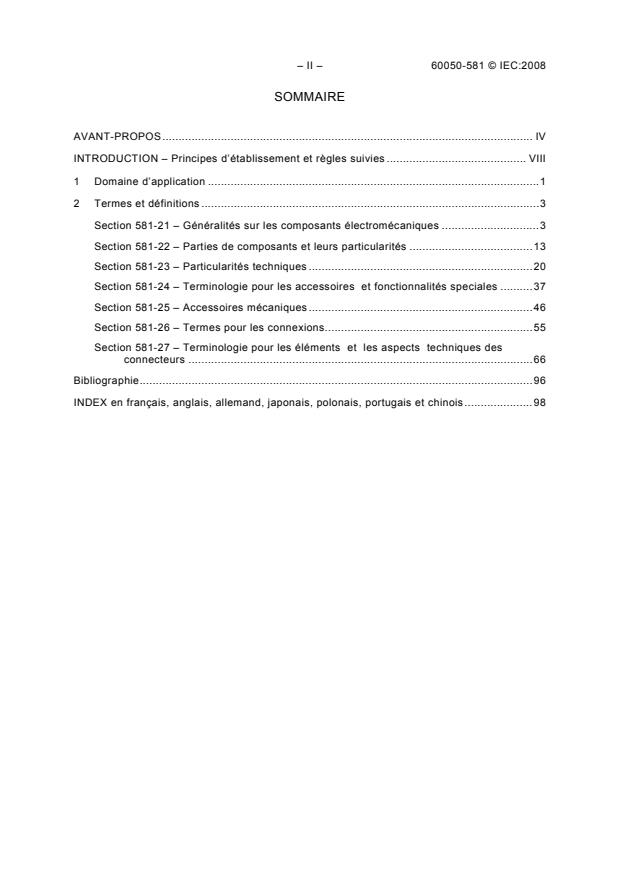
SOMMAIRE
AVANT-PROPOS. IV
INTRODUCTION – Principes d’établissement et règles suivies . VIII
1 Domaine d’application .1
2 Termes et définitions .3
Section 581-21 – Généralités sur les composants électromécaniques .3
Section 581-22 – Parties de composants et leurs particularités .13
Section 581-23 – Particularités techniques .20
Section 581-24 – Terminologie pour les accessoires et fonctionnalités speciales .37
Section 581-25 – Accessoires mécaniques .46
Section 581-26 – Termes pour les connexions.55
Section 581-27 – Terminologie pour les éléments et les aspects techniques des
connecteurs .66
Bibliographie.96
INDEX en français, anglais, allemand, japonais, polonais, portugais et chinois.98
60050-581 © IEC:2008 – III –
CONTENTS
FOREWORD. V
INTRODUCTION – Principles and rules followed . IX
1 Scope.2
2 Terms and definitions .3
Section 581-21 – General terms of electromechanical components .3
Section 581-22 – Terms for parts of electromechanical components.13
Section 581-23 – Terms for technical features of electromechanical components .20
Section 581-24 – Terms for special features and accessories.37
Section 581-25 – Terms for mechanical structures .46
Section 581-26 – Terms for connectors .55
Section 581-27 – Terms for parts and technical features of connectors .66
Bibliography.97
INDEX in French, English, German, Japanese, Polish, Portuguese and Chinese .98
– IV – 60050-581 © IEC:2008
COMMISSION ÉLECTROTECHNIQUE INTERNATIONALE
____________
VOCABULAIRE ELECTROTECHNIQUE INTERNATIONAL –
PARTIE 581: COMPOSANTS ÉLECTROMÉCANIQUES
POUR ÉQUIPEMENTS ÉLECTRONIQUES
AVANT-PROPOS
1) La Commission Electrotechnique Internationale (CEI) est une organisation mondiale de normalisation
composée de l'ensemble des comités électrotechniques nationaux (Comités nationaux de la CEI). La CEI a
pour objet de favoriser la coopération internationale pour toutes les questions de normalisation dans les
domaines de l'électricité et de l'électronique. A cet effet, la CEI – entre autres activités – publie des Normes
internationales, des Spécifications techniques, des Rapports techniques, des Spécifications accessibles au
public (PAS) et des Guides (ci-après dénommés "Publication(s) de la CEI"). Leur élaboration est confiée à des
comités d'études, aux travaux desquels tout Comité national intéressé par le sujet traité peut participer. Les
organisations internationales, gouvernementales et non gouvernementales, en liaison avec la CEI, participent
également aux travaux. La CEI collabore étroitement avec l'Organisation Internationale de Normalisation (ISO),
selon des conditions fixées par accord entre les deux organisations.
2) Les décisions ou accords officiels de la CEI concernant les questions techniques représentent, dans la mesure
du possible, un accord international sur les sujets étudiés, étant donné que les Comités nationaux de la CEI
intéressés sont représentés dans chaque comité d’études.
3) Les Publications de la CEI se présentent sous la forme de recommandations internationales et sont agréées
comme telles par les Comités nationaux de la CEI. Tous les efforts raisonnables sont entrepris afin que la CEI
s'assure de l'exactitude du contenu technique de ses publications; la CEI ne peut pas être tenue responsable
de l'éventuelle mauvaise utilisation ou interprétation qui en est faite par un quelconque utilisateur final.
4) Dans le but d'encourager l'uniformité internationale, les Comités nationaux de la CEI s'engagent, dans toute la
mesure possible, à appliquer de façon transparente les Publications de la CEI dans leurs publications
nationales et régionales. Toutes divergences entre toutes Publications de la CEI et toutes publications
nationales ou régionales correspondantes doivent être indiquées en termes clairs dans ces dernières.
5) La CEI n’a prévu aucune procédure de marquage valant indication d’approbation et n'engage pas sa
responsabilité pour les équipements déclarés conformes à une de ses Publications.
6) Tous les utilisateurs doivent s'assurer qu'ils sont en possession de la dernière édition de cette publication.
7) Aucune responsabilité ne doit être imputée à la CEI, à ses administrateurs, employés, auxiliaires ou
mandataires, y compris ses experts particuliers et les membres de ses comités d'études et des Comités
nationaux de la CEI, pour tout préjudice causé en cas de dommages corporels et matériels, ou de tout autre
dommage de quelque nature que ce soit, directe ou indirecte, ou pour supporter les coûts (y compris les frais
de justice) et les dépenses découlant de la publication ou de l'utilisation de cette Publication de la CEI ou de
toute autre Publication de la CEI, ou au crédit qui lui est accordé.
8) L'attention est attirée sur les références normatives citées dans cette publication. L'utilisation de publications
référencées est obligatoire pour une application correcte de la présente publication.
9) L’attention est attirée sur le fait que certains des éléments de la présente Publication de la CEI peuvent faire
l’objet de droits de propriété intellectuelle ou de droits analogues. La CEI ne saurait être tenue pour
responsable de ne pas avoir identifié de tels droits de propriété et de ne pas avoir signalé leur existence.
La Norme internationale CEI 60050(581) a été établie par le Comité d’Etudes 1 de la CEI:
Terminologie, en collaboration avec le Comité d’Etudes 48 de la CEI : Composants
électromécaniques et structures mécaniques pour équipements électroniques.
Cette deuxième édition remplace la première édition première publié en 1978 et
l’amendement 1 (1998). Elle constitue une revision technique.
La présente partie de la CEI 60050 ne contient que les termes se référant au domaine
d’activité du Comité d’Etudes 48. Les termes généraux et spéciaux qui sont décrits dans
d’autres publications n’y sont pas compris. Le SC 48C, autrefois le SC sur des commutateurs,
a été dissout et transféré dans le SC 23J. Ainsi, les sections 10, 11 and 12 qui comprennaient
des définitions pour interrupteurs ont été supprimées. Ces sections seront désormais prises
en compte par le SC 23J pour leur intégration ultérieure dans la CEI 60050-442.
60050-581 © IEC:2008 – V –
INTERNATIONAL ELECTROTECHNICAL COMMISSION
____________
INTERNATIONAL ELECTROTECHNICAL VOCABULARY –
PART 581: ELECTROMECHANICAL COMPONENTS
FOR ELECTRONIC EQUIPMENT
FOREWORD
1) The International Electrotechnical Commission (IEC) is a worldwide organization for standardization comprising
all national electrotechnical committees (IEC National Committees). The object of IEC is to promote
international co-operation on all questions concerning standardization in the electrical and electronic fields. To
this end and in addition to other activities, IEC publishes International Standards, Technical Specifications,
Technical Reports, Publicly Available Specifications (PAS) and Guides (hereafter referred to as “IEC
Publication(s)”). Their preparation is entrusted to technical committees; any IEC National Committee interested
in the subject dealt with may participate in this preparatory work. International, governmental and non-
governmental organizations liaising with the IEC also participate in this preparation. IEC collaborates closely
with the International Organization for Standardization (ISO) in accordance with conditions determined by
agreement between the two organizations.
2) The formal decisions or agreements of IEC on technical matters express, as nearly as possible, an international
consensus of opinion on the relevant subjects since each technical committee has representation from all
interested IEC National Committees.
3) IEC Publications have the form of recommendations for international use and are accepted by IEC National
Committees in that sense. While all reasonable efforts are made to ensure that the technical content of IEC
Publications is accurate, IEC cannot be held responsible for the way in which they are used or for any
misinterpretation by any end user.
4) In order to promote international uniformity, IEC National Committees undertake to apply IEC Publications
transparently to the maximum extent possible in their national and regional publications. Any divergence
between any IEC Publication and the corresponding national or regional publication shall be clearly indicated in
the latter.
5) IEC provides no marking procedure to indicate its approval and cannot be rendered responsible for any
equipment declared to be in conformity with an IEC Publication.
6) All users should ensure that they have the latest edition of this publication.
7) No liability shall attach to IEC or its directors, employees, servants or agents including individual experts and
members of its technical committees and IEC National Committees for any personal injury, property damage or
other damage of any nature whatsoever, whether direct or indirect, or for costs (including legal fees) and
expenses arising out of the publication, use of, or reliance upon, this IEC Publication or any other IEC
Publications.
8) Attention is drawn to the Normative references cited in this publication. Use of the referenced publications is
indispensable for the correct application of this publication.
9) Attention is drawn to the possibility that some of the elements of this IEC Publication may be the subject of
patent rights. IEC shall not be held responsible for identifying any or all such patent rights.
International Standard IEC 60050(581) has been prepared by IEC Technical Committee 1:
Terminology, in collaboration with IEC Technical Committee 48: Electromechanical
components and mechanical structures for electronic equipment.
This second edition replaces the first edition published in 1978 and amendment 1 (1998). This
second edition constitutes a technical revision.
This part of IEC 60050 contains only the terms relating to the scope of Technical Committee
48. General and special terms which are described in other publications have not been
included. SC 48C, formerly the sub-committee on Switches, has been disbanded and
incorporated into IEC SC 23J. For this reason, the sections 10, 11 and 12 which included
definitions for switches have been deleted. These sections will be considered by SC 23J for
integration into IEC 60050-442.
– VI – 60050-581 © IEC:2008
Le texte de cette norme est issu des documents suivants:
FDIS Rapport de vote
1/2037/FDIS 1/2054/RVD
Le rapport de vote indiqué dans le tableau ci-dessus donne toute information sur le vote ayant
abouti à l'approbation de cette norme.
Cette publication a été rédigée selon les Directives ISO/CEI, Partie 2.
Dans la présente partie du VEI les termes et définitions sont donnés en français et en anglais:
de plus, les termes sont indiqués en allemand (de), japonais (ja), polonais (pl), portugais (pt)
et chinois (zh).
Le comité a décidé que le contenu de cette publication ne sera pas modifié avant la date de
maintenance indiquée sur le site web de la CEI sous "http://webstore.iec.ch" dans les
données relatives à la publication recherchée. A cette date, la publication sera
• reconduite,
• supprimée,
• remplacée par une édition révisée, ou
• amendée.
60050-581 © IEC:2008 – VII –
The text of this standard is based on the following documents:
FDIS Report on voting
1/2037/FDIS 1/2054/RVD
Full information on the voting for the approval of this standard can be found in the report on
voting indicated in the above table.
This publication has been drafted in accordance with the ISO/IEC Directives, Part 2.
In this part of IEV, the terms and definitions are written in French and English; in addition the
terms are given in German (de), Japanese (ja), Polish (pl), Portuguese (pt) and Chinese (zh).
The committee has decided that the contents of this publication will remain unchanged until
the maintenance result date indicated on the IEC web site under "http://webstore.iec.ch" in
the data related to the specific publication. At this date, the publication will be
• reconfirmed,
• withdrawn,
• replaced by a revised edition, or
• amended.
– VIII – 60050-581 © IEC:2008
INTRODUCTION
Principes d’établissement et règles suivies
Généralités
Le VEI (série de normes CEI 60050) est un vocabulaire multilingue à usage général couvrant le
champ de l’électrotechnique, de l’électronique et des télécommunications. Il comprend environ 18 000
articles terminologiques correspondant chacune à une notion. Ces articles sont répartis dans environ
80 parties, chacune correspondant à un domaine donné.
Exemples :
Partie 161 (CEI 60050-161) : Compatibilité électromagnétique
Partie 411 (CEI 60050-411) : Machines tournantes
Les articles suivent un schéma de classification hiérarchique Partie/Section/Notion, les notions étant,
au sein des sections, classées par ordre systématique.
Les termes, définitions et notes des articles sont donnés dans les trois langues de la CEI, c’est-à-dire
français, anglais et russe (langues principales du VEI).
Dans chaque article, les termes seuls sont également donnés dans les langues additionnelles du VEI
(arabe, chinois, allemand, grec, espagnol, italien, japonais, polonais, portugais et suédois).
De plus, chaque partie comprend un index alphabétique des termes inclus dans cette partie, et ce
pour chacune des langues du VEI.
NOTE Certaines langues peuvent manquer.
Constitution d’un article terminologique
Chacun des articles correspond à une notion, et comprend :
- un numéro d’article,
- éventuellement un symbole littéral de grandeur ou d’unité,
puis, pour chaque langue principale du VEI :
- le terme désignant la notion, appelé “ terme privilégié ”, éventuellement accompagné de
synonymes et d’abréviations,
- la définition de la notion,
- éventuellement la source,
- éventuellement des notes,
et enfin, pour les langues additionnelles du VEI, les termes seuls.
Numéro d’article
Le numéro d’article comprend trois éléments, séparés par des traits d’union :
- Numéro de partie : 3 chiffres,
- Numéro de section : 2 chiffres,
- Numéro de la notion : 2 chiffres (01 à 99).
Exemple : 131-13-22
60050-581 © IEC:2008 – IX –
INTRODUCTION
Principles and rules followed
General
The IEV (IEC 60050 series) is a general purpose multilingual vocabulary covering the field of
electrotechnology, electronics and telecommunication. It comprises about 18 000 terminological
entries, each corresponding to a concept. These entries are distributed among about 80 parts, each
part corresponding to a given field.
Examples:
Part 161 (IEC 60050-161) : Electromagnetic compatibility
Part 411 (IEC 60050-411) : Rotating machines
The entries follow a hierarchical classification scheme Part/Section/Concept, the concepts being,
within the sections, organized in a systematic order.
The terms, definitions and notes in the entries are given in the three IEC languages, that is French,
English and Russian (principal IEV languages).
In each entry, the terms alone are also given in the additional IEV languages (Arabic, Chinese,
German, Greek, Spanish, Italian, Japanese, Polish, Portuguese, and Swedish).
In addition, each part comprises an alphabetical index of the terms included in that part, for each of
the IEV languages.
NOTE Some languages may be missing.
Organization of a terminological entry
Each of the entries corresponds to a concept, and comprises:
- an entry number,
- possibly a letter symbol for quantity or unit,
then, for each of the principal IEV languages:
- the term designating the concept, called “preferred term”, possibly accompanied by synonyms and
abbreviations,
- the definition of the concept,
- possibly the source,
- possibly notes,
and finally, for the additional IEV languages, the terms alone.
Entry number
The entry number is comprised of three elements, separated by hyphens:
- Part number : 3 digits,
- Section number : 2 digits,
- Concept number : 2 digits (00 to 99).
Example : 131-13-22
– X – 60050-581 © IEC:2008
Symboles littéraux de grandeurs et unités
Ces symboles, indépendants de la langue, sont donnés sur une ligne séparée suivant le numéro
d’article.
Exemple :
131-12-04
symb.: R
résistance, f
Terme privilégié et synonymes
Le terme privilégié est le terme qui figure en tête d’un article ; il peut être suivi par des synonymes. Il
est imprimé en gras.
Synonymes :
Les synonymes sont imprimés sur des lignes séparées sous le terme privilégié : ils sont également
imprimés en gras, sauf les synonymes déconseillés, qui sont imprimés en maigre, et suivis par
l’attribut “ (déconseillé) ”.
Parties pouvant être omises :
Certaines parties d’un terme peuvent être omises, soit dans le domaine considéré, soit dans un
contexte approprié. Ces parties sont alors imprimées en gras, entre parenthèses :
Exemple: émission (électromagnétique)
Absence de terme approprié :
Lorsqu’il n’existe pas de terme approprié dans une langue, le terme privilégié est remplacé par cinq
points, comme ceci :
.....
“ ” (et il n’y a alors bien entendu pas de synonymes).
Attributs
Chaque terme (ou synonyme) peut être suivi d’attributs donnant des informations supplé-mentaires ;
ces attributs sont imprimés en maigre, à la suite de ce terme, et sur la même ligne.
Exemples d’attributs :
- spécificité d’utilisation du terme :
rang (d’un harmonique)
- variante nationale :
unité de traitement CA
- catégorie grammaticale :
électronique, adj
électronique, f
- abréviation :
CEM (abréviation)
- déconseillé :
déplacement (terme déconseillé)
60050-581 © IEC:2008 – XI –
Letter symbols for quantities and units
These symbols, which are language independent, are given on a separate line following the entry
number.
Example:
131-12-04
symb.: R
résistance, f
Preferred term and synonyms
The preferred term is the term that heads a terminological entry; it may be followed by synonyms. It is
printed in boldface.
Synonyms:
The synonyms are printed on separate lines under the preferred term: they are also printed in
boldface, excepted for deprecated synonyms, which are printed in lightface, and followed by the
attribute "(deprecated)".
Parts that may be omitted:
Some parts of a term may be omitted, either in the field under consideration or in an appropriate
context. Such parts are printed in boldface type, and placed in parentheses:
Example : (electromagnetic) emission
Absence of an appropriate term:
When no adequate term exists in a given language, the preferred term is replaced by five dots, like
.....
that: " " (and there are of course no synonyms).
Attributes
Each term (or synonym) may be followed by attributes giving additional information, and printed on the
same line as the corresponding term, following this term.
Examples of attributes:
- specific use of the term :
transmission line (in electric power systems)
- national variant :
lift GB
- grammatical information :
thermoplastic, noun
AC, qualifier
- abbreviation :
EMC (abbreviation)
- deprecated :
choke (deprecated)
– XII – 60050-581 © IEC:2008
Source
Dans certains cas, il a été nécessaire d’inclure dans une partie du VEI une notion prise dans une
autre partie du VEI, ou dans un autre document de terminologie faisant autorité (VIM, ISO/CEI 2382,
etc.), dans les deux cas avec ou sans modification de la définition (ou éventuellement du terme).
Ceci est indiqué par la mention de cette source, imprimée en maigre et placée entre crochets à la fin
de la définition :
Exemple : [131-03-13 MOD]
(MOD indique que la définition a été modifiée)
Termes dans les langues additionnelles du VEI
Ces termes sont placés à la fin de l’article, sur des lignes séparées (une ligne par langue), précédés
par le code alpha-2 de la langue, défini dans l’ISO 639, et dans l’ordre alphabétique de ce code. Les
synonymes sont séparés par des points-virgules.
60050-581 © IEC:2008 – XIII –
Source
In some cases, it has been necessary to include in an IEV part a concept taken from another IEV part,
or from another authoritative terminology document (VIM, ISO/IEC 2382, etc.), in both cases with or
without modification to the definition (and possibly to the term).
This is indicated by the mention of this source, printed in lightface, and placed between square
brackets at the end of the definition.
Example : [131-03-13 MOD]
(MOD indicates that the definition has been modified)
Terms in additional IEV languages
These terms are placed at the end of the entry, on separate lines (one single line for each language),
preceded by the alpha-2 code for the language defined in ISO 639, and in the alphabetic order of this
code. Synonyms are separated by semicolons.
60050-581 © IEC:2008 – 1 –
VOCABULAIRE ÉLECTROTECHNIQUE INTERNATIONAL
PARTIE 581 – COMPOSANTS ÉLECTROMÉCANIQUES
POUR ÉQUIPEMENTS ÉLECTRONIQUES
1 Domaine d’application
Cette partie de la CEI 60050 fournit la terminologie générale utilisée dans les domaines des
composants électromécaniques pour équipements électroniques, et couvre la technologie, la
conception, la construction, les performances et leurs applications.
Cette terminologie est conforme à la terminologie figurant dans les autres parties spécialisées
du VEI.
– 2 – 60050-581 © IEC:2008
INTERNATIONAL ELECTROTECHNICAL VOCABULARY
Part 581 – ELECTROMECHANICAL COMPONENTS
FOR ELECTRONIC EQUIPMENT
1 Scope
This part of IEC 60050 gives the general terminology used in the fields of electromechanical
components for electronic equipment, and reflects the technology, design, construction,
performance and application employed.
This terminology is consistent with the terminology developed in the other specialised parts of
the IEV.
60050-581 © IEC:2008 – 3 –
2 Termes et définitions
2 Terms and definitions
SECTION 581-21 – GÉNÉRALITÉS SUR LES COMPOSANTS ÉLECTROMÉCANIQUES
SECTION 581-21 – GENERAL TERMS OF ELECTROMECHANICAL COMPONENTS
581-21-01
catégorie climatique
indication de forme concise des exigences climatiques fondamentales auxquelles il convient
que le composant électromécanique satisfasse
climatic category
short form indication of the basic climatic requirements which an electromechanical
component should meet
de Klimakategorie, f
ja 耐候性カテゴリー
pl kategoria klimatyczna
pt categoria climática
zh 气候类别
581-21-02
catégorie de surtension
chiffre définissant une condition de surtension transitoire
overvoltage category
numeral defining a transient overvoltage condition
de Überspannungskategorie, f
ja 過電圧カテゴリー
pl kategoria przepięcia
pt categoria de sobretensão
zh 过电压类别
581-21-03
sous charge
se dit d’un composant lorsqu’au cours d’une utilisation normale un courant circule à travers la
connexion
under load
qualifies a component when, during normal use, a current is flowing through the connection
de unter Last, adjektivisch
ja 通電下
pl pod obciążeniem
pt subcarga
zh 承受负载
– 4 – 60050-581 © IEC:2008
581-21-04
coordination de l’isolement
sélection de la rigidité diélectrique des matériels, en fonction des tensions qui peuvent
apparaître dans le réseau auquel ces matériels sont destinés, et compte tenu de
l'environnement de service et des caractéristiques des dispositifs de protection disponibles
[604-03-08 MOD]
insulation coordination
selection of the electric strength of equipment in relation to the voltages which can appear on
the system for which the equipment is intended, and taking into account the service
environment and the characteristics of the available protective devices
[604-03-08 MOD]
de Isolationskoordination, f
ja 絶縁協調
pl koordynacja izolacji
pt coordenação de isolamento
zh 绝缘配合
581-21-05
courant (connecteur) assigné
valeur de courant d’un connecteur, utilisé pour des spécifications, que le connecteur peut
transporter de façon continue (sans interruption) et simultanément à travers tous ses
contacts, câblés avec le conducteur spécifié le plus grand, avec une température ambiante à
proximitè du connecteur est maintenue à 40 °C
NOTE Si d’autre températures ambiantes sont utilisées pour la définition du courant assigné, il
convient que la spécification indique la température ambiante sur laquelle se basent les
caractéristiques assignées, en citant en référence, le cas échéant, le taux de réduction défini dans la
CEI 60512, essai 5b.
rated (connector) current
value of the electric current in a connector used for specification purposes, established for the
operating condition in which the electric current is present continuously and simultaneously in
all contacts of the connector being wired with the largest specified conductor, while the
ambient temperature near the connector is maintained at 40 °C
NOTE If other ambient temperatures are used for the definition of rated connector current, the
specification should state in the ambient temperature on which the rating is based, with reference, if
appropriate, to the rating curve defined in IEC 60512, test 5b.
de Bemessungsstrom (für einen Steckverbinder), m
ja 定格(コネクタ)電流
pl prąd znamionowy (złącza)
pt corrente estipulada (de um conector
zh 连接器额定电流
60050-581 © IEC:2008 – 5 –
581-21-06
cycle de fonctionnement (d’un connecteur)
une insertion et une extraction des moitiés de connecteur
cycle of (connector) operation
one insertion and one withdrawal of the connector halves
de Steckzyklus (für einen Steckverbinder), m
ja (コネクタ)挿抜回数
pl cykl roboczy (złącza)
pt ciclo de operação (de um conector)
zh 连接器的操作循环
581-21-07
degré de pollution
chiffre caractérisant la pollution attendue du micro-environnement
NOTE Voir aussi les concepts « pollution » en 442-01-28 et « micro-environnement » en 442-01-29.
pollution degree
numeral characterizing the expected pollution of the micro-environment
NOTE See also the concepts “pollution” in 442-01-28 and “micro-environment” in 442-01-29.
de Verschmutzungsgrad, m
ja 汚損度
pl stopień zanieczyszczenia
pt grau de poluição
zh 污染程度
581-21-08
essai de type, m
essai de conformité effectué sur un ou plusieurs échantillons représentatives de la production
[151-16-16]
type test
conformity test made on one or more items representative of the production
[151-16-16]
de Bauartprüfung, f ; Typprüfung, f ; Baumusterprüfung, f
ja 形式試験
pl badanie typu
pt teste de tipo
zh 型式试验
– 6 – 60050-581 © IEC:2008
581-21-09
force d’arrachement
force nécessaire pour séparer un connecteur de son raccordement par une traction axiale
pull-out force
force required to separate a conductor from its termination by an axial pull
de Leiter-Ausziehkraft, f
ja 引張力
pl siła wyciągnięcia
pt força de extracção
zh 拉脱力
581-21-10
programme d’essais complets
programme d’essais exhaustif en vue démontrer des performances environnementales,
électriques et mécaniques
full test schedule
complete schedule of tests to demonstrate environmental, electrical and mechanical
performance
de Gesamt-Prüfprogramm, n
ja 全項目試験計画
pl program badań pełnych
pt programa de testes completos
zh 全面试验一览表
581-21-11
programme d’essais de base
programme minimal d’essais en vue démontrer des performances environnementales,
électriques et mécaniques
basic test schedule
minimum schedule of tests to demonstrate environmental, electrical and mechanical performance
de Grund-Prüfprogramm, n
ja 基本試験計画
pl program badań podstawowych
pt programa de testes básicos
zh 基本试验一览表
581-21-12
programme d'essais intermédiaire
sous-ensemble d'essais, formé en omettant les parties du programme d'essais complet qui
sont considérées inappropriées
intermediate test schedule
sub-sets of tests, formed by omitting those sections from the full test schedule that are
considered to be not appropriate
de Teil-Prüfprogramm, n
ja 中間試験計画
pl program badań pośrednich
pt programa de testes intermédios
zh 中等试验一览表
60050-581 © IEC:2008 – 7 –
581-21-13
surtension, f
tension électrique dont la valeur dépasse une valeur limite spécifiée
[151-15-27]
over-voltage
over-tension
voltage the value of which exceeds a specified limiting value
[151-15-27]
de Überspannung, f
ja 過電圧
pl przepięcie
pt sobretensão
zh 过电压
581-21-14
température limite inférieure (d’un connecteur)
LLT (abréviation)
dans une spécification de connecteur, la plus petite valeur admissible pour la température,
définie par la catégorie climatique, à laquelle un connecteur est destiné à fonctionner
NOTE La catégorie climatique est définie selon la CEI 60068-1 et couvre les températures
supérieures et inférieures et la durée d’exposition à la chaleur humide.
lower limiting (connector) temperature
LLT (abbreviation)
in the specification of a connector, smallest admissable value of the temperature at which the
connector, as defined by the climatic category, is intended to operate
NOTE The climatic category is defined according to IEC 60068-1 and covers the upper and lower
temperatures and the duration of damp heat.
de untere Grenztemperatur (für einen Steckverbinder), f
ja 下限(コネクタ)温度 ; LLT(略語)
pl temperatura dolna dopuszczalna złącza; LLT (akronim)
pt temperatura limite inferior (de um conector) ; LLT (abreviatura)
zh 连接器下限温度;LLT(缩写词)
581-21-15
température limite supérieure (d’un connecteur)
ULT (abréviation)
dans une spécification de connecteur, la plus petite valeur admissible pour la température, à
laquelle le connecteur, défini par sa catégorie climatique, est destiné à fonctionner
upper limiting (connector) temperature
ULT (abbreviation)
in the specification of a connector, greatest admissable value of the temperature at which the
connector, as defined by the climatic category, is intended to operate
de obere Grenztemperatur (für einen Steckverbinder), f
ja 上限(コネクタ)温度 ; ULT(略語)
pl temperatura górna dopuszczalna złącza; ULT (akronim)
pt temperatura limite superior (de um conector) ; ULT (abreviatura)
zh 连接器上限温度 ;ULT(缩写词)
– 8 – 60050-581 © IEC:2008
581-21-16
tension assignée (pour le petit appareillage)
tension fixée par le constructeur pour spécifier les conditions de fonctionnement d'un appareil
[442-01-03 MOD]
rated voltage (for accessories)
voltage assigned by the manufacturer for a specified operating condition of an accessory
[442-01-03]
de Bemessungsspannung (für Installationsmaterial), f
ja (アクセサリの)定格電圧
pl napięcie znamionowe (dla akcesoriów)
pt tensão estipulada (para acessórios
zh 额定电压(附件的)
581-21-17
tension d’isolation assignée (d’un dispositif de connexion)
valeur efficace de la tension phase/neutre ou phase/phase assignée par le constructeur du
dispositif de connexion, celui-ci étant prévu pour être utilisé dans des installations dont la
tension d'alimentation ne dépasse pas la tension d'isolement assignée du dispositif de
connexion lui-même
[442-06-39 MOD]
NOTE La tension d'isolement assignée est toujours comprise comme la tension entre parties sous
tension et non entre parties sous tension et terre.
rated insulation voltage (of a connecting device)
phase/neutral or phase/phase r.m.s. voltage value assigned to the connecting device by the
manufacturer, this device being intended to be used in installations, the voltage supply of
which does not exceed the rated insulation voltage of the connecting device itself
[442-06-39]
de Bemessungs-Isolationsspannung (eines Verbindungsmaterials), f
ja 接続デバイスの)定格絶縁電圧
pl napięcie znamionowe izolacji (urządzenia przyłączonego)
pt tensão de isolação estipulada (de um dispositivo de conexão)
zh 额定绝缘电压(连接器件的)
581-21-18
tension de choc assignée (d’un connecteur)
valeur de tension fixée par le fabricant pour le connecteur, caractérisant la capacité de tenue
spécifiée de son isolation contre les surtensions transitoires
rated (connector) impulse voltage
voltage value assigned by the manufacturer to the connector, characterizing the specified
withstand capability of its insulation against transient overvoltages
de Bemessungs Stoßspannung (eines Steckverbinders), f
ja 定格(コネクタ)インパルス電圧
pl napięcie znamionowe impulsowe (złącza)
pt tensão de impulso estipulada (de um conector)
zh 连接器额定冲击电压
60050-581 © IEC:2008 – 9 –
581-21-19
tension de service
valeur efficace la plus élevée de la tension en courant alternatif ou en courant continu à
travers tout isolant particulier, pouvant se produire lorsque le matériel est alimenté à la
tension assignée
working voltage
highest r.m.s. value of the a.c. or d.c. voltage across any particular insulation which can occur
when the equipment is supplied at rated voltage
de Arbeitsspannung, f
ja 動作電圧
pl napięcie robocze
pt tensão de trabalho
zh 工作电压
581-21-20
tension de tenue
valeur de la tension d'essai à appliquer, dans des conditions spécifiées, lors d'un essai de
tenue pendant lequel un nombre spécifié de décharges disruptives est toléré
[604-03-41 MOD]
NOTE La tension de tenue est désignée par :
a) tension de tenue présumée conventionnelle lorsque le nombre de décharges disruptives toléré
est nul. Ceci est supposé correspondre à une probabilité de tenue P = 100 % (c’est le cas en
W
particulier en basse tension);
b) tension de tenue statistique lorsque le nombre de décharges disruptives toléré est relatif à une
probabilité de tenue spécifiée, par exemple P = 90 %.
W
withstand voltage
value of the test voltage to be applied under specified conditions in a withstand test, during
which a specified number of disruptive discharges is tolerated
[604-03-41 MOD]
NOTE The withstand voltage is designated as:
a) conventional assumed withstand voltage, when the number of disruptive discharges tolerated is
zero. It is deemed to correspond to a withstand probability P = 100 % (this is in particular the
W
case in the low-voltage technology);
b) statistical withstand voltage, when the number of disruptive discharges tolerated is related to a
specified withstand probability, for instance P = 90 %.
W
de Stehspannung, f
ja 耐電圧
pl napięcie wytrzymywane
pt tensão de sustentação
zh 耐电压;耐受电压
– 10 – 60050-581 © IEC:2008
581-21-21
tension de tenue efficace
valeur efficace d’une tension sinusoïdale à fréquence de puissance qui ne provoque pas de
rupture de l’isolation dans des conditions spécifiées et pour une durée spécifiées
[604-03-40 MOD]
r.m.s. withstand voltage
r.m.s. value of sinusoidal power frequency voltage that the equipment can withstand during
tests made under specified conditions and for a specified duration
[604-03-40 MOD]
de Effektivwert der Stehspannung, m
ja 実効値耐電圧
pl wartość skuteczna napięcia wytrzymywanego
pt tensão de sustentação eficaz
zh 耐电压有效值;耐受电压有效值
581-21-22
actif, adj
qualifie une partie conductrice destinée à être sous tension en fonctionnement normal
[151-15-60]
NOTE Une partie active peut être temporairement hors tension lorsqu’elle n’est pas sous tension.
Un conducteur neutre est considéré comme actif mais non les conducteurs de terre.
live, adj
qualifies a conductive part intended to be energized under normal operation
[151-15-60]
NOTE Active part may be temporarily dead when it is not energized. A neutral conductor is considered
as live but earthing conductors are not.
de aktiv, Adjektiv
ja 活線
pl czynny
pt activo, adj
zh 带电的
581-21-23
ligne de fuite, f
distance la plus courte, le long de la surface du matériau isolant solide, entre deux parties
conductrices
[151-15-50]
creepage distance
shortest distance along the surface of a solid insulating material between two conductive parts
[151-15-50]
de Kriechstrecke, f
ja 沿面距離
pl droga upływu
pt distância de rastejamento ; linha de fuga
zh 爬电距离
60050-581 © IEC:2008 – 11 –
581-21-24
isolation principale
isolation des parties actives dangereuses qui assure la protection principale
[195-06-06, 826-12-14]
NOTE Cette notion n’est pas applicable à l’isolation exclusivement utilisée à des fins fonctionnelles.
basic insulation
insulation of hazardous-live-parts which provides basic protection
[195-06-06, 826-12-14]
NOTE This concept does not apply to insulation used exclusively for functional purposes.
de Basisisolierung, f
ja 基礎絶縁
pl izolacja podstawowa
pt isolação princ
...