


IEC 60704-2-16:2019
(Main)Household and similar electrical appliances - Test code for the determination of airborne acoustical noise - Part 2-16: Particular requirements for washer-dryers
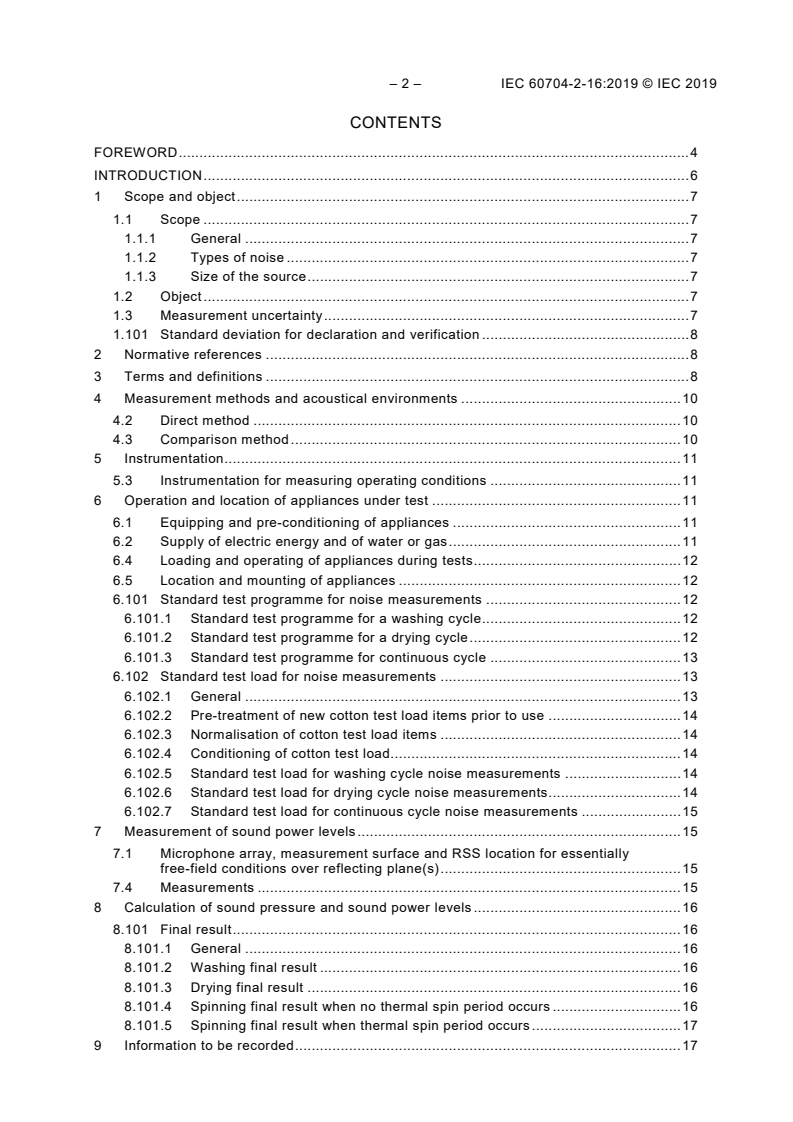
Household and similar electrical appliances - Test code for the determination of airborne acoustical noise - Part 2-16: Particular requirements for washer-dryers
IEC 60704-2-16:2019 applies to single-unit electric washer-dryers for household and similar use intended for placing on the floor against a wall, for building-in or placing under a counter, a kitchen worktop or under a sink, for wall-mounting or on a counter.
This standard is concerned with objective methods of engineering accuracy for determining sound power levels of airborne acoustical noise.
Requirements for the declaration of noise emission values are not within the scope of this document.
This part is intended to be used in conjunction with IEC 60704-1:2010.
Appareils électrodomestiques et analogues – Code d'essai pour la détermination du bruit aérien – Partie 2-16: Exigences particulières pour les lavantes-séchantes
L'IEC 60704-2-16:2019 s'applique aux lavantes-séchantes électriques en un seul équipement pour une utilisation domestique ou similaire prévue avec un placement au sol contre un mur, une intégration ou un placement sous un comptoir, un plan de travail de cuisine ou sous un évier, pour une fixation murale ou sur un comptoir.
La présente norme concerne des méthodes objectives de degré de précision «expertise» destinées à déterminer les niveaux de puissance acoustique d'un bruit aérien situé à l'intérieur du domaine de fréquences utile.
Les exigences pour la déclaration des valeurs d'émission sonore ne relèvent pas du domaine d'application du présent document.
La présente partie est destinée à être utilisée conjointement avec l'IEC 60704-1:2010.
General Information
- Status
- Published
- Publication Date
- 19-May-2019
- Technical Committee
- SC 59D - Performance of household and similar electrical laundry appliances
- Current Stage
- PPUB - Publication issued
- Start Date
- 20-May-2019
- Completion Date
- 05-Jun-2019
Overview
IEC 60704-2-16:2019 is an international standard developed by the International Electrotechnical Commission (IEC) that specifies test codes for the determination of airborne acoustical noise emitted by household and similar electrical appliances. Part 2-16 focuses on particular requirements for electric washer-dryers. This standard addresses products intended to be placed on the floor, built-in under counters, worktops, sinks, wall-mounted, or used on countertops.
The main objective of IEC 60704-2-16 is to provide objective engineering methods for accurately determining the sound power levels produced by washer-dryers. It aims to ensure consistent and comparable measurement results among different test facilities, supporting manufacturers, regulators, and consumers in assessing and comparing the noise performance of washer-dryers.
This standard is intended for use in conjunction with IEC 60704-1:2010, which covers general requirements for testing the airborne noise of household appliances.
Key Topics
Scope of Application:
- Applies to single-unit electric washer-dryers for household use and similar purposes.
- Suitable for various installation configurations, including freestanding, built-in, and wall-mounted.
Measurement Methods:
- Covers direct and comparison methods for measuring airborne sound power levels based on international acoustics standards (ISO 3743-1, ISO 3743-2, and ISO 3744).
- Specifies requirements for test environments, instrumentation, and measurement arrangements to ensure reproducibility and accuracy.
Test Loads and Programmes:
- Details preparation and conditioning of cotton test loads for washing, drying, or continuous cycles.
- Defines standard test programmes for both washing and drying cycles including temperature, load mass, and programme selection criteria.
Operational Conditions:
- Outlines pre-conditioning and cleaning requirements for appliances before testing.
- Specifies water supply temperature, pressure, and other environmental conditions during measurement.
- Details how washer-dryers must be operated and loaded during testing for consistent results.
Calculation and Reporting:
- Describes the process of calculating sound power levels, segmenting by wash, dry, and continuous cycles.
- Sets guidelines for documenting appliance characteristics, test conditions, and measured data in test reports.
Applications
IEC 60704-2-16:2019 is essential for:
- Manufacturers: To objectively measure and compare airborne noise performance of washer-dryers during product development and quality control.
- Testing Laboratories: To perform standardized noise measurements that are recognized internationally, ensuring repeatability and consistency.
- Certification Bodies and Regulators: To assess compliance with noise requirements in various markets and support product certification and labeling schemes.
- Consumers and Retailers: To access reliable information on washer-dryer noise levels, enhancing the decision-making process and user satisfaction.
- Industry Audits and Benchmarking: To facilitate benchmarking of products and support initiatives for quieter household appliances.
By following the standardized procedures, stakeholders can minimize variability in test results due to environmental, operational, or methodological differences. This contributes to fair competition and helps inform product improvements toward reducing noise pollution in domestic environments.
Related Standards
- IEC 60704-1:2010: General requirements for determining airborne acoustical noise for household and similar appliances.
- IEC 62512:2012: Methods for measuring performance of household electric washer-dryers.
- IEC 60456:2010: Methods for measuring performance of household clothes washing machines.
- IEC 60704-3: Guidelines for the declaration and verification of noise emission values.
- ISO 3743-1:2010: Acoustics - Noise source power levels in small reverberation rooms.
- ISO 3743-2:1994: Acoustics - Engineering methods for small movable source measurements.
- ISO 3744:2010: Acoustics - Engineering methods for sound power measurements in essentially free fields.
Adhering to IEC 60704-2-16:2019 ensures the reliability, comparability, and transparency of airborne noise data for washer-dryers, supporting better product design, regulatory compliance, and informed consumer choices.
Buy Documents
IEC 60704-2-16:2019 - Household and similar electrical appliances - Test code for the determination of airborne acoustical noise - Part 2-16: Particular requirements for washer-dryers Released:5/20/2019
Get Certified
Connect with accredited certification bodies for this standard

BSMI (Bureau of Standards, Metrology and Inspection)
Taiwan's standards and inspection authority.
Sponsored listings
Frequently Asked Questions
IEC 60704-2-16:2019 is a standard published by the International Electrotechnical Commission (IEC). Its full title is "Household and similar electrical appliances - Test code for the determination of airborne acoustical noise - Part 2-16: Particular requirements for washer-dryers". This standard covers: IEC 60704-2-16:2019 applies to single-unit electric washer-dryers for household and similar use intended for placing on the floor against a wall, for building-in or placing under a counter, a kitchen worktop or under a sink, for wall-mounting or on a counter. This standard is concerned with objective methods of engineering accuracy for determining sound power levels of airborne acoustical noise. Requirements for the declaration of noise emission values are not within the scope of this document. This part is intended to be used in conjunction with IEC 60704-1:2010.
IEC 60704-2-16:2019 applies to single-unit electric washer-dryers for household and similar use intended for placing on the floor against a wall, for building-in or placing under a counter, a kitchen worktop or under a sink, for wall-mounting or on a counter. This standard is concerned with objective methods of engineering accuracy for determining sound power levels of airborne acoustical noise. Requirements for the declaration of noise emission values are not within the scope of this document. This part is intended to be used in conjunction with IEC 60704-1:2010.
IEC 60704-2-16:2019 is classified under the following ICS (International Classification for Standards) categories: 01 - GENERALITIES. TERMINOLOGY. STANDARDIZATION. DOCUMENTATION; 17.140.20 - Noise emitted by machines and equipment. The ICS classification helps identify the subject area and facilitates finding related standards.
IEC 60704-2-16:2019 is available in PDF format for immediate download after purchase. The document can be added to your cart and obtained through the secure checkout process. Digital delivery ensures instant access to the complete standard document.
Standards Content (Sample)
IEC 60704-2-16 ®
Edition 1.0 2019-05
INTERNATIONAL
STANDARD
NORME
INTERNATIONALE
Household and similar electrical appliances – Test code for the determination of
airborne acoustical noise –
Part 2-16: Particular requirements for washer-dryers
Appareils électrodomestiques et analogues – Code d'essai pour la détermination
du bruit aérien –
Partie 2-16: Exigences particulières pour les lavantes-séchantes
All rights reserved. Unless otherwise specified, no part of this publication may be reproduced or utilized in any form
or by any means, electronic or mechanical, including photocopying and microfilm, without permission in writing from
either IEC or IEC's member National Committee in the country of the requester. If you have any questions about IEC
copyright or have an enquiry about obtaining additional rights to this publication, please contact the address below or
your local IEC member National Committee for further information.
Droits de reproduction réservés. Sauf indication contraire, aucune partie de cette publication ne peut être reproduite
ni utilisée sous quelque forme que ce soit et par aucun procédé, électronique ou mécanique, y compris la photocopie
et les microfilms, sans l'accord écrit de l'IEC ou du Comité national de l'IEC du pays du demandeur. Si vous avez des
questions sur le copyright de l'IEC ou si vous désirez obtenir des droits supplémentaires sur cette publication, utilisez
les coordonnées ci-après ou contactez le Comité national de l'IEC de votre pays de résidence.
IEC Central Office Tel.: +41 22 919 02 11
3, rue de Varembé info@iec.ch
CH-1211 Geneva 20 www.iec.ch
Switzerland
About the IEC
The International Electrotechnical Commission (IEC) is the leading global organization that prepares and publishes
International Standards for all electrical, electronic and related technologies.
About IEC publications
The technical content of IEC publications is kept under constant review by the IEC. Please make sure that you have the
latest edition, a corrigendum or an amendment might have been published.
IEC publications search - webstore.iec.ch/advsearchform Electropedia - www.electropedia.org
The advanced search enables to find IEC publications by a The world's leading online dictionary on electrotechnology,
variety of criteria (reference number, text, technical containing more than 22 000 terminological entries in English
committee,…). It also gives information on projects, replaced and French, with equivalent terms in 16 additional languages.
and withdrawn publications. Also known as the International Electrotechnical Vocabulary
(IEV) online.
IEC Just Published - webstore.iec.ch/justpublished
Stay up to date on all new IEC publications. Just Published IEC Glossary - std.iec.ch/glossary
details all new publications released. Available online and 67 000 electrotechnical terminology entries in English and
once a month by email. French extracted from the Terms and Definitions clause of
IEC publications issued since 2002. Some entries have been
IEC Customer Service Centre - webstore.iec.ch/csc collected from earlier publications of IEC TC 37, 77, 86 and
If you wish to give us your feedback on this publication or CISPR.
need further assistance, please contact the Customer Service
Centre: sales@iec.ch.
A propos de l'IEC
La Commission Electrotechnique Internationale (IEC) est la première organisation mondiale qui élabore et publie des
Normes internationales pour tout ce qui a trait à l'électricité, à l'électronique et aux technologies apparentées.
A propos des publications IEC
Le contenu technique des publications IEC est constamment revu. Veuillez vous assurer que vous possédez l’édition la
plus récente, un corrigendum ou amendement peut avoir été publié.
Recherche de publications IEC - Electropedia - www.electropedia.org
webstore.iec.ch/advsearchform Le premier dictionnaire d'électrotechnologie en ligne au
La recherche avancée permet de trouver des publications IEC monde, avec plus de 22 000 articles terminologiques en
en utilisant différents critères (numéro de référence, texte, anglais et en français, ainsi que les termes équivalents dans
comité d’études,…). Elle donne aussi des informations sur les 16 langues additionnelles. Egalement appelé Vocabulaire
projets et les publications remplacées ou retirées. Electrotechnique International (IEV) en ligne.
IEC Just Published - webstore.iec.ch/justpublished Glossaire IEC - std.iec.ch/glossary
Restez informé sur les nouvelles publications IEC. Just 67 000 entrées terminologiques électrotechniques, en anglais
Published détaille les nouvelles publications parues. et en français, extraites des articles Termes et Définitions des
Disponible en ligne et une fois par mois par email. publications IEC parues depuis 2002. Plus certaines entrées
antérieures extraites des publications des CE 37, 77, 86 et
Service Clients - webstore.iec.ch/csc CISPR de l'IEC.
Si vous désirez nous donner des commentaires sur cette
publication ou si vous avez des questions contactez-nous:
sales@iec.ch.
IEC 60704-2-16 ®
Edition 1.0 2019-05
INTERNATIONAL
STANDARD
NORME
INTERNATIONALE
Household and similar electrical appliances – Test code for the determination of
airborne acoustical noise –
Part 2-16: Particular requirements for washer-dryers
Appareils électrodomestiques et analogues – Code d'essai pour la
détermination du bruit aérien –
Partie 2-16: Exigences particulières pour les lavantes-séchantes
INTERNATIONAL
ELECTROTECHNICAL
COMMISSION
COMMISSION
ELECTROTECHNIQUE
INTERNATIONALE
ICS 17.140.20 ISBN 978-2-8322-6899-5
– 2 – IEC 60704-2-16:2019 © IEC 2019
CONTENTS
FOREWORD . 4
INTRODUCTION . 6
1 Scope and object . 7
1.1 Scope . 7
1.1.1 General . 7
1.1.2 Types of noise . 7
1.1.3 Size of the source . 7
1.2 Object . 7
1.3 Measurement uncertainty . 7
1.101 Standard deviation for declaration and verification . 8
2 Normative references . 8
3 Terms and definitions . 8
4 Measurement methods and acoustical environments . 10
4.2 Direct method . 10
4.3 Comparison method . 10
5 Instrumentation . 11
5.3 Instrumentation for measuring operating conditions . 11
6 Operation and location of appliances under test . 11
6.1 Equipping and pre-conditioning of appliances . 11
6.2 Supply of electric energy and of water or gas . 11
6.4 Loading and operating of appliances during tests . 12
6.5 Location and mounting of appliances . 12
6.101 Standard test programme for noise measurements . 12
6.101.1 Standard test programme for a washing cycle . 12
6.101.2 Standard test programme for a drying cycle . 12
6.101.3 Standard test programme for continuous cycle . 13
6.102 Standard test load for noise measurements . 13
6.102.1 General . 13
6.102.2 Pre-treatment of new cotton test load items prior to use . 14
6.102.3 Normalisation of cotton test load items . 14
6.102.4 Conditioning of cotton test load. 14
6.102.5 Standard test load for washing cycle noise measurements . 14
6.102.6 Standard test load for drying cycle noise measurements . 14
6.102.7 Standard test load for continuous cycle noise measurements . 15
7 Measurement of sound power levels . 15
7.1 Microphone array, measurement surface and RSS location for essentially
free-field conditions over reflecting plane(s) . 15
7.4 Measurements . 15
8 Calculation of sound pressure and sound power levels . 16
8.101 Final result . 16
8.101.1 General . 16
8.101.2 Washing final result . 16
8.101.3 Drying final result . 16
8.101.4 Spinning final result when no thermal spin period occurs . 16
8.101.5 Spinning final result when thermal spin period occurs . 17
9 Information to be recorded . 17
9.2 Description of appliance under test . 17
9.7 Electric supply, water supply, etc. . 17
9.9 Operation of the appliance under test . 17
9.12 Measured data . 18
9.12.101 Spin speed . 18
10 Information to be reported . 18
10.3 Test conditions for the appliance . 18
10.4 Acoustical data . 18
10.4.101 Spin speed at highest noise level . 18
10.4.102 Maximum spin speed . 18
Annexes . 19
Annex A (normative) . 19
Bibliography . 20
Table 101 – Standard deviations of sound power levels of washing and spinning final
results for washer-dryer . 7
Table 102 – Standard deviations of sound power levels of drying final results for
washer-dryer . 8
Table 103 – Standard deviations for declaration and verification for washing and
spinning final results for washer-dryer . 8
Table 104 – Standard deviations for declaration for drying final results for washer-
dryer . 8
– 4 – IEC 60704-2-16:2019 © IEC 2019
INTERNATIONAL ELECTROTECHNICAL COMMISSION
____________
HOUSEHOLD AND SIMILAR ELECTRICAL APPLIANCES – TEST CODE
FOR THE DETERMINATION OF AIRBORNE ACOUSTICAL NOISE –
Part 2-16: Particular requirements for washer-dryers
FOREWORD
1) The International Electrotechnical Commission (IEC) is a worldwide organization for standardization comprising
all national electrotechnical committees (IEC National Committees). The object of IEC is to promote
international co-operation on all questions concerning standardization in the electrical and electronic fields. To
this end and in addition to other activities, IEC publishes International Standards, Technical Specifications,
Technical Reports, Publicly Available Specifications (PAS) and Guides (hereafter referred to as "IEC
Publication(s)"). Their preparation is entrusted to technical committees; any IEC National Committee interested
in the subject dealt with may participate in this preparatory work. International, governmental and non-
governmental organizations liaising with the IEC also participate in this preparation. IEC collaborates closely
with the International Organization for Standardization (ISO) in accordance with conditions determined by
agreement between the two organizations.
2) The formal decisions or agreements of IEC on technical matters express, as nearly as possible, an international
consensus of opinion on the relevant subjects since each technical committee has representation from all
interested IEC National Committees.
3) IEC Publications have the form of recommendations for international use and are accepted by IEC National
Committees in that sense. While all reasonable efforts are made to ensure that the technical content of IEC
Publications is accurate, IEC cannot be held responsible for the way in which they are used or for any
misinterpretation by any end user.
4) In order to promote international uniformity, IEC National Committees undertake to apply IEC Publications
transparently to the maximum extent possible in their national and regional publications. Any divergence
between any IEC Publication and the corresponding national or regional publication shall be clearly indicated in
the latter.
5) IEC itself does not provide any attestation of conformity. Independent certification bodies provide conformity
assessment services and, in some areas, access to IEC marks of conformity. IEC is not responsible for any
services carried out by independent certification bodies.
6) All users should ensure that they have the latest edition of this publication.
7) No liability shall attach to IEC or its directors, employees, servants or agents including individual experts and
members of its technical committees and IEC National Committees for any personal injury, property damage or
other damage of any nature whatsoever, whether direct or indirect, or for costs (including legal fees) and
expenses arising out of the publication, use of, or reliance upon, this IEC Publication or any other IEC
Publications.
8) Attention is drawn to the Normative references cited in this publication. Use of the referenced publications is
indispensable for the correct application of this publication.
9) Attention is drawn to the possibility that some of the elements of this IEC Publication may be the subject of
patent rights. IEC shall not be held responsible for identifying any or all such patent rights.
International Standard IEC 60704-2-16 has been prepared by subcommittee 59D: Home and
similar laundry appliances of IEC technical committee 59: Performance of household and
similar electrical appliances.
The text of this International Standard is based on the following documents:
CDV Report on voting
59D/455/CDV 59D/459/RVC
Full information on the voting for the approval of this International Standard can be found in
the report on voting indicated in the above table.
This document has been drafted in accordance with the ISO/IEC Directives, Part 2.
This Part 2-16 is intended to be used in conjunction with the third edition (2010) of
IEC 60704-1, Household and similar electrical appliances – Test code for the determination of
airborne acoustical noise – Part 1: General requirements.
NOTE When "Part 1" is mentioned in this standard, it refers to IEC 60704-1:2010.
The relevant text of Part 1 as amended by this publication establishes the test code for
washer-dryers.
This Part 2-16 supplements or modifies the corresponding clauses in IEC 60704-1. When a
particular subclause of Part 1 is not mentioned in this Part 2-16, that subclause is applicable
as far as reasonable. Where this standard states "addition", "modification" or "replacement",
the relevant requirements, test specifications or explanatory matter in Part 1 should be
adapted accordingly.
Subclauses and tables that are additional to those in Part 1 are numbered starting from 101.
Unless notes are in a new subclause or involve notes in Part 1, they are numbered starting
from 101, including those in a replaced clause or subclause.
A list of all the parts in the IEC 60704 series, under the general title Household and similar
electrical appliances – Test code for the determination of airborne acoustical noise, can be
found on the IEC website.
The committee has decided that the contents of this document will remain unchanged until the
stability date indicated on the IEC website under "http://webstore.iec.ch" in the data related to
the specific document. At this date, the document will be
• reconfirmed,
• withdrawn,
• replaced by a revised edition, or
• amended.
– 6 – IEC 60704-2-16:2019 © IEC 2019
INTRODUCTION
The noise of washer-dryers has been measured up to now by making use of two standards,
IEC 60704-2-4 and IEC 60704-2-6. This first edition of IEC 60704-2-16 makes it possible to
test the noise of washer-dryers by using one single standard. The following significant
technical changes with respect to the separate use of IEC 60704-2-4:2011 and
IEC 60704-2-6:2012 have been introduced:
• measurement uncertainty and standard deviations are taken into account,
• definition of periods and cycles, in particular definition of thermal spin period and
continuous cycle,
• definitions of standard test programme and standard test load,
• location and mounting,
• information to be reported.
The measuring conditions specified in this document provide for sufficient accuracy in
determining the noise emitted and comparing the results of measurements taken by different
laboratories, whilst simulating as far as possible the practical use of household washer-
dryers.
It is recommended to consider the determination of noise levels as part of a comprehensive
testing procedure covering many aspects of the properties and performance of household
washer-dryers.
NOTE As stated in the introduction to IEC 60704-1, this test code is concerned with airborne noise only.
HOUSEHOLD AND SIMILAR ELECTRICAL APPLIANCES – TEST CODE
FOR THE DETERMINATION OF AIRBORNE ACOUSTICAL NOISE –
Part 2-16: Particular requirements for washer-dryers
1 Scope and object
This clause of Part 1 is applicable except as follows:
1.1 Scope
1.1.1 General
Addition:
These particular requirements apply to single-unit electric washer-dryers for household and
similar use intended for placing on the floor against a wall, for building-in or placing under a
counter, a kitchen worktop or under a sink, for wall-mounting or on a counter.
1.1.2 Types of noise
Replacement:
The methods specified in ISO 3743-1, ISO 3743-2 and ISO 3744 can be used for measuring
noise emitted by washer-dryers.
1.1.3 Size of the source
Replacement:
The method specified in ISO 3744 is applicable to noise sources of any size. When applying
ISO 3743-1 and ISO 3743-2, care should be taken that the maximum size of the washer-
dryers under test fulfils the requirements specified in 1.2 of ISO 3743-1:2010 and 1.3 of
ISO 3743-2:1994.
1.2 Object
Addition:
Requirements for the declaration of noise emission values are not within the scope of this
document.
NOTE 101 For determining and verifying noise emission values declared in product specifications, see
IEC 60704-3.
1.3 Measurement uncertainty
Replacement:
For washer-dryers, the estimated values of standard deviations of sound power levels,
determined in accordance with this document are as indicated in Table 101 and 102.
Table 101 – Standard deviations of sound power levels
of washing and spinning final results for washer-dryer
Standard deviation (dB)
σ (repeatability) σ (reproducibility)
r R
0,6 1,0
– 8 – IEC 60704-2-16:2019 © IEC 2019
Table 102 – Standard deviations of sound power levels
of drying final results for washer-dryer
Standard deviation (dB)
σ (repeatability) σ (reproducibility)
r R
0,4 0,8
1.101 Standard deviation for declaration and verification
For the purpose of determining and verifying declared noise emission values for washing and
spinning for washer-dryers in accordance with IEC 60704-3, the values indicated in Table 103
apply.
Table 103 – Standard deviations for declaration and verification
for washing and spinning final results for washer-dryer
Standard deviation (dB)
σ (production) σ (total) σ (reference)
P t M
1,0 to 2,2 1,4 to 2,4 2,5
For the purpose of determining and verifying declared noise emission values for drying for
washer-dryers in accordance with IEC 60704-3, the values indicated in Table 104 apply.
Table 104 – Standard deviations for declaration for
drying final results for washer-dryer
Standard deviation (dB)
σ (production) σ (total) σ (reference)
P t M
0,7 to 1,0 1,1 to 1,3 1,5
2 Normative references
This clause of Part 1 is applicable except as follows:
Addition:
IEC 62512:2012, Electric clothes washer-dryers for household use – Methods for measuring
the performance
IEC 60456:2010, Clothes washing machines for household use – Methods for measuring the
performance
ISO 3743-1:2010, Acoustics – Determination of sound power levels and sound energy levels
of noise sources using sound pressure – Engineering methods for small movable sources in
reverberant fields – Part 1: Comparison method for a hard-walled test room
ISO 3744:2010, Acoustics – Determination of sound power levels and sound energy levels of
noise sources using sound pressure – Engineering methods for an essentially free field over a
reflecting plane
3 Terms and definitions
This clause of Part 1 is applicable except as follows:
Addition:
3.101
washer-dryer
household or similar electrical appliance for washing, rinsing and spinning of textiles that also
provides a means for extracting excess water from the textiles by tumbling in a rotating drum,
through which heated air is passed
Note 1 to entry: This definition is similar to IEC 60456:2010, 3.1.4.
3.102
rated washing capacity
maximum mass of conditioned textiles, in kg, which the manufacturer declares can be treated
in one complete washing cycle
[SOURCE: IEC 62512:2012, 3.1.1]
3.103
rated drying capacity
maximum mass of conditioned textiles, in kg, which the manufacturer declares can be treated
in one complete drying cycle
[SOURCE: IEC 62512:2012, 3.1.2]
3.104
rated washing-drying capacity
maximum mass of conditioned textiles, in kg, which the manufacturer declares can be treated
in one continuous operation cycle
[SOURCE: IEC 62512:2012, 3.1.3]
3.105
cotton test load
textile load consisting of towels only as defined in Annex C of IEC 60456:2010
3.106
washing period
operating period that begins at the first water filling of the main wash and ends at the start of
the drainage pump before the first rinsing operation
Note 1 to entry: Options such as "pre-wash" are not included in the washing period.
[SOURCE: IEC 60704-2-4:2011, 3.1.4, modified – The phrase "operation period that" has
been added.]
3.107
rinsing period
operating period that begins at the start of the drainage pump before the first rinsing and ends
at the start of the drainage pump after the last rinsing
[SOURCE: IEC 60704-2-4:2011, 3.1.5, modified – The phrase "operation period that" has
been added.]
3.108
final spin period
operating period that begins at the start of the drainage pump after the last rinsing period and
ends with the end of the programme or with start of drying period
[SOURCE: IEC 60704-2-4:2011, 3.1.6, modified – The phrases "operation period that" and "or
with start of drying period" have been added; the word "period" has been added after the word
"rinsing".]
3.109
drying period
operating period that begins with the start of operation of the drying fan and ends with the end
of the programme, excluding the thermal spin period(s) if present
– 10 – IEC 60704-2-16:2019 © IEC 2019
Note 1 to entry: The start of operation of the drying fan can be identified, for example, from changes of the
current and/or power consumption of the washer-dryer.
3.110
thermal spin period
operating period of a drying programme or a drying period of continuous cycle that begins
when the drum speed reaches higher than 100 r/min and ends when drum speed reduces to
less than 100 r/min
Note 1 to entry: Thermal spin periods can occur several times during a drying cycle.
3.111
washing cycle
combination of washing period, rinsing period and final spinning period
Note 1 to entry: This definition is similar to IEC 62512:2012, 3.1.7.
3.112
drying cycle
combination of drying period and thermal spin period(s)
Note 1 to entry: This definition is similar to IEC 62512:2012, 3.1.8.
Note 2 to entry: The washer-dryer's final spinning noise level is obtained by data collected normally during the
washing cycle, but also, in specific cases, by data collected during the drying cycle (see 8.101.5).
3.113
continuous cycle
combination of washing cycle and drying cycle without interruption
Note 1 to entry: This definition is similar to IEC 62512:2012, 3.1.4.
3.114
end of programme
moment in time when the washer-dryer indicates the end of the programme and the load is
accessible for the user or, when there is no end of programme indicator and the door is
locked during operation, the moment in time when the load is accessible to the user or, when
there is no end of programme indicator and the door is not locked during operation, the
moment in time when the power consumption of the appliance drops to a steady-state
condition and the appliance is not performing any function
[SOURCE: IEC 60456:2010, 3.1.24, modified – The phrase "the program is complete" has
been replaced by "moment in time", "washing machine" is replaced by "washer-dryer" and
three sentences have been combined to a single phrase.]
3.115
test series
sequence of consecutive runs of the standard test programme
3.116
standard test programme
programme to be selected for noise testing
4 Measurement methods and acoustical environments
This clause of Part 1 is applicable except as follows:
4.2 Direct method
Addition:
If pure tone components are present in the noise emitted by the source, the estimated
standard deviation of the measured sound pressure levels in the special reverberation room
can increase. In such cases, additional microphone positions or source positions can be
necessary, as specified in ISO 3743-2.
4.3 Comparison method
Addition:
If pure tone components are present in the noise emitted by the source, the estimated
standard deviation of the measured sound pressure levels in the hard-walled test room or in
the special reverberation room can increase. In such cases, additional microphone positions
or source positions may be necessary as specified in ISO 3743-1 or ISO 3743-2.
5 Instrumentation
This clause of Part 1 is applicable except as follows:
5.3 Instrumentation for measuring operating conditions
5.3.4
Addition:
Spin speed shall be recorded at intervals of 1 s or less.
6 Operation and location of appliances under test
This clause of Part 1 is applicable except as follows:
6.1 Equipping and pre-conditioning of appliances
6.1.1
Addition:
Prior to each noise test, all filters, heat exchangers and ducts described as consumer service
items in the manufacturer's instructions shall be cleaned.
6.1.3
Replacement:
Prior to noise measurements, the washer-dryer shall have been operated for at least five
washing cycles as specified in 6.101 with a standard test load as specified in 6.102, but
regardless of the average age of the test load.
Furthermore, prior to noise measurements, the washer-dryer shall have been operated for at
least two drying cycles as specified in 6.101 with a standard test load as specified in 6.102,
but regardless of the average age of the test load.
6.1.4
Replacement:
Care shall be taken to ensure conformance with the climatic conditions indicated in 6.3 of
Part 1.
6.2 Supply of electric energy and of water or gas
6.2.2
Not applicable.
6.2.3
Not applicable.
6.2.4
Replacement:
For noise measurements, the static water pressure during filling shall be (240 ± 50) kPa, if not
contradictory to the manufacturer's instructions.
– 12 – IEC 60704-2-16:2019 © IEC 2019
Appliances shall be supplied with cold water, if not otherwise specified by the manufacturer.
The temperature of cold water shall be (15 ± 5) °C, the temperature of hot water shall be
(55 ± 5) °C.
The water hardness may be neglected.
NOTE 101 When, in some countries, the water supply pressure/temperature differs from the water supply
pressure/temperature of the country concerned, measurements carried out at rated pressure/temperature can be
misleading for the consumer. In this case, additional measurements can be necessary. If the test
pressure/temperature differs from the rated pressure/temperature, this should be reported.
6.4 Loading and operating of appliances during tests
6.4.2
Replacement:
Washer-dryers are operated in the standard test programmes in accordance with 6.101, with a
load in accordance with 6.102, based on washing cycles for a washer, drying cycles for a
dryer or continuous cycles for a washer-dryer.
The way of loading the machine influences the results of the noise measurements. To get
reproducible results, it is necessary to load the machine always in layers from bottom to top.
The cotton test load for each subsequent step is evenly distributed in one level of the drum or
basket. Excessive force should not be used.
6.5 Location and mounting of appliances
6.5.2
Not applicable.
6.5.4
Not applicable.
6.5.5
Addition:
Appliances designed for front loading and specified by the manufacturer for building-in under
a counter or for placing under a worktop between cabinets (under-counter types) shall be
built-in in accordance with the manufacturer's installation instructions in an appropriate test
enclosure in accordance with Annex B of Part 1.
6.101 Standard test programme for noise measurements
6.101.1 Standard test programme for a washing cycle
The standard test programme for noise measurements for a washing cycle is a "40 °C cotton"
programme at the rated capacity, without pre-wash as advised by the manufacturer.
NOTE 101 In addition to this standard programme, other cotton programmes can be tested, too. In this case,
1.101 is not applicable. Programme selection and setting need to be reported.
If this programme is not available, then the most effective programme for cotton according to
the manufacturer's instructions shall be used. Other special options shall be deselected.
The highest available spin speed is to be chosen.
The standard test programme is carried out without detergent.
6.101.2 Standard test programme for a drying cycle
The standard test programme for noise measurements for a drying cycle is a "dry cotton"
programme for achieving a final moisture content of the test load µ = 0 % ± 3 % after
f
completion of the programme in accordance with the manufacturer's instructions.
For washer-dryers having an automatic drying function, usually this is the "dry cotton"
programme.
For washer-dryers having no automatic drying function, the washer-dryer operates for as long
as required to achieve the final moisture content as given above.
NOTE 101 The time required is determined by monitoring the drying cycle. This can be done by either having the
washer-dryer placed on a platform scale or by pre-testing.
NOTE 102 Typical examples of operations that can be used as indicators of programme completion are
monitoring and anticreasing operations.
The final moisture content µ of the test load is calculated as follows:
f
WW−
f 0
µ ⋅100 %
f
W
where
W is the mass of the standard test load after completion of the standard test programme;
f
W is the mass of the standard test load after conditioning, in accordance with 6.102.4.
6.101.3 Standard test programme for continuous cycle
The standard test programme for noise measurements for a continuous cycle is a "40 °C
continuous cotton" programme at the rated capacity for a continuous cycle without pre-wash
as advised by the manufacturer.
If this programme is not available, then the most effective programme for cotton in
accordance with the manufacturer's instructions shall be used. Other special options shall be
deselected.
The highest available spin speed is to be chosen.
The standard test programme is carried out without detergent.
6.102 Standard test load for noise measurements
6.102.1 General
The standard test load for noise measurements depends on which cycle is of interest.
To minimize the influence of changes in the characteristics of the cotton test load items with
increasing age, the standard test load shall consist of cotton test load items that are well
distributed in age to give an average age of the standard test load of between 30 and 50 runs
of the standard test programme. The number of items or average age shall not be adjusted
during a test series.
The average age A of a cotton test load expressed as the number of test runs is calculated
as follows:
N
Aa=
i
∑
N
i=1
where
a is the age of a single cotton test load item as the number of test runs after pre-treatment
i
as defined in 6.102.2, expressed as the number of test runs;
N is the number of cotton test load items.
Cotton test load items shall undergo normalisation as defined in 6.102.3 at least after they
have been used for ten runs of the standard test programme.
=
– 14 – IEC 60704-2-16:2019 © IEC 2019
No test load item shall be used for more than 80 runs of the standard test programme,
excluding pre-treatment runs prior to initial use and normalisation runs.
If the manufacturer does not declare the rated capacity, this shall be determined as described
by IEC 60456:2010, Annex N.
6.102.2 Pre-treatment of new cotton test load items prior to use
New cotton test load items shall be treated before their first use by undergoing normalisation
as defined in 6.102.3 five times, but without intermediate drying.
6.102.3 Normalisation of cotton test load items
For normalisation, cotton test load items shall be washed using test powder of reference
detergent A* in accordance with IEC 60456:2010, Annex B and at a "40 °C cotton"
programme. Detergent shall be dosed with 15 g/kg of cotton test load.
6.102.4 Conditioning of cotton test load
Conditioning is the process of bringing the cotton test load to reach specific remaining
moisture content after normalisation and drying, and prior to the next test series.
Conditioning can be carried out by placing the cotton test load items in a room/chamber in
which the ambient temperature and humidity are maintained at:
ambient temperature 20 °C ± 5 °C;
relative humidity 50 % ± 20 %.
Two methods are available as follows:
– the cotton test load items shall be hung singly and separately so that air can freely
circulate between individual load items. The load is left for a period of not less than 15 h;
– the cotton test load items shall be left until their mass has changed by less than 0,5 % for
two successive measurements, which are taken at intervals of two hours or more.
The cotton test load does not have to be conditioned between consecutive runs of the
standard test programme. However, the test load is to be dried in a tumble dryer until the
mass is within 2 % of the initial mass of the standard test load for noise measurement.
6.102.5 Standard test load for washing cycle noise measurements
The standard test load for noise measurements for washing cycle consist of conditioned
cotton test load (see 6.102.4) at a mass close to, but in any case not more than, the rated
washing capacity.
6.102.6 Standard test load for drying cycle noise measurements
6.102.6.1 General
The standard test load for noise measurements for drying cycle consist of conditioned cotton
test load (see 6.102.6.2) at a mass close to, but in any case not more than, the rated drying
capacity.
6.102.6.2 Conditioning of cotton test load for drying cycle noise measurements
Immediately before each noise test, the standard test load shall be wetted with the initial
content of (60 ± 2) %.
moisture µ
i
The initial moisture content µ of the test load is calculated as follows:
i
WW−
i 0
µ ⋅100 %
i
W
where
W is the mass of the standard test load after wetting;
i
=
W is the mass of the standard test load after conditioning, in accordance with 6.102.4.
Typically, the initial moisture content is obtained by using a rinse period of a washing machine
followed only by a spin period with an approximate speed of 1 100 r/min.
6.102.7 Standard test load for continuous cycle noise measurements
The standard test load for noise measurements for continuous cycle consists of a conditioned
cotton test load (see 6.102.4) of the rated washing-drying capacity as advised by the
manufacturer.
If no rated washing-drying capacity is given, the lowest value between the rated washing
capacity and the rated drying capacity is used instead.
7 Measurement of sound power levels
This clause of Part 1 is applicable except as follows:
7.1 Microphone array, measurement surface and RSS location for essentially free-
field conditions over reflecting plane(s)
7.1.1
Not applicable.
7.1.2 to 7.1.7
Not applicable.
7.4 Measurements
7.4.1
Addition:
For washing, the A-weighted sound power level shall be time-averaged over the washing
period.
For spinning, the highest A-weighted time-averaged sound power level with an averaging time
of 50 s shall be determined within the time interval beginning at the first rinsing period and
ending with the end of the programme within the washing cycle. For the same time interval of
50 s when the highest A-weighted time-averaged sound power level occurs, the averaged spin
speed shall be determined.
NOTE 101 Spinning can also occur during rinsing; therefore, the measurement of noise is carried out during the
rinsing and the final spin periods.
For drying, the A-weighted sound power level shall be time-averaged over the drying period
(which is excluding the thermal spin period(s) if present).
For thermal spin, the highest A-weighted time-averaged sound power level with an averaging
time of 50 s shall be determined within the thermal spin period in drying cycle. For the same
time interval of 50 s when the highest A-weighted time averaged sound power level occurs,
the averaged spin speed shall be determined.
Thermal spin period(s) can occur more than once during a drying cycle. In this case, the
thermal spin is the highest averaging time 50 s level determined during the whole drying
cycle.
If the noise of the appliance under test varies periodically, care shall be taken to avoid any
effect of synchronism between the variation of the noise emission and the measurement
procedure (traverses of a moving microphone, duration of scanning of the microphone
positions, etc.).
NOTE 102 Acoustic indications of the end of the programme or subsequent actions to avoid creasing are
disregarded.
– 16 – IEC 60704-2-16:2019 © IEC 2019
7.4.4
Not applicable.
8 Calculation of sound pressure and sound power levels
This clause of Part 1 is applicable except as follows:
8.101 Final result
8.101.1 General
In 8.101.2 to 8.101.5, calculation methods for final results measured in separate washing
cycles and drying cycles (non-continuous cycles, i.e. interrupted cycles) and continuous
cycles are described. For non-continuous and continuous cycles, related methods can be
independently applied. The final results are bundled together: washing, drying and spinning
(from non-continuous cycles) and/or washing, drying and spinning from continuous cycles, i.e.
six or three sound power levels to be reported.
NOTE101 Noise results of continuous cycles and non-continuous cycles are not comparable because of different
loads and other parameters.
8.101.2 Washing final result
To obtain the final result for the washing, a test series of three runs in accordance with 7.4.1
shall be carried out in the standard test programme in accordance with 6.101.1, with a
standard test load in accordance with 6.102.5. For continuous cycles, three runs in
accordance with 7.4.1 shall be carried out in the standard test programme in accordance with
6.101.3 with a standard test load in accordance with 6.102.7.
The final result is the logarithmic mean value of all measurements, calculated as follows:
N
0,1⋅L
...
Questions, Comments and Discussion
Ask us and Technical Secretary will try to provide an answer. You can facilitate discussion about the standard in here.
Loading comments...