

IEC 60335-2-25:2010/AMD2:2015
(Amendment)Amendment 2 - Household and similar electrical appliances - Safety - Part 2-25: Particular requirements for microwave ovens, including combination microwave ovens
General Information
- Abstract
- Status
- Published
- Publication Date
- 22-Nov-2015
- Current Stage
- DELPUB - Deleted Publication
- Start Date
- 08-Jan-2020
- Completion Date
- 28-Aug-2026
Buy Documents
IEC 60335-2-25:2010/AMD2:2015 - Amendment 2 - Household and similar electrical appliances - Safety - Part 2-25: Particular requirements for microwave ovens, including combination microwave ovens Released:11/23/2015
Overview
IEC 60335-2-25:2010/AMD2:2015 is an important amendment to the international standard specifically addressing the safety of household and similar electrical appliances, with a focus on microwave ovens, including combination microwave ovens. Issued by the International Electrotechnical Commission (IEC), this document updates the 2010 edition with additional safety requirements and testing protocols that enhance user protection and product reliability. As microwave ovens are ubiquitous in homes and commercial kitchens, compliance with these rigorous safety standards is essential for manufacturers and testing laboratories worldwide.
Key Topics
Scope of Amendment 2: This amendment supplements the base IEC 60335-2-25 standard by specifying new requirements for the construction, safety testing, and marking instructions of microwave ovens.
Glass Panel Safety: Introduction of new criteria for outer glass panels on microwave oven doors to ensure safety during breakage. Glass must:
- Break into small, non-hazardous pieces,
- Remain affixed without dropping fragments, or
- Have enhanced mechanical strength verified by a pendulum hammer test.
Microwave Leakage Testing:
- Microwave ovens must be tested for leakage with the appliance operated at maximum power.
- Leakage must not exceed 50 W/m² at a specified distance from the oven surface.
- Instruments used must meet specific calibration and accuracy requirements to guarantee reliable leakage detection.
Marking and Instructions:
- Appliances must include a clear warning that they should not be cleaned with steam cleaners.
- For microwave ovens intended for shipboard use, additional marking instructions regarding rated voltage and frequency compliance with ship systems are mandatory.
Construction and Testing Protocols:
- Compliance with mechanical strength and fracture behavior of door glass is assessed through defined impact tests using tungsten carbide punches and specified measurement techniques.
- Routine test procedures for microwave leakage have been updated with detailed requirements on instrument specifications to maintain measurement quality.
Applications
- Household Microwave Manufacturers: Ensuring compliance with IEC 60335-2-25:2010/AMD2:2015 facilitates market acceptance and enhances consumer safety by aligning with international safety standards.
- Commercial and Combination Microwave Ovens: The amendment is applicable to combination microwave ovens, making it relevant to commercial kitchen appliance designers and manufacturers who require rigorous safety validation.
- Testing Laboratories and Certification Bodies: Provides updated testing methodologies and calibration practices to certify microwave ovens efficiently and reliably.
- Maritime Industry: Microwave ovens deployed on ships must meet stringent marking and instruction criteria ensuring compatibility with marine electrical systems and safe operation under varying power conditions.
Related Standards
- IEC 60335-2-6:2014: General safety requirements for electrical cooking appliances; referenced and updated within this amendment.
- IEC 60068-2-75: Environmental testing-Hammer pendulum test used for verifying the mechanical strength of glass.
- IEC 60335-1: General safety requirements applicable to all household and similar electrical appliances, forming the foundational requirements for IEC 60335-2-25.
- National Standards on Non-Ionising Radiation Protection: For microwave leakage instrument calibration and type testing.
Keywords: IEC 60335-2-25 amendment 2, microwave oven safety, combination microwave ovens, electrical household appliance standards, microwave leakage testing, glass door safety, IEC standards for kitchen appliances, maritime microwave oven requirements, microwave oven construction guidelines, international electrotechnical commission standards.
Relations
- Effective Date
- 05-Sep-2023
- Effective Date
- 05-Sep-2023
Buy Documents
IEC 60335-2-25:2010/AMD2:2015 - Amendment 2 - Household and similar electrical appliances - Safety - Part 2-25: Particular requirements for microwave ovens, including combination microwave ovens Released:11/23/2015
Get Certified
Connect with accredited certification bodies for this standard

ANCE
Mexican certification and testing association.

CIS Institut d.o.o.
Personal Protective Equipment (PPE) certification body. Notified Body NB-2890 for EU Regulation 2016/425 PPE.

Intertek Slovenia
Intertek testing, inspection, and certification services in Slovenia.
Sponsored listings
Frequently Asked Questions
IEC 60335-2-25:2010/AMD2:2015 is a standard published by the International Electrotechnical Commission (IEC). Its full title is "Amendment 2 - Household and similar electrical appliances - Safety - Part 2-25: Particular requirements for microwave ovens, including combination microwave ovens". This standard covers: Amendment 2 - Household and similar electrical appliances - Safety - Part 2-25: Particular requirements for microwave ovens, including combination microwave ovens
Amendment 2 - Household and similar electrical appliances - Safety - Part 2-25: Particular requirements for microwave ovens, including combination microwave ovens
IEC 60335-2-25:2010/AMD2:2015 is classified under the following ICS (International Classification for Standards) categories: 13.120 - Domestic safety; 33.120.10 - Coaxial cables. Waveguides; 97.040.20 - Cooking ranges, working tables, ovens and similar appliances. The ICS classification helps identify the subject area and facilitates finding related standards.
IEC 60335-2-25:2010/AMD2:2015 has the following relationships with other standards: It is inter standard links to IEC 60335-2-25:2010, IEC 60335-2-25:2020. Understanding these relationships helps ensure you are using the most current and applicable version of the standard.
IEC 60335-2-25:2010/AMD2:2015 is available in PDF format for immediate download after purchase. The document can be added to your cart and obtained through the secure checkout process. Digital delivery ensures instant access to the complete standard document.
Standards Content (Sample)
IEC 60335-2-25 ®
Edition 6.0 2015-11
INTERNATIONAL
STANDARD
A MENDMENT 2
AM ENDEMENT 2
Household and similar electrical appliances – Safety –
Part 2-25: Particular requirements for microwave ovens, including combination
microwave ovens
Appareils électrodomestiques et analogues – Sécurité –
Partie 2-25: Règles particulières pour les fours à micro-ondes, y compris les
fours à micro-ondes combinés
IEC 60335-2-25:2010-09/AMD2:2015-11(en)
All rights reserved. Unless otherwise specified, no part of this publication may be reproduced or utilized in any form
or by any means, electronic or mechanical, including photocopying and microfilm, without permission in writing from
either IEC or IEC's member National Committee in the country of the requester. If you have any questions about IEC
copyright or have an enquiry about obtaining additional rights to this publication, please contact the address below or
your local IEC member National Committee for further information.
IEC Central Office Tel.: +41 22 919 02 11
3, rue de Varembé Fax: +41 22 919 03 00
CH-1211 Geneva 20 info@iec.ch
Switzerland www.iec.ch
About the IEC
The International Electrotechnical Commission (IEC) is the leading global organization that prepares and publishes
International Standards for all electrical, electronic and related technologies.
About IEC publications
The technical content of IEC publications is kept under constant review by the IEC. Please make sure that you have the
latest edition, a corrigenda or an amendment might have been published.
IEC Catalogue - webstore.iec.ch/catalogue Electropedia - www.electropedia.org
The stand-alone application for consulting the entire The world's leading online dictionary of electronic and
bibliographical information on IEC International Standards, electrical terms containing more than 30 000 terms and
Technical Specifications, Technical Reports and other definitions in English and French, with equivalent terms in 15
documents. Available for PC, Mac OS, Android Tablets and additional languages. Also known as the International
iPad. Electrotechnical Vocabulary (IEV) online.
IEC publications search - www.iec.ch/searchpub IEC Glossary - std.iec.ch/glossary
The advanced search enables to find IEC publications by a More than 60 000 electrotechnical terminology entries in
variety of criteria (reference number, text, technical English and French extracted from the Terms and Definitions
committee,…). It also gives information on projects, replaced clause of IEC publications issued since 2002. Some entries
and withdrawn publications. have been collected from earlier publications of IEC TC 37,
77, 86 and CISPR.
IEC Just Published - webstore.iec.ch/justpublished
Stay up to date on all new IEC publications. Just Published IEC Customer Service Centre - webstore.iec.ch/csc
details all new publications released. Available online and If you wish to give us your feedback on this publication or
also once a month by email. need further assistance, please contact the Customer Service
Centre: csc@iec.ch.
IEC 60335-2-25 ®
Edition 6.0 2015-11
INTERNATIONAL
STANDARD
AMENDMENT 2
AM ENDEMENT 2
Household and similar electrical appliances – Safety –
Part 2-25: Particular requirements for microwave ovens, including combination
microwave ovens
Appareils électrodomestiques et analogues – Sécurité –
Partie 2-25: Règles particulières pour les fours à micro-ondes, y compris les
fours à micro-ondes combinés
INTERNATIONAL
ELECTROTECHNICAL
COMMISSION
ICS 13.120; 97.040.20 ISBN 978-2-8322-3004-6
– 2 – IEC 60335-2-25:2010/AMD2:2015
© IEC 2015
FOREWORD
This amendment has been prepared by subcommittee SC61B: Safety of microwave
appliances for household and commercial use, of IEC technical committee 61: Safety of
household and similar electrical appliances.
The text of this amendment is based on the following documents:
FDIS Report on voting
61B/537/FDIS 61B/540/RVD
Full information on the voting for the approval of this amendment can be found in the report
on voting indicated in the above table.
The committee has decided that the contents of this amendment and the base publication will
remain unchanged until the stability date indicated on the IEC web site under
"http://webstore.iec.ch" in the data related to the specific publication. At this date, the
publication will be
• reconfirmed,
• withdrawn,
• replaced by a revised edition, or
• amended.
NOTE The attention of National Committees is drawn to the fact that equipment manufacturers and testing
organizations can need a transitional period following publication of a new, amended or revised IEC publication in
which to make products in accordance with the new requirements and to equip themselves for conducting new or
revised tests.
It is the recommendation of the committee that the content of this publication be adopted for implementation
nationally not earlier than 12 months or later than 36 months from the date of publication.
_____________
2 Normative references
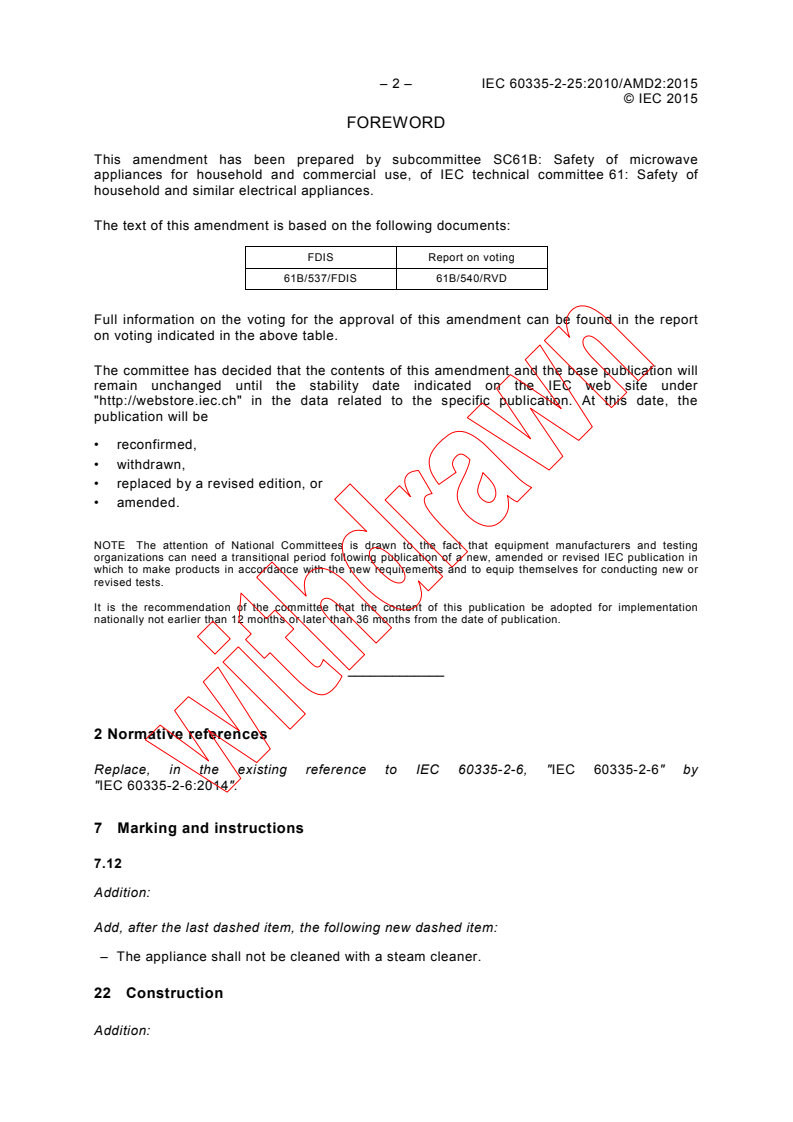
Replace, in the existing reference to IEC 60335-2-6, "IEC 60335-2-6" by
"IEC 60335-2-6:2014".
7 Marking and instructions
7.12
Addition:
Add, after the last dashed item, the following new dashed item:
– The appliance shall not be cleaned with a steam cleaner.
22 Construction
Addition:
© IEC 2015
Add, after the existing 22.118, the following new subclause:
22.119 Outer glass panels of microwave oven doors which break during the test of 21.104
and with an area having any two orthogonal dimensions exceeding 75 mm shall be made from
– glass that breaks into small pieces when it fractures; or
– glass that is not released or dropped from its normal position when broken; or
– glass with enhanced mechanical strength.
For glass that breaks into small pieces when it fractures, compliance is checked by the
following test which is performed on two samples.
Frames or other parts attached to the glass panel to be tested are removed and the glass is
placed on a rigid horizontal flat surface.
NOTE 1 The edges of the sample to be tested are contained within a frame of adhesive tape in such a manner
that the broken pieces remain in place after breakage but without hindering expansion of the sample.
The sample under test is broken by means of a test punch having a head with a mass of
75 g ± 5 g and a conical tungsten carbide tip with an angle of 60° ± 2°. The punch shall be
positioned approximately 13 mm in from the longest edge of the glass at the midpoint of that
edge. The punch is then hit by a hammer so that the glass breaks.
A transparent mask of 50 mm × 50 mm is placed on the fractured glass except within a
peripheral margin of 25 mm from the edge of the sample.
The assessment shall be undertaken on at least two areas of the sample, and the areas
chosen shall contain the largest particles.
The number of crack free particles totally within the mask is counted and for each assessment
shall not be less than 40. The particle count shall be made within 5 min of the fracture.
NOTE 2 In the case of curved glass, plane pieces of the same material can be used for the test.
For glass that is not released or dropped from its normal position when broken, compliance is
checked by breaking the glass when mounted in its normal position in the appliance by means
of a test punch having a head with a mass of 75 g ± 5 g and a conical tungsten carbide tip
with an angle of 60° ± 2° . The punch shall be positioned approximately 13 mm in from the
longest edge of the glass at the midpoint of that edge. The punch is then hit by a hammer so
that the glass breaks.
At the conclusion of this test the glass shall not be broken or cracked such that pieces are
released or dropped from their normal position. Glass that is released within the immediate
vicinity of the punch tip as a result of the punch impacting the sample under test is ignored.
For glass with enhanced mechanical strength, compliance is checked by the pendulum
hammer test Eha of IEC 60068-2-75.
For the test the glass panels are supported according to their method of incorporation in the
appliance.
The test is performed with three blows applied at the most critical point on two samples, the
impact energy of each blow shall be 5 J.
At the conclusion of the tests the glass shall not be broken or cracked.
– 4 – IEC 60335-2-25:2010/AMD2:2015
© IEC 2015
Annex A
(informative)
Routine tests
A.103 Microwave leakage
Replacement:
Replace the existing text of this subclause by the following new text:
The microwave oven is supplied at rated voltage and operated with the microwave power
control adjusted to the highest setting. A load as specified in Clause 32 or a load with equal
dielectric and thermal properties shall be used. The energy flux density of microwave leakage
is measured at any point approximately 50 mm between the field sensor and the external
surface of the appliance. The measuring instrument is moved over the external surface of the
oven and the microwave leakage is measured.
The microwave leakage shall not exceed 50 W/m , as recorded with an instrument fulfilling at
least the specifications in A.104 regarding its accuracy.
Addition:
Add, after the existing A.103, the following new Clause:
A.104 Microwave leakage instrument minimum specifications
A.104.1 The following specification applies only for routine tests and may also apply for
checks of microwave ovens after repair or servicing. Instruments for type testing shall fulfil
more stringent requirements, which are obtained from National bodies responsible for
protection against non-ionising radiation.
A.104.2 Instruments shall be subjected to regular calibration by carrying out the following
tests, to ensure their accuracy is maintained. The tests for instrument compliance are made at
room temperature. For carrying out the tests, the position of the field sensor shall be known
and preferably be marked. In order to allow measurements specified in A.104.3 to A.104.5 the
minimum resolution of the instrument under test shall be 1 W/m .
A.104.3 The level calibrations are carried out either using a generator set-up in an
anechoic chamber, or using a reference instrument in substitution mode. The far field shall be
linearly polarized. The field sensor of the instrument under test (IUT) shall be placed at the
2 2
position where the flux density is 10 W/m or 50 W/m , depending on the task. The range
selector, if any, shall be set to the most appropriate range to measure a flux density of
2 2
10 W/m or 50 W/m , depending on the task and with a tolerance from −40 % to +60 %. The
overall inaccuracy of the IUT shall be less than or equal to ± 1 dB (i.e. from −21 % to +26 %)
related to the average of minimum and maximum reading. The field sensor is positioned to the
minimum reading and then rotated 4 times for 90° around its axis which is aligned to the
propagation direction of the far field and directed towards the radiation source.
A.104.4 During the rotation in A.104.3 the maximum deviation of the IUT readings shall be
less than or equal to ± 2 dB (i.e. from −37 % to +58 %) related to the average of readings.
© IEC 2015
A.104.5 The IUT field sensor is rotated for maximum reading as described in A.104.3 and
then held in this position. The field sensor of an equal IUT is rotated as described in A.104.3
and slowly brought in close proximity of the field sensor of the static IUT. During the approach
to 50 mm distance between the field sensors, the reading of the static IUT shall not change by
more than ± 1 dB (i.e. from −21% to +26 %). During the test the axis of each field sensor has
to be aligned to the propagation direction of the far field and each field sensor has to be
directed towards the radiation source.
– 6 – IEC 60335-2-25:2010/AMD2:2015
© IEC 2015
Annex AA
...