

IEC PAS 80005-3:2014
(Main)Utility connections in port - Part 3: Low Voltage Shore Connection (LVSC) Systems - General requirements
General Information
- Abstract
IEC PAS 80005-3:2014(E) describes low voltage shore connection (LVSC) systems, on board the ship and on shore, to supply the ship with electrical power from shore. This PAS is applicable to the design, installation and testing of LVSC systems and addresses:
- LV shore distribution systems;
- shore-to-ship connection and interface equipment;
- transformers/reactors;
- semiconductor/rotating convertors;
- ship distribution systems; and
- control, monitoring, interlocking and power management systems. It does not apply to the electrical power supply during docking periods, e.g. dry docking and other out-of-service maintenance and repair. It is expected that LVSC systems will have practicable applications for ships requiring up to 1 MVA. Low-voltage shore connection systems not exceeding 250 A, with a maximum of 125 A per cable and not exceeding 300 V to earth are not covered by this PAS. High-voltage shore connection systems are covered by IEC/ISO/IEEE 80005-1.
- Status
- Replaced
- Publication Date
- 24-Aug-2014
- Current Stage
- DELPUB - Deleted Publication
- Start Date
- 08-Dec-2025
- Completion Date
- 28-Aug-2026
Overview
IEC PAS 80005-3:2014 - Utility connections in port, Part 3 - defines general requirements for Low Voltage Shore Connection (LVSC) systems used to supply ships with electrical power from shore. This publicly available specification covers the design, installation, testing and operation of LVSC systems both on board and ashore. It is intended for practicable applications for ships requiring up to about 1 MVA. NOTE: LVSC systems with very small ratings (≤250 A, max 125 A per cable and not exceeding 300 V to earth) are excluded, and high-voltage shore connections are addressed in IEC/ISO/IEEE 80005-1. The PAS does not apply to electrical supplies during dry-docking or other out-of-service maintenance.
Key topics & technical requirements
The standard addresses a comprehensive set of LV shore-power topics, including:
- System architecture: LV shore distribution, shore-to-ship interface, ship distribution and receiving switchboards (block diagram included).
- Components: transformers/reactors, semiconductor and rotating converters, neutral earthing resistors, circuit-breakers and disconnectors.
- Connection hardware: ship-to-shore cables, plugs, socket-outlets, pilot and earth contacts, cable reels and cable-management systems.
- Protection & safety: short-circuit and earth-fault protection, equipotential bonding, interlocking, emergency shutdown and safety loop circuits.
- Control & monitoring: power management, synchronization, load transfer (including blackout and automatic sync methods), instrumentation and independent control/monitoring cables.
- Environmental & mechanical design: degree of protection, cooling, location, moisture/condensation protection and requirements for hazardous areas.
- Verification, testing & documentation: initial site/ship tests, first-call tests, periodic maintenance and required documentation.
Practical applications & users
IEC PAS 80005-3 is essential for:
- Port authorities and shore-power project planners specifying LV shore-power installations.
- Ship designers, naval architects and onboard electrical engineers integrating shore connection systems.
- Manufacturers of plugs, cables, converters, transformers, switchgear and cable-management equipment.
- Classification societies, testing laboratories and installers performing acceptance and periodic tests.
- Port operators implementing shore-power (cold ironing) to reduce emissions and noise when ships are berthed.
Implementing this PAS helps ensure electrical compatibility, personnel safety, reliable power transfer, and consistent testing/maintenance practices across ship and shore installations.
Related standards
- IEC/ISO/IEEE 80005-1 - High-voltage shore connection (HVSC) systems (for higher-voltage shore-power solutions).
- Other IEC standards referenced within the PAS cover specific equipment, protection and cabling practices (see normative references in IEC PAS 80005-3).
Keywords: IEC PAS 80005-3, Low Voltage Shore Connection, LVSC, shore power, shore-to-ship, port utility connections, ship electrical systems, shore power testing, shore-to-ship cable.
Relations
- Effective Date
- 05-Sep-2023
Get Certified
Connect with accredited certification bodies for this standard

DNV
DNV is an independent assurance and risk management provider.

Lloyd's Register
Lloyd's Register is a global professional services organisation specialising in engineering and technology.

FSC International
Forest Stewardship Council certification.
Sponsored listings
Frequently Asked Questions
IEC PAS 80005-3:2014 is a technical specification published by the International Electrotechnical Commission (IEC). Its full title is "Utility connections in port - Part 3: Low Voltage Shore Connection (LVSC) Systems - General requirements". This standard covers: IEC PAS 80005-3:2014(E) describes low voltage shore connection (LVSC) systems, on board the ship and on shore, to supply the ship with electrical power from shore. This PAS is applicable to the design, installation and testing of LVSC systems and addresses: - LV shore distribution systems; - shore-to-ship connection and interface equipment; - transformers/reactors; - semiconductor/rotating convertors; - ship distribution systems; and - control, monitoring, interlocking and power management systems. It does not apply to the electrical power supply during docking periods, e.g. dry docking and other out-of-service maintenance and repair. It is expected that LVSC systems will have practicable applications for ships requiring up to 1 MVA. Low-voltage shore connection systems not exceeding 250 A, with a maximum of 125 A per cable and not exceeding 300 V to earth are not covered by this PAS. High-voltage shore connection systems are covered by IEC/ISO/IEEE 80005-1.
IEC PAS 80005-3:2014(E) describes low voltage shore connection (LVSC) systems, on board the ship and on shore, to supply the ship with electrical power from shore. This PAS is applicable to the design, installation and testing of LVSC systems and addresses: - LV shore distribution systems; - shore-to-ship connection and interface equipment; - transformers/reactors; - semiconductor/rotating convertors; - ship distribution systems; and - control, monitoring, interlocking and power management systems. It does not apply to the electrical power supply during docking periods, e.g. dry docking and other out-of-service maintenance and repair. It is expected that LVSC systems will have practicable applications for ships requiring up to 1 MVA. Low-voltage shore connection systems not exceeding 250 A, with a maximum of 125 A per cable and not exceeding 300 V to earth are not covered by this PAS. High-voltage shore connection systems are covered by IEC/ISO/IEEE 80005-1.
IEC PAS 80005-3:2014 is classified under the following ICS (International Classification for Standards) categories: 29.060.10 - Wires; 47.020.60 - Electrical equipment of ships and of marine structures. The ICS classification helps identify the subject area and facilitates finding related standards.
IEC PAS 80005-3:2014 has the following relationships with other standards: It is inter standard links to IEC/IEEE 80005-3:2025. Understanding these relationships helps ensure you are using the most current and applicable version of the standard.
IEC PAS 80005-3:2014 is available in PDF format for immediate download after purchase. The document can be added to your cart and obtained through the secure checkout process. Digital delivery ensures instant access to the complete standard document.
Standards Content (Sample)
IEC PAS 80005-3
Edition 1.0 2014-08
INTPUBLERICLNATYIONAL AVAIL ABLE
SSTPAENDARDCIFICAT ION
PRE-STANDARD
colour
inside
Utility connections in port –
Part 3: Low Voltage Shore Connection (LVSC) Systems – General requirements
All rights reserved. Unless otherwise specified, no part of this publication may be reproduced or utilized in any form
or by any means, electronic or mechanical, including photocopying and microfilm, without permission in writing from
either IEC or IEC's member National Committee in the country of the requester. If you have any questions about IEC
copyright or have an enquiry about obtaining additional rights to this publication, please contact the address below or
your local IEC member National Committee for further information.
IEC Central Office Tel.: +41 22 919 02 11
3, rue de Varembé Fax: +41 22 919 03 00
CH-1211 Geneva 20 info@iec.ch
Switzerland www.iec.ch
About the IEC
The International Electrotechnical Commission (IEC) is the leading global organization that prepares and publishes
International Standards for all electrical, electronic and related technologies.
About IEC publications
The technical content of IEC publications is kept under constant review by the IEC. Please make sure that you have the
latest edition, a corrigenda or an amendment might have been published.
IEC Catalogue - webstore.iec.ch/catalogue Electropedia - www.electropedia.org
The stand-alone application for consulting the entire The world's leading online dictionary of electronic and
bi bliographical information on IEC International Standards, electrical terms containing more than 30 000 terms and
Technical Specifications, Technical Reports and other definitions in English and French, with equivalent terms in 14
documents. Available for PC, Mac OS, Android Tablets and additional languages. Also known as the International
iPad. Electrotechnical Vocabulary (IEV) online.
IEC publications search - www.iec.ch/searchpub IEC Glossary - std.iec.ch/glossary
The advanced search enables to find IEC publications by a More than 55 000 electrotechnical terminology entries in
variety of criteria (reference number, text, technical English and French extracted from the Terms and Definitions
committee,…). It also gives information on projects, replaced clause of IEC publications issued since 2002. Some entries
and withdrawn publications. have been collected from earlier publications of IEC TC 37,
77, 86 and CISPR.
IEC Just Published - webstore.iec.ch/justpublished
Stay up to date on all new IEC publications. Just Published IEC Customer Service Centre - webstore.iec.ch/csc
details all new publications released. Available online and If you wish to give us your feedback on this publication or
also once a month by email. need further assistance, please contact the Customer Service
Centre: csc@iec.ch.
IEC PAS 80005-3
Edition 1.0 2014-08
PUBLICLY AVAILABLE
SPECIFICATION
PRE-STANDARD
colour
inside
Utility connections in port –
Part 3: Low Voltage Shore Connection (LVSC) Systems – General requirements
INTERNATIONAL
ELECTROTECHNICAL
COMMISSION
PRICE CODE
XA
ICS 47.020.60 ISBN 978-2-8322-1832-7
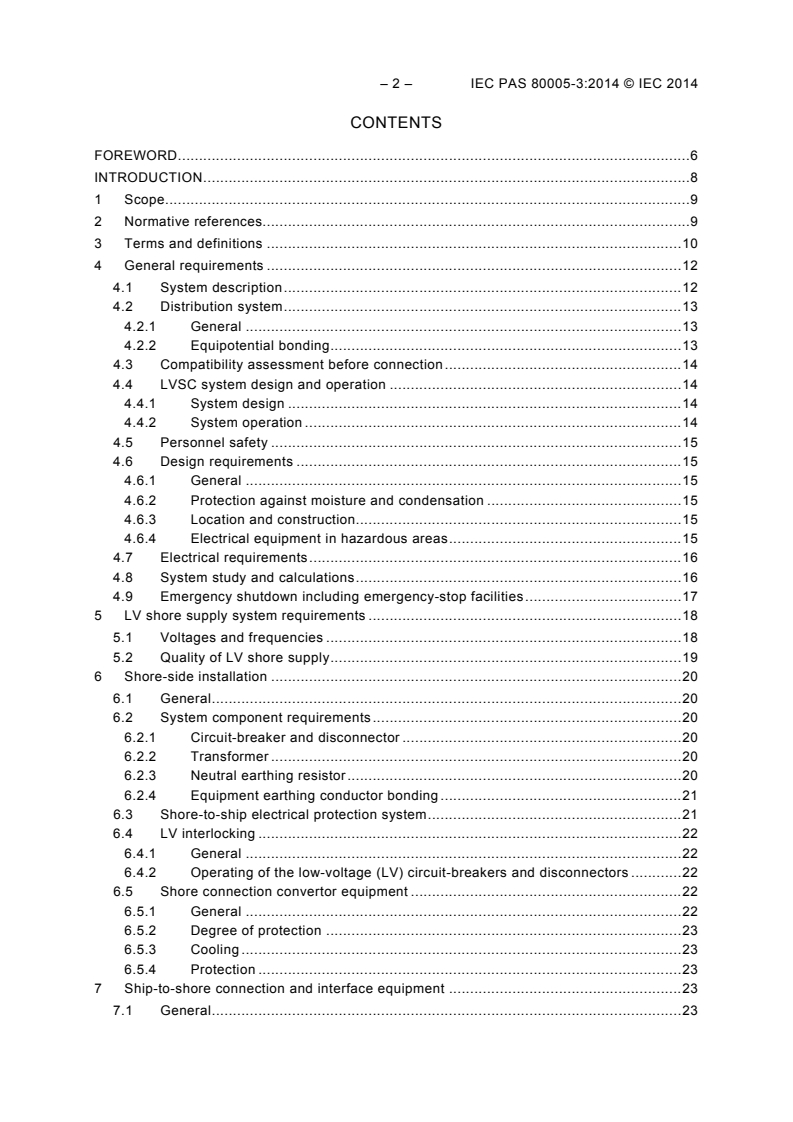
– 2 – IEC PAS 80005-3:2014 © IEC 2014
CONTENTS
FOREWORD . 6
INTRODUCTION . 8
1 Scope . 9
2 Normative references. 9
3 Terms and definitions . 10
4 General requirements . 12
4.1 System description . 12
4.2 Distribution system . 13
4.2.1 General . 13
4.2.2 Equipotential bonding . 13
4.3 Compatibility assessment before connection . 14
4.4 LVSC system design and operation . 14
4.4.1 System design . 14
4.4.2 System operation . 14
4.5 Personnel safety . 15
4.6 Design requirements . 15
4.6.1 General . 15
4.6.2 Protection against moisture and condensation . 15
4.6.3 Location and construction. 15
4.6.4 Electrical equipment in hazardous areas . 15
4.7 Electrical requirements . 16
4.8 System study and calculations . 16
4.9 Emergency shutdown including emergency-stop facilities . 17
5 LV shore supply system requirements . 18
5.1 Voltages and frequencies . 18
5.2 Quality of LV shore supply . 19
6 Shore-side installation . 20
6.1 General . 20
6.2 System component requirements . 20
6.2.1 Circuit-breaker and disconnector . 20
6.2.2 Transformer . 20
6.2.3 Neutral earthing resistor . 20
6.2.4 Equipment earthing conductor bonding . 21
6.3 Shore-to-ship electrical protection system . 21
6.4 LV interlocking . 22
6.4.1 General . 22
6.4.2 Operating of the low-voltage (LV) circuit-breakers and disconnectors . 22
6.5 Shore connection convertor equipment . 22
6.5.1 General . 22
6.5.2 Degree of protection . 23
6.5.3 Cooling . 23
6.5.4 Protection . 23
7 Ship-to-shore connection and interface equipment . 23
7.1 General . 23
7.2 Cable management system . 24
7.2.1 General . 24
7.2.2 Monitoring of cable tension. 24
7.2.3 Monitoring of the cable length . 25
7.2.4 Connection conductor current unbalance protection . 25
7.3 Plugs and socket-outlets . 25
7.3.1 General . 25
7.3.2 Pilot contacts . 28
7.3.3 Earth contact . 28
7.4 Ship-to-shore connection cable . 28
7.5 Independent control and monitoring cable . 28
7.6 Storage . 28
8 Ship requirements . 29
8.1 General . 29
8.2 Ship electrical distribution system protection . 29
8.2.1 Short-circuit protection . 29
8.2.2 Earth fault protection, monitoring and alarm . 29
8.3 Shore connection switchboard . 29
8.3.1 General . 29
8.3.2 Circuit-breaker and disconnector . 29
8.3.3 Instrumentation and protection . 30
8.4 On-board transformer . 30
8.5 On-board receiving switchboard connection point . 30
8.5.1 General . 30
8.5.2 Circuit-breaker . 30
8.5.3 Instrumentation . 31
8.5.4 Protection . 31
8.5.5 Operation of the circuit-breaker . 32
8.6 Ship power restoration . 33
9 LVSC system control and monitoring . 33
9.1 General requirements . 33
9.2 Load transfer via blackout . 33
9.3 Load transfer via automatic synchronization . 33
9.3.1 General . 33
9.3.2 Protection requirements . 34
10 Verification and testing . 34
10.1 General . 34
10.2 Initial tests of shore-side installation . 35
10.2.1 General . 35
10.2.2 Tests . 35
10.3 Initial tests of ship-side installation . 35
10.3.1 General . 35
10.3.2 Tests . 35
10.4 Tests at the first call at a shore supply point . 36
10.4.1 General . 36
10.4.2 Tests . 36
– 4 – IEC PAS 80005-3:2014 © IEC 2014
11 Periodic tests and maintenance . 36
11.1 General . 36
11.2 Tests at repeated calls of a shore supply point . 36
11.2.1 General . 36
11.2.2 Verification . 36
12 Documentation . 37
12.1 General . 37
12.2 System description . 37
Annex A (normative) Ship-to-shore connection cable . 38
A.1 Rated voltage . 38
A.2 Rated section / type . 38
A.3 General design . 38
A.3.1 General . 38
A.3.2 Conductors . 38
A.3.3 Earth conductors . 39
A.3.4 Pilot conductors . 39
A.3.5 Cabling . 39
Annex B (normative) Ship-to-shore connection plugs, socket-outlets, ship connectors
and ship inlets . 40
B.1 Rated voltage . 40
B.2 Rated type . 40
B.3 General design . 40
B.3.1 General . 40
B.3.2 Configuration . 41
Annex C (normative) Additional requirements for Offshore Supply, Service and
Working Ships . 42
C.1 Scope . 42
Annex D (normative) Additional requirements for Container Ships . 44
D.1 Scope . 44
Annex E (normative) Additional requirements for Tankers . 46
E.1 Scope . 46
Annex F (normative) General operating procedures . 49
Bibliography . 50
Figure 1 – Block diagram of a typical LVSC system . 13
Figure 2 – Phase sequence rotation – Positive direction . 18
Figure 3 – Balanced three-phase variables in time domain . 19
Figure 4 – Safety loop circuit for one feeder (a) or three feeders (b), for LVSC system. . 27
Figure 5 – Diagram showing the use of accessories . 37
Figure B.1 – Connection with mobile cable reel . 41
Figure B.2 – Connection with fixed cable reel . 41
Figure C.1 – Example for general system layout . 42
Figure C.2 – Power plug and socket-outlet contact assignment . 43
Figure D.1 – Example for general system layout . 44
Figure D.2 – Power plug and socket-outlet contact assignment . 45
Figure E.1 – Example for general system layout . 46
Figure E.2 – Power plug and socket pin assignment . 47
Figure E.3 – IS Barrier and cable properties (to be developed) . 48
Figure E.4 – Safety loop circuit for LVSC system in tankers (to be developed) . 48
Figure F.1 – LVSC general operating procedures for connection a) and disconnection b) . 49
Table B.1 – Number of feeders function of power demand and voltage . 41
– 6 – IEC PAS 80005-3:2014 © IEC 2014
INTERNATIONAL ELECTROTECHNICAL COMMISSION
____________
UTILITY CONNECTIONS IN PORT –
Part 3: Low Voltage Shore Connection (LVSC) Systems –
General requirements
FOREWORD
1) The International Electrotechnical Commission (IEC) is a worldwide organization for standardization comprising
all national electrotechnical committees (IEC National Committees). The object of IEC is to promote
international co-operation on all questions concerning standardization in the electrical and electronic fields. To
this end and in addition to other activities, IEC publishes International Standards, Technical Specifications,
Technical Reports, Publicly Available Specifications (PAS) and Guides (hereafter referred to as “IEC
Publication(s)”). Their preparation is entrusted to technical committees; any IEC National Committee interested
in the subject dealt with may participate in this preparatory work. International, governmental and non-
governmental organizations liaising with the IEC also participate in this preparation. IEC collaborates closely
with the International Organization for Standardization (ISO) in accordance with conditions determined by
agreement between the two organizations.
ISO (the International Organization for Standardization) is a worldwide federation of national standards bodies
(ISO member bodies). The work of preparing International Standards is normally carried out through
ISO technical committees. Each member body interested in a subject for which a technical committee has been
established has the right to be represented on that committee. International organizations, governmental and
non-governmental, in liaison with ISO, also take part in the work. ISO collaborates closely with the International
Electrotechnical Commission (IEC) on all matters of electrotechnical standardization.
2) The formal decisions or agreements of IEC on technical matters express, as nearly as possible, an international
consensus of opinion on the relevant subjects since each technical committee has representation from all
interested IEC National Committees.
3) IEC Publications have the form of recommendations for international use and are accepted by IEC National
Committees in that sense. While all reasonable efforts are made to ensure that the technical content of IEC
Publications is accurate, IEC cannot be held responsible for the way in which they are used or for any
misinterpretation by any end user.
4) In order to promote international uniformity, IEC National Committees undertake to apply IEC Publications
transparently to the maximum extent possible in their national and regional publications. Any divergence
between any IEC Publication and the corresponding national or regional publication shall be clearly indicated in
the latter.
5) IEC itself does not provide any attestation of conformity. Independent certification bodies provide conformity
assessment services and, in some areas, access to IEC marks of conformity. IEC is not responsible for any
services carried out by independent certification bodies.
6) All users should ensure that they have the latest edition of this publication.
7) No liability shall attach to IEC or ISO or its directors, employees, servants or agents including individual experts
and members of its technical committees and IEC National Committees for any personal injury, property
damage or other damage of any nature whatsoever, whether direct or indirect, or for costs (including legal fees)
and expenses arising out of the publication, use of, or reliance upon, this IEC Publication or any other IEC
Publications.
8) Attention is drawn to the Normative references cited in this publication. Use of the referenced publications is
indispensable for the correct application of this publication.
9) Attention is drawn to the possibility that some of the elements of this IEC/ISO Publication may be the subject of
patent rights. IEC or ISO shall not be held responsible for identifying any or all such patent rights.
A PAS is a technical specification not fulfilling the requirements for a standard, but made
available to the public.
This Publicly Available Specification (PAS) IEC/ISO 80005-3 has been prepared by IEC
technical committee 18: Electrical installations of ships and of mobile and fixed offshore units,
in cooperation with IEC subcommittee 23H: Plugs, socket-outlets and couplers for industrial
and similar applications, and for electric vehicles, of IEC technical committee 23: Electrical
accessories and IEC technical committee 20:Electric cables, ISO technical committee 8:
Ships and marine technology, subcommittee 3: Piping and machinery, and IEEE IAS
Petroleum and Chemical Industry Committee (PCIC) of the Industry Applications Society of
the IEEE.
This PAS will eventually be replaced with an IEC/IEEE prefix and IEC/ISO/IEEE triple logo
standard.
The text of this PAS is based on the This PAS was approved for
following document: publication by the P-members of the
committee concerned as indicated in
the following document
Draft PAS Report on voting
18/1377/PAS 18/1390/RVD
Following publication of this PAS, which is a pre-standard publication, the technical committee
or subcommittee concerned may transform it into an International Standard.
A list of all the parts in the IEC 80005 series, published under the general title Utility
Connections In Port, can be found on the IEC website.
This PAS shall remain valid for an initial maximum period of 3 years starting from the
publication date. The validity may be extended for a single period up to a maximum of
3 years, at the end of which it shall be published as another type of normative document, or
shall be withdrawn.
IMPORTANT – The 'colour inside' logo on the cover page of this publication indicates
that it contains colours which are considered to be useful for the correct
understanding of its contents. Users should therefore print this document using a
colour printer.
– 8 – IEC PAS 80005-3:2014 © IEC 2014
INTRODUCTION
This Publicly Available Specification (PAS) was developed jointly by IEC technical
committee 18: Electrical installations of ships and of mobile and fixed offshore units in
cooperation with IEC subcommittee 23H: Plugs, socket-outlets and couplers for industrial and
similar applications, and for electric vehicles, of IEC technical committee 23: Electrical
accessories and IEC technical committee 20:Electric cables, ISO technical committee 8:
Ships and marine technology, subcommittee 3: Piping and Machinery, and IEEE IAS PCIC
Marine Industry subcommittee.
For a variety of reasons, including environmental considerations, it is becoming an
increasingly common requirement for ships to shut down ship generators and to connect to
shore power for as long as practicable during stays in port.
The intention of this PAS is to define requirements that support, with the application of
suitable operating practices, efficiency and safety of connections by compliant ships to
compliant low-voltage shore power supplies through a compatible shore-to-ship connection.
With the support of sufficient planning, cooperation between ship and terminal facilities, and
appropriate operating procedures and assessment, compliance with the requirements of this
PAS is intended to allow different ships to connect to low-voltage shore connection (LVSC)
systems at different berths. This provides the benefits of standard, straightforward connection
without the need for adaptation and adjustment at different locations that can satisfy the
requirement to connect for as long as practicable during stays in port.
Ships that do not apply this PAS may find it impossible to connect to compliant shore
supplies.
Where deviations from the requirements and recommendations in this PAS may be
considered for certain designs, the potential effects on compatibility are highlighted.
Where the requirements and recommendations of this PAS are complied with, low-voltage
shore supplies arrangements are likely to be compatible for visiting ships for connection.
Clauses 1 to 12 are intended for application to all LVSC systems. They are intended to
address mainly the safety and effectiveness of LVSC systems with a minimum level of
requirements that would standardise on one solution. This PAS includes the requirement to
complete a detailed compatibility assessment for each combination of ship and shore supply
prior to a given ship arriving to connect to a given shore supply for the first time.
The other annexes in this PAS are ship-specific annexes which include additional
requirements related to agreed standardisation of solutions to achieve compatibility for
compliant ships at different compliant berths and to address safety issues that are considered
to be particular to that ship type. These annexes use the same numbering as Clauses 1 to 12
with an annex letter prefix. Hence, the numbering is not necessarily continuous. Where no
additional requirements are identified, the clause is not shown.
UTILITY CONNECTIONS IN PORT –
Part 3: Low Voltage Shore Connection (LVSC) Systems –
General requirements
1 Scope
This PAS describes low voltage shore connection (LVSC) systems, on board the ship and on
shore, to supply the ship with electrical power from shore.
This PAS is applicable to the design, installation and testing of LVSC systems and addresses:
• LV shore distribution systems;
• shore-to-ship connection and interface equipment;
• transformers/reactors;
• semiconductor/rotating convertors;
• ship distribution systems; and
• control, monitoring, interlocking and power management systems.
NOTE It does not apply to the electrical power supply during docking periods, e.g. dry docking and other out-of-
service maintenance and repair.
Additional and/or alternative requirements may be imposed by national administrations or the
authorities within whose jurisdiction the ship is intended to operate and/or by the owners or
authorities responsible for a shore supply or distribution system.
It is expected that LVSC systems will have practicable applications for ships requiring up to
1 MVA. Low-voltage shore connection systems not exceeding 250 A, with a maximum of
125 A per cable and not exceeding 300 V to earth are not covered by this PAS. High-voltage
shore connection systems are covered by IEC/ISO/IEEE 80005-1.
2 Normative references
The following documents, in whole or in part, are normatively referenced in this document and
are indispensable for its application. For dated references, only the edition cited applies. For
undated references, the latest edition of the referenced document (including any
amendments) applies.
IEC 60034 (all parts), Rotating electrical machines
IEC 60076 (all parts), Power transformers
IEC 60079 (all parts), Explosive atmospheres
IEC 60092-101:1994, Electrical installations in ships – Part 101: Definitions and general
requirements
IEC 60092-201:1994, Electrical installations in ships – Part 201: System design – General
IEC 60092-301:1980, Electrical installations in ships – Part 301: Equipment – Generators and
motors
– 10 – IEC PAS 80005-3:2014 © IEC 2014
IEC 60092-401:1980, Electrical installations in ships – Part 401: Installation and test of
completed installation
IEC 60092-502:1999, Electrical installations in ships – Part 502: Tankers – Special features
IEC 60092-504:2001, Electrical installations in ships – Part 504: Special features – Control
and instrumentation
IEC 60146-1 (all parts), Semiconductor convertors – General requirements and line
commutated convertors
IEC 60204-1:2005, Safety of machinery – Electrical equipment of machines – Part 1: General
requirements
IEC 60228:2004, Conductors of insulated cables
IEC 60309-1:2012, Plugs, socket-outlets and couplers for industrial purposes – Part 1:
General requirements
IEC 60332-1-2, Tests on electric and optical fibre cables under fire conditions – Part 1-2: Test
for vertical flame propagation for a single insulated wire or cable – Procedure for 1 kW pre-
mixed flame
IEC 60529, Degrees of protection provided by enclosures (IP Code)
IEC 60947-2:2006, Low-voltage switchgear and controlgear – Part 2: Circuit-breakers
IEC 60947-5-1:2003, Low-voltage switchgear and controlgear – Part 5-1: Control circuit
devices and switching elements – Electromechanical control circuit devices
IEC 61363-1, Electrical installations of ships and mobile and fixed offshore units – Part 1:
Procedures for calculating short-circuit currents in three-phase a.c.
IEC 61439 (all parts), Low-voltage switchgear and controlgear assemblies
International Convention for the Safety of Life at Sea (SOLAS):1974, Consolidated edition
2009, Ch. II-1/D, Regulations 42, 43 and 45
3 Terms and definitions
For the purposes of this document, the following terms and definitions apply.
3.1
cable management system
all equipment designed to control, monitor and handle the LV-flexible and control cables and
their connection devices
3.2
plug and socket-outlet
a means enabling the connection at will of a flexible cable to fixed wiring. It consists of two
parts:
Note 1 to entry: "plug and socket-outlet" corresponds to the French "prise de courant" that has no equivalent in
English. It is anyhow required for the French version of this PAS.
[SOURCE: IEC 60309-1:2012, 2.1, modified (Note 1 to entry added)]
3.2.1
socket-outlet
the part intended to be installed with the fixed wiring (shore side) or incorporated in
equipment
Note 1 to entry: A socket-outlet may also be incorporated in the output circuit of an isolating transformer.
Note 2 to entry: For the use of plugs, socket-outlets, and ship couplers, see Figure 5 – Diagram showing the use
of accessories.
[SOURCE: IEC 62613-1:2011, 3.2 modified ("shore side" and Note 2 to entry added)]
3.2.2
plug
the part intended to be attached directly to one flexible cable, and to be connected to the
shore socket-outlet
[SOURCE: IEC 62613-1:2011, 3.3 modified (“and to be connected to the shore socket-outlet”
added)]
3.3
ship coupler
a means enabling the connection at will of a flexible cable to the ship. It consists of two parts:
[SOURCE: IEC 62613-1:2011, 3.4]
3.3.1
ship connector
the part intended to be attached to one flexible cable connected to the supply, and to be
connected to the ship inlet
[SOURCE: IEC 62613-1:2011, 3.5 modified (“and to be connected to the ship inlet” added)]
3.3.2
ship inlet
the part incorporated in, or fixed to, the ship
[SOURCE: IEC 62613-1:2011, 3.6]
3.4
equipotential bonding
provision of electric connections between conductive parts, intended to achieve
equipotentiality
[SOURCE: IEC 60050-195:1998, 195-01-10]
3.5
low voltage
LV
a set of voltage levels used for the distribution of electricity and whose upper limit is generally accepted
to be 1 000 V AC
[SOURCE: IEC 60050-601, 601-01-26]
3.6
person in charge
PIC
individual responsible for LVSC systems operations
– 12 – IEC PAS 80005-3:2014 © IEC 2014
3.7
pilot contact
a contact of the plug, ship inlet, socket-outlet and ship connector which signals correct
connection and which is a safety-related component
3.8
receiving point
connection point of the flexible cable on the ship
3.9
safe
condition in which safety risks are minimized to an acceptable level
3.10
supply point
the connection point of the flexible cable on shore
3.11
fail safe
a design property of an item which prevents its failures from resulting in critical faults
[SOURCE: IEC 60050-195:1998, 191-15-04]
4 General requirements
4.1 System description
A typical LVSC system described in this PAS consists of hardware components as shown in
Figure 1.
SHORE SUPPLY SHIP NETWORK
6 8
3 9
G
Key
1. SHORE SUPPLY SYSTEM 8. CONTROL SHIP
2. SHORE-SIDE TRANSFORMER AND 9. SHIP PROTECTION RELAYING
NEUTRAL GROUNDING RESISTOR 10. ON-BOARD SHORE CONNECTION
OR/AND IT SYSTEM SWITCHBOARD
3. SHORE-SIDE PROTECTION RELAYING 11. ON – BOARD TRANSFORMER (WHERE
4. SHORE-SIDE CIRCUIT-BREAKER APPLICABLE)
5. SHORE-SIDE FEEDERS CIRCUIT- 12. ON-BOARD RECEIVING SWITCHBOARD
BREAKERS
6. CONTROL SHORE
7. SHORE-TO-SHIP CONNECTION AND
INTERFACE EQUIPMENT
Figure 1 – Block diagram of a typical LVSC system
4.2 Distribution system
4.2.1 General
Typical distribution systems requirements used on shore are given in IEC 60364. Typical ship
distribution systems requirements are given in IEC 60092-101.
NOTE IEEE 45 provides additional information on typical ship distribution systems.
4.2.2 Equipotential bonding
An equipotential bonding between the ship’s hull and shore earthing electrode shall be
established by the earth contacts of the plug, socket-outlet, ship connector and ship inlet.
Equipotential bonding shall be periodically checked (see 11.2.2).
NOTE The terms earth(ing) and ground(ing) are used throughout this PAS and have the same meaning. See
IEC 60050-195:1998, 195-01-08.
– 14 – IEC PAS 80005-3:2014 © IEC 2014
4.3 Compatibility assessment before connection
Compatibility assessment shall be performed to verify the possibility to connect the ship to
shore LV supply. Compatibility assessment shall be performed prior to the first arrival at a
terminal.
Assessment of compatibility shall be performed to determine the following:
a) compliance with the requirements of this PAS and any deviations from the
recommendations;
b) minimum and maximum prospective short-circuit current (see 4.7 and 4.8);
c) nominal ratings of the shore supply, ship-to-shore connection and ship connection (see
5.1);
d) any de-rating for cable coiling or other factors (see 7.2.1);
e) acceptable voltage variations at ship switchboards between no-load and nominal rating
(see 5.2);
f) steady state and transient ship load demands when connected to a LV shore supply, LV
shore supply response to step changes in load (see 5.2);
g) system study and calculations (see 4.8);
h) compatibility of shore side and ship side control voltages, where applicable;
i) distribution system compatibility assessment (shore power transformer neutral earthing);
j) functioning of ship earth fault protection, where applicable, monitoring and alarms when
connected to a LVSC supply (see 8.2.2);
k) sufficient cable length;
l) compatibility of safety circuits, in accordance with 9.1;
m) consideration of hazardous areas, where applicable (see 4.6.4);
n) when a LV supply system is connected, consideration shall be given to provide means to
reduce current in-rush and/or inhibit the starting of large loads that would result in failure,
overloading or activation of automatic load reduction measures;
o) consideration of electrochemical corrosion due to equipotential bonding;
p) utility interconnection requirements for load transfer parallel connection.
4.4 LVSC system design and operation
4.4.1 System design
The design and construction shall be integrated and coordinated among the parties
responsible for shore and ship LVSC systems.
System integration of shore and ship LVSC systems shall be managed by a single designated
party and shall be performed in accordance with a defined procedure identifying the roles,
responsibilities and requirements of all parties involved.
4.4.2 System operation
During the operation of LVSC systems, PIC(s) shall be identified at the shore facility and on
board the ship for the purposes of communication.
The PIC(s) shall be provided with sufficient information, instructions, tools and other
resources for safety and efficiency of these activities.
4.5 Personnel safety
Construction of the LV equipment and operating safety procedures shall provide for the safety
of personnel during the establishment of the connection of the ship supply, during all normal
operations, in the event of a failure, during disconnection and when not in use.
NOTE The use of the term “safe” is not intended to suggest or guarantee that absolute safety can be achieved in
any situation and/or by compliance with the recommended practices set forth herein. The use of terms such as
“safe”, “intrinsically safe”, “electrically safe work practices”, “safe work condition”, “safe work environment", “safe
design”, “safe distance”, “safe work method”, “safe work area”, “safe use”, etc. describe practices, conditions, etc.
in which safety risks are minimized but not eliminated absolutely, such that safety is not guaranteed.
4.6 Design requirements
4.6.1 General
Protection and safety systems shall be designed based on the fail safe principle.
Suitable warning notices shall be provided at locations along connection equipment routes
including connection locations.
4.6.2 Protection against moisture and condensation
Effective means shall be provided to prevent accumulation of moisture and condensation,
even if equipment is idle for appreciable periods.
4.6.3 Location and construction
LVSC equipment shall be installed in access controlled spaces.
Equipment shall be suitable for the environment conditions in the space(s) where it is
expected to operate. Ship equipment shall comply with the applicable requirements of
IEC 60092-101.
Equipment location is critical to the safety and efficiency of operation of the ship's cargo and
mooring systems. When determining the location of the LVSC system, the full range of cargo,
bunkering and other utility operations shall be considered, including:
a) the cargo handling and mooring equipment in use on the ship and shore, and the areas
that must be clear for their operation, along with any movement of the ship along the pier
required to accommodate these operations;
b) traffic management considerations such that the use of an LVSC system does not
interfere with other ships' operations (including mooring) or prevent necessary traffic flow
on the pier and to maintain open fire lanes where required; and
c) personnel safety measures, such as physical barriers to prevent unauthorized personnel
access to LVSC equipment or the cable management equipment.
When determining the connection point of the LVSC system, all tidal conditions and ship
operations affecting ship’s free board shall be considered.
4.6.4 Electrical equipment in hazardous areas
LVSC equipment shall be located outside the hazardous areas of the ship and shore facilities
under normal operating conditions, except where it is shown to be necessarily located in
these areas for safety reasons.
LVSC equipment that may fall within one of the hazardous areas of the terminal under
emergency conditions (inadvertent movement of ship from berth) shall be:
a) certified in accordance with IEC 60079 as suitable for hazardous areas; or
– 16 – IEC PAS 80005-3:2014 © IEC 2014
b) automatically isolated before entering the potentially hazardous area.
Control equipment located within hazardous areas shall not present an ignition hazard.
LVSC systems should as far as possible not be installed in areas which may become
hazardous areas upon failure of required air changes per hours during loading and offloading
cargo or during normal operation.
When a tanker is at a berth, it is possible that an area in the tanker that is regarded as safe
according to IEC 60092-502 may falls within one of the hazardous zones of the terminal. If
such a situation should arise and, if the area in question contains electrical equipmen
...