

IEC 60076-21:2018
(Main)Power transformers - Part 21: Standard requirements, terminology, and test code for step-voltage regulators
General Information
- Abstract
IEC 60076-21:2018 describes electrical, mechanical and test requirements of liquid-immersed, single- and three-phase, 50 Hz and 60 Hz, self and forced-air cooled, distribution, overhead and substation, step-voltage regulators, 1 000 kVA (single-phase units) or 3 000 kVA (three-phase units) and smaller, 34 500 volts and below (2 400 V minimum) and their associated controls. Requirements, references and definitions relevant to either IEC or IEEE contexts are given and their use is described in Clause 4. This publication is published as an IEC/IEEE Dual Logo standard. This second edition cancels and replaces IEC 60076-21, published in 2011, and IEEE Std C57.15-2009. This edition includes the following significant technical changes with respect to IEC 6007621:2011/IEEE Std C57.15-2009:
a) updated list of normative and bibliography IEC and IEEE references and their associated text;
b) updated tables of preferred ratings for inclusion of maximum system voltage (Um), nominal system voltage and rated voltage (Ur);
c) inclusion of tables for optional fan-cooled ratings, external dielectric clearances and sound pressure levels;
d) revision of short-circuit requirements for distribution and substation voltage regulators;
e) inclusion of an universal interface between control enclosure and apparatus;
f) inclusion of tap-changer routine and type tests;
g) inclusion of audible sound pressure emissions test procedures;
h) inclusion of tank enclosure integrity type test procedures;
i) update of control environmental IEC reference test standard.
Keywords: step-voltage regulators
- Status
- Published
- Publication Date
- 06-Dec-2018
- Technical Committee
- TC 14 - Power transformers
- Drafting Committee
- MT 60076-21 - TC 14/MT 60076-21
- Current Stage
- PPUB - Publication issued
- Start Date
- 07-Dec-2018
- Completion Date
- 16-Nov-2018
Overview
IEC 60076-21:2018 - Power transformers - Part 21: standard requirements, terminology, and test code for step-voltage regulators is an IEC/IEEE dual-logo standard that defines electrical, mechanical and test requirements for liquid‑immersed, single‑ and three‑phase, 50 Hz and 60 Hz step‑voltage regulators. It applies to self‑ and forced‑air cooled distribution, overhead and substation regulators rated up to 1 000 kVA (single‑phase units) or 3 000 kVA (three‑phase units) and smaller, for system voltages up to 34 500 V (minimum 2 400 V), including their associated controls.
Key topics and technical requirements
- Ratings and classification: preferred ratings, cooling classes (self‑cooled and fan‑cooled), taps, nominal and maximum system voltages.
- Construction and marking: tank, bushings, external dielectric clearances, terminal markings and nameplates.
- Control and interfaces: requirements for associated controls and a universal interface between control enclosure and apparatus.
- Short‑circuit and mechanical capability: revised short‑circuit requirements and mechanical demonstration of withstand capability.
- Test code: comprehensive test procedures including ratio, polarity, no‑load and load losses, excitation current, temperature‑rise, dielectric tests (lightning impulse, applied and induced voltage), insulation power factor, and on‑load tap‑changer (OLTC) routine and type tests.
- Acoustics and enclosure integrity: sound pressure emission tests and tank enclosure integrity test procedures.
- Updates and harmonization: updated IEC and IEEE normative references, tables for fan‑cooled ratings, external clearances and sound levels, and alignment with IEEE terminology and practice.
Applications and who uses this standard
IEC 60076-21 is used for:
- Transformer and regulator manufacturers - to design, type‑test and certify step‑voltage regulators compliant with international acceptance criteria.
- Power utilities and grid operators - for procurement specifications, factory acceptance testing (FAT) and site acceptance testing (SAT) of distribution and substation regulators.
- Testing laboratories and inspection bodies - to perform standardized dielectric, thermal, acoustic and mechanical tests.
- Consultants, specifiers and regulators - to reference standardized ratings, safety clearances and interface requirements in project documents.
Practical benefits include consistent performance verification, interoperability of control interfaces, verified short‑circuit and acoustic performance, and clear guidance for selection and installation of step‑voltage regulators.
Related standards
- IEC 60076 series (power transformer standards)
- IEEE Std C57.15 (this edition aligns IEC/IEEE practices and supersedes earlier versions)
Keywords: step‑voltage regulators, voltage regulators, on‑load tap‑changer, IEC 60076‑21, transformer test code.
Relations
- Effective Date
- 05-Sep-2023
Get Certified
Connect with accredited certification bodies for this standard

IMQ S.p.A. (Certification)
Italian electrical product certification.

SLG Prüf- und Zertifizierungs GmbH
German testing and certification body.

UL Solutions
Global safety science company with testing, inspection and certification.
Sponsored listings
Frequently Asked Questions
IEC 60076-21:2018 is a standard published by the International Electrotechnical Commission (IEC). Its full title is "Power transformers - Part 21: Standard requirements, terminology, and test code for step-voltage regulators". This standard covers: IEC 60076-21:2018 describes electrical, mechanical and test requirements of liquid-immersed, single- and three-phase, 50 Hz and 60 Hz, self and forced-air cooled, distribution, overhead and substation, step-voltage regulators, 1 000 kVA (single-phase units) or 3 000 kVA (three-phase units) and smaller, 34 500 volts and below (2 400 V minimum) and their associated controls. Requirements, references and definitions relevant to either IEC or IEEE contexts are given and their use is described in Clause 4. This publication is published as an IEC/IEEE Dual Logo standard. This second edition cancels and replaces IEC 60076-21, published in 2011, and IEEE Std C57.15-2009. This edition includes the following significant technical changes with respect to IEC 6007621:2011/IEEE Std C57.15-2009: a) updated list of normative and bibliography IEC and IEEE references and their associated text; b) updated tables of preferred ratings for inclusion of maximum system voltage (Um), nominal system voltage and rated voltage (Ur); c) inclusion of tables for optional fan-cooled ratings, external dielectric clearances and sound pressure levels; d) revision of short-circuit requirements for distribution and substation voltage regulators; e) inclusion of an universal interface between control enclosure and apparatus; f) inclusion of tap-changer routine and type tests; g) inclusion of audible sound pressure emissions test procedures; h) inclusion of tank enclosure integrity type test procedures; i) update of control environmental IEC reference test standard. Keywords: step-voltage regulators
IEC 60076-21:2018 describes electrical, mechanical and test requirements of liquid-immersed, single- and three-phase, 50 Hz and 60 Hz, self and forced-air cooled, distribution, overhead and substation, step-voltage regulators, 1 000 kVA (single-phase units) or 3 000 kVA (three-phase units) and smaller, 34 500 volts and below (2 400 V minimum) and their associated controls. Requirements, references and definitions relevant to either IEC or IEEE contexts are given and their use is described in Clause 4. This publication is published as an IEC/IEEE Dual Logo standard. This second edition cancels and replaces IEC 60076-21, published in 2011, and IEEE Std C57.15-2009. This edition includes the following significant technical changes with respect to IEC 6007621:2011/IEEE Std C57.15-2009: a) updated list of normative and bibliography IEC and IEEE references and their associated text; b) updated tables of preferred ratings for inclusion of maximum system voltage (Um), nominal system voltage and rated voltage (Ur); c) inclusion of tables for optional fan-cooled ratings, external dielectric clearances and sound pressure levels; d) revision of short-circuit requirements for distribution and substation voltage regulators; e) inclusion of an universal interface between control enclosure and apparatus; f) inclusion of tap-changer routine and type tests; g) inclusion of audible sound pressure emissions test procedures; h) inclusion of tank enclosure integrity type test procedures; i) update of control environmental IEC reference test standard. Keywords: step-voltage regulators
IEC 60076-21:2018 is classified under the following ICS (International Classification for Standards) categories: 29.180 - Transformers. Reactors; 33.160.40 - Video systems. The ICS classification helps identify the subject area and facilitates finding related standards.
IEC 60076-21:2018 has the following relationships with other standards: It is inter standard links to IEC 60076-21:2011. Understanding these relationships helps ensure you are using the most current and applicable version of the standard.
IEC 60076-21:2018 is available in PDF format for immediate download after purchase. The document can be added to your cart and obtained through the secure checkout process. Digital delivery ensures instant access to the complete standard document.
Standards Content (Sample)
IEC 60076-21 ®
Edition 2.0 2018-12
™
IEEE Std C57.15
INTERNATIONAL
STANDARD
Power transformers –
Part 21: Standard requirements, terminology, and test code for step-voltage
regulators
All rights reserved. IEEE is a registered trademark in the U.S. Patent & Trademark Office, owned by the Institute of
Electrical and Electronics Engineers, Inc. Unless otherwise specified, no part of this publication may be reproduced
or utilized in any form or by any means, electronic or mechanical, including photocopying and microfilm, without
permission in writing from the IEC Central Office. Any questions about IEEE copyright should be addressed to the
IEEE. Enquiries about obtaining additional rights to this publication and other information requests should be
addressed to the IEC or your local IEC member National Committee.
IEC Central Office Institute of Electrical and Electronics Engineers, Inc.
3, rue de Varembé 3 Park Avenue
CH-1211 Geneva 20 New York, NY 10016-5997
Switzerland United States of America
Tel.: +41 22 919 02 11 stds.info@ieee.org
info@iec.ch www.ieee.org
www.iec.ch
About the IEC
The International Electrotechnical Commission (IEC) is the leading global organization that prepares and publishes
International Standards for all electrical, electronic and related technologies.
About the IEEE
IEEE is the world’s largest professional association dedicated to advancing technological innovation and excellence for
the benefit of humanity. IEEE and its members inspire a global community through its highly cited publications,
conferences, technology standards, and professional and educational activities.
About IEC/IEEE publications
The technical content of IEC/IEEE publications is kept under constant review by the IEC and IEEE. Please make sure
that you have the latest edition, a corrigendum or an amendment might have been published.
IEC Catalogue - webstore.iec.ch/catalogue Electropedia - www.electropedia.org
The stand-alone application for consulting the entire The world's leading online dictionary of electronic and
bibliographical information on IEC International Standards, electrical terms containing 21 000 terms and definitions in
Technical Specifications, Technical Reports and other English and French, with equivalent terms in 16 additional
documents. Available for PC, Mac OS, Android Tablets and languages. Also known as the International Electrotechnical
iPad. Vocabulary (IEV) online.
IEC publications search - webstore.iec.ch/advsearchform IEC Glossary - std.iec.ch/glossary
The advanced search enables to find IEC publications by a 67 000 electrotechnical terminology entries in English and
variety of criteria (reference number, text, technical French extracted from the Terms and Definitions clause of
committee,…). It also gives information on projects, replaced IEC publications issued since 2002. Some entries have been
and withdrawn publications. collected from earlier publications of IEC TC 37, 77, 86 and
CISPR.
IEC Just Published - webstore.iec.ch/justpublished
Stay up to date on all new IEC publications. Just Published IEC Customer Service Centre - webstore.iec.ch/csc
details all new publications released. Available online and If you wish to give us your feedback on this publication or
also once a month by email. need further assistance, please contact the Customer Service
Centre: sales@iec.ch.
IEC 60076-21 ®
Edition 2.0 2018-12
IEEE Std C57.15™
INTERNATIONAL
STANDARD
Power transformers –
Part 21: Standard requirements, terminology, and test code for step-voltage
regulators
INTERNATIONAL
ELECTROTECHNICAL
COMMISSION
ICS 29.180 ISBN 978-2-8322-6260-3
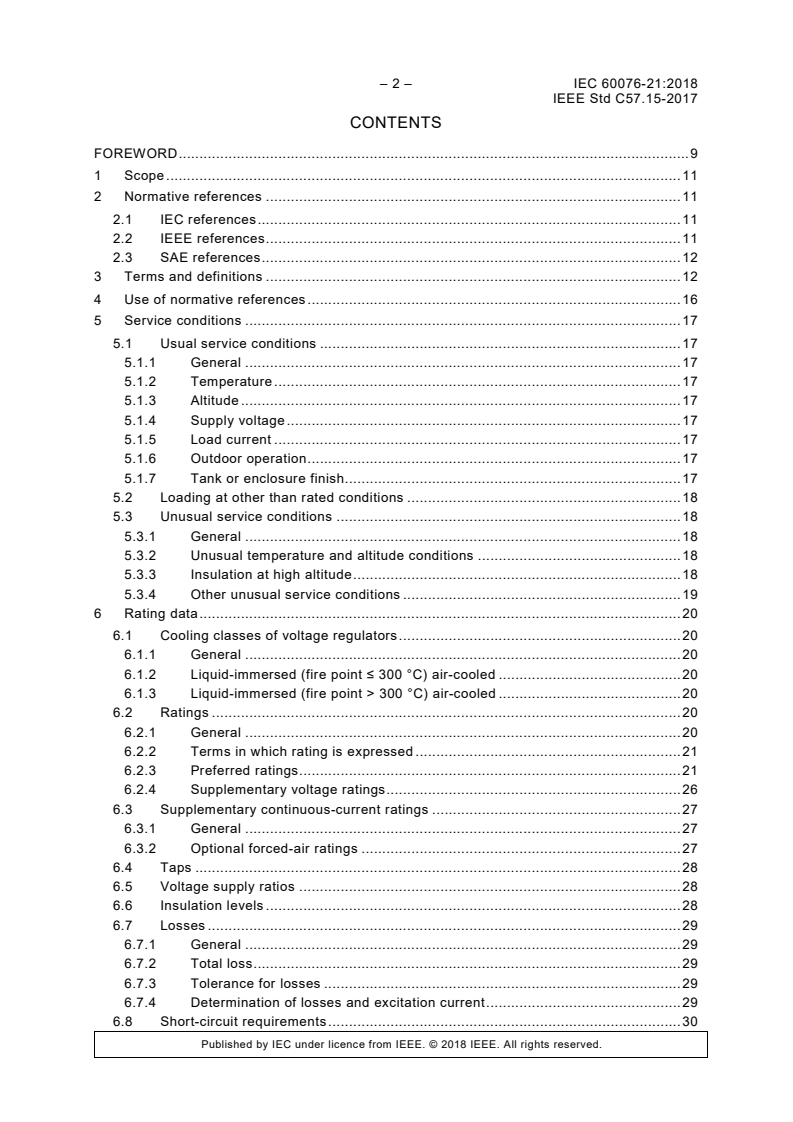
– 2 – IEC 60076-21:2018
IEEE Std C57.15-2017
CONTENTS
FOREWORD . 9
1 Scope . 11
2 Normative references . 11
2.1 IEC references . 11
2.2 IEEE references . 11
2.3 SAE references . 12
3 Terms and definitions . 12
4 Use of normative references . 16
5 Service conditions . 17
5.1 Usual service conditions . 17
5.1.1 General . 17
5.1.2 Temperature . 17
5.1.3 Altitude . 17
5.1.4 Supply voltage . 17
5.1.5 Load current . 17
5.1.6 Outdoor operation . 17
5.1.7 Tank or enclosure finish. 17
5.2 Loading at other than rated conditions . 18
5.3 Unusual service conditions . 18
5.3.1 General . 18
5.3.2 Unusual temperature and altitude conditions . 18
5.3.3 Insulation at high altitude . 18
5.3.4 Other unusual service conditions . 19
6 Rating data . 20
6.1 Cooling classes of voltage regulators . 20
6.1.1 General . 20
6.1.2 Liquid-immersed (fire point ≤ 300 °C) air-cooled . 20
6.1.3 Liquid-immersed (fire point > 300 °C) air-cooled . 20
6.2 Ratings . 20
6.2.1 General . 20
6.2.2 Terms in which rating is expressed . 21
6.2.3 Preferred ratings . 21
6.2.4 Supplementary voltage ratings . 26
6.3 Supplementary continuous-current ratings . 27
6.3.1 General . 27
6.3.2 Optional forced-air ratings . 27
6.4 Taps . 28
6.5 Voltage supply ratios . 28
6.6 Insulation levels . 28
6.7 Losses . 29
6.7.1 General . 29
6.7.2 Total loss . 29
6.7.3 Tolerance for losses . 29
6.7.4 Determination of losses and excitation current . 29
6.8 Short-circuit requirements . 30
Published by IEC under licence from IEEE. © 2018 IEEE. All rights reserved.
IEEE Std C57.15-2017
6.8.1 General . 30
6.8.2 Mechanical capability demonstration . 31
6.8.3 Thermal capability of voltage regulators for short-circuit conditions . 31
6.9 Sound pressure level for liquid-immersed voltage regulators . 31
6.10 Tests . 32
6.10.1 General . 32
6.10.2 Routine tests . 32
6.10.3 Type tests . 32
7 Construction . 33
7.1 Bushings . 33
7.2 External dielectric clearances . 34
7.3 Terminal markings . 34
7.4 Diagram of connections . 35
7.5 Nameplates. 36
7.6 Tank construction . 37
7.6.1 General . 37
7.6.2 Pressure-relief valve . 37
7.6.3 Cover assembly . 37
7.6.4 Sudden pressure relay . 38
7.6.5 Lifting lugs . 38
7.6.6 Support lugs . 38
7.6.7 Substation bases . 40
7.6.8 Tank grounding provisions . 40
7.7 Components and accessories . 41
7.7.1 Components for full automatic control and operation. 41
7.7.2 Accessories for single-phase step-voltage regulators. 41
7.7.3 Accessories for three-phase step-voltage regulators . 42
8 Other requirements . 42
8.1 General . 42
8.2 Other components and accessories . 42
8.2.1 General . 42
8.2.2 Single- and three-phase voltage regulators . 42
8.2.3 Three-phase voltage regulators . 43
9 Test code . 43
9.1 General . 43
9.2 Resistance measurements . 43
9.2.1 General . 43
9.2.2 Determination of cold temperature . 43
9.2.3 Conversion of resistance measurements. 44
9.2.4 Resistance measurement methods . 44
9.3 Polarity test . 45
9.3.1 General . 45
9.3.2 Polarity by inductive kick . 46
9.3.3 Polarity by ratio meter. 46
9.4 Ratio test . 46
9.4.1 General . 46
9.4.2 Taps . 46
Published by IEC under licence from IEEE. © 2018 IEEE. All rights reserved.
– 4 – IEC 60076-21:2018
IEEE Std C57.15-2017
9.4.3 Voltage and frequency . 47
9.4.4 Three-phase voltage regulators . 47
9.4.5 Tolerance for ratio . 47
9.4.6 Ratio test methods . 47
9.5 No-load loss and excitation current . 49
9.5.1 General . 49
9.5.2 No-load loss test . 50
9.5.3 Waveform correction of no-load loss . 51
9.5.4 Test methods for three-phase voltage regulators . 52
9.5.5 Determination of excitation (no-load) current . 52
9.5.6 Measurements . 53
9.5.7 Correction of loss measurement due to metering phase-angle errors . 53
9.6 Load loss and impedance voltage . 54
9.6.1 General . 54
9.6.2 Factors affecting the values of load loss and impedance voltage . 55
9.6.3 Tests for measuring load loss and impedance voltage . 56
9.6.4 Calculation of load loss and impedance voltage from test data . 58
9.7 Dielectric tests . 60
9.7.1 General . 60
9.7.2 Lightning impulse type test . 61
9.7.3 Lightning impulse routine test . 67
9.7.4 Applied-voltage test . 69
9.7.5 Induced-voltage test . 69
9.7.6 Insulation power factor tests . 71
9.7.7 Insulation resistance tests . 72
9.8 On-load tap-changer routine tests . 73
9.8.1 General . 73
9.8.2 Mechanical test . 74
9.8.3 Auxiliary circuits insulation test . 74
9.9 Control system routine tests . 74
9.9.1 Applied voltage . 74
9.9.2 Operation . 74
9.10 Temperature-rise test . 74
9.10.1 General . 74
9.10.2 Test methods . 75
9.10.3 Resistance measurements . 78
9.10.4 Temperature measurements . 79
9.10.5 Correction of temperature-rise test results . 82
9.11 Short-circuit test . 83
9.11.1 General . 83
9.11.2 Test connections . 83
9.11.3 Test requirements . 84
9.11.4 Test procedure . 84
9.11.5 Proof of satisfactory performance . 86
9.12 Determination of sound level . 87
9.12.1 General . 87
9.12.2 Applicability . 88
Published by IEC under licence from IEEE. © 2018 IEEE. All rights reserved.
IEEE Std C57.15-2017
9.12.3 Instrumentation . 88
9.12.4 Test conditions . 88
9.12.5 Microphone positions . 90
9.12.6 Sound level measurements . 91
9.12.7 Determination of sound level of a voltage regulator . 95
9.12.8 Presentation of results . 97
9.13 Calculated data . 98
9.13.1 Reference temperature . 98
9.13.2 Loss and excitation current . 99
9.13.3 Efficiency . 99
9.13.4 Calculation of winding temperature during a short-circuit . 99
9.13.5 Certified test data . 101
10 Component tests . 102
10.1 General . 102
10.2 Enclosure integrity . 102
10.2.1 General . 102
10.2.2 Static pressure . 102
10.2.3 Dynamic pressure . 103
10.2.4 Type test for fault current capability of a voltage regulator enclosure . 103
10.3 On-load tap-changer . 104
10.3.1 General . 104
10.3.2 Type tests . 104
10.4 Control system . 109
10.4.1 General . 109
10.4.2 Control device construction. 110
10.4.3 Accuracy . 110
10.4.4 Type tests . 112
11 Universal interface . 116
11.1 Connection between control enclosure and apparatus . 116
11.2 Universal interface connector . 117
Annex A (informative) Unusual temperature and altitude conditions . 120
A.1 Unusual temperatures and altitude service conditions . 120
A.2 Effects of altitude on temperature-rise . 120
A.3 Operation at rated kVA . 120
A.4 Operation at less than rated kVA . 120
Annex B (informative) Field dielectric tests . 121
B.1 Tests on bushings . 121
B.2 Dielectric tests in the field . 121
Annex C (informative) Step-voltage regulator construction . 122
C.1 General . 122
C.2 Type A . 123
C.3 Type B . 123
C.4 Series transformer construction . 124
C.5 Reactor circuit . 124
C.6 Equalizer winding . 124
Annex D (informative) Hazards of Bypass off Neutral . 126
Published by IEC under licence from IEEE. © 2018 IEEE. All rights reserved.
– 6 – IEC 60076-21:2018
IEEE Std C57.15-2017
Annex E (informative) Overloading of step-voltage regulators . 130
Annex F (informative) Power capacitor and distributed generation compatibility . 134
F.1 Power capacitor application issues . 134
F.1.1 General . 134
F.1.2 Power circuit for consideration . 134
F.1.3 Voltage regulator incorporating line-drop compensation (LDC) in the
control . 134
F.1.4 Voltage regulator incorporating line current compensation (LCC) in the
control . 137
F.2 Distributed generation application issues . 137
F.2.1 General . 137
F.2.2 Control operation with power reversal recognition . 138
F.2.3 Power circuit for consideration . 139
F.2.4 Distributed generator alternatives . 139
F.2.5 P-Q summary . 140
F.2.6 Example system with distribution generation (DG) . 140
F.2.7 Expanded example, distributed generation mode . 142
F.2.8 Caveats . 142
F.2.9 Conclusions . 142
Bibliography . 143
Figure 1 – Single-phase voltage regulators . 35
Figure 2 – Three-phase voltage regulators with two arrangements of bushings . 35
Figure 3 – Type-B support lugs . 39
Figure 4 – Type-C support lugs . 40
Figure 5 – Connections for voltmeter-ammeter method of resistance measurement . 44
Figure 6 – Voltage regulator connected for polarity testing – Voltage regulator in
Neutral position. 46
Figure 7 – Voltmeter arranged to read the difference between the two output side
voltages . 48
Figure 8 – Voltmeters arranged to read the two series winding voltages . 48
Figure 9 – Basic circuit of ratio meter . 49
Figure 10 – Connection for no-load loss test of single-phase voltage regulator without
instrument transformers . 50
Figure 11 – Connections for no-load loss test of a single-phase voltage regulator with
instrument transformers . 51
Figure 12 – Three-phase voltage regulator connections for no-load loss and excitation
current test using three-wattmeter method . 53
Figure 13 – Single-phase voltage regulator connections for load loss and impedance
voltage test without instrument transformers . 57
Figure 14 – Single-phase voltage regulator connections for load loss and impedance
voltage test with instrument transformers . 57
Figure 15 – Three-phase voltage regulator connections for load loss and impedance
voltage test using the three-wattmeter method . 58
Figure 16 – Example of loading back method: single-phase . 76
Figure 17 – Example of loading back method: three-phase . 77
Published by IEC under licence from IEEE. © 2018 IEEE. All rights reserved.
IEEE Std C57.15-2017
Figure 18 – Microphone location for measuring sound level . 90
Figure 19 – Sound reflection correction factor "K" calculated as per Equation (29) . 94
Figure 20 – Measurements using the sound pressure method . 98
Figure 21 – Measurements using the sound intensity method . 98
Figure 22 – Universal interface specification . 117
Figure 23 – Socket/pin detail for universal interface . 117
Figure 24 – Universal interface locations . 119
Figure C.1 – Basic diagram of single-phase, Type A, step-voltage regulator . 122
Figure C.2 – Basic diagram of single-phase, Type B, step-voltage regulator . 122
Figure C.3 – Type A . 123
Figure C.4 – Type B . 123
Figure C.5 – Example of series transformer construction . 124
Figure C.6 – Equalizer winding and reactor circuitry – Non-bridging tap position . 125
Figure C.7 – Equalizer winding and reactor circuitry – Bridging tap position . 125
Figure D.1 – "Bypass off Neutral" power circuit . 127
Figure D.2 – Example of "Bypass off Neutral" RMS symmetrical current pattern of a
Type A design . 128
Figure D.3 – Example of "Bypass off Neutral" RMS symmetrical current pattern of a
Type B design . 129
Figure E.1 – Example of overload capability by tap position . 131
Figure E.2 – Example of Type A load loss vs tap position . 131
Figure E.3 – Example of Type B load loss vs tap position . 132
Figure E.4 – Tap-changer arc interruption envelope . 132
Figure E.5 – Contact wear . 133
Figure F.1 – Power distribution substation and representative distribution feeder. 134
Figure F.2 – Power distribution system with distributed generation . 139
Figure F.3 – P-Q diagram quadrant relationships . 140
Table 1 – Dielectric strength correction factors for altitudes greater than 1 000 m
(3 300 ft) . 19
Table 2 – Limits of temperature-rise . 21
Table 3 – Ratings for liquid-immersed 60 Hz step-voltage regulators (single-phase) . 22
Table 4 – Ratings for liquid-immersed 50 Hz step-voltage regulators (single-phase) . 23
Table 5 – Ratings for liquid-immersed 60 Hz step-voltage regulators (three-phase) . 25
Table 6 – Ratings for liquid-immersed 50 Hz step-voltage regulators (three-phase) . 26
Table 7 – Supplementary voltage ratings . 26
Table 8 – Supplementary continuous-current ratings . 27
Table 9 – Forced-air ratings relationship . 28
Table 10 – Values of voltage supply ratios . 28
Table 11 – Interrelationships of dielectric insulation levels for voltage regulators . 29
Table 12 – Values of k . 30
Table 13 – Maximum no-load (excitation) sound pressure levels . 31
Published by IEC under licence from IEEE. © 2018 IEEE. All rights reserved.
– 8 – IEC 60076-21:2018
IEEE Std C57.15-2017
Table 14 – Electrical characteristics of voltage regulator bushings . 34
Table 15 – External dielectric clearances . 34
Table 16 – Bushing terminal applications . 41
Table 17 – Requirements for phase-angle error correction . 54
Table 18 – Measurements to be made in insulation power factor tests . 72
Table 19 – Ambient sound pressure level correction . 92
Table 20 – Approximate values of the average acoustic absorption coefficient . 93
Table 21 – Voltage level values for select line-drop compensation . 112
Table 22 – Control supply voltage . 115
Table 23 – Socket pin identification for connector . 118
a
Table A.1 – Maximum allowable average temperature of cooling air for rated kVA . 120
Table A.2 – Rated kVA correction factors for altitudes greater than 1 000 m (3 300 ft) . 120
Table F.1 – Relevant system voltages and currents with capacitor location . 136
Table F.2 – System and voltage regulator control response with example distributed
generation (DG), no line-drop compensation . 141
Published by IEC under licence from IEEE. © 2018 IEEE. All rights reserved.
IEEE Std C57.15-2017
POWER TRANSFORMERS –
Part 21: Standard requirements, terminology,
and test code for step-voltage regulators
FOREWORD
1) The International Electrotechnical Commission (IEC) is a worldwide organization for standardization comprising
all national electrotechnical committees (IEC National Committees). The object of IEC is to promote
international co-operation on all questions concerning standardization in the electrical and electronic fields. To
this end and in addition to other activities, IEC publishes International Standards, Technical Specifications,
Technical Reports, Publicly Available Specifications (PAS) and Guides (hereafter referred to as "IEC
Publication(s)"). Their preparation is entrusted to technical committees; any IEC National Committee interested
in the subject dealt with may participate in this preparatory work. International, governmental and non-
governmental organizations liaising with the IEC also participate in this preparation.
IEEE Standards documents are developed within IEEE Societies and Standards Coordinating Committees of the
IEEE Standards Association (IEEE-SA) Standards Board. IEEE develops its standards through a consensus
development process, approved by the American National Standards Institute, which brings together volunteers
representing varied viewpoints and interests to achieve the final product. Volunteers are not necessarily
members of IEEE and serve without compensation. While IEEE administers the process and establishes rules
to promote fairness in the consensus development process, IEEE does not independently evaluate, test, or
verify the accuracy of any of the information contained in its standards. Use of IEEE Standards documents is
wholly voluntary. IEEE documents are made available for use subject to important notices and legal disclaimers
(see http://standards.ieee.org/IPR/disclaimers.html for more information).
IEC collaborates closely with IEEE in accordance with conditions determined by agreement between the two
organizations. This Dual Logo International Standard was jointly developed by the IEC and IEEE under the
terms of that agreement.
2) The formal decisions of IEC on technical matters express, as nearly as possible, an international consensus of
opinion on the relevant subjects since each technical committee has representation from all interested IEC
National Committees. The formal decisions of IEEE on technical matters, once consensus within IEEE Societies
and Standards Coordinating Committees has been reached, is determined by a balanced ballot of materially
interested parties who indicate interest in reviewing the proposed standard. Final approval of the IEEE
standards document is given by the IEEE Standards Association (IEEE-SA) Standards Board.
3) IEC/IEEE Publications have the form of recommendations for international use and are accepted by IEC
National Committees/IEEE Societies in that sense. While all reasonable efforts are made to ensure that the
technical content of IEC/IEEE Publications is accurate, IEC or IEEE cannot be held responsible for the way in
which they are used or for any misinterpretation by any end user.
4) In order to promote international uniformity, IEC National Committees undertake to apply IEC Publications
(including IEC/IEEE Publications) transparently to the maximum extent possible in their national and regional
publications. Any divergence between any IEC/IEEE Publication and the corresponding national or regional
publication shall be clearly indicated in the latter.
5) IEC and IEEE do not provide any attestation of conformity. Independent certification bodies provide conformity
assessment services and, in some areas, access to IEC marks of conformity. IEC and IEEE are not responsible
for any services carried out by independent certification bodies.
6) All users should ensure that they have the latest edition of this publication.
7) No liability shall attach to IEC or IEEE or their directors, employees, servants or agents including individual
experts and members of technical committees and IEC National Committees, or volunteers of IEEE Societies
and the Standards Coordinating Committees of the IEEE Standards Association (IEEE-SA) Standards Board,
for any personal injury, property damage or other damage of any nature whatsoever, whether direct or indirect,
or for costs (including legal fees) and expenses arising out of the publication, use of, or reliance upon, this
IEC/IEEE Publication or any other IEC or IEEE Publications.
8) Attention is drawn to the normative references cited in this publication. Use of the referenced publications is
indispensable for the correct application of this publication.
9) Attention is drawn to the possibility that implementation of this IEC/IEEE Publication may require use of
material covered by patent rights. By publication of this standard, no position is taken with respect to the
existence or validity of any patent rights in connection therewith. IEC or IEEE shall not be held responsible for
identifying Essential Patent Claims for which a license may be required, for conducting inquiries into the legal
validity or scope of Patent Claims or determining whether any licensing terms or conditions provided in
connection with submission of a Letter of Assurance, if any, or in any licensing agreements are reasonable or
non-discriminatory. Users of this standard are expressly advised that determination of the validity of any patent
rights, and the risk of infringement of such rights, is entirely their own responsibility.
Published by IEC under licence from IEEE. © 2018 IEEE. All rights reserved.
– 10 – IEC 60076-21:2018
IEEE Std C57.15-2017
International Standard IEC 60076-21/IEEE Std C57.15-2017 has been prepared by IEC
technical committee 14: Power transformers, in cooperation with the Transformers Committee
of the IEEE Power and Energy
...