


IEC 61009-1:2010/AMD1:2012
(Amendment)Amendment 1 - Residual current operated circuit-breakers with integral overcurrent protection for household and similar uses (RCBOs) - Part 1: General rules
General Information
- Abstract
Deals with terminology related to the measurement of the electrical properties of microwave tubes and contains terms concerning general applications, pulse operation, oscillator tubes, measurement of noise, microwave tube classification, crossed-field amplifier tubes.
- Status
- Published
- Publication Date
- 29-Apr-2012
- Technical Committee
- SC 23E - Circuit-breakers and similar equipment for household use
- Drafting Committee
- WG 2 - TC 23/SC 23E/WG 2
- Current Stage
- DELPUB - Deleted Publication
- Start Date
- 21-Nov-2024
- Completion Date
- 28-Aug-2026
Buy Documents
IEC 61009-1:2010/AMD1:2012 - Amendment 1 - Residual current operated circuit-breakers with integral overcurrent protection for household and similar uses (RCBOs) - Part 1: General rules Released:4/30/2012
Overview
IEC 61009-1:2010/AMD1:2012 is Amendment 1 to IEC 61009-1, addressing general rules for residual current operated circuit-breakers with integral overcurrent protection for household and similar uses (RCBOs). This international standard, developed by the International Electrotechnical Commission (IEC), revises and updates terminology, test requirements, and product specifications to enhance the performance, safety, and compatibility of RCBOs. These devices provide essential protection in residential and similar environments by detecting residual currents and offering overcurrent protection in one unit.
Key Topics
- Scope and Applicability: The amendment clarifies the use of RCBOs in conjunction with socket-outlets and references additional relevant standards.
- Normative References Updated: New references include IEC 60228, IEC 60364-4-44, IEC 60664-3, IEC 60695-2-10/11, and updates to electromagnetic compatibility standards, ensuring up-to-date integration with international safety and quality frameworks.
- Classification of RCBOs:
- According to method of connection (e.g., plug-in, bolt-on, screw-in types)
- According to terminal types (screw-type, screwless, quick-connect, for copper or aluminum conductors)
- Marking and Product Information: Improved requirements for device labeling, including information visibility, terminal identification, and information for various wire types and device orientations.
- Electrical and Mechanical Requirements:
- Clearances and creepage distances are updated for enhanced reliability and insulation performance.
- Material requirements for conductive parts, including corrosion resistance testing.
- Detailed connection specifications for various conductor types and sizes.
- Testing and Compliance:
- New and revised test methodologies for impulse withstand voltage, insulation resistance, terminal reliability, and resistance to rusting.
- Enhanced procedures for verifying dielectric strength, isolation capability, and operational performance under off-load and extreme temperature conditions.
- Updated test circuits for short-circuit performance and test calibration procedures.
Applications
IEC 61009-1:2010/AMD1:2012 provides practical value for:
- Manufacturers: Ensures RCBO products conform to the latest international safety, performance, and compatibility requirements in household and similar settings.
- Testing Laboratories: Offers standardized test methods and updated reference standards for evaluating RCBOs’ electrical and mechanical properties.
- Regulatory Bodies: Supplies a harmonized basis for national regulations and certification schemes focused on electrical safety.
- Installers and System Designers: Clarifies device selection and installation, particularly regarding terminal types and marking requirements, to achieve compliant and safe installations.
- Maintenance and Inspection Personnel: The amendment enhances the clarity of marking and information, aiding routine inspection and replacement procedures.
Related Standards
- IEC 60228: Conductors of insulated cables
- IEC 60364-4-44: Low-voltage electrical installations - Protection against voltage disturbances and electromagnetic disturbances
- IEC 60664-1 & IEC 60664-3: Insulation coordination for equipment within low-voltage systems; use of coating, potting, or moulding for protection against pollution
- IEC 60884-1: Plugs and socket-outlets for household and similar purposes
- IEC 61543: Residual current-operated protective devices (RCDs) for household and similar use – Electromagnetic compatibility
- IEC 60695-2-10/11: Fire hazard testing - Glow-wire test methods
Conclusion
By aligning RCBO product design, testing, and marking with international best practices, IEC 61009-1:2010/AMD1:2012 strengthens electrical safety and reliability for households and comparable environments. Its practical, updated requirements deliver clear benefits to manufacturers, testing entities, regulators, and end-users seeking compliant, dependable residual current protection combined with overcurrent measures. For optimal implementation, users are encouraged to consult this amendment alongside referenced IEC standards.
Relations
- Effective Date
- 05-Sep-2023
- Effective Date
- 05-Sep-2023
Buy Documents
IEC 61009-1:2010/AMD1:2012 - Amendment 1 - Residual current operated circuit-breakers with integral overcurrent protection for household and similar uses (RCBOs) - Part 1: General rules Released:4/30/2012
Get Certified
Connect with accredited certification bodies for this standard

IMQ S.p.A. (Certification)
Italian electrical product certification.

SLG Prüf- und Zertifizierungs GmbH
German testing and certification body.

UL Solutions
Global safety science company with testing, inspection and certification.
Sponsored listings
Frequently Asked Questions
IEC 61009-1:2010/AMD1:2012 is a standard published by the International Electrotechnical Commission (IEC). Its full title is "Amendment 1 - Residual current operated circuit-breakers with integral overcurrent protection for household and similar uses (RCBOs) - Part 1: General rules". This standard covers: Deals with terminology related to the measurement of the electrical properties of microwave tubes and contains terms concerning general applications, pulse operation, oscillator tubes, measurement of noise, microwave tube classification, crossed-field amplifier tubes.
Deals with terminology related to the measurement of the electrical properties of microwave tubes and contains terms concerning general applications, pulse operation, oscillator tubes, measurement of noise, microwave tube classification, crossed-field amplifier tubes.
IEC 61009-1:2010/AMD1:2012 is classified under the following ICS (International Classification for Standards) categories: 01.040.31 - Electronics (Vocabularies); 29.120.50 - Fuses and other overcurrent protection devices; 31.100 - Electronic tubes. The ICS classification helps identify the subject area and facilitates finding related standards.
IEC 61009-1:2010/AMD1:2012 has the following relationships with other standards: It is inter standard links to IEC 61009-1:2010, IEC 61009-1:2024. Understanding these relationships helps ensure you are using the most current and applicable version of the standard.
IEC 61009-1:2010/AMD1:2012 is available in PDF format for immediate download after purchase. The document can be added to your cart and obtained through the secure checkout process. Digital delivery ensures instant access to the complete standard document.
Standards Content (Sample)
IEC 61009-1 ®
Edition 3.0 2012-04
INTERNATIONAL
STANDARD
NORME
INTERNATIONALE
AMENDMENT 1
AMENDEMENT 1
Residual current operated circuit-breakers with integral overcurrent protection
for household and similar uses (RCBOs) –
Part 1: General rules
Interrupteurs automatiques à courant différentiel résiduel avec dispositif de
protection contre les surintensités incorporé pour usages domestiques et
analogues (DD) –
Partie 1: Règles générales
IEC 61009-1:2010/A1:2012
All rights reserved. Unless otherwise specified, no part of this publication may be reproduced or utilized in any form
or by any means, electronic or mechanical, including photocopying and microfilm, without permission in writing from
either IEC or IEC's member National Committee in the country of the requester.
If you have any questions about IEC copyright or have an enquiry about obtaining additional rights to this publication,
please contact the address below or your local IEC member National Committee for further information.
Droits de reproduction réservés. Sauf indication contraire, aucune partie de cette publication ne peut être reproduite ni
utilisée sous quelque forme que ce soit et par aucun procédé, électronique ou mécanique, y compris la photocopie et les
microfilms, sans l'accord écrit de la CEI ou du Comité national de la CEI du pays du demandeur.
Si vous avez des questions sur le copyright de la CEI ou si vous désirez obtenir des droits supplémentaires sur cette
publication, utilisez les coordonnées ci-après ou contactez le Comité national de la CEI de votre pays de résidence.
IEC Central Office Tel.: +41 22 919 02 11
3, rue de Varembé Fax: +41 22 919 03 00
CH-1211 Geneva 20 info@iec.ch
Switzerland www.iec.ch
About the IEC
The International Electrotechnical Commission (IEC) is the leading global organization that prepares and publishes
International Standards for all electrical, electronic and related technologies.
About IEC publications
The technical content of IEC publications is kept under constant review by the IEC. Please make sure that you have the
latest edition, a corrigenda or an amendment might have been published.
Useful links:
IEC publications search - www.iec.ch/searchpub Electropedia - www.electropedia.org
The advanced search enables you to find IEC publications The world's leading online dictionary of electronic and
by a variety of criteria (reference number, text, technical electrical terms containing more than 30 000 terms and
committee,…). definitions in English and French, with equivalent terms in
It also gives information on projects, replaced and additional languages. Also known as the International
withdrawn publications. Electrotechnical Vocabulary (IEV) on-line.
IEC Just Published - webstore.iec.ch/justpublished Customer Service Centre - webstore.iec.ch/csc
Stay up to date on all new IEC publications. Just Published If you wish to give us your feedback on this publication
details all new publications released. Available on-line and or need further assistance, please contact the
also once a month by email. Customer Service Centre: csc@iec.ch.
A propos de la CEI
La Commission Electrotechnique Internationale (CEI) est la première organisation mondiale qui élabore et publie des
Normes internationales pour tout ce qui a trait à l'électricité, à l'électronique et aux technologies apparentées.
A propos des publications CEI
Le contenu technique des publications de la CEI est constamment revu. Veuillez vous assurer que vous possédez
l’édition la plus récente, un corrigendum ou amendement peut avoir été publié.
Liens utiles:
Recherche de publications CEI - www.iec.ch/searchpub Electropedia - www.electropedia.org
La recherche avancée vous permet de trouver des Le premier dictionnaire en ligne au monde de termes
publications CEI en utilisant différents critères (numéro de électroniques et électriques. Il contient plus de 30 000
référence, texte, comité d’études,…). termes et définitions en anglais et en français, ainsi que
Elle donne aussi des informations sur les projets et les les termes équivalents dans les langues additionnelles.
publications remplacées ou retirées. Egalement appelé Vocabulaire Electrotechnique
International (VEI) en ligne.
Just Published CEI - webstore.iec.ch/justpublished
Service Clients - webstore.iec.ch/csc
Restez informé sur les nouvelles publications de la CEI.
Just Published détaille les nouvelles publications parues. Si vous désirez nous donner des commentaires sur
Disponible en ligne et aussi une fois par mois par email. cette publication ou si vous avez des questions
contactez-nous: csc@iec.ch.
IEC 61009-1 ®
Edition 3.0 2012-04
INTERNATIONAL
STANDARD
NORME
INTERNATIONALE
AMENDMENT 1
AMENDEMENT 1
Residual current operated circuit-breakers with integral overcurrent protection
for household and similar uses (RCBOs) –
Part 1: General rules
Interrupteurs automatiques à courant différentiel résiduel avec dispositif de
protection contre les surintensités incorporé pour usages domestiques et
analogues (DD) –
Partie 1: Règles générales
INTERNATIONAL
ELECTROTECHNICAL
COMMISSION
COMMISSION
ELECTROTECHNIQUE
PRICE CODE
INTERNATIONALE
XA
CODE PRIX
ICS 29.120.50 ISBN 978-2-83220-019-3
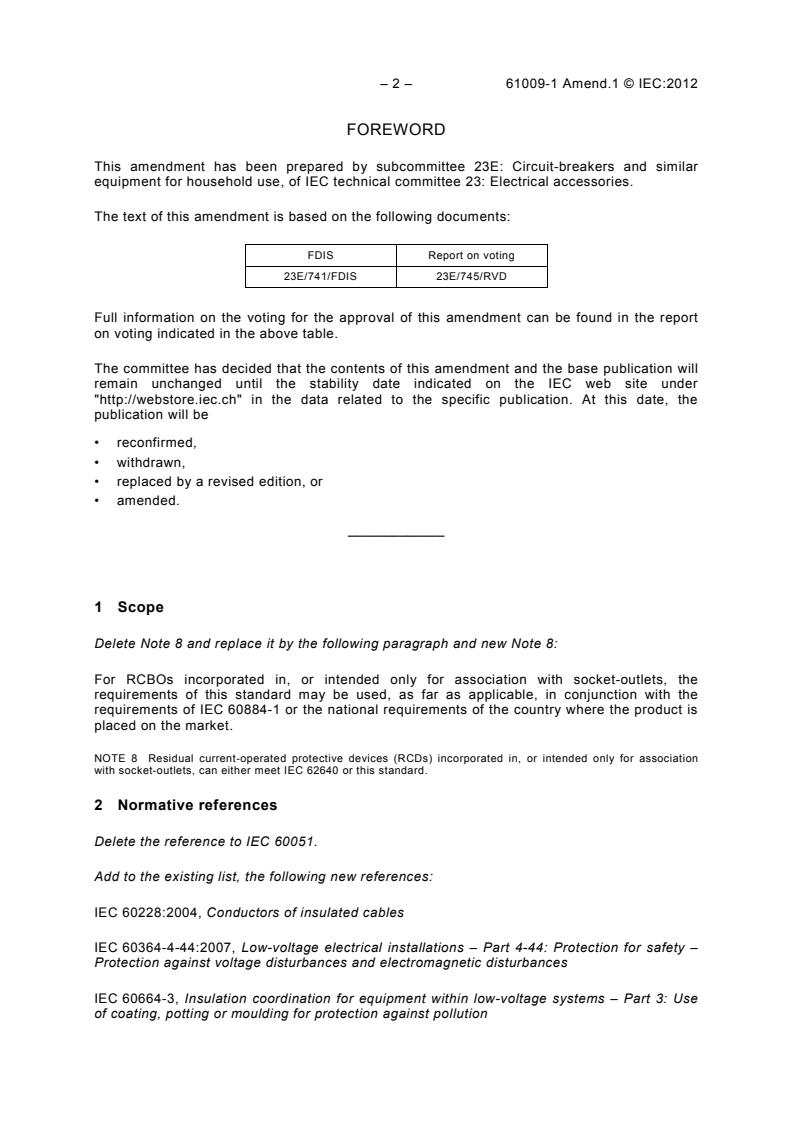
– 2 – 61009-1 Amend.1 © IEC:2012
FOREWORD
This amendment has been prepared by subcommittee 23E: Circuit-breakers and similar
equipment for household use, of IEC technical committee 23: Electrical accessories.
The text of this amendment is based on the following documents:
FDIS Report on voting
23E/741/FDIS 23E/745/RVD
Full information on the voting for the approval of this amendment can be found in the report
on voting indicated in the above table.
The committee has decided that the contents of this amendment and the base publication will
remain unchanged until the stability date indicated on the IEC web site under
"http://webstore.iec.ch" in the data related to the specific publication. At this date, the
publication will be
• reconfirmed,
• withdrawn,
• replaced by a revised edition, or
• amended.
_____________
1 Scope
Delete Note 8 and replace it by the following paragraph and new Note 8:
For RCBOs incorporated in, or intended only for association with socket-outlets, the
requirements of this standard may be used, as far as applicable, in conjunction with the
requirements of IEC 60884-1 or the national requirements of the country where the product is
placed on the market.
NOTE 8 Residual current-operated protective devices (RCDs) incorporated in, or intended only for association
with socket-outlets, can either meet IEC 62640 or this standard.
2 Normative references
Delete the reference to IEC 60051.
Add to the existing list, the following new references:
IEC 60228:2004, Conductors of insulated cables
IEC 60364-4-44:2007, Low-voltage electrical installations – Part 4-44: Protection for safety –
Protection against voltage disturbances and electromagnetic disturbances
IEC 60664-3, Insulation coordination for equipment within low-voltage systems – Part 3: Use
of coating, potting or moulding for protection against pollution
61009-1 Amend.1 © IEC:2012 – 3 –
IEC 60695-2-10, Fire hazard testing – Part 2-10: Glowing/hot-wire based test methods –
Glow-wire apparatus and common test procedure
IEC 60695-2-11:2000, Fire hazard testing – Part 2-11: Glowing /hot-wire based test methods
– Glow-wire flammability test method for end-products
Replace the reference to IEC 61543:1995 by the following new reference:
IEC 61543:1995, Residual current -operated protective devices (RCDs) for household and
similar use – Electromagnetic compatibility
Amendment 1:2004
Amendment 2:2005
4.10 According to the method of connection
In the subclause, replace the existing text and note by the following:
– RCBOs, the electrical connections which are not associated with the mechanical
mounting;
– RCBOs, the electrical connections which are associated with the mechanical mounting.
NOTE Examples of this type are:
– plug-in type;
– bolt-on type;
– screw-in type.
Some RCBOs may be of the plug-in type or bolt-on type on the line side only, the load terminals being usually
suitable for wiring connection.
Add the following new subclause:
According to the type of terminals
4.13
– RCBOs with screw-type terminals for external copper conductors;
– RCBOs with screwless type terminals for external copper conductors;
NOTE 1 The requirements for RCBOs equipped with these types of terminals are given in Annex J.
– RCBOs with flat quick-connect terminals for external copper conductors;
NOTE 2 The requirements for RCBOs equipped with these types of terminals are given in Annex K.
– RCBOs with screw-type terminals for external aluminium conductors.
NOTE 3 The requirements for RCBOs equipped with this type of terminal are given in annex L.
Table 2 – Limit values of break time and non-actuating time for alternating residual
currents (r.m.s. values) for type AC and A RCBO
In the table, replace the word “non-operating” by “non-actuating".
c)
In the table, at the end of Footnote , add the following text:
For the tests of 9.9.1.3 and 9.9.1.4 b), the current I is established so that the vector sum IΔt + I is equal to the
Δt n
lower limit of the overcurrent instantaneous tripping range, according to type B, C or D, as applicable.
6 Marking and other product information
Replace the contents of item l) by the following:
l) the position of use, if necessary;
– 4 – 61009-1 Amend.1 © IEC:2012
Replace the third paragraph after Note 1 by the following:
If, for small devices, the space available does not allow all the above data to be marked, at
least the information under d), f), n), p) and r) (only for type A) shall be marked and visible
when the device is installed. The information under a), b), c), h) , l), r) (only for type AC) and
s) may be marked on the side or on the back of the device and be visible only before the
device is installed. The information under q) may be on the inside of any cover which has to
be removed in order to connect the supply wires. Any remaining information not marked shall
be given in the manufacturer's catalogues.
Replace in the eleventh paragraph after Note 1, the word “circuit” by “conductor”.
Add the following text at the end of Clause 6:
For universal terminals (for rigid-solid, rigid-stranded and flexible conductors):
– no marking.
For non-universal terminals:
– terminals declared for rigid-solid conductors only shall be marked by the letters “s” or
"sol";
– terminals declared for rigid (solid and stranded) conductors only shall be marked by the
letter "r".
The markings should appear on the RCBO or, if the space available is not sufficient, on the
smallest package unit or in technical information.
8.1.3 Clearances and creepage distances (see Annex B)
Replace the existing text in this subclause by the following:
The minimum required clearances and creepage distances are given in Table 7 which is
based on the RCBO being designed for operating in an environment with pollution degree 2.
Compliance for item 1 in Table 7 is checked by measurement and by the test of 9.7.7.4.1 and
9.7.7.4.2. The test is carried out with samples not submitted to the humidity treatment
described in 9.7.1.
The clearances of items 2 and 4 may be reduced provided that the measured clearances are
not shorter than the minimum allowed in IEC 60664-1 for homogenous field conditions.
In this case, after the humidity treatment described in 9.7.1, compliance for item 2 and 4 and
arrangements of 9.7.2 items b), c), d) and e) is checked in the following order:
– Tests according to 9.7.2 to 9.7.6 as applicable;
– Test according to 9.7.7.2 is applied with test voltages given in Table 19 with test
arrangements of 9.7.2 items b), c), d), e).
If measurement does not show any reduced clearance, test 9.7.7.2 is not applied.
Compliance for item 3 in Table 7 is checked by measurement.
NOTE 1 All measurements required in 8.1.3 are carried out in Test sequence A on one sample and the tests
9.7.7.2 are carried out before 9.7.1 on three samples of Test sequence B.
Parts of PCBs connected to the live parts protected against pollution by the use of a type 2
protection according to IEC 60664-3 are exempt from this verification.
61009-1 Amend.1 © IEC:2012 – 5 –
The insulating materials are classified into material groups on the basis of their comparative
tracking index (CTI) according to 4.8.1 of IEC 60664-1:2007.
NOTE 2 Information on the requirements for design of solid insulation and appropriate testing is provided in
IEC 60664-1:2007, 5.3 and 6.1.3.
NOTE 3 For clearances on printed wiring material, the following Note 3 in Table F.2 in 60664-1:2007 can be used:
“For printed wiring material, the values for pollution degree 1 apply except that the value should not be less than
0,04 mm, as specified in Table F.4.” For creepage distances on printed wiring material, distances in Table F.4 in
60664-1:2007 can be used if protected with a coating meeting IEC 60664-3 requirements and tests.
NOTE 4 The dimensioning of clearances and creepage distances for spacings equal to or less than 2 mm for
printed wiring board may be optimised under certain conditions in case of use of IEC 60664-5. Only humidity levels
HL 2 and HL3 are considered.
Table 7 – Minimum clearances and creepage distances
Delete, in this table, point 5 in the first column and the existing Note 3.
e
Replace, in the table, the last sentence of the existing Footnote by the following text:
When interpolating, linear interpolation shall be used and values shall be rounded to the same number of digits as
the values picked up from the tables. For determination of creepage distances, see Annex B.
8.1.4.4
In the subclause, replace the existing text by the following:
Current-carrying parts including parts intended for protective conductors, if any, shall be
made of a metal having, under the conditions occurring in the equipment, mechanical
strength, electrical conductivity and resistance to corrosion adequate for their intended use.
Examples of suitable materials are given below:
– copper;
– an alloy containing at least 58 % copper for parts worked cold, or at least 50 % copper for
other parts;
– other metal or suitably coated metal, no less resistant to corrosion than copper and having
mechanical properties no less suitable.
In case of using ferrous alloys or suitably coated ferrous alloys, compliance to resistance to
corrosion is checked by a test of resistance to rusting (see 9.25).
The requirements of this subclause do not apply to contacts, magnetic circuits, heater
elements, bimetals, shunts, parts of electronic devices or to screws, nuts, washers, clamping
plates, similar parts of terminals and parts of the test circuit.
8.1.5.1
Delete the second paragraph and the note in this subclause.
Replace the contents of the last paragraph by the following:
Compliance is checked by inspection, by the tests of 9.5 for screw-type terminals, by specific
tests for plug-in or bolt-on RCBOs included in the standard, or by the tests of Annexes J, K or
L, as relevant for the type of connection.
8.1.5.2
Replace the existing text and Table 8 by the following:
– 6 – 61009-1 Amend.1 © IEC:2012
RCBOs shall be provided with:
– either terminals which shall allow the connection of copper conductors having nominal
cross-sectional areas as shown in Table 8;
NOTE Examples of possible designs of screw-type terminals are given in Annex IC.
– or terminals for external untreated aluminium conductors and with aluminium screw-type
terminals for use with copper or with aluminium conductors according to Annex L.
Compliance is checked by inspection, by measurement and by fitting, in turn, one conductor
of the smallest and one of the largest cross-sectional area as specified.
Table 8 – Connectable cross-sections of copper
conductors for screw-type terminals
a) b)
Rated current Range of nominal cross-section to be clamped
A mm
c)
Rigid (solid or stranded )
Greater than Up to and including Flexible conductors
conductors
– 13 1 to 2,5 1 to 2,5
13 16 1 to 4 1 to 4
16 25 1,5 to 6 1,5 to 6
25 32 2,5 to 10 2,5 to 6
32 50 4 to 16 4 to 10
50 80 10 to 25 10 to 16
80 100 16 to 35 16 to 25
100 125 25 to 50 25 to 35
NOTE Information on AWG is given in Annex ID.
a)
A range of RCBOs having the same fundamental design and having the same design and construction of
terminals, the terminals are fitted with copper conductors of the smallest cross-section for the minimum rated
current and largest cross-section for the maximum rated current, as specified, solid and stranded, as applicable.
b)
It is required that, for current ratings up to and including 50 A, terminals be designed to clamp solid conductors as
well as rigid stranded conductors. Nevertheless, it is permitted that terminals for conductors having cross-sections
2 2
from 1 mm up to 6 mm be designed to clamp solid conductors only.
c)
2 2
Rigid stranded conductors shall be used for conductors having cross-sections from 1,5 mm up to 50 mm
and shall be in compliance with class 2 of IEC 60228, related to stranded conductors for single-core.
8.3 Dielectric properties and isolating capability
In the last paragraph, delete the words “and 9.20”.
Table 10 – Time-current operating characteristics
Delete the note in the table.
8.13 Behaviour of RCBOs in case of a single-phase overcurrent through a three-pole
or four-pole RCBO
Replace the text of this subclause by “Void”.
Table 12 – List of type tests
In the table, delete the following items:
– Limiting values of the non-operating current under overcurrent conditions 9.18
– Resistance of the insulation against an impulse voltage 9.20
In the table, add the following item at the end of the existing list:
61009-1 Amend.1 © IEC:2012 – 7 –
– Resistance to rusting 9.25
9.5 Test of reliability of terminals for external conductors
Replace the title of the subclause by the following:
9.5 Tests of reliability of screw-type terminals for external copper conductors
9.5.1
In the subclause, replace the contents and Table 15 by the following:
The terminals are fitted with copper conductors of the same type (solid, stranded or flexible)
of the smallest and largest cross-sections specified in Table 8.
The terminal shall be suitable for all types of conductors: rigid (solid or stranded) and flexible,
unless otherwise specified by the manufacturer.
Terminals shall be tested with the minimum and maximum cross-section of each type of
conductors on new terminals as follows:
– Tests for solid conductors shall use conductors having cross-sections from 1 mm up to
6 mm , as applicable.
– Tests for stranded conductors shall use conductors having cross-sections from 1,5 mm
up to 50 mm , as applicable.
– Tests for flexible conductors shall use conductors having cross-sections from 1 mm up to
35 mm , as applicable.
NOTE Information on AWG is given in Annex ID.
The conductor is inserted into a new terminal for the minimum distance prescribed or, where
no distance is prescribed, until it just projects from the far side, and in the position most likely
to assist the wire to escape.
The clamping screws are then tightened with a torque equal to two-thirds of that shown in the
appropriate column of Table 14.
Each conductor is then subjected to a pull of the value, in Newton, shown in Table 15,
according to the relevant cross-section of the tested conductor.
The pull is applied without jerks, for 1 min, in the direction of the axis of the conductor space.
When it is necessary, the tested values, for the different cross-sections with the relevant
pulling force, shall be clearly indicated in the test report.
Table 15 – Pulling forces
Cross-section of the 1 up to and Above 4 up to Above 6 up to Above 10 up to Above 16 up to
conductor inserted in including 4 and including and including and including and including
the terminal 6 10 16 50
mm
Pull
50 60 80 90 100
N
During the test, the conductor shall not move noticeably in the terminal.
– 8 – 61009-1 Amend.1 © IEC:2012
9.5.3
In the subclause, replace the first sentence by the following:
The terminals are fitted with the largest cross-section area specified in Table 8, for stranded
and/or flexible copper conductor.
Delete Table 16.
9.7.1.4 Condition of the RCBO after the test
Replace the existing text by the following:
After this treatment, the sample shall show no damage within the meaning of this standard
and shall withstand the tests of 9.7.2, 9.7.3, 9.7.4, 9.7.6 and 9.7.7.2 (if applicable).
9.7.7.1 Verification of impulse withstand voltage across the open contacts
(suitability for isolation)
Replace the existing title and text by the following:
9.7.7.1 General testing procedure for the impulse withstand voltage tests
The impulses are given by a generator producing positive and negative impulses having a
front time of 1,2 μs, and a time to half-value of 50 μs, the tolerances being as follows:
± 5 % for the peak value;
± 30 % for the front time;
± 20 % for the time to half-value.
For each test, five positive impulses and five negative impulses are applied. The interval
between consecutive impulses being at least 1 s for impulses of the same polarity and being
at least 10 s for impulses of the opposite polarity.
When performing the impulse voltage test on complete RCBO, the attenuation or amplification
of the test voltage shall be taken into account. It needs to be assured that the required value
of the test voltage is applied across the terminals of the equipment under test.
The surge impedance of the test apparatus shall have a nominal value not higher than 500 Ω.
NOTE 1 In 9.7.7.2, for the verification of clearances within the basic insulation, on complete RCBO, a very low
impedance of the generator is needed for the test. For this purpose, a hybrid generator with a virtual impedance of
2 Ω is appropriate if internal components are not disconnected before testing. However, in any case, a
measurement of the correct test voltage directly at the clearance is needed.
The shape of the impulses is adjusted with the RCBO under test connected to the impulse
generator. For this purpose appropriate voltage dividers and voltage sensors shall be used. It
is recommended to disconnect surge protective components before testing.
NOTE 2 For RCBOs with incorporated surge arresters that cannot be disconnected, the shape of the impulses is
adjusted without connection of the RCBO to the impulse generator.
Small oscillations in the impulses are allowed, provided that their amplitude near the peak of
the impulse is less than 5 % of the peak value.
For oscillations on the first half of the front, amplitudes up to 10 % of the peak value are
allowed.
61009-1 Amend.1 © IEC:2012 – 9 –
There shall be no disruptive discharge (sparkover, flashover or puncture) during the tests.
NOTE 3 It is recommended that an oscilloscope be used to observe the impulse voltage in order to detect
disruptive discharge.
9.7.7.2 Verification of impulse withstand voltage for the parts not tested in 9.7.7.1
In the subclause, replace the existing title and text by the following:
9.7.7.2 Verification of clearances with the impulse withstand voltage
If the measurement of clearances of items 2 and 4 in Table 7 and arrangements given in
9.7.2 b), c) d) and e) shows a reduction of the required length, this test applies. This test is
carried out immediately after the measurement of the insulation resistance in 9.7.4.
NOTE The measurement of the clearances can be replaced by this test.
The test is carried out on a RCBO fixed on a metal support and being in the closed position.
The test impulse voltage values shall be chosen in Table 19 in accordance with the rated
impulse voltage of the RCBO as given in Table 5. These values are corrected for barometric
pressure and/or altitude at which the tests are carried out, according to Table 19.
A first series of tests is made applying the impulse voltage between:
– the phase pole(s) and the neutral pole (or path) connected together,
– and the metal support connected to the terminal(s) intended for the protective
conductor(s), if any.
A second series of tests is made applying the impulse voltage between:
– the phase pole(s), connected together,
– and the neutral pole (or path) of the RCBO, as applicable.
A third series of tests is made applying the impulse voltage between arrangements given in
9.7.2 b), c), d) and e) and not tested during the two first sequences described here above.
There shall be no disruptive discharge. If, however, only one such disruptive discharge
occurs, ten additional impulses having the same polarity as that which caused the disruptive
discharge are applied, the connections being the same as those with which the failure
occurred.
No further disruptive discharge shall occur.
Table 19 − Test voltage for verification of impulse withstand voltage for the parts not
tested in 9.7.7.1
Replace the title of the table by the following:
Table 19 – Test voltage for verification of impulse withstand voltage
9.7.7.3 Verification of leakage currents across open contacts (suitability for isolation)
Replace the first paragraph of the subclause by the following:
Each pole of a RCBO having been submitted to one of the applicable tests of 9.12.11.2.1,
9.12.11.2.2, 9.12.11.3, 9.12.11.4b), 9.12.11.4c) is supplied at a voltage 1,1 times its rated
operational voltage, the RCBO being in the open position.
– 10 – 61009-1 Amend.1 © IEC:2012
Add the following new subclauses 9.7.7.4, 9.7.7.4.1, 9.7.7.4.2, 9.7.7.4.3, 9.7.7.5:
9.7.7.4 Verification of resistance of the insulation of open contacts and basic
insulation against an impulse voltage in normal conditions
9.7.7.4.1 General
These tests are not preceded by the humidity treatment described in 9.7.1.
NOTE The tests in 9.7.7.4, as stated in requirements of 8.1.3, will be carried out before 9.7.1 on three samples of
Test sequence B.
The test impulse voltage values shall be chosen from Table 28, in accordance with the rated
voltage of the installation for which the RCBO is intended to be used as given in Table 5.
These values are corrected for barometric pressure and/or altitude at which the tests are
carried out, according to Table 28.
Table 28 – Test voltage for verifying the suitability for isolation, referred to the rated
impulse withstand voltage of the RCBO and the altitude where the test is carried out
Nominal voltage of the Test voltages at corresponding altitude
installation
U a.c. peak
V 1,2/50
kV
Single-phase system Sea level 200 m 500 m 1 000 m 2 000 m
with mid-point earthed
3,5 3,5 3,4 3,2 3,0
a)
120/240
Single phase system
6,2 6,0 5,8 5,6 5,0
b)
120/240 240
Three-phase systems
6,2 6,0 5,8 5,6 5,0
230/400
a)
For installation practice in Japan.
b)
For installation practice in North American countries.
9.7.7.4.2 RCBO in opened position
The series of tests is carried out on a RCBO fixed on a metal support as in normal use.
The impulses are applied between:
– the line terminals connected together;
– and the load terminals connected together with the contacts in the open position.
There shall be no disruptive discharges during the test.
9.7.7.4.3 RCBO in closed position
The series of tests is carried out on a RCBO fixed on a metal support, wired as in normal use
and being in closed position.
All components bridging the basic insulation have to be disconnected.
NOTE If necessary, separate samples can be prepared by the manufacturer.
A first series of tests is made, the impulses being applied between:
– the phase pole(s) and the neutral pole (or path) connected together;
– and, the metal support connected to the terminal(s) intended for the protective
conductor(s), if any.
61009-1 Amend.1 © IEC:2012 – 11 –
A second series of tests is made, the impulses being applied between:
– the phase pole(s), connected together;
– and the neutral pole (or path) of the RCBO.
There shall be no disruptive discharge. If, however, only one such disruptive discharge
occurs, ten additional impulses having the same polarity as that which caused the disruptive
discharge are applied, the connections being the same as those with which the failure
occurred.
No further disruptive discharge shall occur.
Afterwards, a new sample is tested according to 9.7.7.5.
9.7.7.5 Verification of the behaviour of components bridging the basic insulation
A new RCBO sample is tested in order to check that components bridging the basic insulation
would not reduce safety with respect to short term temporary overvoltages.
NOTE 1 Afterwards it is necessary to ensure that components, bridging the basic insulation and having been
disconnected during the impulse voltage test for testing the basic insulation, would not impair the behaviour or the
safety of the basic insulation of the equipment during normal use.
The test voltage has a frequency of 50/60 Hz. In accordance with IEC 60364-4-44:2007,
Table 44.A2, and to IEC 60664-1, the r.m.s. value of the test voltage for the basic insulation is
1 200 V + U0, U0 being the nominal voltage value between line and neutral.
NOTE 2 This test is performed only on RCBOs, where components bridging the basic insulation have been
disconnected during the impulse voltage test of 9.7.7.4.3.
NOTE 3 As an example, for an RCBO having a rated voltage of U = 250 V, the value of the a.c. test voltage for
basic insulation is 1 200 V + 250 V, thus the r.m.s. test voltage is 1 450 V.
The voltage is applied during 5 s between:
– the phase pole(s) and the neutral pole (or path) connected together;
– and the metal support connected to the terminal(s) intended for the protective
conductor(s), if any.
The equipment is then visually inspected; no component bridging the basic insulation should
show a visible alteration.
NOTE 4 It is accepted to replace a fuse before connecting the equipment to the mains. If a fuse protecting a
surge arrester has blown, it is accepted to replace the surge arrester too.
Then, the equipment is connected to the mains in accordance with the manufacturer’s
instruction. Under the condition of 9.9.1.2 c) the RCBO shall trip with a test current of
1,25 I . One test only is made on one pole, taken at random, without measurement of break
Δn
time.
This test is not applied to devices with solid neutral.
9.9.1.1 Test circuit
Replace the last three paragraphs by the following:
The instruments for the measurement of the residual current shall show (or permit to
determine) the true r.m.s. value.
NOTE The information for instrument measurement is available at the following CTL webserver:
– 12 – 61009-1 Amend.1 © IEC:2012
http://www.iecee.org/ctl/sheet/pdf/CTL%20DSH%20251B%20Beijing%202009_05_15.pdf
For RCBOs having more than one rated frequency, the tests shall be carried out at the lowest
and highest frequency, except for test in 9.9.1.3 (Verification of the correct operation with load
at the reference temperature), where verification is performed at only one frequency.
9.9.1.2 Off-load tests with residual sinusoidal alternating currents at the reference
temperature of 20 °C ± 5 °C
In item c) 2), delete the last two sentences.
9.9.1.4 Tests at the temperature limits
In the first paragraph, after 9.9.1.2 c), delete the reference to "1)".
9.9.2.2 Test of instantaneous tripping
Replace item a) by the following:
a) General test conditions
For the lower values of the test current of 9.9.2.2 b), 9.9.2.2 c) and 9.9.2.2 d) respectively
the test is made once, at any convenient voltage.
For the upper value of the test current, the two following tests are carried out:
– At any convenient voltage, one opening operation on each combination of two poles
connected in series is performed. The tripping time is measured and shall be within the
limits of Table 10.
– At rated voltage U (phase to neutral) with a power factor between 0,95 and 1
separately on each protected pole of the RCBO, the following sequence of operation is
performed:
O-t-CO-t-CO-t-CO
the interval, t, being as defined in 9.12.11.1. The tripping time of the O operation is
measured. After each operation the indicating means shall show the open position of the
contacts.
9.12.2 Test circuit for short-circuit performance
Replace the contents of the first three paragraphs by the following:
Figures 7, 8 and 9 give diagrams of the circuits to be used for the tests concerning:
– a single-pole RCBO with two current paths;
– a two-pole RCBO (with one or two overcurrent protected poles);
– a three-pole RCBO;
– a three-pole RCBO with four current paths;
– a four-pole RCBO.
The resistances and reactances of the impedances Z, Z and Z shall be adjustable to satisfy
1 2
the specified test conditions. The reactors shall preferably be air-cored; they shall always be
connected in series with the resistors and their value shall be obtained by series coupling of
individual reactors; parallel connecting of reactors is permitted when these reactors have
practically the same time-constant.
Since the transient recovery voltage characteristics of test circuits including large air-cored
reactors are not representative of normal service conditions, the air-cored reactor in any
phase shall be shunted by a resistor, r, taking approximately 0,6 % of the current through the
reactor (see Figure 9).This resistor may be omitted if agreed by the manufacturer.
61009-1 Amend.1 © IEC:2012 – 13 –
Replace the contents of the ninth paragraph by the following:
A resistor R of about 0,5 Ω is connected in series with a copper wire, F, as shown in
Figures 7 and 8.
After the twelfth paragraph, delete the following sentence:
The current sensors O are connected on the load side of the RCBO.
Replace the contents of the fourteenth paragraph by the following:
The voltage sensors are connected
– across the terminals of the pole for single-pole RCBOs;
– across the supply terminals for multipole RCBOs.
9.12.7.1
Replace the contents of the subclause by the following:
To calibrate the test circuit, links G and G having negligible impedance compared with that
1 2
of the test circuit are connected in the positions shown in Figures 7 and 8.
9.12.7.3
Replace the contents of the subclause by the following:
To obtain a test current lower than the rated short-circuit capacity of the RCBO, additional
impedances Z are inserted on the load side of the links G , as shown in Figures 7 and 8.
1 2
9.12.7.4
Replace the contents of the subclause by the following:
To obtain a prospective current equal to the rated residual making and breaking capacity, at
the corresponding power factor as Table 21, an impedance Z is inserted as shown in
Figure 7.
9.12.9.1 Test in free air
After Note 1, add the following paragraph:
The grid circuit(s) (see Figure C.3) shall be connected to the points B and C as shown in the
test circuit diagrams of Figures 7 and 8.
9.12.9.2 Test in enclosures
In the subclause, replace the second paragraph and the note by the following:
The test shall be performed with the RCBO placed in an enclosure having the most
unfavourable configuration.
NOTE This means that if other RCBOs (or other devices) are normally fitted in the direction(s) in which the grid(s)
would be placed, they could be installed there. These RCBOs (or other devices) should be supplied as in normal
use, but via F' and R' as defined in 9.12.9.1 and connected as shown in the appropriate Figures 7 and 8.
– 14 – 61009-1 Amend.1 © IEC:2012
9.12.11.2.1 Tests on all RCBOs
Replace the contents of the subclause by the following:
The additional impedances Z (see 9.12.7.3) are adjusted so as to obtain a current of 500 A
or 10 I , whichever is the higher, at a power factor between 0,93 and 0,98.
n
Each overcurrent protected pole of the RCBO is subjected separately to a test in a circuit the
connections of which are shown in Figure 7, at a voltage of 105 % of the rated phase to
neutral voltage value.
The RCBO is caused to open automatically nine times, the circuit being closed six times by
the making switch T and three times by the RCBO itself.
The sequence of operations shall be:
O – t – O – t – O – t – O – t – O – t – O – t – CO – t – CO – t – CO
For the test the making switch T is synchronized with respect to the voltage wave so that the
six points of initiation for the opening operations are equally distributed over the half-wave
with a tolerance of ± 5 °.
9.12.11.2.2 Short-circuit test on RCBOs for verifying their suitability for use in IT
systems
Replace the fifth paragraph of the subclause by the following:
Each pole of RCBOs is subjected individually to a test in a circuit, the connections of which
are shown in Figure 8.
Replace the seventh paragraph of the subclause by the following:
For the O operation on the first protected pole, the making switch T is synchronized with
respect to the voltage wave so that the circuit is closed on the point 0° on the wave for this
operation.
9.12.11.3 Test at 1 500 A
Replace the existing third to ninth paragraphs by the following:
The RCBOs are tested in a circuit according Figure 7.
For three-pole RCBOs with three current paths, no connection is made between the neutral of
the supply and the common point on the load side of the RCBO.
For four-pole RCBOs with three protected poles, the neutral of the supply is connected
through the unprotected pole or the switched neutral pole to the common point on the load
side of the RCBO.
If the neutral of a four-pole RCBO is not marked by the manufacturer the tests are repeated
with three new samples, using successively each pole as neutral in turn.
For the test of single-pole and two-pole RCBOs, the making switch T is synchronized with
respect to the voltage wave so that the six points of initiation for the opening operations are
equally distributed over the half-wave with a tolerance of ± 5 °.
61009-1 Amend.1 © IEC:2012 – 15 –
9.12.11.4 Test above 1 500 A
In paragraph b) (items 2) and 3)) and in paragraph c), replace "auxiliary switch A" by "making
switch T".
9.12.13.1 Test procedure
In the fifth and seventh paragraphs of the subclause, replace "the device A" and "the auxiliary
switch A" by "the making switch T".
9.12.13.2 Verification of the RCBO after residual current making and breaking test
In the first paragraph, replace the reference "9.12.13" by "9.12.13.1".
9.15 Test of resistance to abnormal heat and to fire
Replace the introductory sentence by the following:
The glow-wire test is performed on a complete RCBO in accordance with IEC 60695-2-10
under the following conditions:
From the fifth to the ninth paragraph, replace the contents by the following:
The test is made on three samples, points of application of glow wire test being different from
one sample to another one.
The glow wire cannot be applied directly to terminals area or arc chamber or magnetic tripping
device area, where the glow-wire cannot protrude far through the outer surface before
touching either relatively big metal parts or even ceramics, which will cool down the glow-wire
quickly and in addition limit the amount of insulating material ever getting in touch with the
glow-wire. In this situation the parts ensure minimum severity of the test by cooling down the
glow-wire and limiting access to the insulating material under test.
The sample shall be positioned during the test in the most unfavourable position of its
intended use (with the surface tested in a vertical position).
If an internal part of insulation material influences the test with a negative result, it is allowed
to remove the relevant identified internal part(s) of insulation material from a new sample.
Then, the glow wire test shall be repeated at the same place on this new sample.
In accordance with the manufacturer, it is acceptable as an alternative method to remove the
part under examination in its entirety and test it separately (see IEC 60695-2-11:2000,
Clause 4).
9.18 Verification of the limiting value of overcurrent in case of a single-phase load
through a three-pole or four-pole RCBO
Replace the text of this subclause by “Void”.
9.19.1 Current surge test for all RCBOs (0,5 μs/100 kHz ring wave test)
In the last dashed item, add “reverse” between the words “successive” and “peak”.
9.20 Verification of resistance of the insulation against an impulse voltage
Replace the text of this subclause by “Void”.
– 16 – 61009-1 Amend.1 © IEC:2012
Table 27 – Tests to be applied for EMC
Delete the reference to 9.18 in the third column.
Add before Figure 1, the following new subclause:
9.25 Test of resistance to rusting
All grease is removed from the parts to be tested by immersion in a cold chemical degreaser
such as methyl-chloroform or refined petrol, for 10 min. The parts are then immersed for
10 min in a 10 % solution of ammonium chloride in water at a temperature of (20 ± 5) °C.
Without drying, but after shaking off any drops, the parts are placed for 10 min in a box
containing air saturated with moisture at a temperature of (20 ± 5) °C.
After the parts have been dried for 10 min in a heating cabinet at a temperature of
(100 ± 5) °C, their surfaces shall show no signs of rust.
NOTE 1 Traces of rust on sharp edges and any yellowish film removable by rubbing are ignored.
For small springs and the like and for inaccessible parts exposed to abrasion, a layer of
grease may provide sufficient protection against rusting. Such parts are only subjected to the
test if there is a doubt as to the effectiveness of the grease film, and in such a case the test is
made without previous removal of the grease.
NOTE 2 When using the liquid specified for the test, adequate precautions should be taken to prevent inhalation
of the vapour.
Before Figure 7, replace the title “Explanation of letter symbols used in Figures 7 to 12” by the
following:
Explanation of letter symbols used in Figures 7, 8 and 9
Replace the legend of the symbols by the following new legend and add the following new
notes:
N = Neutral conductor
S = Supply
R = Adjustable resistor(s)
Z = Impedance in each phase for the calibration of the rated conditional short-circuit current. The
reactors shall preferably be air-cored and connected in series with resistors in order to obtain
the required power factor.
Z = Adjustable impedance to obtain current below the rated conditional short-circuit current
=
Z Adjustable impedance for the calibration of I
Δ
D = Device under test
frame = All conductive parts normally earthed in service, including FE, if any
G = Temporary connection(s) for calibration
G = Connection(s) for the test with rated conditional short-circuit current
T = Making switch for the short-circuit
I , I , I = Current sensor(s)
1 2 3
May be situated on the supply or on the load side of device under test, but always on the
secondary side of the transformer
I = Additional residual current sensor, if needed
Ur , Ur ,
...